




Abstract
The transition to parenthood is marked by increased potential stressors and relationship satisfaction declines among new parents. Recently, it has been suggested that people with greater mindfulness perceived their environment as less stressful during difficult times in life, which in turn, is associated with greater relationship satisfaction. Accordingly, this dyadic diary study evaluated if perceived stress explains the link between new parents' mindfulness and relationship satisfaction. A total of 78 new parent couples (N = 156 participants; M = 6 months postpartum) provided ecologically valid perceived stress and relationship satisfaction data by responding to a questionnaire on their smartphones, between 7 p.m. and midnight, for 14 consecutive days. Data were analyzed using Actor-Partner Interdependence Mediation Model (APIMeM). Results revealed that parents with higher mindfulness reported lower perceived stress, which in turn was associated with them reporting higher relationship satisfaction. In addition, one’s mindfulness was directly positively associated with their partner’s relationship satisfaction. Lastly, when all partner effects between mindfulness, perceived stress and relationship satisfaction were tested together without defining specific partner paths, one’s mindfulness was positively associated with their partners’ relationship satisfaction. Our findings extend current knowledge on the dyadic association between mindfulness and relationship satisfaction during the transition to parenthood by highlighting perceived stress as a key variable underlying this relationship.
Introduction
The transition to parenthood (TTP), a developmental period instigated after the birth of a first child, is a joyful yet challenging period for many couples. New parents must simultaneously respond to several new demands (e.g., baby needs; Craig & Bittman, 2008), along with adapting to personal (e.g., identity changes; Cast, 2004) and interpersonal changes (e.g., fewer leisure activities shared with one’s partner; Claxton & Perry-Jenkins, 2008). When coping resources are insufficient, or vulnerabilities are too high to manage increasing demands, new parents' distress can spill into their relationship, which in turn can decrease relationship satisfaction (Neff & Karney, 2004; Randall & Bodenmann, 2009). Not to be taken lightly, relationship satisfaction declines are associated with some significant individual (e.g., depression, Holt-Lunstad et al., 2008), conjugal (e.g., increased risk of divorce; Salmela-Aro et al., 2006), and family difficulties (e.g., less infant care collaboration; Christopher et al., 2015). In this paper, we, therefore, evaluate whether perceived stress mediates the association between new parents’ mindfulness and relationship satisfaction.
Mindfulness and Relationship Satisfaction
Preliminary studies suggest that individuals' mindfulness could be a relevant personal resource for romantic partners during demanding periods, given its association with lower perceived stress. In the context of the TTP, individuals with higher levels of mindfulness may perceive their environment as less stressful, which in turn may be associated with greater relationship satisfaction (Karremans et al., 2017).
Mindfulness is the ability to direct attention from moment to moment on internal and external experiences, as they unfold, with acceptance, curiosity, and openness (Kabat-Zinn, 2003). Mindfulness is a personal characteristic common to everyone, at varying levels. It expresses itself in a particular state of mind with behaviors exhibiting a general tendency to be aware of and connected to what is happening in the “here and now”, without trying to control, avoid or label it as good or bad. It is stable over time and across contexts, but can be improved through frequent meditative practice (Carmody & Baer, 2008; Grégoire & De Mondehare, 2016).
Several studies have assessed the link between mindfulness and relationship satisfaction (see McGill et al., 2016; Quinn-Nilas, 2020, for meta-analyses). Taken together, results indicate that the more mindful people are, the higher they report relationship satisfaction. While important, these results require further exploration. For instance, it remains unclear which variable explains the link between mindfulness and relationship satisfaction (Karremans et al., 2017).
Concerned with this question, Karremans et al. (2017) have developed a theoretical model highlighting which variables may explain the association between mindfulness and relationship satisfaction. In their model, they propose that individuals with higher levels of mindfulness greet their internal experiences and external events with less judgment and more equanimity and calmness, resulting in lower levels of perceived stress during threatening or demanding events. Karremans et al. (2017) specify that lower perceived stress could then be associated with higher relationship satisfaction.
They also highlight the importance of exploring this indirect effect between mindfulness and relationship satisfaction through stress at a dyadic level. Indeed, couple members’ respective emotions, behaviors, and points of view constantly influence one another. As such, responses from a single partner provide an incomplete and biased portrait of relational functioning. In contrast, using both partners yield a more accurate picture by considering each member’s point of view and the interdependence of their responses (Kenny et al., 2006). Few studies have explored a dyadic, indirect effect between mindfulness and relationship satisfaction (i.e., Kappen et al., 2018; Adair et al., 2017; Maher & Cordova, 2019; Eyring et al., 2021). Partner acceptance (Kappen et al., 2018), attunement to partner needs (Adair et al., 2016), comfort with partner intimacy (e.g., feeling comfortable sharing emotions with one’s partner; Maher & Cordova, 2019) and tendency to forgive their partner (Eyring et al., 2021) have been identified as mediating variables between one’s own mindfulness to their partner’s relationship satisfaction. Perceived stress is another possible mediating variable that may explain an indirect link between one’s mindfulness and their partner’s relationship satisfaction, which has never been explored.
Mindfulness and Perceived Stress
In their model, Karremans et al. (2017) propose that when individuals are more attentive to their experience without judgment, they will perceive less stress when facing demands from their environment, and so will their partner. For example, a person may notice irritation when their baby is crying, without suppressing or judging it. This mindful attitude may be associated with less perceived stress for the person. As a result, that person may feel less agitated, preoccupied, or impatient, which may relate to higher relationship satisfaction. Yet, this more relaxed demeanor may also be associated with higher partner relationship satisfaction.
Studies on couples' stressful life events support the idea that perceived stress is negatively associated with couples' relationship satisfaction (Neff & Broady, 2011; Randall & Bodenmann, 2017). Other studies show that various forms of stress perceived by new parents during this period, such as parental stress (Rollè et al., 2017) and job-related stress (van Steenbergen et al., 2011), financial stress (Falconier & Epstein, 2010) are all negatively linked to relationship satisfaction. This link between stress and relationship satisfaction seems to occur at both individual (i.e., my stress is associated with my relationship satisfaction) and dyadic levels (i.e., my stress is associated with my partner’s relationship satisfaction) among romantic partners (Breitenstein et al., 2018; Steiner & Krings, 2016). Several correlational, longitudinal, and randomized controlled trial studies have shown that mindfulness is negatively linked to perceived stress (Tomlinson et al., 2018). Dyadic studies evaluating the association between mindfulness and perceived distress also show that one’s mindfulness is negatively associated with their partner’s anxiety and depressive symptoms (Pakenham & Samios, 2013; Schellekens et al., 2017). To our knowledge, no research has assessed the dyadic link between mindfulness and stress. Despite the theoretical understanding of the dyadic associations between mindfulness and relationship satisfaction, the pathway by which these variables are linked needs to be validated empirically. When doing so, research must use robust methodological designs to validly capture parents' stress and relationship satisfaction.
In addition to the mediation hypotheses, Karremans et al. (2017) also point out that mindfulness could moderate the link between stress and relationship satisfaction. They postulate that mindfulness could be linked to higher relationship satisfaction during stressful life events by increasing stressor awareness. They argue that increased awareness could help individuals be aware of stressors arising and not react to them impulsively within relationships, thereby reducing the stress spillover effect (i.e., when stressors external to the relationship cause stress within it). While this moderation is not the primary target of this study, this alternative hypothesis will also be tested.
Capturing Real-Life Romantic Realities
To date, most studies measure emotion and relationship variables using long-term self-reports (e.g., over a week or a month), which generates significant recall and social desirability bias (Schneider & Stone, 2016). The longer the time-lapse during which emotions and relationship perceptions are to be summarized and recalled, the fewer participants remember their experiences accurately and the more their responses are influenced by their personality, beliefs, and stereotypes (e.g., couples who just had a baby must be satisfied; Schneider & Stone, 2016). Research also suggests that negative experiences are often reported as more intense, frequent, and longer-lasting in long-term retrospective questionnaires compared to daily diaries. Participants also tend to favour salient experiences (e.g., one particularly stressed day) and more recent construals (i.e., perceptions of the day they completed the survey) in a long-term recall, while underestimating experiences at other times (Schneider & Stone, 2016). Studies are increasingly using ecological momentary assessment (EMA) to ensure minimum bias in assessing emotion and relationship variables. It consists of sending questionnaires at a high frequency on participants' smartphones. Daily diaries collected in the evening, in which participants are asked to remember their experience during this same day, are currently the most common EMA application (Stone et al., 2007). It significantly limits memory bias by asking participants to report on how they felt and what they did in the last 24 hours, rather than collecting summarized reports of experiences over several days or weeks. Moreover, it collects data while participants are in their natural environment on their smartphones, thus increasing ecological validity (Stone et al., 2007). Therefore, the current study uses daily diaries to ensure high data validity. As no empirical data has previously investigated the role of stress in the dyadic link between mindfulness and relationship satisfaction, global effects between these variables are necessary as an initial step to provide empirical support for Karremans et al. (2017) ‘s theoretical model. As such, diary reports will be averaged into a single, ecologically valid score for stress and relationship satisfaction.
The Present Study
The present study investigated Karremans et al. (2017)’s proposed dyadic model in which perceived stress explains the link between mindfulness and relationship satisfaction. As such, we assessed the individual and dyadic relationship between new parents' mindfulness, stress, and relationship satisfaction during the postpartum period (three to 10 months postpartum). Based on Karremans et al. (2017)’s theoretical model, we first anticipate that parents' perceived stress will explain the positive link between one’s mindfulness and one’s relationship satisfaction (indirect-actor effect, H1). Next, the present study also evaluated three possible partner-indirect effects. Specifically, we foresee that one’s perceived stress will explain the positive link between one’s mindfulness and their partner’s relationship satisfaction (indirect-partner effect 1, M1
Control Variables
Theoretically and empirically identified predictors of relationship stressors and determinants of change in relationship satisfaction during the TTP were assessed, including the length of the relationship, marital status (Doss et al., 2009), pregnancy planning (i.e., whether the pregnancy was planned or not (Bouchard et al., 2006), family income (Don & Mickelson, 2014; Doss et al., 2009), and finally, the infants' negative affectivity temperament and age (Mehall et al., 2009; Solmeyer & Feinberg, 2011). We also tested previous meditation practice and the data collection period (pre vs. during COVID) as a potential control variable. Based on best practice guidelines on control variables, only the covariates with a significant influence on the primary analysis were included in subsequent analyses (Becker et al., 2016).
Method
Participants
A total of 167 new parents participated in our study. Of these, 11 participants were removed as one dyad member had either completed a single diary entry (i.e., n childbearingparents = 5, n partners = 3 removed) or none at all (i.e., n childbearingparents = 2, n partners = 1 removed). Our final sample thus included 78 new-parent couples (N = 156 participants) aged between 21 and 47 years old (M = 32.06; SD = 4.90). They participated in the study around 6 months after the birth of their first child (M = 5.89; SD = 2.01, range = 3–10 months). Of these, 37 couples (47.4%) and 41 couples (52.5%) were respectively recruited prior to (before March 2020) and during (June-October 2020) the COVID-19 pandemic. Most couples were heterosexual (98.7%), not married (75.6%), and had been involved in their relationship for 6.5 years (M = 6.55; SD = 4.00). The majority of participants were born in Canada (79.5%), while the rest were born in Europe (10.3%), in another North American country (1.9%), in Asia (1.9%), in South America (1.3%) or Africa (West: 2.6%; North: 1.3%; Central: 1.3%). Our sample was relatively educated, with the majority having completed a bachelor’s (37.8%) or a master’s degree (22.4%). Some had achieved a high school (17.3%) and a post-secondary or technical degree (16.0%), while only a few participants had completed a PhD (3.9%) or had not finished high school (2.6%). As is typical in Quebec, Canada, where parents benefit from a 1-year provincially subsidized parental leave program, most childbearing parents were on maternity leave (92.3%), and most of their partners worked full-time (82.1%). The most recurring annual income for childbearing parents (33.3%) and their partners (37.2%) ranged from CAN$40,000 to CAN$59,999. Close to half of the sample (54.5%) reported having meditated at least once. Yet, when questioned on how frequently they currently meditated, 74.1% of these initiated parents reported meditating very rarely or never.
Procedure
New parents were recruited using targeted Facebook ads and snowball sampling. Interested parents were invited to contact our research laboratory. A semi-structured phone interview was conducted to establish eligibility and provide study details. Technical information about using the Metricwire smartphone application (www.metricwire.com) for our diary questionnaire and its evening sampling timeline were explained during this interview. To be eligible, participants had to be the biological parents of a single child aged between three and 10 months. Both parents had to agree to participate, be 18 years of age or older, French-speaking, romantically involved, and cohabiting. Following this interview, an email explaining the different steps of the study was sent to the eligible and consenting participants. From this email, new-parent dyads were invited to download the Metricwire app and complete our baseline questionnaire within 48 hours of each other. Once completed, for 14 consecutive days, participants received a notification at 7 p.m. inviting them to begin their evening diary entry on Metricwire (see diary display; Figure 1 in online supplemental materials). If a diary remained unanswered, a reminder notification was sent at 9 p.m. Metricwire deleted any unanswered diary link from participants' phones at midnight. This time-based sampling was chosen to minimize our participants' burden, as they are often already overwhelmed by their new parental demands. Evenings were specifically targeted to ensure that both parents were in a similar environment prior to and when completing their diary entry. Couple dyads were asked to complete the baseline questionnaire and their diary entries separately. Notably, this app could collect data from participants without an internet connection. At the end of the study, dyads received an introductory meditation podcast explicitly created for new parents by the first author and money compensation pro-weighted onto the number of dyadic entries completed (maximum of $28 per participant). The university ethics committee approved the study. The authors attest to describing all data sampling, data exclusions, manipulations, and analyses in the manuscript.
Measures
French-validated questionnaires were mainly used in the present study. When unavailable, a French translation was created using the reverse translation method (Brislin, 1970).
Baseline Questionnaire
Socio-Demographic Data
Participants identified their biological sex, age, last completed degree, and income during the year preceding their parental leave. Children’s age was determined using their date of birth.
Relationship Length, Marital Status and Pregnancy Planning
Participants reported the length of their relationship at childbirth. Marital status (i.e., married vs. unmarried) and pregnancy planning (“Was your/your partner’s pregnancy planned? Yes or no”) were assessed using dichotomous questions.
Previous Meditation Experience
Using two questions from Rolffs et al. (2018), parents were asked whether they had ever meditated (“Have you ever meditated? Yes or no”), and if so, how frequently (“How often do you currently meditate?”) on a 7-point Likert scale, ranging from 1 (never or rarely) to 7 (multiple times per day).
Infant Negative Affectivity
Parents completed the 12-item negative affectivity subscale from the Infant Behavior Questionnaire-Revised (IBQ-R, short version; Putnam et al., 2014). This subscale measures infant self-regulation and reactivity to sadness (“When you were busy with another activity, and your baby was not able to get your attention, how often did s/he cry?”), fear (e.g., “How often during the last week did the baby startle at a sudden change in body position (e.g., when moved suddenly)?"), and distress under constraints (“How often did the baby seem angry (crying and fussing) when you left her/him in the crib?”). Based on parents' perceptions over the past 7 days, parents reported on a 7-point Likert scale, ranging from 1 (Never) to 7 (Always). The translated subscale supported satisfactory internal consistency in our study (α = .85 for childbearing parents; α = .85 for partners).
Mindfulness
Mindfulness was measured using the French-validated Five Facet Mindfulness Questionnaire-Short Form (FFMQ; Bohlmeijer et al., 2011; Heeren et al., 2011). The 24-item FFMQ captures the five facets known as the best indexes of mindfulness, namely the ability to observe internal and external experiences (Observe facet; “I pay attention to physical experiences, such as the wind in my hair or sun on my face.”), describe experiences with words (Describe facet; “I’m good at finding words to describe my feelings.”), act with awareness from one moment to another (Act with awareness facet; “It seems I am “running on automatic” without much awareness of what I’m doing”; reverse item), not judge or criticize thoughts or experiences (Nonjudging facet; “I make judgments about whether my thoughts are good or bad.”; reverse item), and not react to experiences but letting them come and go without trying to control or suppress them (Nonreactivity facet; “I watch my feelings without getting carried away by them. “). The items of the FFMQ were measured on a 5-point Likert scale, ranging from 1 (never or very rarely true) to 5 (very often or always true). A global five-facet mindfulness score was created by averaging the 24 items. The internal consistency for the FFMQ was good, with Cronbach alphas of .87 for childbearing parents and .85 for their partners. High scores reflect higher mindfulness.
Evening Daily Diaries
Each parent’s 14-day diary items were averaged into single-item scores. Despite representing averages of daily reports, the terms ‘perceived stress' and ‘relationship satisfaction’ are used to simplify the text. As typical in diary studies, the short versions of questionnaires and a uniform percentage scale, reporting frequency or intensity, were used to reduce parents' burden (Degroote et al., 2020; Stone et al., 2007). Items were also displayed in the same order each day.
Perceived Stress
Perceived stress was measured using the 4-item, French-validated Perceived Stress Scale (PSS-4; Cohen et al., 1983; Lesage et al., 2012). Using a scale ranging from 0% (Almost never) to 100% (Almost always), participants rated how unpredictable, uncontrollable, and overloaded their day was (e.g., “Today, how often did you feel that the difficulties were piling up so high that you could not overcome them”). Higher scores reflect perceiving more stress (Cronbach α = .90 for childbearing parents and α = .77 for their partners). The PSS-4 has displayed good psychometric propriety in a previous EMA diary study (Lacaille et al., 2018).
Relationship Satisfaction
Relationship satisfaction was measured using the Couple Satisfaction Index-Short form (CSI-SF; Funk & Rogge, 2007). This 4-item scale appraises various facets of relationship satisfaction, including perceived relationship happiness (“Today, how happy are you in your relationship?”) and enrichment (“Today, how rewarding is your relationship with your partner?”), using a scale ranging from 1% (not at all) to 100% (extremely). Higher scores indicate more relationship satisfaction (Funk & Rogge, 2007). The internal consistency of French CSI-SF translation was excellent in our study (α = .94 for childbearing parents and α = .95 for their partners). The CSI-SF displayed good psychometric properties in previous diary studies (e.g., Kouros & Papp, 2019).
Data Preparation
Missing Data
The baseline questionnaire had very little missing data (i.e., less than 0.5% for all variables). As for diary data, parents completed 2 to 14 diary entries (M = 11.65 completed diary entries; SD = 3.16; a total of 1817 daily observations). Very few values were missing among these evening diary entries (0.9% for perceived stress and 0.2% for relationship satisfaction). Missing data in the baseline questionnaire and diary data were imputed using expectation-maximization with the R package Amelia (Honaker et al., 2011). Of note, the number of missing diary entries for each parent was assessed as a potential control variable in our model.
Multivariate Normality and Linearity
Mardia’s test (Mardia, 1974) confirmed that the study variables followed a multivariate normal distribution with nonsignificant skewness (ˆγ1,p = 45.25, p = .847) and kurtosis (ˆγ2,p = −1.49, p = .137). Linearity was confirmed using bivariate scatter plots.
Analytic Plan
The hypothesized mediational model was tested with the Actor-Partner Interdependence Mediation Model (APIMeM; Ledermann et al., 2011) using the R package lavaan (Rosseel, 2012). While controlling for partners’ shared variance, the APIMeM model simultaneously estimates whether the relationship between the independent and dependent variables is explained by a third variable, at both the individual level (e.g., whether one’s stress explains the link between one’s mindfulness and one’s relationship satisfaction; indirect-actor effect) and at the dyadic level (e.g., whether one’s stress explains the link between one’s mindfulness and their partner’s relationship satisfaction; indirect-partner effect; Ledermann et al., 2011).
Comparative fit index (CFI), root mean square error of approximation (RMSEA), chi-square statistic (χ2), the ratio of chi-square to degrees of freedom (χ2/df) and standardized root mean square residual (SRMR) are used to evaluate how well the proposed APIMeM model fit our data. Guidelines to determine the quality of the fit are the following: CFI >.90 indicates a good fit and >.95 an excellent fit; RMSEA/SRMR ≤.05 indicates a close fit and ≤.08 a fair fit; a statistically nonsignificant χ2 value and χ2/df < 3 both indicate a good fit (Browne & Cudeck, 1992; Hu & Bentler, 1999). Our 95% confidence intervals based on 5000 bootstrap samples were used to test the significance of indirect effects.
An alternative moderation model was tested in supplementary analyses with the Actor-Partner Interdependence Moderation Model (APIMoM; Garcia et al., 2014) using the R package lavaan (Rosseel, 2012). While controlling for the shared variance between partners, the APIMoM model simultaneously estimates whether the regression between the independent and dependent variables significantly changes when adding a moderation term, at both the individual and the dyadic levels. A single actor and three partner interaction terms were concurrently tested. Access to data is available by emailing the corresponding author. The detailed R code syntax can be found in the online supplementary materials.
Results
Preliminary Analyses
Mean Scores, Standard Deviations, and Correlations Between Main Variables.
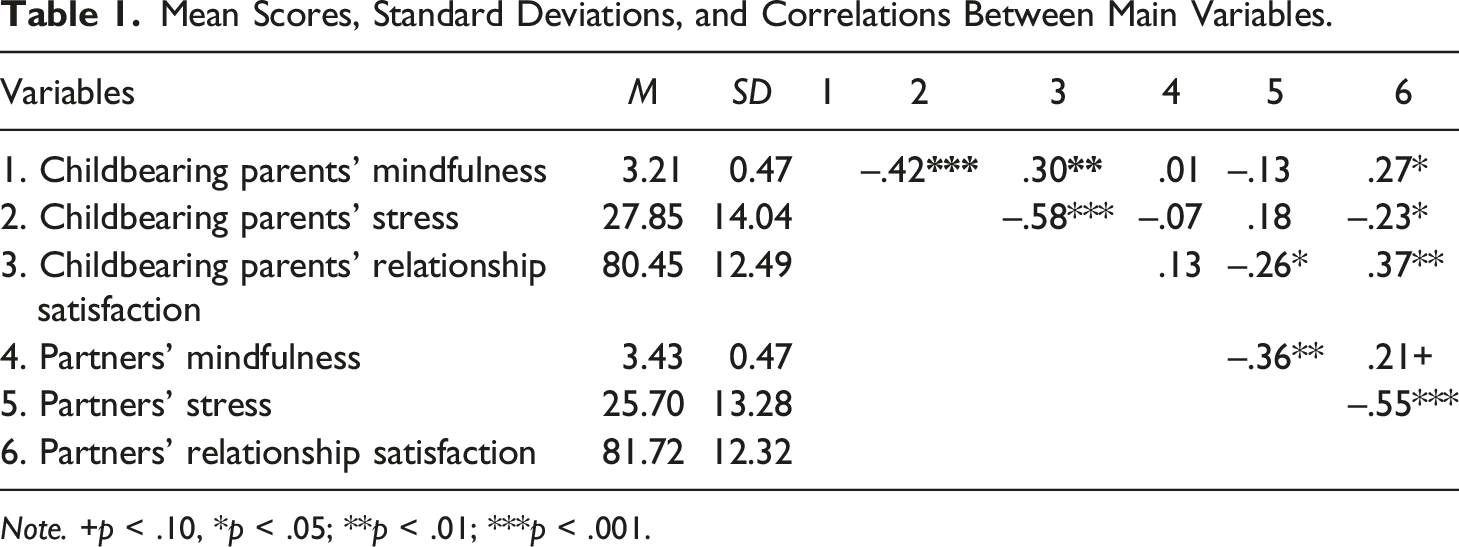
Note. +p < .10, *p < .05; **p < .01; ***p < .001.
Control Variable Inclusion
Based on Becker et al. (2016)’s threshold, only control variables that changed the main predictors (i.e., mindfulness and stress of childbearing mothers and their partners) standardized coefficients on the outcome variables (i.e., stress and relationship satisfaction of childbearing mothers and their partners) by more than .10 must be included. Accordingly, we ran analyses with and without control variables, namely relationship length, marital status, pregnancy planning, family income, infant negative affectivity temperament and age, previous meditation experience, data collection period (pre or during COVID), and the number of completed diary entries. Control variables were entered separately in the model. None of the control variables met this inclusion rule. Moreover, the final APIMeM mediation analysis model was run with and without the control variables. The inclusion of all the control variables strongly deteriorated the model fitness (CFI = 0.93; RMSEA = 0.13, 95% CI = [.10, .16]; χ 2 (53) = 120.48, p < .001; χ 2 /df = 2.27; SRMR = .081; see Table 2 in online supplemental materials). With the poor model fitness and the fact that none of the variables met the inclusion rule, none of the covariables were included in our main analysis.
Primary Analyses: APIMeM Model
Dyad Members’ Distinguishability
Although it is theoretically expected that individual partners in the TTP are distinguishable based on who birthed the child, it is essential to empirically assess distinguishability to use the APIMeM model most consistent with our data (Kenny et al., 2006). To verify this assumption, an omnibus test of distinguishability between dyad members was conducted. More precisely, a model without equality constraints was compared to an I-SAT model where path coefficients, variable means, intercepts, variances, covariances, and error variances were constrained to be equal across genders, or who birthed the child versus their partner for same-sex couples (Kenny et al., 2006). The result of this omnibus test was nonsignificant, χ2 (12) = 10.34, p = .586, indicating that our dyads are empirically indistinguishable. In other words, in our data, the labels of childbearing parents and their partners are statistically unnecessary. Consequently, for the sake of parsimony, the APIMeM analysis was conducted considering each dyad member as being interchangeable in our model, by applying the six equality constraints presented above and labelling them as Partner 1 and Partner 2.
Model Fit and Effect Sizes
The APIMeM model adequately fits the data: CFI = 1.00; RMSEA = .00, 95%CI = [.00, .09]; χ
2
(13) = 10.19, p = .679; χ
2
/df = 0.78, SRMR = .077. Overall, based on Cohen’s recommendations (1988; R
2
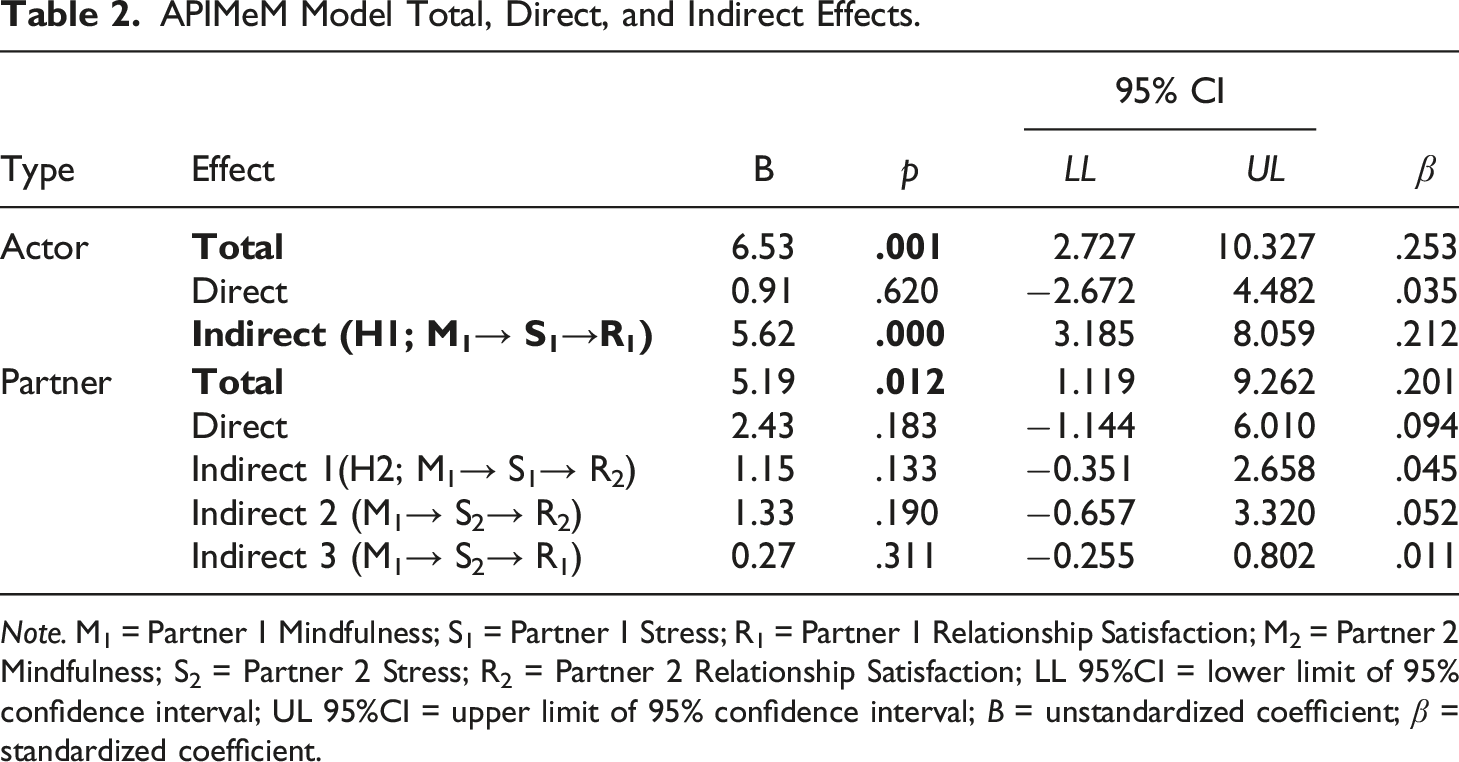
: small .01, medium .09, large .25), our model explained a medium (17.6%) and a large (36.1%) amount of variance for stress and relationship satisfaction, respectively. Moreover, the standardized betas listed below can be interpreted as parameter effect sizes (Cohen, 1988; β: small .10, medium .30, large .50; see Figure 1 and Table 2). APIMeM model. Note: The APIMeM models for indistinguishable dyad members with standardized parameters testing the association between Mindfulness and relationship satisfaction via perceived stress. ***p < .001. APIMeM Model Total, Direct, and Indirect Effects. Note. M1 = Partner 1 Mindfulness; S1 = Partner 1 Stress; R1 = Partner 1 Relationship Satisfaction; M2 = Partner 2 Mindfulness; S2 = Partner 2 Stress; R2 = Partner 2 Relationship Satisfaction; LL 95%CI = lower limit of 95% confidence interval; UL 95%CI = upper limit of 95% confidence interval; B = unstandardized coefficient; β = standardized coefficient.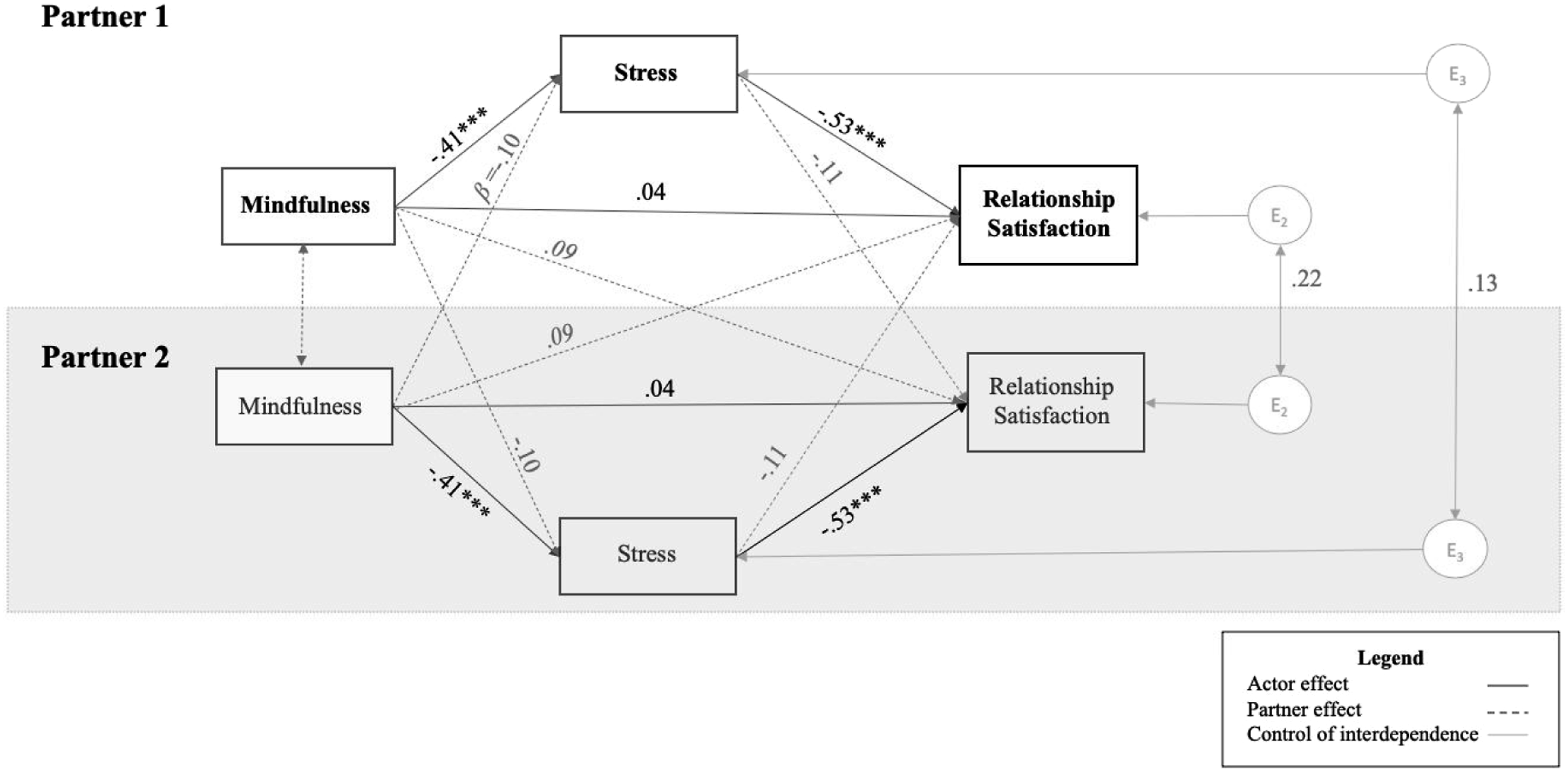
Actor Effects
Total Effect
The total-actor effect was significant (β = .25, p < .001), when all actor effects between mindfulness, perceived stress and relationship satisfaction were tested together without defining specific actor paths, one’s mindfulness was positively associated with one’s relationship satisfaction.
Direct Effects
The actor effect of one’s mindfulness on one’s perceived stress was significant (β = −.41, p < .001), indicating that the more parents are generally mindful, the less they perceive their environment as stressful. The actor effect of one’s perceived stress on one’s relationship satisfaction was also significant (β = −.53, p < .001), meaning that parents who perceive less stress also reported greater relationship satisfaction. When controlling for perceived stress, the direct-actor effect of mindfulness on relationship satisfaction was not significant (β = .04, p = .620).
Indirect Effects
As shown in Table 2, our indirect-actor effect (
Partner Effects
Total Effect
The total-partner effect was significant (β = .20, p = .012), indicating that when all partner effects between mindfulness, perceived stress and relationship satisfaction were tested together without defining specific partner paths, one’s mindfulness was positively associated with their partner’s relationship satisfaction.
Direct Effects
None of the direct-partner effects were supported in our model. There was no link between one’s mindfulness and the other partner’s perceived stress, β = −.10, p = .183. Likewise, one’s perceived stress was not significantly associated with their partner’s relationship satisfaction, β = −.11, p = .119. Also, when controlling for one’s perceived stress, one’s mindfulness was not significantly linked to their partner’s relationship satisfaction, β = .09, p = .183.
Indirect Effects
Three indirect-partner effects were tested to evaluate the role of perceived stress in the association between mindfulness and relationship satisfaction. The first indirect-partner effect (
A sensitivity power analysis was performed with G*Power software (Faul et al., 2007). With our sample of 78 couples (N = 156 parents) and an alpha of .05, if an effect was present in our data, we had an 80% chance of finding it in our APIMeM analysis if the parameter effect sizes were greater than or equal to .34. It was not the case for our partner effects.
Supplementary Analyses: APIMoM Model
The fit indices deteriorated when the interaction terms were included in the APIMoM model (CFI = 0.78; RMSEA = 0.09, 95% CI = [.04, .13]; χ 2 (35) = 55.61, p = .015; χ 2 /df = 1.59; SRMR = .011; see Table 3, online supplemental material). The dyadic link between stress and relationship satisfaction was not moderated by dispositional mindfulness in our study.
Discussion
The primary purpose of this study was to assess the link between mindfulness and new parents' relationship satisfaction and to examine whether perceived stress mediates this association. A supplementary analysis also assessed the moderating role of mindfulness in the relationship between perceived stress and relationship satisfaction. The hypotheses were evaluated using a dyadic design, in which perceived stress and relationship satisfaction were measured using a single composite of the 14-day diary collected on participants’ smartphones to ensure robust data validity. The present study’s findings extend current knowledge by highlighting that, for each parent, mindfulness is positively linked to relationship satisfaction, through its negative relationship with perceived stress.
Mediation Model
Actor Effects
Our results support our first hypothesis by revealing an indirect-actor effect, where perceived stress mediates the link between one’s mindfulness and one’s relationship satisfaction. Specifically, when new parents reported more mindfulness, it was associated with less perceived stress, which in turn was linked to more relationship satisfaction. These results support the theoretical model put forward by Karremans et al. (2017), in which mindful individuals were theorized to be more aware of their emotions as they occur and be less judgmental towards them. They further proposed that mindfulness would be linked to evaluating one’s environment as less stressful, thus positively influencing relationship satisfaction. Our indirect-actor effect is also consistent with empirical research identifying mindfulness as an important resource against distress, as it is associated with less physical and perceived stress in the face of pressure (Tomlinson et al., 2018). It is also in line with previous results exposing a negative link between one’s psychological distress (e.g., stress, anxiety, depression) and one’s relationship satisfaction (Randall & Bodenmann, 2017). This study highlights the importance of lower perceived stress and helps better understand the link between mindfulness and relationship satisfaction.
Partner Effects
Although all expected links were in the right direction, none of the indirect-partner effects were significant in our model. Therefore, in our study, one’s perceived stress did not explain the association between one’s mindfulness and their partner’s relationship satisfaction.
One reason for our null results could be that the indirect-partner effect between mindfulness and relationship satisfaction through perceived stress may be more circumstantial, and thus cannot be observed with a general, mindfulness measure. For instance, it may be possible that despite being generally mindful, new parents could have more difficulty being mindful on specific days, e.g., when sleep-deprived. These day-to-day mindfulness variations could hold a greater association with partners' perceived stress and partners' relationship satisfaction than dispositional mindfulness. In this context, one’s mindfulness in a given moment may be negatively associated with their partner’s perceived stress during this same moment, and thus increase their partner’s relationship satisfaction.
Another potential explanation for our nonsignificant dyadic results could be that indirect-partner effects between mindfulness and relationship satisfaction through perceived stress can only occur while couples are in the presence of each other. Some authors argue that individuals' disposition to be mindful when alone could differ from mindfulness in the presence of a partner (Daks et al., 2021; Kimmes et al., 2017). The few studies that have used general measures of mindfulness (mindfulness in one’s general life) simultaneously with measures of relational mindfulness (mindfulness in the presence of a partner) have shown that relational mindfulness is associated with one’s general mindfulness, yet has a distinct one-dimensional structure from it, and is positively cross-sectionally and longitudinally linked to relationship satisfaction and relationship adjustment (Daks et al., 2021; Fincham, 2022; Gazder & Stanton, 2020; Kimmes et al., 2017). Thus, exhibiting mindfulness while in the presence of their partner may be key in regulating potential stressors, as reported by both oneself and one’s partner, which in turn could be positively associated with their partner’s relationship satisfaction. This hypothesis is consistent with Stanton et al. (2021)’s study, which found an indirect-partner effect between one’s relational mindfulness and one’s relationship quality via the other partner’s tendency to meet their needs. However, this indirect-partner effect was not significant when mindfulness was measured in a general way. Therefore, we recommend that future research use state-level measures of mindfulness and relationship mindfulness.
Lastly, the absence of significant indirect-partner effects could likely be due to a lack of statistical power, which is consistent with relationship research highlighting that partner effects are generally smaller and, therefore, more challenging to detect than actor effects (Kenny et al., 2006). Our sensitivity power analysis also supports a possible false negative conclusion (Type 2 error). In this context, we recommend that future research maximize statistical power, e.g., by increasing sample size. Also, despite not knowing the specific indirect-partner paths, our total-partner effect provides empirical support for the notion that a dyadic association could exist between mindfulness and relationship satisfaction, through perceived stress.
Moderation Model
In our study, dispositional mindfulness did not moderate the dyadic relationship between stress and relationship satisfaction. One alternative explanation for this null result is that we did not distinguish between external and internal stress in our study, which may be key in detecting such effects. Moreover, this null result could also be explained by low statistical power, as explained above.
Limits and Recommendations for Futures Research
The present study is not without limits. First, self-report questionnaires can reduce construct validity through various biases, e.g., social desirability bias (Hogan, 2017). Also, despite offering greater internal validity than long retrospective questionnaires, evening diaries may introduce bias. As stress fluctuates during the day (Aan het Rot et al., 2012), it is likely that parents have over- or underestimated the relative stress acuity of the moment, when summarizing their last 24 hours.
Also, the correlation nature of our study prevents us from making causal inferences about the links between the main variables. It is then possible that there could be a bidirectional association between mindfulness and stress, and between stress and relationship satisfaction. For example, individuals who are more satisfied in their relationship could experience less stress during the TTP. This lower level of stress could, in turn, be associated with more mindfulness. Although possible, this inverse indirect link hypothesis is less likely. First, our mindfulness measure was taken before and at a different time of measurement (baseline questionnaires, day 0) than our daily measures of stress and relationship satisfaction (days 1–14). Furthermore, the literature on the TTP suggests that new parents' increased stressors and their effect on individuals’ regulative resources explain the postpartum decline in relationship satisfaction (Randall & Bodenmann, 2017). Future research could use quasi-experimental designs to explore these temporal associations with more precision, such as in randomized control trials of mindfulness-based interventions or in a laboratory setting where stress levels are manipulated. Also, using average daily scores in our analysis prevented us from exploring dynamic temporal relationships between variables, and assessing within-person change processes (Wenze & Miller, 2010). While also interesting, doing so would have prevented us from addressing the goal of the present study, i.e., to explore macro effects and links between mindfulness, stress and relationship satisfaction. Notably, our sample size was also too small to simultaneously conduct multilevel mediation on dyadic analyses integrating random intercepts and slopes (McNeish, 2017). We recommend that future studies investigate in a larger dyadic sample the associations between mindfulness, perceived stress, and relationship satisfaction using multilevel analysis exploring daily variations and their interaction, among both partners.
The generalization of findings is limited to the specific population of new-parent with noticeably young children. New parents face increasing stressors and are particularly vulnerable to drastic drops in relationship satisfaction over the year following the birth of a first child. As such, our results may be stronger than in the general population. Mindfulness may also be associated with relationship satisfaction through stress in couples from the general population, especially when exposed to life stressors, like work-related stressors or disease. We thus recommend that future studies replicate our results in a broader couple population. Conversely, our sample comprised Quebec families with extended parental leave, including partner leaves and shareable weeks between parents. As exclusive partner leaves and extended parental leaves both protect against maternal stress, through better gender equality in child-related and family tasks, and are linked to less conflict, more couple support and more couple satisfaction (Bünning, 2015; Feldman et al., 2004; Rehel, 2014), we found results in an ideal TTP context. It is very likely that the effects of mindfulness and stress may be more potent in families who do not benefit from these types of leaves, as these new parents would probably have fewer resources and experience more difficulties. Future studies may wish to replicate our study in a less protected new-parent couple population.
Strengths
The present study has several strengths. First, a dyadic design improves results validity, as it can control for shared influence between partners while also offering an overall portrait of the couple dynamic, i.e., simultaneously presenting each partner’s points of view, as well as the interaction between each perspective (Kenny et al., 2006). As all links between variables are assessed simultaneously in a single APIMeM model, the likelihood of a type 1 error is reduced. Also, the influence of several exogenous variables previously identified as influencing stress and relationship satisfaction during the TTP were taken into account, greatly reducing the possibility of a type 1 error. The present research also assesses stress and relationship satisfaction daily to increase internal validity and limit recall bias. Our 14-day smartphone diary design also increases ecological validity by reducing intrusion in participants' lives and collecting data while participants are in their natural environment (Stone et al., 2007).
Conclusion
For new parents, the results of our study are valuable. They highlight how mindfulness is tied to more relationship well-being in the postpartum period. They offer an empirical foundation from which future studies could build and develop mindfulness prevention programs for new parents or enrich existing prenatal classes with meditation practice. Mindfulness could also be studied and promoted within more varied or stressed populations, although more studies are needed to corroborate this idea. In conclusion, the present study extends current knowledge by providing initial empirical support for Karremans et al. (2017)’s theoretical model. It provides evidence that, for each parent, mindfulness is linked to more relationship satisfaction, through its negative association with perceived stress during the TTP. These promising results may encourage researchers to further investigate the role of mindfulness within relationship contexts, especially during moments that seem more harmful to couple relationships, like family development.
Supplemental Material
Supplemental Material - Dyadic Association Between New Parents' Mindfulness and Relationship Satisfaction: Mediating Role of Perceived Stress
Supplemental Material for Dyadic Association Between New Parents' Mindfulness and Relationship Satisfaction: Mediating Role of Perceived Stress by Laurence Morin, Julie C. Laurin, Marina Doucerain, and Simon Grégoire in Journal of Social and Personal Relationships
Footnotes
Acknowledgment
The authors thank all the parents who generously agreed to participate in the study.
Funding
The author(s) disclosed receipt of the following financial support for the research, authorship, and/or publication of this article: The authors received financial support from the Fonds de recherche du Québec – Société et culture (FRQSC) (78312 and RQC00183) and the Social Sciences and Humanities Research Council (SSHRC) (Joseph-Armand-Bombardier Award) to conduct this study. The first author also received an innovative project grant from Metricwire company, allowing her to use their research application for the present study free of charge.
Open Research Statement
As part of IARR’s encouragement of open research practices, the authors have provided the following information: This research was not pre-registered. The materials used in the research can be publicly posted. Supplementary information regarding access to the data can be obtained by emailing the corresponding author.

Supplemental Material
Supplemental material for this article is available online.
References
Supplementary Material
Please find the following supplemental material available below.
For Open Access articles published under a Creative Commons License, all supplemental material carries the same license as the article it is associated with.
For non-Open Access articles published, all supplemental material carries a non-exclusive license, and permission requests for re-use of supplemental material or any part of supplemental material shall be sent directly to the copyright owner as specified in the copyright notice associated with the article.
