




Abstract
Adolescents and young adults who disclose a minority sexual orientation (“come out” as gay, lesbian, or bisexual) to their parents often are met with varied negative reactions. The current work builds on a growing literature aimed at understanding the myriad causes of negative parental reactions to these disclosures. Specifically, this work evaluates a hypothesis derived from evolutionary psychological logic: that variation in parental responses to offspring’s sexual orientation disclosures is driven, in part, by perceived costs to parents’ inclusive fitness (i.e., implicit or explicit concerns related to the reproductive success of genetic relatives). Across three studies (total N = 493), we examined whether daughters’ and sons’ perceptions of parents’ negative reactions to their sexual orientation disclosures systematically co-varied with inclusive fitness concerns, as indexed by parent gender, sexual orientation, and offspring number. This perspective received partial support among daughters, who reported more negative reactions from their mothers (vs. fathers), particularly in response to lesbian (vs. bisexual) disclosures. Reactions to sons’ disclosures did not vary across parent gender, sexual orientation, or offspring number. Taken together, this work provides preliminary evidence that perceived fitness costs may lead mothers to respond negatively to their daughters’ lesbian orientation disclosures.
According to recent estimates (Jones, 2021), approximately 15% of American youth born between 1997 and 2002 identify as lesbian, gay, or bisexual (LGB). Despite progress in civil rights and public attitudes regarding the LGB+ community in the past decade (Bailey et al., 2016), adolescents and young adults who disclose a minority sexual orientation (“come out”) to their parents often are met with a variety of negative reactions (Mills-Koonce et al., 2018). In turn, individuals whose parents react more negatively to their disclosures reliably experience more adverse mental health outcomes compared to those whose parents react more positively (Willoughby et al., 2008). Given the potential psychological and physical costs associated with these experiences, it is critical to understand why some caregivers respond negatively when their child discloses an LGB orientation.
A growing empirical literature has identified diverse proximate developmental and sociopolitical factors that predict systematic variation in such responses among parents. For instance, associations have been found between parental reactions to youths’ sexual orientation disclosures, on one hand, and pre-disclosure family dynamics, parental attitudes, and sociodemographic variables, on the other (Baiocco et al., 2016; Richter et al., 2017; Willoughby et al., 2006). However, almost no research has attempted to understand parents’ negative emotional responses to such disclosures through an ultimate evolutionary psychological lens as a complement to the extant (and predominant) sociocultural viewpoints. (For an exception related to gay men, see Wisniewski et al., 2010.) Further, many of the established risk factors for such negative reactions are not amenable to intervention. The current work begins to address these theoretical and empirical gaps by evaluating an evolutionarily informed perspective regarding parental negativity to offspring’s sexual orientation disclosures. Across three studies, we test predictions derived from the hypothesis that parents’ negative reactions to their offspring coming out as LGB may be driven (in part) by parental concerns related to their own inclusive fitness.
Causes and consequences of negative parental reactions to minority sexual orientation disclosures
Although disclosing one’s LGB+ orientation can enhance well-being by permitting more open expression of one’s sexual attractions (Rothman et al., 2012), many sexual minority youth report expecting and experiencing negative reactions (e.g., concern, disbelief, denial, despair, anger, rejection, and/or withdrawal of support) from one or both parents (Gattamorta et al., 2019; Mills-Koonce et al., 2018; Willoughby et al., 2008). Considerable research suggests that such reactions can impair healthy development among sexual minority adolescents and young adults. For instance, reduced parental acceptance and increased rejection in this context have been linked with increased risks of depression, anxiety, internalized stigma, suicidal thoughts and attempts, problematic substance use, and sexual risk taking (Baiocco et al., 2016; D’amico et al., 2015; Rothman et al., 2012; Willoughby et al., 2008). In some cases, these associations have been found to persist several years after the initial disclosure took place (Ryan et al., 2015).
Given the adverse outcomes associated with parents’ negative reactions to their youths’ sexual orientation disclosures, it is important to understand the myriad factors that predict which parents are likely to respond most negatively and when. Thus far, empirical links have been established between negative parental reactions to youth disclosures and a number of sociocultural variables, including: persistent family dysfunction and stress unrelated to the disclosure; lower quality of parent-child relationships early in life; traditional social, political, and religious views; racial/ethnic minority group membership; and indicators of low family socioeconomic status (e.g., income, parental education) (Baiocco et al., 2015; 2016; Conley, 2011; Gattamorta et al., 2019; Mills-Koonce et al., 2018; Richter et al., 2017; Willoughby et al., 2006; 2008). Whereas research related to many of these factors is robust, other findings related to parental rejection in this context are more mixed. For instance, despite expectations that fathers will react more negatively to their youths’ disclosures than will mothers, some research finds that mothers’ actual reactions are more negative (Wisniewski et al., 2010). Other research finds interactions between parent and offspring gender (e.g., mothers reacting more negatively to daughters’ disclosures than do fathers to sons’ disclosures; Baiocco et al., 2015, 2016), or no differences based on parent (or offspring) gender (D’Amico et al., 2015). Though Needham and Austin (2010) found reduced parental support among gay versus bisexual men, many investigations do not consider differences in parental reactions based on offspring sexual orientation. It remains possible that some of the inconsistencies in the empirical literature may be due to discrepancies between parents’ expected versus actual reactions to their offspring’s disclosures, initial reactions versus long-term support, use of parent versus youth reports, and/or cultural or age differences across samples (among other factors).
Although identifying risk factors for such negative reactions is informative, non-randomized study designs limit the causal conclusions that can be drawn from much of this past research. Further, even if causal evidence was available, many of the established risk factors (e.g., past parenting behavior, religious views) would be difficult (if not impossible or unethical) to attempt to modify. The current work posits a potentially modifiable psychological variable that may help to explain some of the variation in parents’ initial negative reactions to their offspring’s sexual orientation disclosures.
An evolutionary psychological perspective on parental reactions to offspring’s disclosures
Despite relatively critical views of evolutionary psychology held by individuals who identify as LGB (Jonason & Schmitt, 2016), an evolutionary perspective may be useful in elucidating the experiences of this community with the goal of reducing disparities. Indeed, researchers have applied this approach to better understand: close relationships between heterosexual women and gay men (Russell et al., 2018); gay/lesbian mating strategies and behaviors (Howard & Perilloux, 2017); and variation in women’s sociosexual outcomes across sexual orientations (Leri & DelPriore, 2021). Regarding youths’ sexual orientation disclosures specifically, an evolutionary psychological approach may offer insight into the negative reactions frequently demonstrated by parents, and why these reactions might be more negative than those demonstrated by unrelated close others (e.g., best friends; Ryan et al., 2015).
Evolutionary psychology applies Darwinian principles to understand the function of the human mind. Psychologists within this subfield propose that the processes of natural and sexual selection have designed the human brain and its corresponding mechanisms to process information and respond in ways that (on average) would have promoted individual survival and/or reproduction in human-typical environments (Buss, 2019). The evolutionary biological concept of inclusive (or total) fitness (Buss, 2019; Hamilton, 1964) considers not just an individual’s direct reproductive output, but also the survival and reproductive success of the individual’s genetic relatives (indirect fitness). Although this concept often has been applied within psychology to understand when individuals are likely to engage in costly helping behaviors (Kruger, 2003), another implication is that humans will take interest in their genetic relatives’ mating relationships, and conflict will arise when close kin make mating decisions that negatively affect one’s own (inclusive) fitness (van den Berg, 2021). Indeed, researchers have applied this perspective to test evolutionary predictions regarding parental interest in – and attempted influence on – their offspring’s mating relationships (Faulkner & Schaller, 2007; Perilloux et al., 2011).
An evolutionary perspective posits that such mating-relevant conflict may evoke negative emotional reactions (including anger and upset) that function to alert individuals to barriers to their inclusive fitness and to motivate an adaptive behavioral response (Buss, 1989; Perilloux et al., 2008). In the context of youths’ minority sexual orientation disclosures, parents might be expected to demonstrate negative emotional and behavioral reactions to their children disclosing a mating orientation that (on average) is associated with decreased reproductive output across the lifespan (Bailey et al., 2016; Vasey et al., 2014; Wisniewski et al., 2010). Viewing negative parental reactions to youth sexual orientation disclosures through an evolutionary psychological lens might therefore generate the hypothesis that more negative reactions will be expressed by parents who possess heightened concerns related to their own inclusive fitness (i.e., implicit or explicit concerns related to the reproductive success of one’s genetic relatives).
In sum, considering the experiences of sexual minority individuals from an evolutionary psychological perspective, as a complement to (not a substitute for) proximate developmental and family systems perspectives, can be valuable in identifying novel and potentially modifiable influences on parents’ negative reactions to minority sexual orientation disclosures by youth. If the focal “inclusive fitness cost” hypothesis is supported, it would introduce the possibility that one pathway toward attenuating negative parental reactions to offspring’s sexual orientation disclosures (and thus improving youth behavioral and mental health outcomes) would be to alleviate parents’ concerns regarding their own inclusive fitness.
The current studies
We take initial steps to test whether variation in parental reactions to offspring’s sexual orientation disclosures may be linked with perceived costs to parents’ inclusive fitness. That is, the greater the perceived fitness costs to parents related to their offspring’s disclosures, the more negatively we expect that parents will react. To begin to evaluate this inclusive fitness cost hypothesis, we conducted three studies testing the following predictions [osf.io/rwqch] 1 :
Prediction 1: Due to mammalian females’ (vs. males’) greater minimum obligatory parental investment (e.g., gestation, lactation) and resultant limited reproductive opportunities as posited by parental investment theory (Trivers, 1972), mothers will respond more negatively than will fathers to their offspring’s minority sexual orientation (gay/lesbian, bisexual) disclosures. (See also Wisniewski et al., 2010, regarding the evolutionary relevance of parent gender.)
Prediction 2: Given that bisexual orientations involve a higher likelihood of heterosexual mating than do exclusive gay/lesbian orientations (Jeffries, 2011; Leri & DelPriore, 2021) and thus may be perceived as less costly to one’s fitness (on average), parents will respond more negatively to exclusive same-sex (gay/lesbian) versus bisexual orientation disclosures.
Prediction 3: Parents will respond more negatively when they have fewer (compared to more) offspring due to their more limited alternative opportunities to enhance their inclusive fitness. (Related to this, parents should respond most negatively to disclosures made by “only children.”)
Prediction 4: Due to mammalian males’ (vs. females’) higher potential reproductive output and more rigid (less fluid) sexual orientations (Bailey et al., 2016), parents will respond more negatively to sons’ (versus daughters’) disclosures.
Although mammalian males (vs. females) are capable of producing a greater number of offspring, men are more likely than women to remain childless (Waren & Pals, 2013). (That is, men’s reproductive output is more variable than is women’s.) Given links between men’s resource access and their desirability as mates (Walter et al., 2020), parents of men from high (vs. low) status families may perceive heightened inclusive fitness costs and experience heightened concerns when their sons disclose a minority sexual orientation. We therefore expected that the posited main effect of participant gender (Prediction 4) would be moderated by family socioeconomic status (SES). That is, the difference between men’s and women’s perceived parental reactions may be most pronounced among participants from relatively high SES backgrounds.
Study 1: Daughters’ perceived negative parental reactions to disclosures
Study 1 permitted an initial test of Predictions 1 through 3. Specifically, this study evaluated whether daughters’ perceptions of parental reactions to their lesbian or bisexual orientation disclosures vary based on parent gender, sexual orientation, and offspring number.
Method
Participants
Participants were recruited from a college campus in the southwestern United States (Tucson, AZ) and online from across the U.S. via Craigslist (craigslist.org) as part of a larger study of the experiences of sexual minority women. Study advertisements targeted heterosexual, lesbian, and bisexual women ages 18 to 36. All individuals could enter a draw to win one of five $25 Amazon.com gift cards regardless of qualification or participation. The consent document and survey were administered online via Qualtrics (Provo, UT). (Supplemental Material–Appendix A provides additional details regarding recruitment and screening.) 2
Because the current work posited differences in the disclosure-related experiences of women who self-identified as lesbian versus bisexual, we restricted analysis to women who reported one of these sexual orientations and whose orientation had been disclosed to at least one parent. The final analytic sample included 123 (lesbian: n = 57; bisexual: n = 66) cisgender women. Participants’ average age was 25.34 (SD = 4.98, median = 25.00, range: 18–36) years. Women self-identified as non-Hispanic White (66.7%; n = 82), Hispanic/Latino (15.4%; n = 19), multiracial (8.9%; n = 11), non-Hispanic Black (5.7%; n = 7), or Asian (3.3%; n = 4). Regarding their highest educational level, 1.6% (n = 2) did not have a high school diploma, 13.9% (n = 17) earned a high school diploma or GED, 37.4% (n = 46) attended college but had not earned a college degree, 8.9% (n = 11) earned an Associate’s degree, 21.1% (n = 26) earned a Bachelor’s or Registered Nurse (RN) degree, 6.5% (n = 8) attended graduate school but had not earned a graduate degree, 7.3% (n = 9) earned a Master’s degree, and 3.3% (n = 4) earned a Doctoral or Law degree. 40% (n = 49) indicated they were college students.
Measures
Participants completed an online survey assessing their: sexual orientation; status of sexual orientation disclosure to parents; age(s) of sexual orientation disclosure(s); perceived negative parental reactions to their disclosure(s); and number of siblings. (Studies 1-3 also assessed parents’ long-term support related to their offspring’s sexual orientations. However, since parents’ initial reactions and longer-term acceptance may be qualitatively different [D’amico et al., 2015], we did not analyze this measure for the current work.)
Sexual orientation and disclosures
Women’s sexual orientations were classified based on self-identification; participants were asked whether they considered themselves to be heterosexual/straight, gay/lesbian, bisexual, or “something else 3 ” (The Williams Institute, 2009).
The following questions assessed women’s disclosure status: “Has your sexual orientation been disclosed to your mother [birth father]?”; and “How old were you when your sexual orientation was first disclosed to your mother [father]?” (Baiocco et al., 2015). Of the 109 women who indicated that their orientation had been disclosed to their mother, the average age of disclosure was 18.55 years (SD = 4.19, range 5–33; n = 107). Of the 92 women who indicated that their orientation had been disclosed to their father, the average age of disclosure was 18.86 years (SD = 4.09, range 7–28; n = 88). 78 women reported that their orientations had been disclosed to both parents.
Negative parental reactions
To assess parents’ disclosure-related reactions, we presented six items from the Perceived Parental Reactions Scale (PPRS; Willoughby et al., 2006). Participants were prompted to recall and rate their parents’ reactions in the week following their disclosures (1 = strongly disagree, 5 = strongly agree): “She [He] was concerned about the potential that she [he] wouldn’t get grandchildren from me”; “…didn’t believe me”; “…yelled and/or screamed”; “…pretended that I wasn’t gay/lesbian/bisexual”; “…was angry at the fact I was gay/lesbian/bisexual”; “…wanted me not to be gay/lesbian/bisexual.” A reaction score was calculated for each parent by averaging responses across these items, with higher scores reflecting more negative reactions. Mean scores were 2.46 (SD = 1.11; α = .84; n = 109) for mothers and 1.92 (SD = .97; α = .89; n = 91) for fathers 4 .
Sibling number
Two questions assessed parents’ number of offspring as indexed by participants’ reported number of siblings: “How many siblings (brothers and/or sisters) do you have?” [open response] and “Where do you fall in the birth order of your family?” [1 = I am the oldest; 2 = I am somewhere in the middle (not the oldest or youngest); 3 = I am the youngest; 4 = I am an only child]. (Participants could provide additional information about each sibling [e.g., gender, age, full or half sibling] within a separate table; however, this information was not coded or analyzed since many participants did not provide full information on this measure.) Participants reported an average of 2.15 siblings (SD = 1.75; range: 0–11), and approximately 10% (n = 12) indicated that they were “only children.” We recoded sibling number as a categorical variable with two levels: 0 = no or one sibling (n = 53; 43% of respondents) and 1 = more than one sibling (n = 70; 57%). 5
Results
Prediction 1: Parent gender
We conducted a paired samples t-test (SPSS v27, 28) to examine differences between mothers’ and fathers’ reactions to daughters’ sexual orientation disclosures. Women reported that their mothers’ reactions were more negative (M = 2.39, SD = 1.10) than were their fathers’ reactions (M = 1.97, SD = .99), t(76) = 3.84, p < .001, d = .44. 6
Prediction 2: Sexual orientation
We evaluated Prediction 2 within a mixed-model ANOVA (SPSS), with women’s sexual orientation (lesbian, bisexual; between-subjects) and parent gender (mother, father; within-subjects) included as predictors. There was a main effect of women’s sexual orientation, F(1, 75) = 6.04, p = .02, partial η2 = .08. Consistent with Prediction 2, lesbian women (M = 2.42, SE = .14) reported more negative parental reactions than did bisexual women (M = 1.91, SE = .15). (See Figure 1.) The interaction between sexual orientation and parent gender was not significant, p = .55, partial η2 = .01. Negative parental reactions to daughters’ disclosures across parent gender and sexual orientation (Study 1). Note. Higher values reflect more negative parental reactions. Error bars reflect the standard error.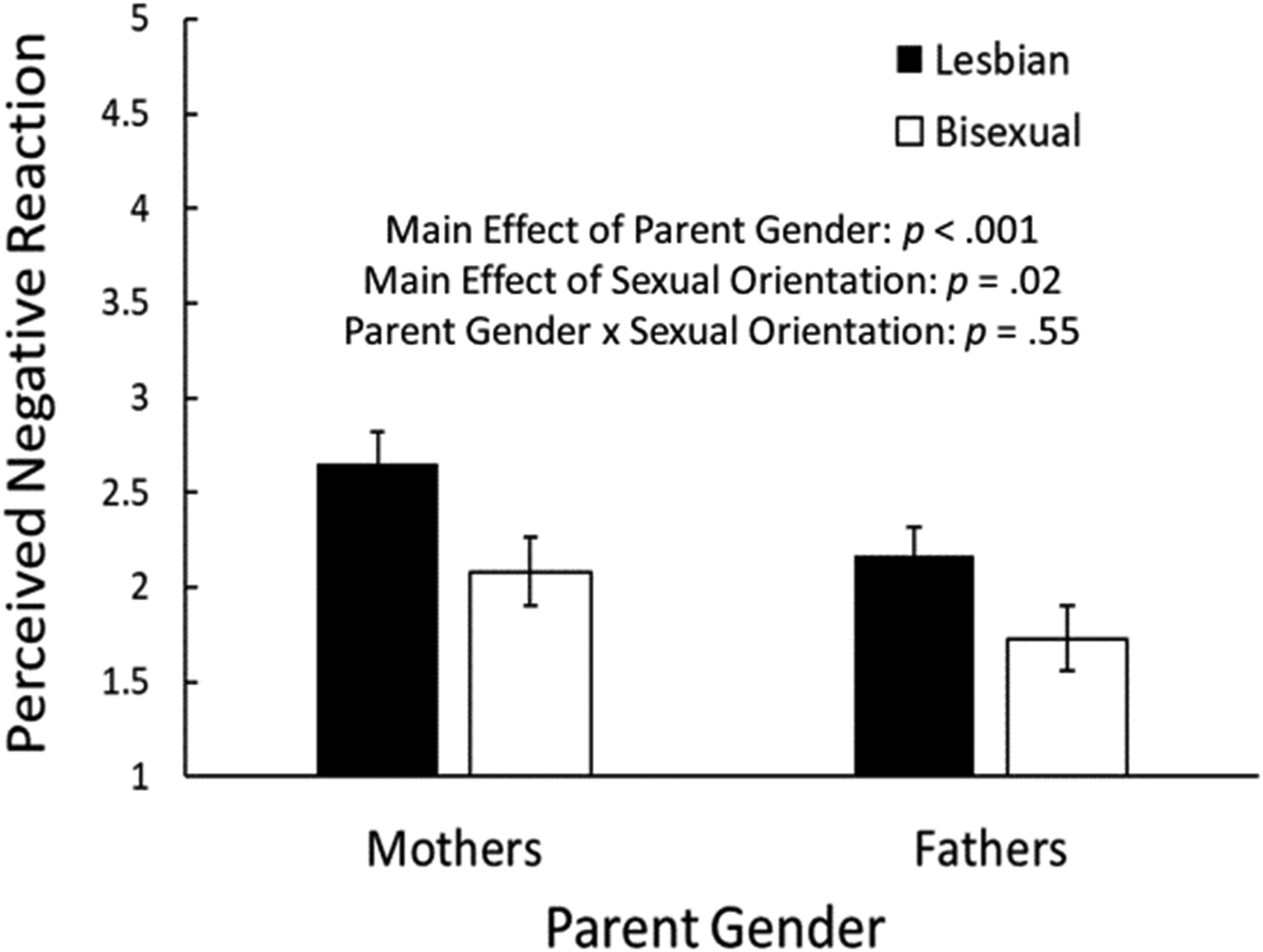
Prediction 3: Offspring number
Prediction 3 posits a relationship between negative parental reactions to daughters’ disclosures and the number of offspring in the family, indexed by participants’ number of siblings. We evaluated this prediction using a mixed-model ANOVA (SPSS), including parent gender (within-subjects), participant sexual orientation (between-subjects), and sibling number (two levels, between-subjects) as predictors. This analysis did not reveal a main effect of sibling number (p = .77, partial η2 = .001), two-way interactions between sibling number and parent gender (p = .12, partial η2 = .03) or sibling number and sexual orientation (p = .99, partial η2 < .001), nor a three-way interaction between these variables (p = .23, partial η2 = .02).
Discussion
Study 1 yielded partial support for the inclusive fitness cost perspective on negative parental reactions to daughters’ minority sexual orientation disclosures. Specifically, mothers responded more negatively than did fathers to daughters’ disclosures, and parents’ negative reactions were more pronounced for exclusive same-sex (lesbian) versus bisexual orientations. Contrary to this hypothesis, having fewer offspring number did not predict more negative reactions among parents.
Although this study provided preliminary evidence in support of some predictions derived from the focal hypothesis, the current sample was relatively small, which could have produced spurious statistical effects or reduced power to detect some predicted effects. 7 Further, this sample included women recruited both online and from a university campus, with the southwestern United States likely over-represented. Finally, the analyses did not distinguish between participants’ numbers of full versus half (or genetically unrelated) siblings, which may have influenced results related to Prediction 3. We addressed these limitations in Study 2.
Study 2: Daughters’ perceived negative parental reactions to disclosures (a replication)
Study 2 was intended to replicate Study 1 in a larger sample of women recruited from a single source.
Method
Participants
Participants were recruited online from the United States using Prolific Academic (prolific.co). 8 We used the platform’s prescreen settings to selectively recruit heterosexual, lesbian, and bisexual women ages 18 to 36. Respondents were paid $4.75. (See Supplemental Material–Appendix A for additional details.)
The final analytic sample consisted of 233 (lesbian: n = 143; bisexual: n = 90 9 ) cisgender women. Women’s average age was 25.74 (SD = 4.55, median = 26.00, range: 18-36) 10 years. Among those who provided race and/or ethnicity data (n = 231), participants self-identified as non-Hispanic White (75.3%; n = 174), non-Hispanic Black (10.4%; n = 24), Hispanic/Latino (8.2%; n = 19), multiracial (4.8%; n = 11), Asian (0.9%; n = 2), or American Indian/Alaska Native (0.4%; n = 1). Regarding their educational level, 0.4% (n = 1) of respondents did not have a high school diploma, 13.5% (n = 31) earned a high school diploma or GED, 35.9% (n = 83) attended college but had not earned a college degree, 9.5% (n = 22) earned an Associate’s degree, 27.7% (n = 64) earned a Bachelor’s or RN degree, 5.2% (n = 12) attended graduate school but had not earned a graduate degree, 6.5% (n = 15) earned a Master’s degree, and 1.3% (n = 3) earned a Doctoral or Law degree. 37% (n = 85) indicated they were college students.
Measures
The measures were the same as Study 1 except where noted.
Sexual orientation disclosures
Of the 227 women who indicated that their sexual orientation had been disclosed to their mother, the average age of disclosure was 17.89 years (SD = 4.01, range 8–35; n = 225). Of the 175 women whose sexual orientation had been disclosed to their father, the average age of disclosure was 18.74 years (SD = 4.08, range 9–31; n = 174). 169 women reported that their orientations had been disclosed to both parents.
Negative parental reactions
Mean negative reaction scores were 2.31 (SD = 1.15; α = .89; n = 225) for mothers and 2.03 (SD = 1.04; α = .89; n = 173) for fathers.
Sibling number
Questions assessing sibling number were the same as Study 1 except that we instructed participants to indicate their number of full biological (as opposed to half and/or genetically unrelated) siblings, specifically. Participants reported an average of 1.29 siblings (SD = 1.18; range: 0–8); approximately 23% (n = 54) indicated that they were “only children.” Similar to Study 1, we recoded sibling number: 0 = no or one sibling (n = 152; 65% of respondents) and 1 = more than one sibling (n = 79; 34%).
Results
Prediction 1: Parent gender
Women rated their mothers’ reactions to their disclosures as more negative (M = 2.31, SD = 1.15) than their fathers’ reactions (M = 2.02, SD = 1.04), t(167) = 3.20, p = .002, d = .25.
Prediction 2: Sexual orientation
We evaluated the effect of sexual orientation using a mixed-model ANOVA. Consistent with Study 1, there was a main effect of sexual orientation, F(1, 166) = 4.49, p = .04, partial η2 = .03, with lesbian women reporting more negative (M = 2.27, SE = .08) parental reactions than did bisexual women (M = 1.95, SE = .12). Unlike Study 1, this main effect was observed in the context of a two-way interaction between participant sexual orientation and parent gender, F(1, 166) = 4.31, p = .04, partial η2 = .03. Specifically, lesbian women perceived their mothers’ reactions (M = 2.48, SD = 1.14) to be more negative than did bisexual women (M = 1.96, SD = 1.09), F(1, 166) = 7.89, p = .01, partial η2 = .05. Fathers’ reactions, on the other hand, did not vary across daughters’ sexual orientation, p = .51, partial η2 = .003. Viewed another way, lesbian women perceived their mothers’ reactions to be more negative than their fathers’ reactions (M = 2.05, SD = 1.06), F(1, 166) = 14.73, p < .001, partial η2 = .08. Bisexual women did not perceive differences in their mothers’ and fathers’ reactions, p = .92, partial η2 < .001. (See Figure 2.) Negative parental reactions to daughters’ disclosures across parent gender and sexual orientation (Study 2). Note. Higher values reflect more negative parental reactions. Error bars reflect the standard error.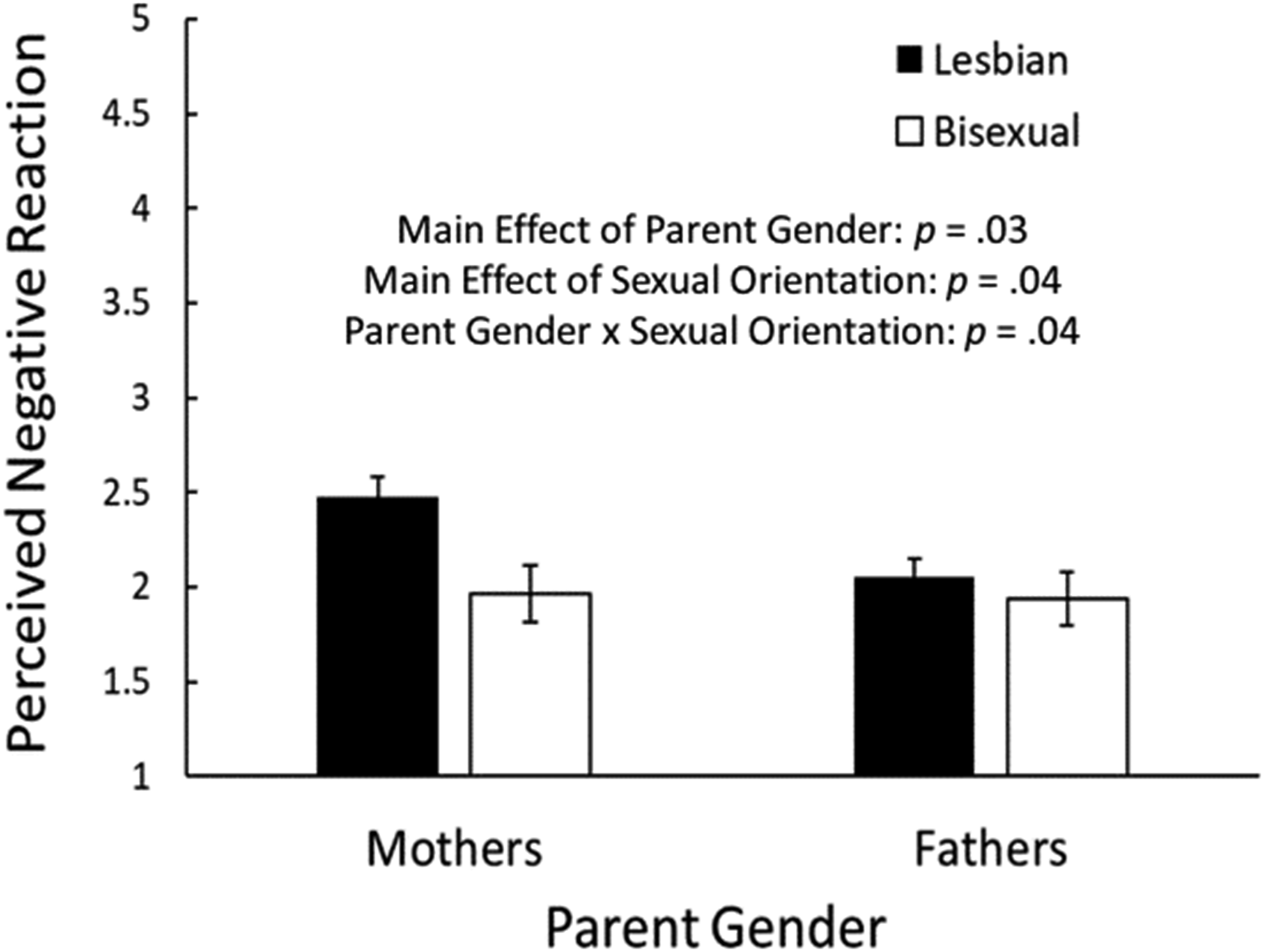
Prediction 3: Offspring number
Negative parental reactions (means and standard deviations) across parent gender, participant sexual orientation, and number of children (Study 2).
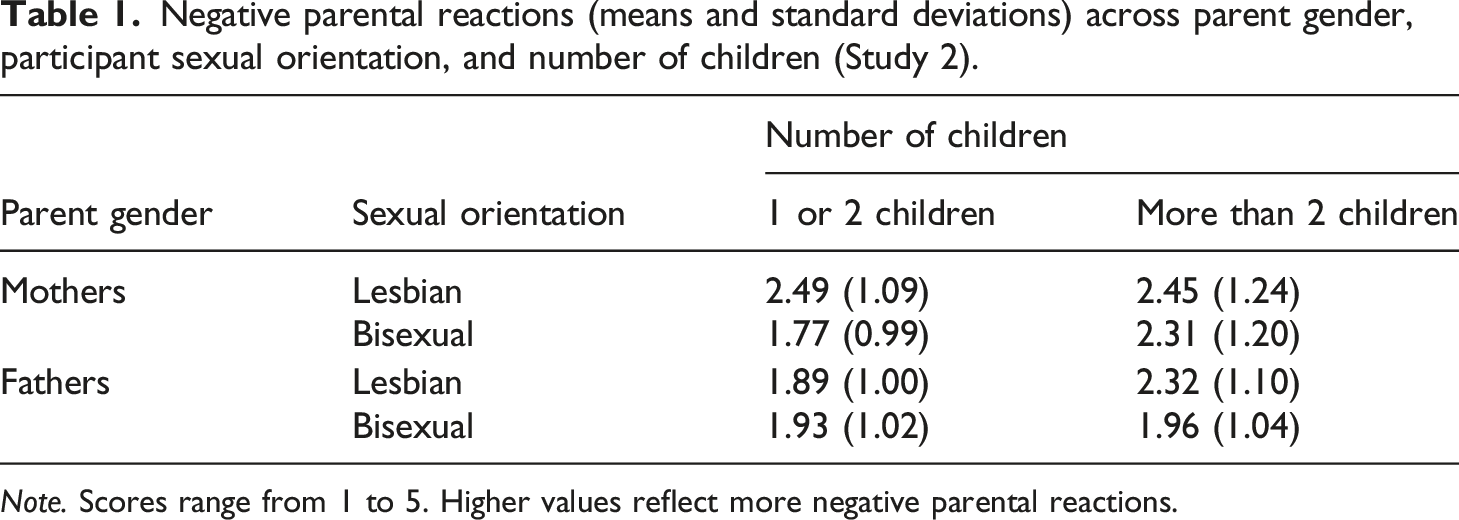
Note. Scores range from 1 to 5. Higher values reflect more negative parental reactions.
Discussion
Study 2 was intended to replicate Study 1 in a larger sample of women recruited from a single source. Consistent with Study 1 (and the focal hypothesis), women perceived their mothers’ reactions to their sexual orientation disclosures to be more negative than their fathers’ reactions. Again, parents’ reactions were perceived to be more negative among lesbian women as compared to bisexual women, particularly when reporting on their mothers. Unlike Study 1, Study 2 provided partial support for Prediction 3. In the current sample, mothers’ more pronounced negative responses to lesbian versus bisexual disclosures were specific to families with one or two children. This difference was not observed among participants from larger families, nor when rating the reactions of fathers.
Taken together, Studies 1 and 2 provided partial support for the inclusive fitness cost perspective on negative parental reactions to daughters’ minority sexual orientation disclosures. We found the most consistent support for Predictions 1 and 2, with mothers’ reactions to lesbian disclosures perceived to be the most negative. We found partial support for Prediction 3 in Study 2, with the observed effects of parent gender and sexual orientation being specific to families with relatively few children. (As noted above, however, this finding should be interpreted with caution given the null results obtained when sibling number was assessed continuously.)
Although Studies 1 and 2 represent an important initial step in evaluating the current hypothesis, a major limitation of these studies is the exclusive focus on the disclosure-related experiences of daughters. This limitation was addressed in Study 3.
Study 3: Sons’ perceived negative parental reactions to disclosures
Study 3 assessed sons’ perceptions of negative parental reactions to their minority sexual orientation (gay, bisexual) disclosures.
Method
Participants
Heterosexual, gay, and bisexual men ages 18 to 36 were recruited from the U.S. through Prolific Academic, Craigslist, a local Pride event (Altoona, PA), and PSU StudyFinder (an online recruitment tool hosted by the authors’ university; studyfinder.psu.edu). Respondents recruited via Prolific Academic (79% of the analytic sample) were compensated $3.50. Those recruited via Craigslist, the community event, and university webpage could enter a draw to win one of five $100 Amazon.com gift cards regardless of qualification or participation. Responses were submitted online via Qualtrics. (See Supplemental Material–Appendix A for additional information.)
Similar to the previous studies, we restricted our analyses to gay or bisexual men whose sexual orientation had been disclosed to at least one parent. The final analytic sample included 137 (gay: n = 87; bisexual: n = 50) cisgender men. Participants’ average age was 26.55 (SD = 4.92, median = 26.00, range: 18–36) years. Among those who provided race and/or ethnicity data (n = 133), men self-identified as non-Hispanic White (70.7%; n = 94), Hispanic/Latino (13.5%; n = 18), non-Hispanic Black (8.3%; n = 11), multiracial (5.3%; n = 7), or Asian (2.3%; n = 3). Regarding their educational level, 1.5% (n = 2) did not have a high school diploma, 8.9% (n = 12) earned a high school diploma or GED, 34.8% (n = 47) attended college but had not earned a college degree, 8.9% (n = 12) earned an Associate’s degree, 28.9% (n = 39) earned a Bachelor’s or RN degree, 3.0% (n = 4) attended graduate school but had not earned a graduate degree, 10.4% (n = 14) earned a Master’s degree, and 3.7% (n = 5) earned a Doctoral or Law degree. 27% (n = 36) indicated they were college students.
Measures
Measures were the same as in Study 2. Of the 135 men whose sexual orientation had been disclosed to their mother, the average age of disclosure was 18.90 (SD = 3.82, range 10–32) years. Of the 100 men whose sexual orientation had been disclosed to their father, the average age of disclosure was 18.74 (SD = 3.60, range 12–31) years. 98 men reported that their orientation had been disclosed to both parents. Mean negative reaction scores were 2.18 (SD = 1.10; α = .88; n = 134) for mothers and 2.13 (SD = 1.08; α = .89; n = 98) for fathers. Participants reported an average of 1.68 full biological siblings (SD = 1.38; range: 0–9), and approximately 10% (n = 14) indicated that they were “only children.” Sibling number was recoded: 0 = no or one sibling (n = 68; 50% of respondents) and 1 = more than one sibling (n = 68; 50%).
Results
Prediction 1: Parent gender
Men did not perceive their mothers’ reactions to differ from their fathers’ reactions, t(95) = .68, p = .50, d = .07.
Prediction 2: Sexual orientation
The mixed-model ANOVA did not reveal a main effect of sexual orientation (p = .64, partial η2 = .002) nor an interaction between sexual orientation and parent gender (p = .39, partial η2 = .01).
Prediction 3: Offspring number
We evaluated Prediction 3 using a mixed-model ANOVA similar to Studies 1 and 2. This analysis did not reveal a main effect of sibling number (p = .45, partial η2 = .01), two-way interactions between sibling number and parent gender (p = .23, partial η2 = .02) or sibling number and sexual orientation (p = .72, partial η2 = .001), nor a three-way interaction between these variables (p = .22, partial η2 = .02).
Discussion
Unlike Studies 1 and 2, which examined daughters’ perceptions of their parents’ disclosure-related reactions, we found no support for the inclusive fitness cost hypothesis among sons. Gay and bisexual men did not perceive their mothers’ reactions to be more (or less) negative than their fathers’ reactions. Further, parental reactions did not vary across men’s sexual orientation or number of children in the family. These null results suggest that concerns related to inclusive fitness may be less likely to influence parents’ reactions to their sons’ sexual orientation disclosures than they are to influence reactions to their daughters’ disclosures. Still, given the limitations of the current sample (discussed below), and previous work illustrating differences in negative reactions to gay sons’ disclosures across parent gender (Wisniewski et al., 2010), the current null results should be interpreted with caution.
Aggregating Studies 1, 2, and 3
Finally, we merged data from Studies 1 through 3 (total N = 493; n = 356 women; n = 137 men). Aggregating the data served three main purposes. First, combining the samples of women (Studies 1 and 2) and men (Study 3) permitted a test of Prediction 4, which posits more negative parental reactions toward sons versus daughters, with family SES serving as a potential moderator. Second, it allowed us to test for main effects of the four focal predictors within a single model and across samples. Finally, this model retains observations from participants who reported on disclosure-related experiences with (only) one parent when testing for between-subjects effects.
Prediction 4: Participant gender
We tested for gender differences in parental reactions within a multilevel model using the lme function in the nlme package in R (version 4.0.0), with parent gender nested within participants. This analysis regressed negative parental reactions on participant gender (0 = women, 1 = men). There was no main effect of participant gender, t(487) = −.47, p = .64, 95% CI [-.24, .15].
In addition to this main effect, Prediction 4 posited that the predicted gender difference may be most pronounced among men (vs. women) from relatively high status families. To test this prediction, we created a family SES variable (α = .69) by averaging participant reports of their fathers’ and mothers’ educational levels (range: 1 = No high school diploma or GED, 9 = Doctoral or law degree), as well as perceptions of their family’s income while growing up (range: 1 = Poor, 5 = Wealthy). Given that these items were measured on different scales, we standardized the individual item scores before averaging them together. Higher scores on the final composite measure correspond to higher family SES. We then extended our initial nested model, regressing parents’ negative reactions on participant gender (dummy-coded), family SES (standardized across samples), and their interaction. The main effect of family SES was not significant, F(1, 483) = 1.35, p = .25, 95% CI [-.18, .03], nor was the interaction between family SES and participant gender, F(1, 483) = .86, p = .36, 95% CI [-.10, .28].
Predictions 1–4
Finally, to evaluate the main effects of the focal predictors within a single model, we conducted a multilevel analysis (R) with parent gender nested within participants. Specifically, this analysis regressed parental reactions on parent gender (0 = mothers, 1 = fathers), participant sexual orientation (0 = gay/lesbian, 1 = bisexual), sibling number (0 = no or one sibling, 1 = more than one sibling), and participant gender (0 = women, 1 = men). Variable order was based on descending t-values obtained for the parameters in each of the one-predictor models.
Consistent with Predictions 1 and 2, the aggregate model revealed main effects of parent gender, F(1, 339) = 20.72, p < .001, 95% CI [-.41, −.17], and participant sexual orientation, F(1, 484) = 3.70, p = .05, 95% CI [-.35, −.002], with more negative reactions perceived for mothers (vs. fathers) and among gay/lesbian (vs. bisexual) participants, respectively. Inconsistent with Predictions 3 and 4, there were no main effects of sibling number (p = .38, 95% CI [-.09, .25]) or participant gender (p = .47, 95% CI [-.26, .12]).11,12 (We should note that when measured continuously, sibling number emerged as a significant predictor in the aggregate model. However, contrary to Prediction 3, having more offspring predicted more negative parental reactions; see Footnote 5 and Supplemental Material–Appendix C.)
General discussion
Although social scientists have made progress in describing the developmental importance and complexity of the sexual orientation disclosure process (Mills-Koonce et al., 2018), an evolutionary psychological perspective may offer unique insights into the negative reactions often demonstrated by parents of sexual minority youth. We applied this approach to develop an inclusive fitness cost hypothesis related to sexual orientation disclosures. Broadly, this hypothesis posits that in contexts characterized by heightened concerns related to inclusive fitness (in this case, elevated concerns among parents regarding their daughters’ and sons’ reproductive potential), parents will react more negatively to their offspring’s minority sexual orientation disclosures. We used this perspective to generate and test specific predictions regarding how these concerns (and thus parental reactions) might vary across parent and offspring gender, sexual orientation disclosed, and number of offspring in the family.
Regarding the role of parent gender, daughters perceived their mothers’ reactions to be more negative than their fathers’ reactions. This finding is consistent with the focal hypothesis. Due to evolved constraints in mammalian females’ reproductive biology (Trivers, 1972), women can produce only a limited number of offspring during their fertile years (post-menarche and pre-menopause). After their own reproductive opportunities have ceased, investing resources (time, money, energy) in one’s children and potential grandchildren becomes the most efficient way for women to enhance their own evolutionary success (i.e., their indirect fitness). Information suggesting that this potential pathway might be foreclosed is something women are unlikely to receive neutrally given the steep evolutionary costs (Wisniewski et al., 2010). In contrast, men’s direct opportunities for reproduction can (theoretically) persist decades beyond women’s (Liu et al., 2012). Accordingly, information suggesting that a given offspring is unlikely to reproduce would be less detrimental to men’s (vs. women’s) lifetime fitness, and thus less likely to evoke a strong negative reaction from an inclusive fitness cost perspective. Although reproductive concerns may help to explain mothers’ heightened negative reactions toward daughters’ disclosures as compared to fathers, we did not find an effect of parent gender among sons specifically (i.e., outside of the aggregate analysis). This null result suggests that inclusive fitness concerns are insufficient to explain parents’ negative reactions to their sons’ disclosures. It also suggests that gender similarity (i.e., parents experiencing more pronounced negative reactions to the disclosures of their same-gender offspring due to unfulfilled gender-specific expectations; Baiocco et al., 2016) alone does not account for our results. Although other research has found more pronounced negative reactions among fathers in response to sons’ (vs. daughters’) disclosures (Baiocco et al., 2015), it is possible that the absence of parental gender differences among sons is due to limitations of the current research, which we discuss below.
Given the heightened reproductive (i.e., evolutionary) costs of exclusive gay/lesbian (as contrasted with bisexual) orientations, the focal hypothesis predicted more negative parental reactions to gay/lesbian versus bisexual orientation disclosures. Again, this prediction received support among women in Studies 1 and 2. That is, lesbian women reported more negative parental reactions than did bisexual women. From an evolutionary psychological perspective, one reason for this between-group difference may be that bisexual orientations more often than exclusive same-sex orientations leave open the possibility of heterosexual mating, rendering bisexual orientations less costly (on average) to parents’ inclusive fitness. Although the inclusive fitness cost perspective may help to explain increased negativity of parents (mothers in particular) toward lesbian daughters’ disclosures, we did not find support for the predicted sexual orientation difference among sons in Study 3. That is, perceptions of parents’ negative reactions did not systematically differ for gay versus bisexual men, contrary to the current hypothesis. In this context, it is likely that the main effect of sexual orientation observed within the aggregate analysis was driven by the female samples. (It also is possible that the number of male participants included in the current investigation was insufficient to detect effects that were relatively small in size, as discussed below. See also Footnote 7 ).
The inclusive fitness cost perspective predicted that parents with relatively few (vs. more) children would respond more negatively to a given offspring’s minority sexual orientation disclosure due to the parents’ reduced opportunities to enhance their inclusive fitness (i.e., their more limited opportunities for grandchildren) within such families. This prediction received only weak support: in Study 2, parent gender and sexual orientation differences were driven by families with relatively few children. That is, mothers’ (vs. fathers’) more negative reactions to lesbian (vs. bisexual) disclosures were found in families with one or two children, but not in families with more than two children. No significant differences in parental reactions were observed in response to sibling number for women in Study 1, men in Study 3, or within the aggregate analysis. Given these null results, as well as the null findings when sibling number was measured continuously (see Footnote 5 ), the interaction involving categorical sibling number obtained in Study 2 should be interpreted with caution.
Finally, we did not find support for the predicted differences in parental negativity based on participant gender. Men’s sexual orientations tend to be more fixed (less fluid) than are women’s (Bailey et al., 2016), and men have higher reproductive ceilings compared to women due to their reduced obligatory investment in reproduction (Trivers, 1972). Accordingly, we posited that sons’ disclosures would be more evolutionarily costly and thus more upsetting to parents, leading men to report more negative parental reactions compared to women. There might be several reasons why this prediction was not supported herein. First, it is possible that methodological limitations (discussed below) made it difficult to detect this gender difference. A second, theoretical, possibility is that although men have higher reproductive ceilings than do women, women may be safer reproductive bets from an evolutionary perspective given that women are less likely than men to remain childless (Waren & Pals, 2013). In this context, sons and daughters may prompt qualitatively different concerns related (or unrelated) to inclusive fitness among parents. Although the current work is unable to directly address these possibilities, as we note below, future research should rigorously evaluate the current hypothesis from the parental perspective.
In all, the current studies provided partial support for an inclusive fitness cost perspective on negative parental reactions to offspring’s minority sexual orientation disclosures, with the strongest support observed among lesbian daughters reporting on the reactions of their mothers. This finding is noteworthy in that if inclusive fitness concerns indeed prompt more negative maternal reactions to lesbian daughters’ disclosures, such negative reactions (as well as their iatrogenic effects) might be attenuated by alleviating these concerns. For instance, these findings raise the possibility that presenting information about reproductive options available to same-sex (e.g., lesbian) couples may help to reduce some of mothers’ initial negativity. At a minimum, these preliminary findings suggest the merit of investigations into implicit and/or explicit evolutionary (fitness) concerns among parents of sexual minority youth that combine naturalistic (correlational) and causally-informed (experimental) methodologies.
Limitations and future directions
As with any complex psychological phenomenon, a number of multilayered factors – both ultimate (evolutionary) and proximate (developmental, sociocultural, political) – are likely to contribute to parents’ emotional and behavioral responses to their children’s disclosures. In addition to exploring alternative or complementary hypotheses pertaining to youths’ disclosure-related experiences (e.g., amount of parental investment, emotional closeness to child, reputational concerns), future research is encouraged to address the methodological and conceptual limitations of the current research. First, the conclusions that can be drawn from this work are limited in that we tested our predictions across samples of women and men recruited at different times and from different sources. It is possible, therefore, that divergent results obtained across our samples are due to unmeasured differences that were unrelated to participant gender. Further, the one sample of men (Study 3) analyzed herein was relatively small and recruited from multiple sources. Although the current work represents a valuable initial test of a novel perspective on an important developmental event, future research is needed to replicate and extend the current results in a large, single sample of women and men.
Second, some measures included across studies carried limitations. For example, although we have assumed that the sexual orientation indicated by participants is consistent with the orientation that was disclosed to their parent(s), it is possible that participants’ current and disclosed orientations were discrepant in some cases. Further, as noted earlier, Study 1 did not distinguish between participants’ number of full versus half (or unrelated) siblings, which may have reduced overall support for Prediction 3. Future tests of this hypothesis should more precisely assess the specific sexual orientations disclosed by offspring to each parent and each parent’s number of offspring, which may be different for mothers and fathers within a dyad.
A third broad limitation is our exclusive reliance on participants’ retrospective, self-reported perceptions of their parents’ initial reactions to their sexual orientation disclosures. Such reports may not accurately reflect participants’ actual experiences nor parents’ true feelings or concerns. To fully evaluate the current hypothesis, therefore, future research should consider the parental perspective. Based on the current results, we would expect mothers to report the most upset related to daughters’ lesbian orientation disclosures, specifically. However, it remains possible that parents’ reported experiences will partially (or completely) diverge from the results observed herein. That is, it is possible that the predictions supported among sexual minority young adults will not be supported among parents, or that predictions not supported here will be supported within a parent sample. Ultimately, we encourage the implementation of complementary randomized experiments that attempt to modify parents’ (anticipated) negative reactions by targeting their fitness-relevant concerns.
Due to budget and time constraints within our surveys, the current studies did not include many measures known to predict variation in parental reactions to their offspring’s minority sexual orientation disclosures (for example, religious and political views; Baiocco et al., 2015). Such factors are important to consider as many predict not just variation in parental negativity, but also demographic variables relevant to the current hypothesis (e.g., family size). Although variation in between-person/family factors are unlikely to have affected the results of our within-person analyses (i.e., differences in individual participants’ experiences with their mothers vs. fathers; Prediction 1), it is possible that they could have influenced comparisons made between participants (i.e., the experiences of individuals from different families) when testing Predictions 2-4. (It is worth noting, however, that the pattern of results obtained in the aggregate analysis did not change when controlling for family SES and participant ethnicity; see Footnote 11 ). Additional limitations that should be addressed in future research include our failure to collect occupational (employment), current income, or disability information from participants and the restricted generalizability of our findings due to our exclusive reliance on American samples.
Finally, it is important to note that formulating evolutionary hypotheses regarding parents’ negative reactions to offspring disclosures is distinct from affirming these reactions. Although identifying sources of variation in negative parental reactions is an open area for empirical inquiry, the adverse outcomes associated with these reactions have been robustly documented (D’amico et al., 2015; Mills-Koonce et al., 2018; Rothman et al., 2012; Ryan et al., 2015). By generating and testing an evolutionary psychological perspective regarding these experiences, we aim to elucidate the role of fitness-relevant concerns in shaping parents’ negative reactions to youth orientation disclosures so that we can attenuate them, not accept them as inevitable or desirable.
Conclusion
Given the prevalence of minority sexual orientation disclosures among adolescents and young adults in the United States (Jones, 2021), it is imperative to understand the socioemotional character and consequences of this process. The current work applied an evolutionary psychological perspective to evaluate the role of inclusive fitness concerns in prompting negative parental reactions to youth disclosures. Although myriad factors likely influence these responses, it is possible that alleviating reproductive concerns may improve mothers’ reactions when exclusive same-sex orientations are disclosed by their daughters.
Supplemental Material
Supplemental Material - Parental negativity toward offspring’s minority sexual orientation disclosures: An inclusive fitness perspective
Supplemental Material for Parental negativity toward offspring’s minority sexual orientation disclosures: An inclusive fitness perspective by Danielle J. DelPriore and Olivia Ronan in Journal of Social and Personal Relationships
Footnotes
Acknowledgements
Thank you to Amarillys Aponte-Lee, Saadia Arshad, Peggy Brownlee, Grace Leri, and Jessica Fish for their contributions to this research. We also thank anonymous reviewers from Penn State’s Commonwealth Campus Grant Writing Workshop for feedback incorporated into the manuscript.
Declaration of conflicting interests
The author(s) declared no potential conflicts of interest with respect to the research, authorship, and/or publication of this article.
Author’s Note
Preliminary (partial) results were presented at Penn State Altoona’s Undergraduate Research and Creative Activities Fair, the Laurel Highlands Undergraduate Psychology Conference, and the Human Behavior and Evolution Society (HBES) Annual Conference.
Funding
The author(s) disclosed receipt of the following financial support for the research, authorship, and/or publication of this article: This project was supported by grants from the University of Arizona’s Commission on the Status of Women and Penn State Altoona.
Open research statement
As part of IARR's encouragement of open research practices, the authors have provided the following information: The research predictions were registered prior to data analysis (Studies 1 and 3) or prior to data collection (Study 2) without an analysis plan. The pre-registered predictions and the data used in this research will be available here:  . Materials are available upon request. The materials can be obtained by emailing:
Supplemental Material
Supplemental material for this article is available online.
Notes
References
Supplementary Material
Please find the following supplemental material available below.
For Open Access articles published under a Creative Commons License, all supplemental material carries the same license as the article it is associated with.
For non-Open Access articles published, all supplemental material carries a non-exclusive license, and permission requests for re-use of supplemental material or any part of supplemental material shall be sent directly to the copyright owner as specified in the copyright notice associated with the article.
