




Abstract
Some adolescents may be more likely to be influenced by parents and peers in their development of externalizing behavior than others. Recent research indicates that sensory processing sensitivity may underlie such differences in sensitivity to environmental influences, and specifically that individuals with higher sensory processing sensitivity may be similarly highly reactive to both negative and positive social contexts. Data from a two-wave, two-year longitudinal questionnaire study with 177 adolescents (M age = 13.34 years, SD age = 1.05) were used to test the hypothesis that the associations between negative relationship quality with parents and best friend and later increased adolescents’ externalizing behavior and between support from parents and best friend and later decreased adolescents’ externalizing behavior would be stronger for adolescents with higher sensory processing sensitivity. Our hypothesis was partly confirmed, with results showing that a stronger negative relationship quality with best friend was only predictive of a subsequent increase in externalizing behavior for adolescents who scored higher on sensory processing sensitivity. More research is needed to investigate whether sensory processing sensitivity functions as a trait that is associated with increased sensitivity to environmental stimuli regardless of valence, especially in the context of negative and positive social exposures such as peer and parent environments.
Keywords
Externalizing problems such as aggression and rule-breaking behavior increase from childhood to adolescence (Moffitt, 2003; Vaillancourt et al., 2007). Engaging in these behaviors is a predictor of, for instance, impaired social relationships (Campbell, Spieker, Burchinal, & Poe, 2006) and a higher likelihood of engaging in crime and violence in adulthood (Moffitt, 2003). Therefore, identifying and understanding the risk and protective factors related to the development of externalizing problems is essential, to minimize the individual, familial, and societal costs of externalizing behaviors (Overbeek, Creasey, Wesarg, Huijzer-Engbrenghof, & Spencer, 2020). The quality of parent and peer relationships is known to be among the most important predictors of externalizing behavior in adolescence (e.g., Hoeve et al., 2009): whereas supportive relationships with parents and peers may have protective effects, negative relationship quality with parents and peers may increase risk (e.g., Pinquart, 2017; Patterson et al., 2000).
A negative relationship quality with parents, often characterized by conflict and parental overcontrol, has throughout literature been associated with more externalizing behavior (for meta-analyses, see Hoeve et al., 2009; Pinquart, 2017). When the quality of the relationship with parents is negative, adolescents may feel misunderstood, angry and frustrated, which may result in negative behavioral coping strategies such as delinquent behaviors or aggression (de Kemp et al., 2006; Campbell et al., 2006). However, parent–child relationships characterized by support have been shown to be associated with less externalizing behavior. As such, emotional support from parents can help adolescents in their continuing development of the capacity to modulate and regulate arousal, associated with an improved capability to consider the consequences of actions and refraining from problematic, externalizing behaviors (e.g., Morris et al., 2017; Miller-Slough & Dunsmore, 2019). While the relationships with parents continue to play an important role in adolescence, establishing relationships with peers outside the home becomes increasingly important (Beyers, & Seiffge-Krenke, 2007; Vander Zanden et al., 2000). Especially best friendships become increasingly important and function as important emotion socialization agents (Steinberg, 2008). Supportive friendships have been shown to provide an environment where adolescents can share their emotional experiences, which has shown to help individuals build social competence and regulate their emotions (Miller-Slough & Dunsmore, 2016, 2019) and buffer against negative emotional experiences (Liu, 2006). In contrast, a negative relationship quality with peers may provide a context that contributes to the development of problems in regulating emotions such as anger and anxiety, where an inability to regulate excessive arousal can express itself in behavioral impulsivity and aggressive behaviors (Criss et al., 2016; Miller-Slough & Dunsmore, 2016).
Sensory processing sensitivity
The extent to which parent and peer relationship quality may affect the development of externalizing behavior may, at least in part, be dependent on adolescents’ sensory processing sensitivity. Sensory processing sensitivity is defined as a relatively stable trait that reflects an individual’s sensory threshold (Aron & Aron, 1997; Aron et al., 2012). The origin of sensory processing sensitivity can be found in biological research from over 20 years ago, where general traits of sensitivity were studied in several different species, such as birds, rodents, and rhesus monkeys, that have been shown to differ in their sensitivity to environmental stimuli (Wolf et al., 2008). Sensory processing sensitivity is assumed to have evolved as a survival strategy, where organisms with greater sensitivity can more easily adapt to opportunities and threats in their environment (Aron & Aron, 1997; Wolf et al., 2008). Research has demonstrated that individuals who score high on sensory processing sensitivity process information in their environment in a deeper and cognitively more complex manner, and have a heightened and more thorough awareness for subtle sensory stimuli, regardless of valence (positive and negative), than those with lower levels of sensory processing sensitivity (Aron et al., 2012; Aron & Aron, 1997). In humans, sensory processing sensitivity is measured with the Highly Sensitive Person scale (Aron & Aron, 1997). Within the last 10 years, accumulating research has demonstrated the link between sensory processing sensitivity and genetic heritability (Assary et al., 2020) and brain activation (Acevedo et al., 2014, 2017), underscoring sensory processing sensitivity as a heritable and biologically based trait.
In line with the idea that sensory processing sensitivity may determine the extent to which an individual is affected by environmental or social stimuli, recent research illustrates that individuals with higher sensory processing sensitivity might be similarly highly reactive to negative and positive emotional and social contexts (for a review, see Greven et al., 2019; Aron et al., 2012; Slagt et al., 2018). For example, fMRI research revealed that individuals scoring high on sensory processing sensitivity showed greater activation in brain regions associated with emotion processing and emotional memories when exposed to positive and negative pictures (in comparison to neutral) than those low on sensory processing sensitivity (Acevedo et al., 2014, 2017). Similarly, other research showed that individuals with high levels of sensory processing sensitivity had significantly stronger emotional reactions to both positive and negative feedback about their academic ability than those with lower sensory processing sensitivity (Aron et al., 2005). These findings seem to suggest that sensory processing sensitivity is associated with heightened sensitivity not only to environmental sensory stimuli, but also to positive and negative emotionally relevant stimuli. Even though there has been no research up to this date that investigated whether adolescents with high sensory processing sensitivity might be more sensitive to the effects of not only negative but also positive interactions with parents or peers, there is some empirical evidence on childhood samples suggesting that high sensory processing sensitivity is linked to greater susceptibility to negative and positive parenting. For example, a recent longitudinal study showed that for children scoring high on sensory processing sensitivity, negative parenting was associated with a stronger increase in externalizing behavior than for children with average sensory processing sensitivity, and that positive parenting was associated with a stronger decrease in externalizing behavior (Slagt et al., 2018). Similarly, another study showed that for children in a high sensory processing sensitivity group, the detrimental effects of permissive parenting on externalizing behavior and the positive effect of authoritative parenting on social competences were strongest (Lionetti et al., 2019). These findings suggest that sensory processing sensitivity may impact the extent to which children are affected by negative and positive social environments, and how this may influence developmental outcomes such as externalizing or prosocial behavior. In contrast, there are also some findings that indicated that sensory processing sensitivity only increased individuals’ reactions to negative, but not positive parental environments. For example, a study showed that the association between retrospectively reported poor childhood parental care and depression was strongest for adults with high levels of sensory processing sensitivity, but that the relationship between a good quality of childhood parental care and depression was not moderated by sensory processing sensitivity (Liss et al., 2005). Similarly, other research showed that retrospective reports of negative childhood experiences were associated with lower life satisfaction for individuals high on sensory processing sensitivity, whereas positive childhood experiences were not (Booth et al., 2015). The latter findings are in contrast to the aforementioned empirical research and to the central tenet of sensory processing sensitivity, namely, that individuals with higher sensory processing sensitivity might be similarly highly reactive to negative and positive socio-emotional contexts. As such, empirical findings are mixed and do not provide a clear picture yet of whether sensory processing sensitivity is indeed a factor that is associated with increased sensitivity to both positive and negative environmental stimuli, and specifically negative and positive social stimuli.
Externalizing behavior in adolescence
A common distinction in developmental psychology is that of externalizing and internalizing disorders. Whereas internalizing behaviors refer to a range of problems affecting the internal psychological well-being of a child (e.g., depression, anxiety, and withdrawn behaviors), externalizing behaviors are characterized by children’s negative actions directed to the external environment that negatively influence children’s social environment and limit everyday functioning (Moffitt, 2003). Specifically, externalizing behavior represents an umbrella term for problematic behavior patterns characterized by aggression and/or rule-breaking behavior, such as threatening others, disobeying rules, vandalism, verbal or physical bullying, fighting, and other acts that oppose social norms and/or harm others. Aggressive and rule-breaking behaviors have been shown to be closely linked to impaired interpersonal relationships such as parent-adolescent (De Haan et al., 2012) and adolescent friendship qualities (Campbell et al., 2006). High correlations between aggressive and rule-breaking behavior originally resulted in the inclusion of both factors in an externalizing spectrum (Achenbach & Rescorla, 2001), which has more recently been located at a level below a general psychopathology factor in hierarchical models of psychopathology (Lahey et al., 2021). In our study, both aggressive- and rule-breaking behavior were used to assess the overarching factor of adolescent externalizing behavior.
Externalizing behaviors in childhood and adolescence have been found to be associated with a range of maladaptive outcomes in adulthood, such as psychopathology and criminal activity later in life (Moffitt, 2003; Von Stumm et al., 2011). Important predictors of externalizing behaviors have been identified, with empirical evidence and recent research illustrating that problems in the modulation of behavioral responses and impulses and emotion regulation represent a core feature of externalizing problems (Heleniak et al., 2016; McDonald et al., 2021). This modulation could be under the control of several specific susceptibility factors, that have been specified at different levels: genetic, such as dopaminergic genes (DRD4, DRD2, DAT1, MAOA, and COMT) (e.g., Belsky & Pluess, 2009; Chhangur et al., 2017), temperament (e.g., Slagt et al., 2016), and in terms of sensory processing sensitivity (e.g., Slagt et al., 2018).
Externalizing behavior and sensory processing sensitivity
As mentioned earlier, recent research illustrates that sensory processing sensitivity is a genetically informed trait. For example, recent findings of twin studies indicate that genetic factors accounted for approximately half (47%) of the variation in sensory processing sensitivity (e.g., Assary et al., 2020). Research also shows that the genetically informed trait of sensory processing sensitivity may influence how sensitive children and adolescents are to negative and positive environments. For example, sensory processing sensitivity may modulate their susceptibility to parenting in their development of externalizing behavior (Slagt et al., 2018). It is essential to know whether and how sensory processing sensitivity may—in the context of a parent and peer environment—moderate the development of externalizing behavior. For example, given that children with heightened sensory processing sensitivity are more sensitive in processing basic sensory stimuli, they may also pick up more cues from the social environments, via, for example, visual or auditory pathways. For instance, if a parent raises their voice, this may be perceived more like shouting by a child with heightened sensory processing sensitivity. Thus, negative peer or parent environments may be perceived as more salient to adolescents with such a heightened sensory awareness. Given that greater exposure to negative peer or parent environments represent a known risk factor to externalizing behavior, especially in the life period of adolescence (Pinquart, 2017; Dickson et al., 2018), adolescents with heightened sensory processing sensitivity may as such develop more externalizing behavior. However, heightened sensory processing sensitivity may also compound existing neurobehavioral risk factors to the development of externalizing behavior: an overload of sensory stimulation may exasperate known risk factors to externalizing behavior such as inhibitory control or emotion regulation problems (Aron et al., 2012). For example, research suggests that individuals with heightened sensory processing sensitivity exposed repeatedly to aversive sensory states (e.g., loud arguments with parents) may experience a low ability to regulate accompanying negative internal states (Brindle et al., 2015), which has been associated throughout literature with increased risk for externalizing behavior (Mullin & Hinshaw, 2007). Given that adolescence represents a period in life that is already marked by being increasingly attuned to social contexts (Altikulaç et al., 2019), it may be especially relevant to investigate the modulating effect of sensory processing sensitivity in the peer and parent context on externalizing behavior in this age group. Because individuals’ with high sensory processing sensitivity may process information in a deeper and cognitively more complex manner, these individuals may however not only experience negative but also positive, supportive environments as more salient (Greven et al., 2019). Since experiencing positive parent and peer relationships have been shown to be associated with the reduction of externalizing behavior (e.g., Miller-Slough & Dunsmore, 2019; Morris et al., 2017), individuals with high sensory processing sensitivity may as such disproportionally benefit from this environmental enrichment and show less externalizing behavior (and possibly more prosocial behavior). This effect may be additionally amplified in adolescents, as (neurobiological) research has shown that especially in adolescence there is a heightened receptivity to social rewards (Altikulaç et al., 2019), social evaluation, and both rewarding and negative social stimuli (Foulkes & Blakemore, 2016). In such a manner, sensory processing sensitivity may moderate the role of negative and positive parenting and peer environment, and thereby be associated with the development of externalizing behavior.
The present study
With this study, we aimed to investigate whether sensory processing sensitivity moderated the longitudinal associations between a negative relationship quality with and support from parents and best friends and adolescent externalizing behavior 1 year later. Adolescents in early to middle adolescence were chosen to be recruited for our study to capture the many varied and rapid psychological and behavioral changes that occur in this developmental stage (Steinberg, 2008), such as the marked normative shifts in levels of externalizing behavior (Kessler et al., 2005) and the increasing importance of friendships (Beyers, & Seiffge-Krenke, 2007) that are observed in this age range. In line with the notion that higher sensory processing sensitivity is associated with increased sensitivity to negative and positive (parental) environmental stimuli, we hypothesized that the longitudinal associations between having a negative relationship quality with parents and best friend and later increased adolescent externalizing behavior would be stronger for adolescents with higher levels of sensory processing sensitivity. Also, we hypothesized that the longitudinal associations between support from parents and best friend and later decreased adolescent externalizing behavior would be stronger for adolescents with higher levels of sensory processing sensitivity. Up to this date, no previous study has examined the role of sensory processing sensitivity in the association between negative and positive parent and peer relationships and the development of adolescents’ externalizing behavior. These findings could help us understand how sensory processing sensitivity may function as a marker that may be implicated in modulating the associations between social (parents and peer) stimuli and adolescents’ development of externalizing behavior. Respective insights could shed light onto how certain adolescents, due to heightened sensory processing sensitivity, may be more sensitive to positive and negative social environments in their development of externalizing behavior. Distinguishing such individuals from those with lower sensory processing sensitivity may represent a useful tool for intervention/prevention research and for practice in refining interventions for adolescent externalizing behavior, by tailoring programs to individual’s sensory sensitivity profiles.
Methods
Participants and procedure
Data were used from the two-wave, 2-year longitudinal ADAPT (Adolescent Development and Peer and Parent Transactions) study. High schools in Amsterdam, The Netherlands, were asked to participate via a letter that described the study. Within five working days after sending the letter, schools were contacted via telephone. Schools that were willing to participate were instructed about the procedure and content of the questionnaire before the study took place. Passive parental consent was used and adolescents had the right to choose not to participate. Adolescents filled out the survey during a regular class hour of 45 minutes, with research assistants and a teacher supervising the session. Adolescents were instructed to not discuss the answers they provided with each other, and to not pass on the information to third parties. Schools received a report of the social development of their students after each wave. At Time 1 (T1), 419 adolescents participated, and 177 of those adolescents also participated at Time 2 (T2). The dropout at T2 was due to two schools having to terminate participation in our study due to insufficient time to participate. For the purpose of conducting longitudinal analyses, data for the 177 adolescents participating at both T1 and T2 were used. The study was approved by the Ethics Review Board (2015-DP-6380) of the Faculty of Social and Behavioral Sciences, University of Amsterdam prior to start. Of all 177 participants, 48% were girls. The average age of adolescents at T1 was 13.34 years (SD = 1.05), with a median of 13.11 and a range of 5.24. Most adolescents followed a pre-university education school tract (80.8%), and the rest followed a higher general secondary education (14.1%) or a pre-vocational secondary education (5.1%). The majority had a Dutch background (67.1%), and the rest had a Turkish or Moroccan (7.0%) background, Surinam, Antillean, or Aruban (5.8%) background, or background defined as “other” (20.1%) without further description. Most adolescents parents were together (83.1%), with the rest being separated, and (91.0%) lived in a two-parent household (biological and/or step-parents). An attrition analysis indicated that there were no significant T1 differences between the participants that only participated at T1 versus those who participated at both T1 and T2 (externalizing behavior (t(390) = −1.04, p =.296), sensory processing sensitivity (t(415) = .145, p = .885), support from parents (t(396) = −.135, p = .893), support from best friend (t(411) = 1.27, p = .204), negative relationship quality with parents (t(396) = −1.58, p = .114) and negative relationship quality with best friend (t(412) = −1.50, p = .134), with the exception that participants who only participated at T1 were older than their peers who participated at both times (t(360) = 4.19, p < .001).
Measures
Support from parents/best friends
Support from parents and best friend was assessed at T1 with the subscale Support consisting of eight items of the Dutch version (Van Lier et al., 2008) of the Network of Relationship Inventory (Furman & Buhrmester, 1985) (see items in Supplementary Table S7). For the parent support measure, the word “best friend” was replaced with the word “parents.” Items were scored on a 5-point Likert scale, ranging from 1 (a little or not at all) to 5 (more is not possible), where the adolescent reported to what extent the statements applied to their relationship with both of their parents/their best friend, for example, “To what extent do your parents/does your best friend help you to solve issues” or “How sure are you that your relationship with your parents/best friend will remain, no matter what will happen.” All items were averaged to create a mean scale score. Cronbach’s α was 0.69 for the support from parents scale, and 0.77 for the support from best friend scale.
Negative relationship quality with parents/best friend
A negative relationship quality with parents and best friend was assessed at T1 with the Dutch version (Van Lier et al., 2008) of the Network of Relationship Inventory (Furman & Buhrmester, 1985) with 12 items (6 items from the “negative interactions” subscale, and six items from the “power(dominance)” subscale) (see items in Supplementary Table S7). For the negative relationship quality with parents scale, the word “best friend” was replaced with the word “parents.” Items were scored on a 5-point Likert scale, ranging from 1 (a little or not at all) to 5 (more is not possible), where the adolescent reported to what extent the statements applied to their relationship with both of their parents/their best friend, for example, “How often do you and your parents/best friend fight” or “How often do your parents/does your best friend tell you what to do.” All items were averaged to create a mean scale score. Cronbach’s α was 0.82 for negative relationship quality with parents, and 0.83 for negative relationship quality with best friend.
Sensory processing sensitivity
Sensory processing sensitivity was assessed at T1 with the 12-item short version of the Highly Sensitive Person (HSP; Pluess et al., 2018) scale. The scale assesses sensitivity to both positive and negative environmental factors, such as “I find it unpleasant to have a lot going on at once” and “I love nice smells,” captured in the total score of sensory processing sensitivity. Items were rated on a 7-point Likert scale ranging from 0 (disagree completely) to 6 (agree completely). All items were averaged to create a mean scale score (Cronbach’s α = 0.73).
Externalizing behavior
Externalizing behavior was assessed with the externalizing behavior subscale of the Youth Self-Report (YSR; Achenbach, 2007) at T1 and at T2. The scale comprises 32 items, of which 17 items assessed externalizing behaviors related to aggressive behavior, and 15 items which assessed externalizing behavior related to rule-breaking behavior. Items are scored on a 3-point Likert scale, ranging from 0 (not at all), 1 (a bit or sometimes), to 2 (often), where the adolescent reports how s/he has acted in the past 6 months, such as “I am mean to others” or “I do not abide to the rules at school, home, or somewhere else.” Scores on all items were summed to create a sum scale score (Cronbach’s α = 0.89).
Data analysis
The study was pre-registered at the Open Science Framework (https://osf.io/st42b). From all items of the study variables, a total of 3.61% were missing. A missing data analysis (Little’s MCAR test; Little, 1988) indicated that data was missing completely at random (MCAR) for support from parents, support from best friend, negative relationship quality with best friend, externalizing behavior, and sensory processing sensitivity at T1, but not the negative relationship quality with parents or for externalizing behavior T1. Separate variance t-tests were conducted to test whether missingness on these variables was related to any of the other variables. Missing at random (MAR) can be inferred if the MCAR test is statistically significant but separate variance t-tests can indicate whether missingness is related to the dependent variable (Tabachnick & Fidell, 2013). Results on Separate variance t-tests showed that missingness on negative relationship quality with parents was not systematically related to any of the other variables, whereby MAR can be inferred. For externalizing behavior T1, missingness appeared to be systematically related to negative relationship quality with parents, t(3.3) = 5.3, p = .010, indicating that data was missing not at random (MNAR). For data that was MCAR/MAR, missing data could be imputed in SPSS with the EM (Expectation Maximization) technique using full information maximum likelihood (Mazza et al., 2015), and for MNAR data, mean imputation was used (Enders, 2010).
We used Hayes’ PROCESS macro version 3.4 for SPSS (Hayes, 2017) to assess whether the associations between support from parents and best friend at T1 and negative relationship quality with parents and best friend at T1 and later externalizing behavior at T2 were moderated by sensory processing sensitivity at T1, controlling for externalizing behavior at T1. We estimated four models: one for negative relationship quality with parents, one for negative relationship quality with best friend, one for support from parents, and one for support from best friend. Bootstrapping was used to generate 95% bias-corrected confidence intervals (5000 samples), and the moderator and independent variable were mean-centered (Hayes, 2017). For significant interactions, we conducted simple slopes analyses and generated regions of significance with Johnson-Neyman intervals (Hayes, 2017). As part of exploratory analyses, Supplementary Tables S4–S7 in the Supplementary Materials display hierarchical regression analyses tables that include the model statistics and variable coefficients (moderator and independent variable mean-centered) from each step in the regression models.
The assumption that the dependent variable was normally distributed was not met: in all models the dependent variable had kurtosis values that exceeded the normal range. Therefore, the dependent variable was transformed by taking the square root, yielding kurtosis values in the normal range. All analyses presented here in this paper were also run with the untransformed data and results can be found in Supplementary Materials (in Supplementary Table S1, S2 and Figure S1). Data was checked for multivariate outliers by checking if there were cases that exhibited disproportionate influence on regression model fit, scoring above the cutoff regarding at least two of the following three indices: Mahalanobis distance (cutoff at chi-square value of 16.27, at α = .001), Cook’s distance (cutoff: 0.024), and Leverage (cutoff: 0.045). In a second step, it was examined whether these cases also classified as univariate outliers, meaning if they scored 3 standard deviations above or below the mean. If a case classified as both a multivariate and univariate outlier a case was excluded (Tabachnick & Fidell, 2013), resulting in the exclusion of two cases in the models with negative relationship quality with best friend and parents as independent variables, and three cases in the models with support from best friend and parents as independent variables.
Results
Descriptive statistics
Descriptive Statistics and Correlations for Child Externalizing Behavior and Negative and Positive Parenting.
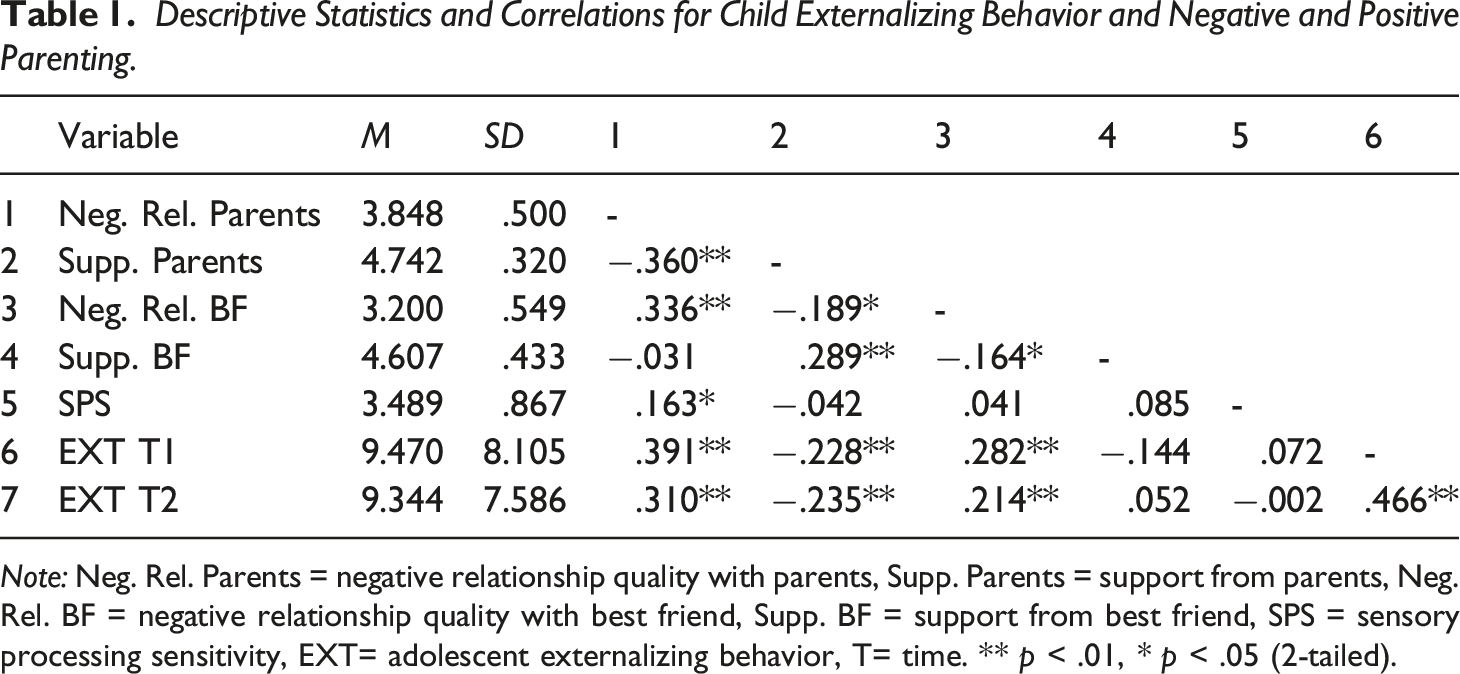
Note: Neg. Rel. Parents = negative relationship quality with parents, Supp. Parents = support from parents, Neg. Rel. BF = negative relationship quality with best friend, Supp. BF = support from best friend, SPS = sensory processing sensitivity, EXT= adolescent externalizing behavior, T= time. ** p < .01, * p < .05 (2-tailed).
Moderation analyses: The role of sensory processing sensitivity
Regression Analysis Results for Child Externalizing Behavior T2 (Transformed by Square Root) With Moderator Sensory Processing Sensitivity.
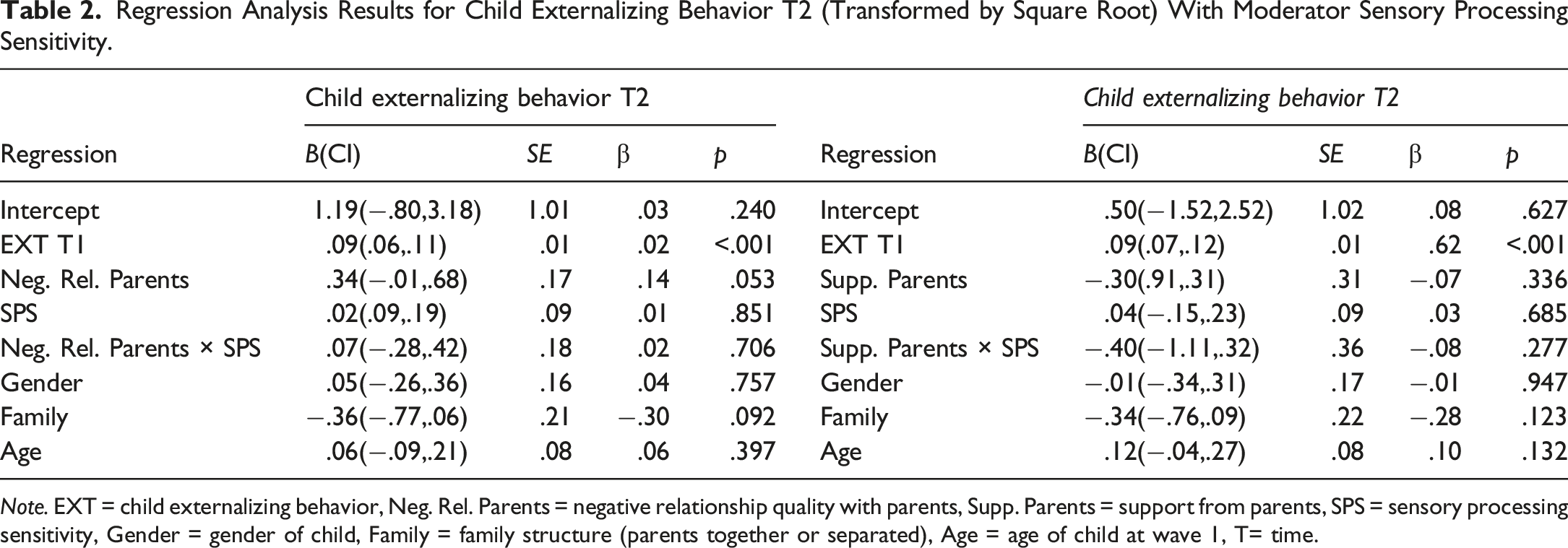
Note. EXT = child externalizing behavior, Neg. Rel. Parents = negative relationship quality with parents, Supp. Parents = support from parents, SPS = sensory processing sensitivity, Gender = gender of child, Family = family structure (parents together or separated), Age = age of child at wave 1, T= time.
Regression Analysis Results for Child Externalizing Behavior T2 (Transformed by Square Root) With Moderator Sensory Processing Sensitivity.
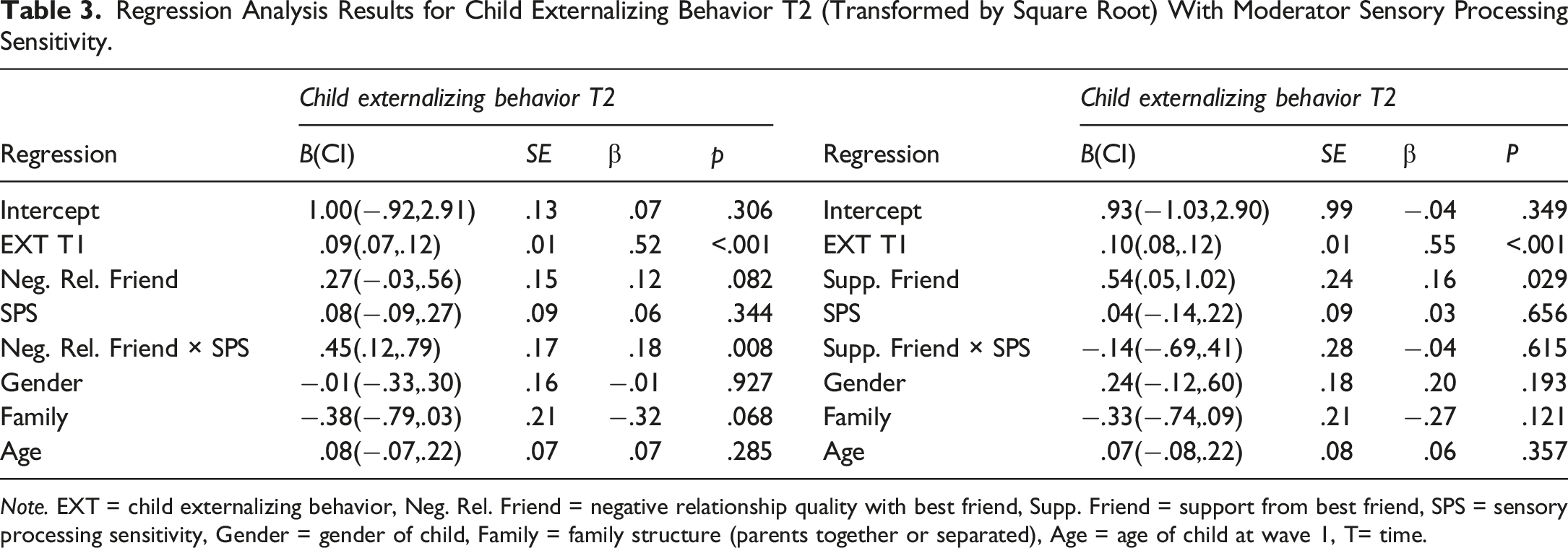
Note. EXT = child externalizing behavior, Neg. Rel. Friend = negative relationship quality with best friend, Supp. Friend = support from best friend, SPS = sensory processing sensitivity, Gender = gender of child, Family = family structure (parents together or separated), Age = age of child at wave 1, T= time.
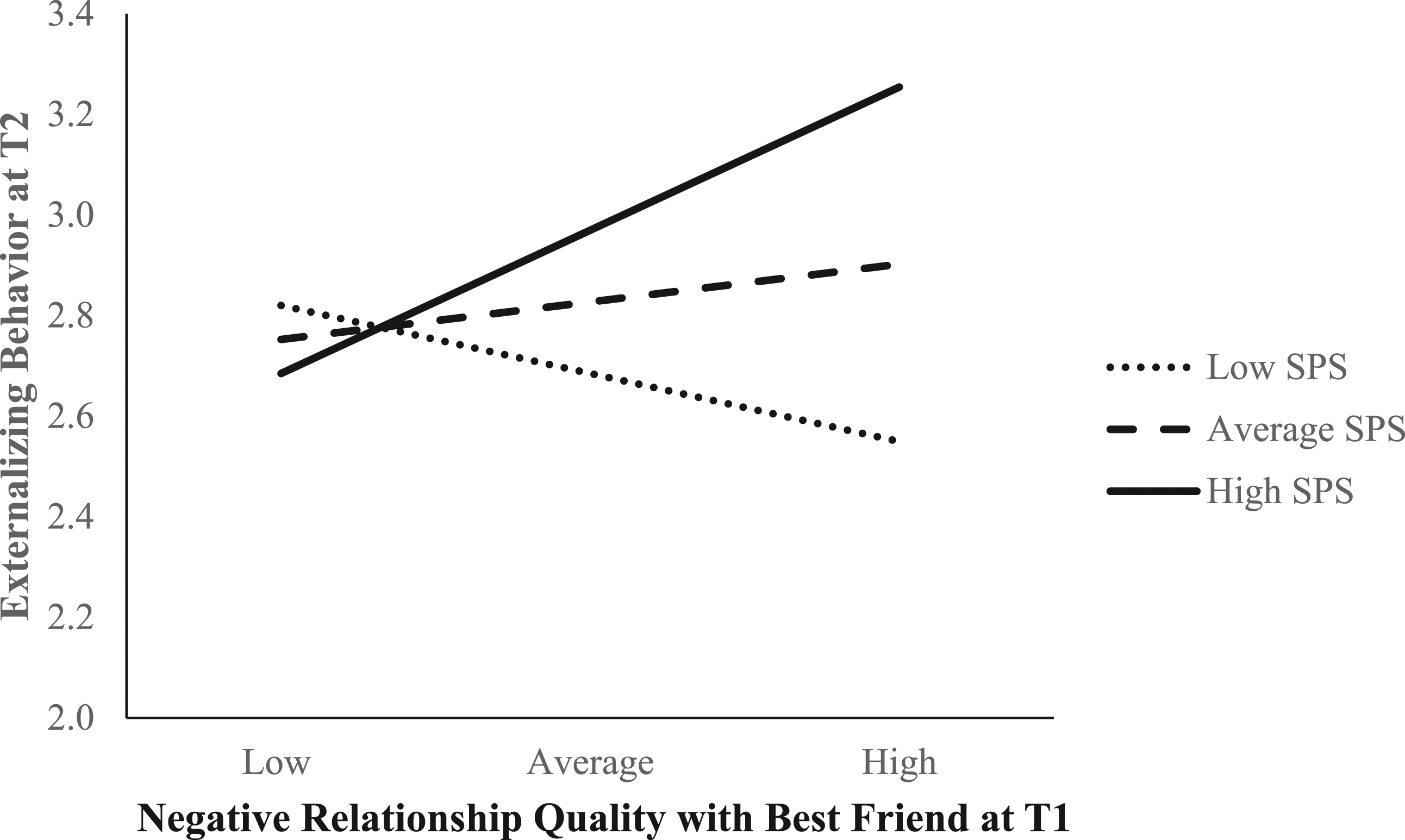
Sensory Processing Sensitivity (SPS) Moderates the Association Between Negative Relationship Quality With Best Friend at T1 and Child Externalizing Behavior at T2. Note. The simple slopes analysis demonstrated a slope of −.12 (SE = .22, p = .577) for “low” levels of SPS (1 SD below the mean), a slope of .26 (SE = .24, p = .077) for “average” levels (the mean) of SPS, and a slope of .64 (SE = .19, p = .001) for “high” levels of SPS (1 SD above the mean).
Discussion
The main aim of this study was to examine whether sensory processing sensitivity moderated the longitudinal associations between support from parents and best friend and negative relationship quality with parents and best friends on the one hand, and externalizing behavior 1 year later on the other hand. Our hypotheses were partly confirmed, with results showing that a stronger negative relationship quality with best friend was only predictive of subsequent externalizing behavior for adolescents who scored higher on sensory processing sensitivity. No other moderation effects of sensory processing sensitivity were found. We found that support from best friend was significantly associated with an increase in externalizing behavior 1 year later; however, we did not find significant effects for the associations between support from parents and adolescent externalizing behavior 1 year later, or for the association between negative relationship quality with parents and best friend and adolescent externalizing behavior 1 year later.
Our findings do not provide systematic or strong support for the notion that sensory processing sensitivity is associated with increased sensitivity to both negative and positive social environments. Nevertheless, one moderation effect (out of four) did show that the longitudinal association between a negative relationship quality with best friend and later externalizing behavior was significant at higher levels of sensory processing sensitivity. Interestingly, adolescents with higher sensory processing sensitivity showed the lowest externalizing behavior at T2 when negative relationship quality with best friend was low, but showed the highest externalizing behavior at T2 when negative relationship quality with best friend was high. These findings therefore appear to indicate that adolescents with high sensory processing sensitivity profit more from lower levels or the absence of negative relationships with best friend and are more vulnerable to the detrimental effects of high negative relationships with best friend at the same time, in comparison to adolescents with average or low levels of sensory processing sensitivity. Avoiding negative relationships with peers may therefore be especially relevant for adolescents with high sensory processing sensitivity in reducing their risk for the development of externalizing behavior. Similar to our findings, other studies show, for example, that for individuals with higher sensory processing sensitivity, negative childhood experiences were associated with internalizing behavior problems (Liss et al., 2005) and lower life satisfaction (Booth et al., 2015), but there were no respective associations between positive childhood experiences and these outcome measures. The other moderation (null-)findings, however, were not in line with recent studies in children (Lionetti et al., 2019; Slagt et al., 2018) that found support for a moderation effect of sensory processing sensitivity on the relationships between both positive parenting and later prosocial behavior, and negative parenting and later externalizing behavior (Lionetti et al., 2019; Slagt et al., 2018). A potential explanation for the null-findings in the present study may be that sensory processing sensitivity is less impactful than expected because, developmentally, adolescents are in a period of heightened social and emotional sensitivity more generally (Steinberg, 2008; Vander Zanden et al., 2000). That is, adolescents are already experiencing developmental increases in emotional sensitivity and reactivity and are paying attention to social interactions, whereby differences in high and low sensory processing sensitivity may be less meaningful than at other developmental periods.
When interpreting these findings, it needs to be considered that sensory processing sensitivity is up to this date primarily being assessed with self-reports on the Highly Sensitive Person (HSP) scale (Pluess et al., 2018; Aron et al., 2012) and only recently have researchers begun to implement other novel assessment approaches, such as observational measures of sensory processing sensitivity (e.g., the Highly Sensitive Child-Rating System, Lionetti et al., 2019). An issue inherent to the use of self-reported sensory processing sensitivity is that individuals, depending on their level of sensory processing sensitivity, may also likely differ in their perceived experienced of, for example, a negative relationship quality with best friend. Thus, adolescents who are low on sensory processing sensitivity may be less sensitive to a negative peer environment and thus report lower levels of it than adolescents high on sensory processing sensitivity, introducing a potential rater bias between those measures (Weeland et al., 2017). Furthermore, the question remains whether the HSP scale—focusing mainly on sensitivity of the senses, rather than on social/interpersonal stimuli—can also capture sufficient variance in sensitivity to social situations and/or relationships. Overall, and in light of the mixed literature, more research is needed to investigate whether sensory processing sensitivity does indeed function as a trait that may modulate sensitivity to negative and positive social exposures such as peer and parent environments.
Next to the moderation effect, we found that support from best friend was associated with higher levels of adolescent externalizing behavior 1 year later. These findings might appear counterintuitive at first glance, as they are in contrast to literature illustrating that adolescents experiencing friendships characterized by low support are at increased risk of developing externalizing behavior problems (e.g., Dickson et al., 2018; Wight et al., 2006). However, where externalizing behavior in adolescence is slightly elevated, this might reflect normative boundary testing—and sometimes crossing—behaviors, related to delinquency also (Moffitt, 2003). Increasing support from friends and increasing externalizing behavior can then be seen as two markers of a normative developmental trajectory in adolescence (Kessler et al., 2005; Moffitt, 2003; Patterson et al., 2000).
An interesting finding in the present study concerns the marginally significant effects of negative relationship quality with parents and best friend on externalizing behavior at T2. When controlling for the stability of externalizing behavior, gender, family structure and age at T1, these social predictors do not predict change, compared to the significant bivariate correlations between these social predictors and externalizing behavior at T2. This finding is discrepant with previous longitudinal research, that did show that negative relationship quality with parent and peers was associated with later increases in externalizing behavior in children and adolescents (Hoeve et al., 2009; Pinquart, 2017; Burk & Laursen, 2005; Dickson et al., 2018). However, many of these studies are based on clinical and forensic samples, or samples with certain at-risk peer and family characteristics, such as low socioeconomic status (SES), family adversity, or antisocial peer group influences. Indeed, recent meta-analytical evidence, for example, shows that associations between negative and positive parenting dimensions and externalizing behavior problems were stronger in clinical and forensic samples that already exhibited heightened externalizing behavior problems, than in community-based samples (Pinquart, 2017). Perhaps, the discrepant findings can be explained that in our present sample we had a relatively high SES, highly educated sample in which overall parent and peer difficulties were limited and thereby variance regarding dysfunctional parent and peer relationships may be lacking. Oversampling adolescents with dysfunctional parent and peer relationships may yield stronger parent/peer “effects” in future longitudinal studies (Bakermans-Kranenburg & Van Ijzendoorn, 2015).
Although we found an effect of sensory processing sensitivity in the context of a negative relationship quality with peers, we did not find any effects for neither a negative relationship quality with parents nor support from best friend and parents and later adolescent externalizing behavior. Literature indicates that even though sensory processing sensitivity appears to be a heritable susceptibility factor implied in the cognitive processing of socio-environmental stimuli, the strength with which sensory processing sensitivity interacts with an environmental condition may depend on the perceived emotional relevance of that condition (Acevedo et al., 2014; Aron et al., 2012). For example, recent fMRI research showed that individuals with higher levels of sensory processing sensitivity showed heightened responsiveness to images rated as emotional (positive and negative)—but not those rated as neutral—in brain circuits related to action planning, information processing, and awareness (Acevedo et al., 2014, 2017). This is in line with evolutionary theories of sensory processing sensitivity that highlight the social advantages of heightened sensory processing sensitivity to social stimuli (e.g., promoting social skills and bonding) that may be especially relevant to one’s survival (Aron et al., 2012; Pluess et al., 2018). Given that in adolescence peers gain increasing importance as social contacts to confide in and share emotional experiences with (Steinberg, 2008), heightened sensory processing sensitivity may, from an evolutionary perspective, be especially relevant in the peer context to help establish new social connections. In the parent context however, skills that promote social bonding associated with heightened sensory processing may be less relevant, as adolescents have already formed social connections early on with their parents. Thereby, although speculative, for adolescents, sensory processing sensitivity may amplify the effects of a negative friend environment to a greater extent than the effects of a parenting environment on later externalizing behavior. More research is necessary to investigate whether sensory processing sensitivity is indeed more relevant for the peer context than the parent context in adolescence.
Even though sensory processing sensitivity of adolescents did not appear to interact with the parenting environment in our study, a recent study (Goldberg & Scharf, 2020) highlights the role that sensory processing sensitivity of parents could play in influencing the parent-adolescent relationship. Specifically, the study investigated the idea that parents with heightened sensory processing sensitivity may be more sensitive to the challenges posed by parenting a child in adolescence. In line with their expectations, results show that heightened sensory processing sensitivity in parents was related to higher levels of inconsistency, psychological intrusiveness and attachment anxiety, and furthermore that the relationship between parents’ sensory processing sensitivity and harsh parenting was mediated by attachment anxiety (Goldberg & Scharf, 2020). Future research may consider exploring sensory processing sensitivity not only in adolescents but also in their parents to determine the effects that heightened sensory processing sensitivity may have on parenting practices and how this in turn may affect adolescents’ developmental outcomes.
Strengths and limitations
Some limitations of the present research should be taken into consideration. All assessments were based solely on adolescent self-reports. Adolescents’ ratings on undesirable behaviors such as externalizing behavior may have been especially affected by a social desirability bias, resulting in an underestimation of levels of externalizing behavior. This may have yielded a skewed variance in the externalizing behavior outcome variable and thus a lower power to detect parent and peer effects on externalizing behavior (Bakermans-Kranenburg & Van Ijzendoorn, 2015), and moderation by sensory processing sensitivity thereof. Furthermore, research consistently demonstrates low-to-moderate correspondence among parent and child self-reports on externalizing and internalizing problems (for a meta-analysis, see De Los Reyes et al., 2015), underscoring the importance of using multi-informant assessments. Second, we used a single cross-sectional adolescent self-report of relationship quality with parents and best friend at time 1, and furthermore, the respective questionnaire items were not formulated in regard to a specific timeframe. Therefore, no inferences can be made about whether negative relationship qualities or supportive relationships were relatively enduring or perhaps represented a short-lived state due to a conflict with parents or perhaps the dissolution of the friendship, and may have resulted in a compromised prediction of externalizing behavior 1 year later. Third, because the primary aim was to assess sensory processing sensitivity as a susceptibility factor to adolescents’ relationship quality with parents and best friend, we chose to test interactions of these variables with sensory processing sensitivity in separate models each. This approach, however, did not allow the assessment of the relative influences of parent and best friend. Nevertheless, if both the interactions of sensory processing sensitivity with relationship quality with parents and best friend would have emerged as significant in our separate models—which appeared not to be the case in our study—a following step could have entailed assessing these interactions together in one model to test their unique predictive value for externalizing behavior. However, and in favor of our approach to conduct separate analyses, it needs to be considered that even in the possible scenario that one of the interactions would not have remained statistically significant anymore after assessment in one model, relationship quality with parents and best friend may still both interact with sensory processing sensitivity on a conceptual level. Fourth, the pattern of missing data for externalizing behavior T1 was not at random, suggesting that missingness may have been associated with other unmeasured factors, which may have resulted in biased estimation of effects. Furthermore, we did not assess percentages for all ethnicity groups, as we had only provided the answer option “other” alongside six ethnicity group options as mentioned in the study’s procedure. Another limitation was that regarding gender identity, participants were able to choose between two groups (boy/girl), but there was no option indicating transgender or nonbinary. Lastly, it is important to recognize that it is not only parents and peers that influence the adolescents’ behavior, but furthermore, adolescents may elicit certain responses from their parents and peers from the way they behave, which in turn impacts adolescents’ behavior again. In light of such a cascade-model, it therefore also needs to be recognized that relationship quality with parents and peers may in first place also be a product of adolescents’ own behavior, and via that route become implicated in the development of, for example, externalizing or prosocial behavior (De Haan et al., 2012).
Strengths of the study include the use of longitudinal measurements, whereby inferences can be drawn about sensory processing sensitivity as a susceptibility factor in adolescents’ development of externalizing behavior over time. Furthermore, this study included both a positive and negative environmental assessment of both parents and best friend, which allowed testing sensory processing sensitivity as a factor that is associated with increased sensitivity to environmental conditions regardless of valence (positive or negative). There is still a lack of research in the field of adolescent adjustment investigating the positive aspects of peer influences (Miller-Slough & Dunsmore, 2016); thus, this study adds to this literature to help understand the potential of prosocial peer influences on adolescents’ behavioral development. Furthermore, including a measure of both parents and best friend furthermore enabled us to study the social dynamics in adolescence in multiple contexts that each play their part in shaping adolescents developmental trajectories.
In conclusion, the present study showed that for adolescents with high levels of sensory processing sensitivity, a negative relationship quality with best friend was related to relatively higher levels of externalizing behavior 1 year later. These results do not provide support for the notion that sensory processing sensitivity is associated with increased sensitivity to both negative and positive environmental exposures. Rather, our results indicate that sensory processing sensitivity amplifies the detrimental effects of a specifically adverse environment on developmental outcomes. More research is needed to investigate whether sensory processing sensitivity does indeed function as a trait that is associated with increased sensitivity to environmental stimuli regardless of valence, especially in the context of negative and positive social exposures such as peer and parent environments.
Supplemental Material
sj-pdf-1-spr-10.1177_02654075221083962 – Supplemental Material for The role of sensory processing sensitivity in the longitudinal associations between relationship qualities with parents and peers and externalizing behavior in adolescence
Supplemental Material, sj-pdf-1-spr-10.1177_02654075221083962 for The role of sensory processing sensitivity in the longitudinal associations between relationship qualities with parents and peers and externalizing behavior in adolescence by Karen Fischer, Helle Larsen, Alithe van den Akker and Geertjan Overbeek in Journal of Social and Personal Relationships
Footnotes
Funding
The author(s) disclosed receipt of the following financial support for the research, authorship, and/or publication of this article: This research was supported by a Research Priority Area “Yield” Graduate Programme grant 022.006.0 from the Netherlands Organisation of Scientific Research (NWO) Geertjan Overbeek was supported by a vici grant (016.vici.185.063) from the Dutch Research Council (NWO).
Open research statement
As part of IARR’s encouragement of open research practices, the author(s) have provided the following information: This research was pre-registered. The aspects of the research that were pre-registered were hypotheses, study type, blinding, study design, existing data, data collection procedures, sample size, measured variables, statistical models, other. The registration was submitted to the Open Science Framework and can be found at  . The data used in the research are cannot be publicly shared but are available upon request. The data can be obtained by emailing:
Supplemental Material
Supplemental material for this article is available online.
References
Supplementary Material
Please find the following supplemental material available below.
For Open Access articles published under a Creative Commons License, all supplemental material carries the same license as the article it is associated with.
For non-Open Access articles published, all supplemental material carries a non-exclusive license, and permission requests for re-use of supplemental material or any part of supplemental material shall be sent directly to the copyright owner as specified in the copyright notice associated with the article.
