



Abstract
Social media platforms’ unique characteristics may make them particularly good outlets for getting even with relational partners. Establishing the prevalence of social media revenge and identifying the forms such revenge may take in different relationship contexts is an important first step in broadening our understanding of these behaviors. In a mixed-methods study, undergraduates (N = 732) and community members (N = 124) were randomly assigned to one of four relational contexts (coworkers, family, friends, and romantic partners) and asked to describe an act of social media revenge experienced or observed in their assigned context. They then rated how often they were the avenger, target, and observer of five control and monitoring and 11 direct aggression behaviors adapted from the Cyber Dating Abuse Questionnaire. The prevalence of social media revenge across all relationship contexts, roles, and revenge types was low and participants reported observing social media revenge more frequently than being the target or avenger. Social media revenge was also more prevalent in some relationships than others and the type of relationship between avenger and target may have implications for how revenge is executed. Analysis of participants’ accounts identified novel revenge behaviors and suggested ways to improve measurement of social media revenge.
Angry that their relationship had ended, Matthew Herrick’s ex-partner created a fake Grindr account in which, posing as Herrick, he invited men to proposition him for sex (Kinkade & Alba, 2019). Over the course of six months, more than 1000 men approached Herrick at his home and workplace, wreaking havoc in his personal and professional life.
Social media use has exploded in recent years with more than 70% of Canadians and Americans and more than 50% of individuals worldwide using at least one form of social media (Chaffey, 2020; Pew Research Center, 2019). Social media can be employed for many constructive purposes, such as staying connected with friends and family (Butler & Matook, 2015) and building work relationships (Heaphy et al., 2018). However, as the example above illustrates, it can also be used in ways that prove less benign in their consequences.
In this article, we explore the use of social media as a tool for exacting revenge in response to perceived provocations in interpersonal relationships. Social media platforms influence how relationships are formed, maintained, and dissolved (e.g., Ellison et al., 2014; Herron et al., 2017; LeFevbre, 2018). We contend that they may also offer individuals simple, convenient, and easily accessible means to get even following provocations that occur in their relationships.
Revenge via social media
We define social media revenge as any attempt to respond in kind to a perceived provocation in which the response is mediated through or performed on social media platform(s) or applications. Social media revenge is, then, a special case of revenge that occurs online and, in contrast to other forms of cyber-revenge, excludes acts perpetrated through email or text messages. Because it is a kind of revenge, social media revenge can be differentiated from the broader construct of aggression, including other forms of online aggression (e.g., cyberbullying, cyber-aggression, cyber-dating abuse, trolling; Bates 2017; Borrajo et al., 2015; Law et al., 2012), in that it is (or is perceived to be) provoked. The boundaries between social media revenge and other forms of online aggression are, however, fuzzy. When these other behaviors are enacted through social media platforms and entail a response to perceived provocation (i.e., revenge porn, reciprocal cyber-dating abuse, reactive online aggression or retaliatory cyberbullying), they would qualify as social media revenge (König et al., 2010). The context, intentions, and medium on which it occurs may thus qualify an act of online aggression as an act of social media revenge.
Cyber revenge—particularly as it unfolds over social media—has attracted comparatively little research attention. There has been some investigation of revenge porn (Bates, 2017; Branch et al., 2017), a form of online revenge which involves online sharing of sexually explicit media without the subject’s consent. However, revenge porn does not always take place on social media and represents just one type of revenge behavior in one kind of relationship (Bates, 2017). Otherwise, our review of the literature revealed no studies examining social media revenge in an interpersonal context. 1
This is an intriguing gap in the literature considering that social media platforms have several unique characteristics that may make them particularly good outlets for vengeance. Because they are widely accessible and widely used (Perrin, 2015; Pew Research Center, 2019), for example, social media platforms may make revenge easier to execute than revenge performed through other, non-social media means. Indeed, in some instances taking social media revenge may require just a few clicks. Imagine sending an anonymous message from a fake Facebook profile to a superior at work in response to unfair treatment or altering the captions on photos on a social media platform to harm a friend after a falling out.
Social media platforms may also offer avengers 2 enhanced ability to retaliate anonymously (Hai-Jew, 2014). Because it permits individuals to avoid the consequences that result when they can be identified, this increased anonymity may considerably lower the costs associated with getting even. Moreover, for avengers who seek maximum damage, social media revenge has the potential to cause greater and perhaps more enduring harm than revenge perpetrated through non-social media means. Not only may a vengeful social media post reach a target’s entire social network on that platform within seconds, but social network members may share it, too. The post may even “go viral.” Finally, because content on social media platforms is irretrievable and may resurface at any time (Hai-Jew, 2014), targets of social media revenge may find it nearly impossible to completely disassociate themselves from the malevolent actions of avengers who take vengeance on social media platforms.
Relationships are central to individuals’ lives and contribute to feelings of belongingness (Baumeister & Leary, 1995). Given that research in the broader revenge literature indicates that revenge can produce significant negative consequences for avengers, targets, and the relationships in which such acts sometimes occur (Boon et al., 2011; Fitness, 2000; Yoshimura, 2007), social media revenge has the potential to cause great harm. This is because individuals ascribe considerable importance to their social media profiles, carefully curate what they share about themselves, and care deeply about the impressions others form of them from the content they share about themselves and their relationships (Chou & Edge, 2012; Papp et al., 2012). As highly publicized examples from the media attest, social media revenge may result in lawsuits (Gollom, 2012) and lost jobs (Workapolis, 2017), and lead to suicide (Day, 2019). Even when it does not result in consequences of this magnitude, social media revenge may damage people’s social reputations, online identities, and relationships (Bates, 2017).
The prevalence of social media revenge
As we argued above, social media revenge may have important consequences for the parties involved and for the relationship between them. Establishing the prevalence of social media revenge in people’s interpersonal relationships is a necessary first step in assessing the size of the “problem.”
Following Borrajo et al., (2015)’s approach to studying the prevalence of cyber dating abuse, we explored both the frequency with which participants engaged in acts of social media revenge (i.e., were the avengers) and were the target of others’ acts of social media revenge. Because social media offer a platform in which individuals may post content visible to members of their social networks, we also explored the frequency with which participants had observed or heard about acts of social media revenge that happened to others.
3
Our decision to expand our focus beyond avenger and target acknowledges the possibility that the impact of social media revenge may extend to those who merely observe it or hear about it from others. Social learning theory would suggest that seeing the behavior modeled by others might increase the odds an individual will engage in the behavior themselves (Bandura & Walters, 1977). Depending on an individual’s relationship to the avenger and target, observing such acts (or hearing about their occurrence) might also elicit anger or upset. And depending on the damage the act causes the parties involved, observers’ inclinations to respond to perceived provocations by retaliating over social media might be diminished. We thus asked: RQ1: What is the prevalence of revenge enacted through social media? More specifically, how often do individuals experience social media revenge either as an avenger or as a target, and how often do they observe (i.e., witness/hear about) acts of social media revenge enacted by others?
Relational context and type of revenge behaviors
Conflict and aggression manifest and are experienced differently in different types of relationships (Goldstein, 2011; Richardson & Green, 2006). With respect to revenge, studies suggest that individuals’ propensity to retaliate in return for perceived provocation may be influenced by relationship type (Boon & Yoshimura, 2014; McDonald & Asher, 2013). Furthermore, based on their varying levels of interdependence and physical context, different kinds of relationships might offer different opportunities for partners to get even after being wronged in their relationships.
Borrajo et al. (2015) identified two categories of cyber-dating abuse behaviors: direct aggression and control and monitoring behaviors. Direct aggression behaviors are aggressive acts enacted with the deliberate intention to hurt the target (e.g., threatening the target, insulting the target, sharing the target’s private information online). Control and monitoring behaviors involve surveillance and invasions of the target’s privacy (e.g., using personal passwords to access private messages, checking a target’s online profile without permission).
Direct aggression behaviors differ from control and monitoring behaviors in at least three ways that warrant distinguishing between them as we seek to understand the frequency with which people employ social media to exact revenge in their relationships. First, the intentions behind them differ. As described above, acts of direct aggression are intended to cause harm (Borrajo et al., 2015); in contrast, and as the label implies, control and monitoring behaviors involve the exercise of power and attempts to exert control over a partner.
Second, direct aggression and control and monitoring behaviors differ in their potential implementation costs. Control and monitoring behaviors tend to be rather subtle and discreet. The target may never know their privacy has been violated. Acts of direct aggression, in contrast, are much more overt, substantially increasing the odds a target will be aware of the avenger’s actions and perceive the actions as vengeful in intent. Consequently, the potential costs associated with employing direct aggression behaviors as revenge are likely to be much higher than the costs associated with employing control and monitoring behaviors. Because revenge violates relationship expectations, persons employing direct aggression behaviors should be at greater risk of experiencing reputational damage and causing harm to their relationships with their targets than those employing control and monitoring behaviors. Direct aggression behaviors also expose the avenger to the possibility of counterretaliation to a much greater extent than control and monitoring behaviors.
Third, given the nature of control and monitoring behaviors, this form of revenge might—in comparison with direct aggression behaviors—be easier to execute in relational contexts of high interdependence and in contexts where relational members cohabit (i.e., romantic and family relationships). Most control and monitoring behaviors require access to the target’s social media account. Avengers are more likely to have such access if they know the target’s password(s) or frequently interact (i.e., have access to the target’s phone or computer) than if they only interact in professional settings or on a less frequent basis.
In addition to establishing the overall prevalence of social media revenge, our ability to assess the magnitude of the problem it poses people’s relationships requires an understanding of the frequency with which it occurs in different relationship contexts and the different forms it takes. We thus asked: RQ2a: Is social media revenge more frequent in certain relationships than others (i.e., between friends, romantic partners, family, or coworkers)? RQ2b: Is there a difference in frequency of social media revenge type (direct aggression vs. control and monitoring)? RQ2c: Does the frequency of revenge type vary across relationship context?
The current study
To answer our RQs, we developed the Social Media Revenge Scale (SMRS) by adapting items from Borrajo et al.’s (2015) Cyber Dating Abuse Questionnaire (CDAQ). Because the CDAQ was created to measure behaviors intended to hurt or control/monitor romantic partners, we designed the present study in part to determine whether other behaviors, perhaps less common in romantic relationships, are also enacted as revenge. The goals of this study were thus threefold. First, we sought to establish how common acts of social media revenge are by examining the frequency with which individuals report experiencing social media revenge as the avenger, target, or observer. Second, we explored whether the frequency of social media revenge varies across different types of relationships, whether it more frequently takes the form of direct aggression or control and monitoring behaviors, and whether any observed difference in the use of direct aggression and control and monitoring behaviors varies by relational context. Finally, we sought to expand knowledge of the range of behaviors employed in exacting social media revenge and to identify ways to improve the instrument that we adapted to measure social media revenge.
Social media have increased dramatically in their breadth of use and influence over the last decade. This study offers a necessary descriptive base concerning the frequency with which social media platforms may be used for one potentially destructive purpose: taking revenge. As acts of social media revenge can pose a threat to the wellbeing of the individuals involved and to their relationships, such a descriptive base will inform scholars and social media users alike of the likelihood that any one individual may find themselves involved in social media revenge in their lifetime.
Method
Participants
Undergraduate psychology students (N = 738; 84%) at a university in western Canada and members of the local community (N = 137; 16%) participated in this study. Students were recruited through the psychology research participation system; the community sample was recruited through an ad posted on our personal and laboratory social media pages and during presentations at local community events. The student recruitment ad stipulated that participants must be able to recall an instance in which they or someone they knew got even on social media. The community ad invited individuals to complete a survey exploring interpersonal transgressions happening on social media platforms (see https://osf.io/g3zqh/?view_only=a99a787b1b0c4ce7a198ca02dc272d6b for the ads and the study materials presented below). Students completed the online survey in a laboratory and received partial course credit. Community members received no incentive and completed the survey online 4 . Prior to analysis, we dropped 19 participants whose data were incomplete. The final sample (N = 856) included 413 women, 409 men, and 34 participants who did not disclose their gender or identified as gender fluid. Participants ranged in age from 15 to 75 (M = 21.4, SD = 4.9, Mdn = 20) and reported diverse ethnicities (45% White, 36% Asian, 2% Latinx, 2% Black, 15% multiple ethnicities or other).
Procedure
Participants were randomly assigned to one of four versions of an online survey in which they completed measures pertaining to social media revenge in either coworker (n = 187), family (n = 260), friendship (n = 223), or romantic (n = 205) relationships. In the first part of the survey, participants described a time when they or someone they knew used a social media platform to get even. They then completed a scale assessing the frequency of social media revenge. Next, the survey asked participants whether they had ever witnessed or experienced any other types of revenge behavior on social media (in their assigned relational context) not captured by the items in the scale and to describe such event(s). Finally, participants completed personality measures (beyond the scope of this paper) and demographic items.
Materials
The instructions and items were identical across all relationship type conditions except with respect to references to the relationship of interest. Below, we present the friendship condition phrasing.
Social media revenge account
The following instructions prompted participants to recall an act of social media revenge:
Social media sites provide individuals with a new medium for getting even with friends in instances in which they feel that a friend has wronged, hurt, provoked or harmed them. Can you recall a time when you, or someone you know, used social media sites to get back at a friend or was the victim of such an act? If you can think of more than one incident of this kind, please choose the episode that was the most significant or memorable to you. Please be as specific as possible in indicating the ways or mediums through which you/the person you know got even.
After providing an account, participants identified both the transgressor and victim in the incident, selecting from the options “you,” “a friend,” “an acquaintance,” and “an acquaintance of someone you know.” They also indicated the social media platform on which the act was performed, how long ago it occurred, and described the relationship between avenger and target.
Social Media Revenge Scale (SMRS)
Given the absence of a scale specifically designed to measure cyber-revenge behaviors, we adapted Borrajo and colleagues’ (2015) Cyber Dating Abuse Questionnaire to measure the frequency of social media revenge. The CDAQ measures 11 direct aggression behaviors (e.g., “writing a comment on the wall of a member in one’s social network to insult or humiliate them”) and nine control and monitoring behaviors (e.g., “using passwords on one’s phone, social network, or email to browse another’s messages and/or contacts without their permission”) enacted through new technologies. We added the stem “After being wronged, harmed or provoked” to the beginning of the scale to focus participants’ thoughts on acts of revenge, not online aggression more broadly. We also altered the items to refer to revenge behaviors in the particular relational contexts examined in this study (e.g., “I shared photos and/or videos of intimate and/or sexual content of a current or former friend to others on a social network without his/her permission.”). Additionally, we dropped three CDAQ behaviors that did not refer to social media platforms (e.g., checking a partner’s mobile phone without permission). Prior to data analysis, we also dropped “check[ing] the time of a partner’s last connection” because after careful consideration, we did not believe it depicted revenge. 5
The CDAQ asks participants to rate how often they were both the victim and perpetrator of each behavior. As we were also interested in determining how often participants had witnessed each behavior, we added items assessing how often someone they knew had either been the target or the avenger (e.g., “Someone I know created a fake profile of a current or former friend on a social network to cause problems AND/OR a current or former friend of someone I know created a fake profile of him/her on a social network to cause problems”). In sum, each social media revenge behavior was assessed with three items.
Participants rated how frequently they had been the target of, engaged in, or witnessed the 16 online revenge behaviors during the past year using a 7-point response scale with options 1 = Never. I have never witnessed/done this act; 2 = Not last year, but I have witnessed/done this act before; 3 = Rarely. I have witnessed/done this act one or 2 times over the last year; 4 = Sometimes. I have witnessed/done this act between 3 and 10 times over the last year; 5 = Frequently. I have witnessed/done this act between 11 and 20 times over the last year; 6 = Usually. I have witnessed/done this act more than 20 times over the last year; and 7 = Commonly. I have witnessed/done this act almost on a weekly basis over the past year. We created composite scores by averaging ratings for the target, avenger, and observer items separately (α′s = .89, .82, and .93, respectively).
Additional social media revenge accounts
Completing the SMRS may have led participants to remember other acts of social media revenge not in the SMRS. Therefore, as a final task, we asked participants if they could think of other behaviors that they/someone they knew had enacted on social media to get even in their assigned relational context. Participants who reported additional events completed the same post-account questions described above.
Results
How common is social media revenge?
RQ1 sought to establish how often individuals experience social media revenge as an avenger, target, or observer. A one-way repeated-measures ANOVA with role as within-subjects factor revealed a significant role effect F (1.34, 1146.54) = 817.93, p < .001. Post hoc paired t-tests indicated that participants reported observing social media revenge more frequently (M = 2.2, SD = 1.0) than being the victim (M = 1.4, SD = 0.6), t (855) = 28.62, p < .001, or the avenger (M = 1.2, SD = 0.4), F (855) = 31.06, p < .001. Additionally, they reported being the victim more often than the avenger, t (855) = 11.42, p < .001. In sum, participants reported observing social media revenge more often than they reported being personally involved in the episode and they reported being the target more often than the avenger. Overall, however, the reported prevalence of social media revenge was low (M = 1.6, SD = 0.5).
To what extent does the frequency of social media revenge vary by relational context and type of revenge?
RQ2a through 2c explored whether the frequency of social media revenge varies with relationship type, the type of behavior (direct aggression vs. control and monitoring), or both. As the frequencies with which participants reported being involved in or observing social media revenge were low, we collapsed across ratings for the victim, avenger, and observer items for each behavior to create mean frequency scores aggregated across role. We then calculated mean frequency scores separately for direct aggression (11 behaviors, M = 1.6, SD = 0.6) and control and monitoring behaviors (5 behaviors, M =1.7, SD = 0.7).
A mixed-design ANOVA with Revenge Type (direct aggression vs. control and monitoring behavior) as within-subjects factor and Relational Context (friends, romantic partners, family, coworkers) as between-subjects factor
6
revealed significant main effects of revenge type, F (1, 852) = 33.27, p < .001, and relational context F (3, 852) = 43.22, p < .001. However, these were qualified by a significant Revenge Type X Relational Context interaction (F (3, 852) = 21.67, p < .001). Post hoc paired samples t-tests comparing revenge types within relational contexts indicated that the differences in the romantic, family, and coworker contexts were significant (t(201) = 5.48, p < .001 for romantic, t(254) = 7.89, p < .001 for family, t(180) = -2.67, p = .008 for coworker, t(217) = -.33, p = .745 for friends). However, as Figure 1 shows, the direction of difference varied with relationship context: Mean frequencies were higher for control and monitoring behaviors than direct aggression behaviors in the romantic and family contexts; the opposite was true in both the coworker and friendship contexts, although the difference in frequency of control and monitoring versus direct aggression behaviors was nonsignificant in friendships. Frequency of revenge by type and relational context.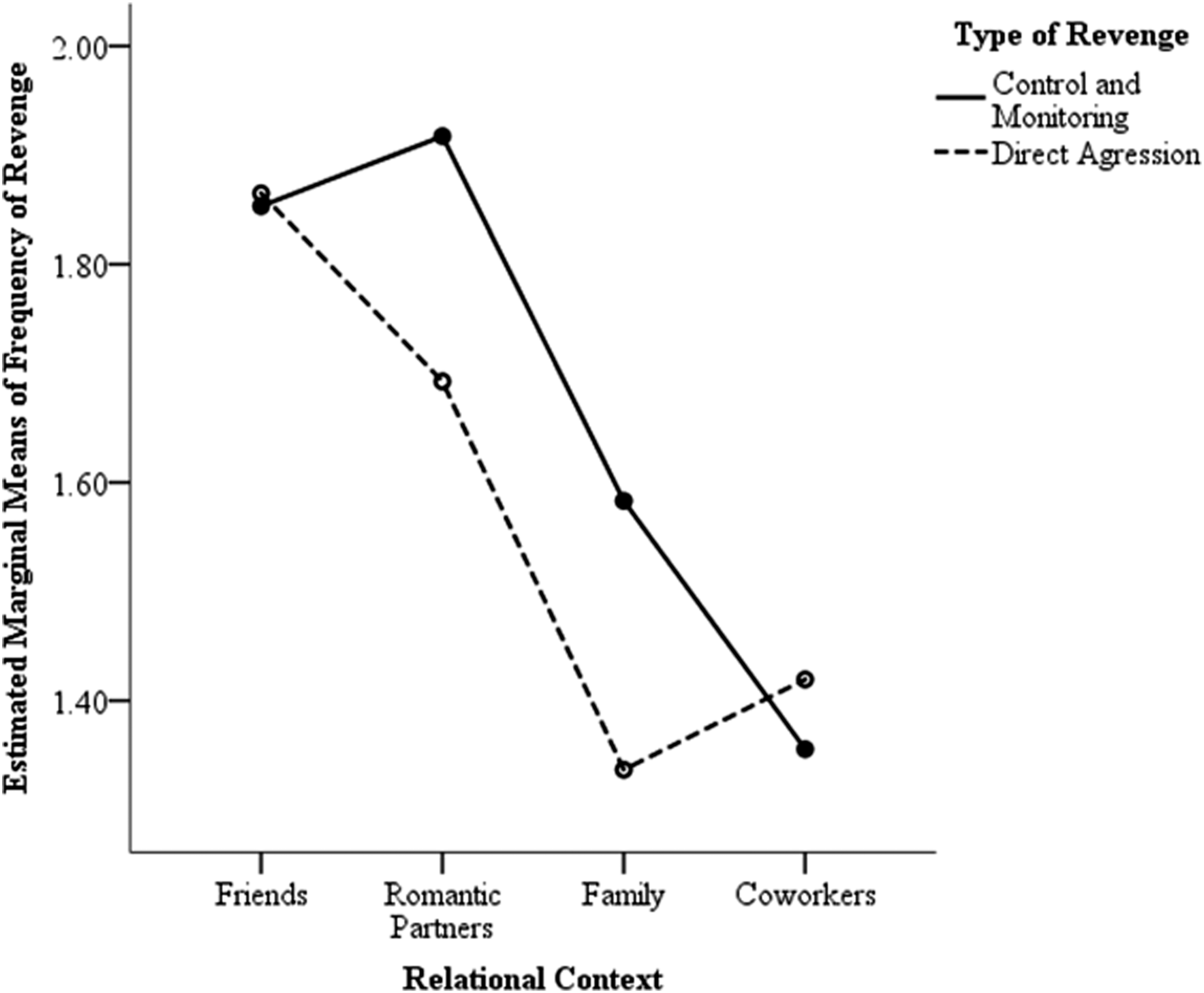
Improving the Social Media Revenge Scale
Finally, we examined the revenge accounts participants provided both before and after completing the SMRS to determine whether those accounts suggested ways the scale might be improved. Below we consider items that might be added to expand the range of behaviors assessed and suggest other revisions to the scale.
First, according to participants’ accounts, images and videos are often employed in social media revenge in ways not captured by the current SMRS. For example, participants described instances in which avengers sent/posted insulting and/or humiliating photographs and videos of the target on social media; shared photographs or videos on social media that did not include the target but depicted the target in a bad way; threatened to spread embarrassing photographs and/or videos of the target (i.e., blackmailed the target); excluded the target from photographs shared on social media (e.g., blurred out a family member’s face in a profile photograph or cropped out one friend in a group photograph); and changed the captions on previously shared photographs that included the target to portray the target negatively. Importantly, these photographs/videos were neither limited to those of an intimate/sexual nature nor always shared in status updates, thus differentiating these behaviors from behaviors in the existing SMRS.
Participants’ accounts also revealed ways that avengers used private messages and conversations on social media to perpetrate acts of revenge, none of which are reflected in the SMRS. For example, participants described incidents in which avengers shared screenshots of private conversations with the target with others, replied to the target’s private messages on their social media without their permission, sent insulting messages about the target to others (i.e., behind the target’s back), ignored the target’s messages, and purposely excluded the target from conversations (i.e., by not inviting them to social media groups or events). Although the SMRS contains items capturing similar behaviors involving private messages, none involve these particular behaviors.
An additional category of behaviors described by participants but missing from the SMRS involve the avenger disassociating themselves from the target. For example, participants described incidents in which avengers got even by blocking and “unfriending/unfollowing” their target and by deleting content about the target on their own social media profiles to show the target that they had “cut them out of their life as if they never existed.”
Similarly, there are no items in the SMRS that specify ways in which avengers can use shared online content for revenge. Participants’ accounts indicate that avengers sometimes tried to embarrass or provoke their targets by “tagging” the target in content or on posts with which the target did not wish to be associated. Avengers also sometimes sought to humiliate the target by re-sharing old posts (previously posted by the target or by others). Neither of these behaviors are reflected in the current SMRS.
Finally, participants in the romantic relationships condition identified several novel behaviors worth adding to the SMRS when studying social media revenge in this context. These behaviors included the avenger posting provocative photographs of themselves to make their (ex)partner jealous, talking to new people online and pretending they had a romantic interest in someone to make their (ex)partner jealous, and changing their relationship status on Facebook to provoke their (ex)partner.
Second, we retained the original wording as far as possible in adapting the CDAQ for our use, which meant that some items specified the motives underlying the behavior (e.g., “to insult or humiliate”). Different motives may underlie the same revenge behavior and multiple motives may operate in some situations (Powell & Flynn, 2017; Yoshimura & Boon, 2018). We saw clear evidence of this in participants’ accounts. Thus, we recommend removing all references to motive(s) from the items and, if desired, including examples of motives in a preamble.
Finally, we recommend each item refer to a single revenge behavior. Several items in the CDAQ, and thus the SMRS, contain multiple behaviors (e.g., “posted music, poems and/or phrases in reference to me in status updates on a social network with the intent to insult or humiliate me”). This structure precluded determining the frequencies of the individual behaviors they contain.
Revised Social Media Revenge Scale (SMRS) items.
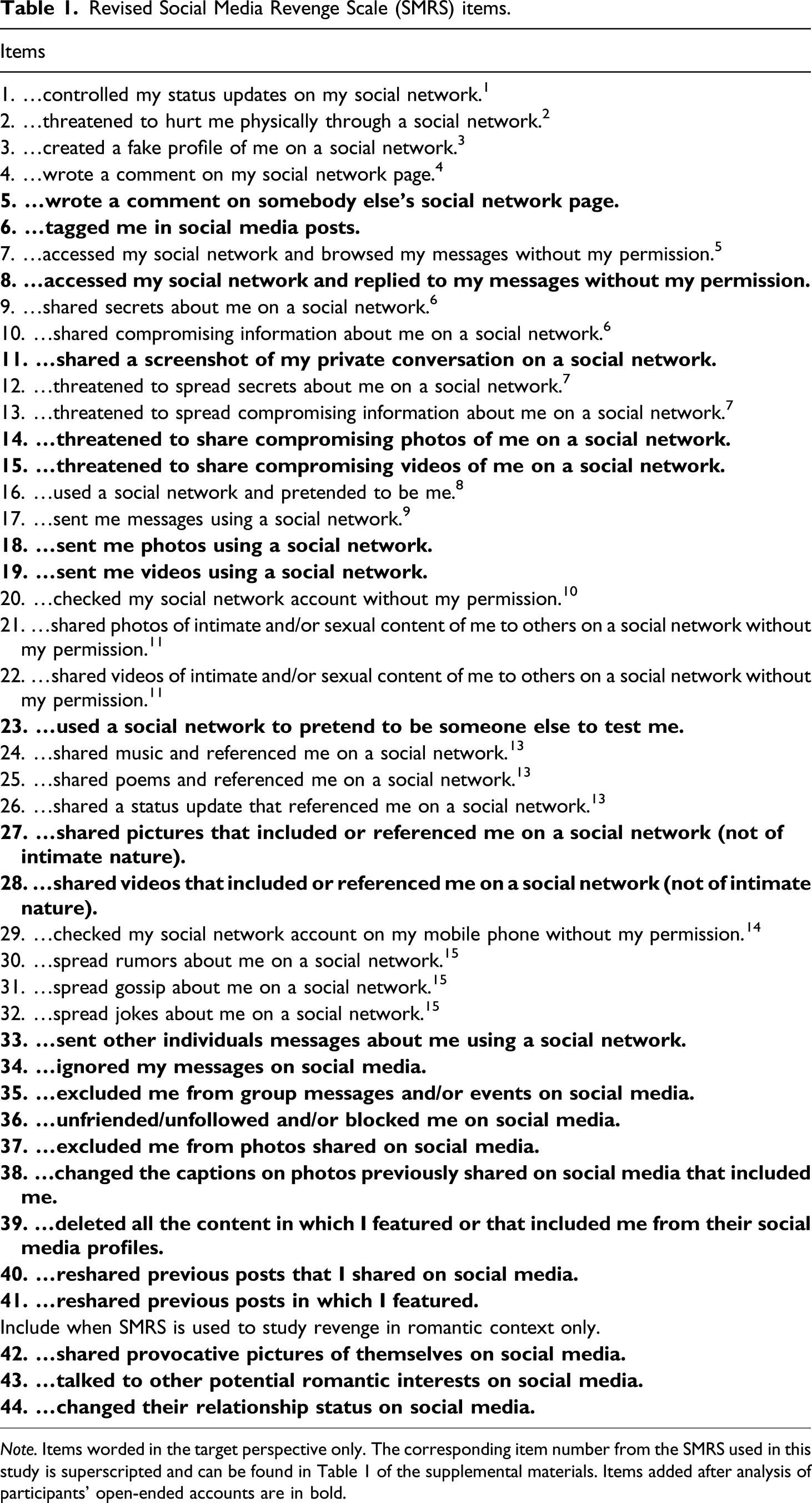
Note. Items worded in the target perspective only. The corresponding item number from the SMRS used in this study is superscripted and can be found in Table 1 of the supplemental materials. Items added after analysis of participants’ open-ended accounts are in bold.
Discussion
We designed the present study to explore how frequently people encounter social media revenge as its target, avenger, or observer; determine whether social media revenge occurs with equal frequency in four important classes of personal relationships; and investigate whether such acts are more likely to take the form of control and monitoring behavior or direct aggression. Having adapted a measure of cyber-aggression in dating relationships for use in assessing the frequency with which social media revenge occurs, we also sought to expand our understanding of the range and kind of behaviors people use to take revenge via social media.
On the frequency of social media revenge
Our findings suggest that, high profile instances like the Matthew Herrick case notwithstanding, social media revenge may occur comparatively infrequently. Overall, reported frequencies suggested that participants had never experienced or observed such behaviors or had not done so in the last year (M = 1.6, SD = 0.5). Importantly, this was true whether we considered participants’ reports of the frequency of revenge acts they had themselves perpetrated, acts in which they had been the targets of others’ vengeful actions, or acts they had witnessed/heard about.
Given social media’s ubiquitous presence in most people’s lives and how simply and easily revenge can be enacted via social media, we were somewhat surprised that participants did not report that they had encountered acts of social media revenge more frequently than they did. At the same time, the broader literature on revenge suggests that people are far more likely to consider getting even—or to desire revenge—than they are to act on such thoughts or desires (Crombag et al., 2003; Yoshimura & Boon, 2021). The present findings may reflect this broader tendency for people to resist impulses to avenge themselves for perceived wrongs far more often than they succumb to them (cf. Boon et al., 2017). Widely publicized accounts of social media revenge may lead to the perception that such events are more common than they actually are (Tversky & Kahneman, 1973).
Despite generally low reported frequencies of incidents of social media revenge, there was nevertheless significant variation across role in the reported prevalence of this behavior. Specifically, participants reported observing social media revenge more often than being its target and being the target more often than the avenger. Participants’ tendency to report that they had been on the receiving end of social media revenge more often than they had been on the performing end may reflect a self-serving bias. In the North American context where we conducted this research, revenge is generally considered deviant and counter-normative and those who engage in revenge are generally viewed as petty and vindictive (Uniacke, 2000). Participants may have been motivated to under-report the frequency with which they had engaged in such behavior.
The pattern of differences may also be at least in part attributable to the fact that, in recalling instances in which they were the observer or target of social media revenge, participants could draw on a larger pool of events in comparison with recalling instances in which they were the avenger. In recalling instances in which they were the avenger, participants were limited to those acts that they, themselves, had performed. When recalling instances in which they were a target or uninvolved observer, they could recall acts performed by multiple avengers.
Future research is needed to determine the extent to which the pattern observed here is best explained in motivational terms or with respect to the size of the pool of eligible avengers whose actions may be considered. In any event, an important implication of our findings is that scholars wishing to investigate social media revenge ought to plan on recruiting large samples, particularly so if they wish to investigate such acts from the perspective of those who enact them.
More generally, our results suggest that, from a mere prevalence perspective, social media revenge may affect comparatively few people directly (i.e., few will either engage in such behavior or be its target). Of course, this assertion is based on investigation of social media revenge as it occurs in important personal relationships. It is unclear whether it applies to acts involving strangers. Additionally, the frequencies we report here are based on a measure that, as our analysis revealed, is incomplete. Prevalence estimates may be higher using an expanded scale that includes the other, novel behaviors our analysis identified as well as a response scale more sensitive to lower frequencies of revenge behaviors such as in the revised SMRS (see supplemental materials).
Does prevalence vary across relationship type and type of revenge?
In answer to RQ2a through 2c, our findings suggest that the prevalence of social media revenge may depend on the relational context in which it occurs and the kind of action it entails. Specifically, mean frequencies were higher for control and monitoring behaviors than direct aggression among participants assigned to the romantic and family conditions, whereas the opposite was true among participants assigned to the coworker condition. Though it mirrored the pattern observed in the coworker condition, the difference was nonsignificant among participants in the friendship condition.
One possible explanation for this rather complex pattern of differences is that certain relationships afford particular opportunities to a greater degree than others. As mentioned in the introduction, individuals typically require access to a target’s social media account(s) to take revenge via control and monitoring behaviors. To access a target’s social network and browse their messages without their permission, for instance, an avenger must know the target’s social media password or have access to the target’s account through their phone or computer. Because of the nature of their relationships and the environment in which their interactions primarily occur, coworkers in particular may have less access to each other’s passwords and phones and thus be less free to engage in control and monitoring behaviors than those considering retaliating against a family member or romantic partner.
Our finding that participants in the romantic partner condition reported more frequent control and monitoring behavior than direct aggression is consistent with Borrajo et al.’s (2015) findings regarding cyber dating abuse in romantic relationships. More research is needed to understand the reasons individuals may prefer control and monitoring behaviors over direct aggression in romantic relationships, but one possibility is that, in comparison with direct aggression, control and monitoring behaviors afford more plausible deniability and therefore involve less risk of damaging the relationship between avenger and target. Given the high value many individuals in western cultures place on romantic relationships and the fact that romantic relationships in this culture are voluntary rather than ascribed, individuals contemplating vengeance in response to wrongdoings may be willing to tolerate less risk of harm to their relationships when the target is a romantic partner rather than a friend, family member, or coworker. We note here, however, that this explanation does not account for the fact that we observed the same difference in family relationships.
We suspect that the lack of difference in the reported prevalence of the two types of revenge among participants thinking of friendships may be due to a combination of factors. On the one hand, friendships are again voluntary relationships, a fact that might raise the stakes associated with engaging in more overt acts (i.e., direct aggression) and thus lead friends to prefer the subtler, more covert tactics available in control and monitoring behaviors. At the same time, friends may have fewer opportunities to engage in control and monitoring behaviors than in direct aggression because they may spend less time with each other and are less likely to live with each other than romantic partners or family members. Therefore, although they may wish to engage in control and monitoring behaviors to preserve their friendship, direct aggression behaviors that do not require access to the target’s social media account might be easier for friends to execute than control and monitoring behaviors. In other words, friends may face competing pressures that cancel each other out so that both types of revenge occur approximately equally often in friendships.
As a final remark, it is worth noting that participants in the friendship condition reported the highest frequency of experience with/exposure to social media revenge of participants in any relationship condition. This is likely a function of the fact that friends outnumber other types of relational partners among most people’s social media contacts. In any case, it stands in contrast to previous findings in the broader revenge literature. Boon and Yoshimura (2014) found that revenge in family contexts may be more common than revenge in romantic contexts or between associates (i.e., friends and coworkers). Consequently, our findings highlight a noteworthy discrepancy between social media revenge and revenge that occurs outside of social media.
On the nature of revenge, social media style
As we discussed previously, our analysis of participants’ accounts of social media revenge resulted in the identification of a range of novel behaviors. Researchers can use this information to measure social media revenge in a more comprehensive fashion in future studies. Here we consider the broader question concerning whether social media revenge involves behaviors that differ substantively from those employed offline (or online but not using social media) to retaliate for perceived wrongs or whether the difference lies in the medium used rather than in the nature of the behaviors themselves.
Based on the present data, we suggest that social media revenge behaviors are not fundamentally different from the behaviors people employ to exact revenge in other spheres of life. Many acts in the revised SMRS involve behaviors with clear non-social media counterparts. For example, avengers can share a secret about the target with others as means to get even without employing social media for that purpose. Other behaviors in the revised SMRS may take a somewhat different form over social media (e.g., unfriending/unfollowing a target) but, fundamentally, reflect broader categories of behavior that can occur through other means (i.e., social exclusion in this instance) or can be performed through other electronic means (e.g., Email, text messaging). Sharing screenshots of private conversations and resharing posts fall into this latter category in that they can be achieved by sharing the content of emails, text messages, etc.
This conclusion leads us to suggest that the real difference between social media revenge and revenge accomplished via other means (with the possible exception of revenge perpetrated via email and equivalents) lies in its ease, accessibility, reach, and durability. Getting even with a relational partner over social media can be as simple as clicking on the share button of a post. Because individuals are connected 24/7 and regardless of geographic distance, there are few temporospatial constraints on when, where, or with whom we may get even on social media. Revenge perpetrated via social media may be public and, when it is, it may be shared and spread well beyond the confines of either the avenger’s or target’s social circles. It may even “go viral.” And it may exist in some location in cyberspace in perpetuity and thus be “resurrected” at a later point in time to be shared again. Few of these characteristics are true of revenge as enacted through non-social media means. The implications of these unique characteristics warrant continued investigation of social media revenge.
Strengths, limitations, and future research
We cast a broad net in this study, examining the prevalence and nature of social media revenge in the context of several classes of personally significant relationships and as experienced by targets, avengers, and observers. Our findings thus offer a broad view of the frequency with which this important behavior occurs across a range of types of relationships and roles in the revenge episode. Our mixed method design also enabled us to identify novel social media revenge behaviors not captured by the measure we adapted for use in this study as well as ways measurement might be improved in future research (see supplemental materials). The revised SMRS will enable a more comprehensive assessment of social media revenge while maintaining flexibility of use: It can be used in a variety of relational contexts to assess the frequency of an extensive array of social media revenge behaviors from the perspective of those occupying different roles in the episode.
Our study also has its limitations. Chief among these is the fact that our data were collected in 2017. Social media platforms and the cultures and norms surrounding their usage change over time (Lampe et al., 2008). Whether our findings reflect the current prevalence and practice of social media revenge is an empirical question. We must also be cautious assuming that our results would generalize to other cultures, older adults, or children/youth given our North American, primarily undergraduate sample. Additionally, we did not collect data concerning participants’ sexuality, disability, or socioeconomic status and therefore cannot speak to whether variation along these dimensions might have revealed nuances in our results. Future research should explore this possibility.
Social media revenge varies, too, with the platform employed. Social media platforms differ in their user bases and frequency of use (e.g., Instagram is more popular among younger individuals; Pew Research Centre, 2019), the type of content users can/typically post, and users’ motivations for using them (Alhabash & Ma, 2017). We assessed the frequency of social media revenge without reference to the particular platform on which it occurred. Researchers may wish to conduct more targeted studies that explore the possibility that platform may matter in important ways we have not considered here.
Finally, although our data suggest that social media revenge occurs rather infrequently, it would be unwise to conclude that its low prevalence implies that such behavior poses only a small problem to the parties involved and the relationships in which such acts occur. Future research should build on our study to investigate the consequences of social media revenge. As the Matthew Herrick case illustrates, a single act of social media revenge can have profound impacts on an individual’s personal and professional life.
Conclusion
Social media use has exploded in recent years, with users now spending more than two hours a day across platforms on average (Chaffey, 2020). This study offers a necessary descriptive base concerning how these platforms are most often used to exact revenge in important personal relationships. Our findings lead us to suggest that the difference between revenge as it occurs on social media and revenge accomplished via other means lies in its ease, accessibility, reach, and durability rather than in the type of behaviors enacted. We also highlight the need for and suggest ways to support the development of a research tool designed to capture the nuances in this new, widely accessible, and potentially long-lasting form of revenge.
Supplemental Material
Supplemental Material - Revenge via social media and relationship contexts: Prevalence and measurement
Supplemental Material for Revenge via social media and relationship contexts: Prevalence and measurement by Mélanie Paulin and Susan D. Boon in Journal of Social and Personal Relationships
Footnotes
Acknowledgments
The authors would like to thank Prakriti Sharma, Jessica Hsieh, Sara Mallet, Katharina Wenzel, and Melanie Moca for their assistance in data collection, and Kamalpreet Dhillon, Gemma Reynolds, Genevieve Bianchini, and Felipe Triana for their assistance with content coding.
Author notes
Portions of this paper were presented at both the 2018 CyberPsychology, CyberTherapy and Social Networking conference in Gatineau, QC, June 26–28 and at the 2018 meeting of the International Association for Relationship Research in Fort Collins, USA, July 12–16.
Funding
The author(s) received no financial support for the research, authorship, and/or publication of this article.
Open research statement
As part of IARR’s encouragement of open research practices, the authors have provided the following information: This research was not pre-registered. The data used in the research are available. The quantitative data can be obtained by emailing: 
Supplemental material
Supplemental material for this article is available online.
Notes
References
Supplementary Material
Please find the following supplemental material available below.
For Open Access articles published under a Creative Commons License, all supplemental material carries the same license as the article it is associated with.
For non-Open Access articles published, all supplemental material carries a non-exclusive license, and permission requests for re-use of supplemental material or any part of supplemental material shall be sent directly to the copyright owner as specified in the copyright notice associated with the article.
