




Abstract
The current study examined children and adolescents’ hypothetical responses to hearing negative or positive gossip shared by a friend or a classmate that targeted either a friend or a classmate. Participants (N = 134, ages 8–16) read eight stories and were asked to take the perspective of the gossip listener and indicate how they would respond, a 2 (valence: negative or positive) × 4 (relationship type: friend or classmate of the sharer and target) design. Participants’ responses to how they would react were coded as encouraging, neutral, or discouraging. The findings showed that negative gossip shared by a classmate that targeted a friend had more discouraging responses than negative gossip shared by a friend targeting a classmate. Furthermore, positive gossip shared by a friend that targeted another friend had more neutral responses than positive gossip shared by a classmate that targeted a friend or another classmate, which had more encouraging responses. Age and gender differences revealed that adolescents provided more neutral responses overall, compared to children, and girls provided more discouraging responses for negative gossip than boys. This study provides information on how children and adolescents think they should respond to gossip. This can help school professionals address neutral attitudes toward gossip and prevent engagement in gossip behavior.
Introduction
Gossip is a form of interpersonal communication that involves a discussion between two people about an absent third-party. It allows individuals to learn about social norms without having to directly observe the behavior. The spreading of this information may come at a reputational cost for the target, if the gossip is negative. However, positive gossip may enhance the target’s image (Baumeister et al., 2004). It is during middle childhood and adolescence, a time where youth are particularly impressionable to changes in social status among their friends and school peers, that reputations have lingering effects socially and psychologically (e.g., Morison & Masten, 1991).
Engaging in gossip is often reserved for friends and people we are close enough with to comfortably express our opinions to (Altman & Taylor, 1973). Targets include those we are often surrounded by (e.g., Wargo Aikins et al., 2017), and this creates the potential for gossip not only involving peers, but within a friend group. While research with adults has shown that the gossip listener’s perception of the gossip sharer varied depending on their relationship to them and the gossip valence (i.e., negative or positive evaluation; Turner et al., 2003), research has not examined how this affects the listener’s reported reaction to gossip. Furthermore, among youth, it remains unknown how the added factor of the listener’s relationship with the target affects how listeners would respond to hearing gossip. While there may be gender differences in the transmission of positive gossip among girls and boys (McGuigan & Cubillo, 2013), research has not examined gender differences in the transmission of negative gossip in middle childhood, compared to adolescence, a period where gossip behavior peaks (Mettetal, 1983). Together, this indicates that there is a gap in the literature. Research has not yet investigated the relationship between the sharer, listener, and target, and the role of gossip valence in the listener’s decision to further share or interfere with the transmission of gossip developmentally and across gender. Among children and adolescents, this is important because listeners are in the position to spare the target from social rejection amidst the social pressures of gaining peer acceptance in school (Gottman & Mettetal, 1986). The listener’s relationship with the sharer and target, and the gossip valence may influence their willingness to broadcast the message or protect the target by helping to stop the information from circulating.
Characteristics of gossip
Gossiping involves sharing an evaluation or opinion to another person about a non-present individual (Foster, 2004). Contemporary research has continued to define gossip this way (e.g., Alicart et al., 2020; Engelmann et al., 2016; Lee & Barnes, 2020), and so has the current study. An essential part of the gossip definition is the absence of the target. In fact, the absence of a target is what differentiates gossip from direct bullying, where the hurtful acts are overtly directed to the target and to their knowledge (e.g., kicking, threatening; Foster, 2004; Olweus, 1993). Gossip, however, is often associated with being a form of social or indirect aggression (Archer & Coyne, 2005). As a form of covert social aggression, it involves the manipulation of other people to harm the target behind their back (Cairns et al., 1989). It is up to the listener to decide what to do and whether or not to interfere with the spreading of the information. Individuals witnessing bullying and gossip listeners are put in a similar bystander-type role, where they can choose to intervene by helping the target, asking the perpetrator/sharer to stop, joining the perpetrator/sharer, or doing nothing (e.g., Leaper & Holliday, 1995; Trach et al., 2010).
Although the word gossip often has a negative connotation, there may be more to gossip than it appears, and it may not always be a form of social aggression (Baumeister et al., 2004). Gossip can also be positive. It can be used to talk about someone in an encouraging way, praising a positive social behavior (e.g., helping an elderly person; Anderson et al., 2011) or discussing good news about someone (e.g., receiving an award; McAndrew et al., 2007). Although pointing out someone else’s bad behavior is an effective way to inform others about norm violations, gossiping about behaviors in a positive light can provide support for what is viewed as socially appropriate behavior (Baumeister et al., 2004). Therefore, both negative and positive gossip have valuable social functions through the exchange of information.
Gossip in children and adolescents
Gossip plays a vital role in individual, group, and relationship development throughout childhood (Kuttler et al., 2002). Gossip permits children and adolescents to make social comparisons with others, which allows them to better understand themselves (Gottman & Mettetal, 1986; Wert & Salovey, 2004). Consequently, at the group level, this offers information on what are considered socially acceptable behaviors (e.g., McDonald et al., 2007; Wargo Aikins et al., 2017) and how to gain more liking from peers (Eder & Enke, 1991). Gossip also has the ability to increase a sense of closeness, allowing children and adolescents to strengthen their relationships and maintain a solid support system with their friends (Gottman & Graziano, 1983). Therefore, gossip has a strong presence in several aspects of children and adolescents’ social lives.
Signs of gossip behavior begin to emerge in preschool (e.g., Engelmann et al., 2016). Gossip then becomes a regular behavior by middle childhood and increases into adolescence (Mettetal, 1983). Middle childhood is an important time because children are faced with learning to navigate how to gain peer acceptance (Parker & Asher, 1993). As such, during middle childhood, gossip serves to establish belonging to a group, define behavior norms, and understand what are considered socially acceptable behaviors (Gottman & Mettetal, 1986). Fine (1986) argued that during adolescence, gossip provides “a map of social scene” (p. 408). With the transition to a new school, adolescents have to adjust a new social hierarchy that has developed among a new group of peers (Brown & Klute, 2006). This creates new opportunities for upward and downward social comparisons, using negative and positive gossip (Gottman & Mettetal, 1986; Wert & Salovey, 2004). As such, gossip plays an essential role in adolescents learning more about themselves (Gottman & Mettetal, 1986). Overall, the school environment contributes to how gossip plays a unique role in middle childhood and adolescence. Being a target of indirect aggression in school can have serious consequences for targets (e.g., depression, anxiety, loneliness, low self-esteem; Archer & Coyne, 2005). Therefore, in order to prevent the spread of hurtful gossip in schools during this critical developmental period, it is important to understand what type of gossip is likely to be transmitted and who is likely to be targeted.
Sharing gossip and friendship
According to Social Penetration Theory (Altman & Taylor, 1973), personal information is shared among people who have developed a meaningful relationship. Related to gossip, comments about others are often reserved for people individuals feel close to (Yerkovich, 1977). Thus, gossip is often received favorably when shared among friends (e.g., Eder & Enke, 1991).
There are different qualities that characterize friendships across development. Gottman and Mettetal (1986) divided friendships across development into three periods: ages 3 to 7, ages 8 to 12, and ages 13 to 18. During ages 3 to 7, young children build friendships through coordinated play, demanding different levels of cooperation. During middle childhood (ages 8 to 12), peer acceptance takes precedence. When social groups begin to form in school, children begin to become concerned about peer rejection and a sense of belonging. For adolescents (ages 13–18), there is a focus on building deep relationships with friends. Verbal communication is at a high and much of their time spent talking with friends consists of conversations about their personal thoughts and feelings, possibly increasing the chances of gossip engagement. Thus, as friendships grow deeper with age, adolescents engage in more intimate disclosure. This might suggest that adolescents may be more likely to be hurt by their friends’ harmful behaviors directed toward themselves and other friends. Still, it remains unknown how children compared to adolescents would act when faced with gossip involving their friends.
While research has shown that gossip among friends is common and supported (e.g., Eder & Enke, 1991), less research has focused on responses to gossip based on the relationship with the gossip target (e.g., McAndrew et al., 2007), especially among youth. Gossip is Person A sharing evaluative information to Person B about absent Person C (Foster, 2004). Therefore, in order fully to comprehend this complex social phenomenon, research must consider the relationship between all three individuals as well as the gossip valence. The additional factor of who the target is must be included in order to provide a more accurate picture of gossip behavior.
Responding to gossip
When hearing gossip, there are various ways one can respond to it. This may include passing on the information to someone else, being passive, defending the target, or asking the sharer to stop spreading the information (e.g., Leaper & Holliday, 1995; McGuigan & Cubillo, 2013). There has been one study with adults that examined reactions to negative and positive gossip shared between friends. Five reactions were identified when discussing people participants appeared to know: discouraging responses (e.g., telling the sharer they did not want talk about that), neutral responses (e.g., ignoring the comment), mildly encouraging responses (e.g., briefly acknowledging the statement), moderately encouraging responses (e.g., asking a follow-up question), and highly encouraging responses (e.g., elaborating on the gossip statement). The findings showed encouraging responses were more common than neutral or discouraging responses, regardless of valence (Leaper & Holliday, 1995). While the use of negative and positive gossip differs among children and adolescents (Gottman & Mettetal, 1986), the developmental patterns in responding to negative and positive gossip remain unknown.
The continued transmission of a piece of information to another person was not a category of response included in Leaper and Holliday’s (1995) research. However, McGuigan and Cubillo (2013) found that positive gossip statements initiated by the experimenter were more often transmitted, compared to fact statements among 10- and 11-year-olds. While this study used the experimenter as the source of the gossip and a teacher as the target, research with children and adolescents should shift their focus to friends and peers (i.e., people they encounter frequently) as sharers and targets. In addition, studying negative gossip statements would also be important in providing information on the magnitude of gossip transmission.
Reporting the sharer’s behavior to the target may be another response research should consider. A frequent behavior among young children especially, tattling consists of announcing and reporting another peer’s negative behavior to an adult. This type of disclosure is used as a strategy for children to navigate the disapproval of certain social behaviors (Ingram, 2019). However, it remains unknown if children and adolescents would report the behavior in question to the person involved (i.e., the gossip target) as a way to interfere with the transmission of gossip. This option would be unique to gossip, an indirect form of bullying, where the target is not aware about what is being said about them (Foster, 2004).
The role of relationships
Both the gossip valence and the relationship to the target can play an important role in deciding what information is kept versus shared in adults. Adults reported being more interested in spreading negative gossip about nonfriends. When friends were targets, they would pass on positive gossip, but not negative gossip (McAndrew et al., 2007; McAndrew & Milenkovic, 2002). Although research on gossip and relationships among youth is lacking, bullying research has shown that relationships to the perpetrator and target were important for bystanders throughout development (e.g., Thornberg et al., 2012). Children and adolescents (ages 9 to 15) acknowledged their likelihood of intervening would be higher if the victim were a friend (Thornberg et al., 2012). In another study, 10- to 13-year-olds reported they would remain passive if the victim were a neutral acquaintance (Lodge & Frydenberg, 2005). Children and adolescents also reported being less likely to intervene (Thornberg et al., 2012) and sometimes actually support a bully if they were friends with the bully (Lodge & Frydenberg, 2005). Gossip is not often shared among strangers (Ayres, 1979) and research has shown that children and adolescents reported defending friends who were victimized (e.g., Thornberg et al., 2012). As such, we expected that participants who heard a classmate sharing negative gossip about a friend would interfere with the gossip more than when a classmate gossiped negatively about another classmate, and when a friend gossiped negatively about another friend or classmate (H1; Valence × Relationship Type interaction). According to these aforementioned studies, it is clear that for both children and adolescents, friends and nonfriends are treated differently when they are targets of aggression. However, reactions to positive gossip involving friends and classmates remains unknown and may differ from negative gossip.
A challenging predicament can certainly be created when a friend is a target of another friend’s gossip and research should help shed light on how children and adolescents would respond to these socially complex situations. As such, our next hypothesis is an exploratory developmental hypothesis about gossip within a friend group. We expected that, compared to children, adolescents would be more likely to interfere with negative gossip shared by a friend that targeted another friend (H2; Valence × Relationship Type × Age Group Interaction). One option adolescents would likely choose is talking to the sharer because of their more frequent verbal communication with friends (Gottman & Mettetal, 1986). We expected they would feel more comfortable voicing their disapproval to their friend about the negative discussion surrounding their other friend.
Developmental differences
When given the opportunity to intervene against a negative behavior, compared to adolescents, children in middle childhood were more likely to take positive active roles (e.g., asking a bully to stop, helping the victim). Adolescents were less likely to cause any sort of interference and do nothing (Trach et al., 2010). Furthermore, older children (ages 10–12) were less likely to tattle, compared to younger children (ages 6–9; Talwar et al., 2016). This is because reporting behaviors to adults is viewed negatively and can have negative social consequences during adolescence (Friman et al., 2004). There is more pressure during adolescence to follow what they believe are appropriate social norms and this may be contributing to adolescents’ non-active intervention style (Pöyhönen et al., 2010). Therefore, we predicted that adolescents would provide more passive responses to gossip, compared to children (H3; main effect of Age Group). In order to uncover if this passive behavior is a consistent reaction pattern among adolescents that extends to witnessing gossip, responses to both negative and positive gossip need to be investigated.
Gender differences
Gender patterns appear inconsistent when considering how girls and boys interfere with aggressive behavior. Some tattling research has shown no gender differences in childhood (Loke et al., 2011; Talwar et al., 2016) and throughout adolescence (Friman et al., 2004), while another study showed girls were more likely to report a bullying incident to an adult (Trach et al., 2010). Moreover, girls were inclined to use more active responses such as confronting the bully or tending to the victim (Bellmore et al., 2012; Trach et al., 2010). Boys, on the other hand, were more likely to do nothing (Trach et al., 2010). As such, we hypothesized that girls would interfere with negative gossip more than boys (H4; Valence × Gender interaction). While research with adults has examined gender differences in responses to gossip (e.g., Leaper & Holliday, 1995), this has not been investigated among youth. Negative or positive gossip may lead to different responses for boys and girls. This information would provide insight as to what types of interventions should be targeted toward boys versus girls.
The current study
The purpose of this study was to examine how gossip valence (i.e., negative or positive) and the listener’s relationship to the sharer and the target influenced how children would react to gossip in hypothetical scenarios. Children and adolescents were presented with stories that included either a negative or positive evaluation of a target. Furthermore, to examine how relationships affected participants’ reactions as the gossip listener, their relationship to both the sharer and target was either a friend or an unfamiliar classmate. This included gossip shared by a friend that targeted another friend (sharer-friend, target-friend condition), gossip shared by a friend that targeted a classmate (sharer-friend, target-classmate condition), gossip shared by a classmate that targeted another classmate (sharer-classmate, target-classmate condition), and gossip shared by a classmate that targeted a friend (sharer-classmate, target-friend condition). Developmental differences were examined according to age group (child/adolescent), given the important developmental changes in gossip behavior and friendship characteristics (e.g., Gottman & Mettetal, 1986). This data was collected in Montreal, Quebec, where middle school and high school are combined. Together, they are known as secondary school and span across 5 years (grades 7–11; Robson, 2019). Therefore, we chose not to split adolescence into two smaller categories. Finally, gender differences in gossip behavior have been debated in the past (e.g., McGuigan & Cubillo, 2013; Wang et al., 2012), however, less is known about gender differences in responses to gossip across valence and relationships. Therefore, this study will address the following research question: how do valence, relationship type, age, and gender influence the extent to which children and adolescents interfere with the transmission of gossip in hypothetical scenarios? Overall, this study is the first to examine developmental and gender differences in children and adolescents’ reported reactions to gossip across valence and relationships.
Method
Participants
This study had 134 participants (ages 8–16, M = 11.77 years, SD = 2.193). The sample size was estimated using the G*Power program with a medium effect size (ηp 2 = 0.06, α = .05, power = .80). We divided participants into two groups based on their age. Children were between the ages of 8 and 12 (n = 77, M = 10.23, SD = 1.337) and were in elementary school. Adolescents were between the ages of 13 and 16 (n = 57, M = 13.84, SD = 1.177) and were in high school. There were no 12-year-olds who were in high school or 13-year-olds who were in elementary school. Furthermore, no differences were found in age across gender in the child group, t(75) = .45, p = .562, and adolescent group, t(55) = .02, p = .285. Participants were recruited from the university’s research database and lived in the Montreal area. Families reported their ethnic/cultural background (see Online Appendix A1), household income (see Online Appendix A2), and level of education (see Online Appendix A3).
Measures
Demographics
Parents of participants were asked to report their ethnic/cultural background, household income, and level of education in a demographic questionnaire. The ethnic/cultural background question was open-ended, whereas the household income and level of education questions were multiple choice.
Vignette design
Participants were presented with eight vignettes that were developed for the purpose of this study and depicted gossip scenarios taking place in a school setting (see Online Appendix B). The vignettes were gender matched with the participant by replacing the names of the story characters and pronouns. The study was piloted with a few children and adolescents throughout our age range to make sure the scenarios were applicable to all. All participants indicated that the scenarios were typical of experiences at school. The gossip scenarios contained either a negative (Cronbach’s α = .63) or positive evaluation (Cronbach’s α = .62) of the target (Valence: negative or positive). Furthermore, the listener was either a friend or an unfamiliar classmate of the sharer and target (Relationship Type: friend or classmate of the sharer and target), a 2 × 4 experimental design. Given that research has only demonstrated broadly that behaviors are commonly gossiped about (e.g., McDonald et al., 2007; Wargo Aikins et al., 2017), our vignettes were designed to explore two different categories of behaviors. We labeled the categories as followed: the target’s behavior type was either an individual act that had consequences for the target only (e.g., getting the lead role in the school musical; getting in trouble for vandalism) or a relational act that had consequences for another peer (e.g., taking an injured student to the nurse; interrupting another student’s presentation; Target Behavior Type: individual or relational act). Used as a between-subjects factor, participants were randomly assigned to one of the Target Behavior Type conditions.
Vignette question
From the perspective of the listener, participants were asked how they would respond to hearing gossip in each scenario by selecting one of the five options presented to them. These five options were the same regardless of valence. Participants were asked if they would report the behavior by telling the target someone was talking about them (tell the target), express displeasure to the sharer about the information being shared (tell the gossip sharer to stop), continue to share the gossip (spread the information), avoid engaging with the gossip shared (do nothing), or other (specify).
Coding of listener responses
For each participant, the one answer they selected per vignette was re-coded into one of the following categories: discouraging, neutral, or encouraging. This was done to identify to what extent participants discouraged or encouraged the sharing of the information in each scenario. No participants selected “other” as a response and this response option was subsequently excluded from further coding. The coding for discouraging and neutral responses was based on Leaper and Holliday’s (1995) study, and McGuigan and Cubillo’s (2013) study for the encouraging response. In addition, we included a new response that was also considered discouraging (i.e., telling the target) that has not been included in the gossip literature and was based on tattling research (e.g., Talwar et al., 2016).
The listener’s response score ranged from 0 (discouraging) to 2 (encouraging) per vignette. A discouraging response was defined as an act that intended to cause some interference with gossip transmission (i.e., tell the sharer to stop, tell the target) and was given a score of 0. Next, a neutral response was defined as the intent to be passive and do nothing with the information (i.e., do nothing) and was given a score of 1. Finally, an encouraging response was defined as the intent to transmit the information to someone else (i.e., spread the information) and was given a score of 2.
Procedure
The institution’s ethics review board approved this study. At their appointment, parents completed a consent form on behalf of their child and a demographic questionnaire. Participants were then taken into a separate room in the research laboratory to complete the study.
Before reading the stories, the researcher asked for the participant’s verbal assent. Participants were randomly assigned to read the individual act or the relational act vignettes. After each vignette, participants were asked how they would respond to hearing gossip when taking the perspective of the gossip listener.
Results
The analyses were conducted to examine responses to gossip in hypothetical scenarios among children and adolescents. Participants’ responses were coded on a scale from discouraging to encouraging. Preliminary analyses using a five-way mixed ANOVA (within-subjects factors: Valence and Relationship Type; between-subjects factors: Age Group, Gender, and Target Behavior Type,) revealed that the Target Behavior Type variable (an individual act with consequences for only the target versus a relational act with consequences for another) showed no differences. Therefore, the vignettes were collapsed for the final analyses. We then ran a four-way mixed ANOVA with Valence (2 levels: negative/positive) and Relationship Type (4 levels: sharer-friend, target-friend/sharer-friend, target-classmate/sharer-classmate, target-classmate/sharer-classmate, target-friend) as within-subjects factors, and Age Group (2 levels: child/adolescent) and Gender (2 levels: boy/girl) as between-subjects factors. Bonferroni corrections at the .05 level were used in all post-hoc analyses and sphericity was assumed. The mean listener response scores as a function of Valence and Relationship Type are presented in Table 1.
Mean (SD) listener response scores as a function of valence and relationship type.
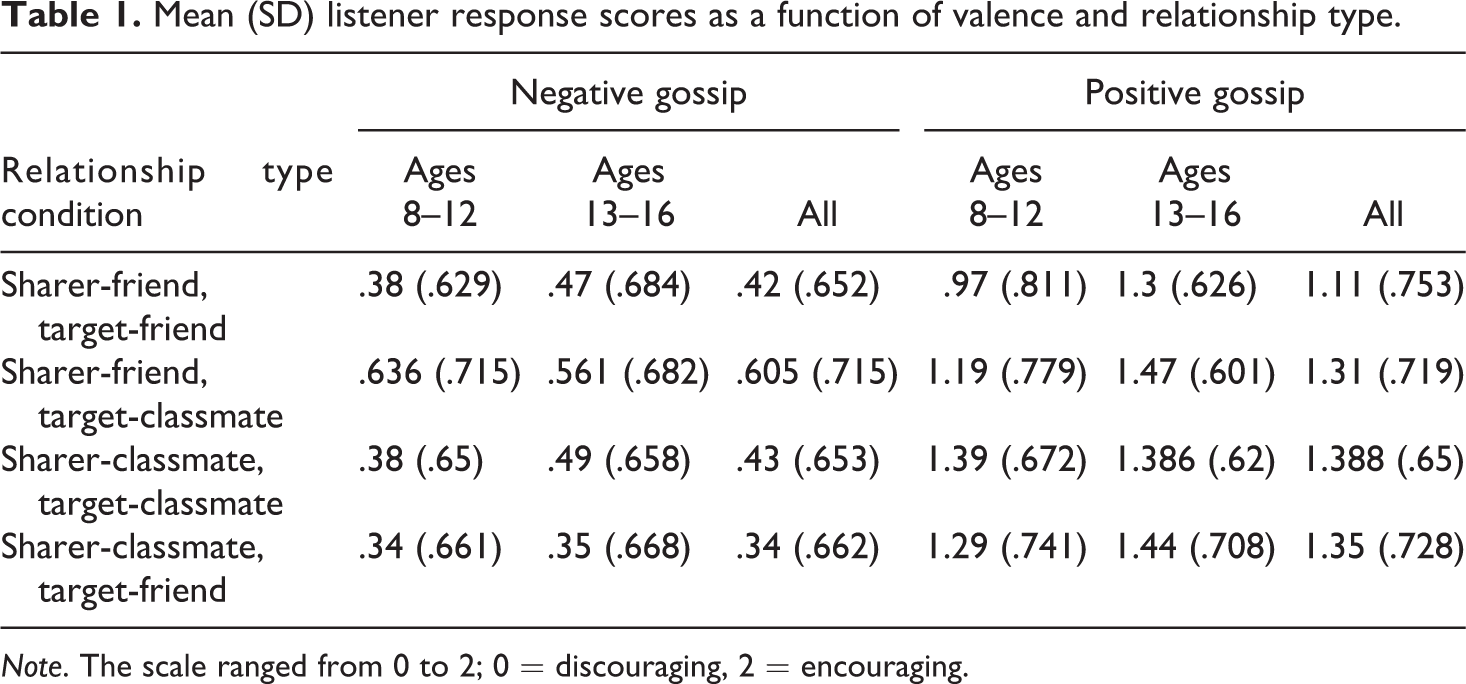
Note. The scale ranged from 0 to 2; 0 = discouraging, 2 = encouraging.
Hypothesis 1
We expected that participants who heard negative gossip in the sharer-classmate, target-friend condition would be more likely to interfere with the information, compared to the other three relationship type conditions. We found a significant Valence × Relationship Type interaction, F(3, 130) = 4.70, p = .003, ηp 2 = .04 (see Figure 1). There was a significant simple main effect of Relationship Type for negative gossip, F(3, 128) = 4.19, p = .007, ηp 2 = .09. In negative gossip scenarios, participants provided more discouraging responses in the sharer-classmate, target-friend condition (M = .35, SE = .06), compared to the sharer-friend, target-classmate condition (M = .61, SE = .06). This only partially supported Hypothesis 1.
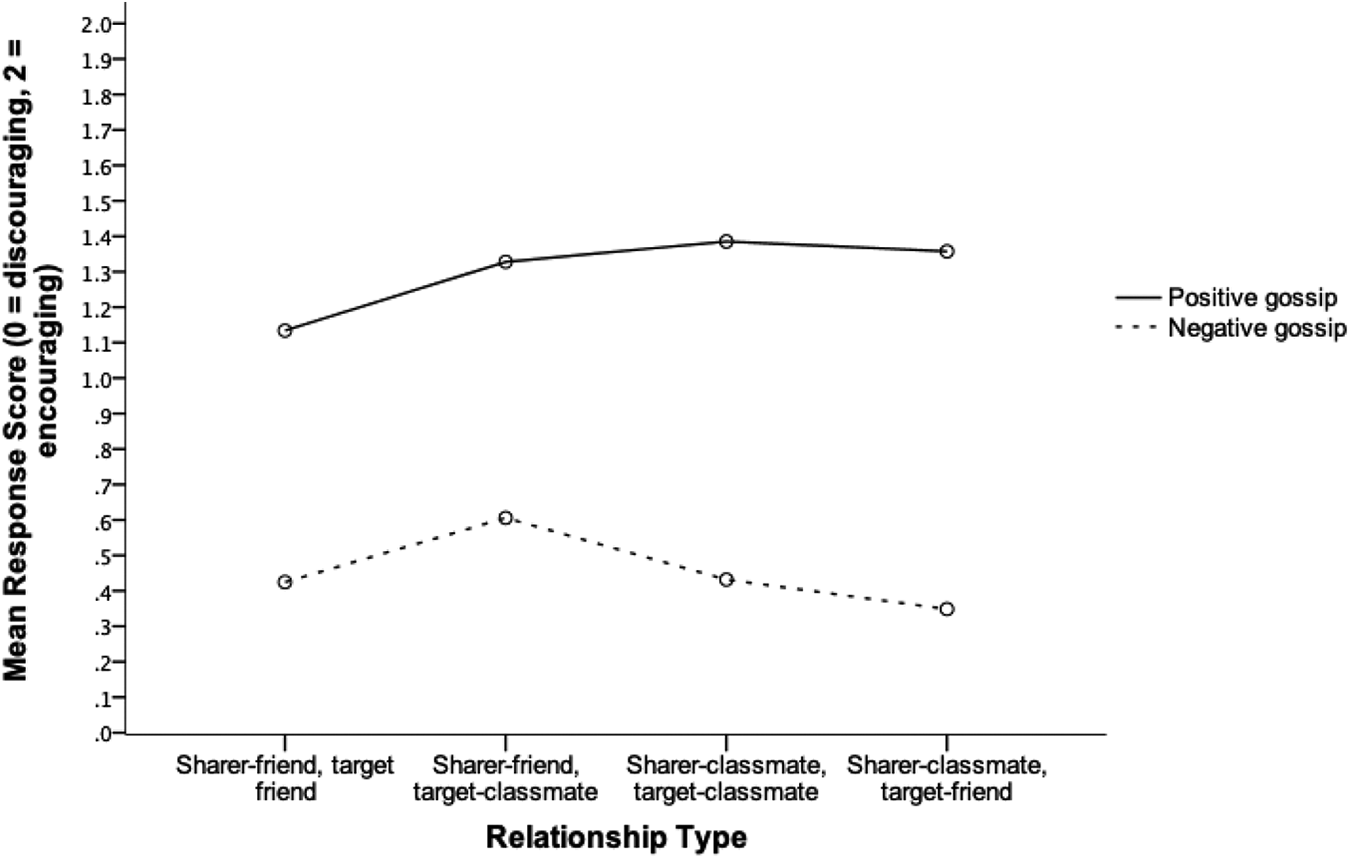
Two-way interaction between valence and relationship type.
Additional findings
Furthermore, there was a significant simple main effect of Relationship Type for positive gossip, F(3, 128) = 4.10, p = .008, ηp 2 = .09. In positive gossip scenarios, participants provided more neutral responses in the sharer-friend, target-friend condition (M = 1.13, SE = .07), compared to the sharer-classmate, target-classmate (M = 1.39, SE = .06), and the sharer-classmate, target-friend conditions (M = 1.36, SE = .06), which had more encouraging responses.
There was also a significant main effect of Relationship Type, F(3, 130) = 4.81, p = .003, ηp 2 = .04. Follow-up pairwise comparisons revealed that, in the sharer-friend, target-friend condition (M = .78, SE = .04), participants provided more discouraging responses, compared to the sharer-friend, target-classmate condition (M = .97, SE = .04).
Furthermore, there was a significant main effect of Valence, F(1, 130) = 215.36, p < .001, ηp 2 = .62. Follow-up pairwise comparisons revealed that participants provided more discouraging responses in negative gossip scenarios (M = .45, SE = .04) than in positive gossip scenarios (M = 1.30, SE = .04).
Hypothesis 2
We hypothesized that adolescents would be more likely to interfere with negative gossip in the sharer-friend, target-friend condition, compared to children. We did not find a significant Valence × Relationship Type × Age interaction, F(3, 130) = 1.86, p = 0.142, ηp 2 = .01. Thus, Hypothesis 2 was not supported.
Hypothesis 3
We predicted that adolescents would provide more neutral responses, compared to children. We found a significant main effect of Age Group, F(1, 130) = 4.17, p = .043, ηp 2 = .03. Follow-up pairwise comparisons revealed that adolescents (M = .94, SE = .04) provided more neutral responses, compared to children (M = .82, SE = .04) who provided more discouraging responses. This supported Hypothesis 3.
Hypothesis 4
We expected girls would interfere with negative gossip more than boys. We found a significant Valence × Gender interaction, F(1, 130) = 6.07, p = .015, ηp 2 = .05 (see Figure 2). There was a significant simple main effect of Gender for negative gossip, F(1, 130) = 9.04, p = .003, ηp 2 = .07. In negative gossip scenarios, girls (M = .33, SE = .06) provided more discouraging responses than boys (M = .57, SE = .06). Therefore, Hypothesis 4 was supported.
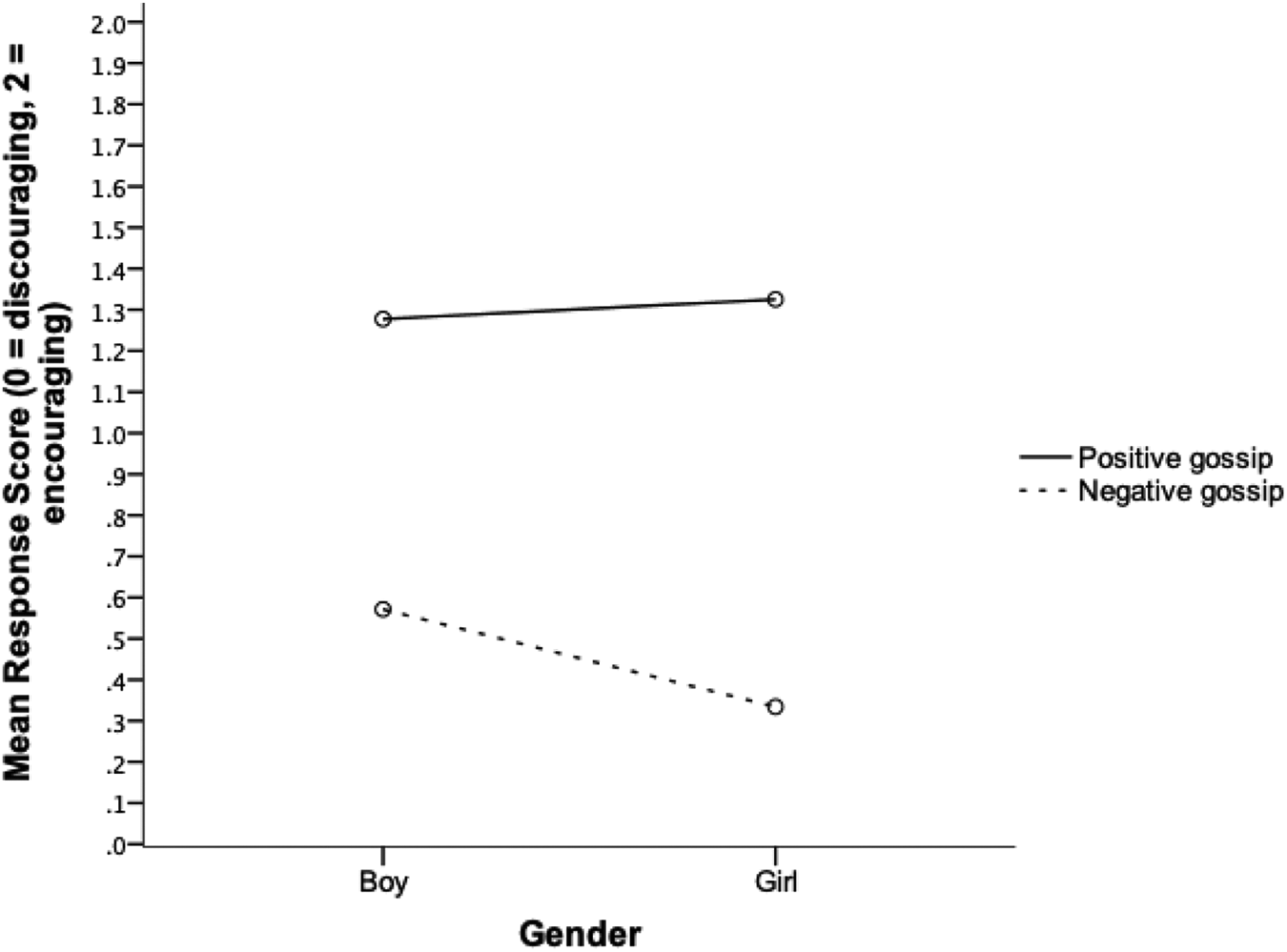
Two-way interaction between valence and gender.
Discussion
The aim of the current study was to explore how valence, relationship type, age, and gender influenced participants’ responses to gossip in hypothetical scenarios. We found that all factors contributed to differences in the listener’s response.
Hypothesis 1
We hypothesized that participants who heard a classmate gossiping negatively about a friend would report interfering with the information more, compared to the other three relationship type conditions. Our results revealed that negative gossip shared by a classmate that targeted a friend had more discouraging responses, compared to negative gossip shared by a friend that targeted a classmate. This only partially confirmed our hypothesis. Research by McAndrew and Milenkovic (2002) demonstrated that adults would not spread negative information about their friends, although they would share negative information about a stranger. In the current study, our results indicate that when a friend shared negative gossip about a classmate, participants did not give the same consideration to the targeted classmate that they gave their friend when their friend was gossiped about negatively by a classmate. Therefore, participants discouraged negative gossip more when their friend was being gossiped about by an unfamiliar peer than when their friend was gossiping about an unfamiliar peer. To our knowledge, ours is the first study to examine how the listener would respond to negative gossip shared by an unfamiliar classmate versus a friend while also considering who the target is. Our results do support bullying research showing that victims who were nonfriends of the bystander were less likely to be helped, compared to victims who were friends with the bystander (e.g., Bellmore et al., 2012). Overall, our results demonstrate that participants strongly protected their friends from negative gossip. Therefore, it should be emphasized by school professionals that students need to be sensitive to all targets, not just their friends, regardless of who shares the information.
Additional findings
Additional findings related to the Valence × Relationship Type interaction showed that positive gossip shared by a friend that targeted another friend had responses that were less encouraging and overall more neutral than positive gossip shared by classmates. Interestingly, this suggests that although friends were talking positively among themselves, listeners chose not to further share the positive information about their friend and instead keep it to themselves. This is contradictory to previous findings by McAndrew and Milenkovic (2002), which showed that friends were more likely to report further spreading positive information about their friends. However, it should be noted that McAndrew and Milenkovic’s study was with adults and also did not manipulate the initial gossip source. Participants in the current study may have questioned the sincerity of the friend who shared positive gossip about another friend. Youth tend to care about their friends’ achievements and successes (Benenson & Bennaroch, 1998), and this may cause jealousy. Therefore, participants may have interpreted the situation as the sharer being jealous. Moreover, listeners may have felt threatened by the positive news about their friend and chose not to spread it. Overall, when a classmate gossiped positively about the listener’s friend, listeners may have been less suspicious of the classmate’s motives.
Additionally, across all gossip scenarios, we found that gossip shared by a friend that targeted another friend had more discouraging responses, compared to gossip shared by a friend that targeted a classmate. This suggests that when the listener heard gossip from a friend, but had no relationship with the target, the listener did not feel it was as necessary to discourage the information. This is consistent with research showing that children and adolescents were less likely to intervene when classmates were targets of verbal aggression (e.g., Bellmore et al., 2012), however, the current study also included positive news about the target. Among children and adolescents, this is the first study to examine their reported responses to negative and positive gossip involving friends and classmates as sharers and targets. This finding suggests that listeners preferred not to discourage gossip shared by a friend that targeted a classmate as much as gossip shared by a friend that targeted another friend.
Finally, we found that participants consistently reported more discouraging responses in negative gossip scenarios than positive gossip scenarios. While previous research has shown that both children and adolescents evaluated negative gossip poorly (Caivano et al., 2020), they also acknowledge their participation in gossip (McDonald et al., 2007; Wargo Aikins et al., 2017). However, the current study differs from previous research in that it asked participants if they intended to actually transmit negative and positive gossip. The results might suggest that participants believed that compared to negative gossip, which can have negative consequences for the target’s reputation (Hill & Pillow, 2006), positive gossip did not have to be interfered with. Perhaps participants felt they would want to share positive gossip more because they knew negative gossip was wrong (Caivano et al., 2020). The decision to further transmit negative gossip could have led them to feel poorly about themselves (Cole & Scrivener, 2013). Together, the findings from the current study and previous gossip research might suggest that there is a disconnect between how children and adolescents think they should respond to gossip and how they actually spontaneously behave. This shows that although they may know the appropriate way to respond (i.e., object to negative gossip), they still difficulty executing the behavior around peers. Thus, children and adolescents may frequently find themselves caving into the pressure and contributing to negative gossip. In fact, research has shown that children and adolescents may behave differently than they want to because of fear, lack of confidence, and feelings of low self-efficacy (Chaux, 2005). This might explain why participants in the current study reported wanting to discourage negative gossip.
Hypothesis 2
Our second hypothesis explored the developmental patterns in responding to negative gossip shared by a friend that targeted a friend. We expected that compared to children, adolescents would report interfering with negative gossip more when it was shared by a friend and targeted another friend. Our results showed that, in this condition, there were no differences across ages; children and adolescents discouraged negative gossip equally when a friend gossiped about another friend. Therefore, our hypothesis was not supported. Previous research with bullying has shown that both children and adolescents would defend a friend who was being bullied (e.g., Thornberg et al., 2012). If a friend were bullying someone else, research has shown less consistent responses. Children and adolescents sometimes reported supporting the bully (Lodge & Frydenberg, 2005) and others reported doing nothing (Thornberg et al., 2012). The current study shows that both children and adolescents played an active role in discouraging negative gossip shared by a friend targeting another friend. This might suggest that participants chose the target over the sharer, perhaps reflecting more empathy toward their friend as the target of negative gossip. As far as we know, we are the first study to explore this relationship type and responses to gossip. More research in this area is needed to understand the underlying reasons why participants sided with the target and the complexities of indirect aggression within friend groups.
Hypothesis 3
Next, we hypothesized that adolescents would provide more neutral responses, compared to children. The findings revealed that adolescents reported more neutral responses, whereas children reported more discouraging responses. Thus, our hypothesis was confirmed. Our findings support that adolescents preferred the idea of remaining neutral for the sake of not involving themselves in other’s interpersonal business. During adolescence, there may be a social norm to stay out of others’ conflicts (Chaux, 2005). Therefore, discouraging gossip by reporting the behavior to the target or telling the sharer to stop would have put adolescents at the center of the problem, a place where they believed they should not be. Children, on the other hand, reported they would discourage gossip. It is during middle childhood where children are more likely to respond in ways they feel would make their parents pleased and proud of them (Loke et al., 2011). Overall, our results might indicate that adolescents did not think it was necessary to discourage gossip behavior, although moving forward, developmental patterns should be explored longitudinally. Knowing what developmental differences exist in children and adolescents’ responses to gossip will be helpful when addressing problematic relationally aggressive behavior. This finding is important to consider for gossip prevention programs that aim to address the passive behavior adolescents may exhibit.
Hypothesis 4
Lastly, we predicted that girls would interfere in negative gossip scenarios more than boys. Confirming our hypothesis, in negative gossip scenarios, girls provided more discouraging responses than boys. Previous research has shown that compared to boys, girls were more likely to help victims in bullying situations and tell the bully to stop. This demonstrates that girls more often take an active role when witnessing aggressive behavior. This may be due to their more empathic tendencies (e.g., Trach et al., 2010). The current study suggests that girls would act similarly when faced with negative gossip. Although research with adults has shown that females were likely to encourage all types of gossip (Leaper & Holliday, 1995), our findings involving youth suggest that boys may not be trying as hard to discourage negative gossip (Juvonen et al., 2013). While gender differences in gossip behavior have shown mixed results across many studies (e.g., Juvonen et al., 2013; Levin & Arluke, 1985; McGuigan & Cubillo, 2013), moving forward, patterns in responses to gossip across childhood and adolescence should be explored further. Understanding gender differences in gossip behavior among girls and boys will allow school professionals to better tailor their relational aggression intervention programs. Based on the current study’s results, more active responses to negative gossip should be emphasized for boys.
Limitations and future directions
The following limitations should be considered. Like the current study, many previous research studies have used vignettes as a way to understand hypothetical behavioral responses among children and adolescents (e.g., Bellmore et al., 2012; Lodge & Frydenberg, 2005). However, using vignettes can cause concern for participants using socially desirable responses and examining their real-life behaviors would increase external validity. However, it should be noted that we had considerable variation in our responses, and they were not skewed (George & Mallery, 2010). Future research should consider following participants’ actual gossip behavior in situations with peers to determine under what circumstances they engage in gossip. This could provide more insight into children and adolescents’ responses as listeners, similar to Leaper and Holliday’s (1995), and McGuigan and Cubillo’s (2013) research. This can shed light on any discrepancies that exist between hypothetical responses and their actual behaviors. Furthermore, longitudinal designs could expand our knowledge on changes across childhood and adolescence. Our findings, those of McGuigan and Cubillo’s, and Juvonen et al. (2013) showed that boys were more likely to engage in gossip behavior. However, Leaper and Holliday’s research with adults showed that it was females who shared gossip more. Therefore, longitudinal designs may be able to determine where there might be a developmental shift in gossip behavior across gender. Finally, the current study could benefit from a larger sample size and this should be taken into consideration when making generalizations.
Implications and conclusions
The findings from the current study provide an understanding of children and adolescents’ hypothetical responses to various school-related gossip events among friends and classmates. Our results highlight that responses to negative and positive gossip have many nuances, underlining the social complexities of gossip behavior when it involves friends versus peers. Although gossip is a rather usual form of interpersonal communication among children and adolescents (e.g., McDonald et al., 2007; Wargo Aikins et al., 2017), our results show that patterns of gossip behavior vary in different social contexts. As such, we now know that gossip valence and relationships are important and taken into consideration when children and adolescents think about how to react to gossip. Furthermore, this study has allowed us to understand that how gossip is viewed and used as a social behavior during middle childhood versus adolescence contributes to how gossip is strategically used to transmit and interfere with certain information.
We found that negative gossip had more discouraging responses than positive gossip. Responses to negative and positive gossip also varied when friends or classmates were involved. Together, this demonstrates how negative and positive gossip have different functions in children and adolescents’ lives. In negative gossip scenarios, the listener is put in a unique situation where they can choose whether or not to protect or defend the target, but without the pressure of the target knowing if they did anything about the gossip shared. Furthermore, the social pressure to agree with information when it is shared by a friend is amplified. This research has provided insight as to how children and adolescents would respond to such situations. Our results also showed that negative gossip shared by a classmate targeting a friend was discouraged more often than when a friend shared negative gossip about a classmate. This might indicate that when gossip is used as a weapon against outsiders of a friend group, both children and adolescents have more difficulty disagreeing with friends when negative gossip is shared. This information can help school professionals teach students how to handle this type of peer pressure with their friends.
In positive gossip scenarios, listeners are left with the decision to spread something good about someone else. The findings showed that positive gossip shared by a friend that targeted another friend had more neutral responses than positive gossip shared by classmates, which had more encouraging responses. On the surface, positive gossip can seem like a nice gesture. However, among both children and adolescents, it may turn into an act that is perceived as disingenuous when it involves their friends. This study has emphasized the complex role positive gossip plays in relationships with friends. This information can help school professionals teach students how to cope with feelings of jealousy and competitiveness. Furthermore, all gossip shared by a friend that targeted another friend was discouraged more than when a friend gossiped about a classmate. Overall, this research has helped uncover the different social communication patterns between friends and peers. This information is practical for school professionals in understanding the role of friendship in gossip behavior.
In addition, our results showed some important age and gender differences. Adolescents reported they would act more passively when hearing gossip. Given how gossip behavior is especially prevalent during adolescence (e.g., Mettetal, 1983), our results might suggest that passive behavior in response to gossip is a way of silently encouraging gossip. This may contribute to the idea that hearing someone talk about someone else (whether it is negatively or positively) is a normal part of everyday conversations. Attitudes about gossip behavior among adolescents need to be addressed in prevention programs, in order to discourage the idea that ignoring gossip can be an effective way to deal with it. We also found that all boys were less likely to discourage negative gossip, compared to girls, signifying that researchers need to think of gossip as more than just a female phenomenon (e.g., McAndrew, 2014; McDonald et al., 2007). In order to prevent problematic gossip behavior among students, school professionals need to highlight the consequences of spreading or not interfering with gossip. Overall, this research has provided insight on what conditions gossip is likely to be spread. Furthermore, this research has provided support for gossip as a complex social behavior that incorporates many factors (i.e., valence, relationships, age, gender) that need to be considered in future research in order to fully understand this phenomenon.
Supplemental material
Supplemental Material, sj-pdf-1-spr-10.1177_02654075211011714 - What would you do? Children’s hypothetical responses to hearing negative and positive gossip involving friends and classmates
Supplemental Material, sj-pdf-1-spr-10.1177_02654075211011714 for What would you do? Children’s hypothetical responses to hearing negative and positive gossip involving friends and classmates by Oksana Caivano and Victoria Talwar in Journal of Social and Personal Relationships
Supplemental material
Supplemental Material, sj-pdf-2-spr-10.1177_02654075211011714 - What would you do? Children’s hypothetical responses to hearing negative and positive gossip involving friends and classmates
Supplemental Material, sj-pdf-2-spr-10.1177_02654075211011714 for What would you do? Children’s hypothetical responses to hearing negative and positive gossip involving friends and classmates by Oksana Caivano and Victoria Talwar in Journal of Social and Personal Relationships
Footnotes
Authors’ note
Research presented at the 2020 Association for Moral Education Annual Conference, Friendly gossip? How peer relationships shape children’s hypothetical reactions to gossip.
Funding
The author(s) received no financial support for the research, authorship, and/or publication of this article.

Open research statement
As part of IARR’s encouragement of open research practices, the authors have provided the following information: This research was not pre-registered. The data used in the research are available. The data can be obtained by emailing:
Supplemental material
Supplemental material for this article is available online.
References
Supplementary Material
Please find the following supplemental material available below.
For Open Access articles published under a Creative Commons License, all supplemental material carries the same license as the article it is associated with.
For non-Open Access articles published, all supplemental material carries a non-exclusive license, and permission requests for re-use of supplemental material or any part of supplemental material shall be sent directly to the copyright owner as specified in the copyright notice associated with the article.
