




Abstract
The purpose of this paper was to document the use of social media in romantic relationships. More specifically, we examined whether the information that people desired to share (i.e., desired relationship visibility) and shared in practice (i.e., actual relationship visibility) about their romantic relationships on Facebook was predicted by their level of relational commitment. A sample of 139 couples, users of Facebook, aged 17 to 30 years, participated in the study. Participants completed questionnaires and used the Friendship application on Facebook (which gathered data directly from their Facebook accounts). The mediating role of desired relationship visibility in the link between relational commitment and actual relationship visibility on Facebook (i.e., declared relationship status and transient relationship visibility) was investigated using path analyses for dyadic data. Results of actor-partner interdependence mediation model analyses confirmed that women’s relational commitment was positively associated with their desired relationship visibility on Facebook. Men’s and women’s desired relationship visibility were, in turn, associated with their own and their partner’s declared relationship status and their own transient relationship visibility on Facebook. Our results provided evidence of the dyadic nature of Facebook self-presentations of coupledom.
Keywords
Recent literature has provided evidence that Facebook self-presentations may shape off-line outcomes and that online behaviors may be an expression of off-line cognitions or emotions (Nadkarni & Hofmann, 2012; Saslow et al., 2012; Steers et al., 2016). In the context of intimate relationships, these studies have investigated associations between Facebook self-presentations of coupledom (which is referred to as relationship visibility) and many relational outcomes, such as love, relationship longevity, quality, or commitment (Lane et al., 2016). However, while many studies explored how relationship visibility predicts relational outcomes (Cole et al., 2018; Hand et al., 2013; Orosz et al., 2015; Papp et al., 2012; Steers et al., 2016; Toma & Choi, 2015), few studies examined how relational characteristics predict relationship visibility (see Lane et al., 2016; Northrup & Smith, 2016; Saslow et al., 2012 for exceptions), even though many researchers acknowledge that the nature of the relationship between the two variables is still uncertain or likely bidirectional (e.g., Orosz et al., 2015; Papp et al., 2012; Rus & Tiemensma, 2017). Furthermore, most studies investigated these relational processes with individuals, mostly students, instead of couples (but see Northrup & Smith, 2016 and Papp et al., 2012 for exceptions).
The purpose of this paper was to fill this gap in the literature by examining whether the information that people desired to share (i.e., desired relationship visibility) and shared in practice (i.e., actual relationship visibility) about their romantic relationships on Facebook was predicted by their level of relational commitment, using young adult romantic couples. Studying couples enabled us to examine mutual associations between partners. We addressed this research question to clarify how relationship visibility on Facebook varies with relational commitment.
Facebook usage among young adults
We chose to focus on Facebook for a number of reasons. Facebook is the most popular social media worldwide and the largest group of Facebook users are young adults (i.e., women of 18–24 years and men of 25–34 years; Clément, 2020). In addition, Facebook is used to share content with family and friends and to stay in touch with loved ones (Iqbal, 2020), which are relevant usages for the concept of relationship visibility. Finally, although other platforms, such as Snapchat, Instagram, or Twitter are becoming more and more popular among young adults, Facebook has unique features related to relationships that are pertinent for young adult romantic couples. These features include declared relationship status (what is known as being “Facebook official”), celebrating Facebook friendship anniversaries, or highlighting romantic relationship memories.
Relationship visibility
Relationship visibility refers to the centrality of the intimate relationship in the self-images that individuals transmit to others (Emery et al., 2014, 2015). Facebook offers a clear set of indicators for operationalizing the concept (Emery et al., 2014). For instance, it enables visibility through declared relationship status and through daily postings implying the partner (Cole et al., 2018; Fox et al., 2013). These indicators vary in level of permanence with declared relationship status (e.g., posted relationship status and profile picture with the partner) being more enduring and daily postings (i.e., photos, comments, and tags implying the partner) being more transient (Emery et al., 2014). In addition, compared to being “Facebook official,” posting dyadic pictures is seen as a more subtle and less formal way to show others that one is involved in a romantic relationship, especially in the beginning of a relationship (Van Ouytsel et al., 2016). An examination of the current literature confirmed that transient forms of relationship visibility have not received as much attention in research compared to more enduring forms (Cole et al., 2018). Yet, in this study, both enduring and transient forms of actual relationship visibility were examined and, to reduce the common method variance, daily postings were measured by gathering data directly from individuals’ Facebook accounts (Steers et al., 2016).
Desired relationship visibility as a mediator
Results of previous studies have shown that higher levels of relationship quality or commitment predicted higher levels of relationship visibility on Facebook (Lane et al., 2016; Saslow et al., 2012). However, the mechanism underlying this association is unknown. We reasoned that people’s desire to make their intimate relationships known to others might be this underlying mechanism. Indeed, people experience their romantic relationships through the lens of their social environment and, successively, they must choose whether they want to communicate information about these relationships to others (Emery et al., 2014). This hypothesis led us to test whether desired relationship visibility on Facebook mediated the link between relational commitment and actual relationship visibility (see Figure 1). The decision to focus on desired relationship visibility as a mediator is also motivated by the fact that this variable simultaneously consider attitudes toward the intimate relationship and attitudes toward Facebook. Accordingly, this variable appeared as a natural choice in explaining the link between two apparently distant content areas: characteristics of the intimate relationship, on the one hand, and specific Facebook behaviors, in the other hand.
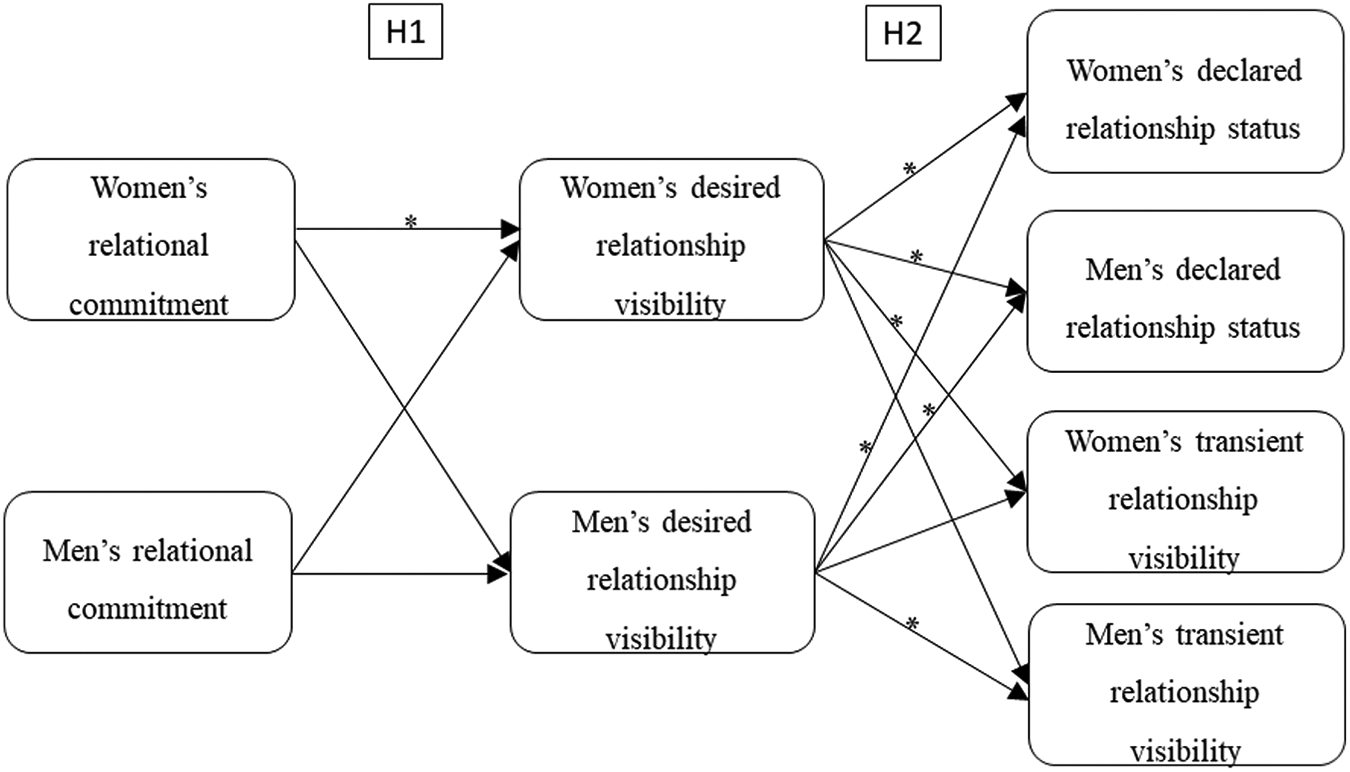
Actor-partner interdependence meditation model predicting actual relationship visibility. χ2(12, N = 139) = 17.92, P = .12; Goodness of Fit Index (GFI) = .97, Comparative Fit Index (CFI) = .99, standardized Root Mean-square Residual (standardized RMR) = .06, Root Mean-Square Error Of Approximation (RMSEA) = .06. *P < .05.
In the same vein, although in many domains, positive attitudes toward something (such as environment or health) do not always translate into behaviors (Mohs & Hübner, 2013; Wolters, 2014), we believe that a link between attitudes toward relationship visibility on Facebook and actual visibility on this social media is likely. More specifically, posting about one’s relationship on Facebook could be linked to one’s own desire to make the relationship visible for multiple audiences (including the partner, friends, and family; Schlosser, 2020) instead of being directly associated with relational commitment. In other words, we expect people to post about their romantic relationship on Facebook to let other persons know about this relationship (and not directly as a reflection of their commitment). In addition, given the nature of these posts, knowledge of one’s partner’s desire for the relationship to be visible (or not) could also be into account by partners. Consequently, self-disclosure concerning one’s romantic relationship on Facebook could also be related to the partner’s desired relationship visibility, in an effort to fulfill the partner’s needs or to please him or her (Tobin et al., 2020).
Self-expansion theory as theoretical support
The conceptual model behind the examination of the link between relational commitment and relationship visibility on Facebook is the self-expansion theory. The latter describes how the self changes as a result of a romantic relationship (Rus & Tiemensma, 2017). More specifically, this theory stipulates that an intimate relationship involves expanding the self to include the other (Aron et al., 1992; Saslow et al., 2012). According to this theory, indicators of relationship visibility, both desired and actual, can be conceptualized as illustrations of inclusion of the other in the self. Greater inclusion of a partner’s identity in oneself should be evidenced by greater desire for overlap in romantic partners’ Facebook profiles, as measured in this study by desired relationship visibility, and greater actual overlap, as measured by actual relationship visibility (Rus & Tiemensma, 2017).
Couples and dyadic analyses
It is well known that two members of a couple are not simply two independent persons. They also share something in common, what we call nonindependence (Kenny et al., 2006). This implies that behaviors, thoughts, or emotions of individuals involved in intimate relationships can be linked one with the other. Accordingly, when studying dyadic phenomenon, assessing variables of interest from one partner only would result in an incomplete view of the phenomenon under study and may lead to a misrepresentation of the couple relationship (Kim et al., 2020). By contrast, collecting data from couples and performing dyadic analyses, as done in this investigation, provide a more valid understanding of the phenomenon under study. For instance, to have a better understanding of one’s behaviors pertaining to relationship visibility on Facebook, it is informative to consider the partner’s attitudes toward relationship visibility. In the same way, to predict one’s attitudes toward relationship visibility, it is informative to take into consideration the partner’s relational commitment. Therefore, the current dyadic study used an actor-partner interdependence mediation model (APIMeM; Ledermann et al., 2011). This model allows for testing of actor effects (e.g., the link between a person’s relational commitment and that person’s desired relationship visibility), partner effects (e.g., the link between a person’s desired relationship visibility and his or her partner’s actual relationship visibility), and mediation effects, simultaneously.
Current study and hypotheses
By testing this comprehensive model, we seek to establish whether 1) relational commitment predicts the extent to which partners want their romantic relationship to be an essential part of the image that others form of them via Facebook, 2) partners’ attitudes toward relationship visibility are linked to their behaviors, and 3) mutual associations between partners are observed on these variables. Considering past empirical findings (Lane et al., 2016; Saslow et al., 2012), the self-expansion theory (Aron et al., 1992), and the concept of nonindependence in dyadic data analysis (Kenny et al., 2006), we hypothesized that:
The limited amount of available data based on dyadic models involving mediation effects prevents us from postulating differences between actor and partner effects on variables under study for H1 and H2. Finally, we also expected that:
Method
Participants
The sample included 139 heterosexual Canadian couples. Their mean ages were 20.49, (SD = 1.94) for women and 21.54 (SD = 2.73) for men. Their average length of relationship was 26.12 months (SD = 19.90). Concerning their relationship status, 3.6% of couples revealed that they were casually dating; 65.5% were seriously dating; 28.8% were living together in a cohabiting relationship; and the rest of the sample were either engaged (0.7%) or married (1.4%). The median annual personal income ranged from $10,000 to $19,999 for men and from $0 to $9,999 for women. The levels of education were, on average, 15.29 years (SD = 2.07) for women and 14.94 years (SD = 1.79) for men. Finally, the median level of general activity on Facebook (e.g., reading the newsfeed or actively posting) was approximately 31–59 minutes a day for women and approximately 6–30 minutes a day for men (as assessed by a 7-point ordinal scale ranging from 0 = less than once a week to 6 = more than 2 hours a day; Emery et al., 2014), with a significant difference between genders, t (138) = 3.23, p < .01.
Procedure
This study was approved by the university’s institutional review board. The following criteria were used to select couples for the current study: partners should 1) be aged from 17 to 30 years, which included, but was not limited to, emerging adulthood (Arnett, 2007), 2) have active Facebook accounts for at least 3 months, and 3) be in an intimate relationship together for at least 3 months. Couples were recruited by word of mouth, with the use of social media and advertisements, and via psychology classes. Participants recruited via psychology classes received one credit point for their participation (see Charbonneau et al., 2019 for a similar procedure). The other participants either received $10 or entered a prize draw with the chance of winning $100 for their participation.
Interested individuals and their partners were invited to our laboratory. They were instructed to complete questionnaires assessing demographic and key variables without consulting their partner. The research assistant was present throughout the session to ensure compliance with the instructions. Participants had the choice of answering the questionnaires in the two official languages of Canada; most of them answered the questionnaires in French, while the remainder of the sample answered them in English. Then, participants were asked to log into their Facebook profile and use the freely available Friendship application on themselves and their partner (Toma & Choi, 2015). This application produces a conjoint profile for any pair of Facebook friends, on which it shows the Facebook information shared by these two persons.
Measures
Demographic questionnaire
Participants were asked to provide their age, length of relationship with their current partner, relationship status, annual income, and educational level.
Relational commitment
The commitment level subscale of the Investment Model Scale was used to assess relational commitment (Rusbult et al., 1998). The subscale comprised 7 items (e.g., I am committed to maintaining my relationship with my partner) that are answered using a 9-point scale ranging from 0 = do not agree at all to 8 = agree completely. Total scores are the means of the responses for each item. Higher scores reflect higher levels of relational commitment. The scale showed good reliability and validity (Rusbult et al., 1998). For this sample, Cronbach alphas were .81 for women and .68 for men.
Desired relationship visibility
Participants answered a questionnaire of desired relationship visibility on Facebook (Emery et al., 2014). It is composed of 3 items (1-It is important to me that my Facebook friends can tell that I am in a relationship; 2-I want my relationship with my partner to be visible on Facebook; 3-I like to share information about my partner and my relationship on Facebook) answered on a Likert scale where 1 = strongly disagree and 7 = strongly agree. The overall score is the mean of the 3 items. Higher scores reflect higher levels of desired relationship visibility. Cronbach alphas were .81 for women and .82 for men in the current study.
Declared relationship status
This variable was assessed by a measure of relationship awareness on Facebook, which consists of four components (i.e., 1-What is your current posted relationship status on Facebook? 2-Have you ever mentioned your romantic partner in status updates? 3-Have you ever posted a picture of yourself and your partner as your profile picture? 4-Have you identified who your partner is in your relationship status box?; Steers et al., 2016). Each component has been rated using a dichotomous score. A sum score of the four components was produced and used as an index of declared relationship status. The higher the score, the more the participant revealed his or her relationship status on Facebook. For this sample, Cronbach alphas were, respectively, .78 and .80 for women and men.
Transient relationship visibility
The following relationship-oriented Facebook behaviors, generated by the Friendship application and covering the last 3 months, were recorded: 1) the number of photographs posted by each participant in which the partner was present, 2) the number of comments initiated by each participant concerning the partner (on his or her wall or on the partner’s wall), and 3) the number of times each participant tagged his or her partner (on his or her wall or on the partner’s wall; Cole et al., 2018; Toma & Choi, 2015). It is important to note that transient relationship visibility measures behaviors initiated by each partner separately. Accordingly, when a mutual friend posted a picture of the couple and tagged both partners, it was not included in the measure of transient relationship visibility because it was not posted by one of the partners. We also counted items on each partner’s wall in order to verify data generated by the Friendship application. This procedure was proven necessary because we realized that if a photo did not have a tag, for instance, it did not appear on the conjoint profile of the two partners in the Friendship application.
The sum of these three relationship-oriented Facebook behaviors (i.e., photos, comments, and tags implying the partner) initiated by each participant in the last 3 months was used as the index of transient relationship visibility. Scores for this variable could vary not only between couples, but also within couples. We chose to use the sum of photos, comments, and tags as the index of transient relationship visibility instead of separate behaviors in order to keep the number of variables lower in statistical analyses and because these behaviors were highly correlated (correlations varying from .50 to .80 for men and from .69 to .84 for women).
Results
Data screening and descriptive analyses
Data screening revealed that one score (i.e., 108) for women’s transient relationship visibility was an outlier. To retain this score, but reduce its influence on the results, we recoded it (maximum for this variable, excluding this outlier, +1) before analyses (i.e., final score of 38). Means, standard deviations, and Pearson bivariate correlations for all variables are reported in Table 1. Women’s relational commitment was positively related to their own desired relationship visibility on Facebook and to their partners’ relational commitment. Men’s relational commitment was also positively associated with their partners’ desired relationship visibility. Men’s and women’s ratings of desired relationship visibility were positively correlated one with the other. Significant positive correlations were also noted between women’s desired relationship visibility and all indicators of women’s and men’s actual relationship visibility on Facebook. The same thing was observed for men’s desired relationship visibility. Finally, all indicators of men’s and women’s actual relationship visibility were significantly associated with one another.
Correlations and descriptive statistics for women (W) and men (M).
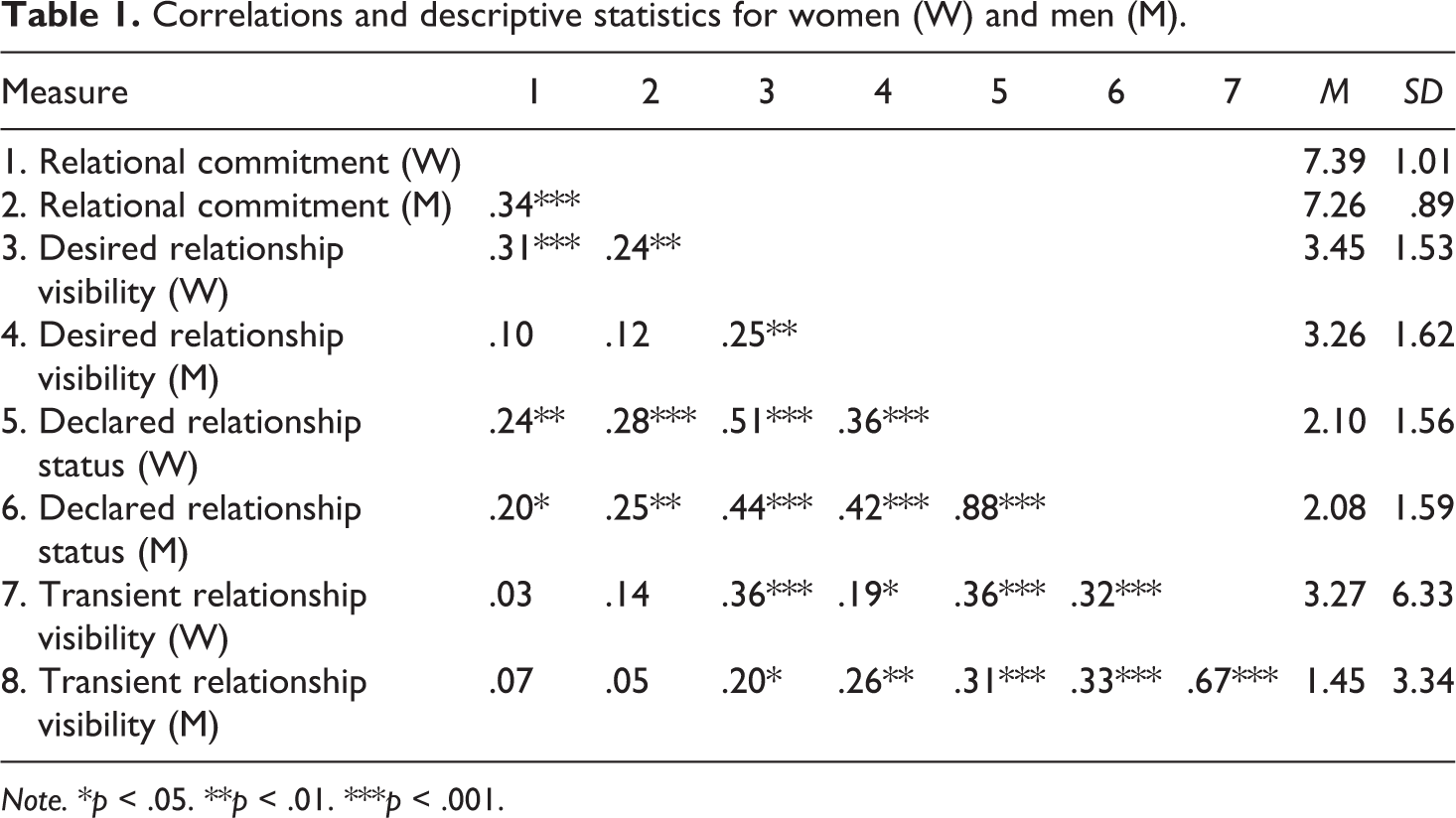
Note. *p < .05. **p < .01. ***p < .001.
Data analysis strategy
An APIMeM (see Figure 1), for distinguishable dyad members, was examined using path analyses (Ledermann et al., 2011). The APIMeM is an extension of the standard actor-partner interdependence model (APIM), but to test mediation effects using three pairs of variables for each couple (X, Y, M; Ledermann et al., 2011). Mediation implies a mechanism through which X (in this study, relational commitment) is linked to Y (in our case, declared relationship status and transient relationship visibility) by M (in our case, desired relationship visibility).
In dyadic analyses, the couple is the unit of analysis and the sample size represents the number of couples (Bouchard, 2018; Cook & Kenny, 2005; Kenny et al., 2006). In APIMeM, predictors are permitted to correlate with one another due to the nonindependence between scores of couple members (Kenny et al., 2006; Ledermann et al., 2011). Likewise, because of unmeasured common causes, error terms of mediators and of outcome variables co-vary between couple members.
Tests of the APIMeM
The maximum likelihood method of parameter estimation was employed to examine the hypothesized APIMeM. Acceptable fit is revealed by a non-significant Chi-square value; a Goodness of Fit Index (GFI) and a Comparative Fit Index (CFI) superior to .90 (Kline, 2011); a standardized Root Mean-square Residual (standardized RMR) inferior to .08 and a Root Mean-Square Error of Approximation inferior to .07 (RMSEA; Hopper et al., 2008). All indicators revealed that the model provided a good fit, χ2 (12, N = 139) = 17.92, p = .12; GFI = .97, CFI = .99, standardized RMR = .06, RMSEA = .06. As illustrated in Figure 1, 7 of the 12 paths were significant. For all paths, unstandardized betas, standard errors, and standardized betas are summarized in Table 2. The model accounted for 32% of variance in women’s declared relationship status, 30% of variance in men’s declared relationship status, 14% of variance in women’s transient relationship visibility, and 9% of variance in men’s transient relationship visibility. All significant paths also remained significant when men’s and women’s levels of general activity on Facebook (as measured by 7-point ordinal scales; Emery et al., 2014), were added as covariates in another APIMeM. The original model was retained given its parsimony and its relative independence from participants’ general level of activity on Facebook.
Results of path analyses for women (W) and men (M).
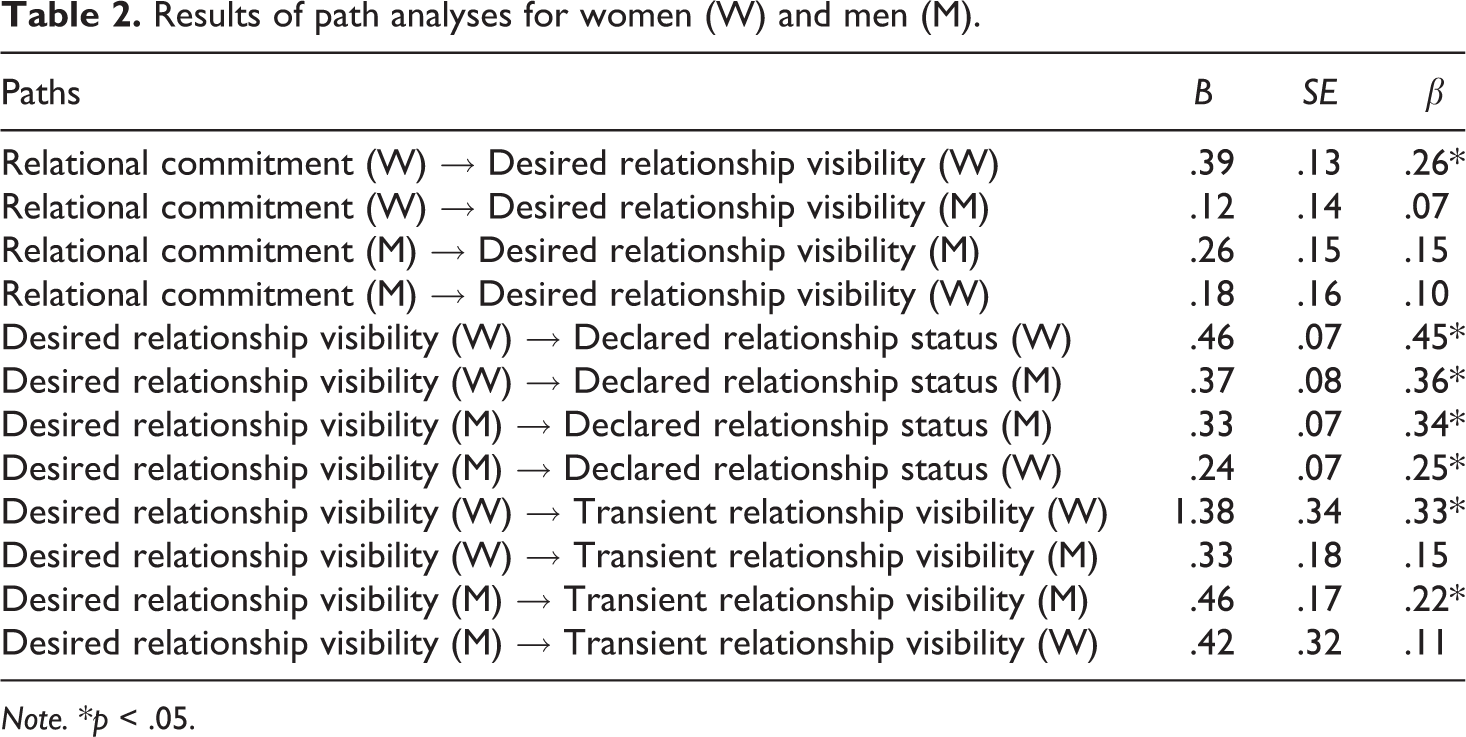
Note. *p < .05.
We next investigated a fully saturated model including at the same time all the direct and indirect (through the mediators) paths between Xs and Ys (Ledermann et al., 2011). Analyses for this saturated model demonstrated no significant direct paths between the two predictors and the four outcomes. We then evaluated whether complete mediation was possible by comparing the χ2 from the original path model (illustrated in Figure 1) with the χ2 from the fully saturated model (MacKinnon, 2008; see Bouchard et al., 2019 for the use of this technique in family psychology). Results indicated no significant difference between the two path models, Δχ2 (8, N = 139) = 8.96, p = .35, suggesting that complete mediation was likely.
Discussion
This study aimed to document the use of social media in intimate relationships by examining the mediating role of desired relationship visibility in the link between relational commitment and actual relationship visibility (i.e., declared relationship status and transient relationship visibility) using dyadic analyses. As hypothesized, actor and partner effects were both observed. Our results revealed that women’s relational commitment (but not men’s commitment) predicted their own levels of desired relationship visibility on Facebook, partially confirming H1. Women’s desired relationship visibility, for its part, predicted all indicators of women’s and men’s actual relationship visibility on Facebook, except for their partners’ daily postings (including tags, photos, and comments) about the relationship. Men’s desired relationship visibility also predicted all indicators of their own and their partners’ actual relationship visibility on Facebook, except for women’s daily postings. Overall, these data confirm H2 concerning the link between desired relationship visibility and actual relationship visibility on Facebook for both men and women. It is important to note that all paths remained significant when men’s and women’s levels of general activity on Facebook (e.g., reading the newsfeed or actively posting) were controlled for in statistical analyses. Finally, partially confirming H3, we concluded that women’s desired relationship visibility could fully mediate the relationships between their relational commitment and most indicators of their own and their partners’ actual relationship visibility. In sum, in accordance with the self-expansion theory (Aron et al., 1992), women’s desire and decision to make their relationships visible on Facebook reflect their commitment to their romantic partners.
The fact that men’s relational commitment did not predict their need to make their romantic relationships known to others was contrary to our predictions. However, the significant positive correlation observed between men’s relational commitment and their partners’ desired relationship visibility was in accordance with our hypotheses (see Table 1). The non-significant actor effect of men’s relational commitment may be explained by the fact that men spent less time on Facebook than women did, perhaps because women, rather than men, are often tasked with maintaining relationships (Dew & Tulane, 2015; Fox et al., 2013). Relatedly, past studies have shown that declaration concerning relationship status on Facebook was less central for men than for women (Orosz et al., 2015; Papp et al., 2012). It is also likely that some highly committed men found that relationship visibility was not required. Maybe they were already sharing positive things about their day with their partners and they felt there was no need for them to do these behaviors again via Facebook (Northrup & Smith, 2016). Some men might also be comfortable showing their romantic relationship to friends, but not to their wider social network of extended family (see Van Ouytsel et al., 2016 for a similar conclusion). Finally, the fact that the reliability score for men’s relational commitment (.68) was acceptable, without being good, may also explained, in part, the observed result.
As predicted, actor and partner effects were observed between desired relationship visibility and most indicators of relationship visibility. However, we failed to observe significant links between men’s and women’s desired relationship visibility and their partners’ postings about the relationship over the last 3 months. These results suggest that there may be a difference between less transient forms of relationship visibility (such as declared relationship status), for which actor and partner effects were observed, and more transient ones, for which only actor effects were observed (Cole et al., 2018; Emery et al., 2014). Declaring one’s relationship status on Facebook may be more central to one’s identity, whereas daily postings may be more peripheral to one’s identity (Cole et al., 2018). Additionally, it may be more difficult for people to maintain a high level of responsiveness to their partner’s desires for relationship visibility on Facebook on an ongoing, daily basis.
Limitations and future directions
Our results confirmed that the model under study (i.e., relational commitment→ desired relationship visibility → actual relationship visibility) offered a good fit to the data, using a cross-sectional design. The non-causal nature of the data must, however, be pointed out. It means that our results do not eliminate the possibility of bidirectional links between relational commitment and actual relationship visibility (Rus & Tiemensma, 2017) or that other unmeasured variables account for the observed associations. Future studies should examine these paths of influence to get a fuller understanding of the reciprocal effects between the two variables using longitudinal data. Directions for future studies also include the investigation of potential moderators in the relationship between relational commitment, desired relationship visibility, and actual relationship visibility, such as attachment styles or jealousy. In addition, it could be interesting to see whether our results can be replicated with other social media platforms, such as Instagram.
Other limitations of the present work and directions for future studies must also be pointed out. We did not include a measure of the participant’s general attitude toward sharing his or her intimate and personal information with others in our conceptual model. This variable could be used as a covariate in future studies. Furthermore, we used the total number of photos, tags, and comments implying the partner as the measure of transient relationship visibility instead of the proportion of these dyadic behaviors by comparison with all behaviors (i.e., relationship-oriented posts divided by all posts). The Friendship application used in this study does not give access to all posts, but only to the ones related to a specific person, in our case, the partner. However, using the proportion of posts is another effective strategy to consider the general level of Facebook activity that could be used in future studies. Furthermore, although dyadic samples allow for tests of a broader range of conceptual and empirical questions compared to individual samples (such as partner effects), recent research showed that they may result in a sample with more relational commitment relative to individual samples (Barton et al., 2019). Consequently, our sample may contain a smaller number of unstable relationships. Finally, the fact that some men of the sample were not particularly active on Facebook is also a limitation. Future studies could investigate our research question with couples selected for their high level of activity on Facebook.
Practical implications and conclusions
Practically, the results of this study emphasize that, for Facebook users, desired relationship visibility is a relevant factor in the relational dynamic of young adult couples. When working with couples, if the desire to make the relationship visible or not on social media is a source of conflict between partners, the question should be discussed considering its complex relationship with relational commitment. The fact that men’s relational commitment was not a significant predictor of their desire to make their relationship visible on Facebook could, for instance, serve as a basis for dialogue.
The current study examined the dyadic nature of Facebook self-presentations of coupledom by investigating how partners react to each other’s level of relational commitment and desired relationship visibility. It extends the existing literature by explaining the mechanism underlying the link between relational commitment and relationship visibility and by testing actor, partner, and mediation effects with a relatively large sample of couples. Our findings confirm the utility of Facebook as a context for investigating how young adults portray their intimate relationships to others as well as the role of women’s relational commitment in this process. Our results also show the usefulness of the self-expansion theory in this analysis. They suggest, as hypothesized by the theory, that greater inclusion of a partner’s identity in oneself, as conceptualized by greater relational commitment, is evidenced by greater relationship visibility on Facebook (Rus & Tiemensma, 2017). Given the growing dominance of online social interaction, more research is needed on how our romantic relationships unfold online and off-line at the same time (Fox et al., 2013).
Footnotes
Funding
The author(s) disclosed receipt of the following financial support for the research, authorship, and/or publication of this article: This research was supported in part by a grant from the Faculty of Graduate Studies and Research of the Université de Moncton (grant number AZ0309).

Open research statement
As part of IARR’s encouragement of open research practices, the author(s) have provided the following information: This research was not pre-registered. The data used in the research cannot be publicly shared but are available upon request. The data can be obtained by emailing: