




Abstract
In this study, we examined whether regular divorces can be distinguished from complex divorces by measuring the intensity of negative emotions that divorced parents report when thinking about their ex-partner. We recruited two groups of parents: n = 136 in a regular divorce, and n = 191 in a complex divorce. Based on the existing literature, we predicted that parents in complex divorces experience more intense negative emotions than parents in regular divorces; especially emotions that motivate emotional distancing (contempt, disgust, anger, hatred, and rage) and emotions that impair self-regulation (fear, shame, guilt, and sadness). We also predicted that these emotions would hamper co-parenting, particularly in complex divorces. The results provided support for our predictions, except for fear and sadness. We found that parents in a complex divorce reported more co-parenting concerns than parents in a regular divorce. In contrast to our expectations, the relation between negative emotions and coparenting concerns was stronger among parents in a regular divorce than in a complex divorce. These findings underline the importance of emotions in the divorce trajectory and suggest that especially the intensity of emotional distancing emotions may serve as a screening tool to identify parents at risk for a complex divorce.
Complex divorces are—unlike regular divorces—characterized by ongoing hostile exchanges between ex-partners (Anderson et al., 2011). Hostile exchanges are particularly pronounced when parents additionally report high levels of concern about the ex-partner’s parenting capacity (Demby, 2016; Togliatti et al., 2011; Visser et al., 2017). Realizing a high-quality co-parenting relationship after divorce is of crucial importance for children’s healthy development (Amato, 2001; Kelly & Emery, 2003), and the wellbeing of all family-members (Spruijt & Duindam, 2010). It is even beneficial to society as a whole, as governments invest in costly interventions aiming to aid highly-conflicted parents and their children (Greenberg et al., 2016) and long-lasting litigation over child-related matters (Lowenstein, 1991). Two questions therefore need answering: Which factors can serve as a screening tool for timely recognition of (potential) complex divorces, and do these factors relate to co-parenting concerns? Here, we propose that negative emotions that parents experience when thinking about the ex-partner—due to their social signaling functions—may provide an initial answer to these questions.
Complex divorces
Divorce (or separation, hereinafter both referred to as divorce) is common today. About 50% of all marriages in western societies (or co-habiting relationships, hereinafter referred to as marriages) end in divorce, and about 50% of children witness parental divorce (Divorce Statistics, 2017; Organisation for Economic Co-operation and Development, 2016). The divorce process is distressing for parents and children. In most cases, however, parents ultimately succeed in forming an effective co-parenting relationship, and typically, their children’s lives—after temporary adaptation issues—can even improve (Mitcham-Smith & Henry, 2007). These divorces are considered regular divorces. Yet, in 10 to 20 percent of the cases, divorced parents do not succeed in developing a co-parenting relationship and become involved in so-called complex divorces (Harman et al., 2016; Joyce, 2016). Although there is no clear consensus on the definition of complex divorces, most researchers agree that these divorces are characterized by long-lasting post-separation conflicts regarding co-parenting (Demby, 2016; Smyth & Moloney, 2017). Previous research has identified observable risk-factors for complex divorces, such as conflicts about child financial support and child-parenting time (Bonach, 2005; Kalmijn, 2015). Also, risk-factors characterizing parents, such as psychiatric disorders, or lacking of negotiating skills have been identified (Gutterswijk et al., 2017). The children of parents who are involved in complex divorces pay a high price (Amato, 2001; Kelly & Emery, 2003). They face adjustment difficulties, such as aggression, depression, and emotional withdrawal from significant others (Goodman et al., 2004; Joyce, 2016; Kelly, 2014; Van der Wal et al., 2019), and stress-related illnesses, such as hypertension (Luecken, 1998; Luecken & Lemery, 2004). An important task therefore is to provide insights into the risk factors related to complex divorces.
Importantly, although certain emotions have been recognized in playing a role in intact relationships (Cameron & Overall, 2018; Williams et al., 2018) and in complex divorces (Demby, 2017; Johnston, 2017; Smyth & Moloney, 2017), the role of negative emotions in relation to co-parenting concerns has, to our knowledge, not been tested empirically. This is surprising because negative emotions in complex divorces are intense and—when parents cannot agree on mutual co-parenting—sometimes even lead to fatalities (Dijkstra & Verhoeven, 2014; Juris, 2017; Walker, 2006). Moreover, little is known of possible gender differences in explaining complex divorces; fathers are often underrepresented in divorce-related and child pathology research (Cassano et al., 2006). The present research explored the role of negative emotions in complex divorces and co-parenting concerns. We described and controlled for gender differences and examined whether these emotions can differentiate between regular and complex divorces, and whether they relate to co-parenting concerns.
Co-parenting and co-parenting concerns
Co-parenting describes a family situation whereby two adults parent a child; post-divorce co-parenting includes the planning and execution of a joint parental plan (Visser et al., 2017). Successful post-divorce co-parenting appears to relate to two factors. On the one hand, co-parenting requires that parents continue to engage in positive parental interaction (Anderson et al., 2011; Bonach, 2005; Whiteside & Becker, 2000), and on the other hand, co-parenting requires that parents allow each other to maintain a warm parent-child relationship (Dunn et al., 2004; Philyaw & Thomas, 2013). Divorced parents who fail to develop a high-quality co-parenting relationship tend to engage in continued litigation that induces negative parent-parent interactions and endangers positive parent-child relationships. Distrust, hostility, anger, and tension induce parenting concerns, sometimes even leading to a complete communication stop (Whiteside, 1998). Due to ongoing conflict and disagreement about parenting, the divorced parents increasingly focus on their ex-partner’s negative characteristics, prompting concerns regarding the ex-partner’s parenting capacity (Anderson et al., 2011; Bonach, 2005; Whiteside & Becker, 2000), and the safety of their children while in the care of the ex-partner (Grych, 2005).
The role of emotions in divorces and co-parenting concerns
Although empirical evidence is lacking, by reflecting on the fatal incidences in complex divorces, we can infer that complex divorces are characterized by intense and mostly negative emotions (Dijkstra & Verhoeven, 2014; Juris, 2017; Walker, 2006). One way to explain the role of negative emotions in complex divorces is to consider the extent to which they impair self-regulation or motivate emotional distancing. For example, fear hinders coping with the divorce and prevents parents from achieving closure (Steimer, 2002), and shame and guilt interfere with effective self-reflection (Tangney & Salovey, 1999). Other emotions in divorces motivate emotional distancing. Hatred and contempt motivate people to avoid others whom they appraise as bad or unresponsive to change (Fischer & Giner-Sorolla, 2016; Smyth & Moloney, 2017). Where hatred coincides with blaming the other for conflicts (Bonach, 2005; Johnston, 2017), contempt may even induce a complete interaction-stop (Babcock et al., 2013; Lisitsa, 2013). Anger also widens the gap between parents. Anger not only predicts relationship break-up and divorce (Fincham & Bradbury, 1992; Gottman & Levenson, 2002; Traupman et al., 2011), but it also hinders successful post-divorce co-parenting (Whiteside, 1998). Thus, two categories of negative emotions appear to play a role in post-divorce co-parenting; emotions that impair self-regulation in interpersonal interactions between divorced parents (fear, shame, and guilt), and emotions that motivate divorced parents to avoid their ex-partner and withdraw from co-parenting interactions (hatred, contempt, and anger).
The aims and research questions of this research
The present study aimed to explore the role of negative emotions in post-divorce co-parenting concerns among divorced parents, including parents involved in regular and in complex divorces. In this study, we assessed specific emotions, and explored whether certain emotions can be clustered, thereby reflecting their function in interpersonal interactions (Fischer & Giner-Sorolla, 2016; Smyth & Moloney, 2017). Based on the existing literature, we predicted that parents in a complex divorce—compared to parents in a regular divorce—experience more intense negative emotions when they think about their ex-partner, especially emotions that impair self-regulation (fear, shame, and guilt) and emotions that motivate emotional distancing (contempt, anger, and hatred). Next, we examined whether clusters of emotions are related to co-parenting concerns, and if so, whether this relation is stronger for parents in regular or in complex divorces. We predicted an emotional spillover to co-parenting concerns when divorced parents experience more intense negative emotions (Amato, 2005; Katz & Woodin, 2002; Mitcham-Smith & Henry, 2007). Because particularly complex divorces are characterized by ongoing co-parenting conflicts (Stover, 2013), we predicted that this spillover, and thus their association with co-parenting concerns, is stronger for parents in a complex divorce than for parents involved in a regular divorce.
Method
Participants
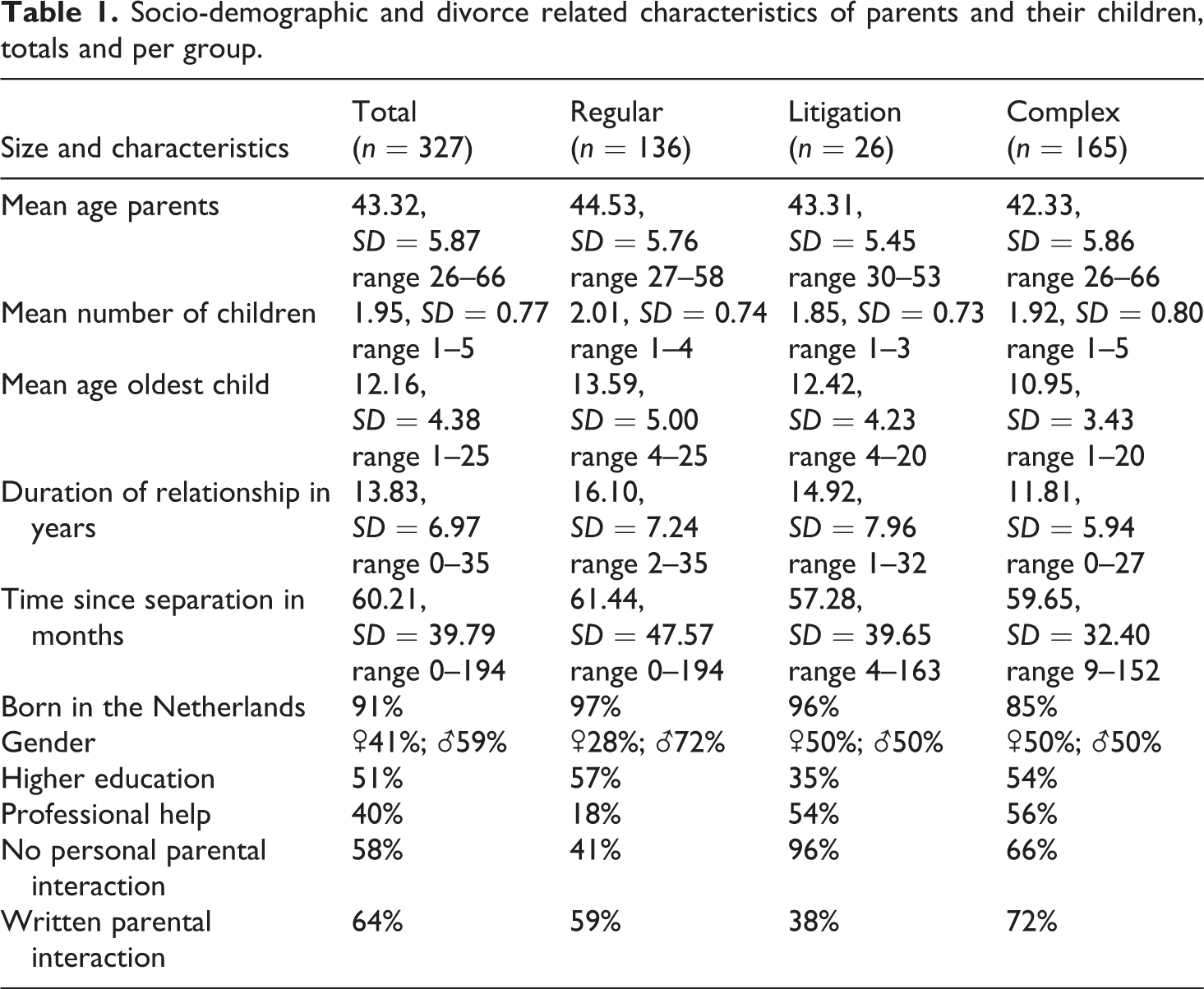
We recruited 327 divorced parents, mean age 43.32 years (SD = 5.87, range 26–66), who on average had two children (SD = 0.77, range 1–5), 91% of the parents were born in the Netherlands, and 59% were female. Except for one ex-couple, all divorced parents had had heterosexual relationships. The oldest child had a mean age of 12.16 years (SD = 4.38, range 1–25). Of the 327 divorced parents, 55% had completed higher education or university; divorce-related professional help had been provided in 40%. On average, the duration of the relationship was 13.83 years (SD = 6.97, range 0–35), and the time between the separation between parents and filling in the questionnaire was 60.21 months (SD = 39.79, range 0–194).
Table 1 provides details of the socio-demographic and divorce related characteristics per group of divorced parents. All procedures performed in studies involving human participants were in accordance with the ethical standards of the institutional research committee (provided by VU University Amsterdam) and with the 1964 Helsinki declaration and its later amendments or comparable ethical standards.
Socio-demographic and divorce related characteristics of parents and their children, totals and per group.
Procedure
To compare the intensities of emotions of parents in regular versus complex divorces, we recruited two samples: a group of regular divorced parents and a group of parents in a complex divorce. Parents in a regular divorce were recruited on divorce-related websites, forums, social media, and our social network. We recruited162 individual parents, who—after having given informed consent—filled in an online questionnaire (programmed in Qualtrics, a survey software program) covering their socio-demographic characteristics, the intensity of their emotions, and co-parenting concerns. Within this group, 26 parents were in litigation, which research has identified to be an element of complex divorces (Nielsen, 2017). We therefore examined whether this group of parents differed from parents involved in regular divorces and report the findings in the Result section.
Parents in complex divorces were referred to for intervention by child protection services or courts; their children faced custodial placement due to their parent’s ongoing conflicts. During the intake at health care institutions (offering interventions for parents involved in complex divorces), the parents were informed about our research and were provided with the opportunity to ask questions. In total, 165 parents (58 couples) voluntary, by written consent, agreed to participate in our study. Parents received a personal code and a link to the online questionnaire, which they completed before the start of the intervention.
Measures
Parents completed a questionnaire examining their and their children’s experience of the divorce; for more information, see Visser et al. (2017). Completion of the questionnaire took about 60 minutes. Here we only report those measures directly relevant to the questions that were at the heart of our manuscript.
Emotions
To assess parents’ negative emotions, we identified nine distinct emotions often considered in emotion research (e.g., Izard, 2007) and relevant in the divorce context, including the emotions fear, shame, and guilt that impair self-regulation (Steimer, 2002; Tangney & Salovey, 1999) and the emotions hatred, contempt, and anger that motivate emotional distancing (Babcock et al., 2013; Gottman & Levenson, 2002; Johnston, 2017). For exploratory reasons, we also included rage, disgust, and sadness, which are often reported in divorce situations. We measured parents’ feelings toward their ex-partner by asking them to rate the intensity of their experienced emotions toward their ex-partner at the moment of completing the questionnaire. An example item is “When I think of my ex-partner, I feel fear.” Parents rated the intensity of the nine emotions on a 5-point Likert scale ranging from 1 (not at all) to 5 (very much).
Co-parenting concerns
Co-parenting concerns comprise of two underlying factors: concerns regarding parental communication (Philyaw & Thomas, 2013) and concerns regarding the safety of their children (Anderson et al., 2011). We measured both with 14 items inspired by validated questionnaires used by De Smet et al. (2011). Six questions focused on the safety of the children (e.g., “The children are unsafe at my ex-partner’s”), the other eight focused on communication surrounding parenting (e.g., “When my ex-partner and I communicate, we mostly argue over the children”). We reverse-coded five positively phrased questions (one regarding the safety of children, and four regarding parental communication). Parents rated the items on a 5-point Likert-scale ranging from 1 to 5 (1 = strongly disagree, 5 = strongly agree). A factor analysis with oblique rotation revealed the two factors; nevertheless, both were strongly related, r = .75, p < .001, and shared 56% of the variance. Because we lacked specific hypotheses regarding the two factors, we decided to use one latent factor and establish one score of parenting concerns, with higher values indicating greater co-parenting concerns (α = .93).
Statistical analyses
Given that the data from parents involved in complex divorces were nested within couple, the data had, at least partly, a nested structure (Kenny et al., 1998). We therefore conducted multilevel modeling analyses using the SPSS mixed-effects models procedure and restricted maximum likelihood estimation. To examine our main hypotheses, we mean-centered clustered emotion ratings, dummy-coded divorce group (−1 = regular divorce and 1 = complex divorce), and added parents’ gender as control variable (−1 = fathers and 1 = mothers). We tested our first hypothesis with a mixed design ANOVA, and examined whether the divorce groups differed on both separate as well as clustered emotion ratings. We entered divorce group and gender as dichotomous variables, and couple id as fixed effect. The model tested main effects of divorce group and gender on separate emotions, as well as clustered emotion ratings.
To test our second hypothesis, we ran a moderation analysis and examined whether emotions are indeed associated with co-parenting concerns, and whether divorce group affected the association between emotions and co-parenting concerns. We entered divorce group and gender as dichotomous variables, and participants’ clustered emotion ratings, and the interaction between divorce group and clustered emotion ratings as continuous variables, and couple id as fixed effect. The model tested main effects of clustered emotions, divorce group, and gender, and interaction effects between clustered emotions and divorce group on co-parenting concerns.
Results
Descriptive analyses
By means of independent-samples t-tests, we compared both the socio-demographic and divorce-related characteristics, as well as the study-variables for fathers and mothers. We found non-significant differences for country of birth, level of education, prior divorce-related professional help, and sadness, anger, shame, rage, fear, guilt, and contempt, all ts(311) ≤ 1.83, p > .05, d ≤ 0. 22. We found significant gender differences on age, hatred, disgust, and co-parenting concerns. On average, fathers were older (M = 44.13, SD = 6.17) than mothers (M = 42.78, SD = 5.56), t(311) = 1.98, p < .05, d = 0.22. Fathers reported more hatred (M = 2.57, SD = 1.24) than mothers (M = 2.24, SD = 1.23), t(311) = 2.32, p < .05, d = 0.27; more disgust (M = 3.22, SD = 1.35) than mothers (M = 2.83, SD = 1.43), t(311) = 2.43, p < .05, d = 0.29; and more co-parenting concerns (M = 3.15, SD = 0.95) than mothers (M = 2.81, SD = 1.00), t(311) = 3.03, p < .01, d = 0.36. We therefore decided to take gender into account as a control variable when testing our hypotheses. “We found a significant difference between groups of divorced parents for duration of the relationship (F(1,323) = 26.34, p < 0.1). The difference between time since the divorce and filling in the questionnaire was not significant (F(1,323) = .22, p = .64).
Emotional intensity distinguishes regular divorces from complex divorces
We tested our first hypothesis that regular divorces can be distinguished from complex divorces by measuring the intensity of the nine emotions that divorced parents experience when thinking of their ex-partners, see the Appendix A. Our analyses indicated that emotions for the group of parents in a regular divorced differed significantly from the parents within this group that were in litigation (MD = −0.63) and from those in complex divorces (MD = −0.61). The difference between the group of parents in litigation compared to the group of parents in complex divorces was non-significant (MD = 0.20).
Emotional distancing and self-regulatory emotions cluster
To identify whether, and if so which, emotions cluster, we conducted a principal factor analysis. Based on the low correlation between the factors, we opted for orthogonal rotation (varimax) on the 9 items measuring emotions. The Kaiser-Meyer-Olkin (KMO) verified the sampling adequate for the analysis, KMO = .83, and all KMO values for individual items were greater than .58. The scree plots indicated two factors which explained 60.87% of the variance. To test the reliability of the two factors, we performed reliability analyses and as hypothesized, the impairing self-regulatory emotions, fear, shame, and guilt—and the added emotion sadness—clustered together. Also, the emotional distancing emotions, hatred, contempt, and anger—and the added emotions rage and disgust—clustered together. These findings provide support, and replicate earlier findings, for the distinction between impairing self-regulatory emotions change (Babcock et al., 2013; Bonach, 2005; Fincham & Bradbury, 1992; Fischer & Giner-Sorolla, 2016; Johnston, 2017; Smyth & Moloney, 2017; Whiteside, 1998), and emotional distancing emotions (Steimer, 2002; Tangney & Salovey, 1999). See Table 2 for the factor loading after rotation and Cronbach’s alphas.
Exploratory factor analysis for the emotions of divorced parents (n = 323).
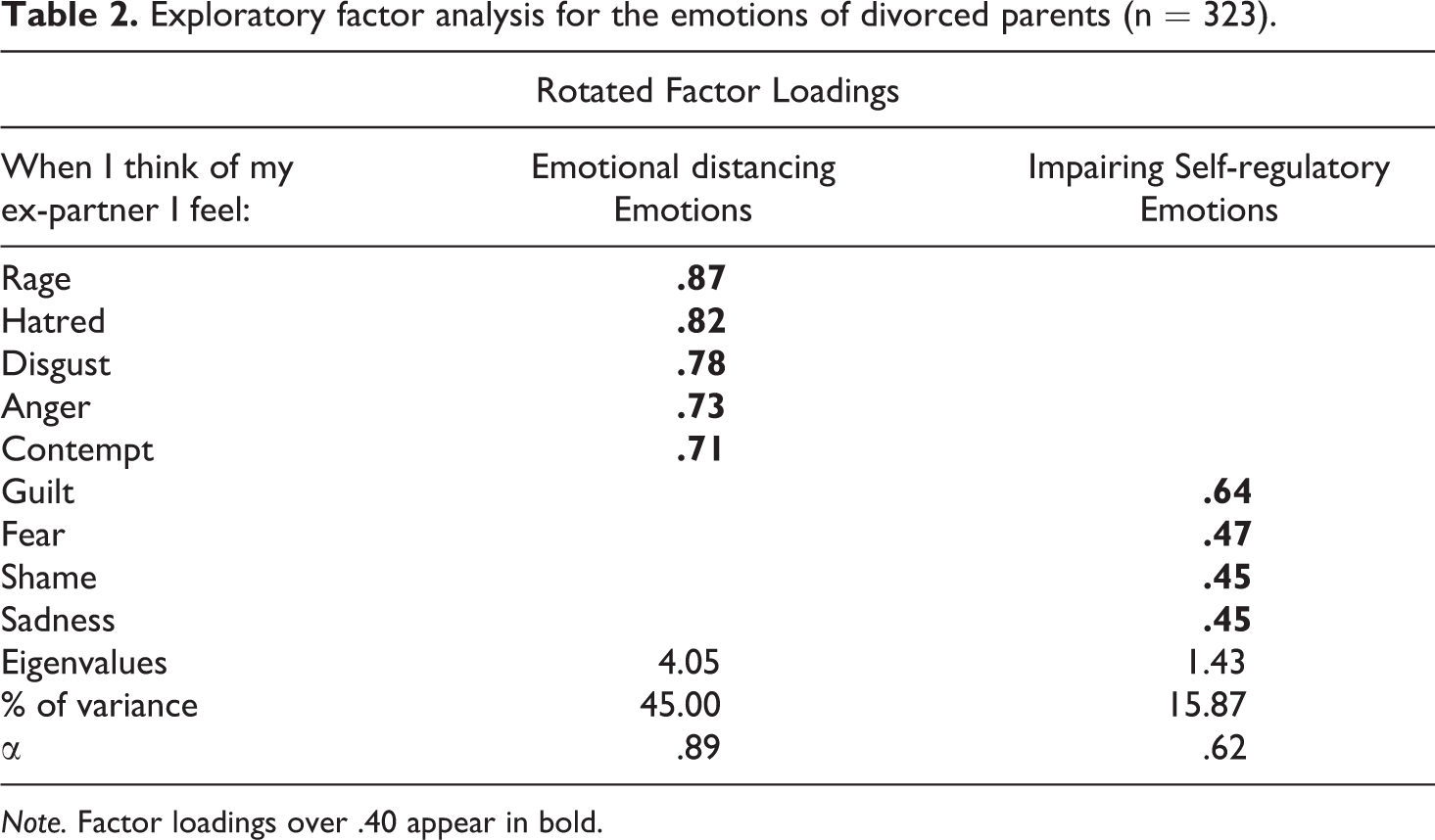
Note. Factor loadings over .40 appear in bold.
To examine the unique effects of each cluster, we proceeded by comparing the means of the clusters emotional distancing and impairing self-regulatory emotions for the two groups of divorced parents. On average, as predicted, parents in a regular divorce reported a significant lower intensity of impairing self-regulatory emotions (M = 2.36, SD = .90) than parents in a complex divorce (M = 2.63, SD = .80); b = .15, 95% CI [.05 to .24], p = .003. Parents in a regular divorce also reported a significantly lower intensity of emotional distancing emotions (M = 2.41, SD = 1.11) than parents in a complex divorce (M = 3.28, SD = .89); b = .43, CI [.31 to .54], p < .001. Additionally, he main effects of gender were non-significant, p’s > .05.
The association between emotions and co-parenting concerns
Our second aim was to test whether emotional distancing and impairing self-regulatory emotions are associated with co-parenting concerns, and whether this association differs between divorce groups. First, as predicted, the analysis revealed a main effect of emotional distancing emotions, b = .43, 95% CI [.33 to .52], p = .001, such that a higher intensity of emotional distancing emotions was associated with a higher intensity of co-parenting concerns. We found no main effect for impairing self-regulatory emotions on co-parenting concerns, b = −.05, 95% CI [−.15 to .04], p = .243. These findings indicate that emotional distancing, but not impairing self-regulatory, emotions are associated with more co-parenting concerns. Second, the moderation analysis revealed a significant main effect of divorce group, b = .35, 95% CI [.26 to .44], p < .001, indicating that parents in a regular divorce reported less co-parenting concerns (M = 2.33, SD = 1.02) than parents in a complex divorce (M = 3.39, SD = .69).
Most importantly, we found a significant interaction effect between emotional distancing emotions and divorce group on co-parenting concerns, b = −.19, 95% CI [−.29 to −.09], p < .001. Contrary to our hypothesis, however, the association between emotional distancing emotions and co-parenting concerns was stronger for parents in a regular divorce, b = .62, CI [.46 to .78], p < .001, as compared to parents in a complex divorce, b = .23, CI [.11 to .35], p < .001. Post-hoc analyses revealed that parents in a regular divorce reported less co-parenting concerns than parents in a complex divorce when emotional distancing emotions were low (−1 SD), b = .51, CI [.39 to .64], p < .001, than when emotional distancing emotions were high (+1 SD), b = .20, CI [.07 to .33], p = .003, see Figure 1. Additionally, we found the interaction effect between divorce group and impairing self-regulatory emotions on co-parenting concerns to be non-significant, b = .08, CI [−.01 to .17], p = .079.
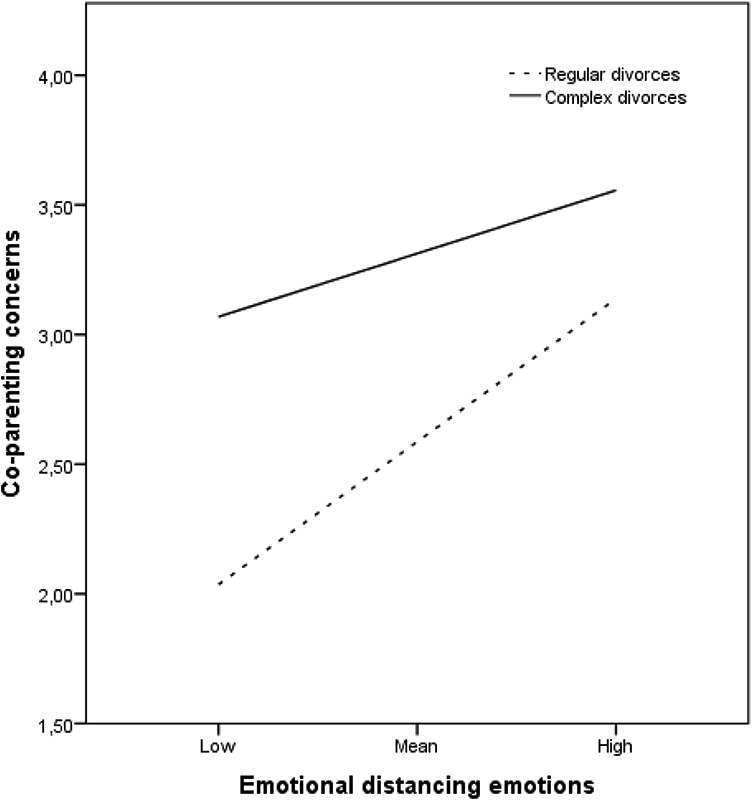
The effect of emotional distancing emotions on co-parenting concerns as a function of divorce group (regular vs. complex).
Discussion
In this study, we examined the association between negative emotions and post-divorce co-parenting concerns among two groups of divorced parents. Our findings extend previous research on the key role of emotions in intact families and divorces (Gottman & Levenson, 2002; Johnston, 2017; Lisitsa, 2013; Smyth & Moloney, 2017; Steimer, 2002; Tangney & Salovey, 1999). Specifically, we found that parents, fathers and mothers alike, in complex divorces experienced higher intensities of emotions than parents in regular divorces. This was especially so for emotional distancing emotions (i.e., rage, hatred, disgust, contempt, and anger). We also found that emotional distancing emotions showed a strong positive relation with co-parenting concerns; concerns that hinder effective post-divorce co-parenting (Philyaw & Thomas, 2013). Additionally, we found that the relation between emotional distancing emotions and co-parenting concerns was stronger for parents in a regular divorce than for parents in a complex divorce. Together, these findings indicate that emotional distancing emotions differentiate between regular and complex divorces, and suggest that these emotions may hinder constructive co-parenting, especially in regular divorces.
Consistent with our prediction, we found lower intensities of negative emotions among parents in regular divorces than among parents in complex divorces. More specifically, we found this difference to be significant for the emotions rage, hatred, disgust, anger, contempt, sadness and fear, but non-significant for shame and guilt. A possible explanation for this may be that rage, hatred, disgust, anger, contempt, sadness, and fear are primary emotions, whereas shame and guilt are considered to be secondary emotions (Tangney, 2005). Primary and secondary emotions differ in that the first are considered to be basic emotions evolving early in life, whereas the latter involve a cognitive appraisal of the self in relation to others (Rohmann et al., 2009; Tangney, 2005). This seems to suggest that parents in a complex vs. regular divorce experience more intense primary emotions, which may reflect their basic reactions to the changes that divorce bring about. An alternative explanation for our findings that the two groups experience similar levels of secondary emotions may be that parents in a complex divorce tend to minimize their own role in the divorce and rather blame their ex-partners instead (Tangney & Salovey, 1999).
We also found that the intensity of negative emotions was related to co-parenting concerns in both groups of divorced parents. This was specifically the case for emotional distancing emotions that motivate withdrawal from social interactions with the ex-partner (Lisitsa, 2013), interactions that are crucial for effective post-divorce co-parenting (Anderson et al., 2011). A possible explanation for our finding that self-regulatory emotions were not associated with coparenting concerns may be that shame, guilt, and sadness—although often elicited by social situations—are considered as intrapersonal, self-directed emotions, which may divert the parent’s attention away from the ex-partner’s role in the divorce and parenting capacity (Levenson, 1999). Surprisingly, emotional distancing emotions were more strongly related to co-parenting concerns in the group of regular divorces than in the group of complex divorces. Although these findings are the opposite of what we expected, here we offer some speculations to explain them. First, it is possible that the relation was stronger for regular divorced parents because they generally have more face-to-face contact than parents in a complex divorce and interactions and their emotions are likely to shape these interactions. Second, although the emotion ratings were not at the scale maximum, and we observed acceptable variation, it is possible that the emotional intensity in the group of complex divorces showed a ceiling effect. Possibly, the negative emotions in complex divorces are continuously high and intense, while they may vary more across situations and interactions in regular divorces. Relatedly and third, it is possible that when the negative emotions are as intense as they were among the parents in the group of complex divorces, these emotions lose their social and emotional signaling functions. Future research replicating our findings and examining the mechanisms underlying them would be promising.
Research strengths, limitations and future research
It is important to note strengths and limitations of the present study, as well as directions for future research. A strength is our unique clinical sample of fathers and mothers in a complex divorce. Not only is research on identified complex divorces scarce, but also fathers are often underrepresented in divorce-related and child pathology research (Cassano et al., 2006), and gender differences can rarely be examined.
An important limitation of this research is its cross-sectional nature. We therefore cannot infer a causal relation of emotions to co-parenting concerns. Possibly negative emotions causally affect co-parenting concerns, but it is equally plausible that co-parenting concerns increase negative emotions. It is also possible that parents in a complex divorce enter a downward cyclical process in which co-parenting concerns and negative emotions reinforce each other. Prospective longitudinal studies may elucidate the directionality of the association, thereby elucidating possibilities of prevention and early detection of risk-groups, allowing adequate interventions at an early stage which may prevent costly long-lasting interventions and litigation. Another limitation of this study is that we used self-reports. Participants may have exaggerated their emotions and concerns to make their situation seem worse, or they may have under-reported the intensity of their emotions and concerns to minimize their problems. This might be especially the case for the parents in the group of complex divorces whom—although participation in this study was voluntary—were facing custodial placement of their children, if they declined participation in the intervention. Observational studies on parental interactions may be helpful to examine the extent to which parents provide biased responses.
The investigation of whether the emotions and actions of divorced parents in complex divorces versus regular divorces differentially affect children exceeded the scope of the present study. Previous research suggests that complex parental divorces may affect children’s attachment style (Kelly et al., 2005), mental health (Bögels et al., 2010), and relational (intergenerational) development (Amato, 1996). Research comparing the short- and long-term effects of the divorce for children of parents involved in regular and complex divorces is lacking. Future, ideally longitudinal, research comparing parents and children in regular and complex divorces might advance our understanding of differential emotional trajectories among divorced parents and their children and intergenerational patterns of divorce. Our findings indicated that the duration of the relationship differed between regular divorces and complex divorces, suggesting that a longer relationship with the other parent may be a protective factor in the divorce process; future research might provide further insight in the effect of the duration of the relationship between parents. We asked parents for their reasons for divorce in an open question. Their answers varied greatly, ranging from “we have drifted apart”, or “we desired to be independent”, to adultery, or accusations of psychopathology of the other parent. Given the great variety of answers, we were unable to systematically examine them, or compare them between regular versus high conflict divorces. Future research examining the reason for divorce and comparing these reasons between regular and complex divorces may enhance our understanding of whether the reason affects the divorce trajectory. It would also be interesting to examine agreement about the reason between ex-partners in the two types of divorces. For example, it is possible that ex-partners disagree about the reason and that the disagreement fuels further conflict more in complex divorces than regular divorces. Future research may also be directed at providing insight in possible spillover of emotions of parents toward each other, often resulting in a vicious cycle of destructive behavior and conflict, which in turn fuel more negative emotions (Holman & Jarvis, 2003). Research may also address the interpersonal effects of this vicious cycle on effective co-parenting, particularly on how one parent’s emotions affect the other parent’s co-parenting experience. For example, a mother’s contempt for the father may not only fuel her co-parenting concerns but may also elicit more intense co-parenting concerns in the father. Similar interpersonal processes may occur in the parent-child relationship. Research investigating the spillover of parents’ emotions toward their ex-partner and/or their children and the relation hereof with children’s parent-child relationship and wellbeing (Verrocchio et al., 2018) would be an interesting avenue for future research.
To conclude, maintaining a high-quality co-parenting relationship may be a challenging endeavor in the aftermath of divorce. The findings of the current study highlight that the intensity of negative emotions ex-partners experience plays an important role in distinguishing a complex divorce from a regular divorce. Moreover, negative emotions are strongly related to co-parenting concerns. These findings underline the importance of emotions in the divorce trajectory and suggest that especially the intensity of emotional distancing emotions may serve as a screening tool for practitioners, identifying parents at risk for a complex divorce. Our findings suggest that high levels of co-parenting concerns may be alleviated by evidence-based interventions directed at emotion-regulation, such as ‘Emotion–Focused Therapy’ (Greenberg, 2004), the ‘Acceptance and Commitment Therapy’ (Hayes et al., 2006), or the ‘Emotion Regulation Therapy’ (Gross, 1998). Our findings might also be integrated in specific interventions directed at helping parents and children in complex divorces, like for instance the ‘Forgiveness Intervention Model’ (Bonach, 2007); or ‘No Kids in the Middle’ (Van Lawick & Visser, 2015). Further, measuring emotional distancing emotions at the start of an intervention—as a baseline measurement—with regular follow-up measurements, might not only be helpful in identifying divorced parents at risk for complex divorce trajectories, but may help in assessing the effectiveness of an intervention. Our findings complement the current focus of many interventions and professionals on communication between parents, financial stresses, the role of new relationships and, the logistics of relocation (Bonach, 2007). Hopefully, our findings contribute to raising the awareness of professionals working with divorced couples, mediators, and therapists of the role of emotional distancing emotions in relation to co-parenting concerns and stimulate further investigations in the crucial role emotions play in divorced families.
Footnotes
Appendix A
We tested our first hypothesis that regular divorces can be distinguished from complex divorces by the intensity of the nine individual emotions that divorced parents experience when thinking of their ex-partners, see Table A1.
As hypothesized, we found a significant main effect of divorce type on emotions, F(2, 318) = 20.18, p < .01, r = 0.33, indicating that parents from the three groups (i.e., high conflict, involved in litigation, and regular divorced) differed in the extent in which they experienced the nine emotions when thinking of their ex-partner. We found no significant main or interaction effects of gender on emotions, Fs < 0.50, ps > .05. With Polynomial contrasts, we found that emotions for the group of parents in a regular divorced differed significantly from the parents in litigation (MD = −0.63) and from those in complex divorces (MD = −0.61). The difference between the group of parents in litigation compared to the group of parents in complex divorces was non-significant (MD = 0.20).
Consequently, we merged the group of parents in litigation (n = 26) with the group in complex divorces (n = 165) into one group complex divorces (n = 191), and compared their emotions to the emotions of the parents in a regular divorce (n = 136) and found a significant main effect, F(1, 320) = 40.58, p < .001, r = 0.33. Figure A1 displays the error bar graph of the mean scores on emotions. As expected, parents in a complex divorce scored higher on all negative emotions—except for shame and guilt.
Funding
The author(s) received no financial support for the research, authorship, and/or publication of this article.

Open research statement
As part of IARR’s encouragement of open research practices, the author(s) have provided the following information: This research was not pre-registered. The data used in the research are not publicly available. The data can only be obtained by researchers following the study publication protocol. The protocol can be obtained by emailing: