




Abstract
Changes in paid labor in families have occurred within the wider context of societal changes in gendered attitudes to work. However, changes in behavior and attitudes are not necessarily correlated with each other, and their associations with family relationships are complex. This study uses data from over 12,000 two-parent families in the U.K.’s Millennium Cohort Study, a nationally representative cohort of children born during 2000–2002. The study investigates the potential association between relationship satisfaction and discordance between attitudes to maternal employment and mothers’ actual participation in paid labor, as well as agreement in attitudes within couples. Results show that attitudes in favor of maternal employment and actual maternal employment are generally associated with better relationship satisfaction for both mothers and fathers. In addition, discordance between an individual’s attitudes and behavior in relation to maternal employment, and discordant attitudes within couples, is both associated with significantly lower relationship satisfaction compared with concordant couples.
Individual gender ideologies often come into conflict with work behaviors necessary to provide for family life. These attitude–behavior conflicts within families have been an ongoing concern for researchers of work and family (Deutsch & Saxon, 1998; Lye & Biblarz, 1993; Usdansky, 2011). Better understanding of the potential conflicts between attitudes and behavior and the potential repercussions on family life are important at a time when maternal employment is not only desired but is often necessary to financially provide for a family. One measure of gender ideology—which has considerable coverage in several study data sets in U.K. cohort, panel, and cross-sectional studies—is gender attitudes to maternal employment and the division of paid labor in families. This article investigates whether these attitudinal variables in conjunction with paid labor variables are associated with couples’ relationship satisfaction. Furthermore, we also investigate whether discordance, between attitudes and behaviors and within couples, proves to be of particular concern as relationship satisfaction has important implications for partners and children’s well-being (Cummings & Davies, 2010; Garriga & Kiernan, 2014; Proulx et al., 2007).
Over the last several decades, changes in gender roles and gender relations have been well-documented at the societal level with increasing levels of egalitarian attitudes (Bolzendahl & Myers, 2004; Davis & Greenstein, 2009; Donnelly et al., 2016; Martin, 2004). To better understand these processes of change and the role of gender in family dynamics, it is necessary to understand the practices and experiences of family members. The transition to parenthood is a time when gender relations are often reset within couples (Schober, 2011). Changes in family dynamics after the birth of a child, such as increased work within the domestic sphere and decreased time available to nurture the marital dyad, also mean that parenthood is associated with marked decreases in marital satisfaction (Twenge et al., 2003). Understanding the role of gendered attitudes and behaviors for parents’ relationship satisfaction is important, given the effects of relationship dissatisfaction on family well-being (Proulx et al., 2007).
Numerous studies have investigated the complex links between gendered attitudes and concomitant behavior, such as attitudes toward employment and family roles, and actual participation in employment and family roles (e.g., Coltrane, 2010; Gjerdingen et al., 2001; Shelton & John, 1996). Parents adopt specific roles within the family for a variety of complex reasons, only some of which may be consciously acknowledged. Relationship satisfaction and gender ideology have been considered together as well, but due to the incredible shifts in attitude over the last several decades, and differences between other countries and the U.S., where much of this research has taken place warrant a fresh look (Lye & Biblarz, 1993). This study investigates whether a lack of agreement, or “concordance,” between an individual parent’s attitudes toward maternal employment and actual maternal employment, influences relationship satisfaction in British couples with young children. In addition, we investigate associations between the extent of attitude concordance within couples and their levels of relationship satisfaction, using a sample of two-parent families with at least one child in infancy, from a large national British birth cohort study. Finding significant associations between both individual’s attitude–behavior concordance and within couples’ attitude–attitude concordance and relationship satisfaction, policy implications in the U.K. are discussed.
Background
The phrase gender attitudes is used to encapsulate a variety of beliefs and attitudes that form part of an individual’s gender ideology—or belief system—about behaviors which have been socially attributed to one gender or the other, such as expectations of masculine and feminine behaviors, beliefs regarding “separate spheres” for men (public) and women (private), male privilege, the primacy of men in community and familial leadership, and family gender roles (Davis & Greenstein, 2009). One gender role expectation regularly included in social surveys is attitudes regarding maternal employment, which is often defined relative to the age of children, and indeed only asked of mothers. In the U.K., opinions have changed over time but still vary markedly on whether a mother should stay at home with young children (Park et al., 2013). The proportion of people who agree with the statement that “It’s a man’s job to earn money; a woman’s job to look after home and family” declined considerably from nearly half of the British public in the late 1980s to 13% in 2012 (Park et al., 2013). Likewise, the proportion who agree that a mother should stay at home when there is a child under school age decreased from nearly two third in 1989 to a third in 2012 (Park et al., 2013). Nevertheless, there is still considerable support in Britain for gender specialization regarding caring responsibilities in families with young children. The British Social Attitudes survey asked respondents what they believed to be the most and least desirable way for two parents to divide paid labor in a family with children under school age. Nearly half of all respondents felt both parents working full-time was the least desirable option, whereas the most desirable option was for a father to work full time and a mother to work part time (Park et al., 2013). Although gender attitudes have shifted in broadly the same way in the U.S. and in Britain over a similar time period, differences in worker rights and labor patterns between countries warrant investigations in a U.K. cohort (Gangl & Ziefle, 2009; Meagher & Shu, 2019).
Despite shifts in attitudes toward maternal employment in Britain over the last few decades, there is still noticeable support for a father-breadwinner model (Park et al., 2013). While gender attitudes have been increasingly recognized as an important predictor of the gender division of labor (Coltrane, 2010; Lachance-Grzela & Bouchard, 2010a, 2010b; Shelton & John, 1996), parents may not always be able to adopt behavior that fully reflects their attitudes or values. In addition, attitudes may shift to accommodate circumstances. The transition to parenthood and parenting preschool aged children is a critical period of the life course for setting gender dynamics within the family and re-setting gender divisions of labor, especially for mothers who enter parenthood with traditional gender attitudes who experience greater reductions in employment than more egalitarian new mothers (Sanchez & Thomson, 1997; Schober, 2011). Even when individuals have egalitarian attitudes, there remains a tendency for couples to move toward gender traditional divisions of labor after the birth of a child (Cappuccini & Cochrane, 2000; Schober, 2011). Partner relationships and parent–child relationships are also crucially important for the health of the family and child development (e.g., Bernier et al., 2014; Froyen et al., 2013; Røsand et al., 2012; Stocker et al., 1997). Discrepancies, or “discordance,” between attitudes and behavior or between the attitudes of the parent dyad may have harmful implications for crucial relationships within the family.
Cognitive dissonance theory posits that when attitudes, beliefs, and behaviors are in contradiction, they cause discomfort to the individual (Festinger, 1957). In the case of our research, mothers or fathers may experience cognitive dissonance if they believe that maternal employment is detrimental for small children but they (or their partner in the case of fathers) are currently employed. On the other hand, dissonance can occur if they feel it is important for mothers to work as a demonstration of equality within the family and to provide the additional benefits (financial and otherwise) that employment can bring, but are constrained by a lack of affordable childcare, flexible employment, or pressure from others in the family. This potential dissonance may lead to dissatisfaction or difficulties in relationships where partners hold conflicting beliefs. Such discordance may influence relationship satisfaction via increased conflict or act as a marker of underlying incompatibilities between partners.
Evidence that discordance between gender ideologies and gendered behaviors can have negative associations for couples has been identified previously. Research has found that couples with egalitarian ideologies but traditional gender divisions of labor are at greater risk of dissolution in their relationship than either concordant egalitarian or traditional couples (Oláh & Gähler, 2014). Regarding employment, employed women who perceive themselves in a provider role in their family enjoy greater psychosocial benefits from being employed than women who see their employment as a supplement to their partner’s income (Helms et al., 2010). Parenthood has been associated with declines in relationship satisfaction, particularly among women, due to perceived unfairness in the division of labor, which can vary according to gender attitudes (Bower et al., 2013; Dew & Wilcox, 2011; Keizer & Schenk, 2012; Twenge et al., 2003). Generally, couples with concordant gender attitudes have enjoyed greater relationship satisfaction even as gender attitudes have changed over time; early support for traditional attitude relationships as the most satisfactory has slowly transitioned toward greater satisfaction among egalitarian couples (Campbell & Snow, 1992; Faulkner et al., 2005; Forste & Fox, 2012; Lye & Biblarz, 1993). Moreover, discordance between partners’ attitudes has been shown to be associated with worse relationship outcomes than for couples who share concordant attitudes, regardless of whether they are traditional or egalitarian (Helms et al., 2006, 2010; Minnotte et al, 2010; Ogolsky et al., 2014).
Couple interdependence is important as partners’ characteristics can often predict each other’s satisfaction (Don & Mickelson, 2014; Keizer & Schenk, 2012). Therefore, investigating relationship satisfaction for both partners in a dyad and additionally modeling concordance and discordance is an important step in understanding relationship satisfaction. Research is increasingly demonstrating evidence for associations between gender attitudes and relationship satisfaction for both men and women, as well concordance in attitudes; however, few studies have been conducted in large national samples or in U.K. populations.
Study aims
This research investigates relationship satisfaction and concordance between attitudes toward maternal employment and actual maternal employment, as well as concordance in gender attitudes within couples, in a large, national cohort of British parents with young children. This study aims to add to the literature by complementing existing literature from other countries using a large U.K. sample and focusing particularly on parents. Additionally, the study considers two distinct forms of concordance, attitude–behavior and attitude–attitude in mothers and fathers, whereas most previous studies have looked at one type of concordance or another. Previous studies have also relied on categorization, for example, defining couples as concordant egalitarian or concordant traditional. In this research, by using interaction terms instead of categories, it is possible to see how relationship satisfaction can increase or decrease by increments of attitudes or work behaviors as well as allowing for differences between partners in a couple. Lastly, this research looks at relationship outcomes (satisfaction) for each parent, so it is possible for them to have different responses, rather than a couple level outcome such as relationship breakdown. We investigate two main hypotheses. Firstly, that concordance between attitudes toward maternal employment and actual maternal employment is associated with greater relationship satisfaction for both mothers and fathers with young infants. Secondly, that concordance between mothers’ and fathers’ attitudes toward maternal employment is also associated with greater relationship satisfaction independent of the attitudes held.
Method
Sample
This study used data from the U.K. Millennium Cohort Study (MCS), a cohort study following 18,552 families with at least one cohort child born from 2000 to 2002 across the U.K. (Hansen, 2012). We used data from the first collection sweep when cohort children were 9 months old, on average, as this sweep had the most relevant variables for our study, many of which did not repeat at later sweeps, and we wished to investigate concurrent attitudes and behaviors. At the time of data collection, mothers eligible for maternity leave were entitled to 18 paid weeks and up to 26 additional unpaid weeks. Therefore, when cohort children were age 9 months, many mothers had decided to return to work. Our focus was on parents’ attitudes toward maternal employment and the division of paid labor between partners, so only data from households where two parents were living together in a relationship and completed their own portion of the survey were included. Of 12,902 eligible couples, 615 (5%) did not complete the self-completion questionnaire containing our main measures of interest, and 273 families (2%) were excluded due to item nonresponse. Therefore, the overall analysis is based on 12,014 complete family cases (93% of eligible couples).
Measures
Unless otherwise stated, parental characteristics are self-reported. The MCS contains a shortened version of the Golombok Rust Inventory of Marital State (GRIMS), which is the relationship satisfaction outcome of interest, and was completed by both partners in the first sweep (Rust et al., 2010). The original GRIMS is a psychometrically designed instrument developed on a clinical sample, which has been found to have good validity and reliability (Rust et al., 1986). The scale contains seven positively and negatively phrased questions such as “my partner is usually sensitive to and aware of my needs” and “my partner doesn’t seem to listen to me.” The possible responses range from strongly agree to strongly disagree and were scored 1 to 5, reversed where appropriate, and totaled. A higher score on the GRIMS scale indicates greater relationship satisfaction. In our analysis, the GRIMS was used as a continuous scale with a range of 7–35 and was normally distributed. For men, the mean score on the GRIMS scale was 27.58, with a standard deviation of 4.13 and coefficient α for the scale was .76. Women had a mean of 27.95, standard deviation of 4.58, and a coefficient α of .81.
Parents’ attitudes toward maternal employment were measured using three questions, which were combined into a single scale for each parent: (1) “A child is likely to suffer if his or her mother works before he/she starts school,” (2) “All in all, family life suffers when the woman has a full-time job,” and (3) “A mother and her family would all be happier if she goes out to work.” Responses were coded 0–4: strongly agree, agree, neither agree nor disagree, disagree, strongly disagree, and the third question was reverse coded. Thus, a low score indicates a gender specialized belief that maternal employment is detrimental to children and family, whereas a high score is less gender specialized and therefore more favorable toward maternal employment. The α value for the scale was .61 for both the mothers’ and the fathers’ scores. Both variables ranged from 0 to 12 and mothers had a mean of 5.95 (SD = 2.23) and fathers had a mean of 5.65 (SD = 2.29).
Parent’s paid work hours were assessed by asking each parent how many hours they usually work per week in their main job, excluding breaks and overtime. For working mothers, their usual work hour responses ranged from 1 to 80, with a mean of 24.9 and a standard deviation of 11.4. Working fathers’ work hours ranged from 1 to 122, with a mean of 46.4 and a standard deviation of 12.1. Although high, 122 working hours was an extreme end of a continuous range and not an outlier. Parents who were not in work had zero entered for their work hours. Additionally, there was a binary variable marking if individuals were in paid work: 6,755 mothers (56.2%) and 10,628 fathers (88.5%) of 12,014 two-parent families in our sample were in paid employment at this sweep.
Covariates
Several covariates were included in the models and were selected based on the data available in the MCS. When available, data were used from both parents as appropriate. However, the MCS was organized with the main respondent who was usually the mother at the first sweep and a partner respondent survey which was shorter; therefore, not all survey questions were asked of both parents.
The measure of domestic labor was reported by mothers only as it was not included in the partner survey. This measure incorporated eight questions about the perception of the division of both housework and childcare tasks. Main respondents were asked to indicate who performed most of a list of given tasks: cooking, cleaning, laundry and ironing, feeding the baby, changing diapers, getting up at night, looking after the child when ill, and looking after the child generally. The response categories were coded: 1 (My partner does most), 2 (More or less equally and someone else/doesn’t apply), and 3 (I do most). For the very small number of cases where the male partner was the main respondent (n = 4), the scores were reverse coded. Therefore, low scores would indicate that the father did most household tasks and high scores would indicate that most tasks were performed by mothers. However, in practice, there were few very low scores so that the lowest end of the scale represents families with mostly equal divisions of labor, not that the father did most. Due to this skew toward women performing most of the domestic labor, the variable was divided into quintiles for analysis to accommodate the highly skewed data and allow for a nonlinear relationship between the exposure and the outcome (Kirkwood & Sterne, 2003). The first quintile represents the most egalitarian division of domestic labor, and the fifth quintile represents the least egalitarian division.
Maternal and paternal social class variables followed the U.K. National Statistics Socio-Economic Classification based on occupation and workplace conditions. The five-category version was used and coded as 1 (Higher managerial, administrative and professional occupations), 2 (Intermediate occupations—combines elements of service relationship and labor contract), 3 (Small employers and own account workers), 4 (Lower supervisory and technical occupations), and 5 (Semi-routine and routine occupations); an additional category 6 (never worked) was added for those who had never worked, including students.
Maternal and paternal highest educational qualification was measured using a combination of educational and vocational qualifications which were converted to a scale according to the U.K. National Vocational Qualifications (NVQs) scale which ranges from one to five, plus additional categories for overseas and no qualifications. NVQs are received for a variety of vocational courses and skills, including trades, professional certificates, nursing, child care, and so on. They have the following equivalencies to educational qualifications: NVQ1 is equivalent to lower grades on General Certificate of Secondary Education courses (GCSEs), which are standardized tests taken at age 16 in the U.K., NVQ2 and 3 are equivalent to higher grades during secondary school and U.K. college (ages 17–18), NVQ4 is equivalent to a first degree or diploma, and NVQ5 a higher degree.
Household income was controlled for using Organisation for Economic Co-operation and Development (OECD) equivalized income quintiles derived by the MCS study team using data from both mother and father reports. The number of children was a three-category variable: one, which was the cohort child only; two; and three or more, as the number of families with more than three children was very small. Lastly, the age for both parents was included as continuous measures. Descriptive statistics for the study variables are included in Table 1.
Parental attitudes toward maternal employment, parental paid work, and family characteristics (self-reports): descriptive statistics (n = 12,014 families).
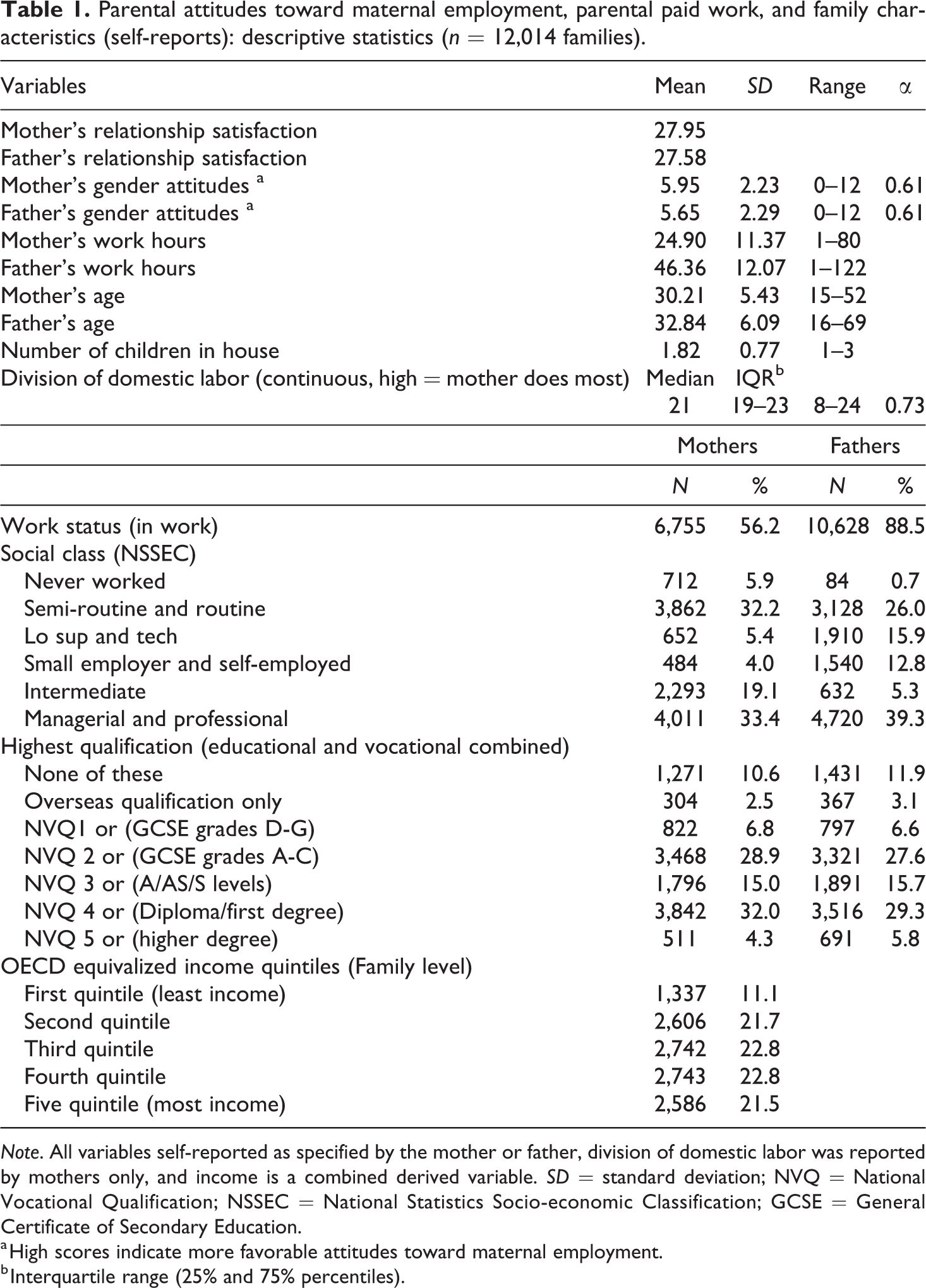
Note. All variables self-reported as specified by the mother or father, division of domestic labor was reported by mothers only, and income is a combined derived variable. SD = standard deviation; NVQ = National Vocational Qualification; NSSEC = National Statistics Socio-economic Classification; GCSE = General Certificate of Secondary Education.
a High scores indicate more favorable attitudes toward maternal employment.
b Interquartile range (25% and 75% percentiles).
Analytic strategy
Mothers’ and fathers’ scores of relationship satisfaction on the GRIMS were modeled in selected MCS families stratified by gender. We analyzed relationship satisfaction for fathers and mothers jointly using a structural equation model to allow for the interdependence of mothers’ and fathers’ relationship satisfaction. We were interested in whether individual-level attitude–behavior and couple-level attitudinal concordance impacted on relationship satisfaction differently for men and women. Additionally, gender stratification also helped take account of the household-level clustering in the data. To test our behavior–attitude and couples’ attitudes hypotheses, we ran two different models, both sets included gender attitudes and maternal work but differed by the inclusion of specific interaction terms. Firstly, we investigated concordance between attitudes toward maternal employment and actual maternal employment behavior by including an interaction term between the attitudes toward maternal employment and the actual maternal employment in the household measured using the mother’s report of her work hours. We then investigated the specific role of attitude concordance within couples, by including an interaction between the mothers’ and fathers’ attitudes. The models also included paid work for both parents and the gender division of domestic labor as covariates as well as the other social and demographic controls for the family. All analyses were conducted in Stata 13 using generalized structural equation modeling (GSEM) and methods for survey data that account for the sampling design of the MCS. The models themselves can be understood as linear regressions, but the GSEM modeling allows for a variety of variables, (continuous, categorical/factor, and interactions) as well as accounting for the relationship between the mothers and the fathers. Due to the design and limitations of GSEM, more traditional fit indices and result reporting are not possible or appropriate, for example, standardized coefficients (StataCorp, 2013). However, GSEM allows for the postestimation of predictive margins and margins plotting which when calculated and graphed can demonstrate the results of the model and are particularly useful for the visualization of interaction terms (StataCorp, 2013).
Results
Fathers and mothers reported broadly similar levels of relationship satisfaction, although fathers (M = 27.58, SE = .04) were slightly less satisfied than mothers (M = 27.95, SE = .04), showing a small but significant difference, t(24026) = −6.65, p < .001. Table 1 shows the average levels of the independent variables in the analytic sample. Mothers had more positive attitudes (M = 5.95, SE = .02) toward maternal employment than fathers (M = 5.65, SE = .02), and this difference between mothers and fathers also appeared to be small but robust, t(24026) = −10.23, p < .001. Table 2 shows unadjusted mean relationship satisfaction scores for both mothers and fathers by attitudes and employment variables, with work hours and gender attitudes grouped for descriptive purposes. All our main variables of interest were associated with relationship satisfaction. Participation in paid labor by both individuals and their partners was associated with greater satisfaction for both mothers and fathers. Furthermore, for both mothers and fathers, more negative attitudes toward maternal employment were associated with decreasing relationship satisfaction.
Mothers’ and fathers’ relationship satisfaction (GRIMS) by parental attitudes toward maternal employment and parental paid work.
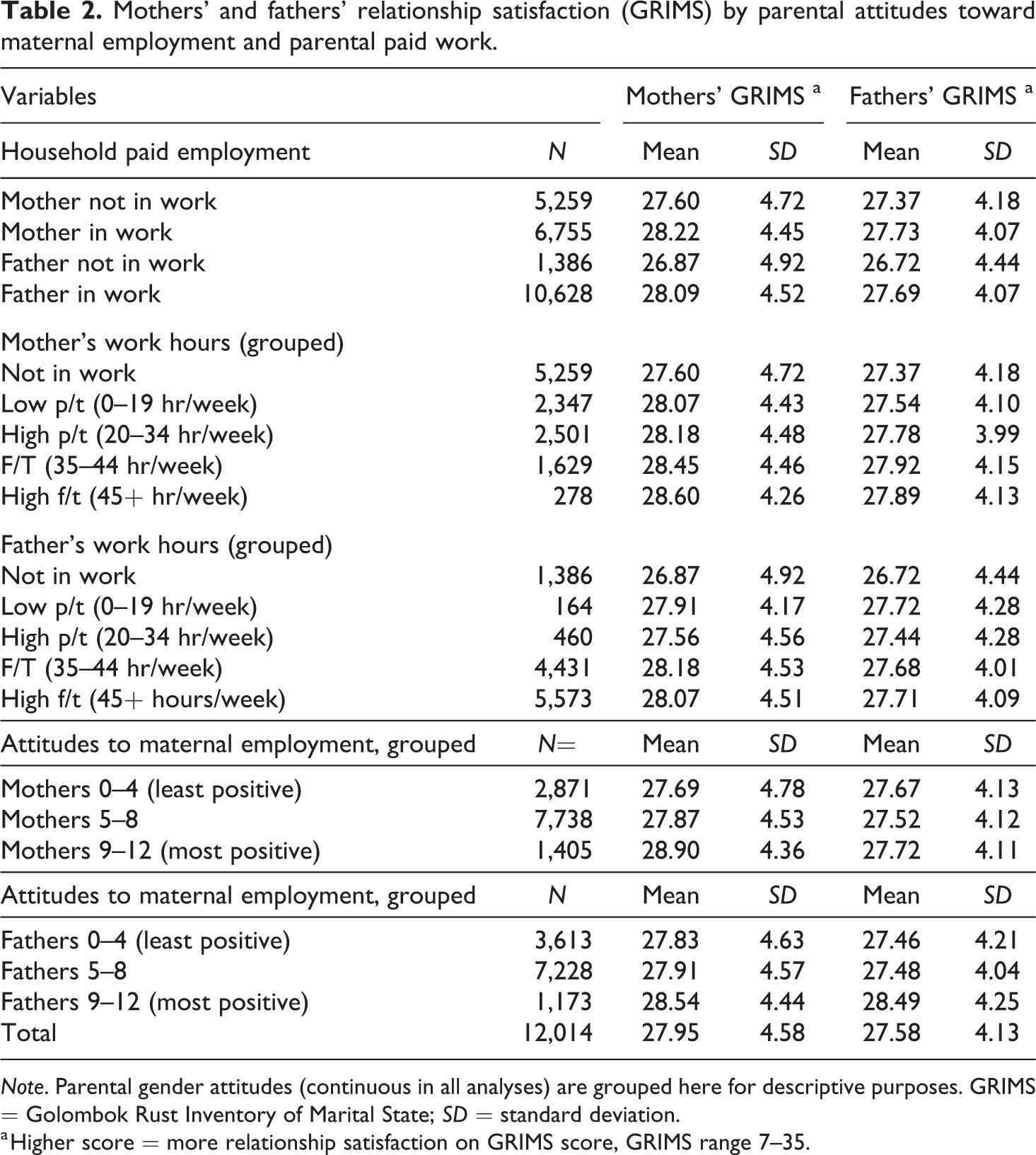
Note. Parental gender attitudes (continuous in all analyses) are grouped here for descriptive purposes. GRIMS = Golombok Rust Inventory of Marital State; SD = standard deviation.
a Higher score = more relationship satisfaction on GRIMS score, GRIMS range 7–35.
Concordance in gender attitudes and behavior
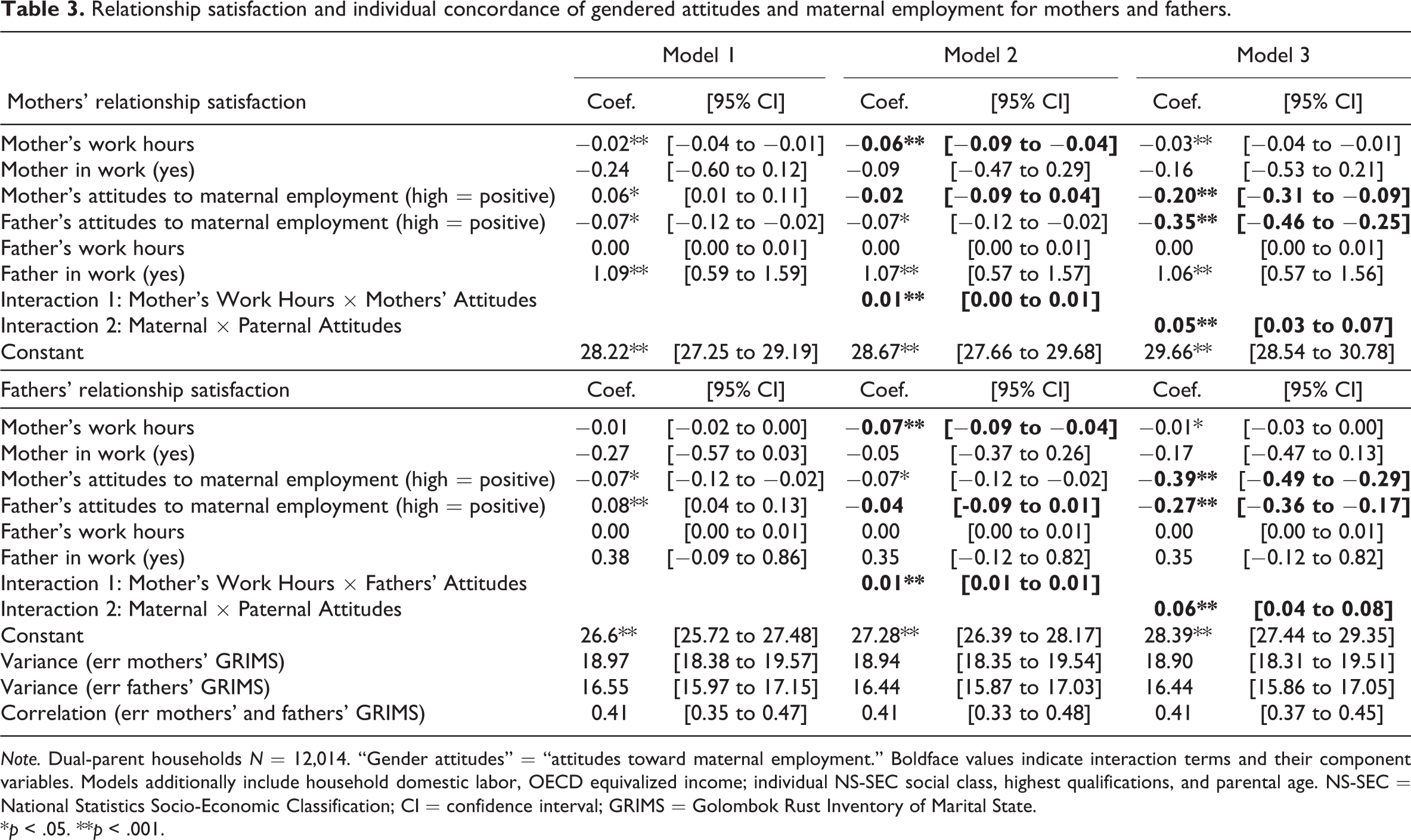
Table 3 shows the results of the models predicting relationship satisfaction for both mothers and fathers. Model 1 includes maternal and paternal paid work and both mothers’ and fathers’ attitudes toward maternal employment with no interactions. All models presented in Table 3 also include the controls: parent age, education, household income, social class, and divisions of domestic labor. In Model 1, mothers’ increasing hours in paid work were negatively associated with relationship satisfaction for mothers (−0.02; 95% confidence interval [CI]: −0.04 to −0.01). Fathers’ binary employment status was significantly associated with more relationship satisfaction for mothers (1.09; 95% CI: 0.59 to 1.59) but not for fathers. Mothers’ attitudes toward maternal employment were associated with more satisfaction for mothers (0.06; 95% CI: 0.01 to 0.11) but less for fathers (−0.07; 95% CI: −0.12 to −0.02). Conversely, fathers’ attitudes toward maternal employment were associated with reduced satisfaction for mothers (−0.07; 95% CI: −0.12 to −0.02) but greater satisfaction for fathers (0.08; 95% CI: 0.04 to 0.13). This first model shows the importance of work and attitudinal variables as well as partners’ impact on each other but also clearly suggests a need to interact variables to test our concordance hypotheses.
Relationship satisfaction and individual concordance of gendered attitudes and maternal employment for mothers and fathers.
Note. Dual-parent households N = 12,014. “Gender attitudes” = “attitudes toward maternal employment.” Boldface values indicate interaction terms and their component variables. Models additionally include household domestic labor, OECD equivalized income; individual NS-SEC social class, highest qualifications, and parental age. NS-SEC = National Statistics Socio-Economic Classification; CI = confidence interval; GRIMS = Golombok Rust Inventory of Marital State.
*p < .05. **p < .001.
Model 2 investigated the hypothesis regarding concordance or discordance between attitudes to maternal employment and actual levels of maternal employment in the household via an interaction term. The interaction term in these models demonstrates that the concordance between attitudes and behavior was significantly associated with greater relationship satisfaction for both mothers and fathers. More specifically, mothers with negative attitudes toward maternal employment had lower scores on relationship satisfaction with more hours in paid work compared to mothers with positive attitudes to maternal employment; for fathers, there was a strong crossover association suggesting considerable support for the importance of behavior–attitude concordance. The interaction between mothers’ work hours and attitudes toward maternal employment remained significantly associated with relationship satisfaction for both parents despite the inclusion of the control variables. Due to modeling in GSEM and the inclusion of factor variable and interaction terms, it is not possible to produce standardized coefficients; however, Stata includes powerful margins utilities to visualize the model results (Williams, 2012). In Figure 1, adjusted predictions for marital satisfaction from the analysis are shown across levels of the two exposures of interest, work hours and attitudes to maternal employment (where high scores are more favorable to maternal employment). Figure 1 demonstrates how the interaction terms operate; for the mothers who work longer hours in paid employment, positive attitudes toward maternal employment were significantly associated with better relationship satisfaction, and attitudes against maternal employment were significantly associated with lower relationship satisfaction for both mothers and fathers. There was no discernible association between attitudes toward maternal employment and relationship satisfaction in households in which mothers were not in paid work. In Model 2, the coefficient for paid work remained significant and increased in size after accounting for our interaction term with gender attitudes toward maternal employment. Attitudes toward maternal employment did not have an independent association with relationship quality for mothers in this model, but more positive attitudes about maternal employment were significantly associated with greater relationship satisfaction for fathers.
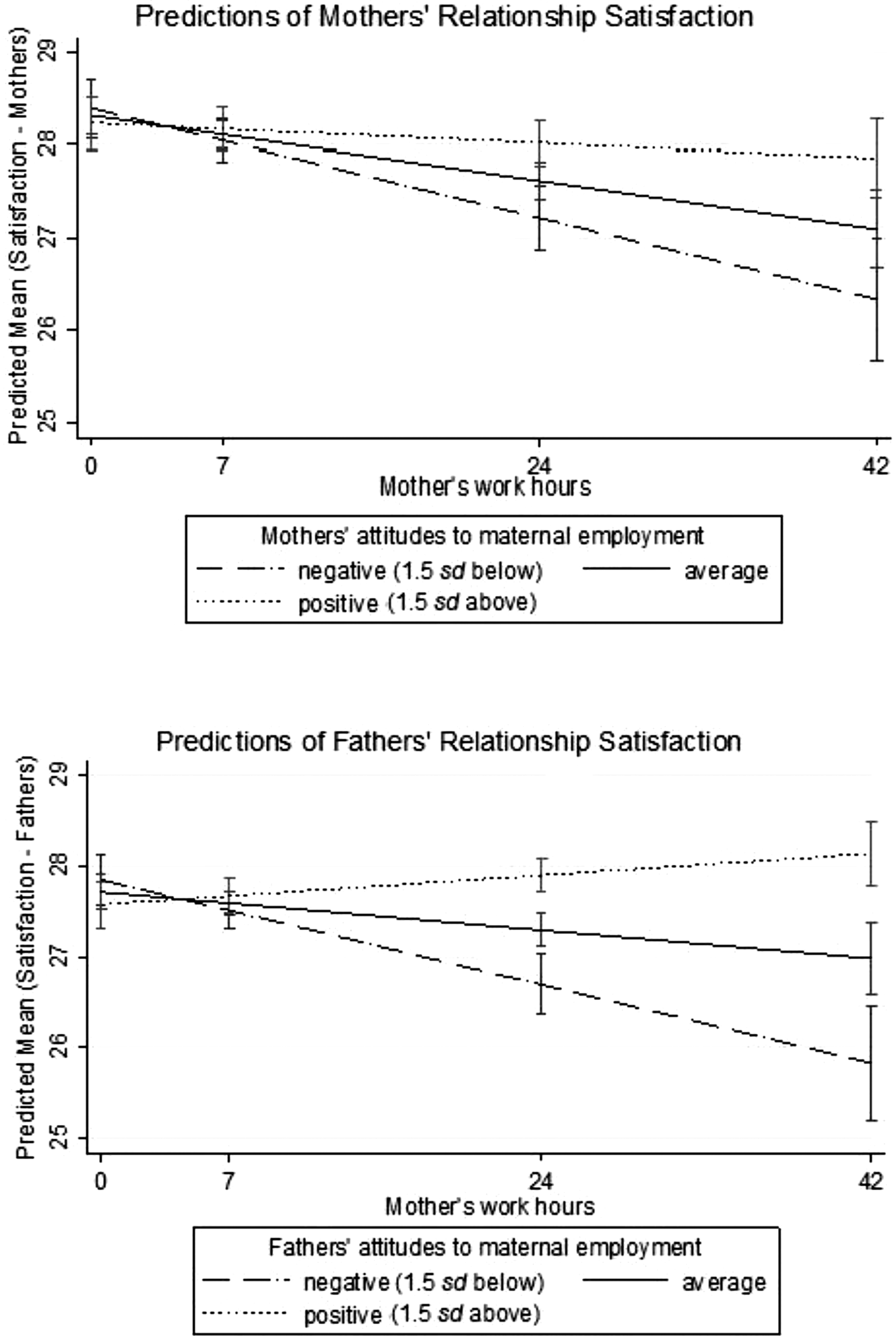
Parents’ predicted relationship satisfaction: visualization of the interaction effect between gender attitudes and mothers’ work hours for mothers and fathers. Note. higher predictions indicate greater satisfaction. “Gender Attitudes” = Attitudes to maternal employment and are at 1.5 SD below mean, mean, and 1.5 SD above mean. SD = standard deviation.
Concordance in couple’s attitudes
Our third set of models in Table 3 examined the association between couples’ concordance on attitudes toward maternal employment and relationship satisfaction. Couples’ concordant attitudes toward maternal employment were positively associated with satisfaction. This association is shown in Figure 2, which plots the interaction between mothers’ and fathers’ attitudes toward maternal employment and relationship satisfaction. Couples in which both the mother and father had positive attitudes toward maternal employment had the most satisfaction in their relationships, followed by couples who had concordant negative attitudes toward maternal employment. Where the couples were discordant in attitudes, we saw the lowest levels of relationship satisfaction. Furthermore, for both mothers and fathers, being the partner who was negative toward maternal employment in a discordant couple was associated with the lowest satisfaction. Thus, for individuals with negative attitudes toward maternal employment, there is a stronger association between partner’s attitudes and relationship satisfaction with high levels of satisfaction among those with partners who had negative attitudes and low levels among those whose partners had positive attitudes. Lastly, for both mothers and fathers, their own and their partner’s attitudes were significantly associated with their relationship satisfaction independent of the interaction term between their attitudes. Negative attitudes toward maternal employment were associated with lower levels of relationship satisfaction,
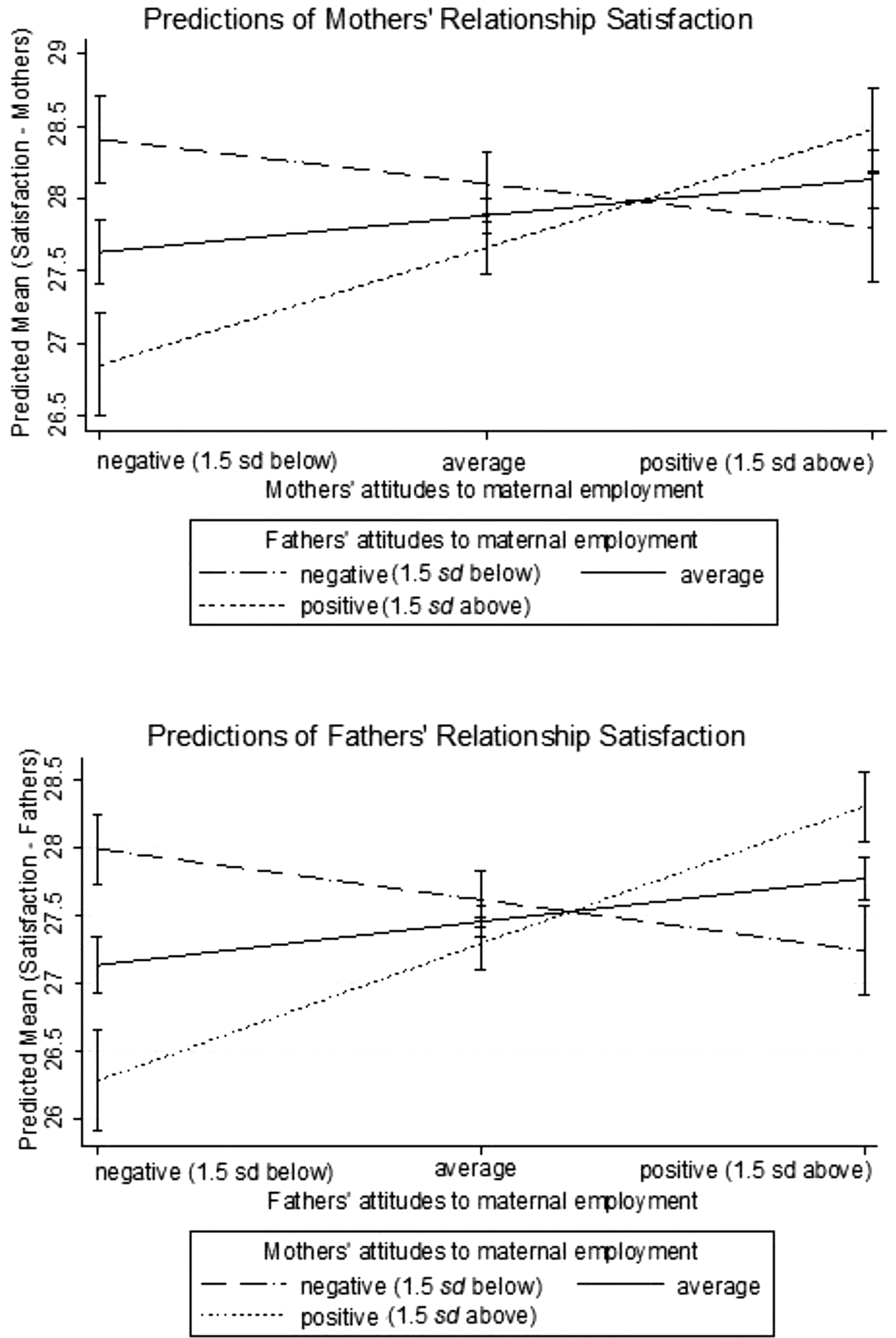
Parents’ predicted relationship satisfaction: visualization of the interaction between mothers’ and fathers’ gender attitudes for mothers and fathers. Note. Higher predictions indicate greater satisfaction, “Gender Attitudes” = Attitudes to maternal employment and are at 1.5 SD below mean, mean, and 1.5 SD above mean. SD = standard deviation.
Discussion
In our study of British families with young children born at the turn of the millennium, we found concordance between attitudes and behavior and between attitudes within couples to be predictive of couple’s relationship satisfaction. We found general support for associations between attitudes to maternal employment, actual maternal employment, and relationship satisfaction. Specifically, our research broadly supported our two hypotheses: that attitude–behavior concordance in individuals between their attitudes to maternal employment and actual maternal employment; and attitude–attitude concordance between couples’ attitudes to maternal employment, would be associated with greater relationship satisfaction. Additional findings included slightly lower levels of relationship satisfaction among fathers compared with mothers. Although a contrast to some studies which have found mothers to have slightly lower satisfaction in the transition to parenthood, generally our results are in keeping with previous research, as a recent meta-analysis on relationship satisfaction found that differences are either small or nonsignificant between men and women (Jackson et al., 2014). These results also provide evidence of interdependence between parents, as fathers’ attitudes toward maternal employment affected mothers’ relationship satisfaction and mothers’ attitudes were associated with fathers’ satisfaction.
We have shown that interactions between mothers’ work hours and individual gender attitudes predicted relationship satisfaction for both mothers and fathers, highlighting the importance of concordant attitudes and behaviors for individuals. Relationship satisfaction was lower when mothers’ working hours were higher for parents who had negative attitudes toward maternal employment and, furthermore, relationship satisfaction was higher for fathers with positive attitudes toward maternal employment whose partners worked longer hours. Our results are similar to those of Ogolsky and colleagues (2014) who found differences in relationship quality among women with egalitarian gender attitudes, depending on the divisions of labor in their households (higher quality with more egalitarian divisions of labor and lower quality in more traditional households) but no association between relationship quality and divisions of paid labor for those with traditional attitudes. These results suggest the importance of enabling families to behave in line with their beliefs, where possible. This research also demonstrates a need to investigate the barriers to maternal employment, as women who have egalitarian attitudes but cannot return to work due to lack of affordable childcare, low opportunities for flexible work, and other such barriers may be prevented from availing themselves of the work/family balance they desire. Researchers investigating parental employment in families would benefit from the availability of attitudinal questions such as the gender attitudes to maternal employment used here. Other types of gender attitudes to employment may also be useful to consider in interactions with paternal employment, for example, gender attitudes toward father involvement in childcare and parental work hours. Such questions could also allow better discussion of barriers that men may face if they desire to spend more time on home tasks and childcare. Having more information on gender attitudes to labor both within and outside of the home would be beneficial to research on relationship satisfaction as well as other related research areas in family well-being.
In testing the parental attitude concordance models, less egalitarian attitudes toward maternal employment were associated with lower levels of relationship satisfaction for both mothers and fathers, independent of their agreement with their partner’s attitudes. This result differs that of Lye and Biblarz (1993) who found that traditional couples had greater relationship satisfaction than nontraditional couples. These conflicting results may reflect secular changes in social attitudes, with traditional attitudes about gender roles becoming less prevalent over the last 30 years (Park et al., 2013) and is in keeping with the trend in the literature from traditional to egalitarian couples being most satisfied. Furthermore, this research demonstrates the importance of attitudes—in this case, attitudes toward maternal employment—for the quality of parental relationships, independent of behavior. Parental gender attitudes remained significantly associated with relationship satisfaction despite the inclusion of multiple labor, socioeconomic, and demographic variables in our models.
Regarding the importance of concordance, we found that couples who were in agreement on gendered attitudes toward maternal employment were significantly more satisfied with their relationships than those who were not. One previous small study of dual-earner couples in a U.S. state found evidence for greater relationship satisfaction when couples had concordant gender ideology but only for men (Minnotte et al., 2010). As we found for both mothers and fathers, Minnotte and colleagues found couple concordance to be particularly important for those who held traditional gender attitudes. Also, similar to their study, we found that men with traditional gender attitudes who were coupled with women who held egalitarian attitudes had the lowest relationship satisfaction; however, we also found this to be the case for traditional women coupled with egalitarian men, perhaps because our sample was not limited to dual-earner households. Further work is needed to understand the processes through which couples’ discordant gender attitudes influence their relationship satisfaction, but it may be that discordant couples experience more disagreement and negotiation over parenting roles and divisions of labor (Greenstein, 1996). More recently, Ogolsky and colleagues (2014) found lower levels of relationship quality for both men and women in couples with discordant gender attitudes. This is consistent with earlier work finding that couples who have differing preferences remain the most unhappy (Lye & Biblarz, 1993). Taken together, the evidence suggests the importance of spousal relations of agreed expectations regarding divisions of labor roles within families before having children.
This study sought to explore the interaction between an individual’s attitudes and the household maternal employment behavior as well as attitudes between couples as previous studies have indicated the possible interdependence in couples of such attitudes and behaviors, and the principle of association between such interactions and relationship satisfaction has been tested successfully in previous studies (Minnotte et al., 2010). Not only do our results demonstrate the importance of interacting couples’ attitudes toward maternal employment and attitudes with actual maternal work behaviors, they also show that not accounting for these important relationships masks some of the association for an individual’s own attitudes on themselves. For example, in Table 3, the coefficient for mothers’ attitudes on relationship satisfaction went from .06 in Model 1 (without any interactions) to .39 in Model 3 (with an interaction with her partner’s attitudes). Although the association between gender attitudes toward maternal employment and actual household maternal employment was slightly less strong a moderator, it was nevertheless still a useful measure of satisfaction. It is possible that whether the behavior–attitude model or the attitude–attitude model would be most suitable would depend on the outcome, for example, a study of the family to work conflict may find a behavior–attitude model more useful and life satisfaction studies may be better served by attitude–attitude modeling. Also, the individual-level attitude–behavior model could also be applied to studies of single parents on relevant outcomes. Until more research is done in this area, testing both types of model would be the most suitable approach for future studies.
Strengths and limitations
This research adds to the literature by finding evidence that couples with concordant egalitarian gender attitudes are more satisfied in their relationships than their less egalitarian peers. Furthermore, we have tested and illustrated the associations of conflicting attitudes within couples on relationship satisfaction and have identified the importance that concordance holds for both mothers and fathers. This research additionally may be interpreted through a lens of cognitive dissonance theory, as the interaction terms in our models (representing the potential conflict between attitudes and behaviors) were very significant, regardless of whether one was for or against maternal employment, or the mother in the house was in work or was not in work; the conflict between attitudes and behavior or attitudes in couples was associated with declines in satisfaction. Using variables from both parents in our models also supports theories of interdependence more generally, showing how parents’ attitudes and behaviors can be associated with their partner’s satisfaction. Lastly, by using a large U.K. cohort study, we additionally feel our research adds to the literature by having a larger and more diverse sample, including different parental working patterns beyond dual-earner households, than previous studies and is relevant for the U.K. context.
However, this research has several limitations. Firstly, it is cross-sectional, so we cannot comment on causality, temporality, or longer-term effects. Secondly, although many of the mothers with a 9-month old child had already returned to employment, there still may have been some mothers who planned to return to work but had not yet done so. Nevertheless, utilizing the 9-month survey may also be considered a strength as it was still quite early in the child’s life; a consideration and limitation in all studies of attitudes is that individuals can change their attitudes over time, particularly to suit their situation. Under the theory of cognitive dissonance, an individual will thus seek to rectify the dissonance through various means to make the contradictory aspects concordant (Harmon-Jones & Mills, 1999). One way to reduce dissonance is to change one of the conflicting thoughts or behaviors. Therefore, it would be possible that over time individuals would adapt either their attitudes or their behaviors to nullify the dissonance. Considering this research question at such an early and changing period of time may better suit our research questions than using data from a later follow-up, although it is possible that some individuals may have already modified their attitudes. This study was also limited in the available gender attitudes, the data only allowed for investigating attitudes to maternal employment; however, more general gender attitudes to family roles and paid work for both parents would have allowed for a much more complete analysis of contemporary gender family role attitudes in the U.K. and potential consequences to parental relationship satisfaction. Overall, this research complements smaller studies well by adding generalizability across a larger population and confirming findings on gender attitudes to maternal employment found in the broader literature.
Conclusion
Taken together, these results suggest the importance of spousal relations of agreed expectations regarding divisions of labor roles within families with young children and enabling families to behave in line with their beliefs, where possible. Some contradictory findings in the past regarding traditional/egalitarian divisions of labor and relationship satisfaction can be at least partially explained by gender attitudes. Overall, this study contributes to the literature by identifying robust associations between paid and domestic labor and gender attitudes with relationship satisfaction for both mothers and fathers in a large U.K. cohort study. We suggest that enabling families to make more egalitarian choices may benefit couples and families to develop stable and satisfying relationships.
Footnotes
Authors’ note
Preliminary versions of this paper were presented at the European Society on Family Relations conference in 2014.
Funding
The author(s) disclosed receipt of the following financial support for the research, authorship, and/or publication of this article: Lauren Bird and Anne McMunn were funded by the European Research Council Starting Grant [ERC-2011-StG_20101124, Anne McMunn PI] and Amanda Sacker was additionally funded by ESRC Grant [ES/J019119/1].
