




Abstract
Societal changes and an increase in personal resources are likely to have an impact on the personal relationships of cohorts coming of age. We expect that, in recent times, (1) relationships more often strike a balance in exchanged instrumental and emotional support and (2) relationships are discontinued more often when there is no balance in exchanged instrumental and emotional support, particularly among nonkin. We compare three birth cohorts from the Longitudinal Aging Study Amsterdam, aged 55–64 years at baseline (early cohort: born in 1928–1937, interviewed in 1992; middle cohort: born in 1938–1947, interviewed in 2002; late cohort: born in 1948–1957, interviewed in 2012). The results indicate that, in the middle and late birth cohorts, personal relationships are more often characterized by a balance in social support exchanges compared to the early cohort. No cohort differences in the effect of balance on relationship discontinuation are observed. The results suggest increased opportunities and preferences of young-olds to maintain balance in their personal relationships.
Keywords
Over the last few decades, traditional communities, such as the (extended) family, church, and neighborhood, have lost strength in protecting and constraining individuals (Giddens, 1990). Individuals are more dependent on their own efforts to establish and maintain supporting personal relationships (Allan, 2008). Therefore, people today might also monitor their relationships more closely to determine whether the returns made on their investments are sufficient to warrant the continuation of the relationship. Empirical evidence on this issue is lacking but is vital to understand how social relationships operate in contemporary society. In the current study, we therefore aim to answer two research questions: (1) How likely are social relationships to be discontinued in subsequent birth cohorts after some time? (2) Can cohort differences in the discontinuation of relationships be explained by differences in the balance of exchanged social support in relationships?
The current study is innovative in at least three ways. First, we compare three birth cohorts (1928–1937, 1938–1947, and 1948–1957) aged 55–64 years. This comparison allows us to identify whether societal changes have affected the balance in social support and the discontinuation of social relationships. Second, we link societal changes and their implications for social relationships to the theory of reciprocity on the functioning of social relationships at the individual level, thereby giving an indication of whether the importance of these mechanisms for societal relationships has changed. Third, we investigate persons aged 55–64 years, an age-group that is of particular relevance for studying reciprocity and the discontinuation of social relationships. They are on the doorstep of old age and therefore in need of maintaining (or building) a support bank from which they can draw support when the need arises (Antonucci, Ajrouch, & Birditt, 2014). Ties that are relinquished because of imbalance are likely to result in a decline in received support in the future, either by receiving less support in the future from the other person that used to give them more support than they returned (in the case of overbenefitting) or by not being able to receive a return on support that they provided to the other person (in the case of underbenefitting).
Reciprocity and discontinuation
Social exchange theory (Homans, 1974) assumes that people keep support exchanges in dyadic relationships in balance. This is also addressed in the theory of reciprocity (Gouldner, 1960). According to Gouldner (1960), an analytical distinction can be made between two constructs of reciprocity: First, a moral norm that one should return some of what one receives from the other, and second, a pattern of exchange, which is the interlocking duties that people owe each other that result in mutual dependence. Balance in social support exchanges is a measure of the second construct of reciprocity, the pattern of exchange. The norm of reciprocity states that people prefer personal relationships in which they give and receive approximately equal amounts of support (Antonucci & Jackson, 1990). When there is an imbalance in social support exchanges in a relationship, the continuation of that relationship is threatened (Klein Ikkink & Van Tilburg, 1999). Imbalance involves a situation when someone receives more social support than he or she provides (i.e., overbenefitting) or when someone provides more support than that he or she receives (i.e., underbenefitting). Imbalance in support exchanges causes cognitive dissonance, a state in which behavior contradicts the norm, which people tend to avoid (Hummon & Doreian, 2003). If it is not possible to change to the desired balanced state, tension can arise. Additionally, ties in which no support is exchanged are likely to be discontinued more often. When no support is exchanged by either party, this is likely to signal an insignificant relationship at the periphery of the personal network that runs the risk of termination, as no investments have been made by any party. Studies on social support distinguish between emotional support and instrumental support. Emotional support comprises behaviors revealing liking, affection, empathy, appreciation, and trust (Kahn & Antonucci, 1980). Instrumental support involves the exchange of tangible goods, services, and aid. The opportunity to exchange social support in relationships is highly reliant on the frequency of contact (Parrott & Bengtson, 1999).
Type of relationship and discontinuation
The odds of discontinuing a relationship vary by relationship type. Therefore, we distinguish four relationship types: biological children, other first-degree kin, friends, and other nonkin. Within family ties, people do not take balance (exchanged social support) into account as much as in nonkin ties (Mills, Clark, Ford, & Johnson, 2004). Ties with children and other first-degree kin (i.e., parents and siblings) have a biological connection and are characterized by strong social norms to provide support. The continuation of these ties is very important to personal well-being. Delayed reciprocity is much more common in these ties, and reciprocity does not have to be immediate (Antonucci & Jackson, 1990; Uehara, 1995). Therefore, these types of ties are less often discontinued, even in the face of ongoing imbalance in social support (Aartsen, Van Tilburg, Smits, & Knipscheer, 2004; Klein Ikkink & Van Tilburg, 1999). At the other side of the spectrum, we find nonkin relationships that are mostly to entirely role-based and, thus, not very personal, such as people from voluntary organizations. These ties are discontinued more often if no timely return on investments is made. Friends are likely to fall in between children and other first-degree kin, on the one hand, and other nonkin, on the other hand. Friends are a selection of nonkin ties that exceed a solely role-based character and have a personal nature. For friends, norms to provide support tend to be less strong than for children and other first-degree kin but are stronger than for other nonkin (Nock, Kingston, & Holian, 2008; Rossi & Rossi, 1990). In socioemotional selectivity theory, it is assumed that people prefer close kin ties over more emotionally distant ties, such as other nonkin when they become older, because of the greater emotional regulation that close kin ties generally provide (Carstensen, 1992). Nonkin ties might, therefore, be more likely to be discontinued in old age.
Cohort differences in the importance of balance for discontinuation
The nature of personal relationships and the mechanisms by which they operate are contingent on the social contexts in which they occur. Over the last few decades, large-scale societal changes ensued that have likely impacted the importance of reciprocity and, more specifically, balance in social support exchanges. Personal relationships are not as structurally embedded as they once were (Giddens, 1990) because traditional communities, such as extended family, churches, and welfare states, have lost strength in constraining and protecting individuals. According to Allan (2001), the significance of personal relationships increased since the 1970s as a result of the more fragmented and less embedded social lives people lead in modern societies. These processes have made people increasingly reliant on their own preferences and needs but also on their own efforts to maintain personal relationships. In such a context, people might strive more for a balance of social support in their social relationships. Although family ties are more flexible than before, normative and institutional boundaries between kin and nonkin presumably remained largely intact (Allan, 2008; Pahl & Pevalin, 2005). In other words, despite large societal changes, commitments and solidarity to provide support to kin in the face of imbalance are likely still much stronger than for friends and other nonkin. Following this line of reasoning, we expect a larger salience of having a balance in later cohorts to pertain mostly to other nonkin relationships, less so to friends, and not so much to children and other first-degree kin. The availability and use of information and communication technology (ICT)-mediated contact has also sharply increased across birth cohorts, potentially contributing to strengthening emotional support exchanges (Wang & Wellman, 2010). This impacts all relationships, but especially ties with friends and other nonkin who do not live close and are likely to be of particular help to those who are less mobile due to health problems. Finally, societal representations of the young-old also dramatically shifted toward emphasizing the productive potential of young-old people who have been linked to more education, better health, and more civic engagement in later cohorts (Martinson & Minkler, 2006). The postretirement phase (also termed the “third age”) is especially assumed to provide many resources for gaining and maintaining personal relationships as, for most people early on in retirement, employment and family obligations lessen and health problems are still far-off (Gilleard & Higgs, 2002; Laslett, 1991). In the present study, we analyze the data of people from three 10-year birth cohorts, aged 55–64 years. The late birth cohort (born 1948–1957) was between the ages of 13 and 22 when societal changes started in the 1970s in the so-called “formative period” (Inglehart, 1997). In the formative period, societal changes were likely to have had a large impact on the outlook and behaviors of individuals. The main aim of the current study is to shed more light on how patterns of balance, and their effects on discontinuation, differ between birth cohorts in response to the abovementioned macrosocietal changes. Thus, we do not aim to provide a direct test of the specific mechanisms that are mentioned above, as the literature on societal change is not that specific on what increased opportunities, desires, and efforts entail. Changes in the social context and societal image of young-old adults suggest that those aged 55–64 years in 2012 might be more likely to have a balance in personal relationships than previous cohorts (
Design of the study
Respondents
In 1992–1993 (henceforth denoted as 1992), the “Longitudinal Aging Study Amsterdam” (LASA; Hoogendijk et al., 2016; Huisman et al., 2011) interviewed 988 respondents born in 1928–1937. The sample was initially recruited for the “Living Arrangements and Social Networks of Older Adults” research program (Knipscheer, De Jong Gierveld, Van Tilburg, & Dykstra, 1995). The sample is stratified according to gender and birth year and is drawn from the population registers of 11 Dutch municipalities that differ as to their degree of urbanization and religion. The response rate was 63%. In 2002, LASA sampled 1,002 respondents born in 1938–1947, adopting the same sampling frame; the response rate was 62%. Similarly, in 2012, LASA sampled 1,023 respondents born in 1948–1957; the response rate was 63%. Follow-up observations were conducted in 1995 (N = 905), 2005 (N = 908), and 2015 (N = 853). Between the baseline and the follow-up, 73 respondents had died, 205 refused to cooperate, 30 were ineligible, and 30 could not be contacted.
We excluded the follow-up data of 317 respondents who did not take part in the face-to-face interview at the follow-up and were briefly interviewed by phone. We excluded two respondents not living independently at the baseline observation and five respondents who became institutionalized between the baseline and the follow-up observation, as their networks were incomparable to the networks of those living independently. We excluded five respondents who only identified their partners in their personal network at the baseline. The reasons for missing data on networks were a short face-to-face interview at either the baseline (N = 9) or the follow-up (N = 59) for those who were too frail or had no time to be interviewed with the entire questionnaire, premature termination of the interview at the follow-up (N = 2), or refusal at the baseline (N = 7) and the follow-up (N = 4). Only two respondents at the baseline and one respondent at the follow-up identified zero network members. Two respondents did not have network members in one of the four selected categories.
The 2,250 respondents identified 40,529 network members at the baseline. We selected network members based on three criteria. First, we selected only network members from those four types of relationships we investigated: biological children, other first-degree kin (parents and siblings), friends, and other nonkin (e.g., people from school, volunteer work and voluntary associations, and acquaintances; leaving N = 28,072). These categories are chosen to reflect the special position of children and friends relative to the first-degree kin and nonkin. Second, due to time constraints in the interview, questions concerning support given and received are collected only for those nine relationships (excepting for spouses)—or fewer, if fewer were identified—with the highest contact frequency. Only ties in the top nine are included in the study, leaving 14,717 network members. Having regular contact is one of the main prerequisites for the exchange of support (Parrott & Bengtson, 1999) and, thus, for securing the inclusion of potentially supportive relationships. Third, we excluded network members for whom there were missing data on social support variables (N = 45, leaving N = 14,672).
In total, we have information on 743 respondents with 4,572 network members from the cohort 1928–1937, 782 respondents with 5,015 network members from the cohort 1938–1947, and 725 respondents with 5,085 network members from the cohort 1948–1957. To study whether reciprocity becomes more significant for the discontinuation of ties in later cohorts, we investigate all relationships with network members identified at the baseline observation and determine whether this relationship is identified 3 years later at the first follow-up observation.
Measurements
LASA aims to identify important and active relationships in the core and periphery of the network. A domain-specific network delineation is employed that encompasses a detailed classification of personal relationships: household members, children and their partners, other family members, neighbors, contacts through work and school, members of associations, and other nonkin relationships. For each of these domains, respondents were asked to “Name the people you have frequent contact with and who are also important to you” (Van Tilburg, 1998). The criteria of importance are left to the interpretation of the respondent. Only persons above 18 years could be nominated. The names of the network members identified in the two observations were compared and, if possible, linked in order to identify whether a person continued to be network member.
Information is gathered on network members, such as type of relationship, gender, contact frequency (ranging from less than 1 (once a year) to 8 (daily)), and travel time to the network member in hours and minutes by usual means of travel. For the nine relationships with the highest contact frequency, four questions about support exchanges were asked. The question for emotional support given was “How often in the last year did…tell you about his/her personal experiences and feelings?” The question on received emotional support was “…did you tell…about your personal experiences and feelings?” For instrumental support, the question was about “help with daily chores in and around the house, such as preparing meals, cleaning the house, transportation, small repairs, and filling out forms.” The answer categories were “never,” “seldom,” “sometimes,” or “often.” To reflect that exchanging support “sometimes” and “often” might be more contingent on actual need during the last year rather than perceived possibilities for support exchange, we conflated these into one category “sometimes/often” for the analyses.
Characteristics of the respondent pertain to the baseline. With regard to the physical health of the respondent, two measures are taken into account. “Functional capacities” is measured with six questions about activities of daily living, based on Katz, Ford, Moskowitz, Jackson, and Jaffe (1963), such as “Can you walk up and down stairs?” The five answer categories range from not at all (1) to without difficulty (5). The item scores are summed to obtain a scale score ranging from 6 (poor) to 30 (good). The number of chronic diseases from seven majors (e.g., chronic nonspecific lung disease, cerebrovascular accident or stroke, and osteoarthritis) is counted. We include cognitive functioning by using the Mini Mental State Examination (range 0–30) that, among others, involves tests of the orientation in time and space, language and the recall of words (Folstein, Folstein, & McHugh, 1975). “Educational level” is measured as the nominal years (ranging from 5 = elementary not completed to 18 = university education) that it takes to complete a level. We also included network size (1–80) by counting all identified relationships, partner status, gender, and age at the interview.
Procedure
To determine whether nonreciprocal ties are more likely to be discontinued, we distinguish between four types of emotional and instrumental reciprocity at the baseline. A relationship is characterized by balance if support is exchanged equally (both sides have “seldom” and “sometimes/often” as exchanged emotional and/or instrumental support). The situation where there is no support exchange at all is seen as a specific type of imbalance. A relationship can be imbalanced in two other ways. In overbenefitting relationships, more support is received than given. In underbenefitting relationships, less support is received than given.
To test Hypothesis 1, whether ties more often have a balance in instrumental and emotional support in the late cohort, we compare the percentages of relationships that have balance in emotional and instrumental support exchanges across the three 10-year birth cohorts for the four relationship types. We use χ2 tests to determine cohort differences.
We describe the discontinuation of relationships between the baseline and the follow-up by the type of relationship per birth cohort. Next, a logistic multilevel regression of the discontinuation of relationships is conducted. Multilevel analyses are used, as relationships are nested in personal networks; the characteristics of respondents, and their network as a whole, are shared by the relationships of the same respondent. We conduct stratified analyses for the four relationship types. Model 1 includes the control, balance, and cohort variables. We compare the early (reference category) and late birth cohort, as societal changes are likely to take some time to manifest themselves fully. The middle cohort is included in the analysis to see whether the trend is linear. To test Hypothesis 2, in Model 2, interactions between the 10-year birth cohorts and the balance measure are added to determine cohort differences in the effects of imbalance on the discontinuity of relationships. Model improvement is tested by the differences in the −2 log likelihood of the model, which is χ2 distributed with the number of interaction terms (12) as degrees of freedom.
Results
Cohort differences in relationships and individual characteristics
Table 1 presents the descriptive statistics per 10-year birth cohort. Emotional and instrumental support balance in relationships differs strongly between birth cohorts. The percentage that is being underbenefitted in terms of emotional support increases from the early to the middle and late birth cohorts, whereas the percentage that is overbenefitted remains stable. The percentage that is underbenefitted and has no exchange in instrumental support is higher in the two later birth cohorts. In the late birth cohort, the average contact frequency is higher, and the travelling time is longer.
Descriptive statistics by 10-year birth cohort.
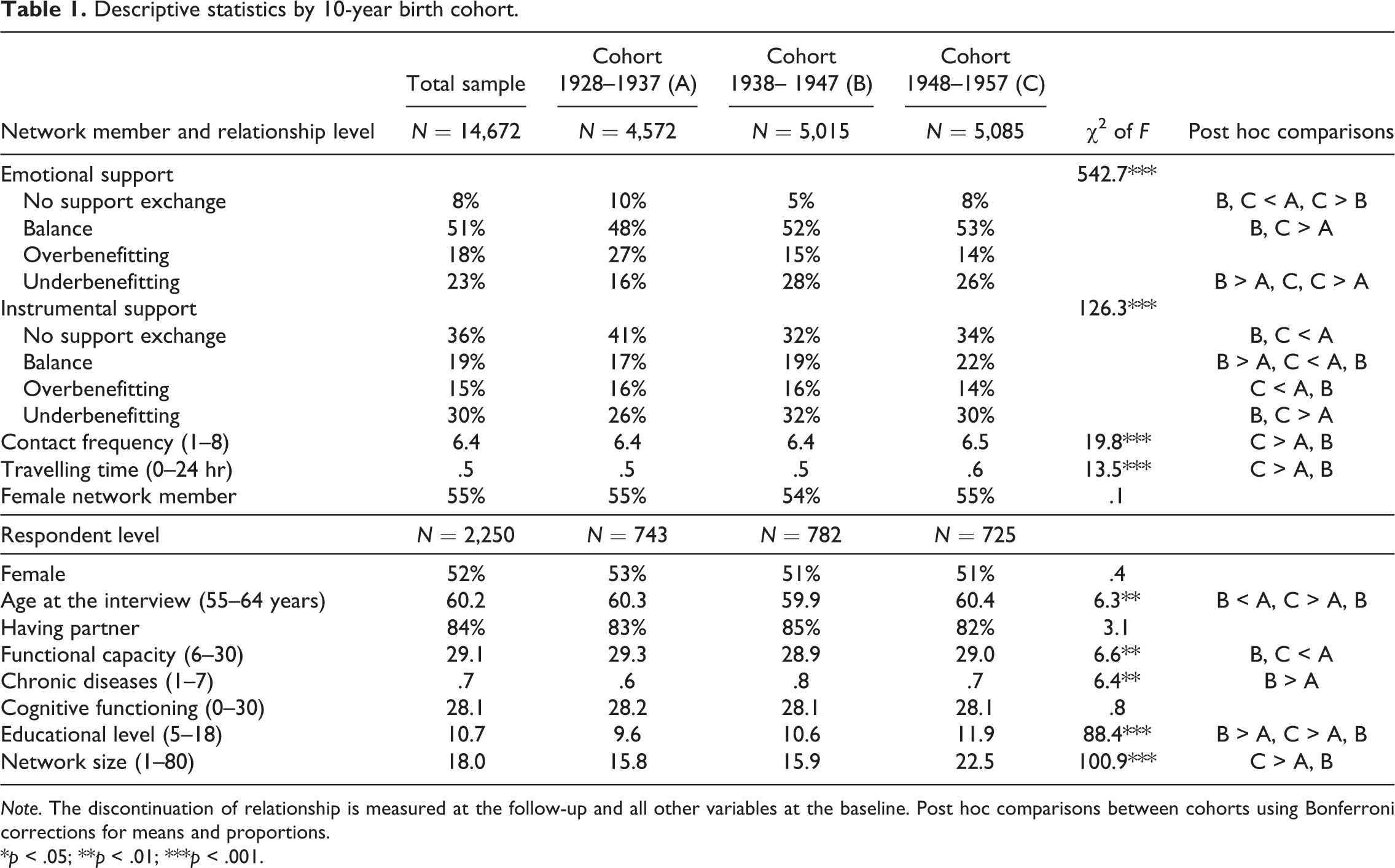
Note. The discontinuation of relationship is measured at the follow-up and all other variables at the baseline. Post hoc comparisons between cohorts using Bonferroni corrections for means and proportions.
*p < .05; **p < .01; ***p < .001.
Cohort differences in the balance of support exchanges by relationship type
The balance of emotional support exchanges in four relationship types and three cohorts is presented in Table 2. The prevalence of the various imbalance categories is shown in the last three columns; this specification is not involved in the testing of cohort differences. In the three cohorts, between 44% and 62% of the relationships with children and friends are balanced. This percentage is lower for other first-degree kin. In particular, other nonkin ties are characterized by a lack of support exchanges. As the pairwise comparisons show, in ties with children, those in the middle birth cohort are more likely to have balance in emotional support (62% of the relationships) than those in the early birth cohort (55%). For other first-degree kin and friends, no significant (pairwise) cohort differences in the percentage of ties with balance in emotional support are observed. Ties with other nonkin are more often characterized by balance in emotional support in the late cohort than in the early cohort, with the middle cohort equal to the early cohort.
Balance in emotional support exchange by relationship type per birth cohort (row percentages).
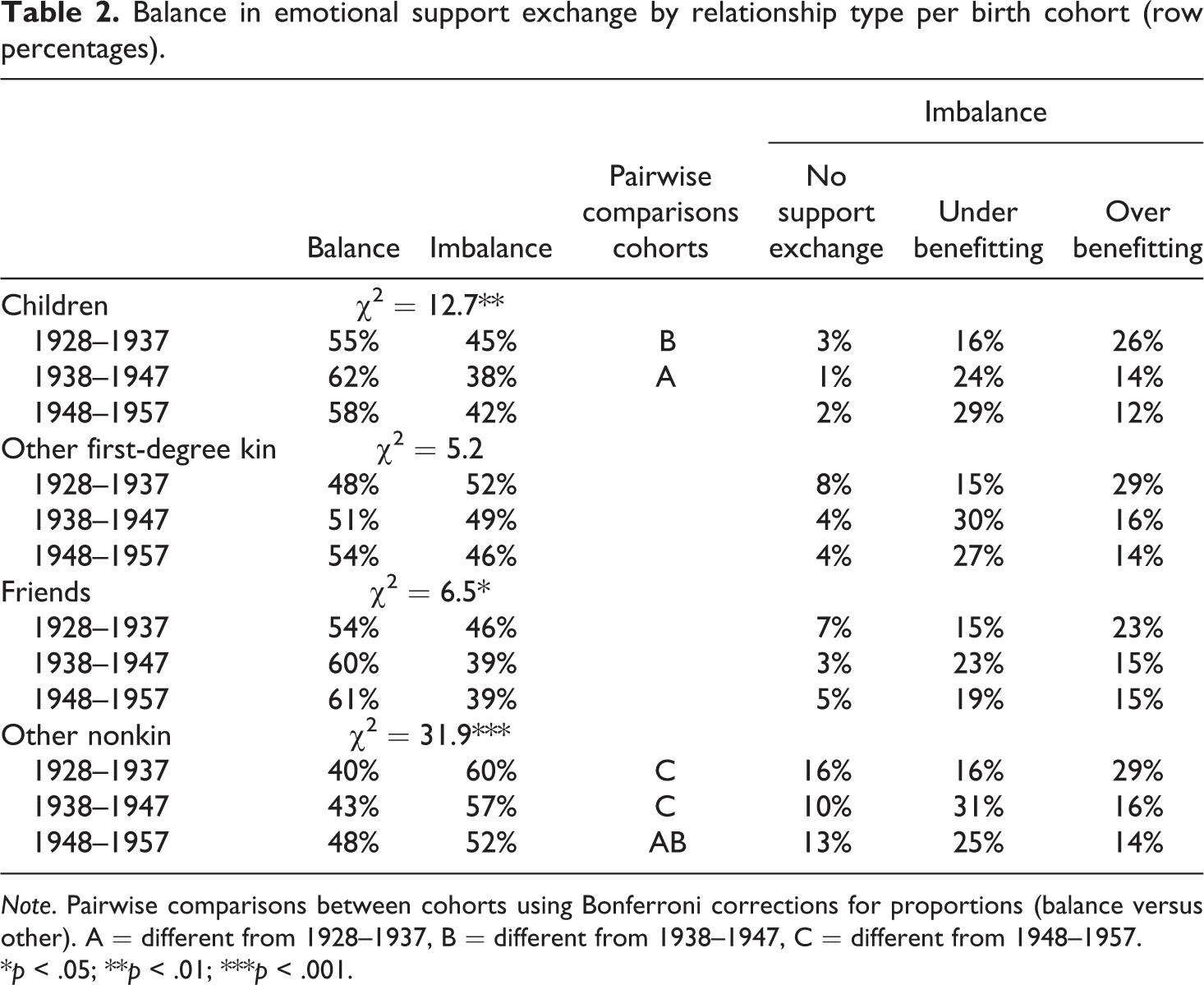
Note. Pairwise comparisons between cohorts using Bonferroni corrections for proportions (balance versus other). A = different from 1928–1937, B = different from 1938–1947, C = different from 1948–1957.
*p < .05; **p < .01; ***p < .001.
For instrumental support (Table 3), we find less balanced relationships than for emotional support. Balance in instrumental support in relationships is more common in the late cohort than in the early cohort for all four relationship types, with the middle cohort being equal to the late cohort (for children and friends) or the early cohort (for other first-degree kin and other nonkin).
Balance in instrumental support exchange by relationship type per birth cohort (row percentages).
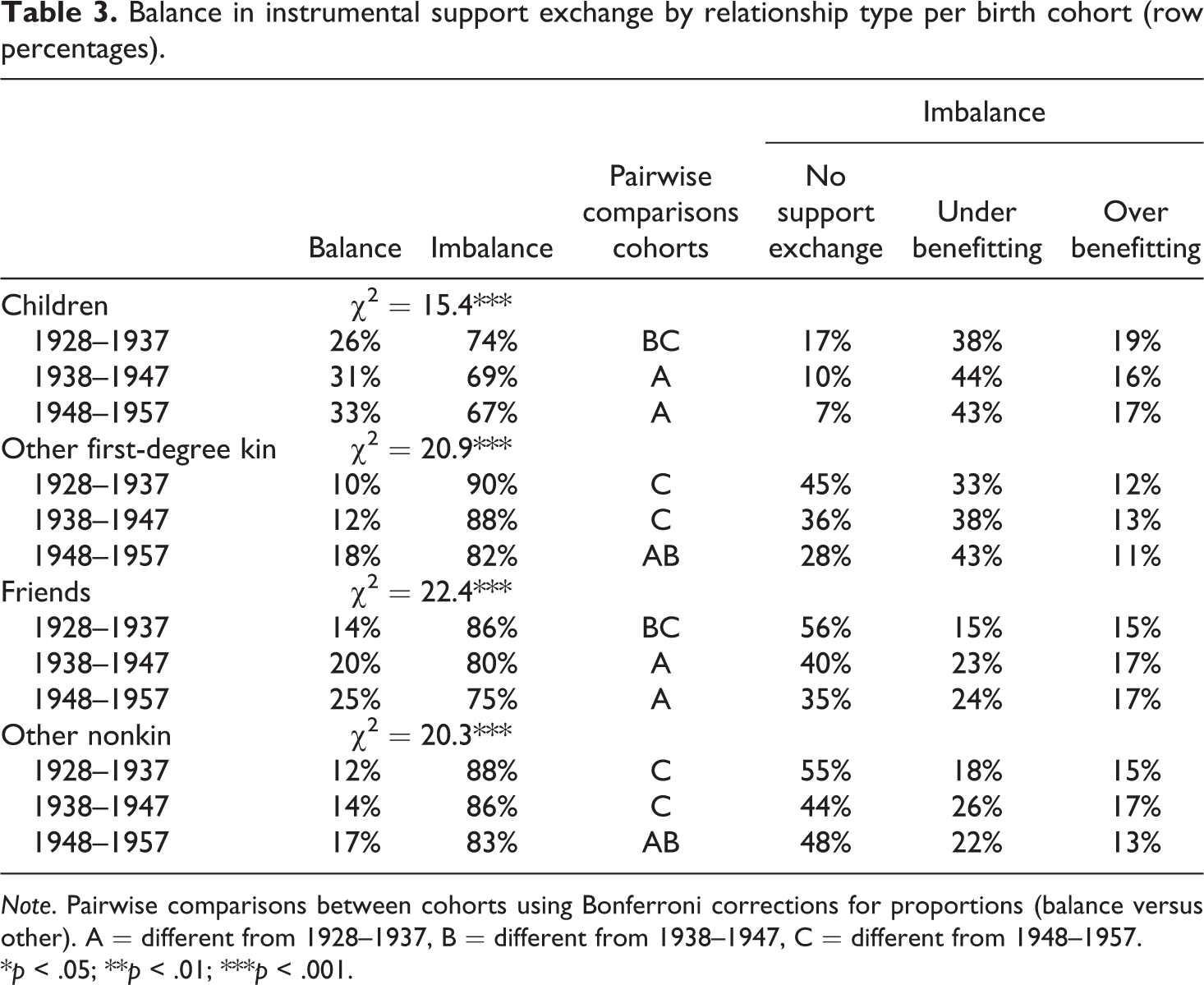
Note. Pairwise comparisons between cohorts using Bonferroni corrections for proportions (balance versus other). A = different from 1928–1937, B = different from 1938–1947, C = different from 1948–1957.
*p < .05; **p < .01; ***p < .001.
Thus, the results confirm Hypothesis 1. Balance in social support exchanges more often characterizes ties in the late birth cohort, as observed partly for emotional support and fully for instrumental support.
Cohort differences in relationship discontinuation
Table 4 presents the percentage of relationships that are discontinued per cohort. About a third of all relationships end over the 3-year time span. The percentage of ties that are discontinued is slightly higher in the late birth cohort than in the early and middle birth cohorts. Relationships with children are discontinued least often; approximately 3% of these ties identified at the baseline are not in the network at the follow-up. The percentages for the discontinuation of other first-degree kin, friends, and other nonkin are 22%, 37%, and 49%, respectively. For children, other first-degree kin, and friends, we observe a trend of decreasing discontinuation from the early to the late birth cohort; for other non-kin, the likelihood of discontinuation does not differ across birth cohorts.
Discontinuation of relationships by the type of relationship per birth cohort.
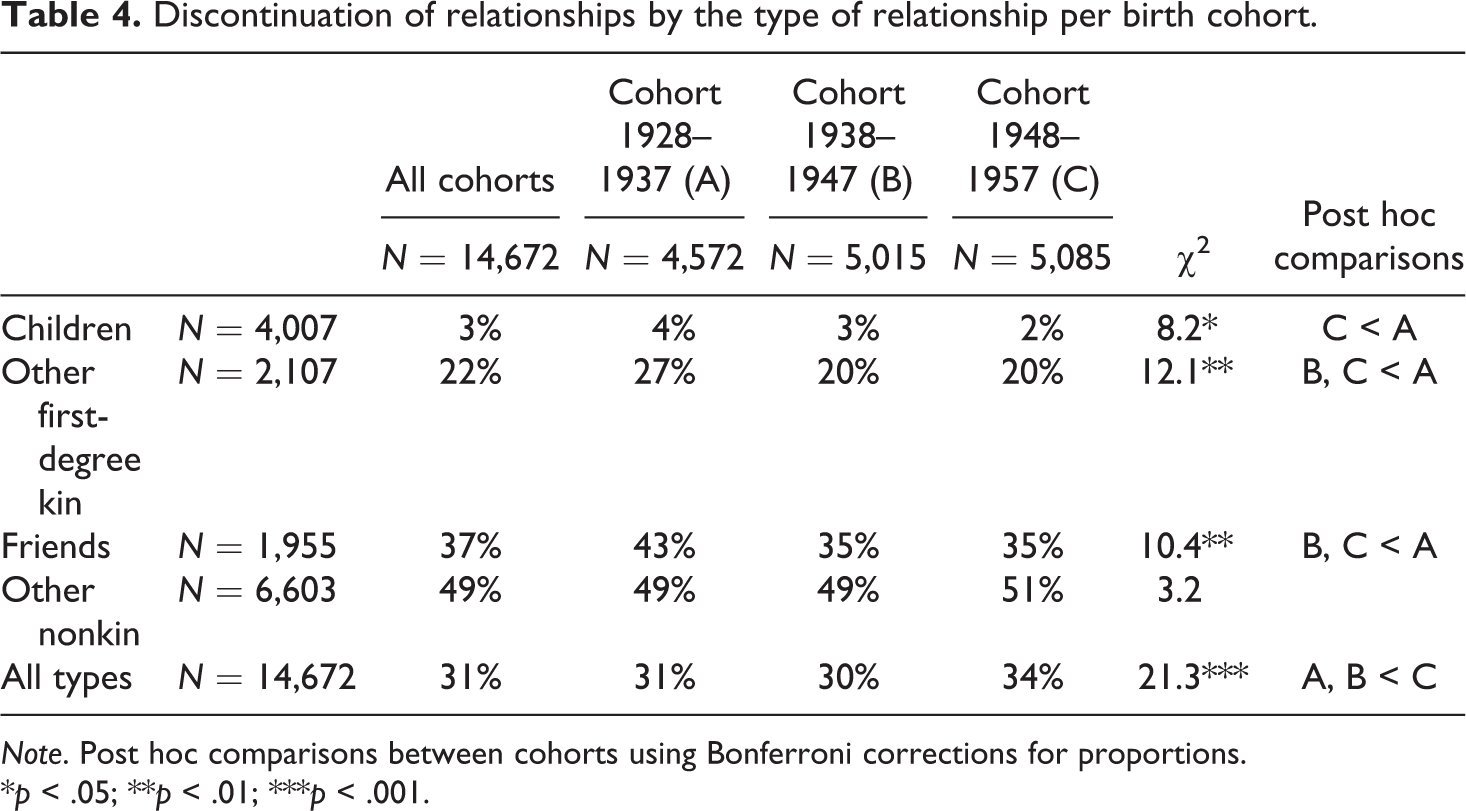
Note. Post hoc comparisons between cohorts using Bonferroni corrections for proportions.
*p < .05; **p < .01; ***p < .001.
Effect of balance of support exchange on discontinuation of relationships
A logistic multilevel regression of the discontinuation of ties between the baseline and the follow-up on balance in social support is conducted. Table 5 presents the results of Model 1. The positive parameters of no support exchanges, overbenefitting (with one exception), and underbenefitting indicate that, compared to ties characterized by emotional and instrumental balance (the reference categories), imbalanced ties of all types are more likely to end. For children, we find this particularly whether there is no exchange in instrumental support. For other first-degree kin, we find this for multiple imbalance situations. For friends, discontinuation is likely when there is an imbalance in emotional support. For other non-kin, most imbalance situations increase the risk of discontinuation. The parameters for the cohorts resemble the results presented in Table 4, with small differences due to the inclusion of balance and control variables in the model.
Multilevel logistic regression of discontinuation of a tie on emotional and instrumental support balance (logit).
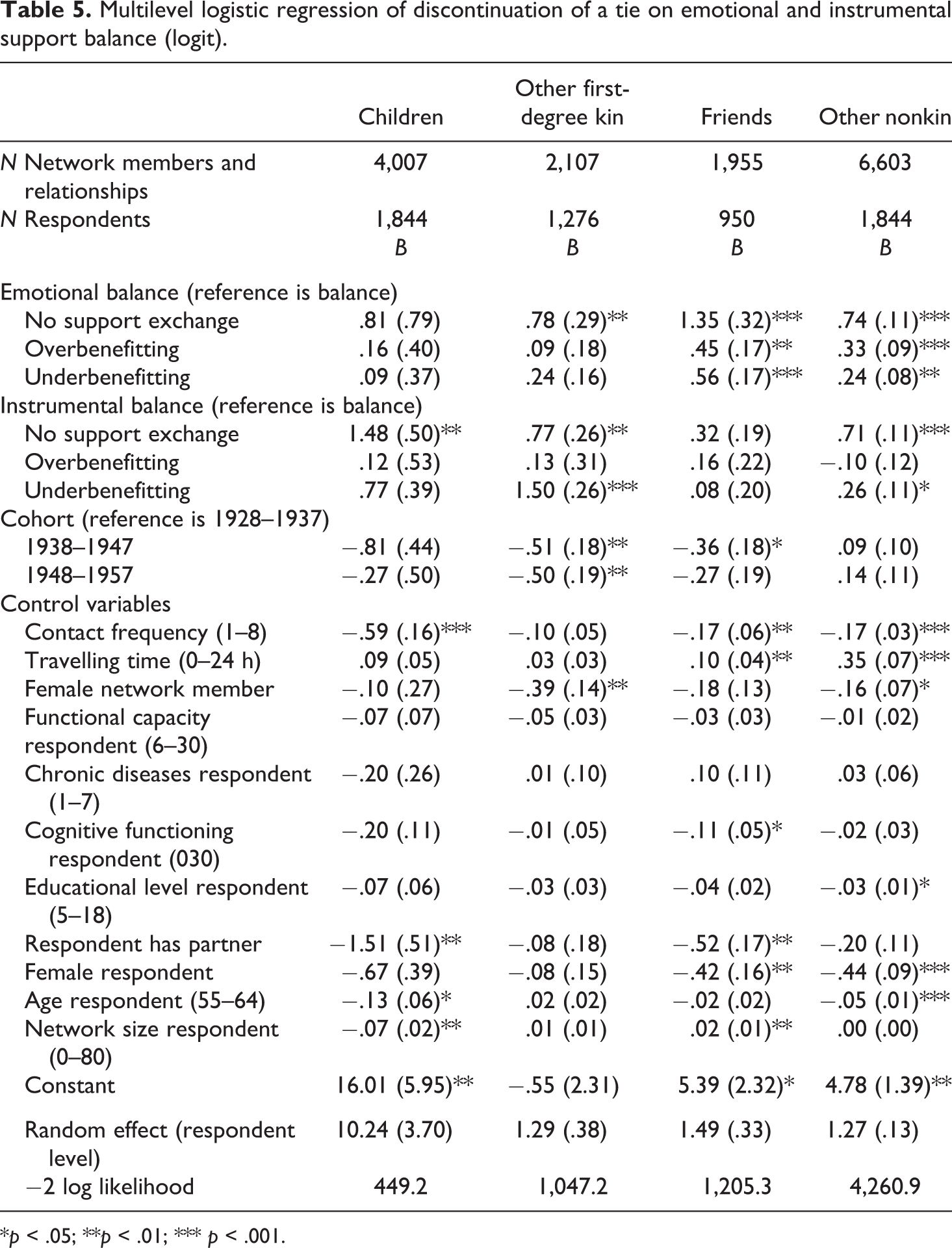
*p < .05; **p < .01; *** p < .001.
Hypothesis 2 assumes that balance in support exchanges has become increasingly important in the continuation of relationships. Model 2 includes 12 interaction effects of balance and cohort (not in the table), with −2 log likelihood of 444.8, 1,041.5, 1,202.1, and 4,255.2, respectively, for the four relationship types. Model 2 is not an improvement over Model 1. We find no cohort differences in the effect of balance in emotional and instrumental support on the discontinuation of all relationship types and, therefore, cannot accept Hypothesis 2.
Other relationship characteristics besides support exchange, including network member and respondent characteristics, impact the discontinuation of ties. A higher frequency of contact reduces the likelihood of the tie ending (but not for other first-degree kin). Ties with friends and other nonkin ties are more often discontinued when the travel time is longer. Ties with female other first-degree kin and other nonkin end less frequently. With regard to the characteristics of respondents, we find that ties with friends are less often ended when cognitive functioning is better. Ties with other nonkin are ended slightly less often when educational level is higher. Ties with children and friends are less likely to end when the respondent has a partner. Females end ties with friends and other nonkin less often. Younger respondents end ties with children and other nonkin less often. Having a larger network size makes it less likely that ties with children will end but slightly more likely that ties with friends will end.
Discussion
We argued that, as the result of detraditionalization, increased resources, and a stronger emphasis on one’s own efforts to maintain personal ties, the relationships of the young-old in the late birth cohort are more often characterized by balance in exchanged social support than those of the early cohort. Hypothesis 1 is supported by our data. For emotional support, balance is more common for the late birth cohort, particularly in relationships with other nonkin. For instrumental support, the development toward more balanced ties is observed for all four relationship types: children, other first-degree kin, friends, and other nonkin.
However, even in a time in which relationships are not considered as given that they once were, balance in social support exchanges is far from the norm in contemporary society. We find that, in all three birth cohorts, about half of the ties, irrespective of the type of relationship, are characterized by emotional support balance. For instrumental support, the picture is very different. In ties with children and friends, balance is slightly more common than with other first-degree kin and other nonkin. However, for all four relationship types, a large majority of the ties are not balanced in terms of instrumental support. Thus, although balance in support exchanges has become more common in later birth cohorts of young-old adults, relationships that are unbalanced in terms of social support remain very common.
We do not find evidence for Hypothesis 2: Imbalance in support exchanges does not more often result in the discontinuation of a tie in the late cohort. The absence of cohort differences suggests that although cohorts coming of age are more reliant on their own efforts to maintain personal relationships and have more resources, their ties do not end more often when there is imbalance in support exchanges. There are two potential explanations for this finding. First, network relationships are often long-lasting; these relationships are likely to be strong and characterized by long-term reciprocity. Therefore, the effect of detraditionalization may not be visible in late adulthood. Rather, it could be that these influences are visible earlier in life (e.g., in young adulthood when networks are expanding (Wrzus, Hänel, Wagner, & Neyer, 2013)). It is therefore of interest for follow-up research to replicate this study among younger age-groups. Second, even though there have been large-scale societal changes that are likely to influence certain network and individual characteristics, the fundamental processes that underlie social ties, such as balance in ties and its effect on discontinuation, might remain mostly unaffected. These mechanisms might represent basic human responses to social situations. Thus, although network characteristics might change as the result of societal changes, this does not automatically have to alter the relative importance of the mechanisms by which ties are maintained. Even in the absence of strong cohort differences in the effect of balance on discontinuation, our results stress the importance of exchange theory. Young-old adults from later cohorts are more likely to have balance in support exchanges in their relationships, which makes it less likely that these ties will be terminated. Imbalance increases the likelihood of the discontinuation of a tie.
In addition to balance in support exchanges, the odds of discontinuation also vary by the type of relationship. In a previous study among early cohorts of older adults (Klein Ikkink & Van Tilburg, 1999), relationship types were less likely to end when the tie was emotionally close and when the social norms to provide support were strong. Across our three subsequent birth cohorts, ties with children, other first-degree kin, and friends (but not other nonkin) are significantly less likely to end in the late than in the earlier birth cohorts. However, this does not change the hierarchy of relationship types in terms of the odds of discontinuation. Ties with children are rarely discontinued, followed by other first-degree kin (about a fifth), friends (about a third), and other nonkin (about half). Therefore, in the face of large-scale societal changes, Cantor’s (1979) hierarchical model, which states that people have a hierarchy in types of ties, with spouses and children on top, followed by other relatives, friends, and other nonkin, remains appropriate. Blood ties continue to be very important in contemporary society, and people strongly depend on these ties. No exchange in emotional support was found, particularly in relationships with other nonkin. Ties with other nonkin having no support exchanges are likely considered to be on the periphery of the network. If no efforts are made to keep relationships going, they tend to decay over time (Burt, 2000; Roberts & Dunbar, 2011). The absence of support exchanges makes network members lose sight of each other and/or could give rise to ambivalence about the state of the relationship.
The tenets of social–emotional selectivity theory are confirmed only partly in the present study. As described in this theory, other nonkin ties are discontinued more often due to a lack of support exchanges and the overbenefiting of the young-old adult in emotional support. However, at the same time, we find very little evidence for a singular focus on close kin ties for emotional support. If anything, balance in emotional support in other nonkin ties actually increases across birth cohorts. Additionally, imbalance in emotional support does not impact on the maintenance of friend ties. Our findings suggest that people’s behavior in social relationships in old age is also strongly dependent on their opportunities and preferences, which are shaped by the social context in which they live. Those aged 55–64 years today are better able to maintain balance in social support exchanges than before, potentially resulting in more social support stored “in the bank” that can be drawn from later. As such, it would be fruitful to investigate in the coming years whether these cohorts will be better-off in received social support when they grow older.
We further note that what makes for a “balanced” relationship is culture specific. For example, in Western societies, social support is more likely to go from parents to children up to a higher age than in the reverse direction (Litwin, Vogel, Künemund, & Kohli, 2008). In more collective and family-oriented societies, such as in Southern Europe and Asia, giving social support to older parents, whether emotional, instrumental, and financial, is considered to be a duty and is desirable (Dong, Zhang, & Simon, 2014; Haberkern & Szydlik, 2010). Accordingly, the idea of what consists of a balanced tie between parents and adult children is most likely different in these contexts. Additionally, in many Western European countries, a distinction between friends and acquaintances is more clearly made than in the U.S. and Canada, where the term friend is used more inclusively to also denote less close ties with nonkin (Höllinger & Haller, 1990; Van Tilburg, Havens, & De Jong Gierveld, 2004). As a result, imbalance in social support exchanges in ties with friends might be more problematic in the U.S. than in the Netherlands, for example. It is thus vital to take into account the specific norms of reciprocity for different relationship types in the societal context that one studies, as these influence what is considered a “balanced” relationship and thus which ties are more likely to end.
In the current study, we investigated the implications of balance in social support exchanges on the discontinuity of ties over a period of 3 years (i.e., the interval between observations in LASA). We therefore only view a relatively short period of relationship behavior in people’s lives. We excluded spousal relationships since it is very unlikely that a discontinuation of such ties is caused by an imbalance in social support over a period of only 3 years. As with children, social support is usually viewed over a much longer period of time in these ties. Additionally, the percentage of marital ties that end within a time interval of 3 years is quite small, making the numbers rather small for investigation. Nonetheless, support exchanges in spousal ties influence perceptions of marital quality (Mickelson, Claffey, & Williams, 2006). Furthermore, to understand the discontinuity of ties, this study focused on balance in support exchanges, so future studies could take into account how societal change has impacted the importance of other motives to engage in supportive behavior, such as altruism, normative obligations, and need-based redistribution, in which a return is not always expected or desired (Eggebeen & Davey, 1998; Silverstein, Gans, & Yang, 2006). Additionally, future studies could give more attention to the role of ICTs in creating balance in social relationships, particularly in subgroups of older adults. The continuous further development of ICTs and their use might, for example, offer unique opportunities for future cohorts of older adults. For example, when they have physical health problems and are therefore less mobile, they may stay in contact with network members and keep these ties more balanced in terms of emotional support exchanges and in specific forms of instrumental support, such as advice.
In LASA, a domain-contact network delineation method is employed to combine the roles that an individual performs in society with contact frequency and to add the importance of relationships as a network member identification criterion (Van Tilburg, 1998). This method provides large personal networks with a wide variety of types of relationships, compared to networks obtained using other delineation methods, such as the core discussion network delineation that delimit mostly very small and close-kin networks (Cornwell, Laumann, & Schumm, 2008). Questions on social support were only asked for the nine network members with the highest contact frequency, and the threshold for inclusion in the top nine thus varies by individual. In contrast to other delineation methods, we have sufficient numbers of less close nonkin ties to study. We also focus on relatively active ties in terms of contact in our study, which are most vital for social support exchanges across old age. The results in the present study might not necessarily pertain one-to-one to ties that are inactive. In inactive ties, imbalance in exchanged social support can be expected to have an even more adverse impact on continuation.
To conclude, societal change has shaped the pattern of social support exchanges. The primary message from the current study is that, in later cohorts, young-old adults more often have balance in social support exchanges in their ties. However, this does not imply that detraditionalization has radically changed the landscape of personal relationships: Many ties today have unequal balance in support, and the significance of balance for the discontinuation of personal ties has not changed.
Footnotes
Funding
The author(s) disclosed receipt of the following financial support for the research, authorship, and/or publication of this article: The Longitudinal Aging Study Amsterdam is supported by a grant from the Netherlands Ministry of Health Welfare and Sports, Directorate of Long-Term Care. The data collection in 2012–2013 and 2013–2014 was financially supported by the Netherlands Organisation for Scientific Research (NWO) in the framework of the project “New cohorts of young old in the 21st century” (file number 480-10-014). Bianca Suanet’s work was supported by a Veni grant from the NWO (file number 451-14-019) and a Van der Gaag scholarship of the Royal Netherlands Academy of Arts and Sciences.
