




Abstract
The restoration of the permanent diaconate was one of the major changes introduced by the Second Vatican Council. Despite considerable scholarly attention to this Roman Catholic sacred order, no empirically-based study has yet aimed to theorise the process of becoming a permanent deacon. This paper addresses that gap by introducing a substantive theory, which elucidates the dominant behavioural patterns underlying the recruitment, selection, formation, and deployment of suitable candidates from the perspective of decision-makers. Employing classic grounded theory methodology in its entirety, this study draws upon interview, focus group, and textual data collected from the Liverpool Archdiocese in the United Kingdom. The article presents the resulting theory and its components, including the concepts of awakening sense of calling, assessing potentiality, enabling actuality, and facilitating discernment. While the study’s focus is specific to the context of the Liverpool Archdiocese, its insights hold broad relevance for decision-makers involved in Catholic dioceses worldwide.
Keywords
Background
The diaconate is one of the three sacred orders of ministry in the Roman Catholic Church, along with the episcopate and the presbyterate. The term deacon originates from the Greek word διάκονος, meaning servant. In the New Testament, this term designates individuals appointed to serve in diverse roles within the early Church (Barnett, 1981: 27–42; Breed, 2019). By the fourth century, the diaconate had become a distinct and permanent order of ministry, with deacons serving under the bishop in a variety of capacities; however, it declined in significance during the Middle Ages, coinciding with the growing dominance of the priesthood (Osborne, 2007: 93–94; Pinnock, 1991: 18–19). In the wake of the Second Vatican Council, Pope Paul VI issued an apostolic letter motu proprio in 1967, which reinstated the diaconate, permitting the ordination of married men as deacons (Paulus Pp. VI, 1967: 697–704). As a result, the Roman Catholic Church presently recognises two types of diaconate: transitional and permanent. The transitional diaconate pertains to men who are preparing for priestly ordination. These individuals are ordained to minister as deacons for a limited time, typically one year, as an interim stage towards ordination as a priest; although technically they retain the diaconal order. In contrast, the permanent diaconate refers to men who are ordained to minister as deacons for life. They may be married or single, and typically hold secular jobs outside of the Church. Since 1967, the permanent diaconate has witnessed a resurgence within the Roman Catholic Church, with approximately 50,000 men serving as permanent deacons globally (Segreteria di Stato Vaticano, 2023).
Deacons are involved in a variety of activities, depending on the pastoral needs of their local communities. As specified by the Second Vatican Council, ‘they are dedicated to the People of God, in conjunction with the bishop and his body of priests, in the service of the liturgy, of the Gospel, and of works of charity’ (Second Vatican Council, 1975: 387). 1 Concerning their role in liturgical ministry, permanent deacons may assist priests and bishops in the celebration of the Mass. They may also administer baptisms, witness weddings, and officiate at funerals. Regarding ‘the service of the Gospel’, they may proclaim the central message of the Christian faith (i.e., the message of salvation through Jesus Christ), deliver sermons, and teach catechism. Regarding their engagement in ‘works of charity’, deacons are called to serve the marginalised members of the local community; therefore, they may visit the elderly and sick, bring Holy Communion to those who cannot attend Mass, and offer support to those in need. While there is a degree of overlap in their roles, there are certain functions that only bishops and priests can perform, but permanent deacons cannot. For example, only bishops and priests have the authority to consecrate the bread and wine during Mass, and only bishops have the power to ordain. Permanent deacons may be involved in counselling, but they do not have the authority to hear confessions or give absolution. They can assist the priest during the Anointing of the Sick, but they cannot administer the sacrament on their own. Thus, the diaconate’s functions complement those of the other two sacred orders.
The recruitment, selection, formation, and deployment of Roman Catholic permanent deacons is a multifaceted process that is primarily governed by the relevant instructions of the Code of Canon Law (1997), the Basic Norms for the Formation of Permanent Deacons (hereafter referred to as Basic Norms), and the Directory for the Ministry and Life of Permanent Deacons (subsequently referred to as Directory). 2 These official church documents, however, do not cover the recruitment phase, and the abstract nature of their guidance renders their practical implementation context-specific. Although a significant body of scholarly literature exists on the permanent diaconate, no empirical study has yet been published to elucidate the previously mentioned process. This paper addresses this gap, focusing on a specific context, the Archdiocese of Liverpool in the United Kingdom. 3 The overall purpose of the research is to develop a data-based theory that explains (a) the issues that decision-makers face in the recruitment, selection, formation, and deployment of permanent deacons in the Archdiocese of Liverpool; and (b) the behavioural patterns by which they resolve these issues. 4
Methodology
To achieve the project’s aim, we used classic grounded theory (CGT) methodology, based on the works of Glaser and Strauss (1967, 1978, 1992, 1998, 2005). In line with the principles of this theory generating research approach, we collected and analysed data concurrently, applying theoretical sampling, the constant comparison method, open coding, selective coding, theoretical coding, memo-writing, and theoretical sorting of memos. Our study was conducted from the perspective of those who serve as gatekeepers in the selection, formation and deployment of individuals seeking to become permanent deacons in Liverpool; we refer to them as decision-makers in this article. The primary questions that guided our investigation were as follows: (a) What issues do decision-makers face during the recruitment, selection, formation, and deployment of permanent deacons in the Liverpool Archdiocese? (b) How do they resolve these issues? 5
The first author of this paper conducted a series of interviews with twelve decision-makers, including Archbishop Malcolm McMahon, spanning from November 2022 to July 2023. 6 These twelve individuals include every key gatekeeper involved in the investigated process, ensuring complete representation. With regard to their demographic characteristics, all of them were white, British, middle-class, middle-aged, and (as is expected of their roles) Roman Catholic. Three of the interviewees were female and nine were male. Although the study was conducted from the decision-makers’ perspective, the inclusion of four participants who not only held decision-making roles but were also permanent deacons themselves offered valuable insights from the viewpoint of those undergoing the process as deacons-to-be. The first author conducted a total of sixteen interviews with these twelve participants (some were interviewed multiple times). The conversations were unstructured and lasted approximately one hour on average. Six of the interviews were in person while ten were conducted online using the Google Meet and Zoom communication platforms. All conversations were audio-recorded. The interviews began with a request for respondents to describe their roles in the selection, formation, and deployment of permanent deacons. The absence of a set of pre-determined questions allowed the participants to express themselves freely, give a detailed account of their experiences, and share any ideas they considered important.
As the first author conducted the interviews, he also analysed the resulting data. The interview recordings were not transcribed; open and selective coding were performed on the audio recordings directly using the MAXQDA 2023 computer-assisted qualitative data analysis software. Theoretical coding was performed manually. The concepts, properties, and dimensions that emerged during the coding process, as well as their respective interrelationships, were discussed on numerous occasions by the authors of this study. 7
Simultaneously with conducting and analysing interviews, official church documents related to the permanent diaconate were theoretically sampled as data. Alongside the previously mentioned Code of Canon Law, Basic Norms, and Directory, the analysis encompassed scoring sheets and related assessment materials employed by decision-makers in the Liverpool Archdiocese. In addition, official documents from the Northern Diaconal Formation Partnership detailing the programme of the formation were subjected to scrutiny. 8 Applying theoretical sampling and the constant comparison method on these written materials provided deeper insights into the inherent structural conditions of the investigated process. The review of the relevant literature, however, was conducted at a separate time from the analysis of these documents; it took place after the theory had been sufficiently crystallised. 9
Once the analysis of the interviews and official documents had been completed, we integrated insights from a focus group discussion that had been conducted by the second author in December 2019 in a face-to-face setting. This session lasted ninety minutes, and its analysis was used to enhance the explanatory capacity of our theory. Five permanent deacons participated in the discussion, each from a different parish within the Liverpool Archdiocese. The demographic characteristics of these men mirrored those of the aforementioned decision-makers. The discussion centred on the responsibilities inherent to the deacons’ role, the necessary competencies for their successful fulfilment, as well as formation needs. The participants’ responses facilitated a more profound understanding of the investigated process from the perspective of those aspiring to become deacons. The research has resulted in a substantive theory that adheres to the quality criteria of CGT methodology (Glaser, 1992: 15). 10
Theory
The theory that emerged from the analysis focuses on the recruitment, selection, formation, and deployment of Roman Catholic permanent deacons within the Archdiocese of Liverpool. The substantive population is the decision-makers involved in this process. Our theory explains how these individuals resolve their main concern within the investigated context. In CGT terminology, the term main concern refers to ‘[t]he issue that emerges across the coded data as the prime motivator, interest, or problem in the research setting’ (Holton and Walsh, 2017: 212), while the most dominant behavioural pattern by which the substantive population resolves this issue is the theory’s core category (Glaser, 1998: 115). The main concern of our theory’s substantive population is the unfulfilled pastoral needs of the Archdiocese of Liverpool. To address this concern, the decision-makers engage in a multifaceted process we refer to as deacon making. This process entails recruiting, selecting, forming, and ultimately deploying suitable individuals who can fulfil the local pastoral needs by serving as permanent deacons.
As depicted in Figure 1, the process of deacon making takes place in two distinct contextual frames, the context of uninterest and the context of interest. 11 The former includes one phase, while the latter includes two phases of the process under study. As the figure illustrates, there is an overlap between the first and second phases. The two contextual frames, the three phases, and the dominant behavioural patterns that manifest within them are elaborated below.
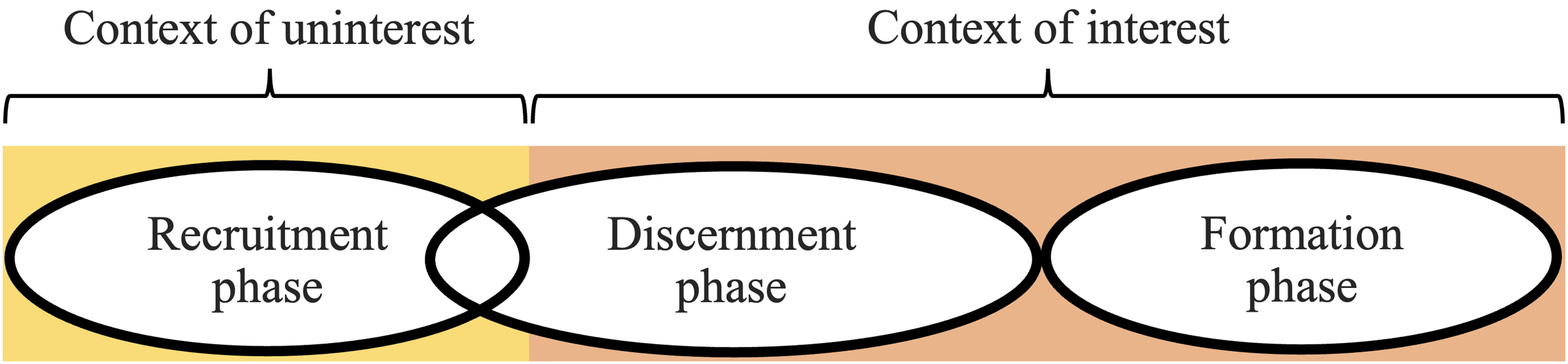
The contextual frames and phases of ‘deacon making’.
Recruitment Phase
Similar to other Roman Catholic dioceses in the Global North (Esteves, 2020), the Archdiocese of Liverpool is confronting a significant uninterest amongst the population in pursuing religious vocations.
12
Consequently, the process of deacon making commences in the context of uninterest, in which the decision-makers seek to engage with individuals whose sense of calling to the permanent diaconal ministry is latent. Sense of calling emerged as a concept during data analysis, and it can be understood as the feeling of ‘a transcendent summons, experienced as originating beyond the self, to approach a particular life role in a manner oriented toward demonstrating or deriving a sense of purpose or meaningfulness and that holds other-oriented values and goals as primary sources of motivation’ (Dik and Duffy, 2009: 427). In our theory, the ‘particular life role’ mentioned equates to the role of a permanent deacon. Only one phase of the process under study, the recruitment phase, belongs in its entirety to the context of uninterest. Although the decision-makers employ virtually identical methods to those used in corporate recruitment environments, they do not specifically aim to attract people. Instead, grounded in the belief that it is God who beckons individuals to become deacons, they strive to awaken a sense of calling in those whom they believe may be divinely called for the role of a permanent deacon within the Roman Catholic Church. The awakening sense of calling behavioural pattern encompasses all the activities that the decision-makers undertake to achieve this goal. Two properties of this pattern emerged from the analysis:
Personal level engagement. This refers to all the actions taken by the decision-makers aimed at direct interactions with individuals. These include targeted networking and one-on-one conversations. Community level engagement. This refers to all the actions taken by the decision-makers to engage with the wider local community. These include hosting informational events, using social media outreach, giving radio interviews, sending deacons to preach in local parishes, and placing marketing assets in church buildings.
As Figure 2 illustrates, these efforts aim to awaken an individual’s sense of calling, the intensity of which varies from person to person. A heightened intensity does not necessarily equate to a genuine divine calling towards the diaconal ministry but rather represents an individual’s subjective perception thereof. As will be seen, the decision-makers support the individual in discerning whether he is indeed called by God to this vocation.
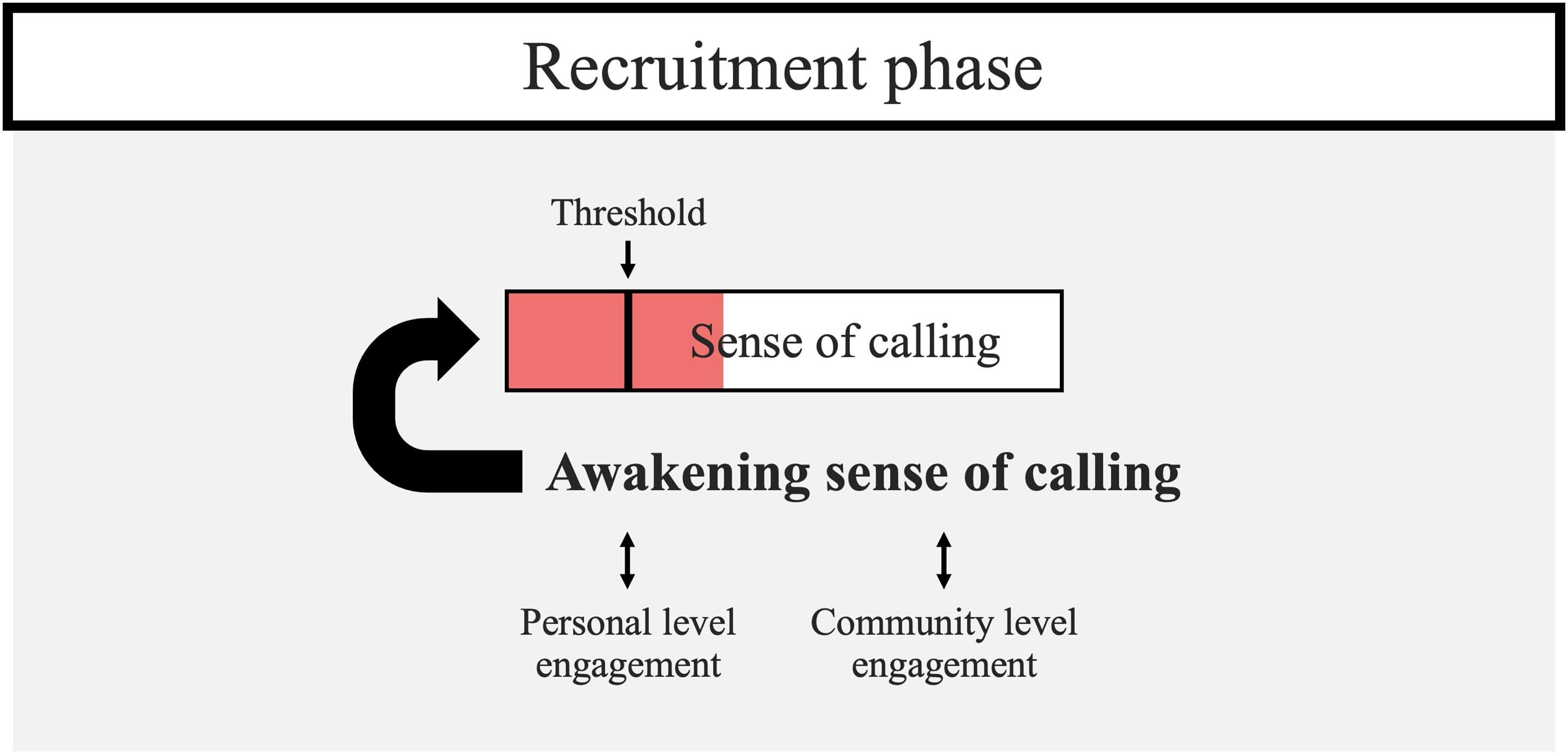
The recruitment phase.
If, as a result of the decision makers’ actions mentioned above, the intensity of one’s sense of calling reaches a certain threshold (which can also vary from person to person), the individual will step from the context of uninterest to the context of interest. Within the latter contextual frame, the decision-makers are engaging with people who possess a sufficient level of sense of calling in pursuing the permanent diaconal ministry, prompting them to acquire a deeper understanding of the vocation. The context of interest encompasses two distinct phases, which are elaborated in the subsequent sections.
Selection Phase
During the selection phase, one of the main objectives of the decision-makers is to ascertain the potential of individuals who express an interest in the diaconal ministry, evaluating their suitability for becoming permanent deacons. This objective is pursued through the assessing potentiality behavioural pattern, two properties of which emerged in the analysis: screening and scoping. These are depicted in Figure 3.
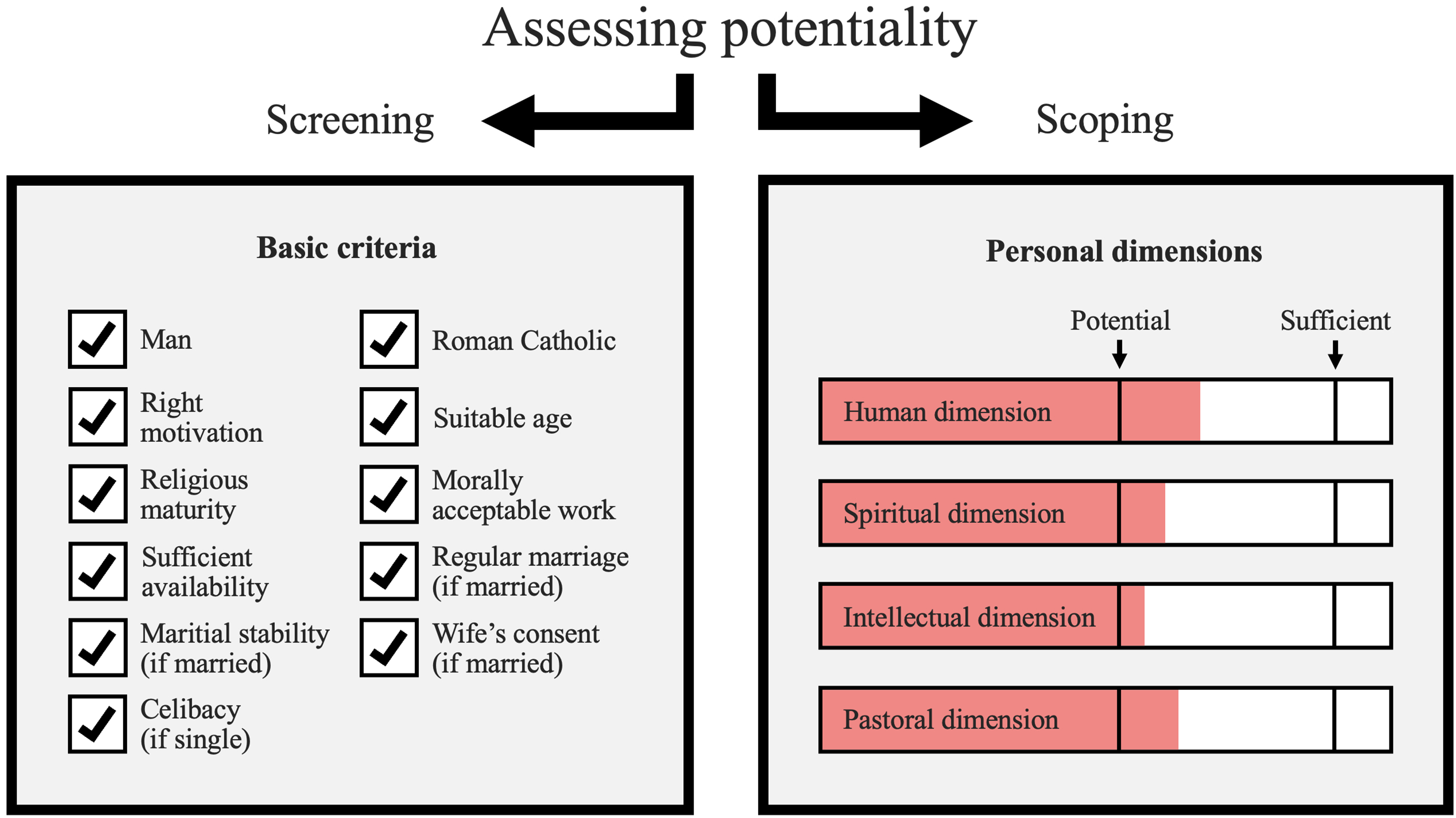
Assessing potentiality.
Screening involves decision-makers assessing whether an individual fulfils the basic criteria required for admission into the diaconate. The term basic criteria refers to the fundamental prerequisites that an individual must satisfy in order to qualify as a deacon. Through the analysis, eleven such requirements emerged, as outlined below:
Man. The individual must be a cisgender male.
13
Roman Catholic. The individual must be a fully initiated member of the Roman Catholic Church. Right motivation. An individual aspiring to become a permanent deacon must possess genuine and altruistic intentions. His motivation must stem from a sincere desire to serve the local community, rather than a pursuit of personal gain or enhancement of social standing.
14
Suitable age. Unmarried individuals must be at least twenty-one years old to begin their four-year diaconal formation, whereas their married counterparts must be a minimum of thirty-one years old to start the same process.
15
The official church documents do not establish a definitive upper age limit. The decision-makers within the Liverpool Archdiocese exhibit flexibility in this regard, allowing for a case-by-case evaluation of each applicant’s suitability based on a holistic consideration of their credentials. Religious maturity. The individual must have a sustained period of active membership in the Roman Catholic Church and possess ministry experience. Although the official documents do not prescribe a specified duration for this affiliation, the prevailing guideline within the Liverpool Archdiocese suggests being a fully initiated member of the Church for a minimum of three years. Morally acceptable work. The individual’s secular occupation must be ethically compatible with the requirements of the diaconal ministry. Specifically, the individual must refrain from engaging in any illicit or illegal activities. Sufficient availability. The individual must have an adequate amount of time to successfully complete the diaconal formation and fulfil the responsibilities associated with the role of a permanent deacon satisfactorily. Regular marriage (if married). If the individual is married, the marital relationship must be monogamous, recognised by the Catholic Church, and his spouse must be a cisgender woman. Marital stability (if married). If the individual is married, his marital relationship must function properly. The official church documents do not specify a duration; however, within the Liverpool Archdiocese, a minimum of three years of a stable marital relationship is considered a strong indicator of the individual’s suitability for the diaconate. Wife’s consent (if married). If the individual is married, he must obtain his wife’s written consent for his active involvement in the diaconal formation and subsequent ministry as a deacon. Celibacy (if unmarried). If the individual is unmarried, he must display a genuine willingness to embrace a lifelong state of celibacy. The official church documents do not specify a temporal criterion; however, within the Liverpool Archdiocese, a minimum duration of three years devoid of any romantic relationship is considered a strong indicator of an unmarried individual’s suitability.
16
Human dimension. This pertains to the individual’s emotional maturity and psychological well-being, incorporating elements such as integrity, interpersonal respect, empathy, self-assurance, adeptness in establishing and nurturing relationships, active listening skills, mental health, altruistic tendencies, resilience, and global citizenship mindset. Spiritual dimension. This refers to the individual’s progression in his inner journey towards achieving union with Christ. It encompasses diverse facets of his spiritual life, including devotional prayer practices, consistent participation in liturgical rites, regular meditation, and the capacity for discerning God’s guidance and bestowed gifts. Intellectual dimension. This pertains to the academic competencies of the individual, including analytical and creative thinking, which determine his ability to successfully complete the diaconal formation and subsequently fulfil his role as a deacon. In addition, it encompasses theological knowledge and other context-specific knowledge relevant to the ministry. Pastoral dimension. This refers to the skills and knowledge required for effectively fulfilling the individual’s ministerial duties. It encompasses proficiencies in preaching, leadership, persuasive abilities, aptitude for collaborative endeavours, capacity to yield tangible results, and adeptness in planning and organising. In addition, it involves an adequate understanding of pastoral theology.
Beyond meeting the basic criteria, an individual aspiring to the role of a permanent deacon must demonstrate certain qualities, encompassing four distinct personal dimensions, each exhibiting a continuum, ranging from low to high. Through scoping, the decision-makers aim to ascertain whether all personal dimensions of an individual meet the minimum threshold, as indicated by the label potential in Figure 3. Meeting the minimum threshold increases the likelihood that an individual will be able to achieve the sufficient threshold within the four-year diaconal formation (also shown in Figure 3). Consequently, using theoretical terminology, an ideal deacon is one who fulfils all the basic criteria and achieves the requisite threshold in the four personal dimensions. These dimensions are as follows:
17
The selection phase encompasses three consecutive stages, each of which involves the presence of the assessing potentiality behavioural pattern of the decision-makers. The type of the assessment and the possible outcomes derived from it, however, vary across these stages, as shown in Figure 4 and elucidated below.
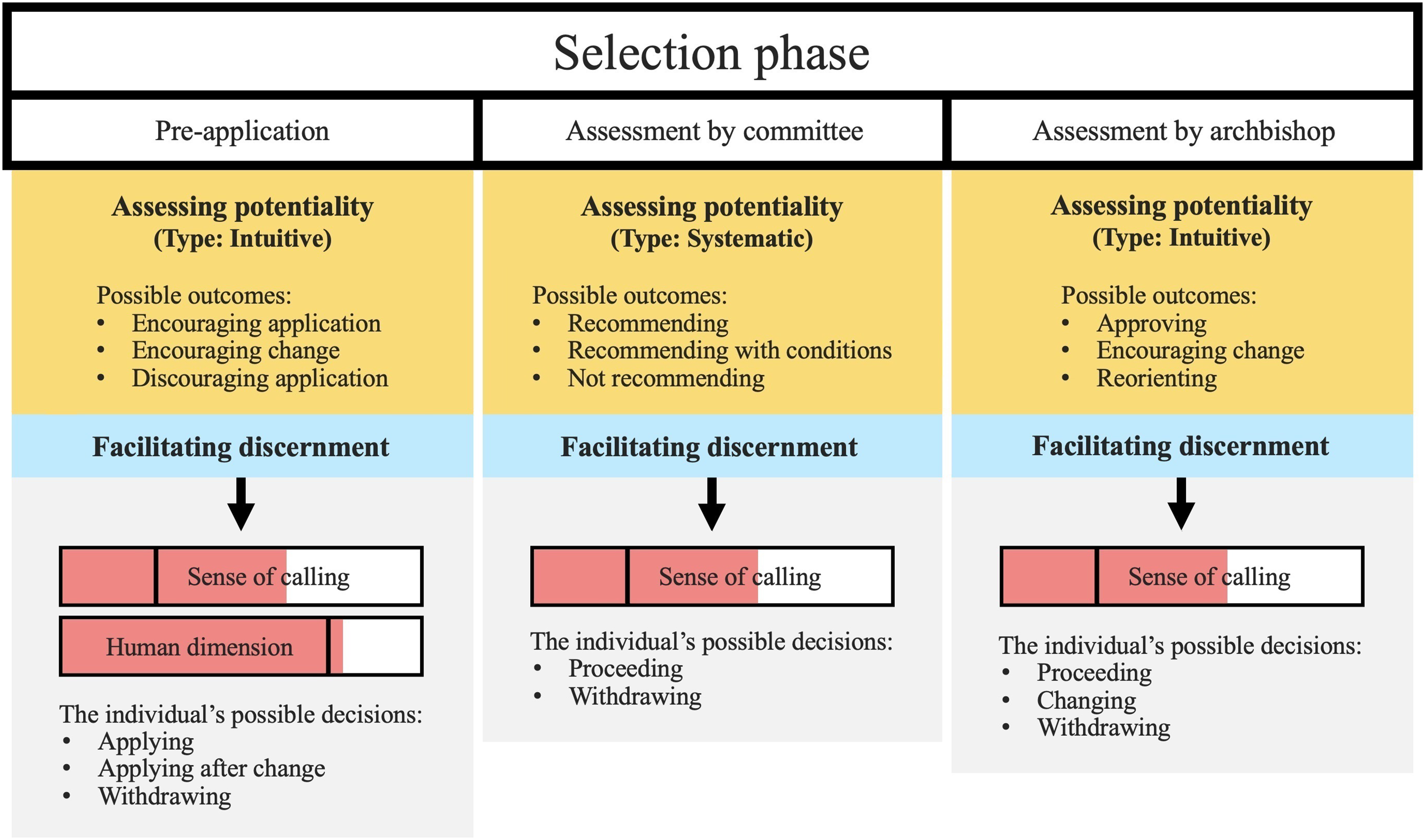
The selection phase.
In addition to discerning an individual’s aptitude for diaconal ministry, the decision-makers also endeavour to assist him in making a well-informed and spiritually attuned choice regarding his participation in the diaconate. The facilitating discernment behavioural pattern, which is present in every stage of the selection phase, encompasses all the activities aimed at supporting the deacon-to-be in this regard, including promoting prayer and meditation, offering spiritual direction, and organising group retreats. Both those considering joining the diaconate and the decision-makers involved evaluate the benefits and costs of such a decision during their discernment; they then proceed to choose the most rational option.
18
The rationality involved in this decision-making process extends beyond mere logical analysis, incorporating an aspiration to align one’s choice with a higher calling.
19
Liebert’s words pertinently capture the form of discernment present in the investigated context: Discernment . . . is the process of intentionally becoming aware of how God is present, active, and calling us as individuals and communities so that we can respond with increasingly greater faithfulness. Those moments in which we make decisions are privileged times in which discernment can make a big difference: in decision making, self-determination comes together with God’s call. Approaching decision making through spiritual discernment relies on awakening and honing the ability to recognize God’s desires in each moment (Liebert, 2008: 8).
As Figure 4 illustrates, interactions with the decision-makers can affect the deacon-to-be’s sense of calling. Thus, his sense of calling may decline, stagnate, or increase, thereby influencing the trajectory of deacon making. 20 The following subsections address the potential choices an individual can make in the three stages of the selection phase; in addition, they explain the types and possible outcomes of the assessing potentiality behavioural pattern present in these stages.
Pre-Application Stage
The first stage of the selection phase encompasses all instances wherein the decision-makers have the opportunity to interact with an interested and/or apparently suitable individual, prior to the submission of his application. These instances comprise private conversations, information evenings organised by the Liverpool Archdiocese, mentoring sessions held in the individual’s residence, and occasions where a decision-maker assists in compiling the application materials. The assessing potentiality and facilitating discernment behavioural patterns are present throughout these engagements.
As depicted in Figure 4, two distinct types of assessment emerged during the analysis: intuitive and systematic. At the pre-application stage, the assessment employed is intuitive, characterised by an unstructured and subjective evaluation that is reliant on the assessor’s personal impressions, opinions, and judgments regarding the person’s suitability for the role. This type of assessment involves informal and unstandardised methods such as free-form discussions, open-ended questions, and qualitative observations.
As previously mentioned, there is a possibility of overlap between the recruitment and discernment phases. The decision-makers may identify an individual with the potential for diaconal ministry before he expresses his interest in the role; that is, the assessing potentiality behavioural pattern of the pre-application stage can manifest prior to the transition into the context of interest. Should the decision-makers identify a person in this manner, they may engage in the awakening sense of calling behavioural pattern. Regardless of whether assessing potentiality takes place before or after the individual enters the context of interest, there are three possible outcomes of the decision-maker’s assessment at the pre-application stage, to which the individual can respond in different ways. The possible outcomes are as follows:
Encouraging application. If the individual appears to meet all the basic criteria and all the personal dimensions seem to reach the potential threshold, the decision-makers will encourage him to apply. If the individual enters or remains in the context of interest during the interactions, he will submit his application and proceeds to the assessment by committee stage. If the interactions with the decision-makers do not lead to a transition into the context of interest, or they cause a return to the context of uninterest, the individual withdraws, and the process ends. Encouraging change. If the individual does not appear to meet all the basic criteria and/or at least one of the personal dimensions does not seem to reach the potential threshold, but he can meet these requirements in the foreseeable future, the decision-makers will encourage the individual to contact them again later. The decision-makers will suggest actions for him to take in the interim in order to reach the potential threshold. If the individual remains in the context of interest, two scenarios can occur: (a) either he complies with the decision-maker’s request and submits his application after having completed the necessary actions, or (b) he submits his application without complying with the request. At this stage, the decision-makers have no authority to prevent a prospective deacon who meets the basic criteria from applying. The stronger the individual’s sense of calling and the higher his human dimension, the easier it is to persuade him to apply later. Conversely, the stronger his sense of calling and the lower his human dimension, the more likely he is to apply without implementing the requested changes. If the individual decides to apply, the process continues with the assessment by committee stage. If the interactions with the decision-makers result in a shift back to the context of uninterest, the individual withdraws. Discouraging application. If the individual does not appear to meet all the basic criteria and/or at least one of the personal dimensions does not seem to reach the potential threshold, and it is highly improbable that he will fulfil these requirements in the near future, the decision-makers will advise the individual not to apply. This is because the application will certainly be rejected. If a transition takes place to the context of uninterest during the interactions, the process ends. However, as mentioned, the individual cannot be prevented from completing and submitting the application materials if he meets the basic criteria. If he insists on applying, he proceeds to the second stage of the selection phase.
Assessment by Committee Stage
After the submission of the application materials, a committee of decision-makers conducts an in-person assessment for all prospective deacons. This committee comprises both lay and ordained individuals from various backgrounds, including some with expertise in human resources and mental health. Their assessment represents a crucial juncture where the potential of each individual is thoroughly evaluated. As shown in Figure 4, the assessment at this stage is systematic, employing rigorous, predefined methods and criteria consistently for all applicants. This approach minimises individual biases, enhancing the reliability and validity of the results. Alongside the evaluation, the decision-makers also assist the prospective deacons in their discernment (as also depicted in Figure 4). Throughout the stage, the committee deliberates and ultimately arrives at a consensus, which leads to one of the following possible outcomes:
Recommending. If the committee concludes that the applicant possesses the necessary potential to fulfil the role of a permanent deacon, they will submit a recommendation to the archbishop for the applicant’s admission to the diaconal formation. If the individual remains in the context of interest after his interactions with the committee, he will proceed to the assessment by archbishop stage. Conversely, if he returns to the context of uninterest, the process ends. Recommending with conditions. If the committee concludes that the applicant does not meet all the basic criteria or does not reach the potential threshold in at least one of the personal dimensions, but he is able to satisfy these requirements in the near future, they will recommend the applicant’s admission to the diaconal formation on the basis of certain conditions. These conditions could include improving academic abilities, gaining additional ministry experience, or addressing personal issues, which may include complex matters of marital status. The individual’s next step – either proceeding to the following stage or voluntarily withdrawing – depends on the intensity of his sense of calling. Not recommending. If the committee concludes that the applicant does not meet all the basic criteria or does not reach the potential threshold in at least one of the personal dimensions, and it is unlikely that he will satisfy these requirements in the foreseeable future, they will advise the archbishop against admitting the applicant to the diaconal formation. If the individual remains in the context of interest after his interactions with the committee, he will proceed to the third stage of the selection phase.
Assessment by Archbishop Stage
Although the committee plays a significant role in the selection process, the ultimate decision-making authority lies exclusively with the archbishop. Regardless of the committee’s evaluation outcome, the archbishop interviews the applicant. If the applicant is married, his wife is also expected to be present during the conversation. This in-person meeting serves a dual purpose: to assess the individual’s suitability for the diaconate and to support him in making the right choice regarding his entry into the ministry. Prior to the conversation, the archbishop is provided with a comprehensive written assessment from the committee, which informs his evaluation of the applicant. In this stage, the type of assessment is intuitive, and its possible outcomes are as follows:
Approving. If the archbishop discerns the individual’s potential to succeed as a competent deacon, he approves the application. Depending on the intensity of the individual’s sense of calling, the process either continues in the formation phase or ends. Encouraging change. The archbishop may deem it necessary for the applicant to meet specific conditions prior to beginning the diaconal formation. If the applicant remains in the context of interest and meets these conditions, he will be granted admission and will proceed to the formation phase. Conversely, if his sense of calling to the diaconal ministry sufficiently weakens, he will voluntarily withdraw. Reorienting. If the archbishop decides to decline the individual’s application, the process concludes, precluding the opportunity for subsequent reapplication. Nevertheless, the decision-makers will assist the individual in identifying a ministry that better aligns with his qualifications and aspirations.
Formation Phase
The second phase belonging to the context of interest is the formation phase. It encompasses five consecutive stages, as illustrated in Figure 5.
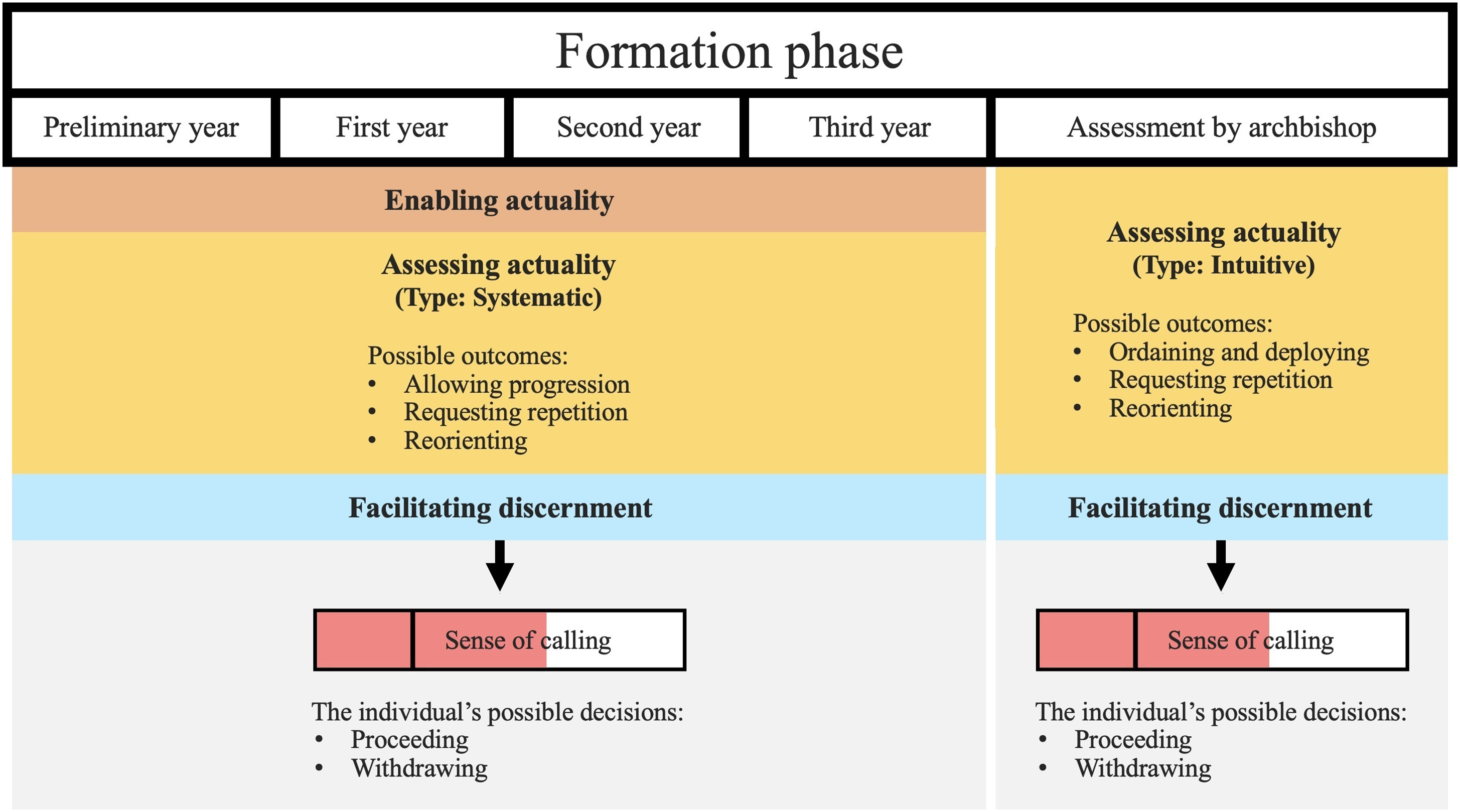
The formation phase.
The preliminary year stage refers to the propaedeutic period, during which ‘the aspirants [are] introduced to a deeper knowledge of theology, of spirituality and of the ministry of deacon, and they [are] led to a more attentive discernment of their call’ (The Congregation for the Clergy, 1998: 47–48). Although the official church documents do not specify the exact length of this period, it takes one year in the Liverpool Archdiocese. Successfully completing this period elevates the individual’s status from aspirant to candidate. 21 The subsequent three stages represent the three years of diaconal formation, during which candidates are ‘formed in the spiritual life and appropriately instructed in the fulfilment of the duties proper to [the permanent diaconate], in accordance with the provisions made by the Bishop’s Conference’ (The Canon Law Societies, 1997: 51). In the Liverpool Archdiocese, the curriculum combines in-person and online sessions, incorporating a two-year certificate programme that forms a substantial part of the academic input during the first two years of candidacy. 22 The fifth stage consists of a final assessment by the archbishop in a personal conversation. The following subsections expound upon the dominant behavioural patterns present in each of these stages.
The Preliminary Year, First Year, Second Year, and Third Year Stages
Despite the above-mentioned differences between the preliminary year and the three candidacy years, the dominant behavioural patterns of the Liverpool decision-makers remain consistent throughout the first four stages of the formation phase. The Basic Norms places particular emphasis on the role of the facilitating discernment behavioural pattern in relation to the propaedeutic period, giving the impression that this pattern is not present during the rest of the diaconal formation (1998: 47–48). The decision-makers in the Liverpool Archdiocese, however, consistently offer support to the individual in his discernment at every stage of the formation phase.
Simultaneously, they enable the potential in the individual to be actualised and assess whether this actualisation is progressing properly; that is, they are engaged in the behavioural patterns of enabling actuality and assessing actuality. Enabling actuality has four distinct properties, each corresponding to a specific set of development opportunities provided for the individual. Each property is linked to a distinct personal dimension, with opportunities purposefully crafted to enable growth in that area. The properties are as follows: (1) enabling the increase of the human dimension, (2) enabling the increase of the spiritual dimension, (3) enabling the increase of the intellectual dimension, (4) enabling the increase of the pastoral dimension. Although the decision-makers provide avenues for the individual to enhance his personal dimensions, the actualisation of this growth depends on the active participation and commitment of the person himself.
Regarding the behavioural pattern of assessing actuality, two properties emerged during the analysis: screening and scoping. While screening mirrors its counterpart from the assessing potentiality behavioural pattern – both pertain to the evaluation of an individual’s fulfilment of the basic criteria – scoping serves a different purpose in this phase. Individuals participating in the diaconal formation have been identified by decision-makers as having the potential to become permanent deacons. Thus, scoping is employed to assess whether their personal dimensions increase adequately to meet the sufficient threshold by the end of the diaconal formation. The assessing actuality behavioural pattern during the first four stages of the formation phase is systematic, and it leads to one of the following three outcomes:
Allowing progression. If the individual continues to meet all the basic criteria and his personal dimensions reach the required threshold for the given year, the decision-makers will permit him to proceed to the next stage. This progression, however, is contingent upon the individual remaining in the context of interest. Requesting repetition. If the individual continues to meet all the basic criteria, but his personal dimensions, although increasing, do not reach the required threshold for the given year, the decision-makers will request that he repeat either the entire year or a portion of it. Depending on the intensity of his sense of calling, the individual will either comply with the decision-makers’ request or withdraw. Reorienting. If the individual fails to meet at least one of the basic criteria, and/or if his progress significantly lags behind the expected standard, and it is unlikely that he will satisfy the requirements within a reasonable timeframe, the decision-makers will request his departure from the diaconal formation while supporting him in finding a suitable ministry.
Assessment by Archbishop Stage
Upon successfully completing the final year, the candidate undergoes a second personal interview with the archbishop. In this conversation, the archbishop assesses how well the candidate has actualised his potential and guides him in making the right choice regarding joining the diaconate. Consequently, the two dominant behavioural patterns at this stage are assessing actuality and facilitating discernment. Before the interview, the archbishop consults the written reports of the decision-makers involved in the diaconal formation and takes them into account in his evaluation. The assessing actuality behavioural pattern at this stage is intuitive and can result in one of the following three potential outcomes:
Ordaining and deploying. If the archbishop discerns that the individual continues to meet all the basic criteria and his potential has been sufficiently actualised, he proceeds to ordain and deploy him. However, if the individual returns to the context of uninterest, he will voluntarily withdraw.
23
A new permanent deacon is typically assigned to the parish from which he originates. Nevertheless, deacons are expected to work collaboratively and support other local parishes. In addition, some have specific non-parochial ministry roles, such as serving as chaplains in hospitals, prisons, or other institutions. Requesting repetition. If the archbishop discerns that the candidate continues to meet all the basic criteria, but his personal dimensions are not yet sufficiently high, he will request that the candidate undergo additional formation. If the individual remains in the context of interest and successfully completes the prescribed requirements, he will be ordained and deployed. Conversely, if the individual’s sense of calling sufficiently weakens, he will discontinue the process. Reorienting. If the archbishop discerns that the candidate either fails to satisfy at least one basic criterion or the levels of his personal dimensions significantly deviate from the expected standards, and it is unfeasible to meet the requirements within a reasonable timeframe, the archbishop will not admit the individual to the permanent diaconate. Nevertheless, the decision-makers will support the individual in exploring other ministry opportunities.
The making of a permanent deacon concludes with the assessment by archbishop stage. Upon ordination and deployment, the individual commences his diaconal ministry to fulfil the local pastoral needs.
Discussion and Conclusion
The existing body of scholarly research on the Roman Catholic permanent diaconate primarily provides descriptive insights into the processes involved in becoming a deacon and the nature of diaconal ministry (Beck, 2019; Ditewig and Tkacik, 2010; Kramarek, 2018; Scott, 2023). In contrast, our work offers the first empirically-driven theoretical exploration that explains the dominant behavioural patterns in the recruitment, selection, formation, and deployment of deacons. This distinction underscores the novelty of our contribution to the literature on the permanent diaconate. Our study is also relevant to the broader field of church management. While most Catholic and Protestant publications in this domain primarily centre on prescribing guidelines for appointing and training new ministers or staff (Fowler, 2019: 19–29; Roberts, 2015: 183–205; Simon Jr., 2016: 33–54; Vincentian Center for Church and Society, 2010: 162–200; Warren, 1995: 365–392), this article provides a theoretical framework grounded in empirical data, representing a fresh perspective in the existing discourse.
As the data utilised originated from the Archdiocese of Liverpool, the applicability of our theory is primarily limited to this ecclesiastical district. Future research could enhance the theory’s utility for a broader spectrum of decision-makers within the Roman Catholic Church by examining its relevance in different geographical and cultural contexts. Data are being collected from decision-makers and permanent deacons across various dioceses in England and Wales. With insights gleaned from these discussions, we aspire to expand the reach of the theory presented in this article, ensuring its applicability across all Catholic dioceses in England and Wales.
The theorisation of the process of deacon making has facilitated a more comprehensive understanding thereof, enabling us to propose practical recommendations for enhancing its effectiveness in the Liverpool Archdiocese. In the face of a significant decline in interest in Roman Catholic vocations, it has become increasingly important to utilise the wide range of relevant knowledge available in marketing management. This knowledge could be pivotal in improving the Church’s brand and the methods used for recruiting suitable candidates for ecclesiastical roles. While the use of marketing techniques by religious organisations may be deemed controversial and attract criticism (Cooke, 2008: 10), such techniques have already been employed by the Roman Catholic Church (Baster et al., 2019; Sulkowski et al., 2022), including the Liverpool Archdiocese. 24 Given the continued lack of interest in pursuing the permanent diaconate, we recommend a more strategic and proficient utilisation of the insights offered by marketing management to enhance the effectiveness of the recruitment phase.
There is a significant lack of diversity among decision-makers in the Liverpool context, evidenced by the homogeneous demographic characteristics of the interviewees. As mentioned, they were all white, British, middle-class, and middle-aged. To better reflect the diverse population of the Liverpool Archdiocese and more effectively meet their pastoral needs, it may be worth increasing the diversity of the decision-makers. Involving representatives from younger generations and minority groups could provide fresh perspectives on key activities and may also enhance recruitment efforts by appealing to a broader audience. It is important to note, however, that the link between diversity initiatives and improved organisational performance is not straightforward, as studies have shown mixed results in this area (Carpenter, 2002; Herring, 2009; Stahl and Maznevski, 2021).
Using effective methods for selection is crucial for optimising organisational productivity. Several studies have emphasised the direct correlation between the effectiveness of these methods and the subsequent performance of hired personnel (Abbasi et al., 2022; Bertua et al., 2005; Schmidt and Hunter, 1998). During the assessment by committee stage, the decision-makers rely on an evaluation document that allows for the assessment of twelve competencies of the applicant: achieving results, analytical thinking, creative thinking, influencing, leadership, planning and organising, self-confidence, teamwork, spirituality, equilibrium, listening, and administration. 25 While these competencies are undeniably important, they do not capture the full spectrum of requirements that emerged from our interviews with the decision-makers and those specified in the relevant official church documents. 26 Furthermore, the evaluation document’s definitions for certain competencies are not suitable for the context of the permanent diaconate. Leadership and teamwork, for example, are defined in terms more fitting to a business environment, while spirituality is articulated in a manner more suited to a Buddhist context rather than a Christian one. 27 To ensure a more contextually appropriate and effective selection process, we suggest a review and revision of the evaluation document.
As previously mentioned, the archbishop’s assessment is intuitive, comprising unstructured interviews with prospective deacons in the selection and formation phases. In other organisational contexts, the validity of this interview method in predicting high-performing individuals is approximately 0.38; that is, it can predict only about 14 per cent of the variance in job performance (Schmidt and Hunter, 1998: 265). This rate might be higher in the current context due to the archbishop’s reliance on written reports from other decision-makers. Nevertheless, introducing a more systematic approach to the archbishop’s assessments would enhance the overall effectiveness of the investigated process.
Based on their experiences, the deacons participating in our research identified two areas in the diaconal formation that require improvement. First, according to one participant, when aspirants or candidates left the programme, the formators provided no explanation to the remaining individuals as to the reasons for this; instead, the formators proceeded as if nothing had happened. This lack of communication was perceived by the remaining aspirants and candidates to negatively impact community cohesion. Second, the formation was noted to have an overly liturgical focus at the time the participants completed it. While recognising that assisting in the celebration of the Mass is an important aspect of diaconal ministry, it was further noted that more attention as to the role of deacons beyond the church walls would be helpful. Thus, the feedback indicated a need for more open communication when individuals discontinue the programme and for the formation to better prepare deacons-to-be for their duties in engaging in ‘works of charity’.
Upon completion of the diaconal formation, the current typical modus operandi is for the individual to be deployed to his original parish. However, considering the main concern of the decision-makers – the unfulfilled local pastoral needs – we propose a more strategic, data-driven approach. This involves an in-depth analysis of parishes within the Liverpool Archdiocese to identify where the individual’s skills and experiences could yield the most significant benefits. To facilitate this, we suggest the incorporation of a deployment phase into the existing process. This new phase would comprise two distinct stages. In the first stage, the decision-makers would systematically assess both the specific needs of the Archdiocese’s parishes and the individual’s abilities to meet those needs. This data-informed process would enable a more strategic placement of the individual. The second stage would involve regular evaluations of the deployment’s effectiveness – assessing whether the individual is successfully addressing the local pastoral needs, or if an alternative parish might provide a more fitting environment. Furthermore, we recommend the establishment of post-ordination formation during this stage to maintain the effectiveness of the individual’s ministry and to foster its potential increase. These proposed changes align with the ecclesiastical vision of the Second Vatican Council, positioning the diaconate as the ‘driving force for the Church’s service’ (Paul VI, 1975: 436).
This paper underscores the importance of empirically-grounded studies on religious institutions, in which data-driven approaches can illuminate often obscure processes and catalyse evidence-based improvements. The theory presented in this article not only deepens our understanding of how the Roman Catholic Church recruits, selects, forms, and deploys its permanent deacons; it can also inform the refinement of these activities, paving the way for more transparent and effective practices.
Footnotes
Acknowledgements
We thank Dr Gary Yeritsian, Dr Daniel Robins, Dr Helen Scott, Dr Christopher A. Fallon, and Rev Paul Rooney for providing constructive feedback on the manuscript. As a non-native English speaker, the first author utilised OpenAI’s GPT-4 model as an editing tool in the writing of this article with respect to grammar and syntax.
Funding
The authors disclosed receipt of the following financial support for the research, authorship, and/or publication of this article: This work was supported by a grant from the Porticus Trust.

Notes
Author biographies
Mátyás Bódi (PhD, University of St Andrews, United Kingdom) conducted this study while he was a Postdoctoral Research Assistant at Liverpool Hope University. He is currently a Research Fellow at Regent’s Park College, University of Oxford.
Peter McGrail (PhD, University of Birmingham, United Kingdom) is Professor of Liturgical Theology and Deputy Head of the School of Humanities at Liverpool Hope University. He is also a priest in the Roman Catholic Archdiocese of Liverpool.