




Abstract
Presently, many Asian churches continue to depend on translated Western congregational songs in their public Christian worship. This essay investigates the historical development of localized Asian Congregational Songs describing how this development in worship music-making was influenced by the reorientation in missiological thinking in the early twentieth century that bore fruit in the 1960s as churches in the Global South became autonomous. Thereafter demonstrate how this genre of congregational songs, guided by theological hermeneutical principles, can offer a viable pathway for contextually determined Asian Christian identity in the twenty-first century through the postcolonial hybrid congregational song form—a genre that holds in balance the original cultural identity of the song and the adaptability of the genre to navigate cultural boundaries.
Asia is the biggest continent in the world. It encompasses Palestine (West), Russia (North), extends South to Indonesia, and to Japan in the East. This landmass is the cradle/epicenter of several major religions of the world—Buddhism, Hinduism, Islam, and Christianity. Even though Christianity was birthed in Asia, church history tells us that Christianity pivoted towards Europe in its formative years. It is this form of Christianity that made a return to Asia in several waves and continues to influence our Christianity through its theology and practice. Even now, we are more familiar with the theological writings of Karl Barth or Dietrich Bonhoeffer instead of C S Song, Kosuke Koyama, or Anscar Chupungco. Then for us as lay people, attendance at any local church worship easily reveals this continuing Western influence through the hymns that are sung.
This practice of singing Western hymnody can be traced to its beginning when missionaries instituted worship services on missional lands. Consider this account by American missionary pastor William Fitzgerald Oldham appointed to missional work in Singapore, Immediately after landing [in Singapore, February 1885], the town hall was secured and such advertisement as was possible was put out, calling the people together to hear Dr Thoburn, who was at that time the best-known [Methodist] missionary in Southern Asia. On the first evening, a remarkable company gathered to hear the preacher…The town hall gathering included many different kinds of white men and women with a sprinkling of Tamils from India and Ceylon, a few Chinese from the coast of China, and one inquisitive English-speaking Malay. Mrs. Thoburn led the singing. Young Oldham distributed the singing books, and Dr Thoburn took charge of the service (Oldham, 1918, 131–132).
By the mid-twentieth century, the concept of Three-Self Principle for missional church plants proposed by Rufus Anderson (1796–1880), Secretary of the American Board of Commissioners for Foreign Missions, and Henry Venn (1796–1873), Secretary of the Church Missionary Society, UK, was broadly accepted and practiced. Its implementation across Asia began in the mid-twentieth century as churches became autonomous after World War II. However, this call for self-governing, self-supporting, and self-propagating did not include a directive to cultivate local expressions for public worship. Consequently, in the twenty-first century, while many autonomous churches thrive through Three-Self ideals, they continue to struggle with localizing their Christian worship practice of prayers and songs. With the lack of guidance in nurturing contextual worship expressions, localizing efforts were often viewed with suspicion as being unorthodox or subversive efforts of foreign liberal theological thinking that were adulterating traditional Christian liturgical forms and practices.
In this essay, I investigate the development of localized Asian Congregational Songs, and their scriptural and historical justification—demonstrating how this genre of congregational songs offers a viable pathway for contextually determined Asian Christian identity in the twenty-first century. Presently, this phenomenon remains in progress as many Asian churches continue to depend on translated Western congregational songs in their public Christian worship. The shift toward localized expressions remains an uphill struggle for our churches. For that reason, I hope this essay will encourage our resolve to welcome localized worship and sacred music expressions as well as offer support to others who are cultivating this work.
Asian congregations like other global south Christians are much more comfortable singing John Newton's “Amazing Grace” or Fanny Crosby's “Blessed Assurance.” They are equally familiar with sacred musical works by J S Bach, G F Handel, and other Euro-American composers than works by local composers. Not surprisingly, local music compositions are not appreciated and routinely judged to be inferior to Western compositions. Often, the latter are held in high esteem compared to local works. Inevitably, churches in the global South maintain the “West is better” mentality when it comes to worship and sacred music matters as they faithfully preserved and practiced what they received from the missionaries.
A Shift in Missiological Thinking
In the 1960s, contextualization efforts in worship and sacred music in Asia began to emerge. These seem to reflect the paradigmatic shift in missiological thinking. In my opinion, the following events helped fuel this change. Firstly, the 1951 publication of H. Richard Niebuhr's Christ and Culture explored the relationship between Christianity and Culture. This seminal work casts a spotlight on the importance of culture as an important element in Christian spirituality. Secondly, the promulgation of the Sacrosanctum Concilium (Constitution on Sacred Liturgy) of the 2nd Vatican Council of the Roman Catholic Church on 4 December 1963. This document addressed the church's concern about the active participation of the laity in worship and in so doing, it noted the need for contextually rooted expressions for worship. It states, In certain countries, especially in mission lands there are people who have their own musical tradition, and this plays a great part in their religious and social life. For this reason their music should be held in proper esteem and a suitable place is to be given to it, not only in forming their religious sense but also in adapting worship to their native genius, as indicated in Articles 39 and 40. Therefore, when missionaries are being given training in music, every effort should be made to see that they become competent in promoting the traditional music of these peoples, both in schools and in sacred services, as far as may be practicable (Church, 1963, Article 119).
To develop our understanding of the interrelation of the gospel and culture with special reference to God's revelation, to our interpretation and communication of it, and the response of the hearers in their conversion, their churches, and their lifestyle.
To reflect critically on the implications of the communication of the gospel cross-culturally.
To identify the tools required for more adequate communication of the gospel.
To share the fruits of the consultation with Christian leaders in the Church and mission (Lausanne, 1978, The Willowbank Report).
This Lausanne consultation expanded Niebuhr's understanding and could be perceived as Protestantism's reforming work comparable to the Sacrosanctum Concilium of the Roman Catholic Church.
Fourthly, in 1983, the ecumenical worship services at the Sixth Assembly of the World Council of Churches in Vancouver, Canada became the inaugural platform to experience non-Western congregational songs reflecting the church's continued interest in contextualization for its worship and sacred music-making.
First Fruits
In Asia, it was in 1963 that the East Asia Christian Conference (EACC) created the first Asian Congregational Songbook, the EACC Hymnal. This important work was edited by Sri Lankan Methodist theologian Rev. Dr Daniel Tambyrajah Niles (1908–1970) and Southeast Asia-based American Presbyterian music missionary Dr John Milton Kelly (1908–1984), and the collection was printed in Kyoto, Japan. For the first time, Asian congregational songs became available worldwide. This hymnal consisted of 200 songs—103 Western hymns, and 97 Asian hymns. In this publication, the Western hymn style of four-part writing was used, and the English translation of Asian lyrics was matched to Asian tunes as exemplified by this musical example, Saranam (Figure 1).
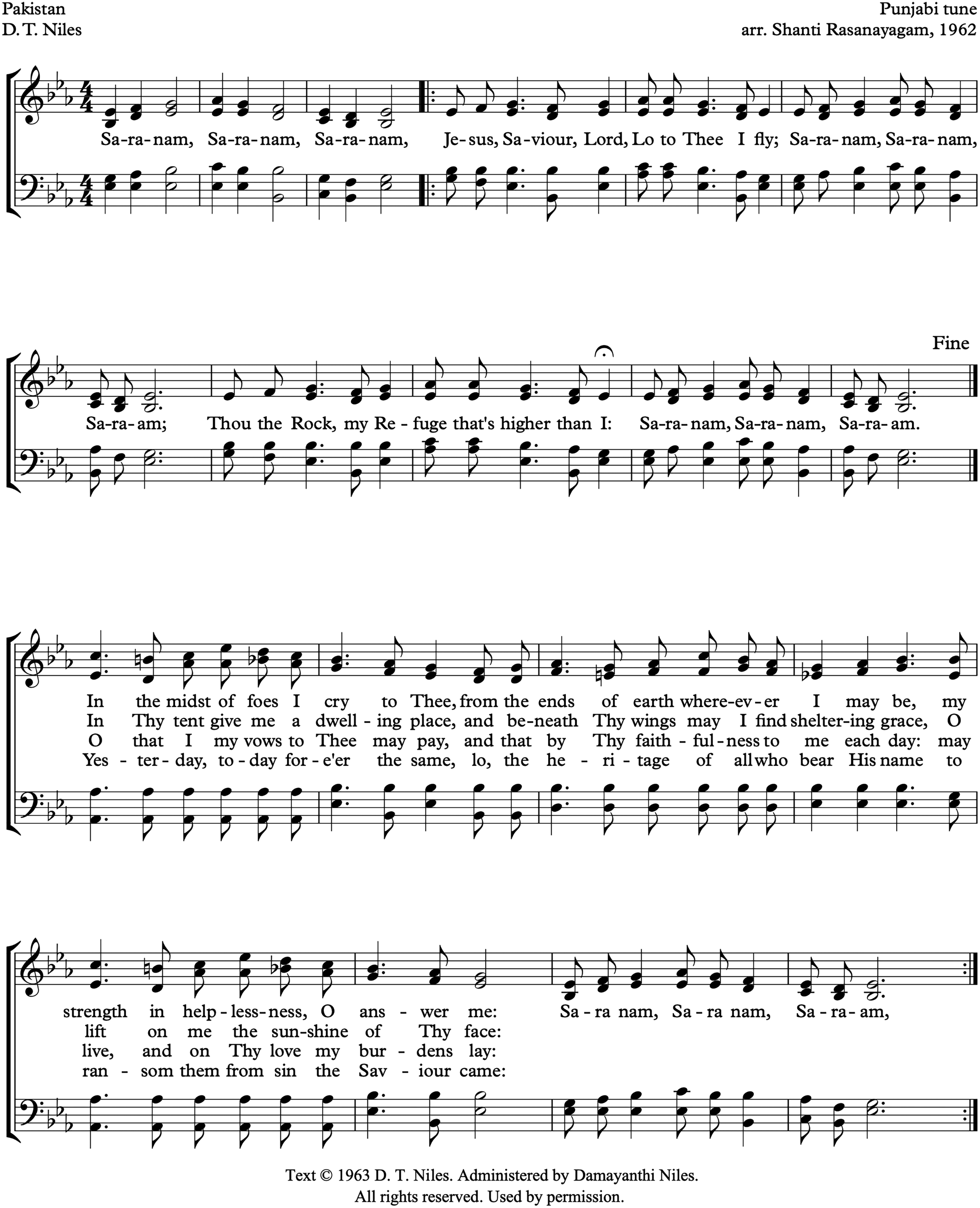
Saranam.
Without a doubt, this music setting sits comfortably in the sonic landscape of many Asian congregations accustomed to hymns’ four-part arrangement in the typical Western (Victorian) hymn style. Musically, there is no hint of its South Asian origin apart from the word, Saranam. With its strong Western musical treatment, this hymn as well as many others in this EACC hymnal was easily accepted by churches in the region. This is because many congregations are nurtured in translated Western congregational songs in Western musical style and these EACC hymns are not overly different. However, the deficiency of this solution for accessibility results in the disregard of local idiomatic expressions and the loss of original Asian lyrics. Explicitly, this approach results in an Indian hymn not sounding Indian, nor does a Chinese hymn embody the sense of being Chinese. Nevertheless, this effort by Niles and Kelly is commendable given their effort to introduce Asian hymns through the initial attempt at hybridization. Indeed, this approach ensured emergent localized Asian hymnody would not face stiff resistance from ecclesial stakeholders. This solution ensured this nascent Asian hymnody remained orthodox in their ears. It is important to note that this unique ability to cross cultural boundaries is a distinctive feature of hybrid congregational song. The inclusion of Saranam in the 2019 enthronement service of Justin Welby as the Archbishop of Canterbury attests to this assertion (Silva, 2019, Saranam).
The Next Step
With the emergence of ethnomusicology in the 1970s as a new discipline of musicology, Asian congregational songs became an avenue of self-expression. This work was pioneered by Taiwanese-American church music scholar, I-to Loh (1936-). He collected, transcribed, and edited several new Asian congregational song collections such as New Songs of Asian Cities (Loh, 1972, New Songs for Asian Cities), Hymns from the Four Winds (Loh, 1982, Hymns from the Four Winds), and the Christian Conference of Asia (CCA) published a trial edition of his work, Sound the Bamboo in 1990 (Loh, Feliciano and Minchin, 1990, Sound the Bamboo).
After a decade of trial use, a revised edition of Sound the Bamboo was adopted with the same title as the official hymnal of the CCA in 2000 (Loh, 2000, Sound the Bamboo: CCA Hymnal). This 2000 hymnal displayed the intricacies of diverse Asian musical styles, the result of the painstaking effort of musical transcription of field recordings. It consists of 315 songs in 44 languages from 22 countries. For the Sound the Bamboo project, Loh served as general editor of this work together with Australian Anglican priest James Minchin who provided English paraphrases to most of the hymns. A few hymns from the 1963 EACC hymnal were included. However, these EACC hymns were re-edited to have their localized expressions. An example would be this iteration of Sarenam.
Both examples in this essay are versions of the same song from South Asia. In Figure 2, the Western part writing was eliminated, and the song took on a single melismatic melody as adapted from Loh's field recordings. In his editorial work, the inclusion of melisma in the melody reflects the essence of South Asia's Karnatic musical idiom and is not merely decorative. For Loh, their presence reflected the song's cultural identity and origin.
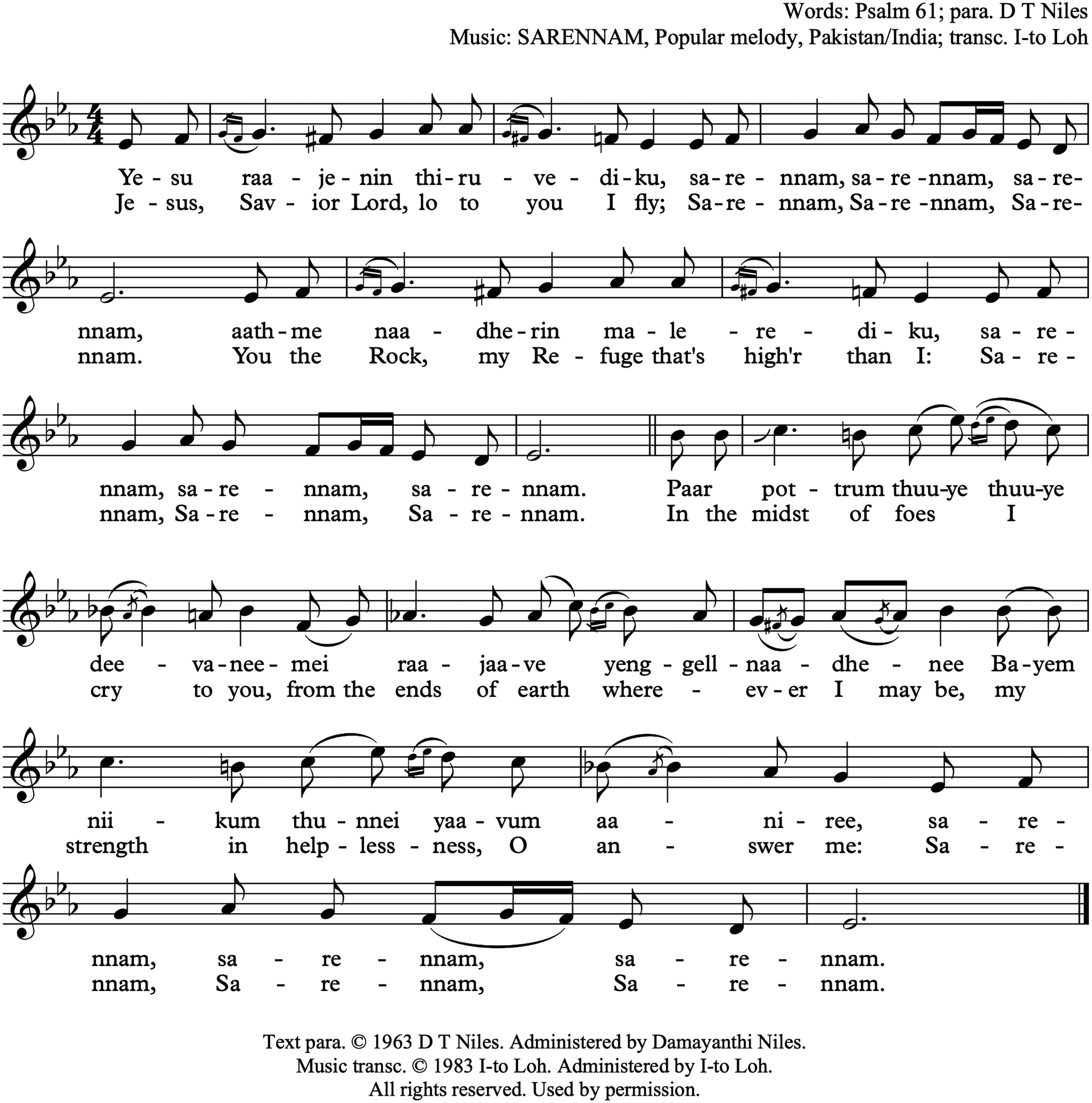
Sarenam (with I-to Loh spelling of Sarennam).
Impact-wise, the EACC hymnal approach earned a positive reception with Asia-based congregations with its multiple reprints while the CCA hymnal garnered a warm reception in North America. It would be fair to say that in Asia, the CCA hymnal had some difficulty in winning the hearts and voices of Asian congregations. This is because the hymnal's overtly ethnomusicological accent in expressing the desire for authentic contextual music-making had unintentionally created an esthetic barrier that untrained Asian congregations found hard to overcome. As a result, Sound the Bamboo hymnal faced a dismal reception in Asia in terms of congregational use unlike its predecessor, the EACC hymnal.
In 2015, the Methodist School of Music (MSM) and Trinity Theological College (TTC) in Singapore published the next expression of the Asian hymnal. This work was entitled Let the Asian Church Rejoice! In the Foreword, then TTC principal Rev. Dr Ngoei Foong Nghian was explicit about the place of this hymnal in the life of the Asian church. He writes, This hymnal is not intended to replace our traditional hymns and contemporary songs, but it is hoped that Let the Asian Church Rejoice! will affirm the home-grown resources of music and liturgy and will find a prominent place in the worship life of congregations in our part of God's world (Gan, Loh and Laoyan-Mosomos, 2015, Let the Asian Church Rejoice!).
In this collection, the editorial committee consisting of Mary Gan, principal of the MSM, I-to Loh, and Judith Laoyan-Mosomos, MSM faculty member made a rigorous effort to have accessibility and musical integrity held in balance in the congregational song repertoire (Figure 3).
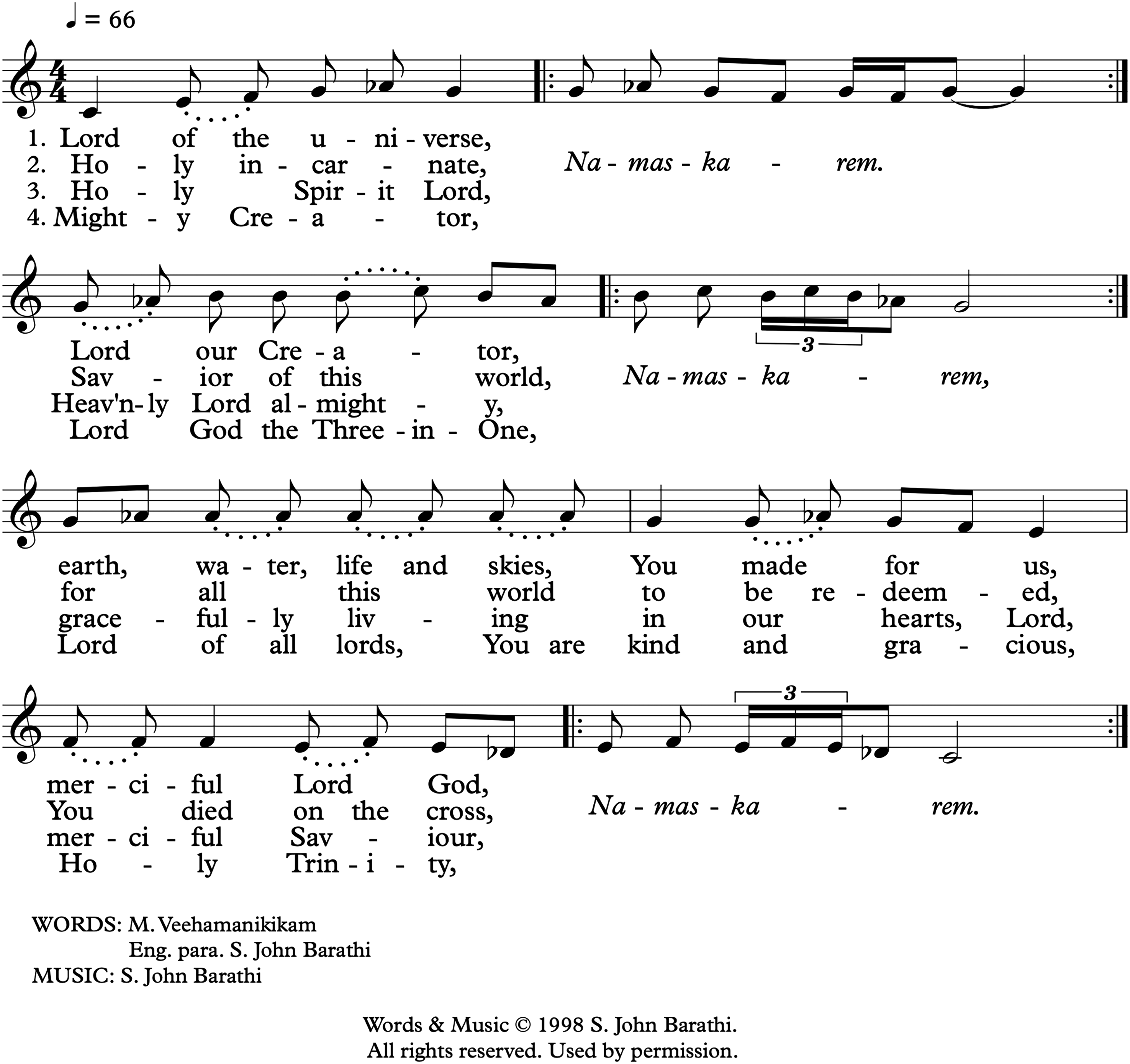
Lord of the Universe.
In this figure, Indian composer Soundararajan John Barathi composed a new tune in 2015 for a popular Tamil Christian congregational song text. He also created an English-language paraphrase that helps this song be accessible beyond its Indian homeland while exhibiting its local (South Asian) musical idiom. We can attest to this hybrid song's accessibility potency in the video recording made by German Jazz artist Uwe Steinmetz in November 2022 covering this song (Steinmetz, 2023, Lord of the Universe).
In Figure 4, Singaporean composer Lim Swee Hong made use of a pentatonic (five-note) melody fused with a simple triple meter lilting arrangement to convey a Chinese-style expression that depicts the gentle wind of the Holy Spirit. Composed in 2004, Lim shared the tune with well-known New Zealand hymn writer, Shirley Erena Murray, who created the text. This hymn was published in 2005 by Hope Publishing Company. In 2008, Lim approached Mrs. Wong Ee Suen from Singapore to create a Chinese paraphrase. In 2015, Japanese Anglican priest, Rev. Paul Hikari Miyazaki, created a new Japanese text to the tune and the song has since become a favorite for Japanese Christians.
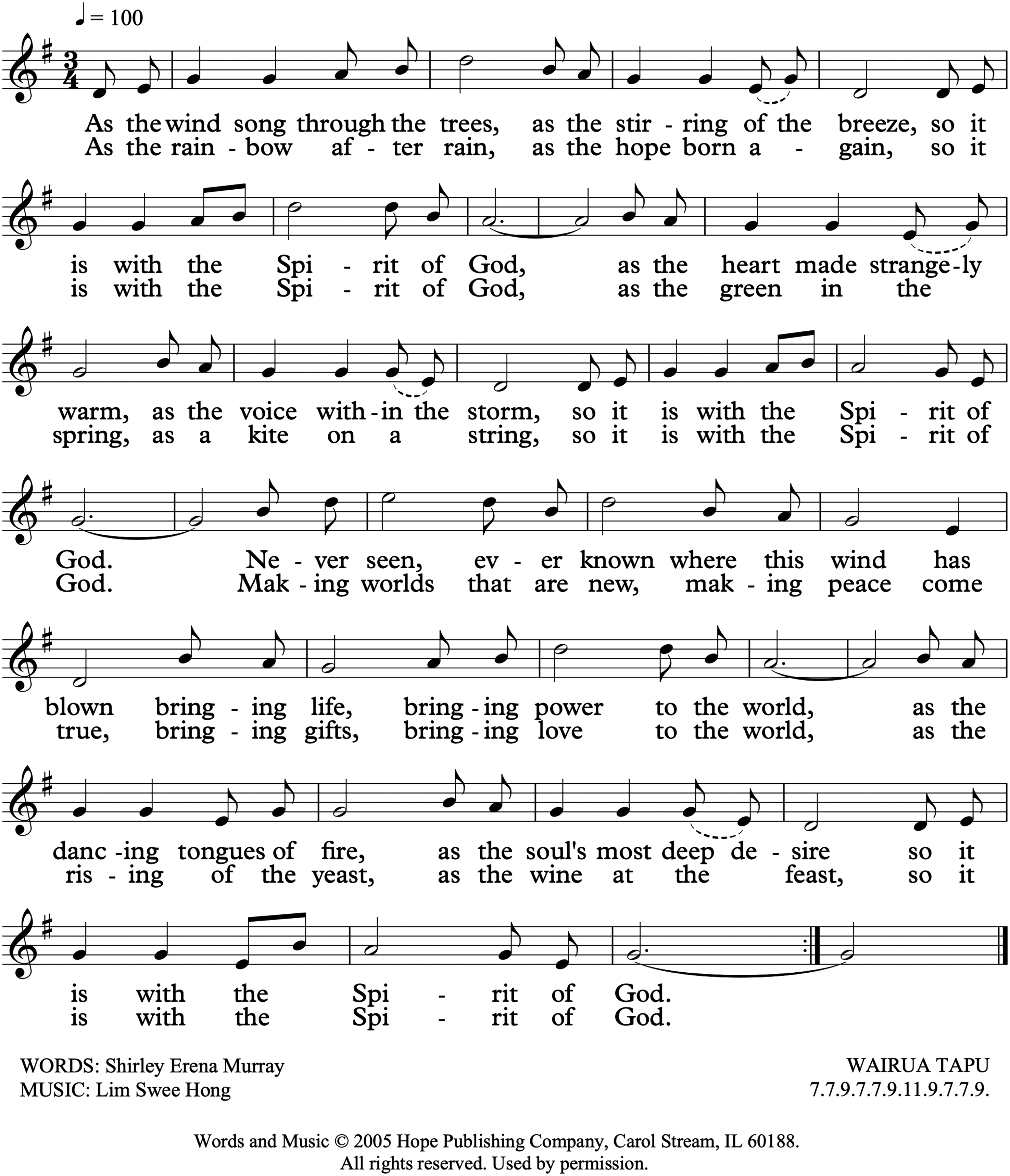
As the Wind Song.
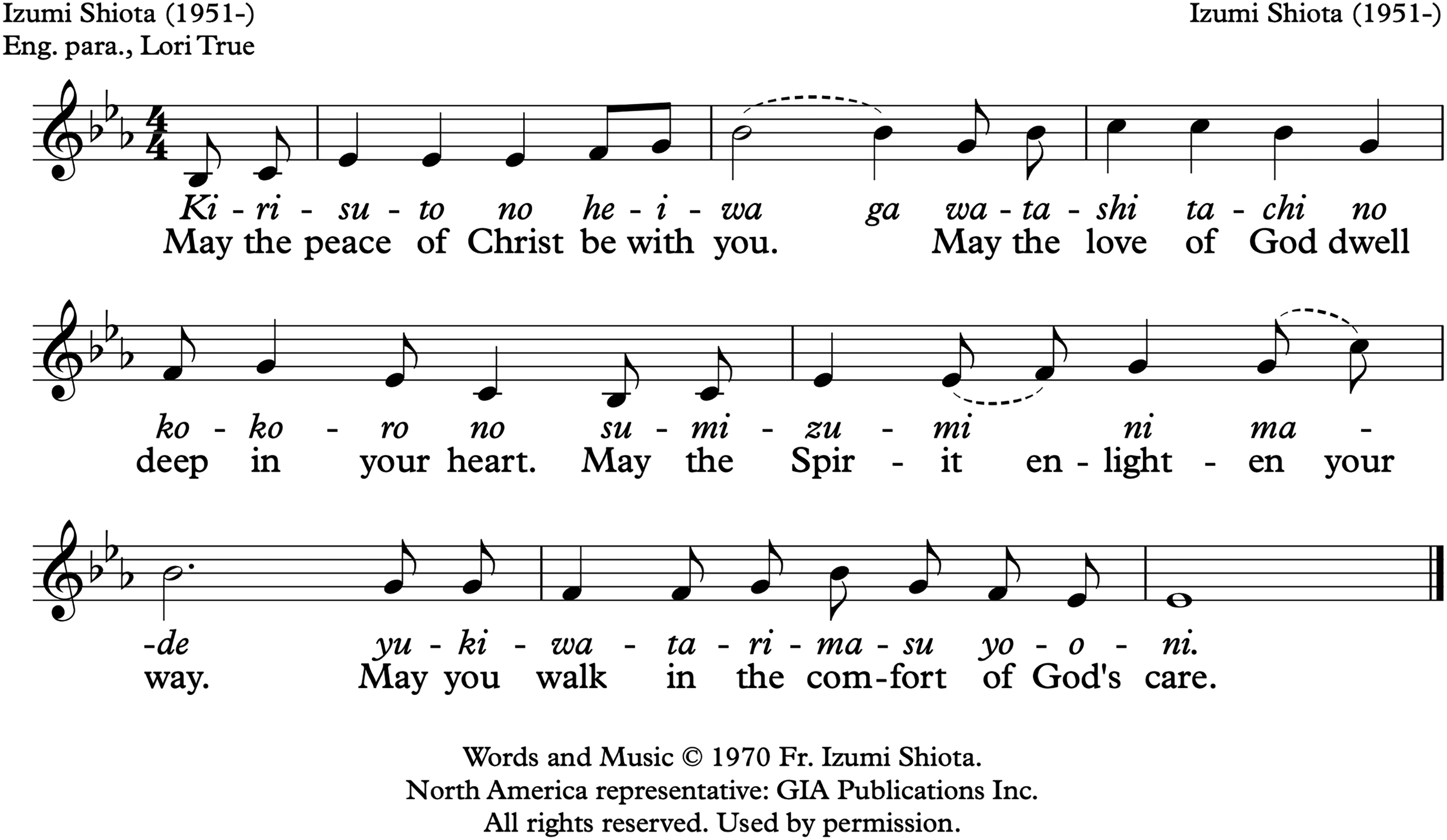
May the Peace of Christ.
Outside of Japan, the Asian congregational song, “Here, O Lord, Your Servants Gather” (tune name TOKYO) by lyricist Japanese Methodist minister Tokuo Yamaguchi and composer Isao Koizumi has been synonymous with Japanese Christianity and included in 21 North American hymnals. However, with its tune based on the ancient Japanese Gagaku mode of musical composition that is meant for court use, it did not resonate with the Japanese church which is an outlier of mainstream Japanese society. Consequently, this song is hardly used in Japan despite its popularity elsewhere. Instead, it is “Kilisuto No Heiwa Ga” (May the Peace of Christ be With You) by retired Japanese Roman Catholic priest Izumi Shiota that epitomizes the Japanese Church and its local voice (Figure 5).
These examples from the 2015 hymnal, Let the Asian Church Rejoice! reflect a determined effort towards hybridization where the integrity of the song's cultural idiom and its accessibility by others outside this context are held in balance. This ability to exhibit musical characteristics of cultural identities while remaining accessible to faith communities from other different cultures is a powerful feature of hybridization. Hybrid congregational songs are created in a variety of ways, and I believe this is the future for congregational songs from the Global South.
Efforts in Hybrid Song Creation
Trope
How might a congregational song reflect this amalgamation of contexts? In Western music history, we know that composers in the Medieval period made use of Trope. In this creative process, new text and/or music section is added to a pre-existing chant. Often, this became an opportunity for composers to show off their talents in music composition. Unfortunately, such treatment resulted in the masses becoming too long and was eventually discouraged by ecclesial authorities. However, in recent years, Contemporary Praise & Worship artists have used this device in their music-making. Examples of this approach include Chris Tomlin's troping of John Newton's “Amazing Grace” (“My Chains Are Gone”) and Isaac Watts’ “The Wondrous Cross” (Tomlin, 2001, 2009).
This effort revitalizes Christian spirituality as the traditional hymns are made accessible to a new generation of believers who otherwise would have ignored this repertoire of songs. However, this troping process does have ethical consequences. In the present era, the copyright of songs can be profitable for singer-songwriters. By troping, previously public-domain songs that are royalty-free now reenter the Christian music industry as copyrighted materials requiring licensing for their use.
Contrafactum
The music compositional practice of Contrafactum is another expression of Trope. In this approach, new lyrics are created and set to existing tunes creating a juxtaposed work. Lyrics are substituted without substantial change to the music. In the 1960s–1970s, this was seen as a suitable solution in Asia and elsewhere to have local expressions by way of familiar community (folk) songs. Here are two examples (Figure 6):
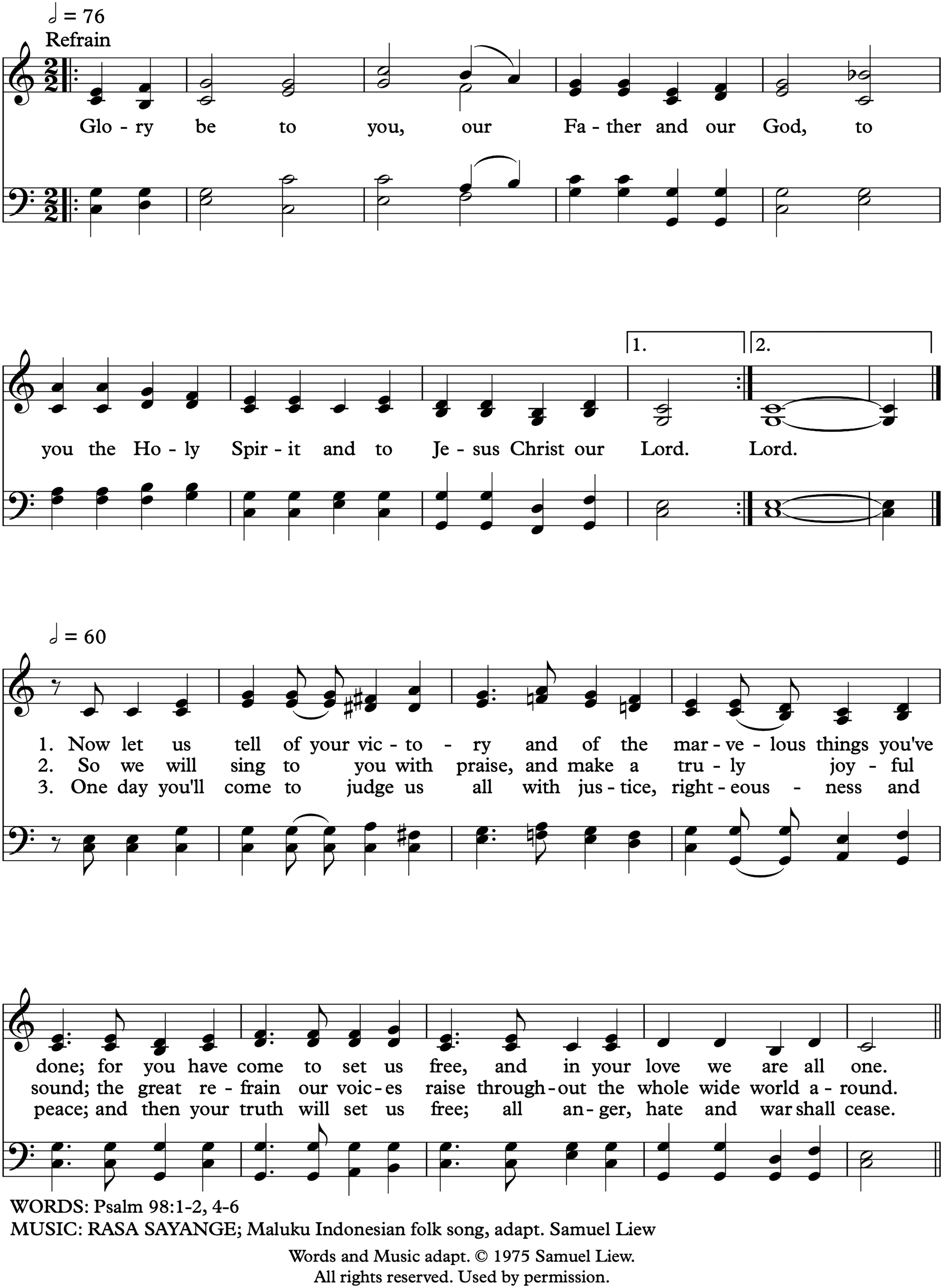
Now let us tell (Glory be to You).
In this figure, Singapore Methodist pastor Samuel Liew now retired, wrote “Now Let Us Tell of Your Victory” and matched it to the popular Indonesian Maluku folk tune, Rasa Sayange (Deredia, 2017, Rasa Sayange). This hymn is published in the Sound the Bamboo hymnal (CCA, 1990, 2000). You will also notice that this juxtaposed hymn retained its Western part-singing treatment like the repertoire in the 1963 EACC hymnal.
In 1980, Nagasaki atomic bomb survivor, Japanese American United Methodist pastor, and hymn writer Nobuaki Hanaoka (1946–2011) created “Praise the Lord, Praise the Lord” lyrics and matching it to the famous Japanese tune SAKURA. This Contrafactum work can be found in 10 North American hymnals (Hanaoka, 1980, Praise the Lord). Praise the LORD, praise the LORD, for the greenness of the trees, for the beauty of the flowers, for the blueness of the sky, For the greatness of the sea; praise the LORD, praise the LORD, now and forever.
Such Contrafactum effort continues to the present time and is not limited to folksongs. For Zoe Cosgrove's Bat Mitzvah on 22 October 2016, Cantor Azi Schwartz of Park Avenue Synagogue juxtaposed the Adon Olam, a Jewish prayer onto the song, “You’ll Be Back” from the highly popular Broadway musical, “Hamilton,” by American composer Lin-Manuel Miranda (Schwartz, 2016, Adon Olam).
While this approach of revitalizing Asian congregational songs is admirable for its attention to contextual cultural reference, there is a need for creators to be cognizant of the socio-cultural association or connotation of these songs. Do these songs, in their original context, embody associations that are not overbearing or contradictory to the Christian message they seek to convey?
It is important to remember that melodies are not neutral. They point to and embody associated meanings. Music is intentional and able to invoke emotional responses to these associated frames of reference. It is for this reason that the work of matching text and tune requires much care, especially of new texts to existing, well-known tunes where the music already has strong pre-existing associations. Consider this example (Figure 7):

Buddhist chant (Public Domain). Transcribed and adapted by Lim Swee Hong.
Musically speaking, this is a lovely melodic line with its arch-shaped contour. A tune that is suitable for congregational use given its limited vocal range and brevity. Not surprisingly, when I shared this melody with my students in North America, many commented that it is effective as a Kyrie musical response. At that time, my students were not aware of its origin and association. In the context of Singapore, this chant-like tune is associated with publicly held Buddhist funeral prayer rites where the bereaved family members are led by monks to chant this tune.
Retuning
Retuning is another way of nurturing local expressions. In this practice, well-known lyrics are matched to new tunes. The Nashville-based group of artists, “Indelible Grace” group, led by Kevin Twit, campus minister at Belmont University was one of the pioneers in this work in the United States. Another group was the “Global Praise” team of the General Board of Global Ministries, United Methodist Church led by S T Kimbrough, attempted to retune the lyrics of Charles Wesley. Consisting of members from other parts of the world, this group created works that made use of other cultural idioms. An example of this is Lim Swee Hong's setting of Charles Wesley's “Blest Be The Uniting Love” (tune name: 合一 HE YI) (Music, 2021, Blest be the Dear Uniting Love). In this approach, the new music lends itself to embody the lyrics without the prejudice of existing associations. At the same time, it enables the lyrics to be relocated or transplanted into a different cultural landscape. Consequently, this approach offers a fresh understanding of the lyrics as the association connected to the original music is replaced.
Motivic Development
The fourth way is Motivic Development. In this approach, specific musical traits or ideas are distilled and harnessed to create new songs. The Taiwanese congregational song, 一粒小種籽 (Little Seed), produced by the Overseas Radio & Television music ministry group serves as a good example (Melody, 2016, A Little Seed). This work by lyricist 葉薇心 (Ye Weixin) and composer 王麗玲 (Wang Liling) makes use of indigenous Taiwanese's non-lexical singing accompanied by Jaw's harp as a bridge between stanzas in Mandarin Chinese supported by Western tonal harmony as a work reflecting the Taiwanese cultural context in all its diversity.
In India, Sheldon Bangera's, Jai, Jai Naam (“Hail Jesus’ Name”) is another example of this hybrid approach (Bangera, 2017, Jai, Jai Naam). However, unlike Barathi's “Lord of the Universe,” Bangera's work was intended for local Indian congregations that had abandoned local expressions and adopted the Western Praise & Worship form. His work demonstrated that it is possible to incorporate local expressions into songs used in worship services that are ambivalent to local nuances. In this song, traditional Indian music is juxtaposed with Western music with both forms of music-making having equal importance.
Motivic development can also embody a particular genre of music. Here, we turn to the South Korean Roman Catholic church on the occasion where it welcomed the visit of the Pope in 2014. Even though Korea is rich in its cultural heritage, the Roman Catholic church chose to showcase the Hallyu (the Korean Wave) of its popular culture namely K-pop music instead of its traditional culture which is ambivalent to Christianity because of its steep Confucianism and Buddhism underpinnings. Thus, the song Koinonia was composed to welcome the Pope on his third visit to South Korea (Entertainment, 2014, Koinonia).
From these musical examples, it is evident that they contain distinct local cultural elements reflecting their origins while at the same time displaying the ability to cross cultural boundaries.
In my assessment, this hybrid approach of congregational songs offers a solution for the church to have new songs that resonate with our congregations and help foster local Christian expression. Yet, as I have explained earlier, there is a need to consider extra-referential meetings associated with the music. What hermeneutical lens can be deployed to ensure the creative effort is grounded in scripture and theological principles?
Theological Principles for Hybrid Congregational Songs
In the Book of Acts, chapter 10, God called on the hesitant Peter to boldly step away from his Jewish Kosher ethos and to minister to the Gentile Roman Centurion, Cornelius. God reminded Peter, “Do not call anything impure that God has made clean.” (Acts 10:15, NRSV)
Too often, our churches have steadfastly and tenaciously held on to their Western missional heritage and resisted efforts to explore and harness our socio-cultural heritage to worship God. The reason for this can be traced to the lack of leadership and expertise in the work of asserting suitable theological rationale to harness local expressions while avoiding the pitfalls of syncretism. Sadly, it is easier to adopt and mimic established expressions than to have localized efforts face the risk of rejection by the faith community. How might we appropriate the call for accepting what God has made clean? What steps can the autonomous Global South church take to follow Peter's example?
At the 2016 Calvin Worship Symposium, Methodist theologian, L. Gregory Jones asserted that the way of forward-thinking about revitalizing worship and church music-making demands the church to embrace the concept of Traditioned Innovation (Jones, 2016, Improvising New Life). This is where innovation is guided by the centrality of the past. In essence, it is having Change and Tradition be in mutual co-existence and held in tension. In my view, this is like the Anglican theological ethos of Via Media and the Wesleyan Quadrilateral hermeneutical principles proposed by American Methodist systematic theologian, Albert Outler. Here, these approaches call for innovative acts to be guided by Scripture and established ecclesial Tradition. Outler's hermeneutical approach includes the elements of Reason and Experience, and the resulting interplay of these elements to guide efforts of transforming and incorporating local expressions into Christian worship and music-making.
In his correspondence with Pope Gregory the Great (540–604) in Rome, Augustine of Canterbury (? – c. 604 CE) asked, Whereas the faith is one and the same, are there different customs in different Churches? And is one custom of Masses observed in the holy Roman Church, and another in the Church of Gaul?
You know, my brother, the custom of the Roman Church in which you remember that you were bred up. But my will is, that if you have found anything, either in the Roman, or the Gallican, or any other Church, which may be more acceptable to Almighty God, you should carefully make choice of the same, and seriously teach the Church of the English, which as yet is new in the faith, whatsoever you can gather from the several Churches. For things are not to be loved for the sake of places, but places for the sake of good things. Choose, therefore, from every Church those things that are pious, religious, and right, and when you have, as it were, make them up into one bundle, let the minds of the English be accustomed thereto (Sellar, 1907: 53).
In this correspondence, we see Pope Gregory instructing Augustine to harness the appropriate local cultural practices and root Christian worship practices onto them so that Christian worship can have integrity and be heartfelt through the thoughtful deployment of local expressions that have met the requirement of being “acceptable to God.” His directive seems to draw from what Paul wrote in Philippians 4:8 (NRSV), Finally, beloved, whatever is true, whatever is honorable, whatever is just, whatever is pure, whatever is pleasing, whatever is commendable, if there is any excellence and if there is anything worthy of praise, think about these things.
Gregory's stance provided an important framework for missionaries in their nascent efforts in foreign lands. Without a doubt, early mission endeavors in Asia like the efforts of Matteo Ricci (1552–1610) in China, Alessandro Valignano (1539–1606) in Japan, and Alexandre de Rhodes (1591–1660) in Vietnam were likely guided by this ethos of harnessing the local cultural idiom to convey Christianity. Sadly, subsequent powerplay in ecclesial politics led to the assertion of Eurocentric expressions over local practice as illustrated in the seventeenth-century Chinese Rites Controversy. This event limited attempts at localization and inevitably reinforced the impression that Christianity is a Western-imported religion notwithstanding its Western Asian (Middle Eastern) origin. Perhaps it is now time to reorient the future development of Christian worship music in the Global South and enable it to take up expressions that reflect the local context.
Conclusion
In this research essay, I offered a brief overview of the development of Asian congregational songs describing how this development in worship music-making was influenced by the reorientation in missiological thinking in the early twentieth century that bore fruit in the 1960s as churches in the Global South became autonomous. This shift coincided with theological concerns about the relationship between Christianity and Culture. This led to an openness to using local expressions in worship music-making. Thereafter, by using published congregational songbooks as guideposts, I traced the development of Asian congregational songs. I proposed that this trajectory points toward the emergence of the hybrid form as the postcolonial expression of congregational song—a genre that holds in balance its original cultural identity and the ability of the genre to cross cultural boundaries with ease. I illustrated with some congregational songs how this hybrid process can be accomplished using compositional devices that maintain the song's cultural identity while providing the means for cultural boundary crossing. To ensure that this innovation remains acceptable to the church, I encouraged the incorporation of theologically grounded hermeneutical lens to help this transformative effort of contextualization.
In my assessment, the hybrid approach is the best practice solution and a critical way to ensure that worship music-making in the Global South retains its local distinctiveness without losing its value to the church that seemingly prefers the perceived sophistication that Western sacred music offers. Indeed, now is the time for the church in Global South to sing a new song to our God, a song that reflects God's people in their distinct cultural identities. If Asian Christianity wishes to move beyond its reputation as a Western-imported religion, this should be not only of liturgical importance, but a missiological priority for the Asian Church in the years ahead.
Footnotes
Funding
The author received no financial support for the research, authorship, and/or publication of this article.
Author biography
Lim Swee Hong is the deer park associate professor of Sacred Music, and director of the Master of Sacred Music Program at Emmanuel College of Victoria University in the University of Toronto, Canada.