




Abstract
The British colonizers, while writing about Mizoram and Mizo history, stressed their achievements in uplifting the Mizo community. Christian missionaries from Wales landed in Mizoram after the British colonizers annexed the land. They also followed the British administrators’ patronizing way of writing Mizo history. They saw the Mizo people as savage, and unsaved who needed the Gospel. They viewed Mizo society as one that needed a complete transformation. The first-generation Mizo Christians, too, looked at Mizo society from the Western lens. That was because missionaries trained them to be as Western as possible. A significant shift in Mizo Christian historiography emerged in the 1990s, emphasizing that tribal communities accepted Jesus Christ not because of external factors such as the arrival of missionaries from a foreign country, but because God resides in their hearts and that the Holy Spirit inspired them to believe in Jesus Christ, whoever the agent was.
Introduction
Mizo tribal historiography has gone through changes, as discussed in this paper. British colonizers documented the first written account of Mizo. That was written from the colonizers’ perspective. It emphasized the enlightening works of the British to the indigenous Mizo community, who, for them, were rough and heathen. Missionaries from Wales followed British administrators who gave Mizo a written narrative of Christian history. Rev. J.H. Lorrain and F.W. Savidge, the pioneer missionaries of Mizoram, reduced the Mizo language into a written form of writing. Following British administrators, missionaries also presented Mizo as ones who needed redemption – barbarian, headhunters, and uncivilized.
When the Mizo started to write their own account, they followed the historiography of both the colonizers and missionaries. That was because they were tailored by missionary sahebs (a term used by some people in India to address or to refer to a man in a position of authority) whom Mizo first-generation Christians believed to be their teacher, mentor, and mediator between heaven and earth.
A significant shift in Mizo Christian historiography emerged in the 1990s, emphasizing that tribal communities accepted Jesus Christ not because of external factors such as the arrival of missionaries from a foreign country, but because God resides in their hearts and that the Holy Spirit inspired them to believe in Jesus Christ, whoever the agent was. This paper investigates this aspect in detail as follows.
Colonial and Missionary Historiographies
The first people to have put Mizo history in writing were none other than the white people – the British colonizers as well as the pioneering missionaries from Wales and England who came to Mizoram at the close of the nineteenth century and the beginning of the twentieth century. When missionaries arrived in Mizo land, they reduced Mizo language into a written form which enabled the latter to preserve their history in writing. No sooner the art of writing was introduced than its effect began to surface on the scene. The introduction of a written form of language quickly affected Mizo literature which voluntarily or involuntarily gave way to a new way of writing and preserving history.
Before Christianity came, the history of the Mizo society was preserved orally. It is because of Christianity that Mizo's history was put in written record. However, the account of history they gave us was not free from criticism. Among all the different reasons that shaped the Mizo tribal historiography, the two Western agencies in the form of colonialism and Christian missions are accountable in a revolutionary role as well as in their life-renovating works. Since officers of the colonial rulers, administrators, and bureaucrats were legitimately appointed to preserve peace and order for the benefit of the British power, the history they wrote of tribal people in India was one of barbarism, inter-clan rivalry and savagism (Vanlalpeka, 2016: 1). This, according to their historiography, called for British intrusion in the region.
To cite some examples, Robert Reid's, The Lushai Hills: Culled from History of the Frontier Areas Bordering on Assam From 1883–1941 (Reid, 1978: 1); Thomas H. Lewin's, A Fly on the Wheel, or How I Helped to Govern India (Lewin, 1885: 1); Reid's, Chin-Lushai Land (Reid, 1893: 1); Alexander Mackenzie's, History of the Relations of the Government with the Hill Tribes of the Northeast Frontier of Bengal (Mackenzie, 1884: 1); Alexander Mackenzie's, The Northeast Frontier of India (Alexander, 2010: 1); McCall and Anthony Gilchrist's, Lushai Land of Tranquility and Upheaval (Call and Gilchrist, 1949: 1); Woodthorpe, Robert Gosset's, The Lushai Expedition (Gosset, 2018: 1) and others give little information about the Chin/Mizo, and delved deep into the Lushai expeditions. These and other pieces of literature aired how Mizo needed the coming of foreign administrators to lift their lowly social condition.
Missionaries, who worked in Mizoram under the patronages of colonial rulers, also wrote about the success of their missionary enterprises. J. Meirion Lloyd's, History of the Church in Mizoram (Harvest in the Hills) (Lloyd, 1991: 1); E. Chapman and M. Clark's, Mizo Miracle (Chapman and Clark, 1968: 1); Dona Strom's, Wind Through the Bamboo: The Story of Transformed Mizos (Strom, 1983: 1); are some examples of missionary historiography. The exaltation of missionary enterprises and the need to educate the simple Mizo people remained their theme.
One of the most crucial factors for the growth and development of the Mizo church was the revival waves that swept Mizoram incessantly. However, missionaries did not see it positively because the revival they witnessed in Mizoram did not correspond to what they used to see back in their homeland. For J.H. Lorrain, the pioneer missionary, the Mizoram revival did not help the Mizo churches to grow and develop, it ‘…worked nothing but evil…’ (Hminga, 1987: 85). The drum, which enlivens the spirit of the revival, became an object of sneering for the missionaries. Here, we see two cultures clashing with one another. Missionaries were representatives of the Western culture, and Mizo revivalists represented the indigenous culture. Lorrain, here, indisputably held missionary, paternalistic historiography.
Historiography of the First-Generation Mizo Christians
The offshoot of British historiography was felt when tribal Christian writers first attempted to write their own tribal history. Tribal writers, much inclined towards missionaries developed their historiography in religious worldview and what was stressed in their writings was that tribal culture was awaiting the arrival of Christianity in their lands for the reformation and redemption of their social, religious, economic, and cultural lives. This holds to a large extent at least from the titles of the books published concerning those times such as V.L. Zaithanga's, From Head-Hunting to Soul Hunting: An Account of Missionary Outreach of the Presbyterian Church in Mizoram (Zaithanga (1981: 1); From Head-Hunting to the Hallelujah Chorus (Hughes, 1936: 1) and the like. Therefore, ‘any historical event and cultural practice before the arrival of Christianity was just a preparatio evangelica at its best or just an animist practice that needed urgent redemption’ (Vanlalpeka, 2016: 1). In other words, for the first Mizo Christian writers, anything that was Mizo needed to be improved, changed, and redeemed by Christian missions.
Liangkhaia wrote Mizo Chanchin (Mizo Chronicle) way back in 1938, which was supposed to have been the first-ever history book written and published by a Mizo. This book is unique in the sense that it was written and published with a view to developing Mizo's sense of belongingness. Liangkhaia inscribed, thus, ‘Mizo hian hnam dang chanchin kan chhiar thin a, mahni chanchin engmah hriat kan nei si lo va’ (We, Mizo, have been reading accounts of other people yet, do not have any consciousness of our own story) (Liangkhaia, 2002: 3).
Liangkhaia dealt mainly with Mizo's past – origin, migration and Lushai expeditions. He touched very little about the history of Christianity, albeit he dedicated one chapter to this. Right from the inception of Mizo history writing, traces of Mizo elements can be unearthed. Yet, their history writings were not free from colonial influences. Mizo and English elements were intrinsically woven together in the tapestry of early Mizo history writings. Zairema's, God's Miracle in Mizoram: A Glimpse of Christian Work Among Headhunters (Zairema, 1978: 1) perceived Mizos as headhunters who needed the reconciling works of missionaries from a foreign country.
Narrowing down our discussion to the Mizoram context, the history writing of various denominations can be conceived as a fight for supremacy over other denominations. The Presbyterian Church of India, Mizoram Synod has put it in the record that the first missionary to have come and preached in Mizoram was Rev. William Williams (1891) while the Baptist Church of Mizoram records that the first missionaries were none other than J.H. Lorrain and F.V. Savidge (1894). What is noticeable in denominational histories is that ecclesiastical allegiance leads to prejudices and bias in writing and recording history. A Presbyterian historian is inclined to write no more than a history of the Presbyterian Church, for the Presbyterian Church and by the Presbyterian Church. The same applies to all other denominations, too!
Recognizing the fact that history writing can be biased, partial and prejudiced, the Church History Association of India (C.H.A.I.) encourages historians to focus on the socio-cultural, regional, national, and ecumenical perspectives. This new perspective proved to be quite a watershed. It emphatically rejected the mission history and the more institutionalized church history approach and was in favour of a socio-cultural history of the Christian people in India (Webster, 2012: 5). Some Mizo thinkers follow this new perspective developed by the Church History Association of India (C.H.A.I.).
Tribal Mizo Historiography
A shift from this paradigm took place with the appearance of postcolonial studies in the field of literature wherein tribal theology began to criticize colonial historiography and even tried to de-colonize the history of tribal Christianity. According to this historiography, missionaries, as well as colonizers, were alleged to have caused the erosion of tribal culture in Northeast India by implanting a new, westernized way of life. For the tribal theologians, it is because of colonial rule in the area that peoples’ minds are under British slavery. Tribal theology states that the introduction of Westernization and Christianity, because of British colonisers and missionaries, damaged the rich local social and cultural heritage of tribal people (Haokip, 2018: 2) and that Western Christianity dislodged the traditional spiritual beliefs of tribal people. Thus, ‘the Christianity they came to practice was seen as part of a monolithic Western Christianity introduced by white missionaries…In such a view, people and their culture were looked upon as passive participants in the process of the historical encounter’ (Nongbri, 2016: 58).
But, after the 1990s, there is a new trajectory. Kipgen's book, Christianity and Mizo Culture – The Encounter Between Christianity and Zo Culture in Mizoram (Haokip, 2018: 5) is one among these. Kipgen professes, ‘A limited knowledge of the Zo culture…led the earliest writers to dismiss the pre-modern Zos as “savages” who were not likely to change for the better. History has proved them wrong’ (Haokip, 2018: 313–314) and continues to say, ‘not only did the Zos adapt themselves to the changes that modernization brought to their area, but in the process, they created an identity that had many new elements but was deeply rooted in the cultural history of the people’ (Haokip, 2018: 313–314). This interpretation shows that Mizo have their own way of resisting the new culture being brought to them by the Westerners and, that they have their own creative way of adaptation which suits their most inner-beings.
In the new historiographical trajectory, things continue to be twisted in a different course. Writers such as Vanlalchhuanawma no longer embrace the idea that Westernization, along with colonialism shaped every bit of tribal peoples’ worldview or influenced every piece of the tribal cultural trait. This philosophy is evidently seen in Vanlalchhuanawma's Christianity and Subaltern Culture – Revival Movement as a Cultural Response to Westernization in Mizoram (Vanlalchhuanawma, 2006: 1). That is to say, the Mizo people are not passive recipients of newly introduced elements – the Gospel and Westernization. They do not candidly follow all they have been taught and they have their own way of either accepting or resisting the Gospel and the new culture being imposed on them (Interview with Vanlalchhuanawma in 2018). This way of thinking developed in the late 1990s.
In the same vein, B.L. Nongbri, a tribal historian, articulates that the conversion of tribal into Christianity should not be elucidated in terms of colonial support since that view could lead to tribal being viewed as dumb and lacking consciousness (Nongbri, 2016: 12). He persuasively stated that tribal should not be seen as submissive partakers in the entire course of proselytization as ‘Christianity was not forced upon but adopted by the people who had their own agenda for doing so…this perspective attributes agency to the people and recognizes them as active participants who…shaped the events that affected their own history’ (Nongbri, 2009: 12), which obviously marked the distinction of the new historiography from that of the previous ones.
Folklore as a New Methodology for Writing of Social History in Mizoram
Discovering the history of the native community that certainly had a past but not a written history is a discouraging job. The drawback lies in the fact that most of Northeast society was oral whereas the history writing depended heavily on printed works in black and white. In the face of the availability of scores of sources such as archaeological, oral, and other accounts the colonial Western method of history writing underestimated earlier precious tales of the indigenous peoples (Malsawmdawngliana, 2015: 178), which categorically brings forth a dilemma for the native people who had been deprived of history on paper.
One valuable gift of the recent development in the trajectory of history writing is the re-definition of texts and sources. Since the Western notion of ‘text’ suffered a sweeping change, oral sources come to occupy an essential place in providing a mine of information about the subjectivity of the past. As a result, legends, memories, fables, myths, stories, ballads, proverbs, folklores, and folksongs become ‘extra texts’ for historians (Interview with Vanlalchhuanawma in 2018), which can be prudently and resolutely used for inventing the social, cultural, and religious history of Mizoram.
Thomas S. Szasz, a psychiatrist and academic markedly distinguished the divergence between the animal empire and human empire in the following words: ‘In the animal kingdom, the rule is eat or be eaten; in the human kingdom, define or be defined’ (Szasz, 1973: 20). This is hugely true of the history of Northeast India in general and Mizoram in particular in the sense that Northeast peoples have been defined by outsiders while self-ascription of the people themselves remains missing.
A good illustration of how tribal peoples’ own perception of themselves differs from the perception of the government is astonishingly given by V.V. Thomas. The following is a table of the misinterpreted views on tribal (Thomas, 2014: 176).
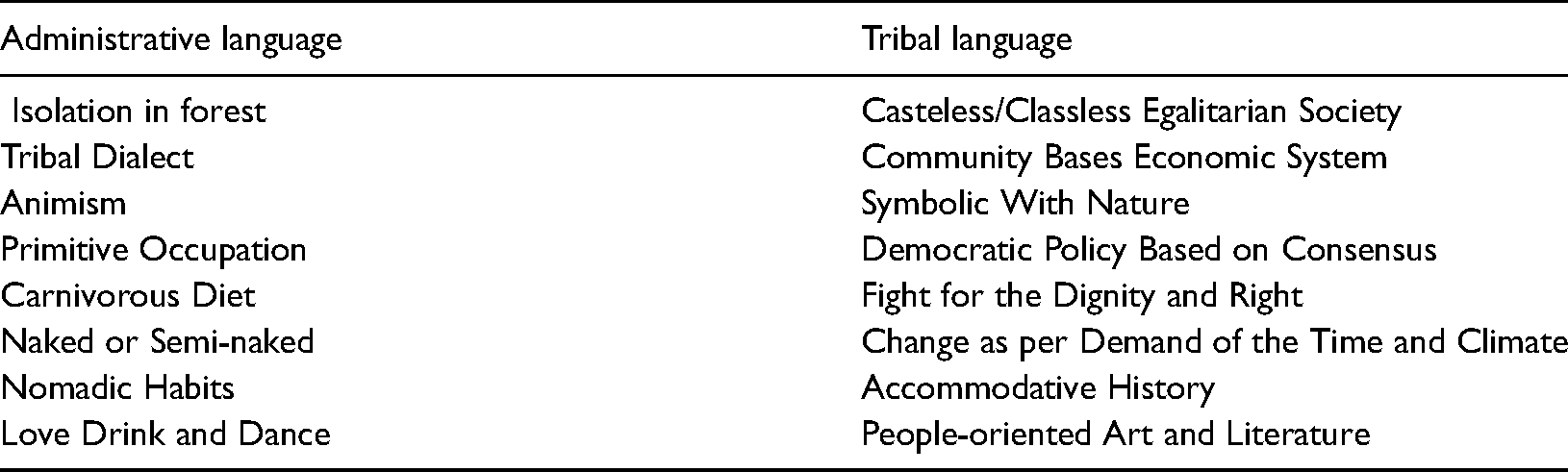
Against this backdrop, folklore is a significant resource for the writing of the history of the people of Mizoram. The people living in Mizoram have been identified, classified, and categorized by outside writers from the latter's perspectives, without acquiring deep knowledge of the indigenous peoples’ identity and history. Therefore, the identity given to these people comes under the etic notion of identity, and sadly not the emic one. Since the history of Mizoram hitherto has been collected and put into writing by colonial administrators and Indian writers who do not belong to these dazzling upland regions, all we have about the area is a distorted, vague, and hazy history.
To cite certain examples, both colonial administrators and white missionaries who worked in Northeast India labelled Mizo and Naga as headhunters, the dirtiest of all nations and so forth. The pertinent question is who is to dub whom? If truth be told, it is not the Northeast Indian tribes who were to be called headhunters, but rather the colonial rulers because of the countless bloodshed they caused to different tribes and nations across the globe in their search for new lands. The colonizers were the real invaders, the factual headhunters.
This aspect of viewing the intriguing hill peoples has been missing in the methodology of writing and studying the history of Mizo society so far. The problem now with the history we have of Mizoram is the deficiency of taking importance to these local peoples’ own stories, lived experiences, folktales, and folklores. The rich cultural heritage which has been handed down through generations remains overlooked and disregarded. Most written documents were silent or prejudiced on the religious and rich cultural aspects of Mizo society. As a result, the story of the lives of these fascinating upland states has been misrepresented, misconstrued, and misunderstood by both Indian and foreign writers. This led to the necessity of using folklore as an important alternative to filling up the gaps or blanks of history. Meeta Deka correctly penned down, thus, ‘Where there has been a dearth of written documents, archaeological and other evidence…folklore is significant to explain and understand societies in the context of preserving cultural diversity…’ (Deka, 2021: 174).
The difficulty of studying the history of the Mizo people is added by the veracity that the region has a larger resemblance and kinship in terms of geographical, race, culture, and tradition to its eastern neighbours such as China, Tibet, Myanmar, and other Southeast Asian nations than with mainland India. This involuntarily led to an identity crisis as to whom these groups of people genuinely belong and the ethnic crisis makes the people inquisitive to look for roots (Deka, 2021: 175) and make up a history, in which folklore plays quite a significant role.
The colonial interpretation portrayed the role of evangelists and missionaries as the sole agent of religious change amongst the tribal and denounced indigenous worship as devilish and as having a connection with evil spirits, cannibalism, and animism. That much is what white people's interpretation put in the picture. On the contrary, if one looks circumspectly at the folk stories, tales, and songs of the indigenous communities one can discover that there were elements of the fear of God, sincerity, earnestness, and genuineness on the part of the worshippers. V. Lunghnema believes that there was a time when Mizo had face-to-face interaction with God (Lunghnema, 1994: 7). This leads us to the conclusion that the tribal communities accepted Jesus Christ, not because of outward factors such as the coming of missionaries, but because God dwells in their hearts and that God spoke to them and enthused them to believe in Jesus Christ, whosoever the agent might be. This facet of tribal religiosity can be rediscovered from a genuine study of tribal folklore.
Where do We Go From Here?
One set of historiographical tools is kind of inept to integrate all spheres of the community as well as individual lives. What kind of historiography we are supposed to envision is a question every serious historian is now faced with.
Firstly, a more spacious version of the postcolonial historiography needs to be thought of. In other words, a new historiography which is not confined to the framework of anti-colonial and anti-missionary oratory only is needed (Joy, 2015: 130) since deconstruction of colonialism has been done in large quantity for a long time already. To formulate a new way of history writing, U.R. Ananthamurthy proposes that global worries, concerns, and literary works need to be translated and apprehended within the clearer framework of native cultures and languages (Joy, 2015: 150). The importance of taking the indigenous culture or going after the ethnographic line is also distinctly expressed by Pheme Perkins in the following words (Perkins, 1993: 89): As third world Christians emerge from the hegemony of European imperialism, they are discovering patterns of meaning and coherence appropriate to their communal experience. Although Western readers frequently speak of Asian theology as though it derived from a single cultural tradition, such a generalization says more about European hegemony than about the cultures involved.
This clearly shows that the Mizo indigenous peoples’ cultures are not given enough consideration and that they are taken for granted for a long time. Therefore, acknowledging the presence of distinct and divergent cultures, historiography along the cultural and ethnic lines is visualized so that people from different cultures may have their fair share of space in the new historiography. This may hopefully minimize the use of derogative terms such as Tribal, Dalits, etc. in addressing these distinct, intrinsic, and unique communities.
Secondly, an alternative historiography in place of postcolonial theory may be proposed with historical resistance motifs. According to Bhambra, ‘Postcolonial historiography has nonetheless reproduced some equivalent hierarchies in its own representation of history from the point of view of the subaltern’ (Sebastian, 2009: 6). There is very little or no serious effort from the point of view of the theological academy to recognize both history writing and biblical interpretation in the native language by theologians in the colonial as well as postcolonial periods. This is mainly because only literature in the English language can be recognized at the global level (Joy, 2015: 128). Furthermore, most of the postcolonial discourses are done in English, which has a ‘universal mission’. However, ‘the biblical focus on mission is always to uphold the people on the edges and at the margins by proffering them an ambience of justice and peace’ (Joy, 2015: 128), which necessitates the use of vernacular language in history writing. If we really care for the well-being and development of native people, we should make a solemn attempt so that they understand the historical and theological discourses in their own mother tongue.
Thirdly, it seems true that the subaltern historiography fails to cover all aspects of the problems of subaltern masses as there are undoubtedly various subaltern groups, which the subaltern historiography could not deal with. This holds for the feminist historiography, too. Speaking of women's ascendancy towards lower women, Jacquelyn Grant compellingly penned down the following words (Joy, 2015: 144): Black women, as part of the servicing class, were not awarded the protection of White patriarchy…Brutality was administered not only by masters and foremen but also by mistresses, reflecting the fact that White women were just as much participants in the system of slavery as were White men.
Women have been oppressing women, which is where the problem with feminist gender concerns lies. As the term ‘feminist’ is disparaged for its exclusiveness in the context of human sexuality and gender issues, a more inclusive term ‘Womanist’ (Thomas, 2018: 5) refers to the experiences and struggles faced by African-American, Latino, Asian, Dalits, and Tribal come to be employed in recent times.
Therefore, the task ahead of us is more than mere deconstruction of male domination in history. Rather, it is the construction of a theology which includes interrogating the social construction of depressed (black, Dalits, Tribal, etc.) womanhood concerning their concerned communities and assuming a liberatory perspective so disheartened and dejected women can live emboldened lives (Thomas, 2018: 5) within their communities as well as in a broader context.
Consequently, departing from feminist historiography, ‘womanist historiography’ will occupy a more prominent part in the years to come because of the failure of feminist historiography to tackle the everyday realities of women of colour as well as the depressed classes and the lack of understanding of the full dimension of liberation from the unique oppressions of black, Dalit and Tribal women. In this discourse, the ‘experience’ of suffering and oppressed women from varied backgrounds will serve a meaningful purpose.
Fourthly, a ‘diasporic historiography’, which gives primacy to the movement of the people – migration and communities who are always at the margins – can boldly be envisaged to take more attention in the times to come. This gives precedence to the questions of race and ethnicity, which are never fixed and given but are rather always in the process of formation, interconnecting and overlapping with notions of class, nation, sexuality, colonialism, and empire (Clines, 2015: 166). This history helps in appreciating various cultures, breaching the barriers between different cultures and countries, g/localizing the global and spreading words of worldwide peace. As migration inrush and influx increase and as the sense of homelessness suffered by immigrants is intense, this kind of history writing will obtain a more noticeable place in history writing. This writing searches the hunt for identity, uprooting and re-rooting, insider and outsider syndrome and nostalgia and sentimentality.
Conclusion
The British administrators gave Mizo the first written history. In their writings, they gave more importance to their outstanding works than the accounts of the Mizo. They discussed the strenuous expeditions to various parts of Mizoram and how they eventually captured the whole of Mizoram. That may be termed as the colonizers’ historiography. Christian missionaries from Wales came to Mizoram after the British colonizers annexed the land. They also followed the British administrators’ patronizing way of writing Mizo history. They saw the Mizo people as savage, heathen, and unsaved who needed the Gospel. They viewed all aspects of Mizo culture and society as one that needed a rehaul or a complete transformation.
The first-generation Mizo Christians, too, looked at Mizo society from the Western lens. That was because missionaries trained them to be as Western as possible. Mizo tribal Christian historiography dramatically changed after the 1990s when indigenous thinkers such as Vanlalchhuanawma, Kipgen, and the like tossed out the colonial hangover from their heads. They started writing Mizo Christian history from an indigenous standpoint, keeping the colonial perspective away. However, there is still a long way to go for Mizo tribal Christians who need to go for gender equity in the church and society and take diasporic historiography more seriously as more and more Mizo brothers and sisters migrate to Mizoram from Myanmar, Manipur, and Bangladesh.
Footnotes
Funding
The author received no financial support for the research, authorship, and/or publication of this article.

Author biography
Lalfakawma Ralte teaches History of Christianity in United Theological College, Bangalore, India. He received his doctoral degree from the Senate of Serampore College, India. His areas of interest are resistance, revival movements, social studies, and migration.