




Abstract
Scholarship on Pentecostal potential and practice forms a significant part of the debate on religion and development, not least when the focus is on sub-Saharan Africa. Yet in this debate African Pentecostal migrant communities have scarcely been represented. The article focuses on two such communities in South Africa, arguing that they may be regarded as developmental agents in the context of racialized xenophobia, even if they do not portray themselves as such. The argument is based on ethnographic fieldwork and shaped through employing the concept of transformational development that centers on restoring relationships. The article concludes that the two communities – living in a context affected by racialized xenophobia – contribute meaningfully towards restoring relationships between people and God, one's relationship with oneself, relationships within the church community as well as relationships between the church community and the neighborhood.
Keywords
Introduction
This article is written at a time of growing scholarly interest in the potential and actual role of Pentecostalism and its churches in development. It could be claimed that interest in Pentecostalism today occupies a prominent place in the broader debate on religion and development, especially in the context of sub-Saharan African societies (see e.g. Adogame, 2016; Benyah, 2019, 2021; Freeman, 2015; Myers, 2019). Furthermore, while the developmental role of African Pentecostal migrant 1 communities – in their own right a significant segment of the present-day global Pentecostal presence – has so far not received the necessary attention, recent contributions suggest that this neglect is also starting to be addressed (Ademolu, 2020; Garbin, 2019).
Joining the conversation, this article explores the actual and potential contributions of two migrant-led African Pentecostal churches – one a parish of the Redeemed Christian Church of God (RCCG) and the other affiliated with the Apostolic Faith Mission of South Africa (AFM of SA) – towards development in Johannesburg, South Africa. To provide a point of focus for the discussion, we define development in the light of the concept of transformational development (TD) as something that refers first and foremost to the restoration of broken relationships and the transformation of marred identities. Bringing our data into conversation with the TD framework, we address the under-researched role of African Pentecostal diaspora communities in development. We argue that these church communities may be regarded as agents of development that call for attention and closer scrutiny, even if they do not identify as developmental agents or engage in large-scale community or developmental work in their respective neighborhoods or society. Our analysis suggests that TD theory is a useful tool for qualitative researchers to arrive at an understanding of the workings and potential contributions of grassroots communities to development, even if the scholarly conversation on TD has to date focused more on theoretical and theological reflections.
It is also important to note that we discuss TD in particular as it relates to racialized xenophobia, a decision that further focuses our argument but at the same time limits its scope. Xenophobia is widespread in South Africa among ordinary citizens, from across racial groups, government departments, police and the media alike (see e.g. Tella, 2016), and Black Africans from beyond the borders of South Africa are most often at the receiving end of xenophobic attitudes and actions (Langa and Kiguwa, 2016). With the majority of the members in our two case study churches belonging to this group, we thus approach the conversation primarily from the perspective of the targets or victims of xenophobia. When it comes to violent expressions of xenophobia, it has been the inner cities and townships of urban centers, such as Johannesburg, that have been the key location of actions that people in and outside of South Africa have become acutely aware of since the deadly xenophobic violence of May 2008 (see e.g. Bekker, 2015). During our fieldwork in September 2019, another violent xenophobic episode in the country affected the life of the two churches where we were busy conducting fieldwork at the time (Human Rights Watch, 2019).
We begin by first unpacking the notion of TD as the conceptual framework for this article and then relate our exploration of TD to the scholarly conversation on development and African Pentecostalism. After outlining our methodological choices and introducing the two case study churches, we analyze and discuss our data from three perspectives, focusing on three important aspects of TD: personal transformation, the transformational impact of a caring church community on its members, and transformation of the relationships between these churches and the surrounding community and society.
Transformational Development as a Concept
In its most worked out form TD has been posited as an authentic “Christian understanding of development” (Myers, 2000: 64; also see Myers, 2011: 137–157; Sugden, 2003). According to this understanding, the problem of poverty is not in the first instance viewed in material terms, as is often the case in a secular understanding of development. By taking the Bible as its guiding source of understanding, TD theory views the problem of poverty first and foremost as a relational issue. The reality of broken relationships, caused by sin, by fallen human beings, is seen as the primary cause of poverty. This brokenness takes on several dimensions: broken, unjust relationships with God, with oneself, with others, with the community, and with Creation (the environment) (Myers, 2000: 64, 2011: 116-117; Offutt, 2012: 41-42). Ultimately, it is the various dimensions of brokenness that explain “the myriad expressions of human poverty in its material, social and spiritual forms”, which in more concrete terms translates into outcomes such as “[d]egraded land, ill-health, marginalization, unjust economic and political structures, ethnic wars and every other cause of poverty” (Myers, 2000: 64).
In the context of xenophobia in South Africa, the TD framework allows us to apply this holistic understanding of poverty to the relational brokenness manifested in racialized xenophobia, on the one hand, and the underlying causes of xenophobia, such as socio-economic inequality, on the other. Moreover, the relational emphasis resonates with the holistic understanding of poverty and the relational nature of human existence characteristic of African theological scholarship (e.g. Mveng, 1994; Oduyoye, 2001; Paris, 2009), suggesting that this conceptual lens has potential to make sense of ecclesial dynamics in South Africa. Indeed, TD was chosen as the conceptual lens for this article only after we analyzed our data, because it helped us make better sense of what we had encountered in the case study communities.
To reiterate, in TD theory development is essentially understood as the restoration of relationships in all their different dimensions (see Figure 1 below). Myers (2000: 64) points to what he calls the “twin goals” of TD, namely changed people and changed relationships. At stake is that people – “the poor” and “non-poor”, and here we could add, the foreign national and citizen – will become whom God intend them to be: human beings made in the image of God and therefore human beings empowered with a new sense of vocation (Myers, 2000: 65, 2011: 140–142). This transformation should begin with “the poor”, who “suffer from a marred or diminished identity and a degraded understanding of their vocation” and who need to discover their identity as God's children and “their vocation as productive stewards” (Myers, 2011: 140). But the restoration also involves “the non-poor”, who “suffer from an inflated sense of identity and of vocation” (Myers, 2011: 140), and who are called “to relinquish their god complexes and to employ their gifts for the sake of all human beings rather than using their gifts as a source of power or control” (Myers, 2011: 140).
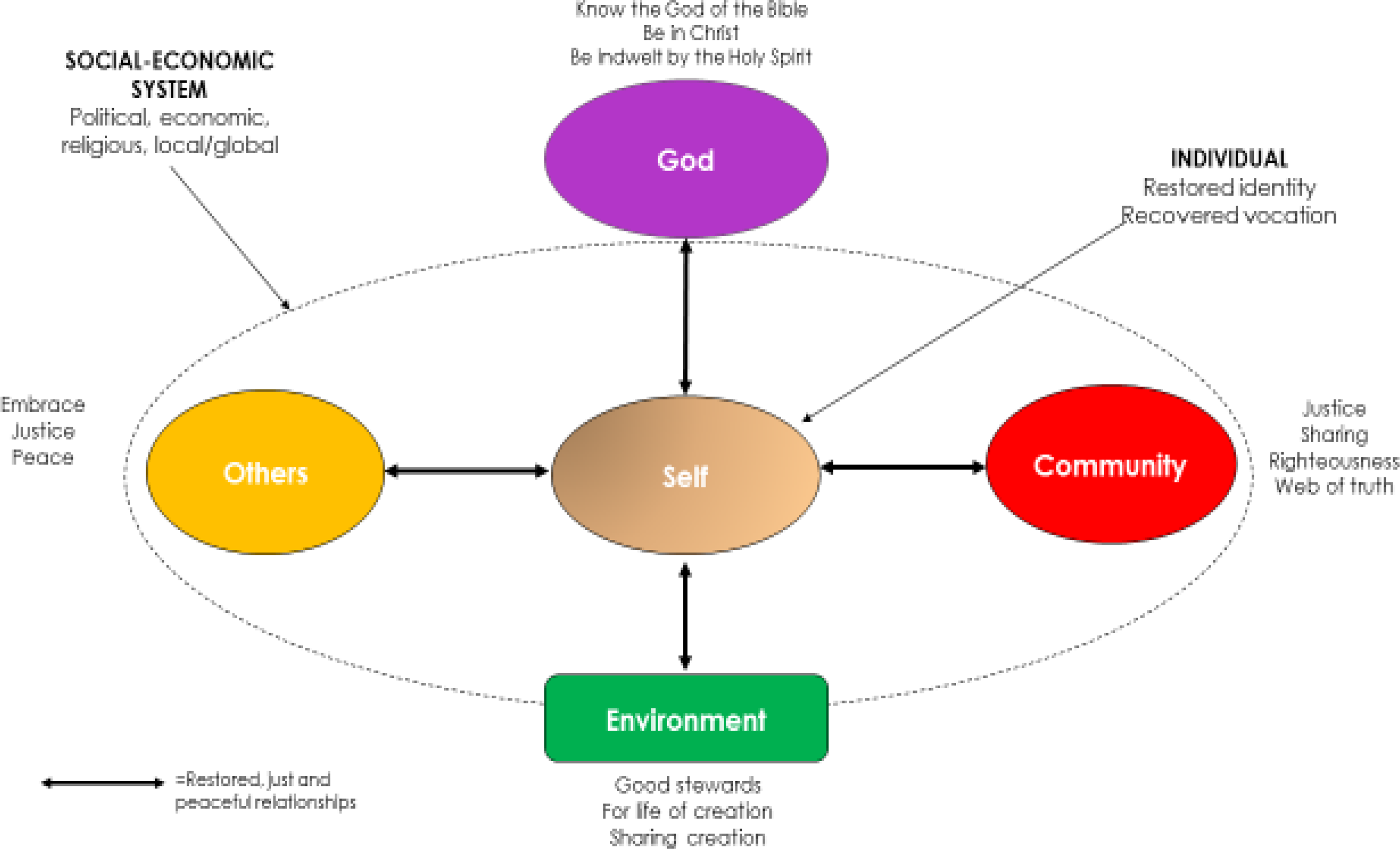
The relational dimensions of transformational development (Myers, 2000: 65; Myers, 2011: 142).
TD consequently focuses on restoring relationships as the means toward recovering identity and discovering vocation. This task of restoration begins with humanity's relationship with the Triune God. This is the central relationship in need of restoration, which demands accepting “God's invitation to faith in Jesus Christ” (Myers, 2011: 142). For Myers, accepting God's story constitutes “the transformational point of maximum leverage for change”, from which “many other good things will follow and become possible” and without which the possibilities of other kinds of transformation are far more limited (Myers, 2011: 142; see also Offutt, 2012: 41). The picture captured in Figure 1 sums up how the restoration of other relational dimensions constitutes the natural outflow of the restored relationship with God. It is from this premise that TD theory lays claim to a transformational dynamic leading to:
individual persons with a restored identity and a new sense of vocation; transformed relationships of the self with other people that will also lead to transformed communities; transformed relationships of individuals and whole communities with Creation (the environment) (Myers, 2011: 143-144; Offutt, 2012: 41-42).
As summarized by Myers, it is when all of the above-mentioned transformations take place that “(t)he outcomes are productive work, justice, sharing, embrace of the other, reconciliation and caring for creation” (2000: 65). By implication, what is at stake is the healing of the communal and societal divisions that cut across ethnic, racial, class and religious lines (Offutt, 2012: 42), but also the divides that manifest between the “poor” and “non-poor” who belong to the same cultural or other community (Myers, 2011: 143). Myers focuses on this “micro level of development” (2011: 147, 2019: 12-13, 16, 19, 28) as a necessary basis for development, and so do we in our analysis. At the same time, however, we do go along fully with Myers's assertion that development cannot be only a local process, but also requires scrutiny of the systems that define life nationally and globally (2011: 147-148; see also 2019).
It is important to make one final observation on how the local church has a special place in TD theory. This does not mean that the imperfect nature of the church is ignored, but rather that one of the obvious tasks of TD must be “to help the church to be what it is intended to be”, namely a living witness to “God's larger story” (Myers, 2000: 67) and consequently a primary vehicle of TD (Myers, 2011: 149-150; see also Sugden, 2003: 73). The church occupies this important place in TD because of its calling to love and serve the community and to provide it with encouragement (Myers, 2000: 65–67, 2011: 149-150).
Transformational Development and Pentecostalism
We acknowledge that there is room for being critical of TD as a theoretical constellation (Offutt, 2012: 43–45). Yet addressing such criticism lies outside the main scope of this article, which is to draw on particular tenets in TD theory to explore the potential and actual innovative contributions of our case study churches as agents of development as this relates to racialized xenophobia. More specifically, our use of TD theory in studying Pentecostalism could be questioned, since the theory originated in the mainline international evangelical movement and not in the workings of Pentecostalism itself. TD is indeed recognized as the “evangelical world's most rigorous and cohesive development paradigm” (Offutt, 2012: 43). Its origins lie in Article Five on “Christian Social Responsibility” in the Lausanne Covenant – the outcome of the congress of the world's evangelical leaders in Lausanne, Switzerland in 1974 – that “became the platform for the construction of Transformational Development” in the years to follow (Offutt, 2012: 39; see also Samuel, 1996; Sugden, 2003). Yet we opt to follow the influential voice of Myers (2015; see also Myers, 2019), who calls for scholars to transcend the evangelical-Pentecostal divide – and thus become open to the ways in which Pentecostalism and its churches may open new vistas for TD.
As a closer study of the emerging literature on Pentecostalism and development suggests, Pentecostalism as a strand of contemporary Christianity – while diverse theologically and in relation to social impacts – seems to share several of the core concerns of TD, noticeably within its “progressive” representation (Myers, 2015: 119; also see Myers, 2019: 127-128). While scholarly interest in Pentecostalism and development is recent, the progressive dynamic can be argued to have already been evident towards the end of the twentieth century: But something else was going on in the 1980s and 1990s in sub-Saharan Africa and other parts of the Global South, and it was good news for the poor. What some have called the third movement of the charismatic/Pentecostal movement, or Neo-Pentecostalism, emerged in poor urban slums in Africa, Latin America, and parts of Asia. This was a self-generating expression of Pentecostalism that emerged from the grassroots, was deeply contextual, and was generally nondenominational or postdenominational … Part of this new Pentecostal movement has been called ‘Progressive Pentecostalism’. One of its characteristics is a deep commitment to social ministries organized around the congregation and its neighborhood or village (Myers, 2015: 115, original emphasis; see also Myers, 2019: 18-19)
Today many Pentecostal churches have proved to be particularly dynamic in the first two relational areas prioritized in TD theory, not least among the poor and marginalized of society, namely achievement of a restored relationship with the Triune God, and personal transformation and holiness (Benyah, 2019; Freeman, 2015; Kakwata, 2017; Myers, 2015, 2019). And yet, from these two areas a further dynamic is unfolding that holds huge potential for such churches’ contribution towards restored relationship of the self with others as well as restored relationships within the larger community.
This dynamic, as an exploration of the literature suggests, may be found in the new moral-ethical foundations emerging from Pentecostal transformation, not only with respect to the narrower confines of marriage and family life, but also a broader human rights culture whereby “all people have value in God's sight” (Anderson, 2020: 130; see also Freeman, 2015: 120–123). Furthermore, a relational dynamic can also be discerned in a host of social services and related institutional initiatives (such as in the areas of education, health and business) offered by Pentecostal churches in many societies. In the particular context of sub-Saharan Africa, scholars have suggested that this collective dynamic is not only leading to people's basic needs being met, but also to new opportunities for human flourishing in community (see e.g. Anderson, 2020; Adedibu, 2020; Burgess, 2020; Öhlmann et al., 2020; Olowu, 2011).
Methodology
This article reports on research that was executed at the intersection of ecclesiology and ethnography; the study design was guided by the principle of integrating “local theological knowledge, traditional theological knowledge, and cultural critique of both” (Wigg-Stevenson, 2018: 426). During our ethnographic fieldwork in two Pentecostal churches in Johannesburg we listened to and observed the local theologies circulating and embodied within the practices of these churches. When analyzing our findings relating to social practices in the case study communities, we discovered that the scholarship on TD could act as a fruitful dialogue partner for the discussion of these findings.
From late 2018 to early 2020, after receiving ethical clearance, we embarked on an ethnographic journey to learn from two migrant-led Pentecostal congregations about whether, and how, experiences of xenophobia shaped religious innovation in these communities. 2 These congregations were a branch of the Heirs of Promises Sanctuary (HPS) and a parish of RCCG, both in Johannesburg. Our primary set of data consists of the transcripts of semi-structured interviews with 34 individuals (and two additional persons whose interviews were not recorded and transcribed). The interviews focused on four topics, namely, the parish/branch itself, selected theological questions, migrant experiences and xenophobia. We wanted to understand the world “through the eyes” of the research participants (Bryman, 2012: 399), even if we obviously could not escape our perspectives and positionality when interpreting the data.
We interviewed both pastors and members of the congregations to obtain a range of outlooks on the life of these churches, and aimed purposefully to include a diverse group of people with regard to gender, age, nationality, cultural group and socio-economic status. As is obvious in the analysis below, we privileged the voices and experiences of foreign nationals, who occupy a marginal position in the matrix of social power in South Africa. This is not to imply, however, that it is the responsibility of the foreign national to resolve issues related to xenophobia in South Africa, or elsewhere in the world (Vähäkangas, 2015).
Additionally, we immersed ourselves in the activities of the churches. This entailed attending a dozen Sunday services at both churches, as well as a few other events such as weekday evening services, including spending time talking to people informally afterwards. Our observations while participating in the churches’ activities were recorded in field notes. This helped us to develop a better “feel” for the studied churches. We also voice-recorded a series of Sunday services and then summarized the sermons and coded them as part of the analysis process.
In our analysis we drew on aspects of grounded theory to construct “an image of reality” (Khan, 2014: 227) based on the collected data. One member of our research group (Hankela) had already done an initial round of open coding on all interviews and field notes, and for the purposes of this article, we re-coded the transcribed interviews and sermon summaries, focusing in particular on the social practices at the churches. This second, more focused round of coding was a mixture of open coding (coming up with new codes as we proceeded) and applying broad predetermined codes relating to the churches’ social practices, but following an inductive approach at all times.
Introducing the Case Study Churches
The case study churches we engaged with were chosen based on their fitting into the category of churches led and frequented by international migrants. The churches were somewhat – even if by no means identically – influenced by similar theological emphases; these included themes such as the centrality of the Word of God, the importance of living a Christ-like life, a strong call to evangelize and a form of prosperity theology (see Hankela, 2020; Swart et al., 2021). Yet it is important to note that the case study churches belong to two distinct Pentecostal denominations – with different backgrounds geographically, theologically and historically – and thus we briefly locate them within their respective traditions before introducing the local churches themselves.
HPS was founded by a Congolese pastor as a French church under the umbrella of AFM of SA in Johannesburg at the beginning of this millennium. AFM of SA is a classic Pentecostal church established in 1908 by American missionaries (Kgatle, 2017: 5). For our purposes it is important to know that assemblies of AFM of SA have over the years cared for the elderly and orphans through their welfare department as well as initiated locally-driven church programs in response to different crises (Kgatle, 2017: 5). RCCG, on the other hand, was established on the continent, and more specifically in Nigeria in 1952 by a Yoruba man (Olowu, 2011: 66). Recently, RCCG has extended its reach beyond its members to address the concerns of the wider society (Osamolu and Atuluku, 2016). Scholars indicate that RCCG is known for its commitment to the poor with the aim of improving life in Africa (Oguntoyinbo-Atere, 2009; Olowu, 2011) and that its public role and social relevance have widened to involve confronting barriers to development and promoting civic engagement (Adedibu, 2020; Adogame, 2016).
Today HPS has several branches in South Africa. We engaged with a branch located in a working-class neighborhood east of the Johannesburg Central Business District (CBD). In this branch the congregants were predominantly Congolese, although many other African countries were also represented, including South Africa. For that reason, the main service was conducted in French but translated into English. Pastor David, 3 one of our interviewees, estimated the membership of this French congregation to be around 500 people, with about 300 attending the service on any given Sunday. A smaller English service had also been introduced to cater in particular to younger members, many of them the children of those who attended the French service. Similar to the congregants, most pastors of this branch were Congolese, except for one Zimbabwean pastor-in-training. The RCCG parish we engaged with was located between a working-class, migrant-dominated neighborhood and a middle-class suburb, not far from the Johannesburg CBD. The majority of the members were Nigerian, with a significant minority from other African countries, including South Africa. The RCCG parish was a smaller community than the HPS branch; Pastor Andrew estimated the usual attendance on a Sunday to be around 190 people, while noting that the official membership was less than that, as the children were not counted. We engaged with a “model parish”, a term that in the RCCG context refers to parishes that are more world accommodating than the more pietistic “classical parishes”. Model parishes are also said to be more attractive to educated and upwardly mobile people than their classical counterparts (Adedibu, 2016: 84).
Discussing the Findings in Light of Transformational Development
While TD did not inform our research design or the fieldwork phase, after analyzing the data we identified it as a concept that could give structure and precision to our argument. In the next three sections we discuss the findings making use of TD as a conceptual framework. First, the TD framework calls for attention to the relationship with God and the implication of that for personal identity and vocation, and this is what the first section focuses on. The second section, again guided by TD theory, examines relationships between people within the church community, here particularly from the perspective of social practices in the case study churches. Third, we focus on the relationships between our two case study churches and the neighborhood, thus extending our use of TD to a third and final level. The aspect of the natural environment (Myers, 2011) did not emerge in our data.
Supporting Personal Identity and Vocation
Our data suggest that the case study churches nurtured an idea of the foreign national being valued by God, capable of making a difference regardless of the circumstances, and called to serve the community as someone who has accepted God's story (cf. Myers, 2011). Agency was encouraged in these congregations amidst difficulties, on the one hand, and evangelizing was linked to a sense of making a difference, on the other. These two perspectives are discussed next in so far as they support a proactive identity and vocation that resonate with Myers's depiction of the transformational dynamic at the personal level.
First, both churches were spaces where the agency of international migrants was encouraged in the face of challenges they encountered. In relation to the host community, they would fall under “the poor” (Myers, 2011) – which, as indicated above, is here used as a holistic category – based on their social location as Black African migrants in an environment affected by xenophobia. Generally speaking, faith did not translate into an indication that one should sit and wait for God to resolve the situation, but instead the agency of the believer was emphasized. Alicia, for instance, described the message preached at HPS as follows: “Yes, you are not in your country, but it doesn’t mean you have to sit there and cry, cry. … God, yes, listen[s] to our prayer but God also needs you to do something.” Likewise, preaching to the younger members of HPS in the English-speaking service, Pastor Obadiah spoke about how some people ended up leaving the church they attended because they did not see their prayers being answered: “It is not the pastor. It is you! … You must take full responsibility for your life” (8 am service, HPS, 24.3.2019).
An emphasis on the need to be smart about navigating an environment impacted by racialized xenophobia further illustrates this call for people to take responsibility for the things they could control. In a Sunday sermon at the RCCG parish in September 2019 Pastor Andrew spoke about a weeknight service that had been cancelled a few days earlier as Johannesburg was experiencing xenophobic unrest. Learning about the cancellation, someone had asked him: “Pastor, u-uh, how are you encouraging your congregation when you say ‘no, [we do not go] to church today because of what is happening’? I thought you would go and pray and pray and pray.” But Pastor Andrew emphasized to the congregation that “things of God, it requires wisdom” (Sunday service, RCCG, 8.9.2019). The choice to follow the God of the Bible was thus linked to a responsibility to work for a better future and apply wisdom. This resonates with some elements in what Frahm-Arp (2018) calls “abilities prosperity theology”, a form of prosperity theology that emphasizes an individual's need to develop their abilities. However, her notion of “progress prosperity theology” – concerned in particular with positive developments within the community – is also evident in the data as highlighted in the analysis below, ensuring that we as researchers do not imprison reality in neat categories.
Second, when thinking of personal transformation, the central place of evangelization – or, more specifically, inviting others into a relationship with God – in the life of these churches speaks to how they positioned themselves in relation to transforming the identity and vocation of individuals outside the church. In interview conversations, material help and concrete service were organically linked to bringing people to Christ, such as when Kesandu (RCCG) explained how winning souls and providing free medication are part of the same mission: We have intensified the preaching not only in church, you see, now we go out for evangelism every Saturday. Every Saturday. Because we want to reach out to people, win more souls. … There was a time we also did … medical outreach, you understand? Because you know, we have a lot of, you know, doctors in the church. So they also brought in … their colleagues. … Whereby we need to reach out to people in terms of, you know, doing tests and other things, giving them medication – free medication – and things like that. And also, sometimes we also do soup kitchen[s] whereby we need to reach out and, you know, look out [for] people on the streets, give them food, give them clothes – understand?
On the one hand, this example further emphasizes what was said above about the proactive identity and vocation we encountered in these churches. On the other, it speaks to how coming to Christ was expected to lead to other things also falling into place. Concrete social outcomes were expected based on what it means to be Christian (cf. Hankela 2020: 317–320): “As a Christian my duties are not only to come to church on Sunday. My duties are to affect my environment. … I need to be a solution. … So we must be solutions and not boast for the little things that we are doing. … It is our responsibility” (Jean, HPS). At the same time, the longer-term solution embedded in outreach practices was rather premised on people coming to Christ than on the concrete acts of service. Resonating with TD theory, it is especially the nurturing of the first relationship between people and God that has the potential to enable change otherwise not imaginable.
While our data do not allow us to measure the impact of the churches on people's identity formation, this aspect is presumably not inconsequential, based on how important these churches were to members as social spaces. Many interviewees told us that they spent time at the church several times a week, or that besides home and work or school, the church was the third space where they spent time weekly: “So, our life is more or less spent here. If we are not at work or at home, we are here,” as Jean (HPS), for instance, explained. Moreover, African migrants forming the majority of the leadership, or the congregation, in these churches clearly had an impact on many people feeling a sense of belonging. As Pitso (HPS) put it: “We are all migrants. We all know how to cross the borders. We all know how tough it is sometimes, you know, to live in a foreign land.” Thus, it appears that these spaces had an advantage when it came to nurturing the identity, faith and vocation of those members who did not have deep roots in the city – or the country – at least not when they first came to the church.
We have argued here that the case study churches were spaces where transformation was encouraged at the personal level, in particular in how these churches nurtured a positive sense of self in, and the agency of, their members. The idea of African diaspora churches as spaces that nurture a sense of agency among migrants, in particular as this relates to evangelizing, is also echoed in research conducted elsewhere (Haugen, 2013; Pasura, 2012); this may suggest that the argument we make about these “foreign” churches as developmental agents is not limited to our case study context.
Restoration Within the Church Community
From personal identity and vocation, we now turn to the relationships between people and groups of people within the two church communities. Social practices at the case study churches – and in particular the material help and concrete services directed at the members – formed a support network for foreign nationals. The people we spoke to in both churches referred to concrete help that was channeled from the church to members, or within the church community from member to member. When looking at the social services and networking opportunities that materialized at the churches, we therefore observed a transformative potential not only in relation to personal but also to intra-communal renewal: while the fact of people's needs being acknowledged as important feeds back into what was discussed above relating to identity and vocation, these practices also provided a platform for potential communal transformation. In the analysis below, we link practices that may otherwise be viewed as welfare or charity to transformational development exactly because of their transformational potential.
Resonating with what we present in this and the following section, many scholars have discussed the role of African diaspora churches on different continents as spaces of meaning-making and support for African migrants as well as the objectives of such churches to make an impact in their host societies (Aechtner, 2015; Berriane, 2020; Pasura, 2012). We nevertheless discuss these dynamics at some length as they apply to our case study churches in order to substantiate our particular argument on development, while acknowledging the scholarship which indicates that these dynamics also have broader traction.
Starting with the socio-economic perspective, in a context where foreign nationals do not enjoy the same benefits available to citizens – whether in relation to access to welfare services (Odunitan-Wayas et al., 2021), health services (White and Rispel, 2021) or protection in the labor market (Mubangizi, 2021) – the case study churches provided at least a partial welfare safety net to their members, thus acknowledging that a struggling foreign national is also deserving of assistance and dignity. Some of the practices that constituted what we call a safety net were formal and took place on a regular basis, while others were ad hoc responses to a particular need. At the RCCG parish a welfare department, informed by principles referred to in the interviews as “Christian social responsibility”, not dissimilar from the Lausanne formulation above, attended to the physical and other needs of members as well as non-members: “We try to identify and provide support, because you could miss those kind of things. It could fall through the cracks. So that department is saddled with that” (Obafemi). Ododo explained that if, for instance, a member struggled to pay rent or school fees or buy food, the welfare department could step in to assist. Likewise, the HPS branch had a social welfare ministry that attended to people's immediate needs, such as rent, food and clothes.
Besides providing material help to members, the two churches provided a platform that enabled networking among members – something that had in some instances led, for example, to finding employment. While this networking aspect does not refer to work that was consciously directed at transforming relationships within the church community, it does draw attention to such relationships as a space for rediscovering dignity and perhaps also vocation. Tunde spoke of people getting information through other members and being connected to skilled or educated people at the RCCG parish, and Jean (HPS) told of how he had been able to assist a few of the congregants in getting a job at a multinational company. His further observation that these congregants “didn’t take anybody's job because … they need to first speak French,” was clearly an allusion to the common xenophobic trope of foreign nationals stealing the jobs of South Africans.
Additionally, the church itself also facilitated networking, something we experienced one Sunday at HPS. Overall, references made in sermons suggested that in the HPS community many struggled with challenges related to immigration documents. On this particular Sunday morning Pastor David then told the congregation about a positive court ruling related to immigration documents, which implied that there was a good chance for people to get more permanent immigration documents. He further spoke about a plan to contact a lawyer and get people to put together a collective application: If we submit together, we can then afford a lawyer. … We are going to apply as a group. We are going to refer to the article issued by the court to support our application. So, with the lawyer's help we have happiness here [people clapping their hands and whistling]. May the Lord continue to help us. May the Lord continue to unite us (10 am service, HPS, 10.10.2019; translation from French by Nishimwe).
We do not know whether this plan materialized, but nevertheless it serves as an example of how a church consisting primarily of foreign nationals could actively engage with needs specific to this community.
Moreover, the helping and networking that took place in these spaces draw attention to the relationships between the “poor” and “non-poor” (Myers, 2011) within the church community. In this context these two groups consisted of the more privileged (e.g. employed professionals, such as medical doctors or lawyers; those with a fluent command of English, or with permanent residence permits or citizenship in South Africa; those living in the suburbs) and less privileged members (e.g. the unemployed and those working in low-paying jobs; those struggling with English; those living in less wealthy neighborhoods more likely to be affected by xenophobic violence). While a caring disposition was clearly something important to these communities, such a disposition could be embodied either in a manner that affirms or undermines the dignity of the less privileged. For us to say anything about these communities as spaces of restoring relationships between “the poor” and “the non-poor” would require further fieldwork focusing particularly on the experiences of the recipients of such care.
The relationships within the two church communities themselves also involved the relational dynamics between foreign nationals and citizens, reflected in how people spoke about the need for the church to adapt to the local context. When speaking of the work of the welfare department, Obafemi (RCCG), who was part of the leadership of the parish, explained: “The Bible is the guide and you structure it to, to suit where you are.” Similarly, Pastor Andrew spoke of a South African member of the parish, saying, “She's in welfare and she brings her input into the welfare, all those things. They know what the South African needs. … We do not want to enforce Nigerian mentality.” Likewise, at HPS, Jean discussed the need for adapting to the context as follows: But thank God most of our pastors have tried to adapt to the South African way of things. Even when they preach now, they use South African lingo, you know. So they are adapting. Even the church, the way we are running the church also we are trying to adapt to a different way than what it is done in, back home. … Our first target must be the people of [the neighborhood]. These are the people that are supposed to be coming and joining the church, but most of them when they pass here, they think this is a French church, you understand. So we need to adapt, we need to adapt in order to grow.
Bringing South Africans and foreign nationals together was not the main mission of either church, but in both churches it was part of the interpretation of the gospel. The two church communities consequently became spaces where relationships between South Africans and international migrants could be reimagined. At the same time, however, this did not mean that all things South African were accepted or appreciated in these communities, similar to what has been argued about African diaspora churches’ critical approach to given elements in their host communities in other geographical contexts (Aechtner, 2015: 65-66; Pasura, 2012: 38, 41).
Lastly, to complicate our analysis somewhat, when asked what interviewees expected to get from or in the church, people from both churches emphasized that they did not expect anything, except maybe spiritual growth, and that they did not come to church to gain something but to worship and serve God. We wondered whether this recurring response had to do with the way we asked about the matter. Yet, be that as it may, this response does appear to emphasize the importance of faith in and of itself, and not as a tool to gain something external to it. This highlights the centrality of the first relationship (between oneself and God) in the imaginaries of these churches, thus corroborating the idea that the gospel and the need to live out one's Christian identity are the driving forces behind the service work done by the church or its members. These are not “social goals” that could be separated from the overall calling to be Christ followers, which is in line with the importance of the relationship with God as the foundation upon which other developmental goals become possible, as articulated in TD theory. From the restoration of relationships within the church community itself, we now turn our attention towards considering the relationships between these church communities and the broader neighborhood.
Impacting Relations Between the Church and the Neighborhood
As already indicated, we also learned from the interviewees of transformative intentions in relation to the broader context outside the local church. The way Abeo, for instance, described the task of Christian social responsibility at the RCCG parish as one that is “to meet the needs of the environment where we find ourselves” resonated with the ways in which others spoke of the social role of their church. In practice both churches were providing some material help and concrete services to the communities around them, even if not on a large scale. In this final section we examine such dynamics between the case study communities and the neighborhood around them in order to showcase the potential for TD in this broader context.
The responsibility of the church in relation to the immediate neighborhood was emphasized in the HPS interviews, possibly because of the neighborhood in which the church was located. In describing the neighborhood, Pastor Paul spoke of drug abuse and violence, and Julienne explained that there had been some cases of theft with either members or church property having been the target. Jean elaborated perhaps the most extensively, and self-reflexively, on the role of HPS in this neighborhood. Among other things, he described the Christian church in general as called to be in the middle of the village: … the church is supposed, is placed in – back home we call it: is in the middle of the village – it means to attract, to change people’s life around. But I can also ask the question: What has Heirs of Promises achieved or impact, what’s the impact of our church in [this neighborhood]? It’s a big question we need to ask ourselves if we need to know where we are going or if we are an impact: Have we impacted [on the neighborhood] since we have been here?
In an attempt to begin to answer his own question, Jean spoke of a cleaning program that HPS had started, aiming at keeping the surrounding streets clean, and continued: But it’s not enough, it’s not enough. There’s a lot of drunkenness here around; there’s a lot of drug abuse; there’s a lot of prostitution; there’s a lot of pickpocketing and petty thieves or house break-ins. We, it is our responsibility to change [the neighborhood]. But when we come in here with our cars parked here, the people around here think, they see us like people who come from somewhere. We are having a meeting and then we leave. But we need to become part of [the neighborhood]. It means we need to outreach. We need to even have more members who live in [the neighborhood] than more members who live outside of [the neighborhood].
In other words, Jean called for his church to be a change agent in the neighborhood it inhabited and, in particular, to impact on the physical space through bringing residents into the HPS family. Including evangelizing as a means of social change in this manner attests to an understanding that resonates with the TD emphasis of spiritual, social and material poverty being intertwined. The emphasis on the first relationship (with God) is again highlighted, here in relation to Jean's thinking of solutions to issues that – in the light of the history of Johannesburg (see Murray, 2011) – were clearly outcomes of long-standing structural violence.
The kind of self-critical reflection we hear in Jean's thinking was present at both churches. Through interview comments that pondered on whether the church is, or churches in general are, doing enough, our data offers a reality check to scholars interested in TD theory and the limits of the transformative energies in local churches organically translating into a broader impact on society. Overall, people did not applaud their churches as being perfect – the interviews were not about image building. Instead, many spoke of both what their church or churches in general do and what more they could do. For instance, Ododo (RCCG), who saw xenophobia being linked to failed service delivery, wanted to see churches stepping in to fill the gap by providing the needed services. She referred to Christ Embassy and the Islamic relief organization, Gift of the Givers, as examples when talking of how churches should impact on the community around them.
While much of our data suggests a close connection between bringing people to Christ and transforming society, as illustrated in Jean's comments above, Ododo's appreciation of an Islamic organization implies that an exclusive relationship with the Christian God was not seen as a necessary prerequisite for transforming South Africa, at least not according to all members. Besides speaking to the idea that churches ought to be active in their social context, the comments by Jean and Ododo are also telling of theologies of service finding their way into these spaces through the leadership but also through members who engaged with the teaching of the church and incorporated their own emphases and experiences. The developmental potential would then lie not simply within the official doctrine of the church, but also in the mix of people who inhabit a congregation.
Lastly, some interviewees connected spreading the gospel to impacting on the relationships between the foreign national and the citizen and, more specifically, on reducing xenophobia (also see Hankela, 2020). To illustrate this, a few people explicitly reasoned that through doing good, the foreign church changes the ways in which South Africans view foreign nationals: “We know we are projecting an image. So it influences even if there's no active full-blown xenophobic issues. The church is conscious of that. The church needs to show love,” Obafemi (RCCG) reasoned, and Gabriel (HPS) echoed this sentiment: But the Bible says that you should love your enemy because let’s say like the one who comes to me to attack me xenophobically is like my enemy. … Love itself should talk and they [the South African community] will look from afar and say: ‘Oh, hold on, we hated these people, but as a matter of fact they are not that bad. You know, we, we are the one who are bad in doing this, but look, we cannot reproach them for anything.’
Thinking, in the light of TD theory, of the example above of HPS putting energy into cleaning the neighborhood in a hands-on way, we see the potential of the church to be a vehicle for transforming relationships within the broader community through reshaping attitudes that feed xenophobia at the grassroots level – something individuals could hardly achieve alone. We do not want to make grand claims about the concrete impact of our two case study churches, as our methods do not allow us such a privilege, but this dynamic appears to be something to watch in the context of churches frequented by foreign nationals in urban South Africa. Whether such a dynamic has the potential to achieve larger-scale concrete impact is something that needs to be further explored in future studies.
Conclusion
The TD framework has allowed us to portray the relational dynamics within two migrant-led African Pentecostal churches in Johannesburg as important to the discourse and practice of development. The dynamics we discuss – namely, the churches as spaces nurturing a proactive identity and vocation among individuals in a foreign country, providing a safety net for migrants, and embodying a sense of responsibility in relation to the host society and nation – are familiar from the scholarship on religion and migration. Our bringing them into conversation with the concept of TD, which centers on the restoration of identity and relationships as a necessary foundation for life-affirming development, provides a new perspective to thinking about churches led and frequented by African migrants as agents of development.
Neither one of the case study churches spoke of themselves as a developmental agent and both rather focused on living out the gospel. However, it is this living out of the gospel that – when read through a TD lens – translates into social dynamics that are relevant for development overall, albeit here operating at a communal micro level. We have shown how the two churches studied contribute towards restoring relationships: with God, with self, with others in the church community, and between the church community and the immediate neighborhood. Yet the impact or importance of this developmental potential should not be overstated. At the same time, it does deserve the attention of those interested in development and is easily missed if simply applying a secular Enlightenment gaze to the potential (and actual) contribution of the two studied churches to development. In our study this potential becomes evident through the application of a theologically informed framework of development. This attests to the utility of the TD framework in the context of empirical research, something that has not been widely applied so far.
Our findings also speak back to TD theory, drawing attention to ways in which the relational energy within the church community is, or is not, translated into a broader societal impact. Our data, while not speaking the language of development, underscore the relevance of the TD framework and its different dimensions, on the one hand, and in relation to this, the connection between the communal or micro level and societal level of development, on the other. However, we also brought to the fore the critical self-reflections of some of the research participants that relate to an urge to do more in the surrounding society than what is the case at present. The empirical data thus pose a question to TD theory regarding the relationship between the relational foundation of development and the possibility of broader societal transformation, calling for this relationship to be spelled out in still more concrete and perhaps more critical terms.
Lastly, our argument is consciously constructed in the context of racialized xenophobia. To this end, TD provides a logical avenue for relating xenophobia and development through the notion of restoring relationships with God, self, others and community, thereby attesting to a holistic understanding of development in the twenty-first century. That this insight is examined through a nuanced portrayal of African Pentecostal churches is important here, as it counters the global politics of race that often relegates African and international migrants of color to the periphery. African Pentecostal migrant communities, while not organized as developmental actors, clearly have a role to play in the advancement of transformational development at the grassroots or micro level of society, not only in South Africa but also elsewhere.
Footnotes
Author Contributions
This article stems from project work under I. Swart's leadership. E. Hankela and C. Nishimwe conducted the fieldwork. All three authors contributed to the conceptualising, writing and revising of the article.
Declaration of Conflicting Interests
The author(s) declared no potential conflicts of interest with respect to the research, authorship, and/or publication of this article.
Funding
The author(s) disclosed receipt of the following financial support for the research, authorship, and/or publication of this article: The research project received a grant from the Nagel Institute for the Study of World Christianity, Calvin University, Grand Rapids, MI, USA, which was funded for the African Theological Advance initiative by the Templeton Religion Trust, Nassau, Bahamas.

Notes
Author biographies
Elina Hankela is an Associate Professor in the Department of Religion Studies at the University of Johannesburg. Her research work focuses on questions related to social ethics, ethnographic theology and liberation theologies, in particular in the context of urban South Africa.
Ignatius Swart is a Professor in the Department of Religion and Theology at the University of the Western Cape, Bellville, South Africa. The focus of his teaching and research includes the related fields of theology and development, religion and development, and diaconal studies.
Clementine Nishimwe is a Lecturer in the Department of Religion Studies at the University of Johannesburg. Her areas of research interest are religion and migration, gender and migration, Christian studies, and African women's theology. She is also interested in ethnographic research on religion.