




Abstract
This article addresses paucity in literature on the conceptualising of the true nature of a Protestant revival. Through a literary review and document study, the article aims to compile a Protestant revival evaluation criterion (PREC) to assess protestant revivals. This was done by integrating the distinctives (characteristics) of Evangelical revivals throughout history as described by prominent scholars such as Armstrong, Cairns, Edwards, Lloyd-Jones and Sprague in general. In addition, various past and present examples and exponents of true and juxtaposing anti-revivals were investigated and beacons set for sustainable revival. From the PREC, three levels were established by which to assess revivals: individuals (micro), the church (meso) and surrounding communities (macro). For the case study, information was gleaned from multiple sources, including interviews, documents, sermons, newsletters, observations and research reports. Applying the PREC in a case study, demonstrates how it operates as a valuable tool; in this case, the revival among the Zulus in KwaSizabantu, South Africa.
Introduction and purpose
With the emergence of the COVID-19 pandemic, the world has been thrown into turmoil. Such a global crisis and restrictions on church gatherings require fresh expressions of church vitality, as exemplified by the 95-year-old North Carolina World War II veteran who recently gathered over 180,000 believers online to start praying for a God-sent revival (Parke, 2020).
When signs of revival do appear on the landscape of history, enquirers regarding its authenticity follow suit (Sproul and Parrish, 2000). These enquiries either stem from scepticism or act in obedience to Scripture (1 John 4:1). Church history is replete with evidence of a collective pattern: spiritual decline, crisis and renewal (revival). Current spiritual declines in such a pattern call for a perennial revival (Cairns, 2015). Such an authentic revival means regaining the vitality of the church’s testimony in Christ, which generates an impregnable transformative force within its society.
The thoughtful reader on revival and church history differentiates between two movements. Since a true revival entails a sovereign act of God, the domain of Satan will be swift to contradict such an occurrence (Hammond, 2004). There may be attempts to diminish the truth by suggesting this is a false fire or by advocating that revival is not meant for Christians living in a post-modern era. Adding to the complexity, Sproul and Parrish (2000) suggest that every recorded genuine revival has also exhibited certain counterfeiting tenets and distortions on its periphery, which bring its authenticity into disrepute. One current example is that of the revival among the Zulus described within this case study. During 2019, this revival underwent a trial-by-secular-media, where the allegations according to an independent panel later proved to be untrue (Fleischmann, 2021).
This raises the question: How can a Christian discern such a strategy and rightfully distinguish a true from a counterfeit revival?
Theoretical Framework
Literature on revival reveals a paucity in conceptualising its true nature (Cairns, 2015). Therefore, the purpose of this article is to address such deficiency by drawing from Jonathan Edwards’ distinguishing marks as well as those of other revival scholars and church historians. These beacons provide guidance, functioning as a Protestant revival evaluative criterion (PREC) in light of the following instruction: “Beloved, do not believe every spirit, but test the spirits, whether they are of God; because many false prophets have gone out into the world” (1 John 4:1, NKJV). To do so, it is vitally important that the church understands the theology of revival (Armstrong, 2001).
Theology of Revival
Armstrong (2001) proposes three main theological views on revival. The first view suggests that the Spirit came down at Pentecost; thus, there is no ‘need’ for further revivals. However, in Acts 10:44-45, Luke describes another remarkable event as an outpouring of the Holy Spirit at Caesarea (Wallis, 1956). The second view of Armstrong on revival is that humans have the responsibility to fulfil these conditions. Once fulfilled, the path is levelled and straightened to receive revival (John 1:23). The third view, according to Armstrong, is that revival remains a sovereign act of God, where God alone receives the honour.
Our impression is that true revival should be regarded as a position balanced between the above-mentioned second and third views. The historical view of church history and revival emphasises the fact that revivals occur unexpectedly and unplanned for (third view); however, throughout history, these movements were linked to an individual or group of praying persons (second view).
The theocentric question reads, “How can a human be just before God?” with the accompanying one, “How can I be acceptable and pleasing before a righteous and holy God?” These questions led to humankind’s earnest inquiry, which developed from an overpowering realisation of God’s holiness and humans’ own depravity. Revivalism, by contrast, does not raise this question and has little to no dealing with God’s holiness and His holy character, as described later.
The Reformer Luther was confronted with the question, “How can I find a gracious God?” In contrast, post-modern humans, without a biblical foundation, seek the solution through an exciting adventure of a spirit-filled experience (Armstrong, 2001). Such an approach leaves the door open for deceiving spirits to operate within the church. Once people have attained such ecstatic experience(s), in many cases such doors are then bolted to scriptural correction or reference to God’s holy nature.
Misconceptions about revival
Endangering the church’s true function and calling, a changed meaning of the term ‘revival’ has been induced gradually. Due to this gradual change, most scholars on revival agree on the importance of defining a biblical revival (Armstrong, 2001; Olford, 2005; Orr, 1981; Ravenhill, 1983; Van Rooy, 1989). In this regard, Orr points out that the term ‘revival’ is often confused and perverted by ‘elementary semantic disorder’. Thus, he stresses the need to define the term ‘revival’ so as to clarify its meaning biblically, etymologically (history of words), historically and logically (Orr, 1981).
The concept of revivalism is also used ambiguously, coining the term ‘modern revivalism’ when describing ‘mass evangelisation’. Again, a shift has taken place that focuses on the organisation of evangelistic campaigns. A further illogical misuse of ‘revival’ describes American evangelistic campaigns. For example, when revival is understood in its true sense, an advertisement stating ‘Revival every day, except Thursdays’ is illogical, for it would imply that God operates in the midst of His people daily, except one specific day.
Revival and Anti-revival
Schaeffer observes that for every truth in a Christian’s life, there is a corresponding antithesis (Sproul and Parrish, 2000). A true revival embodies both Scripture and the person of Christ. Thus, Armstrong (2001) warns that activity separated from these two motives is no true revival, but rather an anti-revival. The meaning of the term ‘anti-revival’ implies not only a substitute for a true revival but also a movement that in reality is in opposition to it. When evaluating revivals, Edwards remarks that extraordinary incidents outside tradition as such do not necessarily imply that these activities are not of God. Edwards argues that God is not limited by human traditions or self-prescribed rules (Edwards, 1741, 1995 imprint).
Koch (1974) warns against anti-revivals which could occur in four spheres of counter-movements:
somatic or physical
psychological
intellectual
cultic.
Whereas the somatic or physical sphere includes sexual and sensual intoxication, psychological intoxication refers to extreme tendencies which enhance spiritual haughtiness. Intellectual intoxication emerges where human reason takes hold of educated people, thereby impeding the working of the Holy Spirit.
Koch (1974) forewarns that the climax of these anti-revivals may result in demonic cults, religious in nature but removed from the truth. As God is also known as the Spirit of truth, the deceptive spirits operating within a church give rise to a ‘strange fire’ (cf. Leviticus 10:1-3) in the midst of the church – not originating from the Holy Spirit. Herein lies a severe warning to the church currently not to be swayed easily through signs and wonders without testing the spirit behind it.
A revived church will not only be recognised by affirmation of revival truths (thesis) but also by its conviction and courage to act against anti-revivals (anti-thesis).
A Working Definition of Revival
Wallis (1956) stresses the importance of defining the term ‘revival’ circumspectly. Inappropriate uses of the word have caused confusion in the modern church, thwarting the longing for a true revival (Armstrong, 2001).
To provide a working definition, for the purpose of this article, ‘revival’ is defined in terms of seven moments: (1) The renewal of the church through an extraordinary, sovereign and surprising act of God (2) in which Christians, as they become intensely aware of His holy presence in their midst, become overwhelmingly aware of their own sinfulness, (3) thus leading them to confess and repent from sin, renewing their obedience to the known will of God (4). This results in both a deepening of their individual and corporate experience with God and being granted power from on high (5), they are revived and unctioned [anointed] thereby reforming the battle lines for a renewed advance (6) to fulfil His last command: making disciples of all nations by becoming his witnesses to the ends of the earth (7) in answer to their prevailing prayer (Fleischmann, 2021).
It should be noted that these seven moments are only a limited attempt to describe the operation of the Holy Spirit within a revival.
Revival brings a richer understanding of Scripture (Bonhoeffer, 1963), which, in turn, provides the theology for revival (Armstrong, 2001). The idea of being revived is reflected in the Hebrew verbs For thus says the High and Lofty One Who inhabits eternity, whose name is Holy: “I dwell in the high and holy place, with him who has a contrite and humble spirit, to revive the spirit of the humble, and to revive the heart of the contrite ones. . .” (NKJV, 1982).
Contextual Background of the Revival among the Zulus
The Zulu people, a Nguni ethnic group in Southern Africa, was known for their fierce warriors under King Shaka (1816–1828). A protestant revival came to the Zulus at the end of 1966. After some months of honest introspection, comparing their own lives with Scriptural standards, missionary Erlo Stegen together with his Zulu congregation became deeply convicted of their own sinful nature (Dube, 2019). Pleading with God to change their lives to that of the first church in Acts, they continued to confess and grieve over their sins. At the end of 1966, God answered their prayer for revival (Khwela and Dube, 2019). As they were united in prayer, there occurred an unexpected mighty rushing of wind (Khwela and Dube, 2019). They all felt God’s holy presence among them. The surrounding community was also affected. Zulus, deeply convicted of their own sin, flocked to them from surrounding areas seeking help (Majola, 2019). From 1966 up till the time of writing, witches have come to KwaSizabantu Mission (Zulu word for the place where people receive help) to burn their occult fetishes and to obtain forgiveness for their evil practices (Hlongwane, 2019). Through the preaching under the authority of the Holy Spirit, a 100-year tribal war between the Bathembu and Mabaso clans came to an end. Nkosi Mabaso (Ndabezitha Mntungwa) a Zulu tribal chief, stated, ‘I can point to many graves in my family, but because of the Gospel, death stopped. There is nothing greater than that closed chasm where many souls plunged in day after day’ (Mabaso, 2011). Documented cases confirm the healing of blind and paralysed Zulus (Fleischmann, 2021). Formerly proud and hard hearts of Zulu men who were clinging to their traditions, habits and customs were changed (Ngubane, 2019). Ngubane confirms: But once we came across this light [of the Gospel], things changed in our lives and the way we look at things . . . we looked differently, putting God first . . . what we cling to is in a good relationship with God (Ngubane, 2019).
Dube (2019), whose brother had been an advisor to late King Goodwill Zwelithini, remarks that ‘others can say anything they like, whether good or bad about Baba uMfundisi [Erlo Stegen], but the testimony of his life before our very eyes has spoken volumes to our Zulu nation’.
Research Methods and Design
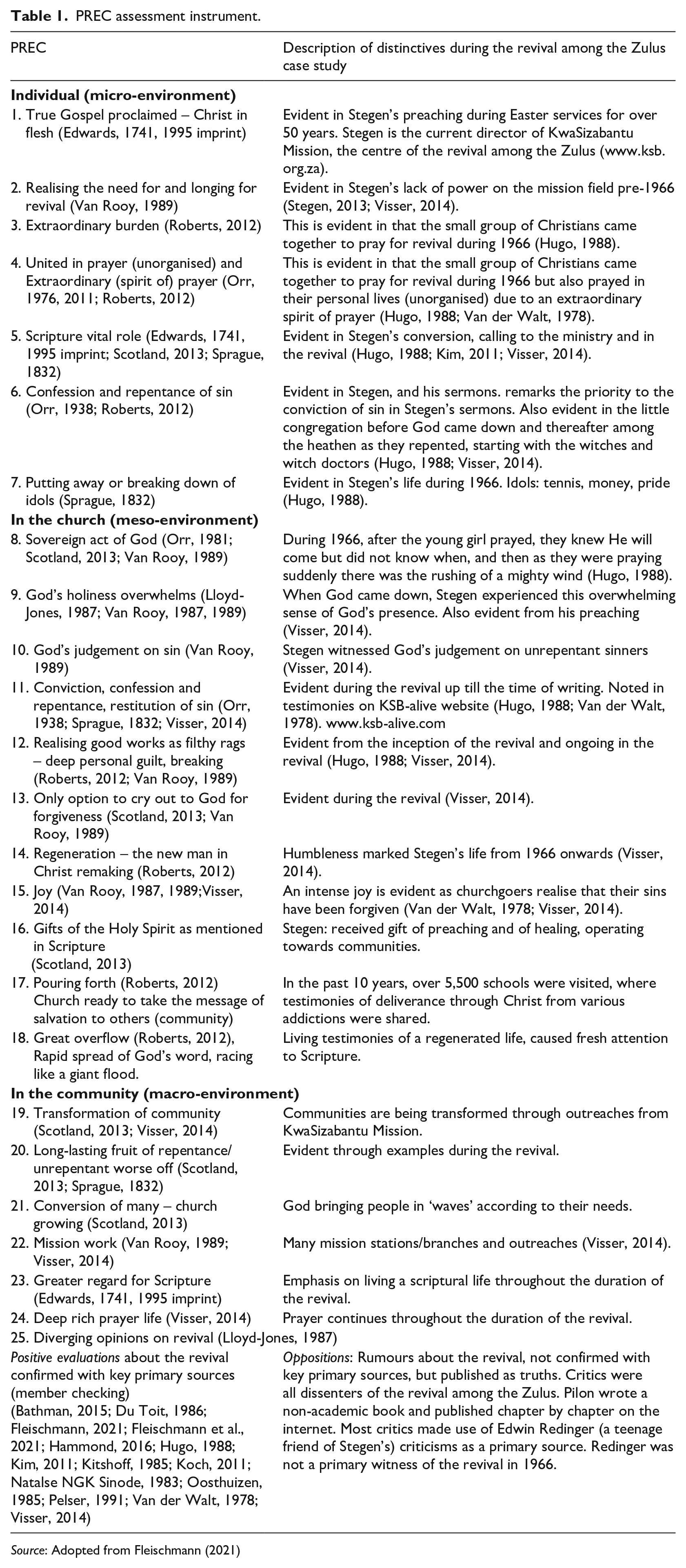
This qualitative study consisted of two phases. During phase 1, literature from various databases, such as EBSCOhost, JStor, Google Scholar and Scopus was searched using terms such as ‘awakening’, ‘Christian’, ‘evaluation’, ‘Protestant’ and ‘revival’. From these searches, prominent scholars on protestant revivals were identified, such as Edwards, Lloyd-Jones, Orr, Roberts, Scotland, Sprague, Van Rooy and Visser. After a review of typical distinctives (characteristics) of revivals, distinctives proven to be a consensus of multiple sources were selected for the PREC (see Table 1) and applied to the revival among the Zulus as an evaluative case study.
PREC assessment instrument.
Source: Adopted from Fleischmann (2021)
During phase 2, key informant sampling (Patton, 2014) was used to select as interviewees individuals who have been part of this revival, traditional and community leaders, members of the Zulu nobility and ministers of the Gospel.
Further data was gleaned from newspaper articles, several academic writings, reports, 50 transcribed sermons, 20 interviews and 20 newsletters. Data obtained from these sources provided a ‘thick description’ of the nature and characteristics of the revival among the Zulus and criticisms thereof. The use of multiple sources of data enhanced source (data) triangulation (Flick, 2018) and promoted internal validity (Merriam and Tisdell, 2016).
Data from these various sources were merged, condensed and analysed (Miles et al., 2014). Corresponding codes were allocated to data pertaining to descriptors contained within the PREC. Further rigour was ensured by continuously moving back and forth between data and descriptors within PREC (Merriam and Tisdell, 2016).
Part 1: Operationalisation – The PREC Assessment Instrument
In revival, Christ, as the Head of the church, sovereignly works as He wishes. This raises the question whether mere humans are capable of evaluating a revival.
Sproul and Parrish (2000) remark that 1 John 4:1 provided a benchmark for Jonathan Edwards against being gullible and accepting any spirit without evaluating its relationship with the Holy Spirit. Based on the axiom that not all spirits are holy, claims to spiritual power should be verified before being validated as a work of God (Sproul and Parrish, 2000: 23).
Scholars agree that revivals may vary yet share common biblical distinctives (Lloyd-Jones, 1987; Visser, 2014). In a true revival, rivalry ceases, as the emphasis is no longer on the importance of preachers and church denominations but on God Himself. In an attempt to describe the working of the Holy Spirit, this article utilises main biblical tenets, as described by Edwards, Lloyd-Jones, Orr, Roberts, Scotland, Sprague, Van Rooy and Visser. These aspects are integrated to provide an assessment criterion for revivals in general.
Edwards’ theology of revival is supported widely by theologians and church historians alike (Cairns, 2015; Sproul and Parrish, 2000). Orr, on the other hand, built a strong historical theory of revivals and awakenings (Elliston, 2011).
Common Descriptors within Protestant Revivals
Tozer (2013) remarks that a revival can occur in sequence on three levels: first personal (pouring forth), then church and finally community (great overflow). In certain instances, churches may oppose the idea of revival, thereby impeding the outflow of living water from a revived individual to other church members.
Prerequisites for Revival – Micro Level
The first prerequisite on micro-level focuses on individual preparation. During the East African revival, which began during the 1920s and 1930s, preparation was not co-ordinated by human intervention. The Holy Spirit worked in the lives of persons separated by geographical distances which spanned thousands of miles, unknown to each other (Warren, 1954).
Awakened to the Need for Revival
The awakened (revived) Christian in post-modern times is able to discern spiritually and is deeply aware of the paradigm shift that has taken place in numerous churches. The point is: the essence of our being is not what humans can get out of God, but what God can get out of humans. This view is contrary to the current post-modernist pursuance of pleasure, which has also compromised the church in several cases. Watchful Christians are burdened by the state of the church and those around them.
According to Calvinist and Puritan tradition, revival can occur through biblically appointed means such as prayer, fasting, faithful preaching and fulfilling duties faithfully, in which Scripture plays a vital role (Scotland, 2013).
Unease about the State of the Church
Individuals are awakened to the state of the church along with an unease about their own spiritual state and powerlessness (Van Rooy, 1989). As people realise that only God is able to revive a person or a church, a longing for a true revival grows. An apt example from church history is the presbytery of Lewis (Hebrides Islands). Prior to the ‘Lewis awakening’ he experienced an increasing discomfort about the state of the church (Campbell, 1954). During the East African revival as well, there was a growing dissatisfaction with spiritual defeat in the lives of individuals as well as common church life. This unease created a desire for God’s intervention to revive and empower them to live victorious over temptation and sin (Warren, 1954).
Sola Scriptura Focus
As the Holy Spirit inspired the Scriptures, He continually seeks to convince and convict not only the revived Christian, but also both the carnal Christian and post-modern person, of sin, righteousness and judgement. In this regard, the Spirit spurs on all members to practical sanctification by confessing sins and making restitution for wrongs (Orr, 1951). The Reformation focused mostly on the return to the undiluted preaching of Scripture (inspired by the Holy Spirit), which evokes a desire to lead a Scriptural life. In like manner, revival entails a life brought into its proper relationship with the Holy Spirit (Schaeffer, 2002). Therefore, Sproul and Parrish (2000) caution that a reformation without revival produces cold orthodoxy, whereas a ‘revival’ without reformation leads to error.
Hanegraaff (2001) remarks that only when the church undergoes a reformation through the undiluted preaching of Scripture, will the world be able to experience a true revival. In the same vein, Buys (2008) emphasises that true revival is not possible without a reformation, and a reformation cannot be complete without a revival. Roberts (2012) and Sproul (2017) point to David’s yearning for revival in Psalm 119:107: ‘Revive me, O Lord, according to Your word’, which also suggests that Scripture and revival go hand in hand.
Longing for Revival
The growing desire for revival produces an extraordinary burden for a lost world and a longing for God to work (Roberts, 2012). There is also the realisation that ‘only God can do something’ (Roberts, 2012). As this longing intensifies, people realise increasingly that humans do not have the strength to empower the church or themselves. Thus, a further realisation awakens that only God can intervene, thereby bringing the revived prayer life into effect (Matthew 5:3) (Van Rooy, 1989). No means are used, other than scriptural ones such as crying out for God to intervene (Sprague, 1832, 2007 imprint). At this stage, humans may be tempted to use their own ‘means’ and induce a revival. However, such a fire will not be lit ‘from above’ but by human hands, which will not produce positive lasting effects. Every genuine revival is saturated with the gracious touch from ‘on high’, moving humans to seek God, and cry out as in Isaiah 64:1: ‘Oh . . . that You would come down! That the mountains might shake at Your presence’ (NKJV, 1982).
Prevailing Prayer
In church history (until the time of 19th-century US evangelist Charles Finney), revival was predominantly based on teachings of the Reformation. In other words, revival was theologically viewed as a sovereign act of God, which humankind may only request from Him through prayer (Cairns, 2015; Wolfe, 1991). In this regard, Lloyd-Jones (1982: 81) explains:
If you are really burdened by the times in which we live, if you are really grieving in your heart as you see the godlessness of the world, if you have a compassion in your hearts for men and women in bondage of sin and of Satan, your first duty is to pray for revival.
A spiritual and moral decline in a Christian life creates in the awakened children of God a dissatisfaction with the lukewarm state of their own spiritual lives (Van Rooy, 1989). An example is Simeoni Nsibambi of the East African revival (Ward and Wild-Wood, 2016). After realising the hopelessness of overcoming their situation on their own, people turn to Christ through prayer. In numerous instances, moral decay resulted in prayer for revival (Orr, 1976, 2011).
The history of revivals suggests that God awakens certain individuals to knock on His door of mercy through prevailing prayer (Lloyd-Jones, 1987). Ravenhill (1983) describes this type of prayer as the ‘spiritual boiler room’ of the church. In essence it is not the correct dogma that saves, but the God of the correct dogma (John 5:39-40). Armstrong (2001) notes that throughout church history, a constant pattern emerges of ‘prayer preceded the outpouring of a fresh endowment of power [termed ‘boldness’] by the Spirit’.
Lloyd-Jones (1987) distinguishes two stages of intercessory prayer. Based on Exodus 33:1-6, he describes the first stage as the point when an individual or small group, usually insignificant in human eyes, quietly takes action in prayer. God is moved by a contrite heart (Psalm 51:17). Others who feel the same burden join in prayer spontaneously (not organised). As they pray, they consecrate themselves and deal with impurities in their lives of which they have become aware and which may hamper their prayers. Their praying becomes more intense as they exert themselves, going out of their way to make restitution to one another as well. The bulk of the church takes notice of them but do not take part in their prayer. In the interim, the individual or little group continue praying, until they receive the assurance that God has heard them. They know they have found grace in His sight, and that God will answer their request. Thus, they keep on praying with the expectation that God will act soon. They have decided to knock on God’s door of grace until He answers (Matthew 7:7; Luke 18:13,14).
The second stage of intercessory prayer is more intense. Having received the promise in Scripture that God will act, they seek more. The individual or little group has a growing desire to know God for who He is. They receive a deeper knowledge of God through the presence of the Holy Spirit in the church. The Spirit leads the believers by sharing the secret of God’s purpose for revival. The participants realise afresh the role of the church as unique and separated for God (Lloyd-Jones, 1987). Both these stages are characterised by an extraordinary spirit of prayer (Roberts, 2012).
Orr points out that in both the Arminian and Calvinist tradition, a prerequisite for revival is extraordinary prayer, which is a symbol of the desire that God Himself should take His rightful place. Calvinists refer to God working in His sovereignty, thereby burdening His children with the condition of the church and of their own lukewarm lives. By the term ‘extraordinary’, Orr refers to prevailing prayer, in which the believers seek God’s countenance, with a quest for true revival. As in the case of the praying men and women of Barvas (parish on the Isle of Lewis) in Scotland, the believers are confronted by Psalm 24, which states that only those with clean hands and pure hearts may ‘ascend the hill of the Lord’ (Campbell, 1954). These prerequisites imply a purification of both outward actions and inward intentions and motives. The believers underwent sincere introspection and confessed their unclean actions and impure motives to Christ. Through these actions they were being prepared to receive revival, which came to Barvas in 1949 and spilt over to widespread areas on the Hebrides Islands (Campbell, 1954).
Disregarding Idols and Confessing Sin
Those claiming to be from the Christian faith but who do not know Christ, will invent their own idols and ideologies as a master plan for their lives. Schaeffer (2002) rightly states that these idols or ideologies will be designed for personal meaning with relative morals to satisfy their own desires. During revival, people come to grips with a holy God. As God reveals the truth of who He is, there is an increased zeal and devotion on the part of God’s people. As a result, they discard idols (i.e. anything that takes up God’s space in someone’s life) (Sprague, 1832, 2007 imprint).
Confessing and repenting of sin constitute an ongoing process within a revival (Orr, 1938; Roberts, 2012). Scripture becomes alive, acting as a double-edged sword, exposing humanistic tendencies for what they are. Persons, realising their shortcomings and sins, feel an overwhelming need to express in words what has been revealed to them, including an intense desire to be reconciled with God through the blood of Christ.
Distinctives of a True Revival – Meso-level
On the meso-level, prerequisites for revival concern the work and ministry of the church as guided by the Holy Spirit.
Sovereign Work of God
There is a realisation that revival is a sudden and sovereign act of God as the sole Author, with no human intervention (Campbell, 1954; Orr, 1981). This sovereign act, however, does not relieve Christians of their responsibility. The God of revival sovereignly chooses to use purified earthly vessels for His honour (See Heidelberg Catechism, Lord’s Day, Answers 24).
Extraordinary Movement of the Holy Spirit
Another distinctive of a true revival is an extraordinary movement of the Holy Spirit (Roberts, 2012). The working of the Holy Spirit creates a clear understanding of ‘Christ’s willingness to save the “whosoever”, and the awful state of the eternally lost in hell’ (Campbell, 1954). During a revival, a pious churchgoer (without a true relationship with God) and the rebel will both be awakened to their eternal destination, leading to a call for Christ’s mercy. For the most sinful, it may be easier to grasp hold of Christ, entering through His narrow gate, as there are no good deeds to cling to. The intensity by which the Holy Spirit can bring about conviction of sin is demonstrated strongly by a young man from Lewis who describes God’s convicting power as follows: ‘The grass beneath my feet and the rocks around me seem to cry, flee to Christ for refuge’ (Campbell, 1954).
Exceeding Glory to God as He Reveals His Holiness
Sprague (1832, 2007 imprint) declares that revival brings glory to God in the present world and also in the heavens, marking an exceeding glorification (Roberts, 2012). When people are coming to grips with the holiness of God, there is an overwhelming sense that all good works are like filthy rags, as described in Isaiah 64:6 (See Heidelberg Catechism, Answer 62; Van Rooy, 1989). This realisation leads to repentance and a revitalisation of people justified through faith. Lloyd-Jones (1987) points to Exodus 33:18-23 where God revealed His glory to Moses through an epiphany. Such revelation accompanies an intense realisation of human sinfulness and God’s righteous judgement on those sins (Van Rooy, 1989). Believers have a deep-seated realisation that no good works such as prayers could save, but only God’s mercy, which is undeserved grace (Van Rooy, 1989).
At times, a physical phenomenon (such as loud weeping) may be present as sinners realise their condition and feel burdened by its enormity (Van Rooy, 1989). Deep personal guilt and a feeling of unworthiness are followed by an acknowledgement and regret (confession) of sin before the Lord. After receiving forgiveness from God through Christ’s offering, the believers also wish to set matters right with their neighbour, which leads to restitution (Visser, 2014). The experienced distress turns into abundant joy as the burden of sin is lifted (Van Rooy, 1987).
Emphasis on human techniques and methods rather than conviction by the Holy Spirit may also indicate a false revival (Van Rooy, 1989). Van Rooy further stresses that to copy physical phenomena without conviction of God’s holiness, sin and righteous judgement does not signify a true revival. An example is ‘slaying in the Spirit’ 1 which is also seen in occult practises among witches in KwaZulu Natal, South Africa.
Overwhelming Sense of God’s Presence
A key element of revival is ‘God revealing Himself to man in awful holiness and irresistible power’ (Wallis, 1956). There is an overwhelming awareness of God’s presence in holiness and majesty (Campbell, 1954). For this reason, witnesses and scholars of revival describe this moment as ‘God coming down’. God overshadows human personalities and programmes (Wallis, 1956). As humans fade into the background, God takes His rightful place as ‘Lord of lords and King of kings’ (Revelation 17:14; NKJV). Being in God’s presence with sin is an awful experience, as ‘our God is a consuming fire’ (Deuteronomy 4:24; Hebrews 12:29). But being in God’s presence with sin and being cleansed by the blood of Christ are to experience His presence as ‘a purifying fire’ (Malachi 3:2; Zechariah 4:2).
Higher Regard for the Scriptures
The working of the Holy Spirit creates a new awareness of the riches of Scripture, where believers hold God’s Word in higher esteem, thereby fostering Christians with sound doctrine and thus a deeper understanding and accelerated spiritual growth (Edwards, 1741, 1995 imprint; Van Rooy, 1989). Contrary to the work of the Holy Spirit is a spirit that leads to malevolent biblical criticism, which Abraham Kuyper rightly describes as degenerating into ‘biblical vandalism’ (Sproul and Parrish, 2000).
Deeper Thought on Spiritual and Eternal Matters
During a revival, people become concerned about their own spiritual state and eternal matters (Edwards, 1741, 1995 imprint). People are alarmed when confronted by their own state, and an intense conviction grips them about prior carelessness (Sprague, 1832).
Conviction of Sin, Righteousness and Judgement
Edwards (1736, 1995 imprint) provides an analogy of conversions during the time of revival. This image depicts an awakening of the conscience about outward acts of sin, which causes a sensing of God’s anger. Realising God’s displeasure, the person attempts to live in a more morally just way, confess past sins and perform religious duties in an effort to appease God’s wrath. However, after a time people are awakened and burdened by heart sins of their corrupted nature such as unbelief, pride, rejection of Christ, stubbornness and obstinate will.
This awakening may occur to such an extent that people feel even further removed from God. They become aware of their own helplessness and the insufficiency of their own works. At this stage, they realise that Christ is their only hope. Thus, turning to Him, they find mercy as a sovereign act of God, where humans cannot boast. Pleading for His mercy, they receive pardon and proceed joyfully. Confession of sin is found among believers (Orr, 1938).
Intense Conviction
God requires a period where a person’s self-importance is broken before He dwells within that person in His fulness. Roberts describes this process as an intense spirit of conviction about aspects such as pride, self-centred will, ignorance, well-laid plans, prayerlessness and remembrance of long-forgotten sins. During this process, pastors and ministers of the gospel realise that their ministry amounts to rubble (Roberts, 2012). This leads to reflection and some amount of sorrow (Sprague, 1832) since the Holy Spirit comes in judgement as a consuming fire (Warren, 1954). Habits, traditions, ordering of life and motives are tested in this holy fire (see Hebrews 12:29). Through this experience, individuals are made aware of iniquity even within their own holiest service. The reason is that love for order and church tradition are tested in terms of its nature. Nevertheless, together with such testing, people also receive grace to correct and confess the errors in His light (Warren, 1954).
Confession of Sin
In tandem with an intense conviction of sin comes the inner desire to confess it. Such confession is not unfamiliar within Calvinism. Furthermore, in Calvin’s Institutes of the Christian Religion (Volume 1, book 3, chapter 4, section 12), he deals with confessing sins to one another, quoting James 5:16 (Calvin, 1541, 1902 imprint).
In the same breath, Calvin exhorts pastors to defend and vindicate this liberty of confession with all their power. Calvin also upheld a second type of confessing sin (cf. Matthew 5:23-24), when a person has been wronged, to do restitution and implore forgiveness. The third type entails someone setting an evil example that has harmed the church as a whole. Such a person should acknowledge his or her guilt and submit to admonition. In this case, repentance comes first and confession afterwards, followed by receiving the right to take communion. Calvin suggests that confession should be free to those who have need of it. From his side, Luther states, ‘When I whisper my sins in the ear of a brother, I find liberty; I cannot do without it’.
Elevated Esteem of Christ
During a true revival, Christ is considered in higher esteem. The gospel proclaims that Christ came in the flesh, as Son of God anointed to be Lord and Saviour through confession and testimony (Edwards, 1741, 1995 imprint). Christ is magnified and worshipped with reverence. The realisation that the Lord is in their midst leads to amazement, further conviction of sin and salvation (Scotland, 2013). Edwards argues that a preoccupation with the Holy Spirit without a view of the biblical Christ who came and dwelt ‘in the flesh’ amounts to an anti-revival (Sproul and Parrish, 2000).
Remaking
For individuals to be useful in God’s service, they require remoulding, being prepared to place God in the centre of their lives (Roberts, 2012). As the light of God’s truth shines on such individuals, they confess their sins and are transformed. Such a radical change of life astonishes the world around them. There is a renewed interest in God’s Word and its faithful application. The prime objective for their lives is walking in holiness before God. Scriptural truths are not mere discussions, but a life lived out daily.
Pouring Forth
After the revived have been endued with the resurrection power of Christ, there is fresh zeal to take on the world of sin and darkness, marching out as a conquering army. The individuals or group are ‘pouring onto’ the world around them, breaking and remaking power, thereby becoming instruments of God’s revival (Roberts, 2012).
This process of ‘pouring forth’ is evident in the case of two young Moravian missionaries. To bring the gospel to slaves on an island in the Atlantic, the missionaries sold themselves as slaves to pay for their passage. The British owner of the island had between 2,000 and 3,000 slaves but refused any clergy. As the ship was leaving Copenhagen and the gap between the ship and peer widened, one young man suddenly raised his hand and shouted to his family and friends standing on the pier, ‘May the Lamb that was slain receive the reward of his suffering’ (Reidhead, 1993). These words became the rallying cry of Moravian missions (Spitters and Ellison, 2017). This ‘pouring forth’ entails that the self has died and that Christ has been raised in a life that brings due glory to God.
Fruits of Revival
During times of revival, the language of actions is sometimes clearer than words. As a matter of saying, it is easier to talk the talk than to walk the walk. In the same sense, long-lasting fruit is evident in a true revival.
Signature of Revival – Macro-level (Towards Communities)
The final prerequisite for true revival, according to the proposed evaluational framework, entails the church’s movement towards its surrounding community. The focus is on church renewal (Visser, 2014), which flows into action (Scotland, 2013). The church, awakened from its slumber, is moved to action within the communities. Perceiving lasting fruits from the church, the surrounding community witnesses God’s power at work.
Excessive Overflow
The Holy Spirit fosters a zeal to spread the gospel and God’s kingdom, letting mission work flourish (Van Rooy, 1989). Thereby, God’s kingdom is extended (Visser, 2014) as many turn to obedience in Christ. The preaching of God’s undiluted Word with unction has an extraordinary effect on individuals and churches.
The church, having been charged with Christ’s last command, is prepared to fulfil this commission without restraint. Not only the minister who preaches on Sundays, but church members take up their positions to further God’s cause in the world. Since church members function as a body, they work together in this endeavour. The unity among revived Christians, when they propagate the Gospel, ultimately glorifies God.
Church Growth
During times of revival, the Lord of the harvest is working. Being exalted, God draws all types of individuals to Himself, which leads to phenomenal church growth. For example, during England’s Great Awakening, approximately 25,000 to 50,000 people were converted and all church denominations experienced rapid growth (Cairns, 2015). The Indonesian revival in Timor (1965–1966) added 200,000 converts to the churches (Cairns, 2015).
Although several revivals show a sharp increase in numbers, there is also the matter of falling away. This criterion should not be applied too rigidly (Scotland, 2013). The main issue is that often the conversion of and commitment by large numbers of people can be observed (Visser, 2014). During revival, church growth is therefore not only quantitative but also qualitative, which points to deepening spiritual growth of church members themselves.
Missionary Expansion
The influence of revivals on missions has been immense where the church advances God’s kingdom strongly (Cairns, 2015). In this regard, the period of 1815–1914 is marked as the ‘great century of missions’ (Visser, 2014), which was propelled by Protestant revivals from the 17th to the mid-18th century.
Spiritual and Ethical Impact
Revival brings clarity to the true nature of God and humans, thereby nurturing a deeper spiritual life and morality that produce new life (Cairns, 2015). The fruit of the Holy Spirit (Galatians 5) manifests itself during a true revival when the world is converted and vices such as drunkenness, lewdness, fighting and striving cease. An example is the large number of taverns in Wales that were shut down due to a lack of business in the years after the Welsh revival (Cairns, 2015).
Ecumenism, Schisms and Opposition
When the Holy Spirit uncovers the sinfulness of the human heart, there is transformation but also rejection and opposition (Stone, 2005). As a revival draws denominations together, a fresh division develops between those who have experienced a chayah (revival) and live for God’s glory, and those who criticise and condemn the process (Lloyd-Jones, 1987). The first group rises out of humble submission to God’s conviction of sin, righteousness and judgement. Having beseeched God for mercy, repentance infuses their lives. Living through faith, they produce the lasting fruit of repentance.
The second group usually arises from the midst of the church. For years they could have been pious, regular churchgoers, but being awakened to their true condition of seeking human honour, they are unwilling to let go of their façade, repent and humble themselves. Thus, they are unable to lead a life of faith. Edwards identified ‘spiritual pride’ as the worst viper in the universe, also lurking within the heart of fallen humanity (Sproul and Parrish, 2000).
Stone (2005) observes, ‘History is replete with evidence that when new expressions of spiritual vitality occur in a concentrated and sizeable section of the body of Christ, it will inevitably create opposition.’ The mighty working of the Spirit of truth will always expose and evoke the antagonism of the carnal mind (Stone, 2005).
Although such schisms occur during times of revival, it should be noted that such movements generally promote ecumenicity among churches. A consciousness of God as holy, overshadows a church consciousness. An apt example is George Whitefield who promoted common religious interest and united the churches by declaring that adherence to denominations is no ‘admission badge to heaven’ (Whitefield, 1771). In the Second Awakening as well, Methodists, Baptists and Presbyterians cooperated during camp meetings on the frontier (Cairns, 2015). In other words, during revival there is true fellowship and ecumenicity between awakened Christians, spanning denominational boundaries, together with those in their midst who oppose the Holy Spirit and sow bitter seeds.
Ultimately, the fruits of the two groups soon become evident when the unrepentant persons end up in a worse spiritual state than before, while repentant ones experience deep joy and bear plentiful spiritual fruit (Van Rooy, 1987). Bearing this phenomenon in mind, Sprague rightfully warns that excessive excitement, large numbers professing to be converted (in a shallow way) and extensive and violent opposition alone are not necessarily evidence of a true revival (Sprague, 1832). When we evaluate a revival, it is therefore important to focus on the other distinctives as well.
Social Reform
Revival effects a social change (Orr, 1974) by positively impacting social and political life and transforming the community in which it takes place (Scotland, 2013). Revival of the whole person is often the springboard for social reform on issues such as antislavery, anti-war and temperance activities (Cairns, 2015). A case in point is William Wilberforce (1759–1833), who succeeded in abolishing the slave trade in England (Cairns, 2015). Numerous revival preachers founded schools, colleges and seminaries, to provide education possibilities to communities (Cairns, 2015). Revivals also led to the printing of Christian literature (Cairns, 2015) and had a phenomenal impact in lowering crime rates. To illustrate, during the Nicholson Awakening in Northern Ireland (1920s), shipyard workers returned pilfered tools en masse, thereby overstocking toolsheds (Orr, 1957).
Courage to Address Antitheses
Schaeffer (2002) stresses the importance in a post-Christian world – and often a post-Christian church – of addressing apostasy clearly. This takes courage. Words such as ‘falsehood’ in addressing the opposite spirits is important (Sproul and Parrish, 2000) when the Spirit operates against the interests of Satan’s domain (Edwards, 1741, 1995 imprint). The Spirit of truth operates against the spirit of error (counterfeit). Essential spiritual truths include the following: there is a God, God hates sin, life is short, there is another world (heaven/hell), accountability to God at the final judgement, a personal revelation of mankind’s exceedingly wicked nature and the human helplessness to provide a cure.
Love and Zeal to Further God’s Kingdom
An authentic revival is saturated by a love for God and humankind. This love overflows into mission work and a zeal that a lost world should find Christ (Sproul and Parrish, 2000). Such an approach, as opposed to natural self-love, gives way to deeper humility (Edwards, 1741, 1995 imprint). In such an instance, love and unity among God’s children flourish (Visser, 2014).
Gifts of the Spirit
As revival is defined by an extraordinary work of the Holy Spirit, and gifts of the Spirit increase – for example, preachers receiving utterances (proclaiming with authority God’s word) (Lloyd-Jones, 1987). Other spiritual gifts are understanding, discernment, and illiterate persons suddenly obtaining the ability to read (Lloyd-Jones, 1987). In this regard, Koch (1981) notes an instance where someone illiterate could suddenly read from the Bible during the revival among the Zulus in South Africa.
Lasting Fruit
Another descriptor of a true revival is individuals bearing substantial and lasting fruit (Sprague, 1832). This is the fruit of the Spirit as mentioned in Scripture (Scotland, 2013). If the work endures trials and temptation and produces lasting fruit, the Gamaliel endurance principle (cf. Acts 5:38-39) indicates that the work is of God, not of humans (Scotland, 2013). Long-lasting fruit of repentance leads to a rich and deep prayer life (Visser, 2014). Intense joy over sins forgiven and assurance of salvation richly abounds (Visser, 2014). Van Rooy (1989) points out that where Christians persevered in prayer, these revivals lasted longer. Thus, when large numbers claim to be converted but with little or no accompanying fruit, this signifies that the phenomenon is not a true revival (Van Rooy, 1989).
Part 2: Evaluation of the Revival among the Zulus within a Case Study
Part 1 of this study discussed the various features of revival as taken up within the PREC assessment instrument. The first column of Table 1 describes the resulting set of criteria.
To consider the effectiveness of the PREC as an evaluative and comparative tool for Protestant revivals, we applied it to the revival among the Zulus. We obtained information for this case study from research studies of Hugo (1988), Van Rooy (1986), Kitshoff and Basson (1985), Oosthuizen (1985), Kim (2011), and Fleischmann (2021), as well as interviews, reports, books and sermons. Because of the sharp difference of opinions expressed in secular media on this revival, we investigated writings from critics as well as findings of an independent panel that investigated KwaSizabantu Mission’s practices during 2020, together with a recent study by Fleischmann et al. (2021).
The first column of Table 1 identifies the PREC’s 25 main groupings of revival distinctives as listed by scholars within three spheres: individual/small group, church and community. The second column within this table depicts some evidence as measured against PREC. These 25 main groupings are not necessarily limited to only one of these spheres, as revivals also differ and may move or overflow into other spheres as well. Although revival movements do differ from one another, they should also show some evidence of these 25 distinctives. Within Table 1, evidence pertaining to the revival among the Zulus has been provided. Within the revival among the Zulus, the holiness of God’s nature and the depravity of man’s sinful nature are being revealed. Scripture thereby becomes the living and double-edged sword dividing between spirit and soul, judging the thoughts and intentions of the heart (see Heb 4:12). This revelation through God’s Holy Spirit is at the heart of every authentic Christian protestant revival, as this revelation prompts humans to either repent in humility before a holy and just God and accept Christ’s atonement, or cling to self-righteousness and pride, and reject the need for repentance and thereby losing out on Christ’s salvation.
Case Study Conclusions
Table 1 summarizes the evaluation of the revival among the Zulus on each of the distinctives in the PREC. The following two inferences can be drawn:
The revival among the Zulus shows evidence regarding the 25 distinctives as set out in PREC, especially the emphasis on God’s holy nature, the depravity of our human nature and the salvation and regeneration through Christ alone.
The PREC provides a workable tool to evaluate and compare Protestant revivals.
Discussion
The criteria to evaluate revivals will therefore focus on transformation dynamics according to the mentioned three levels: individually (micro), church (meso), and community (macro). These levels are depicted in Figure 1.
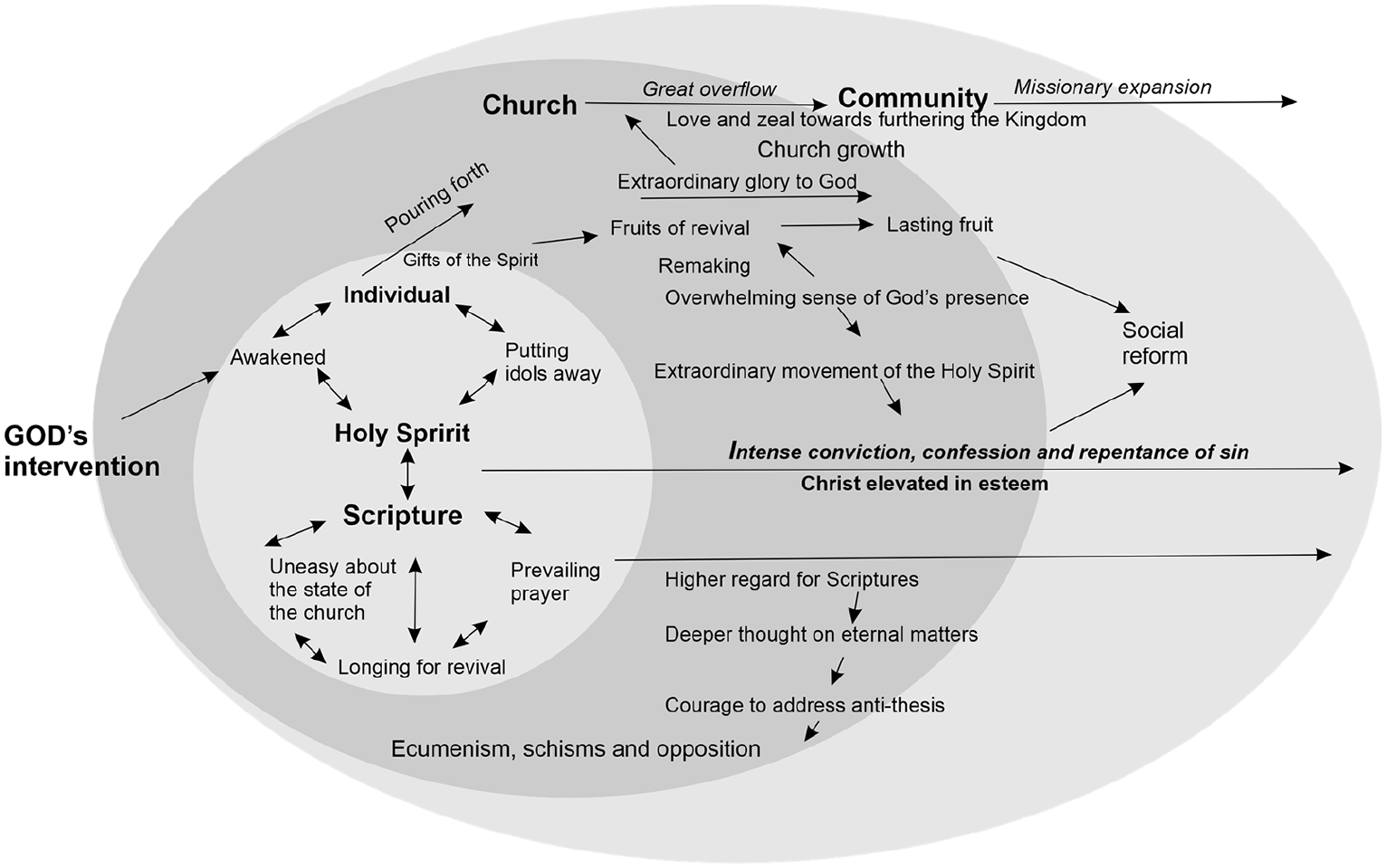
Dynamics within the revival among the Zulus leading to transformation (Fleischmann, 2021).
Figure 1, a compilation by the authors, presents revival dynamics covering the transformation of the individual, church and community, starting with the sovereign act of God’s intervention, awakening an individual to fulfil God’s prerequisites for revival. The authors concede that it is impossible to capture the work of the Holy Spirit through a mere diagram. Rather, Figure 1 is an attempt to provide a PREC ‘fingerprint’ by juxtaposing the main components from a revival for comparative and evaluative purposes.
Conclusion
The aim of this article was to provide a Protestant revival evaluative criterion (PREC), based on descriptions from prominent scholars in the field. The authors of this article agree with the view that only God can judge the work of the Holy Spirit. Nevertheless, God also calls His flock to test and approve all things and assess events and incidents that, at face value, seem to be flowing from His work. To test the viability of the PREC, the revival among the Zulus was used as a case study. Application of the PREC indicated that the revival among the Zulus corresponds to a large extent to characteristics of other Protestant revivals. Finally, this article is also an invitation for further dialogue on the subject of revival by engaging the proposed PREC as an instrument.
Strengths and Limitations
The insider position of one of the authors provided a ‘thick description’ of insider information, which is essential to qualitative research. As this strength also may pose a limitation of subjectivity of this one author, this limitation was dealt with by incorporating more authors who have no connection with the Mission. Although time and resources limited the opportunity for further research, the amount of material collected led to data saturation.
Footnotes
Author Contributions
EM-L Fleischmann was the principal author of this article. N. Ferreira and F. Muller provided academic, theological and doctrinal guidance.
Declaration of Conflicting Interests
Though one of the authors is part of KwaSizabantu Mission ministries, the other authors have no financial or personal relationship(s) that may have inappropriately influenced them in writing this article and were, therefore, able to keep a check on competing interests.
Funding
The author(s) disclosed receipt of the following financial support for the research, authorship, and/or publication of this article: North-West University provided a merit PhD bursary for this study.
Disclaimer
The views expressed in this article are that of the authors and not an official position of any institution or its founder.
