




Abstract
Vision plays an important role in every individual’s life. Women with visual impairment face significant barriers in participating in academic, social, and community life and gather various experiences in their daily lives. This qualitative phenomenological study aimed to gain insights into the lived experiences of women with visual impairment and how they meet their everyday basic needs in the centre where they are accommodated. Employing a purposive sampling, nine women with visual impairment who are active members of the Ileni Mwiitaleleko Centre in the Oshikoto region of Namibia were recruited. Data were collected using individual interviews and focus group discussions with the help of interview guides. Data were analysed using the thematic approach. The study revealed that women with visual impairment encounter complex challenges to access and participate in family, social, and community events. Findings revealed complex challenges of accessing public services as participants have to hire someone to take them to various places; spending the social grant on water bills, electricity, and pond repair. They also experienced difficulties in maintaining steady love relationships and become highly vulnerable for neglect, abuse as well as discrimination. Currently, there is a lack of coordination among the three agencies and this has an implication for the inhabitants of the centre. The study recommends that both government and non-government agencies should continue providing support to the women with visual impairment in Ileni Mwiitaleleko Centre.
Keywords
Introduction
Globally, about 314 million are people with visual impairment. The International Eye Foundation, based in the United States of America, reports that there are currently 45 million of them are blind people in the world (Burton et al., 2021). Visual impairment refers to all degrees of vision loss, harm, injury, and low vision. It relates to a visual condition that limits an individual’s ability to successfully complete the activities of everyday life (Kachaka & Imasiku, 2012; Namibia Statistics Agency, 2003). It is commonly observed that people with visual impairment have limited opportunities for education and employment which keep them away from economic empowerment. It is equally important to understand that individual with visual impairment requires to use assistive devices as well as other supports such as sighted guide and guided dog. However, women with visual impairments are a neglected and frequently disregarded demographic. The study illuminates a population whose perspectives are often overlooked in academic research and government by emphasizing their personal experiences.
Lewallen and Courtright (2001) indicate that visual impairment is considered as a low incidence condition, the prevalence of individuals with visual impairment are high in Africa. Further, Lewallen and Courtright (2001) report that the major causes of blindness in Africa are cataracts, trachoma, and glaucoma which are in-fact curable. Furthermore, eye health services in rural areas are seriously compromised; which enhances the prevalence of individuals with visual impairment in rural regions in Sub-Sahara Africa. It is important to underscore that, some of the causes of blindness in low-income countries could be linked with socioeconomic conditions such as poverty, malnutrition, and limited access to health, lack of education, poor water, and sanitation services. In addition, social stigma, such as witchcraft, juju, and vudoism, disadvantage and exclude children with visual impairment (Haihambo & Lightfoot, 2010). Women who have visual impairments encounter unique obstacles that differ from those faced by other demographic groups. These barriers may encompass obstacles in obtaining public services, establishing connections, and engaging completely in community activities. Examining these difficulties yields significant observations for effectively meeting the distinct requirements of this demographic.
The Oshikoto region has the highest (30.9%) of females with blindness and visual impairment. Hence, the Government of Namibia enacted a National Policy on Disability (Government of Namibia, 1997), based on the principles of access, participation, equity, and democracy to create an inclusive society. Although the National Policy is advocating for access ad participation, individuals with visual impairments are still experiencing barriers in terms of accessing basic needs, love, and relationship and lack of full participation in various social activities.
Further, accessible public buildings, transport, and health facilities form social divisions and differences in Namibia. Therefore, the objectives of this study were to understand the lived experiences of women with visual impairments with the purpose of (a) identify how women with visual impairment (WVI) access public services and community engagements, (b) shed light on the provision of basic needs for WVI, (c) describe the romantic relationships, friendship initiation, love affairs and acceptance. This study was conducted at the Ileni Mwiitaleleko centre in the Oshikoto region in Northern Namibia to understand how it is being WVIs. Narratives relative to the basic needs of WVI community activity engagements, support and treatment accorded to WVI, friendship initiation, barriers to accessing public services, benefits of being in the centre, and determination/dedication of being WVI were considered in this study. Research conducted with marginalized populations can provide participants with a platform to express their experiences and advocate for change, therefore empowering them. Through prioritizing the perspectives of WVIs, the research enables them to express their requirements and difficulties, which may result in increased acknowledgement and assistance for their rights and welfare. Table 1 shows the population of WVI in Namibia.
Population of women with visual impairment.

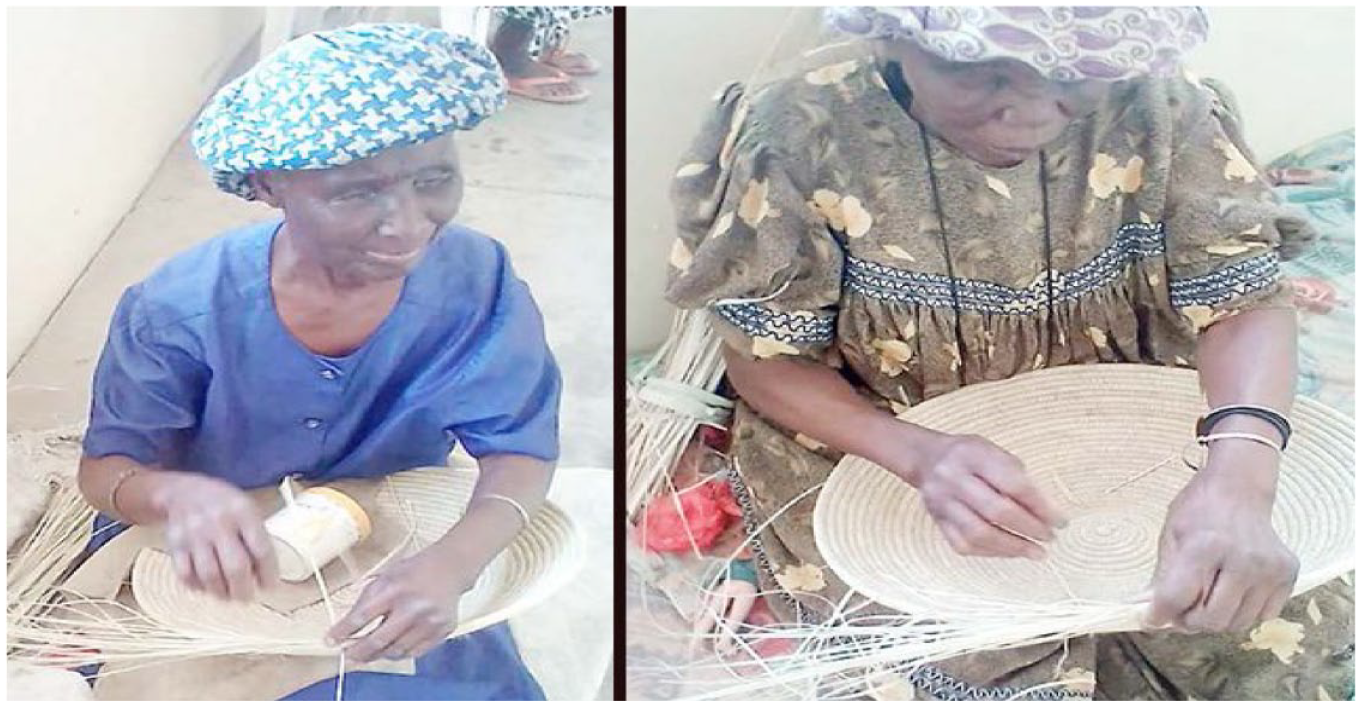
Although WVI did not go far in education, they received basic training in weaving baskets and floor carpets, as shown in the picture below.
Source: Namibian Newspaper, News–National | 2020-11-11Page no: 6.
Study setting
‘You Have No Face – So You Have No Eyes’: It is an English translation of an Oshivambo language idiom that means you have a visual impairment or you are blind. Oshikoto region of Namibia has been accommodating WVI in Ileni Mwiitaleleko Centre which was established in 1993. The Centre accommodates 22 residents; 4 males and 18 females. Nine are WVI, who took part in the study. The centre was developed to address the basic need of WVI together to train vocational skills on weaving and tailoring for adult independent living floor carpets, Braille and literacy classes. WVI in the centre were trained at Engela Parish and Nakayale rehabilitation centres. The establishment of the centre was the initiative of Tuuliki Nekundi to create employment for people with visual impairment under the leadership of Meekulu Hilma Amakali, who was still present on the date of data collection. In the beginning, this centre was operating under a tree and later moved into concrete buildings when was taken by the Ministry of Lands and Resettlements. Some WVI at a later stage joined the centre when they heard the call over the radio and received information from friends that they could go to and register at the centre so that they could use their God-given talents to earn an income and support themselves. The team started weaving baskets, crafting Hoe Handles and ‘Omihuya’ (a peel from the wood). The Ministry of Land and Resettlements helped to take their products to Trade Fairs country-wide for about 9 years. Later on, the Ministry of Land and Resettlement handover the centre to the Ministry of Health and Social Services. Nevertheless, the Local Government and Housing took over the centre from the MoHSS. Currently, the manager who is responsible for the centre does not know where they officially belong as nothing is coming forth from the Local Government and Housing Department.
People from various ministries and non-government organizations visit the centre in 2021, including the representative of Disability Affairs in the office of the president. According to the representative, WVI that are accommodated in the centre currently are not receiving proper support from the government agencies, apart from the Regional Councillor’s office which provides food, that is, maize meal and dry fish. Further, she added that the church helps them spiritually, however, they go to church services by themselves when it is needed. Although they do receive little assistance from good Samaritans who visit them, they are facing barriers in terms of water, electricity and sanitation. It was learned that the inhabitants are responsible for these services themselves. For example, they alluded to the monthly rates of $500 for water, $300 for electricity, $500 for sanitation and sometimes an extra $600 for those who clean the pond. The choice to conduct the study in the Ileni Mwiitaleleko Centre enables a comprehensive knowledge of the experiences of WVI within the specific Namibian setting. This focused methodology guarantees that the discoveries are pertinent and can be put into practice within the specific social, cultural, and economic context of the location. The study has the potential to influence policy development and advocacy activities by shedding light on the obstacles encountered by WVI. This can contribute to the improvement of support systems and the promotion of inclusivity. The research’s emphasis on this specific group contributes to wider endeavours aimed at promoting disability rights and fostering inclusivity.
Theoretical framework
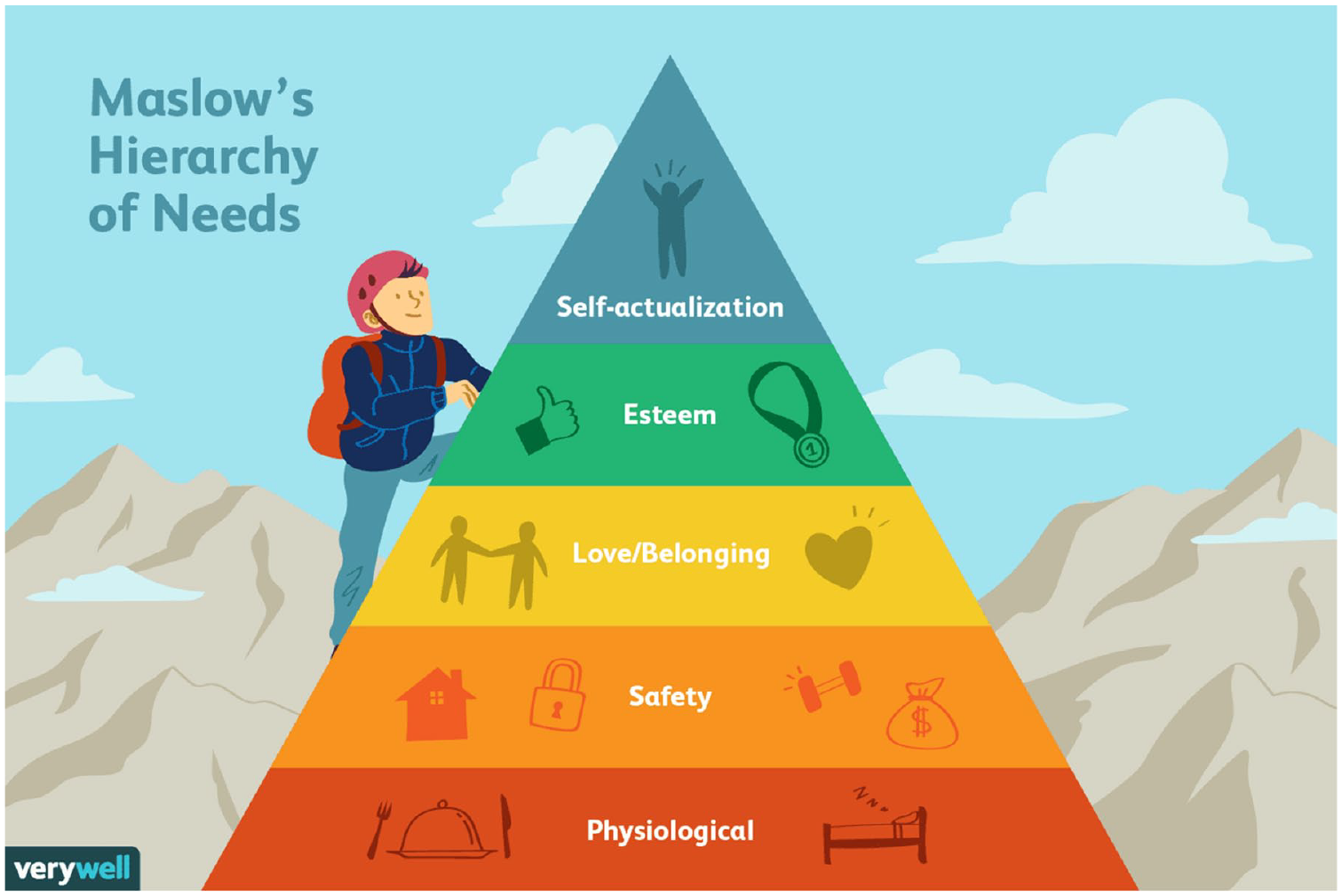
The study was underpinned by Maslow’s (1970) Hierarchy of Needs theory to understanding the lived experiences of WVI in rural Namibia. The theory believes that people are motivated by five basic categories of needs such as physiological, safety, love, esteem and self-actualization. This helped the researchers to understand how women with visual impairments find themselves in the centre (safety), the lived experiences of women with visual impairments, access to public services and community engagements, provision of basic needs, relationships, initiation of friendship and interactions with other community members, support and treatment accorded to woman with visual impairment in the centre, strengths, motivation and determination of being a woman with visual impairments in the society, and romantic relationships and acceptance. Directing attention towards women with visual impairments at the Ileni Mwiitaleleko Centre presents a distinct chance to tackle the specific obstacles encountered by this marginalized group, gain valuable understanding applicable to the local circumstances, and contribute to broader initiatives aimed at fostering inclusivity and empowerment.
The theory of Maslow (1970) on the psychology of motivation is grounded on a hierarchy of needs that ranges from the lower-level needs for survival to higher-level needs, with self-actualization at the apex of the need hierarchy (Naidoo & Jaggernath, 2012). Maslow emphasized that essential needs should be met first in order to develop the full human potential culminating with self-actualization. He referred to the lower needs as ‘deficiency’ needs and the higher-level needs as ‘being’ needs. When the higher-level needs are met then the individual becomes increasingly motivated. Applying Maslow’s theory to the plight of the WVI gives a clear insight into how essential needs such as food, clothing, shelter, safety, love and belonging can become an impediment to the realization of the covert potential within an individual (see Figure 1). If basic needs were met the WVI was considered and well cared for. However, over a period of time society has changed and this led to a change in family dynamics, society in general and subsequently the way needs are met. Thus, certain laws such as the Convention on Rights of People with a disability brought into being to protect the rights of WVI and develop an awareness of inclusive society across the globe. Hence, the use of Maslow’s theory in this study to understand the lived experiences of women with visual impairments accommodated in the Ileni Mwiitaleleko centre in the Oshikoto region of Namibia.
Maslow’s hierarchy of needs.
What previous research found on the experiences of those with sight loss in Africa
Prior study on the experiences of individuals with visual impairment in Africa has identified some significant themes and discoveries. Studies have extensively recorded the widespread occurrence of visual impairment and blindness in Africa, frequently linked to curable or avoidable factors such as cataracts, trachoma, and glaucoma (Lewallen & Courtright, 2001). These problems have a greater impact on those residing in rural areas who have restricted availability of eye care services. Furthermore, studies have demonstrated that individuals experiencing visual impairment encounter substantial obstacles when it comes to accessing educational and employment prospects in Africa. Their full participation in society and attainment of economic independence are impeded by the absence of inclusive educational policies, accessibility infrastructure, and job discrimination (Kachaka & Imasiku, 2012). Furthermore, research has emphasized the restricted availability of high-quality eye care services in numerous African nations, namely in rural and underserved regions
Prior study emphasizes the complex and diverse experiences of individuals with visual impairment in Africa, emphasizing the necessity of comprehensive approaches to tackle obstacles in education, work, health care, and social integration (Namibia Statistics Agency, 2003). These findings offer valuable insights for policymakers, health care professionals, and advocates who are dedicated to enhancing the quality of life for those with visual impairments throughout the continent.
Research methodology
The study applied a qualitative approach with interpretative phenomenological design. The purpose was to gain insights into the lived experiences of women with visual impairment and how they meet their everyday basic needs in the centre where they are accommodated (Smith et al., 2009). A phenomenological design was deemed suitable for understanding participants’ feelings about being a woman with visual impairment in the Ileni Mwiitaleleko centre in the Oshikoto region of Namibia. Interpretative phenomenological analysis (IPA) places focus on comprehending events within their respective social and cultural settings. The Ileni Mwiitaleleko Centre has participants from various backgrounds and social dynamics. By using IPA, researchers can examine how cultural influences, societal norms, and institutional structures influence the experiences of women with visual impairments. The approach used is distinguished by its participant-centred approach, which places emphasis on the viewpoints and voices of the individuals under investigation. This study aims to empower women with visual impairments by providing them with a platform to express their personal experiences and difficulties in their own words. An administrative officer, who had substantial knowledge of adults with visual impairment in the Oshikoto region and worked in the visual impairment section at Oniipa Rehabilitation Centre, referred the researchers to the Ileni Mwiitaleleko centre. The centre had 22 inhabitants all together. Since the study was qualitative, purposive and snowball sampling techniques were employed to select nine participants based on the criteria that they were accommodated in Ileni Mwiitaleleko Centre in the Oshikoto region of Namibia for three consecutive years or more; had visual impairment/ blindness either from birth or from early childhood, and did not have any other types of impairment. Nine children and four males were not part of the study.
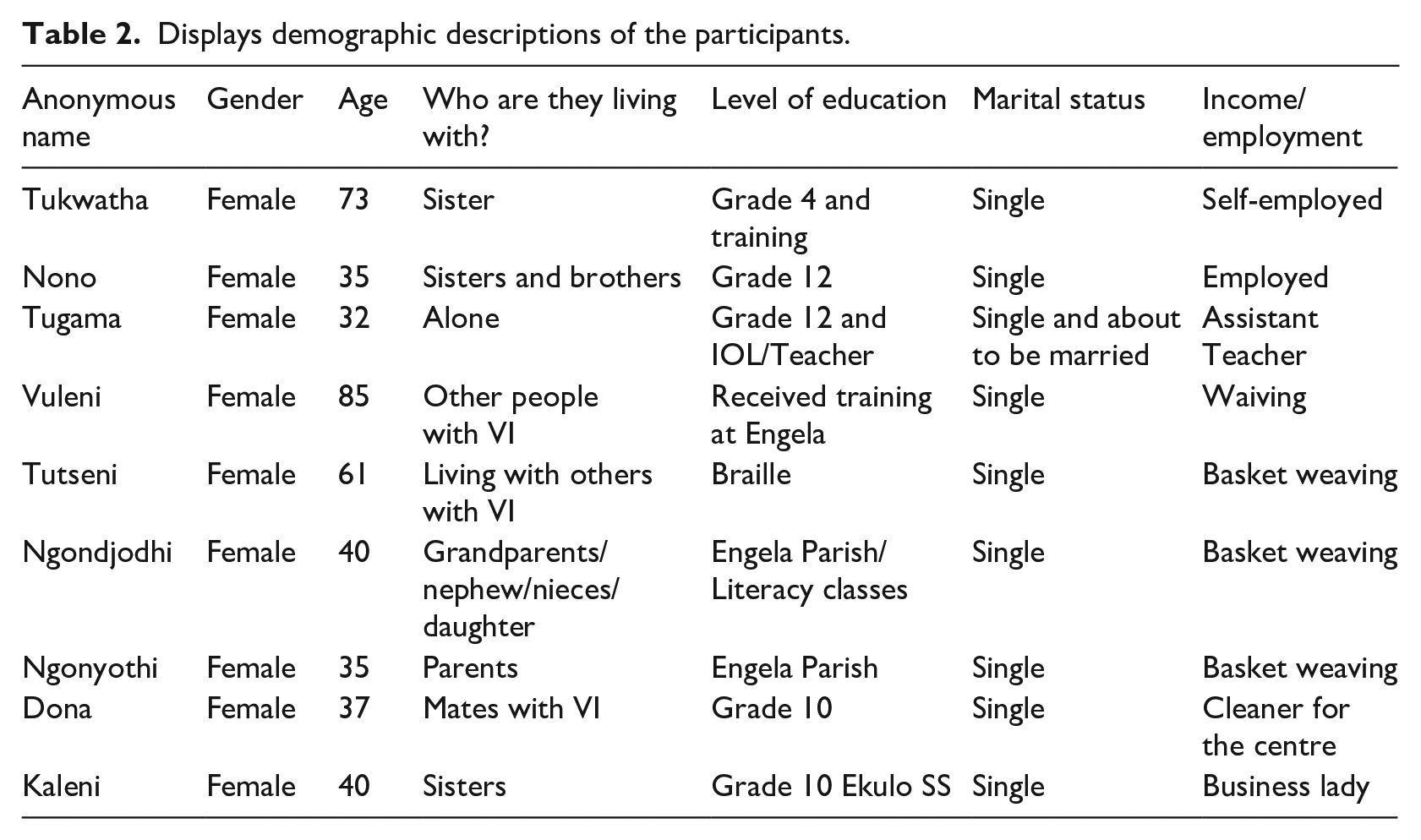
Nine children and four males did not take part in the study. With regards to education levels, Tukwatha completed Grade 4 and training in weaving baskets. She is single and self-employed. Dona and Kaleni are single and completed Grade 10. Dona is a cleaner at the centre while Kaleni is an entrepreneur who sells various health-related products and at the same time attends braille classes in the centre. Nono and Tugama are both single and assistant teachers. Though they have gone up to Grade 12, the points obtained do not meet the higher institutions’ requirements. Ngondjodhi, Ngonyothi, Vuleni and Tutseni do not have education qualifications; however, they received training in basket weaving, literacy and braille reading. All the nine participants are single, nonetheless, one was about to get married at the time of the visit. Further, their ages ranged from 32-85, self-employed and depend on family and community members. Table 2 below displays the anonymous names, gender, age, whom are they living with, level of education, marital status and income/employment status.
Displays demographic descriptions of the participants.
One-on-one semi-structured interviews and focus group discussions were used to elicit in-depth information from the participants. Thus, open-ended questions allowed participants to be frank and share independent thoughts and experiences, which may not be possible in a focus group setting (Harrell & Bradley, 2009). Throughout the process of interviews, probes and follow-up questions were used for elaboration and clarifying participants’ responses. The interviews were conducted in the Oshindonga language and later translated into English by the first and third authors. The interviews were conducted over 3 weeks, from 11 April to 18 April 2023. Interviews took place in the visitor’s office in the centre where participants reside and lasted for approximately an hour each.
Permission letters from the ELCIN Centre administrator and the head of the Ileni Mwiitaleleko Centre were obtained before the study was conducted. The first and third authors contacted the head of the centre telephonically, made appointments to meet participants and explained the nature and purpose of the study. The participants indicated that they understood the purpose of the study and gave personal permission (consent) to take part in the study. Participants were reassured of their rights to withdraw at any time if they wished to do so. They were further assured that data would be handled with anonymity and confidentiality. This process preserves the rights of participants and helps researchers build positive relationships with participants (Chilisa, 2011).
Data were transcribed and translated into English for presentation and analysis. To preserve the confidentiality of the participants, pseudonyms names were used.
Data analysis
Data were analysed following open coding and thematic analysis (Creswell, 2012). The transcribed scripts were grouped on the hermeneutic units of qualitative data analysis. This helped the researchers to organize and facilitate the data in a systematic analysis. First, the transcripts were read repeatedly to gain a holistic view of the experiences of the participants and meaningful segments in the text were labelled with a free code. Meaningful segments were parts of the text such as quotations. In this study, the use of IPA is in line with the goal of examining the personal experiences of women with visual impairments at the Ileni Mwiitaleleko Centre. IPA provides a strong methodological framework for comprehensively capturing the intricate and diverse nature of their subjective experiences. IPA further enabled in-depth descriptive analysis, which is crucial for producing comprehensive descriptions of participants’ experiences. By employing a methodical approach of coding, thematic analysis, and interpretation, researchers enabled reveal latent patterns and significance in the narratives of participants, so gaining a nuanced comprehension of their experiences. The codes were organized into related areas to develop preliminary themes. The researchers analytically reviewed these preliminary themes through a process of abstraction. Second, these preliminary themes were clustered into potential ‘families’ or categories. Third, the categorized data were interrogated, and meaningful patterns were deduced to describe the main elements of participants’ experiences. Fourth, for the ‘interpretive and explanatory level’, the text was then further reviewed and comparative analysis was performed to examine how the categories were interconnected across the dataset, which helped the authors to revise the preliminary themes. Finally, the data were further clustered into thematic categories. To ensure the trustworthiness of the findings, the third and fourth parts of the analysis were discussed between the authors until the final set of categories and the predominant themes accurately representing the interviews were established.
Results of the study
Based on the data analysis, the themes emerged are presented below.
Theme 1. Experiences of learning about sight loss
Visual impairment is the loss of sight. During the interview, women with visual impairment were asked to share information on how and when they acquired the visual impairment, how did they learn that they have VI, and the causes VI. The findings of the study indicate that 89% of participants are blind and 11% are partially sighted. According to the participants; four acquired visual impairment at the age of 2., one at the age of 5, one at the age of 9; one at the age of 10 while one was born blind and only noticed by the age of 8. Concerning the causes of impairment, it was narrated that 67% were struck by Measles, 11% Polio and 11% Chicken Pox, while 11% indicated that she was born blind. One of the examples is Ngondjodhi who said: I got sick with Measles when I was 9 years old. I was not taken to the hospital on time. You know. . . I grew up in Angola with my grandmother, so I was not helped on time”. In addition, participants learned about their visual impairment from their parents and grandmothers. From the analysis of data, it was noticed that some parents noticed that their children could not see. However, parents had a fear of informing them that they had a visual impairment. It became easy for parents to inform them when the children themselves started bumping into various objects and could not reach the places where they were sent. Ngonyothi remarked that: Aaam. . .when I was growing up. . .I experienced a problem of bumping into objects. Grandmother started training me on how to dress, bathe, and cook and told me that I do not have a face, which was difficult for me to understand because she was using an Oshiwambo idiom. . . meaning that I have no eyes to see. . . then she registered me at Eluwa special school in Ongwediva.
On a similar note, Kaleni echoed the same sentiment: My grandmother noticed that I could not see. One day she sent me to collect a bottle of ‘ marula oil (Odjove)’ the traditional cooking oil from the hut and followed me. . .mhm. . .she found me standing in the hut next to the cooking oil bottle that I was sent to collect, she asked me if I found the bottle, and I replied that I did not, then she explained to me that I have no face . . .I have no eyes. . .meaning that I do not see. From that day she informed family members that I could not see, and I was not pretending.
In addition, Dona alluded that: ‘I started rubbing the eye, which started becoming loose in the circuit. . .I was taken to the hospital and the Doctor did the operation/ removed the eye’.
Participants have narrated their experiences of how they arrived in the centre where they are accommodated to date. They have reported that some heard the information from others with visual impairments, some were informed by their friends, while some were invited to a workshop where the information about Ileni Mwiitaleleko Centre was deliberated on and some have heard about the centre through the radio. An 85-year-old Vuleni, stated: We were accommodated at Engela School and started weaving baskets and then we were relocated to Nakayale Centre in 1995. We received training in making and designing scarves and jerseys. While at Nakayale, a friend of mine informed me that there were opportunities at the newly established centre in the Oniipa area, in the Oshikoto region. I wrote an application letter to the management of Ileni Mwiitaleleko Centre (IMC), with the assistance of a sighted friend and I was accepted and joined the others in the centre. We were informed from the beginning that we had to spend two months in the centre and two months at home since we were many, we were giving each other a change. Currently, there are few WVI in the centre because some have passed on while some left due to illness and old age.
Ngondjodhi, a 40-year-old participant, explained that: I first came to attend the Braille workshop at ELCIN rehabilitation centre where I was informed about Ileni Mwiitaleleko Centre, I applied for admission and to attend literacy classes on Braille lessons”. In addition, Nono, 35-year-old, narrated that: “Mhhh. . .I came at the centre as a Literacy Promoter. . .teaching my housemates Braille reading and writing as well as Basic English”. On a different note, Dona, 37 years old, alluded that: “I joined the centre in 2020 since I wa
Theme 2. Positive interactions with others
The analysis of interviews revealed that women with visual impairments living in Ileni Mwiitaleleko centre experienced good relationships with their mates, at home as well as in their neighbourhood. Participants further acknowledged positive interactions with individuals without impairments in their communities which led to effortlessly initiating friendships. In addition, participants clarified that they easily associate with any person, being at the hospital and any public places. Vuleni, 85 years old articulates that: ‘The interactions with people in the community is good, excellent. . .as they do come and visit us. In most cases they drop us at certain places, inform us to call them when we are done, and bring us back home, really. . .they are good Samaritans. Tugama, 32 years old said: “When you are a friendly person, you attract many friends which I believe encourage them to help you”. I can easily initiate a friendship with anyone. I always got help when I go to the hospital, pharmacy, and taxi rank. People are good, they really help me out’. On the contrary, Ngondjodhi, 40 years old differs: ‘I keep quiet, wait for one to start talking to me. . .I do not initiate talking’. In support of Ngondjodhi, Ngonyothi, 35 years old affirms: ‘I do not initiate a conversation, but if someone starts talking to me, we can go ahead with the discussions; but the truth is. . .I really have difficulties in initiating discussions’.
Based on the relationship between the WVI and people in their community, it was found that there is a good relationship with people who are always willing to help; most of the time it all depends on how you approach them. As can be shown from the following participants’ sentiments: Tugama, 32 years old advocates: ‘Our relationship with the community is good, there are people who can call you themselves and help you when you are going in the wrong direction. I do call people to help me and they are always willing to assist’. Kaleni, 40 years old said: ‘People here show good interactions and friendship, some of them do come and bring their children to me for supervision while they go running various errands. I take the elder mates to the post office’. Ngonyothi, 35 years old expounded: ‘One cannot trust anyone. . .I do not walk freely in the community to meet people, but once they come to the centre, we are fine and interact easily’.
The findings of this study discovered the support that WVIs need to be accorded to them in and out of the centre. They pointed out specific needs such as personal guides to take them to the hospital and at other places, financial support, winter and summer clothes, blankets, food, shoes, palm leaves, white canes and anything that saw as valuable to them. Tukwatha, 73 years old felt that it was important for the government to meet them halfway in paying their monthly water bill. She said: ‘We need support in terms of paying our water bills. . .as we use up the money that we get from selling our basket that we weave to repair toilets and pay electricity. . .this is a big challenge to us’. Tallying with Tukwatha, 73 years old Vuleni, 85 uttered the following: We need White Canes. . .Mhh. . .I or let me say. . .we need a place to stay either at home or in the town; to have a place of our own. . .majority of the people with visual impairments are suffering. Especially when our parents passed on. . .we are left on the air, those who are schooling, are likely to drop out of school if they do not have great support. They end up in the unacceptable street. We also need to support our children. Dona, 47 years old, suggests that they need to build up their knowledge and skills to be able to survive academically and emotionally, therefore she said: ‘We need workshops, training and counsellors to come and talk to us to build our self-esteem’.
Theme 3. Barriers to accessing services within society
Results from the participants revealed that women with visual impairment face difficulties in accessing public services. They can access such facilities with the help of sighted counterparts while on some occasions, they found it difficult to access public services. Further, the matter of accessing public services was a big challenge and concern since WI had to hire someone to take them to the shops, post office and everywhere they needed to go. Sometimes this is the only person in the centre who volunteered to assist them. It is also noted that the community do not realize individuals with visual impairment that led them to stand in queue for a long period of time. Examples are such that of: Tutseni, a 61-year-old alluded that ‘mobility is a challenge. . .mhm. . . currently we have someone who volunteered to take us to shops, bank and post office, unfortunately, we don’t go to the same place at a time, which causes a delay and unable to accomplish what one was expected to’. ‘Some of us are here because there is no one to take care of us at home; no one to take you to a certain place. We are better to be here, but the road is too sandy and not safe because I can’t go alone to church because of too many cars using the same road [Vuleni, 85 years]’.
The analysis of the data showed that 56% of participants participated in community activities while 44% of participants were not involved in any community activity. Participants were involved in activities such as the organization for Persons with Disability, ‘omwiidhiliki’ Congregation choir, Bible study and Women’s group. Examples are such that of:
Ngonyothi, 35 years old indicated that ‘I do participate in a choir, and attend meetings related to disabilities’. In addition, Dona, 37 year-old pointed out the following: ‘I am a part-time teacher of Sunday school in the centre; I take WVI to any place they want to go or I do the shopping for them’. Further, Kaleni, a 40 year-old, who comes to the centre to learn braille expressed that: ‘I am learning braille and at the same time selling my products in the community. . .and. . .I have a leadership position in the community as a chairperson of women with a disability organisation in Oshikoto and Ohangwena regions’. On a different note, Nono, Tukwatha, Tutseni and Ngondjodhi indicated that they were not involved in any community activity, apart from attending the Christmas party that was organized by the Oniipa ELCIN church in 2015.
The study established that all the participants received Social Grants from the Government of the Republic of Namibia (GRN), maize meals from the office of the Regional Councillor of Oniipa Constituency, money, clothes and food from families and community members. On a positive note, the results show that WVI at IMC is provided with basic needs. This is seen in the following participants’ excerpts: Nono, a 35-year-old, said: ‘We are weaving baskets. . .and also receiving the Social Grant from the GRN, and sometimes . . . maize meal from the office of the Regional Councillor of Oniipa Constituency’. In agreement with Nono, Vuleni has shown appreciation to the GRN and family members: ‘I do receive Social Grant from my Government, money, clothes and food from my siblings, my sister’s children, and grandchildren’. In the same sentiment, Tutseni 61 years old remarked: ‘I get Social Grant, food from home. . .mhhm. . .I do get food by myself. . .aaa. . .in fact my family do care about me’.
Theme 4. Resilience
WVI believe that one needs to be determined, strong, focused, intrinsic, and extrinsically motivated so that one can achieve what anyone else has achieved in life. Participants explained that when they were growing up, they did not know if there were children who were blind like them. They came to realize that there were other children with visual impairment when they started schooling at Eluwa special school. This motivated and encouraged them to do what others are doing.
Kaleni, 40, states that: ‘Oh. . .me I see a bit during the day. . .but dark at night. In the past. . .I used to cry a lot. But, when I joined the organisation. . .I mean this project, I feel more motivated to see others who are blind, weaving and doing other chores’. In addition, Nono 35 years old narrated the following: ‘I feel strongly motivated that I can read My Bible by myself. I always listen to the radio when they interview motivational speakers and some have impairment. . .God sees his creation is all good’.
Tugama 32 years old said: ‘When you are motivated and determined, you won’t suffer, you will be able to stand on your own. I stayed with my grandmother and whatever she was doing to me, I thought she was mistreating me. My sister made me sow in the field, and I so wanted to hurt myself even by bumping in a stone. . .but now I am free and independent’.
Ngonyothi, 35 years old, ‘I like standing up for myself. I am so motivated, in the radio; there are people who motivate others to live a happy life’. Dona, 37, ‘I always try to lift myself. . .I don’t see as I have a problem with my vision’. Kaleni 40, ‘I have a higher self-esteem, and I am proud of myself, regardless of the condition that I have. I tried, by all means, to have a voice in any question/ barriers that come towards me’. Vuleni, 85 years old stated that: ‘I don’t have someone to marry me. . .so I don’t want to commit adultery’.
The participants thoroughly uttered what motivated them to stand firm and courageous in life. They believe that in life challenges do come but do not last. Participants also feel that since they are God-fearing, Christianity and their faith have strengthened them. WVI indicate that children and youth with visual impairment who are in school, need to be trained to work hard for them to survive in life.
For example, 73 years old Tukwatha said: “I motivate myself . . .life is full of ups and downs. . .challenges and those challenges do come and go. . . If I have a problem today, it will not last, it is not permanent. . .therefore, I relate myself to others and I feel empowered.
In the same vein, Dona, 47 years old had this to say: “I never look back concerning what has happened in the past. I do concentrate on what is in my future. . .I strongly believe that being motivated is the key to anything I do in life”. Further, Tutseni 61 years old, expresses her appreciation: “I thank God I know to do many things on my own “okuyela” . . . wheating millet to separate mahangu from the chaff and “okutenda” cracking the marula fruit to remove nuts). Participants understand that love is a need and every individual should be given love and attention so that they grow well. The participants described the love affairs that they experienced with their partners as unconditional. It was learned from the findings that WVI experienced difficulties in maintaining steady love relationships. In explaining having love affairs, participants overwhelmingly mentioned practical concerns in having relationships. They revealed that men do come and propose them, some do take them while some do not take them. Nono, 35; ‘. . .men do come in my life, they have a choice to make. I have two children, a boy and a girl. The father of my children has a visual impairment like me. He supports his children with social grant money. It is fine with me. He comes and takes the children and spends a holiday together’.
Dona explained that: Men with and without visual impairment. . .somehow do propose me/us/you. . .aah! you accept and later you are dumped. We need love and attention. . .whenever they impregnate you. . .that is the end. . .you won’t see him again. In addition, Tugama, 32 years old expressed with excitement that: ‘very well. . .even my fiancée has accepted me with my VI, even my in-laws accepted me, we are going to get married soon. . ’. Ngonyothi, 35 years old expressed that: ‘Yes, I have one. . .mhhmmmm’. Nono, 35 years old also stated that: ‘Yes, I have one . . . he has no visual problem’.
Some of the participants felt that it was complicated to have love affairs with people without visual impairment. For example, Tukwatha 73 years old emotionally pointed out: ‘This is complicated, some are afraid of dating us really’. In the same vein, Vuleni, 85 said: ‘Ooooh! not good. They come and propose but I do not take them. I was discouraged when a friend of mine impregnated and mistreated by the boyfriend and his family and children were later taken away from her’.
On a sad note, Ngondjodhi, 40 years old indicated that she had a love partner, but unfortunately, he passed on. “Yes, I had one. . .but he is no more. We have two daughters. One is in grade 11 and the other one is in grade 10. Kaleni,40 years old concluded by saying “To tell you the truth, spiritually, we are very strong and I did not bother. . .so I don’t want to be spoiled by those who see, they don’t want to marry us. . .they just want to use us. . .spoil our future. . . Aaah. . .noo. . . “.
Discussion
The process of acquiring visual impairment and the experience of attending the IMC exemplify the difficulties encountered by women who have visual impairments. A significant number of individuals developed their disability during childhood because of diseases like measles, polio, or congenital disorders. The early manifestation of cognitive decline frequently resulted in a delay in the awareness and acceptance of the condition by their families. This is evident from the emotional stories of how families gradually became aware of and adjusted to the situation.
WVI can generate income through weaving baskets and floor carpets. Having these skills helped WVI to live independent lives and sustain themselves. While it was important to have appropriate accommodation for WVI, the study revealed that WVI experience barriers to basic needs in the centre where they are accommodated. For instance, a lack of support to pay water bills, electricity, and other necessities might compromise their well-being. Nevertheless, Maslow (1970) suggests that human beings have all their basic needs met first for them to grow in totality and reach a self-actualization state. Interestingly, despite these hardships, WVIs survived and turned into a resilient group and developed skills and learned to manage family affairs and contribute economically. This study identified that basket weaving was the main economic activity of the affected women in the centre. However, these natural management skills of WVI are often neglected as society does not show interest in buying their products. The results highlight the substantial obstacles that WVIs face while trying to access public services and engage in community activities. Their concerns are exacerbated by difficulties in mobility, a lack of help, and negative public judgements. Maslow’s paradigm emphasizes the significance of safety and belongingness requirements, which are impeded by restricted availability of vital services and social connections.
Accessing public places has to be a priority for all citizens. But then WVI access public services with difficulties if not assisted by a sighted person. It was found that on some occasions WVI were not able to reach the intended places independently. It is also noted that the community do not recognize women with visual impairment and that led WVI to stand in queues for a long time which further caused a delay and unable to accomplish the planned task that one was expected to. In addition, the study revealed that women with visual impairment joined the centre since there was no one to take care of them at home or to take them to certain places. Unfortunately, the issue of busy, sandy, unsafe, and rough road limits their mobility to navigate the environment. Hence, this made participants have limited opportunities for social interaction and community participation. Although participants do receive assistance in the form of social subsidies and basic requirements, there are still challenges in obtaining crucial services and resources. The study uncovers the challenges faced by women with visual impairments in achieving financial security and highlights the necessity of extensive support systems to cater to their diverse demands.
It was discovered that WVI experienced a good relationship with family, friends, mates, and other community members. The findings indicated that some WVI easily associates with any person, being at the hospital or any public place, while some find it difficult to initiate discussions. Cherry (2021) suggests that to avoid problems such as loneliness, depression, and anxiety, it is critical for people to feel loved and accepted by others. Hence, personal relationships with friends, family, and lovers play an important role as does involvement in other groups that might include religious groups, sports teams, book clubs, and other group activities. Notwithstanding the difficulties, members demonstrate resilience and engage in beneficial social connections within their communities. Nevertheless, there are subtle distinctions in their encounters, as several individuals discover it more effortless to establish friendships compared to others. The importance of interpersonal interactions in promoting well-being and social integration is highlighted by Maslow’ focus on belongingness and love needs.
It is critical to note that one needs to be strong-minded, determined, focused, and intrinsic and extrinsic motivated to achieve anything in life. The study participants clarified that one would not know and understand the condition until one encounters a similar situation. Once you meet someone with the same condition as yours, you would be motivated to learn and encourage to do what others are doing. In other words, when you are motivated and determined, you would not suffer as you would be able to stand on your own. Participants exhibit exceptional fortitude and will in overcoming the difficulties associated with visual impairments. Their stories demonstrate a powerful sense of control and internal drive to overcome challenges and pursue their goals. Relatedly, Maslow’s notion of self-actualization is relevant, highlighting the need to strive for personal development and satisfaction in the face of challenges.
Further, it is always important to lift yourself up, forget that you have vision problems, maintain high self-esteem, and feel proud of yourself, regardless of any condition that you might have. Maslow (1970) emphasized that self-esteem involves feeling self-confident and feeling good about oneself and valued by others. Further, when people’s esteem needs are met, they feel confident and see their contributions and achievements as valuable and important. However, Adler (2013) explains that when individuals’ esteem needs are not met, they may experience feelings of inferiority.
Conclusion and limitation(s)
The study explored the experiences of women with visual impairment in IMC in Oshikoto region. Nine participants took part in the study. It is revealed from the data that WVI experienced complex barriers in their real daily lives. Their basic needs were not sufficiently met as per Maslow hierarchy of needs. For instance, they had no enough food, the shelter and the environment where they live is not conducive as the initial plan was for them to be accommodated and supported with all necessities by the Ministry of Land, Resettlement and Rehabilitation. The study discovered that participants also experienced difficulties in maintaining steady love relationships and became highly vulnerable for neglect, abuse as well as discrimination. This study used a qualitative approach with a small sample from one community setting; therefore, the findings of this study cannot be generalized to WVI from other communities, but the information can be useful to anyone experiencing barriers in life. The study concludes that the results are consistent with Maslow’s theory, demonstrating how WVIs managed several levels of requirements, ranging from basic physiological demands to self-actualization. However, there is a slightly difference between the results of this study and what Maslow hierarchy emphasized of initially meeting all the basic needs. The difficulties they encounter in obtaining essential services and establishing personal connections highlight the significance of addressing their safety, sense of belonging, and self-esteem requirements to promote their overall welfare and integration into society. To promote the empowerment and fulfilment of women with visual impairments, policymakers and stakeholders should acknowledge and tackle these demands, hence fostering the creation of inclusive environments. The study recommends that both government and non-government agencies should continue providing support to women with visual impairment in IMC.
