




Abstract
Students with disabilities face myriad barriers and hurdles to success in higher education settings. Institutions in developing nations often lack the necessary resources to provide accessible instruction, and the absence of clearly defined policies further impedes upholding the educational rights of such a special population. The purpose of this study was to examine how undergraduate students with visual impairments in Bangladesh felt about their experiences related to social justice and challenges in learning during the COVID-19 pandemic. A convenience sample of 133 students was recruited from two public universities. The authors developed two instruments, namely, the Social Justice Experiences in Higher Education Scale and the Social Justice Challenges in Higher Education Scale, to measure how the participants felt. The results showed that most of the participants experienced some sort of difficulty in receiving social justice in higher education. However, the differences in the group mean score on social justice experiences and challenges in higher education were not statistically significant between the male and female participants of this study. The outcomes of the study and their implications for rehabilitation research and practice have also been addressed in this paper.
Sight plays a crucial role in our existence, impacting the way we acquire knowledge, communicate, perform tasks, engage in leisure activities, and connect with the environment. Conditions like cataracts, diabetic retinopathy, glaucoma, strabismus, amblyopia, and refractive errors can cause vision loss or visual impairment (Centers for Disease Control and Prevention, 2015). Visual impairment is defined as a visual loss of any degree that negatively affects normal daily activities due to partial or total dysfunction of an individual’s visual system. The extent of vision impairment is most often defined by visual acuity. Visual acuity measures the spatial resolving power of the visual system (Glatz et al., 2022).
The World Health Organization (WHO) (2021) estimates that around 2.2 billion individuals worldwide are currently living with either near or distant visual impairments, with unaddressed refractive errors and cataracts being the leading causes of moderate to severe distance vision impairment or blindness (GBD, 2019). Although most individuals with vision impairment and blindness are over 50 years old, it is important to note that this condition can affect people of all ages. School-aged children, adolescents, and young adults who have vision impairments may experience lower levels of academic performance (Huurre & Aro, 2000; Pinquart & Pfeiffer, 2011), while adults with vision loss may face reduced workforce participation and productivity and higher rates of depression and anxiety (Papadopoulos et al., 2014; Zhang et al., 2013). Therefore, vision impairment can significantly impact the quality of life for people of all ages. This is especially true for individuals living in countries with unstable economies.
Bangladesh is one of the most densely populated countries in the world, with an estimated 171 million people in 2021. Poverty is widespread, but Bangladesh has, in recent years, reduced population growth and improved the health and education systems (BBC, 2023; The World Bank, 2022). In developing countries such as Bangladesh, the impact of vision impairment on student access to education is substantial (Meleo-Erwin et al., 2021). Although some argue that Bangladesh has introduced several policies and legislation regarding the education of children with disabilities (Ahsan & Burnip, 2007; Ahsan & Mullick, 2013), they do not seem to have had a positive effect because only 4% of Bangladeshi school-going-age children with disabilities attend school (Disability Rights Watch Group Bangladesh, 2009, p. 4). In addition, these laws fail to address the requirements of higher education for students with disabilities (SWD) in Bangladesh, particularly those with visual impairments.
Conceptual framework
Equity in education
All people have the right to non-discrimination and equality in education. However, despite the legal right to accommodations, SWDs across the world continue to face barriers in higher education (Hong, 2015; Konur, 2006; Meleo-Erwin et al., 2021). Over the past few decades, various international declarations have been made to promote education for all. These declarations aim to eliminate inequalities in both society and education systems. In 2015, the United Nations Educational, Scientific and Cultural Organizations (UNESCO) released a strategic plan titled “2030 Inclusive Education for All Sustainable Development Goal 4 (SDG-4)” (https://www.unesco.org/en/right-education/vulnerable-groups). This plan aims to reduce educational disparities and enhance global access to education. One of the seven education-related principles is Principle 4.5, which aims to eliminate gender disparities in education and provide equal access to all levels of education and vocational training by 2030. This principle prioritizes the education of vulnerable groups, including persons with disabilities, Indigenous peoples, and children in vulnerable situations.
Achievement of UNESCO’s Sustainable Development Goals (SDGs) of Quality Education (Goal 4) has been set back by the COVID-19 pandemic. The pandemic impacted educational systems worldwide, exacerbating existing inequalities in educational systems globally (Farhana et al., 2020; Simon et al., 2021). In Bangladesh, as in other developing nations, the shift to online classes for secondary education students was difficult, given the deficiencies in the digital infrastructure, and the access of universities to resources, funding, and technology (Cho & Kim, 2022; Khan et al., 2021).
Research has shown that there are possibilities for improvement in the perceptions of instructors and administrators toward the needs of SWDs. Furthermore, the COVID-19 pandemic turned a spotlight on broader social justice concerns that impact SWDs (Käll et al., 2020; National Association of Social Workers [NASW], 2020) including access to health care and assistance in daily living activities. Communication barriers have arisen, in addition to employment and mental health concerns for SWDs. These issues have been documented in various studies (e.g., Armitage & Nellums, 2020; Berian et al., 2018; Clements et al., 2022; Dianito et al., 2021; Santini et al., 2020; the American Psychological Association [APA]). In sum, the impact of COVID-19 on university SWDs is evident around the world. The pandemic increased this population’s already-existing vulnerability to social exclusion and injustice (Cho & Kim, 2022; Courtenay & Perera, 2020; Dianito et al., 2021). Consequently, this research aims to examine the social justice experiences and challenges of university students with visual impairments in Bangladesh during the COVID-19 pandemic.
Social justice
According to Chang et al. (2017) and Singh et al. (2020), the counseling profession has been influenced by five different theoretical paradigms, namely, the psychodynamic, existential-humanistic, cognitive behavioral, multicultural counseling, and social justice schools of thought. Many scholars have presented various viewpoints regarding matters of social justice. Our study concentrates on the issue of unfairness and unequal treatment of resources and human rights, specifically for marginalized individuals who lack equal power in society. Miller (1999) defines social justice as the fair distribution of advantages and disadvantages among members of society. The concept of social justice involves combining advocacy and empowerment with clinical practice in rehabilitation counseling (Blustein et al., 2001; Burnes & Manese, 2008). Both social justice and personal growth are essential for clients’ positive transformation. Higher education is widely acknowledged for its ability to enhance students’ future income potential, career progression, personal networks, and self-confidence. Kim et al. (2020) emphasize the importance of these factors in enhancing coping abilities and fostering personal growth, especially for those with disabilities.
Purpose of the study
Disability activists have long been fighting for social justice and advocating for the removal of barriers faced by individuals with disabilities. The objective of this study was to explore the experiences of visually impaired university students in Bangladesh regarding their social justice experiences in higher education amid the COVID-19 pandemic. The research questions were as follows:
Method
Participants
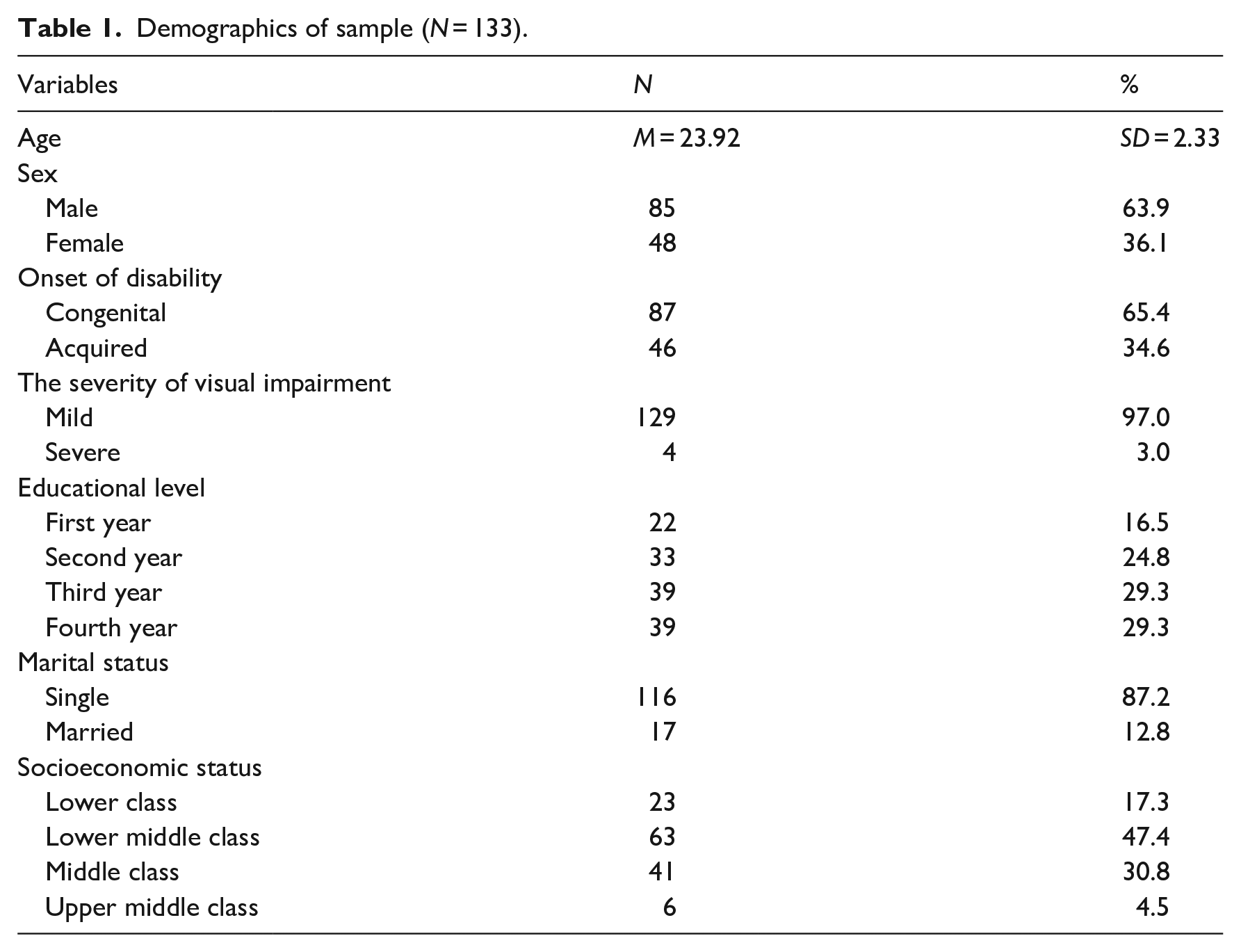
A total of 133 students with visual impairments were recruited from two public universities in Bangladesh. The criteria for taking part in the study include (a) current enrollment in a university and (b) a diagnosed visual impairment. The participants were predominantly males (n = 85, 63.9%) and unmarried (n = 116, 87.2%). The age of the sample ranged from 19 to 30 years (M = 23.92, SD = 2.33). In terms of class standing, third-year and fourth-year students made up the largest group, respectively (n = 39, 29.3%), followed by second-year students (n = 33, 24.8%), and first-year students (n = 22, 16.5%). Two-thirds of the participants had a congenital visual disability (n = 87, 65.4%), and the severity of the impairment for most was mild (n = 129, 97.0%). Concerning socioeconomic status, almost half of the participants (n = 63, 47.4%) came from the lower middle class. See Table 1 for their demographic information.
Demographics of sample (N = 133).
Instruments
We had to develop instruments for this study because no suitable scales were available to examine the unique needs of students with visual impairments in higher education in Bangladesh during a major public health crisis. Following an extensive literature review on higher education administration, disability, assistive technology, and social justice (e.g., Ahsan & Mullick, 2013; Cho & Kim, 2022; Dianito et al., 2021; Meleo-Erwin et al., 2021; Miller, 1999; Salimi et al., 2021), we compiled a preliminary list of statements. A panel of experts in Bangladesh and the United States, consisting of faculty members, disability specialists, and university students, reviewed the list and provided feedback for improvement. Changes were made to ensure the language was comprehensible and culturally appropriate. Based on this list of statements, we constructed two scales for this study for SWDs in higher education in Bangladesh: the Social Justice Experiences in Higher Education Scale (SJE) and the Social Justice Challenges in Higher Education Scale (SJC). After developing the items to measure the two constructs, we named the scales the SJE and SJC. Neither the SJE nor the SJC are existing instruments. The questionnaire included three sections: the SJE, the SJC, and a section on demographic information.
Social justice experiences
We used the SJE (Authors) to assess how students with visual impairments felt about the social justice they experienced at their institutions during the COVID-19 pandemic. The SJE comprised a broad spectrum of 10 items reflecting perceived discrimination and negligence, such as “I have experienced the lack of an educational assistive aid-related device.” and “I have experienced inequality in the educational environment.” Participants rated their level of agreement using a 5-point Likert-type scale: 1 = strongly disagree, 2 = disagree, 3 = neutral, 4 = agree, and 5 = strongly agree. Cronbach’s α internal consistency for this study was .75.
Social justice challenges
We used the four-item SJC (Authors) to assess how the education of students with visual impairments was impacted during the COVID-19 pandemic. The SJC measured the extent of the challenges the participants encountered. Participants responded using a 7-point Likert-type scale: 1 = Very untrue of me, 2 = Untrue of me, 3 = Untrue of me, 4 = Neutral, 5 = Somewhat true of me, 6 = True of me, and 7 = Very true of me.” Sample statements include “My education was challenged due to discriminatory exam system.” and “My education was challenged due to the unequal distribution of electronic resources.” Cronbach’s α internal consistency for this study was .74.
Demographic variables
The participants were asked to provide information about their age, sex, class standing, marital status, socioeconomic status, the onset of the disability, and the severity of the disability.
Procedure and analysis
Approval to conduct the survey was secured from the research ethics boards of the host universities. We used a multifaceted approach to recruiting prospective participants. To contact a targeted, specific disability population, snowball sampling and word-of-mouth communication were considered effective and appropriate (Creswell & Creswell, 2018; Lohr, 2022; Silverman, 2016; Suresh et al., 2011). In addition, the research team contacted individual instructors, requesting that they refer students who met the participation eligibility criteria. Appointments were scheduled to allow the participants to take the paper-and-pencil survey at a predetermined location on the campuses. To accommodate the needs of students with severe visual impairments, they read the questionnaire and had a research team member mark the responses for each item.
We developed an analytic plan to answer the four research questions. For RQ1 and RQ2, we used descriptive statistics (i.e., frequency, percentage, mean, and standard deviation) to summarize the participants’ responses by the item on the SJE and SJC scales. For RQ3 and RQ4, we performed a series of two independent-sample t-tests to determine whether there were differences in the social justice experiences and challenges between male and female students. The Bonferroni correction method was used to control type I error for the probability value (0.05/2 = 0.025). The correction was applied for each t-test conducted (Field, 2017).
Results
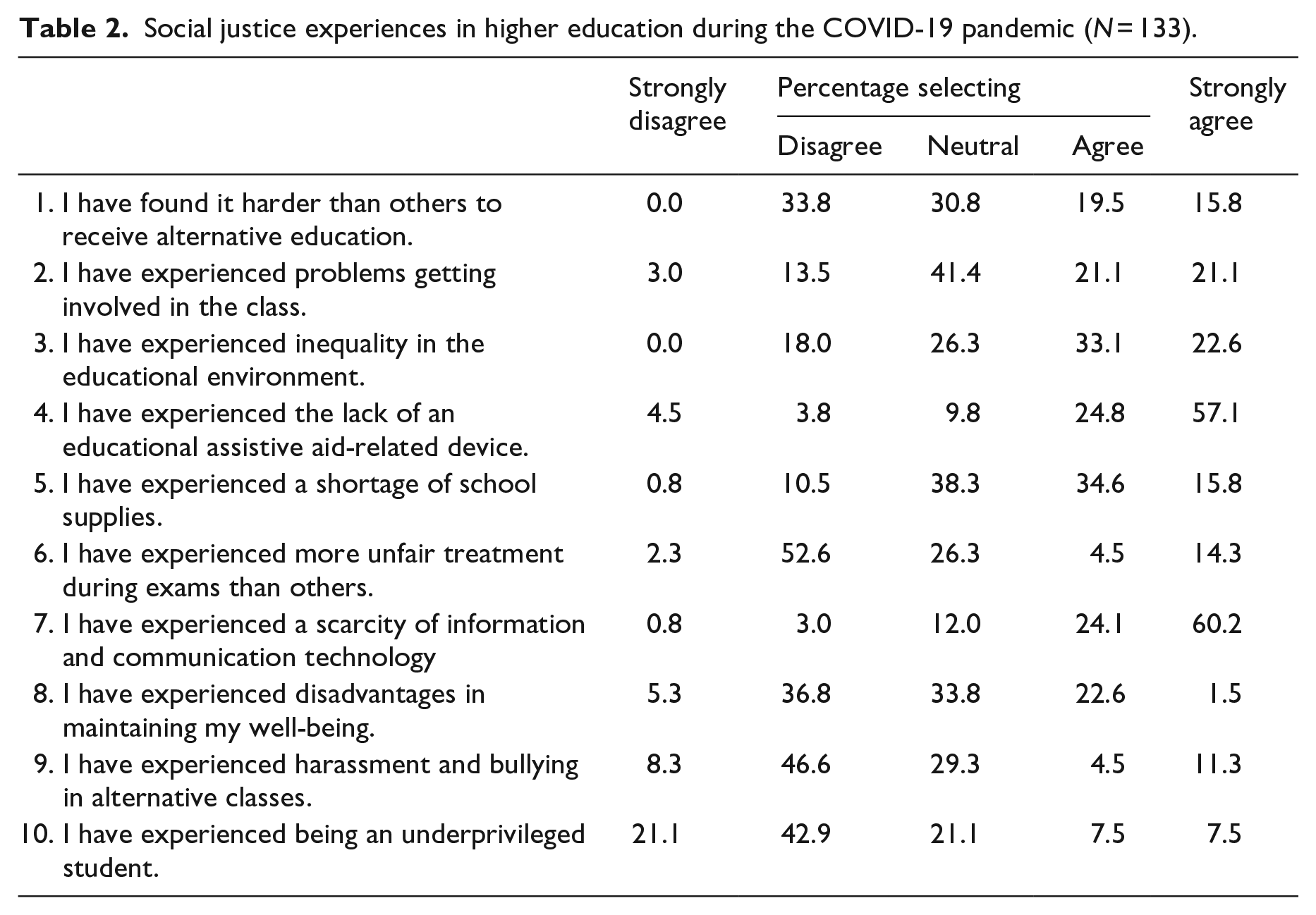
One of the research questions inquired about the social justice experiences of visually impaired students in higher education during the COVID-19 pandemic, particularly regarding social injustice. Of the 133 participants, 35.3% agreed or strongly agreed that they had found it harder than others to receive alternative education, while 33.8% disagreed. About 42.2% of the participants agreed or strongly agreed that had experienced problems getting involved in class, while 16.5% disagreed or strongly disagreed. Approximately 55.7% agreed or strongly agreed that they had experienced inequality in the educational environment, while 18.0% disagreed. In all, 57.1% strongly agreed and 24.8% agreed they had experienced the lack of an educational assistive aid-related device. Half (50.4%) agreed or strongly agreed they had experienced a shortage of school supplies, while 10.5% of them disagreed. More than half (52.6%) disagreed that they had experienced unfair treatment during exams, while 14.3% strongly agreed. An overwhelming majority (60.2%) of the participants strongly agreed, followed by one-quarter (24.1%) who agreed they had experienced a scarcity of information and communication technology. Only 3.8% of the participants strongly disagreed or disagreed with that statement. In sum, more than two-thirds (70.6%) either disagreed (36.8%) or were neutral (33.8%) regarding experiencing disadvantages in maintaining their well-being during the pandemic. By contrast, slightly more than one-fifth (22.6%) of the participants agreed with the statement. More than a simple majority (54.9%) disagreed (46.6%) or strongly disagreed (8.3%) that they had experienced harassment and bullying in alternative classes. Two-thirds (64.0%) of the participants disagreed (42.9%) or strongly disagreed (21.1%) that they had experienced being an underprivileged student. Table 2 displays the full results.
Social justice experiences in higher education during the COVID-19 pandemic (N = 133).
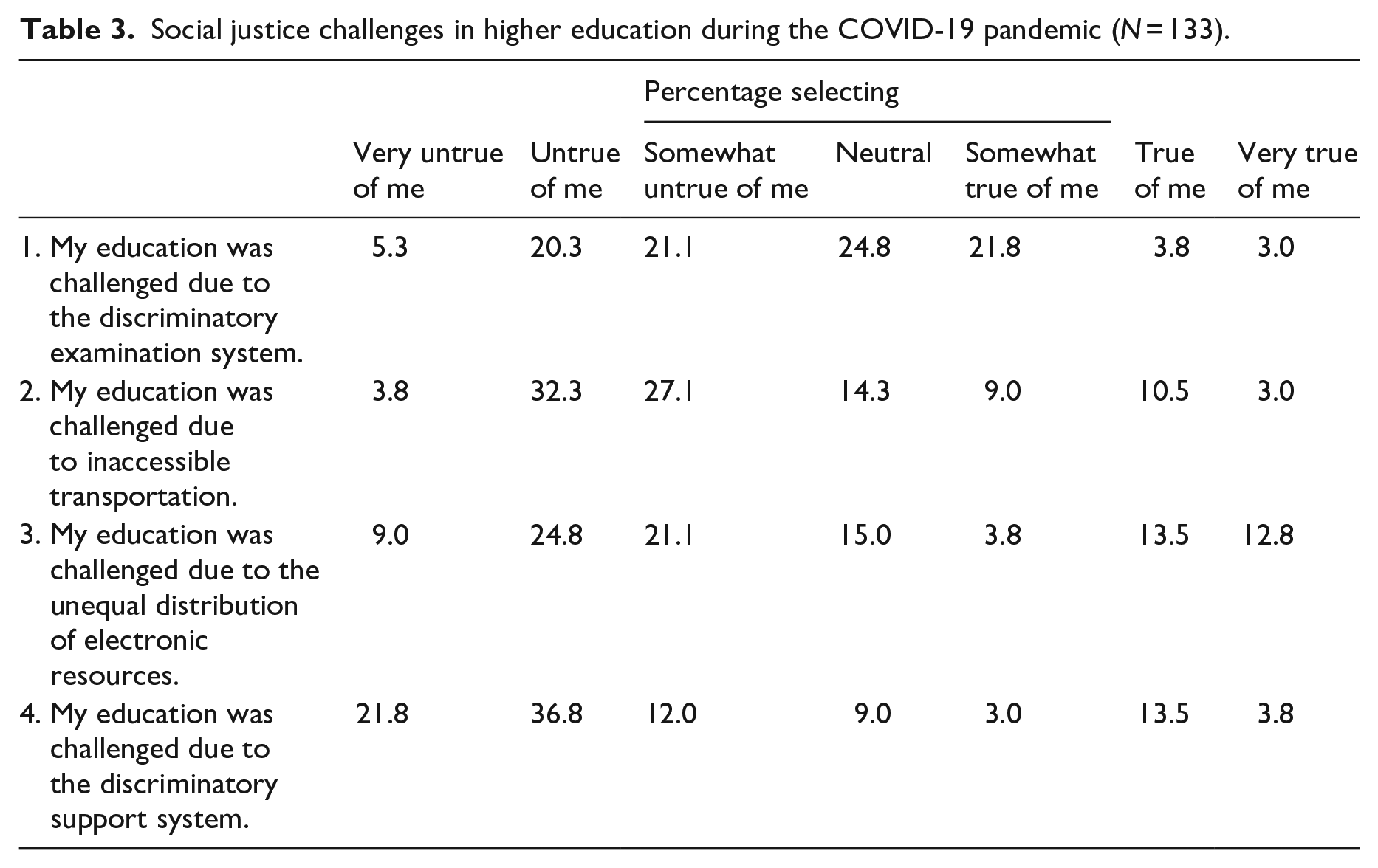
The second research question asked students with visual impairments about their social justice challenges. While 28.6% of the participants felt their education was adversely affected due to a discriminatory examination system, 24.8% were neutral about this statement. Moreover, untrue of me (21.1%), untrue of me (20.3%), and very untrue of me (5.3%) altogether accounted for another 46.7% of all responses. Over six-tenth (63.2%) of the participants who chose Untrue of Me, Untrue of Me, and Very Untrue of Me, indicated that inaccessible transportation did not disrupt their education. Conversely, only 3.0% selected Very true of me and reported that their education was thus challenged. Concerning the extent of the challenge that impacted their education because of the unequal distribution of electronic resources, 30.1% of the participants responded with somewhat true of me, true of me, and very true of me. Still, one-third (33.8%) of the participants reported as untrue of me (24.8%) or very untrue of me (9.0%). Finally, only a small number of the participants Very true of me (3.8%) indicated their education was challenged due to a discriminatory support system. By contrast, an overwhelming majority (70.6%) of the participants responded with Untrue of me (36.8%), Very untrue of me (21.8%), or Somewhat untrue of me (12.0%), and thus thought that the consequences of the discriminatory support system were not very impactful. Table 3 displays the full results.
Social justice challenges in higher education during the COVID-19 pandemic (N = 133).
For the third research question, an independent sample t-test was conducted comparing the group mean score on the social justice experiences in higher education of the male participants with that of the female participants; however, no significant difference was found, t(131) = 1.258, p = .211, Cohen’s d = 0.227 (Becker, 2000). The mean for the male participants (M = 33.44, SD = 5.491) was not statistically significantly different from the mean for the female participants (M = 32.15, SD = 5.996). For the fourth research question, an independent sample t-test was calculated comparing the group mean score on the social justice challenges in higher education of the male participants with that of the female participants. No significant difference was found, t(131) = −0.458, p = .647, Cohen’s d = −0.083. The mean for the male participants (M = 13.44, SD = 5.319) was not statistically significantly different from that for the female participants (M = 13.85, SD = 4.562).
Discussion
The focus of this study was to address the experiences of Bangladeshi students in higher education with visual impairments during the COVID-19 pandemic. Particularly, we examined the participants’ experiences with social justice (e.g., inequality and lack of education assistance) and their challenges with social justice (e.g., transportation and unequal distribution of electronic resources). We also examined the relationship between the independent variables and gender. The sample for the study was drawn from two public universities in Bangladesh. A multifaceted approach was used to recruit the participants in the study. To target specific disability populations, snowball sampling and word-of-mouth communication were used.
The results showed that most of the participants experienced some sort of difficulty in receiving social justice in higher education. Some of those experiences were reported as facing difficulties in receiving alternative education, being involved in class, experiencing inequality in the educational environment, the lack of an educational assistive aid-related device, a shortage of school supplies, unfair treatment during examinations, and a scarcity of information and communication technology. These results were consistent with the findings of the Dianito et al. (2021) study, in which students experienced difficulties communicating and expressing their needs to the instructors and classmates, as well as limited access to assistive technologies.
In terms of social justice challenges in higher education, only a few participants reported experiencing challenges such as examination and support system discrimination, inaccessible transportation, and unequal distribution of electronic resources. These results were not consistent with the findings of Meleo-Erwin and colleagues (2021) that SWDs were receiving limited disability and accessibility services during the COVID-19 pandemic.
We believe that when formulating a research question, it is important to understand the participants’ cultural and religious contexts. Bangladesh is a patriarchal society where men, not women, make the major decisions in most aspects of life. The practice of Islam further dictates how women see their status inside and outside the home (Cohen, 2023). Therefore, the question of whether there are differences in opinions between the two sexes is empirical.
We also found that, in general, gender was not a significant indicator of social justice experiences and challenges in higher education among the study participants during the COVID-19 pandemic. However, the findings of Opini (2012) indicated that female SWD in Kenya identified several obstacles, such as sexual abuse and harassment, limited access to university transportation services and accommodation, and insufficient learning resources. For female students with visual impairment, particularly, lack or limited access to resources such as Braille materials and the absence of reliable readers affected their successful participation in the learning process in higher education (Jun, 2021). Thus, the results may reflect the participant or contextual characteristics.
Limitations
A few limitations are associated with the research design of this study. First, the participants self-reported the severity of their visual impairment. We did not use any clinical diagnostic criteria to determine the level of impairment because ophthalmological care in a developing nation such as Bangladesh may not be as available as it is in Western nations. Second, we did not apply a specific range of monetary figures to determine the socioeconomic status of our study participants. The participants selected a category they believed they belonged to based on their perceptions of family affluence and poverty. Third, as with any survey study, the findings are point-in-time snapshots of an event or phenomenon. The items in the questionnaires were developed weeks before the actual study began. Therefore, we could not anticipate the implementation of new services by municipal and state governments that might affect the study outcomes. For example, several towns introduced temporary shuttle services for residents with visual impairments to relieve the demand for fixed-route bus rides. Although such public transport programs were intended as short-term solutions, their benefits were tangible, as was evidenced by a small number of participants who claimed that their education had been adversely affected due to a lack of accessible transportation.
Third, this study used an unequal research sample of 85 men and 48 women. We acknowledge that the third study used unequal sizes of the two groups of participants, which could be problematic when performing independent-sample t-tests. However, several statisticians have posited that such analyses are robust if the assumption of homogeneity of variance is not violated (George & Mallery, 2022; Gravetter et al., 2018). However, we did not have any control over the sex distribution of the participants. Some plausible reasons for the predominance of males in the sample are that girls with disabilities are less likely to attend school because the parents might be overprotective, they may not be able to afford the tuition fees, they may face negative societal attitudes, or a combination of all these. Finally, 97% of the participants had mild visual impairment. As with most survey research studies, we could not anticipate the severity of the disabilities of the voluntary participants in advance and found out the true position only after the data collection.
Implications
This study has significant implications for college administrators, faculty, and legislators. First, a social justice approach to disability in higher education should reflect students’ rights to benefit from higher education. This means that to support academic success for SWDs, it is necessary to actively work toward removing attitudinal, structural, physical, and institutional barriers. Even with disability inclusion laws and programs, the everyday experience of individuals with visual impairments on Bangladeshi campuses has not improved significantly. Moreover, the COVID-19 pandemic has forced many universities worldwide to shift to online learning, which presents new obstacles for visually impaired students. The widespread use of the internet and digital platforms for course delivery has added to the challenges faced by students pursuing higher education.
In general, research shows that the sudden switchover to online learning platforms during the COVID-19 pandemic has resulted in increased levels of anxiety and stress for students (Salimi et al., 2021; Sharifi Far & Hunt, 2023). This is even more challenging for SWDs. Students with visual impairments a may experience significant levels of difficulty if learning platforms or course delivery are not accessible. An important factor in increasing the overall academic success of students with visual impairments in Bangladesh might be the provision of quality assistive technology. This could include the provision of both low-tech and high-tech devices, such as reading magnifiers or Braille printers.
In addition, this study highlights the significance of implementing policies that cater to the academic needs of students with visual impairments and enhance their overall positive experience in higher education. To achieve this, faculty members must possess adequate knowledge about the inclusion of such students in higher education classrooms. Moreover, university administrators should work with faculty members to ensure that they adopt various learning styles to support students with visual impairments. In addition, the faculty and university disability support services should collaborate closely to identify and provide reasonable accommodations for students with visual impairments. Furthermore, policymakers may consider developing a transitional course to assist these students in acquiring or enhancing the necessary skills that will enable them to function more independently.
