




Abstract
Mathematics training is a challenge for students with visual impairments (VI). However, there are few protocols to assess math skills for them, especially the content related to counting and measurement. The objective of this article was to develop and test the applicability of a protocol to assess math skills in counting and measuring for children and adolescents with VI. The work was organized into two studies. The first dealt with the development of a protocol for assessing pre-arithmetic skills and knowledge and the second study assessed its applicability. In the first study, the protocol was developed from the few papers found on a literature review. In the second study, the protocol was applied to 12 participants with VI aged 5 and 16 years. The results showed that 8 of the 12 participants had performance ranging from 83% to 100% of correct responses in the protocol application, both for counting and measuring skills. The protocol applicability and difference in participants’ performance are discussed. The study concludes that the protocol can be used as a tool to assess math knowledge for children at the end of Early Childhood Education or at the beginning of Elementary School, with or without VI.
Introduction
Mathematics learning is a challenge for people with typical development, and it is possible to assume that the obstacles to mathematics training are also a challenge for those with atypical development and with some disability, as is the case of students with visual impairment (VI) (Carmo & Prado, 2004; Del Campo, 1996). Indeed, Beal and Rosenblum (2018) state that visually impaired students perform substantially lower in math than their sighted peers, as well as have reduced participation in fields with intensive use of mathematics.
Improving mathematics teaching for VI students has highlighted the need to advance on different fronts, such as producing appropriate material for teaching and for assessment (Leuders, 2016). Recognizing the importance of developing procedures and tools for teaching and assessment in parallel is already present in the Early Numeracy Research Project, organized by Clarke et al. (2002), which focus to teach and assess the math skill sets related to number, measurement, and space.
In a similar direction, the works developed by Rottmann et al. (2020) and Krekling et al. (1989) indicated that it is possible and opportune to create a protocol to assess the math skill set, related to the ability to count and measure, for people with VI. The authors confirmed Bryant and Rivera’s (1997) guidelines to produce mathematic assessment material accessible and explored by vision and touch and that the strategies used should answer the question about what the student knows and what he does not know.
Rottmann et al. (2020) presented a modified version of the ElementarMathematisches BasisInterview (EMBI) for children with VIs and an analysis of the respective case study data. The original German EMBI consists of the sections regarding whole number knowledge, with the domains (A) counting, (B) place value, (C) addition and subtraction and (D) multiplication and division and an additional part for 5-year-olds, which is also recommended for children who cannot yet count collections of approximately 20 items. (Rottmann et al., 2020, p. 151)
Some of the modifications were the use of magnetic objects that had a frame which was of contrasting color, and which could be perceived tactually, visual information was replaced by verbal descriptions, the material was tactilely perceptible, and Braille was added to allow reading. A total of 13 children aged 5 years and 11 months to 9 years and 6 months from two special schools for visually impaired children in Germany participated in the research. The degree of VI ranged from total blindness to moderate or mild low vision. Data from a previous study (Gervasoni & Peter-Koop, 2015) using the EMBI to assess whole number knowledge of 7- and 8-year-old German children were included to identify the differences in these groups. The results showed that the adapted version of the EMBI worked for a wide range of performance levels and that different participants’ competencies resulted in different growth points achieved by them. The authors concluded that the results confirmed that the presented adaptation of the EMBI is a suitable tool for inclusive assessment in the early grades, meeting the needs of children with and without VI.
The use of touch in the teaching material exploration was examined by Krekling et al. (1989), with the general objective of reporting the learning of oddness tasks (tasks involving sameness and difference) by children aged 3–8 years, as well as whether visual and tactile modalities are mutually substitutable in this learning. The task consisted of providing three objects (two the same and one different), which could be discriminated with the help of vision and touch. In all, 254 children with typical development children recruited from public schools participated. The stimuli were triangles, squares, rectangles, and hexagons made of plastic, with the same thickness, texture, and weight. Participants were divided into two groups. Before the application of the activities, one group received tactile discrimination training and the other did not. Twenty-five tasks were applied using matching-to-sample (MTS), with a criterion of four consecutive correct responses. If the participant got the activity right, he received praise, and if he got it wrong, the next task was presented without correction. The results showed that the percentage of children who solved the oddness problem increased with age, but the tactile presentation made the problem more difficult to solve than the visual presentation.
In behavior analysis, the authors converge by stating that for the teaching of mathematical skills to become effective, priority should be given to initially identifying present and absent skills through assessment, then establishing the target behaviors to be taught and selecting the available teaching procedures (Carmo, 2012). The position is similar to Bryant and Rivera (1997), Krekling et al. (1989), and Rottmann et al. (2020).
In the same direction, the literature review performed by Costa et al. (2020) aimed to characterize empirical studies on the teaching of mathematics for different populations, including people with VI, carried out in the behavioral approach, in open access scientific literature publications, between 2001 and 2016. The literature survey took place in three stages with the following inclusion criteria: (1) behavioral approach studies on teaching mathematical skills for visually impaired people, (2) behavioral approach studies on teaching mathematical skills for any population, and (3) teaching mathematical skills for visually impaired people, regardless of conceptual orientation. In the first stage, there were no publications, and, in the second and third stages, 11 articles were examined in each one, totaling 22 articles. In the 11 articles in the second stage, there was a predominance of publications on mathematics for students with typical development, in the stimulus equivalence model, with predominant MTS trials. Of these studies, nine presented contents characterized as elementary mathematics, being a part of the regular curriculum of Elementary School I (children aged 6–10 years).
It is worth remembering that MTS trials are widely used for teaching and evaluating conditional discrimination relations, that is, relations between stimuli, which can give rise to the formation of equivalence classes and symbolic behavior (Sidman & Tailby, 1982). In an MTS trial, the individual chooses one comparison stimulus from several available in the presence of a sample stimulus (Cumming & Berryman, 1965), in a procedure that simulates if-then relations: if the sample stimulus is X, then choose the Y stimulus.
According to Carmo (2000), mathematical skills, from the point of view of behavior analysis, involve the relations among stimuli (such as choosing a printed numeral in the presence of a specific dictated numeral) or between stimuli and responses (such as saying the number of objects available on a table) and the formation of equivalent stimulus classes through the emergence of derived relations (Sidman & Tailby, 1982). A possible example of an equivalent stimulus class would involve the dictated word three, the number three, the quantity three, and the fraction 6/2. The stimulus relation network establishes the conditions for the occurrence of verbal and other complex cognitive performances, such as solving arithmetic problems (Silveira et al., 2018).
One way to test relations between stimuli or between stimulus and response is with discrete trials, in which the contingencies of three or four terms are organized into consecutive trials that allow the recording of each response. Each trial consists of (1) getting the learner’s attention, (2) presenting objective instruction and materials, (3) awaiting the learner’s response, (4) presenting differential consequences for correct and incorrect responses in teaching condition or omitting them in test condition, and (5) recording the response (Smith, 2001). Test conditions (when there are no programmed consequences for correct or incorrect responses) are used to determine responses and relations not yet installed in the individual’s repertoire and need to be directly taught.
Therefore, using discrete testing trials, the objective of the present study was to develop and test the applicability of a protocol for the assessment of math skills in counting and measuring for children and adolescents with VI.
The work was organized into two studies. The first dealt with the development of a protocol for assessing pre-arithmetic skills and the second study assessed its applicability.
Method
First study
This study aimed to develop a protocol for assessing math skills in counting and measuring for children and adolescents with VI. A literature review carried out by Costa and Elias (2021) identified a few papers with instruments for measuring mathematical skill for participants with and without VI from 2001 to 2020 (Brankaer et al., 2011; Jeong et al., 2007; Krekling et al., 1989; Zhou et al., 2005). Faced with the need to choose parameters for the elaboration of the Counting and Measurement Task Assessment Protocol (CMTAP), the works retrieved by Costa and Elias (2021) were considered.
The works by Brolezzi (1996) and Carmo (2012) guided the selection of the counting and measurement skills that make up the protocol (biggest/smallest, most/fewest, big/small, sameness/difference). To Brolezzi (1996), counting refers to everything related to the arithmetic of whole numbers, which allows identifying distinct objects, discriminating, separating, and has the mathematical sense of counting objects, such as books on a shelf; while measurement refers to what is immediately joined to something else, and has the mathematical sense of measurement, dealing with the idea of geometry, such as measuring the width of a sheet of paper or weighing a pen. According to Carmo (2012), the assessment should start with the topic related to pre-arithmetic skills, which form the basis for learning arithmetic, such as notions of bigger/smaller, biggest/smallest, more/less, big/small, first/last, before/after, beginning/middle/end, and near/far.
As for the concrete materials, the choices derived from the recommendations of Del Campo (1996) and were toys, pieces of pedagogical material such as cubes of 1 cm on a side that are a part of the Cuisenaire® Scale, in addition to wooden cubes of 5 cm on a side and squares of 4 and 7 cm sides. The squares were cut on of plastic material from the “Pasta Polionda Lombo 35 mm®.” For continuous objects, strings of 10 and 15 cm in length were stiffened with several layers of liquid white glue.
The Barraga (1997) recommendations were met in the definition of the presentation sequence of the objects chosen for application. According to the author, children with VI from 3 years old acquire tactile skills in a hierarchical order. Acquisition starts with the manipulation of large geometric shapes, followed by flat geometric figures, raised dot lines, and raised dots.
Two sets of instructions correspond to the elaborate trials. Initially, there is an instruction regarding the material presented to the participant, so that the tactile information or any other reference favor the understanding of the environment (Barraga, 1997; Del Campo, 1996). The instructions are simple and direct, following the guidelines and structure proposed by Rossit (2003). In the protocol, each task is presented separately, indicating the instruction, expected response, materials, and space for recording the participant’s response.
It was established that in the tasks aimed at verifying major/minor, big/small, and most/fewest relations, the participants should receive the pieces for tactile exploration.
The pieces are arranged on a table, according to the organization described in the protocol, together with the oral instruction: “In front of you there are two/three pieces [or two/three piles].” The instruction has the function of describing what and how the objects are arranged. Then, it is suggested: “Explore the pieces [piles] the way you want” (this instruction implies the possibility of inspection by handling and approaching the parts of the face, at the angle that best suits the visual access of the person with low vision). This second instruction indicates what the participant is expected to do.
Each response should be followed by the same consequence (such as “Thank you”), by removing the stimuli and recording the response as “correct” or “incorrect.” The next trial is presented until the end of all protocol trials. One response is recorded as correct when the person indicates the parts or assemblies that matched the instruction. A response is recorded as incorrect when the participant says, for example, “I don’t know” or “I’ve done it” or indicates the parts or assemblies that did not correspond to the instruction.
The application sessions are programmed to balance the position of presentation of the stimuli in the spatial distribution on the table in relation to the position of the participant. The material should be arranged side by side on the table, whether for individual pieces (a cube, a string wire, a plastic plate) or for sets of pieces. In Sessions 1 and 3 and 2 and 4, the objective is to balance the position in which the stimuli are presented in each trial that comprises the counting and measurement skills. The same occurs for the MTS trials, which are composed of: (1) instruction or sample stimulus presentation, (2) comparison stimuli presentation, (3) the individual’s response, and (4) presentation of the neutral consequence (“Thank you”) for correct and incorrect responses. In some arrangements, the comparison stimuli are presented first, followed by a presentation of the instruction or sample stimulus (Silveira et al., 2018).
In each session, there are 24 counting trials (biggest/smallest, big/small, equal/different), using sets of cubes, squares, and wires and 24 measurement trials (biggest/smallest, most/fewest, sameness/difference), using units of cubes, squares, string wires, organized into four blocks with six trials in each block, without differential consequences. The 192 trials are applied in four sessions. Remembering that Sessions 1 and 3 are the same in terms of the order in which materials and instructions are displayed, the same is true for Sessions 2 and 4.
Below are two examples, one for counting and one for measurement trial. In the first measurement trial, the person testing places 1 and 4 cm side cubes on the table, in front of the student. He or she then provides the following instruction: “There are two pieces in front of you. Explore the pieces the way you want.” As soon as the student explores the cubes and places them back on the table or just stops exploring, the person testing provides the instruction: “Give me the biggest piece.” The expected response is that the student points to the 4-cm cube or picks it up and hands it to the person testing. In the first counting trial, the person testing places two piles with identical cubes on the table, in front of the student. One pile has five cubes, the other has nine. He or she then provides the following instruction: “There are two piles in front of you. Explore the pieces the way you want.” As soon as the student explores the cubes (one by one or the pile as a whole) and places them back on the table or just stops exploring, the person testing provides the instruction: “Give me the biggest pile.” The expected response is that the student points to the pile with nine cubes or picks them up and hands them to the person testing. Each trial ends with data recording on the protocol sheet.
Protocol semantic analysis
The first version of the protocol was applied to a blindfolded non-visually impaired person, who was doing a Master’s in Special Education, according to the sequence of trials, instructions, and material previously mentioned. The participant fulfilled all the trials and suggested the reorganization of the protocol for the presentation of the material and information in the following order: material, initial instructions on the material, instructions on the expected response in the task, and a blank space for recording participant’s responses. The suggestions were incorporated, producing the second version.
The second version was then applied to a person with low vision who was doing a PhD in Special Education. The participant completed all the trials and suggested that the wooden cubes be polished better, to be less rough, and that the string wires be even more stiff. The protocol application procedure was reformulated, following all the suggestions of the participants, producing the definitive version of the protocol (see Supplementary Appendix A) used in Study 2.
Second study
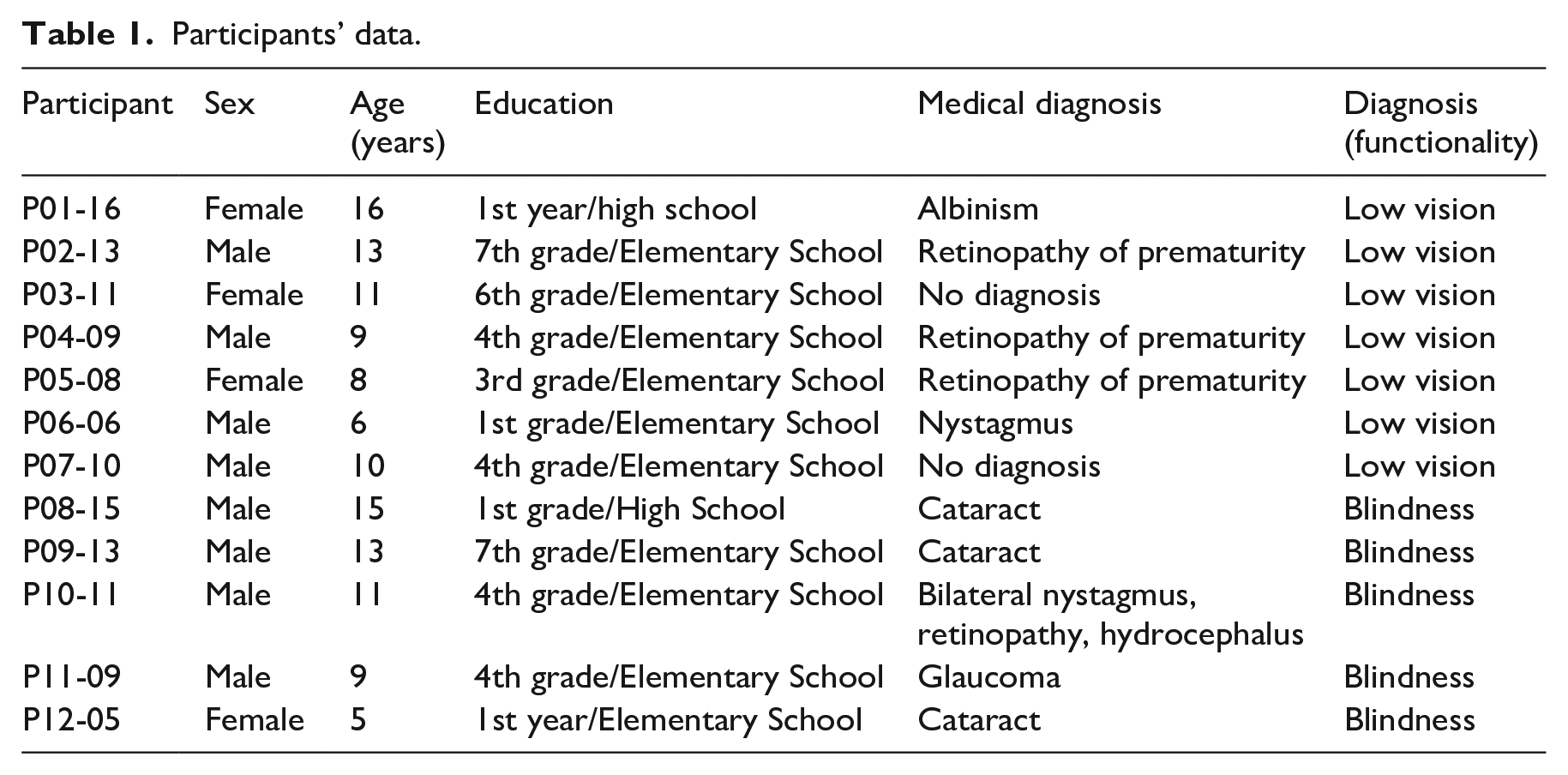
This study aimed to test the applicability of the protocol for counting and measuring math skills for 12 children and adolescents with VI, aged between 5 and 17 years (mean age of 10.5 years at the beginning of the study). All of them attended public schools, and five of them also attended a specialized institution in different periods of the regular school. The five participants who attended the specialized institution (P04-09, P06-06, P10-11, P11-09, P12-05) were recruited in this institution. The other participants (P01-16, P02-13, P03-11, P05-08, P07-10, P08-15) were recruited from public schools. Participants were identified by an alphanumeric code consisting of the letter P, followed by sequential numbers, as the participants were recruited, and age in number of years (see Table 1). Table 1 also contains information about the participants.
Participants’ data.
The study followed the ethical principles of the Declaration of Helsinki. Consent was obtained from participants using appropriate forms and in accordance with procedures suggested by the World Medical Association.
The sessions were individual, lasting between 15 and 35 min. Once the participant and the researcher were accommodated and the material was organized, the participant was notified of the recording and the camera to record the session was turned on.
Data were recorded in two distinct worksheets, one for counting and the other for measurement responses. Then, percentages of correct and incorrect responses were calculated.
Results
Eight of the 12 participants (P01-16, P02-13, P04-09, P05-08, P07-10, P08-15, P09-13, P10-11) had performance ranging from 20 (83%) to 24 (100 %) of correct responses in each of the four applications, both for counting and measuring. This group of eight participants ranged in age from 8 to 16 years, with two of them attending the specialized institution (P04-09 and P10-11). Three of these participants (P04-09, P05-08, and P07-10) attended Elementary School I (1st to 5th grade, aged 6–10 years old), three (P02-13, P09-13, and P10-11) attended Elementary School II (6th–9th grade, 11–14 years old), and two (P01-16 and P08-15) attended the 1st year of High School (adolescents aged 15–17 years). Five had low vision (P01-16, P02-13, P04-09, P05-08, and P07-10) and three had blindness (P08-15, P09-13, and P10-11). These results indicate that they had well-established skills of math skills in counting and measuring. Such results may be related to the type of content that the participants were exposed to, since of the eight participants, five were at the end of Elementary School II or beginning of High School, and the other three attending between the 3rd and 4th years of Elementary School, being exposed to much more advanced mathematical content in the classroom than those exposed during the research (content that should have been learned during Early Childhood Education).
P03-11 had between 12 (50%) and 19 (79%) correct responses in each of the four applications, both for counting and measuring, which indicate that she had well established the skills of biggest, with 100% of correct responses, smaller, with 83.3%, and sameness with 95.8%. On the contrary, she showed 81.2% of incorrect responses in trials involving difference, on which she presented the same responses that were emitted in the trials with sameness.
Three participants (P06-06, P11-09, P12-05) had different performance between the counting and measuring. They obtained between 12 (50%) and 20 (83%) correct responses in the measurement trials and between 1 (4%) and 14 (58%) correct responses in the counting trials. These participants, aged between 5 and 9 years, attended the specialized institution and Elementary School I.
P11-09 demonstrated well-established measurement skills (81.2% correct responses), and biggest/most and smallest/fewest counting skills (72.9% correct responses), but had difficulty in trials involving sameness and difference in counting (27.1% correct responses).
P12-05 demonstrated that she had the skills of biggest and smallest well established in measurements (89.5% correct responses), since for the skill of biggest and smallest in count, she presented 56.2% correct responses. There were many incorrect responses in sameness and difference, both counting and measuring, with 20 correct responses (41.6%). P06-06 had the biggest and smallest skills in measurements well established (85.4% correct responses), but with many incorrect responses in all other trials: 14 correct responses (29.2%) in trials with sameness and difference of measures, and 18 correct responses (18.8%) in the counting trials.
P06-06 and P12-05 showed demand escape behaviors. After 10 min of work, they began to move their heads in the opposite direction to the place where the materials were made available and to talk about personal matters. Also, when the trial instruction was given, they delivered all the parts, which was not in accordance with the instruction. Participants P06-06 and P12-05 were diagnosed with VI only, but the institution’s management informed that P06-06 could have autism and that P12-05 could have hyperactivity, both without medical reports. However, it is necessary to consider the extent and number of repetitions of the tasks in all sessions as a factor that could produce tiredness or disinterest.
In the first and second trial blocks, involving the biggest/smallest or big/small relations, the error rate was on mean below 10%, demonstrating the greater ease of the participants. In the third and fourth blocks, with trials involving sameness or difference relations between objects or sets, the mean error rate was above 20%.
Another analysis considered the mean of the total incorrect responses in the 192 trials by age group. From 5 to 8 years: P06-06 and P12-05 had a mean of 91 incorrect responses (47%); from 8 to 10 years: P04-09, P05-08, P07-10, and P11-09 had a mean of 26.7 incorrect responses (14%); from 10 to 12 years: P03-11 and P10-11 had a mean of 26 incorrect responses (13.5%); from 12 to 14 years: P02-13 and P09-13 had a mean of 14.5 incorrect responses (7.5%); from 14 to 16 years: P01-16 and P08-15 had a mean of three incorrect responses (less than 0.5%). Figure 1 presents the individual performance of participants with low vision in descending order of age. Figure 2 presents the individual performance of participants with blindness in descending order of age.
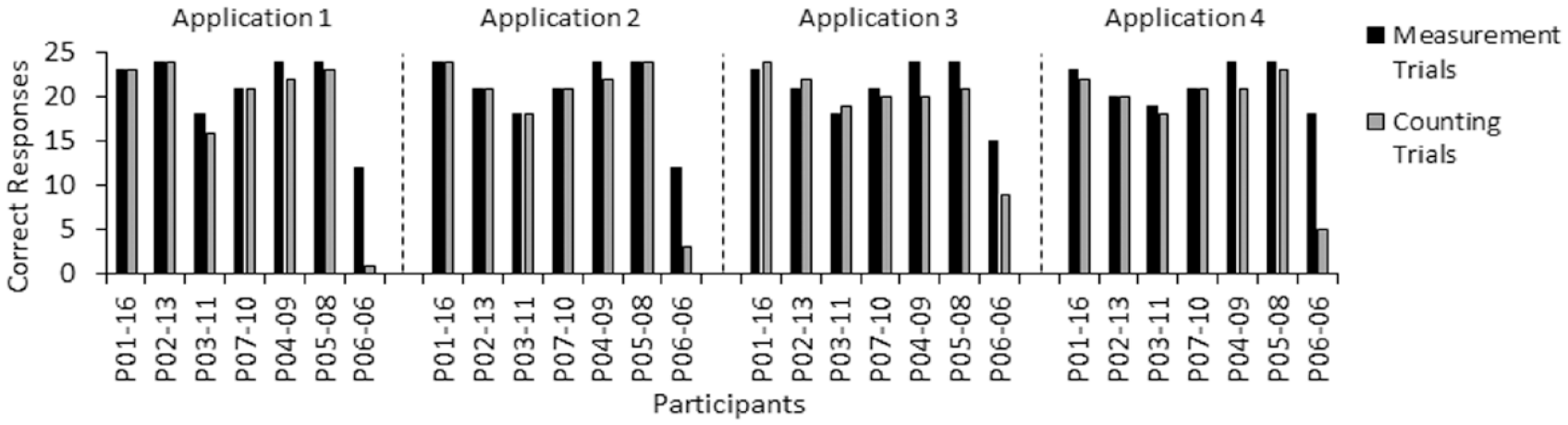
Performance of participants with low vision in descending order of age.
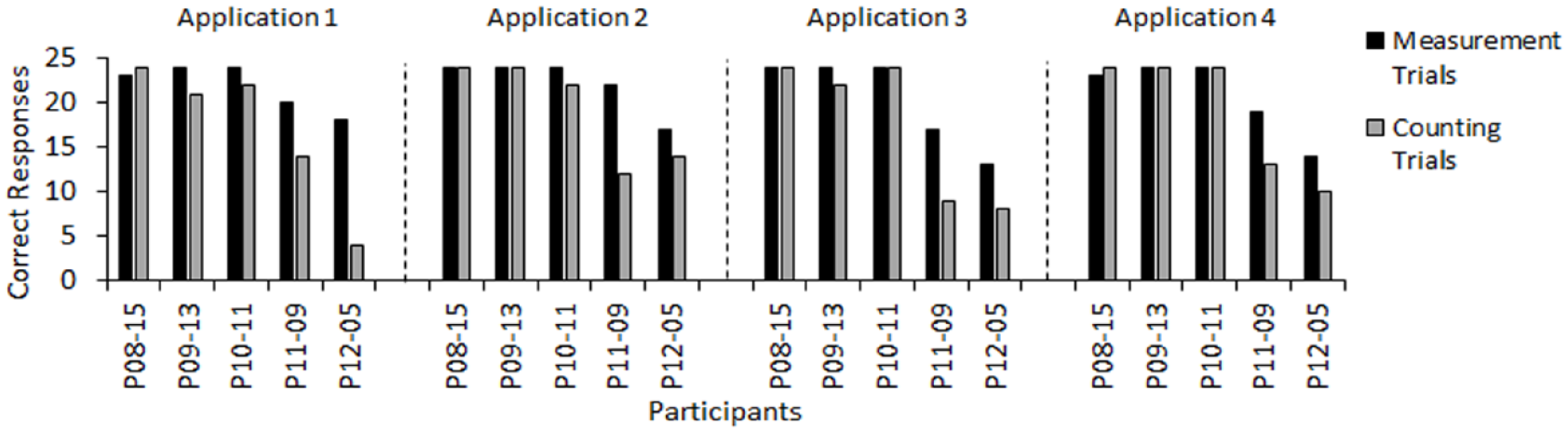
Performance of participants with blindness in descending order of age.
Regarding measurement trials, there was a total of 9 errors involving biggest/smallest, 9 involving big/small, and 117 involving same/different (see Figure 3). For the counting trials, there was a total of 40 errors involving greater/minor, 37 involving more/less, and 172 involving same/different (see Figure 4). These data indicate greater difficulty in counting trials and in trials involving same/different (for measurement and for counting).
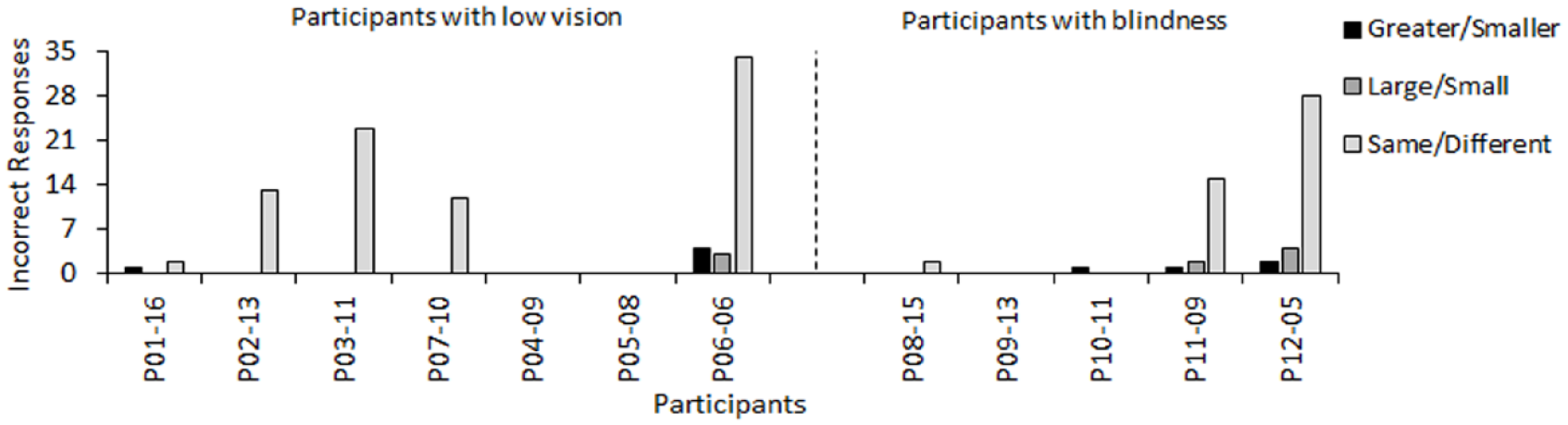
Number of incorrect responses per participant in the measurement trials.
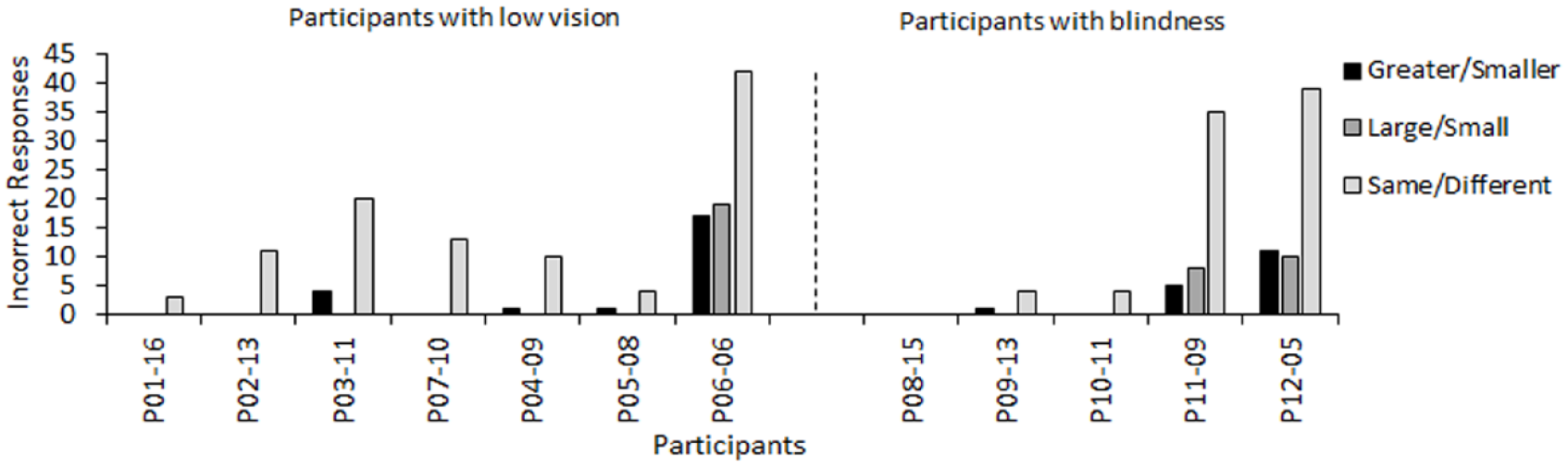
Number of incorrect responses per participant in the counting trials.
Discussion
This second study aimed to test the applicability of the protocol for counting and measuring math skills for 12 children and adolescents with VI, aged between 5 and 16 years. According to the data obtained and participants’ performance in general, the protocol is applicable and seems to meet the needs of children and adolescents with VI. The care in the construction of the material and instructions contributed to this promising and positive finding. It was observed that the visual information described by the researcher facilitated the manipulation of objects; the use of big and small objects, following the recommendations of Barraga (1997), proved to be effective, since the participants did not have any difficulties in using and handling them.
To respond to the trials, the participants with low vision (P01-16, P02-13, P03-11, P04-09, P05-08, P06-06, and P07-10) used the strategy of exploring the stimuli with the vision remnant, bringing the materials closer to the eyes, not having any difficulty in recognizing them, as previously reported in the study by Del Campo (1996). Participants with blindness (P08-15, P09-13, P10-11, P11-09, and P12-05) used the haptic exploration strategy (or tactile-kinesthetic perception). They did not demonstrate fatigue or difficulty in exploring the stimuli. The haptic exploration can be used for the psychometric assessment of cognitive and perceptual motor skills and is adequate to evaluate individuals with blindness (Ballesteros et al., 2005; Mazella et al., 2014).
The protocol (CMTAP) showed to be age sensitive, since there was a predominance of correct responses by older participants and incorrect responses by younger ones. This finding is consistent with data from the literature, strengthening the applicability and quality of the protocol, showing that it was able to measure what was proposed. The high percentage of correct responses (74.8%) in MTS trials corroborate what is published by Krekling et al. (1989), that this procedure helps participants to focus more on the activities, also confirming that such a procedure has been widely used as a strategy for the assessment and teaching of elementary mathematics (Carmo & Prado, 2004; Rottmann et al., 2020).
The results indicate that younger participants got more incorrect responses than older ones, similarly to what was found by Jeong et al. (2007). This fact may be related to the type of content that the participants were exposed to, which are pre-arithmetic skills, considered as prerequisites for learning complex math skills (Carmo, 2012). Participants had difficulties in math skills that are a part of the curriculum of children aged 3–5 years old, indicating a delay in learning this content.
It is worth noting that participants got more correct responses, on mean, on trials involving sameness than difference relations. For Brolezzi (1996), the numerical comparisons between sets of objects involving difference are more difficult than those involving sameness for students with typical development. In addition, it is necessary to evaluate whether the instructions given in the two conditions produce enough understanding to control the expected response. In sameness relations, the word “identical” was used (e.g., “Give me two identical pieces”); in difference relations, the word “different” was used (e.g., “Give me two different pieces”). In the latter case, the participant could understand that he is being asked to deliver two pieces different from the other piece.
As for the greater ease in measuring trials, Brolezzi (1996) suggests that counting (or the comparison between sets) is a much more sophisticated process than the simple unitary comparison between objects. According to the author, the idea of measurement is associated with order, which in turn is at the heart of the idea of comparing two different quantities or measures, to establish an order between them: biggest and smallest size.
Final considerations
This study achieved its objective since it was possible to develop and apply a protocol for the assessment of mathematical skills with 12 participants with VI.
The first contribution that can be highlighted is the development of an unprecedented protocol, which helps to identify the input skill of individuals with VI, fundamental for the planning of activities for teaching specific mathematical skills for which students with greater difficulty, subsidizing the full inclusion of such students in regular education. Another contribution comes from the positive results of the application with the selected sample, since the second study showed a predominance of correct responses by older participants when compared with younger ones, as expected by the literature, evidencing the applicability and quality of the protocol, showing that this protocol achieved its objective.
The participants had no difficulties in handling and tactually recognizing any material used, but the biggest and smallest cubes showed very discrepant sizes. It is suggested that the volume of the two sizes of the cubes is close, such as a centimeter difference. Another change could be made by replacing the string wires with another material, as the material was malleable when handled. It is recommended that the protocol be replicated with a greater number of individuals, both with low vision and blindness and who are younger, preferably children before entering elementary school.
The protocol had Sessions 1 and 3 the same and Sessions 2 and 4 the same. In addition, each session exposed participants to counting and measuring trials, which made the sessions long for some of them. For future applications, there could be only two sessions, with trials being divided into counting and measuring in different sessions, making them shorter and less tiring, by reducing repetitions.
Participants of all ages demonstrated ease in activities involving biggest/smallest and big/small relations, indicating that there is no need for adaptation or modification in these trials and the respective instructions. Regarding the trials involving sameness/difference relations, the participants showed greater difficulty in relations of difference than of sameness.
Limitations and future work
As a suggestion for future research, it is recommended that participants do not have any associated disabilities, to be able to assess the initial performance of present and absent skills. It is also recommended that the protocol be applied with a larger number of participants.
In addition, as an application, it is suggested that the CMTAP can be used as a tool for the assessment of mathematics knowledge for children at the end of Early Childhood Education or at the beginning of Elementary School, with or without VI, serving as a basis for the planning of activities aimed at addressing possible shortfalls. In turn, such an assessment could serve as a basis for planning mathematical activities and transforming them into teaching tasks, with the addition of differential reinforcement depending on the responses and, if necessary, the use of verbal cues and physical prompts.
Supplemental Material
sj-docx-1-jvi-10.1177_02646196231199916 – Supplemental material for Assessment of pre-arithmetic relations in children and adolescents with visual impairment
Supplemental material, sj-docx-1-jvi-10.1177_02646196231199916 for Assessment of pre-arithmetic relations in children and adolescents with visual impairment by Ailton B da Costa, Nassim C Elias, Monalisa Muniz and Maria Stella C de A Gil in British Journal of Visual Impairment
Footnotes
Funding
The author(s) disclosed receipt of the following financial support for the research, authorship, and/or publication of this article: The authors claim to receive the following financial support: National Institute of Science and Technology on Behavior, Cognition and Teaching (INCT-ECCE) with the support of the Coordination for the Improvement of Higher Education Personnel (CAPES - 88887.136407/2017-00); National Council for Scientific and Technological Development (CNPq - 465686/2014-1; 150135/2022-0); Research Support Foundation of the State of São Paulo (FAPESP - 2014/50909-8). We thank the Coordination for the Improvement of Higher Education Personnel (CAPES) for the general ongoing support of the research (PROEX 23038.005155 / 2017-67). This research was conducted as part of the first author’s PhD thesis.

Supplemental material
Supplemental material for this article is available online.
References
Supplementary Material
Please find the following supplemental material available below.
For Open Access articles published under a Creative Commons License, all supplemental material carries the same license as the article it is associated with.
For non-Open Access articles published, all supplemental material carries a non-exclusive license, and permission requests for re-use of supplemental material or any part of supplemental material shall be sent directly to the copyright owner as specified in the copyright notice associated with the article.
