




Abstract
Inclusive education strives to support all students, regardless of their differences, so no child is left behind. However, some teachers, especially those in high schools, may oppose inclusive education. This study aimed to examine the experiences and actions of high school mathematics teachers as they taught students with visual impairments to understand the challenges they faced and how these affected their willingness to embrace the inclusion of these students. Researchers conducted semi-structured interviews with eight mathematics teachers experienced in teaching students with visual impairments. The findings were organized into five themes: mathematics teaching practices, curriculum, material preparation, assessment practices, and beliefs about inclusive education and students with visual impairments. The results revealed that while mathematics teachers were conscious of not being adequately equipped to implement inclusive education, those with strong teaching efficacy beliefs were more inclined to teach rigorous mathematics to students with visual impairments.
Introduction
The field of mathematics education has long recognized the importance of inclusive education and equity (Roos, 2019). Among the special needs groups acknowledged in this regard are students with visual impairments (SVI; Klingenberg et al., 2020). Despite the challenges they face, a significant number of SVI continue to attend general schools. However, traditional educational settings often present difficulties for both SVI and their sighted peers, particularly when teaching and learning mathematics (Bayram et al., 2015).
Previous research has revealed that SVI are frequently provided fewer opportunities to experience advanced mathematical concepts than their sighted peers (Bateman et al., 2018; Emerson & Anderson, 2018; Stylianidou & Nardi, 2019). This can be further exacerbated by the heavy reliance on visual images in mathematics textbooks, making it challenging for SVI to access and understand rigorous mathematical content. This is particularly true for mathematical concepts conveyed through graphs, charts, diagrams, figures, and drawings, which can communicate large amounts of data or relationships between variables (Dikkartin-Övez & Akar, 2018). Thus, research highlights the need for alternative methods and materials for teaching mathematical concepts to SVI.
Our previous research study in the Turkish context (Bayram et al., 2015) investigated the problems that SVI face in schooling (general schools) during mathematics classes. The study revealed that the students felt that their academic needs in mathematics lessons were not adequately met in inclusive classrooms. They reported that the teaching methodologies and materials were insufficient to engage them in learning rigorous mathematics. This finding contrasts with the Ministry of National Education (MoNE) in Turkey, which aims to include students with special needs in general classrooms to allow them to interact with their peers and achieve academic goals at the highest level (MoNE, 2018). However, our previous study revealed that despite evaluating social interaction as sufficient, students reported that their academic needs were unmet. This highlights the need for more effective teaching strategies and materials for SVI in inclusive classrooms and the need to evaluate the effectiveness of current regulations and policies in meeting the academic needs of SVI in Turkey.
Given the challenges that SVI face in inclusive mathematics classrooms, it is essential to understand the teachers’ perspectives responsible for designing meaningful mathematical experiences for these students. This study builds upon previous research by focusing on the experiences and needs of teachers to establish equity for SVI. Previous research has shown that SVI often face difficulties in inclusive mathematics classrooms, often associated with teacher-related variables. For example, students have reported that teachers may hold prejudices, be reluctant to take responsibility or lack knowledge about appropriate teaching materials and methodologies (Bayram et al., 2015).
This study aims to provide a holistic understanding of SVI’s mathematics education by describing the situation from the teachers’ perspectives. By gaining insight into the challenges and needs of teachers in inclusive mathematics classrooms, the study aims to inform the design of effective professional development and collaboration opportunities for teachers, which will help to support the education of SVI in inclusive mathematics classrooms. Thus, the following main research question guided the study: What are the experiences and actions of high school mathematics teachers when teaching SVI in an inclusive education setting?
Method
The researchers selected eight participants for this study using a maximum variation approach among high school mathematics teachers with experience teaching SVI. At the time of the study, six participants were teaching SVI in inclusive classrooms, while the remaining two had previous tutoring experience with SVI. Table 1 illustrates the variations in teaching experiences among the participants.
Demographic characteristics of interviews and observation participants.
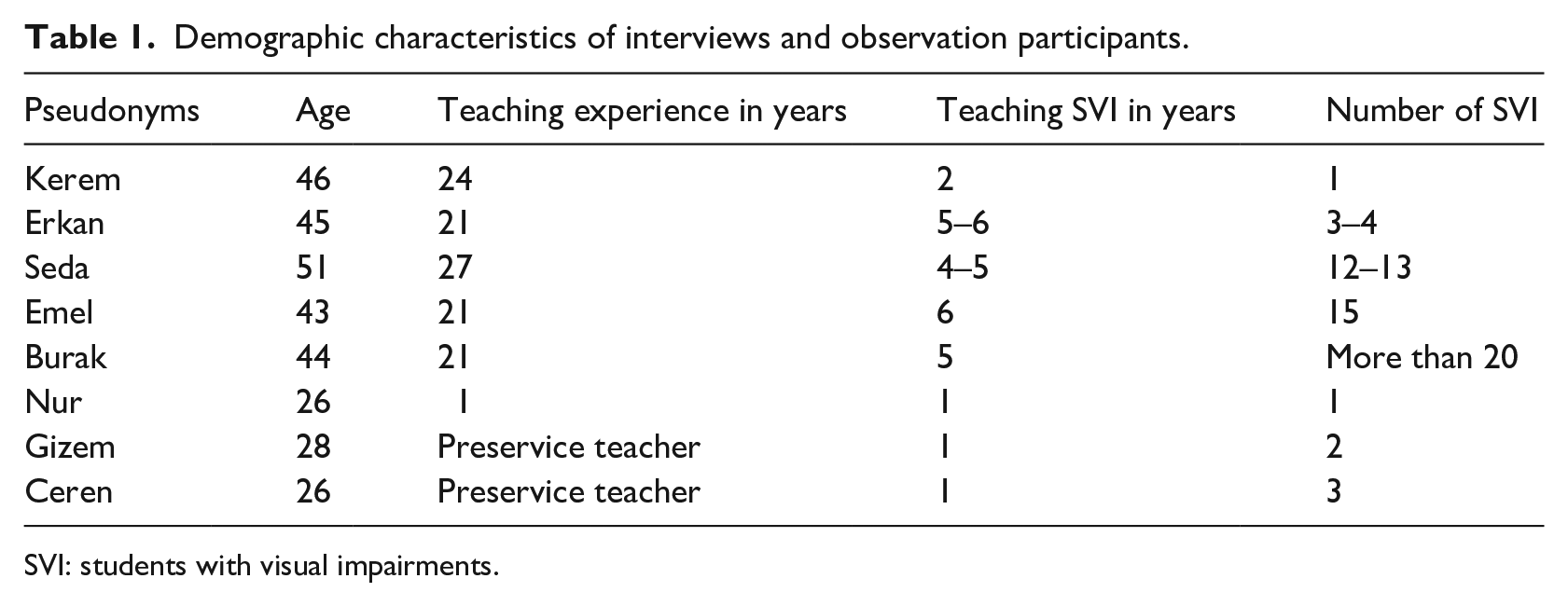
SVI: students with visual impairments.
Data were collected through interviews (in Turkish), participant observations, and relevant document analysis. Participants provided informed consent, encompassing study purpose, methodology, voluntary participation, withdrawal rights, and audio recording permission. Ethical principles for research were regulated internally by the first author’s institution. An interview protocol guided data collection, consisting of three sections: interview arrangements, questions, and member checks. Arrangements entailed planning and logistics, such as setting, duration, and necessary equipment. Interview questions derived from the literature review and the researcher’s experience in differentiated classroom settings, targeting participants’ experiences, opinions, feelings, knowledge, and backgrounds related to teaching SVI (Patton, 2002). Open-ended, non-leading questions promoted candid responses and insights. Member checks ensured clarity and completeness of responses. Semi-structured interviews were conducted face-to-face, enabling observation of body language and gestures, and lasted at least an hour. Participant observations during and after interviews supplied additional insights into actions and interactions in natural settings (Lincoln & Guba, 1985). Expressions and gestures observed during interviews deepened understanding of reactions, while post-interview observations in classrooms revealed information on teaching practices, teacher attitudes, and the learning environment. Triangulation was implemented through various data collection methods, including artefacts such as documents, field notes, and a video featuring one participant to strengthen and validate the study’s data. Reflexive and methodological journals were maintained, with the reflexive journal detailing the researcher’s experiences and reflections and the methodological journal documenting peer-debriefing discussions and methodological readings. Both journals influenced the research design, working hypotheses, data analysis, and interpretation of the results.
The purpose of data analysis can be construed as the pursuit of answering research questions. It is noteworthy that data analysis and collection are intertwined since data collection is an ongoing process that may persist throughout the data analysis phase (Lincoln & Guba, 1985). Data were sourced from interviews, observations, and written artefacts in the present investigation. The constant comparative method was employed for data analysis, which entailed unitizing, coding data, identifying patterns, categorizing similar categories, and discerning themes. These themes highlighted commonalities and distinctions in participants’ experiences teaching high school mathematics and their perceptions of inclusive education. The initial step of the analysis involved transcribing Turkish interview data from audio recordings into Word documents. Subsequently, these transcripts were opened with NVivo8, a qualitative analysis software designed to organize, classify, and systematically categorize tools. Utilizing NVivo8, the transcripts were deconstructed into smaller coding units. During the line-by-line coding process, memos were written for each code, with insights drawn from reflective journals, observation notes, and other written documents. NVivo8 facilitated the code-and-retrieve approach, which enabled the assignment of codes with labelled passages and memos, then retrieving all data under a specific code. The third stage involved the preparation of hard copies of codes obtained from 74 pages. The categorization process commenced with selecting a subgroup of papers to assemble similar codes in a single category. An individual card, comprising a code with labelled passages and memos, was selected and examined to ascertain its relevance to existing categories. The card was then placed within the appropriate category, a new category was created, and a number was assigned to each category. This procedure was executed iteratively until all cards had been analysed. Each card was allocated to at least one category but could be duplicated and included in multiple categories. In the fourth stage, after examining all cards, categories were written on an A3 paper to visualize the names of all cards simultaneously. Consequently, several rechecks were conducted with the assistance of a peer debriefer to ensure that cards were accurately classified within their respective categories. Finally, the findings were organized into five themes: mathematics teaching practices, curriculum, material preparation, assessment practices, and beliefs about inclusive education and SVI.
Results
Profiles
Kerem is a mathematics teacher at a private school in Istanbul that supports inclusive education for SVI, Down syndrome, and other disabilities. In addition, he actively follows the development of educational technologies. Erkan is a mathematics teacher in a pilot inclusive education school in Ankara, but he and his colleagues have not received training on inclusive education practices. So first, he tried to learn braille numbers but then gave up. Seda is the head of the mathematics department at a school known for implementing inclusive education. She has experience with SVI and has had SVI stay in the school dorm with peers. However, she expresses feeling low motivation and anxiety when teaching SVI. Emel currently has one 12th-grade student with a visual impairment, but she doubts her ability to teach mathematics to VI students. Burak is a teacher at a pilot inclusive education school in Ankara, but he did not receive training on inclusive education and has lost faith in their ability to succeed in mathematics. Nur is a first-year teacher at a state school who volunteered for children with disabilities for 6 years to gain experience. Gizem is a mathematics teacher in training and has gained experience with SVI through volunteering and a specialized training centre, which has increased her awareness of their needs. Ceren took a role as a volunteer mathematics tutor of SVI at a private tutoring centre for her master’s thesis.
Teaching mathematics
On one hand, some participants, especially experienced teachers, believed they did not need to plan their lessons. Erkan mentioned, ‘I never used a written lesson plan due to time constraints. A lesson plan [referring to a daily written lesson plan] was only something that an inspector checked’. On the other hand, another experienced teacher Seda expressed discomfort when her SVI asked her to slow down the lesson’s pace, which caused her to forget what she had planned to teach. Some teachers did not see the importance of lesson planning, despite the changing momentum in the classroom with SVI.
Ceren highlighted that SVI needed detailed verbal descriptions. For this reason, she stated that she talked too much to explain and repeat everything. Ceren emphasized that she was mentally and physically exhausted at the end of her lessons. Similarly, Seda complained about the necessity of talking too much in the classroom while teaching mathematics.
Emel mentioned that she attempted to refrain from using pronouns but frequently overlooked them. She stated that her SVI repeatedly reminded her not to use phrases such as look at, here, take this, and put it there about demonstrative pronouns, but she often forgot to read out everything written on the board. In addition, she had grown accustomed to teaching sighted students for over 20 years.
Mathematics curriculum
Burak and Erkan claimed that a teacher could not teach all mathematics content to SVI. Burak repeatedly compared SVI and sighted students: ‘How can I teach them the division of polynomials when even sighted students cannot learn it?’ He advocated that the SVI had a low ability to perform mathematical operations; hence, they could not succeed in mathematics. He claimed, ‘They would need to be a genius [to perform the division of polynomials]’. Burak suggested that only basic mathematics should be taught to SVI. Another participant, Seda, suggested assigning a new specialized curriculum to SVI; her argument of showing parallelism between different circumstances was remarkable: The SVI should have a different mathematics curriculum. For instance, when I worked in a vocational school for girls, I suggested that they should be educated by considering their professions. The department of needlecraft [in the vocational school] requires measurement, or the art department focuses on ratio and proportion. Not everyone needs to learn trigonometry. The same idea should apply to blind students. We should teach them mathematics as far as they can learn it.
Teachers’ opinions regarding the ability of SVI to learn geometry were divided. Some teachers, such as Burak, Erkan, Seda, and Emel, expressed difficulty teaching geometry to SVI. They cited issues such as not knowing how to represent geometric objects to them. In contrast, other teachers, such as Nur, Ceren, Gizem, and Kerem, believed that SVI could learn geometry if the teacher followed a proper curriculum with differentiated methods. Gizem explained: First, the teacher should teach the fundamental concepts, such as angles, angle bisectors, and the median. Then, tactile materials can be designed to improve their spatial imaginations. Moreover, a discussion method can be used [for example, when teaching] the differences between a line segment, line, and point.
These teachers emphasized the importance of using tactile materials to improve students’ spatial abilities and using discussion to understand geometric concepts. Nur claimed that ‘keeping equations in their minds is much more difficult than learning geometry’.
Teachers reported that the MoNE guidelines for exempting SVI from geometry classes were unclear. In addition, frequent changes to the mathematics curriculum were confusing for teachers and made it more difficult for teachers to instruct SVI. According to Erkan and Seda, the mathematics curriculum and materials, mainly textbooks, were frequently updated every 2 years, making it challenging for teachers to plan their lessons without becoming familiar with the new material.
Preparation of materials
Materials are essential for making all areas of the mathematics curriculum accessible to SVI. Adapting printed instructional materials, tactile materials, and technology usage in teaching mathematics allows SVI to understand the subject better.
Ceren and Seda were the only ones who reported knowing Braille mathematics textbooks. They noted that traditional textbooks were converted into the Braille alphabet to cater to the written resource needs of SVI. However, they highlighted that their students had never utilized these books due to their limited availability. Ceren highlighted several challenges associated with the use of braille mathematics textbooks, stating that first, the teacher must be familiar with the braille alphabet in order to check the work of SVI in the class, and second, the teacher must match the braille textbook with the standard mathematics textbook before the lesson, as they may not be the same.
Another participant, Seda, told us that she did not prefer using standard textbooks published by the MoNE because she did not like the content in the textbooks. Furthermore, she complained about the limited number of examples and exercises in the textbooks. Therefore, she collected her examples from many booklets and books instead of using them. In addition, Seda said she sometimes recommended that her sighted students buy particular exercise books to prepare for university entrance exams. However, she stated that she could not recommend the SVI because these exercise books were written for sighted students and used visual representations. Thus, they were not appropriate for SVI. She remarked that the lack of appropriate written material for her SVI made her feel upset and helpless. Ceren approached the issue of the lack of written material for SVI more critically, stating that as a teacher, she should strive to find a solution. Ceren came up with the idea of creating an accessible Braille mathematics textbook by converting selected exercise books into Braille to provide resources for university entrance exams. However, Ceren soon realized the limitations of her idea as she acknowledged that Braille was not suitable for mathematics and that mathematical symbols and notations could not be effectively transferred into Braille due to the linear nature of writing in Braille. As a result, she abandoned her project.
Assessment practices
Emel, Seda, and Burak highlighted that they selected the questions from definitions or factual knowledge questions that did not contain visual representations when preparing exam questions for SVI. According to them, some example questions that might have been on the exams given to SVI, What is the sum of the interior angles in a triangle? How can you find the area of a square? What is the common factor of 8 and 12?
Erkan, Nur, and Seda have relayed concerns from their sighted students, who reportedly questioned the need to answer more challenging questions than their peers with visual impairments. Seda mentioned that she pays attention to the complaints of her sighted students, but she is uncertain of how to address them. Burak reported that one of his SVI has requested to take the same exam as their sighted peers, which may result from feeling isolated and irritated by the complaints of their sighted classmates. Burak stated that he is uncertain of how to resolve this conflict.
Some teachers reported that SVI take exams at a different time and location from their sighted peers and have designated readers, typically selected from among sighted students, to assist with reading and writing. Two teachers expressed concern about finding reliable readers among the sighted students. In comparison, three teachers did not have the same concern and viewed the assessment of SVI as less significant. These three teachers attempted to select readers from among successful students, with Erkan stating that he specifically chose successful readers to answer questions on behalf of the SVI. He also mentioned that the school administration did not allow SVI to fail. Similarly, Nur and Emel claimed that their school administrations always reminded them of the condition that SVI were special, and they should not have suffered from their exam grades. Teachers believed that these demands by their administrators were based on a MoNE regulation for primary schools: Bu okullara devam eden öğrenciler başarısız notla değerlendirilmez [The students at these schools cannot be given failing marks]. (MoNE, 2006, 2018)
Beliefs regarding inclusive education and SVI
Some participants’ initial experiences teaching mathematics to an SVI were filled with emotions like anxiety and helplessness. For instance, Seda feared having an SVI in her class for a year. She wondered how she could assist them and if they could learn mathematics. Seda appeared to be avoiding discussing her discomfort with us about not making enough effort to teach mathematics to her SVI.
Kerem shared a story that still fills him with emotion to this day. He spoke of his SVI, Mert, who was determined to attend the top university in Turkey. Kerem set high goals for Mert, taking into consideration his unique needs. Over 2 years, they worked together regularly after mathematics class. Kerem guided Mert and motivated him to achieve great success in mathematics. Finally, through their hard work and dedication, Kerem and Mert reached a moment that Kerem considered the most unforgettable in his teaching career. They were discussing the continuity of a function, and Kerem had prepared a tactile exercise sheet using silicon for Mert, which included a graph of the function. As Kerem discussed the topic on the board with his sighted students, giving them time to find the points at which the function was continuous, Mert gave the correct answer without hesitation. The class was shocked, and Mert beamed with pride. Until that moment, Kerem felt he might give Mert false hope by catering to his needs. This idea scared him and negatively affected his motivation as a teacher. However, through Mert’s achievement, Kerem realized that a student’s success could have a powerful impact on both the student’s attitude and the teacher’s motivation.
Discussion
Mathematics teachers are not adequately prepared for the implementation of inclusive education
This study indicates that mathematics teachers may lack the knowledge and skills to identify the learning needs of SVI (Mwakyeja, 2013) and use appropriate instructional strategies (Bayram et al., 2015; Forlin & Chambers, 2011; Kesiktaş & Akçamete, 2011). In addition, they may not have a deep understanding of the cognitive processes of SVI (Dick & Kubiak, 1997), leading to a focus on teaching procedural fluency over conceptual understanding (Hiebert, 2013).
Providing appropriate teaching resources is crucial for developing mathematical proficiency for all students, particularly SVI (National Council of Teachers of Mathematics (NCTM, 2000). These students can access the curriculum when teachers provide large prints, braille materials, voice recorders, and tactile graphs (Ives & Pringle, 2013). However, many teachers reported challenges obtaining commercially designed materials for teaching SVI. Although this could allow teachers to design and produce their materials, they may not have the willingness, time, or knowledge to do so (Bishop, 1996; Buhagiar & Tanti, 2011; Mastropieri & Scruggs, 2009).
This study suggests that limited knowledge about assessment may also contribute to teachers’ inadequate preparedness for inclusion. Teachers are responsible for designing and implementing appropriate differentiated assessment tools that enable all students to demonstrate their knowledge and skills. However, teachers may rely on traditional written examinations that provide limited information about student performance (Gelbal & Kelecioğlu, 2007). Furthermore, teachers may ask more straightforward exam questions with a limited scope due to the belief that SVI cannot study mathematics because of their disability (Moreira & Manrique, 2014).
Another reason for the lack of preparedness of mathematics teachers in inclusive education is the lack of training in its implementation (Thawala, 2015). Adequate training is essential for inclusive education as it allows teachers to increase their awareness and acquire the necessary knowledge, skills, and competencies to teach in inclusive classrooms (Gün & Gürbüz, 2016; Oswald, 2007). However, many teachers may not have received adequate training and may lack experience teaching learners with diverse needs (Engelbrecht et al., 2006).
Some teachers hold negative beliefs about including SVI in their classrooms, despite the general understanding that inclusive education is necessary
Not all teachers may support inclusive education (Florian & Linklater, 2010) and may see it as providing socialization benefits without any real educational benefits (DeSimone & Parmar, 2006). They may feel that in an inclusive classroom, they need to devote a significant amount of time to learners with special educational needs (Naicker, 2008), which can pressure teachers with SVI (Lewis & Little, 2007). They may also believe that SVI have a lower cognitive capacity than sighted learners (Kumar et al., 2001) and may struggle to comprehend the abstract nature of mathematical concepts (Agrawal, 2004). Teachers who have never taught mathematics to SVI may experience anxiety and lack confidence (Thawala, 2015) when they encounter an SVI in their classroom. A lack of training in teaching in inclusive classrooms can make teachers feel stressed and incompetent (Hay et al., 2001; Yada & Savolainen, 2017), which may lead to them rejecting SVI more often in their classrooms (De Boer et al., 2011).
This study’s findings regarding teachers’ concerns about placing SVI in their classrooms can also be attributed to a lack of emotional readiness (Moreira & Manrique, 2014). Teachers who lack personal experience with disabled students may be less receptive to the presence of SVI in their classes (Croll & Moses, 2000), as dealing with such students may require them to confront their fears (Forlin, 2001). Limited knowledge about disabilities may also contribute to feelings of insecurity among teachers (Frankel, 2004), and the belief that being held responsible for students’ lack of adaptation is a distressing predicament (Margolis & McCabe, 2003) may lead to teachers refusing to take responsibility for the demands of inclusive practices (Berry, 2010).
Experienced teachers with high self-efficacy are more inclined to teach rigorous mathematical concepts to SVI effectively
This finding may be because teachers who have confidence in their ability to master the implementation of effective teaching practices (Gibson & Dembo, 1984; Hoy, 2000; Yada & Savolainen, 2017) tend to have a greater willingness to teach mathematics to SVI effectively. Through direct and indirect experience, these teachers can persuade themselves to believe they can succeed (Gibson & Dembo, 1984). They may change their perspective to the mindset of if others can do it, I can too, and reflect this in their implementations. In addition, these teachers may desire to acquire knowledge, gain experience under new circumstances, and take on their teaching responsibilities by showing patience and persisting longer when dealing with challenges (Gibson & Dembo, 1984). The study also found that teachers who have a professional approach to teaching may offer students high-quality mathematics education (NCTM, 2000) and believe that a significant role of teachers is taking responsibility for all students so that they can obtain access to mathematics (Lakkala et al., 2016).
Conclusion
This study suggests that Turkish high school mathematics teachers working with SVI should enhance their pedagogical and content knowledge to foster positive attitudes towards inclusive education. These teachers must broaden their perspectives and accommodate diverse student needs, embracing the equity principle to support all learners. Increased awareness, teaching enthusiasm, and self-efficacy in mathematics instruction are vital for teachers, necessitating active responsibility for professional growth. Targeted professional development may encourage receptivity to believe all students can learn mathematics.
However, positive belief shifts in teachers regarding SVI in inclusive classrooms cannot occur independently. Policymakers must provide ample resources, guidance, and in-service education. A potential gap between policy and implementation requires attention, with policymakers advocating for collaboration between general and special education teachers to mitigate challenges in teaching mathematics to SVI.
Future research could explore resources for teaching and learning mathematics for SVI, analysing challenges related to material adaptation. Another area of interest is investigating the impact of collaboration with special education teachers and professionals’ perceptions.
Two limitations of this study may impact the generalizability of the findings. First, the small sample size, consisting of eight mathematics teachers with experience teaching SVI, limits the scope of the results. While additional input was gathered from other mathematics teachers with limited tutoring experiences, a larger sample would offer more comprehensive insights. Second, the potential loss of detail in teachers’ recollections of their experiences poses a challenge. In addition, the varying timeframes since participants’ teaching experiences may have led to difficulties in accurately recounting their encounters, with at least 5 years, have elapsed for some teachers.
