




Abstract
We present a comprehensive review of the various challenges that individuals with visual impairment (VI) face during the COVID-19 pandemic. A structured review was done using online databases PubMed, EMBASE, and grey literature databases between 19 April 2021 and 4 August 2021, using search terms ‘COVID-19’, ‘SARS-CoV-2’, ‘Coronavirus’, or ‘pandemic’ combined with ‘visually impaired’, ‘visual impairment’, or ‘Blind’. Studies included were written in English, published after the World Health Organization (WHO) declaration of the COVID-19 Pandemic (11 March 2020), and focused on the VI population during the pandemic. The initial search yielded 702 publications, of which 20 met our inclusion criteria and were included in analysis. Emotional distress from deteriorating mental health and social isolation were considerably higher in the VI population. For a community that relies on spatial awareness and touch, regulations related to social distancing and avoiding contact were considerable barriers. Further challenges were noted in accessing healthcare, care, receiving timely health information and changes in regulations, adequately sanitizing, using technology, and completing activities of daily living. In the unprecedented times of the COVID-19 pandemic, the VI community has faced unique challenges. A more holistic and inclusive approach needs to be adopted to ensure that more vulnerable populations are adequately cared for.
Introduction
The COVID-19 pandemic has led to catastrophic repercussions in many aspects of life. The virus has disproportionately affected certain demographics including the visual impairment (VI) community. For those with significant vision loss, the sense of touch and haptics are of great importance. These senses are vital for interacting with the environment and obtaining information necessary for daily living. However, the pandemic has created a unique challenge for this community as there is a need to limit physical contact with individuals and surfaces in order to reduce the spread of COVID-19. Regulations related to social distancing, self-isolation, and minimizing the spread of the virus have been rapidly introduced with little consideration for the VI community. This demographic has already been documented to rank higher on loneliness scales compared to the general population (Kim & Sutharson, 2021). With self-isolation being a primary method of containing the disease, mental health impacts are disproportionately higher among the VI population (Kim & Sutharson, 2021; Ting et al., 2021). Further concerns about accessing healthcare, performing activities of daily living (ADLs), and sanitary issues have also been identified (Rizzo et al., 2021).
It is difficult to predict when the next pandemic will sweep across the globe and how contagious or fatal the virus will be. As such, it is important to learn from the COVID-19 pandemic and adjust our strategies with consideration for more vulnerable population groups. There have been a number of papers discussing the difficulties that COVID-19 has imposed on the VI community, but none to date has synthesized these findings. In this review article, we will provide a comprehensive overview of the various challenges globally that individuals with VI faced during the pandemic.
Methods
Search strategy
A retrospective literature search for articles relevant to COVID-19 and the visually impaired community was performed using PubMed, EMBASE, and grey literature databases between 19 April 2021 and 4 August 2021. Search terms ‘COVID-19’, ‘SARS-CoV-2’, ‘Coronavirus’, or ‘pandemic’ combined with ‘visually impaired’, ‘visual impairment’, or ‘Blind’ were used. Also, we performed a Google scholar search of the reference list of the included papers to identify further relevant studies. Relevant papers were selected, analysed, and eventually included in our literature review.
Data selection/eligibility and exclusion criteria
The initial search identified studies including observational studies, review articles, published recommendations, survey reports, book chapters, blogs, newspapers, magazines, news articles, newsletters, and website posts. Two reviewers (H.K. and K.A.) independently screened search results for title, abstract, and full text. Studies that met the following criteria were included in the review:
Written in the English language;
Published after World Health Organization (WHO) declaration of the COVID-19 pandemic (Published after 11 March 2020);
Focuses on the visually impaired population of 18 years of age and above during the pandemic.
Research items that did not meet the inclusion criteria were removed from the study. Studies not focusing on the visually impaired population or on populations below 18 years of age were excluded. Duplicate publications, reviews, editorials, blogs, newspapers, magazines, news articles, newsletters, and website posts were also excluded from our review. Out of the published papers examined, 20 met our inclusion criteria and were included in our review.
Analysis process
This article provides a review of the impact of COVID-19 pandemic on the VI community using published literature. The included research items in this article were summarized to delineate factors that were particularly affected in the VI community compared to the general population. Topics including mental health, access to healthcare, resource acquisition, ease of following pandemic guidelines, and social life were of main interest and were elaborated on in this review.
Results
Literature search
Our search algorithm, ‘(COVID-19 OR SARS-CoV-2 OR coronavirus OR pandemic) AND (visually impaired OR visual impairment OR Blind)’, yielded 702 publications. Screening of the titles and abstracts by 2 review authors (H.K. and K.A.) resulted in the removal of 560 items. The remaining 142 citations underwent a second round of screening of the full text by 2 authors (H.K. and K.A.), which resulted in the removal of 124 citations. A total of 18 articles met the inclusion criteria and were included in our review. Two more articles were finally included in our review via manually looking into the reference lists of all included articles using Google Scholar. A total of 20 papers were included in our analysis. The study selection flow diagram (Figure 1) depicts our research.
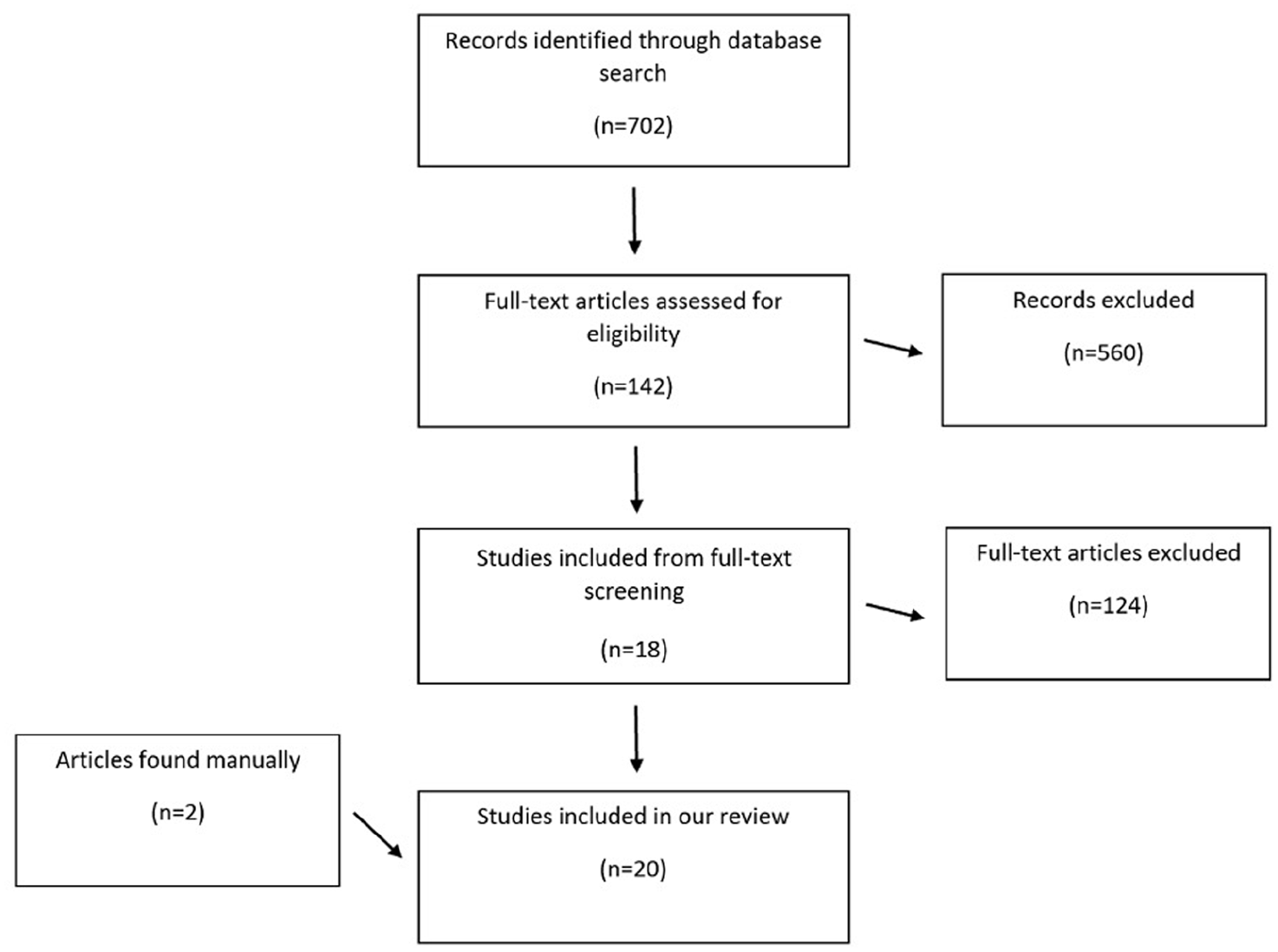
Flow diagram of study selection.
Characteristics of included studies
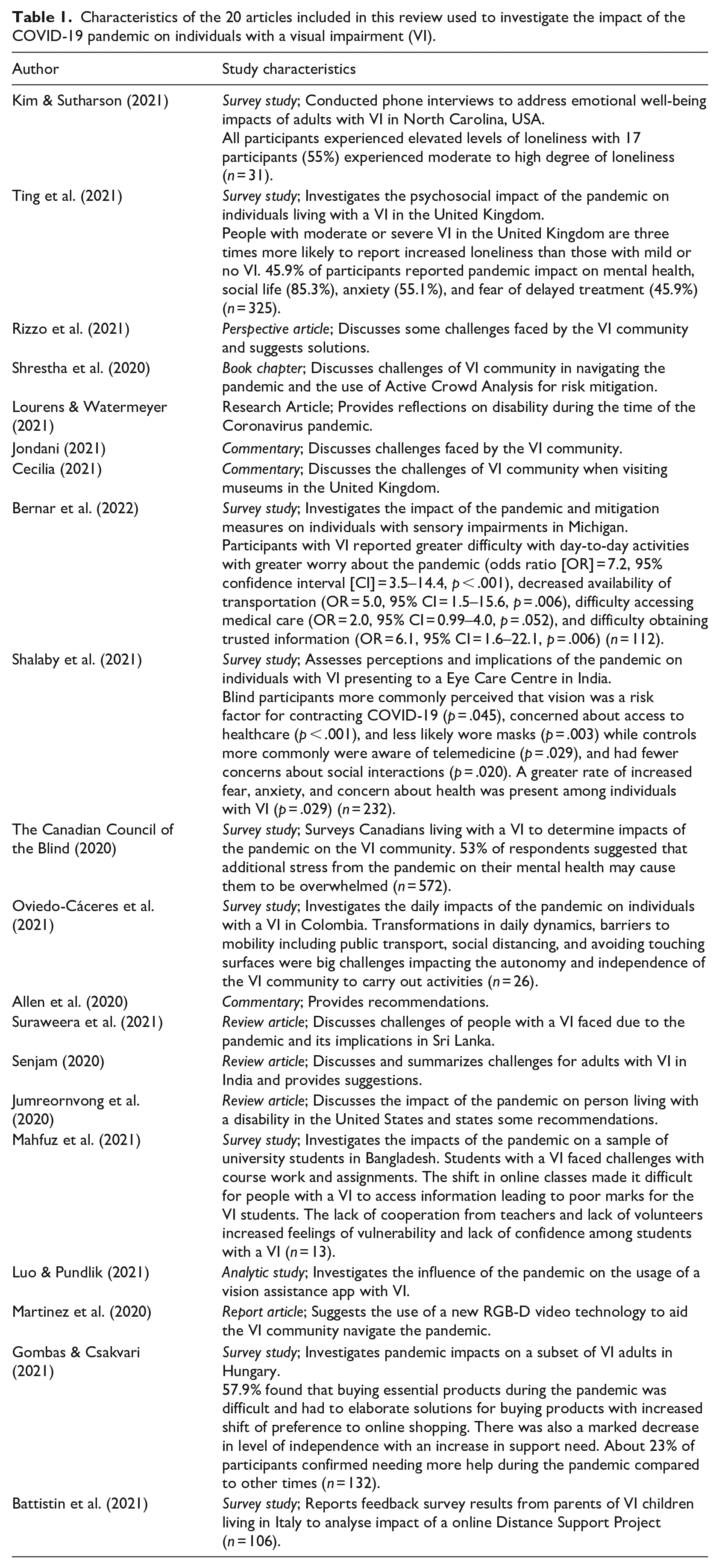
Out of the 20 papers included in our review, 9 were survey studies, 3 review articles, 3 commentaries, 2 book chapters, 1 analytic study, 1 perspective paper, and 1 report article. In eight of the nine survey studies included, online surveys or phone interviews were conducted to primarily assess the impacts of the COVID-19 pandemic on individuals with a VI. Some of the outcomes included psychosocial impact, impacts on ADLs, impacts on leisure activities, isolation, information access, access to healthcare, and self perceptions on contracting COVID-19 virus. Two of the survey studies were conducted in the United States, and one in Canada, India, Hungary, Bangladesh, Colombia, and the United Kingdom. One survey study involved surveying parents of children with a VI to analyse the impact of a support programme implemented during the pandemic as a mitigation strategy. In all three review articles included, authors summarized challenges for the VI community brought by the pandemic. In these papers, the authors also highlight some recommendations to mitigate some of the challenges. The three commentary papers included in this review also highlighted some challenges faced by the VI community. One of these commentaries specifically discussed the challenges faced when visiting museums including the challenge of physical distancing and navigation. In one book chapter and one report article, novel technologies were discussed as mitigation strategies to aid the VI community navigate the pandemic. Table 1 summarizes the characteristics of the papers included in our analysis.
Characteristics of the 20 articles included in this review used to investigate the impact of the COVID-19 pandemic on individuals with a visual impairment (VI).
Discussion
Difficulties of social distancing
It is challenging for individuals with VI to practice social distancing as their visual ability hinders them from maintaining a safe physical distance from other humans (Heidi, 2021; Shrestha et al., 2020). Since maintaining social distancing depends on visual function, people with VIs may accidentally violate this strategy, particularly in crowded places (Jondani, 2021). Individuals with VI are unaware of the newly demarcated directional arrows on the floor of indoor buildings, guide dogs are not trained nor able to assess the new ‘correct’ distance, and canes are not as effective as they tend to be used only as a forward-facing probe (Cecilia, 2021; Rizzo et al., 2021). As a result, they will generally, but unintentionally, end up much closer to surrounding pedestrians than their sighted peers, especially when navigating busy streets, subway platforms, line queues, and so on (Rizzo et al., 2021). Failing to social distance leaves individuals with VI open to criticism which contributes to social stresses experienced (Ting et al., 2021). Studies have shown that individuals with VIs create mental maps or spatial representations of environments in their head to help navigate different settings (Bernar et al., 2022). The introduction of screens, one-way human traffic systems, and new layouts by many businesses and public spaces may disrupt these mental maps making places harder to navigate.
Accessing healthcare
The United Nations (2006) guidelines highlight that providing standard healthcare for all groups of society without any discrimination is the duty of governments and communities (Jondani, 2021). However, according to a survey study by Shalaby et al. (2021), individuals with VI feel that their vision status puts them at a greater risk of contracting COVID-19, and there were serious concerns about access to healthcare. These obstacles were augmented by the forced closure of many health systems and increased dependence on telehealth (Shalaby et al., 2021). A survey study by the American Foundation for the Blind on a population of individuals with VI during the COVID-19 pandemic found that 21% of respondents were concerned about the telehealth platform being inaccessible (Kim & Sutharson, 2021).
Furthermore, additional restrictions have been placed on patient appointments to local eye care centres (Jondani, 2021). Limited availability, as well as accessibility for eye care services during the pandemic, may worsen VI which further increases the severity of a disability (Jondani, 2021). Respondents to a survey done by the Canadian Centre for the Blind (CCB) expressed great concern about accessing a healthcare practitioner, having necessary transportation to medical appointments, setting up telehealth appointments, accessing their ophthalmologist to prevent further vision loss, and to accessing COVID-19 testing sites (The Canadian Council of the Blind, 2020). As COVID-19 vaccination efforts expand, it has become clear that many websites and online registration processes are not fully accessible to those in the low-vision community (Oviedo-Cáceres et al., 2021).
Mental health and social isolation
The emotional distress of the pandemic has adversely affected the mental health of many people. From loss of employment to financial instability, the effects of the pandemic are considerable. In particular, the COVID-19 lockdown has created a negative psychosocial impact on individuals with VI, a demographic that has already been documented to have increased risk of depression, decreased mobility, and higher rates of poverty compared to the general population (Allen & Smith, 2020; Heidi, 2021; Kim & Sutharson, 2021; Suraweera et al., 2021).
In many countries, strict orders were placed for individuals to stay at home during the height of the pandemic. Due to the COVID-19 pandemic, individuals with VI are less likely to maintain an in-person social interaction with other people, leading to social isolation (Kim & Sutharson, 2021). The need for adequate distancing in public spaces and recommendation to minimize physical contact is also difficult for this community as touch represents an important component of building rapport and developing inter-personal connections (Allen & Smith, 2020). Individuals with VI often need the support of others for daily living activities and rely on tactile senses to gather information. Government mandates to social distance and self-isolation have affected both of these support systems (Jondani, 2021).
In the United Kingdom, a 27-item questionnaire was done on 345 individuals with varying levels of VI to assess the psychosocial impact that the pandemic has played on their lives (Ting et al., 2021). The findings illustrated that almost half of the respondents agreed the lockdown has negatively impacted either their mental health or feelings of loneliness. Additionally, 85% reported impact on their social life, 55% felt anxiety with hospital visits, and 45% experienced fear of further sight loss due to delayed review or treatment of their condition.
The American Foundation for the Blind also conducted a survey and found that 59% of respondents believed that their underlying conditions made them feel more vulnerable to COVID-19. Also, 56% had fears related to their ability of practicing social distancing, asking for physical assistance, and using a sense of touch (e.g., using tactile sign language) as COVID-19 is a highly contagious pathogenic viral infection. Meanwhile, 21% were concerned about the telehealth platform not being accessible to people with VI (Shrestha et al., 2020).
As such, there are several well-documented stressors that the VI community face. The pandemic has disproportionately affected this population, and it is therefore important to recognize and provide additional psychosocial support to this vulnerable group during the pandemic (Ting et al., 2021).
COVID-19 impact and information gap
Accessible and specifically designed information for people with VI during the pandemic is limited, posing another challenge for this demographic (Senjam, 2020). Limited information in braille or audio about COVID-19 and its preventive strategies can lead to incomplete information about modes of transmission and techniques for prevention (Shalaby et al., 2021). This makes it difficult for this group to have an accessible emergency preparedness plan and updated health guidelines (Jondani, 2021; Jumreornvong et al., 2020). With rapidly evolving information about the virus, vaccine schedules, and mitigation strategies, it is imperative that the VI community are adequately informed.
Use of technology
The poor accessibility of technology and loss of independence due to the pandemic is another commonly cited issue (Mahfuz et al., 2021). Fortunately, some technological systems are developed and can be implemented to help individuals with VI navigate their surroundings and be more independent. Although some technological platforms are not presently optimized to aid with risk mitigation in the new era of COVID-19, much of what has been developed could be leveraged to successfully aid the VI community. Remote sighted assistance through live video-streaming is one example (Rizzo et al., 2021). ‘Be My Eyes’ is a personal device application which connects individuals with VI and sighted volunteers via a video call (Luo & Pundlik, 2021). Volunteers assist visually impaired people by describing what the user points at with their phone camera. However, this application was found less useful in orientation and mobility (Jondani, 2021). Another technology developed by a group of researchers employs smartphone-based ‘Active Crowd Analysis’ which combines crowd density, distance, and motion analysis to detect the risks associated with nearby crowds and relay this risk to the VI individual through a directional 2D audio (Shrestha et al., 2020). This promising technology utilizes the phone’s native hardware to ensure the VI community can safely maintain social distancing. Another group of researchers developed a wearable system to help individuals with VI maintain safety-critical social distancing. This technology uses head-mounted glasses with an RGB-D camera that combines stereo matching and pattern projection for dense depth estimation and bone conducting headphones to relay audio feedback if a person is closer than 1.5 m (Martinez et al., 2020).
Independence and ADL
Studies have noted that individuals with a VI feel that they have become less independent during the pandemic. The two main barriers that have arisen from the pandemic include the lack of in-person support available and navigating the complexities of new COVID-19 policies and regulations. One particular study found that about 58% of participants with a VI found that shopping for essential product in the pandemic was difficult, with 23% reported increased need of assistance during pandemic when compared to times prior to the pandemic (Gombas & Csakvari, 2021). At the start of the pandemic, many in-person support services were halted. Various demographics that rely on these services were directly impacted and were further restricted by their limited independence (Battistin et al., 2021; Cecilia, 2021). ADLs such as reading braille and going to the grocery store were further complicated by the virus. The risk of infection sparked the concern of reducing contact with physical surfaces. However, for the VI, touch is essential for their perception of their surrounding and to interact with their environment. Individuals with VI rely far more heavily on their sense of touch to support spatial tasks in order to perform their routine activities (Rizzo et al., 2021). With the pandemic, normal tactile cues that were once used were no longer recommended by health authorities. As such, routine ADLs have been complicated and add to the surplus on stressors already placed on this community.
Sanitation concerns
People with VI may be more vulnerable to be infected by the disease as they have more difficulties implementing the preventive strategies against COVID-19 (Senjam, 2020). For example, people with VIs may not be able to locate alcohol-based hand sanitizer dispensers or handwashing stations provided in public places. As such, it would be prudent for people in this group to carry their own hand sanitizers (Jondani, 2021). Furthermore, braille is crucial for this population and is found on signage, elevator buttons, restaurant menus, and elsewhere. However, these surfaces are often touched by many individuals. Information needs to be provided to braille users about the need to sanitize and wash their hands before and after touching braille (Oviedo-Cáceres et al., 2021).
Although we performed a systematic search, all available literature may not have been captured. The use of more databases may possibly have yielded more studies on the topic. Many of these studies were conducted in a very short time frame given the acute onset of the pandemic. Therefore, there have not been many studies investigating the long-term effects of the pandemic on the VI population.
Conclusion
The 20 papers included in our analysis illustrate a multitude of issues pertaining directly to the visually impaired community. The COVID-19 pandemic and associated mitigation measures, such as physical distancing, limiting touch, and personal protective equipment (PPE), pose immense challenges for this community. These diverse challenges can have a direct impact on their psychosocial and economic stability.
Overall, our review revealed a multitude of challenges faced by the VI community. Efforts need to be made to ensure that this demographic is adequately supported and informed about the pandemic. There are various methods that can be implemented including online support, priority vaccination schedules, mental health support, priority shopping or designated hours, and tailored information that is more accessible such as audio formats. There is a crucial need for increased awareness on this issue as the pandemic continues to persist. Future guidelines need to take this demographic into consideration when creating health regulations.
Footnotes
Declaration of conflicting interests
The author(s) declared no potential conflicts of interest with respect to the research, authorship, and/or publication of this article.
Funding
The author(s) received no financial support for the research, authorship, and/or publication of this article.
