




Abstract
The lips and tongue demonstrate similar or greater spatial acuity than the fingertips. Indeed, infants use the mouth to perceive properties of objects such as hardness, texture, and shape. In normal development, it is assumed that mouthing decreases in favour of increasingly advanced hand exploration patterns. However, anecdotal reports suggest that mouthing continues to serve a perceptual function when a person’s vision is abnormal. This study explored blind or visually impaired (BVI) adults’ self-reported use of mouthing to perceive properties of objects. We conducted semi-structured interviews with 20 BVI adults with visual acuities ranging from no light perception to 20/40. Data were analysed using content analysis to identify specific properties perceived by the mouth. Despite social norms that discourage mouthing, some BVI adults use oral tactile perception of texture, shape, temperature, and taste to better characterize objects. These findings suggest that compensatory behaviours using the mouth can support the rehabilitation of individuals with abnormal vision.
Introduction
Touching objects with one’s mouth (oral exploration or ‘mouthing’) is a primary means of tactual exploration and an important source of information for infants (Bushnell & Boudreau, 1991). Mouthing objects is part of typical development, preceding object exploration with hands alone or in combination with visual regard (Schiff & Foulke, 1982). In early development, infants display more complicated actions with the mouth than with the hands (Bushnell & Boudreau, 1993). Infants engage in different patterns of oral responses when exploring or sucking, and with age expend more time exploring (Rochat, 1983). Through mouthing, infants can perceive hardness, texture, and shape, and this object knowledge can be transferred across sensory modalities (E. J. Gibson & Walker, 1984; Meltzoff & Borton, 1979). Furthermore, the actions infants display with the mouth (i.e., cyclically pressing the tongue against the roof of the mouth and drawing it backwards over the surface of the mouthed object), are analogous to the type of hand movements older children use when perceiving texture and hardness with the hands (i.e., pressure and lateral motion) (Bushnell & Boudreau, 1993).
The mouth is equally and sometimes more sensitive to tactile information as the fingertips, and thus unsurprisingly, it is employed for object exploration. Sensitivity to tactile stimulation is higher in the frontal facial region and the hands, with the highest sensitivity located in fingertips and lip borders (Schiff & Foulke, 1982). Skin receptors sensitive to spatial discrimination (e.g., small, sharp borders) are especially densely distributed in fingertips, tongue, and lips (Rosenzweig et al., 1999). Furthermore, the primary somatosensory cortex over-represents (i.e., dedicates more cortical area) the fingers, the lips and the tongue (Rosenzweig et al., 1999; Schiff & Foulke, 1982).
Compared to the fingertips, the lips and tongue demonstrate similar or greater spatial acuity (ability to discriminate features of stimulus configurations like discontinuity, locus on the skin, and orientation) (Stevens & Patterson, 1995). On average, similar to the mean threshold of the fingertip (4–6 mm), the smallest embossed letter perceived with the tongue is 5.1 mm (Essick et al., 1999). Adults discriminate the orientation of tactile gratings at significantly lower thresholds (i.e., finest groove width) with the lip (0.51 mm) and tongue (0.58 mm) than with the finger (0.94 mm) (Van Boven & Johnson, 1994a).
The high spatial sensitivity of the tongue has been utilized for sensory substitution using a tactile display unit (TDU). A TDU displays visual information captured by a camera on the tongue as electro tactile stimulation, which feels to the user like small vibrations (Grant et al., 2016). Using a TDU both sighted and blind subjects are able to detect the orientation of a letter E (Chebat et al., 2007), and early blind individuals can learn to navigate and recognize routes in a virtual task (Chebat, 2010; Chebat et al., 2018). However, this strategy has not become a widespread low vision rehabilitation practice.
Despite the high sensitivity of the mouth, lips and tongue, a transition from oral to manual exploration is viewed as a healthy development that supports children’s ability to perceive object properties, to identify objects, and to use objects for conventional functions (Lightfoot et al., 2009). It is likely that society’s concern with hygiene is a strong motivator for discouraging mouthing beyond early infancy. In typically sighted (TS) children, mouthing decreases between 6 and 12 months of age while hand exploration increases (i.e., holding, fingering, manipulation with visual regard, and differentiated exploration patterns depending on the type of object) (McCall, 1974; Ruff, 1984). With age, hand exploration changes in ways that expand children’s perception of object properties (Bushnell & Boudreau, 1993). For instance, children start to use fingering to explore texture, and rotation to perceive shape (Ruff, 1984). Also, more thorough and systematic manipulation of objects correlates with object recognition (Hoop, 1971). By expending more time exploring objects with their hands, infants develop fine motor skills needed to use objects according to their conventional functions (e.g., scribbling with a crayon rather than mouthing it); a critical aspect of cognitive development (Bigelow et al., 2004). Whereas in early infancy mouthing is not only allowed and viewed as positive behaviour, at later ages mouthing is viewed as abnormal and deemed ‘stereotypical’, that is, rigid, invariant, and lacking functional purpose (Cunningham & Schreibman, 2008).
Are there benefits to using the mouth to perceive object properties beyond infancy? Evidence from children and adults with blindness or visual impairment (BVI) suggest that mouthing continues to be a useful means for object perception beyond infancy. Some BVI children continue to explore objects with the mouth until later ages than TS peers (Fraiberg, 1977; Schellingerhout et al., 1998; Warren, 1984). Many professionals serving children with BVI presume that the mouth remains the most important exploratory system in these children’s first few years of life (Schellingerhout et al., 1997). Indeed, mouthing may allow children with BVI to continue object exploration and perception that would not be possible otherwise, whereas TS children typically decrease in mouthing due to a gain of information obtained through an increase in visual-manual exploration, refraining from mouthing would lead to a loss of information for BVI children due to the lack of advancements in their visual–manual exploration (Schellingerhout et al., 1998). A few accounts of BVI adults’ use of the mouth for perception have been reported. For example, a blind student used her tongue and lips to dissect flowers and get an exact idea of the anatomy (Villey, 1930). Also, some BVI adults find it easier to read braille with their lips than with their fingertips (https://edition.cnn.com/videos/world/2013/07/17/vo-hong-kong-blind-girl-braille-lips.cnn).
Is mouthing for object perception a widespread phenomenon in BVI adults? The limited available evidence suggests that despite likely discouragement from caregivers/practitioners, some BVI adults employ the high sensitivity of the mouth to perceive properties of objects. However, it is unknown whether these are rare and isolated cases. In addition to congenitally BVI individuals, vision loss is common among older adults (Crews & Campbell, 2004). Given that with age tactile spatial acuity at the fingertips deteriorates faster than at the lips (Stevens & Patterson, 1995), the role that the mouth can play in compensatory strategies is particularly relevant in older adults.
This study systematically investigated the mouthing behaviour of BVI adults using a semi-structured interview that explored: (1) to what extent they use oral tactile exploration to perceive properties of objects, (2) which object properties were explored with the mouth, and (3) if mouthing behaviour was linked to visual impairment (i.e., visual diagnosis) or socio-cultural characteristics (i.e., education level, employment status).
Methods
The Wichita State University Institutional Review Board Institutional Review Board approved the study’s protocol. All participants gave informed written consent (Williams, 2008).
Participants
Given the exploratory nature of this study, sample inclusion criteria were broad and included adults age of >18 with VI of any degree and aetiology. Recruitment was done by contacting (in person, by phone, e-mail, flyer) BVI adults who were clients and/or employees of Envision (a non-profit organization that serves and employs the BVI population). Potential participants were informed about the study before consenting to participate. Participants were compensated with a $50 gift card.
Twenty BVI adults (mean age = 48.6 years, range = 25–91 years, 15 females) participated in interviews. Several visual diagnoses were represented in the sample, the most common being retinitis pigmentosa (N = 5), followed by retinopathy of prematurity (N = 2) and Peter’s Anomaly (N = 2). Visual acuity (VA) ranged from no light perception to 20/40. Most (N = 13) participants reported improved vision with increased contrast. More than half of participants reported experiencing BVI onset as a child (N = 13), most commonly at birth (N = 9), and the oldest age of BVI onset occurring was 81 years. Years living with BVI also ranged widely, with the shortest time span reported at 2 years and the longest span at 67 years.
Ten participants attended college for several years: five completed a Master’s degree, three obtained a Bachelor’s degree, and two completed high school. Eleven participants were employed, seven had retired, and two had never held a paying job. Eleven participants were Caucasian, four African American, two Native American, one Hispanic, and two had more than one race.
Interview methodology
We designed a semi-structured interview protocol with standard questions posed to all participants, and probing questions asked based on interviewees’ responses to further explore topics (Creswell, 2009).
To investigate BVI adults’ use of oral tactile exploration for object perception, we asked questions to determine whether participants used the mouth for perception; which properties they perceived in this way; and which specific parts of the mouth they utilized. Participants were told that ‘the mouth’ could refer to any of its components individually (e.g., tongue), or a combination of them (e.g., tongue and lips). This section of the interview had 11 standard questions and 8 probe questions.
To explore relationships between mouthing and BVI adults’ visual and socio-cultural characteristics, participants were then asked about their VI (e.g., visual diagnosis, visual abilities) and socio-cultural background (e.g., education level, employment). This section of the interview had 30 standard questions (see supplemental material Interview protocol for the full interview).
The first author conducted all interviews. Thirteen participants chose to interview in person at the Envision Research Institute, in a private room where only interviewer and participant were present. Seven chose to interview over the phone (only the interviewer was present in the room). Participants read the consent form, or had it read to them, before providing consent. In-person interviewees signed the consent form while over the phone interviewees provided oral consent. Interviews lasted between 15 min to 1 hr, with variance from the fact that participants who reported using the mouth for object perception were asked more questions than those who did not.
Data analysis
Using content analysis, the transcribed interviews were analytically examined and their content described first by generating codes, and then condensing these codes into a smaller number of categories (Vaismoradi et al., 2013). Due to the scarcity of research on BVI adults’ use of mouthing for object perception, we used an inductive approach in which codes/categories were derived from the data themselves (Braun & Clarke, 2012). Data analysis consisted of the following: (1) Interviews were transcribed verbatim and read through several times for thorough understanding of their content. (2) Within the transcribed interviews, blocks of texts (meaning units) with information relevant to this study’s questions were identified (Campbell et al., 2013). (3) Each meaning unit was labelled with a code at a semantic level, that is, they described the content of the data (Braun & Clarke, 2012). (4) Codes were clustered into higher level sub-categories and categories. The development of categories (but not more abstract themes) condensed the content of the data while still providing a broad description of BVI adults’ use of the mouth for object perception. These analytic steps involved discussions among researchers until they reached agreement/consistency in identifying/defining a final set of codes and categories.
A data file containing all units identified for each interview question was created (total of 16). Twelve of the 16 data files had more than one possible code and were coded independently by two coders (first and fourth author). The remaining four data files had one code each and therefore were only coded by the first author during the generation of the coding system. Coding was done using Mangold’s INTERACT (http://www.mangold-international.com).
Responses about participants’ vision and socio-cultural characteristics were transcribed and summarized in aggregate (e.g., how many participants were BVI since birth). To compare responses from participants that reported mouthing behaviour (‘Yes’ group) and those who did not (‘No’ group), answers to these questions were tabulated separately for each group.
Reliability statistics
To measure reliability, Cohen’s kappa was calculated for each question (i.e., considering all the question’s codes). To assess reliability on individual codes within a question, kappa was calculated for each code by identifying the code and grouping all others into ‘other’ code. These calculations were done using Mangold’s INTERACT. Kappa values range from −1 to 1 and usually fall between 0 (coders’ agreement is no better than what is expected by chance) and 1 (perfect agreement). For each code, the coder’s accuracy (0.9 or 0.95 is considered adequate) was estimated by taking into consideration the code’s base rate and the obtained kappa as described in Bruckner and Yoder (2006). In eight questions, coders obtained kappa = 1, and for all codes, a coder’s accuracy = 0.99. In four questions, kappa ranged from 0.64 to 0.87, and coder’s accuracy was between 0.85 and 0.9 and above 0.99 (see supplemental material Reliability results for further details).
Results
Mouthing behaviour in BVI adults
Nine out of 20 participants reported using the mouth to perceive properties of objects (‘Yes’ group) and 11 did not (‘No’ group). We report results from the content analysis of the Yes group’s interview responses. Table 1 shows how codes are clustered within sub-categories and categories.
Study codes, sub-categories, and categories.
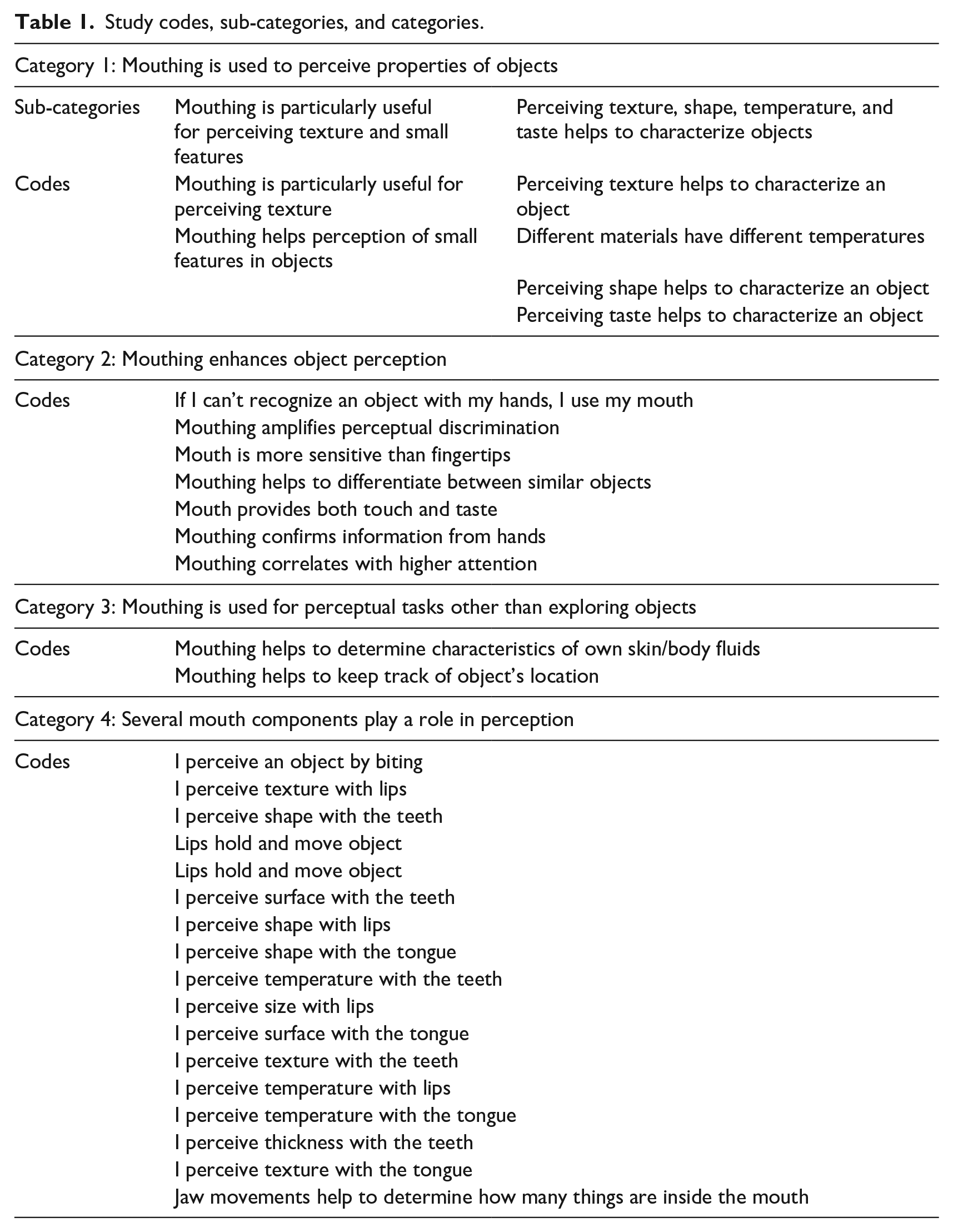
Category 1. Mouthing is used to perceive objects’ properties
Participants reported mouthing in specific situations that had a clear perceptual goal and result. This indicates that mouthing is deployed for perceptual tasks for which the mouth shows advantages over hand and or (residual) vision exploration.
Subcategory 1.1. Mouthing is particularly useful for perceiving texture and small features
Texture was the only property that all participants reported perceiving using the mouth, which allowed them to determine other aspects of the object, such as what material it is made of. A participant reported, Different types of rough textures I feel are more sensitive to pick up with the lips and tongue. Say for example that they are different types of paper. I can’t remember when doing woodwork, I ever tasted the sandpaper, but I suspect that I pressed against my lips.
Perception of small objects and details were also mentioned as tasks for which the mouth was especially useful. A participant reported, ‘I like to do jewellery and I cannot see the holes in the very small beads . . . I do use my teeth and my tongue to find the different surfaces . . . where the hole is’. Another participant explained, I might bring it [cable] to my lips if I can’t feel it with my fingers, to feel the raised dots that are on the micro USB cable . . . that tells me not only what kind of connector it is but which way it will go into the connector itself.
Subcategory 1.2. Perceiving texture, taste, shape, temperature with the mouth helps to characterize objects
Participants reported that perceiving differences in texture with the mouth helped them determine an object’s identity. A participant recalled identifying the duct tape by noticing that
. . . when you go to cut it apart or pull it apart it has like these . . . little threads so that was what I was looking for when I stuck it to my mouth . . . because regular tape is smooth and duct tape is thread.
Likewise, participants reported that perceiving taste helped them to identify an object. One participant recalled, I think the taste of minerals and what you get out of that is very interesting . . . I remember in like high school, geology class, and they’ll be passing the samples out, and I tried to figure out when nobody was looking . . . so I could taste the rock samples.
Exploring shape with the mouth was also described as useful for object perception. A participant recalled, Sometimes my son will bring me toys and he’ll ask me to fix them and I won’t be able to tell with my hands so I’ll use my tongue to find the broken pieces and I can fix them that way.
Temperature was described as a property that varied depending on the type of material. As one participant explained, ‘. . . certain material carries a certain temperature even if it’s room temperature . . . I think aluminium always has a cold feel to it, I think wood can be more room temperature’.
Category 2. Mouthing enhances object perception
Participants reported ways in which mouthing increased their perception of properties and situations where the mouth is more sensitive than the fingertip. A participant explained, To me it [tongue] gives more of a sensitivity. Let’s say you have an object that is ridged, well, it’s not necessarily always that my fingers are going to pick it up. The tongue seems more sensitive to ridges, bumps, lumps.
Participants mentioned that the relatively higher sensitivity of the mouth was influenced by the effect of manual activities on the fingertips’ sensitivity: specifically, braille reading, ‘. . . if I read braille for long periods of time my fingertips go numb . . . so that’s when I put something to my lips’, and guitar playing:
. . . if I am looking for an HDMI cable then I would have to [bring to the lips], there is a slight difference in the way that end feels and I may not be able to tell with my fingers because my fingers are callous up from playing guitar.
The fact that, unlike the hand, the mouth perceives taste, was mentioned as a perceptual advantage of the mouth. A participant explained, I think it’s because it is used to taste food and it has more not nerve endings per se, but it is more accustomed to getting the perception that we need . . . because can you now use the taste buds.
Participants described that objects’ features felt larger when explored with the mouth, compared to the hand, suggesting that mouthing allows one to perceive in greater detail information that otherwise would be perceived in a coarser way. A participant explained, When I use my hands I get a blanket feel and it’s just like if you are standing in a room and everybody is talking at once you can’t pick out individual voices, but when I use my mouth I can get more feedback and so I can pick out individual voices. Like if I held a screw in my hand I would just get the fact that it’s a screw . . . but when I put it in my mouth I can tell that it’s a Phillips head screw, it has a cross pattern in the top, there’s so many ridges, so many turns . . .
Participants reported using mouthing over hand exploration when they had to differentiate between similar objects that shared several features. A participant explained, Like. . . spoons and forks, and if I can’t tell the weight difference, I will stick it in my mouth . . . Because if they weigh the same amount, you have to touch the end of it to see which one it is. And instead of feeling all over it, I’ll just stick it in my mouth to determine if it is pokey or smooth.
Participants described situations in which they perceive with the hand but they only feel certain after confirming with the mouth. A participant stated, ‘. . . my hands say its plastic but it might not be so I stick it up to my mouth and I use my tongue and my teeth and I chew on it just to make sure’.
Participants also reported that while mouthing they devoted more attention to the object. A participant explained, ‘. . . when something goes into your mouth you pay attention more . . . I think it is more the attention to detail that is paid’.
Category 3. BVI adults use mouthing for perceptual tasks other than exploring objects
Participants reported that the mouth was more helpful than the hand for perceiving the state of one’s skin and bodily fluids. A participant stated, ‘. . . if you get cut of course you have to put it toward your mouth to see how significant is the cut, is it a light cut or is it a deep cut, how much are you bleeding’. Participants also reported holding objects in their mouth as a way to keep track of their location, as in the following account: ‘. . . if I’m working with the piece of wire, I’ll just hold it with my teeth so that I don’t put it down and can’t find it again’.
Category 4. Several mouth components play a role in perception
The most commonly reported parts of the mouth used for object perception were first the tongue (N = 9), followed by the lips and the teeth (N = 6). Participants reported using the tongue, the lips, and the teeth to perceive texture, shape, and temperature. For instance, a participant stated using teeth: ‘. . . to see if it [something] was real wood or if it was plastic . . . I can bite into wood, I can’t bite into a hard plastic’. Fewer participants mentioned saliva, which was reported to help perceive taste, and identify objects because some objects generate more saliva than others. The least mentioned component of the mouth was movement of the jaw, which was reported to help determine how many things are inside the mouth.
Mouthing behaviour and participants’ characteristics
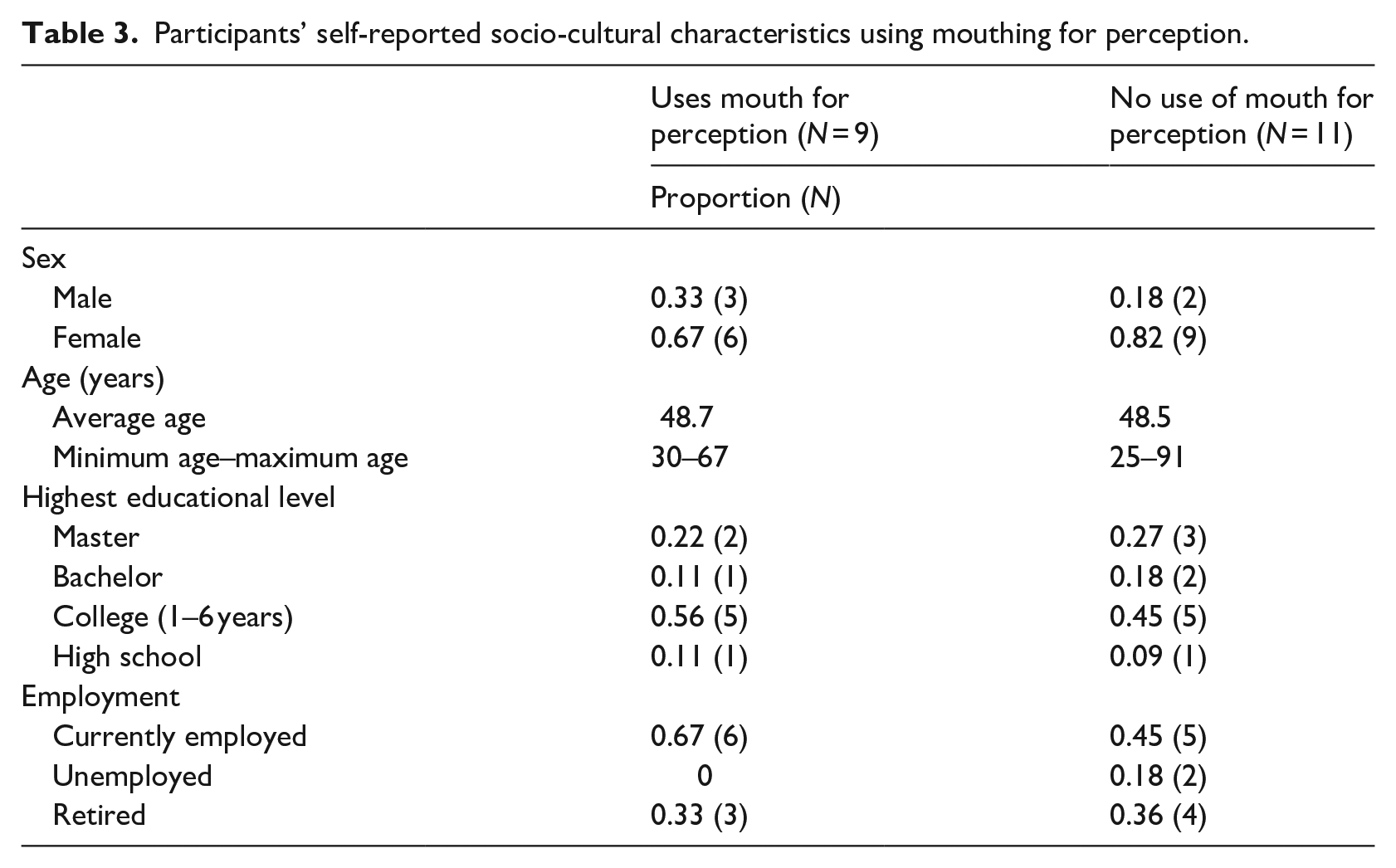
Given the current study’s sample size and self-report methodology, the comparison of the characteristics of the Yes and No group participants is only exploratory observations. No notable differences were found between the groups with respect to several variables including age, years living with BVI, and educational level. Some interesting biases found between the groups are worth further investigation with larger sample sizes. For instance, a higher proportion of participants were BVI since birth in the Yes versus No group, and total blindness (no light perception) was only found in the No group, whereas in the Yes group the lowest level of vision was light perception. Also, although similar proportions of participants in both groups reported having undergone training in braille, a lower proportion in the Yes group reported actually using braille. The comparisons between groups are shown in Tables 2 (visual characteristics) and 3 (socio-cultural characteristics).
Participants’ self-reported visual impairment characteristics using mouthing for perception.
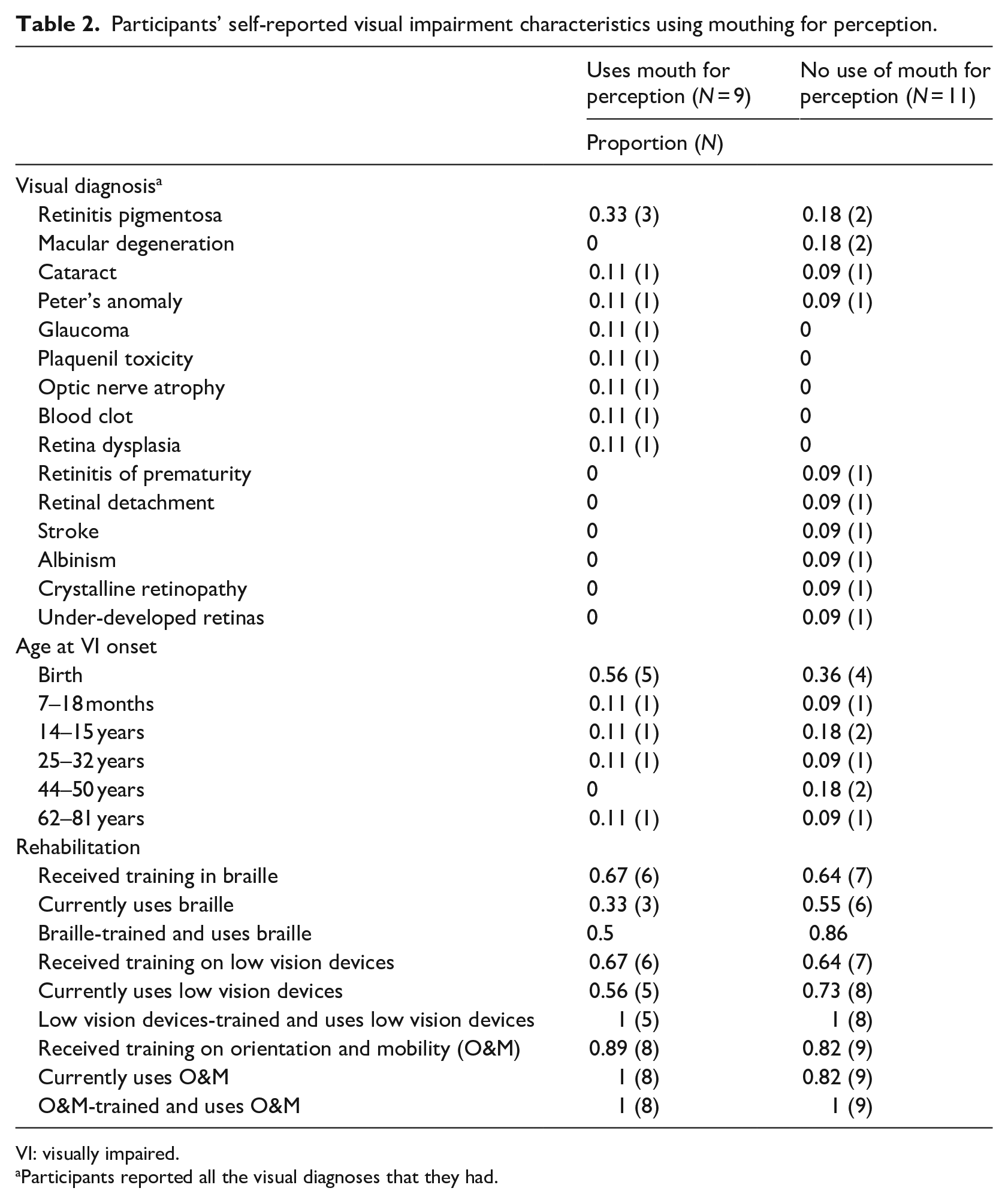
VI: visually impaired.
Participants reported all the visual diagnoses that they had.
Participants’ self-reported socio-cultural characteristics using mouthing for perception.
Discussion
While social norms discourage exploring objects by mouth as adults, our findings suggest that the mouth may be useful for perceiving features, such as texture, temperature, taste, or material, and ultimately identifying and characterizing objects. In particular situations, the mouth may even be preferred over the hand. Participants also reported sometimes using a combination of mouth and hands, for example, first perceiving a feature with their hand, and confirming with their mouth. The fact that BVI adults engage in mouthing despite strong social pressures against it suggests that mouthing behaviour affords significant perceptual gains.
Previous research on tactile perception has demonstrated that touch is especially suited to perceive textures, particularly finer ones (Heller, 1989), and that an object’s identity can be determined by its texture using finger exploration (J. J. Gibson, 1962). Our results suggest that the same can be said about oral tactile exploration, with all Yes group participants reporting perceiving texture by mouth. Furthermore, our finding that the mouth is superior to the finger for perceiving texture in certain situations is in line with the previously reported higher spatial acuity in the lips/tongue, as compared to the fingertip (Van Boven & Johnson, 1994a).
Previous research indicates that tactile perception is especially suited for encoding what objects are made of (Bushnell & Boudreau, 1993). In line with this, our participants reported perceiving several features (texture, temperature, taste) with the mouth which helped them determine an object’s material. There is evidence that tactile perception with the hand, particularly of cold materials, helps to identify an object’s material (Schiff & Foulke, 1982). Our results indicate that this is also the case with tactile perception using the mouth. Differently, our finding that BVI adults use the mouth to perceive shape contradicts the previously proposed idea that touch may be less useful for perceiving shape, compared to ‘substance qualities’ such as texture (Heller, 1989).
It is noteworthy that participants pointed to taste as useful for identifying objects or materials. In fact, participants suggested that the most straightforward advantage of the mouth is its capacity to perceive taste. We did not foresee this and did not include taste in our probe questions. This speaks to the different features that typically sighted versus BVI individuals use to identify and characterize objects.
Participants noted that features other than taste (e.g., texture, shape, edges, material) can be perceived by the hand, but in some situations (i.e., exploring small objects or parts of objects), the mouth is superior to the hand. The mouth’s perceptual superiority partly arises from the enhanced perception it affords. This confirms previous subjective reports that objects feel larger when explored inside the mouth versus on the hand (Schiff & Foulke, 1982). Overall, our results suggest that BVI adults use the mouth to obtain unique (e.g., taste) or additional (e.g., finest texture) information, whose perception with the hands is either not possible or limited. Thus, BVI adults use mouthing behaviour to fill a perceptual gap.
Our exploratory comparison of the Yes and No groups highlights questions worth exploring with larger samples. The high tactile acuity of the fingertip has been compared to the high VA of the macula. By analogy, it could be said that the fingertip, and we would add the tongue and lips, is the ‘macula’ of the skin. If mouthing behaviour is more likely to happen when finest VA is impaired, we would expect diseases that impact the macula, such as Macular Degeneration, to be more represented in BVI adults that use mouthing for object perception. However, no participants in the Yes group had Macular Degeneration. Similarly, mouthing behaviour may be more likely when vision is more impaired. Contrary to this, total blindness was only represented in the No group in our sample. Only impaired visual field was found at higher rates among the Yes group, with fewer participants in the Yes group reporting full visual fields, compared to the No group.
Age at BVI onset may also relate to adult use of mouthing for object perception, with earlier BVI onset leading to a greater likelihood of mouthing as an adult. Presumably, adults who were visually impaired as children would not experience improvements in visual–manual exploration that would promote a decrease in mouthing. In line with this hypothesis, we found a higher proportion of BVI since birth in the Yes group, compared to the No group.
Finally, fingertip sensitivity may also play a role. In our sample, although similar proportions of participants across groups received braille training, a smaller proportion of the Yes group reported actually using braille. A participant in the Yes group described that he could not learn braille due to fingertip insensitivity. These observations suggest that participants who did not have sufficient fingertip sensitivity to use braille were more reliant on using mouthing for object perception. Relatedly, participants who used mouthing behaviour mentioned that certain activities, including braille reading, rendered their fingertips less sensitive.
Our study findings suggest that exploring objects with the mouth may be a useful compensatory skill for the rehabilitation of people with BVI. The training of mouthing behaviour is supported by the finding that tactile acuity with the lip improves with training (Van Boven & Johnson, 1994a). Our findings are also relevant to the rehabilitation of children with BVI. Current clinical practices discourage mouthing beyond infancy. Our findings bring these practices into question. Could it be that when vision is abnormal during infancy, mouthing plays a bigger role in object perception? The visual system continues to develop after birth (Teller, 1997), a development that may play a role in the decrease of mouthing in typically sighted children. Recall that in typically sighted children, as mouthing decreases, visual regard of manual object manipulation increases. It is possible that as the developing sense of vision allows for better perception, properties of objects such as texture and shape commence to be perceived preferentially and more efficiently using vision rather than tactile oral perception. And that when abnormal vision prohibits such perceptual improvements, BVI infants continue to rely on mouthing to detect and identify objects and their properties.
Our study has several limitations. The sample size is small and does not allow for generalizations to the population of BVI adults. The sample’s visual and socio-cultural characteristics were collected based on participants’ reports, which is a less reliable source than medical and other institutional records. The interview methodology used does not allow for direct observation of mouthing behaviour which could provide insights into mouthing behaviour beyond what participants are themselves aware of.
In summary, this study demonstrates that some BVI adults explore objects with the mouth, mainly with the tongue, the lips, and the teeth, in order to perceive specific object properties: chiefly texture, temperature, taste, material, shape, and edges, which ultimately helps these adults to identify and characterize objects.
Supplemental Material
Interview_protocol – Supplemental material for Tactile perception by mouth: Perceiving properties of objects when vision is impaired
Supplemental material, Interview_protocol for Tactile perception by mouth: Perceiving properties of objects when vision is impaired by Andrea Urqueta Alfaro, Laura Walker, Chris Lee and Daisy Lei in The British Journal of Visual Impairment
Supplemental Material
Reliability_results – Supplemental material for Tactile perception by mouth: Perceiving properties of objects when vision is impaired
Supplemental material, Reliability_results for Tactile perception by mouth: Perceiving properties of objects when vision is impaired by Andrea Urqueta Alfaro, Laura Walker, Chris Lee and Daisy Lei in The British Journal of Visual Impairment
Supplemental Material
Supplemental_materials_list – Supplemental material for Tactile perception by mouth: Perceiving properties of objects when vision is impaired
Supplemental material, Supplemental_materials_list for Tactile perception by mouth: Perceiving properties of objects when vision is impaired by Andrea Urqueta Alfaro, Laura Walker, Chris Lee and Daisy Lei in The British Journal of Visual Impairment
Footnotes
Acknowledgements
The authors gratefully acknowledge the contribution of the study participants.
Author’s note
Because this study analyses qualitative data and the participants did not consent to have their full transcripts made publicly available, excerpts of data are available upon request. Please contact Dr. Andrea Urqueta Alfaro at
Declaration of conflicting interests
The author(s) declared no potential conflicts of interest with respect to the research, authorship, and/or publication of this article.
Funding
The author(s) disclosed receipt of the following financial support for the research, authorship, and/or publication of this article: This work was supported by the LC Industries Fellowship.

Supplemental material
Supplemental material for this article is available online.
References
Supplementary Material
Please find the following supplemental material available below.
For Open Access articles published under a Creative Commons License, all supplemental material carries the same license as the article it is associated with.
For non-Open Access articles published, all supplemental material carries a non-exclusive license, and permission requests for re-use of supplemental material or any part of supplemental material shall be sent directly to the copyright owner as specified in the copyright notice associated with the article.
