



Abstract
There is evidence that completion of criminal justice interventions, including family interventions, is an important factor in efforts to reduce reoffending amongst young people, with completers generally having better outcomes, including lower recidivism rates and non-completers having poorer outcomes. Knowledge about what contributes to program completion may help to improve completion rates and, in turn, outcomes for young people and their families. This article reports on a family work intervention offered to young people under the supervision of youth justice and their families in New South Wales, Australia. Completers had significantly lower recidivism rates than non-completers. Several factors relating to completion were identified, including where the family work was undertaken, the age of the young person, program fidelity, and the presence of two adults in the family-work sessions.
Introduction
Numerous studies have shown that family is a crucial factor in youth offending (e.g. Wareham et al., 2009), with Hoge and Andrews (2003) recognising family circumstances and parenting as one of the eight criminogenic risk factors in their Youth Level of Service/Case Management Inventory 2.0 risk assessment instrument (YLS/CMI 2.0). On this basis, a number of different family interventions have been designed to help address family relationship issues and to improve or strengthen family relationships in order to address the issue of youth recidivism (e.g. Sexton and Turner, 2010).
Many studies have also found that youth justice services can effectively reduce the rate of recidivism of young people by addressing family dysfunction (e.g. Farrington et al., 2022; Salisbury and Van Voorhis, 2009; Turner et al., 2007; Wareham et al., 2009). Functional Family Therapy (FFT), Multisystemic Therapy (MST), and Multidimensional Family Therapy (MDFT) are well-known interventions within the field that have been used to address youth offending behaviours by strengthening family relationships (Celinska et al., 2015; Sexton and Turner, 2010; Van Der Pol et al., 2018). Meta-analyses and systematic reviews have also highlighted the effectiveness of family work in supporting the recovery and social reintegration of young people, including substance use prevention programs (Alarid et al., 2012; Farrington et al., 2022; Van Ryzin et al., 2016; Yoder et al., 2015).
It is also evident that non-completers of youth justice interventions generally do worse than control groups (Henwood et al., 2015). For example, a systematic review of adult anger management programs found completion rates varied between 28% and 78% and concluded that: All the studies that included the non-completer groups found that reconviction was higher for these groups than for the control groups (Henwood et al., 2015: 287).
While the research suggests that youth justice interventions, including family-based interventions, may be effective, those who drop out are likely to have poor outcomes and dropouts appear to be common. There are, therefore, clear advantages in understanding the factors associated with program completion, as this may in turn help to enhance completion rates in the future.
This study aims to examine the factors associated with completion and non-completion of a family work intervention with young people under the supervision of Youth Justice in New South Wales. A previous article (Trotter et al., 2020) reported significantly lower recidivism rates for completers in comparison to non-completers, with 16% of completers being sentenced to custody within two years following completion of family work compared to 43% among the non-completers. This article firstly provides a literature review relating to the relevance of working with families in youth (or juvenile) justice and factors relating to completion rates. It then outlines the aims, methodology and results of the study and provides a discussion regarding the results.
The terms completion and non-completion are used throughout the article. Completion is defined as completing the number of sessions initially identified as required for the intervention (at least 4 sessions in our study) and a judgement by the providers of the intervention that it has been completed. Non-completion refers to dropping out of or discontinuing the intervention prior to the required or recommended number of sessions, and a judgement by providers that the intervention has not been completed.
Literature review – factors associated with completion of family-based interventions in youth justice
There is some literature regarding completion rates of therapy in youth justice which suggests that termination of a therapy may be explained as a ‘processual phenomenon’ whereby people choose to drop-out from therapy due to a multitude of contextual factors including discontinuation of another participant, motivations towards change and attitudes to the treatment being offered (Chwal et al., 2014: 43). Nevertheless, some studies have identified specific factors associated with completion. For example, Loeb, Waung and Sheeran's (2015) study on the individual and familial variables for predicting successful completion of a Juvenile Justice Diversion Program in Michigan in the United States, suggested that client characteristics such as aggressive behaviours, academic performance, diagnosis of ADD/ADHD, and youth misbehaviour in the home were key predictors of program completion and non-completion. Previous counselling or treatment experiences were also identified as factors. Belciug et al.'s (2016) study on a Juvenile Diversion Program in Texas demonstrated that young people aged 17–25 years who had both high goal commitment and solution-building skills were more likely to complete the program. The presence of physical, sexual abuse, and/or neglect is also a common factor identified within the literature that has been associated with failure to complete interventions in comparison to those who have no history of abuse/neglect (Loeb et al., 2015; Ryan et al., 2013). The issue of age and the maturity of the participating young person has been raised in the research literature, with some studies linking the age to program attrition. Kraemer et al. (1998) study regarding program completion in a residential sex offender program found that age was a predictive variable, which was consistent with the study undertaken by Carl et al. (2020), who found that younger age at admission to the program was linked to program attrition in a residential youth therapeutic unit.
Some studies have also specifically considered completion and non-completion of family-based interventions. An exploratory study of a Family Violence Intervention Program (FVIP) (Nowakowshi and Mattern, 2014) found that a prior arrest for juvenile violence was linked to program non-completion. Additionally, Celinska et al. (2015) found that the level of program satisfaction for parents and youths was related to family therapy program completion, although they found that parents reported more satisfaction with both the program and therapist in comparison to young people. Some studies have highlighted the importance of the workers’ skills within intervention programs and adherence to a particular model of intervention as another factor related to program completion. Studies on functional family therapy (FFT), for example, have suggested that it is only effective in reducing recidivism of young people when the workers adhere to the treatment model (Baglivio et al., 2018; Sexton and Turner, 2010).
In summary, the literature suggests that completion of programs for justice-involved young people may be related to the characteristics of the young people involved in the programs, previous experiences of treatment, workers' skills, and the extent to which the intervention is delivered in a way that is consistent with the treatment model being used. On the other hand, as Johnson-Kwochka et al. (2022) point out, publication bias may make it difficult to determine the levels of dropouts from interventions and the reasons for dropping out. There have been relatively few studies considering completion and non-completion rates for family interventions in youth justice, and those that have been undertaken have been mostly in the United States or the United Kingdom. Also, those that have been done have not considered factors such as the location of the family work, which family members are involved, or continuity of workers. This study examines these and other factors in a study undertaken in New South Wales, Australia.
Methodology
The aim of this study was to explore factors that relate to completion and non-completion rates of justice-involved young people and their families participating in a Collaborative Family Work intervention in New South Wales (NSW), Australia. A comparison was made between two groups, completers and non-completers, in order to understand barriers that may inhibit program completion as well as explore factors that may facilitate completion.
The procedure
The project was undertaken in the western region of NSW in Australia, which comprises predominantly rural and remote communities. Youth justice staff in the region provide supervision to young people placed on court orders, including community orders such as probation and supervision orders, or on parole following release from detention centres. A two-day practical training course in Collaborative Family Work (Trotter, 2013) was offered to youth justice staff and staff from a non-government agency. The training course was repeated on a regular basis as new staff were appointed, and regular updates to the training were also offered. Young people and their families were offered a series of 4–10 structured family work sessions. These sessions were carried out by youth justice staff, sometimes with assistance from staff from the non-government agency.
Following the initial agreement to participate in the family work, first from the young person and then from family members, a screening process with the Youth Justice workers and senior staff was undertaken to discuss the suitability of the family (although no families were excluded at this stage). Two workers were then allocated to the family, and prior to the first session, an expert panel involving senior staff, and where possible, an expert in Collaborative Family Work, provided advice to the workers on how they should structure the first session. Following each family work session, the panel de-briefed the workers and provided advice about the structure of the next session. In addition to the de-briefing, the work was supported by documents and resources for use in the sessions.
After deciding to participate in the family work, workers asked family members if they would like to speak with a research officer about the research. If agreeable, the research officer met with both the young person and family members to obtain informed consent, ensuring that both the young person and family understood that they could participate in the family work intervention and were not required to participate in the research. Participation in the research included demographic information, semi-structured interviews with family members and workers, documentation completed by workers following each session, including rating scales used to monitor the progress of the family against identified problems and against general family functioning. Re-offending data was also collected.
Brief program description
The intervention was based on a Collaborative Family Work model (Trotter, 2013), offered under the name of ANTS (Act Now Together Strong), which involves working through a six-step problem-solving model developed by Professor Chris Trotter (2013). The model uses the acronym RIDGES to guide workers and family members through the six steps of the model:
In addition to the problem-solving steps, the model includes strengths-based activities and deliberate reinforcement by workers of pro-social comments and actions by young people and family members (Trotter et al., 2020). The sessions often include strategies such as role-playing, alternative methods of family interaction, or providing structured opportunities for family members to provide positive feedback to each other. The intervention generally took between 4 and 10 weeks, with all family members who wished to be involved.
Ethics
Family members and workers were given an explanatory statement and asked to provide informed consent to be involved in the research by a research officer. The project was approved by Monash University Ethics Committee and by the NSW Youth Justice Research Unit. Consistent with ethics approvals, Professor Chris Trotter provided training in Collaborative Family work and undertook the research in conjunction with Dr Phillipa Evans, where several research assistants were engaged for data collection.
The sample
The study was undertaken in the western region of NSW, which, at the time, was one of four Youth Justice regions in the state. Each session was conducted by two workers, from either Youth Justice or a local non-government organisation. The workers were employed as either Juvenile Justice officers or counsellors. Juvenile justice counsellors had relevant tertiary qualifications, typically in either social work or psychology, and had a counselling or problem-solving role, whereas juvenile justice workers were not required to have tertiary qualifications and were generally expected to focus more on compliance and practical issues. These roles have since been amalgamated into a generic ‘caseworker’ role.
NSW Youth Justice administers court-ordered community supervision to young people, ranging from youth justice conferencing to parole orders (NSW Youth Justice, 2025). Each of the participating 45 young people was overseen by NSW Youth Justice at the time of family work. This included young people participating in Youth Justice Conferencing, a key diversionary program employed in NSW, whereby the young person participates in a single meeting with the victim to develop an outcome plan for the young person to complete to make reparations for the harm caused.
Forty-five families were offered and accepted family work during the period of the study. Most of the family work sessions were conducted in the family home. Over the approximately 7 years of the study, about 245 individual family work sessions and a similar number of panel de-briefing and planning sessions were conducted. A previous publication outlined the results of the study in terms of recidivism, with young people who completed the family intervention having lower recidivism on a range of measures in comparison to young people who did not complete, in comparison to young people who declined to participate, and in comparison to a matched sample of young people who were not offered the intervention (Trotter et al., 2020). As mentioned earlier, 16% of young people who completed the family work intervention were sentenced to custody within two years compared to 43% among the non-completers.
NSW Youth Justice uses the Youth Level of Supervision/Case Management Inventory (YLSI/CMI) to determine a young person's risk of re-offending by assessing 42 items (Hoge and Andrews, 2003). As shown in Table 6, the average YLSI/CMI score for young people in the study who completed the family work was 21.53, which is classified as medium to high risk on the samples on which the Inventory has been tested (Bechtel et al., 2007). YLSI/CMI scores were unavailable for 10 young people: 4 of the non-completers and 6 of the completers group. This is partly because risk assessments were not routinely undertaken on young people who were given youth justice conferencing, and some of those young people were included in the sample.
Of the 45 families who began the family work, 31 families completed the intervention and 14 failed to complete. Twenty-five male clients and six female clients participated in the completion group, and twelve males and two females in the non-completion group. The young people in the sample had committed a range of offences such as break and enter, robbery, assault, car theft, and contravening Apprehended Violence Orders. The family members participating in the sessions included 34 mothers, 12 fathers, 12 brothers, 7 grandmothers, 6 sisters, 3 stepmothers, 2 family friends, and 1 stepfather. The average number of participants in the sessions was 5.1, including two workers and 3.1 family members. Of the 45 young people, 22 (49%) identified as First Nations. This proportion is slightly lower than the average for young people on community-based orders, where 57% identify as First Nations (AIHW, 2024).
As mentioned earlier, 31 of the 45 families who began the family work intervention were judged by the workers to have completed the intervention. In other words, these families had worked through the various stages of the model with workers and undertaken a final session including an evaluation and plans for the future.
Data analysis
This was a retrospective study designed to examine factors relating to completion of the intervention. Data was obtained through several sources: an initial screening form was completed by youth justice staff, including details of the young person, including age, current legal orders, the Youth Level of Service Inventory score, alcohol/drug use, mental health, disability, school attendance, and other agencies' involvement. Data was also collected from an initial family meeting form detailing family dynamics/power balances, family structure, schedule of meetings and venue, facilitators' names. A family session form was completed after each session detailing participants' names, venue, and session date, a summary of the meeting outcome, and debrief panel suggestions.
Each of these data sources was gathered and analysed for this study. Researchers also examined the qualitative data detailed in the family meeting and de-brief session forms completed by the workers, which detailed how the model was being implemented, as well as feedback from the panel. All 31 completers and 14 non-completers were included in the data analysis, although session forms for two of the non-completers were not available. Forms from only the first two sessions were examined, as most of the non-completers undertook only one or two sessions. The first two sessions focused on role clarification and ground rules (session one) and identifying problems (session two). The average number of sessions for the 31 completers was 6.5, whereas for the 14 non-completers it was 2.4.
A measurement scale was developed to assess the extent to which the session notes indicated that the workers adhered to the Collaborative Family Work model. Each session was rated on a five-point scale regarding adherence to the structure and principles of the model. This included workers following the structure as set out in Trotter (2013). The researchers then rated the extent to which these elements of the intervention were documented in the available forms described above. This was rated on a five-point Likert scale ranging from 1 to 5 to determine:
No adherence to the model; Minimal adherence to the model; Some examples of adherence to the model; Numerous examples observed and present in the documentation; Workers clearly adhering to the model, with well-detailed documentation for de-briefing, and suggestions were implemented throughout the sessions.
To receive a rating of 5, the documentation needed to demonstrate that family work was conducted in a manner consistent with the model outlined by Trotter (2013). For example, the session should have included key elements such as setting ground rules, with those rules being established from the family member's perspective. A lower rating would be given if, for instance, the worker set the ground rules on behalf of the family.
Two research officers, familiar with the model, rated each set of file notes. There was a reasonably high level of consistency between the researchers. For example, of the 37 file notes reviewed for session one, the correlation between the researchers was .707 (P .001), and for session two (32 sessions), the correlation was .594 (P .004). Unfortunately, notes were not available for all sessions.
Content analysis (Alston, 2020) was used to examine the factors associated with completion and non-completion of the family intervention. Thematic data analysis was also used to summarise and categorise the qualitative data into themes (Braun and Clark, 2021). The researchers used provisional coding based on issues that the literature review suggested may be related to completion and non-completion. They also looked for themes that may not have been identified in the literature review.
Results
Analysis of worker notes and youth justice records from young people who completed at least two sessions of the family work intervention revealed four elements that were significantly related to program completion: the young person’s age at the commencement of the intervention, where the intervention took place, worker adherence to the model, and the presence of two adult family members in the session. Other elements, such as the risk level of the young person and the worker's absence during the intervention, were not found to be significant.
Age
As shown in Table 1, the mean age of the completers group was 15.52 years and the non-completers group 14.36 years. Seven of the 14 young people in the non-completers group (50%) were over 15 years compared to 21 of the 31 young people in the completers group (71.4%).
Mean age of young people.
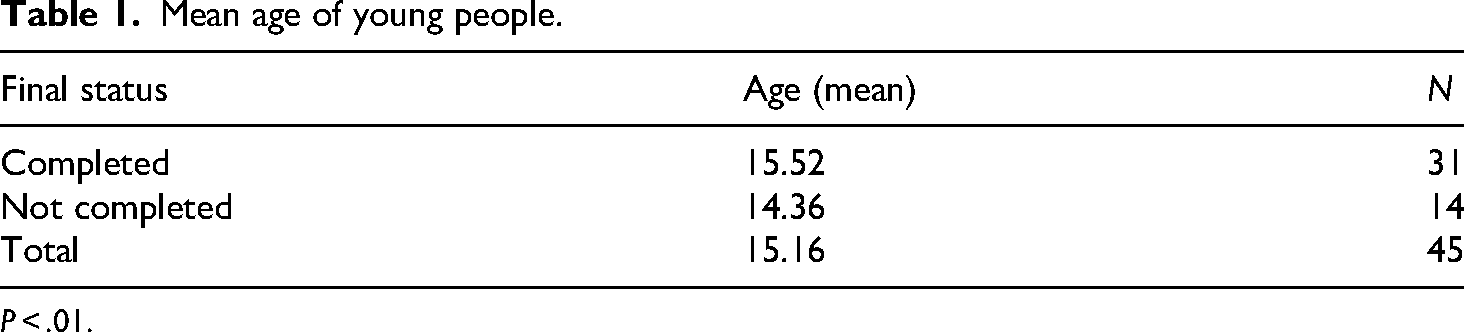
P < .01.
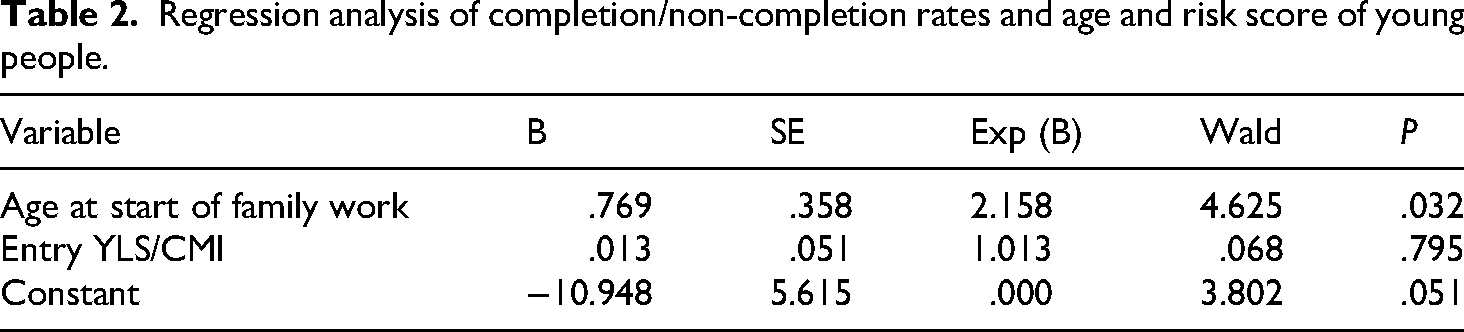
The age of the young person may not have been a substantial factor in determining completion of the family work intervention, given that younger participants tended to present with higher risk levels. However, the difference in risk scores between completers and non-completers, as measured by the Youth Level of Service Inventory (YLS/CMI), was relatively small (mean scores of 21.54 for completers and 22.60 for non-completers). A regression analysis controlling for YLS/CMI risk levels revealed that age remained a statistically significant predictor of intervention completion. This is shown in Table 2.
Regression analysis of completion/non-completion rates and age and risk score of young people.
Location of the family sessions
Family sessions held within the home were related to program completion when compared to sessions held within Youth Justice community offices and/or detention centres. Table 3 shows the differences between the completion and non-completion groups in relation to the setting of the first family session. Thirty-five families undertook their family work sessions in the family home, with 29 of those families completing the intervention (83%). Whereas 10 families undertook the first session in the office or in youth detention, of whom only 2 (20%) completed. One of those completers had the first session in detention but subsequent sessions at home.
Setting of session 1.
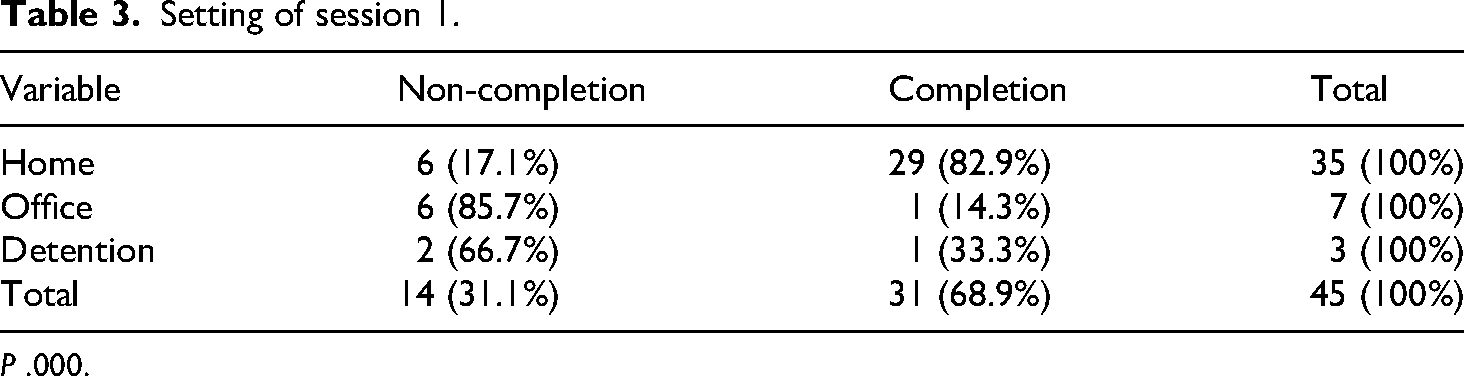
P .000.
The difference between the location of the family work between completers and non-completers was statistically significant even after taking risk into account through a logistic
regression as indicated in Table 4 noting the mean YLS/CMI was actually higher for clients where the intervention was completed compared to those who did not complete as intended (a mean score of 21.54 for completers and 22.60 for non-completers).
Regression analysis of the location of family work and risk.

Treatment fidelity
As previously described, session notes were examined to determine the extent to which workers adhered to the model for sessions one and two. The mean of worker adherence to the model for session one was rated 4.52 for the completer group and 4.33 for the non-completer group. In other words, researchers assessed that workers generally adhered to the structure of the model for session one, with little difference between the two groups (Table 5). There was, however, higher adherence by workers in the second session, where families completed the intervention.
Treatment fidelity score.
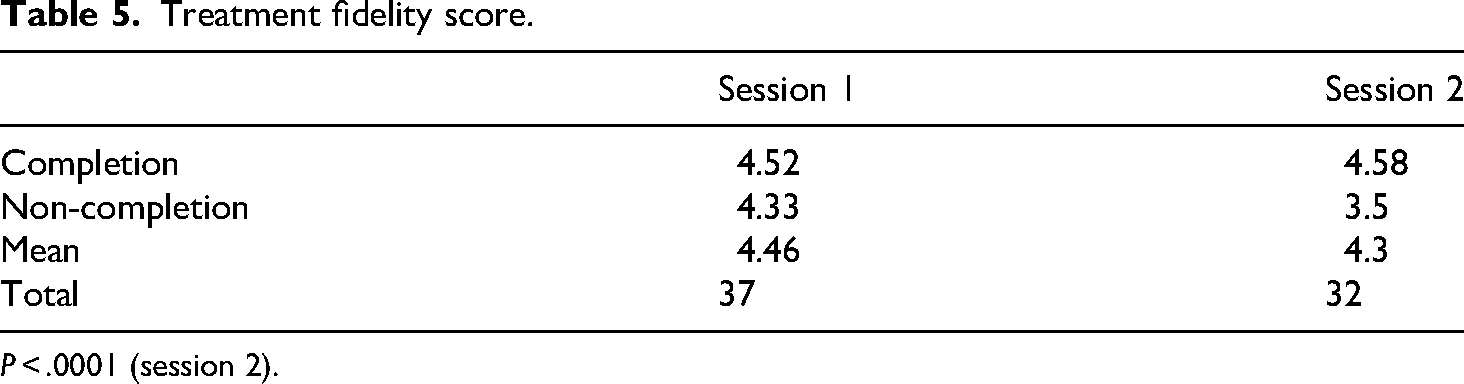
P < .0001 (session 2).
Participating family members
In 19 (42%) of the sessions, two adults/carers or more family members participated in the intervention, and in 26 (58%) of families, only one adult participated. Completion rates were higher when at least two adults participated. The completion rates were 79% among those families where two or more adult family members participated, whereas they were only 48% among families where only one adult participated. This could not be explained by risk factors, as young people who had two parents participating in the family work were higher risk than those with only one parent (YLSI/CMI 20 to 24).
Other factors
There were a number of other factors which were examined but were not significantly related to completion rates Table 6. Records indicated that across both groups, sessions were sometimes rescheduled as a result of worker absence, meaning the planned session did not proceed and was rescheduled. Within the completer group, workers attended 93.5% (n = 29) of scheduled sessions compared to the non-completer group that attended 78.6% (n = 11) of scheduled sessions.
Two adults participating.
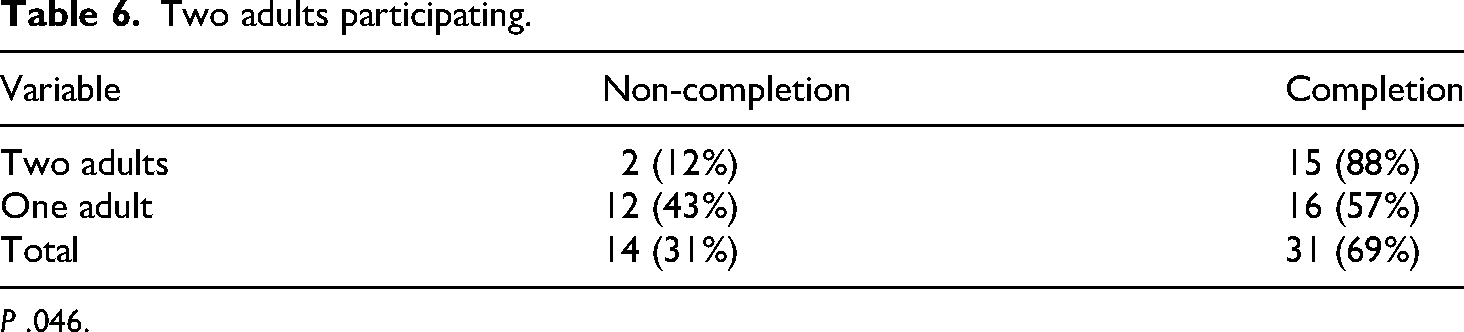
P .046.
There were no reports of participants being under the influence of alcohol or drugs for the completer group. Three sessions, from three different families from the non-completer group, noted a participant being under the influence of drugs or alcohol. This included two young people and one adult.
The YLSI/CMI was slightly higher for those who did not complete the program, where the average YLSI/CMI score was 22.60 (Table 7). This was not statistically significant. Note that the YLSI risk assessment was only available for 35 young people.
Mean YLSI/CMI entry score.

Discussion
The aim of this study was to examine the factors that were associated with completion and non-completion of a family work intervention with justice-involved young people and their families through examination of youth justice records and documentation completed by facilitating workers. It was apparent from the literature review that there is little current research examining completion and non-completion rates of family interventions in youth justice.
From this analysis, there were four statistically significant differences between the completer and non-completer groups: the age of the participating young person, the location of the family sessions, worker adherence to the model, and whether or not two adult family members participated in the sessions. Other factors, including the number of family members that were involved in the session, workers' rescheduling appointments, concerns regarding participants' substance use during the session, and the young person's YLSI/CMI score, were noted, but differences were not at statistically significant levels.
Young people were more likely to complete the program if they were 15 years old and over. Age has been identified as a factor relating to risk levels, with younger people scoring higher on risk assessment instruments, including the LSIR/CMI. This finding is consistent with the studies undertaken by Kraemer et al. (1998) and Carl et al. (2020), noting that the research regarding program completion and age tends to focus on individual rather than family-based interventions.
When held within the family home, families were more inclined to complete the family work, with families more likely to discontinue the program when the session(s) were held in Juvenile Justice Offices or Juvenile Justice detention centres. This may be attributed to family members feeling more comfortable discussing family issues in their own home. There could also be logistical reasons, particularly if there are younger siblings who could not necessarily attend an office environment but could remain at home, occupied, while the session is in progress.
Research regarding home-based family interventions is prevalent in both child protection (Dishion and Andrews 1995; Lutzker et al., 1989) and criminal justice (for example, Multisystemic Therapy and Functional Family Therapy); however, research specifically linking home-based intervention to program completion is less well documented. This may be an important finding for statutory youth justice services, highlighting the benefits of delivering family work in the home.
Participation of two adults from the young person's family was related to completion. A family discussion involving key adults in the young person's life allows integral family members to interact and work through their issues as a collective group. The involvement of two adults has been raised in Parent Management Training, whereby participation of two parents was seen to contribute to better clinical outcomes (Kazdin, 1997), recognising that one parent participating can be compounded by other variables such as marital stress or family income.
The skills of the youth justice workers and their adherence to the family work model were more evident in families where the intervention was considered complete. This includes working from a strength perspective and engaging with families regarding their problems in non-blaming terms. This is consistent with other studies that found worker adherence to a particular model led to more positive outcomes for participants (Baglivio et al., 2018; Sexton and Turner, 2010). This was only evident in the second session rather than the first session. The difference may be explained by the nature of the model. While the structure of each session is clearly set out for workers, session 2 allows for more flexibility and more opportunity to deviate from the structure. Session 2 involves problem identification, which involves discussion of the family problems from the family's perspective and articulation of the problems, verbally and in writing, in non-blaming language. Session one is primarily focused on introducing the model and developing ground rules.
Limitations
This study has a number of limitations. There may have been practical issues, such as moving to another area or a family crisis, which could have influenced the completion or non-completion of the family work model, but which could not be addressed due to lack of data. The YLSI/CMI was only available on 35 of the 45 cases, which may have compromised the capacity to understand the extent to which the findings of the study were independent of risk levels.
The study relied on workers' notes to determine adherence to the model. There were differences in the documentation styles of workers, with some workers providing basic information regarding the session and others providing more comprehensive notes of what was discussed during the session. This difference in documentation may have affected the researcher's ability to understand how the model was implemented when there was minimal information provided.
A further limitation might be the fact that the model developer was also involved in the research. A meta-analysis (Andrews and Dowden 2005) found that outcomes were often better when the model developer was involved. They argue that the involvement of the model developer may have increased the level of program integrity. Regarding potential bias, it is noted that the first author was not the model developer, data collection was not undertaken by the authors, the administration of the intervention was with the Youth Justice, not the authors, and the data is quantitative rather than qualitative. Each of these factors may reduce the level of any potential bias.
Finally, the perspectives of children, young people, and families that did not complete the model were not included. This would have provided valuable information regarding why they did not complete the sessions after agreeing to be involved.
Conclusion
Taking into account the limitations of the study and considering the previous literature, it does seem clear that completion rates were higher when the intervention was undertaken in the family home, when older children participated rather than younger children, when workers adhered to the theoretical model of the work, and when two adults were involved. These findings are consistent with what little previous literature is available on this topic. Further research might help to confirm these findings and identify other issues that might be influential in facilitating the completion of family-based interventions.
Footnotes
Acknowledgements
The support of Juvenile Justice NSW is acknowledged, in particular the support of Leonie Bender, Regional Director, and the staff and families of the Western Region.

Ethics approval
Ethics approvals from NSW Youth Justice and Monash Ethics committees.
Funding
This study was supported by an Australian Research Council Linkage Grant [LP110200711], New South Wales Juvenile Justice, and Monash University.