



Abstract
The number of women working in occupations that lay claim to professional status has increased markedly in recent decades, but the speed and extent of the ‘feminisation’ of the probation service in England and Wales render it unique. Such change has occurred against the backdrop of attempts to present the service in more ‘masculine’ terms, to increase punitiveness while maximising its efficiency. This article seeks to move explanations for feminisation beyond gender stereotypes about care work. Drawing on semi-structured interviews with 38 members of staff from across the probation estate, and with particular regard to the unification of services, it explores the demographic and cultural dynamics of feminisation. The article argues that the sustained (and ongoing) devaluation of probation's professional project, pay and working conditions have impacted retention and recruitment in such a way that has filtered into the gender composition of the service.
Introduction
While the number of women working in many professions has increased relative to men in recent decades, the pace and scale of the ‘feminisation’ of the probation service in England and Wales are without parallel (Annison, 2007, 2013). Feminisation has demographic and cultural dimensions; it refers to both an influx of women into typically male domains and an increase in the need for the emotional or caring skills typically attributed to women (Fudge and Owens, 2006). The degradation of pay, working conditions and the value attached to caring labour often coincides with feminisation (Davies, 1995; Glinsner et al., 2018). These trends are evident in probation. The latest HM Prison and Probation Service (HMPPS, 2023) Workforce Statistics Bulletin shows that there are 16,164 women and 5209 men employed by the service – a gender split which represents an inversion of the constitution of probation for most of the twentieth century, when men outnumbered women by a ratio of two to one (Annison, 2007). Such demographic change has taken place alongside new political economic expectations for ‘control’ (Dominey and Canton, 2022), of people on probation and the costs of justice. An ethic of care (Gilligan, 1982/2003) remains critical to contemporary probation culture and practice (Dominey and Canton, 2022; Gregory, 2010), but its importance has been devalued within the alleged ‘Taylorisation’ (Gale, 2012) of the service's professional project in recent decades (Tidmarsh, 2021).
The feminisation of probation has long been problematised in policy discourses (Coleman, 1989; Dews Report, 1994); however, it is an academically underexplored phenomenon. Much extant research is premised on gender stereotypes drawn from (historically problematic) socio-legal categories of ‘man’ and ‘woman’ (Collier, 2010). This is to say that feminisation is typically explained through men's desire to avoid ‘soft work’ (Knight, 2007: 58) or women's supposed willingness to accept lower-paying jobs (Bailey et al., 2007). This article, therefore, revisits Annison's (2007: 157) call for a ‘gendered critique’ of the service. It argues that the influx of women into probation has occurred alongside a wider challenge to its professionalism (Tidmarsh, 2021). The findings should be treated with some caution, not least because the univariate nature of HMPPS data fails to consider how gender interacts with age and job grade; but the article suggests that the feminisation of probation could be an unforeseen consequence of the degradation of pay and working conditions. Thus, it makes numerous original contributions to knowledge: the article enhances understandings of the relationship between the demographic and cultural dynamics of feminisation; moves debate beyond explanations which ground the influx of women into the service in gender stereotypes; and provides an empirical account of the contemporary realities of probation staff, particularly after the collapse of the Transforming Rehabilitation (TR) reforms and the subsequent ‘unification’ of services.
The article frames the probation service as a caring profession (see Dominey and Canton, 2022; May and Annison, 1998). The first part highlights changes to the professions as male-dominated domains while the second, following Annison (2007, 2013), explores the feminisation of probation against the backdrop of a shift from ‘care’ to ‘control’. The third part reports on the methodology of the study. The fourth part considers the problematisation of a feminised probation workforce, in official discourses, academic research and by informants in this current study. The fifth part explores the demographic composition of the workforce in the aftermath of unification, with a particular emphasis on the gender implications of the erosion of pay and working conditions and their impact on retention and recruitment. The article argues that, while probation work is not specifically gendered, feminisation is a useful lens through which to make sense of demographic shifts and cultural changes to the service in recent decades.
Gender and the sociology of the (caring) professions
The image of the ‘gentlemanly’ (Millerson, 1964) practitioner has dominated the sociology of the professions. Historically, women were excluded from occupations that were successful in achieving ‘professional’ recognition, such as medicine (Witz, 1992) – a point overlooked in early functionalist writings on the professions. According to these accounts (e.g., Carr-Saunders and Wilson, 1933), professional status was demonstrated through the acquisition of gender-neutral ideal-typical traits, including a mastery of abstract knowledge learned through prolonged education and training, and autonomy over the technical content of labour and how it was organised. Most important was a client-centred ideology of service through which aspirant occupations sought to establish political, public and client confidence in their knowledge and methods. Such trust meant professions could construct themselves as indispensable, thus ensuring advantageous pay and working conditions (Parsons, 1952).
The feminist turn in the sociology of the professions sought to expose how the traits model overlooked how men have historically possessed the social and economic resources to cultivate successful professional projects. This scholarship focused on professionalism not as an occupational value system but as a (gendered) project of occupational closure. For example, Witz (1992: 2) highlighted how gender-neutral accounts of the professions presented ‘static analyses’ in which the gender and attributes of practitioners are taken-for-granted and, consequently, reduced women's roles to an undeveloped ‘sex-role theory’. This essentialism contributed to the labelling of women-dominated occupations with care at their core, such as nursing and social work, as ‘semi-professions’ (Hugman, 1991). The prefix ‘semi’ implies inferior status: indeed, using a traits-based approach, Etzioni (1969) argued that semi-professionals did not require the same level of education and training, were less able to exercise discretionary decision-making, and were not able to access the same socio-economic status. Hugman (1991) contends that professions like medicine and law were able to present themselves as caring about clients, engaging with them in a dispassionate manner. Semi-professions, by contrast, care for individuals, a mode of interaction that is typically perceived as less expert. Professional-client relationships within such arrangements are typically externally mediated – namely, by the state (Johnson, 1972). This means that the social and economic power of (women-dominated) caring professions is diminished relative to the ‘traditional’ professions; they are exposed to a greater extent to outside authority, while the value of their work is more difficult to articulate.
Gilligan's (1982/2003) ethic of care has proved an influential philosophical framework through which to convey the worth of work that depends upon ‘empathy, sensitivity, trust, and responding to need’ (Held, 2010: 117). Her research found that girls and boys evaluated moral quandaries in differing ways: where the latter were rules-based in their approaches, the former were more alert to the impact of decision-making on relationships. This explication of an ethic of care is somewhat contentious, for it implies a return ‘to gender as an attribute and an essentialist position’ (Davies, 1996: 665). Critics argue that it serves to reinforce the view that gender is accomplished in binary, assuming hegemonic forms of masculinity and subordinate femininity while ignoring the structural distribution of care responsibilities (Held, 2010; Tronto, 2010). Yet an ethic of care has also been mobilised to critique the gendered concept of profession. For example, in her study of gender politics in the NHS, Davies (1995) contends that nursing, as a (semi-)profession which cares for individuals (Hugman, 1991), ‘stands in complex relation to [the] scientific knowledge’ (Davies, 1995: 149) associated with male-dominated professions. The perception of the (male) doctor as an impartial and detached ‘professional’ was facilitated by the ‘semi-professional’, caring labour of (female) nurses. In this sense, an ethic of care has sociological purchase as a framework through which to foreground labour based on relationships while remaining alert to, and critical of, profession as a gendered concept (Davies, 1995).
In recent decades, however, professions have undergone considerable transformation. Whether in the public or private sector, most professionals are now located in organisations in which decisions are increasingly delegated down managerial hierarchies and are held to account via the disciplinary oversight of performance targets and audit (Evetts, 2013). This managerial control has not diminished the need for forms of labour which seek to mollify clients; rather, Evetts (2013: 787) contends that professionals are expected give more of themselves, ‘to be morally involved in their work’. Such change can be located within the four significant developments which Rubery (2015: 633) argues have characterised employment practices in the UK since the women's liberation movement of the late-1960s: ‘feminisation, flexibilisation, fragmentation and financialisation’. She contends that work has become increasingly precarious, marked by networks and partnerships as opposed to ‘dyadic employee/single employer’ (Rubery, 2015: 634) relationships and underpinned by the relentless pursuit of capital. These developments have coincided with the feminisation of the workplace. Women constituted 47% of the total workforce by 2014 and now exceed men among university students, with many entering traditionally high-status professions having opted to study male-dominated subjects like medicine and law (Rubery, 2015; Sommerlad, 2012).
And yet, demographic shifts as a result of this ‘feminisation of success’ (Gerodetti and McNaught-Davis, 2017: 358) can obscure the gendered impact of more flexible, fragmented and financialised workplaces (Rubery, 2015). Take, for example, the legal profession, the expansion of which has been driven by the entry of more women into a traditionally male-dominated sector (Sommerlad, 2012). In response, Muzio and Ackroyd (2005) contend that law firms have been restructured to preserve the economic interests of senior partners. To progress, junior professionals are subjected to greater hierarchical controls and expected to adopt ‘a “can do” attitude’ (Muzio and Ackroyd, 2005: 636), to demonstrate commitment to their firms by embracing a culture of long hours. This general erosion of professionalism in law has been experienced more acutely by women, who: are more likely to be in subordinate salaried positions, to work part–time, to practise in less prestigious and remunerative firms and legal specialisms and, more generally, to attract lesser terms and conditions. (Bolton and Muzio, 2008: 286; see also Sommerlad, 2012)
This demonstrates how feminisation has both demographic and cultural implications – a point that is illustrated throughout the rest of the article with regard to the probation service in England and Wales.
Probation: the feminisation of a ‘caring’ profession
The probation service in England and Wales is often framed as a caring profession (Dominey and Canton, 2022; May and Annison, 1998). Accordingly, it can be situated between the professions and the semi-professions. As Tidmarsh (2021) observes, in a manner consistent with the traits-based approach, the service acquired the ideal-typical characteristics of professionalism in the early twentieth century, including education and training rooted in social work knowledge and the ability to work autonomously towards solutions to offending behaviour. However, an ideology of service grounded in the words ‘advise, assist, befriend’ more closely resonates with the semi-professional model of care for clients (Hugman, 1991). Like other semi-professions, the ‘involuntary’ status of the individuals with whom practitioners work, coupled with a dependence upon the state for funding, has meant that the service has lacked the social and economic power to exert significant influence over pay and working conditions.
Unlike comparable (semi-)professions, though, probation has historically resembled a ‘gentlemen's club’ (Annison, 2007: 154). Tracing the gender composition of the service, Annison (2007) noted an approximate 70/30 split between men and women practitioners in the postwar period. Its division of labour, moreover, largely followed gendered expectations: women were overrepresented in clerical roles and worked predominantly with other women and children, in large part because of concerns about the appropriateness of men supervising women. Since the 1980s, however, probation has experienced demographic feminisation. Like the legal profession (Sommerlad, 2012), this was due to an increase in the number of women entering into the service as opposed to a fall in the number of men, which remained stable through the 1980s and 1990s. By 2006, a ‘gender switchover’ (Annison, 2007: 148) had inverted the ratio of two-thirds to one-third men/women in 1980, with 1993 the year in which women surpassed men at maingrade probation officer level.
Demographic transformation in probation has been accompanied by a challenge to probation's professional project. From the 1980s onwards, attempts to impose ‘a more masculinised ideology’ (Annison, 2007: 153) upon the service manifested in the twin embrace of a managerial regulatory apparatus and a ‘tough on crime’ agenda of punishment and enforcement. As such, distance was established between probation practice and the esoteric qualities of a care-based professionalism (Tidmarsh, 2021). Organisational measures of ‘success’ have been articulated not through people-work but through performance targets (Phillips, 2011; Robinson et al., 2014). Probation's traditional ‘advise, assist, befriend’ ideology of service was permanently excluded from official documents in 1992, while social work training requirements were abolished in 1995 (Deering, 2010). These changes speak, therefore, to successive governments’ perceptions of how an association with care ethics ‘did nothing to advance public confidence’ (Dominey and Canton, 2022: 418) in probation in a climate in which legitimacy rests, in part, upon measurable outcomes.
The reshaping of the probation profession has spurred parallels with the process of ‘Taylorisation’ (Gale, 2012; Tidmarsh, 2020) – that is, managerial capture of the labour process (Braverman, 1974). Caution must be exercised when assessing claims of Taylorisation – for the behind-closed-doors nature of working with individuals under supervision has enabled practitioners to retain a measure of discretion (Burke and Collett, 2015) – but scholars have nonetheless identified ‘disturbing signs of de-skilling’ (Gale, 2012; Mair, 2016: 11). Practice has become increasingly computer-based, driven by the rise to prominence of risk assessment technologies like the Offender Assessment System (OASys), which could be used by non-qualified officers. Indeed, there has been an influx of lesser qualified probation service officers (PSOs) relative to probation officers (POs), the former constituting a cheaper supply of labour whose roles have gradually encroached upon the latter (Gale, 2012). HMPPS (2023) Workforce Statistics Bulletins are univariate – that is, they do not break down staff by grade and gender – but given the demographic changes described above (see Annison, 2007), we can surmise that most PSOs who entered the service were women. Accordingly, the rise of PSOs demonstrates correlation between demographic and cultural change in probation.
The cultural dynamics of feminisation are present not only in the degradation of pay and working conditions, but also in the enduring relevance of care ethics. In a philosophically grounded counter to the standardisation of practice, Dominey and Canton (2022: 418) situate interpersonal work in probation within a framework of care ethics which asks ‘questions about the cultures of organisations and the qualities of practitioners’. For example, Robinson et al.'s (2014: 136) study of ‘quality’ in probation found that many ‘participants described…good working relationships which clearly featured commitment to and care for the offender’ while acknowledging the importance of reducing risk. Individuals continue to be attracted into the profession because they want to work with people (Annison et al., 2008; Deering, 2010; Tidmarsh, 2021). For Gregory (2010: 2284), a former practitioner, such values are ‘not merely what we know, but who we are’. Thus, while ‘the idea the probation service should care for offenders sits uncomfortably with political rhetoric that has a focus on punishment’ (Dominey and Canton, 2022: 423), and is devalued by the organisation (Robinson et al., 2014), this ethic is essential to probation identity and practice. These tensions are explored throughout the rest of the article, which deploys feminisation as a lens to make sense of recent changes in probation.
Methodology
The data reported on in this article were generated as part of a broader project on professional identity, culture and practice in probation following the collapse of the TR reforms in England and Wales. A comprehensive review of the reforms is beyond the scope of this article, but suffice to say that their detrimental impact continues to affect the service (HMI Probation, 2019, 2022). Given the extant negativity within probation, the aim of the research was to provide a strengths-led account of probation staff understandings of professional identity and practice following the unification of services. As such, it utilised Appreciative Inquiry (AI) – a methodology which foregrounds best practices, peak moments and accomplishments (Liebling et al., 1999) – to consider what is working and how it can be sustained and enhanced in the aftermath of yet more reform. The research was guided by several key questions, including:
What skills and attributes are essential to professional probation practice? What working conditions are most advantageous for sustaining professional practice? How can unification of probation services contribute to enhancing professionalism in probation?
Robinson et al. (2013) have identified both instrumental and normative benefits to AI in probation. Instrumentally, their focus on ‘quality’ aligned with the ‘“AI profile” of research questions oriented to exploring positives’ (Robinson et al., 2013: 5); normatively, it empowered staff in a field characterised by constant organisational change. AI is thus an appropriate methodology through which to try to elicit constructive understandings of professional identity, culture and practice.
Data were generated via semi-structured interviews with 38 members of staff from across the probation estate. Interviews were conducted less than a year after unification, between May and June 2022. The complexities of restructuring 21 CRCs into 12 Probation Regions within the nine-month timescale set out in the Target Operating Model (HMPPS, 2021) meant that staff in this study frequently expressed frustrations with ‘bureaucracy’ (see Tidmarsh, 2023). Hence, keeping staff focused on the positives associated with the use of AI methodology proved challenging within the context of unification. Elliot (1999) identifies four phases of AI: ‘discovery’, ‘dreaming’, ‘design’ and ‘destiny’. ‘Discovery’ brings out the best of past and present practice; ‘dreaming’ extends into how practice can be improved; ‘design’ focuses on the actions required to deliver the ‘dream’; and ‘destiny’ concentrates on solidifying this ideal by beginning the process of organisational change. This research concentrated on ‘discovery’ and ‘dreaming’. As they relate to the findings presented in this article, the former sought to foreground the importance placed by informants upon care ethics in best practices, while the latter entailed staff imaginings of improvements in working conditions – namely, around pay, workloads and recruitment and retention. However, given the nature and extent of challenges regarding working conditions in shaping the daily realities of staff, including their ability to realise an ethic of care, the article explores more negatives than is perhaps associated with AI research.
The small-scale nature of the study means the findings are not generalisable. That the sample was self-selecting, moreover, means it could be skewed towards those who wanted to discuss professional identity, culture and practice. Thus, to achieve the desired balance of job role, gender identity and legacy employment, informants were selected through purposive sampling. Informants consisted of 12 PSOs, nine POs, three practice tutor assessors (PTAs), seven managers (Ms), three senior managers (SMs) and four regional probation directors (RPDs; see Table 1). Twenty members of staff were formerly employed by privately owned Community Rehabilitation Companies (CRC) and 15 worked for the publicly owned National Probation Service (NPS); two had held split roles and one joined after unification. Ten men and 28 women were interviewed – a gender split which reflects the ‘feminisation’ of the service in recent decades (Mawby and Worrall, 2013).
Sample by job title, gender and legacy employment.
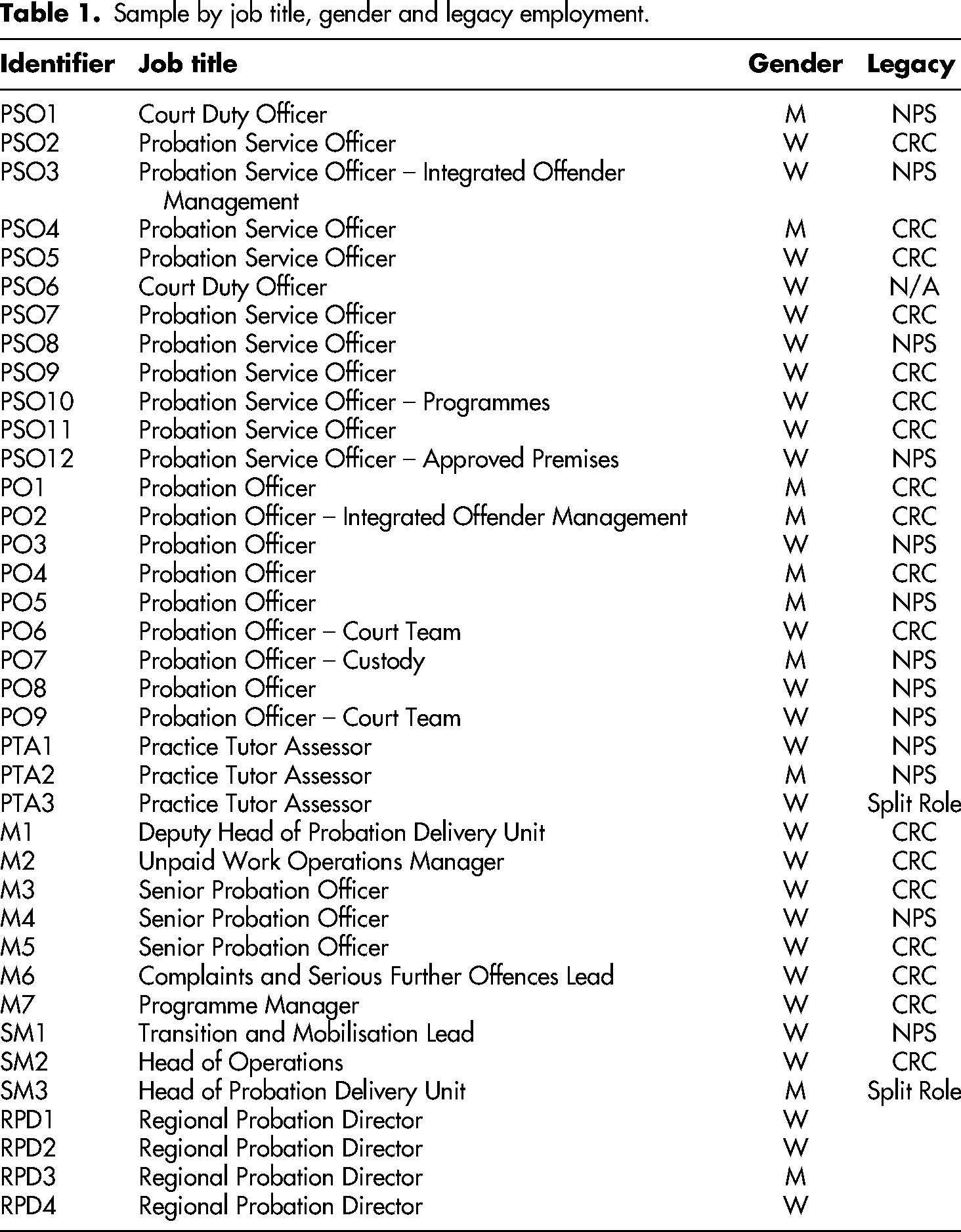
All probation research in England and Wales must be approved by HMPPS's National Research Committee, but access to staff in the regions is ultimately at the discretion of RPDs. Nine regions agreed to participate in the research; however, these will not be revealed to preserve the anonymity of staff. This is especially important for RPDs, who are small in number relative to the size of the probation workforce but overrepresented in this study. As such, their legacy employment has been excluded to ensure anonymity. A call for participants was shared through internal communications in the regions that agreed to participate, and potential informants were asked to email me if they wished to partake. Interviews were conducted on Microsoft Teams before being transcribed verbatim and uploaded to NVivo 12, which was used to sort, code and analyse the data.
Gender is not typically a pronounced theme within research on probation staff. However, like the aforementioned issues around working conditions, it featured prominently in this current study because of the AI approach – often raised as part of the latter through calls to recruit more men into the service. Accordingly, it became a key theme within ‘Framework’ analysis – that is, a generative, matrix-based ‘method of ordering and synthesising data’ (Ritchie et al., 2003: 219) to execute both between- and within-case inquiry.
Probation and the problem of feminisation?
As demonstrated above, the development of probation belies gendered expectations: men dominated the workforce when care-based practice was at its height, while considerably more women have entered the service since the imposition of ‘a “smart macho” organisational culture’ (Annison, 2007: 154) premised on punitiveness and managerialism. This influx of women was problematised within policy discourses. The Dews Report (1994), for example, contained ‘undercurrents of official disapproval regarding the personnel changes that were taking place…in the 1990s’ (Annison, 2007: 149). More recently, Kim Thornden-Edwards, the Chief Probation Officer, suggested that ‘it might be good for a man to be challenging…issues around masculinity and power from a male perspective’ (The Guardian, 2023). While this comment should not be read as a problematisation of the number of women working in the service, it aligns with the views of some informants in this study: I would push to employ more male practitioners. I spent two years in a team where I was the only male in the team – a team of 15 people. Now…there's three men and about 40 women. I think it has implications for service users. It's hard to say without making it sound like I’m saying that women can’t do the job – because obviously they can – but I just think there should be more of a push to get some male colleagues on board. (PO4)
The point, here, as PO4 acknowledged, is not to present informants as implicitly sexist in their views. There are, of course, exceptions where a practitioner's gender is an important determinant of the supervisory relationship – namely, where a female supervisee requests to be supervised by a woman. However, given that men comprise approximately 91% of supervisees and women 76% of supervisors (HMPPS, 2023; MoJ, 2023), we can infer that the typical supervisory relationship in probation is between male client and female officer. In the absence of a robust analysis of gender in probation, explanations for this predominance of women practitioners can seem antiquated. Indeed, there was considerable overlap between the views of informants in this current study and extant research on feminisation, both of which resonate with Witz's (1992) criticisms of gender within the sociology of the professions. An example of what she described as ‘static analyses’ (Witz, 1992) can be found within Bailey et al.'s (2007) attempts to link the demographic and cultural elements of feminisation; they speculate that the prevalence of women can be partially explained by pay scales in probation which are less appealing to men. This unfounded assumption was echoed by PO2: I think, particularly for young men coming into the profession, or thinking about coming into the profession, there's a lot of alternatives where they can be better financially rewarded. There's not that many people who want to do it because of the type of job that it is.
This economic argument is refuted in Knight's (2007) study of why people choose a career in probation, which identified no gender differences in the level of financial remuneration as a significant motivator in why people enter the service. Like PO2, however, she emphasised the nature of probation work as a possible factor in feminisation. Her survey of applicants onto the Diploma in Probation Studies (DipPS) – which, at the time the research was conducted, was the training pathway to qualifying as a PO – found that 48% of male participants thought the service was women-dominated. As such, Knight (2007: 60) reasons that perceptions of ‘soft work’ could be ‘one factor that influences men away from the probation service as a career choice’. For PTA2, too, this was the foundational basis for feminisation: Men don’t come into this profession. […] The soft skills approach does not lend itself well to male thinking, generally.
Here, the contrast presented between ‘soft skills’ and ‘male thinking’ speaks to the historic division of labour discussed above: women were overrepresented in (semi-)professions like nursing, which cared for individuals via ‘a combination of intellectual and emotional expression’ (Hugman, 1991: 11); men dominated professions like medicine, which cared about clients through an impersonal application of abstract knowledge and technical expertise. And yet, as Hugman (1991) reminds us, there is nothing intrinsic about the connection between women and soft skills, such as care; rather, their linkage is a social construct, the result of a shared gender history among caring professions. While women's over-representation in such jobs can entrench stereotypes of certain occupations as unsuitable for men (e.g., Hochschild, 2012), PO4's response nonetheless epitomises how gender stereotypes are reflected in explanations for feminisation. This can be further seen in Bailey et al.'s (2007: 126) contention that women's ‘skills in defusing tension and conflict management may make them better able than men’ to practise. In this sense, research on feminisation in probation often conforms to the ‘sex-role theory’ described by Witz (1992).
Despite how some – predominantly, but not exclusively, male – informants problematised the gender identity of practitioners, this current study identified no discernible differences between men and women in terms of why they do the job: …if you ask most people in the office why they’ve come into this work, they’d say that they like to help people, to make changes in people's lives, to move away from reoffending – kinda helping people to improve their lives. I think that's the common thread, really, when you speak to anyone. (PO4; male) I wanted to do something worthwhile, something involved in social policy. I wanted to do something in that supporting people side of things, the caring side of things. (PTA1; female)
This not only suggests that probation work is not specifically gendered but also emphasises how an ethic of care was a prominent theme within the ‘discovery’ (Elliot, 1999) of best practices, including how practitioners understand their work. Accordingly, the (partial) shift towards ‘control’, of practitioners and people on probation, has accentuated the cultural dimensions of feminisation, including a heightened need for caring labour alongside the worsening of pay and conditions (Fudge and Owens, 2006; Glinsner et al., 2018). These trends were captured by PTA3, who reflected on a probation career that spanned five decades: The nature of the job seems to me to be one that demands more of people, both in terms of time and emotional energy, that you’re not being financially rewarded for. It's almost as though…that's in [probation's] culture; it's always been in its culture. When [probation] was rewarding and not badly paid, that meant it was attractive to people, men and women, who’d done other jobs, who wanted to do something different. (my emphasis)
PTA3's response epitomises how the tensions that characterise probation's professional project have become culturally engrained. Changing expectations have meant the job has become less rewarding – both in terms of professional satisfaction and remuneration – which, in turn, has impaired probation's ability to recruit second careerists (Mawby and Worrall, 2013). Her allusion to the ‘time and emotionally energy’ given by staff not only hints at the persistence of care-based practice, but also highlights how the demands for such work have intensified (Tidmarsh, 2021; Westaby et al., 2016). These cultural signifiers of feminisation, the rest of the article suggests, offer cautious insight into how the (ongoing) challenge to probation's professional project has filtered into the demographic composition of the service.
The cultural dynamics of feminisation: gender and working conditions
As the worth of professionalism grounded in ideal-typical traits like abstract knowledge, autonomy over work and a caring ideology of service has become increasingly difficult to articulate, probation practice has been partially standardised and working conditions eroded (Gale, 2012; Tidmarsh, 2020). Indeed, it could be speculated that perceptions of probation as a ‘socially tainted’ (Mawby and Worrall, 2013: 8) profession which engages with stigmatised individuals renders the service especially susceptible to external interference. As SM1 put it: There's a tremendous amount of compassion in probation, similar to nursing. The difference between the two is that nursing is seen as caring for the right people and probation is seen as caring for the wrong people.
This comparison with nursing implies that the so-called ‘undeserving’ nature of probation's clientele means its status is further diminished. It hints at how, relative to more established professions, a lack of political and public confidence in probation's knowledge and methods renders the service particularly vulnerable to external interventions (Hugman, 1991; Tidmarsh, 2021). This powerlessness is evident in probation's inability to influence both working conditions and how the service is organised.
TR, the Coalition Government's (2010–2015) flagship programme of probation reform, was implemented despite considerable opposition from staff (Kirton and Guillaume, 2015). Informants in this study frequently spoke of TR as ‘ideologically driven’ (PO7), likening the decision to split services between 21 privately led CRCs and a publicly owned NPS to ‘a divorce’ (SM1). The reforms were justified, in part, via the alleged impact of competition for services on professionalism (MoJ, 2013; see Tidmarsh, 2021); however, the evidence from this period points to the ‘diminution of the probation profession’ (HMI Probation, 2019: 3), particularly in the private sector. While it is important to highlight that the fragmented nature of probation during TR meant that the experiences of staff were shaped by local circumstances (HMI Probation, 2021), audits by quasi-government inspectorates found that the ‘commercial and contractual pressures’ (NAO, 2016: 43) under which CRCs operated meant many were trapped in a vicious cycle of redundancies, ‘exceptional caseloads’ (HMI Probation, 2017: 12) and high rates of sickness absence (HMI Probation, 2019). This suggests, with Tronto (2010), that caregiving is difficult to reconcile with the logic of commodification. Indeed, staffing shortages not only contributed to a ‘box-ticking’ culture in which practitioner autonomy was constrained (Tidmarsh, 2021), but also exacerbated the long-term trend towards a diminished ‘pool of collective professional knowledge’ (Kirton and Guillaume, 2019: 940).
Given the challenges posed by TR, probation underwent ‘unification’ in June 2021: CRCs were abolished, with services brought back into the public sector and concentrated in 12 Probation Regions. As private entities protected through commercial confidentiality, CRCs were not obliged to publish staffing levels. Thus, after unification, more than 7000 staff migrating to the public sector were recorded on HMPPS's Workforce Statistics Bulletins. However, staffing shortages have continued: Probation used to be a job for life. We’ve still got the die-hards in the system, but we’ve lost quite a lot of those. We’ve also got a huge amount of trainees coming in. In my region, for example, staff turnover has traditionally been very low; that churn has always been low. But…my older staff are starting to retire, the younger ones are coming through, and the middle ones have started to leave, unfortunately. I’m worried about the workforce. (RPD2)
RPD2's worries about the ‘churn’ of staff are borne out in HMPPS data. The most recent bulletin (HMPPS, 2023), published in May 2023, reveals that an additional 2626 full-time equivalent (FTE) practitioners in post as of the year-end 31 March 2023; however, there remains a shortfall of 1745 POs against the required FTE level of 6158. A total of 2098 staff have left the service in the previous 12 months, which represents a 10% increase on the previous year. This suggests that probation is in the grip of a retention crisis.
Concerns over retention can be linked to working conditions. In their study of staff experiences of unification in one probation region, Millings et al. (2023: 12) found that the problems which shaped staff experiences of TR – including excessive caseloads and coping with high rates of sickness absence (HMI Probation, 2017, 2019) – ‘made many reflect on their terms of employment’. This finding chimes with informants in this current study, many of whom cited caseloads as a key factor in retention: …there's a lack of staff; people have got very high caseloads; we’ve had the backlog of Covid…and the staff on the ground floor are voting with their feet and leaving the organisation. (PSO1)
High caseloads are not unique to TR and unification (see, e.g., Gale, 2012), nor are they experienced in the same way in every probation region (HMI Probation, 2021). However, more than a quarter of the 56 staff interviewed by Millings et al. (2023: 12) ‘compared their pay and conditions unfavourably with other sectors’. There was a sense among staff in this current study, too, that the challenging nature of the job was not reflected in the level of financial remuneration: If you’re looking at paying PSOs, what, £22k [sic] to start work, they can go and work in Tesco or a factory and earn more money that way. And we’re asking someone to monitor someone's risk, child protection issues, violence, for that money? It's a joke, a massive joke for what we’re expected to do. (PO1)
This is not to denigrate those who work in supermarkets or factories, but rather, to emphasise that a starting salary of £23,637 for PSOs (plus a weighting allowance of £4006 in London; MoJ, 2022) is not commensurate with the weight of responsibilities upon the shoulders of probation staff. A joint pay claim submitted by the trade unions which represent probation staff, Napo (2021), Unison, and GMB, demonstrates that between 2010 and 2020 – a period which has been defined in large part by the politics of austerity, cloaked in the pursuit of budget deficit reductions (HM Government, 2010) – pay increased by just 1% in real terms. This is compared to 15.6%, 12.6% and 10.8% rises, respectively, for police, local government and health professionals (Napo, 2021).
The probation service's struggle to translate its worth into financial remuneration has arguably drained the pool from which new staff are recruited, with gendered implications. Some informants speculated that pay is impacting the service's ability to recruit second careerists (Mawby and Worrall, 2013) – that is, those who worked for a considerable time in another, often unrelated, occupation before joining probation: In terms of the pay, I don’t think we are competitive in terms of our entry level to attract as many people who are slightly older, people looking for a second career, people who have more experience. (M7)
This suggests that the prevalence of young women could be an unforeseen consequence of the long-term Taylorisation of probation's professional project, of the interrelation between the demographic and cultural dynamics of feminisation: I think the recruitment model at the moment seems to pick up, whether this is intentionally or otherwise, young, largely female, graduates with limited life experience. (SM3)
Here, it is important to state that no data exist on the pathways from which new staff are recruited. However, the most recent HMPPS (2023) bulletin shows that the number of staff under 30 employed by the probation service increased by 10% between March 2017 and March 2023. This is compared to decreases of 6% for those between 30–39, 2% for those between 40–49 and 5% for those between 50–59. The lack of bi- or multivariate analysis within HMPPS workforce data means precise information on the age and gender of those who have entered probation since unification is not available. These numbers could reflect a younger workforce in the CRCs, for lesser qualified PSOs were more likely to be shifted to the private sector when TR was implemented (Kirton and Guillaume, 2015), but we can surmise that women under 30 are increasing at a faster rate than other age groups.
For most of the period of TR, entry onto the Professional Qualification in Probation (PQiP) – completion of which is prerequisite for qualifying as a probation officer – was limited to those with a university degree in one of four subjects deemed relevant (Kirton and Guillaume, 2015). While the pathway onto the PQiP has recently been widened, new recruits, some argued, are typically drawn from social sciences subjects: If you look at where the majority of our recruits come from, it's an academic background: sociology, psychology, criminal justice and criminology. Those courses are women-dominated, aren’t they? So, our pipeline is women-dominated. (M5)
The absence of data on recruitment pathways means we cannot extrapolate this comment to the service at large, but the ‘women-dominated’ nature of the alleged ‘pipeline’ into probation is confirmed by Higher Education Statistics Agency (HESA, 2022) data. This shows that women constituted 67% of the 282,615 students enrolled on social sciences courses in the academic year 2020/2021 – the most recent year for which data are available. It suggests that the recruitment model biases social sciences graduates, the majority of whom are women.
Accordingly, it can be argued that the typical recruit into probation is a university-educated, ‘highly organized [and] computer-literate’ (Mawby and Worrall, 2013: 153) woman who has been socialised into, and is comfortable with, the discourses and practices of risk management. PTA2 is partially responsible for such socialisation; his role entails inducting new staff, observing them as they begin to undertake interviews with clients and assessing their practice skills. New staff, he argued, are ‘female, under 25’ (PTA2) and often frustrated with the lack of time spent with clients, a finding that is consistent with the experiences of new starters (Annison et al., 2008; Deering, 2010): The biggest difficulty about the job – and they’re all graduates, right? None of these kids are stupid and they’ve gone through a tonne of hoops to get into the service – is they arrive into the service and go, ‘what, I’m not seeing anyone?’ […] That's what saddens me: I think that individuality of care has been lost to the administration side of things.
Taken together, his allusion to the gender identity and graduate status of many of the staff for whom he is responsible supports the experiences of other informants in this study. That practitioners must straddle an ethic of care on the one hand and administrative pressures on the other also hints at the cultural dynamics of feminisation, in which the former is at once necessary and devalued: What I want to teach my learners is to have professional integrity through the questions they ask them. My own little catchphrase is, ‘I want risk management through conversation’. I want them to really understand who's sat in front of them. […] I really do emphasise, get good at OASys quick so that you can do your job; so that you can do the one-to-one work that you actually enjoy. (PTA2)
The emphasis placed by PTA2 upon expeditious acquisition of the skills necessary to manage risk if new staff are to find the time to enact an ethic of care speaks directly to the importance of relationship-building in an environment which has been reshaped by the discourses and practices of risk. This is not to suggest that these two aspects of practitioners’ roles are mutually exclusive nor that women are inherently more capable at delivering care work. Rather, as this article has suggested, long-term trends towards high caseloads and poor pay have impacted retention, with gendered implications for recruitment. Thus, feminisation provides a means to capture these cultural pressures and how they filter in the demographic composition of a service which is women-dominated and appears to be getting younger.
Conclusions
As a demographic phenomenon, the feminisation of the probation service in England and Wales is readily observable. Explaining this shift, along with its significance, however, is more challenging. This is because of a lack of robust data: the univariate nature of HMPPS statistics on gender, age and grade precludes bi- or multivariate explorations of their intersections, while studies on new recruits typically focus on why people choose to enter the profession as opposed to their routes in the service (e.g., Deering, 2010; Knight, 2007). This means that the findings presented in this small-scale study should be treated with caution; they can be considered as preliminary, a prompt for further research rather than a comprehensive analysis of a gendered profession. The significance of this article, instead, lies in its attempts to move beyond ‘static analyses’ (Witz, 1992: 2) of gender in probation which explain feminisation through historical binaries, such as women's alleged suitability for caring labour or their apparent willingness to accept lower pay, towards the gendered implications of cultural change.
The article has suggested that, despite efforts to embed within the service a ‘macho’ (Annison, 2007) organisational culture of control, the influx of women entering the profession could be an unforeseen consequence of the cultural dimensions of feminisation – namely, an assault on probation's professional project, including the degradation of pay and working conditions. The challenges of articulating the value of care-based practice (Dominey and Canton, 2022) rendered the service an easy target for political intervention, its powerlessness relative to other (semi-)professions contributing to a lack of clarity about its positioning and purpose. The recent organisational contexts in which practitioners have operated has continued these trends: TR embedded a culture of high caseloads and staffing shortages in many CRCs (HMI Probation, 2017, 2019), the consequences of which can be seen in the ‘churn’ (RPD2) of staff after services were unified in June 2021. Evidence indicates that workloads remain excessive, as staff are leaving the service (HMPPS, 2023; Millings et al., 2023). The damage brought about TR and the service's struggles to adapt since unification thus demonstrate a retention crisis in probation.
Feminisation is a productive lens through which to study the interrelation between demographic and cultural trends in probation. For informants in this current study, recruitment trends have further entrenched the women-dominated nature of the profession. A starting salary of just £23,637 in most parts of the country at PSO grade – the band at which most, including trainees enrolling on the PQiP, enter the service – has proved insufficient to entice second careerists (Mawby and Worrall, 2013) into probation. This means that the typical entrant is a recently qualified graduate who comes through the ‘pipeline’ (M5) from university-level social science courses to probation. That these degrees are also women-dominated (HESA, 2022) has resulted in what many informants problematised as a lack of life experience in probation, putting much of the workforce at odds with the nature of its predominantly male caseload.
While, as argued above, these explanations should be approached with care, the finding raises questions about whether feminisation matters. Clearly, there are instances where the gender identity of a probation practitioner is relevant to the supervisory relationship – namely, where a woman requests to be supervised by a woman. However, the findings of this article suggest that a commitment to an ethic of care in probation is gender-neutral. Women are no more or less capable of executing arguably the two most important aspects of probation practice – relationship-building and the ability to proficiently manage risk – than men. Indeed, the ways in which the gender composition of the service has been problematised, in academic research as well as official discourses, implicitly reduces probation work to sex-role theory at the expense of explanations located in cultural change.
Accordingly, the findings presented in this article should be of interest to academics and policy-makers, both as a call for further research and as a way to develop how feminisation is discussed in a probation context. Rather than problematising a gendered workforce and grounding explanations for demographic feminisation in binary, historically problematic assumptions about care work, its cultural dynamics are more pressing for the future of probation. Thus, an appraisal of pay and working conditions, and their impact on recruitment and retention, should be considered a matter of urgency if the service is to empower a diverse pool of staff to realise an ethic of care.
Footnotes
Acknowledgements
I would like to thank Libby Smith (University of Leeds) for her research assistance in transcribing some of the interviews on which this project is based. Thanks, also, to Jane Dominey (University of Cambridge) for making the time to discuss the ideas presented in this article with me; and to Jill Annison (University of Plymouth), Hilary Sommerlad, Chris Dietz and the members of the Legal Professions Research Group (University of Leeds) for their comments on an early draft of this article. All mistakes are my own.
Declaration of conflicting interests
The authors declared no potential conflicts of interest with respect to the research, authorship, and/or publication of this article.
Funding
The author received no financial support for the research, authorship, and/or publication of this article.
