




Abstract
This article is about women caught in the cycle of persistent offending, breach and recall. We consider the resettlement challenges faced by this group of women and the extent to which these challenges can be met by the criminal justice system. We reflect on the impact of the Offender Rehabilitation Act 2014 and of statutory post-sentence supervision on the speed of the revolving door between custody and the community. The article draws on some data from an ongoing evaluation of a supported accommodation project for women leaving prison to illustrate its argument. We also question the extent to which the probation service alone has the tools needed to reduce the likelihood of recall and return to prison and identify the importance of factors such as sentencing law and policy and the provision of housing and health services.
Keywords
Introduction
As discussed elsewhere in this special edition, the Offender Rehabilitation Act (ORA) 2014 brought statutory post-release supervision to everyone leaving prison. Before this change, only those serving sentences of more than 12 months were subject to licence on release; ORA 2014 extended this requirement to those with short sentences and created post-sentence supervision (PSS) to ensure that everyone leaving prison would be subject to probation supervision for a period of at least 12 months (and, therefore, often beyond the end-date of the prison sentence). This change was argued on the grounds that it would offer rehabilitative support to individuals with complex needs and a high likelihood of reoffending (Ministry of Justice, 2013). Failing to comply with the requirements of PSS (such as keeping in touch with the supervisor and notifying changes of address) would be dealt with through breach proceedings at the magistrates’ court with, in the event of the breach being proven, sanctions including a return to prison for up to 14 days, a fine, hours of unpaid work or a period of curfew. Voices within the probation service responded to the proposal to introduce PSS with a cautious welcome of the offer of additional post-release support but scepticism about the extent to which this work would be funded (Probation Association, 2014). Other critics pointed to the increase in supervisory control represented by PSS (Cracknell, 2018) and its disproportionate nature, with relatively longer periods of supervision imposed on those serving the shortest custodial sentences (Padfield, 2016). This article explores the position of women caught in the cycle of persistent offending, short prison sentences, post-custody supervision and breach, drawing on data from an evaluation of a supported accommodation project for women leaving prison to shed light on the complexities of resettlement.
These changes to statutory post-custody supervision have brought a predictable increase in the use of recall to custody. The probation service has faced criticism for being too quick to resort to enforcement proceedings and insufficiently flexible when faced with minor instances of technical non-compliance (Robinson, 2014; Robinson and McNeill, 2008). Despite policy developments intended to encourage and sustain compliance (Ministry of Justice, 2015), in the year to June 2019 almost 9000 people serving a short prison sentence were returned to prison (Prison Reform Trust, 2019). In response to concern (expressed by politicians and sentencers) about the enforcement and recall practice of the probation service, HM Inspectorate of Probation (HMIP) undertook an inspection of this area of practice. The picture was mixed; in general terms, decisions about the recall of longer-sentenced prisoners were of better quality than those made about short-sentenced prisoners (HMIP, 2018). The inspectors identified the challenge of building relationships with and providing adequate services for individuals with complex needs. In these cases ‘enforcement had the effect of compounding rather than lessening the sense of a revolving door between prison and the community’ (HMIP, 2018: 9).
The provisions of ORA 2014 were implemented at the same time as the Transforming Rehabilitation (TR) reforms which abolished the existing probation trusts replacing them with a new public sector National Probation Service and 21 regional Community Rehabilitation Companies (CRCs) to be sold (through a process of competitive tendering) to new providers (Canton and Dominey, 2018; Ministry of Justice, 2013). The CRCs assumed responsibility for (among other work) the supervision of all those people assessed as posing a low or medium risk of causing serious harm and the delivery of ‘through the gate’ (TTG) services intended to support the process of leaving prison and returning to the community (Millings et al., 2019).
The TTG services that were established following TR drew on a range of existing practices and partnerships. They were frequently delivered, as part of a contract with the CRC, by voluntary sector organisations. Evidence from both independent inspection and academic research pointed to initial difficulties and then more systemic flaws with the implementation and quality of this work. For example, reporting in 2016, inspectors expressed concern about TTG outcomes. ‘Our sample showed concerning rates of reoffending and recall to prison and unsatisfactory initial outcomes for basic needs such as being in settled accommodation’ (Criminal Justice Joint Inspection, 2016: 8).
Millings et al. (2019) observed that CRCs lacked both the resources and the organisational means to ensure that TTG would provide a good-quality resettlement service. TTG must also be understood in the context of the UK Government’s austerity agenda, which saw public spending cuts affecting not just the criminal justice system but also the housing, welfare and health services that play a part in successful community reintegration (Joseph Rowntree Foundation, 2015).
Women – imprisonment, supervision and recall
It is widely acknowledged that women in particular, but by no means exclusively, are often caught in the revolving door between custody and the community (Gelsthorpe, 2018; Prison Reform Trust 2018). Women with long histories of minor and persistent offending, repeated experiences of short terms of imprisonment and profiles of complex needs resulting from poor physical and mental health, drug and alcohol addiction, homelessness and victimisation find themselves trapped in a cycle of imprisonment, release from prison and then imprisonment again.
Notwithstanding sentencing guidance (Sentencing Council, 2016) and repeated claims from sentencers and politicians that custody is only ever a last resort (Bache, 2019; Lidington, 2017), the proportion of women receiving short custodial sentences has increased over the past decades. For example, Ministry of Justice analysis suggests that in 1993 only a third of prison sentences given to women were for less than 6 months, by 2018, it was nearly double this at 62% (Ministry of Justice, 2019). This is despite the fact that most women (80%) sentenced to imprisonment have committed a non-violent offence (Ministry of Justice, 2019); indeed, more women are sent to prison for theft than violence against the person, robbery, sexual offences, fraud, drugs and motoring offences combined (Ministry of Justice, 2019).
Yet at the same time, 73% of women who receive custodial sentences of less than 12 months are reconvicted within a year of leaving prison; this rises to 83% for those who are trapped in the revolving door and who have served more than 11 previous custodial sentences. To compound the problem, there is a very high rate of recall. The number of women returned to prison while under post-release supervision has more than doubled since the end of 2014, just before the implementation of ORA; 2126 women were recalled in the year to June 2019, for instance (Ministry of Justice, 2019). Whether there is clear cut evidence that this is to do with reoffending it is perhaps difficult to discern. On the one hand, there is evidence to suggest that women released from prison are more likely to reoffend, and reoffend sooner, than those serving community sentences (Hedderman and Jolliffe, 2015). On the other hand, the Prison Reform Trust has produced more recent evidence which indicates a range of reasons for recall. A Freedom of Information request regarding rates of recall made to the Ministry of Justice in August 2017 facilitated analysis of comparisons by gender in the increased number of recalls, recalls by different probation services and the reasons given for recalls to custody (Prison Reform Trust, 2017). From this it became clear that recalls of women were largely activated due to a failure to keep in touch with supervising officers or for non-compliance with conditions of supervision, far more than for new criminal offences (Prison Reform Trust, 2017:7). Building on this, an empirical study involving in-depth interviews with 24 women conducted by Prison Reform Trust researchers pursued the question of why so many women are being recalled (Prison Reform Trust, 2018). The researchers found that the threat of recall itself was contributing to a breakdown in trust between women and the probation staff responsible for their supervision in the community. The women interviewed indicated that the threat of recall created an unhelpful tension between supervision and support, so much so that they were reluctant to reveal the full extent of their struggles for fear of being returned to custody. For example, Imogen
1
felt set up to fail: No support. No housing. Released homeless. I had nowhere else to go. I had to go back to my ex’s. That was against my licence conditions. They recalled me because of that. It makes me mad: what was I supposed to do? (Prison Reform Trust, 2018: 26) They’ve never helped me with anything – never. They just want to stop re-offending, but no help with moving house, benefits, or children…Obviously, if they helped me with housing, drugs, and benefits, I wouldn’t be shoplifting or using drugs. (Prison Reform Trust,
2018
: 25)
What is surprising is that the long-standing mechanisms set up to facilitate better support for those women sentenced to short custodial sentences and then released under supervision have not prevented the high rate of recall. Community Centres for women – set up under the Labour Government in 2003 as demonstration projects, boosted by Baroness Jean Corston’s report on vulnerable women in the criminal justice system (Corston, 2007), and evidently thriving and effective sources of support where financial sustainability has been managed – have struggled or collapsed where there have been financial challenges, something that has been a particular problem since the TR reforms (Gelsthorpe and Russell, 2018). The Ministry of Justice Female Offender Strategy, published in 2018, speaks of an ‘emphasis on community-based solutions’ (Ministry of Justice, 2018:3) but came with only limited funding for new services.
The Government’s doctrine of austerity, combined with disorganisation and stretched resources as a result of the privatisation of probation, has arguably left supervisors unable to resolve complex problems for women, particularly in regard to finding safe and suitable accommodation, support for debt management, drug and alcohol misuse and vulnerability to abusive and coercive relationships (Prison Reform Trust, 2016/2018). Indeed, report after report from HMIP has highlighted deficiencies in service provision (see e.g. HMIP, 2016). All this, despite there being strong indication that we do know what works in terms of effective supervision (Shapland et al., 2012), what women’s crime-related needs are and what is required to facilitate women’s pathways out of crime (Annison et al., 2015; Sharpe, 2020; Sheehan et al., 2011), and fundamentally ‘what works’ with women (Gelsthorpe, 2020; NOMS, 2015). For example, service users themselves value the opportunity to develop a relationship with a supervisor through having sufficient time and consistency to do this, and through their supervisor listening and acknowledging where they are with their problems, including knowing about their families. In other words, emotional support is important alongside the provision of practical support in relation to the problems identified, and scope to together identify useful links with other agencies. The key thing which seems to be important for women is recognition of various vulnerabilities (including childhood trauma and domestic abuse) and the need for holistic support (wrap-around services) which go well beyond a focus on the offending behaviour which drew them into the criminal justice system in the first place. The Better outcomes for Women Offenders report (NOMS, 2015) makes clear the need to stabilise substance misuse, expedite access to mental health support services for anxiety, depression and post-traumatic stress disorder, for example, and through non-judgmental emotional support and cognitive behavioural programmes alongside mindfulness techniques and dialectical behaviour therapy, facilitate scope to develop a prosocial identity, control over their lives and develop supportive family relationships. The role of community centres for women in providing the necessary holistic support cannot be underestimated as women-only ‘one stop shops’, providing peer support and a generally facilitative milieu to address low self-esteem and confidence, and practical problems such as debt and housing needs (Gelsthorpe, 2020).
One approach to providing help and reducing recall: Supported accommodation
We now turn to findings from research evaluating a new accommodation project set up to provide supported housing for homeless women identified as at high risk of recall to prison. The accommodation project is just entering its second year and its evaluation is ongoing. 3 This article does not comprise an evaluation (or even interim evaluation) of the project. Rather, it uses data gathered as part of the evaluation to develop our argument about the factors that keep the revolving door between community and custody in motion and provides evidence of the obstacles and opportunities for services attempting to reduce the likelihood of recall and breach.
The accommodation project, based in an English city, is led by the CRC working in partnership with a large national voluntary organisation with experience in housing management and tenancy support (the ‘housing organisation’) and with a small local women’s centre (the ‘women’s centre’). Housing benefit meets some of the project’s expenses, with the additional costs of support and staffing provided by the CRC.
The housing organisation leased a number of bedsits and small flats from local private landlords. It employed staff to work on the project, undertaking tenancy management and providing support to residents. The city’s women’s centre, which had an existing contract to deliver some women’s specific interventions to the CRC, employed an additional worker to support the residents. The criteria for inclusion in the project were that the women were homeless on release from prison, subject to statutory CRC supervision and (given the importance of housing benefit to the funding model for the project) with a local connection to the city.
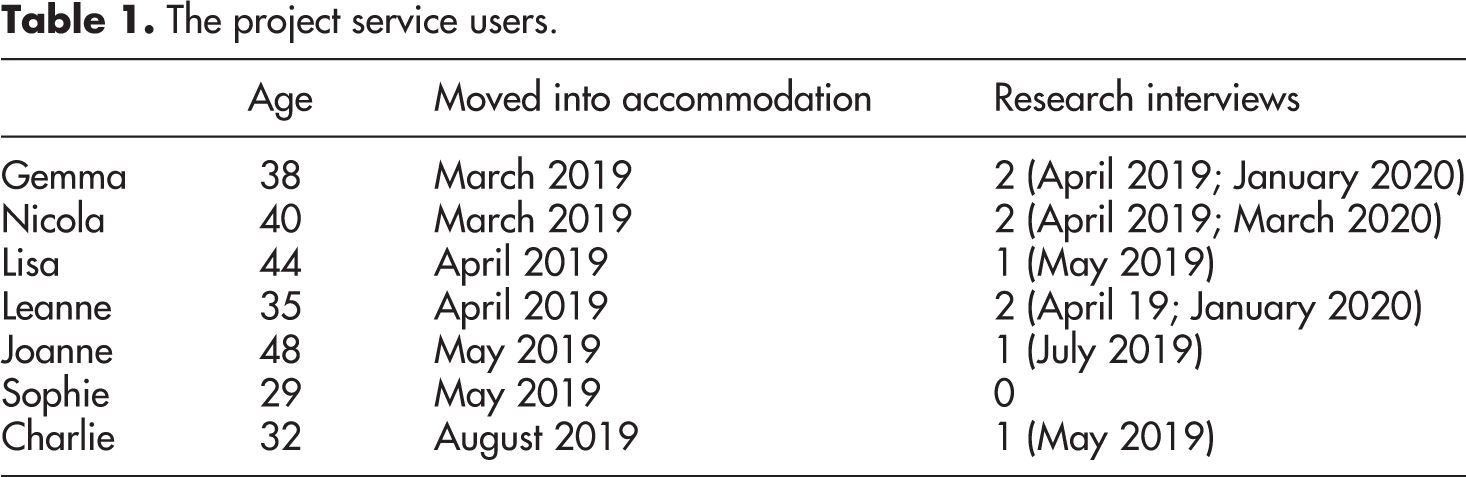
Planning for the project began in 2018. The first accommodation was secured by the housing organisation in early 2019 and the first two women moved in almost immediately. Since then seven women have been housed through the project. Each of these women is familiar with the revolving door between custody and community. They all have a history of persistent offending (with dozens of convictions for a range of offence types, but with shoplifting predominant), previous prison sentences and a record of struggling to sustain engagement with community sentences. Problems with drug use, episodes of rough sleeping and involvement in street sex work feature, to varying degrees, in everyone’s life. All have children who currently live with family members or have been taken into care. As a result of this pattern of disadvantage and difficulty, all the women are well known to the health and housing services in the city. They also know each other, with links as a result of family, friendship, offending behaviour or time together in custody (Table 1).
The project service users.
In many ways, the project was established in line with ideas about what works for women in the community. First, it provided accommodation intended to be safe and secure. The women no longer faced the prospect of leaving prison choosing between sleeping rough or finding temporary accommodation with people still involved in crime or drug use. Second, the project was staffed (from the CRC, the housing organisation and the women’s centre) by women workers committed to creating a gender-sensitive environment and resourced to spend time with each resident. Third, the multi-agency approach aimed to create a holistic response to the women’s needs and difficulties, for example, the CRC supervisors were available to meet the women at the women’s centre. A regular system of conference phone calls provided a formal system of inter-agency communication, complementing the informal communication between practitioners.
The research draws on data from a number of sources: CRC case records; observation (of meetings, of conference phone calls and from accompanying project staff at work); and from interviews with residents. The researchers are hugely appreciative of the way that project staff and service users have participated in the study, being generous with their time and experience. At the outset of the project, the aim was to interview residents on regular occasions for up to a year from a point just before their release from prison. The evaluation of the accommodation project comprised one part of a larger research study which was approved by the HMPPS National Research Committee and the university ethics committee. Residents and staff were provided with information about the purpose and conduct of the evaluation by the researcher. The concepts of confidentiality and anonymity were discussed, with undertakings given to participants about the way that data would be stored, used and reported. Formal consent to participate was obtained from each woman at the time of the first interview. Women who were interviewed in the community were given a small shopping voucher as a token of appreciation for their time.
Fieldwork was not straightforward from the outset. It did not prove possible to interview six of the women before their release from prison. For this cohort, serving either very short sentences or short periods of fixed term recall, the decision that there was a space in the project and that it would be allocated to a particular person was often made just days before release with too little time to arrange a prison visit for the researcher. Once women were in the community, the (often very unpredictable) demands of everyday life meant that research interviews were, understandably, not their priority. The project staff were extremely helpful about supporting research interviews, encouraging the women to participate and arranging interview opportunities (e.g. by providing lunch at the women’s centre). In reality, the timing of research interviews was opportunistic, taking place when the researcher’s visit to the city coincided with a ‘good day’ for the woman. All but one woman participated in a formal interview. Sophie agreed to meet the researcher a number of times, but there was never a ‘good day’ when Sophie was feeling well enough to talk, not overtaken by a crisis requiring an urgent appointment elsewhere, and able to be at the agreed place (her home or the women’s centre) at approximately the agreed time. This article draws on a total of nine interviews with the women supplemented by data from fieldwork notes made following visits to the project. Of these interviews, three were conducted in the prison and six in the community.
The accommodation project has had a number of positive outcomes for its residents and it may have slowed the speed of the revolving door between community and custody. However, each of the seven women has been back in prison during the life of the project (everyone has returned to custody at least once, three women have been back inside twice). Each return to custody is underpinned by a different mixture of reoffending and non-compliance.
From the outset of the project, the CRC staff (front-line supervisors and their managers) were determined to reduce the use of recall. In meetings, they reminded each other that breach action was unlikely to improve compliance and that they did not want to react with threats and sanctions to women with past histories of abuse and trauma. The CRC accepted that if the women were in touch with housing organisation or women’s centre staff, it was not absolutely essential that they kept appointments with probation staff. The project offered a high level of contact to the women, with the project staff willing to make daily visits, to spend hours with the women and to transport them to appointments and meetings.
However, this offer of support was not always welcome or accepted. All the women had phases (some longer lasting than others) in which they were reluctant to engage with project staff, unwilling to answer their door to callers or missing from their property. For example, Charlie’s contact with the project broke down almost immediately following her first release from prison. Two of the project workers met her at the prison gate, took her to her new flat and then to the women’s centre to meet her CRC supervisor. In the words of one of the workers, when at the centre Charlie ‘popped out and hasn’t been seen since’. There was no sign of Charlie until, three or four weeks later, she arrived in prison on remand for offences of burglary and assault. Charlie pleaded not guilty to these offences and was held in custody for 5 months. When she appeared at the Crown Court, charges were dropped, and she was immediately released and returned to the project.
Joanne did not disappear but the decision to take breach action in her case followed a number of weeks during which she missed appointments with CRC staff and was abusive when housing organisation and women’s centre staff called round with offers of food and practical help. In her research interview (which took place before the breach action), Joanne expressed the view that she would need luck to get to the end of her period of PSS. She reflected on her recent experience in custody There’s a lot of people in there who missed an appointment, or missed a couple of appointments. And they’re in there and…yeah…it’s just never ending cos then it starts 12 months again. You know, there’s people – you could be on for years. You can go away for 28 days for shoplifting, and then you’re just in and out of prison all the time cos you can’t finish your supervision. Which is not great.
Faced with prolonged periods of little or no communication between the women and project staff, the CRC saw no option but to take breach action, and six of the women found themselves in this position (it was Nicola who avoided breach action). The CRC then prepared court paperwork proposing options other than a return to custody (e.g. in Joanne’s case, the possibility of a curfew order).
However, these problems with compliance were developing alongside continued offending. For all the women in the project, the need to buy drugs led to ongoing involvement in crime. Nicola described herself as a ‘reckless shoplifter’ and a project worker explained how Leanne was ‘on a shoplifting rampage everyday’. All the women in the study were back in court facing further charges at some point in the year, and it was these new matters, and not the breach of supervision requirements, which led to the further time in prison. The length of the new prison sentences ranged from 4 weeks to 3 years, with almost all new convictions being for shoplifting. Lisa’s 3 years for domestic burglary was the only sentence that exceeded 9 months.
This account, of problematic compliance and continued offending, disguises the accommodation project’s positive outcomes. There were many of these identified both by staff and the residents including providing and sustaining accommodation, accessing drug treatment and building supportive relationships.
The women in the study identified having somewhere safe to live as a necessary first step to living a more stable life. A number viewed themselves as fortunate to be offered this opportunity and were pleased with the accommodation. As Nicola said every other time I’ve been released from prison, I’ve just been released out onto the street with nowhere to go. So I’ve been homeless so many times so…the prospect of having somewhere to live was, yeah, brilliant.
For the first 4 months of the project, the women were housed in bedsits in the same building, an arrangement which was quickly identified as problematic by both residents and project staff. Joanne, who was consistently most critical of the project, explained why: It’s not good. There’s five rooms in there. You know, you’ve got people coming out of prison with hopes to stay clean, and then you put ‘em in a room next door to somebody who’s got men coming all the time. They’re like – you know – you can’t sleep, there’s noise.
Of particular importance was the fact that women did not lose their accommodation if they returned to prison for a short period of time. So long as the period of absence was short enough to allow housing benefit payments to continue, the accommodation was kept for the woman and care was taken to secure her belongings. Nicola explained how it was a ‘weight off her shoulders’ that her return to prison did not result in the loss of her flat. The accommodation for women returned to prison for longer sentences (housing benefit being paid for a maximum of 13 weeks) could not be guaranteed, and so a longer time in prison (as in Lisa’s case) led to a return to the project’s waiting list.
The project dealt with a range of tenancy management problems that reflected the women’s circumstances. The issue of visitors (both during the day and overnight) raised particular challenges for the staff. Some visitors were clearly welcomed by the women but visiting in breach of conditions set by child protection social workers or probation officers. Other visitors appeared to be taking advantage of the women, using the flat as a base for illegal activities and posing a risk of cuckooing. 5 Staff from the housing organisation and the women’s centre thought hard about their response to breaches of the project rules, tried hard to avoid formal warnings and sanctions and frequently found themselves changing locks when the women lost their keys or had them taken or borrowed by other people.
As well as providing accommodation, the project also succeeded in building the link between the women and local health provision, including GPs and dentists, but particularly with the local drug treatment service. The women were previously known to health services in the city, but with a history of patchy engagement and poor compliance with treatment regimes. The project did two things: project staff made appointments for the women, drove women to the appointments and then persisted when these appointments were refused or missed; and it strengthened the link between the project and the drug treatment service, with (after the project had been running for some months) a drugs worker joining the weekly telephone call. This closer inter-agency work enabled a more individual approach to each woman, with flexibility about arrangements for appointments, prescribing and collecting medication. For example, after many weeks of encouragement, support and false starts, Sophie began to regularly collect her prescribed methadone. Gemma, at her second interview, explained that, looking to the future, she wanted to continue to make progress with her drug recovery.
For this group of women, recovery from drug use is likely to be a long-term process punctuated with periods of relapse compounding problems relating to the accessibility of resources and concomitant mental health challenges (Malloch and McIvor, 2011; Trebilcock and Weston, 2020). The support with drug use offered through the project enabled the women to take steps that had not been possible for them in the past. It was a frustration to the project staff that similar progress was not achieved in the area of mental health treatment. For example, Leanne identified her mental health as a problem in her first research interview and the following months saw a number of incidents that very much worried the project workers: they would visit her and find her talking to people who were not there, members of the public found her outside her flat disorientated and inappropriately dressed for the weather and on one occasion the police found her out with a knife. Project staff tried with limited success to arrange specialist support. There were a number of obstacles including long waiting lists for community mental health provision and the requirement that Leanne engage with the drug treatment service prior to receiving this service. When staff had acute anxieties about women’s mental health (something that was not just an issue for Leanne), they responded by making daily checks in person and by telephone.
The importance of the relationships built between service users and staff is clear. The women praised staff from the housing organisation and the women’s centre viewing them as trustworthy, genuine and committed. They were described as caring, non-judgmental and straightforward. Joanne was most ambivalent about support offered through the project and her relationship with its staff. She explained that ‘I’ve just supported myself since the age of 15’ and did not want workers turning up on her doorstep ‘when they think they can’. By contrast, Gemma at her second research interview said that she would ‘live in a dog kennel’ if that included the link with the support workers. Nicola, whose second research interview took place when she was back in prison, explained how she felt ‘bad for letting them down’. Leanne, while also praising the staff, reflected that different staff played different roles. For example, the worker from the housing organisation had to be firmer than the worker from the women’s centre: ‘she’s a bit screechy sometimes’.
Perhaps inevitably given the CRC responsibility for enforcement, relationships with CRC staff were more mixed. For example, Lisa explained why she did not reach out to her supervisor for help: ‘And I couldn’t go to probation cos I thought probation would call the police and get my licence revoked, you know? So I just didn’t know what to do’. Joanne did not see the merits of probation supervision: Cos it’s not like I do anything…it’s all pointless, you know? It’s not like I turn up and there’s anything I achieved. I just turn up, “how are you?” I can say “yeah I’m fine” every time. Which obviously I’m probably not.
There was, though, consistent praise for the CRC supervisor who had a specialist role working with female offenders. A number of the women knew her from past periods of supervision and, as the project developed, the other women were transferred to her caseload. Nicola said I’ve had quite a few probation officers but Becky’s by far the best. Yeah, she cares. You can tell it’s not just the job, you know what I mean? It’s not just to pay her bills sort of thing. She cares about the women. She’s really really good.
Women and the revolving door
The focus of the article is on women and, very specifically, women with a history of persistent acquisitive offending linked with experiences of homelessness and drug use. The experiences of these women suggest that their return to prison results from three inter-linking issues: continued very frequent shoplifting, gaps in accessible and acceptable specialist support in the community and failures to comply with the requirements of supervision.
For all the women in the study further, usually short, prison sentences were triggered by arrest and conviction for shoplifting. Given the women’s previous convictions and problematic history of compliance with community sanctions, the police generally did not use out-of-court disposals and the magistrates deemed custody inevitable. It is argued (APPG, 2018; Gelsthorpe and Sharpe, 2015) that a presumption against the use of short prison sentences would bring particular benefits for women (given the proportion of women serving short prison sentences). Indeed, we can learn from Scotland in this regard; recognising that short custodial sentences disrupt factors that may facilitate a reduction in reoffending and that, in Scotland, 90% of women are given a custodial sentence of a year or less, the Scottish Government has extended its presumption against short custodial sentences from 3 months to 12 months (Scottish Government, 2019). However, given the particular circumstances and persistent offending of the women in the accommodation project, these may well be a group for whom any such presumption is rebutted. Reflecting on the Scottish experience and noting the continued use of short sentences, Tata (2016: 24) wrote: Although it is uncomfortable to admit it, many people end up in prison not because their offending is particularly serious, nor because they are a risk of serious harm. They end up in prison because there does not appear to be anywhere else that can address their chronic physical, mental health, addiction, homelessness and other personal needs.
The challenge of providing welfare and recovery services in the community to people who have complex long-standing problems and are ambivalent about change is significant. In this study, drug services were available to the women and inter-agency work sought to make these as accessible and flexible as possible. Women engaged more than they had in the past, but inevitably their recovery trajectories were not smoothly upward. The project workers were more frustrated by the gaps in mental health provision. They perceived a reluctance to offer a service to drug users, lack of clarity about referral routes and then long delays between referral and appointments. No one was arguing that prison was the appropriate place for either drug rehabilitation or mental health treatment but, on occasions, it did look like the only place where the chaos of life would quiet for long enough to deliver any sort of service.
The existence of PSS played a small part in returns to prison. Project workers visited the women at home regularly, something that the women viewed (mostly but not always) as about support not surveillance. CRC staff were content that this contact with project staff was sufficient for the purposes of PSS. However, they did feel compelled to take breach action when the woman was no longer living in her flat and the support workers had no information about her whereabouts. Individuals leading unsettled and chaotic lives are always likely to fall foul of the requirements of PSS.
Concluding reflections
Having explored the extant research literature and considered the interview data from our supported accommodation project study, we conclude with thoughts about the use of short custodial sentences, the statutory supervision of women, and the need for holistic community services.
We endorse calls for a presumption against the use of short sentences of imprisonment. To be effective in slowing the speed of the revolving door between custody and community, such a presumption needs to be accompanied by close and ongoing liaison between magistrates and the probation service to build shared understanding about the community options available for women. ‘Reckless shoplifters’, for example, might be dealt with not by short sentences of imprisonment but by meaningful community work (unpaid work) which can be taken at the pace appropriate to the woman’s needs, with help with practical issues like transport and childcare, and the recognition that it may take two or three attempts for it to be completed. Changes to PSS also have a part to play in reducing the use of custody for this group of women; shortening the length of the supervision period, removing some requirements, restricting the use of breach or abolishing PSS entirely all merit serious consideration.
There is much evidence of best practice in regard to the statutory supervision of women. The support provided through supervision needs to be flexible, practical and pragmatic. Women value relationships with workers who are honest, trustworthy and caring. While we have concerns about the level of funding for community services, we welcome the ambition in the MoJ Female Offender Strategy that a greater proportion of women receive community, not custodial, sentences. The intention to develop residential women’s centres, with plans to open the first such centre in Wales (Ministry of Justice, 2020), is interesting; it merits careful piloting and evaluation. Learning from the supported accommodation project points to some of the challenges that such centres will inevitably face: eligibility criteria; funding arrangements; benefit entitlements; accommodation of co-defendants, friends and enemies; expectations about visitors and overnight guests; and responding to relapse and reoffending.
More broadly, we agree with Annison et al. (2019) that there is a need for holistic and integrated approaches across criminal justice and health interventions. The criminal justice system alone cannot resolve many of the challenges faced by women caught in the cycle of persistent offending and recall to prison; accessible, flexible and well-resourced community services addressing housing, drug use and health (particularly mental health) are required as well.
We conclude that options such as the accommodation project are a necessary part of a resettlement service, but cannot alone solve the problems faced by women caught in the revolving door between custody and community. As the accommodation project study illustrates, decisions made by the police and courts and the resources available for drug recovery and mental health treatment strongly influence women’s post-prison trajectories. Continuity of care and persistence in the face of setbacks are important too, recognising that change is often a slow process. Nicola explained that the consistent and continuing support from the accommodation project (despite her returns to prison) ‘meant the world’ to her and built her hope and motivation for the future.
Footnotes
Declaration of conflicting interests
The author(s) declared no potential conflicts of interest with respect to the research, authorship, and/or publication of this article.
Funding
The author(s) disclosed receipt of the following financial support for the research, authorship, and/or publication of this article: The research described in the article was partly funded by the Community Rehabilitation Company.
