




Abstract
This article reflects on the production and dissemination of Probationary: The Game of Life on Licence. Probationary is an artwork in the form of a board game that takes its players on a journey as they navigate the complexities of the probation process. This article explores the interdisciplinary collaborations that underpinned both the making and the sharing of the game and examines the benefits and challenges of working with stakeholders in this way. We suggest that creative methodologies can provide new ways of engaging with research subjects and new means of disseminating academic research with a view to informing change.
Introduction
This article reflects on the making and sharing of Probationary: The Game of Life on Licence. Probationary is a collaborative commission, produced through socially engaged art workshops with artist Hwa Young Jung and a group of men on licence to the National Probation Service. This article seeks to examine the interdisciplinary collaborations that underpinned both the making and the sharing of the game. The first phase – the making of the game – was facilitated by a research partnership between Foundation for Art and Creative Technology (FACT) in Liverpool and the Centre for the Study of Crime, Criminalisation and Social Exclusion at Liverpool John Moores University). 1 The production process brought artistic producers from the Justice strand of FACT’s Learning Programme together with a group of criminologists to explore how creative methodologies and practices of co-production could develop criminological research. The second phase – the sharing of the game – involved a research partnership between the academic team and the Howard League for Penal Reform. This partnership aimed to explore the potentially transformative impact of innovative methodologies for penal reform campaigns. Ultimately, by sharing Probationary with diverse audiences, the project sought to develop models for influencing public policy and implementing change.
Presented in the form of a board game (see Figure 1), when activated, this artwork takes its players on a journey through the eyes of four playable characters as they navigate the complexities of the probation process. Board games, from Monopoly to the Game of Life, contain within them the structures and values of the society in which they are produced, presenting back to us the world in which we live. Probationary reflects real experiences of being subject to the criminal justice system and presents us with an opportunity to collectively play, understand, and discuss such systems. The project sought to explore the ways in which knowledge exchange, via the medium of art, can lead to a different perspective on individuals’ lived experience of the criminal justice system. Specifically, the game explores (on an emotional level) experiences of being released from prison and of resettlement.
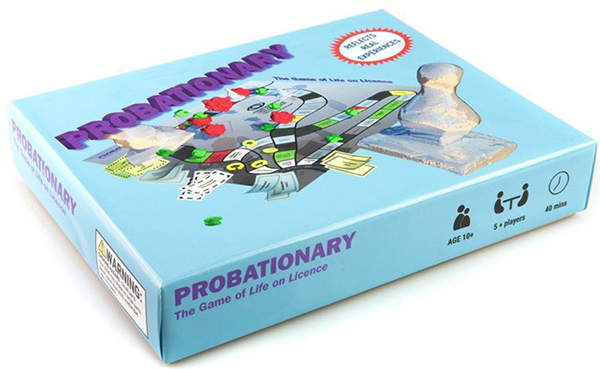
Probationary: The Game of Life on Licence boxed (Burns, 2018).
Following the announcement in 2019 from the then Justice Secretary David Gauke, that the changes implemented in 2014 as part of the Transforming Rehabilitation (TR) agenda were not meeting acceptable standards in offender management work, the probation service is faced once again with wide-reaching change. The subsequent consultation raised important questions about how we learn about the functioning of the system and how knowledge informs change to policy and practice. This article provides a commentary on the making of, and sharing of, this game and, in doing so, explores key findings which we propose might be useful to those considering how we can learn differently and inform forthcoming debates.
By immersing players in an emotional experience, Probationary seeks to reveal the subjective, precarious, and seemingly random nature of life on licence; through play, we begin to see the effects of policy failure. The emphasis on game development for the participants in this project was based on a drive to evoke empathy in players. However, the project team were acutely aware throughout of the potential charge that by making probation into a game we were not taking it seriously. It is our belief that to ‘play’ in this setting is not to deny the pains of probation (Hayes, 2015) or to underestimate the upheaval experienced by those working in a system in constant flux. Instead, Probationary is a serious game that seeks to educate and inform audiences through the medium of play.
The ‘artivist’ potential of serious games
As a team, we were influenced by the idea of ‘artivism’ (or the activist qualities of art) and methods through which art can be used to seek to achieve social change. Artivism involves merging ‘the boundless imagination of art and the radical engagement of politics’ (Jordan, 2016: 1) and at its core it aims to be transformative (Diverlus, 2016). By amplifying marginalised voices (Roig-Palmer and Pedneault, 2018), the drive is to harness art’s ability to inspire us to ‘take on different perspectives and to reimagine our worlds’ (Nossel, 2016: 103). The overarching aim is to effect social and political change through a focus on the educative role of art. To this end, one of the key functions is to foster dialogue and to create and drive conversations usually around sensitive, difficult, or overlooked topics (Duncombe, 2016; Roig-Palmer and Pedneault, 2018). It is this central thrust to this type of work that attracted us as researchers seeking to examine a probation system in a state of flux.
However, we are not the first to suggest that this approach could be well suited to the examination of criminal justice institutions and campaigns for penal reform. Roig-Palmer and Pedneault have argued that artivism can serve as an ‘effective pedagogical tool’ (2018: 17) that can foster ‘advanced learning experiences for distinct criminal justice settings’ (2018: 20). In terms of art as activism in this field, there is evidence of real impact in the United States. For example, in 2013, the ‘Tamms Supermax Prison’ in Illinois was closed in part due to a 2-year campaign, led by artist Laurie Jo Reynolds, referred to as ‘legislative art’ (Reynolds and Eisenman, 2013). In the United Kingdom, opportunities for the visual and sensual characters of injustice to effect policy change are growing but are yet to reach the impacts of US models. Nonetheless, the ability of art to influence public discourse and opinions of policymakers remains a salient matter for those aiming to effect change. Alternative methodologies for the collection of evidence – for example, Fitzgibbon’s use of a ‘photovoice’ method (Fitzgibbon and Healy, 2019; Fitzgibbon and Stengel, 2018) – and the dissemination of research findings that challenge normative assumptions are increasingly relevant in criminal justice and penal reform endeavours. As a team of researchers, our interest therefore lay in the ability of this approach to change both our work and our objects of study.
In this project, we sought therefore to adopt an artivist approach in the production of a ‘serious game’. The practice of using games for purposes other than entertainment can take us as far back as ancient Greece (Wilkinson, 2016), but from the 18th century, there are clear attempts to use games for a range of political and pedagogic purposes (Mayer and Bekebrede, 2006). The origins of the modern concept lie in the work of Clark A Abt who sought to improve education through the use of games that ‘have an explicit and carefully thought-out educational purpose and are not intended to be played primarily for amusement’ (1970: 9). Such games have been recently developed to educate and inform audiences on a startlingly diverse range of issues including, but not limited to, climate change policy (Castronova and Knowles, 2015), infrastructure management (Mayer and Bekebrede, 2006), Alzheimer’s care provision (Arambarri et al., 2014), and the promotion of cross-cultural awareness (Nyman Gomez and Berg Marklund, 2018).
Games can be a valuable tool in explaining complex systems and phenomena that are hard to explain through standard means (Castronova and Knowles, 2015). Much of the development and related scholarship on serious games today is focused on digital games (see Dörner et al., 2016; Ma et al., 2011), but there is still work being done on analogue versions and arguments made for the use of card and board games in educational settings. As Castronova and Knowles explain, by making the rules explicit, board games can allow players to ‘see in no uncertain terms the ways that a game’s various mechanisms link together to form complex, dynamic, and non-linear systems’ (2015: 42). In relation to the broad scope of work in criminology, we have seen the recent development of serious board games that seek to do a number of things including explaining the asylum process (Right to Remain, 2020), supporting those in recovery from substance use disorder (Inspirado Hubs, 2018), demystifying arranged marriage (Sayej, 2017), and facilitating conversations between people in prison and their children (Lloyd-Jones, 2019).
Approaching complex systems and institutions through the lens of art in this way means that players can enter into a different reality. In this case, we are not dealing with an absolute account of the probation system, instead Probationary asks us to navigate through a series of different narratives, experiences, and emotions in an attempt to begin to better understand, or to perhaps think differently about, the current probation system and its impact upon the people within it. Carr and Robinson (2019) have recently considered how the post-TR service is represented in their analysis of the websites of Community Rehabilitation Companies. We agree that the ways in which the service is represented are important if we want to capture the ‘intangible goods of probation work’ (Carr and Robinson, 2019: 1). Artworks such as Probationary provide a different way of representing probation by providing a view from below, representing the service from the perspective of probationers, and arguably therefore providing a critical view of post-reform experiences.
‘Communities of co-inquiry’: A note on method
This article is based upon 3 years of aligned research practice between artist, arts organisation, and research partners. Aligned research practice is an approach to working which has developed as part of the co-production and dissemination of the project and was underpinned in our case by what we saw as the synergies between creative methods used in social research and socially engaged arts practice (SEAP). Encompassing a wide range of methodologies, SEAP is a unique art form which ‘operates within the social context which it considers, rather than simply representing or responding to a subject’ (Murray, Davies and Gee, 2019: 185). Similarly, to participatory methods in criminological inquiry, SEAP also seeks to address power relations, understanding those with lived experience as ‘research partners’ in knowledge production or ‘co-creators’ in artistic production. As the conceptual meets the experimental, researchers are encouraged to think in new research structures, fashioning new practices and creating new ways to see (Leavy, 2015).
Inspired by Urie et al. (2019), our approach to working together suggests that all involved are part of a ‘community of co-inquiry’, bringing artists’ own research practise together with socially based research designs and the creative potential and practise of communities, allowing for a continual dialogue and knowledge exchange (Murray, Davies and Gee, 2019). As a collective, we came together through a shared interest in both social justice and alternative epistemological and theoretical modes of ‘knowing’ and ‘sharing’.
At present, the co-production of knowledge between artists, academics, and participants is a relatively unexplored area within criminology. However, in recent decades, social researchers have sought to explore the value of arts-based methods and the productive dynamics of interdisciplinary collaboration (see Barone, 2012; Chilton and Leavey, 2014; Westmarland and Bows, 2018). As an illustrative example, Maggie O’Neill has sought to harness the transformative role of art to ‘make visible experiences, hopes and ideas’ (2008: 5) and has argued that by drawing upon arts-based methods, both the approach to study and the role of the research subjects are transformed. As a research team, we wanted to see how such an approach to collaborative, interdisciplinary research could inform criminological work that sought to be, in O’Neill et al.’s terms, ‘critical, performative, interventionist and policy oriented’ (2019: 130).
Importantly, however, aligned practices are not unified practices. Each professional partner had its own clearly identifiable role and points of interest. For the academic team, this pilot project was intended to respond to two key research questions: What can be learnt about probation through this sort of creative methodology? What is the potential of the artwork (its content or its form) to advance, challenge, or impact upon wider academic, political, and public concerns?
Prior to the commissioning of Hwa Young Jung, the academic provided academic support to FACT’s Learning team concerning the probation service, and the function of an Approved Premise (AP), particularly (as was relevant then) post TR. Additionally, we met with staff at the AP to ensure that they fully understood this approach to art (as distinct from art therapy). This was followed by co-authorship of the artist’s brief, introductory knowledge exchange meetings with Hwa Young Jung, and finally the successful application to Her Majesty’s Prison and Probation Service (HMPPS) National Research Committee and internal ethical approved from the university.
The making of Probationary
Workshops were led by the artist and facilitated by artistic producers from FACT Learning, with participation from the academic team and AP staff. The aim of the workshops was to place the group of men on licence (n = 6) at the centre of a creative process enabling them to produce a piece of art. The participants were all White and ages ranged from 20 to 55. All participants were resident in the AP at the start of the project and the sentences served varied in length with the group including at least one participant on a life licence. 2 The participants self-selected from within the AP; all residents were given the opportunity to be involved. Each participant took place in 30 hours of workshops over a 5-week period. The small sample size had limitations in terms of the generalisability of the experiences explored in the workshops, but as the aim was to test a method of collaborative working, this was enabled by this sample.
The focus of the workshops was to explore the experiences of life on licence and produce artwork(s) that could reflect those experiences. The workshop sessions emphasised collaboration, negotiation, and consensus building to produce an artwork that represented the experiences of those involved in its creation. The role of the ‘criminologist’ in the workshops was not clearly defined; rather, we were observers, participants, and advisors at the request of the artist and this involved us having full involvement in activities and conversations. We did not dictate the form that the artwork should take but engaged with and informed the creative process. Before, and after each workshop, we provided academic support and guidance to the artist and artistic producer – debriefing where necessary. Finally, to accompany our field notes, the academic team conducted a series of semi-structured interviews with those involved to capture their experiences and reflect on the benefits and challenges of this sort of engagement. Central to all involved was a sense of empowerment and of being ‘heard’ in a new way.
For James, one of the probationers involved, being part of an interdisciplinary collaboration of this type had a significant impact on his sense of self and his place in the world post-release. I think, for me, it’s quite easy, as an ex-Prisoner, to just think that that’s the world you live in and it sort of makes you realise that you can have conversations in different ways, you can fit in to different places in the world. As much as you are all academics, I can hold my own in a conversation. I got on with some of you more than others, and I like the lot of you, but just to show you that you’re not just set in one place in life. You can be more flexible and fit in different places, so, it makes you a bit more confident and comfortable walking into places if you know you can be like that, you can fit in in different places rather than just in the criminal world, that can only be good for yourself, can’t it?. (James, 50, probationer) It was something to do I suppose, see what it’s all about and I enjoyed it though. At first, I thought, “No, I can’t be bothered with this”, but after sitting in there for a few hours and people saying, “Oh, you’re doing well, keep it up”, and all that, so I thought, “Do you know what? I’ll keep it up to see how it goes”. (Paul, 20, probationer) It just felt like we were getting our points across but not in the normal way and that it was going to people that were actually going to be listening for once. Instead of somebody who’s got a sheet there and they want you to give them the answers and it’s gone into a machine and then it’s going to churn out, “53% said this. 53% said that”. (Robert, 55, probationer)
The sharing of Probationary
It is in this phase of the process that our interest in artivism is explored as the potential of the artwork to advance, challenge, or impact upon wider academic, political, and public debates is assessed. Leavy (2015) has suggested that arts-based research can accomplish two important things previously lacking in traditional social research methods. Firstly, artworks are able to go public, as interests in the arts and artwork reach far beyond academia. Secondly, Leavy (2015: 292) notes, ‘the arts have the capability to evoke emotions, promote reflection, and transform the way people think’. As Probationary is activated through play, we sought to harness these two key features in our approach to dissemination.
In terms of being able to ‘go to public’, the artist and the academic team sought to share the game as widely as possible. Collectively, we have played with former and current probationers, academics – including those working in criminology, criminal justice, sociology, science communication, and games design – as well as practitioners, policymakers, and the general public. We have exhibited the game at the London Design Festival, the Manchester International Festival, the Yorkshire Games Festival, and Tate Exchange. The breadth of engagement and the nature of the interactions we were able to have were undoubtedly enabled by the fact that the findings from our research came in the form of a board game.
As with all meaningful artistic experiences, Probationary does not provide an answer, neither does it claim to present an unconditional truth, instead it offers us a space for us to convene, to imagine the probation process ‘as if’ it were a board game (see Figure 2), and to reflect upon our own responses to playing such a game. At the core of this approach is the drive to evoke empathy in players by immersing them in an emotional experience. Taking players on a journey through the probation process, the game seeks to help players understand life on licence not simply by hearing about it but through a visceral experience that play is uniquely placed to induce.
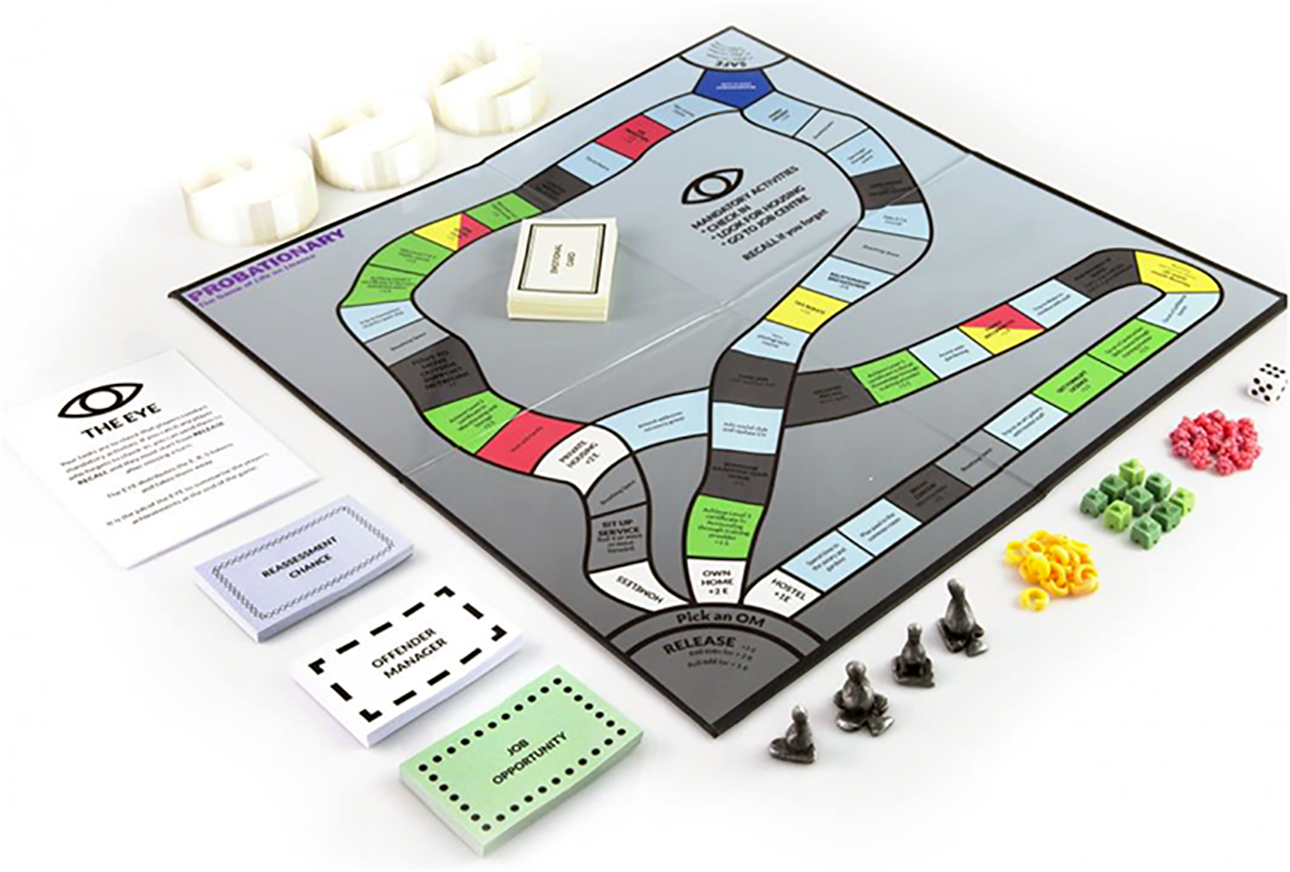
Probationary complete (Burns, 2018).
The form and content of Probationary enabled us to evoke emotional responses and promote reflection in players. In doing so, the aim was to make audiences think differently about probation and in particular the experiences of probationers. As a snapshot of some of the feedback we have received from players, these accounts demonstrate something of the emotional impact on audiences. I felt frustrated at the unnecessary complexity of probation system. More aware of challenges of living on the knife-edge of licence. I felt better informed about the experience of being on probation and about the systems involved; at the same time, I felt confused, and as though aspects of the system are unpredictable and out of my control. I feel like I have had a real insight into some of the problems, I really emotionally invested in the characters and was genuinely upset when I had to start again and when anyone had to start again.
Playing the game: Resettlement and desistance
Interventions with those leaving prison have a long history and priorities for such initiatives shift and change over time. This can make resettlement hard to define as practice and terminology are also affected by competing logics and political points in time. This is perhaps why Maruna et al. (2004) suggest that there is not a singular or coherent theory of resettlement. Rather, we find a large collection of literature which constitutes a discourse on resettlement – exploring the conceptual, engaging with policy, and reflecting on practice in expansive and varied ways. Collectively, these studies outline the importance of understanding both structure and agency in this context. In policy terms, Moore (2011: 132) notes that ‘resettlement is thought of a “systematic and evidence-based process”‘. Inherently optimistic, Maruna (2001) has explained resettlement policy formulation as presumptuous of a prosocial process. This has led authors to question how one might ‘resettle’, asking questions of families, friends, localities, communities, as well as the life opportunities encountered by individuals upon release.
When we think in these terms, resettlement becomes an individual experience rather than a general expectation, and imaginaries of the ‘community’ are challenged (Burnett and Maruna, 2004; Moore, 2011). In Probationary, the board is symbolic of how the probationers understood policies as well as places, and events on their journey. In playing the game, the board is activated and this is experienced through game play. The ‘luck of the dice’ or ‘luck of the cards’ is met with a sort of self-governance, mobilised by the conditions set out in the rules of the game. Every time the game is played, the experience is different, highlighting the fact that resettlement is a complex, unique, and individual transition into social structures, where not everybody starts from the same position.
In his review of the literature, Moore (2011) posits ‘re-entry’ as a buzzword, mainly in the United States. Citing Maruna and LeBel (2002), he explains that re-entry is less about policy (as is the case for UK ‘resettlement’ agendas) and more about a conceptual understanding of this transition as a continuum, with key stages (or phases). Identifying three stages, ‘societal re-entry’, ‘re-entry as emergent social reintegration’ and ‘re-entry as social integration or reintegration’, Moore (2011: 134) provides his summary as ‘indicative of broad theoretical terms’. As the probationers fashioned the contents of Probationary, they (perhaps unknowingly) illuminated each stage.
Stage 1: Societal re-entry
‘Social re-entry’ is the first stage of physically re-entering society. It is both a psychological and social transition as one goes from the regulations of the prison environment to a space of self-regulation. Many who have played the game comment upon how difficult the rules are to understand, while those with life experience of probation have responded: ‘exactly’! Coleman (1988), cited in Moore (2011), suggests that it is the days directly following release that are the most challenging as individuals are often faced with accommodation and employment needs. It is often social networks (e.g. family) and personal aptitudes such as skills and emotionality which determine how these initial stages are experienced. With this in mind, the tokens collected in the game are resonant of human or social capital – and therefore enabling.
For the participants, the game had to begin for players on release with the prison gate as the symbolic starting point. While not necessarily accurately reflecting the beginnings of the probation process for prisoners, it was decided that the game should focus on resettlement at the point of release and, more specifically, it should emphasise the importance of housing from the outset. The starting position on the game, shown in Figure 3, confronts players with three pathways. These pathways relate to the housing situation of the playable characters and have a significant effect on the journey taken as players seek to reach the end of the game.
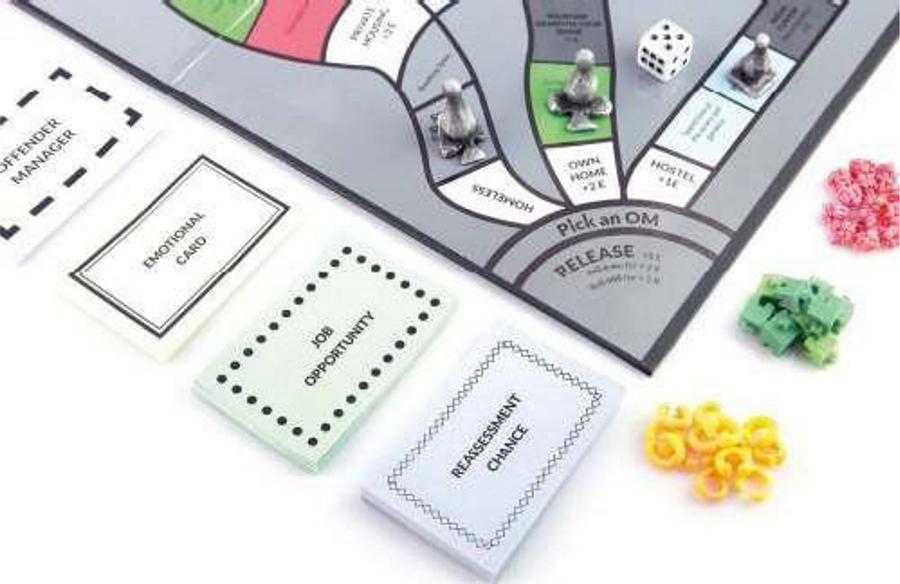
Probationary starting point (Burns, 2018).
Stage 2: Re-entry as emergent social reintegration
Beyond the initial and the physical transition, this second stage is about becoming or being of society (Maruna and LeBel, 2002). The success of this stage is dependent upon both human and social capital. Both forms of capital interact are dependent upon one another. For example, Moore (2011: 136) explains that ‘human capital is subject to change and transformation via the interactive relationship with social capital’ and vice versa. Human capital includes knowledge, skills, and capacities, while social capital includes relationships with others. The objective of Probationary is to get to the ‘safe’ square with the most positive emotions, relationships, and skills. The game was developed to try to make players experience many of key challenges of the resettlement journey as identified by the probationers who participated. The tokens collected (see Figure 4) represent emotional well-being (yellow tokens), the acquisition of skills (green tokens), and the development of relationships (red tokens). These three key elements of the game were devised through the workshops to represent the men’s view of the dynamics of successful resettlement. Acquiring skills and establishing relationships are key to emotional stability and the game seeks to portray a view of resettlement that is both a contributor to, and dependent on, emotional well-being.

Game tokens (Burns, 2018).
Shaped by the probationers, this aim symbolises the generative nature of the task-at-hand for players as they move to finish the game. The aim is not to finish first but to accumulate the most tokens (which can also be lost) as you move your way from release to the end. Each player is, in fact, engaged in what Maruna (2001) describes as a process or a project – the accumulation of emotions, relationships, and skill tokens are crucial to ‘winning’ – evidencing the logics of, and links to, a desire for ‘personal transformation’ (Werth, 2011).
The conversations in the first workshops depicted a very different view of ‘success’ for probationers, based primarily on gainful employment and financial stability. Over the course of the 30 hours of workshops, it became apparent that the initial conversations were structured around what could be understood as standard answers learnt in prison and did not accurately reflect the aspirations of those involved. By developing the game through artistic methods, we were able to draw out a different view of resettlement that, while grounded in the material realities of having a roof over your head, was also based on more complex notions of emotional well-being and relationship (re)building. In this way, we were able to see, and to subsequently represent to audiences, how the system was meeting the needs of those on licence.
The importance of family to the resettlement journey is written into the game. Each player’s ability to form and lose relationships is key to their advancement through the game. Reconnecting with family members, re-establishing relationships with children, and forming positive friendship groups are key markers in the game and enable players to collect relationship tokens (contributing to the chances of winning). The possibility of losing emotional tokens is one means by which the game is designed to reflect feelings of frustration that were understood to be a defining feature of life on licence. For the probationers involved, skill tokens were the only tokens that couldn’t be lost along your journey. Even if recalled (a function of the game which we shall return to), skills are not lost, but representative of a belief that human capital was less precarious than social capital. In the production of a game that provides an emotional experience for players, probationers were very keen to seek to convey feelings of frustration and despair that are produced by a dysfunctional system. However, the game also seeks to invoke feelings of hope and optimism as the journey plays out.
In addition, the game represents the importance for those on licence of establishing and maintaining a good relationship with an offender manager. The probationers’ accounts of the role of the offender manager reflected the well-established view of the importance of effective relationships between probationers and probation officers (Burnett and McNeil, 2005; Shapland et al., 2012). In the game, the offender manager can have a real effect on the character’s resettlement experience and desistance journey, highlighting the enduring importance of this key relationship despite the ways in which TR reforms have sought to revise it (Deering and Felizer, 2019). The probationers were keen to portray their experience of offender managers and to note them as a defining feature in their resettlement journey. When allocated an offender manager in the game, players benefit from consistent relationships with engaged and motivated supervisors who provide practical help and support. Players can also be hindered by broken relationships and supervisors who are overworked or disengaged and fail to provide adequate support and guidance.
Each player card defines the conditions of licence attached to that player. During the workshops, it became clear that the probationers were acutely aware of the threat of recall, and their ambition to be ‘safe’ was largely to be safe from the potential of recall. As a result, the character of the EYE, with their ability to recall players, was devised as a defining feature of the game. The EYE is representative of the State (independent of the players’ relationship to their offender manager) and governs gameplay, distributing tokens to players. Those who ‘forget to check-in’ with the EYE are recalled and must move back to the release square losing all emotional and relationship tokens. The place and function of the EYE illustrates both productive and repressive forms of state power having the capacity to punish and reward. The routes on the board, and players’ interaction with them, are reflective of a transitional stage – in playing the game, one experiences what Maguire and Raynor (2006) refer to as ‘zig-zagging’. When playing the game, as was the reality for the probationers who made it, risk and protective factors co-exist.
Stage 3: Re-entry as social integration or reintegration
As players’ approach ‘safe’, they must stop on a reassessment square where they can choose whether to move to ‘safe’ or to take a maximum of two reassessment cards. For the men, it was crucial that you could not lose any tokens at this stage – only gain. In the first real sense of agency given to players, the choice is a balance between the points associated with getting home and the points possible through reassessment. Importantly, the first to reach the ‘safe’ square is not necessarily the winner, as the probationers wanted to ensure that those who played the game understood that journeys of desistence were personal and sometimes the longer it took, the more one learned. In reality, as individuals move into the third stage of re-entry, they evidence a more established place in society (Moore, 2011); perhaps when in this stage, they are ‘safe’. This stage is often associated with ‘desistance’ or crime cessation. Markedly different than to stop offending, desistance is an ‘end-state’ (Laub and Sampson, 2001), and one’s desistence journey often characterised by progress and relapse (Moore, 2011). Authors have identified a number of influences which they associated with successful transitions, including factors of human and social capital noted above (skills, emotions, and relationships) (Maruna, 2001; Appleton, 2010). In Probationary, as players move to ‘safe’, they highlight the view that upon release, one is tasked with a remaking of the self and ‘re-earning’ full citizenship (Bosworth, 2007; Werth, 2011).
Probationary: Informing policy, practice, publics, and pedagogy
We propose that Probationary is one way that we might both learn differently and inform current and forthcoming debates. By immersing players in an emotional experience, the game reveals the subjective, precarious, and seemingly random nature of life on licence; through play, we arguably begin to see the effects of policy failure and understand some of the challenges faced by those on probation. While the sample size and diversity of participants means that the game cannot claim to be fully representative, this was never the aim. Instead, Probationary seeks to initiate conversations and to provoke reflections on the experiences of probationers. We believe therefore that this artwork represents a new way of learning about probation for those who play it and as the sector undergoes continuing change, we have sought to share it with a wide range of audiences in an attempt to realise its potential.
While the making of the game demonstrated the educational value of co-production, it is through dissemination – that is through play – that we are seeking to explore the potential of the game to inform debates about the future of probation. Probationary not only gives voice to those experiencing life on licence but enables the players feel some of the ‘pains’ of probation (see Hayes, 2015) and appreciate the importance of relationships between those on licence and practitioners. The practitioners who participated in the marking have highlighted the potential of this immersive experience: When we played the game you could feel it, the difficulty of getting round the board and the level of detail and level of intricacy for each step. I was blown away by it. (Sarah, AP manager)
We recognise that there is a great deal of excellent work being done to explore the therapeutic potential of the arts in the criminal justice system, but the aim of this work is not only to effect change at an individual level but to seek transformation at a systemic level too. In the current context, we are seeking to utilise the space afforded to the arts in the criminal justice system to ask difficult questions, including of the state, by critically exploring and challenging existing understandings of the experiences of the probation system. To align criminological scholarship, and policy reform agendas, at the boundaries of art and activism is therefore to draw upon the transformative and poetic qualities of art, to mobilise, and to inspire.
Post-production we are seeking to explore the relationship between method, strategies of dissemination, and impact. ‘Impact’ in this context is based on the potential this artwork has to reframe our modes of perception and to contribute to the process of rethinking probation. We believe that Probationary has this potential because of the way in which it was produced and the way it is experienced by players. In providing a ‘view from below’, the game not only gives voice to those experiencing life on licence but enables us, as players, to follow their journey and share their experiences. If Probationary has a transformative potential in terms of the perceptions of probation, can this, as an artivist intervention, be harnessed by those seeking to effect policy change?
To this end, we have collaborated with the Howard League for Penal Reform to explore the impact that this artwork can have on perceptions of life on licence, as well as the wider potential of this mode of collaborative work between academic, artistic, and penal reform sectors. The utility of Probationary for the Howard League lies in its ability to offer something new to campaign work: Probationary provides a different method by which to engage with the issues, facilitating the potential for greater empathy and a chance to (re)consider the impact of life on licence. (Anita Dockley, Research Director, Howard League)
While we have a sense of the radical potential of this method, we are mindful, following philosopher Jacques Ranciere (in Thomas, 2015) that we have to be cautious of ‘the assumption that artists’ work can have precise, intended effects’. We are aware that the use of artworks in this way cannot be precisely programmed and the impact is potentially difficult to both control and measure. An assessment of the impact on policy in any project of this type will take time and our work with the Howard League will therefore be ongoing. Probationary is an experiment and the potential of artivist interventions for penal reform campaigns will be considered further in the future collaborative projects.
In terms of key challenges to this approach, we are seeking to understand what is gained and what is lost when we work in this way. While we are encouraged by the attraction of Probationary – evident in the engagement with dissemination activities and in requests for copies of the game – we are mindful that the very success of the game may also raise questions about its form and the way in which we present critical issues to new audiences. In this sense, we are wary of the potential risk that by communicating critical issues in this form we render them palatable and ‘safe’. The future exploration of the use of artworks as campaign tools will need to consider if translating critical social research in this way dilutes the key message(s). Our work with the Howard League will therefore need to assess whether the benefits of broadening engagement do not come at the expense of the critical lessons learnt when examining criminal justice institutions from below.
Despite these challenges, as a pilot project, Probationary has demonstrated potential for this collaborative method. The existence of a game about probation has elicited interest from a diverse range of artists, teachers, researchers, practitioners, and policymakers in the United Kingdom and around the world. For many of those who have contacted us to enquire about the game, their interest has been motivated by the apparent potential it has to be used in educational and training settings. We have had many requests for a copy of Probationary from people involved in teaching in criminology and criminal justice as well as people involved in the training of practitioners in probation. The attraction appears to lie in the ability of this game to initiate and develop conversations in educational and training scenarios and to evoke empathy in those learning about probation. As Probationary exists first and foremost as an artwork, it has not been available for replication and resale. However, now at the end of the pilot project, the academic team and Hwa Young Jung are currently in the process of developing a new version informed by the feedback we have received in game play sessions in the last 3 years. The new version is being developed as a teaching tool that will be available for those seeking to use it in educational settings. This new tool will be underpinned by the drive to help players understand life on licence not simply by hearing about it but through providing a visceral experience that play is uniquely placed to induce.
Footnotes
Declaration of conflicting interests
The author(s) declared no potential conflicts of interest with respect to the research, authorship, and/or publication of this article.
Funding
The author(s) received no financial support for the research, authorship, and/or publication of this article.
