



Abstract
In recent years, the English government has been using competitive elements in the process of allocating public funds through policy. Front-line workers struggle with the limitations imposed by such a model. A qualitative case study was conducted to investigate the impact of a new performance-based policy on front-line workers of a public service called Liaison and Diversion. The findings demonstrated that professionals have been adapting the policy to local circumstances found at the street level. We argued that adaptation is a form of employee-based innovation that optimises the use of scarce resources and customises services to the clients.
Keywords
Introduction
A large number of vulnerable individuals, that is, people with mental health, learning disability, substance misuse, and other psychosocial vulnerabilities (NHS England Liaison and Diversion Programme, 2014), enter the criminal justice system every day. The antisocial behaviour that leads them towards wrongdoing is understood to be related to their vulnerabilities, which could be by and large grappled with in the community (Andrews and Bonta, 2016). Strategies devised to assist these have to address clusters of correlated needs and provide multifaceted solutions (Andrews and Bonta, 2016) in a timely manner (Armstrong, 2012; Ministry of Justice UK, 2013; Sinha, 2010) so to ensure desistance from further criminal behaviour (Fazel and Danesh, 2002; Fazel and Wolf, 2015; World Health Organization, 2005). To that end, the involvement of welfare services in the rehabilitation process is crucial to increase the individuals’ chances of remaining crime-free (Hean et al., 2009; Strype et al., 2014).
In the context of offender rehabilitation in England and Wales, a public service called Criminal Justice Liaison and Diversion (L&D) is one means to promote collaborative interactions between organisations in criminal justice and welfare services. The service provides prearrest support for vulnerable people as they come to the attention of the criminal justice system. L&D also collaborates with the police, youth offending teams, and court staff to provide critical information to decision makers in the justice system regarding charging and sentencing. In addition, L&D functions as a point of referral and follow-up for service users, so that they can access and are supported to attend community treatment and rehabilitation appointments (NHS England, 2018).
L&D is a form of diversion that has been locally organised and funded over the past three decades (Reed, 1992). However, in 2014, a performance-based national model for L&D services pre-empted local policies with the goal to standardise practice across sites nationwide (NHS England Liaison and Diversion Programme, 2014). It attempted to do so by specifying outcomes to be equally achieved and dovetailing funding for the services to their performance (Glas et al., 2018).
Although studies have investigated the impact of the national model on L&D services (Disley et al., 2016; Parker et al., 2018), they have focused on service-level outcomes (e.g. arrest rates, diversion rates, and referrals to other services), and little attention was paid at the perspective of professionals at the front line. As explained by Lipsky (2010), front-line workers traditionally operate under bureaucratic constraints and with limited resources. Under these conditions, they tend to struggle with equating top-down instructions and the needs existent at the street level (Hill and Huppe, 2014). Thus, addressing the perspective of front-line workers is also crucial to verify the impact of the national model for L&D services on practice.
The aim of our study was to add to the literature on policy implementation and innovation in the public sector by introducing the standpoint of front-line professionals on the national performance-based model for L&D services. To that end, we posed the question ‘How has the introduction of a performance-based national model for Liaison & Diversion services impacted front-line practice?’, and through the perspective of front-line workers of an L&D site in England, this article attempts (1) to investigate how the model has been implemented at the street level and (2) to examine the strategies deployed by L&D front-line workers to implement the national model.
The article is structured as follows: First, we introduce the theoretical framework adopted in the study of policy implementation and innovation in the context of offender rehabilitation. Further, we present the design and results from our qualitative case study exploring contradictions emerging from the implementation of the performance-based national model for L&D. The discussion raises the question of how to characterise the adaption of the model to the local context. The final section suggests a way to take our research forward.
Theoretical framework
Performance-based commissioning in public services
The main principle of performance-based policy is to use remuneration as a motivator for organisations to achieve desired goals. As Herbst (2007: 90) explained, The rationale of performance funding is that funds should flow to institutions where performance is manifest: ‘performing’ institutions should receive more income than lesser performing institutions, which would provide performers with a competitive edge and would stimulate less performing institutions to perform. The output should be rewarded, not input.
Performance-based funding arrangements were popular in the late 1980s and early 1990s when innovation processes aimed at improving public sector efficiency mostly followed the New Public Management (NPM) agenda. The NPM is a management model widely adopted in public service organisations in the United Kingdom and United States, especially in the late 1980s and early 1990s. The term encompasses a series of reforms and restructures as part of an effort to make the public service more ‘businesslike’ and to improve its efficiency using private sector management models (Hood, 1991). However, with the 2010 UK election of a Coalition government that shared enthusiasm for mixed economy of public service provision (Albertson et al., 2018), performance-based funding arrangements have become mainstream in policymaking again. Top-down performance-based commissioning was again prioritised in different areas of government, including welfare-to-work programmes, public health budgets, and the criminal justice system (Bochel and Powell, 2016). As a consequence, there are several top-down performance-based policies initiated by central levels of government waiting to be implemented by front-line workers, but there seems to be a mismatch between these policies and the conditions existent at the street level (Hill and Huppe, 2014).
The idea of introducing new solutions in the public sector through top-down policy is contested in the literature (Fuglsang, 2010; Lippke and Wegener, 2014), especially in cases where policies introduce a performance-based approach to stimulate implementation. Critics suggest that there is an inherent clash between performance-based commissioning and the notion of innovation (Blais et al., 1993), as it creates risk-averse workers who focus on fail-proof initiatives rather than experimenting new service designs (McGahey and Willis, 2017; National Audit Office, 2015). In the context of offender rehabilitation, the criticism is taken a step further, as the mere idea that financial motivation can be used to galvanise performance is rather simplistic. It assumes a one-dimensional causal connection between intervention and result and shows total disregard for the complex social context of offenders (Burke, 2010).
Thus, by responding the research question ‘How has the introduction of a performance-based national model for Liaison & Diversion services impacted front-line practice?’, this article addresses the implementation of the national model for L&D services (an example of a policy that links funding to the ability of the service to achieve pre-established outcomes) by front-line workers and uncovers potential mismatches between the policy and coping strategies at the street level.
Implementation of performance-based policy at the street level
The terms front-line worker, street-level worker, employees, and staff are interchangeably used in this article. They refer to Lipsky’s (2010) canonical conceptualisation of street-level bureaucrats in the public service sector, that is, those professionals who interact directly with the public they serve.
According to Lipsky, front-line workers are constantly developing coping mechanisms to deal with the challenges of policy implementation in a backdrop of inadequate resources, few controls, indeterminate objectives, and discouraging circumstances (Lipsky, 2010). The current increased need for public services to meet citizens’ demands reveals a proclivity of front-line workers behaving more autonomously rather than blindly following top-down instructions (Hartley, 2005). This approach epitomises the notion of street-level bureaucracy (Lipsky, 2010) and is responsible for promoting innovation in public sector organisations (Arundel and Huber, 2013). As top-down policies often do not meet the needs encountered at the street level, deviations from their rules promote transformation initiated at the front line. Once transformation spreads and develops into a routinised way of performing the work, it becomes the new work practice. Thus, practice-based innovation can be perceived as a cyclical process of learning, whereby deviation from previous work routines initiates a learning process that develops into new work practice (Ellström, 2010).
In this article, we suggest that front-line workers’ drudgery to square top-down policies and street-level conditions is a form of innovation in the public sector rather than implementation failure. In this sense, innovation can incrementally emerge from practice as a consequence of a process where new ideas build upon the ones that already exist (Fuglsang and Sørensen, 2011; Van de Ven et al., 2008). This concept is widely supported in the literature on innovation in the public sector (Fuglsang and Sørensen, 2011; Gallouj and Weinstein, 1997; Sundbo, 1997; Van de Ven et al., 2008) and allows for a concept of innovation that is intertwined with practice to include also improvement consequent of regular learning activities.
Later in this article we will draw upon this theoretical framework to discuss how front-line workers have been coping with the introduction of a performance-based national model attempting to standardise practice among L&D sites, but first we will describe the research context and methods of our study.
Research context and methods
Case selection
The performance-based national model for L&D services was originally rolled out in a few trial sites in each of the National Health Service’s (NHS) regions, namely North, Midlands, East, London, South East, and South West of England (Disley et al., 2016). These sites became known as ‘wave one’ sites. They were chosen because they ran well-established L&D services before the new policy. Building upon the experiences of ‘wave one’ sites, the model has been also introduced in other regions across England. The implementation has been happening in new ‘waves’. Currently, there are also ‘wave two’ and ‘wave three’ L&D sites (NHS England, 2019).
The goal of the case study reflected in this article was to investigate the overall impact of the national model on front-line practice. Therefore, selecting a representative L&D site was crucial. Initially, we conducted a purposeful sampling to narrow down cases for the representative single-case study. The criteria used were (a) L&D services that were part of the ‘wave one’ sites rolling out the new L&D national model and (b) L&D services with well-established local support mechanisms in connection with other services in criminal justice and welfare systems. ‘Wave one’ sites were originally selected by the government to roll out the national model due to their excellence in service provision (Disley et al., 2016) and served as base for the ‘wave two’ and ‘wave three’ implementation processes, thereby being a reliable indicator of a single-case study that was representative of the L&D services.
The selected L&D site belongs to the ‘wave one’. The service has a team that comprises administration professionals, Support, Time and Recovery workers, mental health practitioners, team leaders, and a service manager. Mental health practitioners are health professionals placed in police custody and in court to assist with the screening and assessment of vulnerable individuals entering the criminal justice system. Support, Time and Recovery workers are professionals responsible for following up the initial contact between the mental health practitioner and the client with practical support and referral to appropriate care.
The staff are small and stretched, the team leaders and the service manager have to multitask also functioning as mental health practitioners when necessary, which transforms them into front-line workers for the effects of this study. Service is provided to all ages and is available from 7 am to 7 pm Monday to Sunday. The selected L&D service is responsible for an area of 1000 square miles, which encompasses urban and rural areas serviced by 15 police stations, and has a static population of around 780,000. In 2017, a total of 2365 adults were assessed, and the number has been increasing yearly ever since. Figure 1 shows an illustration of how the scheme’s core workforce and coverage operate, where FT stands for full time and PT for part time.
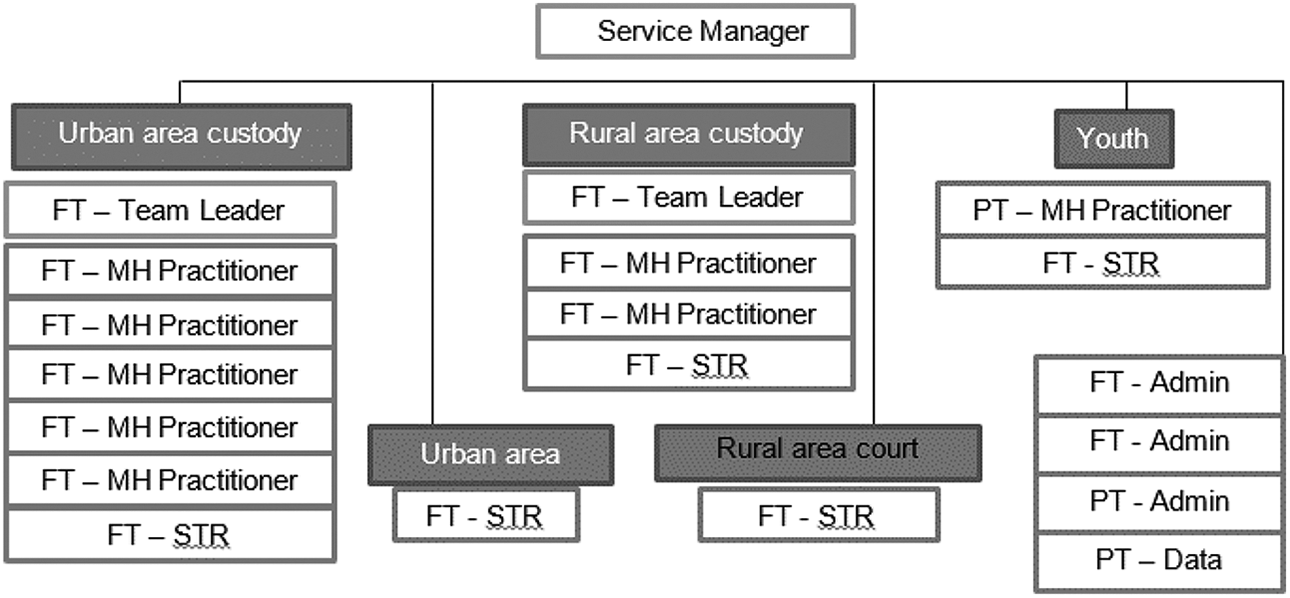
Work division and responsibilities management (adapted from Williams et al., 2019).
Data collection
Data collection followed a representative qualitative case study approach with the goal ‘to capture the circumstances and conditions of an everyday or commonplace situation’ (Yin, 2014: 48). The data collection occurred between 2017 and 2018 and consisted of three main stages.
First, we collected documents providing insights of contextual and historical factors which happened during the transition period in which the selected L&D service went from a locally managed and funded organisation to a site applying the new performance-based national model for L&D. The data set included internal documents describing the process of implementation of the new model (n = 27) and statistical reports of the screening and assessments taking place in custody and court upon the national model (n = 12).
Second, the entire front-line staff of the selected L&D service (n = 19) was interviewed. To ensure willingness, before each interview informants received a letter of invitation containing an information sheet about the project as well as a consent form to be signed. During the interviews, participants were given opportunities to refuse to participate in the research. They were also given a chance to withdraw from the study at any point. In total, 21 semi-structured interviews were conducted. The interview schedule was inspired by cultural–historical activity theory principles (Engeström, 1987) and aimed at exploring contradictions between the model’s instructions and their implementation in practice.
Third, we gathered observational data from visits with L&D staff placed in custody/court and participation in team meetings (n = 4) to ensure embeddedness in the context and build trust with participants.
The views expressed in this article are those of the authors and are not necessarily those of the funders nor the participants, who had no involvement in the study design; data collection, analysis, and interpretation; the writing of the report and the decision to submit the article for publication.
Data analysis
A template analysis method was adopted, which is a method of a thematic analysis of qualitative data that implicates the development of a coding ‘template’ summarising and organising relevant themes inductively identified in the data set (King, 2012).
First, the interviews were transcribed with attention for consistency in transcription across the entire data set. The initial analysis was limited to three transcripts because the goal was to develop an a priori framework based on a representative part of the data set without delving too deep into it (King, 2012). Besides, open-coding the entire data set would not fit the idea of having a framework applied to the data. With the help of the CAQDAS package QSR NVivo version 12, relevant segments of text were highlighted and described to identify the topics commented in each excerpt. Codes were detailed in their description of the extract to record the meaning of the selected excerpt, and the labelling could range from a few words to entire sentences. Through abstraction, codes were grouped into categories, and these were elevated to sub-themes (when suitable) and themes. The a priori template included themes considered relevant in the light of the research questions the study aims to respond.
In the end, a final template consisted of one meta-theme, one theme, three sub-themes, four categories, and three subcategories, which was then applied to the entire data set and served as the basis for the interpretation of the data and writing up of the findings. This article draws upon findings of contradictions between the national model’s instructions and working conditions at the street level. In the following sections, we present and discuss the findings of how L&D front-line workers have been coping with the instructions of the model.
Case-study findings
The performance-based model for L&D services and standardisation of practice
The national model for L&D is a policy enacted by the central levels of government with the goal to standardise performance across the country. Homogeneous practice is galvanised by linking funding to positive outcomes. An outcome is positive if it meets the standards stipulated by the policy and also in comparison with other L&D sites, which reinforces the need for standardisation of the service nationwide (NHS England Liaison and Diversion Programme, 2014). Nevertheless, interviewees bluntly informed that the national model is being subjected to local idiosyncrasies. There are national guidelines from NHS England, but then we just add bits to make them specific to our service. (Mental health practitioner while working at the L&D headquarters) Our scheme offers support work to clients up to 4 weeks. I think it is a guideline from NHS England and you would think that L&D schemes would follow the same rules and have the same setup, but actually they do not. They work completely differently […] I do not have the stats, but let’s say we do 50 referrals per month whereas another area does not do any. It might be simply the case that they do not have support workers. So, there is not much uniformity in the service. (Mental health practitioner while working at a police custody suite)
Interviewees described that the service was already performing at its full capacity before the national model and that the new tasks introduced by the policy only added to the front-line workload. As a consequence, they mentioned difficulties in, for example, going on vacation or on sick leave. Operating with a small staff, participants reported the need to multitask or even prioritise tasks (e.g. screening, assessment, and support of vulnerable clients in detriment of administrative tasks) and cases (e.g. support of clients having a mental health episode or about to be released from custody to detriment of stable clients) they deem more relevant. We have to register the outcomes of our work on our database. It is beyond my capacity to explain to you how these statistics are handled, but I know we have to prove ourselves in order to continue to receive the funding from NHS. […] If I have seen someone in the morning, for example, by the time I am done with the bits and pieces, it is about two and a half hours’ worth of work. So, when we are busy, we have to prioritise. (Mental health practitioner while working at a police custody suite)
Our claim, further explored later on in this article, is that the adverse conditions described above motivate adaptation of the national model to local circumstances found at the street level.
Policy implementation: Front-line adaptation and coping strategies
The goal of the government with the national model was to lay out instructions to be consistently followed by local L&D schemes across the country so that the service could be equally provided nationwide and results could be compared between schemes (NHS England Liaison and Diversion Programme, 2014). However, the text of the national model demonstrates that the document mixes both mandatory rules and suggestive guideline, for example: The service must be [emphasis added] accessible at the earliest stage once an individual is suspected of having committed a criminal offence. (NHS England Liaison and Diversion Programme, 2014: 5) Coverage should be [emphasis added] a 24/7 service consisting of a mix of operating times and out-of-hours arrangements, including links to existing services and provision. (NHS England Liaison and Diversion Programme, 2014: 5) The work of the liaison and diversion scheme and the relationships it develops should be [emphasis added] underpinned by formally agreed service level agreements, joint policies and protocols. (NHS England Liaison and Diversion Programme, 2014: 5) The liaison and diversion service will need to be [emphasis added] integrated and take cognisance of a range of inter-related projects and programmes and developing initiatives. (NHS England Liaison and Diversion Programme, 2014: 6) There is a national model of liaison and diversion that sets out the age group that we have to work with and the things that are supposed to be included in our model, and it is commissioned by NHS England, but again every area that piloted the model has done things slightly differently. (Mental health practitioner while working at a police custody suite)
The national model expressly excludes such responsibilities from the L&D programme (NHS England Liaison and Diversion Programme, 2014, paragraph 8.3), but front-line workers adapted the instruction to the local conditions they encounter. The Street Triage is not a function of the Liaison and Diversion service. Here in this county, both services are provided by the same team, but they have different funding. So, if we are functioning here as Liaison and Diversion during the day and the Police find someone in the streets and ask us to check if the person is on our systems, we could say no to that. However, if we are not having a busy day and they need our support, we can bend the rules. (Mental health practitioner while working at a police custody suite) Practitioners have to prioritise. So, we are coming into the police, and we have five people to see. From start to finish, each assessment is going to take probably a couple of hours if not more, in order for us to do everything we need to do. There is much paperwork involved. So, I think practitioners are constantly under pressure to get to see loads of clients, but we cannot. Then we worry about the ones that we did not see. (Mental health practitioner while working at a police custody suite)
In the end, the findings show that adaptation of the national model to local conditions is part of the front-line workers’ daily routine, although most of the time such adjustments are a consequence of limitations imposed by scarce resources.
Discussion
Front-line adaptation of the L&D national model to local circumstances: Limitation or innovation?
Ever since the roll-out of the national model for L&D (NHS England, 2014), there has been an expectation that all L&D sites equally accomplish the outcomes specified in the policy (NHS England Liaison and Diversion Programme, 2014, paragraph 4). To ensure standardisation of practice, NHS has linked funding of the services to their ability to perform according to the policy. Success has been measured based on the number of assessments carried out monthly.
The results of our study demonstrated that front-line workers have been grappling with lack of time and resources to comply with all the instructions of the national model. Having assessment rates being used as a gauge implies that professionals must register the outcomes of their work on the database to ensure future funding of the service. However, that is a time-consuming task and doing the paperwork of one client means detracting attention from others, which also affects future funding of the service. In the middle of a predicament, L&D front-line workers see themselves forced to choose between performing core-work task (e.g. the support of vulnerable people in contact with the criminal justice) or housekeeping chores (e.g. tasks related with new procedures in information technology, new ways of recording and monitoring activity, and filling up forms). The findings showed that they have been prioritising the former in detriment of the latter despite the impact such decision might bear on future funding of the service.
The explanation is that front-line workers in the context of rehabilitation of offenders often abide by values and ethical standards of their profession (Robinson et al., 2016), which might go against the idea of standardisation introduced by performance-based policies. The prioritisation of certain instructions of the national model (core-work tasks) at the expense of others (housekeeping chores) was the approach adopted by our interviewees to implement the policy in the light of their work values and ethical standards. In the midst of this, however, standardisation of practice among L&D services – one of the main goals of the model – has not happened as expected and the current service-provider has to consistently bid against other suppliers in new tendering processes brought up by NHS (NHS England, 2018).
Based on the findings of our study, we argue that the adaptation of the performance-based national model for L&D services does not have to be perceived as negative necessarily. We understand the deviance from policy intent at the street level as a form of innovation instead of implementation failure (Hupe and Hill, 2016). This is an idea that builds upon the traditional understanding of front-line workers as lower level policymakers (Lipsky, 2010). By the same token, the prioritisation of core-work tasks in detriment of housekeeping chores can be perceived as a tentative means to operationalise the policy in a way that adds value and is beneficial to service users, which is a strategy predicated on the notions of bricolage (Fuglsang, 2010) and everyday innovation (Lippke and Wegener, 2014).
As mentioned in the above paragraph, the adaptation is a tentative to equate policy and practice. Therefore, we are not arguing that it is the optimal approach to implement the national model. Ideally, the policy would be implemented in its full potential through communication and coordination between L&D front-line workers and policymakers. However, the findings of our study confirmed the knowledge that top-down attempts to innovate in the public sector are prone to fail if front-line workers do not recognise them as relevant at the street level (Lipsky, 2010; Rittel and Webber, 1973). Similarly, policymakers are not amenable to practice-based solutions if they feel that they are threatening the order of the system (Høyrup, 2010). Effective innovation processes require both strategic directions for innovation that are initiated top-down along with the presence of ideas emerging throughout the organisation in a bottom-up fashion (Fuglsang and Sundbo, 2005; Sundbo and Fuglsang, 2002). This is what is missing in the case of the national model for L&D services.
However, street-level bureaucracy needs to be taken to task for its purview as a heuristic device. The proclivity to square policy and street-level conditions might seem providential, but its reification by front-line professionals might lead to deleterious effects. Discretion must go in tandem with accountability, and professionals ought to bear the consequences in circumstances where they abuse their discretionary power. In the case of the L&D service discussed in this article, professionals are conceivably not being wary enough to grapple with the repercussions of their adaptations beyond proximal contingencies, even though they are being pressed by a cluster of intractable conditions that increasingly limit their capacity to perform.
Thinking strategically, the discretionary decision of prioritising ‘core-work tasks’ over ‘housekeeping chores’ taken by front-line professionals might lead to a not so benign outcome in the long run. The result could be that, in the future, the service might have funding discontinued due to the partial disobedience of the front-line professionals to the national model despite the workers’ efforts. It is a scenario in which street-level professionals benefit from discretion to override the proposed standardisation of the service and they do so predicated on the understanding that innovation is contingent on an evolutionary epistemology whereby only the most suitable norms should endure. In other words, a norm of the national model should not persist if it does not meet the needs of practice and service user. Although riveting, such understanding might harm the subsistence of the service.
As mentioned earlier, the way the national model is being implemented currently is subpar. Coordination amid the various strata of power is paramount to overcome hardship and avoid a zero-sum game in which either management or front-line achieve their political goals. The findings from the study, however, contribute to interpret the adaptation of top-down instructions as a type of employee-based innovation, as it adds value at both the street level and the system level of the organisation by optimising the use of scarce resources through tailoring the service to the recipients instead of blindly following standardised top-down instructions.
Final remarks
L&D services have been present for nearly three decades (Reed, 1992), but since 2014, they were turned into a national service (NHS England Liaison and Diversion Programme, 2014). With the introduction of a national model for L&D service, the goal was to establish outcomes to be equally achieved across L&D sites and link funding to their ability to perform according to the policy’s standards. The findings of our study revealed, however, that front-line workers have been struggling with lack of time and resources to comply with all the instructions of the national model. Consequently, the policy has been adapted to context-specific circumstances found at the street level.
This article problematised the utilisation of performance-based policies in the context of offender rehabilitation by exploring the challenges faced by front-line workers of an L&D scheme in England implementing instructions of the national model for L&D. We interpreted the adaptation of the policy as a form of employee-based innovation and suggested communication and coordination between L&D front-line workers and policymakers as the solution for the national model to achieve its full potential.
Thus, the question requiring further research becomes how to make sure that the national model for L&D services is implemented and meets the needs existent at the street level? Currently, the government expects the directives of the national model to be naturally spread out, but there seems to be a gap between the policy instructions and the needs of service users and front-line workers (Hill and Huppe, 2014). We understand that new ideas in the public sector should emerge through interaction and not top-down with the use of remuneration as a stimulator (Fuglsang, 2010). In this sense, we suggest that front-line workers should recognise the relevance of the national model, but they also should receive the necessary support for the introduction of bottom-up employee-based solutions (Ellström, 2010; Engeström, 1999), as only they are aware of the needs of service users and street-level bureaucrats.
Footnotes
Authors’ note
The views expressed are those of the author and do not necessarily those of the funders. The funders had no involvement in the study design; data collection, analysis and interpretation; the writing of the report and the decision to submit the article for publication.
Acknowledgements
The authors are thankful to all participants who generously took part in the research.
Declaration of conflicting interests
The author(s) declared no potential conflicts of interest with respect to the research, authorship, and/or publication of this article.
Funding
The author(s) disclosed receipt of the following financial support for the research, authorship, and/or publication of this article: This work was supported by the European Union’s Horizon 2020 research and innovation programme under the Marie Skłodowska-Curie Grant Agreement No. 734536.
