




Abstract
This article explores the increase in the number of older people on probation caseloads. ‘Older’ clients are defined as those aged 50 and over, in line with the use of this definition by Her Majesty’s Prison and Probation Service. Drawing upon a Freedom of Information request submitted to the Ministry of Justice, the data show increases in the age of probation clients across community orders, suspended sentences, and supervision on licence. One in five residents in Approved Premises are over 50. Despite the increase, there is a dearth of research relating to the needs of older people on probation and how well probation services and staff are equipped to meet their needs. Consequently, this article utilises research relating to older prisoners, drawing inferences to probation experiences. This prompts the question of whether probation is ‘institutionally thoughtless’, a term coined relating to the daily experiences of older prisoners. This article depicts findings from qualitative interviews with older prisoners in prison for the first time. The findings highlight ambivalence towards completing accredited programmes, which may be applicable to probation settings. This article concludes that action to tackle discrimination requires a commitment to justice, self-awareness, and knowledge via policy and practice.
Introduction
This article explores the increase in the number of older people on probation caseloads. By defining what is meant by ‘older’, it also considers whether as a consequence of a lack of recognition of this cohort within policy and practice, probation could be seen to be ‘institutionally thoughtless’ (Crawley, 2005: 356) in meeting the needs of older clients. This is important as age is a protected characteristic under the Equalities Act 2010. This article reflects on the results of a Freedom of Information request 1 submitted to the Ministry of Justice (Ministry of Justice, reference 190729012, personal communication, 27 August 2019), which provided details of the ages of clients who are on probation caseloads. The information is supplemented with findings from qualitative interviews conducted with first-time older prisoners, which, although focussed on their prison experience, has relevant findings for probation, particularly their ambivalence regarding participating in accredited programmes. Finally, the article concludes that pragmatic action is needed at policy and practice level with some timely recommendations for the future commissioning of probation services in England and Wales. The article commences with defining what is meant by ‘older’ in the context of the criminal justice system, given that ageing is a social construct.
Defining ‘older’
Age is the one protected characteristic under the Equality Act, which universally applies to every individual. Despite the fact that we are all ageing, attitudes towards the phenomenon are shaped by social, cultural, and political contexts. Drawing upon literature relating to older prisoners, the term ‘older’ has been applied to a number of diverse ages, ranging from as young as 28, that is, above the average prisoner age (Le Mesurier et al., 2009), to 65, the state retirement age (Crawley and Sparks, 2005). The emphasis in research into older prisoners has tended to focus on emerging health and social care needs as a consequence of ageing, so researchers have deployed a range of rationales. Her Majesty’s Inspectorate of Prisons (HMIP) defines older prisoners as aged 50 plus (HMIP and Care Quality Commission (CQC), 2018) due to evidence suggesting that prisoners physiologically age up to 10 years compared to community counterparts (Loeb et al., 2007; Maschi et al., 2011; NACRO, 2009). Other researchers have applied that logic to utilise age 55, as 65 is the age at which people in the community in England would begin to draw their pension (Crawley and Sparks, 2006; Filinson, 2016; Murdoch et al., 2008). Crawley and Sparks (2006) further distinguished between ‘older’ and ‘elderly’ prisoners, arguing that elderly prisoners were those in their late 70s. Thus, the majority of Western research tends to use 50–60 as their criteria for ‘older prisoners’.
Similar issues may prevail when attempting to define an age for those on probation caseloads. However, consistency within Her Majesty’s Prison and Probation Service (HMPPS) would be seen to be a useful starting point, who define age 50 as an ‘older prisoner’. Although this is beneficial where probation clients have experienced a period of time in custody, life-course perspectives on the nature of transitions (Bartley et al., 1997, in Blane 2006) also identify that changes in social status can have long-term effects on future life chances, particularly where there are accumulated levels of dis/advantage. This may be the case as older clients on probation continue to age. This is further exacerbated by the interactions with housing, education, health, and income in community and custodial settings (Humblet, 2015). Conversely, it may be problematic to utilise such definitions for those who are ‘neophyte’ probation clients, that is, those who are coming to the attention of probation services for the first time in later life. In those cases, their demographic histories may well be different.
Historically, the emphasis within probation practice has centred on the processes by which people may age out of crime, particularly as an indicator of desistance (see McNeill et al., 2012, for an overview). Additionally, there is a hesitance to define age, due to the heterogeneity of experiences of older prisoners, which are not necessarily related to their numerical age. Such heterogeneity has been used to justify a lack of national strategy from HMPPS to date. However, this approach has been repeatedly criticised due to a lack of joined up thinking and intervention (Hayes et al., 2013; HMIP, 2004, 2008; House of Commons Justice Committee, 2013, 2014; Prison Reform Trust, 2008; Prisons & Probation Ombudsman, 2017).
Despite such diversity, there is no doubt that prison regimes are designed for younger men, leading to Crawley (2005: 356) coining the term ‘institutional thoughtlessness’. Manifestations of such ‘institutional thoughtlessness’ in custodial settings relate both to environmental factors, for example, not placing people with frailty on the ground floor, and to the prison regime, for example, education and work being tailored to younger men who will be seeking employment on release. The terminology may not be as directly applicable to probation settings, given the fragmentation of probation delivery, and it may be more a case of ‘systemic thoughtlessness’. As this article considers, there may be elements of probation delivery which could constitute indirect discrimination under the Equality Act 2010. Under the legislation, indirect discrimination relates to actions which may be applied in a uniform fashion, which in practice results in an unfair outcome for individuals with the protected characteristic (in this case, age). As Powell and Wahidin (2006: 31) state: by neglecting crime and later life as a legitimate area of research we are indirectly replicating ageism and reproducing the hierarchy of power that excludes and invalidates the experiences of an ageing population.
Furthermore, existing offender management statistics do not lend themselves to an analysis of age and ethnicity. The lack of research may mean that issues relating to intersectionality are not considered.
How many older people are on probation caseloads?
As Canton and Dominey (2018) note, statistics for people who are under community supervision are more difficult to obtain compared to people in prison. However, because there is a large overlap between prisoners and probation clients, it may be reasonable to infer that each faces similar levels of disadvantage due to a range of extensive and complex needs, which is exacerbated by an inability to access services. Prison population data are readily available on the Ministry of Justice website; however, population data relating to probation caseloads are not routinely published. Because demographic data are routinely collated as part of the Offender Assessment System (OASys), a Freedom of Information request was submitted to the Ministry of Justice (Ministry of Justice, reference 190729012, personal communication, 27 August 2019). As Brown (2009: 88) identified, organisations are often ‘data rich’, and according to the information commissioner, The main principle behind freedom of information legislation is that people have a right to know about the activities of public authorities, unless there is a good reason for them not to. This is sometimes described as a presumption or assumption in favour of disclosure.
The data supplied identified that during 2018/2019, 26830 people on probation caseloads were aged over 50. This represents almost 14% of the caseload, with similar proportions for men and women. This means that one in six people on probation are aged over 50. Figure 1 documents the changes in the proportions of those aged over 50 within each type of order.
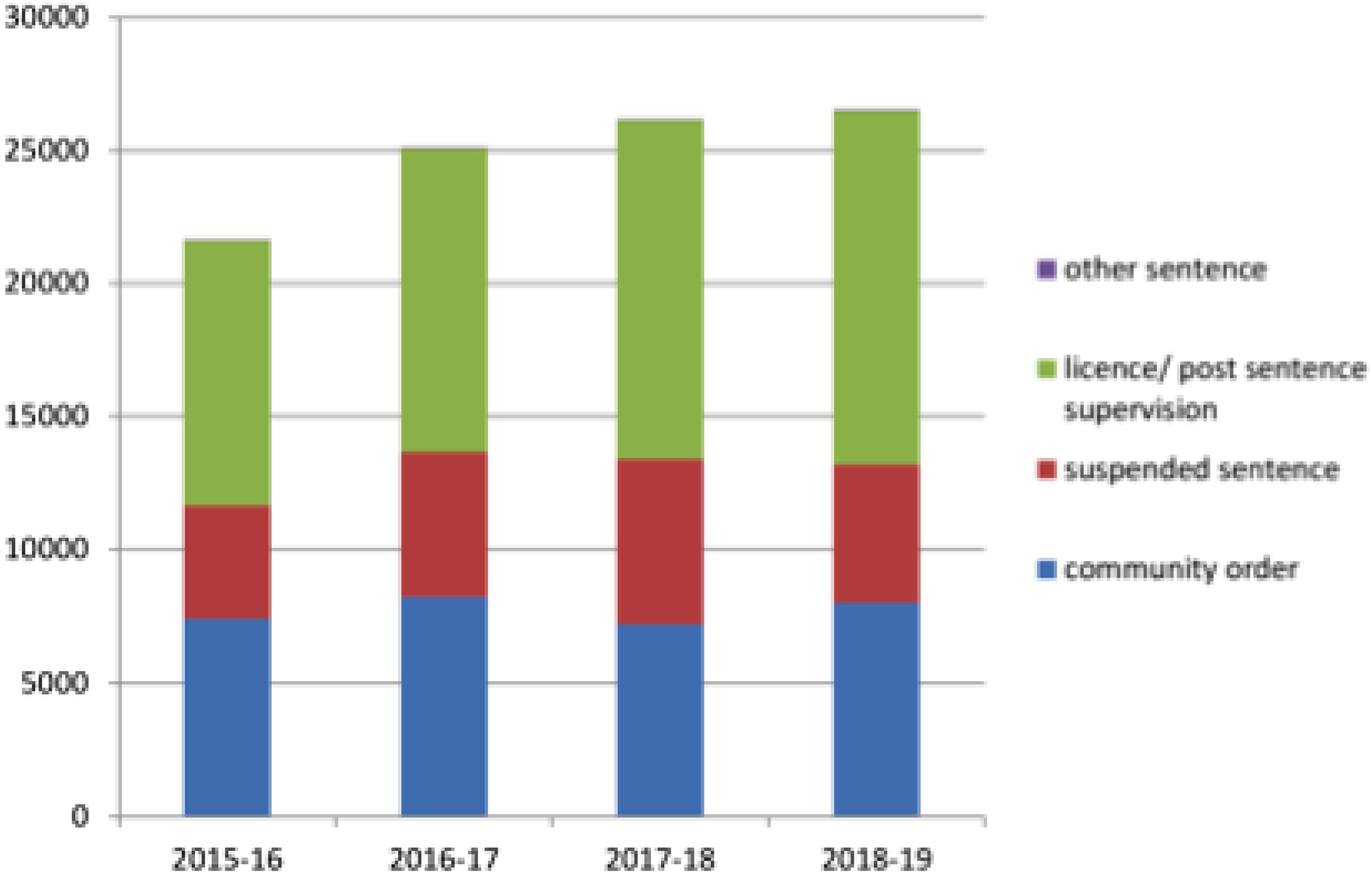
Probation caseloads of offenders aged over 50.
The proportion of over 50s on community orders has remained relatively static since 2015, with around 11–12% of community orders being served by those over 50. However, the proportion of suspended sentence orders has increased from 9.8% in 2015/2016 (n = 4262) to 12.4% in 2018/2019 (n = 5185). Figures for community orders and suspended sentences dwarf the increases in the proportion of post-release supervision or licence. In 2015/2016, there were 9925 people aged over 50 being supervised following a period of custody, 14.6% of those on licence. By 2018/2019, this had increased to 18%, with 13,281 people aged over 50 being supervised. This maybe partially explained by the implementation of the Offender Rehabilitation Act 2015, (Parliament UK 2015) which introduced a minimum of 12 months post-custodial supervision for all custodial sentences over a day’s duration. One in six people being supervised following a period of custody are aged over 50. This is a higher proportion than the percentage of older prisoners in the prison estate, which is 16% (Ministry of Justice, 2019b).
Breaking this down further, 21% of those aged over 50 on licence are over retirement age, including 37 people aged over 90. Recent projections regarding the prison population over the next four years show that although the number of prisoners aged 50–59 may decrease slightly, those aged over 60 are likely to remain constant in absolute and proportionate terms (Ministry of Justice, 2019c). This is important, as the traditional notions of defining, and meeting criminogenic need may well differ for this cohort, for example, expectations around employment.
As highlighted above, there is often the perception that older offenders are sex offenders. Where this is the case, or where offenders are violent, they may be accommodated in Approved Premises following release from custody. Table 1 presents a situation whereby in 2018–2019, over one in five residents in Approved Premises are aged over 50 (21.7%, 352 people). Twenty percent of those aged over 50 are over retirement age. The Freedom of information (FOI) request asked for data relating to those aged 80–89 and 90+; however, these data were suppressed for these age groups due to the low numbers, to avoid personally identifiable information being made public. This means that in practice, there are residents aged over 80 in those premises.
Age of residents in Approved Premises.
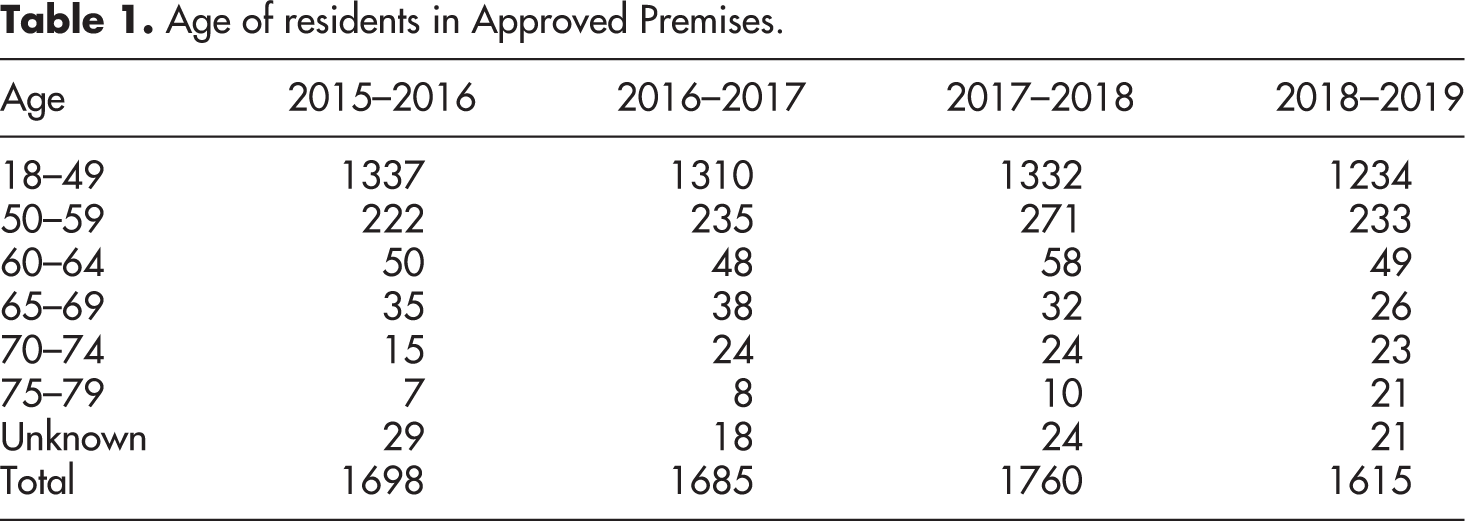
The figures have implications for the provision of an age-appropriate regime, which is a requirement of the Approved Premises specification (Ministry of Justice, 2017), potential increase in demand (Irwin-Rogers and Reeves, 2019), and move on accommodation (Her Majesty’s Inspectorate (HMI) Probation 2017; Reeves, 2013) where both income levels and issues relating to health and frailty may impact on sourcing appropriate accommodation to meet their needs.
The Care Act 2014 requires social services to assess, identify, and meet social care needs of prisoners, which will lead to an increase in requirements for ex-offenders to be either accommodated in care homes or for care to be delivered in their homes following release. A thematic inspection undertaken jointly by HMIP and the CQC (2018: 36) found that such processes are not fully embedded: Processes for transfer and release of prisoners in receipt of social care are not yet well established and more could be done to ensure that there is continuity of care on transfer and release.
What do we know about older clients on probation?
There is a paucity of research into the experiences of older probation clients per se. Back in 2002, Codd and Bramhall analysed the records of 500 probation clients aged over 50. They found that although the two main offence types related to violent and sexual offending, large numbers of offences defined as ‘summary’ or ‘other’ meant that other offending trends may have been concealed in the data. Almost 20 years ago, they lamented the invisibility of research into older people in the criminal justice system, not least as a consequence of prioritising youth crime: Youth crime is central to academic and political debate, especially in relation to probation. Whilst recognising the importance of youth crime issues, focusing on young offenders creates the danger that older people become deprioritised and disempowered, rendered invisible and excluded. (Codd and Bramhall, 2002: 33)
Research identifying the characteristics of those who died while under probation supervision found that people aged 50 and above were over-represented, with 20% of deaths taking place among those aged under 50 despite only being 5% of the caseload (Phillips et al., 2019). As the proportions of over 50s on the probation caseload increase, it is likely that the number of deaths will increase too. Within a prison setting, the number of deaths of over 50s has tripled in a decade. A thematic review of deaths of older offenders by the Prisons and Probation Ombudsman (2017: 3) highlighted: prisons designed for fit, young men must adjust to the largely unexpected and unplanned roles of the care home and even the hospice.
One argument for the increasing caseload is that the numbers reflect the increasing ageing of the general population. Almost one-fifth of the population will be aged over 65 in the next eight years (Office for National Statistics, 2017). Additionally, an increase in sentencing for offenders convicted of historic offences, arising from the so-called Savile Factor (Furedi, 2013), has led to an increase in both custodial and community sentences, including suspended sentences.
Wahidin’s (2006) typology of older prisoners identified the following four cohorts of older prisoners: repeat prisoners ageing throughout their life course, prisoners growing old throughout a long sentence, short-term first-time prisoners, and long-term first-time prisoners, possibly for historic offences. Applying a similar typology to probation, older client cohorts may include: recidivist offenders who have not ‘grown out’ of crime. These may be managed within Integrated Offender Management teams due to their entrenched behaviours; first-time community order clients who have committed an offence at an older age; probationers on standard licences following a period of custody; and probationers on extended licences and/or subject to additional restrictions, for example, Multi Agency Public Protection Arrangements (MAPPA).
It is arguable that each of these cohorts may have distinct needs related to their age and their engagement with probation services. The next section highlights why the needs of probation clients have not been systematically identified to date.
Why the lack of attention on the needs of older probation clients?
Unlike prisons, where physical infrastructure requires consideration of future population numbers, there is no systematic planning within probation to take account of demographic factors, which may influence service delivery. Indeed, inaccurate projections of future caseloads which underpinned Transforming Rehabilitation were seen to contribute towards the failure of the strategy (National Audit Office, 2016).
Despite research highlighting that the needs of older prisoners are not being met, there at least has been increasing attention paid to the older prisoner demographic within the prison service. HMIP “Expectations” (2017), which underpin their inspection regime, explicitly includes reference to meeting the needs of older prisoners under the equality, diversity, and faith expectation. Within this expectation, the benchmark includes ensuring that engaging age-appropriate activities are available, including for those who are retired or are unable to work during the day and staff being able to recognise signs of mental health problems and the onset of dementia. There is no such explicit expectation from HMI Probation, where standards for inspecting probation are more broadly configured around diversity and disproportionality per se (HMI Probation, 2019). As with research around the needs of women and probation, it is not clear whether differences relating to older probation clients are exaggerated or denied (cf. Gelsthorpe, 2007, in Canton and Dominey, 2018).
Furthermore, as NHS England is responsible for commissioning healthcare services within prisons, their commissioning decisions are often underpinned by health needs assessments. Increasingly, there is recognition that meeting older prisoners needs requires bespoke healthcare interventions. Although some health-related research has been undertaken with probation clients (Brooker, 2015; Brooker et al., 2008; Bryson et al., 2019), the emphasis is often on substance misuse and/or mental health. Opportunities to engage with community NHS provision may not be prioritised by probation staff. Of course, segmenting a population does not necessarily mean that measures are being implemented to support their needs, but at least there is a growing awareness of the size of the population and how this may affect future delivery.
One of the main reasons why the needs of older clients on probation are not met is because they are not being systematically asked. Hayes et al. (2013) interviewed 262 older prisoners across the North West of England using the CANFOR-S (Camberwell Assessment of Need – Forensic), which also included items relating to social networks and quality of life. They found that prisoners had an average of 5.7 needs. The most common needs related to accommodation (i.e. having nowhere to live on release) and physical health needs, both of which will impact on their effective resettlement from custody. Over 100 prisoners (40%) received no visits at all. Recent research from within the field of gerontology (Age UK, 2018) highlights that social isolation and loneliness can have a significant impact on physical and mental well-being and the importance of strong social connections. This is increasingly seen to be important by Government (see the Scottish Government, 2018, for an example of how this is being implemented in practice). The importance of connection is increasingly being highlighted in literature relating to recovery and desistance (McNeill et al., 2012; see also Best et al., 2018, for a further overview relating to social identity and community capital).
Could probation services be seen to be ‘institutionally thoughtless’ in respect of older probation clients?
Within a probation context, there is currently insufficient evidence to point to institutional/systemic thoughtlessness. However, applying findings from prison settings and understanding some of the issues faced by people as they age aid with starting the conversation about how to identify the extent to which such issues exist and, if so, what measures can be put in place to tackle the issues.
de Medeiros (2017) outlines three overarching aspects of ageing which can support the development of a discussion about ageing: structure, experience, and care. Structural issues operate at a macro and micro level. At a macro level, there is a fundamental lack of discussion around the effects of ageing on the criminal justice system, which permeates to local delivery. Systemic thoughtlessness locally includes issues relating to clients are travelling to appointments; waiting in uncomfortable waiting areas and simply not having their daily needs and activities considered in a framework of delivering supervision and interventions focussed on employment, reducing substance misuse and issues relating to accommodation, based on criminogenic needs assessed by OASys. Just as in prison, where the fact that older prisoners are often seen as ‘old and quiet’ (HMIP thematic inspections, 2004, and follow up in 2008), there is an inherent lack of emphasis on the needs of older clients in probation services. Given the issues faced in working with younger offenders, including the transition into adult services, an increasing awareness of issues relating to maturity, and a desire to reduce reoffending through working with those most likely to reoffend, it is somewhat inevitable that a focus on younger people necessarily detracts from a focus on older people. However, transitions continue throughout life, and for older people, it may be focussed on transitions from employment to retirement (Hofacker, 2015), roles around giving and receiving care (de Medeiros, 2017), the changing nature of relationships, and transitions around health (World Health Organisation, 2015).
Such structural factors interact with the ‘experience’ highlighted within de Medeiros’ overarching aspects of ageing. Current research in gerontology also affords an opportunity to reflect on the extent to which those who are resident in our communities who are simultaneously experiencing probation are having their broader, non-criminogenic needs met. In addition to the aforementioned research into loneliness, this includes measures relating to ageing in place (Barrett et al., 2012; Scharlach, 2017) and resilience (Bennett, 2015).
Structure and experience also interact with the application of pathways to reduce reoffending, as their applicability may be different for older probation clients. Although sentence planning may be one way in which individual needs can be met, items included in OASys may be less applicable to older probation clients. For example, older clients may be more likely to have had a successful employment history, but equally may be facing the double disadvantage that having a criminal record and being older in the workforce may bring. If they are retired, how their time is filled will be an important consideration. Bruggencate et al. (2018) undertook a systematic review of the social needs of older people. They found that interventions for older people should focus on connectedness, participation, and independence, notions which have resonance to probation practice around recovery and desistance.
Older probation clients are possibly more likely to have more settled accommodation, but equally could be affected by restrictions on where they are able to live, particularly if they are a sex offender. This includes not only Approved Premises, but move-on accommodation (Bows and Westmarland, 2018). Additionally, older offenders are less likely to have misused drugs but could be more likely to have issues related to alcohol (Public Health England, 2018). Where substance misuse has continued into older age, this will bring particular risk factors, including those relating to physical and mental health (Beynon et al., 2007). Additional issues specifically relating to older people and health include mental health. The Association of Directors of Public Health (2019) cites research from the Mental Health Foundation that 22% of men and 28% of women aged over 65 have depression. Baidawi (2019) cites that for older prisoners, the figure is between 40% and 50%. Additionally, physical health declines with age, which includes long-term conditions (such as diabetes, asthma, heart disease), frailty, malnutrition, and dementia (Age UK, 2019). Although health is included as a measure in OASys, the health needs of probation clients per se are not embedded within probation practice (Brooker, 2015). This may result in further unmet needs of older clients, which may also have an impact on their ability to comply with their sentence plan or licence conditions.
Because there is a lack of research relating to the experiences of older probation clients, this next section draws upon research by Cadet (2019). Semistructured in-depth qualitative interviews were conducted with nine men, imprisoned for the first time in their 50s. Their ages ranged from 56 to 79, the average being 66. Just under half (n = 4) declared a disability. Only one participant stated that they had been in poor health prior to coming into prison. Half were single or divorced, half were either married or cohabiting prior to custody. Just under half (n = 4) were retired, with the remainder being in employment prior to coming into custody, which included self-employment. This compares with only one-third of newly sentenced prisoners being in employment immediately before coming into custody (Ministry of Justice, 2012). All interviewees were in stable accommodation prior to coming into custody, including a third owning their home outright. This also reflects differences in the life experiences of older prisoners compared with younger prisoners, as 15% sentenced prisoners were homeless prior to coming into custody (Ministry of Justice, 2013). Although the issues identified may also be important for younger prisoners, it is important to note that the illustrative quotes are verbatim accounts of the experiences of older men, from their own lived experience.
In particular, the research draws upon participants ambivalence about the perceived usefulness of participating in prison programmes. These experiences may have resonance for participants in probation programmes. Although the interview schedule deliberately did not focus on asking participants about their offence, to maintain a focus on transition and induction, the fact that some of the participants had undoubtedly been sentenced for a historical sexual offence may have diminished their perceptions of the usefulness of completing a programme. Whether this was genuine, an attempt to neutralise their offending behaviour (Mann, 2012), or an attempt to demonstrate mastery through refusal (Crewe, 2011) was not possible to gauge. Relating to anxieties of accessing programmes may also include the lack of voluntariness, impeding on participants’ self-efficacy (Filinson, 2016), alongside issues relating to cognitive distortions to reduce their own culpability (Blagden and Pemberton, 2010), and facilitate the reconstruction of their narratives (Ievins and Crewe, 2015). How much use they are, I don’t really know. If you are a bit better educated they don’t seem to know what to do with you. I’ve been around the block. I’m not going to learn anything new about myself. (P1) I’m worried about programmes. I will get out in March and sixteen months could be wasted…I’d be angry if I don’t get to do a programme at all. (P3) I’ve not done my sentence plan yet so I don’t know if I will go onto a programme. I’m not on drugs, no alcohol, no violence so they don’t seem to know what to do with me. (P6)
The final dimension of ageing interactions is care. This is a complex area for gerontologists, not least as individuals may be recipients, and givers of care in a variety of contexts, within intimate relationships and familial settings (Kruijswijk et al., 2015). Thus, an individualised approach, which takes account of people’s particularly experiences and strengths, is vital for this population.
What can be done to meet the needs of older probation clients?
Measures to tackle discrimination require three elements: a commitment to justice, self-awareness, and knowledge (Canton and Dominey, 2018). A commitment to justice requires action at the macro and micro levels. As documented within the prison system, a lack of national strategy has hindered progress, but at least there are a number of local responses which have begun to proliferate. Within the prison service, part of the justification for a lack of national strategy alludes to the heterogeneity of the population, yet they are still being treated as a homogeneous group. Women and black, asian and minority ethnic (BAME) offenders are also heterogeneous populations, yet interventions have focussed on identifying and meeting need to a greater or lesser extent within both probation and custodial settings. Additionally, issues relating to intersectionality require an open and sensitive approach.
While the detail relating to the future of probation is yet to emerge, it is apparent that the voluntary sector was not sufficiently engaged under Transforming Rehabilitation (National Audit Office, 2016). Future commissioning arrangements, both nationally and locally, must ensure that the needs of older probation clients are included in the specification and delivery of services through engagement with national and local voluntary sector partners. This is supported by Clinks (2019) whose report into the infrastructure provided by the voluntary sector for those in the criminal justice system (albeit with an emphasis on prisons) documents a number of ways in which interventions can be developed.
At a case level, work to identify criminogenic need has to go beyond traditional concerns, particularly around employment, training and education, or at least, recognition of the double discrimination likely to be found by those who still want or need to work. The use of ‘thick’ supervision (Dominey, 2019) whereby key workers and probation officers have relationships that provide help, joint work, communication, and community-embedded delivery is fundamental to meeting the needs of older clients, ensuring that resources are available to support clients. Mapping community resources which may support the development of community capital (Best and Laudet, 2010) could support the development of resources to support the needs and interests of older people on probation caseloads. Just as with issues relating to ethnicity and gender, understanding all diversity characteristics and meeting need should not be seen as a zero-sum game. Additionally, lessons could be learned from initiatives to meet the needs of clients from a range of diverse backgrounds, which tend to focus on holistic need (Baidawi, 2019).
Self-awareness requires an appreciation of staffing issues, not just in terms of competence and knowledge to be able to work with older people, but also the fact that staff may be confronting their own ambivalence about their own ageing and that of family members. Staff may also be managing caring responsibilities and having to deal with the aftermath of bereavement and loss (Attuyer et al., 2018). Workforce data for HMPPS (Ministry of Justice, 2019a) show that 36% of staff are aged over 50, with 7% aged over 60. Although this includes National Probation Service staff and prison staff and does not include Community Rehabilitation Company staff, the implications are that an ageing workforce also requires support.
Knowledge can be built via adopting a service user engagement framework, such as that developed by the Revolving Door Agency (2016) to develop mechanisms to engage with older clients and benefit from their lived experience. Utilising infrastructure organisations such as RESTORE network or Age Concern could also support engagement and consultation. Locally, this also needs to be underpinned by training, resources, and support for staff working with older probation clients, including the development of expertise, and possibly, lead roles within teams. This should extend beyond mechanisms to work with clients but also to a greater consideration of the impact of age and ageing on staff, which includes a commitment to inclusive caring policies and support for those who have been bereaved.
Fundamentally, any attempts to meet the needs of older probation clients need to take account of the generational shifts taking place whenever any research is undertaken based on age. Although Crawley’s (2005) work significantly identified coping mechanism for older prisoners, this was based on research from 15 years ago. As Mann (2012) articulates, the next generation of older prisoners will not have experienced the same deprivations of post–Second World War Britain nor had experience of National Service. This also applies to the probation context. It is therefore vital that further research is undertaken with both older clients and the staff supervising them to ensure that needs are not only identified, as they are increasingly in a prison context, but actually met.
Conclusion
This article has highlighted that the numbers of older people on probation caseloads is increasing, in line with increases in the prison population. Although prison research about the experiences of older prisoners has some parallels with probation, there is a fundamental lack of research and engagement around the issue of ageing. The traditional focus on younger offenders, in particular, the transition from youth offending teams to adult services, has further obfuscated the needs of older people on probation, leading to ‘systemic thoughtlessness’. Under the Equality Act 2010, this could lead to indirect discrimination.
The lack of research means that it is not possible to state that outcomes do differ for older clients; however, gerontological research suggests that older people per se face a number of issues relating to ageing, which include isolation, mental and physical health decline, and transitions relating to work and family. These factors may all impact on an individual’s ability to engage with and successfully complete sentence plans and licence conditions. Therefore, it is hoped that this article can serve as a springboard for further conversations and research to be undertaken to ensure that future needs for older clients are identified and met.
Footnotes
Declaration of Conflicting Interests
The author(s) declared no potential conflicts of interest with respect to the research, authorship, and/or publication of this article.
Funding
The author(s) received no financial support for the research, authorship, and/or publication of this article.
