




Abstract
This paper explores the ways in which memories of food speak of environmental change in a lacustrine foodscape. We focus on the case of Xochimilco in southern Mexico City, given its environmental, historical, and cultural importance. By surveying Xochimilca foodscapes, in which axolotl was once central, we address questions of hydrocolonialism and bring these debates into conversation with the recent relational turn of sustainability studies – particularly those regarding plural values and ontologies of nature – and with theoretics emerging from lacustrine communities. This transdisciplinary exploration brings together food geographies with current debates on sustainability science, decolonial theory, the blue humanities, and environmental history through creative participative methods, drawing upon the insights of scholars, activists, producers, and cooks working and living in the Xochimilco canals. Una versión en español de este artículo está disponible en los materiales suplementarios.
Keywords
Xólotl se niega a consumirse
se escondió en el maíz pero lo hallaron
se escondió en el maguey pero lo hallaron
cayó en el agua y fue el pez axólotl
el dos-seres
y «luego lo mataron»
— Octavio Paz, (1962),
Salamandra
Sadly, the future of the axolotls of Mexico is a grim prospect
— H.B. Shaffer (1989),
Natural History, Ecology and Evolution of the Mexican ‘Axolotls’.
Axolotl soup
The city devours the lakes. At least in the case of Mexico City and the borough of Xochimilco to the south. This territory is constantly contested as different understandings of the cultivated lake landscape, its values and its uses come to blows – metaphorically and literally.
Xochimilco is famous for its canals and chinampas – human-made islands where flowers and food are grown year-round – navigated by visitors and farmers on their way to tourist-traps or cultivated plots. This landscape provides the city with water and food and is considered a Wetland of International Importance (Ramsar Convention on Wetlands, 2024), as well as a UNESCO World Heritage Site due to the precolonial agricultural techniques still practiced today. Xochimilco is a particularly important ecosystem for the Mexico City Basin, since it is the habitat of a now-endangered endemic axolotl – Ambystoma mexicanum. Recent studies estimate that between 50 and 1000 individuals remain in the wild (IUCN SSC Amphibian Specialist Group, 2020), and so axolotl has become a charismatic species wielded in crusades for the conservation of the chinampa agroecosystem. Axolomeh 1 are also kept as pets and have been a model organism used for biological research since the 19th century (Reiß et al., 2015). Axolomeh's conservation status has changed the way people think of and relate to them in Xochimilco.
Gaby and Diego speak of axolomeh after a day in the canals: I have a friend who breeds axolomeh, says Gaby.
One time some guy bought an axolotl from him and sent him a picture:
‘Look, I made axolotl soup!’ He was pissed. ‘What the fuck?’
he said,
‘This isn’t why I breed them! This is bullshit!’ But didn’t people eat axolotl until relatively recently? Diego asks. Well, yeah, says Gaby, but that's not the logic behind axolotl breeding. It's for conservation now.
Before being emblems of biological conservation, laboratory-dwellers or curious companions, axolomeh were food. For centuries, axolomeh were part of traditional lacustrine diets, fished, butchered and cooked in mole, stewed in soups or as tlapiques – wrapped in wet corn husks alongside chopped tomatoes, chilies, onions, garlic and epazote (Dysphania ambrosioides); cooked over a griddle until the husks dried and burnt, steaming the axolotl meat, giving it a smoky flavour. Axolomeh also were (and still are) ascribed medicinal properties. However, despite their considerable role as a foodstuff, not a lot has been written on the subject (Muñoz Zurita, 2012; Tate, 2010; Valerio-Holguín, 2016, 2019).
In this essay, we use axolotl soup – and other lake-food recipes – as a medium to approach the environmental history of Xochimilco's lacustrine foodscapes, akin to cultural histories of dishes like turtle soup that explore how food is embedded in colonial, political, and environmental dynamics (Ching, 2016; Trubek, 2001). Throughout this paper, we will return to axolotl not just as a flagship species for conservation, but as a metonym of the lacustrine environment vis-à-vis loss and change in values and relations, considering the cultural importance of axolotl as a foodstuff, bringing to the forefront the ecological aspects that have led to changes in the foodways of the Mexico City Basin.
We believe it is necessary to develop a deeper understanding of our relationships to food and its histories and values to build alternative food systems and more just and sustainable futures. Thus, in this paper, we explore how environmental histories can be traced through organoleptic memories. We will see how changes in Xochimilca foodways and memories of now-proscribed axolotl flavours speak of wider environmental changes, and how these changes alter people's relationships to foodstuffs and foodscapes, as well as the values accrued through these relations. We will see how contrasting values come at odds and how colonial relations linger in the foodscape and on the tongue.
Transdisciplinarity and participatory methods
Our work is part of a wider transdisciplinary project, Cocina Colaboratorio (Balvanera et al., 2025; Mesa-Jurado et al. 2024), which brings together farmers, artists, academics, designers and practitioners to work on food, cooking, kitchens and sustainability. We use methods that draw upon a wide range of disciplines, within a participatory action research framework with a decolonial perspective. We rely on creative methodologies like sensory ethnographies (Pink, 2009), cooking-as-method (Brady, 2011) and making fanzines or collective cookbooks (Avakian and Haber, 2005; Bagelman, 2021; Bagelman et al., 2017), all the while, emphasising the importance of collective work and of co-creating the objectives and products of research.
Our empirical materials were gathered over the course of 2 years through fieldwork in the borough of Xochimilco in Mexico City. We collected these materials through interviews, fanzines, conversations and participant observation in cooking encounters, lunches and workshops focusing on traditional food and agroecological production in the lacustrine territories of southern Mexico City. These spaces were co-designed with local collectives while seeking to establish relationships with participants beyond the scope of our research. Though we run the risk of invisibilising our Xochimilca collaborators by doing so, we have decided to use pseudonyms throughout this text when quoting them, to protect them from backlash over potentially polemic remarks. We also include autoethnographic vignettes as an attempt to break the barrier between ‘researchers’ and ‘participants’, since our research is embodied and collective.
On our positionality
Given Cocina Colaboratorio's attempts at overcoming the power-knowledge asymmetry of hegemonic forms of research and offering collective spaces for transformative processes, we consider it relevant to discuss our positionality. While we are all Mexican, not all of us are Xochimilca, and so, we run the risk of reproducing problematic research dynamics. We try to avoid this by working collaboratively with organisations in Xochimilco and centring local issues and community concerns, using our resources to provide spaces for local producers to exchange experiences and organise beyond our inquiry.
Cocina Colaboratorio emphasises the importance of giving back results to the community, including both academic products, like this paper, and other outputs coproduced with and for the diverse communities where we work. This is particularly important since research fatigue is rife in Xochimilco, as students and researchers come in, ask questions, write papers and theses and seldom return – either their research or in person.
Having outlined the context and methods of our research, we present our theoretical framework. After this, we delve into the history of axolotl as food and of the Anáhuac Basin, tracing the coloniality of hydric development projects. We then explore the memories and experiences of cooks, producers and activists that inhabit lacustrine territories today. Lastly, we consider current conflicts and challenges that develop in this territory and how memory and flavour can lead to new avenues of resistance for more just and sustainable foodscapes.
Lacustrine theoretics
This article draws upon four theoretical sources. We bring together concepts from
Foodscape mnemonics
The foodscape is an important concept when spatialising the question of food. While this concept is multifaceted and sometimes hard to define, we follow Vonthron et al.'s notion that ‘“[f]oodscape” is the right term when explaining how food landscapes are shaped, influenced, transformed by social practices…, by political and legal institutions, by economic decisions, and by relations of power’ (2020: 16). To this, we would add (or make explicit) the environmental dimension made urgent by climate change, biodiversity loss and pollution. Thus, we use the term ‘foodscape’ as a conceptual tool to bring together the ecological, historical and sociocultural realities of food in the lakescapes of Mexico City. Our use of the concept is biocultural, akin to Matta's proposal of a ‘communal foodscape’, which ‘is situated at the intersection of social sciences, arts, cuisine, and activism’ and ‘allows us to… develop an inclusive critique of sustainability… to rethink our relationship with food, the environment, and the “living” in general’ (2023: 57).
We bring together the foodscape with questions of memory. The relationship between food and memory has been explored by diverse authors. Cookbook writers, feminist scholars, historians or anthropologists, all see memory and food as related, whether it be familial or personal memories (Duruz, 2004; Meah and Jackson, 2016), diasporic memories (Darias Alfonso, 2012; Mintz, 2008), or general mnemonics in relation to taste (Holtzman, 2006; Sutton, 2011). According to Sutton, ‘memory should be a focal point in our understandings of food’ (2011: 470). Following in the work of authors like Nazarea, Gagnon, Angé and Berliner (Angé and Berliner, 2020; Gagnon, 2024; Nazarea 2006; Nazarea and Gagnon, 2021), we propose that memory can and should also be a focal point in our understandings of foodscapes and the environment, particularly traditional or localised foodscapes and sites of ecological importance.
Three hydro-logics
The hydric turn emerged in the ‘blue humanities’ from artistic and literary approximations to the Anthropocene, particularly Pasifika scholars’ (see Te Punga Somerville, 2017). While different ‘hydro-logics’ have developed in this scholarship, we follow three specific concepts in our exploration of Xochimilca foodscapes: hydropoetics, hydropolitics and hydrocolonialism.
Hydropoetics refers to the ways in which humans inhabit water. It relates to the presence of water in our everyday lives, our experiences of water and the stories we tell in and of water (Bernal Arias and Marandola, 2018). Hydropoetics are diverse and capture the ways of being of water and of humans in/with/as water (Noguera de Echeverri and Bernal Arias, 2015).
Hydropoetics become hydropolitics when subjected to Modern capitalist ideologies. When they are ‘colonised, unified and reduced’ (Noguera de Echeverri and Bernal Arias, 2015: 4), they cease to be ways of being (with) water and become ways of controlling water. Hydropolitics emerge from a notion of polis where the (hu)man is separate and above nature, seeing in water nothing but a resource.
Hydrocolonialism relates to the process through which hydropolitics operates, with ‘the different levels of colonial control exerted by means of, over, and through water’ (Hofmeyr, 2019: 12). Hydrocolonialism ‘makes visible relations of power that have been shaped around water and its colonial appropriations’ (Hofmeyr, 2019: 13).
While these concepts have been mostly used in relation to oceans, we apply them to the lakes and wetlands of the Mexico City Basin, since they too are enmeshed in a continuing coloniality, as we shall see when we explore their history.
Relational values of water
The ‘hydro-logics’ above echo ideas present in the relational turn of sustainability science (West et al., 2020), like the IPBES’ recent proposal that posits the need to consider diverse values of nature in science and policymaking (IPBES, 2022). Relational values refer to the importance of desirable, meaningful and often reciprocal human relationships within the context of nature (Pascual et al., 2023), allowing us to overcome the dichotomy between the intrinsic and the instrumental (i.e., anthropocentric) values of nature (Chan et al., 2016).
Notions of living from/in/with/as nature depict how individuals, collectives or policies prioritise certain values depending on how people-nature relations are framed (Pascual et al., 2023; Figure 1). Living from nature refers to nature's capacity to provide resources for sustaining livelihoods, but also involves colonial and extractive practices associated with science and policymaking (Baker et al., 2019). Living in nature emphasises how place-based identities emerge from inhabiting nature. Living with nature encompasses the relations between humans and nonhumans, be they animals, plants, bodies of water or other sorts of beings (Pascual et al., 2023). We approach this with a cosmopolitical lens à la Latour (2004) or Viveiros de Castro (2014), considering the political implications embedded in extending the polis to Others in nature. Living as nature embraces the multiple onto-epistemologies of local and indigenous communities around the world, providing a decolonial approach to sustainability. Like any other typology, these categories are not absolute, but a tool to think through different values that overlap and entangle.
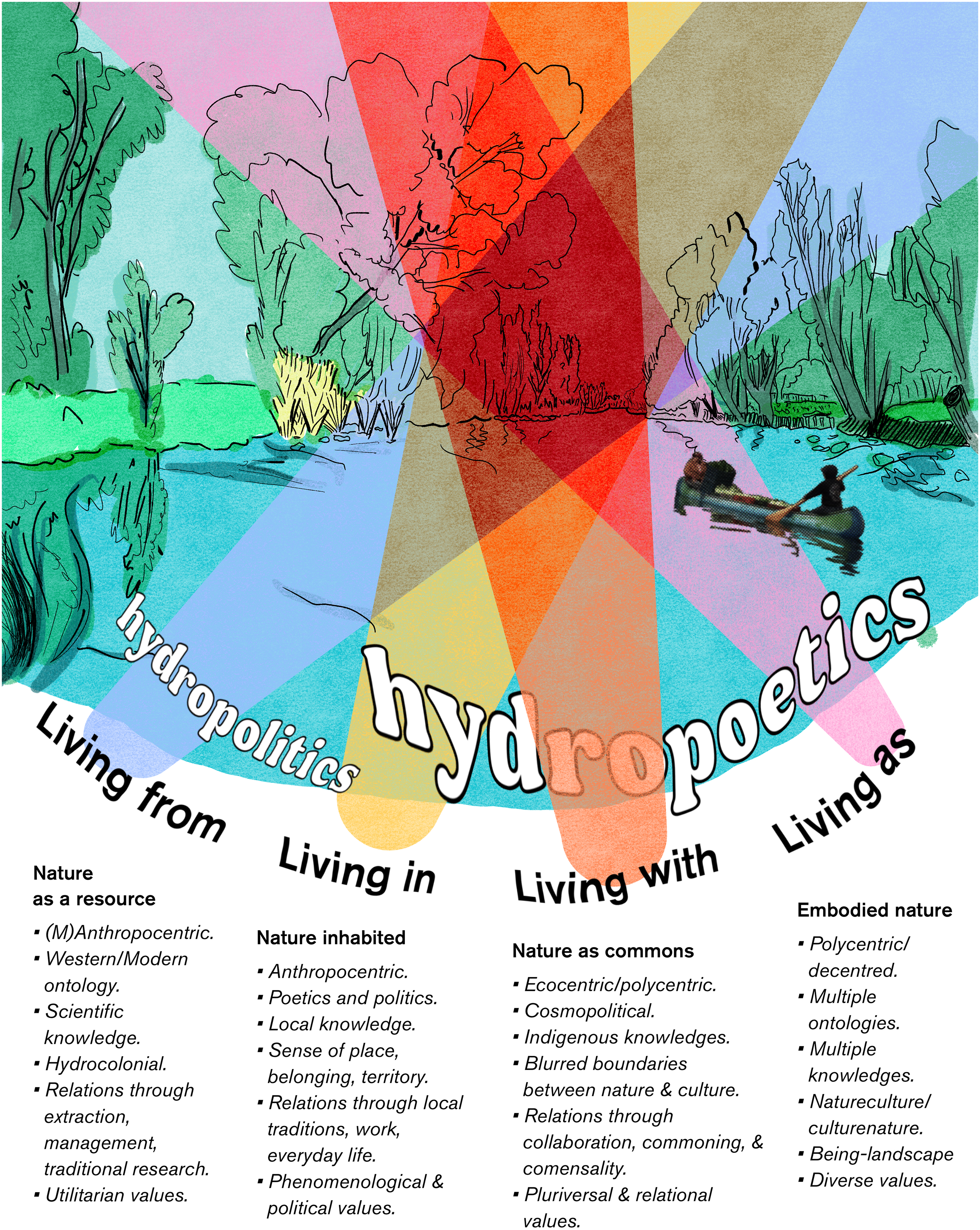
Hydro-logics and diverse values of nature in Xochimilco. Adapted from Pascual et al. (2023).
These notions of living from/in/with/as nature illustrate well the linkages between values of water and the three hydro-logics. In the case of water, we can see hydropoetics as ways of relating to bodies of water in which we live from/in/with/as water. Hydropolitics, on the other hand, implies mainly living from water, as it values water primarily as a resource to be exploited (Figure 1). Different values correspond to different ontologies of water, which lead to clashes and contentions as hydrocolonial relations erase or subjugate certain ways of being and certain values in deference to others.
Lakebed theoretics
Adding to these theories, we have bottom-up concepts that emerge from the lake. We take the notion of campesino biopower from workshops with chinampa farmers. In agroecological workshops on soil chromatography, the facilitator, who has a mobile chromatography lab and works with collectives across Latin America, mentioned this concept. Upon hearing the term, our campesino colleagues would say things like ‘Now, that's campesino biopower’ when discussing the technique of chapín, where silt from the lake bottom is extracted and transported in canoes to build seedbeds for chinampa cultivation, or when reading a chromatography that showed high levels of organic matter in chinampas resulting from this and other traditional agricultural techniques. Campesino biopower then refers to practices inherent to peasant farming, the ontologies that underpin them, and the knowledges developed through them, as well as their politics and their results.
The notion of biopower undoubtedly reminds us of Foucault's biopower and biopolitics. These concepts are diverse but are generally understood as forms of governance and control over human bodies and populations – over life and death itself – enacted by the state in the name of health and wellbeing, often leading to totalitarian systems of death and exploitation (Rabinow and Rose, 2006). However, in this case, biopower goes beyond the human, emerging not from the state, but from campesino's practices in lake territories, from the properties of the lake, the soil and the labour of those who work and inhabit them. Thus, campesino biopower refers to the collaborative actions of human individuals and collectives working with other-than-humans to maintain their reciprocal relationships in/with nature in the face of dominant extractive narratives and histories of dispossession.
An argument could be made against using ‘biopower’ to describe our campesino colleagues’ endeavours given the theoretical baggage of the Foucauldian term; however, we believe this is the right term for two reasons. First, because power is multifaceted, we cannot say that biopower only exists in sinister configurations where institutional apparatuses oppress and control, even if that is the orthodox use of ‘biopower’ in academia. As VeneKlasen and Miller point out, ‘a one-dimensional perspective [of power] can paralyse effective analysis and action’; power is not monolithic, it is in flux, ‘changing according to context, circumstance, and interest. Its expressions and forms can range from domination and resistance to collaboration and transformation’ (2002: 39). Secondly, and perhaps more importantly, because we are not deploying ‘campesino biopower’ as a theoretical concept used by us, academics, to describe or conceptualise the labour of campesinos, but rather bringing to the table a notion originating in practitioners’ own conceptualisations. The idea of campesino biopower was used by our campesino colleagues to describe their work, their agency and their power in the face of antagonistic policies and environmental degradation. Thus, although we could use other terms to describe peasant farmers’ work, like Carney's biopolitical resistance (2013), Slocum and Saldanha's alimentary biopolitics (2016), or Sexton's biopolitics of edibility (2018), we have explicitly decided to put forward campesino biopower, as it is the result of campesino's appropriation of the concept. It is precisely by engaging with theory ‘incorrectly’ that it is freed from academic orthodoxy, allowing for new and more diverse understandings of (bio)power.
Campesino biopower speaks of a form of power that is not just power over an environment but also power with, emerging from collective work and a long history of inhabitation (see VeneKlasen et al., 2004). This echoes the notions of living with, or living as nature mentioned before. Campesino biopower is counter-hegemonic, it is collective and collaborative, it’s biopower from below. 3 It is the power campesinos build together with each other – and with other-than-human collaborators. Campesino biopower is enmeshed in complex relations and is used to shape – to change or maintain – campesinos’ socioecosystems and the dynamics that take place in them. Following this notion of biopower, Carney’s (2013) and others’ accounts of resistance to state biopower through food are not just forms of biopolitical resistance, but forms of ‘biopower from below’ as well.
Alongside campesino biopower, we use the concept of perilacustrism proposed by the Xochimilca design collective Laboratorio Lacustre: Perilacustrism is a way of thinking design, politics, society, and culture… from the shores of the lake… Life happens in the lakeshore, in the mountains and volcanoes, in the perilacustrine barrios, in the chinampas that resist, among native and exotic plants. The persistence of water among us still determines everyday life and our customs. Perilacustrism is… a contemplative, reflexive and creative position from within our territory…
Our four theoretical sources disembogue in complex lacustrine territories. The foodscape is the space where hydropolitics and campesino biopower develop, fuelled by different values of nature. These actions lead to confrontations and changes in the foodscape and in Xochimilca foodways that remain in memory. While we could see changes as another instance of an unfolding Anthropocene, framing them merely as ‘environmental change’ depoliticises and invisibilises the hydrocolonial projects and processes that have been the drivers behind these changes. Like Liboiron, we see environmental degradation as being ‘central to, rather than a by-product of, colonialism’ (2021: 36). Thus, the hydro-logics, the diverse and relational values of nature and the Xochimilca conceptual-political frameworks will aid us in our understanding of the history of the basin and its foodscape.
A hydro-logic history
Volcanic basins and a precolonial psychopomp
The Anáhuac Basin, or Basin of Mexico, was formed recently, by geological standards. It is the result of volcanic and tectonic movements and is one of many endorheic basins in the Transversal Neovolcanic Axis that runs across central Mexico (Arce et al., 2019; de la Lanza Espino and García-Calderón, 2002). In these lacustrine environments, different ambystomatids evolved independently into neotenic amphibians, leading to numerous endemic axolomeh inhabiting the different lakes of central Mexico (Voss and Shaffer, 1997). The convergent evolution of axolomeh's metamorphic failure (i.e., not becoming terrestrial salamanders) is an adaptation to these aquatic landscapes, allowing axolomeh to live their wholes lives in water, avoiding harsher terrestrial environments (Shaffer, 1989; Voss and Shaffer, 2000). A. mexicanum, endemic to the lakes of the Anáhuac Basin, is one of the more recent axolomeh to evolve (Shaffer, 1993), inhabiting the basin for a long time before Mexica tribes arrived and built the amphibian city-states that came to be known as the Aztec Empire.
Like axolomeh, Aztec city-states developed in and around the five lakes of the Anáhuac Basin – the salty Zumpango, Xaltocan and Texcoco and the southern freshwater lakes of Chalco and Xochimilco. The Mexica built a complex hydric infrastructure to manage fresh water and developed chinampas, which allowed them to extend the city and produce large amounts of food under a highly efficient cultivation system. The hundreds of thousands in the basin's cities fed on the produce obtained from this ingenious foodscape, which included lake species like algae, ducks, frogs, fish, shellfish and axolotl.
Besides being a foodstuff, axolomeh were one of the avatars of the god Xolotl – a psychopomp, 4 shapeshifting deity, patron of twins, monstrosities and ball games (Rosado Pascual, 2018). According to Sahagún, Xolotl refused to be sacrificed for the sake of humanity and fled, disguising himself as twin maize and agave plants, as dog and axolotl, eventually being captured and killed to make the sun move (Sahagún in Rosado Pascual, 2018). This is where the name of the ambystomatid originates: from the Nahuatl suffix ā-, meaning water (ātl) and the deity's name. In this sense, eating axolotl can be seen not only as an element of Aztec foodways, but as a form of precolonial theophagy (Valerio-Holguín, 2019).
Hydrocolonial infrastructure
México-Tenochtitlán fell to the Spanish in 1521. This led to a long history of desiccation, starting with the Spanish colonial governments that saw the city as ‘insalubrious owing to the prevalence of unhealthy waters, toxic miasmas belching out of Lake Texcoco, and a filthy barbarous population’ (Vitz, 2018: 22). Water was seen as dangerous, causing flooding and disease, so drainage projects were undertaken with the Huehuetoca Canal being one of the biggest endeavours of the colonial period (Musset, 1993). Throughout this period, hydrocolonialism shaped the basin, both because of the necessary use of ships to achieve control over the territory – especially in the conquest of México-Tenochtitlán – and because desiccation policies clashed with the very idea of a city on a lake.
While the lakes were desiccated, axolotl continued to be eaten. Its flavour was described as similar to eel, and it was said to be the food of lords (Tate, 2010). Sahagún described axolotl as a ‘thin meat, more so than poultry, and it can be eaten during lent. However, it alters humours and is bad for continence’ (Sahagún in Valerio-Holguín, 2019: 151). Although axolotl was seen as problematic, it continued to be eaten as part of a religious diet, though now corresponding to the Catholic liturgical calendar rather than the Mexica precolonial pantheon.
In the 1800s, Mexican independence brought about notions of nationalism related to historic landscapes like chinampas and lakes. Despite this, and though desiccation was not the goal of 19th century policies, during the Porfiriato (1877–1910), ‘large-scale drainage infrastructure…prevailed’ (Vitz, 2018: 32). Porfirian planners engineered ambitious hydraulic projects looking to modernise Mexico City, following ideas not unlike those of colonial urbanists, though based upon the scientific vanguard of their time. Vitz notes the three main hydraulic infrastructure projects of this period: [1] the ‘Desague Nacional del Valle de México…to drain Texcoco and the city's wastewater’, [2] a ‘comprehensive sewer system’ for the city and [3] a revamped water supply system, ‘which tapped the fresh spring water of lake Xochimilco’ (Vitz, 2018: 21). All three projects were connected and had a considerable impact in the lives of lake communities that had inhabited these landscapes for generations. Hydric infrastructure ‘consolidated state power over a fickle environment and boosted Mexico's claim to modernity. Monumental engineering was…wedded to capitalism, further eroding lake-based community subsistence, opening up new lands for development’ (Vitz, 2018: 32).
Porfirian hydraulic projects in the Anáhuac Basin continued the hydrocolonial project started by the Spanish centuries earlier, literally building up modern capitalism in the basin. These monumental waterworks show how Mexican hydropolitics furthered racial capitalism (c.f. Melamed, 2015; Robinson, 2000), since these engineering projects impacted the ways of life of racialised indigenous communities who were memorialised as part of Mexico's glorious past, but maligned in the Modern everyday. Vitz remarks: sanitary engineers derided indigenous means of subsistence, particularly those that revolved around nonagricultural uses of waterscapes… seen as primitive vestiges of the Mexican past… The Porfirian scientific elite embraced rational and capitalistic uses of nature and condemned indigenous practices… (2018: 39).
Hydrocoloniality of knowledge
The same 19th century scientific rationalism behind Mexican hydropolitics led axolotl, an indigenous foodstuff, to become a lab specimen. While Porfirian projects desiccated the basin, axolomeh taken by a French scientific mission in the 1860s were reproduced in Parisian aquariums and distributed among European scientists and amateurs. This coincided with the emergence of the laboratory as method-and-space for science, which led to axolotl becoming a model organism in early biological research (Reiß et al., 2015). This history shows another form of hydrocolonialism since the endemic Ambystoma were reproduced and used for experimentation away from their biocultural context, and because of the way the amphibians were acquired: the scientific mission in Mexico was part of France's second military intervention (Reiß et al., 2015). Specimen collection was an integral part of French colonialism; as Reiß notes, ‘Mexican axolotls were brought from Mexico City to Paris as part of the global circulation of organisms in France's imperial networks’ (2022: 2). Furthermore, axolomeh were bred in the Jardin Zoologique d’Acclimatation, a central part of the French imperial project and the site of infamous human zoos that were on display until the 1930s (Osborne, 1992).
Axolotl continued to be eaten in Mexico throughout the 19th century. Among French sauces and Spanish mutton meatballs, the 1888 edition of the Paris-printed Nuevo cocinero mexicano en forma de diccionario includes several axolotl recipes – fried, stewed, in green chili or clemole (tomato sauce) – with instructions like this: (Rivera, 2016: 3)
‘Frenchified’ cookbooks like this one, published throughout the 1800s, helped establish a notion of national identity through food (Bak-Geller Corona, 2009); and, while it disparaged Indigenous cooking, the Nuevo Cocinero included several axolotl recipes for well-to-do modern cooks to prepare. 5
Although by the late 1800s axolotl was still consumed, the surface of the lakes of the Anáhuac Basin was half of what it had been when the Spanish arrived (de la Lanza Espino and García-Calderón, 2002). Throughout the course of the 20th century, desiccation continued; canals and rivers were intubated and paved over (Terrones López, 2009), and many chinampas became urban neighbourhoods removed from the lake life that once was the norm.
In Xochimilco, the extraction of spring water to supply wealthier parts of Mexico City, like the Roma and Condesa neighbourhoods, led to rapid declines in water levels. By the 1960s, many Xochimilca canals were dry or drying out, which led to protests among chinampa farmers: they took over the Zócalo — Mexico City's central square — giving away flowers and vegetables to passers-by. Different protests, as well as Xochimilco's importance as a tourist destination, made city planners find a solution: Xochimilco's water would still be extracted for use in the city, but after usage, it would be treated and pumped back to the canals. This Kafkaesque resolution still operates today, ensuring the flow of water into the canals, though of poorer quality (Terrones López, 2009).
By the end of the 20th century, and over the last decades, only Xochimilco, Tlahuac and Texcoco, in the edges of the city, have remained as places where life in-and-with water still somewhat continues. Yet, these territories are constantly contested by different infrastructure developments, like the proposed New Mexico City International Airport in Lake Texcoco, 6 the recent construction of an elevated highway in what was a Xochimilca wetland, the continuous and increasing extraction of water for the city or the urbanisation of the remaining agricultural land in the southern boroughs of the megalopolis.
This long hydric history can be seen as an ongoing hydrocolonial project. Following Quijano's ‘coloniality’ where ‘the…paradigm of rational knowledge, was not only elaborated in the context of, but as part of…colonial domination’ (Quijano, 2007: 174), we propose a hydrocoloniality of knowledge. This hydrocoloniality of knowledge meant Modern/Rational ways of conceiving and using water in the city's richer central neighbourhoods superseded the traditional uses of water in lacustrine communities, leading to their dispossession. It led axolomeh to become objects of scientific knowledge, acquired through colonial interventions, instead of an element of traditional knowledge approached through cooking and eating – even the culinary knowledge of axolotl became mediated through standardised Euro-Western cookbooks. This hydrocoloniality of knowledge remains. Indigenous practices and landscapes continue to be simultaneously admired and ignored, seen as vestiges of a long-lost past, while the water demands of the city are put above the values and needs of chinampa farmers. Desiccation and environmental change today are not just an element of our environmental crisis, but a result of hydrocolonial dispossession, or, as Xochimilca activists often say: it's not drought, it's plunder.
Hydropoetic memory
Filters of memory and stone
Changes wrought by the extraction of water in Xochimilco affected the lacustrine environment in more ways than one. While desiccation was avoided by pumping treated water into the canals, water quality decreased considerably. Gaby speaks of her familial memories of water:
My grandfather said water was crystal-clear, you could see the bottom of the lake. He used to drink directly from the canals; he’d take his hat off, submerge it in the water from the edge of his canoe and drink it up. We can’t do that anymore.
Xochimilca memory is hydropoetic: it remembers ways of being with water. But memory entails change. Houses and workshops in former chinampas dump their waste into the canals, pouring in myriad contaminants. Agrochemical runoff from some chinampas has led to eutrophication and proliferation of huachinango (Eichhornia crassipes lilies) making life in water difficult for humans and nonhumans alike:
Lilies are choking out the canals,
says Fátima, a Xochimilca woman. Her chinampa is surrounded. I try to clean up the canal but it's an impossible task for one woman.
Not only lilies are in the water. The director of a local agroecology project tells us about water quality in Xochimilco:
The water here has heavy metals; we’ve found lead and cadmium. Water quality changes across canals, the worse ones are closer to urbanised areas.
Water pollution is one of the main issues faced by farmers, who irrigate their crops with canal water. In these seemingly desolate waters, so far removed from crystal-clear hydropoetic memories, emerge gestures of care that speak of campesino biopower. The agroecologist continues:
Our chinampa is further away, so the water quality is better. On top of that we have biofilters that take out the heavy metals and other pollutants.
Biofilters are one way in which chinamperos manage the landscape to deal with this problem. To build a biofilter, a wall of porous stone is erected at the mouth of an apantle (a small canal between chinampas); the stones filter out some contaminants, and different aquatic plants are grown to get rid of others.
We see in biofilters a form of campesino biopower, a gesture of care for the foodscape and of resistance to the effects of hydrocolonial dispossession. Biofilters, like memory, take out heavy metals and other pollutants from the canal water, rendering it clean once again – if not clean enough to drink, clean enough to water vegetables and herbs.
It is important to avoid idealising biofilters as an epitome of hope and peasant biopower. On the one hand, biofilters are not enough. A chinampa farmer tells us he doesn’t think the usual design of biofilters is enough to clean the water, and the agroecologist seems to confirm this; after telling us of the way biofilters work, he adds: ‘…still, we have found several harmful bacteria in the water, even with the biofilters. So make sure you wash and disinfect everything throughly!’
Conservation, care and cooking
Isidro is a chinampa farmer engaged in an axolotl conservation plan that seeks to return ambystomatids to the canals. In an exchange session with different producers, he talks of the process of habilitating an apantle for this programme: We had to close it off and let it dry, then we dug by hand until it was 1.5 metres deep; we added tezontle [volcanic rocks] to filter out the water, and different aquatic plants, but they had to be plants from other apantles that have been set up as axolotl habitats, to avoid eggs from invasive species being present, you see. We have to be very careful about that… The apantle is ready to receive axolotl now, we’re just waiting for them to bring us the axolomeh or their eggs, whichever.
Programmes like this speak of care. We see conservation-as-care in the labour of building an axolotl habitat. We also see campesino biopower, since it implies transforming the landscape, to a certain extent.
Conservation is a means of relation that informs the way nature is understood and valued. Through breeding and reintroduction programmes, axolomeh become direct subjects of care whose survival depends on human action. Their value comes no longer from them being a foodstuff, but from them being an endangered species of ecological importance. And yet, old values remain in memory…: As Isidro narrates the long, painstaking process of modifying his apantle so axolomeh can inhabit it, Carmelita, an octogenarian cook with a keen interest in agroecological practices, raises her hand with a question. Isidro yields the floor and she asks:
I just want to know one thing:
Once the ajolotes in the apantle are grown,
will we be allowed to eat them?
In her memory, axolotl flavours persist:
What did axolotl taste like?
Somebody asks. Delicious. She answers
After the workshop, Carmelita and Diego talk, and she speaks of her organoleptic memories: I grew up with my grandparents… I remember my grandma cooking, not just axolotl, but crayfish [Cambarellus sp.], duck, and different types of fish. She would clean the axolot's grey-black skin with ashes and cook them in a green sauce with vegetables, like nopales [Opuntia sp.] or broad beans [Vicia fava].
Carmelita remembers other lacustrine flavours, some still present: My gran would also cook ahuautle [Corixidae eggs]. I still have that recipe: You clean and toast the ahuautle in a clay griddle, you grind them in a metate, mix them with [chicken] eggs and make little croquettes which you fry and serve with vegetables. I won a cooking contest with that recipe.
Carmelita's memories speak of flavours and skills inherent to life in water with different water critters. With memories comes a sense of nostalgia related to lacustrine foodscapes not yet marked by environmental degradation:
I had a very happy childhood.
Back in the day we ate crayfish, axolotl, charales [Chirostoma spp.], frog's legs [Lithobates spp.]
The list is long, but she craves crayfish in particular.
When asked:
What did axolotl taste like?
She responds:
It was the most delicious
But these things are gone; the foodscape is not what it was:
How have chinampa landscapes changed?
A lot. Now there are more houses than cultivated plots, says a chinampa farmer. I feel very sad about these changes, adds another.
An environmental nostalgia caused by hydrocolonial dispossession is present in Xochimilca memories, rooted in the disappearance of lacustrine foodways. Many of the species once eaten are now endangered. Are axolomeh then subject to cooking or conservation? One would think conservation strategies and discourses make axolotl an unthinkable foodstuff. In many cases, they have – most people outside Xochimilco are surprised and express a visceral rejection at the prospect of eating axolotl. It would seem conservation and consumption are antithetical, which raises several questions regarding conservation strategies, diverse values, and different ways of establishing relations with nature.
Kitchens, care and commensality
Nowadays, the question of care seems to verge towards practices of ecological conservation in a foodscape marked by environmental devastation. While relations established in the kitchen remain in memory, relations established through care seem to be prevalent: Back in the day people ate axolotl, right? Diego asks Pascuala, a traditional Xochimilca cook, while washing dishes after lunch. Yeah, we ate them, she answers, but we don’t anymore. As if to clarify, she adds: Now we take care of them.
Axolomeh, were part of living from, in and with nature, but our relations to them and their values have shifted. Once caught and cooked in droves (‘at weddings there would be bucketfuls of axolotl to make mole’ a Xochimilca woman remembers), now they are seldom found outside breeder's tanks. Pascuala's words point to this perception of axolotl; it is no longer a foodstuff; it is now the recipient of care. Besides speaking of changing values, this point raises questions regarding the meaning of care amid environmental crises. Caring and eating are not unrelated, as both are ways we relate to the foodscape and its inhabitants As Roy posits, ‘[t]o feed…is invariably to be inserted into relationship, a relationship with an other, though not always or necessarily a human one’ (Roy, 2010).
Relational values are useful to our understanding of these changes: Can we care for something we eat? Or is caring out of the question when killing, gutting, skinning, cooking, and devouring are part of the way we relate to a species? In Pascuala's perspective, caring seems to be related to ecological conservation and breeding programmes, like Isidro's biofilter-habitat, rather than to the appetite remembered by Carmelita and Fátima. But perhaps caring isn’t absent in a trophic relation; isn’t the production and maintenance of the chinampa landscape a way of caring not only for axolotl, but the whole network of living things that once inhabited this foodscape? Didn’t the axolotl care for us by feeding and nourishing us? On the other hand, Xolotl refused to die for the sustenance of humans. So, which is it?
Conflicting values and contested territories
Is axolotl conservation another instance of hydrocolonialism? Or is it a necessary change in the way this foodscape is inhabited? Biosciences – especially conservation – often imply and develop from a coloniality of knowledge that assumes science knows best, and that goes against traditional practices like, in this case, eating axolotl. As we’ve seen, axolotl aquariums are part of the hydrocoloniality of knowledge and the wider colonial networks that provided the materials needed for the development of Western science (Astorga de Ita, 2024; Baker et al., 2019; Liboiron 2021; Park et al., 2023; Saldanha, 2010). Is conservation then a (neo)colonial project, turning the foodscape into a laboratory to be studied and controlled?
The notion of eating axolotl, albeit scandalous in our current environmental context, could be read as a practice that maintains old ways of living from, in, with, and as nature. As Valerio-Holguín points out, axolotl is a totemic animal and foodstuff in which Mesoamerican Xolotl is still present (2019: 152). Although when we hear testimonies of axolotl dishes in Xochimilco, rather than a mythic-totemic theophagy, what emerges is nostalgia for a recent past, before environmental degradation. In this nostalgia – in ‘feeling…the words of the gods vanish,…the most familiar animal, vanish. The evanescent taste of what you ate’, as Glissant puts it (2010: p. 7) – we see a basis for relation. As Angé and Berliner point out, ‘in damaged environments, longings bring together humans, plants, animals, ancestors and a wide array of earthly organisms connected through bodily communication’ (2020: 5).
Ecological nostalgia is present in other Xochimilca foodstuffs, like epazote (D. ambrosioides), used in axolotl tlapiques among other traditional dishes. The Xochimilca variety of this plant is remembered as being particularly fragrant and delicious. It used to grow wild, but now, because of water pollution, it is hard to find and has to be carefully cultivated.
From these memories of eating emerges a commensality between food and conservation. It is as Probyn posits: eating opens up ‘possibilities of connection and coexistence: the radical and visceral interconnections between humans and the land’ (2000: 125). Commensality is a useful word: it denotes both the act of eating and an ecological relation. Memories of axolotl as food could lead to commensalism with ambystomatid populations. After all, it is thanks to conservation programmes that memories like Carmelita's emerge. Thus, science and tradition come together at the table; values and memories emulsify, appetites becoming an incentive for conservation. In this context, axolotl is seen as both a foodstuff and an important biological element of the ecosystem; this is why we speak of the foodscape as a space that is biocultural and keeps multiple meanings.
While talking with some chinamperos about this paper, one of them says: Axolotl can be bred for food, you know? There are some people who’ve talked about the possibility. They’re actually really easy to breed in aquariums. The problem is breeding them in the wild.
And so, the aquarium becomes muddled too, not just an element of western science but an extension of the foodscape and a place of traditional culinary knowledge as conservation and consumption come together. Still, even if there is commensality among this set of values, other values of nature remain in conflict.
Xochimilco's foodscape is constantly contested. A clear instance of this is the recent attempt by the Mexico City government at installing new water pumps in San Gregorio Atlapulco's springs. This was received with local protests. The involvement of riot police and paramilitary groups that attacked protesters resulted in widespread public condemnation, as many protesters were elderly, women or children. As a result, the new hydric project was halted, at least for the time being. These water management policies show a continuing hydrocoloniality in the Mexico City Basin, adding to the historical confrontations between state hydropolitics and the hydropoetics of lacustrine communities. While the government sees Xochimilco as a peripheral borough rich in water, from a perilacustrine perspective, water is part of daily life, even more:
Water is like blood. Water is life,
It's called urbanity, they start to destroy natural things… they put the water into pipes… there used to be water springs… now they’ve taken the water to Mexico City.
Despite being part of Mexico City, from a perilacustrine perspective, the city is seen as an Other space, with rapacious rhythms and different values;
Relations have been broken… life out there [in the city] has devoured us,
We see the urban appetite in other approximations to the landscape. Whereas life in water is an everyday, embodied experience for Xochimilcas, for urbanites Xochimilco is a space to be consumed through tourism. Water is an excuse for a deterritorialised party or an exotic outing. While Xochimilco has a long history of being a space for tourism and leisure, this use now seems to be the norm. Places that were used for food production have become spaces for tourists, from axolotl aquariums to campsites and football fields. On this, Julia, a chinampera says:
Chinampa work has gone from food production to the production of merchandise… It's a predatory tourism… they’re commoditising the landscape, the food, the culture, even the people…
The landscape is consumed, but not through food, nor by its inhabitants. In touristic spaces, grasses grow – exotic species enveloping the ground, making a comfortable cover for visitors but incompatible with chinampa agriculture. Football fields are an interesting case. Like biofilters, they require closing-off apantles, though here canals and inlets are desiccated to make expansive football pitches. Some might argue this is another way of living in water; that there is a hydropoetics to playing the beautiful game surrounded by water, but chinamperos see this as part of the pattern of urbanisation rooted in hydrocolonialism. Here are values in conflict, which lead to a contestation of space.
Football fields are a symptom of the devaluation of traditional lake agriculture and economy, resulting from hydrocolonial history. Chinamperos were seen as near-destitute, working long hours for little pay, and many urged their children to study so as to avoid the arduous life of the lacustrine campesino. Many Xochimilcas speak of this attitude:
I’d go to the chinampas with my parents… taking us was a punishment: ‘You need to study or you’ll end up in the chinampa!’… from dawn to dusk… eating cold tortillas with beans. I wouldn’t want that!… only now does one realise that growing something is a wonderful thing.
Gaby experienced similar responses when she started working her family's chinampa:
People didn’t understand, they’d say things like:
‘Why are you doing this? You went to university!’
While this perspective seemed prevalent until recently, some people see in these same experiences a form of topophilia (Tuan, 1990) – a love of the earth: My dad taught us to love the chinampa, the sowing, the growing. I was just five when he’d take us at 5 a.m. to plant maize; I’d carry my coat full of corn. Says Fátima. When we went to the chinampa my mum would cook a pot of beans… while we rested, my dad would make a salad of tomatoes with onions, epazote, some chopped chilies and our beans. There, lunch is served! Ah, my mouth is watering now. And our cold tortillas, made with 100% pure maize; pure, good, from big ears of corn that my dad grew… he taught us that love.
This topophilia goes beyond a utilitarian valuation of nature; it entails living from, in and with – even as – the landscape. It comes from a relation with the lake and the mud and the chinampa's produce, from a commensality established through everyday growing and eating.
Some projects deploy a language like this, of love of the earth, sustainability and tradition, but are often seen as another instance of commoditisation and exotisation, since they speak of heritage recovery while catering to wealthy visitors, effectively gentrifying the foodscape for its consumption. Different authors have explored how foodways are commodified, gentrified and appropriated (Hall, 2020; Kasper, 2020; Williams, 2020) and the ways these processes are embedded in colonial logics of recovery and discovery (Herrera Miller, 2016; López-Canales, 2019; McDonell, 2019). In this case, we see the gentrification of this foodscape of chinampas as part of the history of hydric dispossession. Gentrification, rather than a form of commensality, is predatory or parasitic, furthering hydrocolonialism by offering Xochimilca history and territory to be consumed by outside actors. Counterposed to these projects are communitarian institutions like peoples’ assemblies and local community representatives (‘representantes de parajes’). Through these institutions, communitarian and autonomous logics, politics, practices and decision-making processes are strengthened.
Academic research is another instance where values clash. While some suggest scientists live with nature, academic practices are often exploitative and extractive (Baker et al., 2019; Liboiron, 2021). In the third National Assembly in Defence of Water and Life that took place in San Gregorio Atlapulco in 2023, organisers spoke against colonialism, extractivism, and exotisation, directing some choice words towards academics: Enough! With all due respect to academics, we don’t want any more emeritus professors! We don’t want any more scholars using us!
In recent months, while this paper has been in review, this sentiment of vigilance and suspicion towards artists and researchers has gained momentum, following a conflict with a particular artistic project in Xochimilca territories. Recent polemics have involved communal institutions, chinampa farmers, and outside research and art projects. One can now find placards outside chinampas reading: ‘Out with touristic, research, and artistic projects that add nothing to the community and only use us for their own ends’. These conflicts and polemics remind us of a thought Gaby once shared when speaking of notions of community: one cannot romanticise community and collaboration; conflict is a part and parcel of this type of work. 7 So is conflict resolution. While not all authors of this paper are still part of the in situ work of Cocina Colaboratorio, the work of our colleagues in the field now turns to navigating collaboration and conflict resolution in spaces where personal and institutional disagreements entangle with a continuing hydric coloniality.
The issue with values isn’t so much that they are multiple, but that they are embedded in relations of power-knowledge that place certain values above others, affecting whose values are considered in decision-making and policy planning (Arias-Arévalo et al., 2023). Hegemonic values of Modernity/Rationality are the ones to prevail – those arising from living from nature – however, as campesino biopower demonstrates, there are subaltern knowledges that demand recognition and impact the world, if through different means. The question then is not how to agree on the value of nature, but rather, how do we make space for the commensality of plural values in the search for sustainable futures.
Conclusions
As the relational turn of sustainability science suggests, it is imperative to make space for plural onto-epistemologies of nature and their corresponding values. While diverse values can lead to confrontations, they can also lead to commensality, to ways of eating and living together. As Arias-Arévalo and collaborators discuss (2023), diverse values of nature can be leveraged to achieve transformative change. In the case of Xochimilco, recognising plural values means going beyond hydrocolonial practices by paying heed to hydropoetic values emerging from the lived experiences of chinampa farmers. From a decolonial perspective, our relation to nature-as-food and the traditional values that emerge from this ought to be considered alongside scientific values given to species and ecosystems. As we have seen, while different values may lead to conflicts, these can be resolved, coming together in commensality.
Scientific fact and memory can coexist, since memory of taste is not just nostalgia but holds a polytemporality (Sutton, 2011). This polytemporality brings together nostalgia for the past, acknowledgement of current crises, and hope for the future, as Angé and Berliner propose, ‘eco-nostalgias can encourage for innovative action’ leading to ‘new forms of interspecies intimacies and responsibilities’ (2020: 7–8). Axolotl soup, then, can be seen as both a form of environmental nostalgia and a potential embodiment of hope. Alongside other receding lacustrine foods, memories of axolotl dishes speak of things lost while longing and working for a hopeful future for both humans and nonhumans where axolotl soup may be eaten once again.
Transdisciplinary research is a useful tool to make space for plural values of nature and plural onto-epistemologies, particularly within academia. By pursuing collaborative and community-oriented research, as Cocina Colaboratorio proposes, we can question the (hydro)coloniality of knowledge and transgress the hierarchies of knowledge-power-value that often ignore subaltern spaces and experiences. By making space for other ways of being and thinking, transdisciplinary research becomes a space of possibility for decolonial thought and practice. The possibility of critique is a particularly important element of transdisciplinary research, since it allows us to politicise notions like ‘environmental crisis’ or ‘biodiversity loss’, which are oft-portrayed as politically sterile catastrophes, or as the consequences of the negligence and ignorance of local communities.
Transdisciplinarity allows for the recognition and cross-pollination of ideas and concepts emerging from different traditions. Such is the case of campesino biopower. This theoretical proposition with which we engage emerges from the relation between theory and embodied, everyday practical knowledge and politics of chinampa farmers. This concept aids our understanding of the conflicts and contestations that take place in these lake territories, but it has the potential to go further. Campesino biopower can add a decolonial layer to Foucauldian theoretics and can be used to explore the relations, values and conflicts present in other campesino communities in Mexico and the world.
By bringing together diverse theories, knowledges and practices, transdisciplinary research brings forth a commensality from which we can glimpse opportunities and possibilities beyond single points of view, and from which we can start to imagine and co-create alternative futures beyond current environmental devastations.
Supplemental Material
sj-pdf-1-epd-10.1177_02637758251361707 - Supplemental material for Axolotl soup: Hydrocoloniality, contested foodscapes, and plural values of nature
Supplemental material, sj-pdf-1-epd-10.1177_02637758251361707 for Axolotl soup: Hydrocoloniality, contested foodscapes, and plural values of nature by Diego Astorga de Ita, Gabriela Alejandra Morales Valdelamar, Adriana Cadena Roa and Patricia Balvanera in Environment and Planning D: Society and Space
Footnotes
Acknowledgements
We would like to thank the anonymous reviewers for their insightful comments, as well as the team at the Biodiversity & Human Wellbeing Lab for their comments on an early version of this paper and our colleagues at Cocina Colaboratorio, particularly Fernanda Estrada, for their feedback. We would also like to thank our colleagues working the chinampas at Xochimilco and San Gregorio Atlapulco, and the Xochimilca collectives that have collaborated with us in the past, particularly Colectivo Ahuejote, the members of the former Proyecto Mixquiahuac and of the Agroecological Learning Community at San Gregorio Atlapulco, Lum K’inal S.C., and Humedlia A.C.

Funding
This paper is part of Cocina Colaboratorio, a transdisciplinary project of research-incidence financed by CONACYT's Programa Nacional Estratégico de Sistemas Socioecológicos y Sustentabilidad [National Strategic Programme of Sustainability and Socioecological Systems] (Grant title – Construcción transdisciplinaria de sistemas socioecológicos interculturales agroalimentarios más justos, sustentables y resilientes/ CONACYT-PRONACES F003-2022-319065), as well as UNAM's Programa de Apoyo a Proyectos de Investigación e Innovación Tecnológica [Support Programme for Research and Technological Innovation Projects] (Grant titles – Cocina colaboratorio: un prototipo para la construcción transdisciplinaria multiactoral de sistemas agroalimentarios más justos y sustentables/PAPIIT IV-200120; & Cocinando aprendizajes para cultivar sistemas alimentarios locales más sostenibles con número de expediente IG201224). This article is also the result of a Postdoctoral Research Fellowship granted by DGAPA-UNAM undertaken at the Institute for Ecosystems and Sustainability Research (IIES-UNAM) from March 2022 to December 2023.
Declaration of conflicting interests
The authors declared no potential conflicts of interest with respect to the research, authorship, and/or publication of this article.
Supplemental material
Supplemental material for this article is available online.
Notes
References
Supplementary Material
Please find the following supplemental material available below.
For Open Access articles published under a Creative Commons License, all supplemental material carries the same license as the article it is associated with.
For non-Open Access articles published, all supplemental material carries a non-exclusive license, and permission requests for re-use of supplemental material or any part of supplemental material shall be sent directly to the copyright owner as specified in the copyright notice associated with the article.
