




Abstract
The infrastructures of global logistics are hailed as developmental solutions for countries previously peripheral to global trade routes. Building on ethnographic fieldwork performed in the village of Anaklia, West Georgia, this article proposes a grounded analysis of this developmental promise. It does so by focusing on the attempted construction and failure of a deep-sea port that was set to turn the village into a logistics hub part of the Belt and Road Initiative. In dialogue with ethnographic accounts of infrastructural failure and feminist approaches to the study of global circulation, this article outlines the villager’s efforts to “domesticate” the promise of prosperity attached to the port, mapping how the intimate spaces of the village have been transformed by the mercurial promise attached to Anaklia Port. In the aftermath of the project’s failure, this article shows the mark that the projected logistical future has left on the village’s economy and life. In doing so, it sheds light on the variegated impacts that logistical projects leave behind, even when they remain unfinished.
Keywords
Intro: an ever receding logistical future
The village of Anaklia is at the north-western edge of the Republic of Georgia in the South Caucasus, only a few kilometres from Abkhazia, a de facto state and site of multiple conflicts since the collapse of the Soviet Union. For the past decade, this small settlement has been designated as a transit node for goods and people, projected to position Georgia as a key juncture amongst global logistics networks. Between 2010 and 2012, the former President of Georgia Mikheil Saakashvili set out to develop Anaklia into a futuristic city to be named Lazika (Easterling, 2014: 41). Lazika was intended to become a business hub with global reach; however, Saakashvili’s electoral defeat in 2012 1 left the project unfinished (Frederiksen and Gotfredsen, 2017). In 2015, a new wave of development invested the village, including plans to build the largest deep seaport in the country, a smart city and a free industrial zone aspiring to become a hub for the Chinese-led Belt and Road Initiative (BRI). This time the development was conducted through a public–private partnership between the Georgian government and the Anaklia Development Consortium (ADC), a multinational corporation lead by TBC, one of Georgia’s largest private banks.
Between 2017 and 2019, I conducted ethnographic fieldwork in and around Anaklia. Towards the second half of my ethnography, however, the ADC project became enveloped in a crisis that eventually led to its demise, 2 leaving the village and its inhabitants to contend with another failed development. Once more, however, this was not the end. Three years after the severing of the contract between ADC and the Georgian government, Georgia’s Prime Minister announced yet a new tender for the construction of a logistics hub in Anaklia, this time with the government maintaining 51% ownership of the future infrastructure (Civil.ge, 2022). As yet another wave of development looms over this shore – and, with it, a new cycle of projections about Anaklia’s future is about to begin – this article maps the transformation that the inhabitants of the village have had to contend with amidst this ever receding logistical future (Figure 1).
Megaprojects, as an increasing number of accounts document, are often “overbudget, over-time, over and over again” (Carse and Kneas, 2019; Flyvbjerg, 2011, 2014). The ubiquity of unfinished projects, however, is rarely translated into more cautious depictions of new ones (Barry and Gambino, 2024; Flyvbjerg, 2009). This was certainly the case with Anaklia. Until the abrupt interruption of the ADC’s project, the future cast over Anaklia by its developers was marked by a futurism of sorts. Futurism, according to Peter Pels “may be defined as the classification of an epoch in terms of a prediction of progress – and by an assumption of newness” (Pels et al., 2015: 782; Tsing, 2004: 332–333). The transformation of this marginal village into a logistics hub was commonly described as the “project of the century” (ADC, 2016, 2017a) capable of catapulting Georgia into prosperity (Anand et al 2018; Harvey, 2018; Harvey and Knox, 2012, 2015; Knox, 2017; Reeves, 2017). During my fieldwork, I encountered this promise in different forms: from company communication, to government’s documents, to the statements of foreign diplomats and, more poignantly for this article, embedded into the daily communications of those who lived and worked in the village. Intermixing the technical language of logistics – including mentions of the future port’s container capacity and specific information about its depth – with hyperbolic predictions about Georgia’s destiny to become a bridge between East and West, description of the planned port conjured a distinctively logistical future for the whole country (Gambino, 2021a).
The port of Anaklia was described by Georgia’s government as key node of the Belt and Road’s Middle Corridor,
3
enabling the country to position itself as a multimodal link in this transnational network. However, a large port, as many of my interlocutors told me, was always supposed to be built in Anaklia. The Soviets had already planned it and after the collapse of the Soviet Union, several investors had been interested in a similar project, but it never materialised. As ADC embarked in the construction of the port in 2017, it seemed that finally the time had come (ADC, 2017b). Early on in my research, I discussed the port with a young anthropologist and employee of a logistics company. As I explained to him my plans to document the port’s construction, looking dubious, he said: it is almost like Anaklia is the only thing that keeps the country together, the prospect of the stability which the port will bring, the wealth … Is always heralded like the proverbial carrot for the donkey, it keeps the hope going, without ever materializing. In some ways I say, this is not that different than during communism, when they used to say that communism had to be reached after the evolution of socialism: if we only put another five-year plan that we can make it … No one ever got there!
This observation shows two things that are central to this article’s analysis: firstly, while clearly sceptical that a port would ever be built in Anaklia, the anthropologist, nevertheless made very clear how projections of the future are as important and tangible as the future itself (see Yarrow, 2017). Secondly, from his description, we get a sense of how the future is both the product of and is generative of forms of work: the ever receding promise of Anaklia’s future domesticates Georgians to work like donkeys, in exchange of a reward that might never come.
In what follows, I will map the different kinds of labour that locals undertook in anticipation of the port. As I will show, these efforts changed the village’s architecture and recast the social and economic relations between its inhabitants. I analyse these multi-layered transformations through the lens of domestication. Taking my cue from Anne McClintock’s (2013) seminal work, I understand the domestic to constitute a laboured social relation to power (McClintock, 2013: 34). The noun “domestic” indicates the intimate realm of the home. The verb “to domesticate” indicates the act of taming something or someone by bringing them under one’s care (McClintock, 2013: 32). The “domestic”, as McClintock shows, is not only the space where domestication takes place, but is itself already the product of broader processes of domestication that casted certain homes as markers of civilization, while branding others as uncivilised. By arguing that villagers have been “domesticating logistical futures”, firstly I show domestication as an embodied and materialised effort to translate the planetary horizon of logistics into Anaklian homes. Secondly, I expose how by bringing home the developmental promise attached to the port, Anaklians have opened their most intimate spaces to processes that will permanently reframe their domesticity. Finally, I contend that these transformations have left the villagers exposed to the effects of the port’s failure.
This article is based on fieldwork in Anaklia conducted over two years, including 18 in-depth interviews with its inhabitants, employees of ADC and other companies engaged in the port’s development. Since the completion of this fieldwork, I have returned to Anaklia several times for short visits and to catch up with my host family and acquaintances. I begin this article by situating my analysis within ethnographic accounts of infrastructural developments and their failure. Since Anaklia was set to plug Georgia into an ever expanding network of logistical corridors, I believe my analysis can provide a corrective to critiques of global logistics. In particular, in dialogue with feminist work on the grounded effects of global circulation, I show how the promise and failure of logistics in Anaklia has transformed the village’s household economy (Peano, 2019). To this end, I outline the different ways in which Anaklia Port’s future was domesticated by locals and the architectural, social and economic transformations that this domestication unleashed.
A grounded approach to Georgia’s logistics
The developmental narrative attached to the construction of Anaklia port is part of a global script that pitches investment in logistics corridors as a one-size-fits-all developmental strategy (Rekhviashvili and Lang, 2024; see Silver, 2021; World Bank, 2019). As investment in infrastructure, and especially transit infrastructure, has been hailed as a developmental solution for countries previously peripheral to global trade routes (Schindler and Kanai, 2021), international banks have committed to aiding countries to develop suitable transit regimes (Grappi, 2016). These exhort governments to make their infrastructures appealing by eliminating any obstacles that might hinder the free flow of goods through their territories, facilitate foreign direct investment and, often, shoulder the risks of potential investors (Gabor, 2021). Critical accounts have been crucial to grasp the transnational, even planetary dimension of this logistical paradigm, and to elaborate a common language of struggle across borders (Carse et al., 2018; Cowen, 2014; Khalili, 2020; Transnational Social Strike Platform, 2017). Indeed many recent works have highlighted the importance of mapping the frictions that populate infrastructural networks and understanding the work which sustains logistical flows (Chua et al., 2018; Gambino, 2019; Gregson et al., 2017; Mezzadra and Neilson, 2019; cf Bear et al., 2015). Building on seminal works by anthropologists such as Anna Tsing (2004), Mezzadra and Neilson, for instance, express their commitment to understanding how “the operations of capital hit the ground and shape the conditions of everyday life” (2019: 21). Spanning across several continents, their analysis shows how planetary projects of accumulation and extraction hit diverse localities, showing how local customs become integrated in transnational operations (Foster, 2008; Tsing, 2009) and charting different forms of grounded resistance. In providing such a panoramic view, however, Mezzadra and Neilson’s critique stops short of an in-depth engagement with specific localities, offering instead a fascinating, yet aerial compendium of struggles against logistics in different parts of the globe. What would a grounded approach to the study of logistics look like? And what kinds of relations would it unearth?
To begin with it would take the grounds “hit” by logistical operations seriously. In her article “on the grounds of globalisation” (2001a) feminist geographer Cindy Katz proposes to deploy topographic knowledge for the purpose of a feminist engagement with globalisation. Topography, according to the Oxford English Dictionary, is “the accurate and detailed description and delineation of a locality”(OED, 1971 in Katz, 2001a). Notably, by focusing on the natural and “man-made” elements of a defined landscape, Katz notices that topographies “embed a notion of process” highlighting how places and nature are produced (2001a: 1228). Katz proposes “to look, not only at particular global processes in place, but at the effects of their encounters with sedimented social relations of production and reproduction” (2001b: 720; see also Riofrancos, 2021). Katz’s point is at once methodological and epistemological: capitalist projects, such as the one I observe here, do not just hit the ground, they also seep into the fabric of local people’s lives, infuse their aspirations and transform local geographies. It is impossible to grasp the grounded effects of global processes without an in-depth and sustained engagement with a specific site and the communities that inhabit them. As such, this article rests on years of engagement with the same locality. In line with Katz’ exhortation it pays in-depth attention to the different elements that compose Anaklia’s environment: its roads, houses, plots of farmland and their interaction with the newly excavated port territory.
As Nikhil Anand has suggested, present infrastructural projects exist in accretion to the past (Anand, 2015). My own ethnography of the Anaklia port project therefore builds on recent critical accounts that have looked into new forms of marginalization, both territorial and socio-economic on the Georgian Black Sea. Reading these accounts there is the sense of a layering of ethnographic insight: in particular, Pelkmans, Frederiksen and Khalvashi have all observed the development of the same city, the coastal town of Batumi that grew from an abandoned backwater in the early 2000s (Pelkmans, 2003, 2011), to the site of the most extensive, yet exclusionary, urban redevelopment undertaken under Saakashvili’s presidency (Frederiksen, 2013; Khalvashi, 2015, 2018). These ethnographies build a recursive archive of the transformations of Georgia’s Black Sea coast to which my ethnographic intervention seeks to add.
Additionally, attention to temporality is essential to showing how logistical projects hit the ground (Kneas, 2018; Rowe, 2017). Anthropological analyses have made clear how a solely spatial focus is insufficient to understand the processes that populate infrastructure (Bear, 2015; Mitchell, 2020). Coming to terms with failed or unfinished project requires an attention to the temporal promises they sought to materialise (Alexander, 2023b; Gupta, 2018; Howe et al., 2016). The history of failed logistical investments in Anaklia shows that rather than an exceptional event, infrastructural projects are constantly brokering failure (Gambino, 2021b). This insight chimes with analyses of grand developmental projects which have been shown to be ridden with failure (Ferguson, 1999; Schwenkel, 2013). Indeed, the futurism attached to Anaklia Port mimicked the promises carried by modernist projects. Yet, as analyses of more recent infrastructural failure are growing in number, they shed light on the precarious conditions of existence of projects within contemporary regimes of accumulation and extraction. What constitutes a failure and for whom is itself object of analysis (Alexander, 2023a). Rather than endpoints (Miyazaki and Riles, 2005), infrastructural failures are shown to be often cyclical (Kneas, 2018) and in some cases made to work for future projects, as previous failures come to be described as an integral part of the process of “getting things right” (Alexander, 2023b; see also Halpern and Günel, 2017). Thus, the failure of infrastructural projects is often part and parcel of the cycles of boom, bust and repeat that sustain the reproduction of financialised projects of accumulation (Chua, 2021; Danyluk, 2018), leaving harmful traces (Kallianos et al., 2023). Who is left to negotiate the effects of repeated failures? From the urban centres of the global north to rural communities living in the proximity of sites of potential extraction, the mercurial iterations of infrastructural projects force populations into uncomfortable relations to time (Smith, 2023; Zeiderman, 2020). By looking at the ways in which Anaklians have brought the port’s future into their homes, this article figures failure not as an exceptional event or an endpoint, but rather as one of “the heterogeneous forms of pacing, duration, waiting, pause, obsolescence, and delay that also characterize [contemporary capitalism’s] generative rhythms” (Bear et al., 2015; Starosielski, 2015). In doing so, my aim is to write the failure of ADC’s project within the script of global logistics.
A final conceptual thread that runs through this article is an attention to the forms of domestic labour that failed logistics engendered in Anaklia. During her ethnography of “oil futures” in Equatorial Guinea, Hannah Appel sullenly wrote in her field diary “the future is exhausting” (Appel, 2018: 52). Throughout my own engagement with Anaklia’s logistical future what became apparent is that capitalist futures “require a tremendous amount of work. From manual, managerial, domestic, and political labour; to material infrastructures and technologies; to legal, ethical, and affective framing processes” (Appel, 2019: 3). It is largely this labour of mediation, compensation and translation that sustain processes of production, that, in my own experience renders “the future” exhausting. Through its narrative of seamlessness, the pursuit of logistical connectivity seeks to erase the messy reproduction of its making and maintenance (see Haugen, 2019). For this reason, Irene Peano exhorts critiques of logistics to expose the role of supply chain management in shaping […] patterns of household organisation, kinship and intimacy […] To overlook such crucial forces would also mean to foreclose the possibility of imagining concrete, viable opposition against them. (Peano, 2019)
Thus, this article takes Peano’s suggestion to be integral to showing how the planetary project of logistics actually “hits the ground”. The figure of domestication lends itself to this purpose because it sheds lights on people’s efforts to turn the future promise of Anaklia Port from something “out there” into something of their own, in this case by literally bringing it into their houses (see Creed, 2010; Smith and Rochovská, 2007; Stenning et al., 2011). As a promised future penetrated the villagers’ homes, the most intimate aspects of Anaklians’ lives became exposed to the consequences of the port’s failure. By going into the households of Anaklians and observing how their most intimate attachments have been recast by logistics’ haunted projection, I will show the legacies of this sequence of failed projects.
Grounded transformations
In a little over 10 years, the village of Anaklia has been permanently transformed by the promise of logistics. In what follows, I show that the changes to the village topography underwrite dramatic shifts in societal relations. In preparation for Saakashvili’s Lazika project in 2011, large plots of agricultural land were taken away from their owners without compensation. This expropriation was justified by accusing the farmers themselves of expropriating state-owned land, 4 and urging them to return it for the sake of the country as a whole (Aslanishvili and Halpern, 2020). Expropriations of this kind were common during Saakashvili’s presidency, and at the time of Lazika’s construction, mass protests were taking place to demand his resignation. In 2017, in preparation for the port’s construction, the government begun a relocation and compensation process which included those whose lands were previously expropriated. As a result of the compensation process, several families were awarded repayment of one million Georgian Lari 5 or more, with others receiving smaller sums. Within the space of six months, neighbours who had shared very similar lifestyles were separated – physically and financially – by the future port.
In the autumn of 2017, when the preparations for the port’s construction started, three quarters of the long boulevard that connected the centre of town with the site where Lazika was supposed to be built was cleared (Figure 2). In less than a month, everything that rose on it was removed and during the months that followed, the territory was fenced off to delimitate the edges of the future hub. The attempted construction of the port split the village in two and impacted people’s circulation. For several months, between the summer of 2018 and the port’s demise in 2020, access to this land was prohibited and people were forced to circumnavigate it through a road that took almost one hour to reach the wetlands were many villagers fish. More importantly, the inhabitants of several houses that were left on the wrong side of the enclosure were forced to endure a long journey to take their kids to school and reach the centre. Notably, the fence delimitating the edge of the port territory came to delineate more than a physical obstacle to daily life in the village (Figure 3), since it came to be a border separating those who suddenly became rich from those who stayed poor. Grafted onto the physical transformations of the village, two new class formations emerged: on one side of the planned port there were those who had benefited from the compensation scheme – the millionaires (მილიონერები/milionerebi); on the other was everyone else.
Bringing the future home: vernacular spectacular
The village’s houses are the most visible indexes of the changes that have invested Anaklia; testimonies of the new class relations that have emerged. Looking at the houses’ exterior, and subsequently venturing inside them, over the next sections I will show how the past decade of failed infrastructural developments has been domesticated by Anaklians, and in turn, has domesticated them by seeping into their habits and lives. Observing the architectural transformation of the village it is possible to detect a labour of translation of the powerful transnational aesthetics that populate logistical worlds (Easterling, 2014; cf Harvey, 2010). Inside the houses, however, different stories are told, ones that speak of the ruptured spatial intimacies that years of waiting for the future to materialise have engendered (Laszczkowski, 2016: 99; Frederiksen, 2018; Ozoliņa-Fitzgerald, 2016).
Over the two-year period across which my fieldwork in Anaklia stretched, I witnessed dramatic changes to the architectural texture of the village. Tens of new buildings mushroomed on the sides of the two main roads that compose the village’s core. These buildings, each unique in its design, nevertheless share a common aesthetics that I have branded, in more or less serious conversations with my research assistant and others: “vernacular spectacular” (Figures 4 and 5). The exterior elements of vernacular spectacular are the following: low rise multi story buildings, large amounts of see-through panelling – often tinted in different colours such as shiny turquoise or amber – visible or external staircases – echoing the ones of vernacular housing in Anaklia’s region, Samegrelo – and façade ornaments inspired by neo-classical style. The interior design of these newly built mansions can also be broadly defined by some of its elements, most of the houses I have visited feature two distinct elements: on one side they have polished marble-effect laminate floors, grand antique replica furniture arranged in spacious and still mostly empty common areas, whereas on the other side most buildings feature a separate part of the house where rows of simply decorated rooms, some including private bathrooms, are placed (Figure 6).
These houses are more than just a new aesthetic feature of the village; they are the materialisation of a range of, at times contradicting and often painful, processes that have reshaped Anaklia since the horizon of logistical development was cast onto the village. They are, in other words, the way in which locals brought the logistical future home. In their spectacular appearance that in some cases mimics the daring curves of the failed constructions left behind by Saakashvili’s attempt to build a futuristic town at the edge of the village, they are at once sources of pride and sites of unprecedented disorientation: shiny and alien to the surrounding landscape, they have become objects of muffled envy as well as repositories of collective hope. Made of glass, steel and concrete, they mimic the evocative features of the cities of the future that dot an increasingly large portion of the globe (Laszczkowski, 2016; Ong, 2011). Their vernacular aspects are not just derived from their reinterpretation of traditional architectural styles and spatial cultures, they are also the result of what Charlotte Grace and Maria Alexandrescu, the tutors of the architecture studio with whom I have collaborated throughout my fieldwork, have named a new kind of “global vernacular” made of cheap decorating materials mass produced in the special economic zones of China and resold in Georgia’s wholesale markets: pre-fabricated replica columns, fluorescent tiles and plastic shower curtains. 6
Anne McClintock shows how at the turn of the 20th century commodities came to embody the colonial progress narrative that placed Europe and Europeans at its apex (2013: 36). In particular, domestic products were sold as thresholds objects to a civilised household (McClintock, 2013: 57–65; cf Drazin, 2011). Through an emerging commodity spectacle, civilization was depicted as achievable through the consumption of western products. The term Euro-remonti (ევრო-რემონტი), meaning literally European renovations, is commonly used to describe a kind of aspirational house improvements in Georgia. As the name suggests, this type of renovations are understood to replicate styles popular in Europe and thus demarcate a distancing from outdated, Soviet, styles. This echoes a set of domestic aspirations common across the former socialist bloc. As Krisztina Fehérváry (2002, 2011) has described, the materiality of imagined Western-European and North American suburban houses defines the aspirations of upwardly mobile homemakers to “middle-class” and simultaneously “first-world” status in post-Socialist Hungary. As cemented patios replace orchards and new fences with post boxes are more reminiscent of a Western periphery than of the vernacular houses that surround the village, in Anaklia too, vernacular spectacular housing materialises locals’ aspirations to become part of an “imaginary West” (Yurchak, 2013: 158).
Not just the village’s aesthetics, but also its social relations are transformed. Vernacular spectacular housing is also the main pivot around which the new economy of the village is constructed. Walking through the Anaklian main street, aside from the fully new architectures, many older buildings have been extended or renovated, adding balconies or roof-top cafes. Most of the new buildings are the habitations of the new millionaires, and all of them contain also family-run guest houses, while a few others have been constructed by investors from outside Anaklia and some by other villagers who have taken out loans to take part in the building frenzy that has overcome the Anaklian coastline. By 2019, at the centre of Anaklia there were 11 new mansions belonging to the millionaires, some of them built very close to one another, making for awkward geometries in the otherwise spacious arrangement of Anaklia’s two only roads. The reason for such cramped-ness is the astronomical rise in the price of land that followed the enclosure of the port territory. Following the compensation process, new millionaires started looking to buy land to build their new houses. While many of them have bought flats in Tbilisi or Batumi, all families have maintained Anaklia as their main residence. The square metre prices they paid to relocate, however, are in many cases higher than the rates they received by the state for their original land. As Guri, 7 one of the teachers at the local primary school and new millionaire, tells me the state had given him $40 for each square metre of his old property that included a large house with an orchard and a small tangerine plantation for a total of 2700 square meters. We are sitting underneath the large aquarium of tiny fluorescent fish he has constructed in his new living room as he explains that, for the land to build his new house, however, he was charged $50 a square metre. “I could have bought land in England for that price” he jokes.
Domesticated households
The topographic approach that Katz calls for allows us to excavate the layering of processes that make up a specific location (2001a: 1129). A key insight that emerges from sustained attention to a locality is that the developmental promise attached to infrastructure such as Anaklia Port is rarely homogeneous (Bear et al., 2015). Indeed, in the case of Anaklia, it is not possible to understand the kind of future that Anaklians brought into their homes without looking at the longer history of future projections that have invested the village. If ADC’s project aimed at turning the village into a hub for commercial logistics – although it was never specified what exactly would transit through here and from where – Anaklians understood this projection to include a different kind of circulation: tourism. When Saakashvili firstly took interest in the redevelopment of Anaklia, he promised to turn the village into a tourist resort that would make the French riviera envious (Aslanishvili and Gambino, 2018). The vague plans for his futuristic city of Lazika maintained this direction by picturing a development that would include high-end touristic infrastructure as well as a range of cargo facilities. The project led by ADC never planned to include any tourist infrastructure; however, in its communications with locals and through a variety of corporate social responsibility activities, ADC implicitly fed the locals’ understanding that the transit of commodities and materials and that of wealthy tourists would go hand in hand. As the company offered them English language classes and courses on how to set up their own traditional cuisine or arts and craft business, locals were readying themselves to host hordes of hungry international travellers, rather than preparing for employment in the planned large port. Constructed thanks to the new influx of capital that followed the beginning of ADC’s construction of the port, therefore, the vernacular spectacular houses that mushroomed in Anaklia are built for a heterogeneous future that reflects the layering of projects, which has invested this village in the past decade.
During my first visit to Anaklia in 2017, indeed the village was already a tourist resort. Besides the four large hotels in Anaklia, most of which were built during Saakashvili’s presidency, there were around 20 family-run hotels registered on booking sites, a number that fluctuates from season to season and does not include rooms rented through word of mouth. During the summer, moreover, virtually every household in the village has rooms for rent. However, the relocation process connected to the port’s construction accelerated and intensified the transformation of Anaklia’s households at the service of tourism as locals prepared for the prosperous future that they understood would be finally delivered by the port. Most compensation money went into buying, building and refurbishing homes; those who lived in the other side of town took out hefty loans to keep up. As the bedrocks of these anticipatory activities, domestic spaces became uncomfortable sites of a new, frictional domesticity. Khalvashi notes that across the Black Sea villages “the domestic space of houses became varied, differentiated and multiplied in the service of tourism” (2015: 217). In welcoming strangers, houses are turned from intimate spaces to sites of work. Similarly, Anaklia’s new vernacular spectacular homes are a materialisation of complex and changing attitudes derived from the friction between rent-seeking and daily life, domesticity and the necessity of profit making, between hospitality and a performance for the benefit of strangers (cf Curro, 2020).
Domestication is an ambivalent process of which locals are at once agents and subjects. In what remains of this article, I explore the ways in which locals domesticated the layered future promise attached to the port, and the material, social and affective effects that this domestication had on their lives before and after the port’s failure. I will enter into two households of – former and current – residents of Ersantia Street, the road that was partially cleared out to make space for the port and that now ends abruptly into the abandoned port territory. I start by following the dust rising upwards from the empty port into the house of Giorgi and Lela. After their relocation, the couple has built a house right on the edge of what should have become the port. For years now, their newbuilt house has been periodically inundated by dust rising from the abandoned port territory and dusting has become an incessant activity for Lela. Subsequently, I move into Neno’s new vernacular spectacular home on the other side of town. I show how, beyond the damage inflicted by the dust onto the surfaces of Anaklia’s new houses, the abandoned port has engendered and intensified deeper transformations that make life in the village difficult to endure.
Giorgi and Lela
Giorgi and Lela live in the closest house to the port territory, a beautiful wooden and golden chalet built after they were relocated in view of the port’s construction (Figure 7). In September 2019, I visited the house for the last time together with my research assistant Sophio Tskhvariashvili. At the time, the dirt road that allowed trucks to travel across the port territory had already been blocked off for several months and replaced by a wall of sand. In November 2018, a mass of dark sand was dredged from the sea to strengthen the existing soil – which was too damp to provide strong foundations for the future port – and was resting there, waiting to be compacted into the ground. Following the end of the soil reclamation, the territory was set to rest for six months before moving on to the next phase of the works. However, the next phase never started. The sand mound was so tall that nothing beyond could be seen. As I was staring at it from below, I remembered the words of Keti Bochorishvili, one of the CEOs of ADC, describing to me the current state of the port’s development. “We are making mountains!” – she said, during our interview in October 2018. I could now see it was an apt description. Rather than terrestrial mountains, these tall plateaus were more reminiscent of lunar landscapes, smooth and lifeless. Apparently immovable, however, these extra-terrestrial mounds have been interacting with their surroundings, infiltrating their environment. Towards the end of the summer in 2019, strong winds arrived in the village lifting the loose sand lying on the top of these alien heaps, and for days on end nearby houses were inundated by thick dust, infiltrating every corner and spoiling the immaculate bedsheets of the guesthouses awaiting tourists.
Giorgi and Lela’s property includes their owners’ new residence and a small hotel, and as we enter Lela is keen to show us around. It was not my first visit to the place, but this time, rather than admiring the beautiful furniture and the creative decorations in the different rooms, what we were shown was the dust. It was everywhere. The wooden floors were dark with soil and all of the surfaces of their southern facing rooms were covered by it: “I have had enough of cleaning this mess!” Lela told us, visibly annoyed. “Every time it just comes back!”. Because of this dirt they had not been able to receive guests for weeks. The damage to their new business however was not the worst of it: the local doctor confirmed that the flying dust had reached the school building a few hundred metres down the road and was causing several children to contract allergies and experience eye problems.
With the help of his sons, Giorgi had built an incredible construction: a two storey wooden chalet with carvings and golden finishing. Inside, the décor is impressive: the living room is a triumph of replica Louis XV furniture in white and gold, under a ceiling decorated like a blue sky with clouds (Figure 8). The guest rooms are decorated more simply, but the creative effort of the owners is still visible: each room is themed after a different global city, pictures of Moscow, New York and London printed on their walls. Channelling the global cues that have influenced Georgia’s recent architectural refurbishment as well as the weaving together vernacular threads from multiple locations, this house is a wonderful example of Anaklia’s vernacular spectacular. Similar to the houses described earlier, inside this chalet overlooking the port, a new relation to the domestic space was being foregrounded. The building is an awkward synthesis between the previously separated spaces of business and private life. While households in Anaklia were previously hosting tourists during the summer, the development of the port and the insertion of Anaklia on the tourist map incentivised people to “up their game” to meet the ever-changing needs of a new, imagined, class of wealthy tourists as well as the not yet defined population that would have gathered around the port after its completion. The chalet on the edge of the building site is a materialisation of this new understanding of home amidst the never ending spatial revolution taking place in Anaklia. Both its structure – several rooms, each with their own European style bathroom 8 – and its position right on the edge of the future port, cater to the needs of a foreseen population of tourists and business people who will require Western standards and proximity to the new focal point of the village.
In the wake of the port’s failure, this new domestic arrangement is proving challenging to navigate. Without tourists, this house is empty, yet needs constant attention to prevent its new surfaces from spoiling. Media theorist Jussi Parikka has noted that dust is “better characterized as a milieu” (2013: 4). Indeed, following the agitated Lela around every room of her sandy new house, the dust appeared to me as an index of the deeper processes that have affected the life of the Anaklians since the beginning of the port’s construction. Pervasive and unexpected, the sand polluted newly built hotels and old structures alike as a reminder of the unpredictability of the village’s present amidst futuristic horizons and their repeated retreat (Kneas, 2018). A new exhausting milieu that the owners of the house are forced to navigate. In domesticating the promise of prosperity waged by the port, Giorgi and Lela sought to claim a piece of this future for themselves. Yet, as the future receded once more, their powerlessness vis a vis these seemingly unending cycles of speculation was exposed. For some months, their unashamedly luxurious house was the uncontested sign that they had made it, that the future they had waited for so long had finally arrived. However, looking around the rooms covered in sand (Figure 9), the family’s plans appear to have, at least temporarily, all collapsed. Not suitable for domestic life nor for hosting tourists, this example of vernacular-spectacular had momentarily become an alien, unmanageable structure. “‘Hope dies last’ our ancestors were saying, but how long can we be like this? I don’t know anymore” – Giorgi told us as we left his dusty house (cf Weszkalnys, 2016).
Neno
The experience of another villager is helpful to further explore the new, fraught domesticity, that has come to pervade Anaklia’s new homes. One of the latest interviews I have performed during my fieldwork has been with Neno, one of the new millionaires and Lela and Giorgi’s former neighbour. We met at her new house on the village’s main road. Neno’s place is built in close proximity to the one of another millionaire due to the diminished supply of space in the village centre after the relocation process. Her living room is very large and as we chatted we rested our elbows on her heavy glass table where our image faintly reflected in its shiny surface. We are far enough from the port to be protected from most of its dust, and the house looked pristine. The table was the only piece of furniture in the room, leaving what felt like an expanse of freshly polished linoleum floors empty. In the absence of furniture, our voices echoed slightly. Like most of the other millionaires, Neno invested a large sum of the money received in building a hotel in order to be able to participate in the tourism boom that was foreseen to hit Anaklia once the port will be in place. Her life by the time we met was much more comfortable than ever before: she had some money to spend, her daughters bought a flat in the capital and her new place was big enough to fit her family’s guests plus the paying guests of the hotel. However, she shared with me how she struggled to find her place in this new situation: “I have been uprooted”, she stated and, as she uttered this sentence, tears came to her eyes.
Relocations are a standard practice in the construction of large infrastructure, and equally it is around these processes that infrastructural contestations tend to emerge (Barry, 2013; Rekhviashvili, 2023). Unlike other projects in Georgia that have come to a standstill because of the locals’ opposition, in Anaklia, most villagers were favourable to the port’s construction, where the relocation – and especially the compensation that came with it – was seen a positive signal that the port would finally be built. Despite this, the destruction of the houses on Ersantia street was still a dramatic change for those who lived there. Many of the buildings had belonged to families for generations and the gardens that surrounded them were the result of continuous seasons of hard work. During Soviet times, as Khalvashi argues, homes, while not owned, belonged to their inhabitants as an inalienable right (2015: 110). As a result of this system, the materiality of the house, as Krisztina Fehérváry argued in the context of post Socialist Hungary, became highly idealized during state socialism, “as evidence of family permanence” and prestige (Fehérváry, 2011: 17). Not owned nor rented and yet inhabited, socialist houses existed at once as a basic, inalienable right and as a manifestation of the family’s own history and identity. While the collapse of the Soviet Union sanctioned the transition from collective to private ownership, it was only later that this distinction came to be experienced by those who lived in the homes. This was the case for Neno and her neighbours who technically only came to own their houses in the moment they were asked to evacuate them . Rather than reflecting possession, thus, legal ownership of their former homes marked their displacement.
As the relocation was taking place, Neno refused to leave the house until the last minute: Each moment for me was very important. I was living in the corridor on a couch. All the neighbours had left and around me it was a terrible landscape. Like the ones you have seen during the war in photos […] everything destroyed, abandoned, stray dogs roaming … [When I finally moved] I felt very bad, I didn't want to live here […] I was like in alien environment. It was terrible. We were building this but I never could imagine that I could love this house.
Despite managing to carry most of her possessions into her new home, the place remained drenched in a sense of alienation derived from having abandoned a world she knew for the empty and largely unknown room in which we sat (Navaro-Yashin, 2012: 6). Her new home is plagued by what Navaro-Yashin calls “the unhomely”, that is a sense of uncanniness that permeated her habitation (2012: 184). Displacement, as Rozena and Smith argue in their respective research on the aftermath of the Grenfell disaster in London, does not end with physical removal. Rather, the experience of displacement is accretive, a palimpsest of pre-existing traumas including the legacy of years of marginalization and previous waves of dislocation (Rozena, 2022; Smith, 2023: 159). During our conversation, Neno paints a picture of her home in Ersantia street as an anchor amidst the traumatic transformations that marked Anaklia’s recent past. “[The 90s in Anaklia] was the most difficult time, It was terrible, everyone got arms […] at that time we still had a huge citrus garden behind the house and a big farm that was sustaining us all”. In the years that followed, as things became less dangerous in the village, the house remained a sanctuary for Neno and her family, as well as key to their sustenance.
As Rekhviashvili argues in relation to the long process of transition to the market economy that has invested Georgia after the collapse of the Soviet Union, the brutal push towards marketisation clashed with and sought to suppress culturally specific and longstanding ways of social integration, social bonds and mutuality (Rekhviashvili, 2017: 20). On Ersantia Street, Neno, Giorgi and Lela and the other families lived as a community of neighbours. As Neno tells me: I wanted all of us to re-settle on our street. I loved our street. Me and my children wanted to stay there so much. From a business point of view [The new house] is better for sure. But for me that place had different value. Ersantia street, that was the best place for me! […]You know, good life and welfare is everyone's desire but the memories that connected me to that house, the past with my children, it was for me very important and facing this [relocation] was very hard really. Financial welfare, one minute you have it and the next is gone!
On their old street, Neno and Giorgi and Lela’s houses were all surrounded by farms that included citrus fruit plantations, small orchards and, in Neno’s case, some water buffalos. In the relocation process, both households, and many of the others who became millionaires, gave up their farms in order to invest in bigger houses to rent. The uprooting that Neno describes is thus not only from her house but also from her work in the farm. Her pain, as she explains, extends to the habits and relations that made up her life on Ersantia Street.
One anecdote she relates to me is revealing: after completing the construction of the new house, the first guests that arrived were a couple of girls from Germany. After welcoming them and showing them around, they asked whether it was possible for her to make them dinner at the house. She panicked; it was after dark and it was too late to milk the buffalo! She started to worry, what would she do? It was only after some minutes that she realised that she no longer had a buffalo to milk and, more poignantly, that she no longer needed to have one in order to get milk – she could just go to the shop! Listening to Neno’s story, I asked her whether this was a welcome realisation. She replied, that yes, of course, now things were much easier, but she felt disoriented: “when a nice cow is walking along the street sometimes I want to milk it” she tells me, now laughing. “And my son in law is getting crazy about it, he says wish for something else! But somehow this wish is still there!”. By reporting this story, it is not my intention to glorify the poorer life led by Neno before the compensation, since as she herself states, those were times of suffering. Rather, in observing her disorientation at the loss of her previous work habits, “seasonal task-scapes” (Heintz, 2005) and the almost bodily urges that this loss generates, what became apparent to me was her embodied refusal of the new domesticity she came to inhabit in the aftermath of relocation.
Despite remaining incomplete, Anaklia Port engendered profound changes to the domestic lives of those who live and work in its proximity. Neno’s stubborn attachment to her memories, objects and habits in the face of relocation should indeed be seen as a reaction against the new domesticity waged by the port. Yet her struggle cannot counteract the transformation that the project brought upon the village. In the space of a few months Neno, Giorgi, Lela and many others moved from a life which remained attached to the rhythms of agricultural production within a tight-knit community, to the life of a landlord, whose houses are permanently open and whose income is derived from rent. By transforming their homes to cater to the new forms of circulation that the port promised to bring, villagers sought to domesticate its projections of prosperity. However, this new, unhomely domesticity ultimately left them exposed to the unpredictable fate of the infrastructures set to transform this territory.
Conclusion
In March 2023, I returned to Anaklia after almost four years. Amidst the Covid-19 pandemic and Putin’s full scale invasion of Ukraine that dissuaded many from travelling to the region, the tourist seasons in Anaklia have been quiet and many guest-house owners struggled to attract even locals. 9 As I walked into the house of my former host family, Gulo, the eldest woman in house and my closest interlocutor in Anaklia, asked with a mocking tone: “so is the port going to be built?”. I have no idea, I said. That evening and over the following days, Lali, one of the neighbours, came to visit us after dinner. She had just been deported from Turkey where she was working as a carer. Her deportation bans her from returning for a year, yet she was making plans to go back as soon as possible. 10 After yet another recession of Anaklia’s promised future, more and more women are leaving their homes to seek domestic employment abroad. “Everyone is leaving […] they leave their men here and they go” said Gulo. “Also the daughters of millionaires now”. She said the last bit with a note of irony.
As yet another cycle of investment is about to hit Anaklia, 11 the stories reported here seek to inscribe the damages that its inhabitants are sustaining within the developmental promise waged by infrastructure and its imagined geographies. In following failures into the villagers’ homes, I have shown how, once domesticated, the logistical future attached to the port has reframed intimate spaces and engendered new social and economic relations. Ejected from the subsistence networks on which they relied, Anaklians have become dependent on attracting increasingly volatile rental income. Left exposed to the fluctuations of the new village economy many of those who dreamt to turn their houses into vehicles of prosperity are now forced to labour in other people’s homes.
Like countless infrastructures across the world, the construction of Anaklia Port was conferred the power to engender an epochal break between a present marked by struggle and a prosperous future. By placing failure as an ethnographic object, this article has shown that infrastructures act on time and space in markedly different ways than those ascribed to them by their proponents. I have shown how the future promise and the failure of Anaklia Port are neither marking epochal shifts nor endpoints; instead, they are accreted and incremental (Silver 2014). Following failure into the world (Alexander, 2023b) shows how it takes multiple trajectories, becoming refracted and amplified through events, forms of work and relations. Attempting to secure their livelihoods amidst uncertain futures, local populations engage in processes of domestication that simultaneously appropriate and deepen the impacts that recurring failures have on their lives. A focus on domestication highlights how intimate spaces are both transformed by transnational projects of accumulation and are sites where those projects are rescaled and adapted to fit people’s lives. Through recursive ethnographic engagement it is possible to map what forms of work this domestication entails, how these reflect situated and accreted histories and how they feed into the shifting geometries power and capital and labour that populate logistical networks.
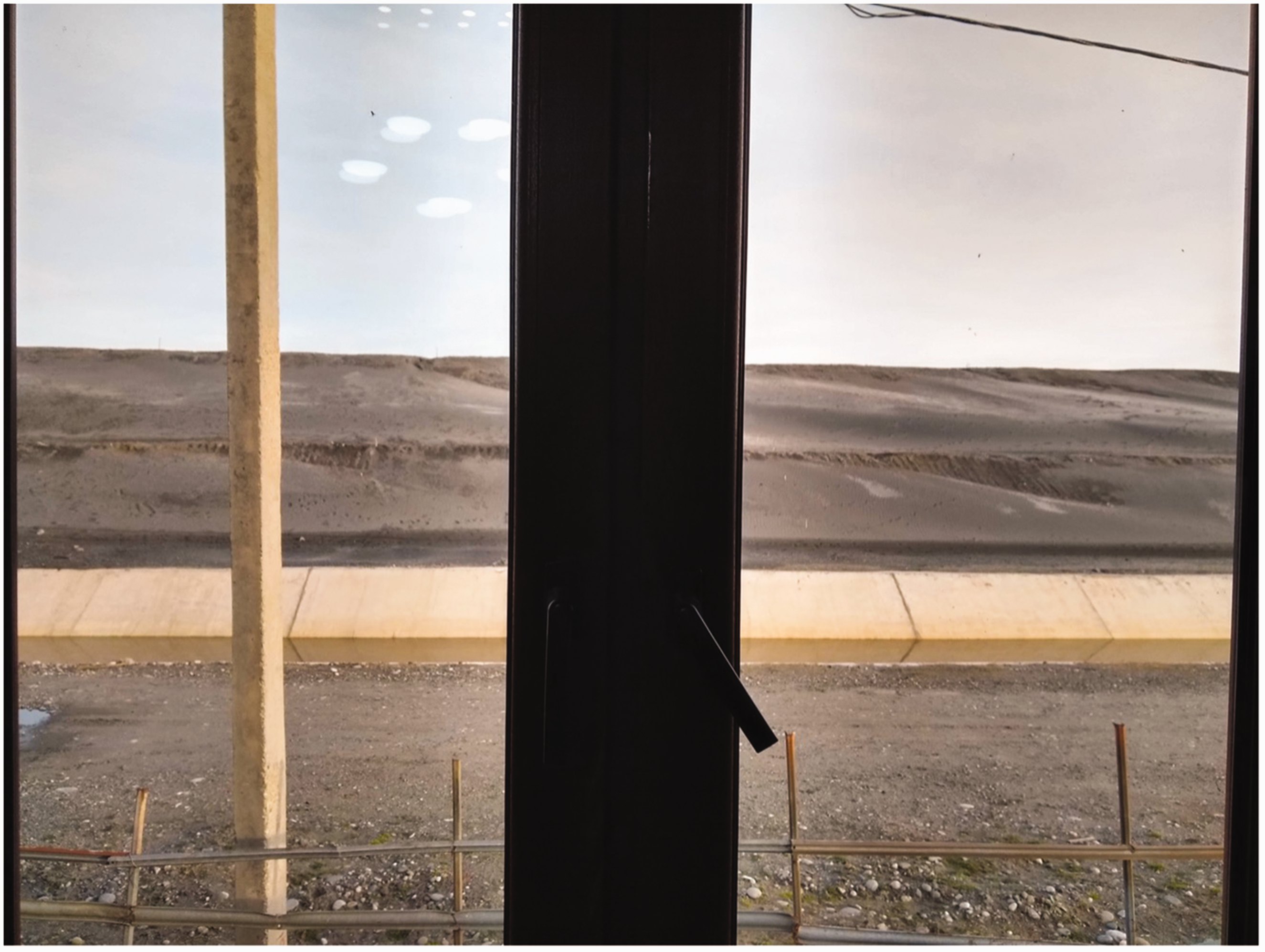
The abandoned port of Anaklia from Giorgi’s window, September 2019 (picture by the author).
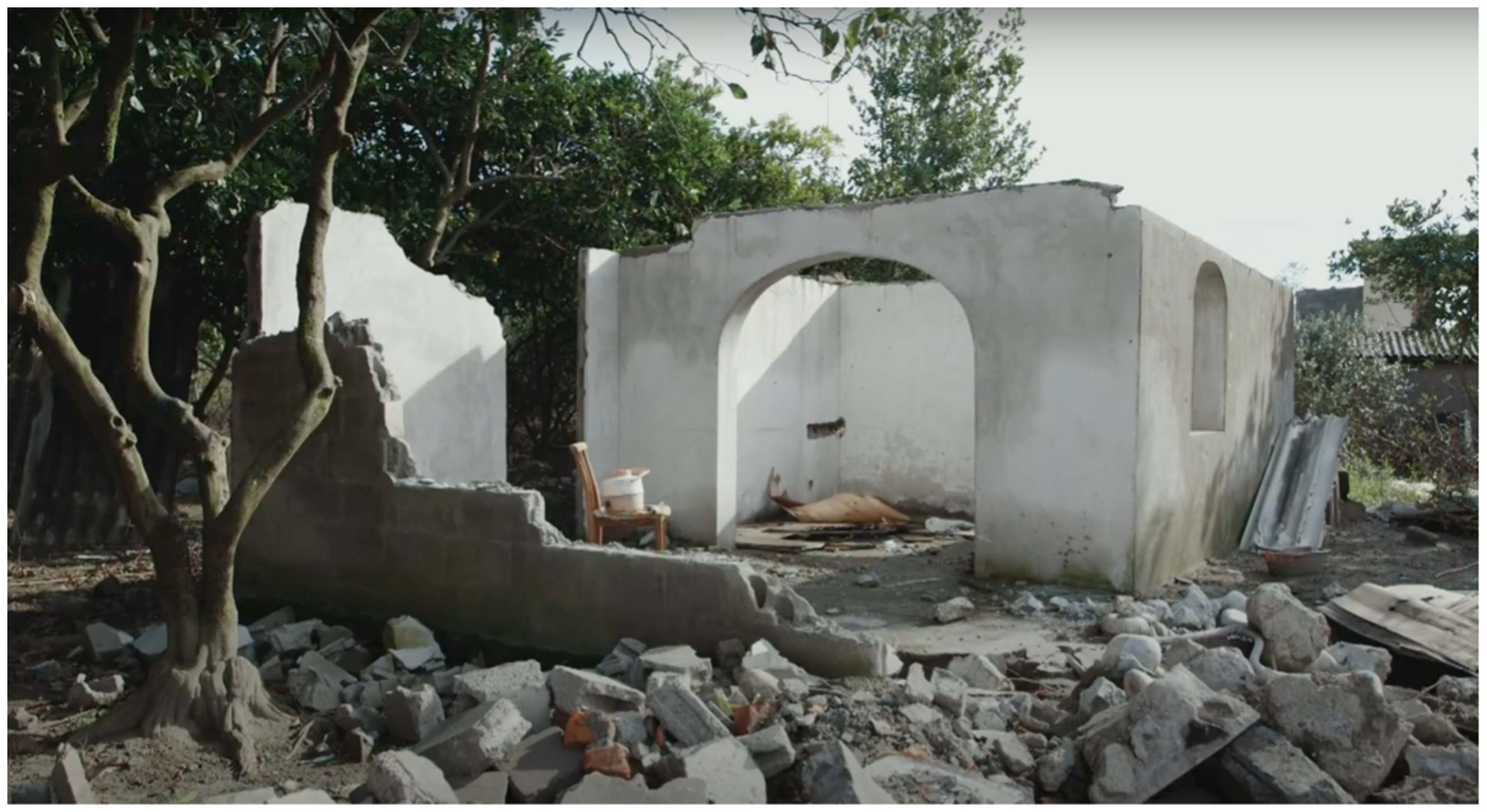
An old house being cleared away, summer 2017 (still from Tekla Aslansihvili’s film “Scenes from Trial and Error” (2020), published with the permission of the author).
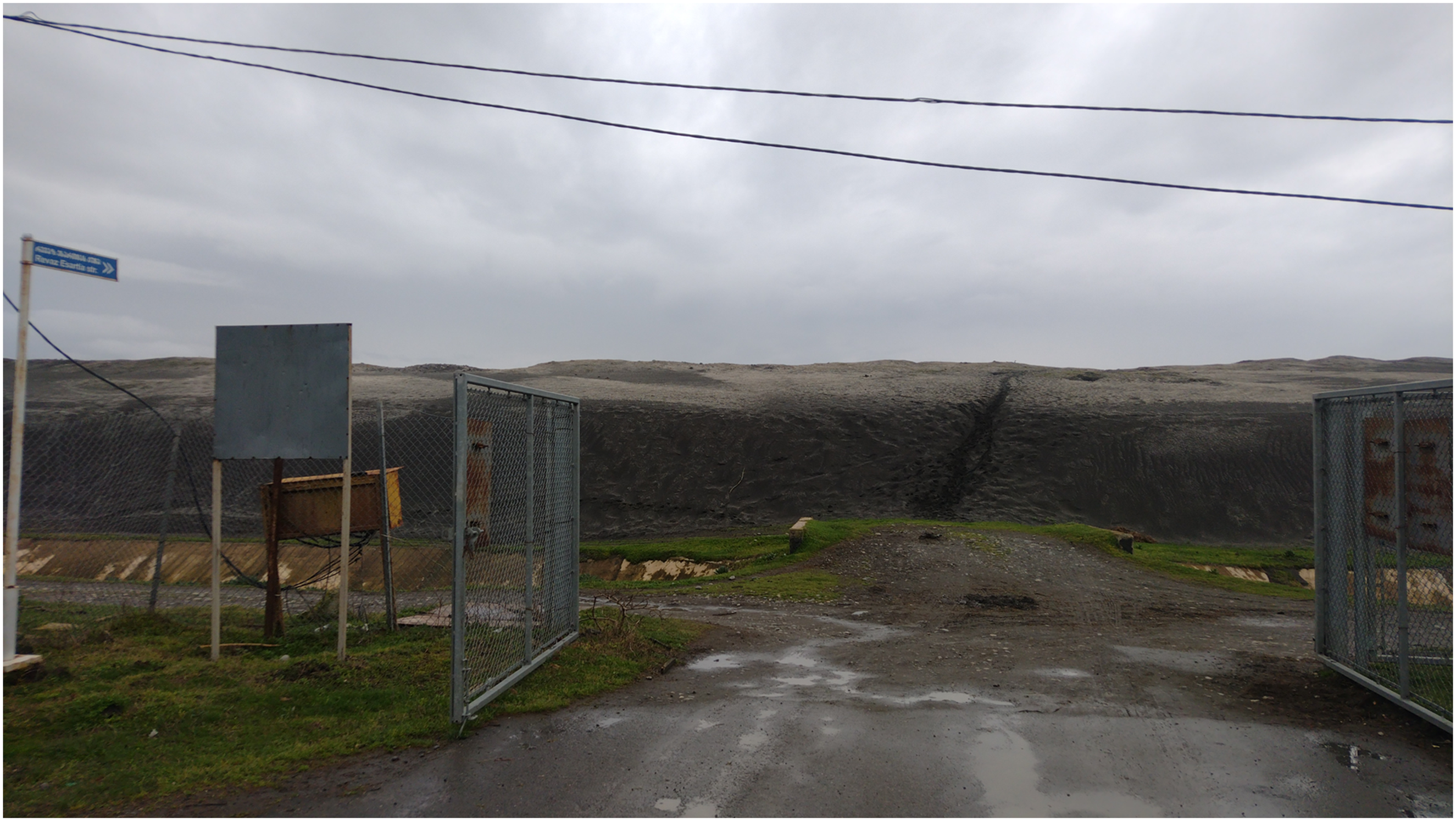
The port territory as a border (picture by the author).
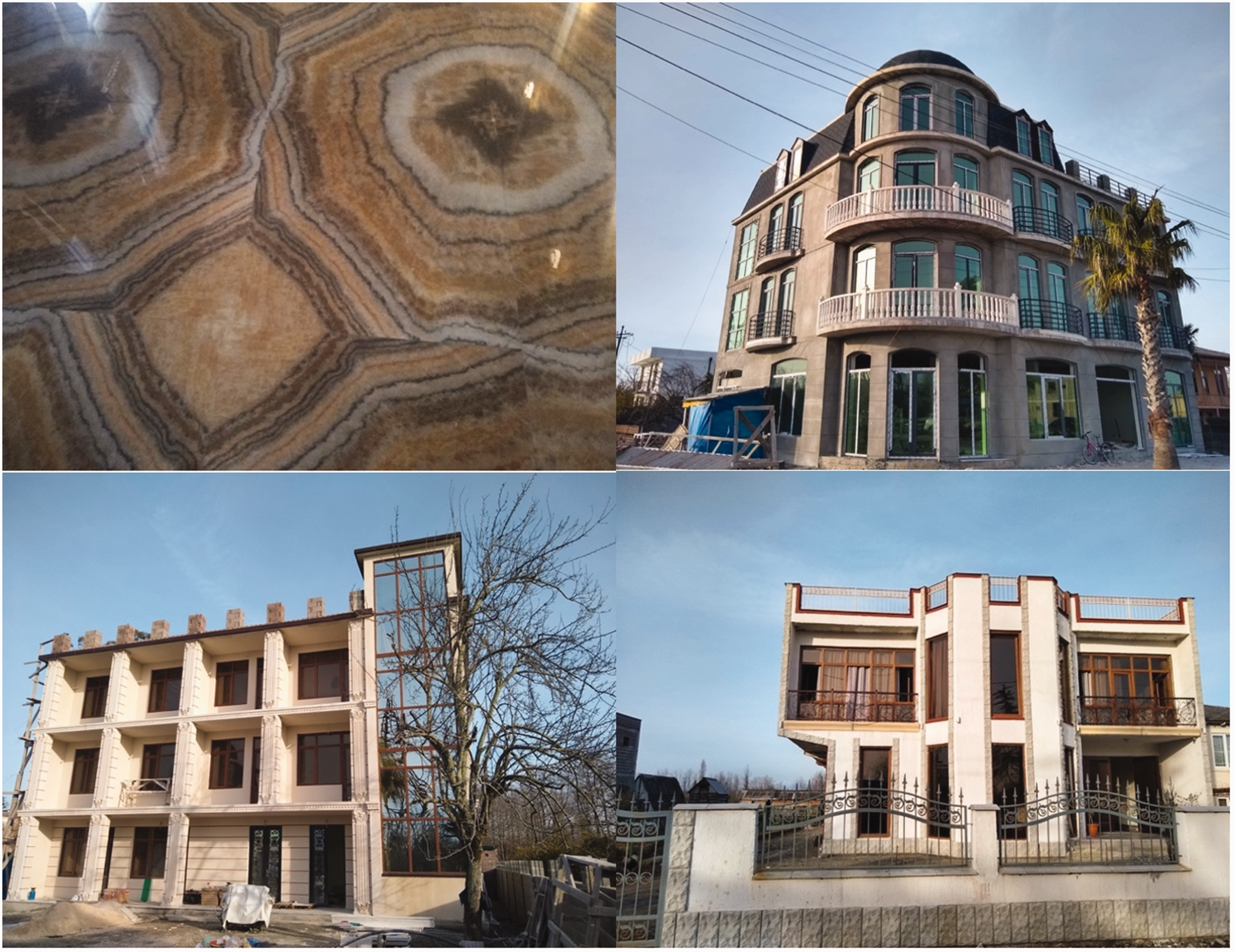
Some of the new spectacular buildings that populate Anaklia (picture by the author).
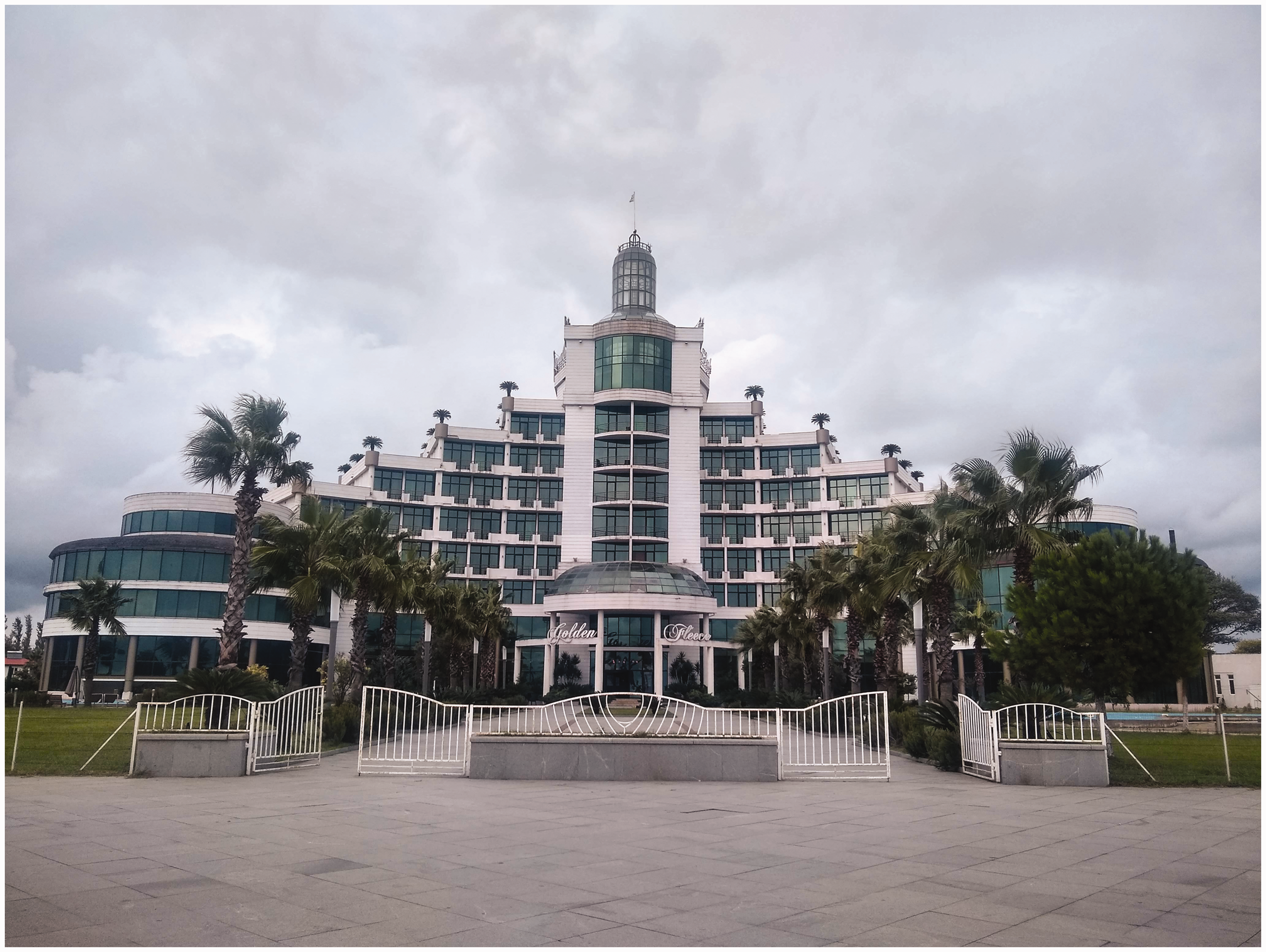
The Golden Fleece Hotel built during Saakashvili’s Presidency (picture by the author).
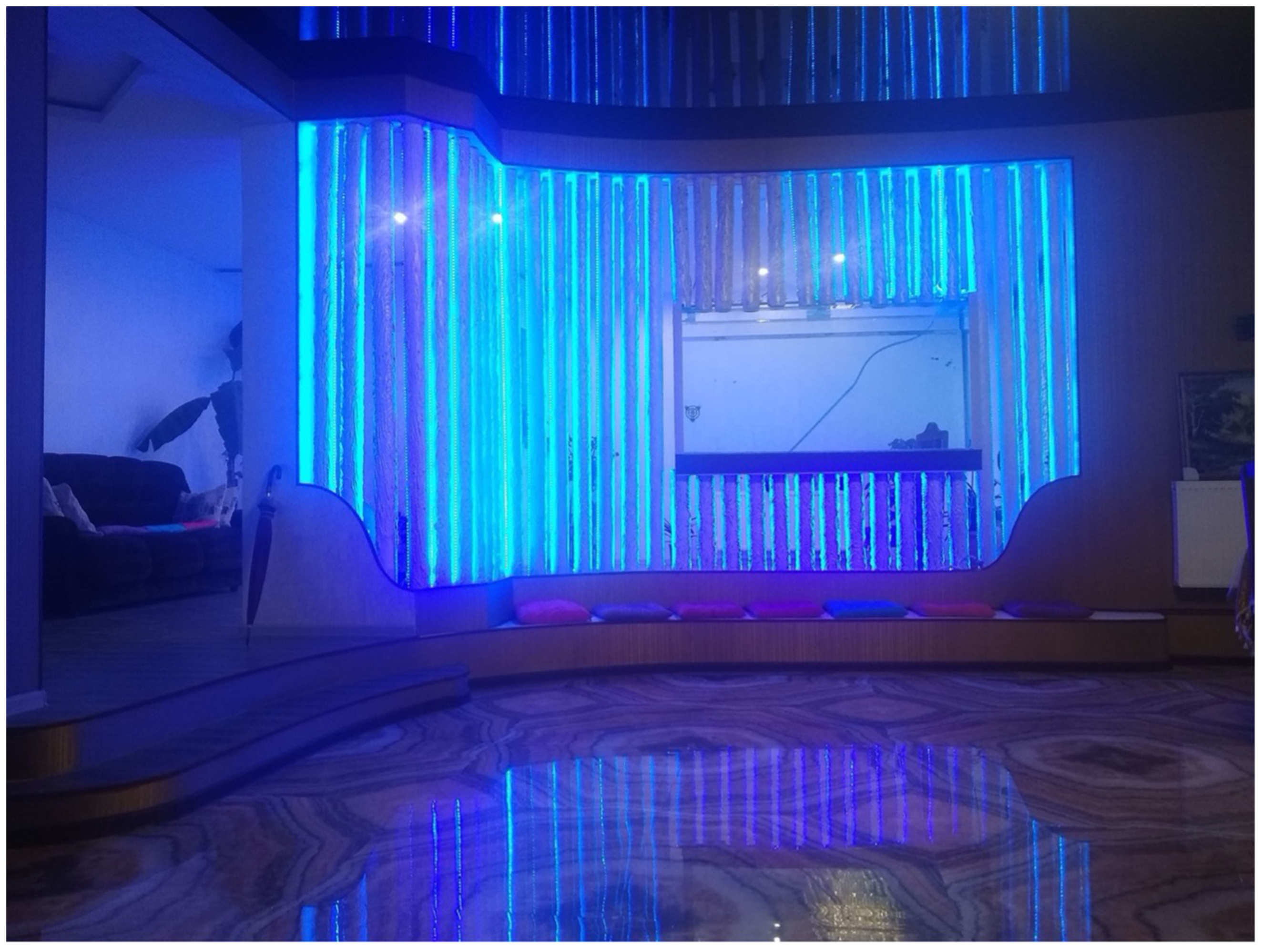
The interior of one of the vernacular spectacular houses (picture by the author).
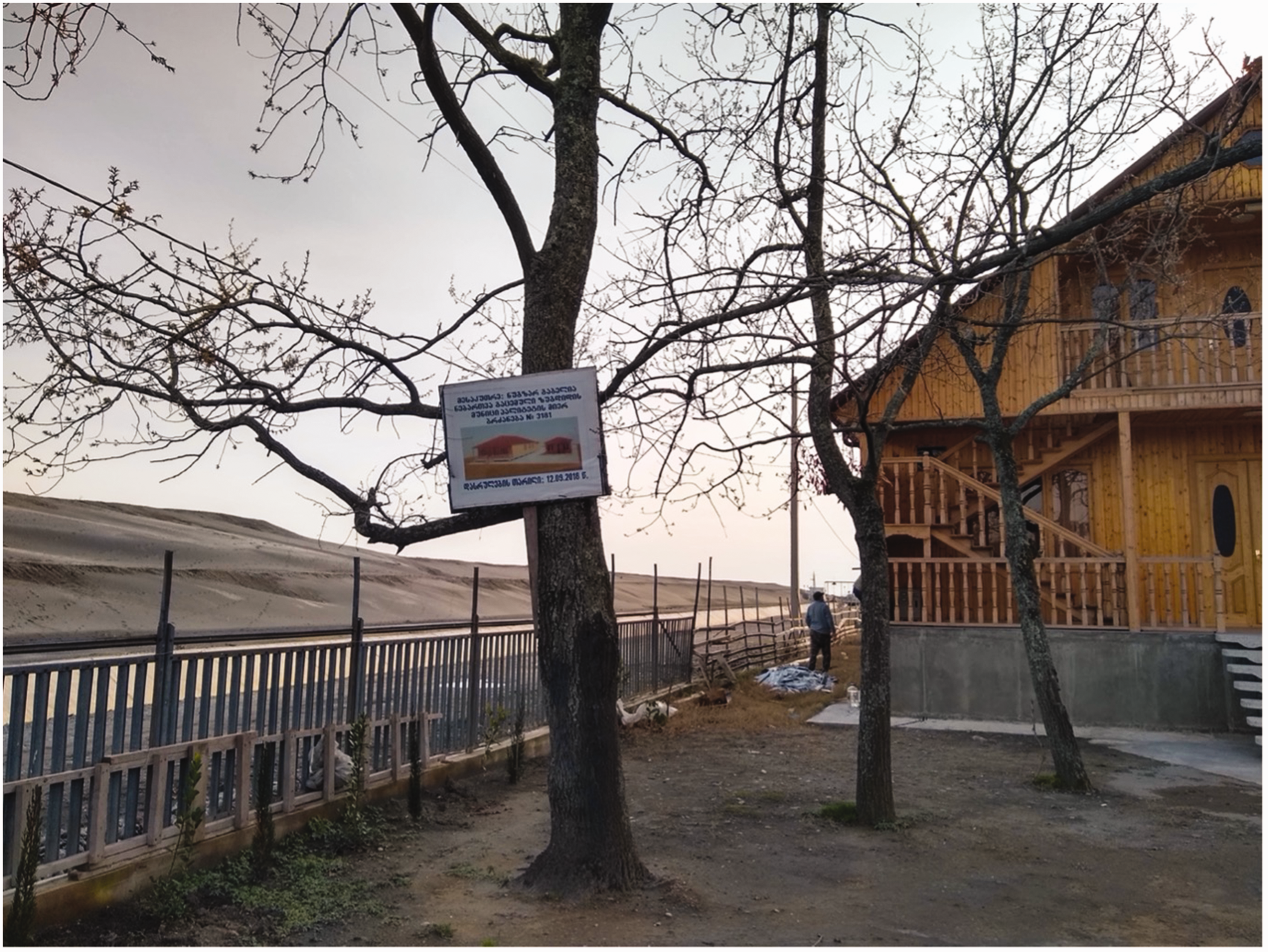
Giorgi and Lela's house, next to the abandoned port territory (picture by the author).
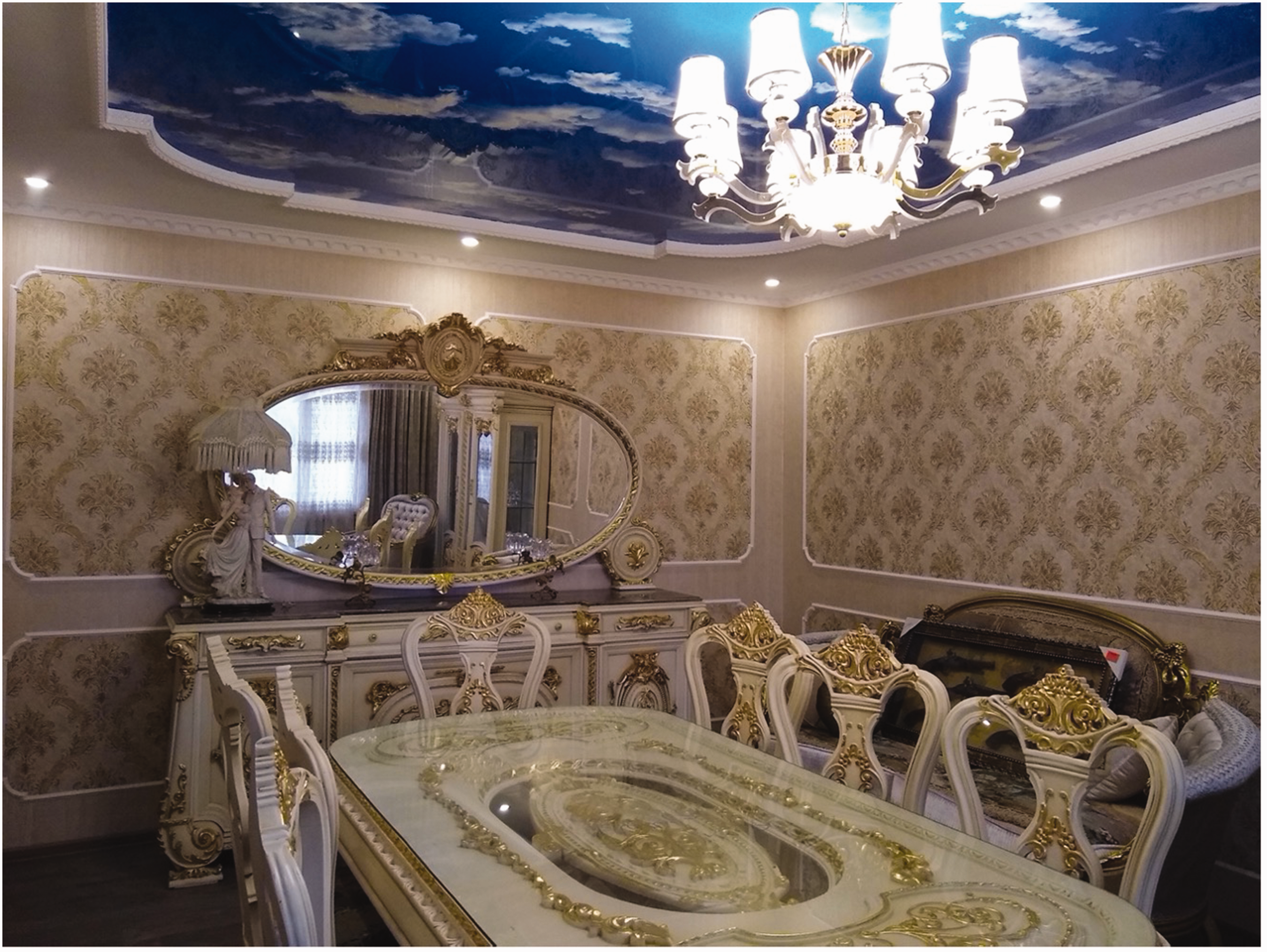
The interior of Giorgi and Lela’s house (picture by the author).
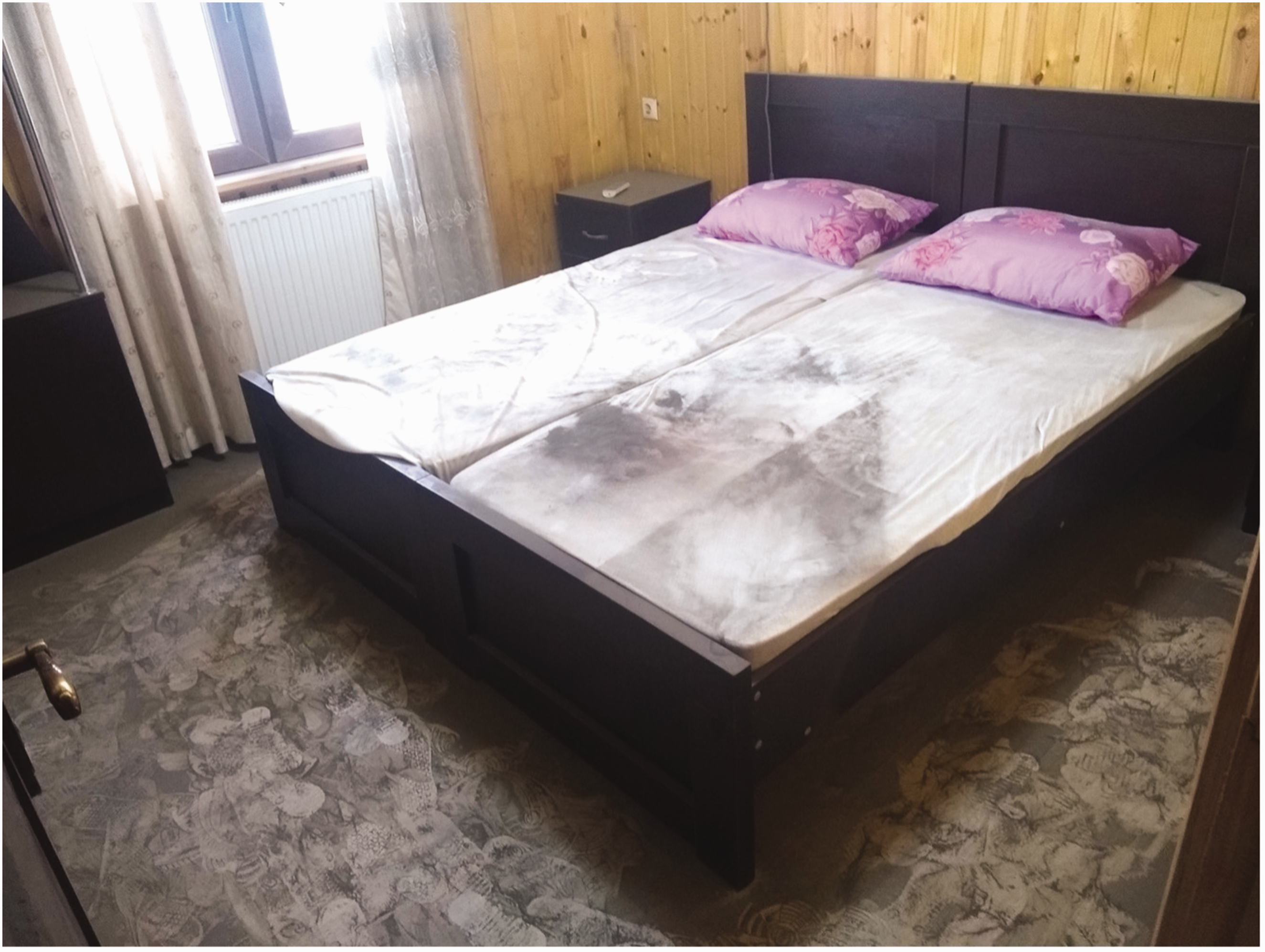
One of the rooms covered in dust (picture by the author).
Footnotes
Acknowledgments
This article draws on my ESRC-funded doctoral research. I am grateful to my supervisors Andrew Barry and Hannah Knox for guiding me through that journey and to my research assistant Sophio Tskhvariashvili for helping me map the domestic transformations in Anaklia in the wake of the port’s failure. Thanks to Lewis Bassett for reading earlier versions of this article and to the three anonymous reviewers for their precious feedback, especially to reviewer 1 who pushed me to engage further with Anne McClintock’s work. I am grateful to my interlocutors in Anaklia who shared their hopes and fears with me in times of change.
Declaration of conflicting interests
The author(s) declared no potential conflicts of interest with respect to the research, authorship, and/or publication of this article.
Funding
This research was supported by a doctoral scholarship from the Economic and Social Research Council (ESRC) grant number 1888765.
