




Abstract
This article examines the eco-coloniality of the UK–France border by tracing the transformation of the notorious Calais “jungle” refugee camp into a nature reserve. We empirically investigate the ecological politics of the Calais borderzone, arguing that the environment plays a crucial role in both enacting and obscuring border violence. Based on long-term research at this site, we explore how the environment does political work by excluding, harming, and erasing the presence of racialized migrants from the shores of the English Channel. Taking a critical postcolonial approach, we argue that environmental ideas that were once forged during empire—including the imperial origins of environmentalism—continue to shape the marginalization of racialized groups today. By deepening our understanding of what counts as border violence and tracing the colonial genealogy of violent environmentalism, this article develops the concept of ‘eco-coloniality’. This builds upon burgeoning research at the intersection of border studies and political ecology, which has explored the co-option of ‘nature’ into violent border practices, and the deepening links between eco-fascism and exclusionary migration regimes. At a time of heightened environmental disruption, we emphasize the importance of unearthing the roots that connect contemporary politics with the perennial legacies of colonialism. Ultimately, we suggest that the protection of the environment, both at the border and during empire, has been used as a pretense for dispossessing racialized groups.
Introduction
This article asks critical questions about the environmental dimensions of political borders. What role does the environment play in both producing and disguising border violence? How might environmental ideas and practices that were formulated during empire continue to shape the dispossession of racialized groups today? And what is at stake by converting a notorious refugee camp into a nature reserve? In answering these questions, we examine the ‘eco-coloniality’ of the UK–France border by tracing the transformation of the notorious Calais “jungle” refugee camp into a space of environmental conservation. We empirically investigate the ecological politics of the Calais borderzone, arguing that the environment plays an increasingly crucial role in both enacting and obscuring the violence of borders. Based on long-term research at this site, we explore how the environment is being used to exclude, harm, and erase the presence of racialized migrants from the shores of the English Channel. In dialogue with postcolonial scholarship, we argue that the protection of the environment, both at the border and during empire, can be used as a pretence for racial dispossession.
Geographers and migration scholars have engaged extensively with the former camp in Calais, which was nicknamed “the jungle”. By 2016, the site had become the largest refugee camp in mainland Europe, and a key bottleneck for people attempting to claim asylum in the UK. As we detail below, the so-called “jungle” would not only be demolished by the French state but would also be redesignated as a nature reserve. The lenses of necropolitics (Davies et al., 2017; Hagan, 2023), urbanization (Mould, 2017), liberal violence (Isakjee et al., 2020), domicide (Mould, 2018; Van Isacker, 2019), dispossession (Brito, 2023), departure (Katz, 2023), containment (Tazzioli, 2022), camp studies (Katz et al., 2018), racial exclusion (Tyerman, 2021a), archeology (Hicks and Mallet, 2019), public health (Dhesi et al., 2018), sanitary politics (Hagan, 2019), and postcoloniality (Davies and Isakjee, 2019) have all been applied—amongst other frameworks—to understand this borderzone. The specters of hope (Mould, 2018), activism (Calais Migrant Solidarity, 2015), humanitarianism (Sandri, 2018), and solidarity (Tyerman, 2021b) have also become focal points of research, alongside scholarship that attends to the methodological challenges of researching Calais’ contingent geographies (Hagan, 2022). Whilst inspired by this research, here we take a different approach. Our contribution to this literature is in exploring the role that the environment plays at the UK–France border. We build upon burgeoning research at the intersection of critical border studies and political ecology, which has explored the co-option of ‘nature’ into violent border practices (Ozguc and Burridge, 2023; Pallister-Wilkins, 2022; Rullmann, 2020; Schindel, 2022; Squire, 2014; Van Isacker, 2020), and the deepening links between eco-fascism and exclusionary migration regimes (Hultgren, 2015; Turner and Bailey, 2022). In doing so, we develop an analysis with relevance to environmental politics, borders, and migration regimes around the world.
Our analysis is based on longitudinal fieldwork in Calais between 2015 and 2024. 1 Our engagement with the site started in 2015, when authors Thom Davies and Arshad Isakjee, alongside Surindar Dhesi, conducted the first environmental health survey of the Calais refugee camp, which was nicknamed the “jungle” (Davies et al., 2017; Dhesi et al., 2015). In the following nine years during separate field visits, we traced how this site has changed over time, drawing from a ‘collage’ of methods (Freeman, 2020), to explore the imbrications of environmentalism, border security, and coloniality. As Freeman suggests, ‘collage’ is a useful methodological framework that accounts for the messy realities of multiple-methods research—especially over a long duration—where each method ‘provides different fragments of information that, when pieced together, help to explain a broad research area’ (Freeman, 2020: 330). With this in mind, we utilise various empirical fragments, including participant observation at the site both before and after the camp became a nature reserve; interviews with migrants and refugees living in the camp prior to its destruction in 2016; French municipal documents outlining the changing legal status of the site; and photographic methods, including over 500 documentary photographs and ‘repeat photography’ techniques (see Meyer and Youngs, 2018) that visualise how the site has transformed from “camp” to “nature reserve”.
Building upon recent scholarship that highlights the deep connections between contemporary migration and colonialism (Mayblin and Turner, 2020), we combine our empirical observations with a postcolonial critique that examines how the protection of the environment—both at the border and during empire—continues to be used as a pretence for racial governance. We conceptually link logics of racial hierarchy that were mobilised in the past, with the environmental logics that we see underpinning Calais’ violent border regime in the present. In doing so, we trace how the environment has been used to camouflage violence (figuratively and literally) and ‘absolve’ both France and Britain from the consequences of their harsh border regimes.
In the next section we introduce the research site, which exists today as Fort Vert nature reserve. Following this, we introduce the theoretical framework that we have developed to understand this borderzone: eco-coloniality. In the remainder of the article, we analytically disaggregate eco-coloniality in this space in terms of exclusion, harm, and erasure. We do this not to argue that these are distinct categories of eco-coloniality. Rather, we understand them as the interconnected effects of eco-coloniality in Calais that illustrate the varied ways that the environment can be made to do political work.
‘Renaturation’: introducing Fort Vert
Let us return then to the site of the Calais “jungle” which had become an informal place of shelter for thousands of asylum seekers as they made journeys towards the UK. A few months after the camp’s demolition by French police in October 2016, and the forced eviction of its residents, large notice boards could be seen around the edges of the newly destroyed “jungle”. They announced a process of “demolition et renaturation”. Less visibly, the site of the dismantled camp had also become a space of racialised segregation and violent policing: today, if migrants set up camp on this site, it would not only be deemed illegal under Calais’ ‘no point of fixation’ policy (Hagan, 2023: 496)—otherwise known as the ‘zero-anchor point’ approach (Brito, 2023)—meaning that people who camp informally are moved on every 24 hours. Significantly for this article, it would also be seen as an anti-environmental act, transgressing its redesignation as a place of wildlife conservation. The space of Fort Vert—as this nature park is now known—having once inadequately housed thousands of people from former European colonies (see Davies and Isakjee, 2019), has been transformed into an archaic colonial trope: a terra nullius or “nobody’s land”, that abuts the UK border. In a borderscape so characterised by high fences and lucrative security contracts, it is notable that this terra nullius does not require razor wire. Such obstructions are unnecessary at the location of the former camp because it has been transformed into a place of environmental protection; primarily, and with a horrible irony, for observing ‘migrating birds’. In Calais, the environment thus provides an acceptable version of violence, a ‘green violence’ (Büscher and Ramutsindela, 2016) where nature is co-opted, not just to guard the border by keeping people away from accessing the nearby Port of Calais, but also to disguise its ugly realities. Completing this environmental illusion, at the edge of the former camp, beneath the constant gaze of a rotating CCTV camera, a wooden sign reminds would-be trespassers that “Access is Forbidden” [‘Access Interdit’].
But Fort Vert has not entirely been washed clean of its recent history. When we visited the site in 2024, we encountered the former “jungle” camp as a crime scene. It was full of forensic evidence that an injustice had taken place here. Discarded tear gas canisters, a child’s shoe, a broken spoon, a pile of asbestos, a spatula, torn fabric caught on a tree, a crushed water jug, shotgun cartridges, a dirty toothbrush (Figure 1), all amongst the overgrowth of this supposed zone of nature. Left behind objects ‘grow’ from the soil like ecological mutations. All this forgotten detritus: a ‘material witness’ to the camp’s violent past (Schuppli, 2020). It is also, perhaps, a portent for Calais’ violent present and uncertain future, where waste and people are cleared, discarded, and entirely abandoned, before the process repeats again, and again. As Maria Hagan observed, this border zone is a space where ‘objects are fleeting and traces of migrant lives are constantly erased’ (Hagan, 2022: 357).
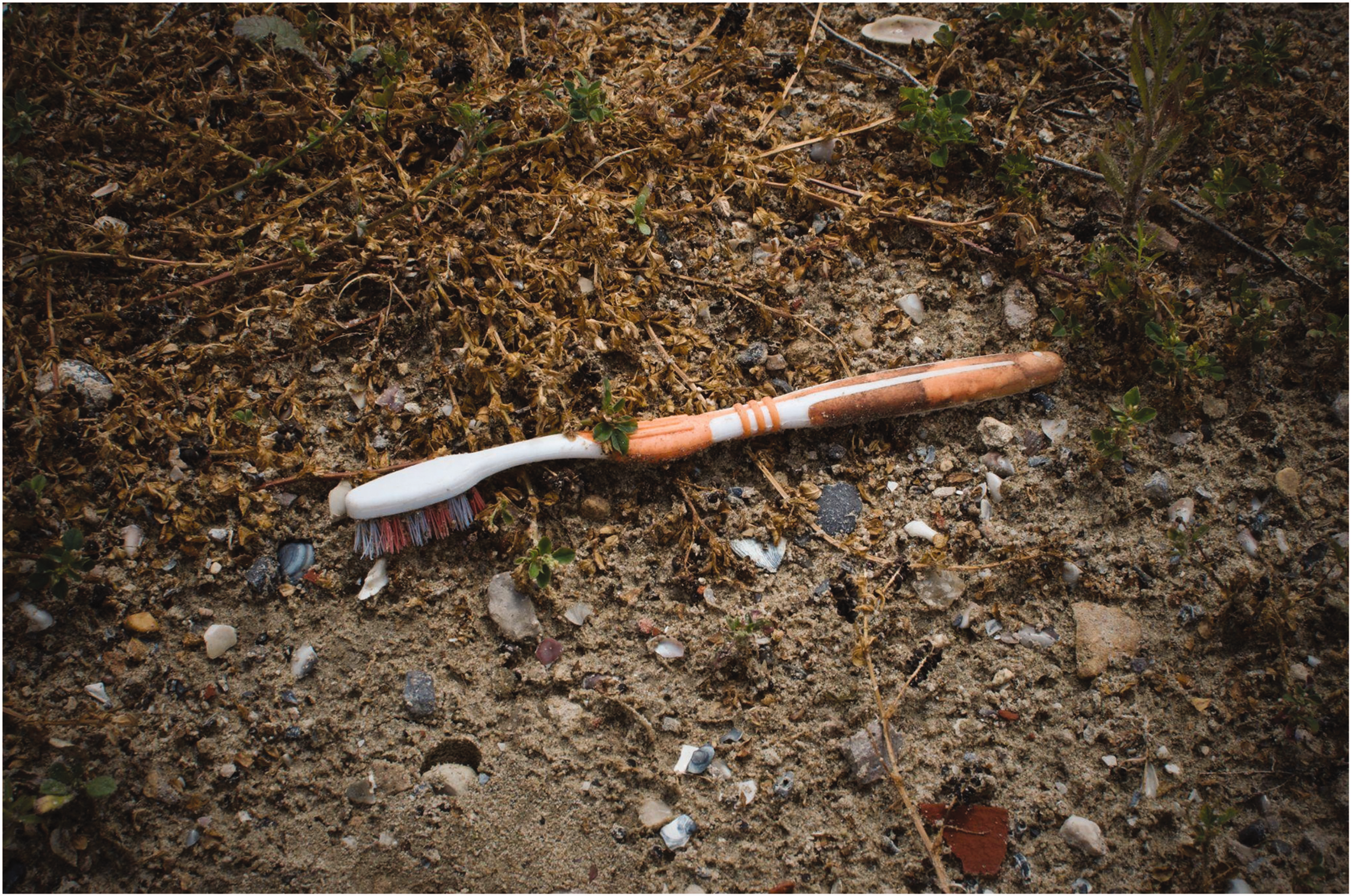
A discarded toothbrush in Fort Vert nature reserve (Photo: Thom Davies, 2019).
As the years go by and the vegetation grows, and as the bird populations settle and the graffiti fades, the more the site becomes greenwashed. Fort Vert—or ‘Fort Green’ in English—is ‘vert-washing’ with each passing season. But scratch a little beneath the surface, or simply go for a walk here (when the police are not watching), and an ‘instant archaeology’ of border violence reappears amongst the shrubbery (Davies and Isakjee, 2015: 93). It juts out of the gravel and gets caught in the branches. A flock of brown sheep graze where men from Sudan once camped; songbirds swoop in search for insects above the place where Afghan-run restaurants once enraged Daily Mail readers (see Allen, 2016); and a waddle of ducks gather where piles of human waste once stank.
St Michael’s Church (Figure 2), with its tarpaulin walls and Eritrean congregation has long gone, its thin fabric bulldozed beneath some unremarkable hawthorne and new-growth birch trees. So too are the makeshift mosques flattened and forgotten: a blackbird nesting where young men once prayed. Above, the motorway roars behind a 15-foot fence, and the Dover-bound lorries never stop. This entire geography has been carefully designed to ensure their swift arrival and departure.
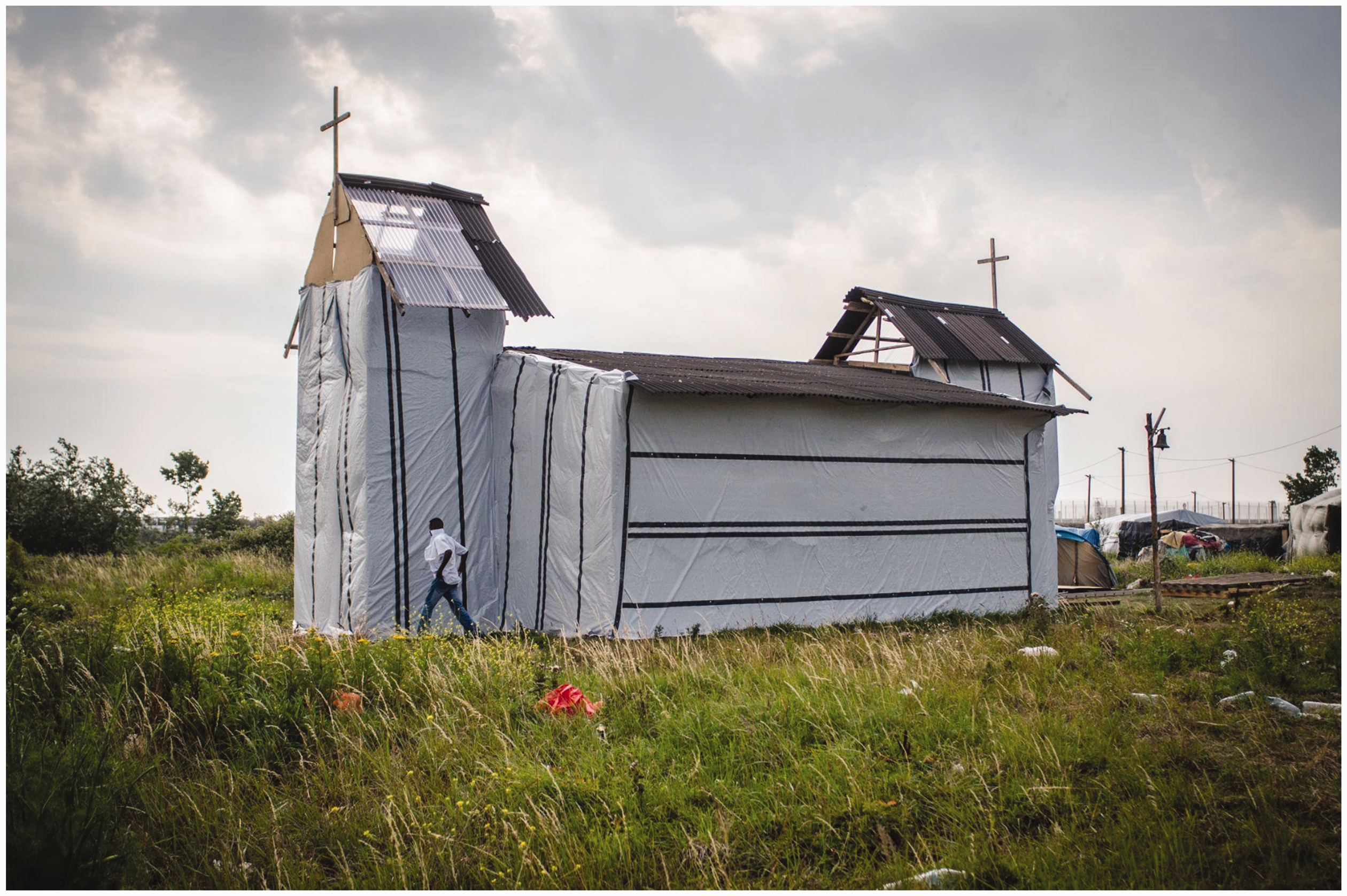
A man walks past St Michael’s Church in the Calais camp in July 2015. Like all structures in the so-called “jungle”, the church was demolished by French police in 2016 (Photo: Thom Davies, 2015).
Walking through the undergrowth of the former camp, the stench from overflowing portaloos and burning rubbish of 2016 is a distant memory, but the acrid smell of chemicals from the nearby factory reliably lingers as toxic as ever. Long before the camp became a place of violent abandonment, the industrial facility next door—‘a specialist manufacturer of fine chemicals’ (Interor, 2023)—had designated this space a ‘Seveso Zone of Moderate Toxic Risk’ (Dhesi et al., 2018). Today, despite the best efforts of the ducks, the hawthorne bushes, and the local municipality that planned Fort Vert, this site remains a ‘racialized hazardous wasteland’ (Davies et al., 2017: 1275). Clinging to a fence on the edge of the factory, a red warning sign reads: ‘Site Chemique/Chemical site’, and continues: ‘Défence d’Entrer/No Entry’. For the convenience of Fort Vert’s erstwhile residents, it has also been translated into Arabic.
Whilst this securitised nature reserve attempts to greenwash the ruins of the former “jungle” (Van Isacker, 2020), the environment has gradually and purposefully been integrated into the border politics of Calais: From the flooded fields that prevent access to the Channel Tunnel entrance, to the hostile architecture of the stone boulders found scattered around the town centre, to the policing patrols that remove migrants from settling in the now-protected nature zone of the former “jungle” camp. By enlarging the aperture of what counts as ‘border violence’ to include environmental constructs, it becomes very clear that the environment not only helps restrict human mobility, it also conspires to disguise the brutality of the border. In Fort Vert, a place to watch migrating birds—made from wood and chipboard like so many former shelters in the destroyed camp—is now a site to forget migrating humans (Figure 3). This nature reserve attempts to liberate Calais from its all-too-recent shame: a search for environmental absolution in the midst of an ongoing drama. Afterall, who could argue against protecting the environment?
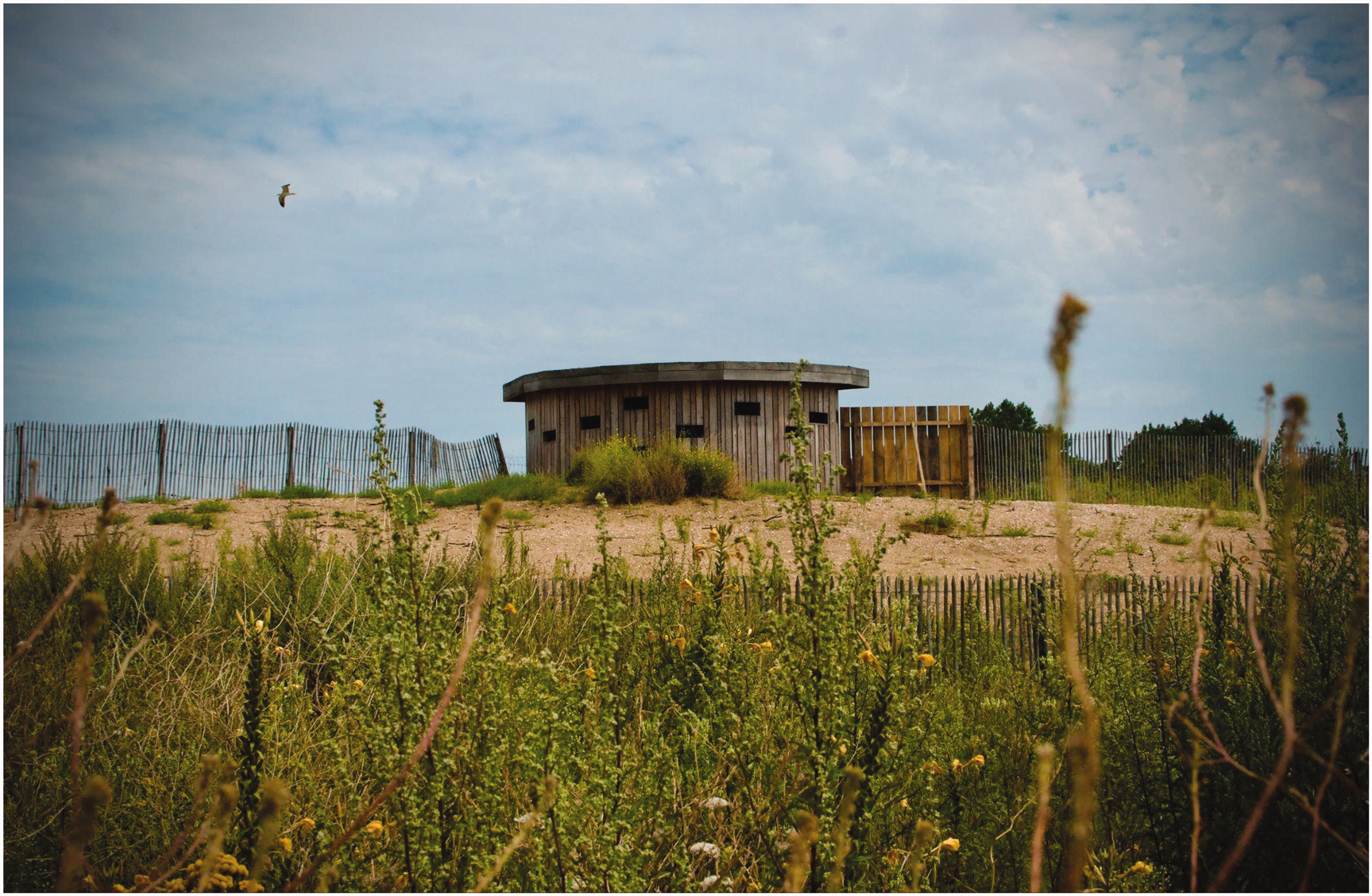
At the edge of the former “jungle” camp, a wooden shelter has been constructed for observing the 250 species of birds that reportedly feed and nest here (Photo: Thom Davies, 2019).
Introducing eco-coloniality
In order to better understand the greenwashing of racialized border violence in this site, we conceptualize environmentalism in Calais as a form of eco-coloniality. As we have written elsewhere, ‘when colonial logics and contemporary border politics come together, their entanglement becomes hard to ignore’ (Davies et al., 2021: 2322). The colonial fantasy of the ‘offshore’, for example, continues to shape how ‘small boat’ Channel crossings are being governed and imagined by the UK government (Mayblin et al., 2024). So too, we suggest, are colonial imaginaries of ‘nature’ and the environment playing crucial roles in the governance of this deadly borderzone. In what follows, we flesh out our argument by locating it within the violent ecologies and colonial histories of Fort Vert and the “jungle” in Calais.
Eco-coloniality describes how environmental ideas which developed under conditions of formal colonialism and imperialism continue to shape the contemporary world. Inspired by research into ‘green imperialism’ (Grove, 1996) and ‘ecological colonialism’ (Crosby, 2004)—which examines the histories of environmental governance—eco-coloniality stretches the temporality of these structures by focusing on how these colonial systems of knowledge and power are repurposed in the present day. Drawing upon the insights of colonial studies and environmental history (see Ferdinand, 2021; Sultana, 2022), our conception of eco-coloniality helps us understand the persisting remnants and impacts of colonial environmentalism in its modern guises, and the way these histories are both mobilized and forgotten. As we explore below, colonial and imperial understandings of ‘nature’—and the way the environment is operationalized—often outlive the historic timescapes of formal empire, and in our case study, reappear through the contemporary governance of the Calais borderzone. This subtle shift is not a radical break from the aforementioned scholarship on ‘ecological colonialism’, but augments attention towards the here and now, enhancing our understanding of how environments are made to act politically.
Our use of ‘coloniality’ follows the work of Puerto Rican philosopher Nelson Maldonado-Torres (2007), who highlights the differences between colonial-ism and coloni-ality: the latter, he suggests, denotes the ‘long-standing patterns of power that emerged as a result of colonialism … beyond the strict limits of colonial administrations’ (Maldonado-Torres, 2007: 243). In other words, by naming the coloniality of the environment—or eco-coloniality—we emphasise how environmental ideas born under the milieu of colonialism and imperialism continue to augment how environments are understood, governed, and co-opted today. Crucially, just as during colonial rule, these environmental ideas often have racializing effects that work to harm and dispossess subaltern groups.
If eco-coloniality gets us to interrogate colonial systems of power and material practices of environmentalism today, then it also hinges on a relationship to other familiar terms. We suggest that eco-coloniality relies upon and revives connected political projects and practices such as environmental racism and eco-fascism, without being reducible to them. The concept of environmental racism (Bullard, 1990; Pulido, 2016) helps to uncover the unequal and racialised effects of environmental degradation, toxicity, and pollution. That is, how racialised groups are structurally conditioned to be exposed to slow violence and premature death caused by ecological damage (see Davies, 2018; Nixon, 2011). We thus use this term when describing how people on the move are made vulnerable to forms of harm wrought by environmental damage at the border—such as the conditions in the former “jungle” camp.
The concept of ecofascism refers to a more explicit political project that blends together racial supremacy, authoritarianism, and environmentalism. This reactionary environmentalism claims the principles of ‘blood and soil’ by linking the presence of a racialized people to a certain natural territory or ‘homeland’. In the ecofascist imaginary, the protection of nature is linked to the violent expulsion of degenerate ‘others’ who threaten the purity of the ‘native’ race and its environment (Moore and Roberts, 2022). Explicitly ecofascist ideas often rely upon colonial forms of racialisation and environmental management (Tilley and Aji, 2023), and we see direct appeals to migrants as environmental threats in the Calais borderzone. Yet eco-coloniality expands the frame of reference further, beyond the explicit authoritarianism of the contemporary far right. In using eco-coloniality, we demonstrate the ways that both environmental damage (toxicity, exposure, pollution, etc.) is structurally focussed on racialised migrants, and the way that colonial environmentalism and conservation has a wider genealogy than within proto-fascist movements which includes forms of liberal governance. As such, eco-coloniality allows us to interrogate how environmental damage and environmental protection can both be used to exclude racialised groups.
In this way, we suggest that the environment is being utilised in Calais in an attempt to exclude migrants and refugees from the UK–France border, and over the next sections of the paper we follow this practice back to the nascent environmentalism of European empires. We focus here on the environmental history of the “jungle” camp, its resonances with environmental politics in French and British Empire, and in settler colonial states, and how the environment is being repurposed today at Fort Vert to greenwash racist border violence in Calais. While it is an accepted scholarly practice to draw lessons from events in European histories to make sense of the present—such as Giorgio Agamben and the concentration camp (i.e. ‘the state of exception’) or Michel Foucault and the European Prison (i.e. ‘the panopticon’ or ‘biopolitics’)—drawing upon colonial histories to make sense of the present is often less-well accepted. Here, following a tradition of postcolonial scholarship and an emphasis on connected histories (Mbembe, 2019), we push back against this, and draw upon the colonial past to better understand the Calais borderzone today.
Eco-coloniality in Calais and the specific practices of removal and expulsion from Fort Vert are foregrounded in previous histories of environmental deracination. For example, when Indigenous groups were driven from their land to make way for Yellowstone, Yosemite, and Glacier National parks in the late 19th century (Lee et al., 2022; Spence, 1999). It has faint echoes of Aboriginal communities being forcibly relocated in the mid-20th century to provide ‘pristine’ laboratory conditions for British Nuclear testing (Alexis-Martin, 2019); or how their French counterparts displaced Indigenous people on the islands of French Polynesia (La Polynésie Française) and nomadic communities from the deserts of French Algeria (L’Algérie Française). It reflects, too, the contemporary ‘green colonialism’ of Israel (Sasa, 2023), where Palestinians are denied access to land, water and natural resources in an environmental apartheid, whilst the occupying state commits war crimes and markets itself as “eco-friendly”. We consider these past and present events ‘spectres’ (Manchandra and Salem, 2020) which show structural familiarities with what is happening today in Calais. The eco-coloniality of Calais has parallels, too, with Big Game conservation projects in Southern Africa, where today’s safari ecologies are predicated on the continued deracination of tribal groups (Ferdinand, 2021: 178). And in a more complex example that draws-out the entanglements between coloniality, the environment, and asylum—in the early 21st century, the Republic of Nauru’s dependency on extracting hazardous phosphorus fertilizer would mutate into the Island nation becoming economically dependent on another ‘toxic’ industry: Australia’s offshored asylum system (Morris, 2023). A similar colonial relation towards the environment persists around the UK’s externalized border in northern France: an ecological experiment whereby the environment is not an innocent bystander, but a tool used to exclude, harm, and erase racialised migrants from the shores of the English Channel—thus exculpating both France and Britain from the consequences of their violent border controls.
From the inception of modern environmentalism, which historians have traced to the ‘green imperialism’ of French colonial administrators in the 18th century (Grove, 1996; Sasa, 2023: 222), there developed a ‘conception of wilderness predicated on Indian displacement’ (DeLuca and Demo, 2001: 544). Environmentalism—like liberalism itself (see Mills, 2017)—has always been entwined with the twin specters of racism and eugenics. John Locke, Hugo Grotius, and George Washington, for example, all referred to Indigenous groups as ‘wild beasts’ (Losurdo, 2014: 27). Later on, the Scottish-American environmentalist John Muir (1838–1914), who founded the first national parks in the U.S. as well as the Sierra Club, described the Indigenous people he encountered in Yosemite as unclean ‘specimens’ (Muir, 1894: 93), who had dirt on their faces: ‘so ancient and so undisturbed it might almost possess a geological significance’ (Muir, 1894: 93). They ‘seemed to have no right place in the landscape …’ he wrote in his book about the Californian environment: ‘… and I was glad to see them fading out of sight’ (Muir, 1894: 108). Throughout his writings, Muir contrasted Indigenous people with his racialised notion of ‘nature’: ‘A strangely dirty and irregular life these dark-eyed, dark-haired, half-happy savages lead in this clean wilderness …’ he reflected in his later environmental memoirs: ‘… Two things they have that civilized toilers might well envy them—pure air and pure water. These go far to cover and cure the grossness of their lives’ (Muir, 1911: 206).
For early environmentalists such as Muir and his French counterparts—who were invariably white, free, men (Ferdinand, 2021), Black and Indigenous people were both of nature (primitive, unclean, ‘geological’) yet excluded from the environment’s supposed liberal virtues (beauty, tranquillity, purity). For the antecedents of contemporary eco-fascists, racialized groups were thus ‘wild’ yet, in Muir’s words: had ‘no right place in the landscape’. In the Racial Contract, C.W. Mills (1997: 48) calls this contradiction a ‘mutually complementary myth’, whereby land can be both ‘unpeopled’ yet also packed full of supposedly threatening uncivilised ‘human beasts’ (Mills, 1997: 49). This contradiction can be found in the evolution of what is now called Fort Vert and what used to be called “the jungle”; where the exclusionary politics of nature was first used to exclude, and then harm, and then finally erase the presence of refugees and migrants.
In the following sections, we explore how the environment has been used in Calais to exclude, to harm, and (attempt) to erase people on the move. We conceptualise these interconnected practices and their effects in terms of eco-coloniality. While there are many ways in which scholars might theorize such practices in this or other borders, 2 thinking with colonialism allows us to understand what we have observed not as one-off events in an unprecedented contemporary emergency. But instead, as part of longstanding logics of human hierarchy and their material implications.
Exclusion
In the build up to the so-called “Calais Migrant Crisis” in 2015, nonwhite groups in the French bordertown were deemed ‘wild’ enough to be ‘cast out’ from the streets and squats of Calais-proper, and were placed into a camp that was ignominiously named the “jungle”. This strategy of racial segregation limited people from accessing autonomous solidarity networks in the centre of Calais (Calais Migrant Solidarity, 2015; Van Isacker, 2019, 2020). Racialized migrants were thus excluded from the whitened polity of Calais in a process that ‘confined migrants to a peripheral “tolerated zone” while making the rest of town a space of zero tolerance’ (Tyerman, 2021a: 474). The racial zoning of Calais began to resemble the ‘twin-city’ segregation of urban space witnessed in French-occupied Morocco (Rabinow, 1989: 287). It echoed, too, the ‘reciprocal exclusivity’ (Fanon, 1963: 32) that existed in Algérie Française, where the colonized and the colonizer existed separately in two distinct zones: in a ‘world divided into compartments … cut in two … [and] inhabited by two different species’ (Fanon, 1963: 38–39). Beyond the French empire, the racial segregation of Calais also began to reflect the ‘sundown towns’ that sprang up in the U.S. Midwest between 1890 and 1960 in the wake of The Great Migration, where de facto racial exclusions—in tandem with collaborative policing—restricted the presence of nonwhite groups in urban spaces. During visits to Calais in the years following 2015, for example, we witnessed refugees and migrants being racially profiled in the town centre by French gendarmes, while white homeless people were allowed to sleep rough in the same places (Isakjee et al., 2020).
In April 2015, people on the move began to be dumped by the police—sometimes quite literally—alongside the fly-tipped waste of the semi-industrial zone that came to be called “the jungle”, next to an old education camp named ‘The Jules Ferry Centre’, that had been hastily converted to house women and children. The Jules Ferry Center was named after the 19th century two-time premier of France—a contemporary of John Muir—who was a firebrand imperialist, and oversaw a rapid expansion of the French Empire. Like Muir, Jules Ferry was an avowed white supremecist, and he often made impassioned defences of Empire in the French Parliament. For example, he concluded one such speech: Gentlemen, I must speak from a higher and more truthful plane. It must be stated openly that, in effect, superior races have rights over inferior races! (Ferry, 1884, 28 March, the French Chamber of Deputies, Paris)
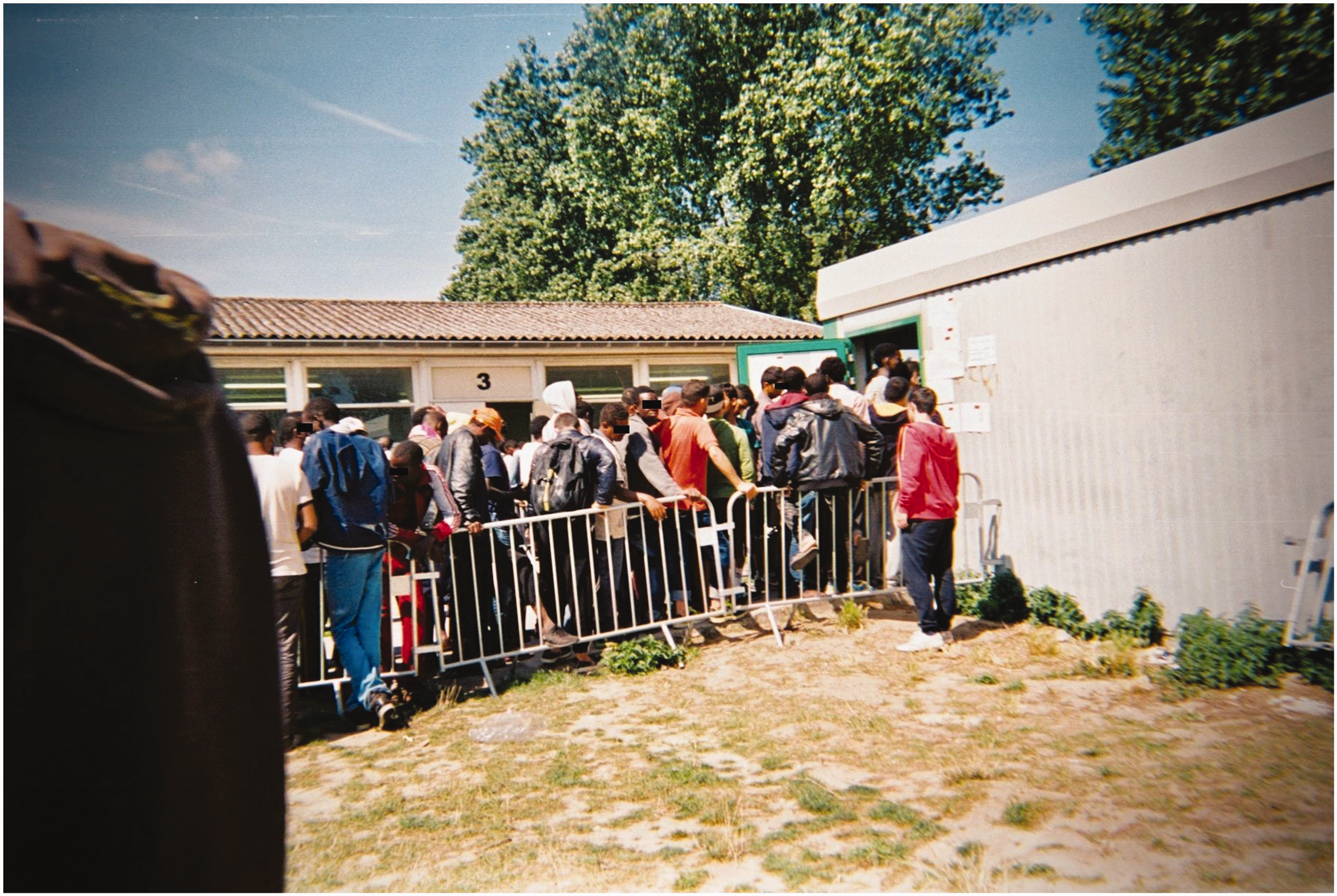
Residents of the Calais “jungle” camp wait in line at the Jules Ferry Centre (Participant Photo, 2015, identities obscured).
Despite the stark coloniality of the Calais borderzone, the name this day centre—after France’s most infamous Imperialist—could at first glance be discarded as mere coincidence. Yet examined through a lens that takes colonial history seriously (Davies and Isakjee, 2019; Mbembe, 2019; Mayblin and Turner, 2020), the name foreshadows the continuation of imperialist logics that can be traced to the present day. The practices of exclusion witnessed in Calais were undertaken under a logic of racial hierarchy that would have been very familiar to Ferry and his colonial forebears, a logic through which human equality and dignity are never put at the centre of responses to the reality of irregular migration in Europe. And a logic through which the environment is routinely co-opted to exclude racialized groups. These links between racism, exclusion, and the environment were noted by activists at the time, who described how ‘the day centre is an attempt to shackle people to an isolated wilderness outside Calais’ (Calais Migrant Solidarity, 2015). As the so-called “jungle” camp began to grow around the Jules Ferry Centre, this environmental exclusion quickly created serious environmental harms.
Harm
Not long after having formed in 2015, the “jungle” camp became a concentration of squalor, gastrointestinal sickness, and harms that were crucially attributed to environmental causes: dirt-adjacent illnesses, and filth-induced wounds that could conveniently be blamed on the very people that they injured. The French state consistently withheld basic amenities. Toilets were scarce and rarely emptied. Water points were contaminated with human faeces. And food distribution was kept deliberately low (Dhesi et al., 2018). At the Jules Ferry Centre, for example, an organization exclusively funded by the French state—and to whom one could not donate money—provided only one meal per day that was distributed to less than half of the camp’s population (Isakjee et al., 2020).
All of this created an environment in which pathogens thrived, scabies spread, and hunger abound. With poor access to hand-washing facilities, or refrigerators to store food, a large number of avoidable illnesses became inevitable. After analyzing food, water and surface samples that we collected from different locations inside the camp during a health study in 2015, we found harmful levels of microscopic lifeforms: bacteria with Latin names and miserable consequences (see Dhesi et al., 2015). These included ‘E. coli spp.’ which can cause diarrhea; ‘K. pneumoniae’ which can cause respiratory illness; ‘Enterobacter sp.’ which can lead to waterborne infections; and ‘Clostridium spp.’ which causes vomiting, acute abdominal pain, and debilitation (Dhesi et al., 2018). Although we could not publish it at the time, one sample that we collected showed evidence that the camp may have contained infectious levels of the bacterium Typhoid, which can lead to the potentially fatal infection of typhoid fever (Salmonella typhi). In short, by denying basic provisions, the violent inaction of the French state had created a racist political ecology that was incubating all manner of preventable harms.
This environmental racism—akin in this case to a strategy of ‘benign neglect’ (Smith, 2021: 63)—is redolent of imperial governance. Throughout empire, settler-colonists often benefited from the ecological violence of disease and epidemics, fostering situations that would expose subaltern groups to environmental harms. For example, First Nation communities in Canada tell stories of blankets infected with smallpox being intentionally sent into Indigenous communities to cause biological damage (Smith, 2021). As a case in point, in 1763, General Jeffrey Amherst, who was born in Kent near Dover before becoming Commander-in-Chief of the British Armed Forces, wrote to his subordinate during the French and Indian War (1754–1763): ‘Could it not be contrived to send the Smallpox among those disaffected tribes of Indians? We must, on this occasion, use every stratagem in our power to reduce them’ (Amherst, 1763, cited in d’Errico, 2010). Such pernicious use of environmental conditions, which was evident during various colonial projects can also be traced in the governance of contemporary borderzones, where migrants and refugees are rarely purposefully killed, but are routinely debilitated and made sick through subjection to poor environmental conditions (Davies et al., 2017). In 2023, a similar subjection to environmental harm occurred on the other side of the English Channel, when asylum seekers housed on the prison barge Bibby Stockholm were exposed to a potentially deadly bacteria (Legionella pneumophila), which was discovered in the water supply. From the Darién Gap to the Sonoran Desert; and from the Aegean Sea to the Balkan Route—environmental conditions are routinely used to harm migrants in spectacular and benign ways (Davies et al., 2017, 2024; Pallister-Wilkins, 2022; Schindel, 2022; Squire, 2014).
In Calais, sandwiched at the border between the fifth and sixth biggest economies in the world, the so-called “jungle” was not a pre-political ‘state of nature’—or what Thomas Hobbes called “the Naturall Condition of Mankind” (Hobbes, 1651: 182)—it was instead a highly artificial environment that had been politically orchestrated through the abandonment of the French state. An ‘organised abandonment’ (Gilmore, 2022: 303) designed to encourage migrants and refugees to self-deport back to the post-colonies from whence they came. Despite the presence of the mud, the pathogens, and the parasites, this was by no means a ‘natural environment’. It was instead, a fabrication of the state’s making, as “man made” as the plastic sheeting one now finds scattered half-buried across the site. The so-called “jungle” was a place where the means of life had been deliberately withheld by the French state, and where ‘nature’ had been press-ganged into doing its violent borderwork. This ‘violence of inaction’ (Davies et al., 2017), as we called it then, was of course an entirely active choice on the part of the French government. A twenty-first century ‘reservation’ had been constructed at the UK border, and it worked hand in glove—like settler-colonial reservations always had—with the brutal affordances of the environment.
In Calais, the environment played another role, too. One that made this border crime appear oddly acceptable. Throughout mediaeval history, ‘the forest as a space of the politically outcast’ (Davies et al., 2019: 225) was a key trope of the European environmental imagination. It was the ‘proper’ place for vagrants, vagabonds, and the socially condemned to hide away from feudal oversight. In the post-colonial borderzone of northern France, however, this environmental lore had given way to a much more pernicious, and more racist form of ecological imaginary: an environmental racism of Jim Crow-era temerity that was barely concealed in the name “la Jungle”.
As Doreen Massey wrote, ‘the language we use is one of the sources of the political straitjacket we are in’ (2013: 9). It is worth pausing for a moment to reflect on this name. How troubling it was, that the biggest refugee camp in mainland Europe, which almost exclusively contained black and brown people from countries once colonised by both France and Britain, would have the racialized epithet: “jungle”. The word itself is not only ‘politically saturated’ (Tyerman, 2021b) by contemporary logics of racial exclusion, it is also imbued by a deep colonial inheritance that has long marked-out certain environments as peculiarly racialised geographies. In Anglo-French colonies in North America, for example, a self-reinforcing logic maintained that ‘forests were wild because Indians and beasts lived there, and Indians were wild because they lived in forests’ (Spence, 1999: 10). At other times there emerged a conflation between racialized subjects and the ecologies in which they lived, as showcased by a letter from Colonel Bouquet to General Amherst: ‘every tree is [sic] become an Indian for the terrified inhabitants’ (1763, cited in D’Errico, 2010). Likewise, in other parts of European empires, places of ‘wilderness’ and other so-called ‘wastelands’ (Fr: terres gastes) were always already marked-out as spaces of colonial adventure and racial threat (C.W. Mills, 1997; Zurawski, forthcoming). The word jungle itself has always been entwined with empire. Originating from the ancient Sanskrit term jan· gala (meaning ‘wasteland’ or ‘forest’), it entered English vernacular during imperial expansion into South Asia. Today, in Pashto, Persian, Urdu, and Hindi—languages commonly spoken by undocumented groups in Europe—the term ‘jangal’ or ‘dzhangal’ is commonly used to describe the hostile environments through which migrants are forced to travel, as well as the makeshift camps (not just in Calais) that they are forced to inhabit (see Agier, 2018; Davies et al., 2019; Rosello, 2016). When viewed through a post-colonial lens, however, jungles in particular become ecologies of white innocence and racial oppression.
From the 15th century onwards, Europeans began to chronicle jungle environments, which developed in tandem with colonial expansion (Nahaboo and Kerrigan, 2021). As Douglas Kerr argued: ‘to the European imagination the jungle was the location and symbol of what was most foreign about the foreign parts which the European empires had penetrated’ (1997). Under imperialism, these environments were not just racialized spaces far away from the solace of the white metropolis, but uncomfortable, unruly, and exotic ecologies of danger and difference; jungles were a ‘colonial leitmotif’ (Ibrahim and Howarth, 2018) where whiteness could be ‘proven’ and codified against the savage backdrop of uncivilized Others. In other words, the jungle was a race-making ecology: a space of tropicality that demonstrated ‘the colonial fusing of bodies and environment’ (Nahaboo and Kerrigan, 2021: 28). It was no accident, for example, that the imperialist writer Rudyard Kipling chose this to be the setting for his short stories that comprised The Jungle Book, which reflected—in various Orientalising ways—long-standing colonial anxieties in the wake of the Indian Mutiny of 1857 (Hotchkiss, 2001). But the jungle fantasy was not the preserve of literary fiction. As early as the 1830s, for example, the uncultivated jungles of British India were formally designated as ‘wastelands’, precluding the expansion of plantations, indentured servitude, and the violent dispossession of Indigenous communities (Shahid and Turner, 2022). As C.W. Mills (1997: 87) explained, the racialized imaginary of jungles during empire had very material consequences: In the colonial outpost in the “bush” or “jungle” of Asia and Africa, there is a long history of vigilantism and lynching at which white officialdom basically connived, in as much as hardly anybody was ever punished. (C.W Mills, 1997: 87)
Importantly, this racist environmental imaginary is not confined to history. In 2022, Europe’s most senior diplomat, Josep Borrell, starkly recalled the imbrication of liberal racism and colonial environmental tropes. In his speech about migration, he said: ‘Europe is a garden. We have built a garden. Everything works …’ yet: … Most of the rest of the world is a jungle, and the jungle could invade the garden. The gardeners should take care of it, but they will not protect the garden by building walls. A nice small garden surrounded by high walls in order to prevent the jungle from coming in is not going to be a solution. Because the jungle has a strong growth capacity, and the wall will never be high enough in order to protect the garden. (Borrell, 2022)
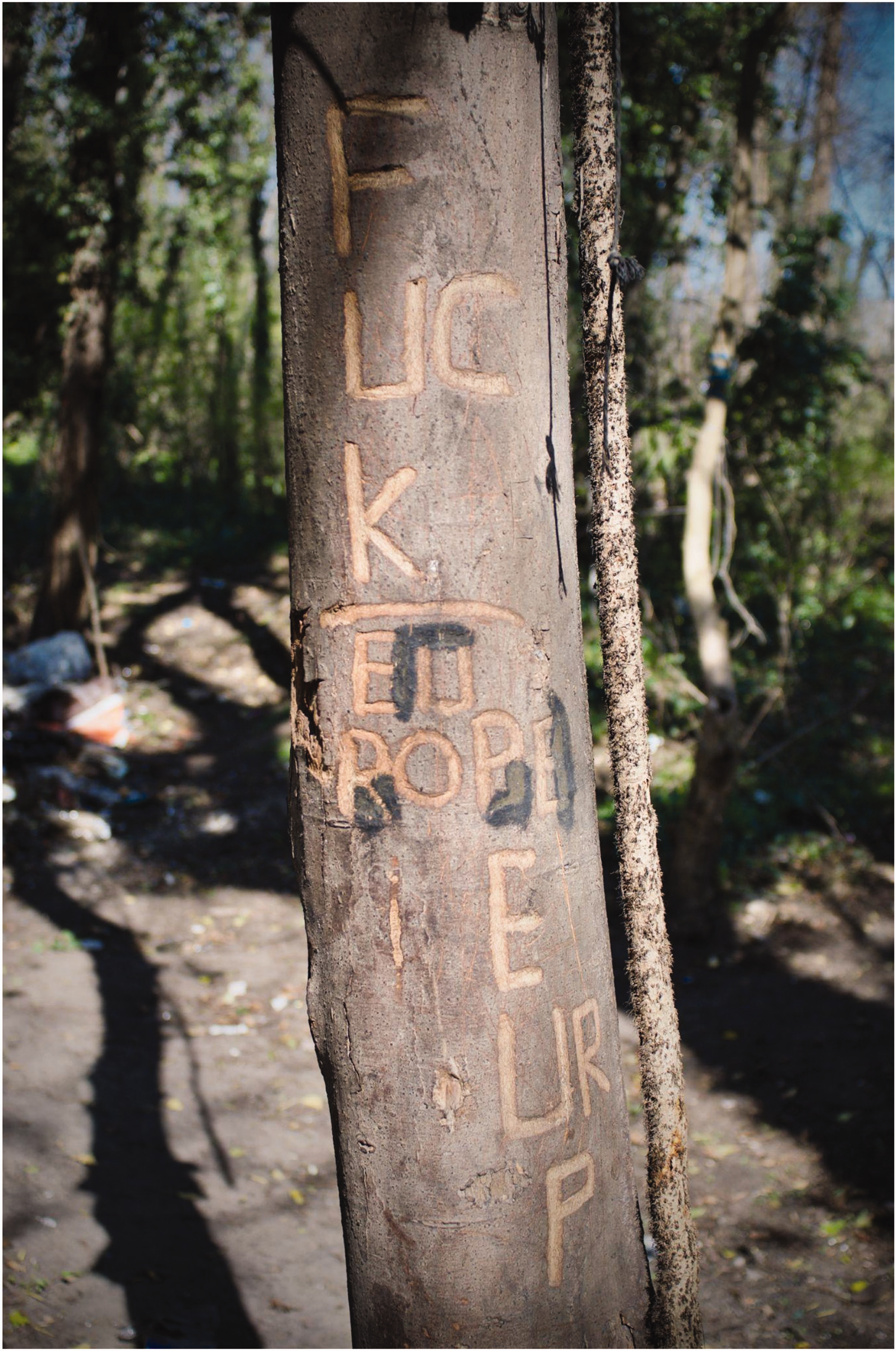
“FUCK EUROPE” carved into a tree near the Calais “jungle” (Photo: Thom Davies, 2015).
As journalists descended on the “jungle” to write stories about ‘the grossness of their lives’ (Muir, 1911: 206), and photographers circled from planes above to take aerial footage, the camp became a quasi-apartheid spectacle of black space on a white European landscape (Davies et al., 2019). It became a ‘spatial fix’ for the global ‘color line’ that contemporary borders so easily reproduce (W.E.B. Du Bois, 1911). And above all, it became a ‘raced space …’ that appeared to ‘… mark the geographic boundary of the state’s full obligations’ (Mills, 1997: 50). In postcolonial Calais, the so-called “jungle” was a place where health regulations did not apply, where shelter did not need to be provided, and where the environmental racism imbued in the term “jungle” made its harmful ecologies appear—to some, at least—as oddly appropriate.
In many ways, the conditions of the camp echoed what Frantz Fanon sardonically referred to as the ‘jungle status’ that colonized subjects were forced to endure under French occupation (Fanon, 1967: 9). By the time the camp’s population reached its peak of around 10,000 residents in the summer of 2016, it was a thriving habitat for rats, cockroaches, bedbugs, scabies, lice, pests, and pathogens: a convenient juxtaposition or continuum for those—like UK prime minister David Cameron—who would refer to potential Channel crossers as ‘a swarm’ at the gates of Britain. With this environmentally racist sleight of hand, the conversion of migrants and refugees into ‘human beasts’ (Mills, 1997: 49) was complete. The environment had thus excluded and harmed racialized subjects in Calais. The next step was erasure.
Erasure
While the camp’s squalid environment had proven itself to be a useful ‘technology of “non-citizen” segregation’ (Van Isacker, 2019: 121), as the months drew on, increased media attention in the UK and France—as well as the looming specter of the 2017 French presidential election—culminated in the camp needing to be physically erased. A municipal order sent out on 24 October 2016 would see bulldozers, riot police, and waste workers enter the so-called “jungle” to tear down shelters and destroy belongings. Acrid smoke from burning rubbish caught in the throat and mixed with the stench of pepper spray, while residents of the camp were herded onto buses, to be dispersed across the five corners of France Hexagone.
But the camp’s destruction—through bulldozer electioneering—was not enough to erase the presence of refugees and migrants. For this, the environment would once again need to be conscripted to the state’s bordering agenda. This time the environment would not be used to inflict direct harm, but would instead act as a ‘progressive signifier’ (Hultgren, 2015: 5); a liberal offering that would be put to work in the service of exclusionary politics. This came into sharp focus in March 2017, when the former French Minister of Interior, Bruno Le Roux, announced in an interview while visiting the demolished camp, that: The dismantling of [“the jungle”] was a successful operation and that it will now continue with an ambitious project to return this territory back to nature. To ensure that it benefits the environment and especially to make sure that there will be no new encampments in Calais. (Le Roux, 2017, cited in Rullmann, 2020) … ongoing work, supported by UK funding, permanently to remove all former camp infrastructure and accommodation and to restore the site to its natural state. That work will help to prevent any re-establishment of squats or camps in the area. (House of Commons, 2017)
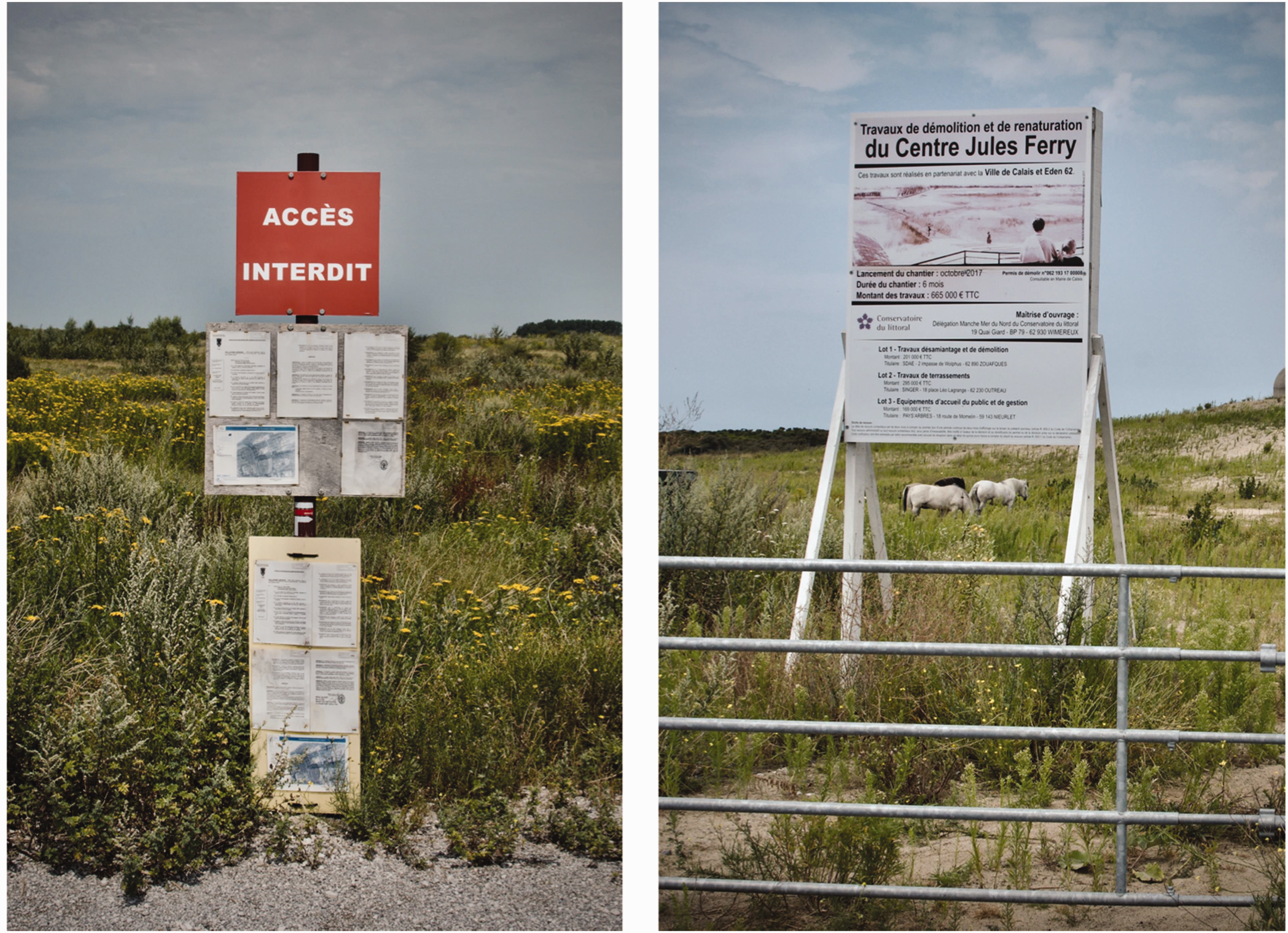
An information board (left) details the Municipal Order that bans activities such as trespass on the nature reserve. A sign (right) details the demolition and “renaturation” of the Jules Ferry Centre (Photo: Thom Davies, 2019).
This crude coalition of political force and environmental protection is resonant with settler-colonial occupation. From the late 19th century in French colonial Algeria, for example, park rangers (conservateurs) from the Ministère des Eaux et Forêts (Ministry for Water and Forests) were given quasi-military authority to police forest reserves, and would administer severe penalties against Indigenous groups (Ford, 2008), including fines, imprisonment, and forced labor (Duffy, 2019). In the U.S., meanwhile: ‘park management in the late 1870s resembled that of a small western military installation’ (Spence, 1999: 86). Park headquarters were built in easily defensible locations, lest they be attacked by the Indigenous groups that had been violently dispossessed (Spence, 1999: 86). And so too does the management of Fort Vert today resemble this securitization of nature. Police routinely patrol the site by foot or on dune buggies, and overlook the nature reserve to prevent illegal activities such as camping from taking place (Figure 7). Again, this is backed up with the full force of the law: Article 2 of the Municipal Order deems it forbidden ‘to destroy, cut, uproot or remove plants without prior authorisation’, while Article 4 states that: ‘Camping, bivouacking, or any other accommodation is strictly prohibited’.
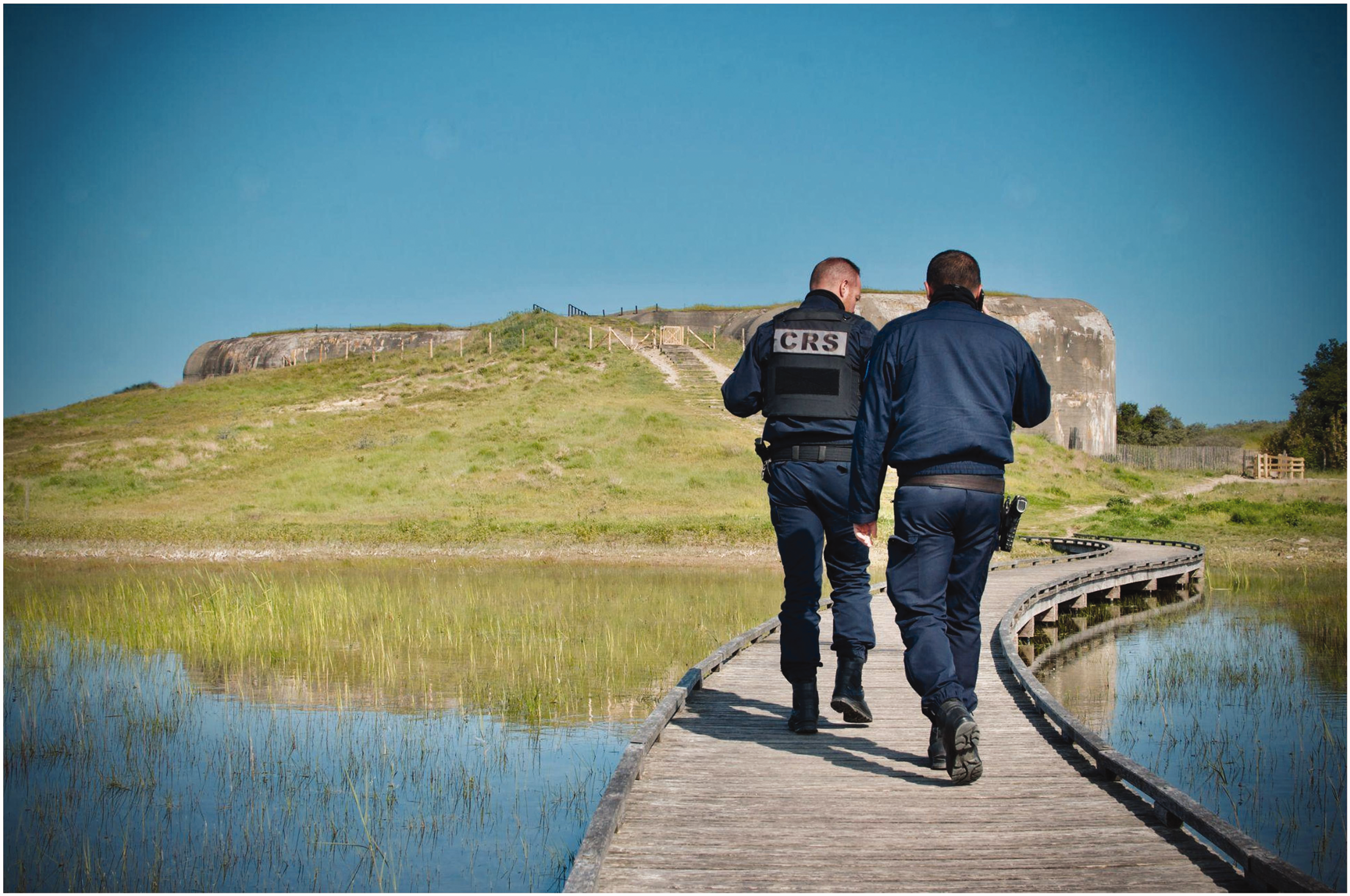
Two French Riot Police (“CRS”: Compagnies Républicaines de Sécurité) patrolling Fort Vert nature reserve on the location of the now-demolished Jules Ferry Centre (Photo: Thom Davies, 2023).
We can draw a clear line from colonial environmentalism to contemporary border ecologies and the violence it supports: eco-coloniality. For example, French colonial administrators would often forcibly dispossess racialized subjects to ‘protect’ (and exploit) the environment. At the height of the French empire, a series of réserve naturelle intégrale (integral nature reserves) were constructed across its colonial possessions in Africa and Asia. This included 50 nature reserves in Cochinchina (Vietnam) between 1891 and 1912, 13 parks in Algeria between 1921 and 1931, 10 natural reserves in Madagascar in 1926, and a further 10 in Cameroon prior to 1932, as well as other nature reservations in Tunisia, Morocco, and French West Africa. Formally designed to protect fauna and flora, these environmental reserves all involved the forcible expulsion of Indigenous groups (indigéne), and banned life-supporting activities including wood collection, habitation, hunting, starting fires, and grazing (Duffy, 2019).
To take Algeria as an example—which Jules Ferry considered ‘la plus Grande France’ (“Greater France”)—the geographic scale of these nature reserves, covering 27,600 hectares, made the nomadic lifestyles of occupied Algerians all but impossible (Pincetl, 1993: 85). As in Calais, ostensibly environmental laws were used to specifically target subaltern groups. The French Forest Code of 1827, for example, which was enforced verbatim in occupied Algeria, disallowed the grazing of goats and sheep—an integral practice to nomadic pastoralism—but permitted the European custom of pannage (pig grazing), which was a taboo for Muslim Algerians (Ford, 2008). By the early 20th century, with forests and jungles fast becoming key sites of economic extraction, French occupiers also ‘forbade the building of “gourbis” (huts) less than one kilometer from a forest’ (Ford, 2008: 345), further echoing the camp clearances that preceded the construction of the Fort Vert nature reserve a century later in Calais (Article 4). What this colonial history demonstrates is how the façade of environmental protection—and the enforcement of so-called “civilized” environmental behaviors—has routinely been put into the service of racial exclusion and the dominant interests of imperial power. This was the case under conditions of colonial domination, and we suggest that today it is central to the production of ‘violent borders’ (Jones, 2016).
In Calais, from July 2017, the “renaturation” of the site began at a cost of €593,000, using regional, local, and UK funding. The environment effectively became another border contractor to whom the state could outsource its violence; and like any contractor, this cost money: this included €127,000 for reforesting the former “jungle”, and €359,000 for cleansing its polluted environment, such as collecting the waste that had accumulated during the camp’s 19-month existence, as well as landscaping new earthworks on the nature reserve that could double-up as an ‘anti-intrusion’ measures (Rullman, 2020). This process of ‘securitised conservation’ was aided by local volunteers who hand picked litter from the site (see Van Isacker, 2020: 204), demonstrating how ‘migrant dispossession and environmental concern are made to work in tandem’ (Hagan, 2019). In carefully curating this landscape as an environmentally protected zone, ‘Fort Vert becomes a struggle to specify what forms of life have a right to inhabit and use the area’ (Nahaboo and Kerrigan, 2021: 31).
As Hanna Rullmann (2020) found in her study of the site, the preservation of one small plant species—a rare fen orchid—‘was one of the main objectives of the construction process that was framed as “renaturing”’. Here, again, we find entanglements with environmental imperialism. The taxonomic process of isolating, naming, and cultivating individual plant species emerged as an ecological technology of French and British imperialism dating back to the 16th century, and ‘colonial botany’ was fundamental to the creation of the plantation economies that sustained both empires, alongside the brutal uprooting and transplantation of humans that preceded it (Schiebinger and Swan, 2007: 2). In Fort Vert, the protection of this rare orchid (Liparis loeselii) became an ecological conduit into which efforts could be poured and the exclusions of people on the move justified. Revealingly, UK Border Force—whose official remit is to ‘secure the UK border’ (Home Office, 2023)—was a named financial partner in the construction of Fort Vert nature reserve (see Rullmann, 2020), further demonstrating how the pretence of environmental protection can be used to cultivate violent border regimes.
In Calais, the colonial logic of the Reservation, that had sought to encamp racialized groups in confined spaces, had given way to the environmental logic of Conservation that sought to preserve an ‘acceptable’ and curated version of ‘Nature’ by excluding the very people who were now considered too ‘wild’ to be there in the first place (see Figures 8 and 9). And so it was that this moderately toxic, asbestos-strewn former refugee camp became a ‘clean wilderness’ (Muir, 1911: 58), not to be disturbed or dirtied by the presence of migrants and refugees: a racialized group simultaneously considered too animal to freely exist in the white polity of Calais, yet not animal enough to enter this protected zone of nature. In John Muir’s words, they were a group with ‘no right place in the landscape’ (Muir, 1894: 108).
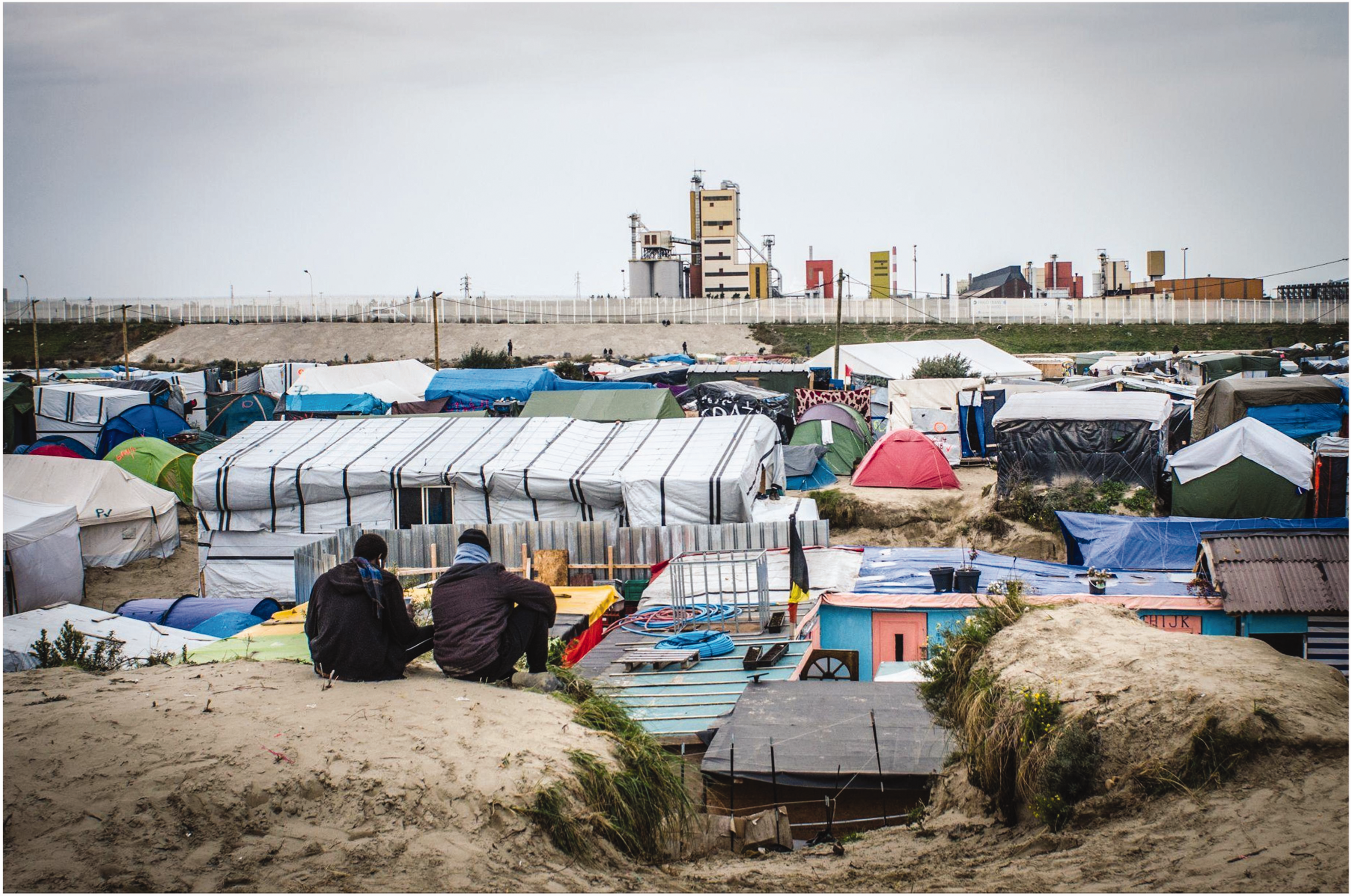
Reservation: the Calais “jungle” a week before its demolition (Photo: Thom Davies, 2016).
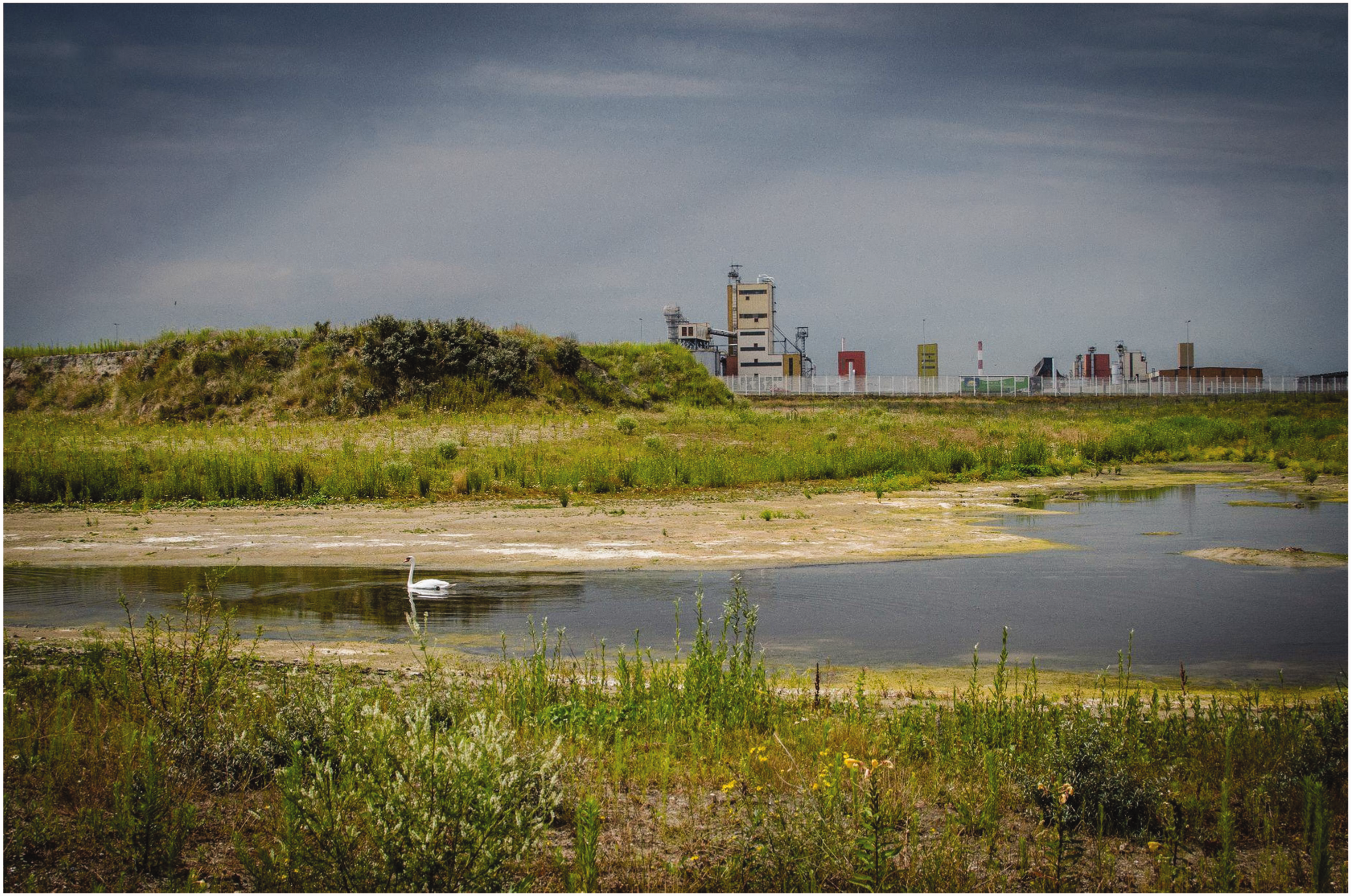
Conservation: “Fort Vert” two years after redesignation as a nature reserve (Photo: Thom Davies, 2019).
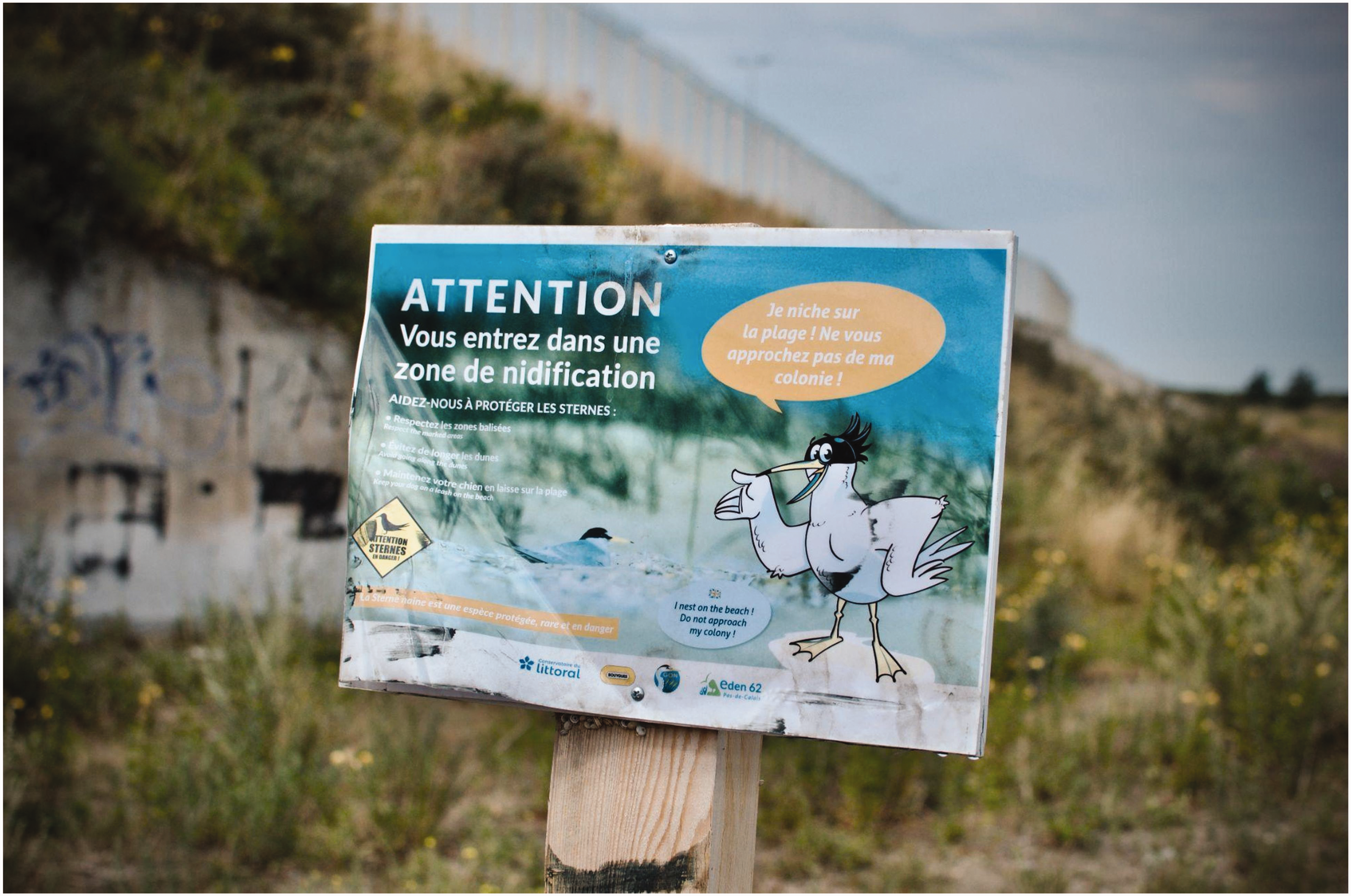
“Attention: you are entering a nesting area”—a sign at the entrance to the former camp: “Do not approach my colony” (Photo: Thom Davies, 2019).
With the Minister of Interior’s promise to ‘return this territory back to nature’, and the UK’s commitment to ‘restore the site to its natural state’ (House of Commons, 2017), a geographical metamorphosis was taking place, transforming the “jungle” from reservation to conservation. Yet the racism and eco-coloniality remained consistent. At the edge of the newly-designated nature park, one information board further highlighted the site’s coloniality, describing Fort Vert as ‘landscape reconquest’ (Van Isacker, 2020: 168). For all the orchids and the thorn bushes, and for all the swans and migratory birds, this was a highly curated landscape; a place where the politics of environmental protection had conspired to ‘reanimat[e] colonial imaginaries in which the “savages” must be conquered and expelled to protect a pristine landscape’ (Van Isacker, 2020: 168). In this way, the nature reserve became choreographed to instrumentally forget and strategically disguise: a crude reminder that ‘the construction of the environment is itself an exercise in cultural power’ (Mazel, 1996: 41).
At the UK–France border, we can witness a form of ‘ecobordering’ (Turner and Bailey, 2022), where immigration control comes thinly disguised as environmental protection. We join others in seeing ‘Calais as an unfinished (post)colonial landscape’ (Hicks and Mallet, 2019: 20) and as such, its border securitisation should be viewed within a wider context of the region’s future environmental ambitions. In 2023, for example, plans were announced for the Calais–Dover crossing to become the first ‘green shipping corridor’ that would provide ‘sustainable ferry routes’ as part of the Port of Dover’s ‘Clean maritime plan’ (Moore, 2023). Much like Fort Vert itself, this entirely laudable environmental aspiration ‘to facilitate the zero-emissions movement of goods and people between the ports’ (Moore, 2023), may also provide new eco-fascist opportunities to portray migrants and refugees as ‘environmental vandals’ (Turner and Bailey, 2022: 120) or ecological threats at the gates of the UK’s “green” border (Hultgren, 2015). To put this differently—as borders become greener they may also become more violent and inhumane.
It is also vital to situate Fort Vert and the eco-coloniality of the border within a wider politics of eco-fascism in France. Ahead of the 2019 EU elections, for example, the far right leader of the political party National Rally, Marine Le Pen, argued that: Environmentalism [is] the natural child of patriotism, because it’s the natural child of rootedness … if you’re a nomad, you’re not an environmentalist … Those who are nomadic … do not care about the environment; they have no homeland. (cited in Turner and Bailey, 2022)
Today, in part due to the success of Fort Vert’s environmental cosplay, Calais has been designated a ‘Villes et Villages Fleuris’ (a “Town in Bloom”), that ‘rewards the commitment of communities to improving the living environment …’, as well as ‘… the promotion of French botanical heritage’ (Town in Bloom, 2023). Calais received the highest award possible of “Four Flowers”, which it proudly displays on street signs marking the city’s outer limits. The Town in Bloom website describes Fort Vert as offering ‘immense foreshore, salt meadows, dunes, brackish slacks, marshes and polders. A belvedere, two observatories, and various hiking trails built in 2018 offering an attractive stroll within a site hosting 250 species of birds’ (Town in Bloom, 2023). Nowhere, of course, are the strange border ecologies mentioned, or the site’s recent history: the outcrops of crushed tent poles; the entanglements of ripped canvas; or the thousands of other forgotten objects that are scattered across this post-colonial reservation. Unmentioned, too, are the acts of solidarity, the kindness, the prayers, the kinship, and the hope that flourished here, despite the ongoing nature of border violence. Instead, Fort Vert offers an environmental lesson in erasure (Figure 10.).
On the other side of Calais, near the entrance to the Channel Tunnel, a prefabricated blue and yellow ‘Pet Reception’ building glints in the sunlight. Emblazoned on the side above a picture of a puppy, it boasts: ‘Over 1 million happy pets have travelled with us.’ Opened in 2022, this facility provides dogs and cats with a ‘pet exercise area’, a ‘drive through pet check-in’, and ‘an air conditioned reception’ (LeShuttle, 2022). A few hundred metres from here, on the other side of the tall white fences that criss-cross Calais, people have died trying to catch the same pet-filled trains. Between 1999 and 2024, almost 400 people died at this border, an average of one death per month (Pawson and Thibos, 2024). ‘We love pets here at Eurotunnel Le Shuttle’, their website states, reminding us of the more-than-human ecologies produced by borders, and the struggle to demarcate which forms of life have a right to inhabit and move across them.
Conclusion
This article has introduced the concept of eco-coloniality to theorise how environmental ideas and practices developed during colonialism continue to affect the contemporary world. Drawing on long-term research in Calais, we have shown how the environment is used in projects of racialised border control. We have contributed to political ecology and border studies literatures by using a postcolonial lens to analyse how the environment is made to do political work. The violent environmentalism witnessed in Calais—whether exposing refugees to environmental hazards in “the jungle” or dispossessing migrants under the guise of ‘conservation’—are indicative of a longstanding tradition of eco-colonial practices inherited from the racial projects of European imperialism. In this way, we emphasise the importance of researching the connections between environments, race, and borders, and recognizing the persistent legacies of colonialism today.
If the environmentalism of the 19th century was the handmaid of settler colonial violence, then today’s border environmentalism—as witnessed in Calais—is the servant of ‘liberal violence’ (Isakjee et al., 2020): a brutality that hides both its violent nature and its racial foundations. The liberal motto of France—“Liberté, Égalité, Fraternité” (Liberty, Equality, Fraternity), which was institutionalised in the Third Republic and the France of Jules Ferry, has been replaced in Fort Vert today by an alternative environmental tripartite of “Exclure, Nuire, Effacer” (Exclude, Harm, Erase). At the UK–France border, the environment is being used to restrict the very principles once shouted from the barricades of the Paris commune. Then, as now, those principles never fully extended to the racialised subjects that imperialists like Jules Ferry once deemed ‘inferior’ (Ferry, 1868); and so too today can we witness a colonial continuation—or eco-coloniality—where the environment is being choreographed to reproduce racial othering and maintain white supremacy: an environmentally mediated racism that specifically targets people who come from European post-colonies.
In Calais, these eco-colonialities play out in subtle ways: a nature reserve; a pet reception centre; a flooded field. They may have the look and feel of ecological mundanity, yet they disguise and outsource a complex interplay of racism and environmental care. Eco-coloniality then is an approach through which to understand contemporary geographies in which race, place, and the environment continue to be shaped by latent colonial environmentalism. Today, through eco-coloniality, we can see how environmental ideas that were cultivated under imperialism both mutate and can be instrumentalised within contemporary political contexts. As race and the environment intersect, they only do so amidst the material and symbolic legacies of colonial extraction. With the polycrisis of displacement and global environmental disruption becoming increasingly interlinked, reckoning with eco-fascism and the rise of far-right politics becomes an urgent collective task. It requires that we equip ourselves with a new set of conceptual, environmental, and political tools. It is here that eco-coloniality might make its contribution. By uncovering the colonial logics hidden under the guise of environmental protection, we can resist misanthropic attempts to blame racialised groups for environmental damage, and further recognise this as a racist ecological trick as old—and as wrong—as empire. In this way, any effort to ‘decolonise’ must also attend to the environment.
At this time of heightened environmental disturbance, when climate change is producing the very migrants that eco-fascists might wish to blame, it is more important than ever to understand the complex entanglements between environmental politics, borders, and coloniality. Throughout this article, we have attempted to sketch the connections between the histories of colonial environmentalism and the ways that the environment is being co-opted to enforce violent border regimes. By revealing how the environment is used as a mechanism to exclude, harm, and erase racialised groups from the ‘green borders’ of northern France, we emphasise the importance of unearthing the roots and rhizomes that connect contemporary politics with the perennial legacies of colonialism.
Footnotes
Acknowledgements
This paper is especially indebted to people on the move who shared their experiences with us over the years. We are grateful to the peer review team and journal editors for helping to strengthen the article, and to Dr Surindar Dhesi who played a vital role in conducting the environmental health research in Calais in 2015. The article has benefited from critical feedback at the ZiF Border Talk Series, Universität Bielefeld, Germany. The work was supported by the Economic and Social Research Council (ES/W006170/1) and is dedicated to all those trapped at the border in Calais.
Declaration of conflicting interests
The author(s) declared no potential conflicts of interest with respect to the research, authorship, and/or publication of this article.
Funding
The author(s) disclosed receipt of the following financial support for the research, authorship, and/or publication of this article: This work was supported by the ESRC (Grant number: ES/W006170/1).

Notes
Together they work on the ESRC-funded Channel Crossings project.