




Abstract
The article examines the Muslim community’s struggle to maintain their cemeteries in Tel Aviv-Jaffa, and highlights a broader geo-temporal interpretation of the indigenous right-to-the-city. We analyse a succession of mobilizations against sales and demolitions of Muslim cemeteries across the city since the 1950s and investigate how activists recently gained tangible achievements by framing their protest as an urban citizenship mobilization. We show that by utilizing creative spatial performances, applying to municipal governance and stressing their right to use and produce urban space, to participate, and to have their local heritage acknowledged and commemorated, they invoked and reinterpreted right-to-the-city ideas. Their struggle also expanded this agenda, as they did not focus on their living area, but rather advanced claims related to the full city space and its history, and to the customary view of their spaces as 'terra nullius'. In analysing their struggle, we thus contribute to the right-to-the-city literature and agenda, highlight the right for commemoration as part of right to live in the city as equal citizens, and address the promise this case presents for minority ethnic politics.
Introduction
In summer 2020, activists from the communally elected Muslim Council of Jaffa came together at the site of the ancient Al-Isaaf Muslim cemetery, located in north Jaffa, to protest the Tel Aviv-Jaffa Municipality’s decision to build on the site. These events continued a line of repeated demolitions and sales of Muslim cemeteries across Tel Aviv-Jaffa, and of the community’s struggles against them since the 1950s. While the previous events met a customary minor public attention in Israel (Bar, 2020), in the recent case the activists managed to attract positive media representation, and to influence the construction on the site as well as policy making concerning other cemeteries. Our objective is to analyze this struggle in the historical, political and spatial context, and show how the activists invoked and reinterpreted right-to-the-city ideas and spatial practices (Lefebvre, 1968). We argue that their interpretation highlights the values of the urban framing for current and future ethnic and indignados mobilization.
Henri Lefebvre challenged national citizenship as the sole basis for rights (Pierce et al., 2016). The Urban Citizenship literature thus demanded an equal “right-to-the-city” for all – to produce, to access, and to use urban space (Jabareen, 2014b; Lefebvre, 1968, 1996, 2003; Purcell, 2003, 2014). We contribute to this literature by addressing the right-for-commemoration as part of urban indigenous struggles for recognition and against settler-colonial erasures, and by discussing how this right, and the struggle for it in Jaffa, expands the idea of urban citizenship. Like other studies addressing indigenous citizenship struggles, and particularly Palestinian struggles in Israel (Avni et al., 2022; Hackl, 2020; Jabareen, 2014a; Nejad et al., 2019; Sabbagh-Khoury, 2022), we address the national-political contexts. Yet, we further highlight the role of urban politics and space for the mediations of remembering, and mourning the dead (Stevenson et al., 2016).
We consider cemeteries as ‘living’ places that determine and are shaped by past and present socio-political dynamics (Miller and Rivera, 2006). Cemeteries are historically located on the margins of settlements (Rugg, 2000), and demonstrate a conflicting human desire to separate the dead from the living and to give proximity and presence to absence (Romanillos, 2015). With cities' expansion, cemeteries, and particularly the ones used by indigenous communities, also serve as spatial markers’ for the changing histories of places. The spatial arrangement and the design of gravestones enable the living to construct a meaning behind death and reflect cultural and spiritual norms (Miller and Rivera, 2006), with performative gestures of love, loss, and memory (Fyfe and Sternberg, 2019; Wylie, 2005). Yet, in various countries, indigenous cemeteries have been dispossessed (Fabian, 2020; Rubertone, 2001; Simpson, 2020), and they remain targets for colonial demolitions (Gallois, 2013; Sanbar, 2001), entangled with neo-liberal land acquisitions and redevelopment (Riley, 2002).
Simultaneously, indigenous cemeteries often host cross-generational resistance and festivals of belonging (Geschiere, 2009). Noam Leshem (2015: 36) stresses “the site specificity, cultural nuances and political contingency of resistance” that these cemeteries facilitate. In South Africa, indigenous communities highlight cemeteries as evidence of their land ownership (James, 2009), and as memorials of Apartheid and colonialism (Shepherd and Ernsten, 2007). In the USA, the Mohegan tribe conducts guided tours around their Royal Burial Ground as place-making that reinstates their connection with the land (DeLucia, 2019). Hausa Muslims’ continuous struggle for burial space in Ibadan, Nigeria, resists colonial and post-colonial modes of discrimination, and articulates their urban identity and belonging (Onwuzuruigbo, 2014). These struggles thus encapsulate a demand for space, identity, and memory. We argue that in urban contexts they can demonstrate and expand the right-to-the-city and to produce urban space.
In Israel, Muslim Palestinian citizens consider their cemeteries material evidence of their pre-1948 presence (Hijazi, 2016), and the cemeteries’ demolition a crucial component of the settler-colonial discrimination against them (Hawari, 2018; Sanbar, 2001). Their cemeteries have long been targeted for erasure (Hanafi, 2006; Rashed et al., 2014), while Jewish and Christian cemeteries are preserved (Bar, 2020). The plan to construct a “Museum of Tolerance” on the site of Mamilla cemetery in Jerusalem is the most studied case (Leshem, 2015), analyzed as an act of “memoricide” – the erasure of a group’s history (Hijazi, 2016). Moreover, struggles over cemeteries are part of a broader struggle by the Israeli Palestinian citizens to commemorate legacies of eviction and dispossession and to claim a Palestinian autochthonal geography of belonging (Boqa’I in Masalha, 2013). Their practices of space production include conducting awda (return) trips (Sa’di, 2002), commemoration marches (Hawari, 2018), political guided tours (Huss, 2023), family picnics, summer camps, and public prayers in destroyed settlements (Masalha, 2008), and using pre-colonial street names (Leshem, 2015).
In Tel Aviv Jaffa, the Palestinian activists Sami Abu Shehadeh and Paddy Shivita (2010: 145) write that their fight is driven by their need to be recognized “as a group with a historic right to the land of the city and its assets”. In this central and expensive city, the symbiosis between settler-colonial logic, gentrification, and spatial privatization (Yacobi and Tzfadia, 2019) continuously links urban development to perceptions of pre-state Palestinian sites (Margalit, 2014), including burial sites, as 'terra nullius'. Thus, unlike in examples of “spatio-cide” or “urbicide” that involve extensive spatial destruction (Coward, 2008; Hanafi, 2006), Shehadeh and Shivita (2010) relate to an incremental but painful elimination of memories, tenures and landscapes.
Notably, the city is also the place where Palestinians imbue citizenship with a progressive meaning (Jabareen, 2014b). In fact, the mobilizers in Jaffa followed contemporary urban citizenship mobilizations in Tel Aviv-Jaffa and elsewhere (Blokland et al., 2015). We show that they also expanded this agenda and demanded a deep, geo-temporal right-to-the-city that encompasses the entire urban area and its history and a religious right to commemorate the dead. They thus connected the right to live in the city as free and equal citizens, (Lefebvre, 1968, 1996, 2003; Purcell, 2003), with the right to receive acknowledgement of their past and their ancestors, and their difference.
In the next sections, we present our theoretical contribution to the right-to-the-city literature. We then explain the geographic, legal, and political context and discuss early erasures and struggles, based on interviews with community leaders, activists and journalists and on archival tracing and analyses of court rulings, spatial plans, maps, meetings' minutes and newspapers coverage. Next, we analyze the recent struggle, its representation in Israeli media, and its consequences.
Expanding the right-to-the-city
Compared to national citizenship, urban citizenship is a more contextual, communal, and bottom-up framework, which is better-suited to the expression and production of difference (Blokland et al., 2015). Lefebvre (1996) declared the “right-to-the-city” an inclusive right for the co-habitation and co-creation of urban space (Pierce et al., 2016), and demanded equal rights for all urban inhabitants and users (Brenner and Schmid, 2015). These rights include not only the right to access, inhabit, and use urban space (Lefebvre, 1968, 1996, 2003; Purcell, 2003), but also to produce urban spaces (Jabareen, 2014b; Purcell, 2003) and participate in urban decision making (Mitchell, 2003; Purcell, 2003).
The urban scale is also crucial for providing the actual spaces where such expressions take place. The right to appropriate urban spaces or intervene in them thus entails possibilities for communicative, artistic, and interactive representation and protest, for performances such as walking, blocking roads, and marching (Butler, 2012; Lefebvre, 1992; Mitchell, 2012). Urban mobilizations have intensified since the Occupy 15-M movements, and in Israel and Tel Aviv-Jaffa since the major housing protest of 2011 (Kemp and Margalit, 2017). Moreover, activists now increasingly connect urban spaces and media spaces, using mass media to reach large audiences (Rogers, 2016; Schatz and Rogers, 2016; Schweitzer and Stephenson, 2016). They tailor their visual language for digital screens (Abaza, 2014), and compel online users to feel their message (Papacharissi, 2015).
Lefebvre’s insistence on including the right-to-difference within the right-to-the-city, correlates with the right to differ (Dikeç, 2001) and be recognized in urban policy discourses and decisions (Grigolo, 2019). It is a right to participate and to be included regardless of any personal or group ethnic, gender, religious, or socio-economic difference (Jabareen, 2014b; Lefebvre, 1996; Purcell, 2003: 103), viewpoint or preference (Dikeç, 2001). Individuals and groups also have a right to change their selves “by changing the city” (Harvey, 2008: 23), and having “their difference(s) acknowledged” in policy making (Grigolo, 2019: 25).
Scholars noted that Lefebvre did not consider particular identity groups or power structures (Dikeç, 2001; Pierce et al., 2016). Against this, Purcell (2014) suggests that the right-to-the-city should be understood not as a natural or normative fact of urban life but a goal to be struggled for. This view opens possibilities for expanding the agenda vis-à-vis ethnicity and recognition of the rights of indigenous people, and to view the right to difference as particularly relevant for minority people.
This possibility, though, was mainly used in studies of settler-colonial societies that issued the urban space as the site used to protest the national state and its policies, symbols, and definitions (Jabareen, 2015; Nicholls and Vermeulen, 2012). We argue that this approach concentered “a right through the city”. Here urban refers not “to a geographical place or administrative entity, but to a specific sociopolitical and institutional setting, in which various scales – from the local to the transnational – are layered, condensed and materialized” (Blokland et al., 2015: 657). We also consider indigenous right to the (specific) city, we address both the violation of rights and the struggles against it as inner urban matters. This perspective is crucial, we argue, because unequal or discriminatory planning laws often deny the indigenous their right to access, inhabit, produce and use actual urban spaces (Njoh, 2017; Quicke and Green, 2017). Similarly, national governments' failures to articulate indigenous needs and aspirations (Nejad et al., 2019) often deny their right to have “their difference(s) acknowledged” by municipal policymakers (Grigolo, 2019: 25).
In Israel, the attributions of “a right through the city” are especially common, because urban planning and real estate development overlap with national, ethnocratic growth projects, and the national legislation, agencies and budgets are aided by centralized management of most (93%) land (Yiftachel, 2006). Palestinians’ citizens therefore use the urban sphere to protest unfair policy-making on the national level (Ghanem and Mustafa, 2018; Jabareen, 2014a, 2015; Sabbagh-Khoury, 2022; Sorek, 2015). Simultaneously, cities are where actual ethno-spatial segregation and land confiscation (Jabareen, 2014a, 2015; Sabbagh-Khoury, 2022; Yacobi, 2009), and centralized placing of some sites outside of regular planning laws (Alkhalili et al., 2014), hurt Palestinian dwellers the most.
The recent struggle in Jaffa exposed how national policies are followed and/or pursued by urban governments, and result in actual discrimination of their urban rights. Against this, and in correlation with a broader “return of history” notion in current Palestinian citiezens' mobilizations across Israel (Rouhana and Sabbagh-Khoury, 2015), the activists assumed a cyclical temporality that hosts a future of liberation in the present through activating the past (Abu Hatoum, 2021). Their struggle also exemplified the habitus of sumud (steadfastness), and how Palestinians' capacity to resist discrimination (Griffiths and Repo, 2021; Hammami, 2019; Joronen et al., 2021; Tawil-Souri, 2011) complicates the elimination of their spaces and identity (Sabbagh-Khoury, 2022).
Simultaneously, we argue, they expose how the joint urban planning of Tel Aviv and Jaffa led to the elimination of their history. In their view, the burial sites are targeted for destruction because they interrupt the settler-colonial construction of a “neutral” urban landscape (Blomley, 2013), and specifically facilitate entanglement between land and identity that disrupts Zionist claims over the land (Wahbe, 2020). In contesting this, they thus provoked the continual treating of their spaces as empty “terra nullius” (Hawari, 2018; Wahbe, 2020), and against the expansion of “necropolitics” (Mbembé and Meintjes, 2003) towards the management of death bureaucracy and spaces (Shalhoub-Kevorkian, 2020; Wahbe, 2020).
The latest struggle underscores the potential of urban citizenship activism to undermine both national and urban conceptions through demands to acknowledge difference and “to physically access, occupy and use urban space” (Purcell, 2003). The potential, we argue, lies not only in this adaptation of right-to-the-city agenda and practices, but in the way these activists expanded the agenda. In stressing their right to have their local heritage recognized, acknowledged, and commemorated, like other urban mobilizations, they used spatial performances (Mitchell, 2012), demanded to participate in urban decision making (Jabareen, 2014a; Purcell, 2003), and to have their difference recognized in policy discourse (Grigolo, 2019; Mitchell, 2003). They produced new meanings through urban space (Butler, 2012), and tailored their message to attract media coverage (Schatz and Rogers, 2016; Schweitzer and Stephenson, 2016). They also highlighted their ethnically-based “difference”. While urban protests usually focus on current condition in the living area, they illuminated erased Palestinian localities and past events and protested in their living area in Jaffa- and across Tel Aviv.
In this manner, they demanded specific remedies, and also provoked the ongoing use of settler-colonial practice in the local urban planning. Their interpretation and their struggle over burial sites referred to the historic right and the contemporary right to commemorate it (Huss, 2023), as part of their right to live in the city as equal citizens. They therefore aimed to change their selves “by changing the city” (Harvey, 2008: 23). In the next section, we explain the socio-historic and legal context for their wide-reaching interpretation.
Historic and legal context
Abed Abu-Shehadeh, chairperson of the local party Yaffa (“Jaffa” in Arabic) and a leading activist, explained the wide scope of the struggles to us. He noted that the local history of cemetery destruction “requires us to forget the city’s borders as we know them.” Because “cemeteries delineate the city’s limits,” they are markers of the erased borders of Jaffa since the war in 1948 and unification with Tel Aviv in 1950. Moreover, Jaffa prior to 1948 was surrounded by suburbs and villages, “each having its own cemetery,” and they were spread over “almost all of Tel Aviv” (Figure 1). He pointed to a double erasure: the initial dispossession of Palestinian spaces (in his words, “al-Nakba – the disaster”), and a secondary erasure of the cemeteries, which are the last demarcations of these spaces. The community, he said, feels a “constant threat hovering over the Muslim cemeteries,” and thus in a way, “you cannot really live here, and the persecution against you prevails after death.”
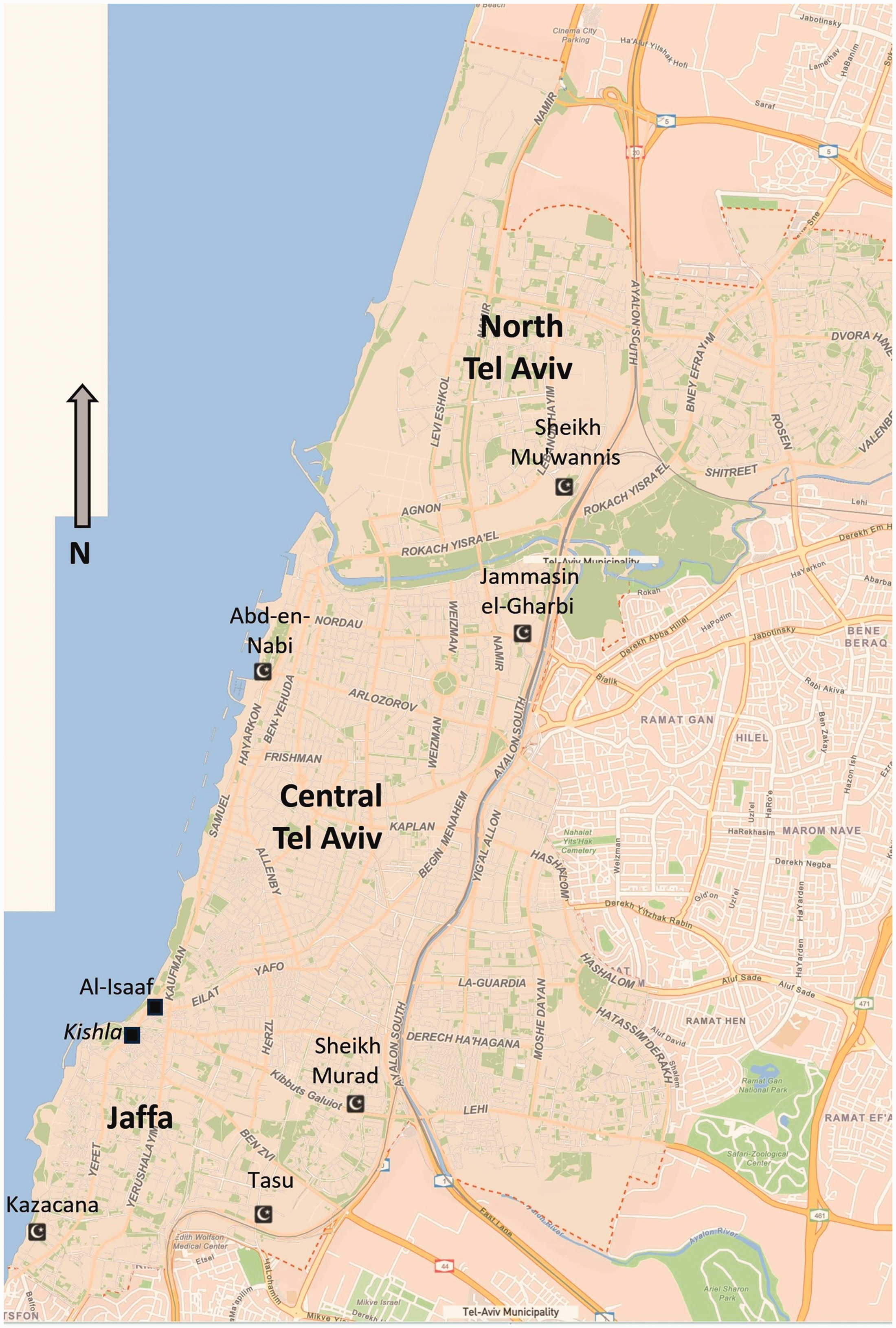
Map of Tel Aviv-Jaffa with the locations of the Muslim cemeteries.
The erasure of the Muslim cemeteries is part of the wider, on-going deletion of the Palestinian assets and past throughout the municipal area (Margalit, 2014). This is not unique to Tel Aviv-Jaffa (Hackl, 2020; Hammami, 2020; Sabbagh-Khoury, 2023). Soon after the 1948 war, the new Israeli government legislated the Absentee Property Law that designated Palestinian refugees “absentees,” and their lands and property an “absentee-properties,” and nominated a custodian to manage these properties (Forman and Kedar, 2004). Subsequently, most of the lands were transferred to the Jewish National Fund (JNF) and a new 'Development Authority'. In 1960, the Israel Land Administration (ILA) was founded and took over the management of these lands, as well as of government lands and the lands previously purchased by JNF (Kedar and Yiftachel, 2006).
These events and institutions significantly impacted the development of Tel Aviv and Jaffa. During the war, 95% of the city’s Palestinian residents escaped or were forced to leave Jaffa and the surrounding villages and suburbs; their assets were allocated to the Custodian and ILA (LeVine, 2005; Monterescu, 2015). In 1950, the government merged Jaffa and Tel Aviv; the master plan defined the vacant, absentee lands around the built city as sites for new development, while most of the built areas in Jaffa and the surrounding villages where designated “slums and reconstruction areas” (Tel Aviv Municipality, 1954). Tel Aviv prospered, but Jaffa, once a central Palestinian city, became a disadvantaged quarter (LeVine, 2005; Monterescu, 2015). Since the 1980s, ILA and the municipality have promoted gentrification and tourism, but the disparities between Jaffa and Tel Aviv maintained (Margalit and Vertes, 2015).
In this context, the Muslim residents of Jaffa consider keeping their sacred sites, in both Jaffa and Tel Aviv, especially important. However, in early-state-years, Israeli authorities took over the management of these sites. They deemed cemeteries and all Waqf properties (namely, community assets supervised by religious institutions) “absentee properties” and placed them under the Custodian’s management (Suleiman and Home, 2009). In 1965, the Parliament passed an Amendment to the Absentee Property Law, 1 establishing state-appointed-and-supervised Committees of Trustees in mixed Arab-Jewish cities (like Jaffa). Remaining Waqf properties were released to these committees. Yet, erasures and sales of cemeteries continued in Jaffa and elsewhere.
Legally, these actions were approved by fatwas (“religious endorsements”) issued by Shari’a Muslim courts, setting a precedent that “the test for arame (obliteration or disintegration) after 36 years,” and if “the cemetery is neglected, and it is difficult to maintain its sanctity” (Natour, 2013: 177, 186). Natour (2013) questions the validity of these fatwas, since 36 years had not passed between when use of these cemeteries ceased and their issuance. He points to the problematic subordination the Shari’a courts to the Israeli state, and argues, “senior government officials evidently expected (and possibly encouraged) members of the Committees of Trustees to sell Waqf properties in their charge to Jewish hands.” Moreover, Natour observes that instead of fixing the neglect of cemeteries, the committees used that neglect to justify sales or promised that the profits would be used to repair other Waqf assets.
This conduct should be understood in the context of the state of the Palestinian community, which now constitutes 20% of citizens of Israel, most of them Muslims. Between 1948 and 1966, those who remained within the newly-established state , either in their own villages and cities or as internally-displaced persons elsewhere, were placed under military rule and their movement was restricted (Darweish and Sellick, 2017). Later they received regular citizenship rights, but simultaneously their history and national symbols were erased (Rouhanaa and Sabbagh-Khouryb, 2015), and state budgets, policies and plans limited their well-being, civic engagement, and development (Yiftachel, 2006). In 2018, the controversial Nation State Law was constitutionalized. It allowed only Jews to immigrate to Israel, highlighted Jewish heritage, prioritized Jewish settlements, and declared Hebrew as the only official language.
In the early years, Palestinians in Israel lacked a stable political, social, and religious organization to protect the cemeteries that were neglected and sold (Bar, 2020; Reiter, 2009). Under military rule, their resistance to discrimination and dispossession was relatively quiet and hidden (Sa’di, 2016). Reclamation of place and identity occurred through symbolic acts such as temporary returns to depopulated villages and cities, or singing of national songs during religious celebrations (Darweish and Sellick, 2017). Still, some localized political protests did occur, as in Nazareth on 1 May 1958, initiating a shift towards more public and organized acts of resistance and demands for equal citizenship rights (Darweish and Rigby, 2015).
In Tel Aviv-Jaffa, Abu-Shehadeh explained, “the Arab community after 1948 was a broken community numbering only a few thousand [people].” The first struggle to protect a Muslim cemetery occurred in 1957. As we show, this struggle and others that followed when the Muslim community grew and gained more power did not stop the erasure and sale of cemeteries. In fact, the authorities considered each erasure a precedent that justified the next one, deepening the frustration in Jaffa and leading to successively stronger protests.
Early cemetery demolitions and struggles
The first struggle, in 1957, was mounted against the Custodian’s neglect and mismanagement of the Tasu Muslim cemetery, adjacent to Jaffa to the east. This cemetery was new (built in 1943), and the only one that still served for burial, and its gravestones were vandalized when the Jewish Agency built barracks and a barn to house Jewish migrants on site (Kotler, 1957). In response, the Muslim community stopped burying their dead there. The struggle was successful, and the state removed the new structures. The community’s demand to regain control of the cemetery was also met, and Sa‘id Habbab was appointed as the head of the local Committee and a aramehi (trustee) for the cemetery.
However, Habbab, who was close to the Israeli authorities, was involved in the selling of another cemetery, Abd-en-Nabi (Natour, 2013). This sale provoked a second, longer struggle. Before 1948, Abd-en-Nabi served the village Summail, then located near north Tel Aviv. The location, on a beautiful cliff above the beach, attracted plans for erasure and sale of the cemetery. First, the municipality developed a wide, new park nearby, and negotiated with state authorities to expand it towards the cemetery area (Tel Aviv-Jaffa Municipality, 1954). Then, the Israeli government invited a representative of Hilton Company to choose a location for first Hotel in Israel, and he chose that site.
The Israeli authorities justified the purchase with the hope of developing tourism (Margalit, 2003). They sought the cooperation of the Shari’a Muslim court, and in 1963 the court indeed issued a fatwa to permit the sale to the municipality, based on unnamed testimonies stating that the cemetery had not been used for over forty years (Natour, 2013). Meron Benvenisti, who then served as a junior clerk in the governmental Tourism Development Company (TDC), later wrote that he bribed leaders of the Muslim community to obtain this fatwa (Benvenisti, 2012: 188). A letter from the Ministry of Finance to the Deputy Mayor detailed their agreement: TDC would finance the purchase and removal of gravestones. The municipality would allocate part of the public park to build the hotel. In return, it would receive ownership of the remaining cemetery land and use it to expand the park. 2
Israeli Hebrew newspapers reported, “the Muslims in Jaffa are raging” (Levi, 1961: 2) and had initiated a legal battle, including a petition to the Israeli Supreme Court asking that the site be left in its present condition (Ayalon, 1962). The municipality and “representatives from the dignitaries and elders of Jaffa” then reached a compromise stipulating that the land would be reassigned to the ownership of the Muslim administration and leased to the municipality for a period of 99 years for “usage as a public park only.” 3 This agreement did not cancel the erasure, but assured the collection of the bones from damaged tombs in accordance with Muslim law, and their concentration within a smaller, fenced area within the park. It also promised that the municipality would build a Muslim home for the elderly, a school, and a community center in Jaffa. In 1965, the Hilton hotel opened. Muhammad Adrei, the current (since 2020) Chairman of the Committee of Trustees of Waqf property in Jaffa told us that the agreement was signed “with elders, some of whom were illiterate,” and the municipality did not respect it: the collection of bones did not comply with Muslim law, tombs were used to build the fence, and the promised public buildings were not built.
At the same time, the agreement became a precedent for more cemetery deals. In 1969, the Committee of Trustees sold two Muslim cemeteries to ILA: one that served the village Sheikh Mu’wannis (now in north Tel Aviv) until 1948, and Sheikh Murad cemetery that served Abu Kabir, a former suburb east of Jaffa. In 1973, the Committee also sold half of the Tasu cemetery, which was designated for future expansion, to a Jewish development company. As in Abd-en-Nabi, these sales were facilitated by the issuing of fatwas that relied on testimonies about the period in which the usage of the cemeteries was halted and declared the cemeteries as ill-fit for use due to negligence (Natour, 2013). In these cases, opposition only came a decade later when the deals were revealed to the public. 4
During that period, Palestinian political mobilization in Israel shifted towards more vocal, organized, civil resistance, such as the Land Day on 30 March 1976 (Ghanem and Mustafa, 2018; Sorek, 2015) initiated by National Committee for the Defence of Arab Lands, one of the more than a thousand organizations that emerged since the 1970s to represent Palestinians in Israel (Ghanem and Mustafa, 2018). Utilizing their “fragile” and “hollow” citizenship (Jabareen 2014; Zureik, 2003; Rouhana and Sabbagh-Khoury, 2015), these organizations mobilized within the parliament, municipal institutions, and on the streets. They called for a comprehensive transformation in the structure and policies (Jamal, 2007; Sabbagh-Khoury, 2022). The struggle over Muslim cemeteries in Tel Aviv-Jaffa shifted accordingly, as shown below.
Cemetery deals and struggles since the 1980s
In Jaffa, local Palestinian organizations worked to foster infrastructure restoration, fight eviction and Jewish gentrification, and ensure proper education (Plonski, 2017). 5 Increasing their commitment to the issue of Muslim cemeteries, the Muslim community set up a democratically-elected council in 1980, for the purpose of opposing the state-appointed Committee of Trustees of Waqf property. The Muslim Council became a focal point for organizing public acts of dissent, and Adrei described it as a “communal protest body,” formed to protest the sale of cemeteries and the ill management of Waqf properties. The Shari’a court also changed its attitude by reinstating the holiness of all Muslim cemeteries and calling to fire Qadis (Shari’a court judges) who had permitted sales (Natour, 2013). Still, the sales continued, and the struggles escalated. In 1986, the Committee of Trustees sold sections of the cemetery that served the village Jammasin el-Gharbi (now in north Tel Aviv) before 1948. Violence erupted in Jaffa; the house of one committee member was burned and another member was murdered (Handverker, 1989; Yarkoni, 1987).
Nonetheless, the deal was implemented. Another struggle arose against new attempts to narrow the burial area in Tasu cemetery. In 1990, after the first Palestinian Intifada, 300 Muslim residents of Jaffa submitted objections to a plan to confiscate a central section of this cemetery for road development (Trelbasi, 1990). They convinced the Municipal Planning Committee to alter the plan, but in 1991, a court approved the earlier (1973) sale of half of the cemetery’s land. For the first time, the community enacted performative measures, including a protest rally, cleaning operations within the cemetery, and attempts to hold burial ceremonies in the disputed section (Trelbasi, 1990). In 1994, the community used similar means, including a series of communal cleaning actions, weeding, and marking paths in the cemetery (Algazi, 1994). In 1996, hundreds marched from the large Mosque of Jaffa along the main street (Algazi, 1996). These actions of site-specific resistance used creative place-making to reinstate the holiness of the cemetery and the rootedness of the Palestinian community.
In 1999, the chronicle of erasure expanded with a plan to build a neighborhood on the grounds of Sheikh Murad Cemetery, east of Jaffa (Greenbabel, 1992). This time the community protested and submitted two lawsuits to halt construction. The Knesset addressed the erasure (Natour, 2013), but the court yet again rejected the lawsuit based on earlier precedents (Barak, 1993). Activists also increased the magnitude of the protests, their political stance, and visibility. This was evident when the struggle over Jammasin cemetery re-emerged in 2005, in response to the municipality’s decision to install a sewer line that imperiled graves. A group of young activists from Al-Assassin Al-Aqsa, an organization seeking to protect Muslim endowments, stood in front of the tractors, declaring their willingness to die if the desecration of graves were to continue (Nachmias, 2005). Simultaneously, the council filed a lawsuit against the municipality. 6 The court acknowledged the designation of the site as a cemetery in statutory plans and ordered the municipality to dig the sewer elsewhere. Three years later, the court also dismissed the validity of a 1986 sale of a section of this cemetery (Levy, 2008).
In 2008, the legal struggle over Tasu failed when the Supreme Court approved the former decisions on the sale. The community increased their performative protests. An estimate one thousand people marched the streets of Jaffa (Chai and Khoury, 2008), and activists displayed signs citing the words of Prophet Elijah in 1 Kings 21:19, “Thou Murdered and Also Taken Possession?” (Shalev, 2008). These actions had impact, and no construction was carried out until 2017. At that point, the investment company that purchased part of Tasu sued the board for compensation and demanded immediate evictions of new graves. In response, the council organized four buses that drove hundreds of protesters from Jaffa to the court hearing.
Further erasure and resistance came in 2009. This time a plan for a luxury hotel in the historic Kishla prison, located in the main Jaffa square provoked a protest nearby. The protestors warned the municipality that the work would endanger the remains of an historic Muslim cemetery located in the foundations (Kushark, 2009). During construction, some graves were indeed exposed and damaged, and local organizations submitted a petition to the district court. 7 They presented a new argument, that the Israeli Law of Human Dignity and Liberty extends to dignity in death. The court dismissed this for technical reasons, and by again using the precedents to allow the erasure of unused Muslim cemeteries. Similar dismissal came in 2012, when Arab student-activists and representatives of Palestinian organizations opposed a plan to build dormitories over Shiekh Mu’wannis cemetery in north Tel Aviv. 8 They broke into the site to document the violation of graves and organized a guided tour in the area (Matar, 2012). They also appealed to the Supreme Court, which rejected the suit on technical and property rights grounds. 9 The repeated demolitions and legal denials, and the evolution in the extent and means of these protests, paved the way to unprecedentedly large and recurrent protests in 2020, against the construction work in Al-Isaaf ancient cemetery in Jaffa.
The struggle over Al-Isaaf
The magnitude of the struggle over Al-Isaaf, and the tactics and means used reflect strengthened community organization, as well as deepening frustration. It came after two decades of active challenging political mobilization by Palestinian citizens of Israel, in parliament and municipal institutions, as well as street protests (Jamal, 2007). The struggle erupted in a period marked by the “return of history,” in which Palestinians with Israeli citizenship frame their current inequality as stemming from the “Nakba” (disaster) in 1947-1948 and the logic of Israeli settler-colonialism (Rouhana and Sabbagh-Khoury, 2015). This historically-oriented, more combative stance influenced the recent struggle to save the ancient Al-Isaaf Muslim cemetery. In parallel, activists intentionally framed the struggle as “urban” mobilization and used “right-to-the-city” ideas and means.
Al-Isaaf cemetery was closed in 1916 by decision of the Ottoman government, and a one-story building was later erected on the site. 10 Eventually, the site was designated as municipal homeless shelter. By 2018, the local La’sova organization received a permit to build a larger shelter. Prior to the construction the Israeli Antiquities Authority found tombs on site. They collected bones in boxes and allowed to continue the work. 11 At this point, activists from the Muslim Council arrived and returned the bones to the graves. They reached an agreement with the municipality to postpone the work until the end of Ramadan and use the time to seek resolution. Four days before the set date, the activists returned to the site, and erected grave-like structures with a sign stating: “Cemetery: A Holy Place” (Figure 2). When municipal workers began evacuating the structures, several dozen residents of Jaffa came to protest.
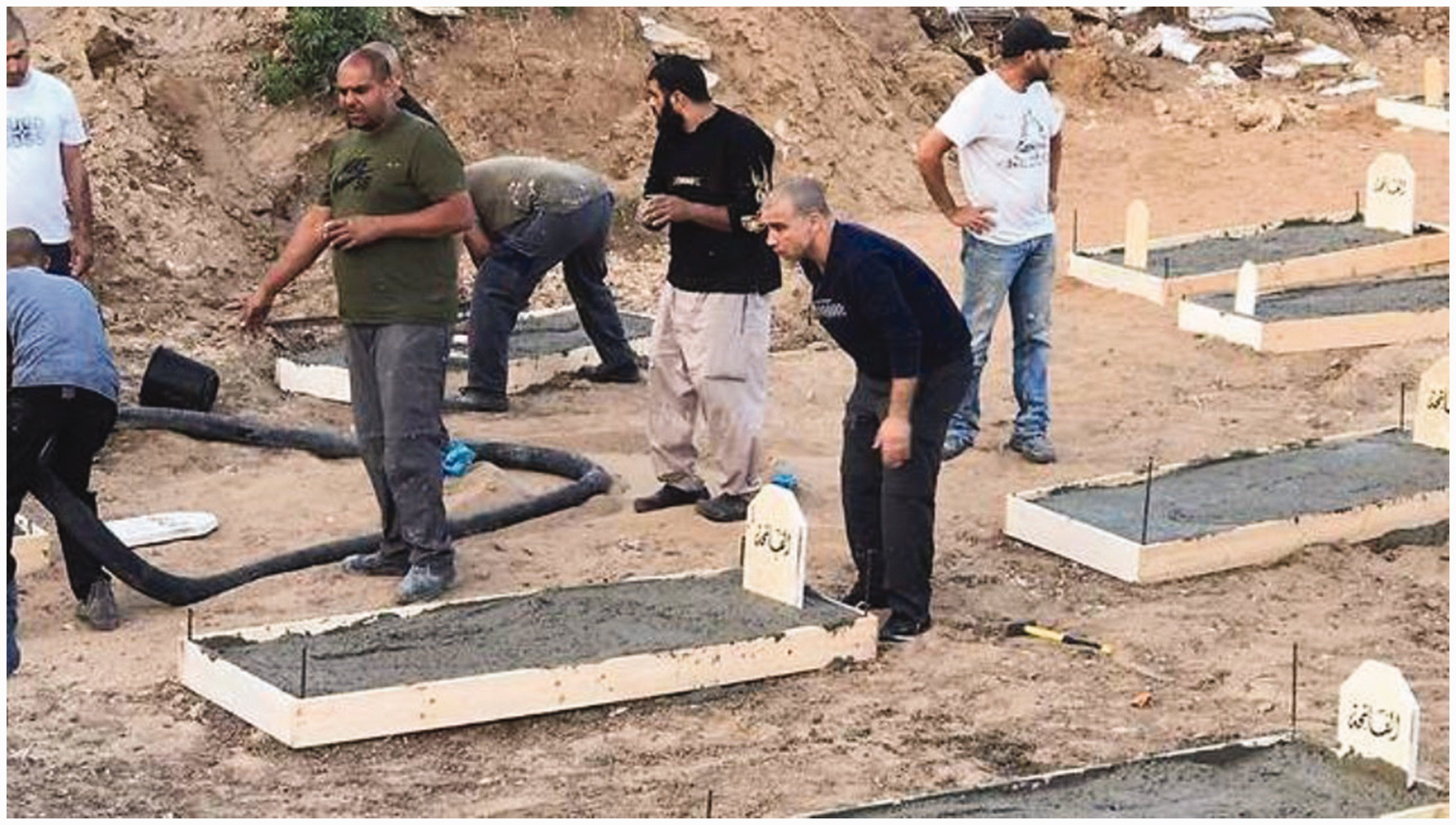
“This is how it looked”, YNET 16.05.18, Photographer: Jaffa 48, https://www.ynet.co.il/articles/0,7340,L-5262004,00.html.
Adrei told us that this struggle was political, and directed especially against the municipality, which justifies its actions with references to fatwas and the Islamic ruling allowing the removal of unused cemeteries and making “itself our Mufti.” 12 Yet, Adrei explains, “Fatwa is known to change by time and place. When you are under occupation and your lands have been expropriated, surely, religious approval for the sale of land and removal of its dedication is forbidden.” In this spirit, the Council initiated a legal battle and invited a clergyman to visit the site and issue a fatwa that forbids relocating the tombs.
Nevertheless, in June 2020, the court permitted the construction work, in accordance with a proposal by the municipality that workers would use hand-tools, avoid removing graves unless necessary, and when necessary, isolate each skeleton to honor the dead (Peleg, 2020a). The next day, a violent confrontation arose in Jaffa between Muslim protesters who threw stones and blocked roads, and armed police who responded with shock grenades (Peleg, 2020a). 13 Later that night, some protesters blocked a bus on the main street, burned trash cans and threw fireworks and firecrackers (Senor and Blumenthal, 2020). Over the next three days, activists staged non-violent mass demonstrations including mass-protest prayers near the cemetery (Figure 3). The next night, violence returned; protesters ignited trash bins, cars, and the municipal agency building in Jaffa (Blumenthal, 2020b).
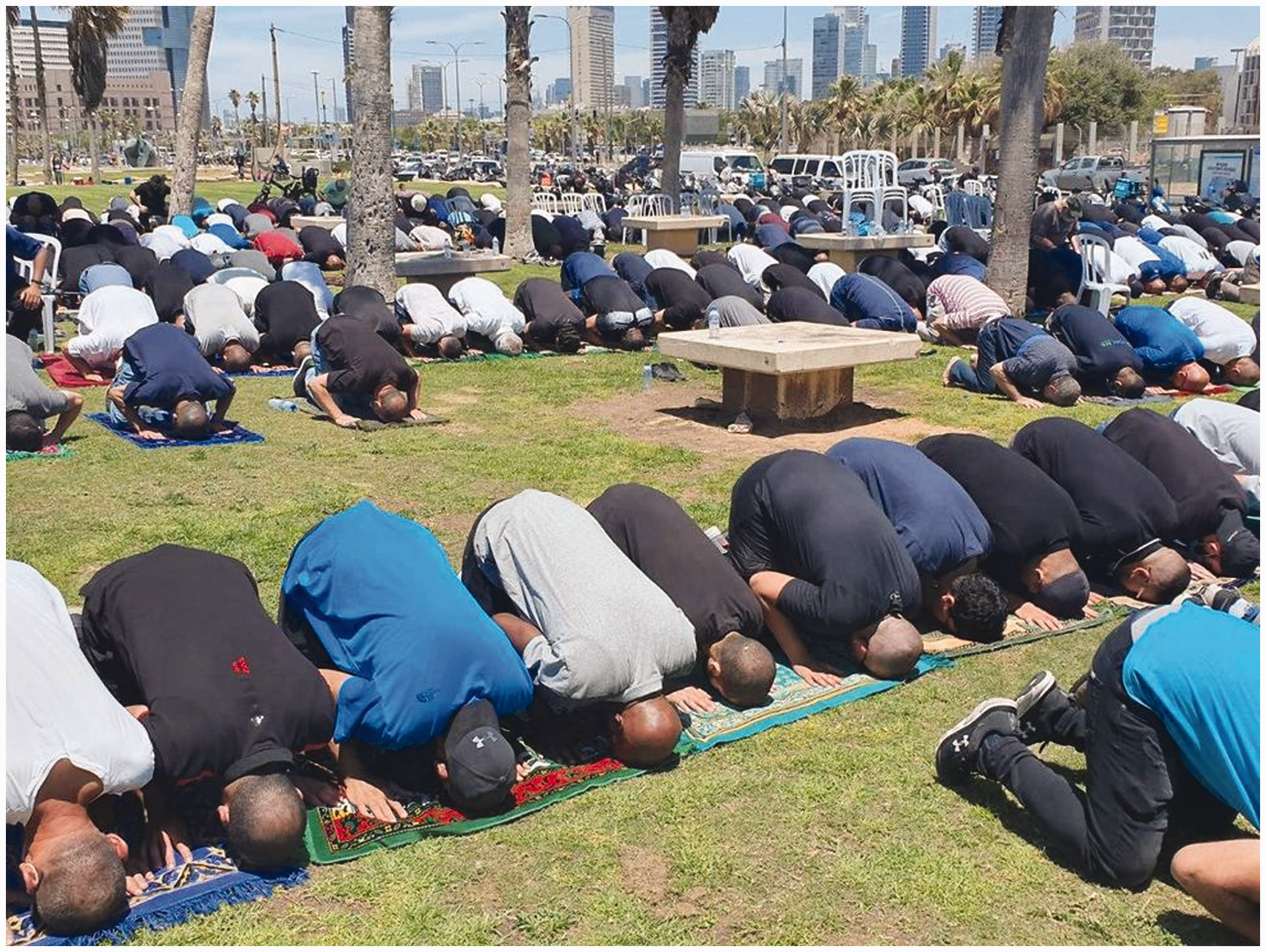
“Friday Prayer That Became a Protest Demonstration”, YNET 12.06.20, Photographer: Yariv Katz, https://www.ynet.co.il/articles/0,7340,L-5747021,00.html.
In an action that highlighted the urban focus of the struggle against the municipality’s conduct, Abu-Shehadeh resigned from the municipal coalition and was followed by Amir Bidran and Moriah Shlomot from the 'We Are the City' party. In an interview, Abu-Shehadeh told us that despite the ethno-national political stance, the activists tactically framed their struggle as an urban protest over religious rights; for instance, by prohibiting protesters from carrying Palestinian flags.
Utilizing symbolic visual and performative means, activists occupied the tourist space in central Jaffa, marching, chanting, and decorating it with a large sign stating “Huldai [the mayor of Tel Aviv-Jaffa] desecrates Muslim graves.” They went beyond Jaffa and protested outside of city hall, at Rabin Square, in central Tel Aviv. At this prime location, they stressed the municipality’s responsibility for the conflict by setting up an installation of coffins and signs stating, “Tel Aviv Municipality desecrates Muslim graves.” Two weeks later, protests expanded the geography of their dissent to the mayor’s suburban home, where they installed coffins and a ladder to “help him climb down” from his stubborn refusal to reach agreement. By targeting urban institutions and persons they stressed the city-level responsibility for the violation of graves and invoked their rights to be included as urban citizens.
Despite this persistent struggle, court permitted the construction, 14 and in 2022 the building opened. Nevertheless, Adrei and Abu-Shehadeh consider the struggle a success. First, Adrei noted that the construction plan was altered to avoid removing graves, and also told us that the struggle led to an important development within Jaffa’s Muslim community: the historical merger of the Committee of Trustees and the Council, with the goal of “regaining control over Waqf assets.” Moreover, a new cooperation was formed with the authorities and impacted prolonged struggles. For instance, the Antiquities Authority now includes a representative from the Committee in excavations. Similarly, when the Metropolitan Mass Transit System recently began the construction of light rail near Shiekh Mu’wannis cemetery, “they learned a lesson from Al-Isaaf and asked the Committee to be on-site.” After decades of legal battle and protests, the municipality approved a plan to regulate Tasu cemetery, including the segment that had been sold; the state agreed to expropriate this section and compensate the company that bought it. 15
Abu Shehadeh told us, “The goal to influence public opinion succeeded,” and even Tel Aviv’s Chief Rabbi visited the site in solidarity during a protest. For the first time, general Israeli-Hebrew newspapers published intensive and relatively positive coverage of the events. The next section focuses on this achievement. We found intensified coverage in the three main Hebrew-language newspapers, representative of the Israeli center and left (Ma’ariv,Yedioth Ahronoth, and Haaretz, print and online). From the 1950s to the present, these newspapers published 84 articles on all events related to Muslim cemeteries, including 22 articles on the ongoing events at Tasu cemetery. Between April and August 2020, the struggle over Al-Isaaf was covered in 33 articles and 4 opinion pieces. An editorial article referred to the events a year later.
We contend that the increased media attention to the struggle in Jaffa probably also influenced the authorities to change their traditional conduct and promoted the tangible achievements at site and beyond.
“The goal to influence public opinion succeeded”: Coverage by Israeli (Hebrew) media
Key activists provided different reasoning for the increased media attention in the later struggle. Aderi referenced journalists’ notorious attraction to conflicts, stating that the Israeli media is only after “drama and friction.” We interviewed two journalists who supported this perspective, saying that reporters mainly covered protests where there were violent events, and responded to the magnitude of the demonstrations. Abu Shehadeh observed that the recent struggle “tells the power of symbols,” and the Israeli media responded to this, and to the activists’ framing of the struggle as an urban protest. The media, he told us, “adopted the narrative that it is a civil-religious struggle.” He reflected, “although I would have liked to make the struggle more political, we got exposure, we got framing.”
To probe these contrasting perspectives, we examined the media articles using quantitative and qualitative methods of critical discourse analysis (Fairclough, 2003, 2013) and found that among the 33 articles that covered the events in Al-Isaaf, only 10 highlighted the violent acts. Articles focused more on religious meaning, and the urban conflict between citizens and the municipality (together, 15 headlines). In addition, all the articles presented the performative protests, including 55 pictures of marches, prayers, and installations.
Moreover, the media often supported the struggle and linked it to other issues related to the national conflict and those concerning the Palestinian community in Jaffa and beyond. One editorial explained the struggle as representing the troubles of Palestinian citizens, arguing, “the source of the protest is the ongoing issues inflicting the community in Jaffa, and the inequality between Jews and Arabs in Israel” (Haaretz, 2020). Opinion pieces were usually positive towards the struggle, stating, for example, “the protests reflect the ongoing erasure of the Palestinian heritage” (Zandberg, 2020), and “without serious solutions to the problems in Jaffa, a major conflict could always erupt” (Peleg, 2021). One column was written by Sami Abu Shehadeh, a political leader from Jaffa who was a member of parliament at the time. He explained that the protestors symbolically struggle to protect the honor of the dead but aimed “to protect the honor of the people living in Jaffa today” (Abu Shehadeh, 2020).
Second, compared to the coverage of previous cemetery-related events, recent coverage showed significant representation of Muslim actors. Fairclough (2003) classified degrees of actors’ representation in media: the highest degree is actual participation in media discourse by writing an article, (e.g., Abu Shehadeh’s column). The second degree is giving actors a voice in interviews or quotations in articles. The next degrees of representation include references to certain actors, of varying frequency and positivity. We found that earlier coverage of cemetery erasures rarely referenced activists by name or cited them, protest actions were not depicted in detail, and the community was mentioned with stigma, e.g., “Selling cemeteries, throwing grenades” (Rotem, 1975). When covering Al-Isaaf, most journalists highlighted the active agency of the “residents of Jaffa” (Blumenthal, 2020f). In addition, journalists mentioned people by name, sometimes with pictures, and gave voice to their perspectives and claims.
This positive and personal representation was highly significant, appearing in 18 articles, that usually cited named actors, mostly communal leaders, and quoting the signs and chants used by protesters. Journalists cited city leaders who specifically attacked the one-sided planning process and demanded the right to participate. Council member Amir Bidran criticized the mayor who “ignores and hurts the weak populations” (Peleg, 2020c), and added “what broke us is the mayor’s decision to demolish the cemetery without talking with the community” (Peleg, 2020d). Tarek Ashkar, head of the Islamic Council said that the mayor’s decisions “discard our feelings, together with the bones” (Peleg, 2020c), and further explained the violent acts as responses to institutionalized and “excessive violence against the Muslim residents of the city” (Peleg, 2020b), and as “just protest of the Muslims living in this city” (Blumenthal, 2020f), whose “citizenship is victimized” (Peleg, 2020e).
These leaders not only pursued the right to differ and participate (Dikeç, 2001; Jabareen, 2014b; Purcell, 2003), but demanded recognition and inclusion in policy decisions and discourse (Grigolo, 2019; Mitchell, 2003). Ashkar invited the mayor to “come talk to us – your residents” and Bidran asked him to “consider the people’s feelings and make an historic justice” (Blumenthal, 2020c). News articles also responded to the urban-religious framing, and quoted statements like “the mayor and the police are chasing the dead,” calls for the mayor to resign, and “stop the municipality from building on our graves” (Blumenthal, 2020a, 2020c, 2020d). Journalists talked to Muslim residents and quoted them blaming the Jewish population, saying “our morals will conquer your crime against the dead” (Blumenthal, 2020e). One article presented the resident Ayat Abu Shamis, who positioned the cemetery events as part of ongoing institutional marginalization, saying: “We feel deprived by the municipality for years and years… we could not ignore the situation with the bones in the boxes. It shocked us” (Peleg, 2020c).
Our analysis shows that the Israeli newspapers did not focus only on violent acts; rather many responded to the urban-religious framing and to the highly creative and evocative site-specific performances. Journalists addressed the wider issues inflicting the Muslim community, in Jaffa and elsewhere, Palestinian history, and the ethno-national scale. Our concluding discussion addresses these results and their meaning for future urban struggles.
Concluding discussion
In this paper, we contribute to the right-to-the-city scholarship by addressing communal struggles against the continued erasure of Muslim cemeteries in Tel Aviv-Jaffa. In the context of settler-colonial studies, we highlight the activists’ broad geo-temporal interpretation of urban citizenship.
We showed that after years of failed struggles this interpretation brought change – both in the actual protest and in its consequences. This change, we argue, reflects an evolution in the relationship between civil Muslim and Israeli institutions, and the strengthening of Palestinian political mobilization. While struggles against early cemetery sales mainly took place in courts, in the recent struggle the Muslim community became more unified and organized, with activists and residents channeling their frustration from years of ongoing demolitions into large protests, and site-specific, performative gestures. This, and their urban focus captured broad and largely positive media representation, which helped them gain tangible achievements on site, at other contentious locations, and in the institutional arena.
A key factor for consideration is the activists’ tactical decision to frame the recent Al-Isaaf protest as a religious-urban mobilization. Although all the cemetery struggles since the 1950s have had an ethno-national dimension, in practice they demanded the right “to physically access, occupy and use urban space,” as free and equal citizens (Lefebvre, 1996; Purcell, 2003: 103). The recent activists purposely highlighted this demand and the urban scale, addressed the mayor as the sole responsible party, demanded the right to participate (Jabareen, 2014; Lefebvre, 1996; Purcell, 2003), and be included in policy discourses (Grigolo, 2019; Mitchell, 2003). The media also played an intriguing role; coverage in general newspapers presented this urban struggle and the voices of the local activists to the larger Israeli audience, linking the urban claims to the wider political conflict.
We argue that the activists’ interpretation of the right-to-the-city, their practices and their achievements demonstrate the opportunity that urban framing offers indigenous struggles for recognition. The struggle in Jaffa speaks to the importance of the urban scale, site-specificity and materiality, and at the same time expands the right-to-the-city agenda and the notion of urban citizenship. Correlated with conflictual local history and the actual spatial and historic context, the activists reached beyond the residential spaces and daily issues to fight for rights to commemorate their dead, and to mark their local heritage in the full urban area. The religious-urban framing of the Al-Isaaf struggle not only helped them attract media attention but also extended their message to the national scale.
We thus contribute to the urban citizenship agenda and literature by interpreting the cemetery mobilizations as struggles for the right to their specific city, that is also “for a right through the city” (Blokland et al., 2015: 656). As long as formal national politics offer only limited opportunities for ethnic minorities, and particularly for the Israeli Palestinian citizens, we contend that the urban framing, and this perspective, hold promise for their movement politics.
Footnotes
Declaration of conflicting interests
The author(s) declared no potential conflicts of interest with respect to the research, authorship, and/or publication of this article.
Funding
The author(s) disclosed receipt of the following financial support for the research, authorship, and/or publication of this article: The research was supported by the ISRAEL SCIENCE FOUNDATION (grant No. 238/18).