




Abstract
Affects and emotions serve as tools of governance in settler urbanism, facilitating colonial dispossession and control of Indigenous land. Drawing on modernist logics, housing projects in indigenous territory seek to instill fixity and urban orders on mobile Indigenous populations through the management of fear and uncertainty. Here we examine the production of emotions associated with the development of the Pañacocha Millennium Community, a public housing project in the Petroamazonas oilfields of what was once Indigenous Kichwa territory in Ecuadorian Amazonia. We draw on research in Indigenous planning, the geographies of emotion, and critical urban studies to demonstrate the emotional impacts of the imposition of colonial governmental logics of housing production in Indigenous lands. At the same time, we examine the limitations of settler urbanist governance through emotion by documenting the embodied Indigenous relations with land, housing, and mobility captured in the concept territorio cuerpo-tierra, which has led to various forms of resistance and avoidance to the housing project. The case of the Pañacocha Millennium Community illuminates the role of emotion in urban planning and settler urbanism, in particular, and contributes to emerging work in Indigenous and decolonial planning.
Keywords
Introduction
Settler urbanist projects have historically been invested in the production of emotion to control Indigenous bodies, families, and lands (de Leeuw, 2016), serving as a “laboratories of modernity” (Stoler, 1995: 15) through affective management of sentiment and desire. Through the colonization of interior experience as a site of governance (Tucker, 2017), settler urbanism has become the chief mechanism for dispossession and elimination, transforming ancestral Indigenous land into urban space that serves the extractivist goals of the colonial project (Porter and Yiftachel, 2019; Sandercock, 2004; Weizman, 2017; Wolfe, 2006).
In the following, we consider the production of emotion through settler-colonial housing development in Indigenous territories, examining how affective politics serves as a tool of governance and thus allows the settler colonial state to enact power through dispossession of Indigenous lands (Schoenberger and Beban, 2018). Our discussion centers on the Pañacocha Millennium Community (PMC), a public housing project in the Petroamazonas oilfields of what was once Indigenous Kichwa territory in Ecuadorian Amazonia. Since the late 1960s, oil exploration has transformed this area into an exemplar of national modernization and development (Lu et al., 2016), leading to the development of the Millennium Communities program to house Indigenous people displaced by the oil industry. Located on the banks of the Napo River within oil camp B12 (SNH, 2016), the Millennium Communities housing project is a modernist enchantment built on promises of improving the lives of Kichwa displaced from their lands. Vastly different from traditional Kichwa communities, which were collectively constructed using mostly natural materials, the PMC features houses built with concrete and corrugated zinc roofs in a grid pattern and infrastructure such as police stations and schools, thus employing a disciplining, modernist esthetic to further a settler urbanist project.
To examine the role of affective politics and emotion in the development of the PMC, we draw on emerging research on affect and emotion in human geography, especially in subfields concerned with embodiment and the intimacies of everyday experience. Rather than assigning ontological priority to either affect or emotion, we view the politics of affect as intimately linked with matters of planning and notions of citizenship, nation, racism, and place (Crang and Tolia-Kelly, 2010; Nayak, 2010; Sweet and Ortiz Escalante, 2015, 2017; Tolia‐Kelly, 2006) and emotions as political and gendered aspects of human experience that serve as mediators of social relations (Anderson and Smith, 2001). While emotional geographies derive from the understanding of emotion in terms of sense of place (Pile, 2010), affective geographies draw inspiration from non-representational theory (Cadman, 2009; Deleuze and Guattari, 1988). We thus engage with affect as a means of highlighting the non-human agency embedded in Indigenous knowledges and the affective dimensions of Indigenous housing production. Understanding the situatedness of emotions and how they are shaped by colonialism helps reveal the “differentiated affective energies” of sites, landscapes, and the body (Crang and Tolia-Kelly, 2010). Our focus on affect and emotion reflects the importance of the body as a site of analysis, the better to comprehend the mobilities, intimacies and proximities (Pile, 2010, 2011) produced by the affective politics of settler urbanism and the agency derived from Indigenous emotional relations with land.
Inspired by McKittrick's (2013) concept of plantations futures, we see the management of emotion via the PMC as deployment of colonial affective traces. McKittrick’s work emphasizes the persistence of emotions associated with slavery over time, in the sense that the violence of plantations past is carried into the future through the traces left in land and in people’s bodies. Similarly, we suggest that settler urbanism in Ecuadorian Amazonia deploys emotion as a mode of control precisely through the traces of the anti-Indigenous violence of the past and the contemporary affects produced through these traces. Through its disciplinary esthetic accompanied by modernist conceptualizations of private property rights and urban orders, the planning and design of the PMC evoke collective memory of oppressions by religious missions, the peonage of the hacienda system (Moreno Tejada, 2015; Wasserstrom, 2017), the death and illness caused by unsafe housing conditions during the rubber booms (García, 1999; Muratorio, 1991; Porras, 1955), and the assimilationist practices in the more recent oil camps (Perreault and Valdivia, 2010; Valdivia, 2005), thus inspiring emotions of fear and resignation that support this most recent iteration of colonial intervention in Kichwa Napo territory.
However, the production of colonial affective traces through planning and design is both contested and incomplete. Despite the attempt to govern through emotion via nebulous promises of development and despite the significations of modernity associated with the housing project, the PMC fails as a totalizing urban settler project because of its reductionist and instrumental approach to the concept of housing. For Kichwa, the materiality and form of housing matters but so does its nonhuman elements and its socio-spatiality. Emotion is embedded in all aspects of Kichwa housing production. Housing provides an array of affordances, uses, and values, and its spatiality shapes affectual politics. Memory of traditional Indigenous housing evokes forms of Indigenous, situated and place-based ways of planning that contrast with the violence, fixity, and individualism of settler state planning praxis. Kichwa thus navigate a liminal position between Indigenous and state-based conceptions of housing that triggers distinct memories and emotions, impacts their subjectivities, and shapes their everyday resistance and accommodations to settler-colonial development practices. While 64 Indigenous and non-Indigenous families were resettled in the PMC, many other families resist living under these new urban logics, arguing that doing so acknowledges the appropriation of their lands. Indigenous and non-Indigenous families have also questioned the quality of materials, the logic of the site and building designs, and the cultural appropriateness of the housing design.
While our work emerges from a long tradition of Latin American social mobilization (Escobar, 2001; Freire, 2005; Yashar, 2005) and its radical and insurgent planning actions (Hecht, 2011; Miraftab, 2009; Roy, 2005; Sletto, 2013), we specifically engage with conceptualizations of Indigenous political subjectivity in racialized colonial state-making (Nemser, 2017; Radcliffe, 2007; Valdivia, 2009). To examine the deployment of colonial affective traces in the PMC and the role of emotion in both Kichwa resistance and accommodation to settler urbanism, we engage with research in decolonial geographies of indigeneity (Radcliffe, 2017, 2018; Zaragocin, 2019). In particular, we draw on work in emotional geographies (Hayes‐Conroy and Hayes‐Conroy, 2010; McDowell, 1992) to better understand the politics of affect and the expressions of self/defiance in Indigenous spaces subject to settler colonialism (Urrieta, 2019). To foreground Indigenous agency, we engage with work in Indigenous planning, a subfield of urban planning that seeks to document Indigenous traditions of planning (Walker in Porter et al., 2017: 641; see also Jojola, 1998; Porter et al., 2017; Radcliffe, 2017, 2018; Sandercock, 1998a; Walker et al., 2013) and which views planning as a way of making the world by encompassing plural epistemologies (Escobar, 2018; Sandercock, 1998b).
To develop a decolonial approach to Indigenous planning that is attentive to geographies of affect and emotion, we draw on the Abya-Yala Indigenous concept of territorio cuerpo-tierra (territory body-land) (Cabnal, 2017). Conceived with the explicitly emancipatory aim to re-dignify embodied connections with land (Cabnal, 2017; see also X. Solano and Icaza, 2019), territorio cuerpo-tierra draws attention to the intimate connections between body, land and territory which are severed through settler colonial planning (Sweet and Ortiz Escalante, 2015, 2017; see also Hayes-Conroy, 2010; Longhurst et al., 2008, 2009). In the following, we suggest that Kichwa residents of the PMC are challenging the deployment of colonial affective traces in the Ecuadorian settler colonial project and reframing the logic of settler urbanism precisely through their situated relationships between territory, body, and land.
Our discussion is based on field research conducted over a period of 10 months in the years 2015–2016 and also informed by the Lamiña’s personal experience working in Ecuadorian Amazonia starting in 2010 as a geographer and environmental technician for state agencies and NGOs. During the years 2010–2014, she also worked as a community researcher for Kichwa Nation organizations in Pastaza and Napo, leading community workshops, assisting with participatory mapping, and conducting geographical assessments of land and natural resources in Indigenous territories. Lamiña’s identity as a Kitu-Kara Indigenous woman with mestizo influences coupled with the Sletto’s three decades of work in decolonial planning, Indigenous cartographies, and Indigenous territorialities in Venezuela and elsewhere (see e.g., Sletto, 2009, 2014, 2015; Sletto and Bryan, 2020) shape our approach to Latin American decolonial thought. In order to challenge the “geopolitics of knowledge” (Rivera Cusicanqui, 2012) that have so long fostered epistemic domination, racialization, and exoticization of Indigenous people and intellectuals from Latin America, in our research, we aim to facilitate an iterative process of co-learning and co-production of knowledge (Freire, 2005; Lamiña, 2018; Lawson, 1995) and thus support the Indigenous decolonial project of healing, transformation, and mobilization (Smith, 2012). Rivera Cusicanqui (2015) calls such self-learning essential to understand the colonial wounds as legacies that live among us (Cacopardo, 2018; Rivera Cusicanqui, 2015), especially since the “colonial past” is embedded in our bodies, emotions, and knowledges (Smith, 2012: 19–20).
In our work, we have found that Indigenous storytelling of place and home touch people’s understandings of self, taking on new resonances as people, researchers, and territorialities are connected through the performance of story. As Lamiña conducted the interviews referenced here, she was also touched by the emotional impacts of the housing project and came to realize that Indigenous place-making are sites of intense emotional relations. For Lamiña, emotions are part of the self-reflection process within the relational milieu that shapes the ethnographic work and informs the ethics and positionality of the researcher. As some stories were painful for participants to share, we have refrained from publishing particularly sensitive quotes to respect participants’ right to refusal and challenge the tendency to dehumanize Indigenous peoples through portrayals of suffering. In addition, some Indigenous women participants stated they were “tired of being asked to repeat the same stories about this project.” Instead of sharing some of this sensitive first-hand information, we seek to learn from the past, grasp the present, and inform the future (Chilisa and Tsheko, 2014) by presenting insights from the interviews in narrative form to illuminate the emotional impacts of settler colonial planning.
The conversations with Kichwa respondents prompted them to express their fears, uncertainties, and feelings of resignation through their bodies, manifested through shaking, crying, long silences, and raised voices. As she personally gained awareness of the intensely emotional impacts of the housing project on Kichwa residents’ lives, Lamiña came to realize the limitations of her own understanding and also the lack of consideration of the role of emotion in settler urbanist research. BothLamiña and Sletto recognized the need to revisit their reading of colonial history through the lens of emerging decolonial studies in emotional geographies and indigenous planning, while at the same time respecting Kichwa epistemologies and politics of affect. Remaining cognizant of the performative and emotional relationships inherent to such ethnographic work, we argue, is necessary for planners who seek to advance decolonial approaches to knowledge construction.
Settler urbanism vis-à-vis Indigenous planning in Amazonian Indigenous geographies
The concept of settler urbanism emerged from settler colonial studies, critical geography, and critical urban studies (Hugill, 2017; Roy, 2006; Tomiak, 2017; Ugarte et al., 2022). The settler colonial city differs from the colonial city in its reliance on capital accumulation strategies intended to enrich settler constituencies, its exclusion of Indigenous people from core economic and political activities, and its zealous commitment to maintaining colonial relations of power through extractivist strategies (Dorries et al., 2022; Hugill, 2017). Settler cities are thus constructed as urbs nullius (Coulthard, 2014) (after terra nullius); i.e. as urban spaces devoid of Indigenous people, thus providing the pretext for exclusionary planning practices and policies. As a product of modernist planning shaped by patriarchal Western imperial logics (Porter, 2010; Roy, 2006; Sandercock, 1998b), settler urbanism thus facilitates neocolonial violence by inscribing certain sensibilities, rationalities, and technologies, producing settler spatial orders (Barnd, 2017; Goeman, 2013) in contradiction to lived experiences of place (Massey, 2005).
In the case of Ecuador and Latin America more broadly, settler urbanism is intimately associated with land dispossession and is thus central to the colonial project of indigenous elimination (Radcliffe, 2014; Speed, 2017). Although Amazonian cities, urbanity, and mobility were integral to Indigenous peoples’ lives even prior to colonization (Alexiades, 2009; Santos-Granero and Fabiano, 2023), the Ecuadorian state now pursues urban development based on key tenets of settler urbanism, including racialized extractivist capitalism, natural resources destruction, land dispossession, and gender violence (Ugarte et al., 2022; Zaragocin, 2019). In this way, we complement the Latin American notions of “internal colonialism” and “coloniality of power” (see e.g., Casanova, 2006; Quijano, 2000; Rivera Cusicanqui, 1991) by viewing urbanization in Indigenous lands as ongoing settler processes rather than residuals or legacies of a colonial past. By engaging with the concept of settler urbanism as an ongoing state of occupation, we thus seek to reveal the place-based historiographies of Indigenous planning vis-à-vis the “official planning” (Sandercock, 1998a) that drives Amazonian urbanism as a means of examining the emotional impacts of land dispossession.
Other work on settler urbanism builds on the concept of “land grabbing,” suggesting that “grabbing” extends beyond material dispossession of land to also constitute an “affective grab,” in the sense that emotions such as fear and uncertainty engendered by dispossession serve as tools of governance and thus facilitate state control and capital accumulation (Porter, 2010; Porter and Yiftachel, 2019; Schoenberger and Beban, 2018). Mollett (2016) argues that land “grabbing” is an intrinsic part of a long racial-cultural project to shape new enclosures and property dynamics, achieved by mobilizing anti-Black and anti-Indigenous sentiments and using the mechanisms of urban planning to facilitate the expansion of the colonial frontier. Conversely, Keisha-Khan (2013) shows that land grabbing leads to displacement and gender violence against poor Black women but that their emotional capabilities, organizing strategies, and experiences help them to resist and improve their daily lives.
We contribute to this emerging discussion on the affective politics of land grabbing by drawing on literature in Indigenous planning, arguing that native ways of living constitute a planning project that challenges the affective grab of settler urbanism. “Planning” with a capital ‘P’ is commonly understood as an imperial and colonial discipline and practice of the West. However, scholars who engage with Indigenous perspectives of planning understand ‘planning’ as a human activity that is not owned by the West, its theorists, or its practitioners. The everyday placemaking of Indigenous peoples serves to produce emotionally regenerative spaces of “territorio cuerpo-tierra” (Cabnal, 2017: 100; Sandercock, 1998b; Sweet and Ortiz Escalante, 2017: 595) and thus constitutes a form of planning in the sense of “a universal human function with an abiding and justifiable concern for the future” (Matunga, 2013 in Walker et al., 2013: 4).
Amazonian Indigenous standpoints offer fertile grounds for contributing to such a decolonial conceptualization of planning due to their place-based critiques of coloniality, focus on embodied epistemologies, examination of ongoing land-based struggles, and conceptualization of differentiated processes of city-making (Alexiades and Peluso, 2016; Eloy et al., 2015; Lu et al., 2016; McSweeney and Jokisch, 2007, 2015; Valdivia, 2009). In the case of Ecuador, emerging research focuses on state planning failures (Klaufus, 2012; Lu et al., 2016; Noroña, 2022; Radcliffe, 2012; Wilson and Bayón, 2018) and on creative ways to work with Indigenous politics (Radcliffe and Laurie, 2006), while revealing the architectures of extractivism that are reproduced through urban planning paradigms (Espinosa, 2017). As Indigenous planning scholarship has revealed, the colonial present continues to structure planners’ imperial practices and ethnocentric universalisms (Jojola, 1998; Porter, 2010; Sandercock, 2004).
However, the role of Indigenous ways of planning in the face of governance through emotion is little discussed in settler urbanism in Ecuador. Critical and feminist planning scholars argue that the politics of affect are critical to constructions of citizenship, nation, and place (de Leeuw, 2016; Porter, 2020; Sandercock, 1998b). In particular, a better understanding of the colonial violence directed towards places, landscapes, and the body is necessary in order to comprehend the situatedness and continuities of settler colonialism (Dorries and Harjo, 2020). That is to say, interior experience becomes a site of governance in planning, both in terms of maintaining but also disrupting power relations (Tucker, 2017). In order to map the emotional geographies of settler urbanism in Ecuador, we thus draw on the work in Indigenous planning coupled with work on affect and emotion to reveal how spatial, material, and human dimensions converge to produce urban subjects under settler urbanism.
Settler urbanism and colonial affective traces in Pañacocha
At the risk of oversimplifying more than 500 years of colonization, we focus here on a series of critical events that served to transform Pañacocha, a name derived from the Kichwa words paña (piranha) and cucha (lagoon), into a place of dispossession, resource extraction, and Indigenous elimination. Prior to European colonization, the Indigenous Záparo, Omagua, and Yumbos groups that inhabited the Napo River basin had been absorbed by the Quechua-speaking Inca culture (Muratorio, 1991). Post-contact, the religious orders that dominated the area continued favoring the Kichwa language to more easily assimilate the Indigenous population (Whitten, 1976). The Spanish colonizers and early white settlers enslaved the Kichwa-speaking population along the Upper Napo river (Muratorio, 1991; Whitten, 1976), leading surviving Kichwa to escape into the forest to evade the colonial violence. During the 19th century, Amazonian Indigenous peoples were subjugated as plantation workers, gold diggers, and rubber tappers; they were dehumanized, and they were sold or exchanged as property (Peñaherrera and Costales, 1969). These forms of exploitation were exacerbated by the influx of the military, merchants, priests, and all kinds of adventurers in search of fortune (Gerlach, 2003).
While colonial urbanization elsewhere in Latin America was based on imposing a gridded street model on top of existing Indigenous cities, settler urbanism faced difficulties in the remote Napo River region due to intertribal conflicts, the diversity of languages, a low number of missionaries, and epidemies (de Carvalho, 2016). Once the Ecuadorian State and the Catholic church delegated the evangelization work and development of Amazonian Indigenous lands to the Capuchin order, the Capuchins decided to establish a small missionary settlement in Pañacocha while securing the freedom of Indigenous hacienda workers who lived in debt peonage in the Napo basin area (Behing, 1964; Capuchin Mission, 2017). Founded in 1959 under the name Saint Christ of Pañacocha, this initial urban settlement included an orphanage, cattle farms, and a landing field for light aircraft (Capuchin Mission, 2017). The Capuchin mission thus implanted an urban grid system as a means of controlling and civilizing Indigenous people, exemplified by the Capuchin’s 1917 Puerto Asís urban plan on the Putumayo River in Colombian Amazonia (Uribe, 2013), including the establishment of an orphanage as a colonial strategy to facilitate evangelization and keep Indigenous families permanently settled (Kuan, 2020).
Following the founding of the Capuchin mission and the subsequent establishment of Pañacocha parish in 1960, the area began to see an influx of mestizx settlers and former members of the military. Starting in 1975, settler mestizxs began to push for privatization of land through individual ownership of plots, facing resistance by Indigenous families who sought protection for their collective land rights under Ecuadorian law. These land rights conflicts deepened with the arrival of the oil companies in the 1980s, the establishment of new territorial divisions in 1984, and the creation of the Bosque Protector Pañacocha (the Pañacocha protected forest) in 1986 (Salazar, 2012). Today, local and international NGOs and tour operators work freely in the Pañacocha area without respecting Indigenous norms for the use of communitarian land, while settler mestizxs organizations are still advocating for privatization of Indigenous lands.
The PMC thus folds into a long history of settler urbanism and conflicts over land in Ecuadorian Amazon. According to state officials, projects such as the PMC are intended to mitigate the serious social and environmental damages stemming from oil exploration (Petroamazonas, 2013) in Indigenous communities. In 2013, the Ecuadorian government proclaimed that “we can overcome poverty without losing our identity and culture” and invoked “social justice” goals to promote the Millennium Communities program (Ecuadorian Presidency, 2013). The housing program was lauded as an effective anti-poverty strategy in areas of resource extraction, yet it was promoted under the premise of transforming Indigenous people into settled households to support socialist and colonial settler urbanism. Petroamazonas along with other state agencies continue to develop housing projects similar to the PMC in Indigenous territories throughout Ecuador in return for their “consent” to allow extractivist activities in their lands (Lyall, 2016).
Designed and built by the private firm Constructora Villacreces Andrade (CVA) (CVA, 2017; Petroamazonas, 2013), the PMC is located in the poorest province in Ecuador, Sucumbios, where poverty levels reach 87% (INEC, 2010). The PMC is based on a modernist planning model, consisting of 14 blocks, four neighborhoods—12 February, Elías Baquero, Sumak Kawsay, and Pañacocha—and areas designated for schools, public market, health center, sport facilities, community police station, a landfill, and a cemetery (Figure 1). The Indigenous residents were not invited to participate in the planning and design of the housing project, thus excluding families from collectively imagining, dreaming, and planning their housing based on their relationships with land. The private contractor only emphasized speed and profitability rather than cultural appropriateness or social justice goals (Lamiña, 2017). Instead of drawing on Kichwa models of communal housing, in accordance with canons of modernity the project consists of 64 two-floor private houses linearly arranged inside a grid model separated with cobbled streets, thus resembling a private, gated urban complex (Figure 2). As one of the residents, Maribel, observed, the project was aimed at “the urbanization of the Indigenous peoples.”
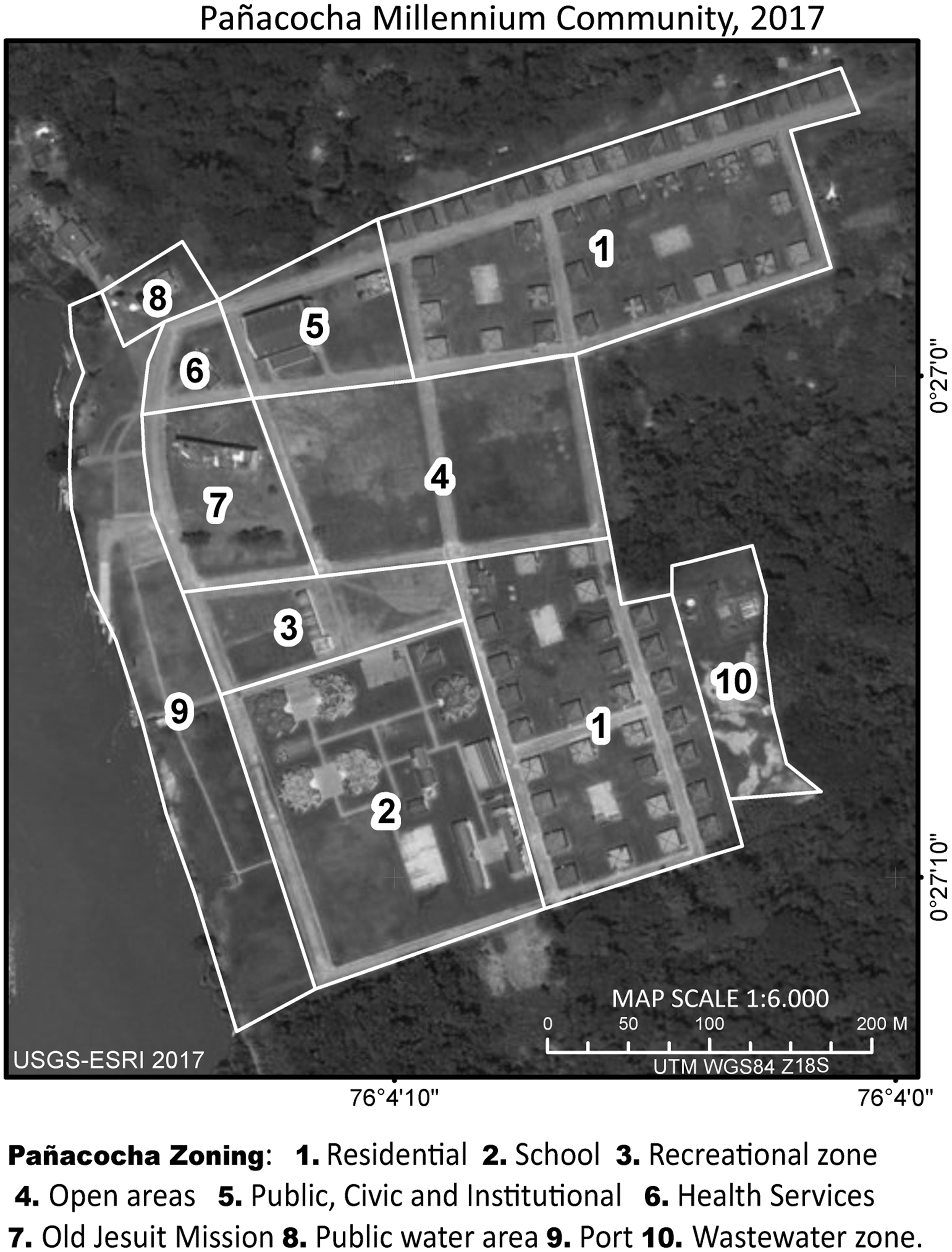
Urban zoning in the PMC (adapted from Lamiña, 2018).
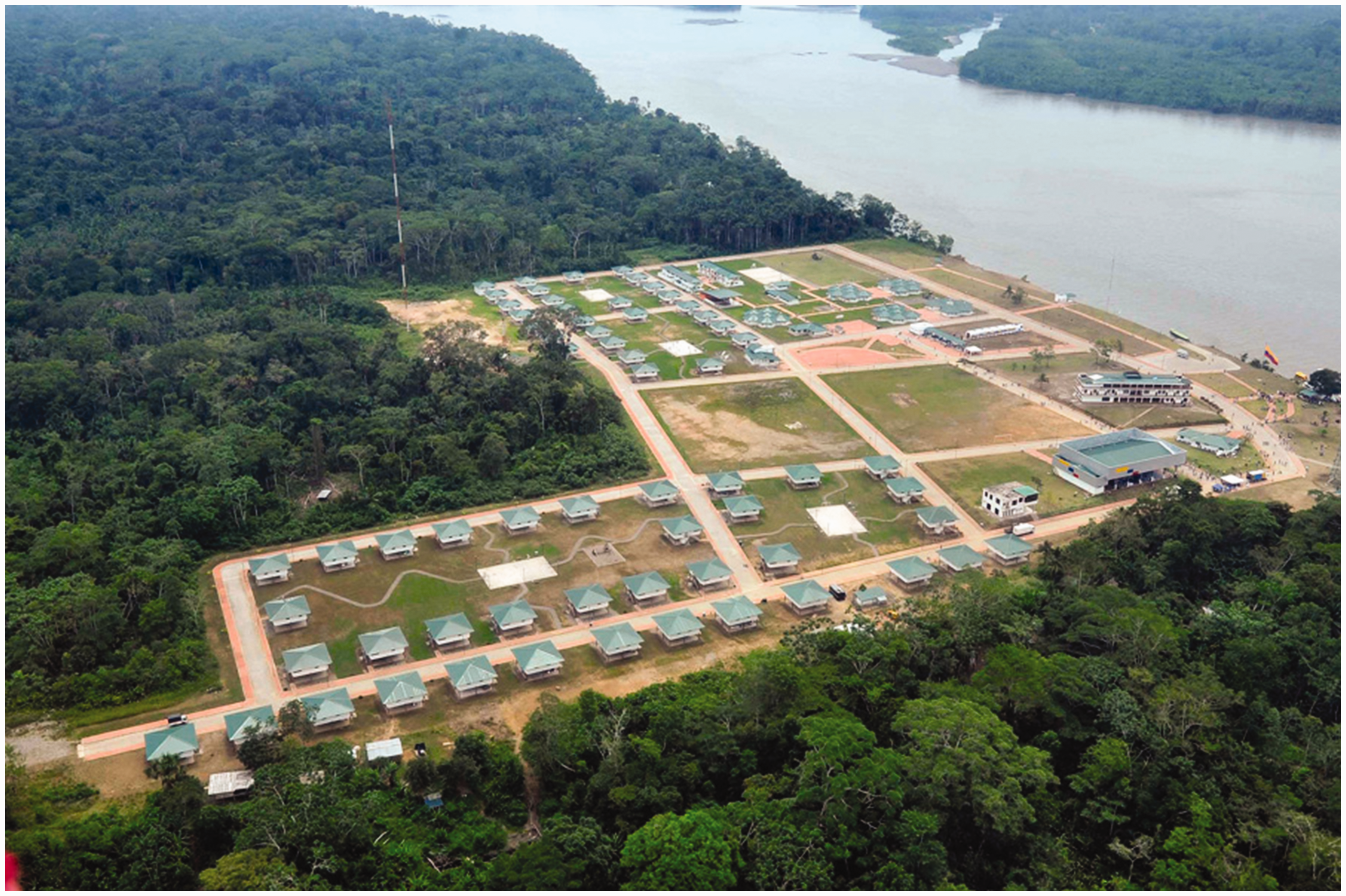
Grid pattern of homes in the PMC (La República, 2014).
A closer examination of the housing project reveals how settler urbanism seeks to discipline Kichwa through emotional modes of governance, including via the designs of the housing units themselves. To conduct this study, Lamiña’s fieldwork drew on a mixed-method approach combining surveys, housing assessment with the collaboration of residents, and 10 in-depth and 15 semi-structured interviews with local officials and residents, in particular women, as well as a number of informal conversations. In order to document the comfort and livability of homes in the PMC, Lamiña registered humidity and temperature values in 16 homes using portable THC-4 digital sensors, which led to a collaborative analysis with family members of the implications of housing conditions for levels of occupation and family health.
The research found that 23 houses (35% of the total) had already began to deteriorate due to lack of maintenance merely two years following their construction. While 43 homes were occupied by families, either permanently and temporally, 21 homes were identified as abandoned by local informants. In our collaborative analysis of the humidity and temperature measurements, residents indicated that the high humidity levels and temperatures were the main reasons for the lack of occupation of houses. The research found that second-floor temperatures 1 and humidity reached 33.3° Celsius (C) and 100.2% relative humidity (RH), respectively. Families indicated that the limited living space, the low quality of the construction materials, and the poor ventilation made the houses “inhuman and uninhabitable” (Figure 3). In addition to the flawed housing construction, public infrastructure such as the sewage and water delivery systems had collapsed due to a lack of capacity and poor maintenance. Sidewalks showed cracks, holes, and erosion due to water infiltration. Development of some of the green areas as well as the cemetery had not been completed. In addition, no garbage collection system had been put in place, the electricity service suffered frequent power outages, and there were no home internet and phone services.
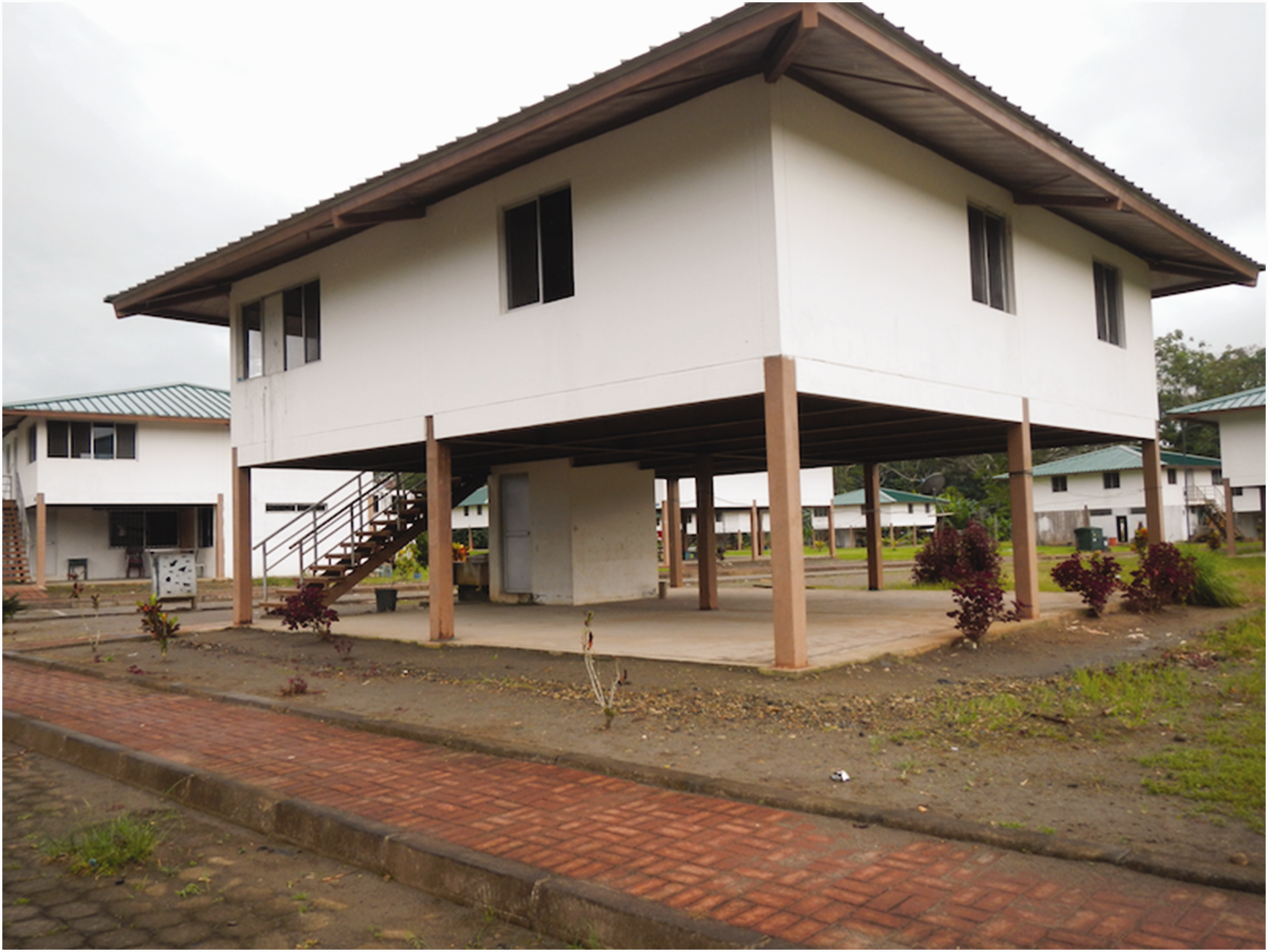
One of the standardized homes in the PMC. Image by Lamiña (2017).
Despite the obvious construction flaws and the inadequate community infrastructure, residents’ concerns were not taken seriously by the contractors and state agents, exacerbating the emotional impacts of the project. While Petroamazonas and CVA had shown future residents a design concept for the homes prior to construction, in interviews, both Indigenous and non-Indigenous women stated that the companies built “a different housing model” than the sketches showed. They said they felt treated as “less than humans” by state officials when they questioned the planning and construction work. In the words of one resident: When we complained about the quality of the materials used in the PMC, the contractors would insult us, threaten us, like we were less than humans. They told us that we don’t know about modern materials and their ecological character. If we protested, contractors sent us to the Fiscalía (Provincial attorney’s office) to legally intimidate and shut us up. Threats and humiliation were the contractors’ responses to silence our claims. I feel betrayed because the housing project looks like a wall-less prison. I just feel indignant. (Adult non-Indigenous woman, who is living in the PMC, 2015) My husband and I cannot cover the living expenses here (PMC), but we want our four children to keep studying in the new built school. So, we decided to leave our children here, while we stay in the finca (farm) harvesting our food. My oldest daughter (12 years old) is in charge of the house when we are absent.
However, other families feel that these material conditions are acceptable and even justified given the importance of turning Pañacocha into what they refer to as a “modern” community. Marco, a non-Indigenous resident, remarked that “now the community looks like a planned cabecera parroquial (parish).” Marco’s family is one of seven who have invested in their home to make up for the inadequacies in the original housing, installing an air conditioning unit on the second floor, a washing machine, and window grills for added security. He believed that modern infrastructures and the presence of the national government will bring “community conflicts to an end.”
Marco belongs to the non-Indigenous organization Corazón de Jesus (Heart of Jesus), a group that has been calling for a legal division of ancestral Indigenous land into one portion for each local organization, and his perspective reflects the socio-territorial conflicts that have been exacerbated by the development of the PMC. In the PMC, a range of organizations have emerged to advocate for different economic, political, clientelist and racial goals in the face of complex relations of power among national state agencies, local and regional governments, NGOs, oil companies, and religious institutions. This conflictive scenario has led to deepening tensions between Indigenous and non-Indigenous residents but also served to further a governance through fear, as evidenced through the statements and body language of Kichwa women during the research process. In informal conversation, Kichwa women often explained they were afraid of losing their land through legal division and privatization. At times, they were suspicions of Lamiña’s intentions, and at other times they sought to hear what she had learned in her interviews with public officials and non-Indigenous residents.
The call for formalization of land tenure in the modernist mold also illustrates the broader loss of communality, gendering of Indigenous governance, and emerging conflicts among Indigenous residents due to the PMC development. While in the past, colonial governance was administered through religious missions and the plantation system, Indigenous communities are now under the tutelage of oil companies. Assuming the colonial responsibility to promote the sumak kawsay (wellbeing) of the communities and residents, Petroamazonas is now seeking to structure land administration through the logic of planning modernity (Petroamazonas, 2017), which in turn is exacerbating pre-existing conflicts, deepening financial dependence, and restructuring political control in the community. As Marcia said, “we keep disputing land, money (oil revenues), ventures (assistance programs), politics, organization …” And in the word of other interviewees: Past Indigenous and settler leaders [mainly men] controlled the organization for more than eight years. The oil company only negotiated with these leaders and the rest of the community did not know anything. If someone said something, there were insults, disrespectful acts, and violence. (Adult man, non-Indigenous resident, member of Corazon de Jesús Organization) Conflicts between the president of the junta (Pañacocha parish) and its members are endless. Thus, local government has halted the maintenance of the community. The parish president spends more time in the city. Right now, for example, we have problems with the water, electricity, and the waste management, but the junta members cannot take decisions without the president. The president always says that the junta does not have enough funds for the obras (infrastructure). (Adult Man, Indigenous resident, Pañacocha Organization)
Memory and emotional geographies: Challenging the PMC
However, while Indigenous people have responded to forced displacement by developing new forms of mobility, particularly urban and international migration (Alexiades, 2009; Santos-Granero and Fabiano, 2023), they have also historically responded to settler colonialism through the maintenance of embedded Indigenous place-making practices, thus drawing on more-than-human knowledges and affective relations with land. While the PMC project is pursuing settler urbanism through the management of emotions, the affective relations between people and land have led Kichwa to quietly challenge the Ecuadorian settler colonial project and reframe the logic of settler urbanism through their everyday practices. They do this in part through maintaining traditional housing forms, which in turn serve to reproduce traditional forms of communality and mobility. Traditional Kichwa housing production thus constitutes a form of Indigenous planning that reflects a broader decolonial resurgence and process of Indigenous future-making based on the more-than-human relationships of territorio cuerpo-tierra.
While traditional Kichwa houses are stereotyped as indicators of poverty and marginality (Petroamazonas, 2013), Indigenous homes are in fact ingeniously built to support traditional livelihoods (Lamiña, 2017). Kichwa homes, which are still common in the area surrounding the PMC, are built next to rivers and surrounded by chacras (family gardens) (Figure 4). Paths connect the houses to the river, the rainforest, and other traditional infrastructure in the community, as the Kichwa believe the runa (people) is merely one of several elements that constitute the world (Vitery, 2002). Kichwa houses typically avoid right angles, instead relying on circular shapes that symbolize the cyclical dynamic of the Amazonian forest. Some houses in the vicinity of the PMC, especially the traditional freestanding kitchens, still feature circular roofs constructed from woven palm leaves.
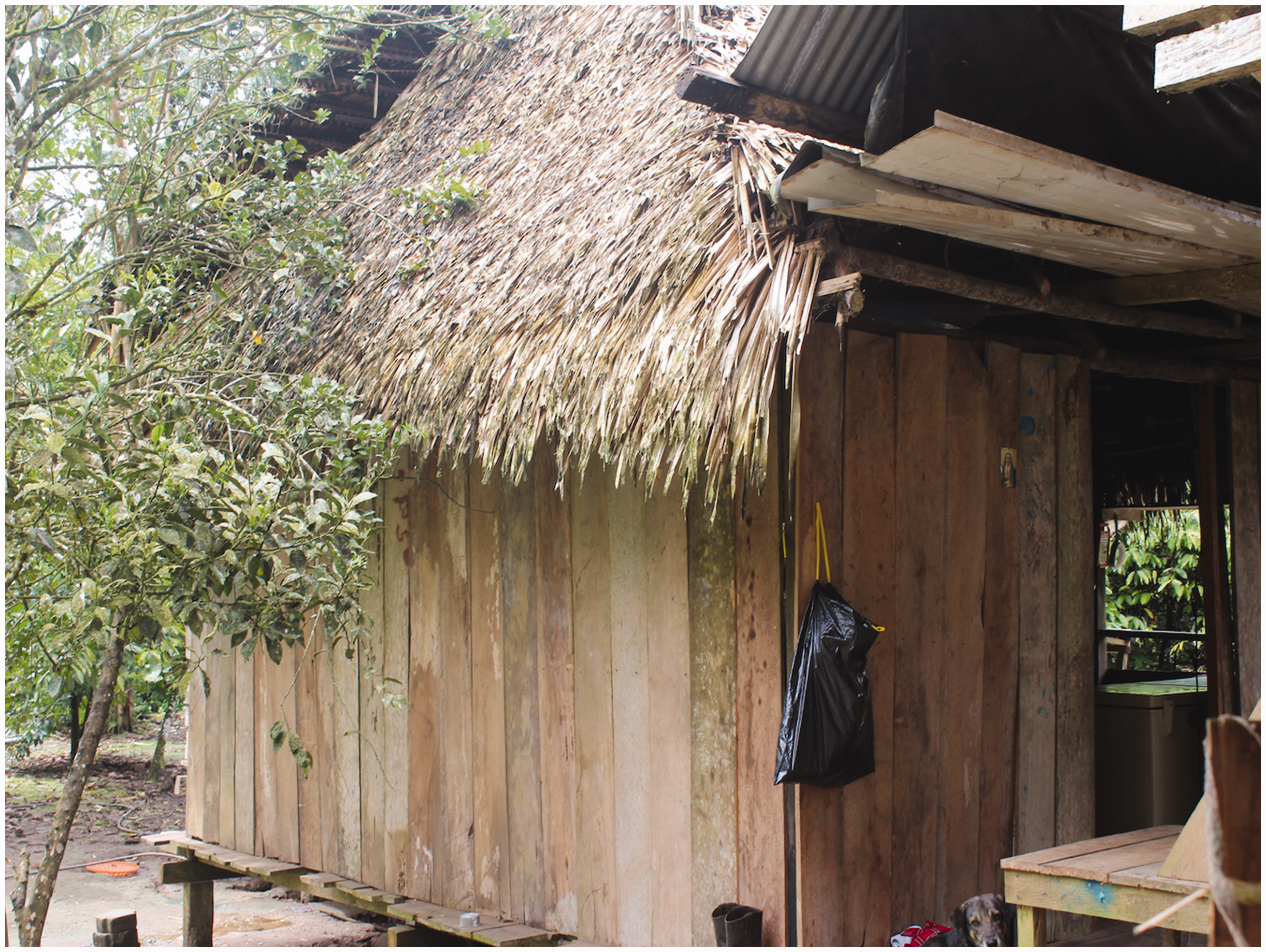
Traditional Kichwa kitchen. Image by Lamiña (2018).
The Kichwa cosmovision of housing planning views collective housing rather than private property for individual households as the norm (Vitery, 2002). Each member of the community participates in the construction of homes with no money exchanged, using materials collected in the forest. Collective housing construction thus illustrates the Kichwa communitarian vision of planning the llactaguna, i.e. the space that supports the runa’s (people) livelihood. For the Kichwa, learning about place is a collective exercise, and their Indigenous epistemology is shaped by experience, memories, and sensibilities. Kichwa families do not build “human settlements”; rather, they collectively build and manage temporal places and spaces for human livelihoods based on sustainable and just use of the collective rainforest resources (Lamiña, 2014). The arrangements of family dwellings are not permanent but rather built in accordance with the local conditions of the rainforest.
Such community management of Indigenous livelihoods was ignored in the PMC project and as a result, many Indigenous and non-Indigenous families continue residing in their former houses located near their chacras. These homes provide the necessary support to contend with the violence of settler urbanism and its use of emotion as a tool of governance. As this elderly Kichwa woman, who decided to leave the PMC and return to her former house, explained: In the PMC, I felt alone and got sick, no one visited me, no one lived with me. But, here, in my Kichwa house, I have everything I need: my gardens, my dogs and chickens, my spacious kitchen and patios. Here, my family and grandchildren are closer to me. Here, I can keep teaching and sharing my [Indigenous] knowledge about how must the Kichwa runa (people) live. (Elderly Kichwa Indigenous woman, 2016)
The circulation of Indigenous people through their ancestral lands thus constitutes sensing-thinking processes, producing affective geographies that recall experiences, knowledge, and sensibilities from the past. These affective geographies contribute different meanings and identities to places while reproducing the individual and familial relationships that are key to communitarian coexistence. Despite the modernist vision of development implemented via private housing schemes, land privatization, and the colonial urbanity of the PMC, many Kichwa families therefore continue living and working in their own wasikuna (ancestrally inherited dwelling) in order to maintain the social and cultural values embedded in Kichwa infrastructures. As Camila explained: We seasonally circulate. We always move. My familial lineage came from the Pastaza’s Kichwa. My parents had three houses in the past, because Amazonian living is a seasonal living. That [our spatial mobility] is the way in which we have been living and persisting. I am not afraid of this settler project (PMC), because I will not abandon my Kichwa house and way of life. I fear for our pueblo (Indigenous peoples) who already is quieto, callado (quiet, silent), living with fears and doubts. Jeopardizing our political achievements by embracing the settler’s way of life. (Camila, Indigenous woman, Pañacocha, 2016.)
Conclusions
Drawing on the conceptualization of interior experience as a site of governance (Tucker, 2017), we have described the role of colonial affective traces in settler urbanism. The Ecuadorian state has deployed fear, discomfort, and uncertainty as mechanisms to discipline people while constructing them as settler households. In the PMC, Kichwa subjectivities are shaped through their encounters with settler urbanism, revealing how colonial affective traces are essential to settler urbanism and associated land grabs in Amazonian Indigenous territories. However, while the settler urbanist project uses fear, discomfort, and uncertainty as mechanisms to discipline Indigenous people, these governance techniques do not fully capture the affective experiences and subjectivities that derive from Indigenous mobilities and their embodied, emotional, and affective relationships with land, place, and housing. Instead, the affective relations that constitute Kichwa housing mobility reveal the contradictions between the Amazonian cyclical dynamic and the immobility of the urban settler project.
Settler urbanism in Ecuador is premised on providing Indigenous people with access to urban infrastructures, and, through the comforts of modernity, prevent their permanent migration to cities. This attempt to maintain people in place through settler urbanism conflicts with Indigenous mobilities and the continuing (re)constitution of multiple identities and meanings associated with the movement between different places. While this ordered and planned urban community produces a local, physical fixity and consequent social, cultural and political immobility, cyclical dynamics and mobility/immobility relations remain present in the daily life of the people of Pañacocha. Their affective connections with land serve to maintain Kichwa’s communitarian networks despite the deployment of emotional modes of governance.
The case of Pañacocha demonstrates the need for greater attention to the role of affect and emotion in Indigenous planning, especially in work that seeks to examine the role of planning in settler urbanism in Indigenous territory. However, the role of emotion and affect in settler urbanism remains on the margin of urban scholarships and Indigenous planning research, even as an increasing number of Amazonian Indigenous people live in settler urban spaces. Scholars such as Sandercock (1998b), Walker et al. (2013), Porter (2010), and Jojola (1998) have begun to demystify the assumption of planning as an exclusive discipline and praxis of official institutions, international agencies, and the academy, thus introducing previously disregarded knowledges into Western/European planning. Drawing on Northern Indigenous studies, Walker et al. (2013) show how Indigenous planning mediates relationships among Native communities, lands, philosophies, political formations, and life conceptions. The case of the Kichwa resistance to the PMC settler urban logics thus helps us conceptualize emotion as a pivot point in the clash between Indigenous and non-Indigenous housing production, calling for greater attention to the contradictory role of emotion in settler urbanism and Indigenous planning more broadly.
This study thus extends the work on colonial violence beyond formal political spaces by bringing emotions to the forefront, showing how colonial affective traces are produced through colonial statecraft and intimately lived and reproduced but also contested through individual bodies and relationships. De Leeuw (2016) shows how labelling and spatio-legal control of Indigenous lives favor the effective reproduction of colonial power and “slow violence” (after Nixon, 2011: 4–13). Drawing on de Leeuw's (2016) contributions to feminist geographies of emotion, we suggest that slow violence is not merely associated with removal and relocation of Indigenous bodies but also with the erasure of emotional connections with everyday practices of Indigenous planning. These forms of emotional erasures cannot be captured by analysis of internal colonialism and coloniality of power, which fail to acknowledge the ongoing settler colonial process while perpetuating the idea that settlers have settled and have blurred the settler–settled divide using mestizaje. Given the complex scenarios of settler urbanism, involving various forms of resource extraction processes, complex and opaque relationships among planning actors, and the presence of historic socio-political conflicts, such attention to emotional modes of governance provides a productive means to critically analyze and interrogate the structures of dominance and resistance associated with this latest iteration of coloniality.
Ultimately, by engaging with Indigenous planning research and work on emotional geographies emerging from multiple sites, this work provides an unusual conversation between decolonial feminist approaches emerging from the Global North as well as the South. On the one hand, drawing on Cabnal (2017) and Sweet and Ortiz Escalante (2017), we have engaged with the notion of the body as a space of experience and politics to better understand Kichwa resistance to modernist housing. We have expanded the empirical foundation of feminist literature on the body by providing an assessment of the emotional geographies of infrastructure and materiality in the PMC, which also allowed us to advance Latin American decolonial theorization beyond structural approaches as called for by Varea and Zaragocin (2017). On the other hand, our study extends the work on geographies of emotions to the quiet, slow, and everyday nature of violence in settler urbanism, thus bringing Indigenous perspectives to bear on understandings of the body and emotion in North American planning scholarship. As de Leeuw (2016) points out, geographical work must avoid detaching violence from the messy nature of colonialism and the ways in which colonialism is lived in the everyday. This study thus advances the decolonial project in planning, critical geographies, and Indigenous studies by decentering land, natural resources, and territory as the exclusive foci of analysis of colonialism.
Footnotes
Acknowledgements
Alexandra Lamiña expresses her deep gratitude to the Pañacocha families, especially the Amazonian Kichwa women and her Amazonian Kichwa mentors, who inspired her to contribute to the co-production of knowledge by respectfully revitalizing Indigenous knowledge.
Declaration of conflicting interests
The authors declared no potential conflicts of interest with respect to the research, authorship, and/or publication of this article.
Funding
The authors disclosed receipt of the following financial support for the research, authorship, and/or publication of this article: This research was possible thanks to the support of the Lozano Long Institute of Latin American Studies LLILAS and the School of Architecture at The University of Texas at Austin, the Ecuadorian Government (SENESCYT Grant 2014), and the Betty J. Meggers Grant Program ARENET 2017.