



Abstract
This interdisciplinary dialogue draws on climatology and cultural studies to explore the phenomenon of “Saharan dust” that passes through and beyond the Spanish Mediterranean Basin. The dialogic process seeks to unearth the power relations within which weather stories and the authors are always already entangled, with a view to re-imagining weather writing and climatic storytelling in decolonial terms. Our parallel inquiries trace how origin stories, material mobilities, atmospheres, and environmental regulation work to codify the aeolian dust as an intrusion across borders. Drawing on critical theory, we argue that this weather “from” the Sahara Desert is othered in Eurocentric weather narratives, mapping onto geopolitical logic of “Fortress Europe”. Our research is instructed by postcolonial thought, political ecology, and the speculative feminist position of weathering. Through critical engagement with science in context, we dwell lastly on African air quality and experiences of weathering atmospheric dust further upwind. Our concluding comments speculatively drift with Mediterranean winds to animate a positionality of middleness.
Keywords
Storying weather: Towards critical theories
When dust from the Sahara Desert drifts en masse towards parts of mainland Europe, skies become saturated with ochre hues and surfaces require dusting. National and regional weather reporting becomes loaded with commentary on reduced air quality attributed to the influx of particulate matter, the origins and otherness of which are continuously reinscribed. This article investigates how “Saharan” dust is defined, intercepted, analysed, and framed via a multidisciplinary dialogue; Lucy Sabin writes primarily through the lens of critical theory, Jorge Olcina Cantos through that of climatology. Together, yet differently, we trace how materials, atmospheres, subjects, objects, and relations are imagined, recycled, and mobilised when clouds of desert dust sift northward, disrupting postcolonial illusions of European exceptionalism and enclosure (Mbembe, 2017: 157, 177). By following the atmospheric dust and its material capacity to deliquesce categorical logics of ontological boundaries and geopolitical borders, we navigate towards a reconceptualisation of political ecological relations predicated on mobility and fluidity.
The discursive format of this article speaks to the complex dialectics of climate and culture. The notion that cultures and climates continuously compose one another is especially pertinent in times of anthropogenic climate change and its disproportionate impacts (Austin, 2014: 5). It has been argued that the idea of climate can only be understood by thinking with the humanities and social sciences (Hulme, 2015: 9), for climate science itself has cultural practices and is shaped by historical power relations (Carey, 2012: 234; Randalls, 2017: 10). In this sense, ideas of climate and the ideological mechanisms of colonialism are inextricably linked (Berland, 1993; Mahony, 2021; Mahony and Endfield, 2018). Climate determinism, for one, designates the pejorative characterisation of whole groups of people (and retroactive justification of violence towards said groups) based on climatic differences (Mahony, 2021: 48; Meché, 2022). Weather, extrapolated as climate, is always already political (Neimanis and Hamilton, 2017).
To an extent, applied research at the intersection of culture and climate has, on the climatology side, emphasised the importance of visual culture within interdisciplinary research by thinking with famous artworks that depict or simulate aspects of weather (Thornes, 2008; Zerefos et al., 2007). Following cultural climatology (Thornes and McGregor, 2003), visual communication plays an equally important role in this dialogue. At the same time, we are mindful that uncritical readings of European high culture, while useful in other scenarios such as extracting climate proxy data, are not necessarily conducive to our specific task of deconstructing weather narratives embedded in climate colonialism (Bhambra and Newell, 2022 ). We cast our net beyond Eurocentric ideas of Culture, engaging with critical approaches to theory and practice. Without overdetermining a connection between climate and culture, then, climatology is herein understood as inextricable from cultural identities and geopolitics. Recruiting the tools of the non-sciences, we place science in context, excavating social histories and power structures of European imperialism residing in interpretations and portrayals of weather (Carey, 2012: 242).
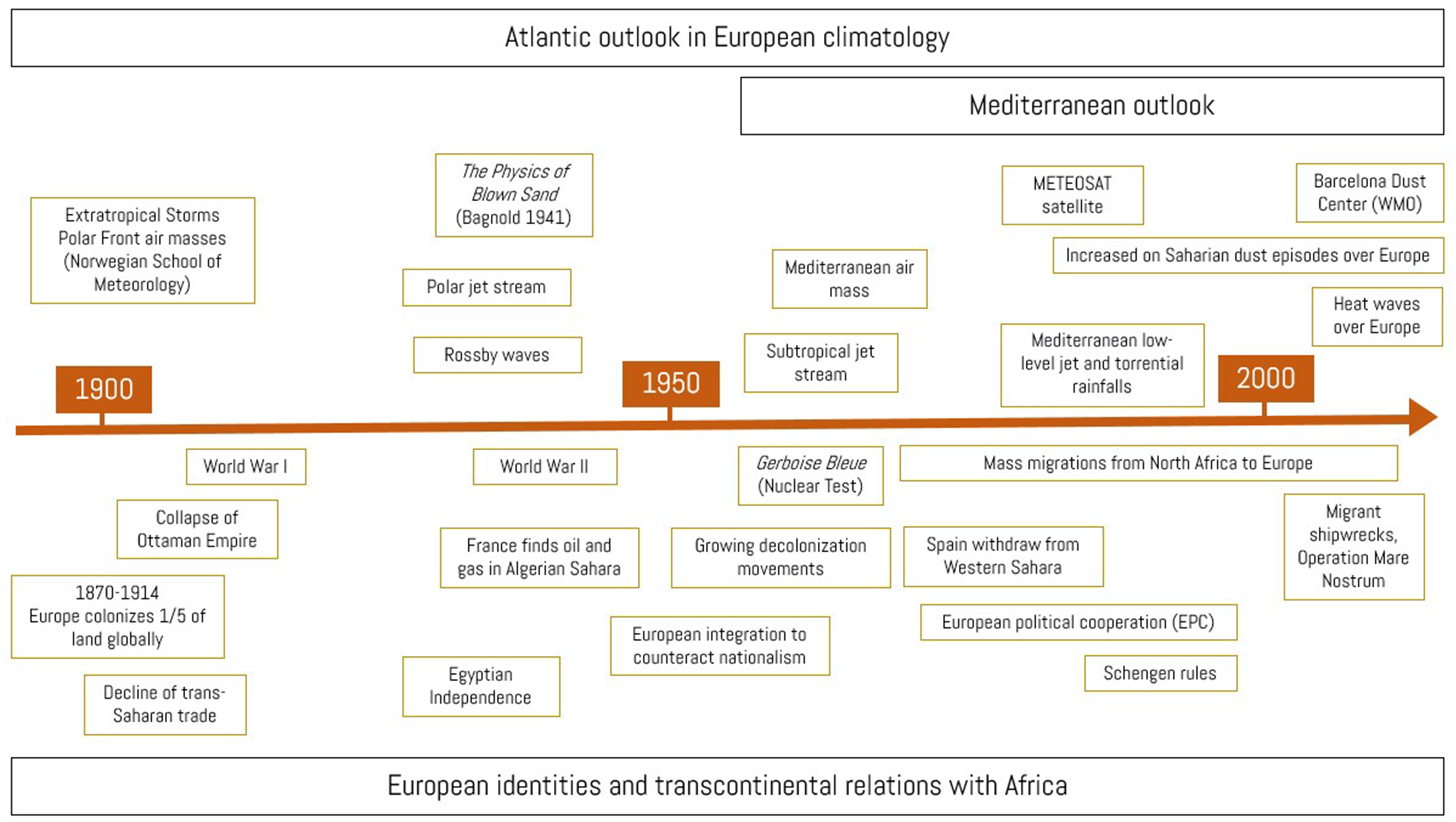
To preface our dialogue with some historical context, we trace a non-exhaustive, twofold timeline of events throughout the past 20th century: developments in meteorological research on the one hand, alongside Europe’s political and cultural formation on the other (Table 1). European climatology, we discern, once adopted an “Atlantic outlook", following weather front theories from the Norwegian Meteorological School in the early 1900s, then arguably turned towards what might be called a Mediterranean outlook", following studies of Saharan air over the Mediterranean Basin (Jansa Guariola, 1959; Olcina Cantos, 2008; Gil Olcina and Olcina Cantos, 2021: 646-652). More recently, the implementation of surveillance networks and organisations validates North African atmospheric dynamics as important processes in European meteorology (METEOSAT geostationary satellite and Doppler-type meteorological radars, EUMETSAT, ECMWF). These networks testify to intense Saharan dust events since 2010 in Western Europe and, above all, notable heat waves in Europe (2003, 2017, 2022, 2023). Indeed, climate change projections (IPCC, 2021–22) indicate the growing influence of subtropical subsidence in European synoptic space.
From “Atlantic” to “Mediterranean/African” vision in climate conceptualisation over Iberian Peninsula and Europe in parallel with sociohistorical events.
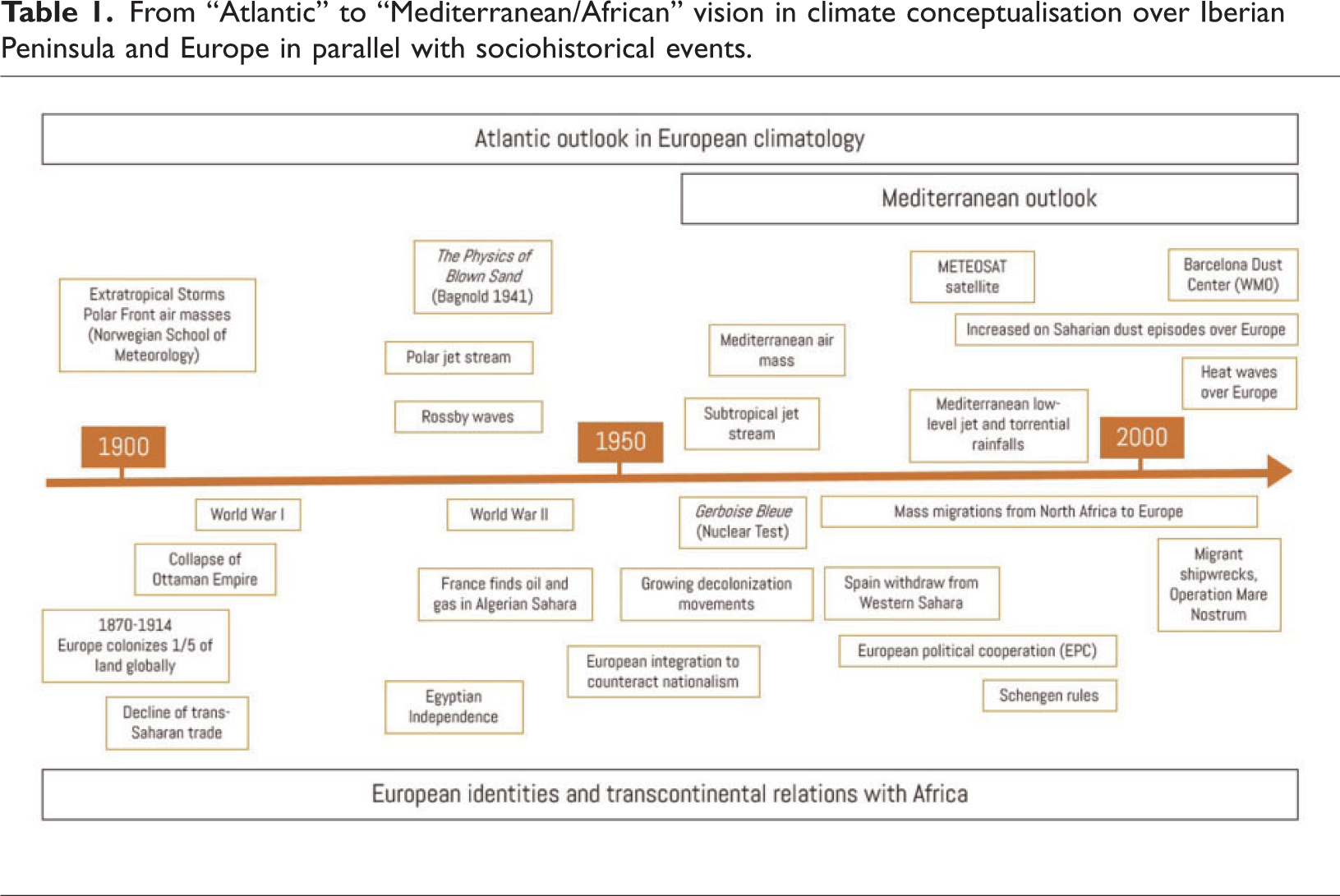
If weather narratives can no longer be viewed as separate from the nexus of European geopolitical borders and their colonial legacies, then the Mediterranean outlook in European climatology might be read with care and a critical eye. The socio-cultural trajectory of this research, which is one-sided in the dialogue but collaborative in the introduction and conclusion, is instructed by a feminist, processual approach to studies of cultures and climates put forward by Astrida Neimanis and Rachel Loewen Walker (2014) who invoke “weathering” as an embodied and situated response to the vastness and uneven distribution of climate chaos. Weathering “describes socially, culturally, politically and materially differentiated bodies in relation to the materiality of place, across a thickness of historical, geological and climatological time” (Neimanis and Hamilton, 2018: 80–81). We also lean into other critical theories to this tune from multiple and cross-pollinating lineages, namely: political ecology, eco-feminism, eco-criticism, media theory, and critical race theory. Scholars in these fields reiterate, in distinct ways, that experiences of weather are all-encompassing for materially differentiated bodies: weather is transatlantic antiblackness (Sharpe, 2016: 104); weather stories lurk behind racialisation (Meché, 2022); climate controls (Furuhata, 2022); dusty weather shapes political spaces, livable spaces, possible interventions (Nieuwenhuis, 2018; Zee, 2017, 2022).
This ontological work widens the basis for generating counternarratives, revisionist histories, and other creative or speculative interventions of imaging and imagining otherwise (e.g., Engelmann et al., 2022). One might then ask, when and where can trans- or post-disciplinary interventions take place that might help communities build and weather more hopeful futures? As per Meché’s account of Black/African eco-criticism/futurism, “what other stories can be told?” (2022: 67). What other approaches to artistic practice, weather diaries, urban legends, reporting, forecasting, filmmaking, and poetry might engender other imaginaries of this weather and how to weather it? Beste İşleyen and Nora El Qadim call for more nuanced understandings of Mediterranean spaces and their “entanglements” by questioning “sides” and focussing on the specificities of local and international processes (2023: 5). In this spirit, perhaps one learns to evade land-based logics by drifting with – rather than intercepting or capturing – atmospheric dust (Choy and Zee, 2015). Perhaps the granular as other might be subverted through a speculative address of becoming granular (Jamieson, 2021b) or becoming atmospheric (Stewart, 2011).
In this research, granularity is attempted through experimentation with authorship. Rather than flattening the distinctness of our approaches into one voice, we present two parallel texts edited together. This open-ended, Bakhtinian dialogue is a methodological experiment in moving beyond hegemonic ideas of weather and place by drifting, not unlike dust, from one to disciplinary field to another as a mode of shared research inquiry (Anderson, 2020). A dialogue form can open a “more inclusive debate” and has been used in transdisciplinary discussions about definitions of the Anthropocene and approaches to climate justice (Barry and Maslin, 2016: 2; Roser et al., 2015). Such dialogic exercises provide insights as to differences in perspective, but also help to orient each researcher’s positionality as it unfolds. For “a dialogue cannot be prescribed; its very nature requires that the participants go down paths that the dialogue uncovers and defines” ( MacInnis and Portelli, 2002 : 35).
In our dialogue, we respond to the same four questions about atmospheric dust regarding its ontology, origins, effects, and metrology: What is (Saharan) dust? Where does the dust come from? What kinds of atmospheric conditions does the dust create? How and where is the dust monitored (or not)? The questions or prompts that drive the dialogue are designed to be accessible beyond "a primarily disciplinary orientation” thus placing “the curiosity-driven question first” (Loveless, 2019: 25, italics original). Our responses are in respect to the questions posed, with the dialogue coming in the form of the evolving character of the dust discussed in the interplay between speakers; dust infiltrates the negative space. In composing this dialogue, we tried to avoid continuity errors while switching between authors, while also playing with the dissolution of coherency at times by suspending the expectation to establish a unified discourse, believing that the process of exposing differences between disciplines is more illuminating than diluting them. If there is a continuous thread throughout this polyvocal article, it is a performative attentiveness to following wind-blown dust in all its waywardness without settling on an overdetermined narrative or authoritative perspective. Our “granular geography” is therefore left open to future reframings of the phenomena discussed (Jamieson, 2021a).
Dialogue
The story is not so benign or salubrious in cities further inland, such as Madrid and Barcelona, where mineral dust may mix with, reduce the dispersion of, and thus exacerbate the impacts of local airborne pollutants on human health (López-Villarrubia et al., 2020). So, in my field of climatology, atmospheric dust is generally interpreted as a variable that makes the air cloudy and reduces air quality, that is, with respect to the established standards of air quality (global, European, national, etc.). Other disciplines (ecology, environmental sciences, chemistry) undertake studies of the dust’s chemical composition and aerobiological imprint (Escudero et al., 2005).
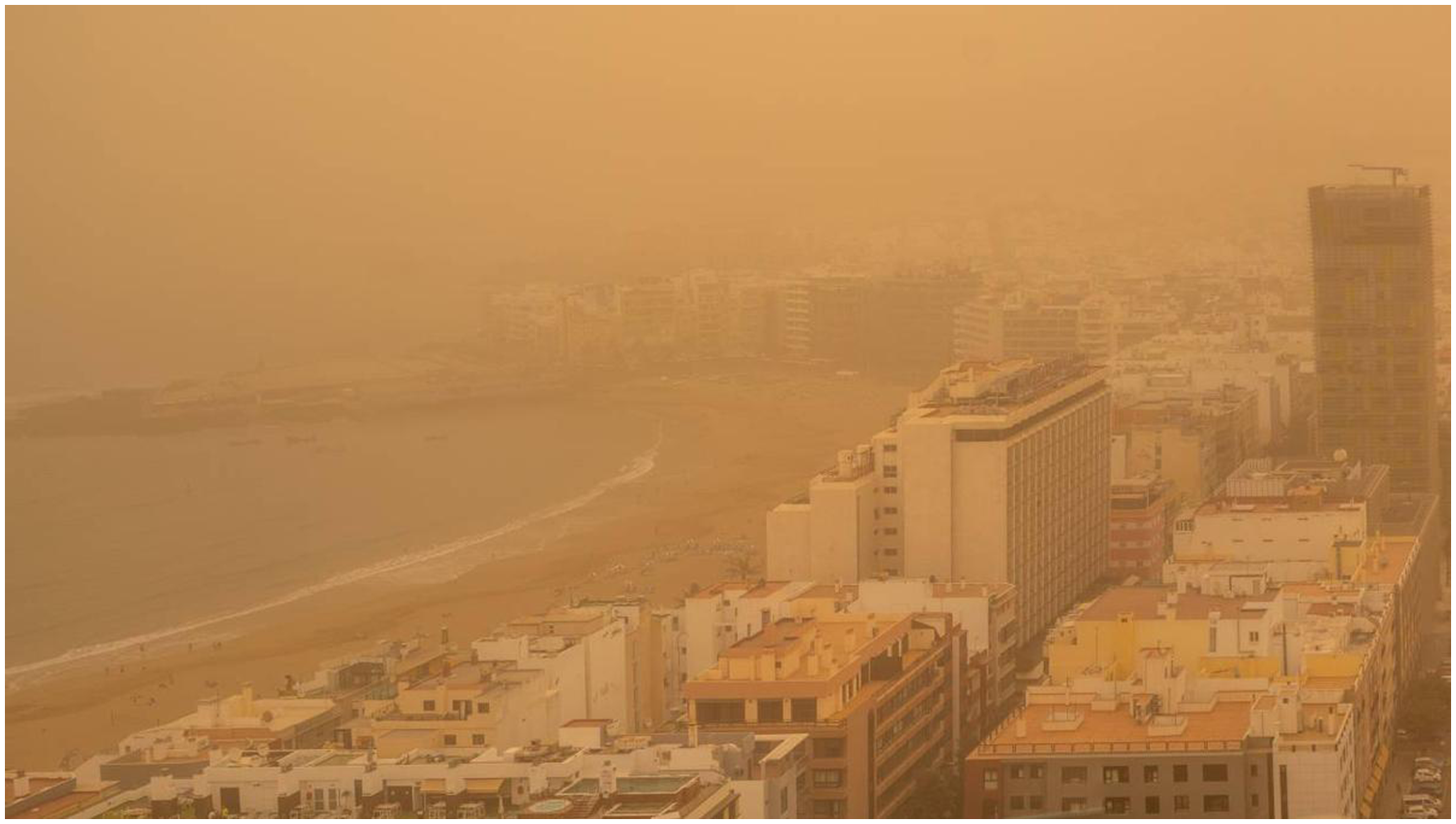
Orange haze due to the presence of Saharan dust on the beach of San Juan, March 14th 2022, Alicante.
Saharan dust particles intercepted byEuropean air quality networks typically range in size from 0.1to 10 micrometres (Perez et al., 2012) ). The dust is mostly formed of particles of silicates (of approximately 60 nanometres), which are covered in sulphates, and bioavailable ion. Yet the dust also transports biological matter, such as the fungus Aspergillus sydowii,a species which has proven harmful for coral formations but not for human beings (Griffin, 2007; Ramirez-Camejo et al., 2022). Other studies have shown that the dust may interact with and co-transport pollutants from further upwind such as bacteria, pollen, petrochemical effluence, smoke from biomass burning, traffic emissions, shipping emissions, and radioactive particles from old nuclear test sites (Bockarie et al., 2020; Marone et al., 2020; Masson et al., 2010; Meola et al., 2015). How one classifies this object according to specific mineralogical, physical, or biological properties depends on the aims of the study.
The dust in our case study is not inherently abject or out of place, nor is it inherently political, but this substance gains broader significance when its displacement disturbs European cartographic imaginaries of enclosed spaces and systems, provoking encounters and frictions with material and immaterial b/orders as well as air quality sensors and other measures of progress (see Barry, 2013: 137–153; Nieuwenhuis, 2018: 30). Analysing the headlines of mainstream news media and public communications of leading meteorological organisations reporting on recent dust episodes that reached the Iberian Peninsula as well as Western and Central Europe, for example in February 2021, March 2022, and June 2023, words such as irruption, intrusion, or invasion are commonly employed, often with an insinuation of a geographically symbolic threat or attack heading towards Europe (e.g., Copernicus, 2020; Rejón, 2023; WMO, 2021).
The very idea that Europe is a site where Saharan dust is “received” positions Europe at the centre and as an endpoint in itself, even though much of the heterogeneous dust mixes with local pollutants and affects climates beyond the continent. This Mediterranean outlook within European meteorology coincides with the developments of new surveillance technologies that position Europe as a recipient of an outside force. Indeed, a parallel history might be tentatively drawn with border surveillance, dramatizing the Mediterranean as a zone of transmission (İşleyen and El Qadim, 2023: 5), flowing with and against the grain of colonialexpansion while echoing perilous border crossings from South to North. For centuries, the Mediterranean has been a zone of transmission between continents, bearing witness to the extraction and profitable circulation of mineral resources (salt, gold, copper, oil, uranium, sand) predicated upon systemic racialization (Yusoff, 2018). So, while Saharan dust may be painted as a spectral or alien intrusion, perhaps “Fortress Europe” is the true ghostly figure of this weather story, “draw[ing] and redraw[ing] the Mediterranean as a demarcation separating EUrope from its ‘Others’” (İşleyen and El Qadim, 2023: 3).
Of course, Saharan dust is not anchored to one interpretation; its transcontinental trajectories might be pereceived as a reminder that separate land masses are ecologically and politically connected by these fluctuations of air made visible. Inhabiting the granularity of the dust renders b/orders of bodies and geopolitics uncertain while passages across b/orders become fugitive (Agard-Jones, 2012; Foucault, 1966: 398; Nassar, 2018: 414). In Elsewhere, within here, feminist theorist and filmmaking artist Trinh T. Minh-ha describes borders as “boundary events” while the crossing or “passage” is a “metamorphosis” like “the conversion of water into steam” (2011: 49–50). The drawings and photographs of Elsewhere, within here by artist Jean-Paul Bourdier portray metamorphing silhouettes of trees and bodies in landscapes. The trees are wind-blown, uprooted, leaves dispersing or transforming into wings or sheets of paper. The bodies are crouching to resemble sand dunes, painted nudes that blend with the horizon – then jump out of their camouflages, figures walking tightropes above dunes or seas or mountains. Granularity is not destructive but generative and might be harnessed as a modality for reimagining relations and passages, whereby the dissolution of established b/orders perhaps invites more fluid cartographic imaginaries and subject positions.
Where does the dust in our case study come from?
These Saharan air ridges (continental tropical air, Tc) are associated with the development of stable weather, with the presence of high surface pressure. Occasionally a “cold drop” may form at some of the ends of the anticyclonic ridge in the middle and upper layers of the atmosphere, generating unstable conditions in the synoptic space in question. In these cases, the combination of Saharan dust in the lower atmosphere and atmospheric instability conditions, although not very pronounced, can lead to the development of weak precipitation, in which the condensation nuclei of raindrops are precisely the Saharan dust that ends up deposited on the surfaces in those areas affected by precipitation. The so-called “mud rains”, “dust rains“ or “blood rains” (due to the reddish colour of the Saharan dust transported from the desert) (Criado and Dorta, 2003; White et al., 2012) are thus formed (Figure 2).
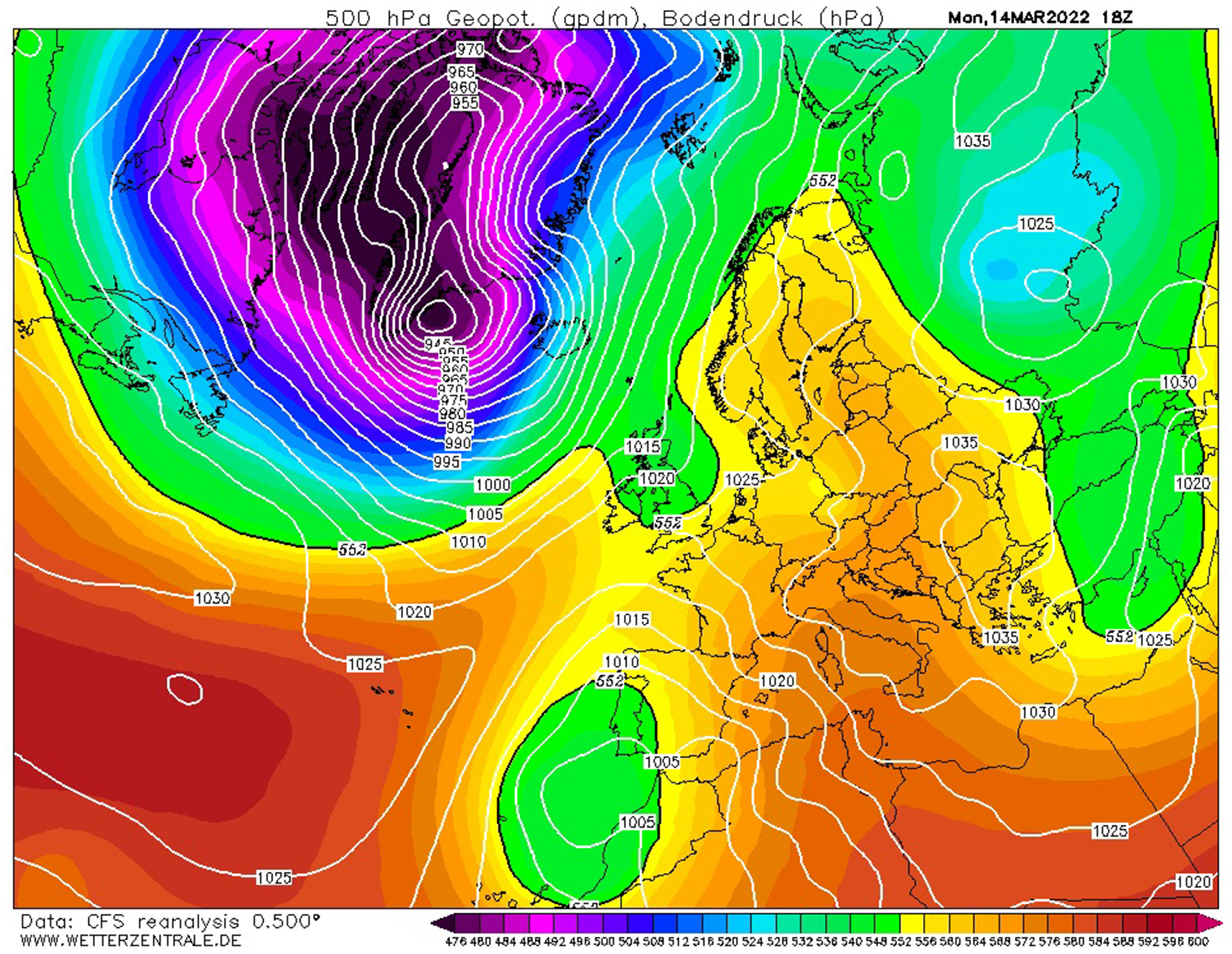
Characteristic atmospheric circulation (500 hPa and surface) of an advection of Saharan dust and mud rain in the south and east of the Iberian Peninsula and the Balearic Islands (March 14, 2022). Source: Wetterzentrale.
The sources and trajectories of the dust are particularly obvious in satellite images (Figure 3). Satellite images are a good source for detecting the presence of Saharan dust in the atmosphere (Cachorro et al., 2008). These images allow us, climatologists, to understand how the European climate is influenced by the atmospheric dynamics of North Africa. Powerful anticyclonic ridges draw the Continental Tropical air, which in this planetary area is called Saharan air, into European airspace. It is the mass of air that originates sequences of high temperatures and, in summer, episodes of “heat wave”. Sometimes, this air mass is loaded with a significant portion of dust, which causes episodes of Saharan dust. The movement of Saharan air in territories closer to the Sahara Desert is always accompanied by Saharan dust in suspension. A simple analysis of the atmospheric situation allows to detect the presence of Saharan dust in the atmosphere of southern Europe or in the Canary Islands (Dorta et al., 2005). The analysis of long time series (1980–2023) of photographs and satellite images shows us that the presence of atmospheric dust from the Sahara Desert is increasingly frequent in Europe, and more recently we have seen episodes of great intensity (Orza et al., 2020; Quereda et al., 1996; Salvador et al., 2022).
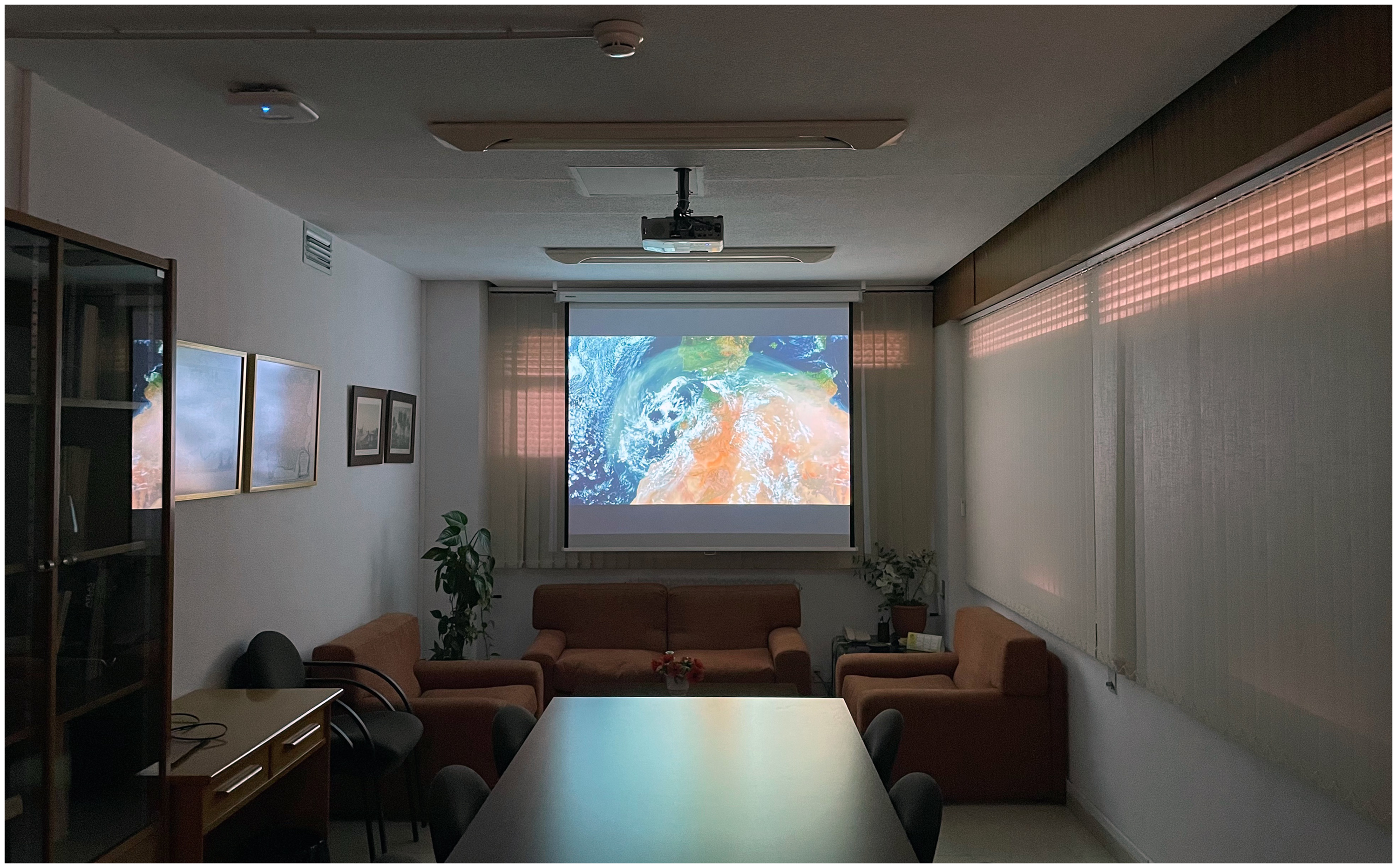
Projection of a satellite image during Sabin's research visit at the Instituto Interuniversitario de Geografía, University of Alicante in February 2022.
Clifford et al. (2019) have studied Saharan dust events in Central Europe during the last 2000 years, based on the analysis of ice deposits from the Alps. In their study, they also point out that a warmer climate favors a greater number of Saharan dust elevation events from North Africa to Europe. The problem is that until the creation of the Barcelona Forecast Dust Center (dependent on the World Meteorological Organization) in 2007, there have been no official statistics on these events. There was no obligation to record these episodes in the observatories of the official meteorological networks (Spain, Portugal), because they were considered anecdotal, singular events, but without meteorological significance. In Spain, research has been carried out using proxy data, which also confirms this increase in events in the last three decades. There is only one official source in Spain, from an observatory in the city of Elche (Alicante, Valencian Community) that has records of mud rains since the 1940s and that confirms this upward trend in Saharan dust events (Quereda and Olcina Cantos, 1994).
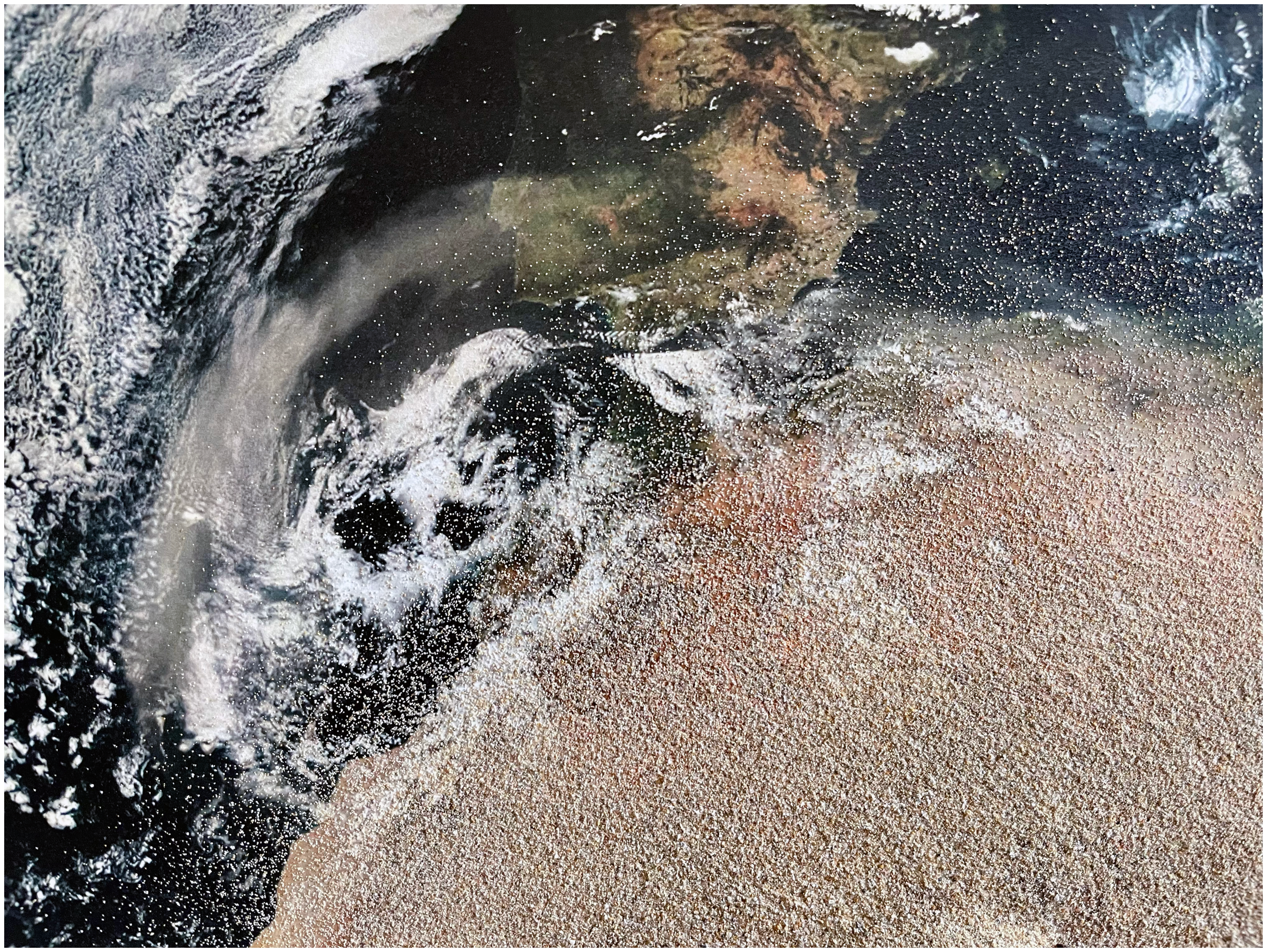
Satellite image of “Saharan” dust overlayed with “Spanish” sand.
Evidence of desert-becoming-weather as a volumetric expansion and disruptive “boundary event”, to use Minh-ha's term, is encapsulated in the meteorological satellite image that allows scientists to understand how European weather events are affected by North Africa (Figure 4). Despite an illusion of neutrality, the satellite image evokes the imagined perspective of a higher power whose insights are "given back" to earthbound subjects (Ingold, 2015: 73; also, Cosgrove, 2001: ix). The perspective forgoes situated knowledges (Haraway, 1988) to align “the aerial gaze with formations of geopolitical power and vision” (McCormack, 2018: 40). The image frames an ephemeral bridge of erstwhile sediment stretching across the Mediterranean, testifying to a displacement and apparent expansion of matter from the Sahara across fringes of sea and land that constitute the geopolitical borderlands of Europe: the southeast façade of the Iberian Peninsula, the Balearic Islands, the Canary Islands off Northwest Africa, and the autonomous cities of Ceuta and Melilla on the African continent.
During a Saharan dust episode, the satellite image appears with continental edges obscured by this sweeping centrifugal movement of desert matter. This specific trajectory is steeped in broader cultural narratives of mobilities across the continents, heightened by a contemporary shoring up of Europe (Mbembe, 2017: 177). Countries on the “edge” of Europe, like Spain, play a special role in managing these boundaries. Ancient superstitions about the calima and sirocco as “dark” and pathological (Watson, 1984: 279) echo throughout recent news headlines that sensationalise, militarise, or pathologize the weather: Yet again, an outbreak of desert/Saharan dust strikes/hits Europe! One scientific article even refers to the microbial communities of Saharan dust deposits in the Dolomites as legal immigrants (Weil et al., 2017), reminiscent of dehumanising and racialising metaphors that have been applied to people who journey across the Mediterranean towards Europe (Sharpe, 2016: 15). Weather and the Other are simultaneously reinscribed (Berland, 1994: 102) as part of an overarching “border spectacle” (De Genova, 2015). The dust may be everywhere, yet language ensures that this material remains “foreign”, proximate yet distant (Mbembe, 2017: 160).
With each occurrence of Saharan dust clouds in Europe, photographs scatter across social networks and news media, depicting a hazy atmosphere from elsewhere, that has miraculously materialised on one’s doorstep. Conditions of perception and respiration have altered dramatically – literally overnight – and yet the landmarks remain the same. Scenes of sepia cityscapes and sandy ski slopes become a source of fascination. Journalists and bloggers compare the transformed aesthetic to the planet Mars or dystopian sci-fi, infusing the landscape with “multiple places and times” (Messeri, 2016: 31; Figure 5). Did you know… begins a tourist guide to the Canary Islands, that North Africa accounts for approximately 55% of global dust emissions? When la calima arrives, the guide continues, the general advice is to check into a spa, to which one might add the subtext, just ignore the sense of uncanny dépaysement. The fine white sand is not so bothersome when extracted from Western Sahara to bulk up the tourist beaches.
Postcard design for la calima, Sabin 2022.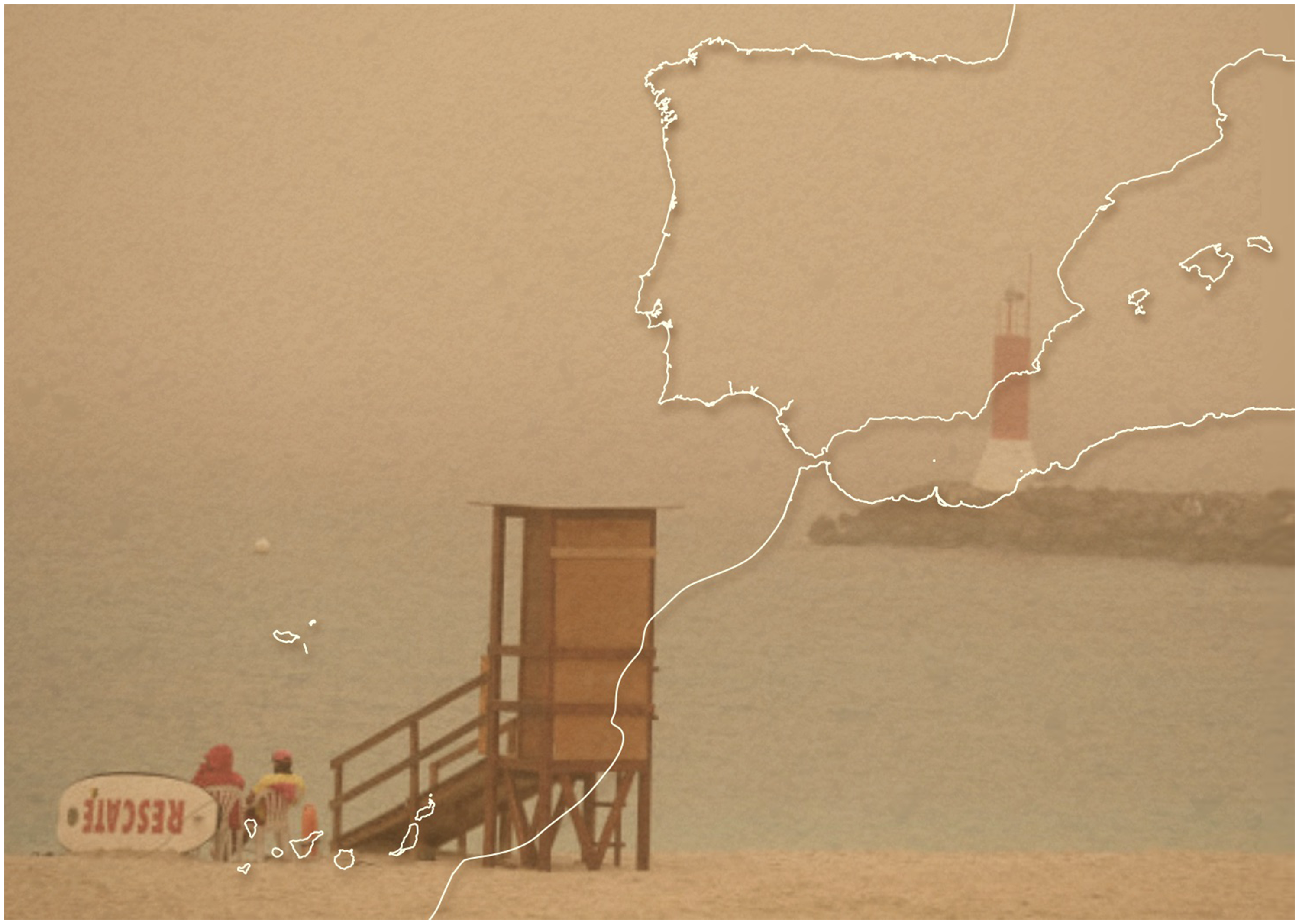
What kind of atmospheric conditions do dust episodes create?
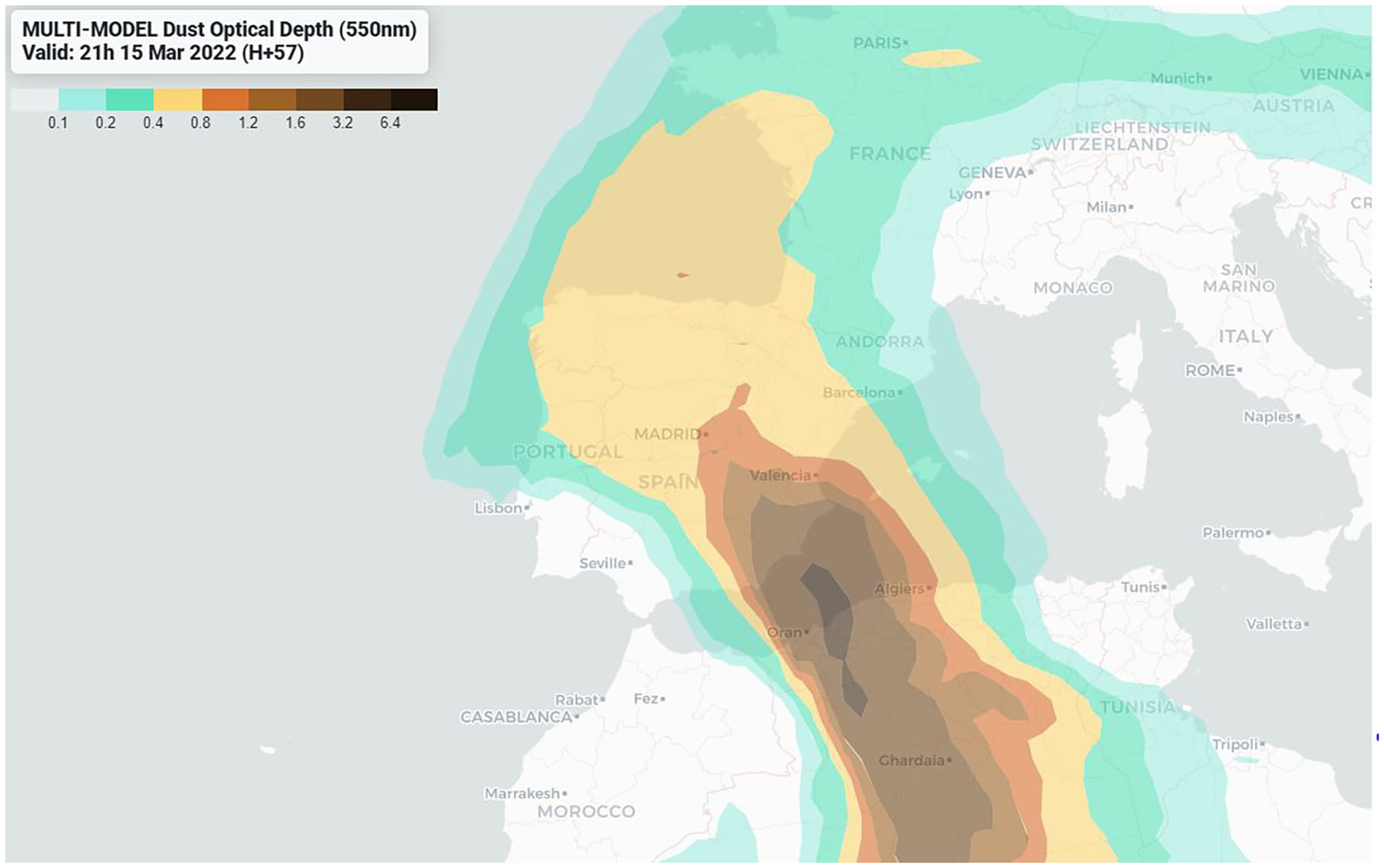
Example of Saharan dust advection forecast map from the Barcelona Dust Forecast Center (March 15, 2022). Source: AEMET.
If the proportion of Saharan dust in the European atmosphere, especially in southern Europe, is high, it becomes a pollutant (PM10, PM2.5, ultrafine). In these cases, the pollution is due to the high amount of dust in the atmosphere. This pollution is not caused by the existence of chemical components dangerous to human health, but by the presence of small particles that can affect the respiratory passages. The size of the dust particles that reach Europe is between 0.1 micrometres and 50 micrometres (the particle sizes monitored in Europe are <2.5 and <10 micrometres). When the dust circulates over European space, the monitoring networks detect its presence and analyse its load and composition in case it is necessary to issue warnings to the population. If the proportion of Saharan dust in the European atmosphere, especially in southern Europe, is high, it becomes classified as a pollutant (Rodriguez-Navarro et al., 2018).
Transcontinental pollution is that which occurs when a pollutant (dust) circulates in high proportion over long distances and crosses continental spaces away from its original source. In the case of Saharan dust, the two paths that generate transcontinental pollution are the "European" path, from the desert to western and central Europe; and the "Atlantic" path, when the trade winds circulate the Saharan dust across the Atlantic Ocean between northern Africa and the Caribbean (Gutleben et al., 2022; Plocoste et al., 2022; van der Does et al., 2021). In this second case, the displacement is usually not so great and normally reaches the Canary Islands, where intense calima days are recorded (Cuevas et al., 2021). In these cases, the atmospheric weather is called "southern weather" in the Canary archipelago, which defines a configuration with winds from the southeast, which is clearly different from the "trade winds weather" or NE weather, which is the most frequent in this geographical area (Marzol and Máyer, 2012).
Animating voices of critical theory together with a weather world of atmospheric dust might incite a futurist reading. To stay with the European Traveller, the quintessential satellite image, or the post-/neo-colonial imaginary of the desert risks re-producing otherness through geographic and geological means – through dust (see Yusoff, 2018: 17). Instead, one might pivot. Theory might unfold by virtue of speculatively “following” dust clouds (Parikka, 2015: 87). Mineral fragments may be treated as interscalar, empirical objects for thinking and feeling with across space and time (Agard-Jones, 2012; Hecht, 2018). The uprising and suspension of desert dust might evoke a poetic orientation of “becoming-open” (Choy and Zee, 2015), an opportunity for reconfiguration following the dissolution of an established order (Nassar, 2018: 414). To pay heed to dust is to notice the cyclical or circular (Nieuwenhuis and Nassar, 2018) de-materialization and re-materialization of entities assumed to be fixed and solid, including one’s own world. Thinking with dust, within dust and the atmospheres it conjures, forces a dissolution of the kind of categorical logic that reinstates boundaries between body and world, ground and weather (see Nieuwenhuis, 2018: 20; also, Nassar, 2018: 424).
To drift is to come undone from the “fixity of Western philosophy” (Lavery, 2018: 12). Drifting requires moving with the conditions of immersion (McCormack, 2018: 13): “flow within flow” and “movement within movement” (Ballestero, 2020). Rather than telling stories of dust, one would tell stories with dust (Nassar, 2018: 414), detouring into “descriptive eddies and attach[ing] to trajectories” (Stewart, 2011: 452). This tactic also debunks notions of matter out of place. For place does not precede matter in order for matter to arrive and be out of it. Matter continually remakes people and places. Dust makes islands. Before and after Europe, there remains but a patchwork of materially entangled islands (Chandler and Pugh, 2021; Pugh and Chandler, 2021). As philosopher Michael Marder points out, “there is no transparent support underneath layers of dirt. It is dust all the way down” (2016: 110). And all the way up. Fingertips draw in sand, eyes scan the horizon for dust clouds, breath inhales dust to blow over dusty artefacts and conjure up past worlds.
To face dust is to face not the Other, but the self (Marder, 2016: 6). Kathryn Yusoff diagnoses that the “Anthropocene cannot dust itself clean from the inventory of which it was made” (2018: 32). A poignant example is the Cesium-137 detected in swabs of atmospheric dust in France. The radioactive isotope was traced back to French nuclear test sites in the 1960s Algeria (Henni, 2022). Some of the detonations took place even after the nation was declared independent from its colonisers. And now, writes Samia Henni, these “spectres of France’s colonial toxification of the desert are haunting people across Europe” (2021). The contaminated atmosphere serves as a seasonal reminder of the “uneven spatiotemporal distribution of nuclearity” (Hecht, 2012: 249), and specifically the ongoing exposures of Algerians to radioactive contamination nearer the source (ACRO, 2021). What kind of atmospheric conditions do dust episodes create? The effects “continue to radiate both temporally and spatially, travelling by way of footsteps, weather patterns, water aquifers, cells, DNA, bones, milk, roots, soil, marketplaces, memories, dust” (Jarvis, 2022: 56).
How and where is this kind of atmospheric dust monitored?
For the study of these episodes, the most important sources of data are daily meteorological notes, meteorological satellite images (visible channels) (Asutosh et al., 2022) and secondary sources (urban photographs, news in the media and social networks). In Spain, Saharan dust episodes are not necessarily included in the daily records of the official observatories of the state network. Therefore, it is necessary to rely on data from secondary observatory networks (meteorological amateurs or news in the media and social networks). The interest of the media in these episodes has grown significantly in recent years due to their exceptional nature and the "rarity" of the presence of Saharan dust in the atmosphere in an area theoretically far from the desertic source.
As I mentioned earlier, the major problem for the study of Saharan dust events is the lack of historical data. Only if very intense episodes took place, it is possible to find some reference, in meteorological notes or in written press reports (Criado and Dorta, 2003). But this greatly limits the study of frequencies and trends. Some investigations have used "proxy" sources such as the record of cars washed in automatic car washes, which occurred days after the deposition of Saharan dust on the vehicles (Figure 7). Indeed, the next day and during the following days, there is a massive presence of vehicles in car washes, which allows to detect possible days with Saharan dust and mud rain (Quereda et al., 1996). Once this anomalous visit of vehicles to the car wash has been detected, it is necessary to confirm the development of a Saharan dust episode from meteorological sources such as weather maps. These methods make it possible to fill the existing gaps in the historical annotation of these episodes.
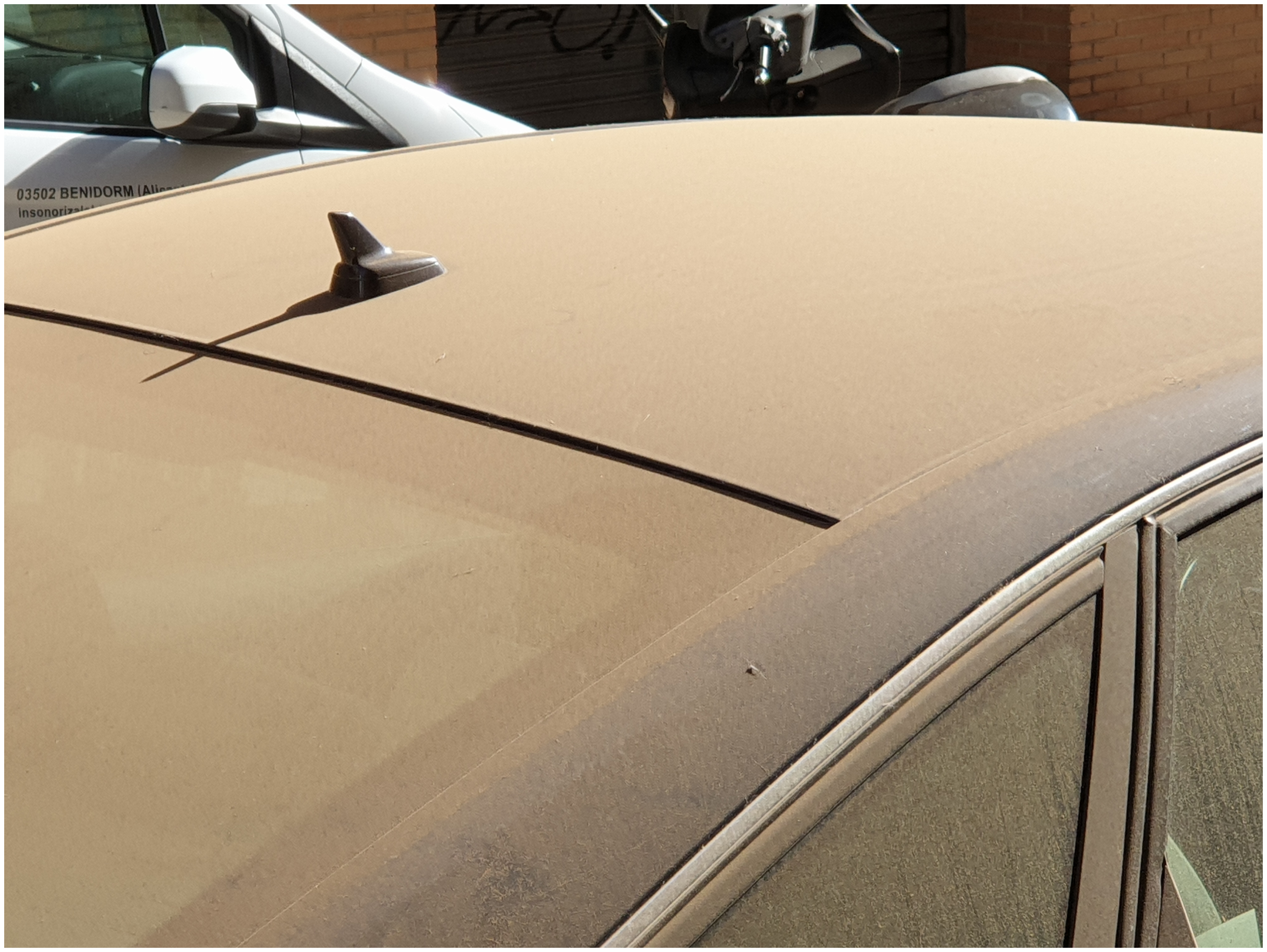
Effects of mud rain on vehicles after an intense deposition. Alicante, February 6th 2021.
It is significant that some acts of sensing and interception are imbued with significance by news media while others less so. The perennial fallout of Cesium-137 gained notoriety only when the dust “returned” to France (ACRO, 2021), even though exposure is more acute upwind, nearer the source, with palpable, perceptible, “radiant” effects (Jarvis, 2022). Of course, Saharan dust is also “from elsewhere” in most of the African continent, “blowing out from the desert proper and coextensive with the phenomenon of creeping desertification of mobile borders” (Tousignant, personal communication, 23 February 2023). The seasonal presence of dust in West African cities like Dakar, Senegal and its association with negative impacts on health, both biomedically and in the vernacular, have long been known (de Longueville et al., 2013; Toure et al., 2019). Heterogeneous layers of dust appear on buildings, clothes, plant leaves. In Port Harcourt, Nigeria, particles irritate respiratory systems and make skin sooty when mixed with black carbon from oil refineries and fossil fuel combustion (Hecht, 2019).
There is comparatively less monitoring infrastructure on the ground in North and Central Africa, with South Africa receiving some coverage via SAAQIS,1 though the situation is changing with sensor networks like AfriqAir in Ghana set up in 2020 (Giordano and Jaramillo, 2021). Atmospheric scientist Eloise Marais informed me that satellite observations show where pollution hotspots are and it is possible to parse the atmosphere for the “unique signal” of dust from the Sahara, detecting where dust clouds came from (back trajectory models) and where they are going (forecasting). Africa has the advantage of staying bright all year, which facilitates space-based analyses, Marais informed me, but more ground-based analyses are needed to clarify, corroborate, and calibrate satellite data (Jerrett et al., 2017). According to AfriqAir, local infrastructure, local partners and stakeholders, and accessible data are required (Giordano and Jaramillo, 2021). Rather than simply repurposing European or U.S. models of air pollution, more place-based understandings that address the specific situations in Africa are needed.
Saharan dust mixes with other substances in the air. Parts of Africa have intense concentrations of aerosols, due to biomass burning in the Sahel, charcoal, indoor air pollution, transport and other fossil fuel emissions (Bockarie et al., 2020; Marais et al., 2019; Marais and Wiedinmyer, 2016). Africa is the most exposed to biogenic dust, yet the combined effects of this dust with local sources of pollution are understudied (de Longueville et al., 2010: 4–5). What is more, the “locality” of these pollutants could be called into question, given that super-polluting vehicles and dirtier fuels wind up in Africa to meet Japanese, European, and North American air quality and emissions standards (Abera et al., 2021; Hecht, 2019). The resulting road traffic emissions are worse than what Europeans experience, yet less monitored, evoking the inattention of Rob Nixon’s concept of “slow violence” (Nixon, 2011). Given the influence of international policy and global markets (e.g., for diesel) as well as transcontinental pollution – which flows both ways with European ozone in North Africa being one example – there is the need for an inter- or trans-national approach to air quality (Duncan et al., 2008: 2280). In an ideal world, such an approach would account for multiple scales in recognising the ongoing legacy of colonialism in environmental regulation and pollution (Liboiron, 2021) as well as the need to address local problems locally.
While more air quality data are needed and are being developed, along with more specific models to inform effective mitigations against pollution (Garland and Plantinga, 2020), that is not to say that evidence of a burgeoning environmental health crisis is lacking, merely under-publicised (deSouza and McKinney, 2020). In answering the question, “how and where is this kind of atmospheric dust monitored?”, I began with an account of technoscientific monitoring, but one might also refer to qualitative modes of monitoring. Indigenous knowledges might be a guide here. Seth Appiah-Opoku advocates indigenous knowledges within environmental management because not only do such knowledges offer an “intimate and detailed knowledge of the environment” but also a technological capacity to respond based on iterative improvement and a place-based, ecological worldview (2006: 206). Knowledge co-production and sharing beyond numerical air quality monitoring might speak to the relations between breathing bodies and the environment. After all, these relations are ultimately what air quality indices should serve as proxies for. “You don’t need an air quality monitor to tell you when you are laboring for oxygen”, as Gabrielle Hecht (2019) puts it, drawing attention to sensorial and aesthetic encounters with Saharan dust and myriad other airborne particulates as an act of informed witnessing.
Conclusion: Lessons with atmospheric dust
By way of conclusion, we shall tease out any latent capacities for performing this drift as a dialogue. First, we set out with the same object of study (Saharan dust and its arrival in Europe) viewed from dual perspectives (critical cultural theories and climatology). We observed that the effect (social impact of the arrival of Saharan dust) cannot be understood without the explanation of its cause (explanation of the North African atmospheric dynamics and its influence on Europe); but the cause equally finds meaning in the context of European meteorological science, with the transition from an “Atlantic” to a “Mediterranean” outlook. Meanwhile, we position this transition in relation to the emergence of European identity, borders, and sociohistorical relations with North Africa.
We have not sought to collapse or synthesise (and thus dilute) the lineages of climatology and cultural studies, but instead to show how the coming together of two strands of discourse prime reflection on an atmospheric phenomenon in a socio-cultural context in transformation. Our voices edited together approximate a more holistic study of said phenomenon. Yet our discourse is not synthesised and leaves space for difference, a space in which the reader’s interpretation may drift between “dissonant forms” to “anamorphically shatter single-point perspective” (Loveless, 2019: 105).
Like the swirling airs that transport it, dust is uncannily present and graspable (to be swept up or choked on) while also evidencing spatial and temporal extensiveness both materially, as a climatic and topological force to be reckoned with, and in cultural imaginaries as a harbinger of the inescapable processes of decay and disorder that might be systematically projected onto an Other. Alternatively, following atmospheric dust, in dialogue with both climatology and critical theories, might bring one to dwell on the the metamorphic passage, the drift, the ambiguity of being between origin and source, of encountering otherness within oneself, on either side of a border, suspended in air between monitoring devices or worldviews where things become either fixed in place or out of place. Following atmospheric dust might present an imaginative, speculative, embodied, temporal, mapmaking strategy for “questioning the practices of management and discourses of weather neutrality that we have inherited” (Hamilton and Neimanis, 2018: 1).
By way of example, anthropologist Jerry Zee (2022), who has undertaken analogous research on the political ecologies of dust storms in China , claims that dust events call for novel political spatialisations that attend to processual dynamics of following dust. Zee (2017) emphasises the conditions of downwind-ness and upwind-ness that connect and materially collapse different spacetimes, rather than divisive fixations on origins, boundaries, and destinations. Hecht similarly follows the “cyclical” changes in air, such as the Harmattan blowing over West Africa and across the Atlantic, as well as “linear” changes of dust leaving the desert, mingling with black carbon at another place, then eventually “settling” someplace else, dusting cities and infiltrating bodies; fertilising marine algae, or Amazonian soil; melting snow in the Alps; transforming respiratory, mineralogical and microbial conditions of life (Hecht, 2019).
In this study, downwind–upwind relations reveal how post-colonial social histories co-emerge with experiences and narratives of weather and climate. An investigation of such narratives in Spanish places became multi-sited as it became evident that ideas of place and material flows compose one another through extensive relations, which have often manifested as a logic of otherness. By acknowledging drift and following the dust, however, these relations might be imagined otherwise. Dwelling on a visual representation of this possibility, we imagine stepping into the nonsensical middle of a rosa de los vientos, a compass, featuring the winds of the Mediterranean. Arms outstretch, fingertips comb the sea breeze, in a gesture of becoming-open to the ever-changing conditions of immersion: air–wind–algae–dust–breath. The dis-orientation is a kind of emplacement that refuses the logic of the compass while attuning to forces from an infinity of degrees, like ripples in a spider’s web. This half-memory is how we visualise the “middleness” Minh-ha articulates (2011: 70): where extremes lose their power; where all directions are (still) possible […] a place of decentralization that […] takes into its realm the vibrations of both, requiring thereby constant acknowledgement of and transformation in shifting conditions. […] Difference is thus paired with harmony, rather than with conflict […].To return to Deleuze and Guatarri’s terms, what is designated in this space between the two extremes is […] “[…] a transversal movement that sweeps one and the other way.”
Footnotes
Acknowledgements
The authors wish to thank Samuel Biener for the climatological sources. Thank you to Sam Randalls and Noemi Tousignant for providing feedback on early drafts and Eloise Marais for answering questions about air quality monitoring in Africa. Andrew Barry, thank you for inspiring the dialogue form. We are grateful to the anonymous reviewers and journal editors for encouraging and refining our innovative approach. Thanks to members of the (unofficially named) Material Flows research group: Sabrina Chou, Kristine Ericson, Charlotte Leib, and Jia Weng for all the generative conversations. Thank you to Benjamin Lamptey and Frank Ohene for explaining African weather monitoring several years ago; it planted a seed. Last but not least, we thank Sarah Nuttall and Megan Vaughan for including this paper in the WISER-UCL Breathing in: Air and atmosphere seminar series.

Declaration of conflicting interests
The author(s) declared no potential conflicts of interest with respect to the research, authorship, and/or publication of this article.
Funding
The author(s) received no financial support for the research, authorship, and/or publication of this article.