




Abstract
This essay contributes to literature on the intersections of white settler colonialisms, racial capitalism, and U.S.-Mexico borderlands history by tracing the web of spatial, temporal, and legal power relations that produced El Paso, Texas’ seemingly legitimate possession of stolen Mexican territory known as “El Chamizal” in the El Paso-Cd. Juárez borderlands. This land theft became the Chamizal Dispute: an international land and boundary conflict between the U.S. and Mexico caused by the meandering Río Grande that defines the “fixed” international border between El Paso, Texas and Cd. Juárez, Chihuahua. In the 1860s, multiple shifts in the Rio Grande “relocated” El Chamizal north of this river/boundary. Soon thereafter, and despite Mexico’s sustained claim to and jurisdiction over this land, recently arrived Anglo American settlers incorporated El Chamizal into the nascent City of El Paso. In 1964, the U.S. and Mexico finally agreed to resolve this conflict by virtue of the landmark Chamizal Treaty, which ceded 630-acres of El Paso to Cd. Juárez as El Chamizal. Contrary to what dominant state accounts and the mainstream historical literature on this settlement would have us believe, however, this ceded land includes only a fraction of the original contested terrain. El Chamizal therefore remains a stolen tract of land nestled within the heart of El Paso. Drawing on oral histories, court testimonies and affidavits, and an array of binational records, this essay demonstrates that this ongoing theft is not a finite or complete project. Rather, the process hinges on a fragile web of spatial, white settler temporal, and legal practices of concealment/denial anchored to a colonial rumor that refuses to open this region to the mystery and wonder of the Río Grande’s “wayward life, beautiful experiment in how to live.”
Keywords
Introduction
When Dolores Irene Zapata had her high school report on the Chamizal Dispute published in the Texas State Historical Association’s 1953 issue of The Junior Historian, she could not have known that in just 10 years’ time the U.S. federal government would announce to the world what she had been led to believe was impossible. That is, in the late nineteenth century, Anglo American settlers had illegally incorporated Mexican territory known as “El Chamizal” into Zapata’s hometown of El Paso, Texas, and that, after more than a century of conflict over this territory, the U.S. would finally return El Chamizal to Cd. Juárez, Chihuahua. To be fair, this announcement shocked everyone across the United States and Mexico—let alone fronterizos in the El Paso-Cd. Juárez borderlands. For El Pasoans, however, this declaration from their government was especially staggering, as the widely accepted narrative in the Texas city was that the Chamizal Dispute was—and had always been—an illegitimate territorial conflict. Indeed, as most El Pasoans saw it or had been led to believe, Mexico’s claim to El Chamizal had been absurd because this tract of land—consisting of El Paso’s historic neighborhoods of Chihuahuita, Segundo Barrio, and parts of downtown—had never not been part of the Texas city. Even Zapata, who was a teenager at Jefferson High School in 1953, understood this to be true. “During the course of its gradual formation,” reads Zapata’s article, “the Chamizal tract has always been a part of the growing town of El Paso, Texas” (Zapata, 1953: 4).1 As such, she continues, “[t]he United States and the state of Texas have always exercised jurisdiction over the tract.” 2
This version of the Chamizal Dispute was so entrenched in El Paso, so couched in the ethos of the city, that by 29 August 1963, when U.S. President John F. Kennedy signed the Chamizal Convention in Mexico City promising El Chamizal’s return, any suggestion of this narrative’s fabrication stirred up a complicated mix of confusion, hostility, and denial among El Pasoans. “[B]y the Treaty of 1848, El Chamizal is ours forever,” responded one El Pasoan, Ralph Hamilton, in a 1963 letter to the El Paso Times following news of the proposed Chamizal Treaty (Hamilton, 1963: 9). “El Chamizal is ours,” he insisted, “if not, where is the proof?” This essay traces the fragile web of temporal, spatial, and legal power relations that not only produced this narrative version of the Chamizal Dispute and, in turn, El Paso’s seemingly legitimate possession of El Chamizal, but moreover this city’s ongoing theft of this land (Figure 1).
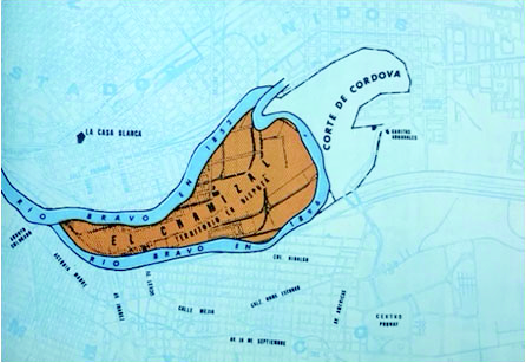
Mexican map showing the contested area known as “El Chamizal” between the 1852 and 1896 Río Grande channels. Other estimates for El Chamizal, however, represent this area as far larger, exceeding 1000 acres. Today, the area shown here covers El Paso’s First Ward of “Chihuauita” and parts of the Second Ward of “Segundo Barrio.” Only a portion of the area shown in this map was ceded back to Mexico as part of the Chamizal Treaty. Source: El Chamizal, solución complete: album gráfico by M. Quesada Brandi.
I argue that at the root of this complicated web are binational settler anxieties toward the Río Grande that defines U.S.–Mexico boundary through this region and whose meanderings created El Chamizal’s contested terrain. Ever since this river was established as a fixed geopolitical border in 1848, the Río Grande through the El Paso-Cd. Juárez borderlands refused to comply with this colonial fantasy and instead did as it has always done: wander across a four-to-six-mile alluvial plain that had developed over centuries of accumulative meanders. Although binational state records confirm that El Chamizal was south of the river in 1848 (and in 1852 when the Río Grande was officially surveyed as the boundary), unprecedented floods in the 1860s caused meanders in the river to “relocate” this land—known at that time as Paso del Norte’s (later renamed Cd. Juárez) most northern district Partido Chamizal—north of the Río Grande and seemingly into U.S. jurisdiction (de Hinojosa, 2021b: 99-100). As the river continued to flood and meander through the early 1900s and as Anglo American settlers continued arriving to the region, this growing disputed area became colloquially known as “El Chamizal.” Estimates for El Chamizal total anywhere between 590 and 1200 acres; but, in truth, its exact size and location remains highly contested and is perhaps impossible to define due to limited and cursory documentation for the river’s meanderings (de Hinojosa, 2021a: 719). In 1964, however, after more than a century of conflict, the U.S. and Mexico announced they had finally identified this tract of land by virtue of the Chamizal Treaty, which ultimately ceded 630-acres of El Paso to Cd. Juárez as El Chamizal. This ceded land, however, includes only a fraction of the originally contested terrain—an unequivocal fact that both the U.S. and Mexico have since obscured and denied (Figure 2)
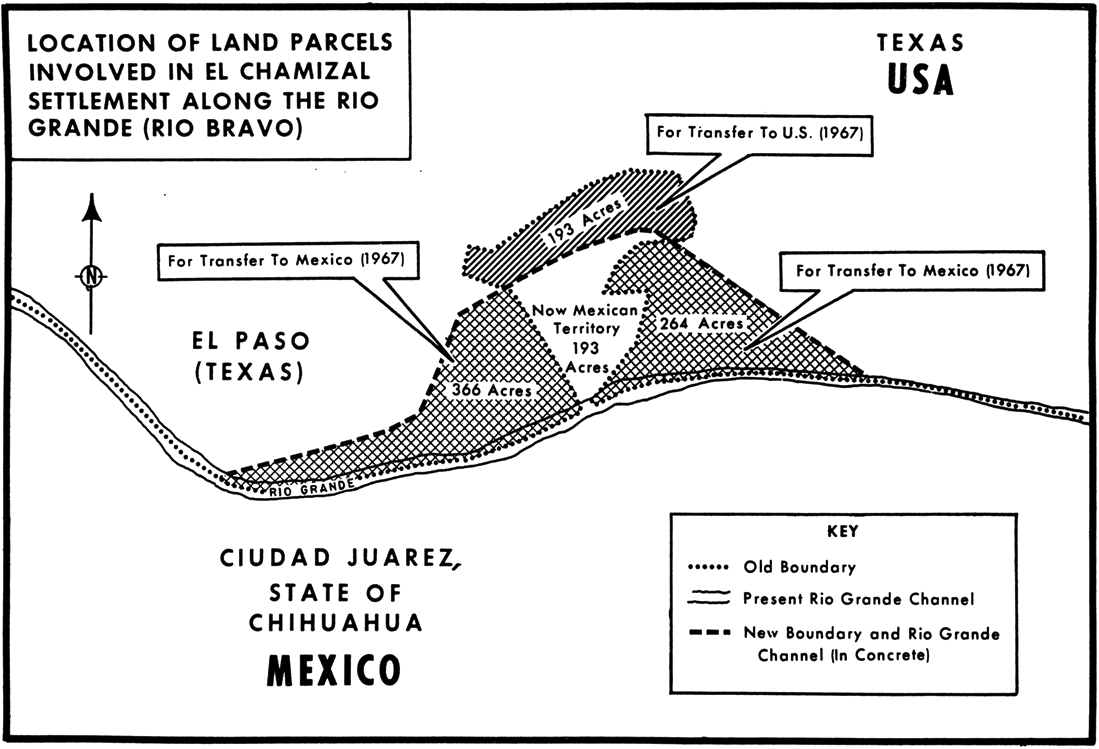
Map showing location of land tracts involved in the Chamizal Treaty. A total of 630 acres of South El Paso were ceded to Mexico as “El Chamizal;” however, only the western portion of 366 acres consisted of the original El Chamizal. El Chamizal is a much larger tract of land still north of the U.S.–Mexico border in El Paso, Texas. Courtesy of the National Border Patrol Museum, El Paso, Texas.
Contrary to what state narratives would have us believe, then, El Chamizal remains a stolen tract of land nestled within the heart of El Paso. This ongoing theft, however, is not a finite or complete project. Rather, it hinges on the fragile web of temporal, spatial, and legal practices of concealment/denial that is the basis of this essay’s investigation, and which I moreover argue is anchored to a colonial rumor that refuses to open this region to the Río Grande’s mystery and wonder. By mystery and wonder, I mean how the river through El Chamizal moves in and out of clarity and consists of multiple, evasive forms and meanings that neither the U.S. nor Mexico (and their attendant settler subjects) could fully predict, control, or understand. In this way, I insist that the river through El Chamizal enacts a wonderous and self-determined “fugitive landscape” that “clamour[s] for the right to opacity (Craib, 2004: 2; Glissant, 1997: 194). Indeed, it was here at El Chamizal that federal agencies, regional land speculators, and entrepreneurs “hoped to domesticate and modernize a fugitive landscape—what they saw as a wild and barbaric frontier, but it continually slipped out of their control” (Truett, 2006: 6).
Perhaps nowhere was this fugitive slippage more unmistakable in the El Paso-Cd. Juárez borderlands than the Río Grande through El Chamizal. Each summer, as the Colorado mountain snows upriver melted, the Río Grande between these two frontier cities would swell in size, flood, and begin its meandering. Its tendency to overwhelm its width, open new bending, ribbon-like channels and sometimes abandon older channels altogether were not only its defining features, but these characteristics announced the river as both an author of and protagonist in this region wherein it lived unregulated and free. In this way, the river constantly reshaped the landscape in its own ancient, mutable image. In 1852, however, when a binational team of engineers and cartographers mapped this river through the towns of Franklin (later renamed El Paso) and Paso del Norte as the new U.S.-Mexico boundary, the Río Grande’s meandering was perceived as nothing short of anarchy: a river in open rebellion against the boundary commission and a threat to the sanctity of the U.S.–Mexico border. Elsewhere, I have argued that this rebellious river refused various ideological and geographic projects required to enact and anchor both the U.S. and Mexico as settler possessions (de Hinojosa, 2021a: 714). The river did so by denaturalizing what Aileen Moreton-Robinson (2015) has called “white possessive logics” and, in turn, unsettling the supposed inevitability of white settler colonial processes and structures. In this way, I remain convinced that this unruly river is this land’s pedagogic and haunting endeavor relentlessly reminding settler society of its unjust past/present as well as its fragility and impermanence (Simpson, 2014: 20).
In this essay, I build on these earlier arguments by tracing a twofold dynamic: (1) How the mystery of how the Río Grande moved across this landscape unsettled both Mexican and Anglo American settler possession to El Chamizal, and (2) How the nascent American settler society of Anglo El Paso anxiously attempted to resecure their possession of El Chamizal by concealing/denying this mystery via rumor and then marrying this rumor to the law. To demonstrate this dynamic, I focus on the Chamizal Dispute as it was unfolding between 1856 to 1911. During this time, this conflict is entrenched in a single question: Did the Río Grande between El Paso and Cd. Juárez move gradually and imperceptibly from its surveyed 1852 boundary location through erosion—a process environmental scientists and engineers call “accretion”—or did it move suddenly and abruptly through a process called “avulsion?” 3 The distinction here (gradual accretion v. sudden avulsion) was of utmost importance and is known as “the law of accretion:” a legal principle that stipulates that if a river-boundary moves gradually through erosion (accretion) the boundary moves with the river; however, if the river-boundary moves suddenly (avulsion) the boundary remains at its surveyed location. At face value, this seems a simple enough question. Yet, ever since the law’s first application to the Río Grande in 1856, American and Mexican authorities have never been able to definitively determine whether an accretion or avulsion shift transferred El Chamizal north of the Río Grande. The mystery of how (gradual v. sudden) the Río Grande moved was particularly troubling, however, to Anglo El Pasoans. This mystery so haunted the Anglo American racial control of colonial space in this region that it required categorical concealment and denial through the only way possible: the rumor of an 1848 accretion southward shift that legally moved El Chamizal north of the river in the U.S.’s territorial favor. “During the course of its gradual formation,” reads Zapata’s (1953) high school report, which draws on this rumor and illuminates its longevity, “the Chamizal tract has always been part of the growing town of El Paso, Texas.” As I will show, this “always” was established as “fact” by narrating El Chamizal as the product of this rumored 1848 accretion shift.
By engaging Anglo El Paso’s rumor for what it is—a nervous, precarious colonial story couched in nonnormative, unauthenticated evidence and time’s knotted relationship with the law—this essay confirms what this rumor seeks to conceal and deny: that this region is integrally involved with El Chamizal and the Río Grande and what I identify as this river’s “wayward life:” its self-determined, fugitive opacity and “beautiful experiment in how-to-live” (Hartman, 2019: 203–204). This argument unfolds in five parts. I begin by contextualizing Anglo El Paso’s rumor within the literature on hearsay and settler temporality to understand how the accretion/avulsion mystery shaped understandings and narratives of time, space, and power in this city. Next, I draw on archival sources to trace the seeds of Anglo El Paso’s rumor. In turn, I demonstrate how the historical geography of El Paso is entrenched in an enduring colonial scheme to obscure the accretion/avulsion puzzle and El Chamizal’s formative role in the making of this city. Next, I examine the “mode of rationalization” that enabled multiple renditions for this rumor to spread unchecked (Moreton-Robinson, 2015: xii). Thereafter, I examine legal documents, briefings, and affidavits to show how one 1903 civil lawsuit codified Anglo El Paso’s rumor into a legal truth. Perhaps most importantly, however, I demonstrate how the Río Grande has and continues to unsettle this institutionalized rumor. As a result, I ultimately turn to the Río Grande through El Chamizal as a land/place that instructs us not simply in matters of white settler colonialism’s fragile pretenses to power, but why we must open ourselves to land’s wayward poetics of unknowability in our pursuit of “otherwise worlds” (Lethabo King et al., 2020).
Race-related rumors and the prose of countersovereignty
Just as all settler societies have their founding myths that lend credence to power, Anglo El Paso summoned their concealment of the accretion/avulsion mystery through a collectively authored, unsubstantiated rumor. This rumor insisted that the U.S. had claimed and exercised “an undisturbed, uninterrupted, and unchallenged possession of the disputed territory since the treaty of 1848” (Reports of International Arbitral Awards, 2006). This undisputed possession was supposedly the result of an 1848 accretion southward shift that legally rendered El Chamizal U.S. territory via the law of accretion. So seductive was this rumor that by the turn of the twentieth century, Anglo American lawyers in El Paso would repeat it in their legal arguments, judges would accept it as evidence in courts of law, and well into the twentieth century historians and scholars of international river-boundaries would repeat this rumor in their scholarship.
The profound repetition of this rumor against a historical record that not only confirms the legitimacy of the Chamizal Dispute, but which moreover suggests credible evidence for avulsion southward shifts, illuminates how rumor often flourishes where White supremacy necessitates unverifiable evidence to maintain the power of Whiteness . In this way, Anglo El Paso’s rumor is indicative of what Manu Karuka has defined as “the prose of countersovereignty:” colonizers’ anxious and fragile narratives and claims to power that require constant repetition and violence to dress them in any semblance of legitimacy and which often fray and unravel thus “underscoring institutions and ideas [sic] of the United States as not native, but alien; not natural, but produced through colonialism” (Karuka, 2019: 13, xii). While Karuka articulates the prose of countersovereignty as a settler response to Indigenous sovereignty, I read Anglo El Paso’s rumor as a twofold settler response to Indigenous and Mexican sovereignties to El Chamizal. Of course, Mexico’s sovereignty to this land is itself a settler colonial claim, as Spanish and Mexican mestizo settlers first stole El Chamizal (and this region more broadly) from the Manso, Suma, and Mescalero Apache peoples. But when this region became the U.S.–Mexico borderlands in 1848, U.S. property law and racial logics relegated the landed, mixed-race Mexicanos—including the elite “Spanish” families who owned property in El Chamizal—into a racially inferior and landless category that was “Other” to Anglo Americans. El Paso, Texas, is thus founded on acts of overlapping dispossession and is a site of layered colonialites.
Because the legality of Mexican dispossession from El Chamizal was questionable at best, Anglo El Paso required a particular narrative (fashioned through the genre of rumor) to bring this legality into the realm of the irrefutable. The rumor of an 1848 accretion southward shift did just this by rationalizing and legalizing Mexican dispossession—or the “racial adjustment”—within El Chamizal (de Leon, 1983: 13). So advantageous was this rumor that eventually it transformed into History—a transformation that experts of hearsay agree is common for rumors, especially when the rumor emerges within a context of hostile racial relations and a fragile power structure that depends on specific narratives to confirm the necessity of uneven racial relations (Knopf, 1975). Ann Knopf, for example, has argued that simply by holding racist beliefs “each race is automatically predisposed to accept certain rumors—unverified reports, exaggerated stories and other distortions of reality—about the other race” and sometimes even their own racial group (154). In these contexts, she says, “[w]e are convinced that the belief is rooted in objective reality […] and thus that the rumor, too, is rooted in objective reality” (158–159). To this end, these “race-related rumors” are functionally tied to social conflict and racist belief systems. They not only materialize, confirm, and intensify race-based hostility and conflict, but generate a “common culture” wherein rumor is readily and easily accepted as truth. This context consequently gives race-related rumors their full power and significance: a racially-driven anxiety about the state of the social order that becomes so intense it suspends reality to resecure the racial hierarchy. In El Paso, Anglo Americans similarly suspended reality when they concocted their own race-related rumor of an 1848 accretion shift that legalized their illegal occupation of Partido Chamizal and the disposession of the district’s Mexicano claimants.
Anglo El Paso’s racially-driven anxiety certainly stemmed from Mexico’s compelling claim to El Chamizal; but it also was a response to the unruly Río Grande that refused to comply with the Enlightenment insistence that everything can and must be knowable and within White possession. But just as this river is only “unruly” from the perspective of Euro-colonial ideologies of rationality, fixity, and predictability, the accretion/avulsion “mystery” is only mysterious via the law of accretion. Sure, the Río Grande through El Chamizal was rarely exactly as it had been the year before; but it was not an erratic thing that moved without reason nor was it wild and barbaric as the Spanish and later Anglo-European colonizers often understood it (or needed it) to be. Rather, the river was an ancient living relation that was part of a sophisticated cultural landscape. Its movements without a fixed destination followed sacred rules that made life possible in this region’s harsh desert climate. Even so, controlling this river has been the object of differential settler societies for centuries. In the 1600s, for instance, the Spanish introduced an elaborate acequia (irrigation canal) system across Partido Chamizal. Later, Mexicans and Anglo Americans modified this landscape through dams, levees, and artificial cut-offs in the river to alleviate flooding—human activity that may have contributed to the accretion/avulsion “mystery” (Figure 3). These modifications to the Río Grande locate what Donald Worster has called empire’s “epidemic of blindness” (1992: 56). “In his raging, uncontrolled drive for self-preservation and self-extension,” argues Worster in his book Rivers of Empire , “the dominator loses sight of the very ends of life.”
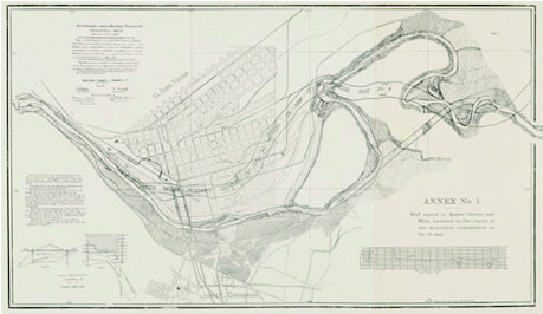
1897 map produced by the International Boundary Commission showing multiple Rio Grande channel locations across El Paso and Cd. Juarez from 1852 to 1897. River channels marked with dotted lines indicate a network of flood-water channels that formed after a particularly devasting flood in the Rio Grande in 1897. Source: Henry Lane Wilson Papers, Courtesy of University of Southern California, on behalf of the USC Libraries Special Collections.
For Anglo El Pasoans, however, there was something decidedly unsettling about this mysterious river because, when confronted with its opacity, expectations and assumptions for their legitimacy and propertied control of space went awry. Armed with rumor, they could mitigate this mystery; but, without it, the accretion/avulsion puzzle could not be clarified—which made Anglo El Pasoans shutter with disgust. The law of accretion and the genre of rumor thus conveniently offered these settlers the means to rid themselves of this disgust. Sure, their rumor was strung together with questionable evidence; but what lent this rumor its credence was the temporal anchor of 1848. It was, of course, no coincidence that this rumor hinged on an event: the same year the Treaty of Guadalupe Hidalgo declared the Río Grande the U.S.–Mexico boundary and the new U.S. frontier. This temporal focal point is emblematic of what scholars have referred to as “settler time:” a particular way of narrating, conceptualizing, and experiencing the unfolding of time and space as beginning with white settler possession—and thus normalizing white settler presence, privilege, and power as timeless (Rifkin, 2017: viii). Charles Mills (2014) has called this “the White temporal imaginary” wherein “the White settler state ‘sets the historical chronometer’ at zero, to signal that before its arrival, no history has taken place, no real passage of time, since a time in which no [White] history passes is a time that has not really itself passed” (29, 31). When concocting their rumor, then, Anglo El Pasoans married settler time with the law of accretion. In turn, they not only produced their legal possession of El Chamizal, but they also shored up a specific time-space (1848/El Chamizal) that could not be conceived by Anglo Americans as anything other than in service to Anglo-American Whiteness.
Anglo El Paso’s rumor thus demonstrates for us how White settler colonialism is more than just a problem of space and territory. Rather, it includes “narrative confrontations with multiple temporalities” (Gniadek, 2017: 3). “These temporalities,” argues Melissa Gniadek (2017), “emerge from pasts of a place as they are encountered in a present moment, as well as within historical narratives crafted as settlers work to claim belonging that is simultaneously never belonging” (3–4). In El Paso, Anglo American settlers fabricated a story from which they could conceal the accretion/avulsion mystery and, in turn, claim legitimate possession of—and belonging within— El Chamizal. But this belonging is a never belonging to which these settlers were deeply hostile to discovery.
It may have been unspeakable, but Anglo El Pasoans understood themselves to be in this position of never belonging. It was for this very reason that by the turn of the twentieth century it had become a tacit agreement among these settlers that to claim membership in this community was to claim participation as both audience and co-author of this rumor. If we understand, as Michel Trouillot has argued, that “human beings participate in history both as actors and as narrators,” we can follow how this unspoken agreement became a site where history was produced (1995: 2). By listening to and repeating this rumor, Anglo El Pasoans were not simply acting as independent entities in its dissemination, but as collaborative participants in a larger set of transactions intent on naturalizing this rumor as fact. And with each repetition, they masked this rumor as History—a transformation that would “become so deeply enmeshed in the web of recorded history that [it] cannot be easily excised” (Rosnow and Fine, 1976: 43). In fact, “[s]ome rumors never die, but become part of the folklore and established belief structure” (1976: 5). Indeed, Anglo El Paso’s rumor would eventually become so woven into the narrative fabric of this city that in two generation’s time a teenager at Jefferson High School would recite it as an unequivocal fact in her high school history report on the Chamizal Dispute.
Mystery, hostility, and the law of accretion: The seeds of Anglo El Paso’s rumor
Where exactly the rumor of the U.S.’s undisturbed, unchallenged, and uninterrupted possession of El Chamizal since 1848 originated is difficult to say. Karuka (2019) has argued that in an analysis of rumors, questions of their origins are often irrelevant. Rather, he posits, what is relevant and instructive about colonizer rumors is what they may conceal and obscure, their repetition and transformation over time, their social reproduction of local knowledge and meaning, and the consequences of these processes in the maintenance of unequal power relations and historical narratives that naturalize these relations and obscurations (3–4). In the case of Anglo El Paso’s rumor, however, what is also instructive is how obscurity in fact motivated this community to concoct their rumor in the first place. Although historians and psychologists of hearsay agree that rumors originate across varying contexts and causes, they all insist that rumors have one consistent characteristic: “the seeds of rumor are planted when the evidence pertaining to an important topic is ambiguous” (Rosnow and Fine, 1976: 28). When ambiguity goes unresolved for too long, when the status quo and existing expectations about the world are violated because of ambiguity, experts tell us that there is often an increasing anxiety and desire to stabilize the situation through what may seem like the only option: the genre of rumor. “Rumors take shape,” argues Tamotsu Shibutani, “as individuals entertain and pass on reports that enable them to give vent to anxieties or hostilities they are otherwise reluctant to acknowledge” (Shibutani, 1966: 6). Motivated by their racially-driven anxiety, their desire for power, and a quest for closure to the accretion/avulsion puzzle, a loosely bound collectivity of Anglo American settlers carefully constructed a collectively sanctioned solution to their problem: an 1848 accretion southward shift that legally made El Chamizal U.S. territory (Figure 4).
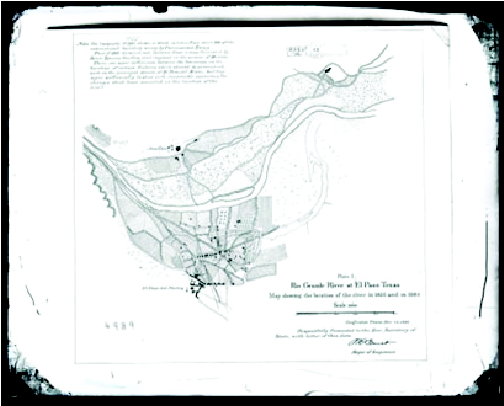
Map showing the locations of the Rio Grande between what is now El Paso, Texas and Cd. Juarez, Chihuahua in 1855 and 1885. The 1855 river location is the more pronounced, northern river channel as shown on this map. The 1885 location is more faintly demarcated and is shown perturbing south into to the farmlands of Partido Chamizal in Paso del Norte. Source: Smithsonian Institution Archives. Image #MAH-4989.
It mattered little that those who repeated this rumor often knew it to be untrue. “There is not a real estate man in this town,” wrote one Anglo American lawyer based in El Paso to his brother in 1906, “who does not know that these poor, friendless Mexicans, who have been driven off their property, hold the true title to this land.” 4 Nor did Anglo El Paso care that by 1911 both American and Mexican federal authorities had repeatedly debunked this rumor. Just as rumors “remain [sic] stubbornly persistent even in the face of contradictory evidence,” believing in this rumor and knowing it to be false do not contradict one another (Rosnow and Fine, 1976: 13). Rather, what mattered to Anglo El Paso was that this rumor employed the law of accretion to “reflect and consolidate language, ways of seeing, and modes of subjectivity that render indigenous and colonized populations as outside history, lacking the requester cultural practices, habits of thought, and economic organization to be considered sovereign, rational, economic subjects” (Bhandar, 2019: 3). Their rumor, in other words, not only rendered Partido Chamizal claimants improper legal subjects, but also narrated a world where Anglo American domination over, possession of, and emplacement within El Chamizal were legal, natural, and inevitable via the law of accretion.
The law of accretion is itself both a remarkably predictable and unusual legal framework within U.S. property law and colonial ideology. Concerning the latter, it is one of the rare instances in which nature and geography are not engaged as corrupt, savage entities in need of White manipulation to adhere it to colonial projects of property, capital, and rationality—but, under certain conditions, in fact foster them. As scholars of the law have regarded it, the law of accretion is an “universal rule”—both “ancient and modern”—that protects a landowner’s entitlement to future accretion lands as a “vested right” that is part of his “aleatory contract with nature” (Walsh, 1974: 182). The basis of this “contract” is that when accretion lands attach to a landholder’s property, this landholder (and not the landholder from whom the accretion lands have detached) is in a better position than anyone else to exploit the land—and thus, via his contract with nature, is made the righteous owner of these accretion lands. The law of accretion thus engages the natural whims of geography as a vehicle to produce productive propertied control of land. In this way, it turns out, the law of accretion operates according to established colonial ideologies of productivity that have and continue to underwrite and rationalize the displacement and dispossession of Indigeneity and colonized subjects (Montoya, 2002: 80).
The law of accretion as it was applied to the Río Grande can be traced back to 1856 when one of El Paso’s earliest Anglo American settlers, James Wiley Magoffin, wrote an “anxious inquiry” to the U.S. government concerning a change in the Río Grande’s deepest channel. 5 Alarmed, authorities forwarded his letter to the U.S. Attorney General Caleb Cushing who, after reviewing the 1848 Treaty and consulting international law on fluvial boundaries, submitted an official legal response that directly contradicted the 1848 treaty that specifies the U.S.–Mexico boundary is a fixed line following the middle of the Río Grande’s deepest channel. In his written opinion, Cushing began by saying that the writers of the 1848 Treaty had been correct when they declared the boundary was to be forever that described by the settlement: an immutable line mapped with “due precision” wherein “no change shall ever be made […] except by the express and free consent of both nations.” 6 However, Cushing reasoned, “if [the boundary] need modification to give it absolute exactness” then changes in the boundary were to be allotted for provided that such changes be through the “gradual change of a river-course by insensible accretion” and not by the sudden abandonment of an existing riverbed for another one entirely. 7 In effect, Cushing’s opinion applied the law of accretion by stipulating that if the river’s course changed gradually through erosive accretion, the U.S.–Mexico boundary moved with the river (Walsh, 1974: 182). However, if the river’s course changed through sudden avulsion by abandoning its channel for another one, the boundary remained at its original surveyed demarcation. Though at the time of Cushing’s opinion there was already evidence that the Río Grande was shifting southward into Paso del Norte, it is impossible to say if Cushing knew of this evidence or if it factored into his opinion.
The discrete principles of accretion and avulsion as defined by Cushing’s opinion, however, ultimately proved unworkable in its application to the Río Grande through El Chamizal (Rebert, 2001: 191-192). This was largely because the law of accretion is based on precedents from Western Europe, the eastern United States, and rivers in humid regions of the world where the unique definitions for accretion and avulsion often apply. At El Chamizal, however, a combination of the river slowing down in the lower valley and depositing sediment over centuries had built up an extensive alluvial plain over which the river moved outside the neat definitions of accretion and avulsion. Instead, the river’s meanderings were often a complex combination of abandoned avulsions, erosions, and accretions at rates that were frequently rapid, imperceptible, and indistinguishable . But Cushing’s opinion did not account for such intermediate, ambiguous processes—and neither the U.S. nor Mexico dared publicly admit that the Río Grande defied the law of accretion. To do so was to admit the intolerable: first, that the Río Grande was not a passive heap of mass that would inevitably conform to their needs and desires, and secondly, “that state fixations all too often ended up as state frustrations” (Craib, 2004: 11) (Figure 5).
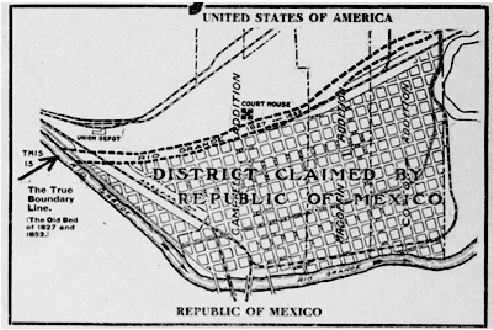
Illustrated map showing the Mexican district, Partido Chamizal, across what is now El Paso, Texas. Contrary to what this map suggests, the boundaries for Partido Chamizal are highly debated. This map, for example, suggests that Partido Chamizal’s northern boundary coincided with the Rio Grande’s locations in 1827 and 1852—both of which are shown as interchangeable on this map. Binational state maps of the river’s location in 1852, however, show this 1852 channel further south (along what is today 7th Avenue in El Paso) than the 1827 location—although the official 1852 location has also been contested. In any case, this illustration shows us how some defined and experienced Partido Chamizal. Source: El Paso Herald-Post, 7 March 1907.
Despite the law of accretion’s fraught application to the Río Grande through El Chamizal, Cushing’s opinion proved to be one of the “built-in-imperfections” of the U.S.–Mexico boundary (Martinez, 2006: 9). For westward-bound Anglo Americans, the unspoken implication of Cushing’s opinion was heard loud and clear: that the U.S.–Mexico border was not fixed in place, but rather could be redrawn according to their “aleatory contract with nature.” When builders for the Aitchison, Topeka, and Santa Fe Railroad arrived in El Paso in 1881, for instance, and began their construction through the southwestern corner of Partido Chamizal—known at that time by Mexicanos in Paso del Norte as the 1818 Chamizal Land Grant—railroad representatives fielded protests from the land grant’s Mexican owner, Pedro Ignacio Garcia del Barrio, by arguing the area was open for American settlement under the law of accretion (de Hinojosa, 2021b: 95). Meanwhile, Anglo American land speculators who timed their business plans with the railroad’s arrival began imposing a new urban blueprint atop Partido Chamizal by surveying streets, alleys, and lots and selling these lots to Anglo Americans as part of three residential subdivisions to the City of El Paso: the Cotton Addition established by Frank B. Cotton in 1880, the Campbell Addition established in 1881 by the Campbell Real Estate Company, and the Magoffin Addition established in 1882 by Joseph Magoffin. 8 Like all colonial projects, renaming Partido Chamizal thus “functioned as a routine mechanism for possession, in which a new cultural presence was imprinted onto the land to both confirm and create a space upon which colonization could occur” (Craib, 2005: 45). Renaming the district was, in other words, part of a broader transformation in which Anglo American claim to this Mexican district went from a contested fact into a fait accompli. Of course, it didn’t matter to the Anglo American land speculators that evidence of Partido Chamizal was all around them: the farms and their livestock, the patrón and peon houses, the sophisticated acequias (one named Acequia del Chamizal) that watered the fields, let alone the more than 700 Mexicanos who lived in the district. 9 Nor did it matter that Cushing’s opinion did not yet have the status of a formal inter-governmental agreement. 10 What mattered was that Cushing’s opinion offered them the discursive legal infrastructure through which to narrate, rationalize, and assert their legitimate settlement of El Chamizal. Besides, they told themselves, their right to El Chamizal was born from their race—a fundamental sense of proper propertied belonging in the world, wherever that might be (Figure 6).
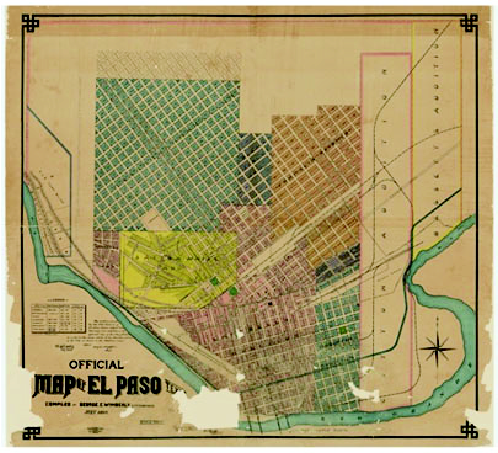
1899 Map of El Paso, Texas showing recently-established Campbell Addition, Magoffin Addition, and Cotton Addition (left to right) across El Chamizal/South El Paso. Source: General Map Collection, Texas General Land Office.
By renaming Partido Chamizal, Anglo El Paso conveniently closed the gap between their rumor and its embodiment as “fact.” This transformation put Partido Chamizal residents in a position of externality toward their own home. Soon, violent evictions came to define daily life in the district, and by the 1890s appear to have been rampant. In response, some Partido Chamizal residents protested. They organized meetings with their elected representatives and sent letters to Washington D.C. Even in the dark of morning, when Anglo Americans arrived at Mexican homes with batons in their hands, some Mexicanos resisted forced eviction. But Anglo El Pasoans did not care, as Mexican resistance only stoked their appetite for violence.
The coordinated raids that took place across Partido Chamizal often ended with Mexicanos dispossessed, their houses and farmlands in disrepair, and sometimes residents were beaten bloody if they dared defend themselves. In turn, the violent spectacle of these evictions inscribed onto the landscape a new racial hierarchy wherein Anglo Americans sat at the top. Meanwhile, Anglo El Pasoans continued to persuade themselves of their unwavering legitimacy over El Chamizal by replacing Partido Chamizal with their own invented society. By the end of the 1880s, what had once been Partido Chamizal was incorporated into downtown El Paso, the city’s First Ward of “Chihuahuita,” and the Second Ward of “Segundo Barrio.”
Layered fictions and the mode of rationalization
As is often the case with rumors, there were layered fictions to Anglo El Paso’s—and sometimes as many as three distinct renditions were volunteered. The first rendition is already familiar to readers of this essay and told of an 1848 accretion southward shift in the Río Grande. The second rendition, however, insisted that El Chamizal had always been north of the 1848 river channel and that the Río Grande never meandered from this location (Hamilton, 1963). For those who perhaps felt it was foolish to outright deny the river’s meanderings, a third rendition was given. This third version similarly insisted that El Chamizal had always been north of the 1848 river channel, but also claimed that the river moved from this location only to eventually (at some unspecified point in time) return to its 1848 demarcation. Although each of these versions are distinct, they were often entertained as simultaneous possibilities. This concurrent repetition of contradictory claims did not immobilize its narrators, as each version served the same engineered end: displacing the possibility of El Paso’s illegitimate possession of El Chamizal. This tells us that Anglo El Paso’s anxiety over their control of El Chamizal was so intense that the repetition of contradictory claims was both necessary and rational—a “mode of rationalization” that illuminates their insistent investment in reaffirming and reproducing the settler nation-state’s ownership, control, and dominance over Indigenous lands at all costs (Moreton-Robinson, 2015: xii). Consequently, there was no reasoning with those who offered up any one or all these renditions. Their sense of power, place, and belonging depended on this shapeshifting rumor. 11
As earlier sections of this essay suggest, it was this rumor’s first rendition that ultimately became Anglo El Paso’s version of choice. Unlike the other two renderings that each insist El Chamizal had been north of the 1848 river, this first rendition did what the other two did not: it admitted that El Chamizal was south of the 1848/1852 river channel and thus firmly within Mexican territory. Yet, it also insisted that an accretion southward shift beginning in 1848 had gradually—and legally—rendered El Chamizal U.S. territory. Although historical records can neither wholly confirm nor deny an 1848 accretion southward shift, this unverifiable characteristic (coupled with the law of accretion) gave this rendition its power as it passed from person to person at a speed dependent on Anglo El Paso’s growing anxiety. Indeed, when narrators of this version were asked to explain how they knew the river had moved by accretion in 1848, the answer went something like this: Because the United States had taken possession of El Chamizal in 1848, and because this possession had been unchallenged and lawful, this inarguably indicated that the Río Grande had moved gradually through accretion. 12 To this end, this particular version of Anglo El Paso’s rumor was useful in a way the others were not: it made sense of that which could not be definitively proven (accretion v. avulsion) by drawing on El Paso’s present possession of El Chamizal as evidence and confirmation for an accretion shift. Of course, such a convoluted claim required constant repetition to dress it in any semblance of legitimacy. But even when this version was repeated in the form of a question, its repetition gave it credence. “Had the river’s change been by avulsion would [El Chamizal] not necessarily have been awarded to Mexico?” debated one Anglo El Pasoan to another in 1908. 13
This rumor’s first rendition was also especially attractive because it opened up yet another useful narrative logic: that the river’s natural instinct was to move in favor of Anglo American property rights. By the late 1880s, for instance, Anglo El Pasoans began insisting that the river’s natural tendency was not only to move in favor of the U.S., but to create Anglo American property. When the Campbell Real Estate Company began seizing and surveying land within Partido Chamizal as the Campbell Addition, the company challenged Mexicano protests by insisting its operations were lawful on the grounds that Mexican titles had been “annulled and defeated by a change in the channel of the Rio Grande” and that, in turn, “American title has been created through changes occurring in such channel since the date of the Treaty of Guadalupe Hidalgo.” (Republic of Mexico Secretary of Foreign Relation, 1905: 9). This suggestion was so seductive that it seeped into the collective consciousness of Anglo El Paso. “The river was trying to work into Mexico all the time,” James Wiley Magoffin testified in court in 1896, adding, “Its natural course is that way.” 14 Part of my point here is that the Rio Grande’s opaque past and its impenetrable present so frustrated the Anglo-White racial control of colonial space in this region, that Anglo El Paso summoned its domination through the only way possible: a story that could bring the unthinkable (a river that remained beyond their reach of knowing and control) back into the realm of the acceptable: a world where the Río Grande, as a colonized subject, always moves according to Anglo American needs and interests.
So entrenched was Anglo El Paso’s rumor that when the International Boundary Commission (IBC), the intergovernmental agency tasked with resolving boundary disputes along the borderlands, took up the Chamizal Dispute in 1895, the U.S. Commissioner, Anson Mills, publicly questioned whether El Chamizal had been south of the Río Grande at all in 1852. Only after his review of maps and other official records did Mills finally enter into the court record that he was “willing to admit on the part of his government” that El Chamizal “was wholly within the territory and jurisdiction of Mexico” in 1852. Having agreed on this point, Mills and his Mexican counterpart, Javier Osorno, concluded that if they were ever to settle this conflict, they needed to determine whether the river had moved by accretion or avulsion. But because both Mills and Osorno argued the law of accretion rendered El Chamizal their own—Mills arguing the river had moved by accretion and Osorno arguing it had moved by avulsion—the law of accretion did little to clarify the issue. With no other recourse for determining how the river moved, the IBC began soliciting witnesses. Although these witnesses confirmed that El Chamizal ended up north of the river after extrodinary floods in 1862, 1864, and 1865, to the IBC’s horror, the witnesses did not resolve the accretion/avulsion puzzle. Rather, they suggested both processes had taken place when they described “violent changes” in the river that “washed away the land” (Republic of Mexico Secretary of Foreign Relation, 1905: 117, 138). Defeated, Mills and Osorno tabled the case until an international arbitration tribunal could consider the case. More than 10 years, however, would pass before this tribunal convened. Meanwhile, Anglo El Paso’s rumor continued to spread from person to person unchecked.
A codified truth
Repetition was crucial to solidifying Anglo El Paso’s rumor into History, but it was not enough for this illegal scheme of land accumulation to perpetuate itself—both required the backing and blessing of the law (Figure 7). The promise of this legal endorsement came in 1902 when a U.S. lower circuit court judge, Thomas Sheldon Maxey, for the Western District of Texas presided over a civil lawsuit: W.J. Warder v. Laura M. Loomis et al. The plaintiff in this case, William Jasper Warder, was an Anglo American California businessman representing Partido Chamizal landholders whose properties had been rezoned into the Campbell Addition. The defendant in the case, Laura M. Loomis, was the widow and heir of Albert Marshall Loomis, one of Anglo El Paso’s earliest settlers and a prominent real estate agent who had purchased, in the 1880s and through the turn of the century, multiple lots within Partido Chamizal from the Campbell Real Estate Company. When the lawsuit convened in 1902, Warder argued that El Chamizal was Mexican territory and introduced Partido Chamizal property deeds evidencing that the Mexican titles to his clients’ properties could be traced as far back as 1817 from seller to buyer. 15 Warder knew, however, that this paper trail alone would not legitimize his clients’ titles. Instead, he knew that he needed to prove the Río Grande had moved suddenly via avulsion. To do so, Warder planned to present witnesses to the great floods of the 1860s—including testimonies collected by the IBC in 1895 and 1896. Steadfast in this legal strategy, Warder later said that he believed these testimonies “would establish unquestionably the fact that the changes wrought in the channel of the Rio Grande had been such as did not work a change in the International Boundary, and therefore that the boundary remained where it had been previously located [in 1852]” (Republic of Mexico Secretary of Foreign Relation, 1905: 100). With these testimonies, he must have thought to himself, the whole structure of Anglo El Paso’s rumor would lay in pieces before them (Figures 8 and 9).
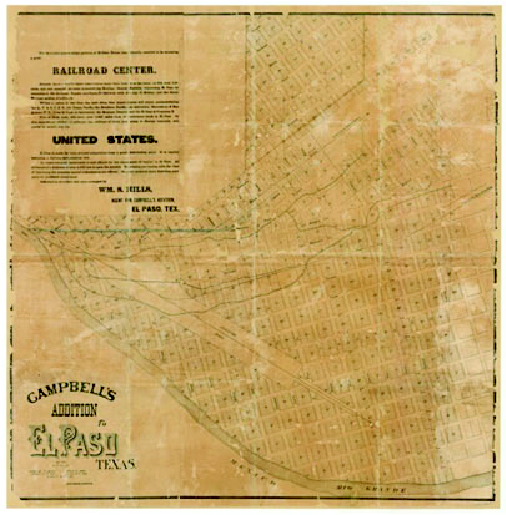
1885 map showing the Campbell Addition to the City of El Paso where real estate agent, A.M. Loomis, purchased property from the Campbell Real Estate Company. Source: General Map Collection, Texas General Land Office.
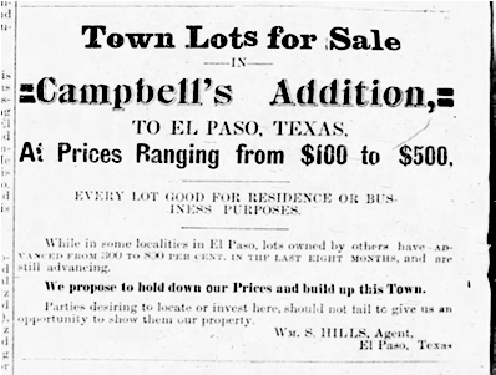
1881 advertisement for town lots in the Campbell Addition to the City of El Paso. W.S. Hills, who was dispatched to El Paso from St. Louis, Missori by Robert Campbell’s Estate, served as trustee and agent to the Campbell Real Estate Company. Under Hill’s direction, the company sold lots within the Campbell Addition through the turn of the 19th century. Source: El Paso Times, 10 June 1881.
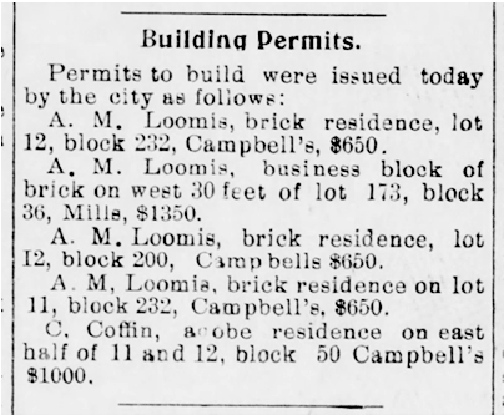
1899 newspaper announcement of building permits, including several to A.M. Loomis in the Campbell Addition. Source: El Paso Herald-Post, 26 April 1899.
But before Warder could introduce the testimonies, Loomis’ legal team motioned that the lawsuit be thrown out (El Paso Herald Post, 1902). The basis for this request was as follows: If Partido Chamizal claimants did indeed have rights to the land in question because of an avulsion shift, it necessarily followed that El Chamizal was Mexican territory and thereby “the court was without jurisdiction over the land in question” (El Paso Herald Post, 1902: 1). Although this motion may seem odd coming from Loomis’ legal team because the motion recognizes Mexican sovereignty over El Chamizal, it was in fact a strategic legal argument because, if accepted, it promised to nullify the present lawsuit as well as additional pending cases involving El Chamizal. In other words, if accepted, this motion would maintain the status quo (that is, Anglo American posession) across El Chamizal until an arbitration tribunal could be convened. What then came as a shock to Warder, was cause for celebration among Anglo El Paso—as Maxey actually accepted Loomis’ motion and dismissed the case for lack of jurisdiction. The significance of this dismissal was not lost on Anglo El Paso. “The most important decision in a land suit ever rendered in the southwest was given yesterday afternoon by Judge Maxey,” reported the El Paso Times on 12 November 1902. “The decision […] affects the status of seven other suits instituted by the same plaintiff, and which involves the title of hundreds of thousands of dollars worth of property in the southern part of the city.”
In a stunning turn of events, however, in April 1903 Maxey reversed this decision and reopened the case.
16
When it finally came time for Warder to present his argument for an avulsion shift, Warder had nine men—eight Mexicanos from Cd. Juárez and one Anglo El Pasoan—submit written testimony to the character of the Río Grande’s meanderings during the floods of the 1860s.17 As before, these testimonies did not neatly prescribe to the legal definitions of accretion or avulsion. Even so, their significance did not go unnoticed by Loomis’ legal team, as together the witnesses spoke to experiencing multiple sudden and violent southward shifts in the Río Grande. “There were instances in which people living in houses a distant fifty yards from the bank, on one evening, had to fly in the morning from the place on account of the encroachments of the river,” testified one Cd. Juárez resident, Mariano Samaniego, adding, “It carried away forests without giving time to the people to cut the trees down” (Republic of Mexico Secretary of Foreign Relation, 1905: 75). Another Cd. Juárez witness, Espiridion Provencio, recounted that “the people would be standing on the banks watching a piece go down, and somebody would call ‘look out! There is more going to fall!’ and they would have to jump to keep from falling into the river” (Republic of Mexico Secretary of Foreign Relation, 1905: 82). But before the testimonies were submitted to the jury and without the introduction or presentation of any testimony whatsoever attempting to prove the river had moved by accretion, Loomis’ legal team motioned that these testimonies be stricken from the record on the grounds that they were trivial to the case. Drawing on Anglo El Paso’s rumor of choice, this motion read: And the Court is asked to strike out all evidence introduced by plaintiff respecting a change or changes in the Rio Grande by avulsion, and all evidence to show that the land in controversy has not been placed upon the north side of the river by accretion, and all evidence tending to show any title under the Government of Mexico to the property, because the admitted facts and the evidence show that the United States Government and Texas are, and for many years have been, exercising jurisdiction, civil and political, over the property, and that the United States Government claims, and for many years has claimed, that said property is in the United States, and by its claim has for the purposes of this case established the fact that the changes in the river by which the land was thrown upon the north side of the river were by accretion and not by avulsion (Republic of Mexico Secretary of Foreign Relation, 1905: 29).
18
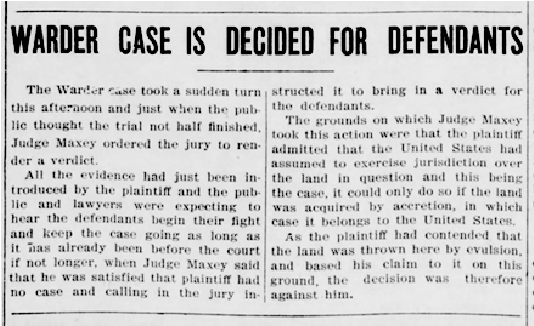
Newspaper report announcing Judge Thomas Sheldon Maxey’s decision in the W.J. Warder v. Laura M. Loomis et al. lawsuit. Source: El Paso Herald 16 April 1903.
In what would become a defining moment—and legal precedent—in the Chamizal Dispute for years to come, Maxey approved this motion, arguing that because the U.S. government was presently asserting political as well as civil jurisdiction over El Chamizal, U.S. jurisdiction “must be presumed by the Court to be rightfully exercised, and that the only way in which said jurisdiction could be rightfully exercised would be by reason of accretion.” 19 In turn, Maxey struck the testimonies from the record and forbid the jury from considering them. This denied Partido Chamizal claimants the right to prove that the river had changed by avulsion. For them, Maxey’s decision was impossible to reconcile. How a judge could unilaterally determine witness accounts irrelevant to the case was unthinkable to them; yet, it had been done. A handful of years later, a team of lawyers working with Warder critiqued Maxey’s decision, arguing that it “rested upon the single proposition that inasmuch as the United States, State, Country, and City Governments were in possession and exercising civil and political control and jurisdiction over the property, the Courts of the United States were compelled to presumed absolutely that the river had changed by accretion and not by avulsion and that the Court and Judge were precluded by such presumption from hearing or considering or permitting the jury to hear and consider any testimony whatever that would tend to show or demonstrate that the river changed its channel by avulsion.” 20 In effect, Maxey’s decision perpetuated through the law a worldview where Anglo American hegemony is natural and taken for granted, where this worldview wins over facts, and where any alternative worldview remained in the realm of the trivial. Consequently, on April 16, 1903, Maxey instructed the jury to bring in a verdict for Loomis. The jury complied.
By accepting rumor as evidence in his court, Maxey became a co-author to Anglo El Paso’s rumor by reaffirming a legal racial regime of property founded on the idea that Anglo American possession is always legitimate and timeless. This was only possible by producing and upholding “a specifically legal narrative time-space of perpetuity” wherein El Chamizal—contrary to all evidence—has always been the possession of the United States (Renard Painter, 2019: 109). Rumor in this context became law, which reciprocally upheld a White temporal-spatial imaginary where any challenge or rupture to Anglo White possession is unintelligible. Indeed, the jury’s ruling illuminates how this rumor so structured social affect and social cognition among Anglo Americans in this city, that time and space could not be conceived as anything other than in service to Anglo-American Whiteness. Rumor had become so lodged in the socio-mental geography of El Paso that its codification was reasonable, logical, and legally sound.
The Warder v. Loomis lawsuit thus illuminates law’s knotted relationship with time. It does so by showing us how colonial legal temporal techniques co-produce a vast set of legible and illegible temporalities in service of racialized non-white dispossession. For example, by accepting Loomis’ motion, Maxey ruled that the Río Grande does not so much exist within the flow of (Anglo-White) time, but punctures through it as an anomaly from a bygone past. From this perspective, this river is of “another time:” a backward, irrelevant, and incoherent temporal frame of reference that is “outside” modern time and which need not be considered at all. Of course, this “irrelevant” temporal frame of reference is also that which unsettles Anglo American settler claims to El Chamizal (then and now) by raising unwelcome questions about how Anglo Americans came into their possession of El Chamizal. By striking out these testimonies, Maxey employed the law not simply to negate these questions, but to foreclose a time-space wherein the Río Grande may not have acted in favor of Anglo American possession. His decision demonstrates “how state law not only relies upon and produces temporalities” in order to discipline deviance (the Río Grande and Partido Chamizal claimants) into disappearance (“striking-out”), but also how “the law is buffeted by times that exceed its control (Renard Painter, 2019: 114).”
Perhaps more difficult to discern, however, is how white possessive logics demand flexibility—sometimes in overtly absurd and feigned ways—in the legal rationales it employs to conceal these ruptures (Bhandar, 2019: 25). Maxey’s 1903 decision, for example, works through the law of accretion while simultaneously rejecting testimony that—via this law’s very logic—opens the possibility that U.S. possession of El Chamizal is illegitimate. Maxey is only able to do this by utilizing rumor to classify Partido Chamizal claimants and the Río Grande as fundamentally ahistorical: as illegible actors from a past and present that are and remain incoherent.
In 1905, yet another feigned legal logic was applied to the Chamizal Dispute when Warder’s appeal reached the U.S. Supreme Court (Figure 11). As Maxey had initially done, the Justices concluded that they lacked jurisdiction in the case—this time, however, on the grounds that the case involved an international land and boundary dispute and therefore needed to be taken up by an international arbitration. 21 However legally sound this ruling might very well be, the Supreme Court’s refusal to take-up this lawsuit maintained Anglo American possession of El Chamizal for the time being. What we are seeing here is how American lawyers and judges consistently applied an insatiable, circular legal logic—at times declaring El Chamizal within the fold of U.S. legal jurisdiction and at other times outside it—to El Chamizal in ways that conveniently manipulated the law to maintain U.S. possession. This was possible only by simultaneously disavowing and recognizing El Chamizal as a “zone of legal anomaly” produced by conditions of contested and multiple legal authorities, and then leveraging this legal anomaly to maintain Anglo/White possession (Benton, 2006: 29–30).
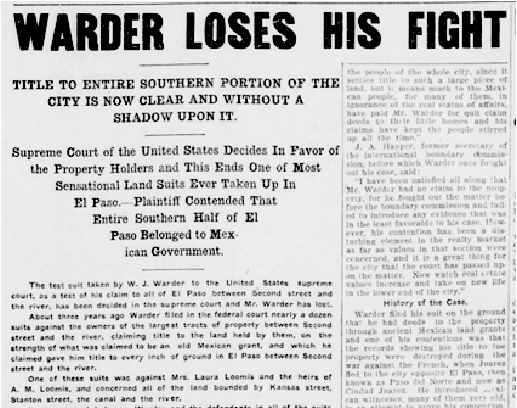
Newspaper report announcing U.S. Supreme Court’s ruling in the W.J. Warder v. Laura M. Loomis et al. lawsuit. The Supreme Court ruled it lacked jurisdiction in the case and therefore would not accept the lawsuit in its court. El Paso newspapers, however, declared the Supreme Court’s decision essentially ruled in Loomis’ favor, arguing Warder had lost the legal fight.
“Inability to lay the ghost of El Chamizal”
Anglo El Paso would take great pains to render their rumor the only rendition of the Chamizal Dispute. To their frustration, however, the accretion/avulsion puzzle continued to haunt the city, reminding them of their failed colonial endeavor to relegate the Chamizal Dispute safely to the past. In 1910, for instance, when an International Arbitration Tribunal finally met to deliberate the Chamizal Dispute, even trained engineers hired to study the Río Grande through El Chamizal were taken aback by the river. “The river’s work of altering its bed to suit the necessities of the moment is never ending,” an U.S. engineer reported. “I have been unable to learn whether this movement has been continuous throughout the thirty years, or whether it has been intermittent”. “It is probable,” another authority commented, “that no other international boundary represents such a tangle of accretion and avulsion cases” (quoted in Rebert, 2001: 192). This expert testimony deeply troubled Anglo El Paso, as it exposed their rumor for what it was: a fabricated story with loose threads.
Despite the implications of this expert testimony (that no one could determine whether the river had shifted by accretion or avulsion) several Anglo El Pasoans submitted affidavits to the tribunal repeating Anglo El Paso’s rumor. One man, William Michele Coldwell, did so by arguing that “Mexican authorities made no attempt whatsoever to exercise authority over that tract.”
22
Notably, Coldwell rationalized this claim by leveraging his own settler temporal framework. “I first came to El Paso on the 23rd day of December, 1873,” Coldwell began. From my first arrival to the country down to about 20 years ago, the authorities of the United States and of the State of Texas exercised undisputed and practically unquestioned jurisdiction over what is known as the Chamizal tract, which I never heard called by that name until after the origen of the present controversy between the two countries [in 1895].
In 1911, after months of debating how and when the Río Grande had transferred El Chamizal, the Arbitration Tribunal ruled 2–1 (the U.S. being the dissenting vote) that the dispute was the result of a “rapid erosion” shift in 1864. By this logic, the tribunal recommended that this shift be treated as avulsion and that all land south of the 1864 channel be returned to Mexico. Although Mills, the U.S. IBC commissioner in the tribunal, had previously agreed to accept the tribunal’s ruling, he refused to comply, arguing that the 1864 channel was impossible to locate due to cursory documentation and that, in any case, “rapid erosion” was an unacceptable category under the law of accretion. It was in this light that the tribunal’s decision merited the front page of the El Paso Morning News on 16 June 1911. Berated as “the decision that failed to decide,” the reporter not only argued that the tribunal had acted inappropriately when it ruled that a “rapid erosion” shift should be treated as avulsion, but also critiqued the tribunal for having “no idea how such a boundary could be located, and did not know of any person who did know” (El Paso Morning Times, 1911). This analysis was not unfounded; the law of accretion does not account for intermediate processes such as “rapid erosion” and documentation for the 1864 channel was sketchy at best. Thus, Mill’s refusal may have been (in part) legally sound, but it also preserved U.S. possession of El Chamizal and emboldened the repetition of Anglo El Paso’s rumor. “The tract is and has always been part of El Paso,” reads the same El Paso Morning Times report, in which the reporter also describes El Chamizal as a “body of accretion land” (El Paso Morning Times, 1911: 1).
Pride to be in this position of “always,” however, was only a stand-in for Anglo El Paso’s collective White fragility couched in their hostility to the discovery of their own illegitimacy. If Mills’ refusal calmed this hostility, it didn’t last long. In the decades that followed, both the accretion/avulsion puzzle and El Chamizal’s disputed boundaries undermined various racist capitalist projects in El Paso. In some cases, the mostly working poor, Mexican-immigrant tenants living in the disputed zone successfully renegotiated their rents by refusing to pay at all on the grounds that the land’s title was faulty. 23 This upset land values, profits, and real estate businesses within the area. In the 1930s, after decades of landlord neglect and structural abandonment by the City of El Paso (two processes that together produced the Mexican “slums” of Chihuahuita and Segundo Barrio) El Chamizal obstructed slum clearance programs proposed for this part of the city. “The inability of American and Mexican officials to lay the ghost of the Chamizal,” explained the El Paso Times in 1937, “barred the slum clearance program from the area, as governmental regulations prohibit federal participation where ownership is in question” (El Paso Times, 1937). That same decade troubling questions surrounding the citizenship of those born within El Chamizal also emerged. In 1934, the El Paso Times ran a story with the headline “Persons Born in Chamizal Zone May Be Citizens of Two Countries,” which suggested that because no one knew where El Chamizal began and ended, the boundaries of U.S citizenship in El Paso were not as concrete as they seemed (Yermillion, 1934: 16). Some could not help but see this terrain as willfully injuring and endangering the sanctity of their city and privileges north of the border. El Chamizal was a risk, they said to one another, to the public good. Texas officials labored ceaselessly to nullify this risk; but their efforts to define El Chamizal’s boundaries repeatedly came up short, as the Río Grande through El Chamizal abided no authorities and refused to make itself known.
Only on face value, then, did Anglo El Pasoans live what seemed like an entirely secure and serene life of dominance as a direct result of their rumor. Sure, there were White folks in the city who knew this rumor was a lie; but no one dared give it this name—as if denial would prevent the memory of this lie from coming back to haunt them.
But the secret of this rumor’s perjury was an ever-present, looming specter that conjured up a complicated mix of fury, fear, and denial. For instance, when word of the Chamizal Treaty arrived in El Paso, it was hard for El Pasoans to contain this mixture of unspeakable emotions. In a 1963 letter to the El Paso Times entitled, “Believes Rio Grande Occupies 1848 Channel,” Ralph Hamilton addressed this fury, fear, and denial in veiled but unmistakable terms—largely by repeating Anglo El Paso’s rumor. “If the river bed is where it was from 1848 to 1862,” he explains, drawing on one version of this rumor, “then the Treaty of Peace of Feb. 2, 1848, guarantees that both nations will respect [the river] as a boundary from 1848 on and that will never be changed. No meandering is provided for” (Hamilton, 1963: 9). “Those who claim it did move,” he pivots, drawing on the second rendition, “agree that it is back to its old bed, where it was in 1848.” “Thus,” concludes Hamilton, “by the Treaty of 1848, El Chamizal is ours forever.” More than simply illuminating the repetition and durablity of this rumor as well as its multiple renditions, Hamilton’s letter shows us how the “antiseptic face of colonial authority” in this city is only maintained through an overtly aggressive and precarious stance in which the telling of lies and rumors is core to sustaining the city’s colonial order (Karuka, 2019: 4). Indeed, Hamilton illustrates how the nature of truth in this white settler society is only accepted when it is consistent with a White temporal spatial imaginary that obscures and denies the illegal, illegitimate, and violent processes that produced and maintain that society.
Conclusion
When U.S. President Lyndon B. Johnson finally signed the Chamizal Treaty in 1964, he directly upended Anglo El Paso’s rumor. He did so by recognizing that the 1911 International Arbitration Tribunal had been correct when it ruled the Chamizal Dispute was the result of an avulsion shift in 1864 and that El Chamizal had been illegally incorporated into El Paso. In turn, Johnson announced that amends were to be made in the form of returning all land south of the 1864 channel to Cd. Juárez—making the Chamizal Treaty the first and only time the U.S. has ever given land back to Mexico. 24 To accomplish this tremendous task, a newly agreed upon and in no way certain location for the 1864 channel was mapped and solidified in place through a concrete canal. This concocted 1864 channel determined the redrawn El Paso-Cd. Juárez boundary and the 630-acres ceded to Mexico. While this return of land was celebrated as the settlement’s great triumph, an unspoken achievement was the declaration of having solved the accretion/avulsion puzzle. This allowed the U.S. and Mexico to insist the fundamental conundrum of the Chamizal Dispute had been resolved. Consequently, they told the world, the terms of the settlement simply reconfigured El Paso and Cd. Juárez to how they had been in 1864. “Neither country lost nor gained anything in the settlement,” insisted David Herrera, Mexico’s international boundary commissioner in 1974 (Hillinger, 1974: B6). “The boundary merely reverted to where it had been before the Rio Grande changed its course during the 1864 floods.” This version of the Chamizal story is central to U.S. and Mexican state narratives that deny the ongoing theft of El Chamizal (Figure 12).
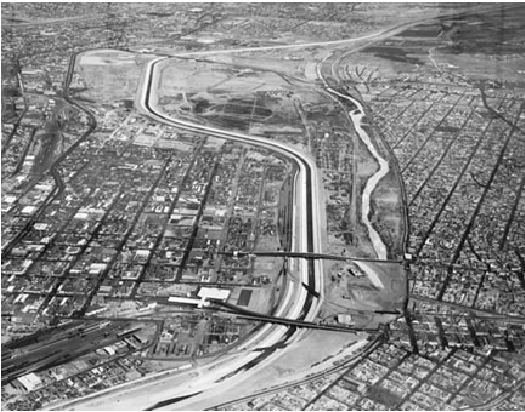
Aerial view of El Paso-Cd. Juárez on 27 February 1969. Photo shows the newly constructed concrete canal (left) and the natural Rio Grande riverbed (right). Land in between this canal and riverbed was ceded to Cd. Juarez as “El Chamizal” by the Chamizal Treaty. Today, the U.S.-Mexico boundary runs through the middle of the concrete canal. Source: IBWC Papers, MS042, C.L. Sonnichsen Special Collections Department, University of Texas at El Paso Library.
The Chamizal Treaty is thus part of an ongoing colonial project that refuses to open this region to the mystery and wonder of the intertwined fugitive landscape that is the Río Grande through El Chamizal. This binational colonial project refuses to open this region to this mystery/wonder because to do so is to admit—to invite—the unacceptable: a river whose self-determined opacity and knowledge of freedom—the wonderous, unfathomable ways of evading, subverting, and humilating the rigid rules of white settler colonialism—are impossible to fully eliminate, conceal, or force into the realm of the knowable. The canal that presently fastens the Río Grande in “its proper place” through El Paso and Cd. Juárez thus locates ongoing binational settler anxieties, fears, and hostilities towards this fugitive landscape. I want to conclude, then, by emphasizing how the Chamizal Treaty and Anglo El Paso’s rumor are part of the same colonial endeavor to foreclose this terrain’s wayward life, beautiful experiment and obstruct what this land still makes possible: geographies of refusal that not only denaturalize settler colonial ideologies and geographic impositions of natural, unwavering, and timeless White possession, but which also announce a land-based poetics of unknowability where otherwise worlds can be and are possible.
Footnotes
Declaration of conflicting interests
The author(s) declared no potential conflicts of interest with respect to the research, authorship, and/or publication of this article.
Funding
The author(s) received no financial support for the research, authorship, and/or publication of this article.
Notes
References
Supplementary Material
Please find the following supplemental material available below.
For Open Access articles published under a Creative Commons License, all supplemental material carries the same license as the article it is associated with.
For non-Open Access articles published, all supplemental material carries a non-exclusive license, and permission requests for re-use of supplemental material or any part of supplemental material shall be sent directly to the copyright owner as specified in the copyright notice associated with the article.
