




Abstract
On the Kola Peninsula in the Russian Arctic lies an innocuous iron disc about the size of a dinner plate. If one were to prise this disc open, they would find the remains of the world’s deepest vertical hole. Reaching a depth of over 12 kilometres, the Kola Superdeep Borehole was drilled in the pursuit of excavating scientific knowledges for a better understanding of the Earth’s crust. Whilst the borehole produced some important findings, and hosted an international delegation of researchers, once the Soviet Union collapsed, it fell into disrepair. Since its closure, the Kola Superdeep has become lost to history, but its existence as a ruin has generated new artistic engagements with the underground. This article uses the geological notion of discontinuity – a structural break in the rock – to imagine how discontinuity might be found within the borehole itself. It does this by identifying three access points: excavation through drilling and coring, collaboration through cross-border scientific work, and imagination through art and the weird. By resisting the notion that the subterranean can be objectively known through science, I reveal how the Kola Superdeep produces other relations, knowledges, and ways of sensing the subterranean.
Leave Murmansk by its only bridge across the river Tuloma, along the road towards Norway, past several checkpoints staffed by bored soldiers, until you reach the once-closed town of Zapolyarny. The landscape is treeless, scrubby, dotted with glacial lakes and periodic reminders of the region’s industrial and military history: a giant abandoned radar device, a now-defunct biotechnological institute that once trained surveillance dolphins, a single-track railway (that still runs occasionally) to transport the nickel the area is known for to St Petersburg. From the hills above Zapolyarny you can see the outline of the nickel smelting plant that has polluted the area since the Second World War, to the extent that nearby residents across the Norwegian border formed a movement called ‘Stop the Soviet Death Clouds’. Carry on out of Zapolyarny along a dirt track road – it is only possible by 4 × 4 – and you will arrive at a cluster of buildings in a state of disrepair. Piles of rusted instruments litter the ground, sheafs of yellowing papers, spilled substances of unknown origin stain the floor. There is no sign to indicate what this once was, but eventually you will stumble across an innocuous iron disc, about 9 inches in diameter, the numbers 12,262 daubed on (Figure 1). Beneath this disc is a shaft that descends for 12,262 metres; called the Kola Superdeep Borehole (hereafter KSB), it is the deepest vertical hole in the world.
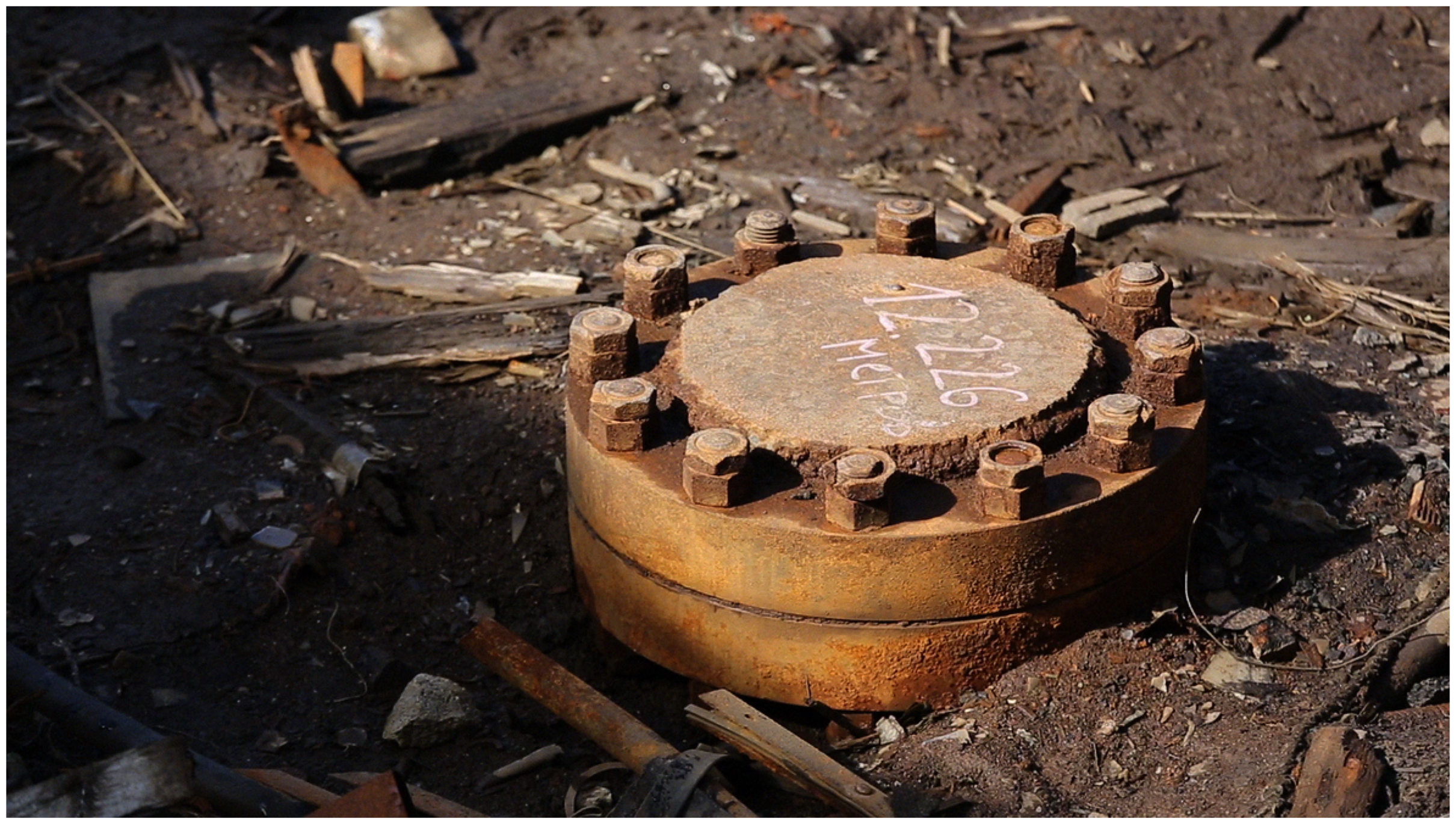
The Kola Superdeep Borehole (Bennett, 2016).
A common (and inaccurate) refrain regarding geology is that more is known about the cosmos than is known of our own planet’s inner makeup (Kroonenberg, 2011). Before modern geological sensing technology digitally rendered the subterranean, before even seismologists were extrapolating from their data that the Earth was made up of different layers surrounding a dense, solid core, imagination curated the underground. Ancient mythologies of Mesopotamia, Egypt, Greece and Rome have all imagined the underground as a place associated with death and the afterlife, and current-day religions with large followings all employ the subterranean ‘hell’ narrative in various ways, often accompanied by descent narratives that see a living human enter the underworld, who can then return to the surface and regale the living of the horrors discovered down there. The Kola Superdeep is located in Sapmi, the ancestral homeland of the Sami people. Sami shamans mobilise descent narratives themselves, with shamans possessing the ability to travel into the spirit realms. The location of the underworld is often anchored to the landscape itself, with Finnish Sami understanding access to the lower realms to be found through Saivu lakes, with sacrificial sieidi stones acting as portals (Äikäs and Spangen, 2015).
With the advent of new geological sciences, the descent narrative shifted somewhat from a religious or mythological pilgrimage to one of pioneering knowledge (Rudwick, 2014). The KSB was one of a number of drilled boreholes designed to further scientific understanding of the crust and subterranean makeup. Squire and Dodds state that “the underground has not just served as a space of spiritual self-discovery but as a vector to literally ‘unearth’” (2019: 6); the ‘unearthing’ of the ground on the Kola Peninsula, the drilling, shattering and transporting of rock – often piece by piece – to the surface is indicative of a process of excavation that extracts, rather than enters; that comes out, rather than goes in. The descent narrative offered by the KSB was not one of the human bodily entering the underworld; rather, its aim was to render the underground visible and knowable in other ways, mediated by technology. By mapping and spatialising the layers of rock that comprise the Earth’s crust, the KSB deepened the quest to turn folklore into fact, hypothesis into proof. Scientific boreholes – particularly the KSB – are proffered as examples of the purity of scientific knowledge, of the utopic marriage between human and machine that brings up the truth from below. However, to spatialise the KSB as a continuous drilling downwards, as a vertical excavation that hollows out a singular piece of crust, is to deny the other forces – both material and spatial – that play across strata. If you were to prise open the cap that fits over the mouth of the KSB, you would find that the shaft had long subsided, churned by seismic waves, eroded by heat and pressure. To think about the process of drilling and excavation demands moving beyond assumptions of verticality and unidirectional, continuous boring down; this article, conversely, presents the KSB through multiple modes of subterranean spatialities that are never fixed and are constantly producing new relations.
Excavation necessarily produces an intrusion: the intrusion of the drill, the intrusion of surface-dwelling scientists on the hunt for truth, the continuation of laboratory hypotheses downwards. By keeping this in mind, I am mobilising a process (both material and intellectual) of discontinuity to reimagine the vertical and extractive bias found within geological excavation. The word discontinuity is used in geology to define a ‘structural break’ – a shift in the physical or chemical properties of rock. Discontinuities can be small, or they can be huge: the boundary between the crust and the mantle, for example, is called the Mohorovičić Discontinuity. What discontinuity as an intellectual intervention does is push back on the idea that the underground is static, mappable, or even knowable; attempts to know the subterranean through boreholes like the KSB may produce further discontinuities, breakdowns of hypothesis, clashes of explanation, other forms of understandings. As Hugh Raffles puts it: “holes … relentlessly draw in human investigation and imagination yet refuse to conform, heal, or submit to explanation in ways we might desire or think we need” (2020: 12). What the story of the KSB can demonstrate is that discontinuities can be found in all manner of surprising places, disrupting the idea of the smooth, continuous form of the borehole, and instead creating jagged access points from which new and creative relations with the subterranean can emerge. These discontinuities act as portals that do not deny the connections between the overground and the underground, but rather are interventions, traverses, and points of entry into the subterranean that do not travel along a vertical, linear trajectory.
In this article, I present three stages of the KSB’s history: its existence as a Soviet scientific object, as a site for cross-border collaboration during perestroika, and as the ruin it exists as today. Through these stages – excavation, collaboration and imagination – I will identify the different relations that emerge with the underground, and demonstrate that the KSB is not merely a vertical superdeep borehole that can be scientifically excavated, but rather patchwork of different materialities and spatialities that manifest as discontinuous entry points, revealing multiple ways of knowing and understanding the subterranean.
Knowing the subterranean
Rosalind Williams’ remarkable book Notes on the Underground tracks the technological necessity of survival underground, and how it prophesises an environmental surface future from which nature has been ‘effectively banished’ (1992: 4). She draws on the work of Lewis Mumford on mines and mining, who, in 1932, stated that “the mine … is the first completely inorganic environment to be created and lived in by man” (1934[2010]: 77). The underground, to Mumford, is a space devoid of the environmental facets that make life possible: the only space on the planet that cannot support any organic matter at all (disregarding, of course, any near surface caverns, caves and cracks), and therefore a separate realm to the surface. He also finds in the mine a reflection of modern science, in its coldness, sterility and commitment to unearthing truth. Williams questions this viewpoint – as do I – and argues that rather than discarding the spiritual and religious realm of the underground/world, subterranean science still concerned itself with uncovering the secrets of the Earth, albeit in a different format dressed in the guise of fact and ultimate truth. The word excavation does a lot of work for Williams in gathering together the dual-meaning of depth and verticality – that the further we go into the Earth, the more truth we will find. Since the nineteenth century, then, excavation has served as a dominant metaphor for truth seeking. The assumptions that truth is found by digging, and that the deeper we go the closer we come to absolute truth, have become part of the intellectual air we breathe. In this respect scientific inquiry retains an aura of the mythological, since the heroic quest for scientific truth has the pattern of a descent into the underworld. (1992: 49)
Excavation is a loaded term and is inextricably linked to a spatiality of removal as well as creation, carving out new space by removing a material of sorts – usually earth or rock. The new knowledges found within the excavation exist because of the respatialisation of the site being excavated. It is a process with a clear subject/object dichotomy: the subject doing the excavating, the object being excavated, in a way that produces a binary between under and overground. 1 And, in a clear echo of mythologies both ancient and modern, this has always meant the descent of humanity into the space they have forged in the pursuit of truth-seeking. This review will track how science produces a particular understanding of the subterranean as something sensible, mappable and controllable through surface level intrusions, and then identify other forms of sensing and knowing that might subvert the idea of a singular subterranean ‘truth’.
Whilst much geological science constructs the subterranean as a separate realm from the surface, it is important to state that geology is inherently political and politics are inherently geological. The tools used by geologists for sensing and making sense – which, of course, have changed across history – of geology do not exist in a vacuum of objectivity, but rather, are buttressed by the discipline’s own motivations, and the interests of those who seek to promote and use geological findings to further their own political ideologies (Yusoff, 2018). With the KSB, the drill (constructed specially for the project) and aim of drilling the deepest hole in the world were contextualised through a Soviet ideology that promoted pioneering scientific discovery as central to its identity. Geology becomes political, according to Bobbette and Donovan, “through what it makes sensible and what it excludes; how it allows the geos to become an object of understanding; and how the tools through which it achieves that shape and bring into being what can be understood” (2018: 11).
These tools are not necessarily physical instruments, but also encompass the layered histories of archived knowledge, found in the maps, charts and various other documents used to make sense of the underground across time (Marston and Himley, 2021). Maps, as Bruce Braun points out, were topographically flat until the 19th century when a mapping project in Dawson, Canada produced a new understanding and ‘seeing’ the underground through vertical space, rather than horizontal (2000). This seemingly obvious flip had a monumental impact, not only on the way geological surveys were conducted and mapped, but also in the way vertical cartographies were used as prospecting for capital – usually in the form of mining companies – and mobilising the subterranean as an extractable space. The invention of remote sensing technologies and seismic monitoring tools has rendered the specific material topography of geology much more visible and accurate in a way that can be mobilised as a form of power. Stuart Elden’s ‘Secure the volume’ considers the vertical – or, rather, the volumetric – from an aerial view through drone warfare (2013); just as Dawson’s vertical mapping project produced a respatialisation of the underground as potential capital, so too does the drone produce a respatialisation of territory through a process of supposed ‘securitisation’. These technologies, whilst impressive, force a certain unobjectionable objectiveness to the ways in which the subterranean is experienced and mobilised as scientific knowledge. The fact that it is difficult to argue against the neatly layered maps and charts that render volume and depth as closely as possible to seeing it for ourselves mean that any resistance against the political underpinnings of geological sensing is swept aside, or actively repressed (Wang, 2021). However, these technologies fail to take into account the rather more fluid and difficult-to-sense agencies of subterranean matter (Powis, 2021) – when attempting to map, sense or draw what a subterranean area is in order to secure it as territorial and scientific truth, acknowledging that it might be different the next day stands largely at odds with these practices.
How can we account for these embodied, more personal modes of sensing which do not make it onto models and maps? How can the mobilising of geological knowledge to claim territory at the expense of other knowledges be resisted? Marston and Himley call upon scholars to “challenge the idea that the subterranean is a world apart, detached from the sociopolitical worlds of the surface, and instead focus on the complicated relations and processes that remake and weave meaning into often unseen depths” (2021: 2). Rather, the subterranean might be conceptualised not only as an extension of a vertical axis, but also as a rhizomatic gathering of different processes and relations that organise and inflect structures on the surface (Deleuze and Guattari, 1987). Harriet Hawkins offers artistic engagements through imagination and a subterranean aesthetics to ‘complicate’ what is assumed and known about the underground through traditional sensing methods (2018, 2019). Rejecting the notion of the underground sublime, seen so often in the religious texts and works of pioneering scientific prowess, a subterranean aesthetics considers multisensory, multi-historical art forms that imagine the underground as a dynamic and unknowable spatiality. Artists producing imaginative work that does not render the underground ‘accurately’ but rather encourages new ways of thinking with and responding to subterranean spaces and forces are key to resisting the hierarchical knowledge of so-called objective science.
The embodied experience of physically entering the subsurface is not only relegated to mining, and the motivations for doing so will produce vastly different material and biopolitical relations. For some, going underground is a pleasurable experience, one saturated with the thrill of discovery and adrenalin (Melo Zurita, 2019). As Dimitrijz Mlekuz notes, the cave is “overdetermined as universal” (2021: 2), spatialised largely as a gap in the continuity of the surface instead of attention being paid to the specific materiality and sensorial properties of particular caves. Sarah Cant remarks on the ‘poetic-sensual appeal’ of caving which acts as a counter to the heroic and masculine descent narrative of discovery (2003). Rather than the subject entering into and probing forward through a lifeless subterranean, many of the cavers interviewed by Cant speak to the rather more intimate and relational quality of pressing flesh and form against and around rock formations, as well as the darkness and the silence that envelop them and heighten senses (Cant, 2003). Caves, Mlekuz states, “act as ruptures in the fabric of the world … The cave exposes the monstrous innards of the landscape” (2021: 4). Whilst the ability to bodily enter these caves and holes produces a particularly affective quality that renders a sense of the uncanny, the materiality and spatiality of the borehole can similarly act as a fissure in the normative assumption of surface stability and an underground–overground binary (Clark, 2017).
It is important to note, however, whilst the surface and the underground are interlinked, human life below is vastly different to life above. Mumford’s classification got this right. Whilst we should push for the inclusion of the subterranean in understanding how geopolitical relations are produced and maintained, its specificity as a material space, devoid of the human life-supporting environmental properties, means that any theorisation must take into account the difference of the underground human (Woon and Dodds, 2012) – in whatever guise that may be (often not physical). Gavin Bridge is careful to demarcate the discontinuity of the subterranean to surface life, despite the connections provided by the various holes and tunnels and access points used by humans to descend underground (2013). He states (specifically on holes): [H]oles also mark the point of entry/exit into a different realm: the qualities of space on either side – above on the surface, and below underground are radically different. The idea of the hole as a portal to another world reflects the profoundly disorientating experience of descending into the earth. (Bridge, 2013: 55)
The idea of the hole, the cave, the tunnel as a portal that is both connected to but different from the surface is where I am proffering the notion of discontinuity, to reveal both the break between material and phenomenological experiences in the different realms, but also the dynamism of subterranean forces that resist scientific categorisations of the underground. Not only does violent seismic activity dislodge strata, but the rather slower and more banal processes of erosion, slippage and pressure can cause the earth and rock to shift, to collapse and fill those carefully dug tunnels and holes. Bridge states that “Tunnels and holes exemplify the political possibilities (and terrors) associated with the potential for (dis)connection” (2013: 55). The borehole can be seen through a similar lens, as a rupture in the knitted together materialities of surface and subsurface, an experiential discontinuity that produces possibilities of entry, engagement and affect. Yet these entry points, or portals, are subject to and in relation with strata, the interior and exterior of the hole that is dependent on its stability to produce an “accurate” understanding of the underground, whilst at the same time beholden to its instability. It is through this instability that other ways of knowing the subterranean are found – ones that might break free from the construction of the subterranean as an excavatable space.
The KSB was drilled to further scientific understanding of the subterranean. Yet it was a product of entangled geopolitical relations that promoted a Soviet ideology and walled out other forms of both scientific and non-scientific knowledge. The closure and subsequent breakdown of the borehole, both politically and materially, produced other relations that were at odds with the geological knowledge it was designed for, acting as a portal for more generative, dynamic and imaginative engagements. As an Arctic scholar who has written extensively on Russian permafrost (Wrigley, 2023), I was drawn to thinking about other forays below ground, and how they might be rendered or related to differently. In 2021, I visited the site to discover a decaying set of buildings, a borehole cover a Youtuber had painted to look like a birthday cake, and a few urban explorers; to experience the material ruin of the site and its access points was the catalyst to unearth its history, for which I accessed its online archive of articles, visited its museum exhibit in Nikel, and interviewed still surviving geologists from the delegation that visited the KSB in 1992, as well as artists and creatives. The following sections each draw on this empirical work and demonstrate how the purely factual, scientific knowledges are transgressed in a variety of ways, forming a discontinuous understanding of what the subterranean is.
Excavation: Drilling and coring for science
Soviet geologists had been dreaming about a scientific superdeep borehole as far back as the Second World War (Belousov, 1982). By the time their engineering technology had reached the point of this being possible, the US were planning their own deep drilling project: Project Mohole was designed to drill through the Pacific Ocean crust (thinner than the continental crust) to reach the Mohorovičić Discontinuity. The author John Steinbeck joined the expedition and described it as a “project that is surely an adventure towards the discovery of a new world as were the three lumbering ships of Columbus” (1961: 118). Despite the grand (and colonial) narrative of the project, it failed to drill through the crust and was subsequently defunded. A few years later, in 1970, drillers broke ground on the KSB near the town of Zapolyarny. The KSB was the first of a planned network of 12 boreholes across the Soviet Union commissioned partly to prospect for ores and other precious minerals (Golovanov, 1980), but also to further understanding of its vast crustal geology. Promoted as the flagship borehole, the KSB’s aims were detailed in the journal Science and Technology: The goal here is knowledge. The nature, the properties of matter, the essence of the process by which it lives or lived, the technical solutions that inevitably appear on the drilling rig in order to go further and further into the unknown …”. (1983: n.p.)
In both the American and Soviet borehole projects, the subterranean was constructed as an unknown, separate realm, the likes of which can only be explored by daring adventurers.
The KSB site was chosen due to its location on the Baltic Shield – an ancient pre-Cambrian part of the crust with bountiful ore deposits and, the geologists hoped, cooler temperatures that would allow for a maximum drill depth of 15,000 metres. Drilling was initially undertaken with a drill designed to prospect for oil and gas, but as the hole got deeper, the drilling company Uralmash designed a new drill capable of reaching superdeep depths: weighing 15,000 tons, equipped with a diamond drill bit, and housed in a 75-metre-tall structure (Skuf’kin, 2021). Drilling did not merely produce a shaft; it also produced a core of rock which would be shuttled to the surface by the drill string in cylindrical pieces. At the height of drilling, the Uralmash-15000 was kept constantly running, serviced by teams of drillers working in shifts. Around 700 workers inhabited the cluster of structures that sprung up around the drill site: offices, laboratories, storage rooms, a canteen and a library, whilst most of the staff lived in Zapolyarny. The funding for the KSB during the Soviet years was, seemingly, endless.
From 1984 to 1992, the KSB was further deepened a mere 262 metres. By then, there were multiple shafts, splaying outwards like the roots of a tree. Sometimes, equipment would fall down a shaft and the drilling crew would have to go on what was known as a ‘fishing trip’: a process that involved sending a special tool down the hole in an attempt to ‘fish’ the object out; otherwise, the drilling would be compromised. One such fishing trip at the KSB lasted five years, whilst drilling continued on another shaft. The drillers tried to keep the bit vertical, but frequently this was not possible; some rocks are easier to drill through than others, and a shift in rock type or another obstacle might cause the drill to warp or swerve. The drillers could account for this using curvature calculations, but these were sometimes not enough to keep the drill straight. Head of the project David Guberman explains: We've encountered what the drillers call “natural curvature.” When hard rock is often interspersed with soft rock, the trunk stops moving vertically and “turns” towards the soft rock. We had to deal with this scourge, and this is the most difficult technological problem. We did everything we could, but in the end we couldn't prevent the curvature. (Hitsky, 2007: n.p.)
Once a drill hits a certain amount of curvature, it is very difficult to keep going. Subsequently, several KSB shafts were abandoned due to too much curvature, and the deeper shafts redrilled. The shaft that reached 12,262 metres was achieved by keeping to a curvature of less than 10 degrees: a feat that Guberman describes as a ‘very difficult task’, with the resulting curve being so minor that it would not be visible to the human eye. However, the fact remains that all the shafts drilled at the KSB are not strictly vertical; describing the main shaft, one of the drillers stated: “It has a rather complex shape … it is a very smooth wavy curve, which is also twisted into a stretched-out spiral. Thus, strictly speaking, its length exceeds its absolute depth” (Golovanov, 1980: n.p.).
Although the KSB has now been surpassed in length by oil wells in Qatar and Sakhalin, 2 it remains officially the deepest vertical borehole in the world. The diagrams produced of the KSB largely show a single smooth line, sometimes accounting for its slight curvature, but certainly not displaying its waves or spirals. What testimony from the drillers tells us, however, is that this verticality is something that is constructed outside of the hole. Beyond the physicality and the mess of burrowing down, spiralling and jarring, the KSB is smoothed out to become a vertical – and singular – shaft to be imagined within a simulated subterranean space of scientific enquiry. This vertical imaginary subsumes the difficulties faced by the drillers – the curvature, the objects dropped down the hole which had to be fished out, the aborted shafts – and instead retrains the eye (or mind) towards a simplified process undertaken by man and machine in which the ground itself has little agency. This is necessary to legitimise the science done on the KSB cores as being controlled and untainted. Whilst the KSB geologists recognise the curvature in their work, it is not deemed to be a problem for their science; indeed, the verticality that emerges from their work is less material, more abstract, and produced by the notion of excavation of what comes out of the hole. Returning to Williams’ statement that excavation is the pursuit of truth-seeking (1992), the excavation of the KSB upholds a dichotomy between the messy business of drilling down and the purity of science done on the surface. The objectivity that science promotes is found within the smooth, shiny pieces of core which are, indeed, perfectly vertical and straight; or, as Powis puts it: “a way of setting boundaries by classifying matter vertically” (2021: 101). What happens down the hole is engaged with through the cores rather than the material process of drilling.
The drillers, by contrast, are much more attuned to the underground itself. A journalist who visited the site in 1983 stated: Technique, methods – everything is new; just knowledge, just skill is not enough. Often, things are decided by flair and intuition. Caverns with sludge accumulations form in the wellbore, with the sludge sliding like an avalanche from these cavities. Tools sticking, shaft curvature. Every hour of work can, and often does, produce surprises.
Drillers form intimate knowledges about the underground, informed by their expertise but also through the embodied nature of drilling into a space that has never been drilled before. They are also working with depths never experienced before. The driller Viktor Kirpichnikov explained: “Almost all drilling processes are automated, and yet … from the start-up mechanism, you involuntarily embrace the feeling of the abyss that lies beneath you. We must know every slight bend of this multi-kilometre shaft” (Urvantsev, 1980: n.p.). For the drillers themselves, the holes they have made are certainly not smooth and vertical, but rather awkward, jagged and discontinuous: the stop-start-shudder of the drill as it encounters different forms of rock, the wait to adjust for the curvature, the slowness of bringing core to the surface unshattered. As the drill went deeper and the time it took to raise the core lengthened (at its height it was taking 24 hours), the likelihood of the core exploding due to the pressure differential between well-bottom and surface increased dramatically; once the borehole reached 12 kilometres, the pieces of core that had been relatively intact at shallower levels were little more than shards (Figure 2).
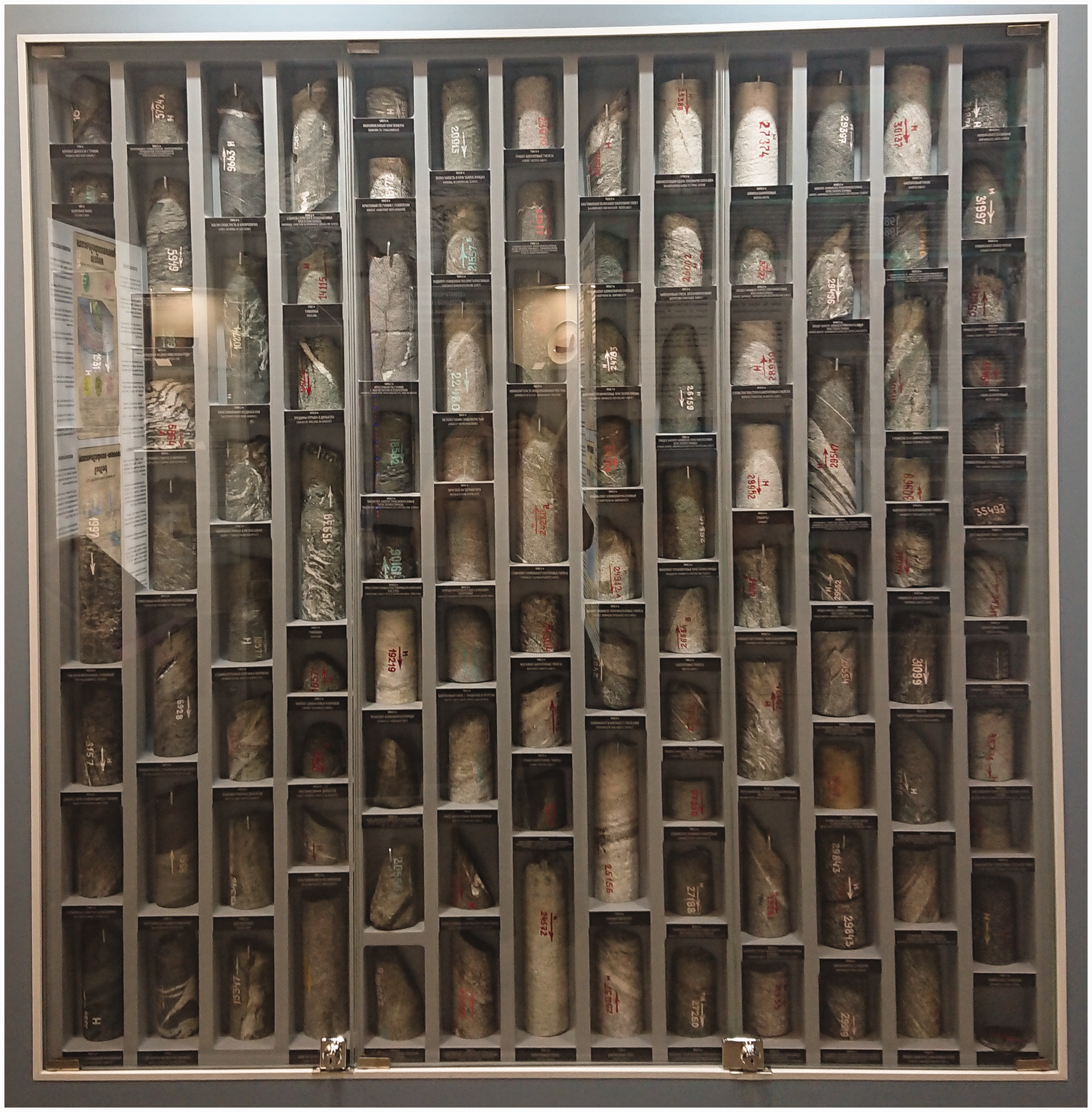
Pieces of the core (Author's own, 2021).
The 15-kilometre goal set by the KSB project was never reached. The geologists had hypothesised that the temperature at such depths would be around 120°C – heat that the drill had been designed to withstand. However, the actual temperature at the well-bottom was close to 200°C and the drill started to malfunction. By then, perestroika was casting a shadow over (now) Russian science, and the funding was drying up. The workers carried on valiantly for a while, but the lack of money and the difficulties with the drill meant that the KSB never went another metre. Millions of rubles had been spent; 10,000 cores had been collected. These cores are scattered across Russia in various repositories (and still being worked on in some cases); they have become material containers of information that act to suppress the messiness and the discontinuity of the hole itself, laid out in neat little rows that fit the shattered pieces together to produce a visual representation of the underground at the surface. By disregarding the failures and difficulties of the drilling itself, scientific knowledge excavation is rendered as separate from the hole, in its own sphere, used to cultivate a vertical spatiality that can be used by the surface powers of the nation state. In the KSB’s case, once the borehole ‘surfaced’, as it were, it became representative of a Soviet technoutopic ideal that both shored up territory and crossed borders. The drill became a boundary making apparatus that attempted to erase embodied relations with the underground (Powis, 2021). The drillers, however, knew better.
Collaboration: Knowledge across the iron curtain
For 14 years, the KSB was kept a secret from the rest of the world. The iron curtain was frequently a barrier to knowledge sharing, and whilst the KSB geologists were aware of the American Project Mohole, their own superdeep project was only unveiled at the 1984 International Geological Congress in Moscow. By then, the KSB had reached 12,000 metres and was officially the deepest hole in the world. To promote their project to the scientific community, the Soviet geologists produced both a pamphlet that was handed out at the congress, and a collection of papers written in English detailing the initial findings of the KSB (Kozlovsky, 1984). Having worked on the deep cores for over a decade, the geologists had made a number of discoveries. Ore was indeed discovered at the lower depths – quartz, calcite, cobalt, lead, zinc, copper and gold – but it was much too far down to consider mining it; rather, the geologists predicted that the dynamic church of strata would thrust the ore to the surface over time. The purely scientific discoveries, as noted by David Guberman, “showed that we knew almost nothing about the continental crust” (Hitsky, 2007). One of the main aims of the KSB was to discover proof of Conrad’s Discontinuity – a point in the crust where granite would transition to basalt. The geologists found no evidence of its existence; instead, the granite just kept on going (Kozlovsky, 1984). Not only this, but water was discovered in the lower depths: mineralised fluid produced by pressurised flows of helium and hydrocarbons (Orlov and Laverov, 1998). But the main point of the KSB’s reveal in 1984 was to present the Soviet Union’s achievement to the world. The newspaper reports at the time describe dazzled delegates from all over the world who were desperate to make a trip to the KSB. The German head of the International Geological Union was quoted as saying: We are shaken by what we have seen: the depth of 12,000 meters, the unique geological and geophysical studies, and the team that has achieved such outstanding success. We hope that the depth of 15,000 meters will be the next Russian achievement. In the realm of hope there is no winter. (Soviet Pechenga, 1984: n.p.)
In 1989, a Scottish geologist called David Smythe hatched a plan to visit the KSB. Knowing the Soviets were sending a team to the International Geological Congress in Washington DC, he arranged for his colleague – and fluent Russian speaker – Con Gillen to ambush the group and pass along a proposal for an international delegation to conduct their own research on the hole; they would bring the latest equipment – such as seismic vibrator trucks – and technology which the Soviets could use, and all data would be shared at the end. To Con’s great surprise, the attending Soviet Minister for Geology agreed. After several years of logistical planning, the delegation – comprising American, British, Norwegian and German Earth scientists – were ready to make the journey. Perestroika had turned the Soviet geologists into Russian geologists, but David recalled the only thing that changed was the colour of their flag lapel badges. Science became the great leveller, facilitating a cross-border collaboration that had rarely been seen in the Soviet Union. Con described the atmosphere: It was a combo of technology and equipment and their knowhow and our knowhow of using different types of materials and different models of how the Earth works – a combination of West and East, input, knowledge and different scientific approaches. Nobody was saying this side was better than that side, there was no competition; it was very genuine cooperation and collaboration. (interview with author, 2021)
This is not to say there were no discrepancies. David recalled the Russians having only basic computers, and were fascinated by the latest Western technology; they were, to compensate, very good mathematically. The Russians tried hard to prove themselves to the delegation, and anybody deemed to not be pulling their weight was quietly removed, so keen were they to demonstrate their abilities matched the flashier grants and pedigrees of the Western scientists. The Westerners, for their part, were impressed by the sheer feat of engineering that had produced the KSB. Nothing that deep existed anywhere else on the planet. As David stated: “For us Earth scientists it was the geological equivalent of going to the moon!”
The convergence of East and West at the KSB, as Con put it, offers an insight into a subterranean accessibility and engagement generated by the porosity (or not) of borders and geopolitical boundaries. The 1992 delegation happened at a time when the Iron Curtain was dissolving, borders were being awkwardly redrawn, and the entire structure of Soviet government was dismantled. Russia became a capitalist society, its economy seized by oligarchs. The funding that had been so plentiful during the 1970s and 1980s was gone, and the utopic ideals of the KSB faded. What had been integral to the construction of the Soviet identity as a pioneer of new technoscientific fronts was subsumed by the novel necessity of state projects to be profitable. The KSB limped through the nineties as a potentially viable source of ores, its geologists attending mining and prospecting conferences – often facilitated by Western connections – in an attempt to attract capital investment, but there was little interest in a site so isolated and lacking in modern infrastructure.
Yet whilst the (overtly) horizontal space of the nation state and its borders mobilised the vertical space of the KSB in its territorial imaginary, the relations produced down in the hole itself were infinitely more entangled. Franck Billé points to the frictions between “the surface, where modern cartography leaves no space for gaps, blanks, or overlaps, and the subterranean substratum—messy, intermeshed, and ambiguous—that actually sustains these somewhat illusory partitions” (2022: 148). Whilst the hard borders of the Soviet Union and the turmoil of perestroika made the collaboration between the West and the Russians complicated through the obtaining of visas, the difficulties of travel, the awkwardness of moving around a militarised zone, the subterranean space of the KSB generated complex links that bypassed political surface tensions; this is not to say the underground is not political, rather that deep modes of spatial organisation produce different political relations. The combining of both Western and Soviet geological and engineering knowledge was facilitated by the possibilities the borehole promised to geological thought.
Once these relations returned to the surface, however, the collaborative relationship was challenged. The data travelled back to the geologists’ home countries, although David recounted an unpleasant incident in which the group’s Russian guide attempted to stop the results leaving Russia – a situation that was only resolved when one of the Norwegian scientists grabbed the guide by the throat and yelled: “If you don't let us out with the data I'm gonna kill you!”. Whilst the incident did not sour the good relations that had built up between the geologists, it was clear that the party was over. When asked about what the KSB had achieved as a project, David was candid: The Soviets had one idea which was totally at odds with the Western idea (of the crust), and in fairness to the Russians, they decided to drill this hole in Kola at a place where they could conceivably go through the upper layer to the lower layer within the crust, and see what the lower crust was like. And it turned out their notion of the crust layering was wrong, so they disproved their own theory and they had to accept the Western theory of the crust. (interview, 2021)
The reiteration of West versus East speaks to the mobilisation of scientific knowledge as a geopolitical tool. The utopic designs for the KSB and ultradeep drilling all but evaporated with the Soviet Union’s collapse, and its contribution to the field of geology largely forgotten as the scientific world moved on. Regardless of the collaborative atmosphere facilitated by the crossing of borders, how Western and Russian geologists approached and accessed the underground through the borehole produced different ways of understanding the subterranean. The point is: once the subterranean is brought to the surface, it is subject to the construction of surface spatial arrangements that attempt to disregard the messiness and the entanglements of ‘down there’. It is the KSB’s discontinuity as a geopolitical imaginary that produced both an atmosphere of collaboration, but also a discrepancy of knowledge; as a pioneering Soviet project closed to the West, it buttressed Soviet understandings of the underground, but its collapse and subsequent facilitation of border crossing during perestroika produced new relations, new knowledges, and a portal to the underground that mobilised horizontal spatialities as well as vertical.
Imagination: Art and the subterranean weird
Drilling on the KSB’s main shaft stopped in 1990, and on the supplementary channels in 1994. The project was mothballed for good in 2007; in 2008, the remaining ‘staff’ were laid off (although they had not been receiving a salary for six months) and the KSB ceased to officially exist. In the years since its closure, the site has fallen into complete disrepair. Periodically, the Murmansk federal government has broached developing the site as a tourist attraction, but nothing has ever come of it. Publications occasionally emerge detailing the ‘weird’ aspects of the world’s deepest hole, usually drawing on the ‘well to hell’ hoax that emerged in a Swedish newspaper claiming that the Soviet geologists had drilled so far down they reached hell, and the screams of the damned could be heard echoing up through the drill shaft. 3 The hole slipped into scientific obscurity, but was simultaneously curated as a strange, ghostly place. In 2020, a Russian horror film called ‘Superdeep’ took huge liberties with the KSB’s story – in the movie, it was possible for humans to enter the hole where they were subsequently attacked by creatures – which reignited interest. Urban explorers, Instagrammers and Youtubers sometimes make the journey. However, ask anybody if they have heard of the KSB, even in Russia, and the answer will almost certainly be no.
From 2014 to 2016, the arts organisation Sonic Acts curated a travelling symposium around the Kola Peninsula. Called ‘Dark Ecology’, it took its name from the Timothy Morton concept that draws attention to the material and metaphysical darkness of ecology itself, and the role that humans have played in the current ecological moment – namely, the Anthropocene (2016). The organiser of Dark Ecology, Arie Altena, described visiting the town of Nikel in the winter of 2012 and watching snow start to fall; the snow was black, infused by the polluting fumes of the nickel plant, a dark ecology unfolding before his eyes. Once he began to research the area, Arie discovered the Kola Superdeep. Fascinated by the story, he commissioned sound artist Justin Bennett to produce an accompanying sonic piece, and in 2016, the Dark Ecology team hosted a sound walk at the KSB site itself. A surprising number of people came, many of whom were hearing about the KSB for the first time. One of the last surviving KSB geologists, the rather eccentric Yuri Smirnov, showed up and began to give his own (and in his mind, better) tour. 4 Wandering through the crumbling buildings and corridors strewn with papers and equipment, attendees were narrated to by the former KSB geologist Victor Koslovsky, who had begun to conduct his own ad-hoc experiments at the hole after it had shut down, using sounding equipment to listen to the Earth move. He explained: “So, yes, this is what I still practise – listening to the past, in order to hear the future. And now everybody's left it's nice and quiet. Perfect for listening, no?”
Victor guided the attendees aurally throughout the site, culminating in the hole itself (now overlain with a rusted cap), the drilling tower long since dismantled and scavenged. His voice faded out, replaced with the otherworldly sound of white noise, gurgling and dripping water, echoes of unknown origin, the scurrying of animals in their burrows. This was what Victor spent his days listening to, waiting for the rumble of seismic activity in the subterranean deep. Once the sound walk was over, many people wanted to meet the man who had guided them so eloquently, and whose obsession with the underground had led him to continue working at the now abandoned hole. Awkwardly, Justin had to tell them that Victor was a figment of his imagination
5
: an unreal character created from real snippets of interviews, scientific studies and Sami mythology. Victor’s vocal situatedness within the corridors of the KSB generated a sense of uncanny that Justin admitted to taking as his inspiration for the sound walk: There were some places where it looked like okay, it's abandoned, but it looked like it was abandoned last week. So there were cutlery and cups and personal letters and notebooks and photographs and all this … You expected to meet somebody there. So okay: there is somebody still there, he's somebody who stayed on to carry on his research. (interview, 2022)
The ‘presence’ of Victor speaks to the spectral resonances a place like the KSB can produce. Tim Edensor’s work on the fluidity of ghosts in industrial spaces speaks of a memory that is “characterised by discontinuities and irruptions and cannot be fixed or conveniently erased” (2005: 829). The fact that Victor was made up adds another layer of uncanniness to what remains ‘real’ at the KSB, as its scientific history becomes further lost to the dusty archives and faded memories of those who worked there, its material remains decaying through the passage of time. Justin spoke of his naivety and subsequent frustration that he would not be able to merely pop open the lid of the KSB and stick a recording device down it (his recording of the hole was also constructed from his imagination); when I asked him what I would see if I were to take the cover off, David Smythe merely said: “It will have collapsed internally due to the stresses of the Earth. There's nothing open at all down there anymore”.
But this is not merely a process of spatial degradation or collapse; rather, the dynamism of the hole has dissolved the boundary between the so-called truth and the imaginary. The science of the KSB is no longer confined to journals and conferences, bounded sites of extracted knowledge and supposed objectivity. Science can also be generative of creativity, of art. Justin’s work reveals the resonances and ruptures that can emerge from a scientific fact, taking on a life of their own and bleeding into other spaces, to the extent that such knowledge can enter the scientific sphere once again. His video installation that accompanied the sound walk lingered on Victor’s drawings and diagrams of subterranean strata and seismic activity that acted as anchors between the real and the unreal (Figure 3):
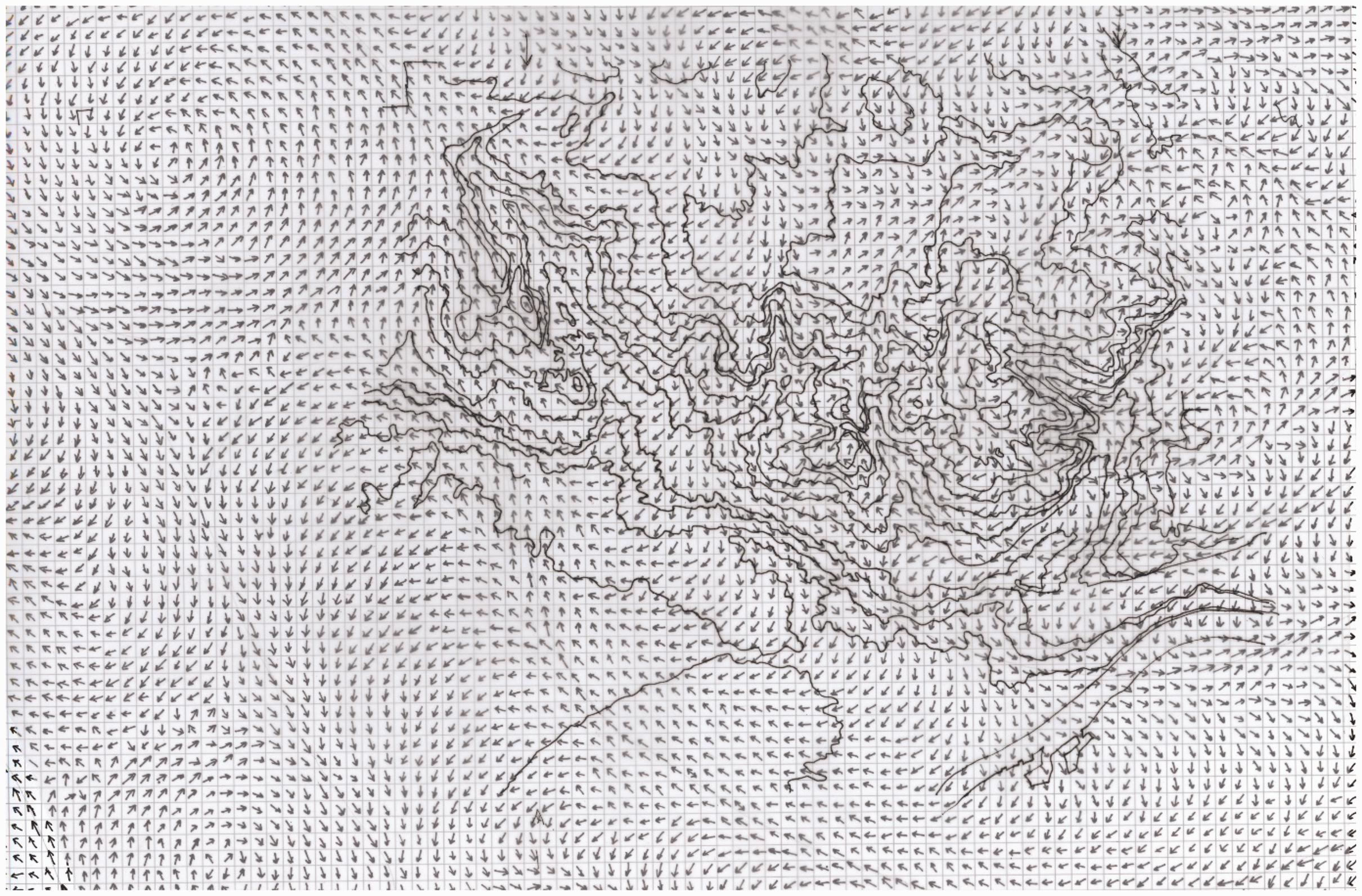
“Victor's” drawings of the crust (Bennett, 2016).
There are some drawings that I show that look like kind of layers … of geological layers. But it's just painted. I mean, it's kind of made up. And I showed them when I showed this as an installation in Belgium. And this geologist came from the university. And I just thought, he's just going to be really annoyed. And then he started explaining to somebody else what all these layers meant on this drawing, which is, of course, just made up. So I thought, okay, but that's great, because then there really is a blurring of science and art. (interview, 2022)
Without continuous drilling, the KSB’s shafts disintegrated, the churn of the Earth and the friction of stratal movement filling the extracted space with new rock formations. This is a discontinuous spatiality that not only accounts for planetary dynamism, but is also generative of novel relations and emergences from the dynamism (Hawkins, 2018; Steinberg and Peters, 2015). The retreat of scientific work done under the banner of extracted objective knowledge and verticality left a gap that was (re)filled by myth and legend, by ghosts and weirdness, by art and creative interpretations of abandoned science. Science begets art begets science, an entanglement of supposedly opposed spheres facilitated by subterranean forces.
In their call for a new weird geography, Turnbull et al. define the weird as “concerned with transgressions of normative spatiotemporal orderings” and “novel encounters and rupturing presences” (2022: 8). Justin’s aim was to capture some of the weirdness that emanated from the KSB site when he composed the sound of the underground that ended both his sound walk and installation film (the screen faded to black). Whilst he could not record inside the hole, he used geophones to pick up vibrations from the Earth, but admits that he had no idea what the sounds he recorded were: There is kind of grumbling, grumbling sounds, and a lot of very low frequencies … And you don't know what it is. So I kind of mixed this with recordings of wind and, you know, in a way it doesn't matter what the sound is. It’s just there to evoke this imaginary world. And at that point, that imaginary world underground will be different for everybody, whether you think it's something coming up from very far away coming towards you, or whether you imagine yourself underground in the middle of this space. (interview, 2022)
Both the other-worldly sounds and the blackness of the screen served to disorient the listener, who remains on the surface, but is aurally transported underground where the movement of the strata beneath their feet becomes apparent. Anything is possible down there, and the listener’s imagination is flooded with the weird and uncanny, with the potential for new encounters and relations with the subterranean. This is a discontinuous space that collapses entirely the borehole’s design of linear form and access from the surface. The assumption of solid ground is evaporated with the gurgling of water, the booming of distant earthquakes, the scrape of rock against rock. And not only this, but the sounds of life are also apparent: lemmings, birds, and perhaps the screams from hell. Through this dynamic activity, the idea of the borehole is enough to produce an access point for surface dwellers into the underground, with the listener becoming a conduit for the weirdness of the subterranean to emerge. Or, as Victor puts it: Maybe the underworld is just a reflection or a downward continuation of the sky, the heavens. And we are in between, stuck on to the surface of the Earth – the border between them. And yes, out here on the Kola Peninsula we are at the border of everything. Between East and West, night and day, summer and winter, the tundra and the taiga, the past and the future. Except … I don't know any more if there is a future. Just look around you. Do you see the future here? (Bennett, 2016)
Conclusion
As the climate crisis worsens, the subterranean has begun to be featured heavily in speculative reimaginings of how humans might survive an apocalyptic scenario that renders the surface uninhabitable. In 2009, the Russian architecture firm AB Ellis Ltd released a design blueprint for an underground city to be built in the mine next to the town of Mirny in eastern Siberia (Lutomsky et al., 2009). The Mir – mir meaning both ‘peace’ and ‘world’ in Russian – mine is the largest open pit diamond mine in the world, 525 metres deep with a diameter of over a kilometre. Calling their project ‘Ecocity 2020’, AB Ellis imagined a solar-panelled glass dome that would cover the mouth of the hole, rather like a giant greenhouse, and three levels: the bottom level housing a forest to provide the city with oxygen, the middle level for housing up to 50,000 people, and the top level a recreation zone. By retreating underground, the residents would be protected from both the brutally cold winters of Siberia and the encroaching climate crisis.
Needless to say, 2020 came and went with a global pandemic but no Ecocity. The Mir mine continues to operate despite a deadly flood in 2017, and the architectural plans for a futuristic underground dwelling shelved, at least for now. But the subterranean is frequently meted as a solution to the excesses of anthropogenic pollution and destruction. Arctic Svalbard is host to an underground permafrost repository that banks millions of seeds from around the world as a safeguard. Carbon capture and storage uses specialised receiving plants to ‘capture’ CO2 before it enters the atmosphere, which is then injected into deep geological formations to be trapped indefinitely, although the technology is still experimental. Deep geological containers are used in some countries to store their nuclear waste, but again, nobody is sure how long term this solution can be. Indeed, it was suggested – never particularly seriously, thankfully – that the KSB be used to house nuclear material from the rusting nuclear submarines that litter the Kola Bay next to Murmansk. Subterranean repositories are becoming synonymous with safety, from the bunker to the vault, banking on the assumption that depth means stability, depth means protection from the surface world above, and that excavation means greater knowledge of our world and how to control it.
This article has followed the attempts of humans to maintain a continuous, vertical, extractive relation with the earth through a clear subject/object spatial dichotomy, and the ways this continuity is resisted by subterranean agency we might understand as discontinuous – or, a structural break in the normative order of things. Using a case study of the world’s deepest borehole, the Kola Superdeep, it has identified a variety of ways of understanding the underground through discontinuous access points and relations. The first examines the role of the KSB as a site of scientific excavation, analysing the ways the KSB geologists discarded the embodied knowledges of the drillers, using the extracted cores to produce a sense of linear verticality and objectivity. The second tracks the cross-border collaboration between the Soviet/Russian geologists and a Western delegation that visited the KSB during perestroika, and the ways in which this collaboration either held up or fell apart through the differential spatialities of the borehole. The third intervention reveals the emergence and importance of imagination to understandings of the subterranean, drawing on the artistic engagement with the KSB once it had closed down, and the dynamic forces that collapsed the shaft producing new generative, creative and weird relations that subvert scientific truths.
A future form of the subterranean might see an about turn, an entrance into the underground. The deep subterranean of the future, far from one that houses demons and ghosts and something we prefer not to think about, is becoming redefined as both a refuge and a frontier. China is leading the way in terms of deep laboratories, utilising the infrastructure of mining shafts to build underground research centres that can study the effects of depth on the human body (Liu et al., 2018); as the shallower minerals get used up, maintaining the technologies and commodities that have made China a global economic power will demand deeper and deeper mines, and deeper and deeper bodies (Morris, 2008; Yusoff, 2021). SNOLAB, a deep laboratory in a Canadian nickel mine, has studied the effect of depth on whitefish and found their bodies grew significantly longer than those kept on the surface (Pirkkanen et al., 2020). There is renewed interest into the psychology of humans in underground spaces, and the difficulties that accompany being without access to natural light, escape routes, temporal markers (Lee et al., 2017). Cave dwelling experiments and the effects of underground life on mental and physical health are certainly not new (Foer, 2008), but current studies are prospecting subterranean living as necessary for survival, the more the surface becomes uninhabitable.
The KSB is obsolete in this subterranean future; there is no entrance of the human into its depths, nor will it become a repository for waste or carbon. But by thinking of its existence as a discontinuous one, that which is dynamic and heterogenous and constantly shifting, the underground can be recast as something that is much more than the thing we stand on, or the thing we extract commodities or knowledge from. It could be said that the KSB raised more questions about the subterranean than it answered (Beluosov, 1982), but if its legacy can say anything, it is that the underground is not some separate space that can be controlled, mapped, scientifically studied in a vacuum; rather, it is a set of multiple spatialities, relations and forces that are deeply connected with the surface and its humans. This connection is not a smooth, continuous one, but one that is rather like the KSB itself: jagged, spiralling, shattered, discontinuous. Any bodies entering this world would be radically altered.
If humans were to descend into the underground as dwellers, what might happen? Perhaps humans would form new kinships with other subterranean dwellers. Symbiotic relationships, such as mushrooms have with trees, could evolve over time: ways for solar loving bodies to tap into the sky and drink the sun. We might become stunted, no longer upright, seek nutrients to suck from salt deposits, be rendered blind. Our ears would become hyper-sensitive, attuned to listening to the deep rumble of the Earth. We would know the underground riches with our hands. And would we forget, eventually, in this terraformed existence, what the surface world was ever like?
Footnotes
Acknowledgements
I am grateful to everyone who gave feedback on this article in its various forms, particularly the attendees at the ‘Mediating Arctic Geographies’ and ‘Geopolitics and Planetary Boundaries’ conferences, and the three anonymous reviewers that improved the piece significantly. I also thank everyone who gave their time to me during data collection, both on the Kola Peninsula and beyond.
Declaration of conflicting interests
The author(s) declared no potential conflicts of interest with respect to the research, authorship, and/or publication of this article.
Funding
The author(s) received no financial support for the research, authorship, and/or publication of this article.