




Abstract
Hawai‘i faces a crisis of homelessness due to the high cost of housing across the islands. Many without formal housing establish interdependent communities unsanctioned by property regimes and refer to themselves as “houseless” because intimate relations with place and expansive practices of care provide an adequate home. Attending to the experiences of Hawai‘i’s houseless, I unpack the meanings and practices of organized abandonment while proposing that some face structural neglect by “living with abandon.” I argue that the rupturing of life-giving relations entwined with particular places serve as a foundation of organized abandonment. Devolution, state retrenchment, the intensification of land use for revenue-oriented development, and a punitive carceral state layer upon this foundational rupture to propel the continual abandonment of shared resources. This enables the ongoing circulation of capital through the environment. In response, people live with abandon by rejecting, or holding an ambivalent relationship with, aspirations to thrive within capitalism. Living with abandon is a form of creative improvisation that cultivates connections in the face of broken relations, yet remains defined by uncertainty and heartbreak. It both invokes the fullness of time and space and mourns the losses that have produced the tenuous present.
The village at the Wai‘anae Boat Harbor is tucked in a grove of kiawe trees, sandwiched between the highway and Pacific Ocean. Since the early 2010s, a few hundred people have lived here. Tarps connected by poles and pallets provide shelter, many furnished with a couch and bed. Papaya and banana trees growing from the sandy soil intersperse with generators powering lights that cast shadows across the dirt at night. The people who live here affectionately refer to their home as Pu‘uhonua o Wai‘anae (refuge, sanctuary of Wai‘anae). Yet while the village is visible from the nearby parking lot, most only venture in if one lives there or has a friend or relative who does. When I entered with a community group after living a few hundred yards away for almost a year, I was pleasantly surprised when residents were quick to greet visitors with a friendly smile. Pu‘uhonua o Wai‘anae is in fact a welcoming space where anyone can live if one follows the rules: Don’t steal, respect your neighbors, keep your area clean. And while most were forced here due to an inability to pay rent—they were “corralled,” in the words of one resident—the majority make do with fish from the ocean, wages from work, and donations from volunteers.
This article attends to the experiences of houseless people on the Wai‘anae Coast on the island of O‘ahu in Hawai‘i to unpack the meanings and practices of organized abandonment while proposing that some, including those at the Boat Harbor, face this structural neglect by “living with abandon.” I argue that the rupturing of life-giving relations entwined with particular places serves as a foundation of organized abandonment. Devolution, state retrenchment, the intensification of land use for revenue-oriented development, and a punitive carceral state that polices the housing insecure layer upon this foundational rupture to propel the continual abandonment of shared resources. This enables the continued circulation of capital through the environment (Labban, 2020). In response, people live with abandon by rejecting, or holding an ambivalent relationship with, aspirations to thrive within capitalism. Living with abandon is a form of creative improvisation that cultivates connections in the face of broken relations yet remains defined by uncertainty and heartbreak. It both invokes the fullness of time and space and mourns the losses that have produced the tenuous present.
Existing scholarship on organized abandonment conveys how neoliberal state reorganization sacrifices particular places. This results in the flight of economic activity and jobs, environmental degradation, underemployment, the diminishment and privatization of public programs, and the disappearance of entire ways of life, all part and parcel of the disregard of those subjugated by a racial capitalist social order (Gilmore, 2008; see also Bhandar, 2018a). Ruth Wilson Gilmore (2008) describes the loss of entire ways of life as one of the several elements of organized abandonment, and I likewise show how the forced abdication of lifeways—often by bulldozing interdependent communities—is foundational to abandonment. I further build on Gilmore’s discussion of how people in abandoned locales “craft ad hoc and durable modes for living and for giving meaning to … life” (37) by elucidating the contradictory and sometimes indeterminate ways people recuperate connections in a place indelibly shaped by Indigenous dispossession.
While the aforementioned antiracist Marxist geographers foreground the economic, political, and social forces shaping environments, geographical scholarship on Indigenous Hawai‘i underscores the ancestral knowledge, practices, protocols, and metaphysical forces that permeate Hawai‘i’s natural world, including places neglected and threatened by colonial projects (Andrade, 2008; Louis and Kahele, 2017; Oliveira, 2014). Carlos Andrade (2008) emphasizes how property regimes have fractured intimate and familial relations with land, forcing the Kanaka Maoli to contend with, alter, and “selectively appropriate” (Beamer, 2014) these systems. 1 They are in conversation with Native Hawaiian historian Lilikala Kame‘eleihiwa (1992), who casts the institutionalization of property as the turning point in the loss of sovereignty for the nation of Hawai‘i and private property as a pillar of capitalism. 2 Building on this, I foreground abandonment as another defining element of capitalism that shapes places and placemaking in contemporary Hawai‘i. Synthesizing scholarship on organized abandonment with Native Hawaiian geographies, I show how the organized abandonment of otherwise abundant land shapes the living history of Hawai‘i, and how the abandoned get organized by drawing from intimate ancestral connections with people and places.
It is not uncommon for advocates to frame houselessness in Hawai‘i as a Native Hawaiian issue (see for example Kelly, 2014). In the most recent count, 28% of Oahu’s houseless identified as Native Hawaiian while representing 19% of the island’s population (Partners in Care, 2023). Native Hawaiians, and Pacific Islanders from other parts of Oceania pushed from their homes to Hawai‘i due to economic and environmental processes tangled with US empire, are grossly overrepresented among the houseless. 3 One study finds that 121 of every 10,000 Native Hawaiian and Pacific Islanders in the US experience homelessless, a rate far surpassing all other racial groups (NAEH, 2023). Native Hawaiians and other Pacific Islanders account for 34% of the counted houseless population on O‘ahu, and those facing mental health challenges, disabilities, and substance use problems are similarly over-represented among the housing insecure (Partners in Care, 2023). 4 While Native Hawaiians are overrepresented, at least 72% are non-Indigenous; thus, settler colonialism cannot possibly be the sole explanation for Hawaii’s housing crisis and the houselessness that ensues, although this process surely intersects with other issues. Scholars have defined settler colonialism as a system of power that involves the ongoing expropriation of Indigenous land through the attempted erasure of Indigenous people and lifeways for the purpose of replacing Indigenous people with settlers, the latter deemed more deserving of land and resources (Saranillio, 2015). This contours Hawai‘i’s housing landscape, particularly in light of a tourist-oriented economy that drives up land value and places pressure on existing units while squeezing out Indigenous and working class locals. And yet by attending to the specificities of how the rupturing and recuperation of place-based relations are foundational to abandonment and living with abandon in Hawai‘i, I make more general observations of capitalism’s fundamental tendency to advance the settler colonial and racial imperative to split apart life-giving relationships, and how this is always accompanied by fraught efforts that contend with dislocation. This is particularly the case in places where people hold intimate and multigenerational connections to the land.
In 2022, the median sales price of a single-family home in Hawai‘i was $1.131 million (UHERO, 2022). Estimations from 2015 ranked Hawai‘i as the state with the highest rate of homelessness (NAEH, 2016) and a 2022 ranking placed Hawai‘i right after New York and Washington, DC (NAEH, 2022). In response, the City and County of Honolulu (encompassing O‘ahu, Hawai‘is most populous island) controls public space with sit-lie bans, sweeps and encampment raids, property confiscation, and curfews (Darrah-Okike et al., 2018). This pushes the houseless out of commercial centers, such as the tourist hub of Waikīkī, into concentrated zones that government agencies tacitly agree to ignore, at least for a time. In these “out of sight” places, people often come together to forge interdependent communities such as Pu‘uhonua o Wai‘anae to exercise a degree of self-governance while facing constant threats of relocation. This is particularly the case on the Wai‘anae Coast, a predominantly poor and working class rural community where Kanaka Maoli and other Pacific Islanders comprise 71.5% of the population (US Census, 2020). For decades, the State of Hawai‘i has let houseless communities in Waianae grow for a time before evicting them, moving them from beach to beach without offering long-term solutions. “Crisis” adequately describes Hawai‘i’s housing landscape because official government institutions and the commercial real estate market do little to resolve this problem; rather, they perpetuate it. At the same time, crisis signifies a moment where everyday people challenge structures of power and attempt to reorganize them (Gilmore, 2002). 5
The following section offers a historical account of the roots of Hawai‘i’s housing crisis, namely the intensification of land commodification in the 1970s that spurred both resistance and the bulldozing of interdependent communities throughout Hawai‘i (Figure 1). Evictions continually ruptured the communal lifeways of people coming together to refuse capitalist development schemes and live on their own terms. The following section focuses on the outcomes of devolutions of the 1970s that saw the off-loading of state programs for the poor onto local bodies that coincided with a carceral turn. In tracing this history, while sharing stories from Hawai‘i’s houseless, I develop a working definition of organized abandonment. The third and final section brings us to the present, examining how the people of Puuhonua o Waianae live with abandon by prioritizing survival over adherence to a coherent ideological doctrine or strategy, living in indeterminate realms ripe with possibility. Yet in contrast to the movements of the 1970s that synthesized anticolonial and anticapitalist movements, a sense of both hopelessness and pragmatism permeates efforts to create alternative ways of relating to the land and to each other.
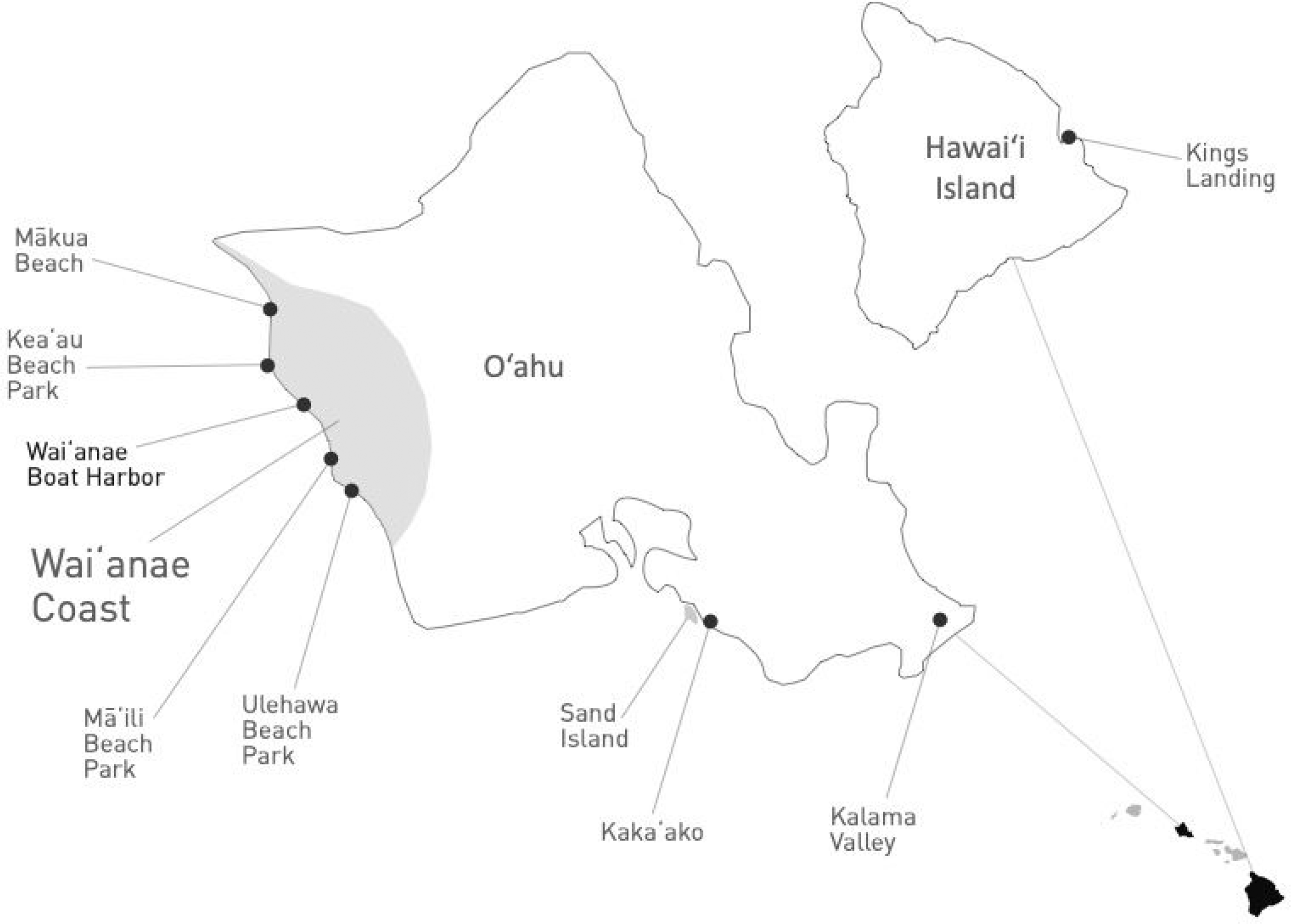
Houseless encampment and anti-eviction struggle sites discussed in this article.
Bulldozing
In 1981, Skippy Ioane moved to King’s Landing on Hawai‘i Island. To this day the State of Hawai‘i Department of Hawaiian Home Lands controls the area and has been slow to officially place Hawaiians on the land under the Hawaiian Homes Commission Act, passed in 1921. Ioane took matters into his own hands, and his goal, along with several other families who moved to King’s Landing soon after, has been to create a self-sufficient Hawaiian village that manages natural resources in the pursuit of a subsistence lifestyle as a basis of Hawaiian self-determination. They constructed homes with second-hand lumber along water pooling in lava rocks on the shore. They have grown fruit trees such as avocado, banana, and lemon while raising chicken and livestock (Malama Ka ‘Aina Hana Ka ‘Aina King’s Landing Community Association, 2022 and 1985). 6 Ione has been adamant that the word “homeless” does not apply. “We don’t call Hawaiians homeless because we, the Hawaiian people, are home. We are just houseless … What you see out here [tents and tarps] is affordable housing. Nature is not our enemy. Nature is our mother” (Blaisdell et al., 2014: 295). This idea is foundational to Indigenous relations to land, and many have echoed Ioane. In 1996, a resident of another self-governing community at Mākua Beach, located seven miles north of the Wai‘anae Boat Harbor, stated simply: “We’re not homeless, we’re Hawaiians” to underscore indigeneity and belonging (Niheu et al., 2007:208). Over two decades later, a Pu‘uhonua o Wai‘anae resident asserted: “We not homeless … this place is our birthright” (Young, 2019: iii). 7 They approach human ties with ‘āina (land that feeds and sustains) as part of an intimate and “sacred genealogical relationship,” the source of a “vital spatial knowledge” that reckons with and refuses Indigenous erasure (Louis and Kahele, 2017). Many in Hawai‘i embrace the term “houseless” to counter policies and rhetorics categorizing those without formal housing as disposable miscreants while asserting intimate relations with the natural world as the basis of belonging. Expansive practices of kinship between and among humans, the Earth, and metaphysical realms shape Indigenous refusal confronting a housing crisis on Indigenous lands. Figure 1 depicts King’s Landing, Mākua Beach, the Wai‘anae Boat Harbor, plus other sites of anti-eviction struggles and houseless encampments that I discuss below.
Haunani-Kay Trask (1987) discusses the islands’ first major contemporary anti-eviction struggle that gave birth to the modern Hawaiian movement, rising in opposition to intensified capitalist development and the criminalization of those refusing this profiteering. Following statehood in 1959, Hawai‘i moved from an economy dominated by cash crops to one dependent on tourism and land speculation, the latter dictated by large landowners intent on driving up property value. In this context, major landowner Bishop Estate (now Kamehameha Schools) announced plans to build a subdivision of freestanding houses in Kalama Valley on the eastern edge of Honolulu. The problem was that Kalama Valley already provided a home for about 150 families, mostly working class pig and vegetable farmers who were Native Hawaiian and non-native locals (many descended from plantation workers), living on Bishop Estate leases. University activists and grassroots community members began organizing in 1970 to oppose the development because the new units would be unaffordable for most island residents and they strived to protect a way of life, in the words of Trask, “not driven by the suburbanite’s desire for neat lawns, fancy houses, expensive cars, big fences, and unseen neighbors” (Trask, 1987: 131). They opposed nothing less than the commodification and enclosure of the natural world. Bulldozers arrived on 2 July 1970 to demolish a few Kalama Valley houses, which led to the arrest of four protesters attempting to physically block the machines to no avail. This kicked off study groups, a publicized trial of the arrested protesters, grassroots advocacy, a “tour” of the valley attended by over 2000 people, protests, and the eventual full-time occupation of the valley by a few hundred supporters. Bulldozers demolished the last home in Kalama Valley on 11 May 1971 and arrested three-dozen people who refused to leave (Trask, 1987). In 2023, houses on 1000 to 2000 square foot lots in this neighborhood sell for 1 to 1.65 million dollars.
Anti-eviction struggles continued as land commodification intensified. One of many more clashes played out at Sand Island, a fishing village “built up from scraps of the torn-down sections of Honolulu,” across the lagoon from Honolulu International Airport. As the cost of living soared, the community grew to 134 dwellings. Residents fished and rediscovered their ancestral relations with the sea (Puhipau, 2014:128). The State of Hawai‘i issued an eviction notice in October of 1979; three months later, bulldozers arrived with enforcement agents, dogs, guns, the Coast Guard, a police riot squad, and helicopters. They arrested 19 people (Puhipau, 2014). Amid the demolition, a tenant cried, tears streaming down his face, “This is our life!” (Keith and Rochford, 1982) They were not just losing the dwellings where they happened to live, they were also losing their interdependence with the natural world and all it offered.
The devotion of state resources toward the violent displacement of houseless communities continues to this day. Immediately after Governor David Ige declared homelessness a statewide emergency in 2015, the City and County of Honolulu and State of Hawai‘i jointly coordinated a “sweep” of Kaka‘ako encampments near where development is booming (Gill, 2015). Honolulu Mayor Kirk Caldwell, who served from 2013 to 2021, similarly prioritized enforcement over services, and sweeps were a signature feature of his policy—even amid the COVID-19 pandemic—which the ACLU Hawai‘i chapter describes as a failure in alleviating homelessness (Jedra, 2020). Gratifying tourists along with owning and renting residents, public officials fail to challenge the market logics that propel the housing crisis while jettisoning responsibility to provide housing to those in need of support. This “corrals” the housing insecure into rural and working class areas such as the Wai‘anae Coast, located almost 40 miles from the tourist hub of Waikīkī.
The housing crisis stems largely from the fact that working class and poor people, who have depended on the Earth’s bounty for generations through fishing, farming, and hunting, find themselves forced into an exploitative labor market while facing astronomical rent. Even when holding multiple low-wage jobs, most are still unable to afford rent, especially earning Hawai‘i’s minimum wage of $12/hour in 2023. The National Low Income Housing Coalition (2022) ranks Hawai‘i as the state with the most “out of reach” housing, and calculates that someone would need to work 123 hours per week at minimum wage to afford a one-bedroom rental home on the islands. In 2022, the average market-rate rent of a two-bedroom apartment in the state was $2113, with even higher prices in urban Honolulu. A person must earn at least $40.63/hour and work 40 hours a week (earning $84,510 per year) for a two-bedroom home to be within reach in the state. About 40% of Honolulu residents rent their homes, and the average renter earns $20.59 per hour. Carlos Andrade (2008) provides historical context for the transformation from intimate environmental connections to property regimes: “Those emotional and familial ties binding the people and the land together, expressed in so many songs, sayings, and chants of the Hawaiian people, are entirely absent from the word tenant” (70). Andrade continues: “Lines drawn, recorded, registered, and filed away in central offices worked to fracture and fragment their world” (78). The property regimes that uphold capitalism have enforced the abandonment of subsistence lifeways that no longer enable people to fulfill their economic obligations. This has thrust maka’āinana (eyes of the land, or people that tend to or care for the land) into an economy revolving around rent, debt, and taxes (Andrade, 2008: 93, 98).
This exemplifies “the break-up of a previous social world” that provided means of survival without labor markets (Fraser, 2017: 57). Karl Marx describes this as primitive accumulation, capitalism’s imperative that is “nothing else than the historical process of divorcing the producer from the means of production”—food, shelter, tools, and land—as the bases of livelihood. Glen Coulthard (2014) describes primitive accumulation as the “tearing” of Indigenous societies from land, a persistent process integral to both capitalist and colonial relations (8–10). Capitalism requires the repeated theft of shared land, commodification of the soil, evictions, forced entrance into the labor market, and “the suppression of alternative, indigenous, forms of production and consumption” (Harvey, 2004: 74, 2010). The collaboration of state forces with private interests to continually bulldoze interdependent communities living alongside property regimes transfigures the natural world from the basis of life to the basis of profit. This in turn coerces the poor into underpaid waged work for survival.
The extraction of value from land and labor requires state and capitalist forces, along with much of the populace, to treat some places as desirable and worthy of investment, and others as “dangerous” or “dirty”—code for left behind and designed to hold capitalism’s waste. These same forces treat houseless people as detritus to be removed, propelled by rhetoric of “cleanup” and “safety.” One of their few means of protection includes living in areas that are, in the words of one Pu‘uhonua o Wai‘anae resident, “out of sight, out of mind.” In this regard, a variegated landscape sorts populations according to the extent they adhere to property norms (Bhandar, 2018b). The treatment of those defying or failing to ascribe to these norms as waste or forgotten structures organized abandonment, which requires a “sacrificial logic” that casts certain lives and land as disposable, better off demolished so that the space where they live can fulfill its potential to generate profit (Bhandar, 2018a). Lying in wait is a “growth machine” designed to constantly intensify land use for revenue-oriented development (Darrah-Okike, 2019). In Hawaii, this looks like the construction of luxury housing catering to the wealthy, many of whom are non-residents. These projects are bound to a tourist industry that devotes resources to visitors at the expense of locals (Taum, 2010). Boosters claim that such development brings housing and jobs while ignoring the fact that the market on its own will never resolve the crisis of affordability.
While developers continue to build luxury condominiums, the carceral state attacks those abandoned by a system that prioritizes profit over well being. In the words of Mazen Labban (2020), abandoned locales are those “at once forsaken and subject to intensive predation” (2) especially by the police state. Largely multiracial and predominantly Hawaiian, organized houseless communities in rural areas such as Wai‘anae draw from Native Hawaiian paradigms of human-environmental intimacy. In response, state bodies approach these areas as “lawless spaces absent [of] legal order” inhabited by savages and criminals (Stark, 2016). The criminalization of indigeneity and the houseless regulates, contains, and confines Indigenous people and practices (Lloyd and Wolfe, 2016; Simpson, 2014). And yet across the capitalist world, including places where the houseless are not drawing explicitly from Indigenous paradigms, anti-homeless laws similarly attempt to “annihilate” the housing insecure. Catering to a “nervous bourgeoisie” grappling with insecurities endemic to late-stage capitalism, politicians and managers constantly reproduce space as a “playground” for global capital in the name of “livibility” (Mitchell, 1997: 304–305). And yet the complete erasure of houselessness is an impossibility given the failure of existing systems to remedy the housing crisis. Weapons and machines then bulldoze, otherwise annihilate, and contain the houseless, enforcing the continual abandonment of shared resources in order to create an environment friendly to market imperatives.
This repetitive dispossession, facilitating capital’s continued circulation, propagates a chain effect for the dispossessed. First, it ruptures relations between kin, friendly neighbors, and the natural world, sources of connection and life. This opens a gaping psychic wound for individuals, communities, and the Earth while paving way for accumulation. Second, and somewhat contradictorily, by containing people in certain areas, it encourages the flourishing of places where people recuperate what they have lost, drawing from paradigms of human–environment interdependence. Noelani Goodyear-Ka‘ōpua (2011) argues that such configurations enact Hawaiian sovereignty that expands “beyond and beneath” state-based models to prefigure a liberatory future. Third, because this poses a veritable threat to official capital and state formations, the carceral state bulldozes such spaces. Repertoires of confinement span from evictions by police to corralling people into houseless encampments to bulldozing interdependent communities to controlling time through underpaid labor, all constricting possibilities for living, loving, thriving, and simply being in the world.
The previous pages have shown how the repetitive bulldozing and confinement of communities living intimately with the natural world reproduce space to enable capital’s continued circulation through the environment. This rupturing of life-giving relations entwined with particular places constitutes a foundational feature of organized abandonment. The following pages trace the lives of houseless people in Hawai‘i to further unpack the meanings and practices of this term (Figure 2).
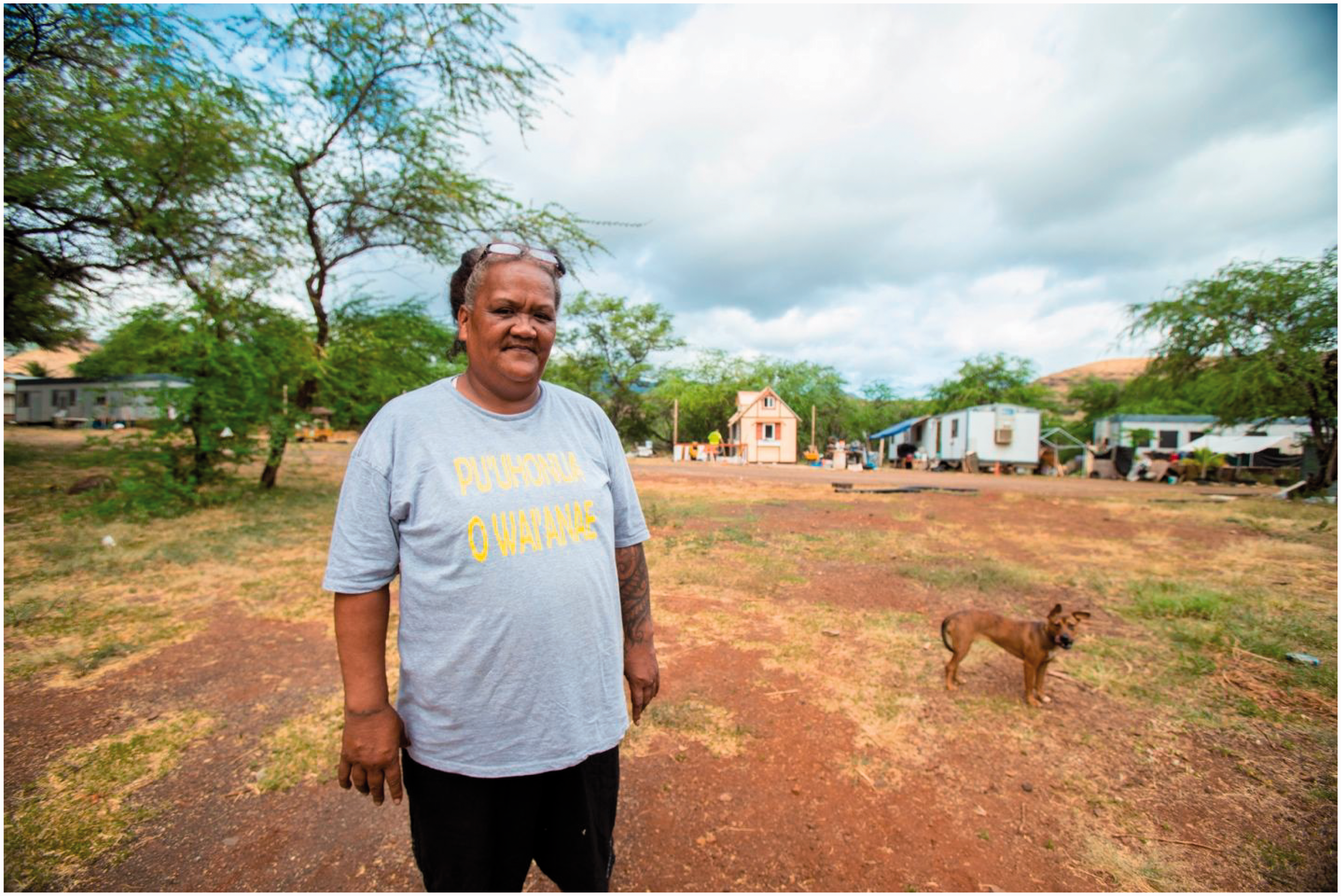
Twinkle at Pu‘uhonua o Wai‘anae Mauka in 2021. Photo by Pakē Salmon.
Organized abandonment
Alice Greenwood was born in 1946 and raised in Wai‘anae. As a child, she lived with her family in a covered wagon at Mākua Beach as her parents completed building a house nearby. She explained, “There was not a need for food. We always had plenty of snacks like mountain apple, sugar cane … We also did a lot of fishing, a lot of limu [seaweed] was all around the place.” Many of her generation similarly spent months at a time living on the beach, sharing the ocean bounty with family and neighbors. They were not homeless, or even houseless. According to Alice, it was “not like today.” But as the islands became more commercialized, more tourists arrived. Coral, in Alice’s words, then “crumbles over, gets stepped on, and is sold off” as novelties. As humans destroy and commodify the environment, the tourist industry grows, and living indoors in a house sanctioned by a deed or lease becomes the only legitimate lifestyle. This imposes the abandonment of subsistence and collective lifeways, prompting the loss of entire ways of life. As a result, people living outside face stigmatization and criminalization.
As an adult in the 1970s, Alice adapted to Hawai‘i’s nascent growth machine and rented a house on the Wai‘anae Coast. Yet in 2006, the owners sold it and rent skyrocketed as she became disabled due to a work-related injury (Magin, 2006). She explained in 2014, “when they took away my house, my dignity and everything, I became exactly what you guys wanted me to be: an alcoholic, lazy, bum. I didn’t create that. The system did.” The “system”—formal modes of government and commercial real estate schemes—put Alice in an impossible situation while failing to provide for vital life needs. Rather than the abundance of the 1950s, Alice in 2006 faced unaffordable housing, criminalization, exploitative labor conditions, and the abandonment of a public infrastructure to support health and well-being. She moved to Ma‘ili Beach, yet another organized houseless community on the Wai‘anae Coast, where she became a leader. Yet the state of Hawai‘i evicted them in 2007 (Hillyer, 2007). During the period of 2005–2012, average rents in Hawaiʻi increased by 45 percent, while wages increased by only 21 percent (Hawai‘i Appleseed, 2014). Describing the ongoing nature of abandonment, Alice explained that “the system” gets “better every year at screwing the people.”
Organized abandonment plays out through the forced abdication of interdependent lifeways coupled with the retrenchment of government programs, forging the persistent layered neglect of shared resources. While the state wages destruction to uphold power, it can also do the opposite: provide protection from calamity and opportunities for advancement (Gilmore, 2007: 52, 84), especially for the poor. Alice took this seriously, and engaged with government bodies to demand accessible public transit, lunch and education programs for children, and services for veterans (her husband served in the military), while encouraging people in her community to vote. By expressing that the system repeatedly “screws” people, Alice—a Native Hawaiian woman—does not express total disdain for the settler government; rather, she describes the tragedy of the lack of public services that coincides with the concentration of resources for military, policing, and private interests that do not benefit her people. She understands that the state’s power does not lie solely in its ability to wage destruction, it also lies in the capacity to provide and withdraw shared resources such as government programs.
In 2017, Alice passed away, leaving a legacy that includes her mentorship of Pu‘uhonua o Wai‘anae leader Twinkle Borge. Twinkle became houseless in 2003 when she fell into a depression after a breakup and, heavy with a broken heart, opted to figure things out on her own rather than turn to family. At first, she was one of seven people at the Wai‘anae Boat Harbor. Then, around 2011–2012, more arrived after an eviction from Ulehawa Beach Park, also located on the Wai‘anae Coast. Around 2013, after another eviction from nearby Kea‘au Beach Park, the majority of residents arrived. But trouble brewed when people from the adjacent high school accused Boat Harbor residents of theft and vandalism and advocated for their eviction. Following Alice’s example of engagement with officials and the public, Twinkle attended a meeting to explain that Boat Harbor residents had in fact apprehended people trying to steal. She reminded everyone that they live there because of financial strain and appealed to the attendees to consider the well-being of the children who lived there. Twinkle recounted that the Hawai‘i Department of Land and Natural Resources (DLNR) head at the time, William Aila, was in attendance. He said, according to Twinkle, “You have 60 days to clean up your area. If you do not cleanup to my standards, I will come in and give you one sweep.” So Twinkle coordinated cleanup. The school made peace with their neighbors and opened showers for the kids at 6 a.m. before the school day. In the face of abandonment, Twinkle recuperates the communal interdependence that land commodification has forcefully ruptured. She faces the threat of bulldozers by engaging with state authorities while drawing from an innate ability to command respect through her remarkable warmth and biting humor.
With a lack of government programs and no end sight for Hawai‘i’s housing crisis, police encourage houseless people to move to the Boat Harbor and ask for Twinkle. When Twinkle explained this, I asked incredulously, “You’re a social service provider, they just don’t pay you?” She responded affirmatively. She holds monthly meetings for all residents and assigns captains to each area who resolve conflicts. If this is not possible, they come to Twinkle. In 2017, Twinkle’s hanai family—hanai is a word meaning those one raises, feeds, or sustains who are not blood relatives—was comprised of 21 people in her tent. Some were gay, lesbian, and māhū (transgender) young adults possibly banished from their homes. She ensured that the children ate, attended school, behaved, and were well dressed. In the words of scholar Kalaniopua Young, the people of Pu‘uhonua o Wai‘anae engage in a counter-neoliberal insurgency “disrupting abandonment, unsettling sexualities, and decolonizing identity politics through makeshift economies of solidarity” (Young, 2019: 3). Twinkle describes her work as “overwhelming” and says that she sometimes skips meals because she is so busy. At the end of the day, she is often “out cold.”
While admirable, it is necessary to contextualize Twinkle’s responsibilities as an outcome of devolution. Many older Native Hawaiian Wai‘anae community leaders I interviewed established and ran youth and adult programs through federally funded Model Cities programs that ran from 1966 to 1974. While such programs did not confront poverty as a feature of capitalism and sought to contain the poor through inclusion, they served as a “dynamic condition of possibility” (Goldstein, 2012: 6) that remade the state on the state’s dime. They were also paid for their labor. In the following decades, President Nixon dismantled War on Poverty programs while Reagan’s presidency of the 1980s continued cutting federal programs, including for housing. Amid a growing faith that the market should, and would, solve all problems, many began to celebrate voluntarism as the decisive alternative to state programs (Wolch, 2014). Gilmore (2022) defines devolution as the “offloading to increasingly local state- and non-state institutions the authority to allocate or withhold shredded social welfare” (304). As a result, mutual aid and community governance fill in for government institutions that have offloaded their responsibilities onto informal associations. This devolution to the realm of “community” requires excessive sacrifice from leaders like Twinkle (Herbert, 2005: 850–851). Twinkle further fulfills the prerogatives of the state by holding centralized decision-making capacity that other authorities recognize (Tilly, 1985: 171), as she explained that police officers walk away when they see her. A Boat Harbor resident similarly described Twinkle as “the glue that holds the place together,” echoing definitions of the state as an organizer that “holds a ruptured social formation together” amid crisis (Hall et al., 1978: 202–217). Drawing from Jennifer Wolch, Gilmore (2007b) refers to this as the “shadow state,” the growing voluntary sector that provides services previously provided by state agencies. To summarize, in the void of devolution, Twinkle offers the protection and care previously underwritten by the state.
Organized abandonment’s multiple layers include devolution and retrenchment facilitated by rhetoric that touts government “shrinkage” amid the ballooning of resources to police the poor (Gilmore, 2007b; Gilmore and Gilmore, 2008). This is part of a “carceral turn” since the 1970s where states increasingly criminalize poverty, withdraw programs for the vulnerable, and proliferate punitive spaces such as prisons (Story, 2019). As a case in point, the City and County of Honolulu’s 2023 fiscal budget devoted over $312 million to the Honolulu Police Department; their responsibilities, not surprisingly, include citing and displacing houseless people. The Department of Community Services funds providers, outreach, hygiene centers, and additional resources for the houseless, among other responsibilities such as elderly affairs,and received approximately $132 million (City and County of Honolulu, 2022). On the state level, the Department of Business, Economic Development and Tourism—committed to “achieving a Hawai‘i economy that embraces innovation and is globally competitive, dynamic and productive,” started off 2023 with a $2 billion surplus, and state legislators pumped in hundreds of millions more during the ensuing legislative session (Dayton, 2023). Policies of devolution and the retrenchment of services authorize ongoing capitalist development while simultaneously attempting to police away the problem of houselessness that it creates to ensure the continued viability of a market that cashes in on real estate.
This layered process has garnered despair and dislocation among the houseless. Twinkle introduced me to Pu‘uhonua o Wai‘anae resident Derek Robello, who was born in 1955 and raised in Halawa, next to the area now called Pearl Harbor. He grew up in a working class family hunting in the surrounding mountains. He explained, “we lived right across from civilization”—without electricity and flushing toilets. They were evicted around 1970 to make way for the construction of Aloha Stadium, the home of the University of Hawai‘i football team, even though his grandfather held a property deed. “You say no,” he said, “but we got evicted.” Facing the development that accelerated in the 1970s, they moved to a Central O‘ahu suburb. As an adult, Derek held a construction job and his family was proud of his success. But his work on the controversial H3 freeway through Halawa Valley that now connects Pearl Harbor to Kaneohe Marine Force Base stuck with him. Activists staved off construction for 10 years because of the threat it posed to endangered species, cultural sites, and the environment (Gonzalez, 2013). “I seen a lot of things,” Derek reflected, speaking in Hawai‘i’s pidgin language. “All of our heiau [places of worship] and everything like that getting destroyed … we destroyed everything.” Derek continued: “They destroying everything, the culture, the land. The same way how they came and destroyed our language …” He arrived at the Boat Harbor in 2010 to recuperate what he lost, “to live Hawaiian culture,” and because he knows “how for live this kine life.” But he said, “We’re kind of forced here. Because we cannot go any place else, eh? … I don’t think there’s enough facilities to handle the people right? I don’t see anybody trying to solve the problem.” Describing the “coralling” of the houseless into encampments, he, like Alice and Twinkle, points to the failure of services and facilities to meet their needs, and describes the prison-like environment of shelters. While Derek does not expect the settler state to remedy these injustices, he nonetheless feels the sting of its failures.
Confronting dislocation, Derek, Twinkle, and many others move to houseless communities to gather themselves and reclaim a sense of belonging and ties to place amid the ruptured connections that knit together entire ways of life. Yet Derek found it nearly impossible to stitch things back together. While Twinkle exercises remarkable leadership in the face of this splitting apart, Derek unraveled. He discussed his shattered dreams to establish a school that would teach youth and adults, in his words: how we used to trade with the mountain and the sea, how we never needed money before. Before we used to teach the kids to live without money … And you never had land because nobody can own land. You only take care of the land to live. And that’s how it was in the old days, that’s why you never needed money, people traded. People had the ocean. They traded fish for meat. In between is all the taro. Nobody needed money.
In comprehending how people confront this abandonment of shared resources, it is easy to read Twinkle’s experiences as a success story, and Derek’s as a failure. Twinkle has been resilient in the face of adversity; Derek has crumbled under its weight. While we should honor their experiences and tell these stories, I want to be clear: these are not merely the stories of Twinkle and Derek. These are stories of a vast and repeated cycle of systematic abandonment. These are the stories of the wreckage of bulldozers as the state’s purported solution to the continueation of interdependent lifeways as modes of communal survival. From bulldozing to devolution to retrenchment, organized abandonment creates a void of care and abundance. These are the life-giving resources that provide the basis of belonging and sustenance. This shatters lives while breaking hearts. At the same time, these same processes open possibilities for finding a degree of freedom that draws from the past to rebuild life in the present, albeit in complex and contradictory ways.
Living with abandon
In 2021, I visited Twinkle at a 20-acre lot in Wai‘anae Valley that Pu‘uhonua o Wai‘anae had recently acquired. Private donors and supplemental government funds provided 1.4 million dollars to purchase this land, and Twinkle had moved from the Boat Harbor to the valley, located about 2.5 miles inland, at the beginning of the COVID-19 pandemic in March of 2020. In June of 2021 only 12 people had relocated, and 194 people remained at the Boat Harbor. So Twinkle spent days at the Boat Harbor and slept mauka (inland). She planned to build a village with A-frame houses. Twinkle explained, “Our goal is bringing everybody home by next summer.” (As of this writing, in May 2023, construction is still in progress.) As we sat on a couch outside shaded by a tarp, a tiny goat named Billy jumped on Twinkle’s lap and she pet him lovingly. Twinkle was excited to grow ‘ulu (breadfruit), taro, papayas, corn, beans, and chili pepper. While drawing from the bounty of the Earth, similar to houseless communities in the 1970s and 1980s, it struck me that Twinkle’s rhetoric contrasted with previous generations. The Kalama Valley, Sand Island, and Mākua anti-eviction movements vocalized explicit opposition to a colonial growth machine, while Twinkle’s position is more nuanced. She appealed to private entities such as Alexander & Baldwin—one of the largest private landowners in Hawai‘i that previously capitalized on sugarcane—to fund their relocation. Rather than reject property regimes, she works with major capitalist players to ensure land ownership and stability for her community.
Yet many at the Wai‘anae Boat Harbor have no plans to move, refusing to yet again split from the web of connections they have established with neighbors and the place they call home. Even though the State of Hawai‘i DLNR controls the Wai‘anae Boat Harbor and could attempt to evict them at any moment, some are taking the risk to stay put. They are doing what I refer to as living with abandon. For them, living with abandon rejects the promise of ownership and more general aspirations to thrive within capitalism such as holding a steady job and even supporting a nuclear family. Audra Simpson (2014) defines Indigenous refusal as a practice of Indigenous political authority that challenges the structures advancing the elimination and containment of settler colonialism. Living with abandon thus characterizes a mode of refusal that devises ad hoc forms of togetherness that are experimental and open-ended, engaging in trial and error while recuperating interconnectedness between and among humans and the Earth. As a way of organizing lives, living with abandon also submits to how life organizes you (Gibson-Graham, 2006). Rather than sentimentalizing living with abandon, it is imperative to foreground that heartbreak and despair definitively shape this way of life.
As abandonment encompasses the ruptured relations that serve as the basis of life itself, living with abandon encompasses the uncertainty and anguish with which many encounter this condition. As an example, Derek explained that he had abandoned his family, destroying his relationship with children, grandchildren, and extended family when he moved to Pu‘uhonua o Wai‘anae. I gathered that he moved there in lieu of working out challenges he faced with his life binding him to them. Likewise, many other houseless people leave behind spouses, children, and grandchildren. They both lament these choices, and see no other way, describing the unsatisfying grind of underpaid 40-plus-hour-a-week jobs and long car commutes necessary to subsidize a working to middle class family. They mourn the forced abdication of land, loss of capacity for self-determination, and lack of collective belonging that hinders their ability to maintain a content and stable life. Because of this, their wants and needs cannot possibly be met through property, a wage-earning job, a spouse, and children. Living with abandon thus involves a diversity of living arrangements, all non-normative, that defy the constraints of a nuclear family. Yet it must be emphasized that those who live with abandon grapple with the anguish that such familial relations are untenable. I sense that most in fact desired a stable home and family, yet their needs are vastly more complex. They long for access to the natural world as the basis of reproduction, membership in a broader unit that extends beyond legal and blood relations, and meaningful capacity for self-governance to dictate the future of their communities. Living with abandon aspires to “surplus possibility” and multidimensional pathways ripe with uncertainty (Gibson-Graham, 2006: xxx–xxxi) while dislocation and grief saturate this mode of living.
This compels those who live with abandon to create new worlds while reckoning with a past that stays in place, something that many express through maps and stories of what those in the western world might understand as apparitions. In 2015, Twinkle and her niece Autumn presented me with a map of their village at the Boat Harbor (Figure 3). The massive piece of graph paper, lovingly folded, marked 111 tent structures, holes with ‘opae ula, and dirt paths that connected the homes, including two named “‘Uhane Stroll” and “Kepolō Lane.” ‘Uhane is the Hawaiian word for soul, spirit, or ghost. According to Twinkle and Autumn, Kepolō means “no good … bad spirit, devil.” Several confirmed that they had seen green, black, red, and white ghosts and kepolō spirits. In Hawai‘i, people often speak of ‘uhane where the growth regime tears apart places. For example, Summer Kaimalia Mullins-Ibrahim, a community organizer and cultural practitioner explained that ‘uhane, who she calls ancestors, materialize frequently during times of sadness; she described ‘uhane frequenting the construction site of a luxury resort on ancestral fishing grounds. Such ‘uhane are manifestations of “kaumaha,” meaning heavy, weighty, and grief. In spaces cracked open by the ruptures foundational to abandonment, a past lingers in place (Gordon, 2008) through grief that sinks into these crevices. Yet while grief functions as a weight, the past in place also serves as a form of ancestral connection, as Summer describes. Carlos Andrade (2008) expresses the importance of recognizing ancestral knowledge bound to particular places, referring to this as “traveling in a time machine” (3). The people of Pu‘uhonua o Wai‘anae thus re-member ancestral intimacies in the face of the dismemberment of Indigenous lands, families, and sovereignty (Osorio, 2021). Acknowledging grief from loss, Twinkle and Autumn’s map also demonstrates that death is not final and that ancestors remain in place as their spirits offer a remembrance of an ever-present past.
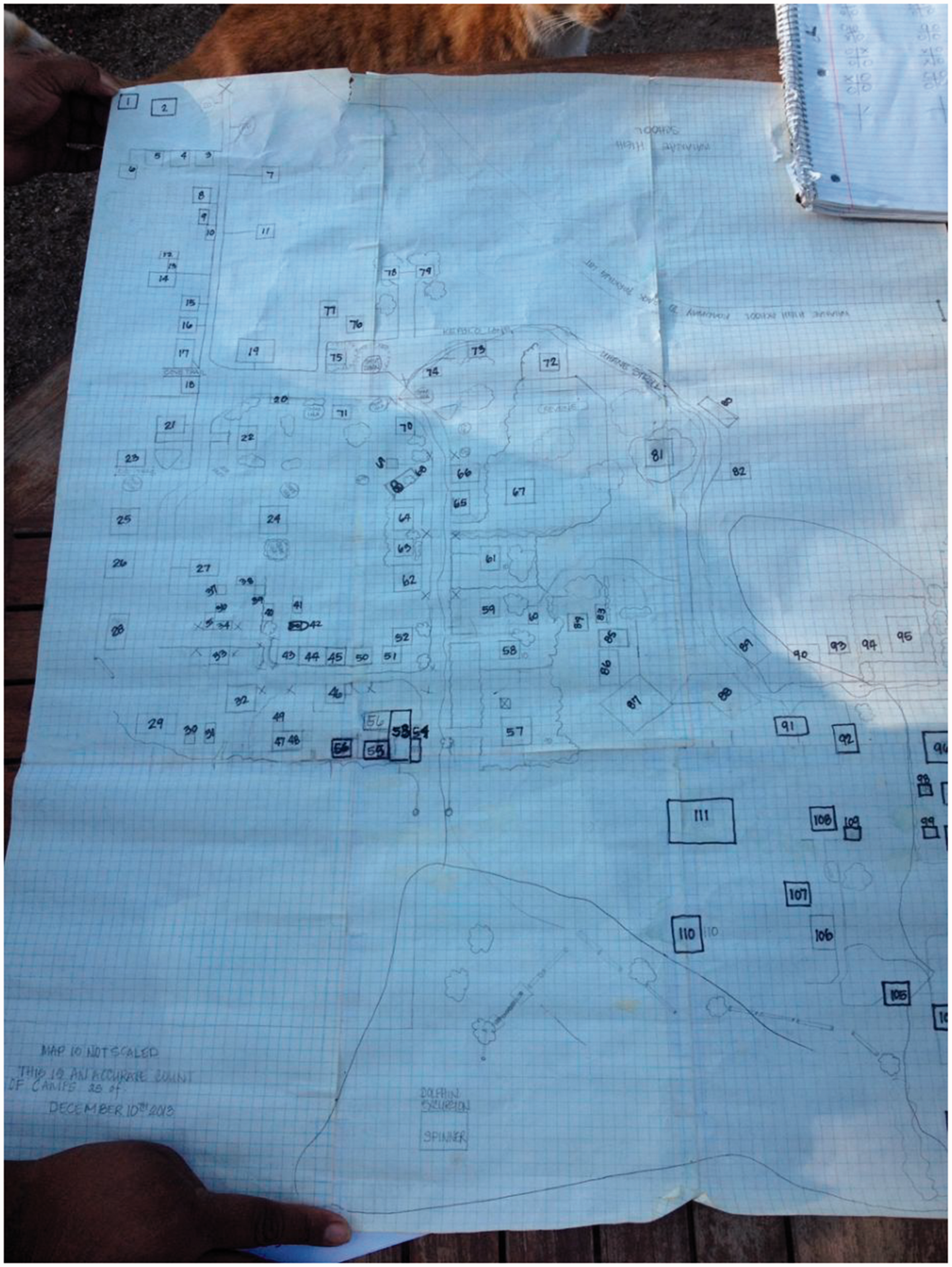
Map of Pu‘uhonua o Wai‘anae, photo taken in 2015.
This recognition of grief, an ever-present past, and the coexistence of spiritual and material realms all constitute living with abandon and cultivate a politics that are tentative and contradictory. For example, Derek explained that he was striving to recuperate a way of life that centered collectivized and sustainable Native Hawaiian economic practices that defied capitalism, while at the same time he constructed massive fences surrounding his living area that were significantly larger than his neighbors’. Even Twinkle, willing to work within capitalist frameworks, exercises a degree of living with abandon through deeply ambivalent politics. When I asked her if life at Pu‘uhonua o Wai‘anae enacts Hawaiian sovereignty, a movement to exercise Indigenous self-determination and national liberation, Twinkle’s skepticism caught me by surprise. Twinkle asked, “Why we gonna change the shit when we’re already living it?” She emphasized that most lived there because “their financial end up stopping,” specifically jobs and government support. She is dubious, to say the least, that the restoration of the Hawaiian monarchy that was internationally recognized by western powers in the 1840s and formally overthrown in 1893 would resolve these economic problems. At the same time, she respected members of her community who spoke the Hawaiian language with their children and embraced Hawaiian cultural practices. Tempered by ambivalence, living with abandon can involve pragmatic efforts to meet daily challenges that prioritize material wellbeing over a coherent political doctrine. As such, rather than directly defying capitalism and colonialism, the refusal of those who live with abandon challenges narratives that simplify Indigenous “culture” into “one comprehensive, official story,” and instead expresses ripe openness that rejects the entrapment of “Indigenous discourses into memorizable, repeatable rituals for preservation” (Simpson, 2014: 96–99). Maps and stories of apparitions embrace the “fullness of time and space” (Tran, 2018: 91), how the simultaneity of belief and doubt and the knitted nature of time encircle around and hold onto open-ended speculation.
Broken hearts and fear of the bulldozer indeliby shape the lives and longings of the people of Pu‘uhonua o Wai‘anae. Here people engage in the messy efforts of rebuilding their lives in the face of the forced abandonment of extensive kinship ties between and among humans and the natural world. This is layered with a housing crisis that stems from the transfer of resources from shared life-making infrastructures into a growth machine enforced by a police state. In response, many of the houseless live with abandon by dwelling in spaces of creativity, uncertainty, and refusal. Their fraught search for an alternative future reckons with persistent histories of loss, grief, and resignation, and is also defined by a ripe openness to what has been and could be. Living with abandon demonstrates that Indigenous political authority and settler colonial capitalism do not stand diametrically opposed; rather, they entangle and overlap. This way of living represents a mode of creative improvisation that eschews straightforward ambitions to thrive within capitalism, invoking the fullness of time and space while mourning the losses that have produced the tenuous present.
Footnotes
Acknowledgements
The author would like to thank the many teachers and readers whose ideas planted seeds that enabled this piece to grow over many years. These include but are not limited to: Ruth Wilson Gilmore; Craig Howes; Kalaniopua Young; Phil Garboden; Manu Mei-Singh; Alice Newberry; Leah Keller; the members of the UT Austin Feminist Geography Collective, especially Kaily Heitz, Erin McElroy, Tianna Bruno, Rebecca Torres, and Caroline Faria; the participants of workshops organized by the Princeton University American Studies and Women and Gender Studies programs; the article’s anonymous reviewers, and Natalie Oswin.
Declaration of conflicting interests
The author(s) declared no potential conflicts of interest with respect to the research, authorship, and/or publication of this article.
Funding
The author(s) received no financial support for the research, authorship, and/or publication of this article.