




Abstract
Has modernism evolved from a means to create a utopian future to an architectural discontent co-opted for racist purposes? The planners who built mid-20th century Scandinavian, modernist suburbs conceived of them as places of innovation, possibility, and visionary thinking. By the 1970s, however, this assessment had shifted dramatically: near-monolithic media and popular representations depicted environments of failure, insecurity, and ugly architecture – despite the half-finished states of the projects at the time. As these opinions evolved into “facts,” the areas became linked to ideas of intractably dangerous designs and, later, dangerous people. This set the stage for near-continuous physical and social interventions, beginning in the 1970s and continuing into the present. Today, in Sweden and Denmark, modernist neighborhoods are labeled “problem areas,” “concrete suburbs,” “vulnerable areas,” or even “ghettos,” where residents, often with family histories of migration, live in so-called “parallel societies.” Politicians have persistently positioned them as perilous places that never joined the present. This attitude renders them symbolically malleable sites, paving the way for recent radical densifications, privatizations, and demolitions, whereby the (half-century) histories of these suburbs are typically ignored. This history of the recent past focuses on how the “blame” for the problems of modernist urbanism – especially around perceived dangers – has shifted from buildings to people to a politically convenient combination of the two, or what I label “hereafters.” I contend that discourses of “unfinished” and “dangerous” places with “criminal” residents have made modernist urbanism a perfect target for xenophobic political discourse, where buildings and landscapes have become scapegoats for less socially acceptable feelings and concerns. Yet caricatures of modernist suburbs as “dangerous” obscure the fact that these supposedly failed cities of the future are now, decades later, places with both long histories and abundant everyday life. I therefore call for new “hereafters” for modernist suburbs: narratives that understand them as living neighborhoods in the present tense.
2. A separation area (särområde) is defined as a housing area with at least 5,000 inhabitants, where the proportion of immigrants and descendants from non-Western countries exceeds 50 percent and at least one of the following criteria are fulfilled: The proportion of residents between the ages of 18 and 64 who are not connected to the labor market or in the process of getting an education exceeds 40 percent. The proportion of residents convicted of a crime constitutes at least three times the national average …. (Lapidus, 2021: 7)
In the 2021 novel Paradise City, author Jens Lapidus paints a dystopian picture of Sweden in the very near future, when “segregation has run amok” (Lapidus, 2021: back cover), with “The Separate Area Law” begun in the year 2025 1 . As antidotes to social problems, this law identifies as problematic any residential area “where the proportion of immigrants and descendants from non-Western countries exceeds 50 percent” with high unemployment and crime. To address this, the law mandates a new architectural intervention, the “Comfort Divider” (trevnadsdelare): “an elongated facility around a separation area [built] in order to obstruct passage” (Lapidus, 2021: 7). The novel unfolds largely behind a Comfort Divider enclosing “Paradise City,” revealed to be Järva Field in northern Stockholm, a real place containing several modernist suburbs constructed during the 1960s and 1970s.
As modern science fiction, the premise of Paradise City appears implausible, yet actual measures from Denmark inspired it: the so-called “Ghetto Plan” of 2018, or, more officially, “A Denmark without parallel societies – No ghettos in 2030” (Økonomi- og Indenrigsministeriet, 2018). (Figure 1). Like its fictional counterpart, the Danish plan partially defined a “ghetto area” (ghettoområde) as having more than 50 percent “non-Western” residents (Økonomi- og Indenrigsministeriet, 2018: 11). There, local children would be required to attend Danish-language preschools from age one, and “tightened penalty zones” (skærpet strafzone) would result in increased criminal punishments (Økonomi- og Indenrigsministeriet, 2018: 8). Importantly, the so-called “hard ghettos” (on the list for four years) could only have 40 percent family social housing by 2030 (Økonomi- og Indenrigsministeriet, 2018: 13). To achieve this, the Danish government has promoted a massive program of demolitions, displacements, and privatizations.
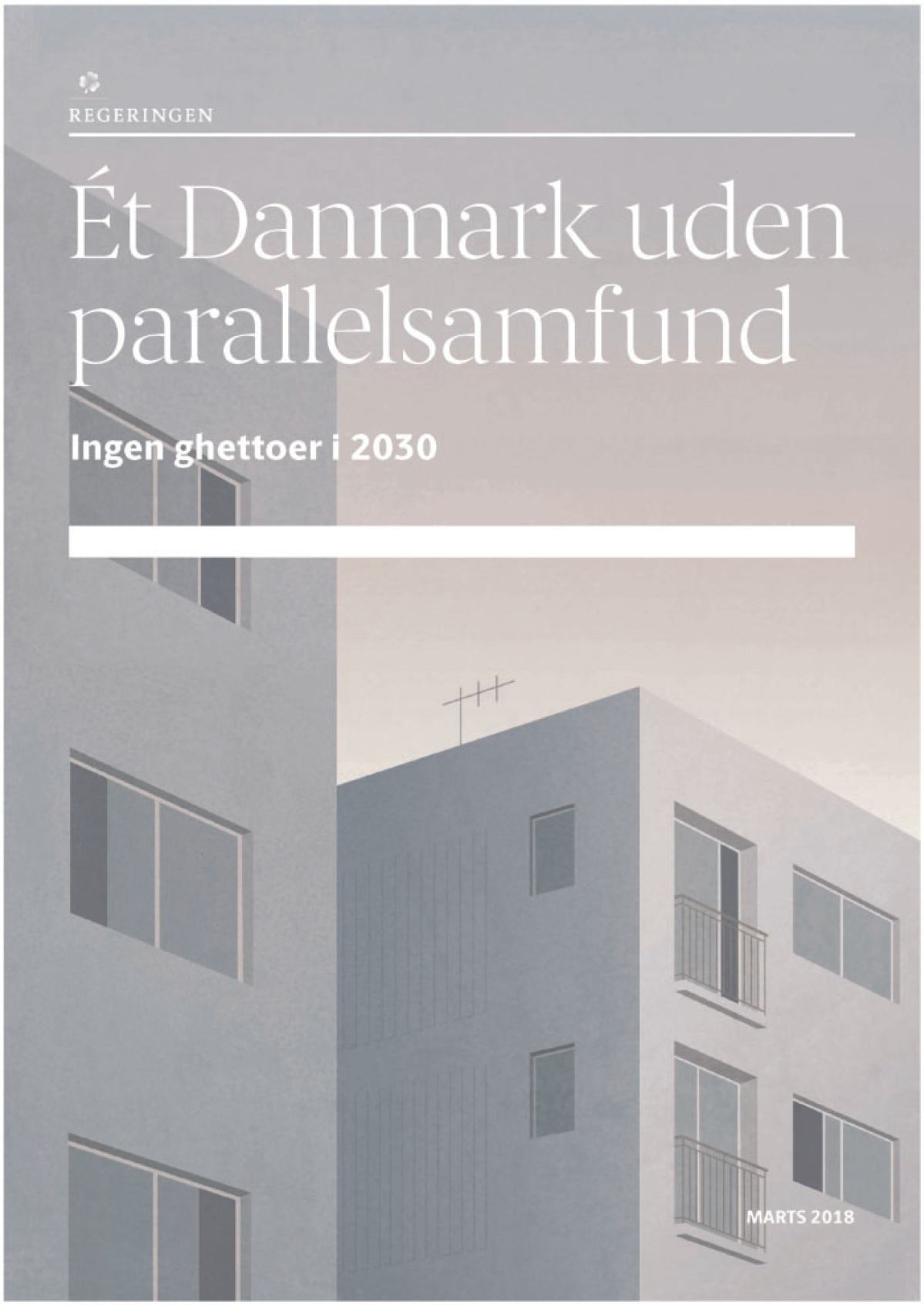
“One Denmark without parallel societies – No ghettos in 2030” “Ét Danmark uden parallelsamfund: Ingen ghettoer i 2030,” Økonomi- og Indenrigsministeriet, Government of Denmark, (2018): front cover.
What can one make of these “ghetto plans” – real and imagined? Mid-20th century Scandinavian, modernist suburbs were explicitly intended to build a better future: to realize utopia. Yet today, journalists and politicians in places like Sweden and Denmark often portray them as dystopian hellscapes like those in Paradise City. They are labeled “alienation areas,” “problem areas,” “concrete suburbs,” “vulnerable areas,” or “ghettos,” where residents, often with family histories of migration, live in the so-called “parallel societies.”
Meanwhile, modernism’s architecture and urban designs have been disparaged as not merely “ugly” or “monolithic” but the very cause of crime and despair. Since the 1970s, many modernist neighborhoods – particularly those containing social or public rental housing – have been diagnosed with an ailment much like the pollution and squalor of early industrial cities that inspired modernism itself: an ever-intensifying urban disease of crime and danger, lending the drive to demolish more traction. Yet as argued by Katharine Bristol in her groundbreaking 1991 article, “The Pruitt Igoe Myth,” modernism has long been blamed for structural problems that design could never solve (Bristol, 1991), and other authors have lately dispelled other such “myths,” such as their supposedly higher rates of all types of crime (see Bloom et al., 2015; CRUSH, 2016).
Critically, however, blame for the travails of “problem areas” has recently widened to encompass both the supposedly unsightly housing and the people living in it. In Sweden, this blame is neatly wrapped in a “racialized” package (Molina, 1997), with increasing parallels to the Danish discourse, a discourse that has a longer history. In discussing imperialist, racist tropes within the history of non-Western architectures, Irene Cheng, Charles L. Davis II, and Mabel O. Wilson argue that “race and style became isomorphic terms for explaining cultural differences that legitimized the broader scientific aspirations of the discipline and the politics of empire” (2020: 7–9). In Sweden, discussions of “race” have often been positioned as “taboo,” even as “racialization” – the social construction of “race” – has distinct historical connections to earlier notions of “racial biology,” where “particular bodies are connected with particular regions and continents, and are sometimes also supplied with certain qualities and orientations” (Hübinette et al., 2012: 45). It is intriguing (and perhaps paradoxical), then, that what was once a “universalist” modernism – the mid-20th century, high European welfare state’s pièce de resistance – has now become geographically and demographically synonymous with non-white residents, and, following Cheng et al., similarly “isomorphic” in supporting projects of reform. Today, in other words, modernism’s own social claims have been turned against it – by politicians, critics, and even architects and urban designers – leaving a void of discontent that racism and xenophobia increasingly inhabit.
This legacy is what I label the “hereafters” of modernist suburbs: the dominant images of failure, insecurity, and threat that have come to define them. Celeste Olalquiaga has compared the relics of modernism to those of world’s fairs, which “grandiosely represented this belief ….leaving only the dusty shells of its dreams behind” (1992: xx). Here, I investigate how modernism’s positioning as a “dusty shell” has given space for racism and xenophobia to expand, as buildings and landscapes that are positioned as perpetually unfinished mistakes require intervention after intervention after intervention. Today, with talk of demolition on the lips of far-right, nationalist politicians (and, increasingly, others to their left), modernist suburbs in Sweden and Denmark are stuck as both utopian welfare “cities of the future,” and somehow, as places that prevent the (all-white) future these politicians are peddling. Prevailing ideas about appropriate cures for the disease of modernist urbanism have taken the form of biopsies, amputations, or why not just euthanasia? I understand this as a form of socially acceptable annihilation, whereby undesirable buildings substitute for undesirable people, an imagined form of settler colonialism in which white Scandinavians will prevail.
To trace how modernism evolved from a means to create a utopian future to an architectural discontent co-opted for racist purposes, I bring together historical and current ethnographic narratives, following Kristina Spohr Readman’s charge that 21st-century scholars of “contemporary history” should work “in medias res … to ‘write the world’ as it presents itself today” (2011: 508). I interweave historical assessments of modernist urbanism from official planning documents and scholarly reports to show how it has been associated, since the mid-20th century, with failure, fear of crime, and a continuous need for rehabilitation that has become increasingly tinged with xenophobia and racism. In equal measure, I include residents’ own depictions, both historically and today, drawing on a range of sources: research reports, planning documents, ethnographic research, and, in particular, two public seminars with panels of residents that I co-organized and that were held in Copenhagen in October 2021 and Stockholm in October 2022. 1 In including residents’ own perspectives, I follow Janina Gosseye’s recent call to fill the “silence” in histories of architecture through the feminist practice of including oral testimony (2019), recognizing alternative histories of modernist urbanism as having been subject to a particularly deafening silence. Throughout, I emphasize Swedish conditions but gesture to other modernist suburbs in Europe, particularly Danish ones, to illustrate how the spatial practice of renovating or demolishing modernist housing to quell xenophobic and racial anxieties has traveled. The new Swedish government, elected in September 2022, has explicitly labeled Denmark its paragon, and my excursion through this traveling discourse, and how residents in both places experience it, is based on a strong belief that the two countries will soon have a very similar approach.
In developing the outlines of these hereafters, this history of the recent past focuses on how the “blame” for the problems of modernist urbanism – especially perceived dangers – has shifted from buildings to people to a politically convenient combination of the two. I contend that discourses of “unfinished” and “dangerous” places with “criminal” residents have made modernist urbanism a perfect target for xenophobic political discourse, where buildings and landscapes become scapegoats for less socially acceptable feelings and concerns. I bring these narratives to light in the hope that today’s modernism can assert a new hereafter, and that this may help residents to stake their own claims for the present – and future.
A first hereafter: Dangerous designs in the mid-20th century
Welfare cities built with modernist architecture were nothing less than a heroic project to remake the world. In 20th-century European welfare states of the post-Second World War period, modernist urban design was a tool in the development of what Kenny Cupers has described in France as a “social project” (2014). In Sweden, modernist neighborhoods would also answer a major housing shortage, hinging on architecture’s ability to make a new society for the future welfare state (Hirdman, 1989; Mattsson, 2010; Rudberg, 1980). As early as 1928, Swedish Social Democrat Per Albin Hansson outlined a welfare-state vision in his “People’s Home” (Folkhemmet) speech before Parliament (Berkling, 1982: 227–234). Citizens shared equal political rights, he argued, yet “while some live in a palace, others view it as a success if they can live in their allotment cottages even during the cold winter” (Berkling, 1982). 2 This call was answered by the authors of the 1931 Functionalist architectural manifesto acceptera, who asked: “In our building we do not utilize the resources of our age as we do in most other areas of production” (Asplund et al., 1931, republished in Creagh et al., 2008: 219). Functionalist architecture would tap into this present to create a better future: a utopia, today.
To materialize a People’s Home, the Swedish national government invested in massive research projects, such as those of the Home Research Institute, which conducted observational studies of housewives to define optimal apartment interiors (Rudberg, 1980: 74 and 76). The resultant building norms appeared in the Good Housing (God bostad) booklets of 1960 and 1964 (Kungliga Bostadsstyrelsen, 1960 and 1964), used by construction companies taking national loans, and the 1965 report “Heightened Building Standards” solidified the government’s approach (SOU 1965: 32).
In an act of Parliament, Swedish leaders promised to build one million dwelling units in just 10 years, beginning in 1965 (Caldenby, 1998; Hall, 1991; Hall and Vidén, 2005). Critically, this so-called “Million Program” was not social housing but intended for citizens from across the socioeconomic spectrum (Borgegård and Kemeny, 2004; Hall, 1991; Hall and Vidén, 2005; Söderqvist, 1999). Urban designs combined elements of Clarence Perry’s Neighborhood Unit and CIAM’s Functional City, with multifamily housing, a town center with commercial and social “service:” schools, parks, playgrounds, public transit, and traffic-separation, typically sited near natural features like lakes and fields (Franzén and Sandstedt, 1981; Roos and Gelotte, 2004) (Figure 2).
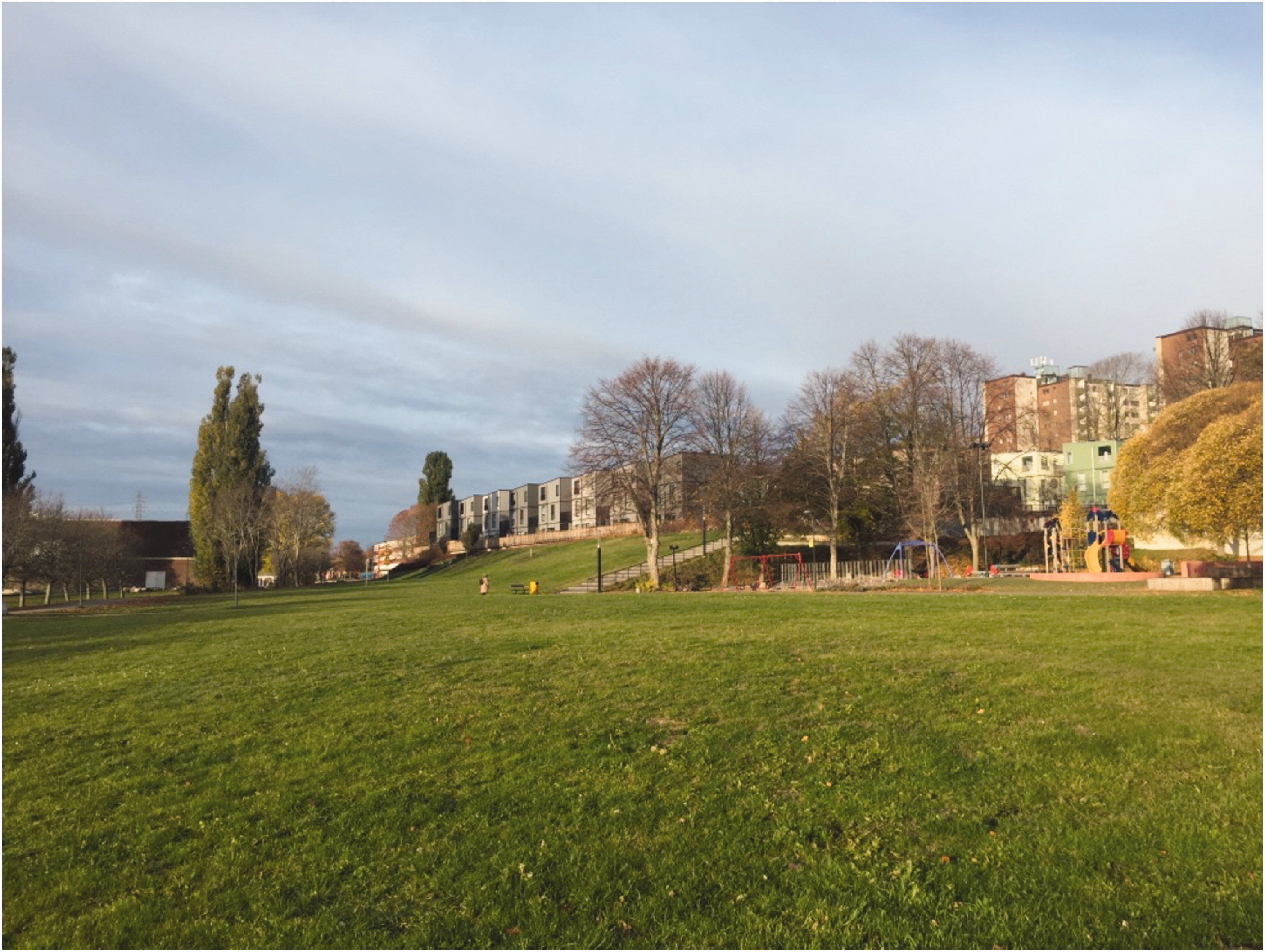
Suburb of Fittja, Botkyrka, Sweden, built during the Million Program. Photo from 2018. Photo: Author (2018).
As residents settled in new areas, however, the government’s sanguine projections quickly dissipated, and Million Program neighborhoods were disparaged as “ugly,” “miserable,” and “monolithic” (Ericsson et al., 2002; Mack, 2019). This reflected a broader negative discourse about modernist urbanism during the 1960s, when, as urban historian Margaret Crawford has put it, “optimism had expired” (2020: 50). During this period, blame for the “failure” of modernism was assigned to architects, whose apparent hubris had, the logic went, recklessly produced inhumane and unattractive environments.
For example, when the Million Program neighborhood of Skärholmen, on the outskirts of Stockholm, opened its town center on 8 September 1968, an enormous crowd came for an inaugural speech by Prince Bertil (Figure 3). Yet just two days later, journalist Lars-Olof Franzén penned a newspaper article with the caustic title, “Tear down Skärholmen!” (Franzén, 1968). Sociologists Mats Franzén and Eva Sandstedt mark this as initiating a “suburbs debate” that disparaged modernist urbanism as producing a passive, consumerist citizenry (Franzén and Sandstedt, 1981).
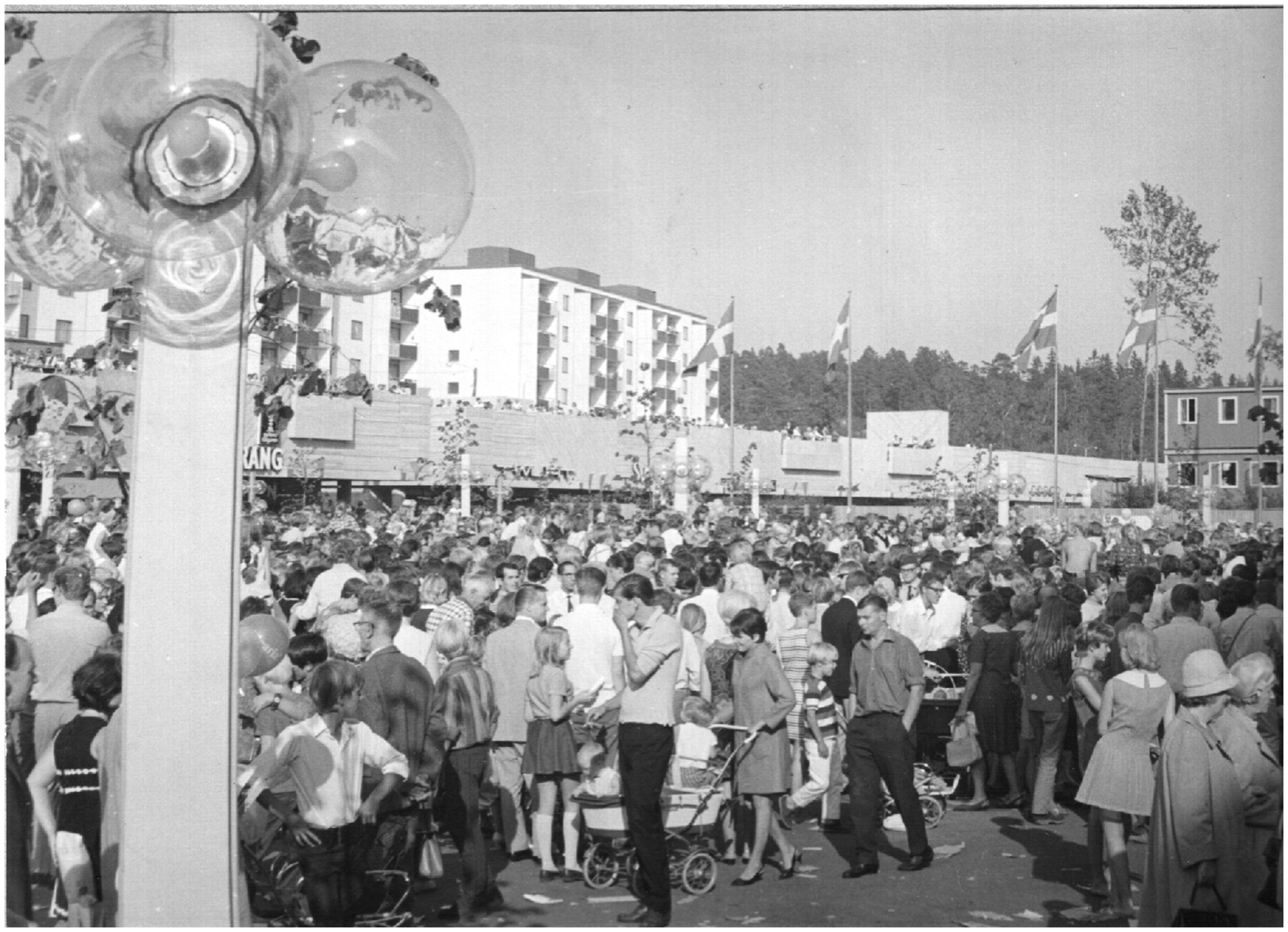
Inauguration ceremony of Skärholmen town center, Sweden, 8 September 1968. Photo: Gino Forsell (1968).
Anti-modernist sentiment grew among conservative architectural factions in the 1970s and 1980s, such as Hans Asplund, who argued that it was time to say “Farewell to Functionalism!” (1980). While his father, Gunnar, had co-authored acceptera, the younger Asplund’s patricidal text claimed that early objections against functionalism were “silenced … quickly and effectively by the new, so-called progressive establishment within architecture and culture … that exhaled irony, contempt, and ridicule toward the defenders of tradition” (Asplund, 1980: 12).
But what did residents think? In the 1970s, journalists and academics penned numerous popular reports, often interviewing suburbanites and excerpting salacious details. These authors, however, often revealed their biases, such as Margareta Schwartz and Suzanne Sjöqvist, who wrote acerbically in 1978 about how one neighborhood’s “Daddy … is a computer. It counted out how it would be without leaving anything to chance” (1978: 31). In Rapport Tensta, concerning the southern Stockholm neighborhood of Tensta (still incomplete at the time), the authors wrote that, “What was planned to provide protection and safety becomes, after many years, when the number of small children is largest, constant threat and grinding anxiety” (Bengtzon et al., 1970: 49).
Meanwhile, resident interviews emphasized their misery and dissatisfaction, such as a 26-year-old civil servant who said, “It’s pretty amazing that the gentlemen who build communities like this don’t think about most people having the urge to be human. Isn’t that humiliating?” (Bengtzon et al., 1970: 32). Interviewees also portended an impending mass exodus, for instance when a young dental hygienist said, “Tensta is not the future, it is just a temporary savior” where she would remain for a maximum of five years (Bengtzon et al., 1970: 26). Any positive views included were sandwiched between dystopian depictions, with innuendo that those who actually liked the neighborhoods had mental health or social problems (Mack, forthcoming 2024). Modernism transformed from a beacon of future living to a vast fiasco, subjected to exactly the “irony, contempt, and ridicule” that Asplund had lamented (1980: 12).
As “failure” took a chokehold on optimism (in suburbs that were, after all, still largely under construction), writers began to describe how the callous designs had created not merely ugly, uncomfortable places; they were dangerous. For example, in two adjacent Million Program neighborhoods of 1978, Schwartz and Sjöqvist wrote, residents feared that criminals were living beside them (1978: 37–38). Even so, the authors continued, everyone has heard about [crime] … in some roundabout way …. Mrs A in Norsborg has not been assaulted […]. But she has heard a lot, so for safety’s sake she has taped up a photo of her boxer on the front door and a sign with the text: “Warning, guard dog.” (Schwartz and Sjöqvist, 1978: 38–39) (Figure 4) Norsborg, Botkyrka, Sweden, 1978. Margareta Schwartz and Suzanne Sjöqvist (1978) Kvinnoliv, Förortsliv. Stockholm: Gidlunds. Photo: Lars Nyberg (1978).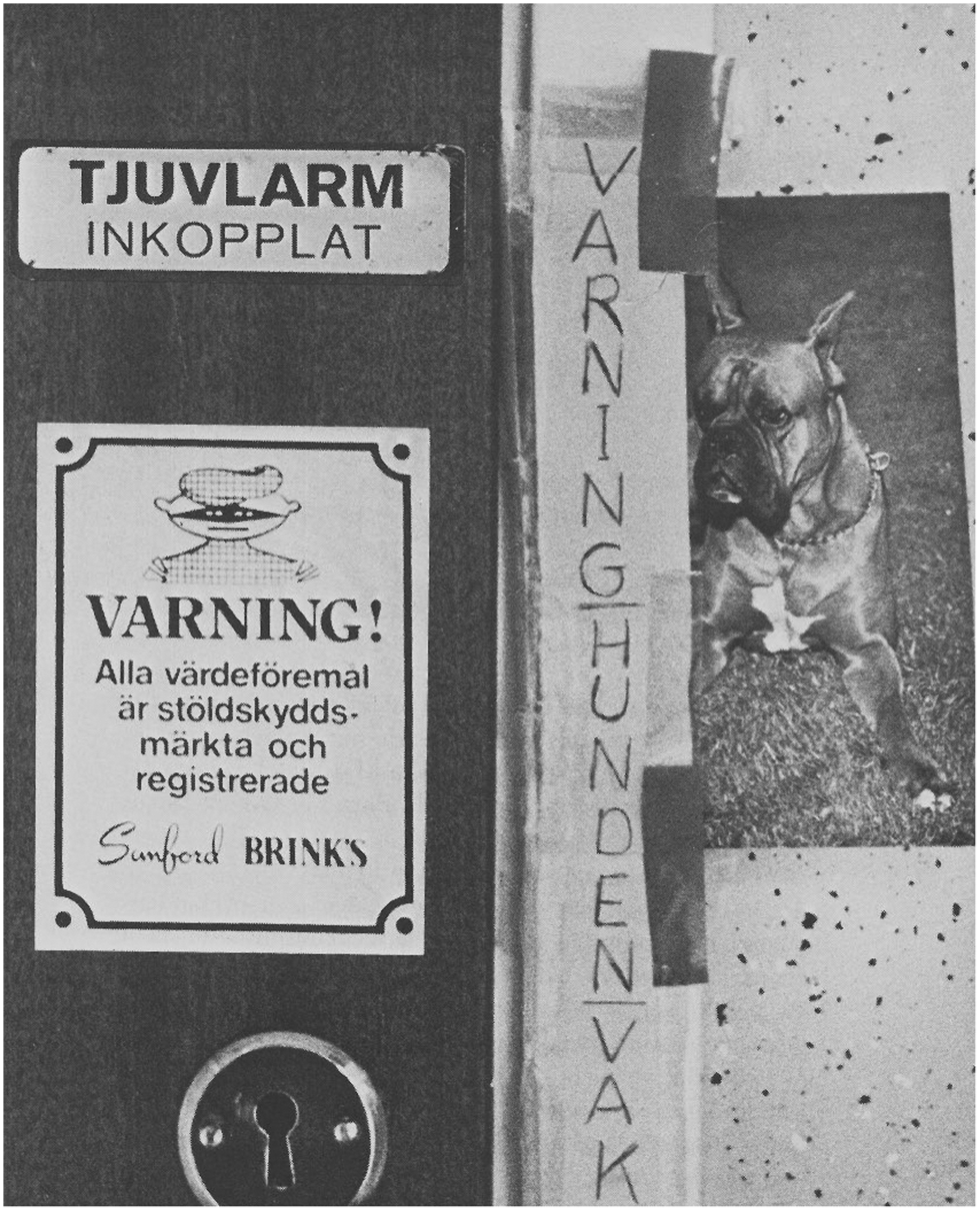
The themes of crime, danger, and a life badly lived also echoed through early fictional representations of the Million Program, such as the 1973 film The Stone Face (Stenansiktet), directed by Jan Halldorf. 3 Taking place in Skärholmen, the film centers on a series of contract kidnappings ordered by an enraged social worker after the death of his child. He hires a local youth gang to kidnap several people associated with its planning, whom he then murders. Here, terrifying spaces and criminal youth – notably all blond and white – appear to be everyday phenomena, and residents are victims who must avenge their missing utopian future.
Danger was, of course, also paramount to critiques of modernist urbanism in new neighborhoods beyond Sweden. In The Death and Life of Great American Cities, first published in 1961, Jane Jacobs explained that modernist urban planning actually signified the “deliberate rebuilding of unsafe cities” and identified ways that residents “live with this insecurity” (Jacobs, 1961: 46). With hyperbole, she likened housing projects to “big wild-animal reservations of Africa, where tourists are warned to leave their cars under no circumstances until they reach a lodge” (Jacobs, 1961: 46). In her vision, architects had subjected residents – through misplaced faith in modernism – to the very “death” of the city.
In the preface to his 1972 book, Defensible Space: Crime Prevention through Urban Design, Oscar Newman credits Jane Jacobs with inspiration for his “model for residential environments” to combat danger, citizen apathy, and fear in modernist neighborhoods (Newman, 1972: 3 and xvi). His solution would subdivide public spaces to produce “territoriality.” Notably, like the Swedish critics, Newman placed the blame for the danger squarely with the architects, writing that “there is little evidence of any genius and now, in this period of high crime rates, … [the neighborhoods] have become containers for the victimization of their inhabitants” (1972: 8). For him, a subdivision of semi-public space into defensible space “inhibits crime by creating the physical expression of a social fabric that defends itself” (Newman, 1972: 3). In her 2014 article “The Economy of Fear,” however, architectural historian Joy Knoblauch argues that Newman’s “defensible space” normalizes private property ownership as “natural and safe” (Knoblauch, 2014: 352): solutions that ran contrary to the spirit of welfare-state urbanism and its public clientele.
In Sweden, critiques had immediate physical effects. From 1975 – just one year after the Million Program ended – until 1986, national Environmental Improvement Subsidies offered funding for renovation projects that included newly built areas. They supported about 1700 renovations (Kristensson, 1994; Schlyter, 1985, 1994; Vidén and Lundahl, 1992). This was the case, even though vegetation was just starting to grow, and playgrounds and paths were still being built, with residents, in effect, positioned as passive victims of architects’ crimes against humanity (Mack, 2019). The impatient redesigns of the 1970s and 1980s seemed to confirm the stigma while reinforcing ideas that Million Program suburbs were places without a past: places where the future promised had still not arrived and where planners could still make it happen.
These approaches have parallels in the present day. Recently, renovations positioning modernist urbanism as villainous are widespread, an attitude that causes current residents of affected Swedish and Danish neighborhoods distress as design features that they have grown to prize come under attacks promulgated as renovations (Mack, 2021). For example, Marie Northroup Christensen, a housing activist in her 30s and co-founder of Almen Arkiv (Common Archive), explained that the urban design of Aldersrogade had been disparaged as “closed off,” both locally and societally. She had come to understand this as an assault on what she called its “modernistic architecture.” In the original designs, four interior courtyards had traffic-separated connections and interior courtyard-facing balconies. A renovation was enacted, she explained, ostensibly to “open up the areas and make it become a part of the city and make it part of society again,” but also involving a partial destruction of this modernist planning. Measures included physically separating each courtyard (perhaps in an homage to defensible space), changing the entrances, and removing the balconies. As Marie explained, So all this common space, that’s what you’re going to remove [….] when you step out of your apartment, you go out to the shopping street. So, you are becoming a consumer … instead of being [part of] a social, everyday network where you help each other out [….] And the architecture that allows this is also erased.
A second hereafter: Dangerous people
In the 21st century, a utopian view of Scandinavian societies and their commitment to social equality persists internationally, running parallel to domestic “common sense” views of suburbs as threatening, perhaps unsalvageable wastelands. As architects have been forgotten and national and local governments replaced, however, a new culprit explaining modernist neighborhoods’ “failure” has emerged: their residents. Today’s Scandinavian media produces sensationalist reports about how people living in modernist neighborhoods use public spaces for unwanted, unpleasant, or even illegal activities (Backvall, 2019; Ericsson et al., 2002). Critically, current residents are often members of non-white minority groups: migrants and their descendants, adding new xenophobic and racist dimensions to the attacks (Listerborn, 2011; Mack, 2017). Recent invectives imply that minority groups living in modernist suburbs are inherently dangerous people; they are perhaps even besieging the city.
Geographer Mustafa Dikeç describes the transformation into “badlands” of the French banlieues, suburban modernist neighborhoods understood as menacing the Republic and its ideals of color-blind national belonging (Dikeç, 2007). Noting that this danger has nonetheless been racialized in the public imagination, he analyzes cartoons in the magazine L’Expresse, where, from the 1970s to the 1990s, the “hooligans and hoodlums” changed skin color from white to Black, a shift that “best exemplifies the changing color of fear of ‘the banlieue’” (Dikeç, 2007: 8). A parallel phenomenon has emerged in Scandinavian suburbs, as the blond gang of 1970s The Stone Face has metamorphosed into a new racist and xenophobic portrayal of immigrant-led gang warfare and criminal families, a hereafter of more recent vintage.
Modernism itself offered an expansive social argument, yet today’s design interventions are often reduced to a cynical, singular emphasis: the need for more “security” (trygghet in Swedish). Journalists, politicians, police, real estate developers, and urban planners consider new ways to transform neighborhoods into urban fortresses. With residents portrayed as potentially hazardous, new designs respond to perceived threats coming from within: more police, more police infrastructure, and ever more defensible space.
This is apparent in periodic emails sent by the Swedish organization Trygg och Säker (Secure and Safe). For their 2020 annual conference with police, planners, and others, they explained that “A violent parallel society is developing” in Sweden in “alienation areas,” 5 with local laws defined – with racist implications – by “criminal family networks” (Trygg och Säker, 2020). Discussions of gang violence constantly pepper the Swedish media after a spate of recent shootings and bombings of residential entrances, even though some forms of crime are actually decreasing in frequency.
Critically, these dangerous residents are implied to be migrants or are, as in the recent Danish legislation, problematically “non-Western.” As Søren-Emil Schütt, a resident of Lundtoftegade in Copenhagen, explained, The foreigners are defined by a lack. They are non-Western. They are not democratic. They do not want to be Danish. They do not want to learn the language. That is how they define some people rhetorically, as the opposite of what it is to be Danish.
As noted, in September 2022, a new Swedish national government came to power, a right-wing coalition whose majority was made possible by support from the nationalist, far-right Sweden Democrats. This has sharpened the rhetoric against Million Program suburbs, especially through the drafting of the so-called Tidö Agreement, the government’s guiding policy document written in the aftermath of the election. Following these trends, in February 2023, Minister of Justice Gunnar Strömmer of the Moderate Party called “gang criminality” a form of “homegrown terrorism” in a press conference, and he repeated his support for “visitation zones” – a measure already used in Denmark – and anonymous witnesses (Flores, 2023). In late March 2023, Finance Minister Elisabeth Svantesson, Moderate, and Åkesson, leader of the Sweden Democrats, jointly announced that a 500-million crown census – likely including knocking on doors – would determine so-called “risk areas,” defined as places where the number of actual and registered residents are thought to differ. Åkesson explained, “Sweden has in great control [sic] lost control over the population. We have a shadow society that we don’t know the extent of” (Stahle and Törnmalm, 2023).
These comments, portraying “homegrown terrorism” and “shadow societies” explicitly or implicitly located in modernist suburbs, follow a proliferation of new fortress-like buildings to house local police forces in these same neighborhoods. Architectonically, these buildings treat modernist neighborhoods as sites of potential combat, a view that many political parties seeking electoral success accentuate. New projects flatten urban design to militarized design, with punitive buildings and cameras that emphasize surveillance and control of residents, or what urban design theorist Nan Ellin has called the “architecture of fear” (Ellin, 1997). Notably, Strömmer also promised to quadruple security cameras across the nation in his February speech.
One example is a police station in the Million Program neighborhood of Rosengård in Malmö. In a scathing critique from 2016 entitled, “The bunker that will defend our open society,” journalist Peter Kadhammar describes the space: The façade is graphite gray and gloomy or rather hostile. There are few windows on the ground floor and the ones upstairs are banded or like parapets. No attacker can reach them. Fence. Cameras. Signs everywhere – I count eleven – that say: “Stop. Protected object. Prohibition against photographing, depicting, describing, or measuring the protected object without special permission.” (Kadhammar, 2016) (Figure 5) Police station in the Million Program suburb of Rosengård, Malmö, Sweden. Photo: Jorchr, CC BY-SA 3.0, via Wikimedia Commons.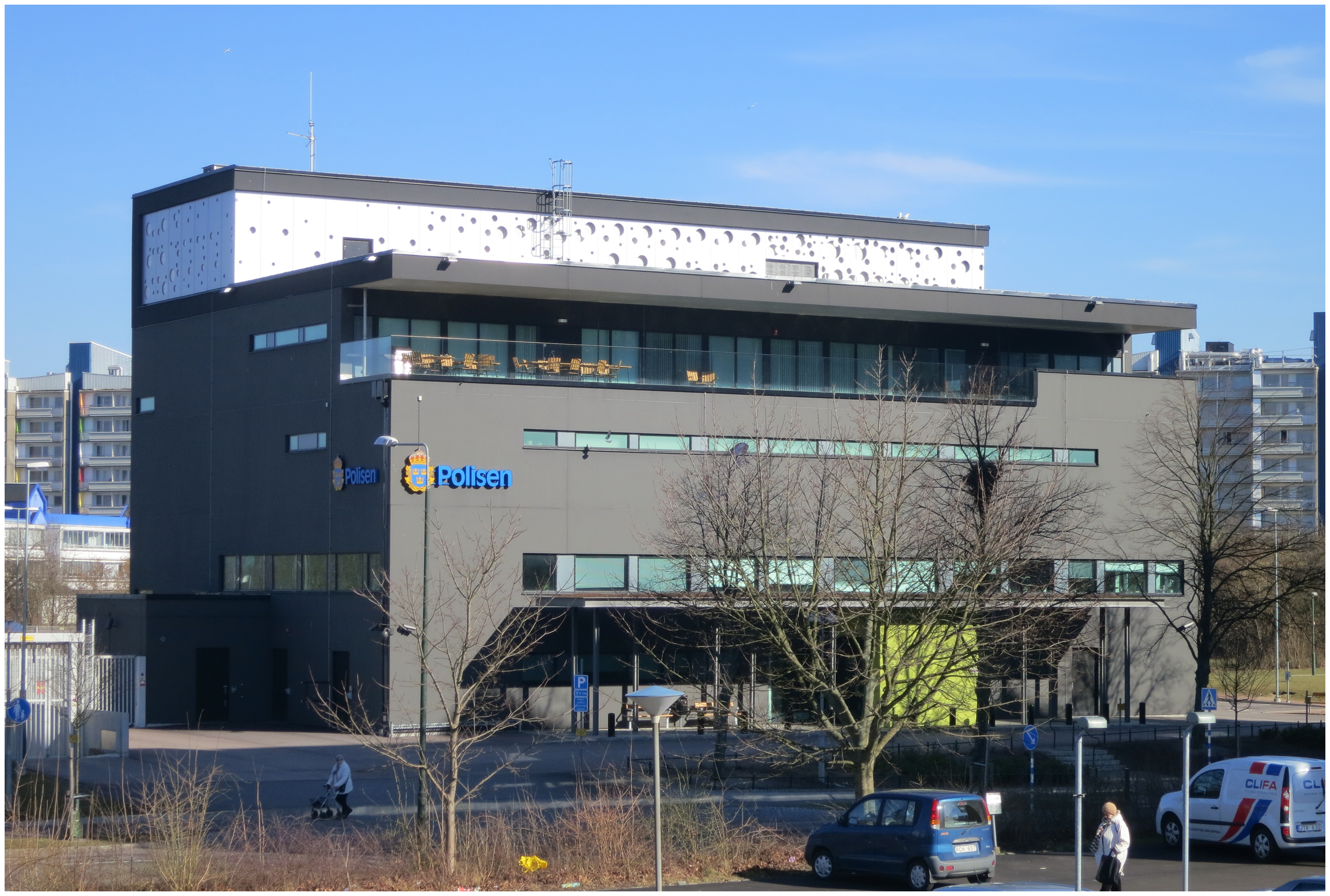
This approach to articulating a “safer” environment materially resurfaced in a new police station in Rinkeby, a Million Program neighborhood outside Stockholm, which opened in 2020. Like its counterpart in Rosengård, signs inform passersby that no photos may be taken. Its hard material surfaces, siting, and physical and graphic barriers suggest that it was commissioned for a battleground. Residents of an adjacent building explained that they felt uncomfortable with the implied surveillance and therefore never used their balconies. In Kristina Boréus and Janne Flyghed’s research on youth and police relations after widespread riots in the nearby neighborhood of Husby – after police killed a resident – they describe the importance of närpolis (local police) for productive communication between the parties, and how police in riot gear create a climate of mutual suspicion instead (Boréus and Flyghed, 2016). These buildings express a similar attitude architectonically.
Not all recent urban interventions are this explicit, however. Many renovation projects in Million Program areas highlight security mainly through changes to residential landscapes. For instance, numerous “security” (trygghet) projects were initiated between 2016 and 2018 by the National Board of Housing, Building, and Planning, Boverket. According to their website, Security is the feeling that is triggered when the individual interprets the design and use of a physical environment by combining sensory impressions with their own experiences, as well as with other individuals’ or media descriptions of the risk of being exposed to crime or threatening situations. (Boverket, 2022) (Figure 6) Crime prevention and security measures supported by Boverket, as described on their website Boverket.se.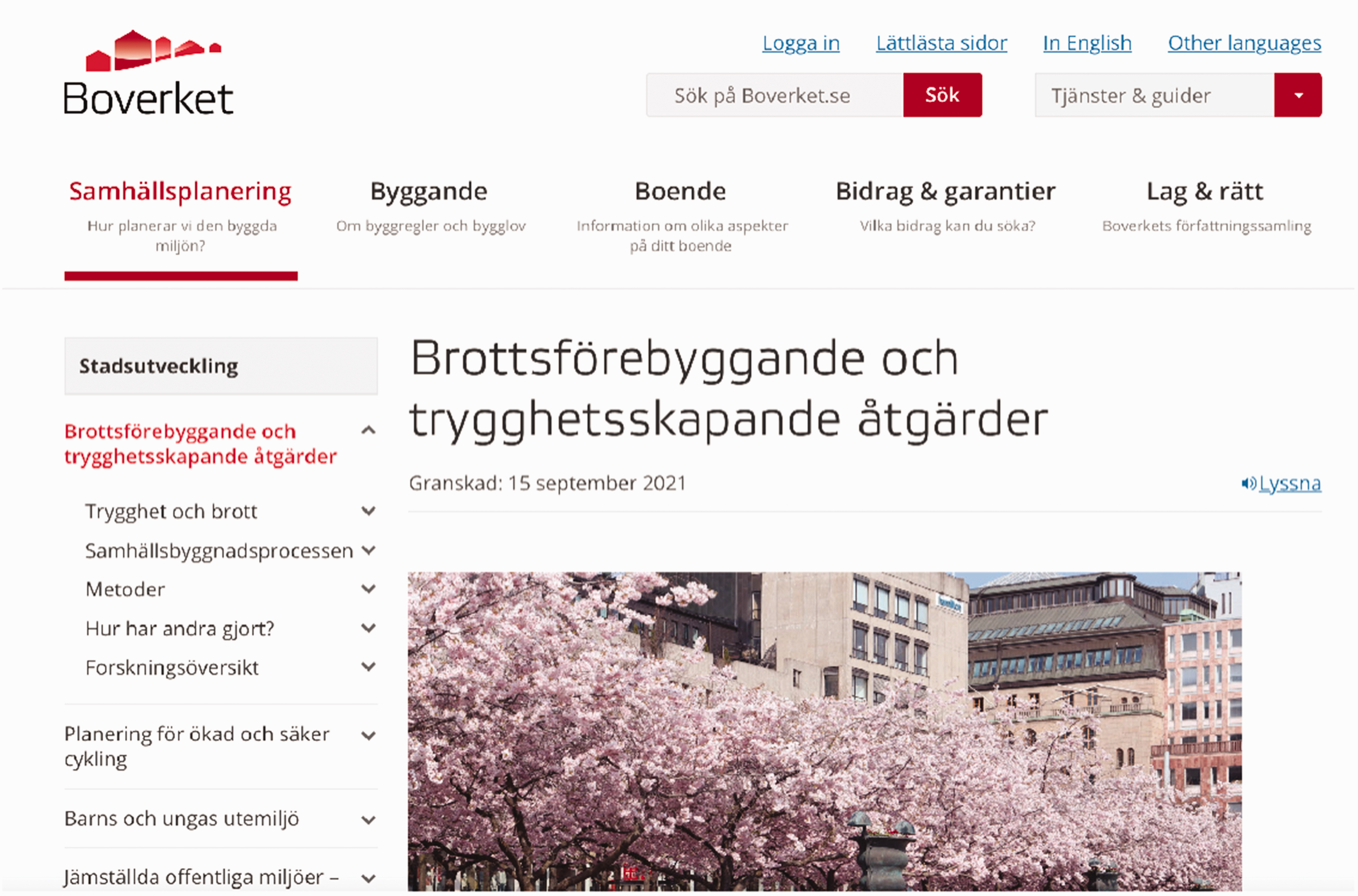
In one of Boverket’s supported projects, analysts from a private consulting firm described current conditions: In all of the courtyards, there is a large Rhododendron bush on the far end of the yard, these block the windows that otherwise would have allowed a greater degree of social surveillance [….] These bushes should be rejuvenated or replaced with lower shrubs.” (Urban Utveckling, 2019: 6)
A closer look at the data collected, however, reveals inconsistencies between perceptions and actions. The analysts admit that During the dialogue, the residents do not seem to experience that the courtyard is unsafe but instead point out other places in the area when insecurity is brought up. The town center is named, for example, as an unsafe place. (Urban Utveckling, 2019: 8) (Figure 7) Suburb of Norsborg, Botkyrka, Sweden, built during the Million Program. Photo from 2018. Photo: Author.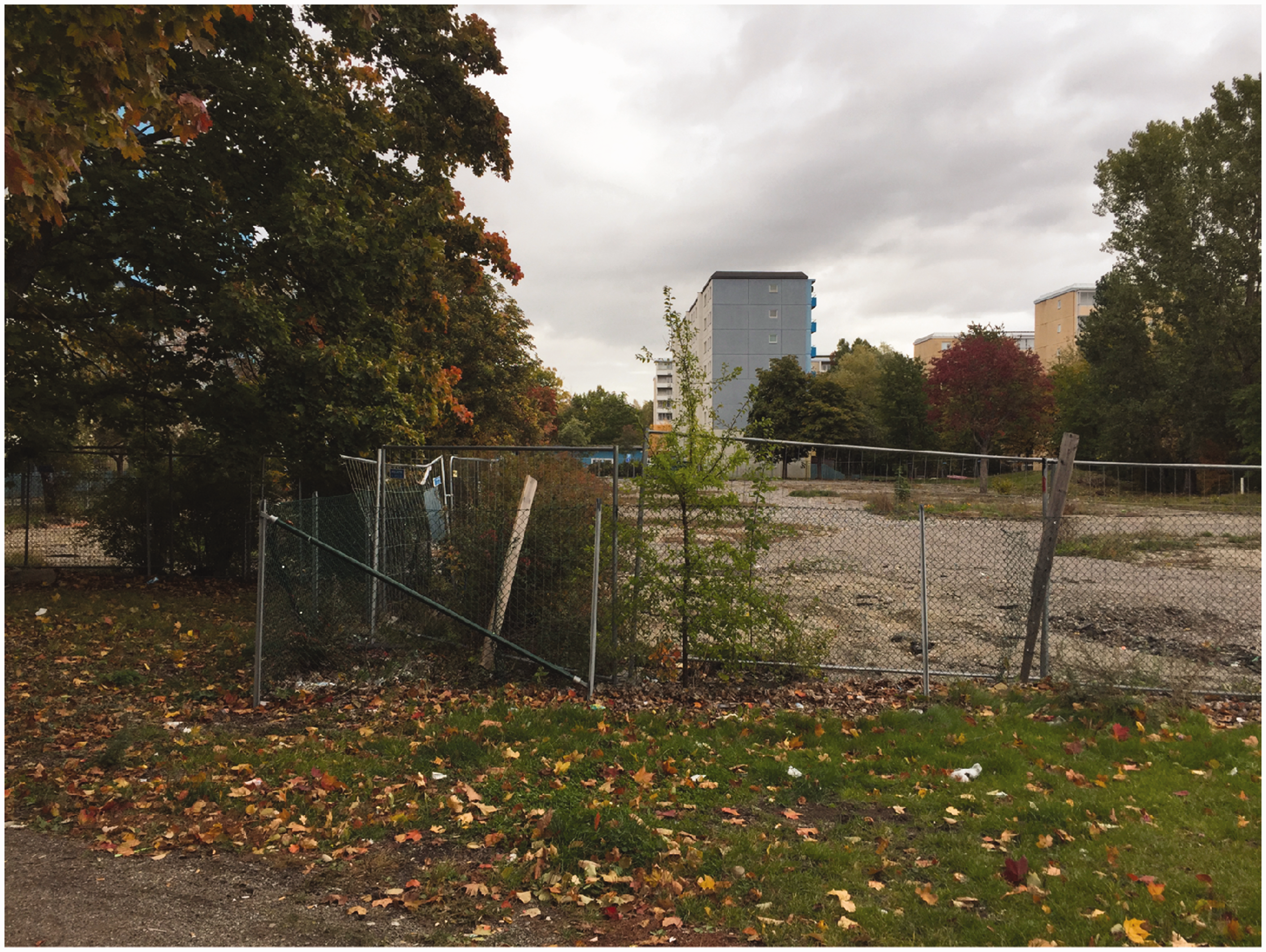
When Fritz Umbach and Alexander Gerould unraveled the myth that “Public Housing Breeds Crime” in the 2015 book Public Housing Myths, they pointed to evidence showing that crime is not necessarily higher in US housing projects, with some neighborhoods notably safer than nearby private housing (Umbach and Gerould, 2015). Even so, in this hereafter, residents are assumed to be criminals, making the focus on safety measures logical. Fears coming from outsiders and with racist overtones justify new militarized buildings and extreme renovations, treating modernist suburbs as sites of siege, a place where “visitation zones” and security cameras can be added to a courtyard without bushes. Modernist urbanism has furthermore been treated as eternally “unfinished:” lacking a past and thus unusually malleable.
The choice to trim courtyard bushes extensively to improve feelings of safety appears misaligned, exceeding the time of the present and the place of the analysis. This is similar to the mismatch recorded by anthropologist Catherine Fennell among residents of the Henry Horner Homes public housing in Chicago, built in the 1950s and demolished in the 1990s (Fennell, 2015). Although media reports of crime were unrelenting, Fennell describes tenants’ emotional pain over being forcibly moved to new mid-rise complexes, especially upon losing what she calls “project heat” – the free central heating that sometimes reached over 35°C/95°F.
Likewise, most current residents I have encountered do not describe their neighborhoods as particularly “dangerous.” They do recognize that maintenance has gone missing, especially under the management of irresponsible housing corporations, a perspective echoed in conversations I had with Märta, a woman in her 70s living in a Swedish Million Program suburb, which she told me was generally “extremely calm” and where she enjoyed living with her partner. When I met her for a walk, she joked about how a neighbor had recently stopped by her garden and asked if she had ever heard that they were apparently both “underprivileged” and the area unsafe. The two discussed it like gossip, with her friend asking, “So, have you noticed anything?” She said she had not. She then told me, “That’s the impression, but it’s something that we almost don’t recognize ….We don’t feel anxious” (Pers. comm.).
When residents’ perspectives are positive, they are sometimes even denied plausibility, much as they were in some reports by journalists in the 1970s. For instance, Elsebeth Frederiksen, a resident of Gellerupparken in Aarhus (an area that the Danish government designated in 2018 as a “hard ghetto”), explained that people often deny her perceptions. She said, I’ve often been accused of being a bit naïve in my … in the things I say about Gellerup. Because why won’t I admit that there is a lot of criminality? And why won’t I admit that there is social control? And this and that. But that is because I experience it from another starting point than the media and politicians do, because I actually live in the area.
In the 1970s, the message that modernist urbanism made dangerous neighbors began, and this hereafter slowly became tinged with xenophobia. In the present, “non-Western” residents are metaphorically and discursively associated with gangs, crime, and other unsavory activities in public spaces. These depictions are then used to justify renovations that privilege security as the main factor of success. This hereafter of modernist suburbs sees dangerous people as causing the neighborhoods’ decline, yet it remains oblivious to (or condescending about) residents’ actual experiences, or how residents themselves describe and use public space. When residents are blamed for failed modernist neighborhoods, the areas are treated as sites where anxieties about ethnicity and nationalism can be, supposedly, neatly addressed through urban planning and architectural measures rather than through social interventions.
A third hereafter: Dangerous designs and people
Today, even more radical forms of intervention have surfaced, and the early, tongue-in-cheek polemics from Lars-Olof Franzén to “Demolish Skärholmen!” have given way to calls for more systematic, top-down demolitions of modernist urbanism. Far-right Scandinavian politicians now talk regularly and openly about razing modernist neighborhoods en masse, constantly referring to them as crime-ridden architectural failures – as though these ideas, which began on dubious grounds in the 1970s, are simply accepted truths. Their views – where both designs and people are dangerous – are quickly being normalized across the political spectrum.
As noted, in April 2018, the leader of the far-right Sweden Democrats, Jimmie Åkesson, appeared on Swedish Public Radio, stating that areas defined by Swedish police as “especially vulnerable” (särskilt utsatta) should be demolished, “to start from the start” (Sveriges Radio, 2018). While Åkesson’s idea was received as rhetorical in 2018, it mirrored the real demolition projects just south of the border in Denmark that began that same year and has recently gained traction in the discourse of the right-wing government his party buttresses. Swedish politicians have, over the past several years, often said that they want to be “like Denmark” in finding solutions to problematic suburbs. In this hereafter, modernist urbanism and its residents now appear to be discursively interchangeable.
To understand this, I return to the then-Danish Prime Minister Lars Løkke Rasmussen’s New Year’s Speech of 2018, which included militant calls to action, many focused on modernist neighborhoods that he called “ghettos.” Broadcasting on television to the Danish public, Rasmussen charged that: We must set a new target of phasing out ghettos altogether. In some places by breaking up the concrete. By demolishing buildings. By spreading out the inhabitants and rehousing them in different areas. In other places by taking full control over who moves in. We must close the gaps in the map of Denmark ….” (Rasmussen, 2018)
In the aftermath of Rasmussen’s (2018) speech, the Danish government developed its 2018 “Ghetto Plan,” promising to “integrate” the so-called “parallel societies” by 2030 through the programs that, as noted, including the reduction to 40 percent of family social housing in so-called “hard ghettos” (Økonomi- og indenrigsministeriet, 2018). Initially presented in the Swedish media as racist or extremist, these plans have increasingly spilled across the border ideologically. When the Sweden Democrats received 20.54% of the vote in the 2022 election and thereby became the kingmakers in parliamentary negotiations, these proposals in fact became more likely.
As urbanist Nazem Tahvilzadeh explained during the panel in Husby in the fall of 2022, I myself usually in almost every lecture I give, for students and the general public, almost every text I write, try to bring up the Danish case, how absurd a democracy itself can change its politics, still call itself democratic, still call itself liberal, but in fact dismantle the foundations that are democratic politics, including legal certainty, respect for basic human rights [....]. And I think that this political maneuver that the right-wing alliance [in Sweden] has used is very much inspired by Denmark.
Lately, the Swedish national media have often taken these hereafters not as narratives or opinions but as truths. For instance, one article appearing in Dagens Nyheter on 21 August 2021 decried the fact that Sweden and Denmark have similar problems with gang violence and social exclusion but, unlike its neighbor to the south, Sweden has “no plan” (Wierup, 2021). Author Lasse Wierup described how, in one Million Program area, “several worn rental buildings have been demolished according to the Danish model to make room for more attractive homes” (Wierup, 2021) The celebratory tone about the demolitions is hard to miss.
Even earlier, in the Swedish Police’s 2020 report, “Right action in the right place,” the ghetto plan’s approach and tone were mirrored, even if proposals diverged (Riksrevisionen, 2020) (Figure 8). The Swedish “vulnerable areas” (utsatta områden) were labeled as such after selection by police officers, based on their own subjective assessments of them. The Danish plan’s graphic design supported statistical claims through emotionally resonant juxtapositions, telling its scientifically dubious story (including the invented category “non-Western”), while the Swedish report relied on the opinions of police officers to define the status of the areas (Kajita, Mack, Riesto, and Schalk, 2022). While Million Program neighborhoods were once called “alienation areas” or “problem areas,” the Swedish Police report ranked them, echoing the Danish plan, as: 1. “vulnerable areas,” 2. “risk areas,” and 3. “especially vulnerable areas” (Riksrevisionen, 2020). In this view, migrant residents are symbolic figures, both victims and perpetrators of crime, and the neighborhoods require more security and more police as the main forms of support.
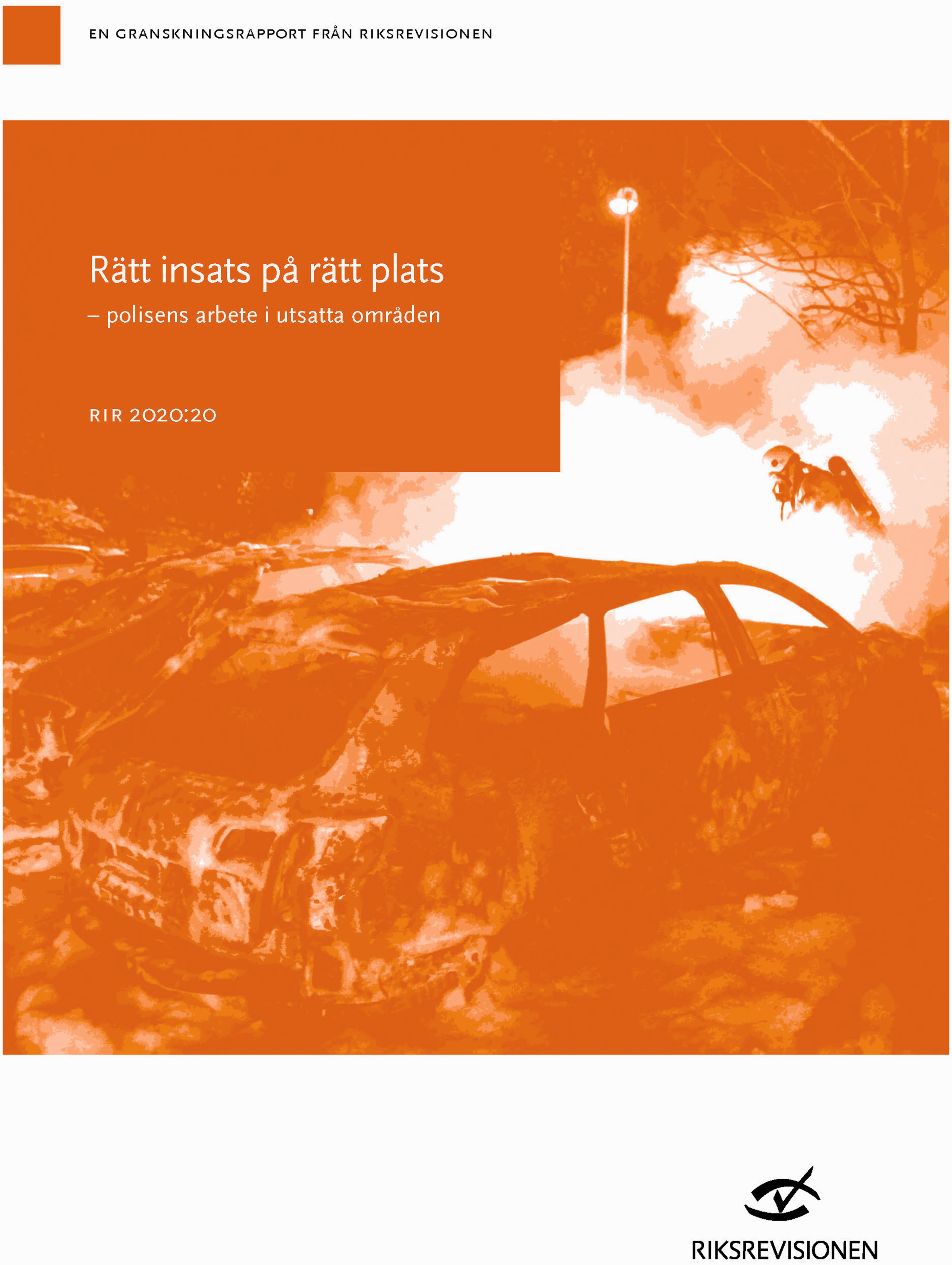
“Right action in the right place – the police’s work in vulnerable areas.” Riksrevisionen, “Rätt insats på rätt plats – polisens arbete i utsatta områden,” (RIR 2020: 20): front cover. Photo: Joachim Nywall.
In both countries, a wide range of politicians appear increasingly open to demolitions and other extreme measures. In fact, a minority of Danish parties are against the proposals, with some espousing newer ideas to market a better Ghetto Plan and immigration politics, “but with more heart.” Facing critique, the Danish government replaced the word “ghettos” from its plans in 2021 with “parallel societies.” Yet its new category of a “prevention area” (forebyggelseområde) includes all neighborhoods with more than 30% “non-Western” residents, an even more extreme percentage than in the categories of the earlier plan. This provoked Søren-Emil, a resident of such an area, to proclaim, And that is basically a criterion we cannot and will not work with. But it is such a vicious cycle that we will probably never come out of. So, it’s very good political craftsmanship, you could say, because we simply cannot do anything about it. We can work with people’s connection to the job market and all kinds of other things, but we can’t do it with diversity.
The Swedish echoes are growing louder and louder and are also traveling across the political spectrum. For instance, a 2021 proposal from the then-leader of the Swedish Liberal Party, Nyamko Sabuni, proposed evicting entire families should one relative be identified as a “criminal gang member” (Wierup and Härdelin, 2021). The Social Democrats, the party behind the original construction of the Million Program, supported this, explaining that they had previously feared accusations of racism but now wanted to appear take charge, given the outsize representation of gang violence in the media. In 2021, the Social Democratic Prime Minister Magdalena Andersson promised in a press conference, “I will turn over every stone to break segregation and smoke out the violence that threatens our community” (Karlsson and Nilsson, 2021), echoing George W. Bush’s earlier “smoke them out of their holes” rhetoric. During the 2022 campaign, the Social Democrats adopted terminology that sounded distinctly Danish, with Anders Ygeman, a Social Democrat and then-Minister for Migration and Asylum Policy, for example, proposing that no neighborhoods should be allowed to have more than 50% “non-Nordic” residents.
This third hereafter for modernist urbanism faults both buildings and people. It positions demolition and extreme renovation as the “only” solutions and implies that both physical neighborhoods and existing collectives of neighbors have no right to a future together. Both are dangerous. Together, they are even more so, as leading political parties’ proposals in both Sweden and Denmark – focused on razing buildings, evictions, and dispersals of neighbors – suggest. In Denmark, residents are now fighting proposed demolitions and other measures through everything from media appearances to taking the Danish government to court. This also counters what Alex, the resident of Bispehaven, called “repressive tolerance, through which we are embraced with all the dialogue we could desire—without really being listened to.” Even so, these efforts are up against a veritable tsunami of plans, informational omissions, and racist logics. In this hereafter, modernist suburbs are not simply omitted from the present; they prevent the future that far-right populists and their collaborators – now moving along the political spectrum – promote. Both the architecture and its residents must therefore be obliterated.
Conclusion: In search of new hereafters
Uncovering the “public housing myth” of crime in American residential projects, Fritz Umbach and Alexander Gerould argue that “the collection, analysis, and presentation of crime statistics is a social undertaking” (Umbach and Gerould, 2015: 64). Indeed, positioning Scandinavian suburbs and their residents as dangerous has also been a social undertaking – at least since the 1970s. More than mere stories, they are hereafters. The assessments made while housing and landscapes were still under construction in the 1960s and 1970s took root, deeply, and have rarely been contradicted since then. The temporal and discursive shifts they employed have persistently justified both physical and political actions, actions that continue into the present day. These security-based hereafters have vindicated security-based interventions, even when presented as banal renovations, anodyne changes of building ownership, improvements for public safety, or “getting Sweden in order:” the tagline that the right-wing Moderate Party chose for its 2022 election campaign (Figure 9). In other words, identifying suburbs as inherently crime-ridden and irredeemable began as a social act decades ago, and this framing has since repeatedly buttressed calls for restructuring, radical renovation, and now eradication.
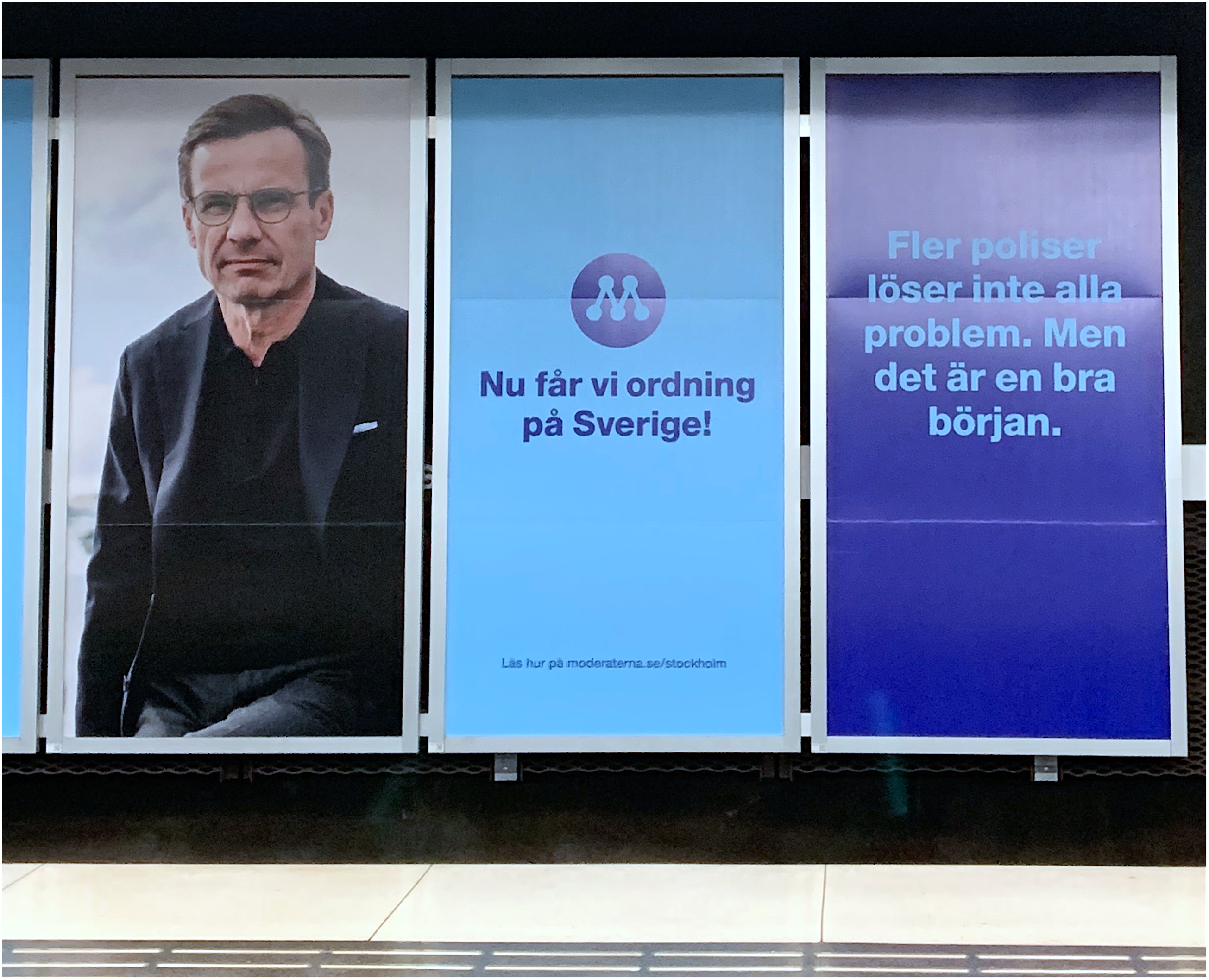
“Now, we will get Sweden in order!” “More police don’t solve everything. But it’s a good start.” Advertisement in the Stockholm subway, 2021. Photo: Author (2021).
In identifying fragmentary and dystopian spaces, this narrative also involves a temporal slippage. The last decades of stigmatization of Scandinavian suburbs have hinged on the absence of the white, middle-class residents who are still imagined as their (only) rightful occupants, ignoring decades-long social changes. Today, “vulnerable areas” or “ghettos” often replace “immigrants” or “migrants” in political speech and in public discourse (such as in comment fields on websites). Proposals to demolish or fundamentally renovate them echo what urban planning theorist Ananya Roy has called “racial banishment,” processes of stealth ethnic cleansing masquerading as gentrification (Roy, 2017). Here, however, they go much further, with an annihilation by proxy focused on buildings as metaphors for people. In these views, the white, middle-class Swedish residents envisioned for these areas remain absent figures, and demolitions or large-scale renovations are thought to make these desired occupants finally materialize while eliminating the non-white, “non-Western,” “non-Nordic” others. Treating modernist suburbs as places where a future of welfare-state whiteness never arrived – as a continuous tabula rasa with no past – waters the roots of atemporal, jaundiced analyses of social conditions, allowing them to blossom further.
During the construction of modernist urbanism in the 1960s and 1970s, scholars and practitioners argued about it in a broad social sense. Did it live up to its promises? Who were these architects to remake the world anyway? Did they not know better? Was it dangerous? Over time, however, security design began to replace the broad social agenda of modernism’s aims to create utopian worlds. For these reasons, broadening their histories – positioning modernist neighborhoods in the present tense – could alter their treatment and the forms of intervention proposed. One former resident, Imra, told me on a walk I don’t think that there’s any problem with the architecture there [.…] There’s a really bad ring when you say, “Million Program,” but it had a really fantastic goal [.…] It’s not the architecture itself, it’s the politics that are wrong.
As noted, the future of modernist suburbs pervaded the highly inflammatory rhetoric of the Swedish general elections of September 2022. Every eligible party mentioned “utsatta områden” – vulnerable or exposed areas – in their platform, with the Moderates also using their own earlier designation “utanförskapsområden” – alienation areas – as a synonym. Most politicians touted the addition of more police and police resources to solve their social problems, with the Sweden Democrats blithely dog-whistling by promising “beautiful architecture.”
When ugly architecture, crime, and criminal residents are said to be insurmountable problems for modernist suburbs, xenophobic messengers argue that the only way to save these areas – and one narrow vision of Swedish society – is to destroy them, to “start from the start.” Fatma Tounsi, a resident of the Danish neighborhood of Bellahøj, explained her understanding of why this populist rhetoric was so powerful: one of the most bizarre things about this legislation is that they claim to work against segregation in the city and segregation in the housing market by actually forcing people to move and taking away the rights from the ones who are most discriminated against in the housing market. … A real package of inconsistencies, but yes, in the end we learned that anything can be done in Danish politics if they just add enough racism to it. Then they can sell anything.
Tracing popular understandings of modernist urbanism for neighborhoods in Sweden and Denmark over time illustrates how discourses of blame – and danger – have traveled: from the designs to the residents to both. In the process, methods of remediation have also changed: from anxious analyses of promises unfulfilled to restless renovations to radical demolitions. These efforts have, however and notably, repeatedly failed in their aims, underscoring the fallacy of blaming modernism for things it cannot control, much as Katharine Bristol warned in her analysis of the demolished Pruitt-Igoe (Bristol, 1991). Likewise, D. Bradford Hunt’s studies of the villainization of public housing designs in the United States demonstrated how analysts obscuring their unusually high proportion of youth and child residents had ignored social conditions that architecture alone could not alleviate (Hunt, 2015). Architecture has long been a convenient scapegoat.
Perhaps modernism was overly ambitious, and its promises could never be entirely fulfilled. The Paradise Cities it pledged to create will likely remain elusive. But the flattened, two-dimensional representations of Scandinavian modernist suburbs – and their placement within a frozen past from which they can never escape – clearly require an update, especially when far-right politicians and an increasing host of others speak loftily in metaphor while proposing hard new realities. Planning processes often ignore both the past and the present of these neighborhoods. Elsebeth, the resident of Gellerupparken, called for designers to rethink their approach: we hear about documents in circulation, that time is spent making volume studies because there might be a decision out in the future, and then you also mention that architects cost a lot of money, so they don’t have enough time to speak with you. [….] There is a need for … that the architects spend time listening and entering into processes of translating or explaining things so they can be understood. There is also a need for architects to be involved in these processes.
Historicizing discourses about dangerous modernist urban design as “hereafters” illustrates just how long police and panic have defined these Paradise Cities. Most media stories about Swedish Million Program suburbs or Danish social housing today are about assault, theft, robbery, gang warfare, rape, murder, or drug sales. That this hereafter would lead to militarization, demolition, or just leveling hills to prevent criminals from hiding behind them seems logical. With dangerous designs and people as “common sense,” the arrival of the wrecking ball is just par for the course. Yet the danger-based assessments of modernist urban designs can be understood as dangerous themselves: socially, culturally, and politically. As one resident of Järva lamented at the end of the seminar in the Stockholm suburb of Husby, They call me “especially vulnerable area.” Why? It’s the police that have aggregated you. Okay. For my personhood? It is we who are living here or these buildings? That’s what I want to know. Is it the building that is “especially vulnerable” or is it me as a person? people have to be made into objects to be able to treat them in the way that is being planned in the parallel society legislation. Because when you are a foreigner, then you can be managed, and that is what they’re trying to do with us, isn’t it?
Another hereafter could thus be conceived. Another hereafter could emphasize histories of the recent past that support efforts to preserve, to maintain, to listen, and to care. Another hereafter could read modernist neighborhoods as places with history, attachments, and visionary architectural intentions by architects, planners, and past and present residents. Scandinavian modernist suburbs can be defined as more than flat caricatures of political hubris, architectural ugliness, social struggles, or rampant crime. These supposedly failed “cities of the future” are now, decades later, spaces with a long history and an ongoing, abundant everyday life: places in progress.
Footnotes
Declaration of conflicting interests
The author declared no potential conflicts of interest with respect to the research, authorship, and/or publication of this article.
Funding
The author disclosed receipt of the following financial support for the research, authorship, and/or publication of this article: This research was generously funded by Riksbankens Jubileumsfond as part of a Pro Futura Scientia Fellowship with the Swedish Collegium for Advanced Study, as well as by the Swedish Research Council Formas under grant number 2016-00309. The public seminar events were funded by White Architects’ ARQ (Foundation for Architecture Research and Foundation for Planning, Building, and Design) and Sweco’s FFNS (Foundation for Research, Development and Education).
