




Abstract
This article considers how urban peripheries are made and unmade by forms of “shifting”. We examine these shifts from the perspective of rickshaw garages and mess dormitories in Dhaka, Bangladesh, which both offer makeshift working and living arrangements to rural–urban migrants. By explicitly situating these spaces as part of the movements and crisscrossing trajectories that animate urban peripheries, we challenge the tendency in urban scholarship to analyze peripheral and marginalized spaces primarily through the lens of habitation. Breaking with residentialist and sedentarist approaches to urban space, we present rickshaw garages and mess dormitories as spaces that are enabling and undergoing various forms of shifting, as their occupants move and alternate between different places, neighborhoods, and spatial arrangements to establish a continuity of work and income. We argue that these forms of manoeuvring are made possible by a degree of spatial malleability that reflects the territorial impermanence of the periphery itself, which is continuously pushed sideways through tandem processes of precariousness and improvement. By directing attention to the “shifting” in “makeshift”, we contribute to a less static understanding of how labor migrants try to hold their place in the city amidst wider processes of exclusion, expansion, and densification.
Introduction
“In the last ten years, I have moved accommodations eight times,” Ishrat1 explained. She first arrived in Dhaka 10 years ago, when she and her husband migrated to the capital city of Bangladesh from their home village in Tangail. Tragically, her husband had died in an accident a few years later, making Ishrat the sole ricewinner of the family. She currently shared a bed with her three children at a “mess dormitory” in Rayerbazar, a neighborhood located along the western fringes of Dhaka city, close to the Buriganga river. Every morning Ishrat rearranged their small room into a modest workshop from where she taught embroidery work to women in the neighborhood. It was just one of the many jobs, ranging from domestic work to working at a fish market, that she had tried out in Dhaka. In her never-ending search for work and income, Ishrat had moved from one mess accommodation to the other. She explained that one of the main reasons for moving was the increase in rent: “Neighborhoods that were affordable to rent in the past have now become expensive. I am forever on the lookout for a new neighborhood with cheap rent”.
Mustafa, who also stayed and worked in Rayerbazar, was on the lookout for empty land as well as cheap rent. He ran one of the many cycle-rickshaw garages that can be found along the peripheral edges of Dhaka city, where storage space is relatively easily available. Mustafa had accessed his current storage space – an empty piece of wasteland – only six months ago, by entering a lease agreement with a powerful landowner. He had relocated from a more established part of Rayerbazar after the owner of his previous garage site had decided to use the land for the construction of a high-rise building. Mustafa’s colourful cycle-rickshaws, which he rented out to individual drivers on a daily basis, were stored in the open air. While most garages offered some sort of provisional, free-of-cost accommodation to rickshaw drivers, Mustafa had not been able to invest in such a sleeping place. In two months or so, he would have to temporarily park his 23 rickshaws at the roadside, because of the annual mela (“fair”) that would be hosted at the site of his garage. Moreover, the landowner also had plans to eventually develop the plot for real-estate purposes, so soon he would be packing up his business again. The prospect of relocating did not particularly bother him: “I am not worried, it will be easy to find a different spot to run my business from”.
Peripheral urban neighborhoods like Rayerbazar are filled with people like Ishrat and Mustafa who need to continuously shift and alternate between different places and spatial arrangements to make a living for themselves. In this article, we examine such forms of shifting, which play out across different scales, from the ethnographic vantage point of mess dormitories and rickshaw garages. Both of these spaces, each in their own way, highlight the various movements that animate and help constitute urban peripheries. Both mess accommodations and rickshaw garages can be understood as places where “tentative, residual, or nascent links to both city and rural areas are maintained and intersect” (Simone, 2010: 51). Rickshaw garage spaces provide an important source of labor and shelter to temporary, seasonal, and long-term rural–urban migrant workers. They thus play a crucial role in enabling the tidal waves of laborers moving in and out of the city. Mess accommodations similarly attract rural–urban migrant workers but, as Ishrat’s example highlights, also function as entry and exit points amidst intra-urban flows, in the sense that people pass through these spaces in their restless search for cheap rental accommodation in the city.
Neither rickshaw garages nor mess accommodations should be understood as a mere stopover on wider trajectories of movement. Far from representing a stable or static spatial configuration, these spaces are themselves continuously made and unmade by forms of shifting. The example of Mustafa speaks to the fact that rickshaw garages are not just located in the peripheral areas of Dhaka, but actually move with the periphery as informal land uses are pushed towards the edges of the city by processes of urban development and speculative real-estate investments. Moreover, both mess accommodations and rickshaw garages bear testimony to everyday forms of shifting, such as the rearranging of furniture to transform a sleeping place into an embroidery workshop or the temporary relocation of a rickshaw garage to a nearby street to accommodate a cultural fair. Such practices speak to a degree of malleability and manoeuvrability that is often central to people’s efforts to carve out a living for themselves amidst wider processes of urban exclusion, expansion, and densification.
By analyzing how rickshaw garages and mess dormitories emerge as spaces “in” and “of” movement, we seek to contribute to a deeper understanding of the lateral ways in which urban peripheries are produced “over time and across space” (Caldeira, 2017: 6). In doing so, we build on Simone’s (2018: 264) conceptualization of “make + shift life”, which captures how people “literally ‘make’ and then ‘shift’ to adapt in rapidly changing circumstances” (Bhan, 2017: 593). By focusing explicitly on dimensions of shifting, our article complements the existing literature on peripheral and marginalized urban neighborhoods, which tends to emphasize forms of “making” by highlighting processes of auto-construction (Caldeira, 2017), upgrading (Echanove and Srivastava, 2016), repair (Bhan, 2019), squatting (Vasudevan, 2015), and incremental adaptation (Kamalipour and Dovey, 2020). We offer that shifting, just like making or building, represents a crucial way in which people try to “hold their place in the city” (Simone, 2010: 45). Moreover, we argue that whereas making or building a home entails a negotiation “over the terms of establishing permanency” (Makhulu, 2015: 11), shifting ultimately relates to the struggle of establishing a continuity of livelihoods.
Our aim in foregrounding dimensions of work and movement is to break with the tendency to interpret and problematize peripheral and marginalized urban spaces solely through the lens of habitation. Indeed, the tension between precariousness and improvement that fuels the lateral production of urban peripheries (Caldeira, 2017: 6) is often intuitively framed as a contrast between improvised and permanent dwellings – between tin sheds and high-rises. This preoccupation with habitation and the “generally substandard settlements in which large segments of the urban poor live and work” (Weinstein, 2014) has been encouraged by a myopic concentration on slums as the dominant frame for making sense of Southern urbanism (see Arabindoo, 2011; Banerjee, 2022; Roy, 2011). Shot through with allusions to shelter and habitation, the category of “slum” fails to capture how people’s lives and livelihoods are part of an “intricate set of connections and flows stretching across multiple physical spaces” (Arabindoo, 2011: 643). What gets lost amidst residentialist and sedentarist approaches to urban precariousness is that for many people residence in a particular place hardly constitutes an adequate measure of their presence, engagement, improvisations, struggles, and negotiations with/in the city. Indeed, for labor migrants like Ishrat the city represents an avenue for making a living rather than a place to live.
In this article, we present shifting as a set of strategic practices that people engage in as they try to make a living amidst processes of urban exclusion, expansion, and densification. First, we examine what it means – theoretically – to move away from habitation and outline our own approach to studying peripheries as shifting configurations. Next, we contextualize rickshaw garages and mess accommodations as part of wider trajectories of urbanization in Bangladesh, paying specific attention to the ways in which circulations of capital and labor shape the formation and shifting of urban peripheries in Dhaka. Our empirical section highlights the specific forms of shifting that rickshaw garages and mess dormitories are enabling and undergoing. The first section focuses on rickshaw garages and shows how these spaces accommodate rural–urban flows, and move with the periphery as Dhaka continues to extend outwards. The second section on mess accommodations directs attention to intra-urban movements and sheds light on the everyday forms of shifting that play out as people rearrange their furnishings to combine functions of living and working. We argue that both rickshaw garages and mess dormitories indicate a degree of malleability and manoeuvrability that is reflective of the tentative nature of peripheries. In our discussion section, we further reflect on what this malleability tells us about the tension between precariousness and improvement that shapes the shifting of urban peripheries.
The material presented in this article is based on extensive ethnographic fieldwork in various neighborhoods along the southwestern and eastern fringes of Dhaka city (Figure 1). Annemiek carried out 11 months of fieldwork in Dhaka between 2015 and 2018. Her research focused on the mobilities and labor trajectories of cycle-rickshaw drivers. Throughout her fieldwork, Annemiek visited approximately 75 rickshaw garages, located in peripheral areas like Rayerbazar, Kamrangirchar, Shonir Akhra, and Badda, where she conducted semi-structured group discussions and individual interviews with both rickshaw drivers and garage owners. Shreyashi conducted six months of field research in Dhaka between 2016 and 2018, focusing predominantly on mess accommodations (dormitories) for low-income workers in Mirpur and Rayerbazar. She conducted participant observation, carried out semi-structured and unstructured interviews, and shadowed and accompanied multiple state- (planning officials, administrative staff) and non-state actors (workers, real-estate builders, caretakers, landowners). While the section on “rickshaw garages” reflects the ethnographic work of Annemiek, the section on “mess dormitories” builds on the research findings by Shreyashi.
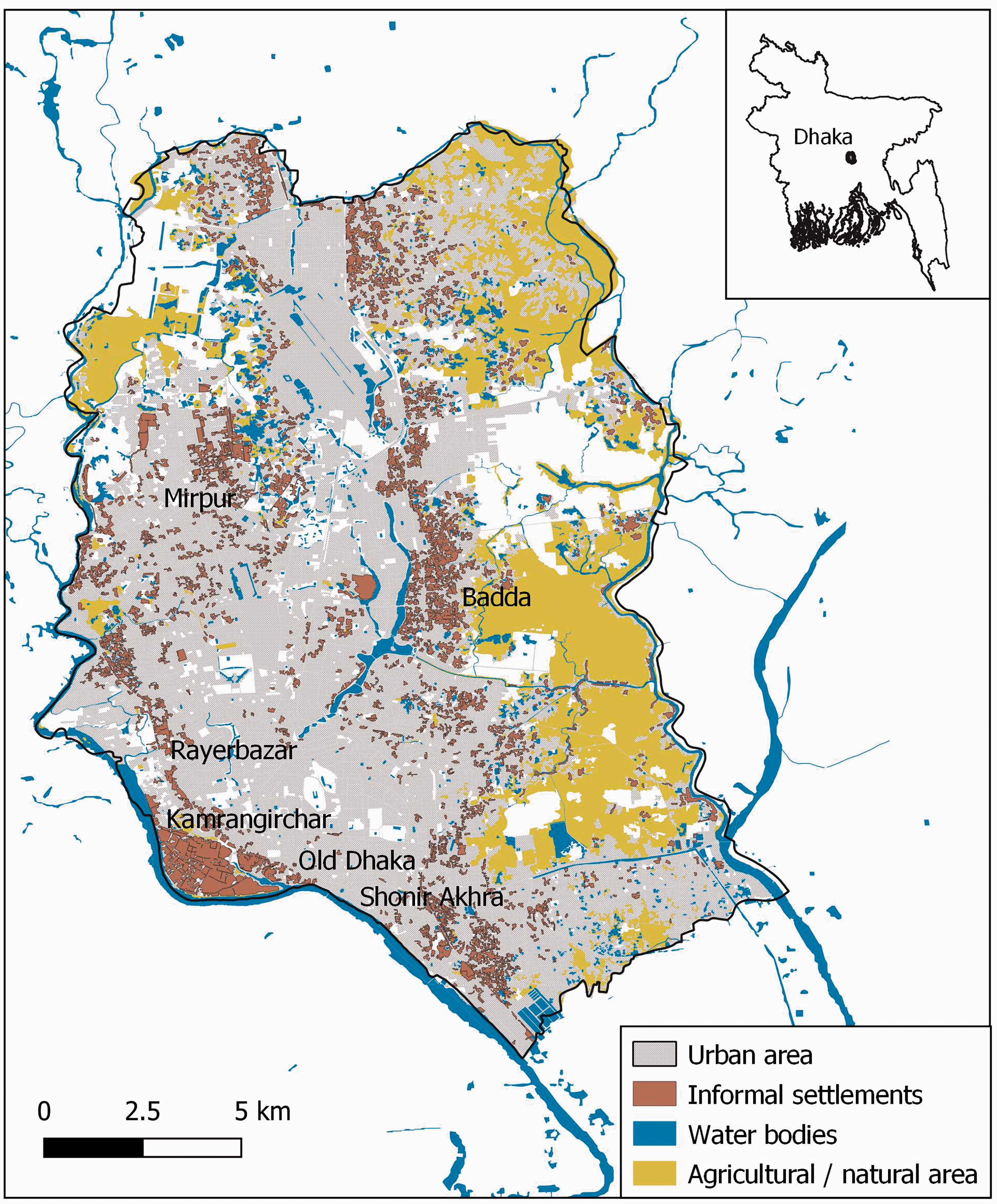
Map of Dhaka city, highlighting the main fieldwork areas of this research. Informal settlements are indicated by brown shadings. Map source: World Bank (2017); informal settlement locations taken from Gruebner et al. (2014).
Beyond habitation: Deterritorializing urban peripheries
In our attempt to move beyond categories and epistemologies of habitation, we take inspiration from authors who have criticized the centrality of slums in making sense of Southern urbanism (Arabindoo, 2011; Banerjee, 2022; Gilbert, 2007; Rao, 2006; Roy, 2011). In many ways, slums have become the predominant frame through which cities in the global South “are perceived, understood, mapped, and created” (Arabindoo, 2011: 639). Gilbert (2007: 698) points out that the term slum has helped to stir fears about mass-urbanization and rural–urban migration, thereby essentially morphing the complexities of urban inequality and precariousness into a recognizable image and distinct habitat. This has impeded the “recognition of varied forms of dwelling practices” (Banerjee, 2022), while also restricting the scope of urban analysis. Indeed, Rao (2006: 227) observes a gradual slippage from slum as population and terrain to “slum as theory”. This conflation of territorial and epistemological categories implicitly reifies habitation as the main mode of engaging with the city, by suggesting that urban precarity in the global South is best understood as an extension of a particular settlement type.
What such a residentialist and sedentarist2 approach to urban life fails to address is that for many people the city primarily constitutes “a place for making a living”. Martinotti (1994) has pointed out that the experiences of non-residents, especially workers, are too often side-lined in analyses of cities. Despite the increased intertwinement of rural and urban realities and the fact that “many people reside in one [place] but work in the other” (Champion and Hugo, 2004: 3), urban research has long revolved around “residential units of observation” (Martinotti, 1994). This static approach does not fit the South Asian context where “movement, both within rural areas and between villages, towns and cities has always been, and continues to be, a central feature of life” (Gardner and Osella, 2003: vi). The normalcy of such mobilities and translocal relations requires a different way of looking at “the relationship between the ephemeral and the durable” (Dharia, 2022: 4). Indeed, as can be expected, fostering a sense of continuity in such a context does not always center around residence or habitation, nor is it necessarily aimed at establishing permanency in a certain place. For instance, Jackman (2017: 251) has shown that (temporary) labor migrants in Dhaka often deliberately divest resources away from residence and rent in the city in order to advance projects elsewhere, including “supporting family elsewhere, starting businesses, paying dowries, or purchasing land”. Our article similarly puts emphasis on the translocal and mobile nature of the “hustle” for work and income that gains shape as people navigate precarious urban conditions (Thieme, 2018). We turn to the notion of periphery as a space/function to think about these issues rather than slums or habitation.
Conceptualizing shifting urban peripheries
Periphery, in contrast to the notion of slum, facilitates an explicit focus on movement. Although often employed to make sense of informal or marginalized neighborhoods, the term periphery provides a less stigmatizing, static, and topological alternative to the notion of “slum”. Roy (2011: 231–231) contends that the concept is more suitable to capture the “inevitable heterogeneity of Southern urbanism” due to its “ability to transcend territorial location”. With its origins in Marxist theorizations of economic and political dependency, the notion of periphery is also more closely connected to circulations of labor and capital. Specifically, the concept has been used to explain how the uneven development of capitalism permeates city-suburb and city-hinterland relations (Harvey, 1985; Smith, 1984; Soja, 1989).
Periphery thus signals the political-economic hierarchies that shape how urban centers burst apart and dissolve into bordering territories. The fact that these processes are inherently diffuse makes it difficult to definitively map and locate the edges of this dynamic. Consequently, the periphery cannot be simply understood as a “zone at the edge of the city” (Foot, 2000: 8). Instead, Simone (2010: 40) has defined the periphery as a space that has never been “brought fully under the auspices of the logic and development trajectories that characterize a center, and therefore embodies an instability that is always potentially destabilising of that center.” This instability coincides with a degree of territorial impermanence, marking peripheral urbanization as a “process that is always being displaced, reproduced somewhere else where land is cheaper because it is more precarious or difficult to access” (Caldeira, 2017: 6).
The fact that urban peripheries are often continuously pushed sideways, through processes of urban expansion and densification, suggests a tension between urban access and exclusion. On the one hand, the periphery functions as a repository for inward migrants searching for work and economic opportunities. Yet, at the same time, urban peripheries are also “attractive to investors seeking to capture gains from rapidly rising land value” (Gururani and Kennedy, 2021: 1). Such forms of capitalist expansion, which become manifest through the construction of mega-projects, land and real-estate speculation, and increasing urban living costs, make it so that urban newcomers are often on the brink of being “out” again. It is this degree of uncertainty and ambivalence that marks urban peripheries as spaces of “aspirational compromise” (Archambault, 2021). Navigating these shifting configurations requires a constant (re)attunement of “one’s aspirations with one’s circumstances” (Archambault, 2021: 303).
Such compromises and trade-offs are characteristic of what Simone (2018) has described as “make + shift life”. Various authors have explored what it means to “make” and establish a place for oneself in the urban periphery by focusing on auto-construction, squatting, and repair ( Bhan, 2017, 2019; Caldeira, 2017; Vasudevan, 2015). Less attention has been paid to shifting as a spatial tactic, with exceptions such as Solomon's (2022) work on the movement and adjustment of patients in a Mumbai hospital. While based on a very different context, his work helpfully unpacks shifting as a form of praxis that implicates bodies, space, and time in trajectories of survival (Solomon, 2022: 57). This article focuses on trajectories of economic survival, by honing in on the different practices of “shifting” that play out as people move and alternate between different places, neighbourhoods, and spatial arrangements in order to establish a continuity of work and income. Such a focus on shifting allows for a further examination of the malleable and indeterminate nature of urban peripheries, which are often caught between processes of concentration and dispersal; arrival and exclusion; and precariousness and possibilities.
Situating garage and mess spaces as part of shifting peripheries
As we have seen, urban peripheries are ambivalent places – situated in the interstices between rural and urban – where the expansionist tendencies of capital meet the restless search for work and opportunities that animate the movements and trajectories of rural–urban migrants. Garages and mess dormitories can be viewed as nodes where these different tendencies intersect, while also highlighting how urban peripheries themselves are continuously shifting amidst processes of urbanization and land speculation.
Urbanization in Bangladesh is characterized by intertwining processes of expansion, densification, and rural–urban migration. The capital city Dhaka counts as one of the fastest-growing and most densely populated megacities in the world and has an estimated population of 22 million (World Population Review, 2022). This reality of urbanization is intimately tied to rural and agrarian transformations (Dasgupta, 2019: 289), as trajectories of rural–urban migration are fuelled by varying degrees of landlessness, rural displacement, and ecological vulnerabilities such as river bank erosion (Hossain, 2013: 370). Despite this constant influx of new people, which is intensified by realities of climate change, Dhaka does not merely constitute a space of arrival. In fact, as Etzold (2016: 171–173) has pointed out, urban newcomers do not always settle in Dhaka, but often remain situated in a “translocal social field” as they “organise their livelihoods dynamically across different places”.
Both rickshaw garages and mess accommodations speak to a longstanding history of tentative, seasonal, and tidal movements into the city. Historically, messbari or mess dormitories emerged as an affordable boarding option for people migrating from rural areas to cities in Bengal during the colonial period. Basu (2019) highlights the cultural and social significance of these spaces for those who pursued educational and job opportunities in Kolkata. Dhaka had similar boarding houses and mess dormitories, catering to government officers and students. In the 1970s, the need for low-income housing in the city intensified, as Bangladesh shifted its economic focus toward export-oriented industrialization and the number of readymade garment units in Dhaka started to increase (Ghafur, 2010: 8). With official planning practices focusing exclusively on higher and middle-income groups (Ghafur, 2010; Kabir and Parolin, 2012), the formal housing market largely failed the influx of new workers. To this day, private rental dormitories play an important role in meeting this demand for affordable lodging, by offering a variety of rental arrangements ranging from one-day to weekly, monthly, and yearly options. The (temporary) occupants of dormitories work as domestic workers, construction laborers, garment factory workers, rickshaw- and car drivers, small-scale entrepreneurs, street food vendors, and local restaurant workers.
Whereas contemporary mess dormitories represent a broad segment of the rural–urban migrant population and cater to men, women, and families, rickshaw garages focus almost exclusively on men who work as cycle-rickshaw drivers. With an estimated 1.1 million cycle-rickshaws operating in Dhaka (Karim and Salam, 2019), the rickshaw industry constitutes an important source of (seasonal) labor for rural–urban migrants. The fact that rickshaws can be rented on a per diem basis, makes for a relatively accessible avenue of work that requires no investment capital and enables workers to come and go according to their needs and wishes (Prins, 2021). The only real requirement for prospective rickshaw pullers is that they have a neighbor or family member, usually someone from their home village, who can vouch for them with the so-called rickshaw malik (owner). The vast majority of drivers rent their vehicles from rickshaw owners, who are also responsible for running and maintaining the rickshaw garage. The fact that only a small percentage3 of workers actually own their rickshaw is a reflection of the translocal lives that most of them lead. Over 80 percent of rickshaw pullers spend time at their rural home every six months, and only 45 percent of them rent a room in the city with their family (Karim and Salam, 2019: 38). The rickshaw garage provides a form of improvised shelter to those who do not rent a room.
Their crucial role as urban entry and exit points amidst rural–urban flows marks mess accommodations and rickshaw garages as peripheral spaces. They are not only part of wider “territories of transition and connection” (Simone, 2010: 51), but also implicated in the distinct hierarchies that shape the relation between urban centers and their hinterlands. These hierarchies, which relate to both class and geographical dimensions, become clear from the way in which Dhaka’s built-up area has expanded and densified over time. Closed off by the Buriganga river along its southwestern fringe, Dhaka initially expanded northwards from what is now called Old Dhaka. The higher grounds along the city’s south–north axis were singled out to establish planned residential projects for middle- and higher-income groups (Kabir and Parolin, 2012: 12). The low-lying floodplains on the western and eastern flanks of the city, on the other hand, have long attracted rural–urban migrant workers, informal settlements, and low-cost housing (Hafiz, 2007: 61). This peri-urban belt is continuously pushed sideways, as the rapid increase in land-prices encourages real-estate developers to fill up the water bodies that can be found along these low-lying edges (Alam, 2018).
Such forms of encroachment and extension, fueled by the expansionist tendencies of capital, make it so that inhabiting the urban periphery often requires “moving with-” the periphery as informal land-uses are pushed away from the center. At the same time, these shifting edges also retain a degree of fluidity (Dasgupta and Prins, 2023), open-endedness, and possibility, as “the city continues to host migrants as they come” (Sowgat and Roy, 2022: 425). In what follows, we further unpack this malleability, and the forms of shifting that correspond with it, from the explicit perspective of rickshaw garages and mess dormitories.
Rickshaw garages
Garage relocations: Moving with- the periphery
From the previous section, it becomes clear that the urban peripheries of Dhaka are far from static. Land scarcity and population growth trigger processes of expansion and densification that continuously transform the urban landscape and the city’s edges. These processes also affect the way in which rickshaw garages are situated. Historically, the rickshaw and cycle industry has had its mainstay in Bangshal, which is located in Old Dhaka (Figure 1), the oldest and most congested part of the city. The area used to be a hub for the different categories of workers involved in the industry. Central to this article are rickshaw wallahs (drivers) and rickshaw maliks (owners), but equally important are the manufacturers, mechanics, and artists who make, repair, and decorate the rickshaw. While Bangshal is still home to a variety of rickshaw art studios and rickshaw assembly workshops (Islam, 2015), rickshaw garages are increasingly absent from this bustling part of town.
One of the few rickshaw owners who still operated his business from Bangshal was Iqbal, who had lived in Old Dhaka his whole life. Iqbal did not only rent out his rickshaws; he also made and designed them. He mentioned that up until 15 to 20 years ago, Bangshal had been host to many rickshaw garages. Yet, today his garage was only one of the two or three garages still left in the area. He explained the decline as follows: To build a garage you need empty (khali) space, but that is difficult to find in Old Dhaka. It is impossible to stay somewhere permanently. If you find an open space, you can make a garage, but these spaces are also needed for constructing high-rises.
The above example shows how processes of densification, specifically the mushrooming of high-rise buildings, push rickshaw garages away from more central areas of Dhaka. This movement is fuelled by the constant search for open stretches of wasteland, which results in a shift to peripheral lowlands near water bodies. One example of such an area is Rayerbazar (Figure 2), which is located along the western fringe of the city and inextricably entangled with the floodplains of the Buriganga river. With the construction of an embankment road in the 1990s, the low-lying swamplands along the western edge were gradually made inhabitable, as ponds were filled up with mud and rubbish to accommodate informal dwellings, workshops, and rickshaw garages. Today, these informal land uses are increasingly under pressure from an influx of private and public investments toward real-estate development and infrastructural upgrading. The fact that Rayerbazar is located directly next to the upscale residential area of Dhanmondi has further stimulated these speculative processes (The Dhaka Tribune, 2020). Areas that used to be largely self-built are increasingly co-opted and transformed into housing blocks for the (higher) middle classes, thereby highlighting Simone’s (2018: 264) observation that “whatever is made then shifts in terms of its availability to specific uses and users”.
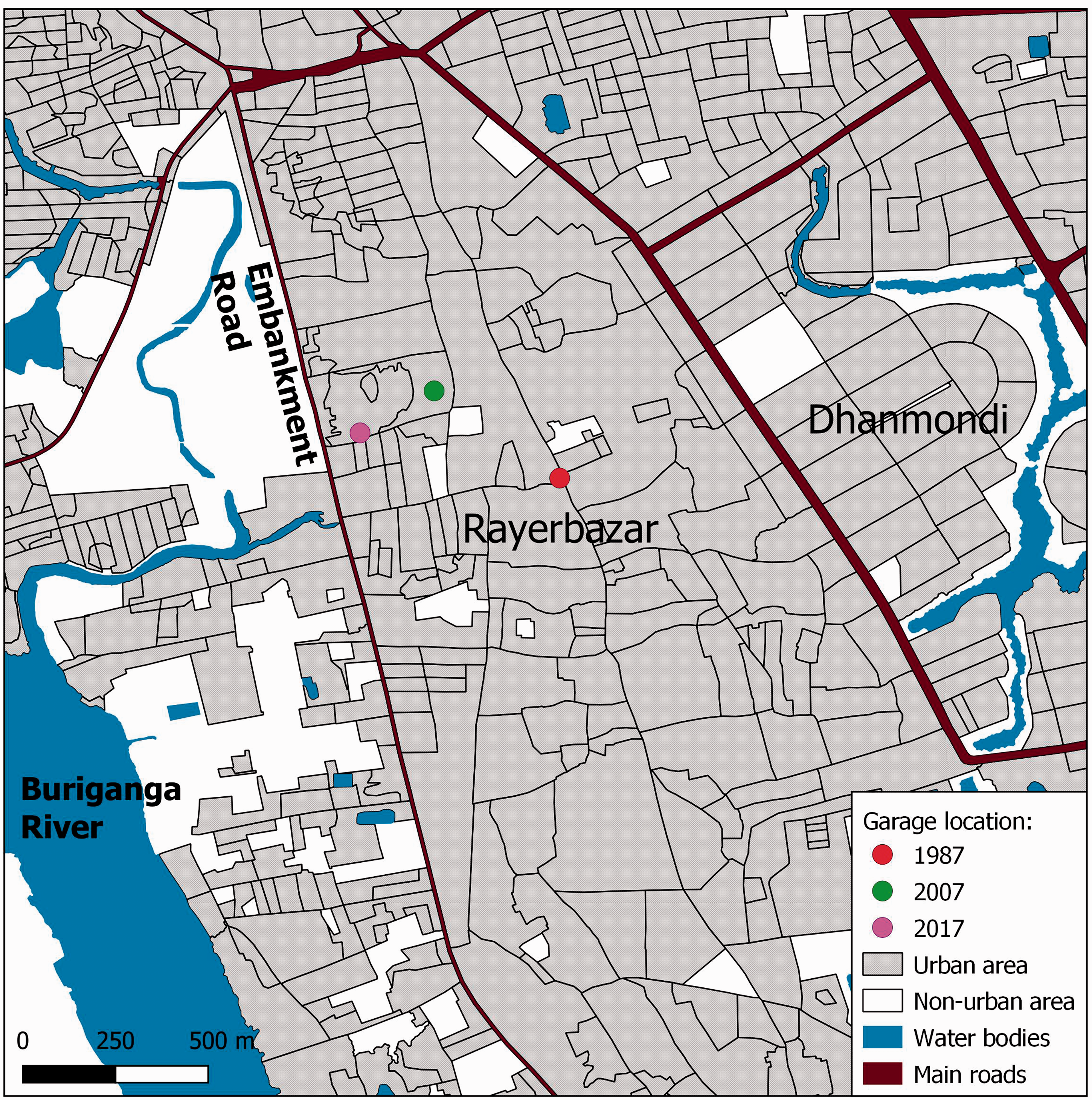
Map Rayerbazar with the approximate locations of one rickshaw garage within 30 years (1987–2017). Source: World Bank (2017).
Rickshaw garages are very much affected by such forms of expansion and co-optation, due to their reliance on land that is owned by others and destined for other purposes. Mustafa, the rickshaw malik who was mentioned in the introduction, knew very well that he would have to vacate his newly found spot in Rayerbazar as soon as the land-owner decided to strike a deal with a real-estate company to develop the plot into a high-rise building. Most rickshaw owners, including Mustafa, relied on temporary lease constructions with private landowners or local political leaders to obtain access to stretches of land waiting to be converted for different purposes. The inherent temporariness of such lease constructions, which function as a bridge between current and future land values, explains why rickshaw owners often had to move. In Rayerbazar, such shifts followed existing geographical and socio-economic fault lines, as garage owners would relocate away from the more established areas near Dhanmondi towards the lowlands near the embankment – often literally referred to as nama or niche (“down”, “below”). One local rickshaw owner, who had his current garage almost directly next to the embankment, detailed how he had moved three times in 30 years, shifting a couple of hundred meters westwards with each relocation (Figure 2).
Literally moving with- the periphery is one way in which rickshaw maliks maintain a sense of continuity amidst exclusionary processes of expansion and densification. In addition, garage owners also sometimes resort to more ad-hoc or seasonal forms of shifting in order to “hold their place” (Simone, 2010: 45) in a certain part of the city. Mustafa, for instance, mentioned that he would have to temporarily move his rickshaws because of the annual cultural fair that would be staged at the large playing field from where he operated his garage. To accommodate this move, the landowner had arranged for Mustafa to store his vehicles at the roadside. Such forms of spatial overlap between rickshaw garages and other urban functions – a playing field, a cultural fair, the road – were particularly common in more densely populated areas. For example, one of the few garage owners who had managed to hold his place in a bustling market area of Old Dhaka, near the city’s main boat terminal, had only been able to do so because he was willing to alternate between two different locations. His rickshaws were usually parked at an open, sandy patch of land between the higher-up road and the immediate riverside. However, the owner explained that he could only stay there during the dry season. As soon as the summer rains would arrive, the Buriganga river would overflow, and he would have to move his 80 rickshaws higher up, to one of the already crowded roads on the other side of the market.
Hence, in the context of the rickshaw garage, it is not so much the investment in a permanent place, as the willingness to move that allows owners to establish a continuity of livelihoods. Their reliance on spaces that are inherently peripheral – namely, unused but soon-to-be exploited stretches of wasteland – leads to a privileging of practices of shifting over incremental forms of upgrading. To some extent, these shifts are indicative of distinct forms of marginalization that characterize peripheries. The forms of expansion and densification that push garages towards precarious, flood-prone, and low-lying spaces are fuelled by a land-hungry real-estate sector that only caters to middle- and higher-income groups. However, the spatial and temporal indeterminacy that characterizes spaces that have not yet been co-opted by hegemonic logics of city-making also marks these peripheral wastelands as potentially generative spaces that allow for a degree of malleability and manoeuvrability that is often central to people’s efforts to carve out a living for themselves.
Malleable spaces: Moving in and out of the city
The rickshaw garage is not just a movable space; it is also a malleable space where different functions overlap and coalesce. Rickshaw garages do not always mark a distinct space to begin with and vary significantly in size and shape: from cramped tin shed storage spaces with a handful of rickshaws, to large open fields with up to 200 vehicles. Whereas most rickshaw garages are built as large, half-open structures, made out of bamboo and corrugated iron (Figure 3), some garages simply consist of a collection of rickshaws being stored in the open air, be it on a playing field, under an elevated expressway, or at the side of the road. This rudimentary shape foreshadows the forms of shifting that garage owners have to engage in, while also highlighting the multiplicity of possibilities that these spaces open up to different groups of people. Indeed, the rickshaw garage often functions as an office, storage space, repair shop, and dormitory all at once. This malleability also plays an important role in accommodating the frequent, irregular, or seasonal movements of cycle-rickshaw drivers.
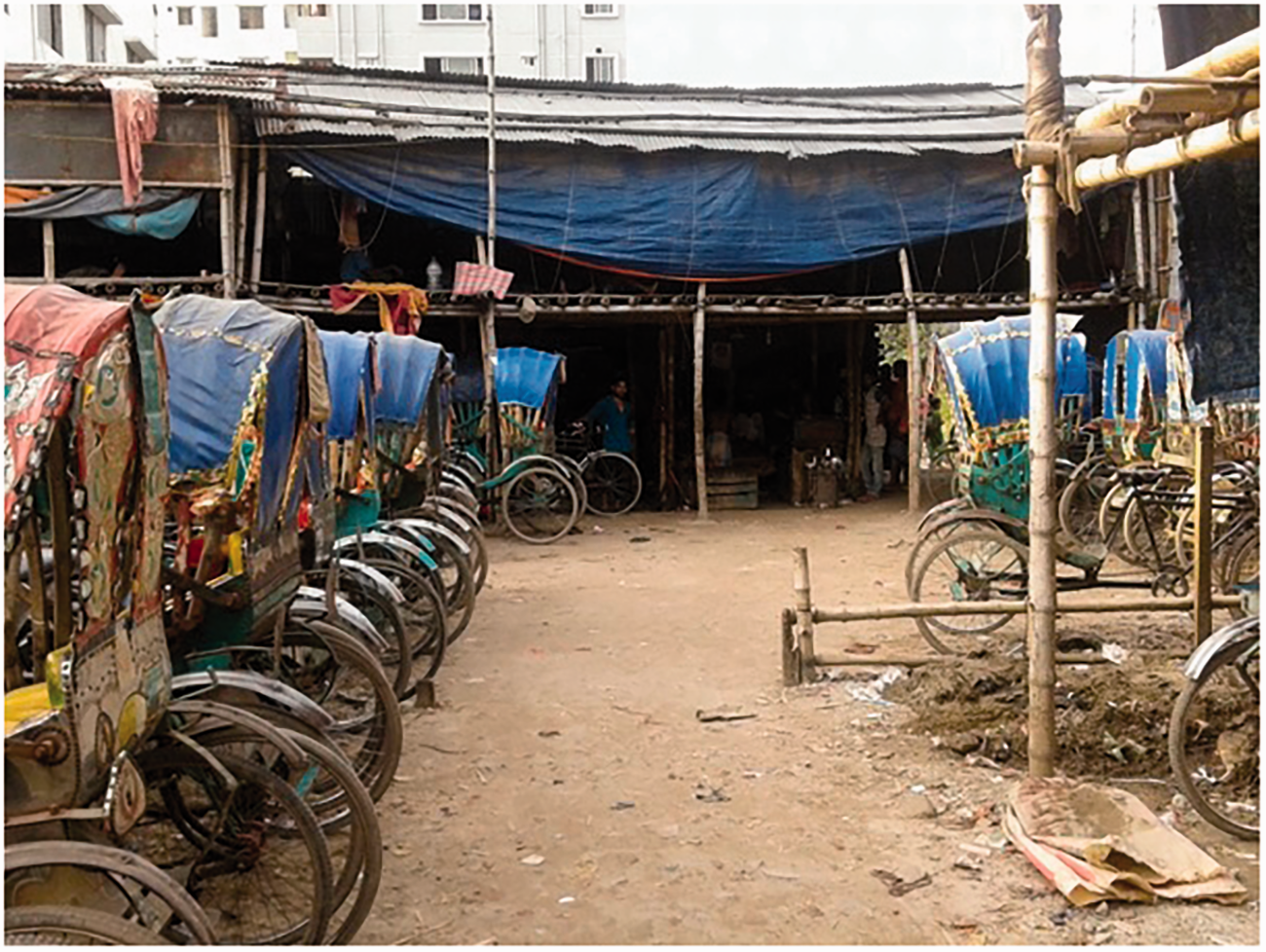
Picture of a rickshaw garage, photograph taken by Annemiek Prins.
Whereas rickshaw owners had usually settled in Dhaka city more-or-less permanently, the majority of rickshaw wallahs did not rent a room in the city with their families (Karim and Salam, 2019: 38). Most of them maintained translocal networks and livelihoods, and even for drivers who had moved to Dhaka with their wives and children, and rented informal housing in slums, residence did not necessarily equal settlement. Indeed, it would be quite common for rickshaw pullers to send back their families to the countryside in times of economic hardship or increasing living costs to save up on rent. The rickshaw garage, by offering free-of-cost accommodation, provided drivers with something to fall back on when they had to resort to such “aspirational compromises” (Archambault, 2021). The fact that most garages doubled as improvised dormitories made the rickshaw industry accessible to workers who only came to Dhaka occasionally or seasonally to complement other sources of income. The extent to which rickshaw garages are able to accommodate such tidal movements relies not only on the availability of space but also on a malleability of form.
Just how malleable these spaces are, becomes clear from the example of a rickshaw garage that was located under one of the large bridges that stretch across the Buriganga river. The garage consisted of 200 rickshaws and rickshaw vans (flat-backed carts) that were stored between the large, cement pillars of the bridge, with the four-lane road essentially doubling as a roof. There seemed to be no place where rickshaw drivers could potentially sleep, but the rickshaw malik testified that there were 15 rickshaw drivers who frequently slept at his garage. One of them was Enamul, who had worked as a rickshaw puller in Dhaka for over 35 years. Enamul had moved to Dhaka by himself, leaving his family behind in the countryside. He travelled back and forth between the city and his rural home every six weeks. During his time in Dhaka, he would spend his nights at the garage. He bought his meals from one of the many roadside restaurants and used the public washroom nearby to freshen up after work. At night, he slept on top of one of the flat-backed rickshaw-vans that were parked in the garage, with the bridge functioning as a roof of sorts. When asked whether sleeping like this was a problem, Enamul explained: “No, when it gets hot in the summer, we just attach a fan to a bamboo pole to keep cool”.
Such signs of (temporary) habitation could also be difficult to recognize when visiting more established rickshaw garages, consisting of an indoor or partly enclosed storage space. There were often subtle clues in the form of a pillow stacked between two bamboo poles, a rolled-up mosquito net dangling from the ceiling, or a line of duffle bags leading up to an attic. The makeshift attic where most rickshaw drivers spend their nights, although clearly demarcated as a place of sleeping, would often seem rather unfurnished at first sight. During one garage visit, a rickshaw driver by the name of Jalal offered to show us the attic where he spent his nights in the city. After wriggling our way through the dimly lit storage space, full of rickshaws, we climbed a bamboo ladder to access the platform. Jalal first pointed to a small cabin that served as a bathroom, and then to the right corner of the attic, where a few pots and some large water jars had been arranged on a plastic piece of sheet: “This is where we cook our meals”. Apart from the kitchen space and a small television set, the floor of the attic was mostly empty. Checkered lungis4 had been hung out to dry on a clothesline that crisscrossed through the room. At night, most drivers would simply roll out a blanket to sleep on or wrap themselves in their lungis.
While this absence of beds and possessions can easily be viewed as a condition of lack, it also speaks to the malleability of the space, which accommodates varying numbers of rickshaw drivers throughout the year. The lack of permanent furniture highlights that for many rickshaw drivers the city does not represent a permanent place to live. Jackman (2017: 251) alludes to a similar point by showing that, for rural–urban laborers, accepting very basic living conditions can be a way of divesting resources away from rent towards other homes, places, and purposes, including “supporting family elsewhere, starting businesses, paying dowries, or purchasing land, livestock or new homes” (Jackman, 2017: 251). This also resonates with Enamul’s situation, who planned to move back to his village to start a business as soon as his son or daughter was old enough to contribute sufficiently to the family’s earnings. In the meantime, he used his mobile phone to wire back money to his wife and children every day. Jalal’s presence in Dhaka was even less permanent, as he only intended to stay in the city for the duration of the rainy season. Jalal ran a fish farm in Bangladesh’s coastal area, but this year his fish stock has been washed away by heavy flooding. To make up for his losses, he had temporarily moved to Dhaka to earn some extra cash as a rickshaw driver.
The examples of Enamul and Jalal thus show the limitations of interpreting the rickshaw garage and its makeshift form solely in terms of unfinished and unfurnished living conditions. Instead, these malleable spaces and their territorial impermanence bear testimony to the tidal movements of people moving in and out of the city as they try to establish a sense of continuity, not by investing in one particular place, but by shifting between different spatial arrangements, places, and livelihoods.
Mess accommodations
In the previous section, we have seen that the malleability of the rickshaw garage foreshadows different shifts and movements. It allows garage owners to move with- the periphery in their restless search for empty wasteland, while also accommodating the rural–urban comings and goings that enable rickshaw drivers to piece together translocal livelihoods. While mess dormitories similarly help to facilitate such rural–urban shifts, their nodal function should also be understood in relation to people’s hustle for money and opportunities within the city. These forms of “hustling” (Thieme, 2018), although shaped by the same processes of densification and expansion that push rickshaw garages sideways, do not always follow a clear pattern or direction. Instead, the functioning of mess accommodations helps to draw attention to the ad-hoc and haphazard forms of shifting that gain shape as people “make their moves” and “move on” (Simone, 2018: 271) based on where certain relations, vulnerabilities, and opportunities might become manifest.
Due to their role as part of wider trajectories of work, mess dormitories cannot simply be viewed as a static point of habitation. While for some workers, mess accommodations act as a node or springboard for finding work and establishing networks in the city, for others the mess itself functions as a place of work or entrepreneurship. Dormitories attract workers from various industries, including garments and construction, and are often located near small- and medium-scale industries, as is the case in both Rayerbazar and Mirpur. At the same time, mess accommodations also tend to co-exist side by side with affluent residential neighborhoods like Gulshan, Banani, and Dhanmondi. Such hierarchical relations of proximity become visible, among other things, through a difference in density. Whereas these planned residential neighborhoods offer spacious apartments to higher-income groups, mess dormitories are low-income spaces where multiple people live in close proximity to one another. These living conditions signal a wider trend towards densification. Roy and Sowgat’s (2020) study stipulates that about 40% of the residential communities in Dhaka city have a density of over 99,000 people per km2. Since 1991, population densities in the outskirts of Dhaka have increased 28-fold, whereas the rise within the city boundary has been twofold.
A closer reading of the mess landscape allows us to view these spaces through all kinds of adjustments, trade-offs, and forms of shifting that gain shape as people negotiate density and try to carve out a living for themselves. This hustle for work, as we will see, also often involves shifting between different mess accommodations.
Moving through mess dormitories
The majority of the residents encountered during fieldwork frequently moved from one mess accommodation to the other as they routinely changed between jobs. This becomes clear from the example of embroidery worker and teacher, Ishrat, who was mentioned in the introduction and moved accommodation eight times until she found a place with affordable rent in Rayerbazar. Her hustle for cheap rent was intertwined with a restless search for work. Ishrat explained: “I have changed five jobs before this. I can’t seem to sustain any workplace. I quit the job of domestic help, and then worked in a grocery shop, then fish market, and now embroidery.” She added that home-based embroidery work allowed her to spend time with her kids. Rokib, another respondent, had also changed mess accommodations several times. He worked at a garment factory in Mirpur, and lived at a two-storey mess accommodation that was managed by a tea stall owner who operated his shop from the ground floor of the building. Rokib explained how he had ended up at this particular dormitory: I arrived in Dhaka to look for work six years ago from a village in Barisal district. Initially, I lived in a room that had a tin shed roof shared by five people. It was a nice neighborhood but then we had a fire and lost several important things including money. After that, I decided to shift but it was a bad experience as the landlord cheated us with deposit money and pressurized for higher rent.
Ishrat and Rokib’s movements and aspirations not only reflect wider regimes of capital and the struggle for work but also strategic efforts through which people try to “hold their places” in the city (Simone, 2010: 45). For Ishrat, this strategic effort involved “recalibrating” her choice of work based on how much she will earn, how it will improve her conditions of living in certain neighborhoods, and whether she can do the work from home. Rokib, on the other hand, found ways of acknowledging these peripheral spaces as an opportunity. His constant movements between mess accommodations, being in multiple jobs, and converting his sleeping space into a storage space for work were not a last resort. Rather he turned these prospective threats into opportunities. Rokib explained that he was rather happy with his current living and working situation: One of my relatives from the village moved to this neighborhood. Hence, I thought of living close by. I assist my relative in his business on a part-time basis where I store and deliver some raw materials for garment production. This part-time work allows me to earn extra money and save for my college education. It is my dream to study and secure a stable job. But before that, I need to recover all the money I lost in the last few years.
Rokib’s narrative helps us to reflect on the movements that mess accommodations make possible, as their occupants shift between rooms, neighborhoods, jobs, and time-slots in order to make a living for themselves. The focus on shifting highlights a continuity of livelihoods across different neighborhoods where those navigating it can never be sure about whether they are moving towards new opportunities or are actually on the brink of being pushed out of the city. These shifts register on different scales, ranging from rural–urban comings and goings to relocations within- or between neighborhoods, to the constant rearrangement of rooms, furnishings, and materials.
Rearranging rooms, and shifting furnitures
While mess accommodations, at least from the outside, seem to represent a relatively static structure, this does not take away from the fact that the spatial arrangements within dormitories are characterized by a degree of malleability, which gains shape through practices of shifting. Whereas rickshaw drivers use their workspace as a sleeping space (to save up on rent), the residents of dormitories use their sleeping space as a space of work. Both are examples of strategically optimizing space, money, and time and show how shifting is also a way of making “aspirational compromises” (Archambault, 2021). Inside Rokib’s accommodation (Figure 4), for instance, I observed how the storage boxes in his room were moved around. Sometimes they were piled up systematically, whereas at other times they were arranged in a haphazard manner. Consequently, there was barely any floor space visible. The small room was full of boxes with garments: on the floor, on the sides, on his bed. In the other corner of this room, he kept a few pots and pans, containers of spices, and other cooking-related essentials on the floor. Rokib explained his situation:
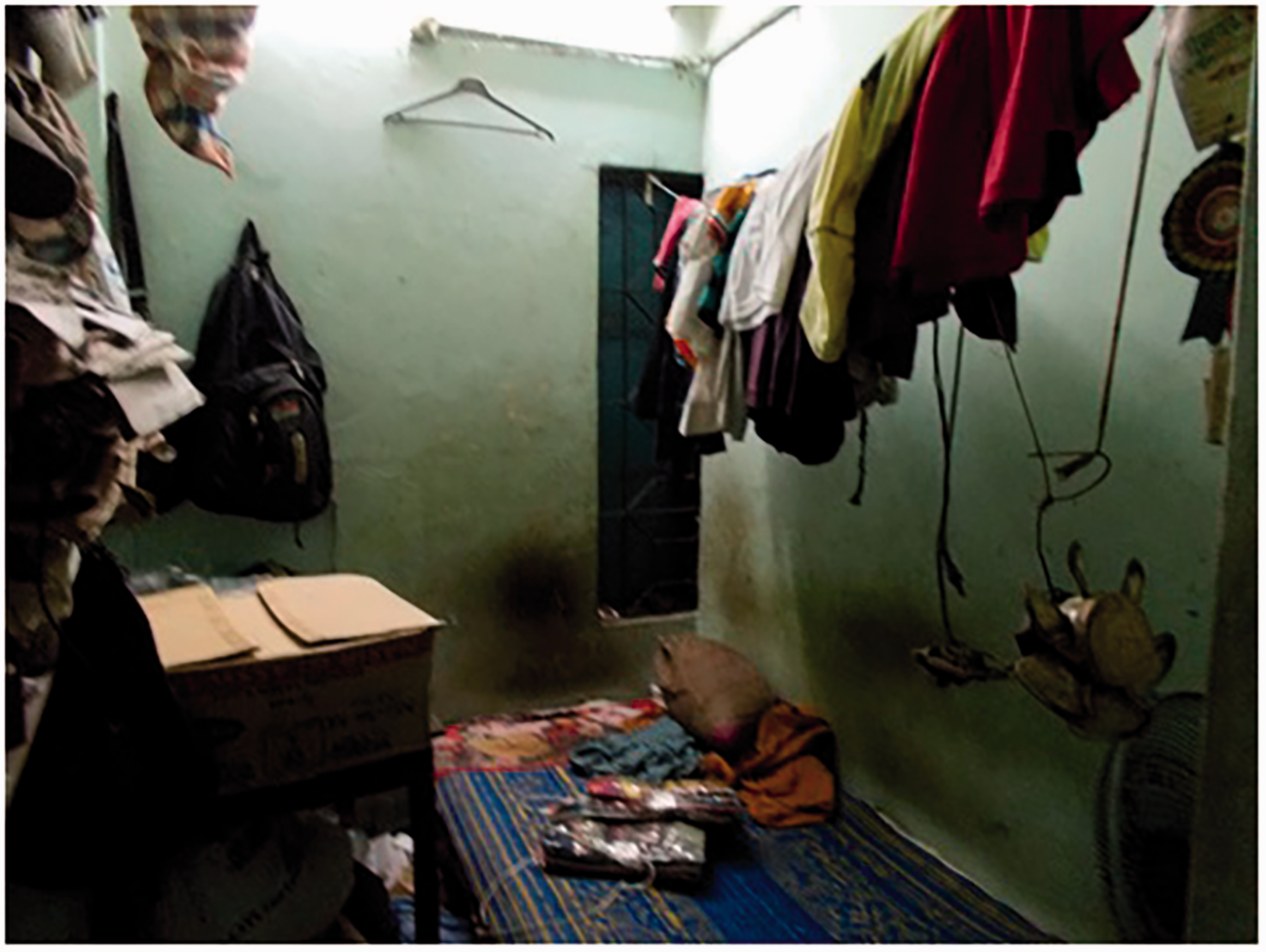
Picture of Rokib’s room, photograph taken by Shreyashi Dasgupta.
I need to make space in order to store all my boxes. These boxes have raw materials/garments that I need for work. I cannot remove these storage boxes. So I need to stack them up systematically everywhere in the room.
His room was organized differently at night. By then, he would shift the boxes again and pile them up haphazardly. He elaborated: “Even if I feel tired in the night, I need to diligently put things in order. Only then do I get some space to sleep. I need to use the room as much as I can for work”. The conversation with Rokib thus illustrates dimensions of movement and shows that everyday forms of shifting straddle the line between stability and relocations. Perceiving of the mess only as a place for housing does not do justice to these flows and practices of “multipurposing”. What is missing from such an interpretation is the way in which the constant shifting of storage boxes, pots and pans, floor mattresses, and pillows indicates specific ways of investing in the continuity of livelihoods.
The above example shows how the dormitory can be read as a malleable space, characterized by fluid boundaries between day and night, working and living, and multiple other activities. This also becomes clear from the room next to Rokib’s, which had a different sleeping and working arrangement. Arif and his roommates were embroidery workers, as was evident from the large, rectangular wooden plank in the middle of the room. On top of the wooden plank, the cloth for embroidery was laid out so that all four residents of the room could sit down and work on their designated portions. Although the room had no windows, there were five bright tube lights. Arif mentioned: We need these lights for our embroidery work. It is easier for us to see the threads clearly, focus on the task and work better. We switch off the majority of the lights when we are not working. Now we will cook our lunch, so we just need one tubelight not all of them.
While his roommates were busy preparing their meals in the corner of the room, Arif elaborated on how they organized their days: “We spend long hours working on the fabric every day. But we also take lunch and dinner breaks. We need to cook our own meals.” It was observed how some of the residents folded the scattered cloth materials from the floor and put it to the side in order to create some space to sit and eat together. Arif said: This space is like a workshop, it is easier for us to work like this. The most important thing here is the wooden plank, as that works as a base for our work. The rest of our belongings are stored in the corners. We have our individual mattresses as well to sleep on during the night.
Viewing mess accommodations solely through the lens of habitation thus limits our understanding of the “make + shift” nature of these places. Both Arif and Rokib’s rooms highlight practices of multipurposing and strategies of shifting. These movements show that peripheral space is not fixed, as functions are not neatly tied to one particular space. These unfinished and unfurnished forms of living do not merely signify a condition of lack but bear testimony to ways of manoeuvring various opportunities and exclusions.
Discussion: Between precariousness and improvement
Throughout our analysis, we have used “shifting” as a lens for understanding the relocations, movements, and forms of malleability that shape the functioning of rickshaw garages and mess dormitories. The example of the rickshaw garage highlights the importance of these spaces in facilitating the tidal waves of laborers moving in and out of the city. The everyday functioning of mess accommodations, on the other hand, speaks to the intra-urban movements that materialize as people shift between neighborhoods and accommodations in their hustle for work, income, and cheap rent. Such shifts do not always follow a clear direction but may take shape in an ad-hoc manner based on where certain relations, vulnerabilities, and possibilities become manifest. The relocations that rickshaw owners engage in, on the other hand, do show a clear spatial pattern, as businesses are moved from more established parts of the city towards the low-lying edges near waterbodies. In both cases, this restless search for opportunities is intensified by rising land prices, real-estate speculation, and hegemonic forms of urban development that push peripheries sideways. Practices of shifting can be viewed as a way of negotiating such forms of urban extension and exclusion. While shifting between rural and urban areas can be a way to ensure a continuation of livelihoods in the face of both agrarian and urban transformations and enclosures, shifting between neighborhoods or accommodations can represent efforts to “stay with the city” amidst exclusionary forms of expansion. Moreover, the shifting of materials, furniture, and possessions can be a means of negotiating processes of densification.
These multi-scalar and multi-directional forms of shifting ultimately direct attention towards the ambivalence of urban peripheries, where the crisscrossing of trajectories makes it almost impossible “to clearly identify just what is ‘coming and going’” (Simone, 2010: 54). Peripheries are transient places that highlight tensions between the ephemeral and the durable (Dharia, 2022: 4). As we have seen, it is difficult to appreciate whether people are arriving in the city, ready to embrace new opportunities, or whether they are on the brink of being pushed out and cut off from the city. The question that arises is how to recognize and make sense of precariousness and improvement in such an ambivalent context. Caldeira (2017: 6) has argued that in order to capture “the simultaneous processes of improvement and the reproduction of inequality and precariousness” it is important to focus on the “lateral reproduction of peripheries”. The relocations of rickshaw garages and the way in which workers move between dormitories expose this lateral reproduction of peripheries. However, a focus on shifting not only makes visible how peripheries are pushed sideways but also poses a challenge to sedentarist and residentialist notions of what precariousness and improvement might look like. Too often, this tension is envisioned in terms of habitation and simply understood as the intuitive contrast between improvised and permanent dwellings.
What is overlooked in such accounts is that for many rural–urban workers the city represents an avenue for making a living rather than a place to live. This is true for Ishrat, who professed that she did not mind sleeping on the floor as long as her room has sufficient electricity to continue her work after dark. And for Rokib, who approached his sleeping space as an opportunity for making money by renting out his bed to friends and offering up his room as a storage space. It is also true for rickshaw drivers like Enamul and Jalal, who have their families living in the countryside and are merely looking for a temporary sleeping place in the city. What is at stake for them is not so much the (im)possibility of acquiring and negotiating a permanent place to stay in the city, but the (im)possibility of ensuring a continuation of livelihoods. A focus on shifting has allowed us to examine how people try to foster a sense of continuity amidst processes of densification and expansion, and the trade-offs they end up making in the process. The fact that peripheries are shifting thus requires an understanding of precariousness and improvement that pays attention to what is either cut off or enabled in terms of movements, trajectories, and relations.
Conclusion
In this article, we have focused on the “make + shift dynamics” (Simone, 2018) that shape urban peripheries. Referring to the ways in which people “literally ‘make’ and then ‘shift’ to adapt in rapidly changing circumstances” (Bhan, 2017: 593), this notion helpfully addresses attention away from static configurations of habitation, to the inherent dynamism and mobility of urban peripheries and the life projects of those who stay and work there. We have argued that to gain a better understanding of such moving configurations it is important to not just look at processes of auto-construction, squatting, and gradual upgrading, but to also pay attention to spatial practices that are shaped by a willingness to move and relocate. Specifically, we have sought to demonstrate that the improvised nature of these peripheral spaces should not be read as a sign of the apparent lack of more permanent structures or furnishings, but as a “generative space” that allows for strategic forms of shifting. Throughout this article, we have shown that shifting constitutes a crucial way through which people try to “hold their place in the city” (Simone, 2010: 45).
Taking shifting seriously as both a spatial tactic and an economic strategy not only paves the way for a less sedentarist and residentialist approach to urban space but also invites a reconsideration of some of the taken-for-granted notions that are used to make sense of urban struggles. Too often, the struggles and improvisations of those living precarious urban lives are only interpreted as efforts to establish permanence. In contrast, mobility practices, including migration, moving, and shifting, are typically associated with conditions of transience and the inability to forge lasting connections with the city. We offer that it is also possible to interpret such practices differently, namely as efforts to establish a continuity of work and income. Shifting thus helps us to appreciate that there are “always invisible durabilities within the ephemeral” (Dharia, 2022: 22), while also addressing “attention to practices and negotiations within the city that are spatially distinct from those of slums” (Banerjee, 2022: 4). It highlights how the improvisations that characterize precarious urban life in South Asia (Dharia, 2022; Kamalipour and Dovey, 2020; Vasudevan, 2015) are not always aimed at establishing a permanence of place and living.
While our analysis of shifting is firmly situated within South Asian urbanism, the application of this notion carries relevance beyond this specific context. First, shifting allows us to understand how migrants and newcomers try to implant themselves into the urban system, without reducing such efforts to “finding and negotiating a literal place in the city”. Secondly, our conceptualization of shifting offers an analytical point of departure for studying other spaces that are inherently bound with the ever-shifting edges of the city, such as waste plants, transportation hubs, manufacturing workshops, and wholesale markets. Lastly, shifting enables us to interrogate the changing nature of urban peripheries, by highlighting the processes through which these tentative edges are constantly made and remade.
Footnotes
Acknowledgements
We wish to thank the editor and anonymous reviewers for their helpful comments and feedback. In addition, Annemiek would like to extend her gratitude to Yasin and Aslam, both of whom offered invaluable support as research assistants. She also wishes to thank Work for Better Bangladesh (WBB), who hosted her throughout her fieldwork, and the many rickshaw drivers who generously shared their time and stories. Shreyashi would like to thank all her interlocuters who supported her during her research.
Declaration of conflicting interests
The author(s) declared no potential conflicts of interest with respect to the research, authorship, and/or publication of this article.
Funding
The author(s) disclosed receipt of the following financial support for the research, authorship, and/or publication of this article: Shreyashi Dasgupta received funding for the completion of writing this article through the Economic and Social Research Council ESRC – Cambridge Postdoctoral Fellowship Grant ES/W006391/1. The research conducted by Annemiek Prins was completed with the support of a grant from the Rosanna Fund for Women, as well as an Elphinstone Scholarship from the University of Aberdeen.
