




Abstract
Engaging with scholarship on hegemony, park history, and in particular with Sevilla-Buitrago’s analysis of Central Park as a pedagogical space, this article traces the establishment of two parks in the Swedish textile industry centre of Norrköping. These parks, bearing very similar names – Folkparken and Folkets Park – were established just six years apart. But though both parks linked “park” and “people” (Folk), their intended political effects were radically different. The 1895 Folkparken was an elite attempt to create a de-politicised landscape park, while the 1901 Folkets Park was instead the labour movement’s attempt to create their own space. Exploring this latter park enables telling a story of park production beyond elite dominance. Like dozens of similar labour-controlled parks across Sweden, the People’s Park allowed Norrköping’s labour movement to shape their landscape long before the Social Democrats made any significant inroads into parliamentary politics. Combining a platform for socialistic agitation, with a theatre and space for recreation, this park quickly became central to Norrköping’s working class. Thereby, it could both enable social-democratic presence at an everyday level, and function as an important resource during periods of intense class-struggle.
What would a Central Park designed by proletarians look like? How would such a subaltern landscape differ from the creatures of nineteenth-century bourgeois pastoral taste that we have come to identify with urban nature? (Sevilla-Buitrago, 2017a)
Introduction
In the 21st century, parks are frequently sites for expressing dissent, and are in many ways central to public life. But for the 19th and early 20th centuries, most historians and historical geographers tell us that parks were elite landscapes, produced as explicitly de-politicised spaces enabling the moulding of park-visiting subjects in line with bourgeois sensibilities (Angelo, 2021; Gandy, 2002; Rosenzweig, 1985; Rosenzweig and Blackmar, 1992; Sevilla-Buitrago, 2017a, 2017b). Designed to inspire people to change their ways, parks were “pedagogical spaces” built to instill “subjects with a form of self-government that consolidate[d the] elite’s authority” (Sevilla-Buitrago, 2017b: 171).
In this article, we focus on such a pedagogical-political role through scrutinising and contrasting the early history of two parks, Folkparken and Folkets Park, established just six years apart in the Swedish city Norrköping (see Figure 1.). Though both these were constructed in the name of the people (Folk), they were meant to carry radically different political projects. The 1895 Folkparken was an elite attempt to create a de-politicised landscape park, while the 1901 Folkets Park (hereafter the People’s Park) was instead a labour-movement attempt to ensure a stable meeting space for a city where socialist agitators were otherwise shunned. Scrutinising these parks allows emphasising the park as an elite landscape (in Folkparken) in line with previous scholarship. But it also allows us to hone in on the less often told story of how parks were used as pedagogical spaces by the groups they are commonly assumed to educate. By establishing their own park, organized labour hoped to teach the proletarian population of Norrköping their ways.
While we focus on park politics in one city, Norrköping was not an isolated case. During the last decades of the 19th century, urban parks nicknamed folkparker were established or planned in several bigger Swedish cities. Meanwhile, Norrköping’s People’s Park was preceded by a dozen similar parks throughout Sweden, with the first established in Malmö a decade earlier (Pries et al., 2020; Pries and Jönsson, 2019). Initially, these parks provided an answer to the “logistical dilemma of finding suitable places in which to gather” (Pries et al., 2020) during an era when labour organisers were frequently barred from public space and shop-floors, and found it difficult to rent other venues (Ståhl, 2005). But the parks quickly also became crucial sites for working class leisure. Attracting parts of the population beyond organized labour into a sphere controlled by labour activists made them integral to the Social Democrats’ claim of being not only a workers’ party, but the people’s (Andersson, 1987; Berman, 2006; Engel, 1982). In 1905, a national organisation, Folkets Parkers Centralorganisation, was founded, gathering delegates from 11 parks at its first congress. When turning 25, it had 123 members, from Trelleborg in the south to Kiruna in the north (Folkets Parkers Centralorganisation, 1930). Meanwhile, a dozen parks in southernmost Sweden, including the country’s oldest parks in Malmö (1891), Lund (1895) and Helsingborg (1895), were represented through their own association, Södra Sveriges Förenade Folkparker (Andersson, 1987).
Through telling the story of two parks and the city they were located within, our ambition is to contribute to scholarship on the geographies of (securing or challenging) hegemony (Kipfer, 2008; Sevilla-Buitrago, 2017a, 2017b). Our argument builds on Sevilla-Buitrago (2017b: 166), who in studying New York’s Central Park proposed the notion “environmental hegemonies” to grasp how “certain class projects mobilize and mediate the intersection of space, design, governance, and subjectivity to further their own interests”.
Such an emphasis on pedagogical spaces and environmental hegemonies underlines the fundamental importance of pedagogy within a Gramscian approach to politics (Pizzolato and Holst, 2017), while simultaneously broadening Gramsci’s (1971: 350) insistence that “[e]very relationship of ‘hegemony’ is necessarily an educational relationship”. Such an educational relationship now not only includes relations between people, but also between people and the landscapes they inhabit. Centring on parks as pedagogical spaces furthermore allows foregrounding an otherwise under-acknowledged spatiality of the “hegemonic apparatus” discussed at length by Thomas (2009: 226) to underscore “the wide-ranging series of articulated institutions (understood in the broadest sense) and practices – from newspapers to educational organisations to political parties – by means of which a class and its allies engage their opponents in a struggle for political power”. As we will show, parks functioned as fundamental parts of such hegemonic apparatuses, articulating not only the notion of the “people” to, but aligning actual people in their everyday lives with, particular political projects.
Scrutinising park politics in this light illuminates both how “hegemony […] must be constantly built and rebuilt” (Pizzolato and Holst, 2017: 23), and how hegemony-building comprises “not only the means of consolidating a group’s power but simultaneously also possibilities for this power to be challenged and transformed by subaltern groups” (Mayo, 2017: 36). Contrasting Sevilla-Buitrago’s (2017a, 2017b) account of Central Park with Norrköping’s People’s Park consequently suggests a different story of environmental hegemonies, where his hypothetical question concerning what a Central Park designed by proletarians would look like is answered by an examination of what a park initiated, designed, owned, shaped, and for many decades managed by proletarians indeed did look like (see also Fisher, 2015). It bears remembering that Gramsci theorised hegemony not merely to describe working class accommodation, “but in order to examine how it might be transformed into focused rebellion” (Glassman, 2013: 242). Parks as pedagogical spaces might often have been constructed to buttress established power, and “the most visible greening projects tend to be those that use nature to shore up existing social arrangements” (Angelo, 2021: 136). But greening is, as Angelo (2021) suggests, “available to a wide range of actors and political projects, even in the same place and time, and, being available to all kinds of visions, it is also one that has no predetermined relationship to power and hegemony” (22).
People’s Parks, the politics of park provision, and the fight for hegemony
The notion of a “People’s Park” might sound commonplace to many readers. Labelling parks “the People’s” predates the turn-of-the-century Swedish People’s Parks movement by more than half a century. Already in 1851 Frederick Law Olmsted celebrated Birkenhead Park as a People’s Park, or garden, and proclaimed that “this magnificent pleasure ground [was] entirely, unreservedly, and forever the People’s own” (Olmsted, 1851: 226). Meanwhile, this park was predated by German and Austrian Volkspärke and Volksgärten, such as the 1823 Volksgarten in Vienna, endowed by the elite to the urban poor.
The notions of “people” and “park” are differently joined in Mitchell’s (1995, 2003, 2017) research on the struggles shaping Berkeley’s People’s Park since the late 1960s. At this site, south of the UC Berkeley campus, activists pre-empted University-led redevelopment plans by “planning to take (or perhaps take back) another space in the name of creating an open community-controlled political space. They were planning to make a People’s Park” (Mitchell, 2003: 108). A People’s Park in the sense of a site claimed is similarly evident in Copenhagen’s People’s Park, established in the late 1970s as “residents cum activists” appropriated a lot slated for redevelopment through “the reuse of materials from demolitions like cobblestones, planks, and bricks and trees and bushes from local allotments” (Rutt and Loveless, 2018: 104).
Toponymic similarities should, therefore, not distract from the obvious differences between various People’s Parks. Volksgärten, or Birkenhead Park, were open to the public, but nonetheless designed by established elites. Making and subsequently defending Berkeley’s People’s Park was instead an experiment “in the radical democratization of decision making, and of the adjudication of conflicting rights – including, quite apparently, the right to the campus and to the city” (Mitchell, 2003: 113). Likewise, Copenhagen’s People’s Park was a site appropriated by activists, rather than a park provided by municipal authorities.
Distinctions between elite and subaltern spaces dedicated to “the people” are, however, complicated by how subaltern groups leave their marks on parks designed by established elites. In his study of Worchester working class culture, Rosenzweig (1985: 127–128) thus emphasised that viewing park reform exclusively from the ‘top down’ […] ignore[s] the possibility that workers might have taken an active part in conceiving or advocating parks and assume that workers uncritically accepted the park programs handed down by an omnipotent ruling class.
Rosenzweig’s observation here aligns well with a concern for grasping the concrete construction of hegemony. Subalternity should, in Thomas’s (2018: 876) words, “not be regarded as exterior to hegemony”. Elites providing parks needed to allow subaltern groups, like workers and the urban poor, to partly choose how to make use of parks in order to ensure that these sites remained effective parts of the hegemonic apparatus. But simultaneously, those that decided on park rules also sought to steer everyday use to blunt demands on the elites. Hegemony, in short, requires incorporation and compromises, but within definite boundaries (Thomas, 2009: 235).
Sevilla-Buitrago’s account of Central Park highlights how it was a response of a fraction of the local bourgeoisie to the challenge of a working class that, at a time of political and economic turmoil, began to organize specifically proletarian institutions and proposed alternative urbanisms, amongst others by connecting shop-floor and neighborhood grievances and resistance. (Sevilla-Buitrago, 2017a) The park’s class character lay in its attempt to materially articulate bourgeois social and cultural preeminence by prefiguring a new common sense of urban order—a representation of space whereby the elite not only reinforced its class boundaries through promenades and carriage drives, but also and especially tried to normalize and educate the entire body politic, rendering its social “others” a polite, respectful assemblage of subaltern classes. (Sevilla-Buitrago, 2017b: 167)
While the labour-movement parks in Sweden internalised political desires of a very different kind, they were also meant to shape people, arousing “a yearning for beauty” based in a belief that environs had profound impacts on human being (Sage, 1918: 3). The Swedish People’s Parks illuminate how popular movements could counter bourgeois “environmental hegemony” by creating parks not disconnected from the shop-floors and neighbourhood grievances. In contrast to those parks Rosenzweig or Sevilla-Buitrago discuss, People’s Parks were from the beginning intended as spaces educating people, preparing them for productively devoting their time and energy to class struggle and movement activism within a wider challenge to the cultural, political and economic dominance of industrialists and other elites.
Though the first People’s Parks were created to simply allow the politically marginalized labour movement spaces to assemble, these parks were never proposed to be meeting spaces exclusively for workers. From their inception, they combined movement functions with the broader ambition to be, as the name indicates, for “the people”. The parks’ spatial pedagogy tended to be one of carefully curated forms of class-conscious politics articulated with popular leisure, and a pastoral landscape ideal (Mitchell et al., 2021). Borrowing from the hegemonic formation, the emphasis on popular culture provided to (and as we will show later often by) ordinary workers challenged the paternalist order that public parks otherwise epitomized.
The working class’s appropriation of hegemonic popular culture beyond the bourgeoisie’s hegemonic apparatus was perhaps most provocative to established elites when it came to questions related to nationhood. That the 19th and early 20th centuries’ push for (urban or rural) parks was entangled with nationhood, nationalism, and wishes to create a civilized, healthy, population is well established (Conway, 1991; Mels, 2002; Olwig, 1984). Yet, as the workers’ movement laid claim to providing parks for the people, this came up against commitments to internationalist struggle. Particularly when Norway left its enforced union with Sweden in 1905, People’s Parks featured prominently as nodes where the Young Socialists defied bans on anti-militarist agitation and where unions voiced threats of a general strike to bring the looming war to a halt. When the police targeted anti-militarist demonstrations and confiscated seditious banners, this often resulted in public meetings in People’s Parks (e.g. Egefur, 2016). At the tail end of this unrest, off-duty army men even sought to storm the pacifist Young Socialists’ meeting in the People’s Park in at least one city, before being beaten back by a crowd (Hansson, 1939: 244). Furthermore, instead of the Swedish flag, the People’s Parks prioritized their own red flag, though the Central Organization issued a recommendation in 1940 that this flag should fly alongside Sweden’s, following a debate concerning whether a “less political” flag should be introduced, given how parks had “shifted into becoming a gathering place for different parts of the population [folklager]”(cited in Engel, 1982: 106, all translations in this article by the authors).
But the People’s Parks were by no means completely dissociated from nationalism or nationalized understandings of nature before 1940. In Norrköping, the Swedish flag was used alongside People’s Park’s red flag at least from the 1920s (Bentzén, 1926). Meanwhile, in its 25-year retrospective, the People’s Parks Central Organization underscored the uniqueness of the Swedish parks as a source of national pride. As a potential contributing factor, they underscored “that our country’s vegetation and topography have great advantages above other countries for such a movement. We have our beautiful oak hills and birch and fir groves which are particularly suitable for a People’s Park” (Folkets Parkers Centralorganisation, 1930: 5, see also Mitchell et al., 2021: 30).
The conditions of the working class in Sweden’s Manchester
Located by a river (Motala ström) harnessed for water power, the fate of Norrköping, nicknamed Sweden’s Manchester because of the prominence of textile industries, was fully entangled in the fate of its manufacturing basis at least from the 18th century. Around the mid-19th century, large textile factories had clustered the river side, displacing the small-scale manufacturing facilities previously located there (Andersson et al., 1986). By the early 20th century Norrköping was one of Sweden’s most thoroughly industrialised cities, with 54% of the population employed in manufacturing (SCB, 1917). It was also a city dominated by a conservative political and economic elite, in a country dominated by that same elite and where as late as 1896 only 6.3% of the population had voting rights (Bengtsson, 2020). In Norrköping, the degree of this conservative dominance is illustrated by how neither the Social Democrats nor the Liberals found it worthwhile to enter any candidates in the 1906 municipal elections. When they did enter in 1910, the liberals won two seats and the Social Democrats three, hardly denting the Conservative’s majority (it held 21) (Andersson, 2000).
At the time, Norrköping was infamous for the state of its housing stock, epitomised by the prevalence of spiselrum (single room dwellings with a cooking stove). The city’s economic basis in textile manufacturing meant a poorly paid mostly female workforce, often living in areas described as “human dumping grounds” or in houses described as “grubby huts” (Andersson et al., 1986: 13). By the turn of the century, 97.4% of the working class lived in one-bedroom apartments or bedsits, with or without kitchens, and as late as the 1920s less than 3% of the population lived in apartments with a bathroom (Kvarnström et al., 2000: 26, 39). The proletarian population was simultaneously pushed out to surrounding parishes without formal building regulations, like Östra Eneby in which 80% of the population worked in Norrköping (Andersson et al., 1986; Kvarnström et al., 2000: 26–27). Thereby, Norrköping municipality could absolve itself from responsibility for the poor at a time when poor relief remained a matter for the parish-scale budget (Persdotter, 2019: 109–111).
While Norrköping’s political and economic elites were relatively unconcerned with the state of working-class housing, they paid more attention to other aspects of the urban fabric. This was particularly true of John Philipson (1829–1899), banker, sugar refinery owner, leading local conservative politician and briefly Member of Parliament. With the help of donations by Philipson, a cobblestone-clad square between the city hall and the train station was remade in 1877 into an urban park built on a symmetrical grid, and later, after further donations from Philipson, extended down to the stream (Malmberg, 1984). But while the city was materially shaped by its conservative elite, bourgeois dominance was by the late 19th century countered by an increasingly strong labour movement. A local party and union organization (arbetarekommun) was established in 1899. Two years later, a People’s House and the city’s first cooperative grocery both opened.
Nationally, the Social Democrats would go through two significant splits during the first two decades of the 20th century, first excluding its anarchism-influenced youth organization in 1908 and thereafter in 1917 when the next youth organization left the party to found what eventually became the Swedish Communist Party. Only a small minority of parks were, however, managed by communists (Ståhl, 2005), and these were met by potential repercussions. Engel (1982: 78–79), for example, chronicles the hardships of Lidköping’s Folkets Park, as members of the Social-Democratic party did not want to support a park owned and managed by their new left-wing antagonists. But for the period primarily in focus in this article, Norrköping was not yet characterised by such splits and its only People’s Park was (and would remain) controlled and owned by the Social Democrats. Instead, the faultline in Norrköping ran between the unions and associations increasingly bound to the Social-Democratic movement and older liberal and class-collaboration-oriented associations (Hjort and Nordström, 1989; Horgby, 1993).
Established in 1860, Norrköping’s Association for Labourers (Norrköpings arbetareförening) was the city’s first association for the working class, combining a liberal support for universal suffrage with a more traditionalistic critique of capitalism and a fear of the consequences of mechanisation (Horgby, 1993: 206). But during the 1860s, the city’s bourgeoisie gradually took control of the association (Horgby, 1993: 45–49). Led by F.A. Malmström, factory manager at Norrköping’s biggest wool-manufacturer Drags AB, this association thus fought back riotous workers demanding cheaper food prices during the 1867 famine. Twelve years later, the association took the stance that strikes did more harm than good for labourers (Hjort and Nordström, 1989: 11–14). Yet, the organisation also established insurance funds for workers, explaining part of its continued influence among the city’s proletarians (Horgby, 1993; Malmberg, 1984: 196).
In 1884, the smaller Workers’ Club (Norrköpings arbetareklubb) became a first more class struggle-orientated competitor to the Association, guided by an anti-capitalist, anti-militaristic, worker’s protection agenda (Norrköpings arbetareklubb, 1887). It was also this club that in 1886 put the park question on the municipal agenda, urging the municipality to buy or rent land so that the city’s population could find space for summertime recreation and parties. The club particularly emphasised the importance of such a park “for the manual labourer, whose income does not permit him to embark on steamboat or railroad leisure travels [lustresor]” (Norrköpings stadsfullmäktige, 1887).
Responses to this petition show broad support for the idea of providing outdoor space for Norrköping’s working population. But those responding simultaneously sought to etch their ideas and visions into the prospective landscape of such a park. Norrköpings nya arbetareförening (a left-wing break-out group from the Labour Association), three unions (the carpenters’, the tailors’, and the shoemakers’), and the free-masons offered their full support. The temperance organisations unsurprisingly underscored that the sale of liquor or malted beverages should be banned within any future park. The 1860 Labour Association in addition suggested a ban on meetings with lectures or discussions of any kind, lest this would distract from the “worthy purpose” of offering the working population possibilities for well-deserved outdoor rest and recreation. Just as New York’s elites wanted Central Park to become “an orderly, monitored leisure realm disconnected from both the shop floor and popular communities” (Sevilla-Buitrago, 2017b: 166), the Labour Association in other words emphasised that the park should contribute to a strict work-life/leisure-life separation. Convinced by the temperance organisations’ desires for sobriety and the Labour Associations’ demand for de-politicised leisure, the municipality thereafter initiated discussions to rent woodland outside the city for a green refuge (Norrköpings Stadsfullmäktiges handlingar, 1887: 23). However, no park was ever established following these efforts.
Failing in their attempts to get the municipality to provide land, in 1888 the Workers’ Club instead rented Lida kulle southeast of the city for summertime parties. This both continued and clashed with previous activities for Norrköping’s working class. Already the 1860 Labour Association had summer parties as a central feature, attracting two to three thousand people to its annual party every August. These parties followed a bourgeois script with speeches and toasts to celebrate not only the association but also “the woman” and the king (Horgby, 1993: 47). By contrast, at Lida kulle, the Workers’ Club parties were instead interlaced with speeches by labour agitators, like Social-Democratic pioneers Hjalmar Branting and August Palm. Other events of obvious political nature included a protest for voter’s rights that attracted “several thousands” (Arbetet, 1888), and the centennial of the French revolution on 14 June 1889. Another prominent activity was flag inaugurations, held as both the city’s unions and the Workers’ Club itself presented new, embroidered red banners. At Lida kulle, the Workers’ Club thereby established the sort of combination of political performances and public merriment that would later permeate the People’s Parks.
In 1889, these labour-movement activities at Lida kulle came to a halt when the local parish (St. Johannis) proposed a 20 kronor fine for both organisers and property owners allowing meetings with speeches that “intend to tear down existing law and order and spread hate and discontent between different classes, etc.” (cited in Dagens Nyheter, 1889). This phrasing, unarguably directed at the Workers’ Club, was softened as the bill was formalised, and the bill itself was later revoked by the Parliamentary Ombudsman (Arbetet, 1890). But by then the parish’s action had already succeeded in dislodging the labour-movement from a site that thereafter instead came to harbour activities such as the Methodist Sunday school summer parties, and Salvation Army events.
The birth of Folkparken …
In 1895, Norrköping instead gained a park in line with the Labour Association’s ambitions for de-politicised leisure. Two years earlier, John Philipson had approached the municipal council with plans to fund a landscape park along the river west of Norrköping (see Figure 2). Agreeing on the need for pastoral recreation, Norrköping’s decision-makers immediately warmed to this idea, setting aside almost 19 ha (Norrköpings Stadsfullmäktige, 1893). A month later, the local conservative newspaper described how Philipson would transform this land to “a park beyond all the others, a People’s Park [en Folkets Park]” (Bonhomme, 1893). Even before its inception, this park, by far Norrköping’s biggest, was thus framed as a park for the people, though this was not yet its formal name.
Early in September 1895, the name was to be decided in the municipal assembly, and the committee formed to recommend a formal name for the park suggested Norrköpings nordvestra park (Norrköping’s Northwestern Park). But naming the park proved much more than a mere technicality (see Norrköpings Tidningar, 1895a). The municipal assembly’s vice-chairman, Axel Swartling, agreed with the committee in that a name in line with the location of the park was to be preferred, suggesting the Shoreline Park (Strandparken). Another member instead suggested the similar Riverhill Park (Åbacksparken), while yet another suggested Oscarsparken (presumably to honour the then monarch Oscar II). But most discussion at the meeting centred around a suggestion to call the park Folkparken and what this would mean.
The creation of socialist People’s Parks elsewhere in Sweden was already well known within Norrköping’s conservative circles, and critics within the municipal assembly argued that labelling Norrköping’s new park Folkparken risked implying that the new park was the property of the working class. The park was supposed to cater for all classes and “it should not be given a name that implied that one class had precedence to use the park”. But to those in the Municipal Assembly who preferred the Folkparken name, and who eventually won the vote 33–6, a name similar to the labour-run parks was not to be feared. As one assembly member argued, “the purpose of the park was particularly that the city’s large population of workers should enjoy the refreshment that the park offered”. Similarly, park financier John Philipson, argued that the name would spur the city’s populace to feel responsibility and “cherish and protect it from all possible mischief” (Norrköpings Tidningar, 1895a).
In other words, it was Philipson’s ambition that the park should function as a pedagogical space, teaching the population to care for its urban greenery. To ensure this function, a name invoking “The People” mattered. As this debate illuminates, the very act of naming the park was fully entangled in discussions over who this park was for, and its potential political effects. The chosen name said something very important about what the park should be according to those governing Norrköping, and what it should or should not mean to link park and people. Folkparken was to remain de-politicised, with rules explicitly ensuring that “No political or religious public speeches or demonstrations [were] allowed within the park” (cited in Hellerström, 1996: 11).
As a site for everyday use, the park provided an aesthetically pleasant space for family-oriented recreation, such as picnics or flower-picking (Norrköpings Tidningar, 1895b). In this the park might have seemed like a pastoral sphere far removed from the city and urban politics. But that Folkparken nonetheless linked people to political projects comes as no surprise. Its June 1895 inauguration was marked by the singing of patriotic songs and a ceremony that concluded with a military style march (Norrköpings Tidningar, 1895c). Meanwhile, advertisements for the park in the local newspaper show how the army’s music corps, Andra lifgrenadiärregementets musikkår, would continue to provide entertainment, ensuring that park visitors were met by tunes such as Lefve Kung Oscar (Hail King Oscar) or on other occasions potpourris of Nordic folk songs and dances. In this way, an elite understanding of a deep relation between people, nation and pastoral landscapes was made explicit (see also Mels, 2002), and forged on workers’ free time. Furthermore, a conservative understanding of organic links between an established elite and the people was reinforced by how this spectacle framed the park as Philipson’s gift. The local conservative newspaper described the park as a “noble benefactor’s” gift to the people of Norrköping, who were expected to show its “heart-felt thanks for the grand facility” the philanthropist had provided (Norrköpings Tidningar, 1895c).
Philipson’s Folkpark was, like Central Park, a pedagogical space integrated within a broader hegemonic apparatus alongside the conservative newspaper, the 1860 Labour Association, as well as all those public institutions under the political elite’s control. It was designed to provide a space for non-political recreation severed from the solidarities which threatened to emerge in the dense working-class areas and on the shop-floor. Instead, the park’s pastoral landscape connected urban workers to the nation as well as bolstered the increasingly tattered paternalistic relationship between workers and capitalists which class struggle and the labour movement’s very existence put into question. But only six years after its inception, Folkparken was met by a radically different and politically more radical park project.
… and Folkets park
During one of these beautiful summer evenings, a stranger for the first time sees the People’s Park in Norrköping. In a pleasantly flower-scented cool, he walks under tall leafy trees with strings of many-coloured electrical lights slowly rocking in the evening breeze. He walks past rows of refreshment and leisure facilities. He stops by the main goal of his evening visit, the theatre, and notices how immediately and naturally, but at the same time efficiently, it has been adapted to its environ. Everything, with the sounds from the dance floor like an ever-present, but under the trees’ foliage pleasantly dulled backdrop, creates, he thinks, an impression of unity, of a creation based in the purposeful implementation of a pre-designed and once and for all determined plan. (Hertz, 1941: 9)
The early labour movement’s meeting places were few and far between (Kilbom, 1956; Olofsson, 2018, 2019), and apart from Lida Kulle, Norrköping’s labour movement at the end of the 19th century had to make do with a range of temporary solutions. When socialist agitator August Palm visited the city in 1883, the Labour Association refused to rent out its venue. Palm thus had to speak outdoors, on the city’s north-western fringe (Hjort and Nordström, 1989: 28). Apart from the unavailability of permanent meeting spaces as a problem in itself, access to the sites that temporarily became available could add further difficulties. For example, H.E. Wester (1926: 7), a veteran within Norrköping’s labour movement, recounted how on one occasion a land-owner issued a sudden ban on access to the road leading to one of these remote outdoor meeting places, Tallbacken, which could consequently only be accessed through mass trespassing.
Labour agitators were thus discouraged from using public or privately owned space, rural or urban. But nonetheless they continuously managed to make their presence felt. In some instances, police efforts to stop meetings even seem to have added a sense of spectacle. In 1887, when Palm once again visited Norrköping, he was banned from speaking at the advertised site. Anticipating this, the city’s socialists had secretly rented a second site. Shut out from the announced meeting place to the north of Norrköping, the organisers could, therefore, just ask the audience to follow them to their alternative site east of Norrköping, creating an impromptu labour rally through the city (Palm, 1970: 233). But while such episodes might form a good basis for humorous anecdotes in agitators’ memoirs, it is obvious that unstable access to meeting places was a source of frustration within the labour movement.
With the construction of the 1901 Folkets Park, Norrköping’s labour movement finally found a stable home. From the onset, the park’s board was firmly tied to Norrköping’s pre-existing Social-Democratic organisation. Unsurprisingly, given the male-dominated nature of Swedish Social democracy (Hirdman, 1992), the park board during the early years remained all-male. But as we will elaborate on, the park also enabled the labour movement to go beyond the gendered divisions characterising unions and workers’ collectives.
One thing among many that distinguished the People’s Park from the already established Folkparken was its construction. In its 40-year festschrift, Norrköping’s People’s Park might have boasted of a landscape giving the impression of being a result of “the purposeful implementation of a pre-designed and once and for all determined plan” (Hertz, 1941: 9). But rather than the result of comprehensive plan, the site that became Norrköping’s Folkets Park was initially simply the space that became available to the city’s workers. The local party organisation bought the 4 ha site southwest of the city for 11,910 kronor on 21 June 1901 and the park opened a mere two weeks later, on 7 July. Whereas the 1895 Folkpark’s inauguration was celebrated by patriotic songs performed by a military orchestra after years of careful landscaping work, the opening of the 1901 People’s Park was something else completely. Norrköping’s union clubs, assembled in the city and under 13 banners and a standard, proudly marched out to “Norrköping's workers’ own park” (Norrköpings Tidningar, 1901, Östgöten, 1901), which was still little more than a muddy field. Once there the crowd of about 2,000 people was greeted by speeches by park manager and Social-Democrat A.P. Larsson and the head of the Swedish Transport Workers' Union, Charles Lindley. The latter emphasised what labourers working together could achieve, invoking Belgian and French examples to emphasise the cooperative movement (Östgöten, 1901).
The first, sadly not very detailed, map of the park depicts an oblong property a little over 400 m long, 150 metres wide in its Southern edge and narrowing to little more than 20 metres in the North. Before being turned into a park the lot consisted of farmland where oats and potatoes had previously been grown, as well as uncultivated land covered with bushes and trees (Hertz, 1941). Though beautification was recognised from the beginning as important for the park’s success, the state of the park’s economy in the early years meant that more advanced landscaping was put on the backburner. Indeed, merely maintaining ownership of the land initially proved challenging. In 1903, parts of the property would have been sold were it not for a 3,500 kronor loan from the local People’s House, underscoring how various labour movement facilities supported each other financially (Pries and Jönsson, 2019). Just over a decade later, it was instead the People’s Park that was in a position to issue loans to other labour-controlled organisation, buy shares in the People’s House, and help finance the Social Democrats’ election fund (Norrköping Folkets Park, 1905, 1916, 1919, 1920, 1941).
While the work to reshape the People’s Park landscape continued for several decades, this more slow-paced labour was also of different kind than in Folkparken. Particularly in its early history the People’s Park was directly shaped by the workers it should serve (Norrköpings Folkets Park, 1941). A newspaper piece from May 1905, for example, accounts for how 95 sugar refinery labourers showed up at 6 am on their only day off to work for half a day in the park, followed by 202 men from the paper mill the Sunday thereafter (Östergötlands Folkblad, 1905). In sharp contrast with how park workers were separated from the fruits of their labour and rendered invisible in parks like New York’s Central Park (Gandy, 2002: 94), the work that went into shaping the land and the workers who provided this work were here a pronounced source of pride, foregrounded as examples of how the “city’s workers had strong arms” (Hertz, 1941: 11).
The first buildings in Norrköping’s People’s Park were functional and unassuming (Lindström, 1941). As a park veteran recounts, visiting the park in 1901 meant a long walk over pathless and muddy plains to reach a wild grove (vildmarksdunge). Once there, “the dance-floor and serving facilities were of the most primitive kind, not to mention the ‘stage’, which consisted of some planks nailed together over a pile of rocks (stenkummel)” (Janzon, 1941: 34). The initial layout of the park essentially consisted of surrounding such primitive facilities with chairs and tables bought from a local ironmonger’s, with further additions to come. In 1904, a new bandstand and dancehall were constructed, followed by more elaborate gates in 1906. To these were added a new café kiosk (serveringshus) and an additional dancehall in 1907, a café pavilion in 1908, a shooting range in 1909, another café by the dancehalls in 1911, and in 1915 another dancehall (Norrköpings Folkets Park, 1926).
From the very beginning, the People’s Park could offer a space for working-class families’ picnics, while popular games and dances were organised by the Social-Democratic youth club (Norrköpings Folkets Park, 1926). But like other People’s Parks throughout Sweden, Norrköping increasingly focused on theatre and musical performances. In 1921, Norrköping became the first park to build a stage with a roof over the audience (Folkets Parkers Centralorganisation, 1930, see Figure 3; Norrköpings Folkets Park, 1926). Contributions to the People’s Park’s 25-year festschrift emphasise “the People’s Park’s significant contribution to sound and refining entertainment,” and that the People’s Park “taught the masses to attend the theatre” (Norrköping Folkets Park, 1926: 11, 13). Leafing through its first 10 annual reports (1904–1913) reveals more of what visitors were offered. Seasons stretched from late April or early May to late September or early October. High-profile activities included theatre plays by both the People’s Park's own amateur ensemble and travelling troupes, carnivals, banner inaugurations, and political speeches. The park also played an important role as a family-oriented leisure destination, with free entrance for children accompanied by their parents. Coffee and cigars were sold, as were soda pop and candy. Besides attending theatre plays and the dancehall, visitors could pay to play croquet, or to shoot rifles. Establishing a park thus allowed the labour movement to simultaneously find a more stable ground for meetings, securing more of an everyday presence among the people of Norrköping, and to engage with more force on the “constant battlefield” (Hall, 1981) of culture.
The cultural offerings were to a significant degree a continuation of previous bourgeois past-times, such as “living artworks”, where performers re-enacted famous paintings (Janzon, 1941). But established forms of culture were simultaneously transformed by the labour movement, popularised not only in the narrow sense of reaching a wider audience but also in widening the range of performers and (crucially) in appropriating oeuvres and producing new works as a strategy within cultural struggle (see Hall, 1981). Advertisements for Norrköping’s People’s Park show how the songs sung from the stage could include both songs by Carl Michael Bellman, a famous 18th-century musician under the patronage of king Gustav III, and the International or La Marseillaise. Meanwhile, the amateur cast for the first play staged in the park during the 1907 season consisted of Social-Democratic party members, with the play itself about intense struggles between transport workers and their employer, aided by British strike-breakers housed in a ship in Norrköping’s harbour (Lindström, 1926). The play thus both offered an opportunity for workers to quite literally take centre stage, and to present their experience of recent conflicts to park visitors.
Besides allowing particular stories to be told putting on plays was a prominent way to attract people to the People’s Park. This was important both in order to reach broad parts of Norrköping’s population and to ensure that the park remained profitable. Equally important was how the emerging labour press covered park activities. From spring 1905 onwards, Norrköping’s labour movement had its first long-lived newspaper in Östergötlands Folkblad (literally “the People’s Paper of Östergötland”). The paper presented visits to the People’s Park as a self-evident pastime for Norrköping’s labourers. In general, the park would advertise the weekend’s events in the Friday newspaper, sometimes accompanied by advertisements for unions that held their own early morning picnics in the park. Such ads were typically followed by short articles repeating the weekend programme. When the first newspaper was published the following week, it would include a short piece on attendance numbers, weather, and so forth. Sometimes, readers could also read transcriptions of political speeches delivered in the park, as well as longer stories emphasising the appeal of the park. Furthermore, when Folkbladet was established, several events in support of it were organised in the park. In 1906, these included three especially to benefit the newspaper, the last of which was reported as a particularly well-attended carnival. To financially aid the labour press, regional parties were also organised in the park, to which delegations from various parts of the Östergötland region would march (Karlsson, 1926: 5).
Importantly, the park was not only part of a network of other People’s Parks, but rather folded into a “labour-movement constellation” (Mitchell et al., 2021: 24) encompassing parks, People’s Houses, newspapers and journals, and (eventually) also the Young Eagle scouting groups, summer cottage villages, ski resorts, and funeral parlours, allowing entire lives to be lived within the ever-expanding confines of the labour movement. As a pedagogical space, the People’s Park was thus shaped by, and itself shaped, a labour-oriented way of life where certain kinds of behaviours and activities were increasingly to be made self-evident (Ambjörnsson, 2017). Horgby (2000: 416–417) elaborates on this: The norms that one tried to make self-evident were that the workers should read Folkbladet, not [the conservative] Norrköping’s Tidningar, should entertain themselves in the People’s Park – not a private entertainment establishment, should shop at the Co-op – not a merchants’ collective (delningsförening) or a privately owned shop. Preferably, one should also be an organised teetotaller.
Spatial pedagogies of class conflict unleashed
At the turn of the century, Folkparken and the People’s Park were competing pedagogical spaces seeking to shape Norrköping’s proletariat for very different ends. But in the archives, it is, perhaps surprisingly, hard to find traces of direct conflict between them. While competing for the attention of Norrköping’s population, the two parks’ different locations, cultural programs and design meant that no one was forced to choose one park over the other once and for all. Folkparken was integrated into a larger network of riverside paths and visitors could come and go. The People’s Park was further removed from Norrköping’s centre, requiring more of an active decision to travel there. It was, moreover, a park only open during weekends, for part of the year, and for paying visitors.
Intense conflicts arose instead with Hultet pleasure ground, established in 1907 close to where the People’s Park was located. Hultet itself was a remnant from the 1906 Exhibition of Art and Industry, which had attracted 350,000 people to Norrköping (Höjer and Höjer, 1996: 8). At this exhibition, Hultet had been among the most popular features, with many attracted to what was essentially a cottage and a petting zoo recreating the kind of idyllic rural scene previously popularised at Skansen in Stockholm (Figure 4).
When businessmen bought and moved this popular facility to a site close to the People’s Park, it caused the People’s Park board to write an open letter to “the organised men and women of Norrköping”. This letter is worth citing at length (in all its tortured syntax) to illustrate both the intended purpose of the park, and the perceived nature of the competition: We workers, that for our and our kin’s existence are forced to remain toiling and drudging at our places all summer long, we that cannot, like the upper class, afford to provide our families with summer cottages in archipelagos or pleasant wooded parks, we must now while awaiting a happier future in that respect, hurry to, like in previous years, prepare our hitherto only, but valuable, leisure destination, the People’s Park. [...] As most are familiar with, some capitalists have combined in a company that through establishing a leisure park on the mountain above Borg […] competes with the People’s Park. The company is obviously hoping that Norrköping’s working population will immediately abandon its own park to blindly favour the capitalist enterprise. Will that happen? We hardly think so; the organised labourers of Norrköping will certainly have a clearer view of the matter. Moreover, the People’s Park is bigger, more freely located, more beautiful and – our own park. It is ours and this we should benefit and develop, there we should find entertainment, comfort, and recreation. (Norrköpings Folkets Park, 1907)
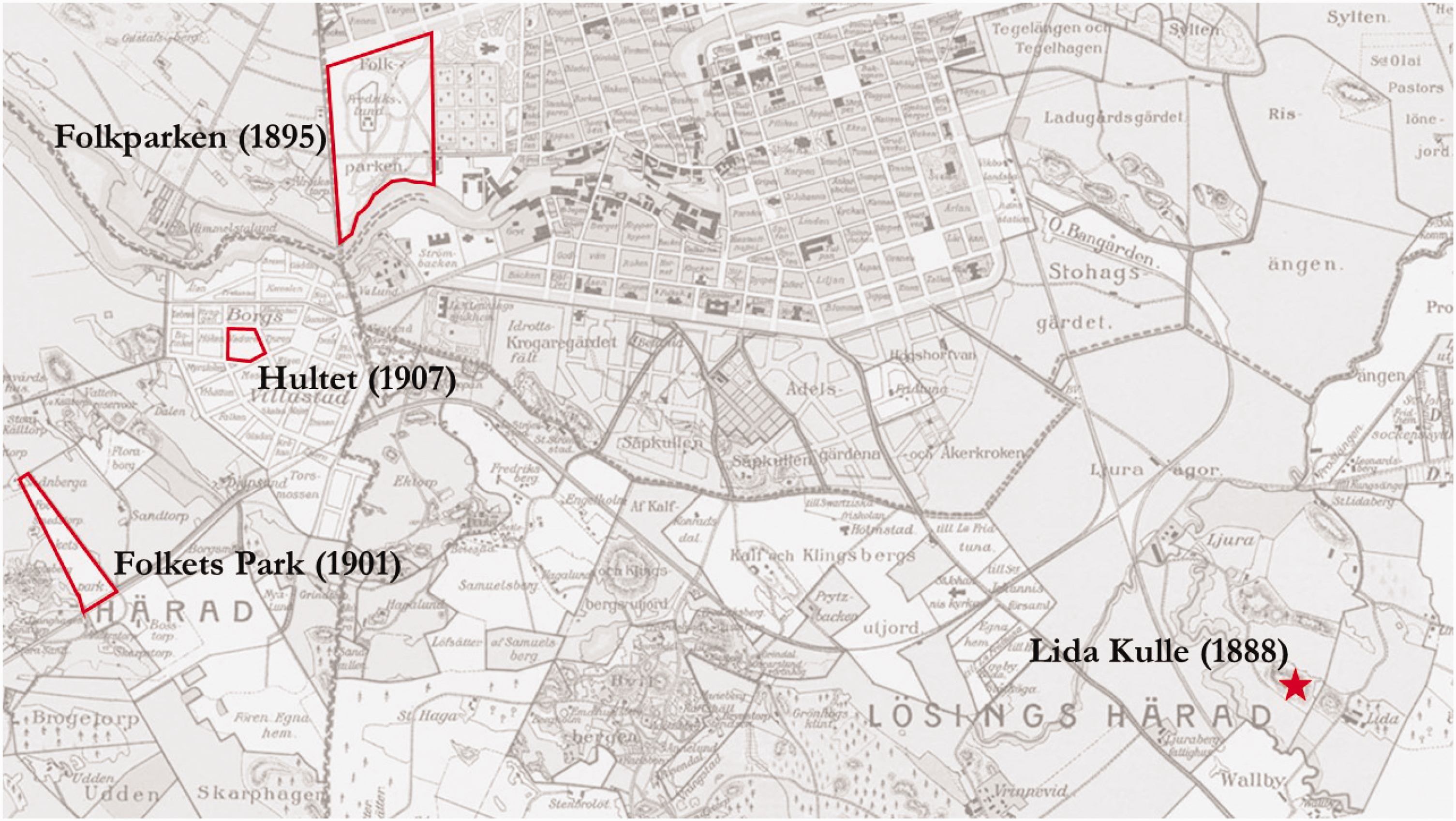
A 1908 map of Norrköping’s city centre and southern outskirts, with areas of interest highlighted. (Map source: Norrköpings stadsarkiv, alterations by the authors. Reproduced with permission)
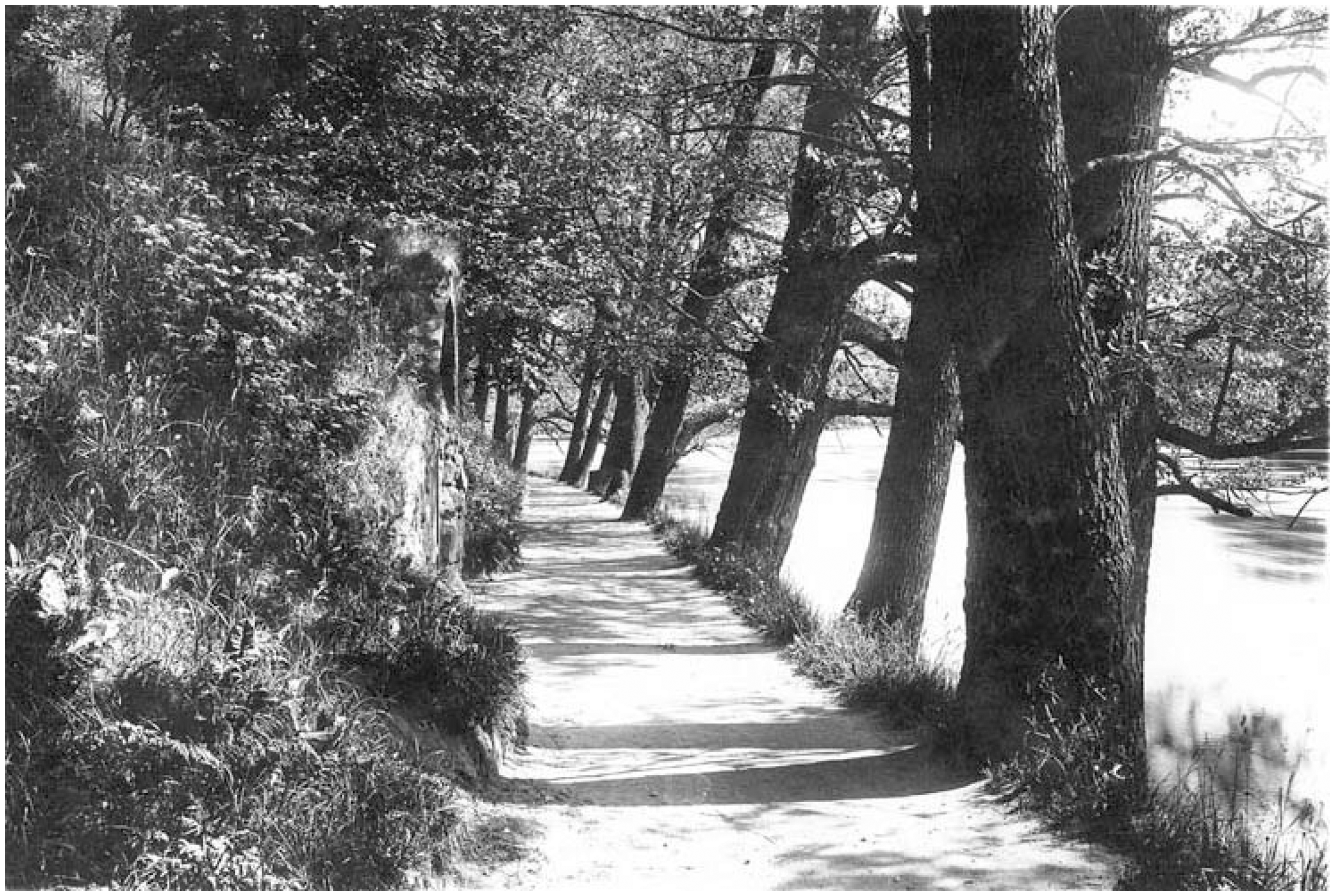
Walking paths along the stream in Folkparken 1920 (Source: Norrköpings stadsarkiv, photo by Gustaf Lidberg. Reproduced with permission).
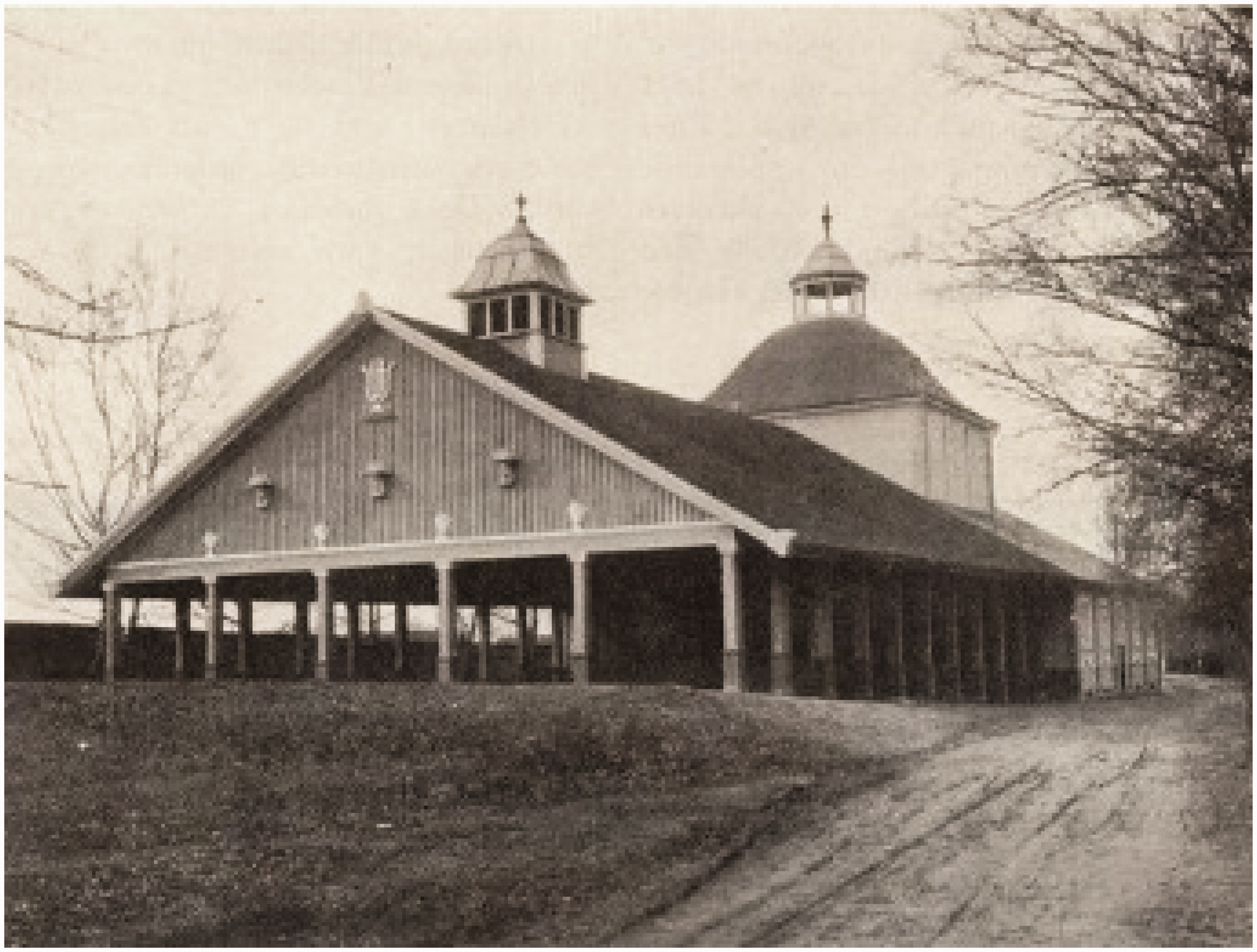
The first roofed theatre in Norrköping’s People’s Park (from Folkets Parkers Centralorganisation, 1930: 64).
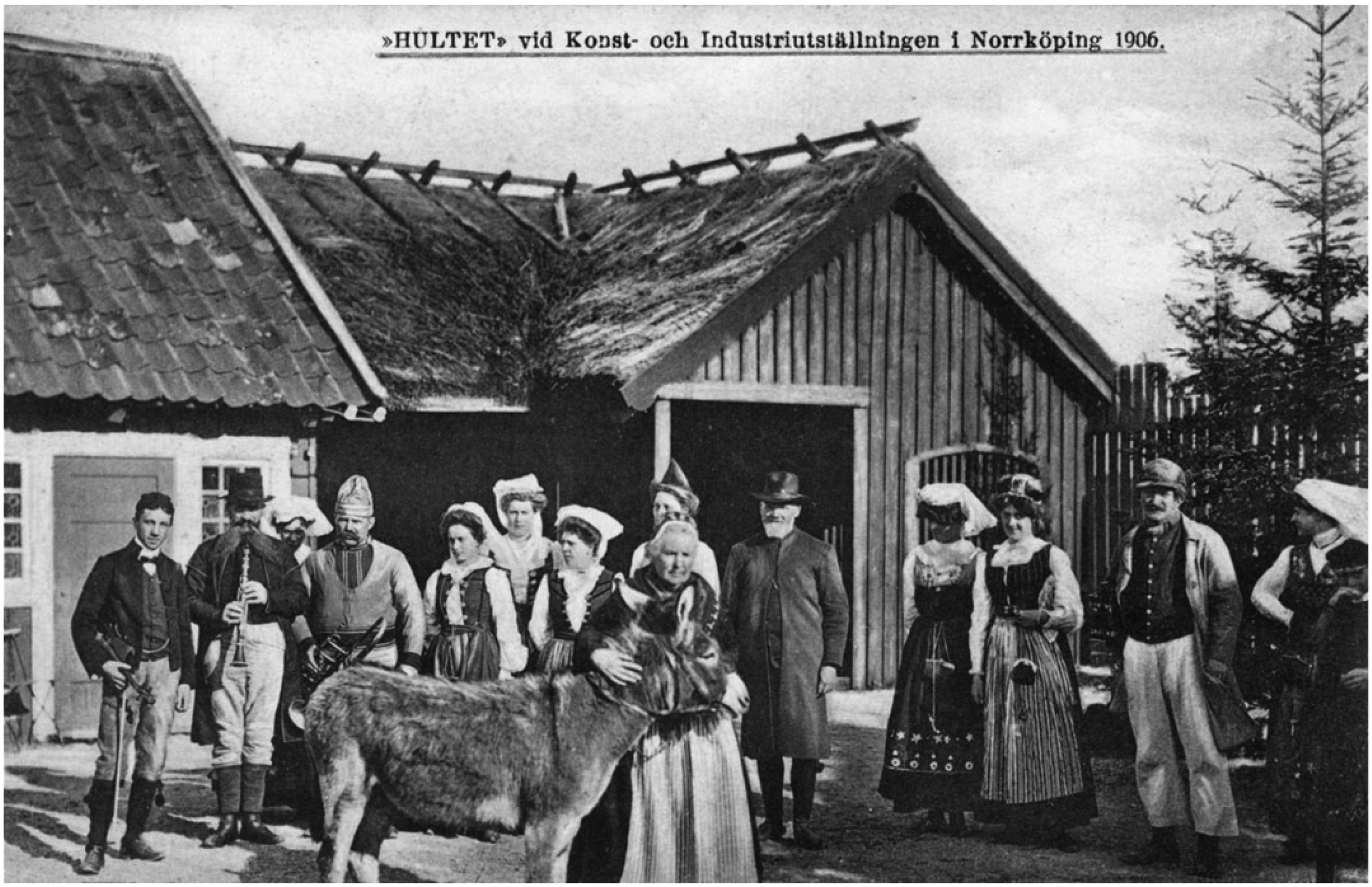
Postcard of Hultet at the 1906 Exhibition (Source: Digitalt Museum. Image in Public Domain).
Perhaps the most evident illustration of the People’s Park’s importance for the budding labour movement in Norrköping is found in the activities that took place during the 1909 strike, the first large-scale test of strength between the employers’ union and the Social-Democratic labour unions. Following two years of economic downturn and a period of increased tension, the employers’ union declared a nation-wide lockout on 26 July 1909 to force workers to agree to lowered wages. When many in Norrköping found themselves out of work, the People’s Park immediately became the place where they could spend their newfound free time. On the first day of the lock-out, 2,000 workers marched to the park, while singing workers’ songs, to listen to union leaders. Two days later, a similar number of locked-out workers marched, under banners, to the park for a party. A short description of the party from Östergötlands Folkblad (1909) sheds light on the kind of activities hosted in the park. After one had twirled for a while at the dance-floor,and watched performances by amateurs from the range of the locked-outs, some tunes were sung by the Social-Democratic youth club’s choir. Thereafter the journalist Albin Lund held a short talk, emphasising that the workers’ wages presently did not allow the slightest bargaining.
The park continued to function as a crucial meeting place throughout strike. On 29 August, 6,000 listened to Sven Persson, a Social-Democratic member of parliament while 5,000 gathered the next day (Svaret, 30–31 August). Indeed, the park even became more important following a 19 August decision by the Magistrate to ban both demonstrations and crowds within Norrköping (Svaret, 21 August). Such closure of public space followed the pattern elsewhere. During the 1909 strike, regional and local authorities activated 19th century public order bylaws to proclaim 420 sites “protected” (fridlysta). Thereby, a range of sites (public as well as private roads, harbours and railroad areas, municipal facilities, and industrial lots) were deemed out of bounds for demonstrations (Eklund, 1974: 135–136; Olofsson, 2018). According to a state report, proclamations to protect such sites were in general initiated by employers, sometimes with the explicit aim of protecting strike-breakers (Kommerskollegium, 1910: 198). Furthermore, the same report outlines how 15 of Sweden’s 24 regions, issued various kinds of more general bans on demonstrations and crowds, including the wholesale ban on crowds in Norrköping, making public shows of support for the strike cumbersome. Another function assumed by the park during the strike was as site for circulating news, with strikers complaining that the police tore down pro-strike placards throughout the city and that the typographers’ strike meant that not even labour papers could be printed. Furthermore, as the park was repurposed as a site for striking labourers, a bakery was established alongside soda drink production, while the strike committee met daily at the park’s shooting range (Hertz, 1941).
Conclusions
Despite the masses gathering daily in Sweden’s People’s Parks during the 1909 strike, the month-long strike ended in defeat for the labour movement. Nation-wide, 300,000 workers returned to work without their demands met. In Norrköping, textile workers were now forced to accept individual (as opposed to union-negotiated) wages while the local Social-Democratic organisation lost half of its 1,900 members, a loss that took almost a decade to overcome (Andersson, 2000: 240). It would consequently be too simplistic to claim that this People’s Park, or the nationwide network of such parks that it was part of, ensured that the Social Democrats would gain the upper hand. A budding labour movement was by now met by an increasingly coordinated association of capitalists, which set the scene for three decades of intensive employer-union conflicts until the famous 1938 Saltsjöbaden Agreement set Sweden on a reformist path to social peace and the welfare state.
But though the existence of the People’s Park could not guarantee the success within any particular struggle, the park managed to make a meaningful contribution in forging everyday linkages between the labour moment and people, as the workers’ “own park” became the centre for political agitation, popular culture, and working-class leisure. Before, during, and after the strike it provided a crucial part of the infrastructure for a labour movement that had little access to established political arenas, and functioned as a kind of pedagogical space that countered elite attempts to utilise parks as tools for establishing their “common sense of urban order” (Sevilla-Buitrago, 2017b: 167). Against the established elite’s environmental hegemony, and their entire hegemonic apparatus, the Social Democrats were now constructing their own. Within this apparatus, the People’s Park played a crucial role as the institution par excellence for ensuring that the labour movement could secure an everyday presence among the men, women, and children of Norrköping.
In tracing the early history of Norrköping’s People’s Park, we have told a story that contrasts with many other stories of 19th- and early 20th-centuries-park developments – including developments within Norrköping itself. This was not a landscape where those whose labour materially shaped it remained hidden (cf. Gandy, 2002). Rather, the labour of park-making was a source of pride. While the profits made (inter alia) at John Philipson’s sugar refinery allowed him to “offer” an ambitiously landscaped river-side park to the people of Norrköping, a decade later, sugar refinery workers chose to use their free time to instead shape their park. This was not a park produced as “an orderly, monitored leisure realm disconnected from both the shop floor and popular communities” (Sevilla-Buitrago, 2017b: 166). Rather, it was a park where workers could meet and discuss all that could not be openly declared at the shop-floor, or even on public squares, without significant risk of interruption, and where social-democratic messages could be woven into the plays they staged. It was a park where the working people of Norrköping could both dance to their own tunes and appropriate others’.
Like New York’s Central Park, Norrköping’s People’s Park was central to urban social, cultural, and political life rather than topographically central. But whereas Central Park entailed the erasure of an established exurban fabric (most notably the infamous removal of the Afro-American village Seneca, see Rosenzweig and Blackmar, 1992), Norrköping’s People’s Park was the suburban product of a working class itself pushed out to the suburbs. Once the labour movement had reshaped the farmland it bought into more of a landscape park, they were able to provide beautiful nature to those that could not “like the upper class, afford to provide [their] families with summer cottages in archipelagos or pleasant wooded parks” (Norrköpings Folkets Park, 1907). If Central Park functioned as a space that instilled “subjects with a form of self-government that consolidate[d] elite’s authority” (Sevilla-Buitrago, 2017b: 171), Norrköping’s People’s Park functioned as one space among several where workers sought to challenge this authority by educating people beyond the labour movement into socialist sensibilities, in the process borrowing and reworking pedagogic tools otherwise designed to ensure their own subordination.
Footnotes
Declaration of conflicting interests
The author(s) declared no potential conflicts of interest with respect to the research, authorship, and/or publication of this article.
Funding
The author(s) disclosed receipt of the following financial support for the research, authorship, and/or publication of this article: Research for this article was funded by the Swedish Research Council, Grant 2018:01283.
