




Abstract
Subvertising, a portmanteau for ‘subverting advertising’, is the illicit practice of intervening into urban advertising space, from graffiti scribbles and removed adverts, to full-blown billboard takeovers and digitally hacked adverts. In this article, I draw from 24 months of ethnography with subvertisers to suggest that a particular ideal of public space, that of a ‘regime of order’, is folded into the hegemonic spatial management of urban communication by advertising actors. This ‘regime’ relies on separating worlds from common use, that is, on what Giorgio Agamben has phrased ‘consecration’. As an operation with capacities for ‘profanation’, subvertising makes visible the ‘natural’ appearance of this urban regime, and enacts highly temporary placeholder forms for the communicative commons to come. Contributing to debates on the geographies of public space and publicness, subvertisers show that the possibility of common use does not emerge from property rights, shared value-systems or a pre-determined scope of usage. Instead, common use emerges from the deactivation of the very notions of rights, laws, identity and ends. Here I trace subvertisers’ insistence on taking seriously the charge of openness, incompatibility, contestation, excess and the dysfunctional in urban expression as sources of inspiration and (self-)transformation.
Introduction: Subvertising in context
‘So, what exactly is the plan then for tonight?’ I ask. My question is met with silence. Marco, too subsumed by whatever he’s looking at on his laptop, is paying little attention. I look out over West Brooklyn, the distant skyscrapers of Manhattan glinting in the warm light of the setting sun, and then peek four floors down from the warehouse rooftop on which we are sat. Despite the desolate look of its architecture, the area thunders with life. Bar life spills onto pavements as a car speeds past, thick beats pumping through its speakers. A welcome breeze re-animates the city, cooling it down after a day of clear blue skies and an unforgiving sun. Still no response.
Suddenly Marco stands up and grabs me a beer from the fridge, seemingly uninterested in whether I want another one or not. Upon plunging back into his beach chair, he says, ‘I am cutting into a billboard.’ His voice is thrilling with excitement. I look at him, for a second, and ask: ‘What do you mean cutting?’ His laughter reveals I failed to hide my confusion. ‘I want to cut a circle in the middle of a billboard. We’ll need a drill, a knife and a piece of rope.’
I follow him inside, knowing that there’s little point to asking any further questions. An hour later, we’re standing opposite the billboard and Marco is putting on a high visibility vest. ‘Just act as if we are supposed to be doing this, it’ll be fine,’ he assures me, before walking across the street. How I do this, I am not told. By the time I hear the drill for the first time, I am so nervous I can’t help but look the other way, away from Marco’s unlawful gestures, away from other people’s eyes, which might, upon seeing mine, sense that the present is, temporarily, out-of-joint.’ (Field notes, June 2016)
In his text on Kafka’s story The Castle, the philosopher Giorgio Agamben takes us to the ‘land surveyors’ of Roman times. These surveyors were tasked with determining boundaries that single out and assign plots of land – ‘the high and the low, the castle and the village, the temple and the house’ (Agamben, 2008: 26). The establishment of land borders had such a sacred character in Roman law that they were seen as having ‘a heavenly origin’, and, thus, as having a ‘perpetual endurance’ (Hyginus, cited in Agamben, 2008: 23). Anyone guilty of the crime of transgression could be killed, by anyone, with impunity. Only certain people, guided by certain rules, were allowed access to exclusive spaces, objects and people. More than solely a question of property and access, the borders marked a fear of impurity, disorder, lowliness, profanity. Recognising the contemporary continuation of this logic, Agamben (2007a, 2008) demands us to ask: what is lost in the separation of spaces, objects, people and language from common use into a sphere of exclusivity?
In this article, I take inspiration from Agamben to unpack an urban manifestation of the separation from common use, as uncovered through the practice of ‘subvertising’. Subvertising, a term first coined by Mark Dery (1991), can be described as the practice of enacting illicit, material interventions into billboards, digital advertising screens, bus shelter advertising and a wider plethora of spaces that make up the outdoor advertising landscape. The practice is, arguably, as old as the spaces it intervenes into. In the first centuries BC, for instance, inscriptions promoting gladiatorial battles on the houses of the wealthiest in Pompeii commonly encountered passers-by who would inscribe their own humorous or insulting responses. While subvertising endured century after century, it was not until the commercialisation of paint markers and spray paint in the 1960s that it became a more prominent and documented urban sight. During May 1968 in Paris, protesters found in billboards a site for voicing their frustration with consumerist language and imagery – Buy and shut up!; Your desire is fictional, a function of consumption; I spend so I am (Michel and Schwach, 1973: 114–117; translations mine).
A decade later, subvertising became a sustained, much more carefully organised effort with the emergence of collectives. In San Francisco, the Billboard Liberation Front altered the meaning of a diverse range of billboards by selectively adding or removing words. During those same years, the Billboard Utilising Graffitists Against Unhealthy Promotions, a collective of activists and medical professionals, commenced their material offense in Sydney, employing spray paint to alter the words and images of billboards promoting cigarettes and alcohol. Alongside the rise of self-proclaimed anti-consumerist magazine Adbusters, these collectives, through the publication of ‘how-to manuals’, helped spark the expansion and diversification of subvertising practices across cities around the globe. 1 Today, subvertising, a portmanteau for ‘subverting advertising’, is an emergent spatial practice taking the form not only of graffiti interventions or even full replacements, but of all kinds of interactions: supplementation, removal, reversal, cutting, digital hacking and destruction.
Most recently, groups such as Collectif des Déboulonneurs, Brandalism, Special Patrol Group and Indecline have made international news headlines through subvertising actions addressing a wide range of social, economic and environmental struggles, from advertising’s involvement in accelerating climate change and its promotion of unhealthy body images, to London Metropolitan Police’s racialised operations and the separation of migrant children from their families by the US immigration agency. Other times, they have installed subvertising posters to promote the practice itself (see Figure 1). Although popularising, subvertising remains, arguably, a more marginal practice than other critical spatial practices and forms of ‘urban subversion’ (Mould, 2015), including skateboarding, parkour, graffiti, BMX and urban exploration. Unlike these practices, subvertising lacks global cohesion, public web forums, a recognisable aesthetic, and has not (yet), to follow Daskalaki and Mould’s description of the stages of ‘subculturalisation’ (2013), entered the stage of a ‘formalised’ subculture. In part, I argue, this is due to its a priori limited field of intervention. Like other forms of ‘culture jamming’, subvertising is reliant upon existing media formats (Gilman-Opalsky, 2013), in this case, outdoor advertising. Despite its selective emphasis on the effects of contemporary advertising, I argue, subvertising inspires a broader spatial imagination of relevance to debates around the geographies of public space (see Qian, 2020 and Vigneswaran et al., 2017 for recent overviews of literature), and the related concept of ‘the urban commons’ (Chatterton, 2016).
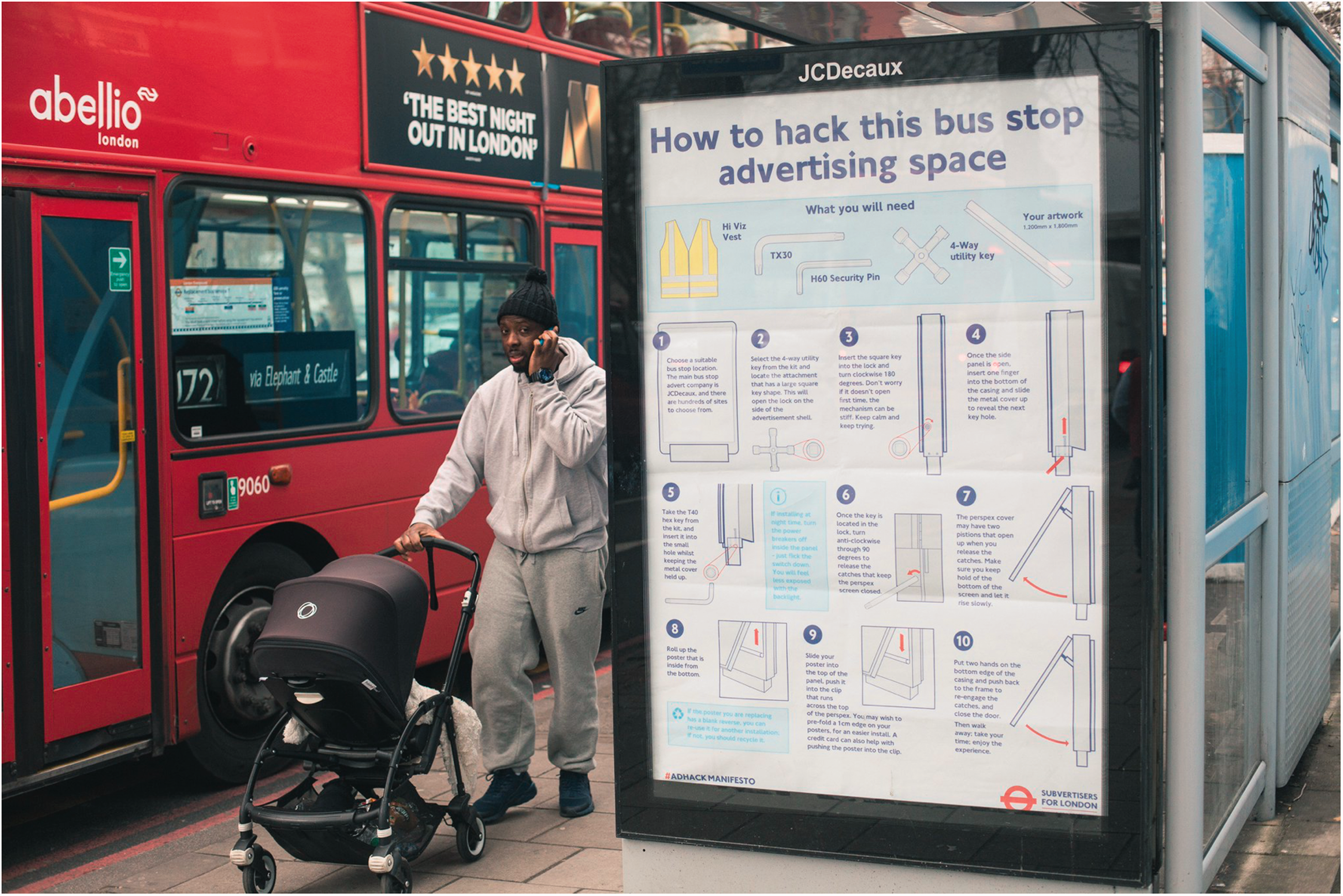
Poster designed and installed by anonymous subvertisers (London, May 2019).
More specifically, the paper contributes to existing literature on the geographies of public space in two ways. On a first level, the paper extends debates around the diverse and sometimes divergent ways in which public space is modulated and managed to accommodate certain bodies while excluding others. 2 The present paper pushes us to consider the communicative geographies of public space. It shows how these are arranged by advertisers and other state-corporate actors through what I term the ‘regime of order’. This regime, I will go on to suggest drawing on Agamben’s idea of ‘profanation’, facilitates ongoing efforts to exclude certain urban worlds into the realm of the untouchable and sacred. Along the way, it forecloses the emergence of other imaginative forms of communicative engagement with public space.
On a second level, the paper intervenes into debates around how various practices of resistance intervene into the hegemonic management of public space. Existing literature offers important insight into how acts of urban subversion intervene into (Douglas, 2014), subvert (Mould, 2015), transgress (Cresswell, 1996), recompose (Borden, 2001) and contest (Chiu, 2009) spatial, legal and social arrangements of public space. The question this literature raises, but needs further consideration, is: what alternative imaginations of publicness and public space are performed in acts of urban subversion? The present paper explores this question through the lens of one form of urban subversion (subvertising) and one constitutive component of public space (communication). When engaged in acts of profanation, subvertising attempts to deactivate the ‘special unavailability’ (Agamben, 2007a: 73) of the city’s communicative landscapes in order to present the possibility of ‘common use’ (Agamben, 2007a). What is unique about ‘common use’, following Agamben, is that it is not a form of use based around shared values, property rights or strict functionality. Instead, it is built on the very deactivation of identity, rights and ends. Complicating existing debates around publicness, acts of subvertising show that it is only in the ongoing negative work of deactivating new separations, new laws, that a common use of expressive urban infrastructures attains a sense of possibility.
To articulate these arguments, in the sections that follow I will bring into relation my 24-month ethnographic research with individual subvertisers and subvertising collectives in Western Europe and the United States, interviews with advertising professionals, and a conceptual vocabulary taken from Agamben. In the concluding section, I offer final reflections on what the notion of profanation offers geographers interested in the intersections between public space and urban politics.
The advertising city: A regime of order
Moving through the city by car, foot, bike or public transport, one inevitably negotiates a plethora of advertising spaces. The only ‘traditional’ advertising medium to still expand its market share in times of advertising’s becoming digital (Outdoor Advertising Association of America, 2017), outdoor advertising occupies a progressively eclectic range of media spaces: hoardings, bus shelters, scaffolding, interactive billboards, large high-way billboards, banners behind airplanes, phone-boxes, buses, touchable screens, bicycles, pavements and just about any surface that can be projected upon. This is the advertising city. Subvertising is a reactionary practice concerned with the ongoing expansion of this city’s control over the communicative potential of public space. Subvertisers ask: who has control over the textual, affective and aesthetic landscapes of urban surfaces? What is the embodied and psychic toll of an uneven access to these landscapes? To subvertisers, outdoor advertising haunts progressive dreams of the city as a space supposedly accessible to all.
Two weeks after meeting Marco on his roof, I was crossing Brooklyn on foot with Bobby. At some point, Bobby reached into her bag and lifted out a spray can. As she graffitied over a phone booth advertisement, she told me ‘it almost doesn’t matter what I write on them’ (Bobby, July 2016). This struck a chord: here is someone writing for the sake of leaving a mark, without worrying about giving shapes or meanings to this mark. What counts is that something is written, where it is written, not what is written. A few hours later, a long trail of graffitied advertising spaces behind us, she returned to the same topic. ‘I want to attack the idea that these spaces are sacred by writing on them’ (Bobby, July 2016). Advertising as sacred. The ‘sacred’ is a term overburdened with religious connotations, commonly referring to a divine affinity with a higher power. But how is the sacred evoked in non-religious terms? It was only months later that it became apparent that to speak of advertising in terms of the sacred, as Bobby had, might be to move alongside Walter Benjamin and his text Capitalism as Religion (1996: 288–291), and even more closely alongside an avid reader of that text, Giorgio Agamben.
In his book Profanations, the latter tells us that ‘[r]eligion can be defined as that which removes things, places, animals, or people from common use and transfers them to a separate sphere’ (Agamben, 2007a: 74). Separation is not an ornament to the real practices of religion, an accidental expression of religious life, but, instead, is central to the functionings of religion. We even find it in the term’s etymological origins. Religion does not derive from ‘religare’ – ‘that which binds and unites the human and the divine’ – but, more correctly, needs to be traced back to ‘relegere’, that which respects and ensures the division between the human and the divine (Agamben, 2007a: 74). This separation, enacted always uniquely in a particular spatial and temporal context, is what invests the religious with privilege, marking it as an ‘apparatus of power’ (Agamben, 2007a: 77). It produces the ‘sacred’ and governs it with a series of determinate rules which do not simply exclude the sacred from society. Instead, they render it accessible only to a selected few. Importantly, Agamben goes on to suggest that ‘[n]ot only is there no religion without separation, but every separation also contains or preserves within itself a genuinely religious core’ (Agamben, 2007a: 74). In this sense, what Agamben effectively illustrates is how apparatuses of power, even those conceived of as secular, are in fact reliant on deeply religious operations. These operations are never simply ‘political’, but in fact are metaphysical: the separation of ‘life’ from ‘use’, ‘being’ from ‘action’ (Braun, 2014). And thus, for Agamben (2007a), capitalist praxis is religion in extremis. It generalises everywhere the removal of spaces, objects and people from common use.
It is here that we may begin to grasp the sense of the sacred that Bobby intended. The urban is invested with a series of quasi-religious operations of power inflected with separations. Outdoor advertising, in particular, bulwarks itself against the flux of urban life to guarantee ‘an impossibility of using, of dwelling, of experiencing’ (Agamben, 2007a: 84). Adverts are ordered and separated into a sacred realm, marked by exclusion, shifting the communicative potential of public space away from general usage. But how, exactly, does it enact and police such powers of consecration? Which different ‘rites’, to follow Agamben’s term (2007a: 75), are performed towards this end?
As Lefebvre wrote, as perhaps one of the first, the city is increasingly swayed by ‘a rage for measurement and calculation’ (Lefebvre, 2003: 122). It is obsessed with taming the disorderly in order to make space for manageable grids of property, function, profit and aesthetics (Lin, 2013). We encounter this clearly in the advertising industry’s own practices of calculation (Cronin, 2010). As Cronin (2010) shows, the presence and mobility of certain target markets, the actual visibility of advertising infrastructures and the duration of that visibility, are all employed to render manageable and profitable the messy flows of urban life. But this fixation on taming disorder involves more than the advertiser’s occupation with measurement and calculation.
Subvertisers develop an unusual spatial knowledge of the material manifestation of this obsession, turning them, perhaps ironically, into a collective body paying more attention to advertising than anyone else. To follow them around town is to bear witness to peculiar material constructs: spikey anti-climbing cages enclose ladders towering up to billboards; vandal-proof glass fortifies bus shelter adverts against spray paint, bricks, baseball bats, out-of-control cars and any other destructive (non)human forces (Iveson, 2012); key locks prevent simple removal of posters; billboard CCTV cameras trace any possibly illicit gesture for later use in court rooms; automated mixtures of anti-hacking coding, software and hardware keep unauthorised texts and images from being displayed on digital billboards (Dekeyser, 2018).
Each of these material manifestations offer a glimpse of the regime of order: advertising’s refusal to ‘return to common use’ (Agamben, 2007a: 82) expression in the city. This ‘regime of order’, as I use it here, is the collective effort of a range of actors (institutional and non-institutional, legal and social, material and discursive, corporate and non-corporate) to rule out semiotic, sensual and material disorder. To use Agamben’s term (2011: 252) taken from Heidegger’s idea of ‘Gestell’, the regime speaks to the ‘orderability’ of the world as a mode of governance. It exerts its power by installing and effectuating an order that attempts to sustain the separation of the sacred from the profane. To do so, the regime of order seeks to promote and perform ways of engaging public space that arrest communication in a particular order, ascribe value to it, and to police that order and value. It performs its power daily through the production of order, and the management of sensuous disorder and material entropy, requiring continues activities of repair and maintenance (DeSilvey and Edensor, 2013) as much as various legal constructs (Young, 2014). 3 Its hope is to promote a view of public space ‘as characterized by perfect order, completeness, immanence and internal homogeneity’, rather than made up of ‘leaky, partial and heterogeneous entities’ (Graham and Thrift, 2007: 10) marked by ‘intrinsic disorderliness’ (Kaviraj, 1997: 99).
Subvertising performs an embodied experiment in cracking open the regime of order. Through embodied and material engagements, it exploits and plays with the material points between the sacred and the profane. Advertising keys, paint brushes, spray paint, buckets with glue, grappling hooks, printed posters, high-visibility vests; all these add up to a wide-ranging toolbox for deactivating the city’s regime of order. Most of the tools are, even if they require some further adjustments, readily and legally accessible from DIY-stores and print shops. In fact, the force of the regime of order is held up perhaps less by material processes of consecration (e.g. installation of locking mechanisms), than by social ones.
To unsettle the sacred/profane border, to reach out to the untouchable, as Agamben (2007a: 77) writes, is to question the ‘aura’ of the sacred, and, in doing so, is to risk being shamed into an immoral subject. The ex-advertising director Denise told me, in reflection upon the actions of a subvertiser, named Sylvie, that she should, in Denise’s eyes, have become a legal artist: Sylvie really had the opportunity to have made great things. […] Sometimes it just doesn’t make sense to burn the house down without any plan. All she ever wanted to do was burn the house down. That’s kind of the problem I had with her […] she just never created beauty. She just created trouble. […] her mission is just to destroy, not to build anything. (Denise, June 2016)
Here we might draw a connection to Cresswell’s (1996) and Iveson’s (2010) important work on the wars against graffiti. In their work, the fight against graffiti is a social warfare separating the civilised subject from the uncivilised subject. Similarly, when I spoke to the CEO of an outdoor advertising company, he told me his firm actively works with local councils to promote the appeal of a graffiti-free city. Benny’s company sponsors an educational program at 350 primary schools on the topic of ‘graffiti awareness’. The goal of the program, Benny told me, is to educate young people on vandalism laws, the importance of respecting other people's property, and ways to beautify communities. The implicit aesthetic dismissal of graffiti is not coincidental. Benny, throughout the interview, separated graffiti (tags) from graffiti art (legal and figurative urban paintings) – the former ‘out of place’, the latter ‘in place’ (Cresswell, 1996). His educational programme is an ongoing accentuation of this border, separating out the orderly from the disorderly, the aesthetic from the dirty, the civilised from the uncivilised.
Alongside other forms of social consecration, educational programmes help the regime of order to become more than itself, to become a pervasive atmosphere reproduced through and via urban communities. Bobby told me that when she undertakes her subvertising graffiti interventions, she commonly encounters deeply hostile subjects, who scream at her: ‘You are using someone else’s property! You have absolutely no right to it’ (Bobby, July 2016). Like urban explorers using ‘stealth tactics’ (Garrett, 2013: 101), to avoid such uncomfortable encounters with members of the public and the police, subvertisers undertake an embodied performance of ‘hiding in plain sight’ by simulating the garment, attitude and activities of official advertising workers. As one subvertiser told me: Ironically, once you put on a high-vis vest, everyone ignores you. You just blend in. […] And when you get going, if you just stay calm, take your time, you’re getting paid by the hour, maybe even smoke a ciggie if you have to […] that’s what the official guys do too. No one will bother you. (Tobias, June 2016)
So far, I have described how particular material and social processes of consecration come to produce advertising as sacred space. However, this is not a flawless or singular process executed by a bounded and homogeneous constellation of individuals. On the one hand, there is no exclusive performer of consecration (Agamben, 2007a). Sylvie told me that, when she announced that she was organising a public ‘how to subvertise’ workshop, some subvertising friends were upset at the idea of others having access to the advertising keys, thus hoping to reconstruct a separation between those who should and those who should not make use of the city’s expressive potential. On the other hand, even when consecration is a seeming aim of corporate and state actors, it is often fragmented, fragile and sometimes even contradictory. When I asked one senior executive at a New York advertising agency about his personal relation to subvertising, I expected a tone of hostility in his voice. Instead, he spoke in a hesitant, supportive tenor: even though I work in an agency […] I sympathise with their aims in a big way. Because it's taking back control, isn't it, you have no control over the messages […] You should be able to respond to that. Feels natural. (Frank, July 2016)
Profaning the sacred city
I want to return to Bobby’s articulation of advertising as sacred space. If to separate from common use into a sacred sphere is to consecrate, then to wrench the sacred/profane border is to conduct a form of profanation. As Agamben suggests, profanation does not abolish the sacred. It does not speak to a privileged capacity for opposition, nor to an essential quality of a singular practice (Agamben, 2007a: 85). 4 Instead, profanation is simply an activity that reveals the hidden work undertaken to mark a particular object, space, language, person or practice as sacred. When subvertising is engaged with the possibilities of profanation, 5 it reveals the ‘sacred interior’ of advertising space, that is, its reliance on processes of consecration (Taussig, 1997: 37).
In this sense, profanation is a form of ‘transgression’, literally a ‘crossing of boundaries’ (Cresswell, 1996: 30), which might ‘caus[e] a questioning of that which was previously considered “natural,” “assumed,” and “taken for granted”’ (Creswell, 1996: 26). However, what is unique about profanation is that it takes this questioning, this revelation, as an explicit concern. If, like other transgressive practices in public space (Chiu, 2009; Garrett, 2013; Saville, 2008), subvertising defies material, social and legal borders in public space, it is not necessarily or only, as we will expand on in the next section, about expressing ‘counter-symbols’ (Maiello and Pasquinelli, 2015), pursuing ‘self-representation’ (Chiu, 2009), seeking embodied ‘enjoyment’ (Saville, 2008), or providing ‘improvements’ and policy recommendations (Douglas, 2014). It is also often centred on making-visible the quasi-religious processes of separation that maintain a particular bordering in public space. The blatantly illicit nature of Bobby’s scrawl, for instance, forces into view the legal enforcement and material management making possible the advertisement’s untouchability. Likewise, when a subvertiser installs her own poster, it stands out as that which is most commonly not there: a yearning not to buy, a call for solidarity, a reminder of exploitation, a poetic assault on borders.
It is only once a sacred space, object, person, is profaned, Agamben shows, that it can be opened up to scrutiny and may emerge as ‘false or oppressive’ (Agamben, 2007a: 76). We might draw a connection here between profanation and geographic scholarship on infrastructure. Graham writes that infrastructural failure performs an unintentional process of ‘unblackboxing’, where those urban systems and technologies ‘which are normally kept within a black box that is only penetrated by specialist engineers and policy makers, are suddenly clearly revealed’ (Graham, 2010: 18). The unexpected absence of electricity during a blackout, for instance, suddenly makes apparent its usual, normalised omnipresence (Bennett, 2005). We might think of the subvertiser’s pull towards profanation as forcing the acceleration of infrastructural entropy or collapse. In becoming materially defaced and dysfunctional (from the advertiser’s perspective), the advertisement infrastructure’s givenness, its ‘natural’ appearance and default social, material and legal inaccessibility, might come to stand out as ‘other’. The infrastructure of the sacred suddenly bears down as sacred, or rather, as a produced sacred, in the moment of profanation’s ‘disenchantment’ (Agamben, 2007a: 74). From this perspective, profanation does not undo the enforced sacred/profane border as such, it emphasises it and brings it into greater relief, moving it ‘from an excess of invisibility to an excess of visibility’ (Taussig, 1999: 52). Profanation animates the advert and the regime of order it is constructed through, ‘bringing dead and apparently insignificant matter to life’ (Taussig, 1999: 43).
As ‘apparently insignificant matter’, outdoor advertising is overlooked by most, as Anne Cronin correctly tells us. Advertising’s seeming invisibility is an unavoidable failure of the industry to fully grasp and overcome the embodied, more-than-human complexity of urban life (Cronin, 2010). For Cronin, advertising’s general invisibility is a sure sign of advertising’s affective limitation. But is advertising’s mostly-invisible presence perhaps not also its most poignant and perilous quality? Is it not that which protects its legitimate status as an infrastructure that is ought to be there, removing it from the possibility of contestation? In other words, is advertising as sacred yet benign not its most dangerous affective form?
If profanation seeks to make-visible, then consecration is in the business of concealment. This leads us into a series of specific hiding mechanisms that Agamben recognises as sitting at the heart of any form of consecration (Agamben, 2007a: 86). The owner of an outdoor advertising firm provided insight into this when I asked him about some particular subvertising actions addressed at his business. He told me it is graffiti, and a thing of the past. He further clarified: How you discourage it is by removing it, by making it non-visible […] And once you remove it, and they come back and hit it again, you remove it again. They come back, remove it again. And again and again. The idea is they want to put it somewhere where it is going to remain up. (Benny, June 2016)
As I have shown, when performing acts of profanation, subvertising reveals that which advertising power seeks to hide (its manufactured sacredness) and hides that which advertising power hopes to reveal (its promotional material). But is there not a second register of profanation at play in subvertising? Agamben tells us that to profane is also to actively ‘return to common use that which has been removed to the sphere of the sacred’ (Agamben, 2007a: 82). In articulating ‘a new dimension of use’ (Agamben, 2007a: 76), does subvertising not also reveal the desire to belong to a different public space, one whose communicative potential is opened up beyond the constraints of the regime of order? It is to subvertising’s enactment of a particular urban commons that I now explicitly turn.
The commons of subvertising
To begin to understand subvertising in terms of a particular profanation of public space, we need to carefully consider what, exactly, Agamben refers to when he writes that profanation ‘returns to use what the sacred had separated and petrified’ (Agamben, 2007a: 74). The ‘returning to use’ of profanation speaks less to abolishing the sacred, or being indifferent towards it, but rather to a mode of behaviour that ‘deactivates’ the separation that enables it. It ignores that separation and its meaning, and puts it to a new dimension of use (Agamben, 2007a: 75). In this deactivation, we witness a breaking-up of the unity between an activity (a ‘rite’: communicating in an advertising space) and its story (a ‘myth’: the norms that determine who is to communicate in advertising space). As a form of physical play, or ‘ludus’, profanation garners force by removing the myth and preserving the rite. In freeing the rite from the myth, profanation temporarily opens it up to ‘an inappropriate use’, a playful ‘reuse’ (Agamben, 2007a: 75).
But we still need to attend to the specific understanding of the term ‘use’ in Agamben’s writings, and, with it, to the particular form of ‘common use’ enacted when subvertisers engage profanation. Sylvie begins to sketch out a specific mode of use when she writes the following on her blog: ‘[w]hen we privilege one type of communication over another we are making a collective decision about our priorities and ultimately our desires for our future selves’ (Sylvie, November 2016). She begs us to ask: what are the markings, texts and images that are privileged, and which ones slip into oblivion or are discarded? In excluding certain forms of expression, what do we leave behind? A few months later, Sylvie clarified what she believes the effects are of ordering the communicative capacity of the city along a strictly commercial imperative: To homogenize the messages we are subjected to is to condemn us to their whims and neuter our ability to weigh one idea against the next to create complex beliefs that are based on analysis instead of circumstance. (Sylvie, personal communication, March 2017)
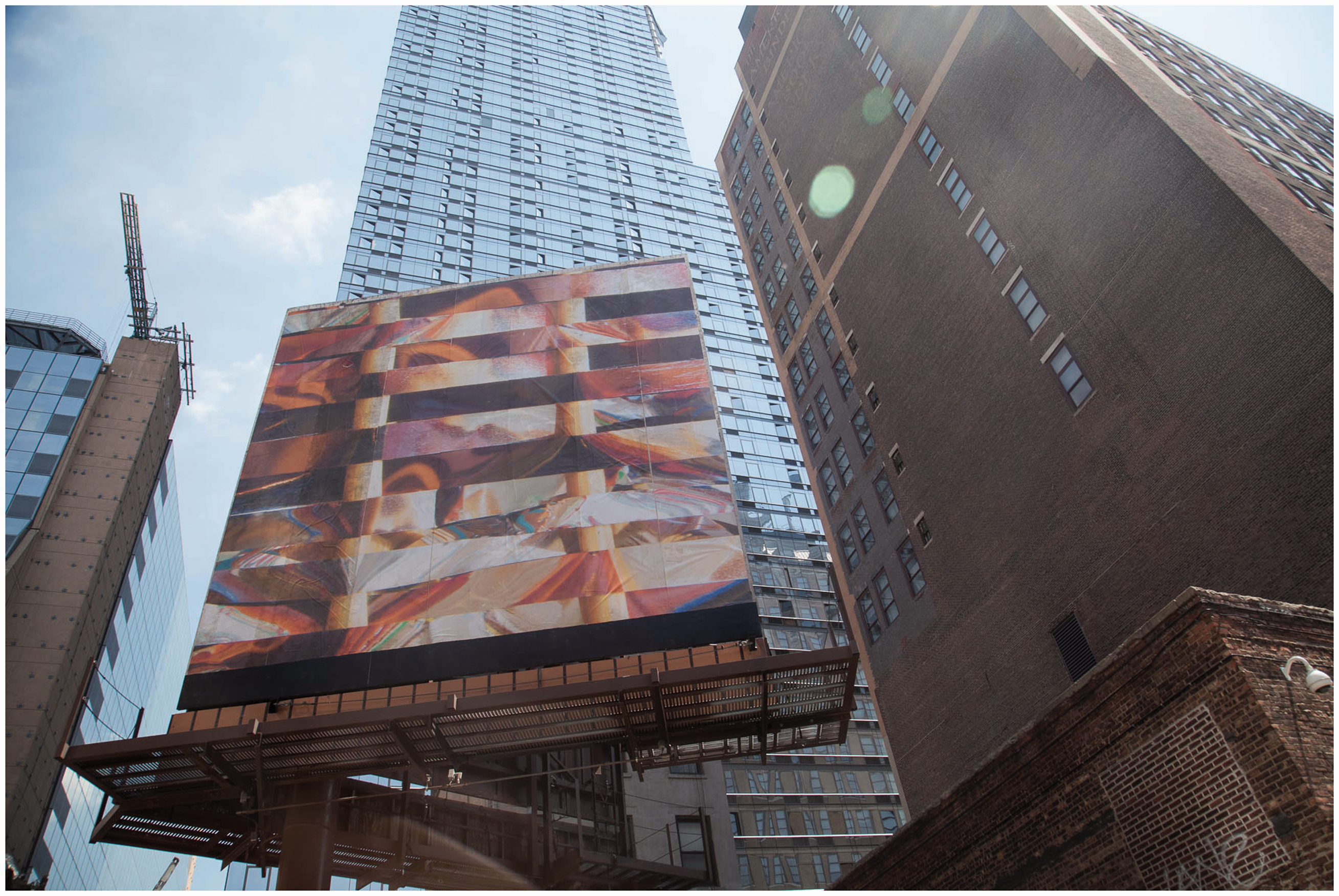
Anti-message illicitly pasted onto billboard by Marco (New York, June 2016).
In opening urban expression up, in all directions, beyond a strict concern with representation, the engagement with public space, as found in certain subvertising, acts in accordance with Agamben’s concern with ‘common use’ and ‘pure means’. In Agamben (2007a: 73), use refers not to any mode of engagement with an object, space, idea or language, but to ones that are ‘pure, profane, free of sacred names’. It is always therefore, Agamben continues, a relationship that deters appropriation, possession and any obligatory relationship to an end. We witness such a notion of use in the profanations of language by Marco and Bobby. Their use of language is strongly at odds with that found in corporate or state media channels, including advertising. Agamben writes that ‘[t]he apparatuses of the media aim precisely at neutralizing [the] profanatory power of language as pure means, at preventing language from disclosing the possibility of a new use, a new experience of the word’ (Agamben, 2007a: 88). Against advertising, the ‘word’, understood here in the broad sense of general expression, of Marco and Bobby emancipates language from any strict demarcation. Profaned public space exists exactly within this refusal, this deactivation, of inscribing a new apparatus of separation. It refuses a modelling of a new order onto the communicative potential of the city.
What emerges is more than public space as a utopian space for making demands freely, constructing meaning or seeking recognition (Zukin, 1995), ‘a vital locus for moulding public opinion and asserting claims’ or a ‘shared symbolic space’ (Goheen, 1998: 484, 494). Marco’s productions and destructions take urban space to constitute an affective, embodied site of circulation excessive of rational debate, where words, images, inscriptions, gesture and expressions travel or fail, dissolve or strengthen meaning, institute or disturb relations. The act of expression spilling over from the regime of order simultaneously includes and flees signification. Messages and anti-messages dwell alongside one another, often in tension but without the institutionalised attempt at resolving difference. This separates a concern with profanation from one with secularisation. For Agamben (2007a: 77), the latter ‘guarantees the exercise of power by carrying it back to a sacred model’, while profanation hopes to deactivate any sacred model. In its claims to push beyond the sacred, the secular re-instigates the exclusionary force of separation. The secular removes spaces, objects and language from any truly free use, albeit via renewed value systems and series of practices that are not strictly religious.
We might think here of those spatial practices in public space desiring new stable identity formations or shared value-systems. A secular public space might find in the contemporary moment – formed by global mass consumption and the faltering of identity – an urge for renewed identity formations (Marden, 1997). Certain urban subcultural practices in public space might speak to this moment. They might enact forms of expression aimed at recognition (being a skateboarder, urban explorer, graffiti artist, traceur) within and outside of their community, and in doing so, might form new norms, expectations and belongings (Daskalaki and Mould, 2013). While their transgressive praxis may conflict with the hegemonic management of public space, in shifting separation onto a new identity axis (no longer advertiser–consumer, but insider–outsider) it remains at odds with a profaned sense of publicness.
The ongoing urge towards the principle of identity, which Agamben calls ‘the original sin of our [Western] culture’ (Agamben, 2007a: 59), loses its grip in the commons of profane public space. Here, the ‘common is not premised on any condition of belonging or claim of identity, […] but by belonging itself, by “being such”’ (Agamben, 2007b: 2). A profane use of public space is not concerned with identities or essences as the founding political elements of democracy (Agamben, 2014). We catch a glimpse of this in the publicness predicated through some forms of subvertising. What is unique about such subvertising practices, as Iveson (2013) notes in two case studies, is that they tend to refuse identity claims, and related forms of authority, built around nationality, age, merit, education, wealth or any other founding principle. Their urban imagination involves envisioning expressions as strung together only by their collective capacities to affect bodies, rather than by any homogeneous appearance, coherent value-system or programmed cause.
Avoiding the strict demarcations that identity might involve means opening oneself up to being overwhelmed. One is being pushed beyond static conceptual boundaries of the self, through interaction with the not-yet-known of an expanded sociality. An encounter with extended sociality, as Young (2013) argues in relation to street art, carries the possibility of enchantment, of disrupting urban bodies, tearing them from their comfortable default intellectual and sensory disposition, their coherent sense of self, towards an openness to the ‘other’. A profane public space embraces common use. The heterogeneous and conflicting array of more-than-representational expressions and texts it gives rise to are taken as generative and inspirational, rather than as a threat that needs to be levelled out to the point of exhaustion. What is, in other words, at stake in profanation, following Lauren Berlant, is a communicative mode of publicness that acts against ‘politics as the resolution of ambivalence’ (Berlant, 2016: 395); not the resolution of contesting or incompatible expression, nor merely its toleration, but its active celebration and acceleration.
It is this explicit refusal to resolve antagonism, and the radical conception of commonness that this engenders, that importantly develops existing accounts of publicness. If many scholars of public space recognise that contesting voices (Collins, 2010; Marston, 1990) and diverse ‘disorderly publics’ (Staeheli, 2010) are what produce publicness, rather than taking place ‘in’ them, then an account of profane public space goes one step further. It illustrates that a common use of urban expression might require ongoing processes of destitution (Agamben, 2014), tracing and deactivating (conditions of) separations, sacred or secular, wherever they might take hold. ‘Public-making’, to use Vigneswaran et al.’s term (2017: 498), requires unmaking.
Taking this seriously means profane use finds little hope in new forms of law. This is where Agamben pushes us to challenge liberal-democratic notions of ‘common rights’ to and ‘common property’ of public space (for instance, see Blomley, 2004; Mitchell, 2003). As with the desire for identity-formation outlined above, these notions follow in the tradition of secularisation. At odds with such conceptions, Agamben (2005, 2007a) finds inspiration in the 13th-century conflict between the Catholic order of Franciscans and John XXII. For the latter, if consumption is the negation of a thing, its destruction, then it equals the impossibility of use, which presupposes that the thing remains intact and usable (Agamben, 2007a). Failing to accept that this implies, by extension, the impossibility of property, John XXII continues to propose the path of property as the move of objects and spaces into a separate sphere, turning it into a right. The Franciscans, on the other hand, refuse all forms of property, embracing ‘a generic potentiality that can be used without ever being owned’ (Agamben, 2005: 27) – ‘usage without right’ as opposed to ‘a rightful usage’. Within such a common use without legal authorisation, Agamben finds the possible subtraction from law: the deactivation of, rather than an admittance to, or direct conflict with, the grasp of power and its laws (Agamben, 2005).
Carrying no coherent demands appealing to the law, profanatory acts of subvertising follow a similar disposition, differentiating them from those pursuits of public space that emphasise making legal demands (Hankins and Powers, 2009) or legal recommendations (Douglas, 2014). Perhaps, most importantly, with an eye on the advertising city, it distinguishes them from a straightforward call for mute cities pursued by some subvertisers. 6 As Sylvie wrote with regards to her subvertising workshops, ‘[m]y hope is that this appetite will grow and that instead of demanding advertising’s removal, over time the citizens of Clermont Ferrand will simply demand more and more access to their public space’ (Sylvie, personal communication, July 2017). In their acts, subvertisers like Sylvie and Marco are not concerned with establishing a new regime of order, a new pact carefully defended by legal-material management that considers the ‘stories’ of subvertisers more ‘truthful’ than those of advertisers. To argue for this would do little more than re-asserting the violent sacred-profane distinction central to the regime of order. The communicative geographies of an urban commons cannot ever ‘be grasped in terms of either expropriation or appropriation but […] can be grasped, rather, only as use’ (Agamben, 2000: 117). With their particular imagination of public expression, subvertisers like Sylvie and Marco also tend to depart from a historical range of opposition groups throughout the 19th and 20th centuries that insisted that outdoor advertising was an unruly disfigurement of the ‘proper appearance of the city’ (Gudis, 2004: 168). Against the installation of a new regime and a new aesthetic order, subvertisers involved in profanation fold themselves and others into the deep expressive wildness of the city enabled by common use.
But the difficulty with profanation, Agamben (2014: 71) acknowledges, lies in ‘deactivat[ing] every juridical and social property, without establishing a new identity’. Because, as we have seen, profanation is a mode of activity, not a quality or possession, subvertising could never be thought of as a collective practice of profanation that consistently challenges new apparatuses of separation. Within communities of subvertising, and within the individual lives of subvertisers, diverging mixtures of profanation and consecration co-exist. Always more and less than pure profanation, subvertising tends to, at times, enter into the logics, aesthetics and spaces of consecration. We may think here of the moments when subvertisers, in an act of consecration, echo advertising’s desire for developing recognisable ‘brands’ with a recurring alias (e.g. Brandalism) and professional aesthetic (of posters, a coherent online identity, logo), using a set of practices and skills common to advertisers. In another consecrative gesture, subvertisers may enter into collaborative relations with the advertisers, co-producing ‘pre-defaced’ billboards, ‘honest’ self-loathing adverts, or advertiser-sponsored ‘art’ in bus shelter spaces, in ways that not only help maintain, but directly facilitate the legitimisation of urban expression’s wide unavailability. In these instances of subvertising commodification, ‘while the use of a space might change, the forms of authority or “titles to govern” that pertain in the city may remain the same’ (Iveson, 2013: 455). Profanations of the advertising city inadvertently end up serving that same city.
The lure of consecration within subvertising efforts is pertinent at a time when, as Agamben (2007a: 87) writes, capitalist praxis hopes to become nothing but ‘a gigantic apparatus for capturing pure means, that is, profanatory behaviours’, ultimately seeking to render itself ‘unprofanable’ (2007a: 92). Capitalist consecration, as we see it play out in the advertising city, aims to redraw, incessantly, its own boundaries, in tune with fluctuations of brand values, aesthetic trends, stock exchanges and consumer demand. This is not a sign of the failure of profanation, but instead, of its ongoing pertinence. It offers the deceivingly simple reminder that ‘we must always wrest from the apparatuses—from all apparatuses—the possibility of use that they have captured’ (Agamben, 2007a: 92). Profanation remains forever unfinished; there is no utopian, profaned public space at the end of subvertising journeys which would settle, once and for all, the spatial management of urban expression. It is only through the persistent crafting of new profanatory tools, the tracing of new profanatory possibilities, that we can counter resurgent forces of division. Along the way, we might begin to witness a communicative commons and the liberatory affects found therein.
Conclusion
I returned to Marco’s studio two days after the billboard cut with which I opened this paper. He was editing the video footage I had produced of the action. When I asked him about his feelings about the intervention, he pointed at the playing video: ‘Look, what I like about it is that it’s hard to make sense of’ (Marco, June 2016). I looked closely: the performance showed the struggle, the unevenness of the cut, the falling paper, the becoming sense-less of words and images as they are distorted. It seemed less about what it signified than about it what it destabilised – a normative urban order. In this paper, we have traced the actions of subvertisers as they cut into, and write over, the city’s advertising infrastructures, to ask: what is this normative order that they hope to destabilise? And which alternative spatial imaginations, which ideals of public space, does this destabilisation in turn engender?
Agamben’s concept of profanation, as developed in this paper, allows us to think of subvertising as revealing a sensuous, spatial imagination that opens up the affective potential of urban expression, in ways that are often at odds with what I have termed the ‘regime of order’. This regime operates through attempts at consecration, that is, through the carefully maintained but often naturalised separation of public space into the sacred and the profane, the inaccessible and the accessible. In attempting to deactivate this separation, much of the subvertising discussed in this paper announces the question of democratic public space anew, asking: what might it entail to bring the communicative geographies of cities into the embrace of common use? Or more simply, as Sylvie had once pondered at one of her workshops, ‘what would this city be like, what would it feel like, if everyone had their own billboard?’ (Sylvie, July 2016). Rather than presenting an alternative ‘new’ or ‘better’ regime, when engaged in profanation, subvertising aims to retreat from the violences of separation and the mechanisms of exclusion it maintains, all-together, wherever it arises – a new law, a new identity, a new right. It welcomes the irreconcilability of social life. This irreconcilability becomes the pre-condition for inspiring visions, shocks to thought, disruptive stories, and collective emancipation; essential fragments in the struggle for more socially-inspired urban futures. The dream: a communicative commons carved into, again and again, with texts, images, ideas and our passions, sometimes productive, other times destructive, but always refusing to be limited by a fixed image of and relationship to urban communication.
By way of conclusion, I briefly highlight the particular contributions of ‘profanation’ to existing debates around public space and urban politics. On a first level, the conceptual axiomatic of profanation and concretisation develops recent debates into how the geographies of public space are managed and arranged via exclusionary operations (Qian, 2020; Vigneswaran et al., 2017). In line with the work of Iveson (2012, 2013), it offers a fruitful conceptual extension of the question of the ‘urban commons’ beyond debates around the provision of housing (Squires and Kubrin, 2005), essential (digital) infrastructures (Jiménez, 2014), police discrimination (Derickson, 2017), and surveillance (Koskela, 2000), by bringing it into the terrain of urban communication. More specifically, it provides a way of examining how communicative geographies of public space are managed, and moreover, how it does this through a ‘sacred’ logic that carefully arranges and maintains the exclusion of spaces, objects and language from common use. A possibly fruitful avenue for further investigation would be to empirically examine whether, as Agamben proposes it does within capitalist societies (2007a), this religious underpinning of apparatuses of power extends into other geographies of public space. If so, which material, social, affective, legal and economic formations are enrolled towards such mechanisms of exclusion?
On a second level, further engaging existing debates on the geographies of public space, the notion of profanation allows us to critically approach claims of urban ‘publicness’. Geographers have long recognised that publicness is not a given, but an ideal aspiration that requires ongoing active cultivation through social, economic and spatial formations, as Collins (2010), Qian (2020), Marston (1990), Vigneswaran et al. (2017) and others insightfully show. Profanation and the related idea of profane use push us to ask whether, in emphasising the need to produce commons, we are not dismissing the negative work needed to deactivate the violence of separations that are bound to re-enter public space, again and again. Without the ongoing labour of unmaking and deactivation, the notion of profanation suggests, we are at a danger of simply asserting secular forms of sacred exclusion, enacting new modes of exclusivity in the name of publicness. Profanation offers one way into tracing and rendering inoperative the logic of separation underpinning the ongoing politics of exclusion.
In this regard, and on a third level, profanation particularly offers tools for considering the performative potential of those ‘deviant’ bodies in urban space that are involved in the transgression of borders in public space, including subvertising and various other forms of urban subversion (Chiu, 2009; Garrett, 2013; Mould, 2015; Saville, 2008). As Iveson (2013) has argued, there exist ongoing tendencies to celebrate and romanticise urban interventions and their political energies of resistance, enabling heroic stories of autonomous and conscientious subjects charged with revolutionary desire. What profanation provides is a way of attending to how these practices may, at times, end up reproducing the logic of consecration, and the important dangers that loom there. It offers a productive conceptual contribution to considerations of the ‘parasitic’ logic of practices like subvertising. Profanation offers neither a straightforward celebration (Klein, 2000) nor strict denouncement (Gilman-Opalsky, 2013) of a practice for its simultaneous subversion of and reliance on that which it seeks to undermine. Instead, profanation begs us to dig deeper into the various dynamics always at play: what particular forms of separation and exclusion are re-produced in a said practice, time and space? In which contexts do ‘subversions’ of hegemonic public space pursue a maintained openness to common use, and when do they offer their own closings of use? And in which ways might new forms of exclusion and separation end up facilitating the recuperation of urban subversions?
If, as Agamben (2007a) writes, the capitalist dream is to produce an unprofanable world, then this latter question carries much weight. What modes of urban profanation, if any, manage to outlive the recuperative logic of capitalism, its efforts at absorbing each move towards common use? To bring it back to subvertising, the only certainty we can hold on to, for now, is that there is a swath of practitioners out there who will continue to pressure into a variety of directions, impatient to exert their desire for a communicative commons. As Bobby told me, ‘we’re not stopping until this city lives up to the potential of its people’ (Bobby, personal communication, February 2019). Whether their desires will finally be caught on the way, in a consecrative trap, or whether they will continue to dig deeper, deserting further underground, diversifying and expanding, remains of course, as of yet, to be seen.
Footnotes
Acknowledgements
I wish to thank the anonymised subvertisers for welcoming me into their lives with so much trust, care and openness, and for their relentless critical engagement with the spaces and politics of advertising. Thanks also go to Bradley Garrett and Emma Roe for their deep engagement with previous versions of this paper. Additionally, appreciation is extended to the editor Alexander Vasudevan and the reviewers for their critical but helpful comments.
Declaration of conflicting interests
The author(s) declared no potential conflicts of interest with respect to the research, authorship, and/or publication of this article.
Funding
The author(s) disclosed receipt of the following financial support for the research, authorship, and/or publication of this article: The study was funded by British Academy (PF19\100052), Research Councils UK and Royal Geographical Society.