




Abstract
This paper discusses improvisation as a liminal practice of inhabiting the in-between that marks urban spaces from squats and brownfields to communal gardens, from infrastructural maintenance and urban living labs to political protest and solidarity in times of crisis. It shows how improvisation emerges in the interstices between uncertain flux and ossified rigidities to construct in-between spaces of ambiguous political openings even in ostensibly formal, rigid contexts. To that end, it draws on documents, media reports, interviews and participant observation to analyse the multiple mutations of what eventually became the Boris Yeltsin Presidential Centre in Ekaterinburg, a cultural flagship in Russia’s third largest city. Morphed from an abandoned office block into a memorial multi-purpose complex, the Yeltsin Centre is the product of elites and ordinary people responding to conjunctural openings in seemingly inert structures. While highlighting the political openings made possible by improvisation inhabiting the in-between, the paper also underscores the ambiguous nature of this practice and its limits.
Introduction
The building announces itself from afar. With its perforated façade, it stands out as the sleekest and most elegant among the high rises that line the water front in Ekaterinburg, Russia. Several sweeping flights of stairs lead up from the embankment promenade. The terrace is teeming with people. Children are crying with joy and flitting between adults’ legs where a playground and food stall invite you to stay and linger. And if you decide to enter the building, something unusual happens in this urban quarter of bulwark high rises: You are invited to come in, rather than shut out. What is now the Boris Yeltsin Presidential Centre, or simply Yeltsin Centre in local lingo, is a building with a short but chequered history – a history which would not have happened as it did without the colliding of different orders, unexpected events and the improvisation that made all come together – for a while.
Easily the most popular and most diverse gathering place in the city of Ekaterinburg, the Yeltsin Centre is as hard to miss as it is to describe. Officially, it is a memorial to the first president of the Russian Federation, Boris Yeltsin, opened in 2015. But it is housed in an office tower and the memorial function occupies only a small part of its floor space. Shops, offices, cafés, co-working spaces and medical facilities line its floors and make for an eclectic mixture. Regular events turn it into a place for open discussion and exchange as much as into a place of leisure. It has turned into a cultural flagship of sorts for Ekaterinburg without aiming to, creating a mixture of admiration, envy and unease among the cultural and political establishment in the city itself and in the much larger Russian cities of Moscow and St. Petersburg. Yet, its future remains as uncertain as its past.
A key tactic in the face of uncertainties and ambiguities, improvisation marks cities anywhere in the world. One could theorize it from Berlin and Sydney, and from Rio de Janeiro and Lagos. Even from seemingly neat Zurich. We have chosen to theorize it from Ekaterinburg in Russia. Improvisation is neither unique to Ekaterinburg nor is it particularly specific to it. Stories about improvisation ‘can be told everywhere’, Zinaida Vasilyeva (2019: 13) notes. ‘When told in Russia, however, they are usually longer and have more details’. If improvisation is ‘catastrophe tamed’ (la catastrophe apprivoisée), as the French writer and film-maker Jean Cocteau (1918: 433) put it, then Ekaterinburg, and post-socialist cities at large, from Warsaw and Belgrade to St. Petersburg, Baku and Astana, have flirted and skirted catastrophe more than most others (Blau and Rupnik, 2018; Grubbauer and Kusiak, 2012; Kelly, 2016; Laszczkowski, 2016; Meili et al., 2012; Murawski, 2019). For the short succession of variegated socialisms, imposed market reforms, global financial crises, political regimes and wars has left a jumble of urban forms, policies, institutions and lives. So there is a richness in improvisation in Ekaterinburg that makes for diversity and nuance in theorising improvisation. It allows us to think with the Global East, as it were, in an effort to further globalise and diversify urban theory (Ferenčuhová, 2016; Gentile, 2019; Robinson, 2016; Tuvikene, 2016).
Thinking improvisation as inhabiting the in-between, we open it up as a generative concept to theorise the different modes of carving out a living between dominant structures and creative destruction. We position our notion of improvisation not, as it has been traditionally done, as a subversive, emancipatory weapon of the weak (Simone, 2018) nor as the tactic of elites in crisis-prone neoliberal times (Silva, 2011) – but squarely in-between these two poles. Improvisation needs both constraining structures and the singular event that rips them open. Jacques Derrida (2004: 322) reminds us of this when he calls improvisation ‘the creation of something new, yet something which doesn’t exclude the pre-written framework that makes it possible’. Always provisional and never perfect, improvisation as inhabiting the in-between is at the heart of the uncertain and precarious city, characterising urban squats and communal gardens, infrastructural maintenance and urban living labs, social movements and political protest as ways of creating somewhat liveable niches where there were none.
Practicing this art of liminal thinking of improvisation is perhaps easier in those liminal spaces of the Global East to which Ekaterinburg belongs and which are epistemologically located somewhere between, or beyond, North and South (Müller, 2020). Thinking with the East as a tertium quid, as we do in this piece, can then become a way of thinking with, but also in-between and across the currently dominant frames of urban theory, where the universal is often attached to the North and the particular to the South. While improvisation has mostly been studied as a feature of cities in the South, such as those in Africa and Asia (Desai et al., 2015; Kumar, 2019; Simone, 2018), it is always embedded in multiple relations across scales; it is acting with and in the world (Robinson, 2016; Roy and Ong, 2011). The flows of capital, people, images and expertise between cities create intense relations where the local, the national and the global collapse, as cities act in a web of dependencies and rationales that stretches horizontally across the globe, between North, South and East. As such, this paper contributes to the still rare but much-needed conversations between Easts and Souths. It does so by thinking between Easts and Souths (Chari and Verdery, 2009; Robinson, 2016) to suggest that the two have much more common than is often conceded and that whoever says or thinks ‘Global South’ must also always say or think ‘Global East’.
Following the twists and turns of the emergence of the Yeltsin Centre in Ekaterinburg, we demonstrate how improvisation emerged from the rigidities of existing structures and forces and the potentialities created by unexpected events. In our fieldwork between 2012 and 2019, we examined various sources to elucidate how complex configurations of actors, interests, paths, symbols and resources formed around the Yeltsin Centre. We conducted archival analysis, semi-structured interviews, participant observation and site visits to explore three facets of improvisation. First, the various aspects of fixity and flow as the condition for improvisation. Second, the concrete manifestation of improvisation in the shape, purpose and use of the building that was to become the Yeltsin Centre. Third, the ambiguous political effects of improvisation of creating an opening and a political space of possibility.
Where possible, we interviewed key stakeholders, that is, those who were involved in the project of conceiving and operating the Yeltsin Centre from the beginning. This resulted in a total of 16 interviews with decision-makers and planners from Ekaterinburg’s planning department, experts in construction and urban development, and the staff of the Yeltsin Centre as well as in nine interviews with visitors of the Yeltsin Centre. In an effort to capture the ephemeral, informal aspect of improvisation, we encouraged our interviewees to report both the ‘official account’ of the events but also reflect on stories of ‘less official’ behaviour (Becker, 1970) – everyday practices, personal networks, creative invention – that is a crucial component of improvisation. This approach allowed a critical interpretation of policies and rhetoric containing and reflecting multiple agendas and perceptions of the Centre. The interviews were supplemented with participatory observation during the tours across the Yeltsin museum, in the art gallery and before and after the lectures, music performances, festivals, film screenings, etc., paying special attention to the behaviour of the visitors. The transcripts from the interviews were compared with field notes of our observations. During this analysis, particular attention was paid to discrepancies between the ways in which the staff of the Centre conceive events and situations, and the tactics and reading of the people frequenting it. The story we tell is one of improvisation as an ambiguous practice that emerges from the interstices between economic exigencies and political power on the one hand and the vicissitudes of the event and the creative potential of acting on the other.
Three modes of urban improvising
Improvisation is a key feature of cities. If we see cities as in a permanent tension between the built, fixed and rigid on the one hand and engines of creation, loci of crises, sites of the surprising and unexpected on the other (Amin, 2013; Amin and Thrift, 2002; Blok and Farías, 2016; Simone, 2016, 2018), then improvisation is never far. Improvisation is the precarious bringing-into-being of the city multiple: the actualisation of the potentialities immanent in urban life and its material spaces. It is omnipresent as a creative practice that allows not just navigating but, more crucially, tapping the potentialities of the urban as an always unfinished, open project. The Latin root im-pro-videre underscores that improvisation relates to that which cannot (the prefix im-) be foreseen (pro-videre).
In its current usage as a concept in urban studies, two different modes of improvisation emerge, summed up in a schematic fashion in the first two columns of Table 1. The first and most prominent one thinks of improvisation as a practice of making do of the urban poor and marginalised, often in the Global South, from Mumbai and São Paulo to Jakarta and Dakar (Caldeira, 2017; Desai et al., 2015; Simone, 2010, 2014, 2018; Young et al., 2017). This improvisation serves to cobble together livelihoods in situations of vulnerability, poverty and often in the absence of infrastructures and with a truncated state. It is marked by uncertain, fluid situations which require incessant preparedness and where people themselves become, in a now prominent turn of phrase by AbdouMaliq Simone (2004), infrastructure. This improvisation as making do is one of dignity and hope, despite precarity; it is an emancipatory way of making lives in the face of adversity, of creating potential where, at first glance, there seems to be none.
Three modes of urban improvisation.
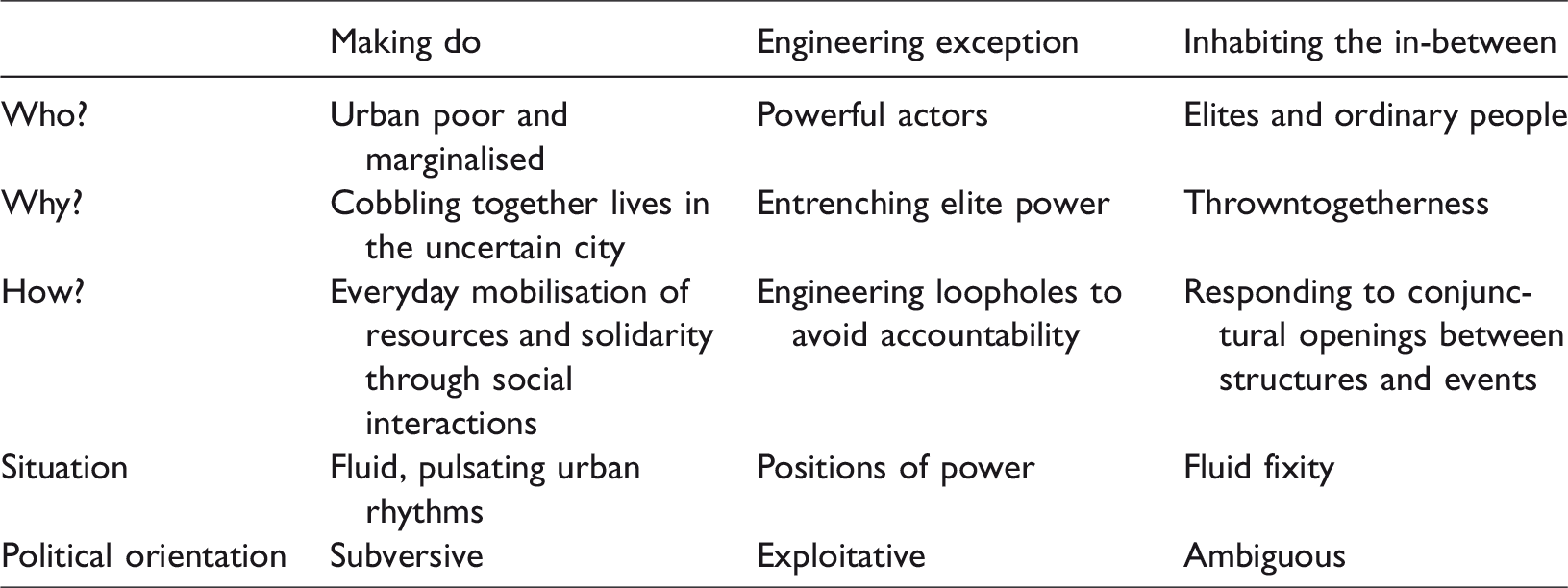
In the second mode of improvisation that emerges from the urban studies literature, improvisation is at the opposite end of the political spectrum: rather than a practice with progressive potential it is a predatory practice of exploitation. This ‘improvisation as engineered exception’ is not so much born out of necessity but springs from, sometimes deliberate, actions by elite actors or the state to exploit unexpected events and legal loopholes to entrench power and wealth (Meili, 2015; Roy, 2014: 144). This mode of improvisation can be a tactic of shirking responsibility, shifting blame and evading accountability: the last-minute change of plans that sidesteps organized protest or the exceptional measure that undermines democratic decision-making. Silva’s (2011) study of highway franchises in Chile demonstrates how improvisation resulting from economic liberalisation reinforces the power of the state through a lack of accountability, while falling most heavily on the most vulnerable communities. Where ordinary people improvise in this mode, it is out of need, with improvisation often forced upon them by a neoliberal state that has withdrawn infrastructures and safety nets and encourages individual entrepreneurialism (Jeffrey and Young, 2014; McFarlane, 2011). This mode of improvisation tends to cement existing structures rather than challenge or re-interpret them. ‘Open and flexible, if provisional’, Michael Watts (2005: 184) notes wryly, ‘is what we … used to call self-exploitation’.
The third mode of improvisation, the one that we propose in this paper, inhabits the in-between spaces, drawing from the previous two modes. It unfolds at the encounter of rigidities on the one hand and unexpected flux on the other, where state power, (infra-)structures of social and political dominance, and material articulations of inequality in the cityscape meet crises, unanticipated events and human ingenuity. This mode of improvisation therefore springs not just from uncertainty alone, but from uncertainty that meets rigidities, leading to overlapping, colliding orders and rationalities that allow shuttling ‘between the possible – the unstable flows of materials and substances – and the prescribed – the imposition of functional, stable structures that secure a statistical order to their relationships’ (see also Hentschel, 2015; Kumar, 2019; Simone, 2011: 357). It arises not so much from necessity, as the first type, nor from conscious exploitation of power, as the second, as from opportunistic acting in response to a conjunctural opening, cutting across actors, from ordinary city dwellers to elected officials, spatial planners and large enterprises. This improvisation needs to ‘work with what is there, that is, a less-than-concrete plan, a half-functioning law, a nasty yet dominant moral code, or an infrastructure that no longer meets people’s needs’ (Hentschel, 2015: 85). As such, improvisation as inhabiting the in-between is morally and politically ambiguous. It may lead to desirable outcomes, but often through problematic means, or the other way around.
Inhabiting the in-between in the urban East
The cities in the postsocialist East provide, in many ways, an appropriate place to study this third mode of improvisation as inhabiting the in-between. Cities in the post-Soviet space are of particular interest for studying improvisation, as state socialism saw them as grounds of experimentation with new urban forms and socialities in seeking to realize social progress and the socialist utopia (Collier, 2011; Kotkin, 1997). Against the prevailing stereotype of Soviet urban planning as subject to rigid procedures and omnipresent state control, from its earliest days it had to reconcile the expectations laid down in countless plans with the unexpected events that kept overtaking those very plans: shortages of material and personnel, changes in political will, adverse environmental conditions and so on. Most Soviet urban planning and city building, although ostensibly laying down and following strict plans, therefore amounted to the art of the possible (Ilchenko, 2017; Kotkin, 1997).
One can see this improvisation in action in one of the grandest experiments of socialist urban planning: the so-called sotsgorod (соцгород), the planned socialist city. After the prolonged argument between urbanists about the character of socialist cities in the 1920s (Kopp, 1979), the sotsgorod sought to realize the socialist egalitarian idea in the urban form (Erren, 2002): it featured a functional division between production and reproduction and adequate housing and services for workers and their families, following the ideas pioneered by Soviet urban planner Nikolay Milyutin (1930). A whole series of sotsgoroda, such as Magnitogorsk, Nowa Huta, Stalingrad and Eisenhüttenstadt, emerged, mostly between the 1930s and the 1950s. In addition to these, the socialist states redesigned, rebuilt and extended many existing cities, often at a large scale, from Tselinograd (today Astana or Nur-Sultan, Bissenova, 2014; Laszczkowski, 2016) to Tashkent (Meuser, 2016) and Warsaw (Grubbauer and Kusiak, 2012) . Stephen Kotkin (1997) evokes improvisation to describe the Great Break (великий перелом), that is, the acceleration of industrialization and collectivization from 1928/1929. The construction of Magnitogorsk, an urban metallurgical complex, exemplifies, in his view, ‘the paradoxical character of the USSR’s vast, noncapitalist, industrial improvisation’ (Kotkin, 1997: 42, 152).
Ekaterinburg became the site of one of the first sotsgorod, Uralmash, built from scratch around a large machine-making plant from the 1930s, which extended Ekaterinburg to the north. While nominally adhering to steadfast principles of socialist urban planning, this experimental form of urbanisation in the woods outside the old city of Ekaterinburg depended, like most of the Soviet Union’s mega-projects, much on improvisation in the face of constantly changing conditions. Budget shortfalls, scarcity of resources and changing priorities required frequent ad hoc adjustments (Erren, 2002). Giving a sense of the pervasiveness of uncertainty, Mikhail Ilchenko (2016) writes: ‘in many cases, the “strategy” [of town planning] was in fact based on a set of situational decisions; furthermore, certain processes remained beyond any control’. A perpetual incompleteness, an unresolved tension between plan and execution, therefore characterized Soviet city building.
This need, indeed art, of navigating between the expected and the unexpected, the code and the event, to create new possibilities continues to characterise city building in the post-socialist East today. Situational, ad hoc interventions, also known as ‘manual steering’ (ручное управление) in Russian, have become a prominent feature in urban and regional governance (Zubarevich, 2014). City administrations and citizens battle to make do in the face of the vicissitudes of political will, planning goals and codes and market forces. The attempted, but never finished, transition from socialism to market capitalism has led to the co-existence of socialist, capitalist, neopatrimonial and authoritarian elements, creating ambiguous social orders and accumulation regimes, not just but particularly in cities (Ferenčuhová and Gentile, 2016).
Highlighting this mixture of practices and orders, scholars have thus described post-socialist city-making in terms of ‘scrappiness’ (Buchli, 1999; Laszczkowski, 2015), chaos (Kusiak, 2012) and, with an aesthetic bent, as urban mosaics (Brade and Neugebauer, 2017; Kliems and Dmitrieva, 2010; Nedović-Budić et al., 2006). Constant break down, repair, fixing and making-do are quotidian experiences of most urban dwellers today. Writes Laszczkowski (2015: 139): ‘scraps clatter [clutter] especially post-Soviet space—the collapse of the USSR having been a “breakup” in quite a literal, material sense’. Others, writing on present-day Warsaw in the tellingly titled Chasing Warsaw (Grubbauer and Kusiak, 2012), for example, highlight the severe disruption of the urban fabric and infrastructure through large-scale tinkering as something particular to this city, turning it into an ‘acephalous urban organism’ (Bartmański, 2012: 143) of sorts.
In this paper, we build on these uses of improvisation in postsocialist cities, which suggest a creative making-do in the face of tumultuous change and state withdrawal, but further them at the same time. What we suggest is that the urban condition of the Global East, in its jumble of infrastructures, practices and ideologies, resembles what Doreen Massey called ‘throwntogetherness’: a condition of creative chaos that lets emerge the ‘potential for the happenstance juxtaposition of previously unrelated trajectories’ (Massey, 2005: 94). Improvisation thrives on this throwntogetherness, as it involves ‘the unavoidable challenge of negotiating a here-and-now (itself drawing on a history and a geography of thens and theres); and a negotiation which must take place within and between both human and nonhuman … This is an aspect of the productiveness of spatiality which may enable ‘something new’ to happen’ (Massey, 2005: 140, 94). Throwntogetherness is crucial in three ways for how we conceptualise improvisation as inhabiting the in-between. First, it evokes both the historicity of action (‘drawing on a history and a geography of thens and theres’) and its heterogeneous composition that creates newness (‘happenstance juxtaposition’). Second, it acknowledges that improvisation is always situational, power-laden and politically ambiguous (‘challenge of negotiating a here-and-now’). Third and last, throwntogetherness refers to an explicitly spatial condition, as it is both produced by space and produces space at the same time. This mirrors our notion of improvisation as situated in space and its affordances, working with what is. With the Yeltsin Centre and the city of Ekaterinburg this paper examines precisely such a space.
Thrown together in Ekaterinburg
Ever since its founding, Ekaterinburg has rubbed against the powers that be, often between orders of politics, planning and governance, creating a tension and throwntogetherness that are generative of improvisation. Established in 1723, it was one of the first cities in Russia founded for an industrial purpose, as it was mandated to prospect and exploit the deposits of iron ore in the Ural region. This mission manifested itself in the town plan. Unlike most other cities in Russia at the time, it had square street grids and iron works, not a kremlin, at its centre. Its industrial founding rationale and economic base still distinguish it from other major cities in Russia, such as Moscow, St. Petersburg, Kazan and Nizhniy Novgorod, and have resulted in a streak of independent-mindedness that has characterised it up to the present time. Ekaterinburg is also the place where Boris Yeltsin forged his political career, before moving to Moscow and most famously stopping the coup d’état against Gorbachev in August 1991, leading eventually to the dissolution of the Soviet Union and his ascendancy to become the first president of post-Soviet Russia.
Despite the significance of Ekaterinburg in Russia, it is not well known outside Russia. This ignorance often comes as a surprise and indignation to people living and working there. After all, with about 1.5 million inhabitants, it is the third largest urban region (Rogov and Rozenblat, 2020) in the largest country of the world, they think. But few people from outside Russia are able to get the name right (popular butchering includes ‘Ekaterinenburg’, ‘Ekaterinaburg’ or ‘Ekaterinberg’), much less locate it on a map. (In case you are also wondering: it is in the Ural Mountains, about 1700 km or a 2-hour flight east of Moscow.) Ekaterinburg is also a blank page in global urbanism, an academic approach committed to multiplying the locations that inform global urban scholarship (Roy, 2009). As far as Anglophone academic knowledge production is concerned, it might as well not exist, with just a handful of publications mentioning it (Trubina, 2015; Turgel and Vlasova, 2017). Just as Ananya Roy (2016: 200) reports for Kolkata, we, too, felt that we were ‘presented with a vast city seemingly without a map, without recorded history’. Yet, it is precisely in these margins of global urbanism, as we shall show, that one can best inhabit the in-between.
Suspended between ambitions of a global urbanism and the strictures of an authoritarian, hierarchical state where budgets and political priorities are passed down along the power vertical from the federal centre in Moscow, Ekaterinburg and its citizens have, time and again, negotiated political deadlock and opposition, financial exigency and other unforeseen events, cultivating a form of defiant can-do attitude. It was the only major Russian city to have, for some time, a mayor that did not belong to the ruling party and it has been the site of protests critical of the current regime, resulting in a notable defeat of a plan to build a new church in the centre of the city in 2019. Its reputation as the ‘hipster capital’ of Russia – an accolade of sorts one would much more expect to go to Moscow or St. Petersburg – underscores both its insertion into global trends and a certain free-spirited disposition.
Like many cities in Russia, and globally, Ekaterinburg has experimented turning its economic capital into cultural capital. Striving to take advantage of its geographical situation between Europe and Asia, it has invested into a range of image-making projects aiming to establish it as an urban hub between East and West. It hosted the summits of the Shanghai Cooperation Organisation (SCO – a Eurasian political, economic and security alliance which includes Russia, China and India, among other countries) and the BRIC countries in 2009, the Football World Cup in 2018 and bid for the Expo 2020 (which it did not get). In these experiments with international branding, expertise and exposure between East and West Ekaterinburg resembles Astana (now Nur-Sultan), in seeking to acquire the symbolic capital that ‘would enable [it] to to ascend the ladder of established hierarchy and to catch up with modern cities in the developed world’ (Bissenova, 2014: 129; see also Koch, 2014).
Exercising the art of becoming global, Ekaterinburg can be understood as a ‘worlding city’, ‘a milieu of intervention, a source of ambitious visions, and of speculative experiments that have different possibilities of success and failure. … Inherently unstable, inevitably subject to intense contestation, and always incomplete, worlding is the art of being global’ (Roy and Ong, 2011: xv). It is one of those speculative experiments, the Boris Yeltsin Presidential Centre, and the throwntogetherness and improvisation that made it coagulate that we shall now discuss.
Becoming the Yeltsin Centre
Global ambitions interrupted
The story of what was later to become the Yeltsin Centre starts in the early 2000s. Russia, and Eastern Europe at large, had just come out the financial crisis of 1998 and had logged several years of continued economic growth for the first time since the collapse of the Soviet Union in 1991. Russian cities, as all postsocialist cities, were latecomers to the game of urban entrepreneurialism, but were playing catch-up with all the more vigour. In Ekaterinburg, as in many other cities in ex-socialist countries, alliances of subnational authorities and business communities emerged, which were keen to position their cities in the global economy and acquire cultural capital, often with the strong involvement of state institutions (e.g. Bissenova, 2014; Golubchikov, 2010; Kinossian and Morgan, 2014; Makarychev and Yatsyk, 2015).
As one crucial step in following the imperative to compete in the global economy, Ekaterinburg bid for and was awarded the right to host the summits of the SCO and the BRIC countries, both in 2009. This bidding, while ostensibly following a logic of global competition, was at the same time a key means of underscoring Ekaterinburg’s claim, not so much to international investment, as to federal money attached to those events in a highly centralized state (Trubina, 2012). Ekaterinburg therefore navigated the language and played the game of global competitiveness in large part to be able to claim a larger share of the federal budget cake.
In contrast to the modest role that the summits played internationally, for the city and regional authorities and business circles their preparation provided an occasion and rhetoric for promoting investments in commercial real estate. Thus, during the run-up to the summits, dozens of buildings that together make up the city’s ‘face’ (as government officials put it) were erected: hotels, shopping centres, office blocks, residential skyscrapers, traffic interchanges and large roundabouts (Trubina, 2015). In a rush to meet deadlines for the summits and promote flagship development projects, the city administration sought to open itself to private investment by developing land parcels in the city centre, including along the embankment of the main river called Iset.
Most of the construction projects were launched before the global financial crisis of 2008, including that of an office block known as ‘Demidov’. A local architectural practice designed the building and, in a move to underscore Ekaterinburg’s global ambitions, exhibited the model at one of the leading real estate and architecture shows of the world, MIPIM (Marché international des professionnels de l’immobilier) in Cannes. A local private investor had commissioned the building, commenting on its extravagant architecture: ‘specifically for the SCO summit, we are constructing the cupola and the glass-covered panorama walk over the Iset river, as it is planned that the informal meeting of the presidents [of the participating countries] will take place there’ (Sharafulin, 2008). Then, as the summit approached, the global financial crisis struck. In the absence of financing and with uncertain prospects for future use, the construction process ground to a halt. For a while, the construction site remained an empty shell: the walls had been erected, but much more work needed to be done to complete the building.
Coinciding with the financial crisis in 2008, the federal government enacted a new law (Federal Law of Russia, 2008); it foresaw building a memorial centre for past presidents of the Russian Federation. Boris Yeltsin’s family, who already in 2000 had established a foundation called ‘Yeltsin Centre’, had lobbied for this law. A memorial to Yeltsin, the only past president of Russia, would allow addressing the strongly divergent perceptions of Yeltsin and his legacy in Russia and abroad. In Russia, many people hold Yeltsin responsible for the dire consequences of the ‘shock therapy’ of economic reform in the early 1990s and the dissolution of the Soviet Union, which is often remembered with nostalgia (Hesli and Bashkirova, 2001; Shestopal, 2016). Abroad, by contrast, Yeltsin’s image is somewhat more positive and associated with political tolerance and anti-communism (Colton, 2008).
These developments provided four key components for improvisation as inhabiting the in-between. First, the ambitions of urban and regional authorities to stake their claim in the global symbolic economy; second, the financial crisis, leading to dashed hopes and empty buildings but also to unexpected opening; third, the political decision to commemorate past presidents of Russia and fourth and finally, the ambivalence surrounding the figure of Yeltsin.
Improvising with what is
The ambivalence surrounding the figure of Yeltsin in the public mind made it inopportune for the government to situate a memorial to Yeltsin in Moscow, the heart of power, as it would risk bestowing symbolic approval on his legacy. Instead, his hometown Ekaterinburg became the site of choice. The new board of trustees for the Centre and Yeltsin’s family also favoured this option. In 2013, the board appointed the up-and-coming architectural practice of Boris Bernaskoni, who had won several competitions, beating such established architects as Zaha Hadid and Coop Himmelb(l)au. The practice and the board first attempted to find vacant land in the city centre to construct a new building. But when they found the plots that the municipal government offered unsatisfactory, the abundance of shopping and business centres, both completed and uncompleted, proved useful. On advice of the powerful mayor of the city (Chernetskiy, 2015), they decided to reinvent the empty shell of what was once meant to become the office block ‘Demidov’, thus actualising the potential created, in a paradoxical way, by the financial crisis. The architects underscored this potential: ‘Such an approach emphasizes the aspiration of the first Presidential centre to restore the existing hidden resources of the city and to create new public spaces’ (Bernaskoni Architects, 2016, emphasis added).
The museum designers studied American, British and French memorial traditions to incorporate the best practices, exhibition strategies and schemes of financing (Bondarev, 2017). The future memorial was to contain a presidential archive, library and museum, borrowing much from the American approach to presidential memorials and breaking with the Soviet tradition of enshrining past leaders in quasi-sacral spaces (Boltunova, 2017). Finally, the American museum exhibition design firm Ralph Appelbaum Associates, well known for its concept of the Holocaust Memorial Museum in Washington D.C., received the commission to develop the concept of the Yeltsin museum as the nucleus of the Yeltsin Centre. The Yeltsin Centre finally opened in 2015.
The opportunities for improvisation did not just emerge by serendipity, however. In our case, many informants openly emphasised the role of the president’s family in the emergence of the Centre. ‘Without a strong will, the Centre would not have appeared’, said one member of the staff of the Yeltsin Centre. Willpower or an energy reserve that a person uses to continue with willed action and to combat obstacles is the trait that some informants see in Yeltsin’s daughter, Tatyana Yumasheva. Some of them fondly recalled how they saw her and Yeltsin’s wife Naina work hand in hand during the opening ceremony. Others referred to Tatyana’s influence when explaining to us the difference between the rather generous funding of the Centre and the meagre budgets of other cultural institutions. The mostly privately funded Centre counts both illustrious oligarchs (Oleg Deripaska, Roman Abramovich, Vladimir Potanin, Alisher Usmanov, …), politicians (Andrey Rappaport, Alexander Kazakov, …) and large corporate sponsors (Russian heavyweights such as Bashneft, Renova, Atomstroycomplex, Rusagro, Sberbank, …) among its financial and political supporters. Yet other informants hinted that the family’s attention and control extended to decisions about the colour of furniture and the appointment of specific, hand-picked people to work in the administration. So elite actors, in this case, Yeltsin’s family and entourage, proved potent. They were able to use significant political influence and access to donors to establish a well-funded memorial outside the two large urban centres of Moscow and St. Petersburg as the typical foci of flagship projects.
The potential for the transformation of the purpose of the building – from office block to memorial – therefore emerged both from a contingent concatenation of elements that was neither planned nor foreseeable and from powerful elites. The material ruins left behind by the global financial crisis; a law that foresaw memorials to past presidents, inspired by the US example; a controversial president whose memorial could not be situated in the heart of power; a city keen to enhance its national and global recognition; and the involvement of individuals with political influence and financial resources.
Improvising throwntogetherness
But with its eight stories, once conceived to be an office centre, the building was much too large and much too costly to maintain for a presidential memorial. Thus, in a second twist of improvisation, the not-for-profit centre took in for-profit users, creating a veritable situation of throwntogetherness (Massey, 2005) in uses and tenants. It now hosts a supermarket, a mobile phone shop, several galleries, a bookshop, several coworking spaces, office space for small companies, a gym and such unexpected things as a clinical institute of reproductive medicine with surgery facilities, a sperm and embryo bank, reanimation facilities, doctors’ offices and a small hospital ward. About one-quarter of the building (22,000 m2) is devoted to public, memorial, educational purposes while the rest comprises company offices, retail and unoccupied spaces.
This throwntogetherness is an outcome of the nearly universal discrepancy, throughout Ekaterinburg, between the ways in which things are planned and proclaimed to be on the hand, and the intrusion of unexpected events and economic necessities on the other. The sudden drop of the exchange rate of the Russian ruble in 2014 and the slow-down in economic growth was one such event that an informant described: ‘When it was planned that the commercial space of the Centre would pay for its museum and intellectual events, it was difficult to foresee what would happen after [the events in] 2014. It is one thing to hope that your space would be rented to high-tech companies and start-ups when one dollar trades for 30 rubles and it is a totally different thing to remain hopeful about the commercial potential of the Centre when a dollar trades for over 70 rubles’. Despite the motley mixture of uses, the Centre attempts to carefully select tenants to ensure at least some coherence of the Centre’s presentation.
In addition to this commercialisation, however, the centre has also managed to claim a salient place in the cultural landscape of Ekaterinburg, quite independent of its function as a memorial. ‘Reducing the number of idiots’ is the pithy explanation of its mission by one member of the Centre’s staff. The administration of the Centre employs many local cultural entrepreneurs who formerly worked in libraries and bookshops, galleries and universities. This previous experience and the contacts gained from it help take the edge off uncertainty: ‘When you organized, with much less money, all these festivals and book fairs, the unexpected does not easily scare you’, one curator said. At the time of writing in late 2018, the Centre advertised a veritable tour d’horizon of Russian and Western high culture: a festival of contemporary choreography by Diana Vishneva, prima ballerina of the Mariynskiy theatre, the screening of a 2018 Russian biographical film about writer Sergey Dovlatov, a performance of a theatre version of the Kolyma tales by Varlam Shalamov, a contest and exhibition of children’s drawings and a lecture on Jacques Lacan and psychoanalysis, among others. The Centre also hosts a book shop whose lecture series included events on Russian inventors, the biography of the French composer Erik Satie, science and technology studies of the human body, and the British director Derek Jarman. This litany of minutiae illustrates the breadth but also the eclecticism of the cultural programming, which has little to do with the memorial function of the building. But it is also potent evidence of the throwntogetherness and worlding (Roy and Ong, 2011) practiced in the Yeltsin Centre, underscoring its ambition to be a global cultural institution that sticks out from the state-mandated cultural programming of other institutions in Russia that increasingly need to cater to nationalist, conservative discourse (Trubina, 2018). The Yeltsin Centre, by contrast, sees its peers more in other international cultural institutions abroad.
One might dismiss this bricolage as the result of a survival strategy to take in whatever pays money and attracts people. One might take offence at the commercialisation of the memorial, the cobbling together of tenants and uses. But that would disregard the congenial throwntogetherness of the place. ‘When people make jokes about our eclecticism, we respond by saying that we’re inspired by the way Rem Koolhaas describes skyscrapers: everything can be found there’, noted one informant. Indeed, Koolhaas points to ‘the subversiveness of the Skyscraper’s true nature – the ultimate unpredictability of its performance’ (Koolhaas, 1978: 27). In a similar vein, looking at iconic Manhattan edifices, and Rockefeller Center in particular, the architect Raymond Hood notes: ‘it would be impossible to estimate the number of official minds that have engaged in untangling the complexities of the problem: and certainly the number of unofficial minds that have pondered over it is even a more meaningless guess. Architects, builders, engineers, real estate experts, financiers, lawyers – all have contributed something from their experience and even from their imagination’ (quoted in Koolhaas, 1978: 178). Taking this juxtaposition of the official and unofficial minds further, much beyond Hood’s concern with elite professions, the Centre embodies an intricate tapestry of events and negotiations, contingencies and sparks of ingenuity. Because so many identified and unidentified, official and unofficial minds contributed to its emergence, it now fosters receptivity to new ideas and enhances diverse encounters with its space – just as it creates new business opportunities for those who wish to rent spaces there or launch new projects using its premises.
At the same time, what the Centre can and cannot do is circumscribed within certain boundaries that result from the very way that it has been improvised and the compromises it has had to strike. Its museum part depicts Putin as Yeltsin’ hand-chosen successor and boasts Putin’s financial support of the institution, thus legitimating the current regime. The comparatively generous financing of the Centre and its memorial function reduce the autonomy of cultural production. Thus, the Centre avoids renting its space to the political opposition and its managers state that having the Presidential Administration among the Centre’s founders involves certain constraints on its activities (Shakirov, 2017). To supplement the Centre’s budget, Yeltsin’s son-in-law, Valentin Yumashev, is engaged in fund-raising: ‘I visit old pals and have to ask and persuade’ (Kats, 2019). Having to work with corporate and individual sponsors, many of them inevitably close to the Russian government or even state-owned, also imposes constraints on the programming, which avoids being overtly critical of the current government. The Centre thus is obliged to carefully navigate the possibilities and constraints, testing the waters in each case.
Improvising a public space
It is precisely the juxtaposition of seemingly unrelated elements that explains in large part why, after barely three years of existence, the Yeltsin Centre had become both a landmark and the most popular space in the city. ‘I feel like the Centre has always been there. Look at the panorama of the City Pond: the city and the Centre are in a perfect harmony. It is nice to realize that, if visitors have just one day in our city, they now come here: we’re a landmark after just two years of existence!’, says one member of the Yeltsin Centre staff.
In addition to this function as a landmark, the Centre has also become a central public space, where people with and without means intermingle. People with means can, for instance, enjoy restaurants and cafés with exquisite wine lists where, along with stewed goat and poached scallops, they can savour meals prepared according to Naina Yeltsina’s recipes. More importantly, adults, children and pensioners can spend hours without paying a single ruble, watching the world go by from the open terrace, while animators teach and entertain children in the atrium. The opportunities for free roaming that the Centre offers are particularly important given that it is located in a CBD of sorts, with government and office buildings and a posh hotel next door. While most of the surrounding architecture – with its closed gates and grim-looking security guards – intimidates people away from access, the Centre invites them to enjoy exhibitions and film screenings, concerts and discussions, various activities for adults and children, thus providing an important counterpoint to the surrounding sterile and inaccessible buildings. Protection from harsh weather in winter is also a significant draw: ‘The winter seems hopelessly long and I am here nearly every night: many things are easier to endure with the Yeltsin Centre’, confessed one informant.
But more than just an open space, the Centre has also become, somewhat unexpectedly, a space for political argument and contestation. It is perhaps here that Massey’s (2005: 94) claim of the productiveness of a throwntogether spatiality becomes most evident. While the programming of the Centre is only rarely overtly critical of the government, the audience often enough raises thorny issues concerning the current political situation in Russia. Thus, in October 2018 the Centre organized a debate about the state of urban planning in the country. Planners from Germany and members of the local architectural community as well as the public took part in the discussion. While the Germans confidently presented their understanding of the planners as intermediaries between the different stakeholders, their Russian counterparts admitted to the subservient status of the planners who, at best, were allowed to ‘plan the parking lots’, to quote one of the participants. In this sense, the Yeltsin Centre, although privately owned, becomes a public space of sorts, at least in the way that Massey (2005: 153) describes it as a space that is open to contestation: ‘because of the elements of chaos, openness and uncertainty … space, and here specifically place, are potentially creative crucibles for the democratic sphere. … The very fact that they are necessarily negotiated, sometimes riven with antagonism, always contoured through the playing out of unequal social relations, is what renders them genuinely public’.
As a consequence of this courage to criticise the status quo and dissent, the Centre is much contested. When, in 2017, it received the prestigious Kenneth Hudson Award (‘in recognition of the most unusual and daring achievement that challenges common perceptions of the role of museums in society’), Russian film director Nikita Mikhalkov compared this award to the Wehrmacht iron cross. The specific target of his critique was the Yeltsin Museum which, according to him, ‘glorified the period of the destruction of the Fatherland’ (Kolesnikov, 2017: 4). Online fora vilify the Yeltsin Centre as a place of ‘liberal propaganda’ that fails to exhibit proper patriotism. The Centre thus evokes controversies and strong emotional responses from its publics because of its narrative of liberal values, democracy and a liberalised economy, all elements which are being increasingly contested in the current neoconservative backlash in Russia.
Visitors, too, question the ways in which the memorial part of the Centre depicts Yeltsin as having brought freedom to Russia. One visitor we interviewed commented: I am expected here by the curators and creators to marvel at the times of freedom that the 1990s allegedly were and to connect the values of freedom and the Constitution with a specific name – Yeltsin. But how fair is this? I remember the thrill of the late 1980s, when the first cooperatives appeared, when there happened enormous creative outbursts – just think of the authentic late Soviet rock – and mind you, this city was great at it! – to theatre and literature. Trips abroad became possible for those who had money, they allowed us to listen to the Voice of America…This is freedom to me. And it is strongly linked to Gorbachev. Yeltsin, I am sorry to say, was too strongly linked to the oligarchs and this is exactly what resulted in Putin’s appointment.
As an ambiguous outcome of improvisation, devoted to an ambiguous president, the Yeltsin Centre reflects the very ambiguities that gave rise to it in the first place. In its throwntogetherness it inhabits the in-between of the global ambitions of Ekaterinburg, the ruins of the financial crisis and the political imperatives and strictures of an increasingly authoritarian state. These often conflicting rationales allowed improvising with the material form and the function of the building and its uses. The result visitors see and experience now is far from what was intended 10 years ago as a business centre, or 5 years ago as a presidential memorial. The various rounds of improvisation that resulted in the building’s witty material and functional reinvention have turned what promised to become yet another faceless and soulless, pompous edifice into a unique social and cultural establishment, which occupies a special place in the heart of the citizens of Ekaterinburg. The Yeltsin Centre has then also emerged as both complicit with and critical of the current authoritarian-cum-neoliberal tendencies in Russia by taking a building abandoned by global capital and a president of dubious domestic reputation, and amalgamating both to create a throwntogether space for debate and encounter.
Conclusion
Just as musical improvisation occurs between score and inspiration, we have conceptualised urban improvisation in this paper as a practice of inhabiting the in-between of pre-given structures at one end and multiple fluidities at the other. It arises from the throwntogetherness of diverse elements that creates conjunctural openings in a situation that is neither quite fluid but neither quite fixed either. As such, the concept of improvisation as inhabiting the in-between, developed through the case of the Yeltsin Centre in Ekaterinburg, is of relevance much beyond the case itself. It speaks to all those processes that seek to graft themselves onto and into cities cast in stone, steel and concrete and seek to create a liveable space in the interstices, from refuges and shelters to social movements and urban art. It is also, as we have shown, a politically ambiguous operation: in seeking to create new openings and possibilities, it can never escape existing structures of power and dominance.
Improvisation that inhabits the in-between perches between the global forces of neoliberal capitalism and the principles of capital accumulation, with which it must contend, and the multiplex potentials of remaking urban spaces, on which it feeds. As such, it steers a delicate middle path through the, somewhat overplayed, antagonism of some current urban theory debates (see Peck, 2015; Roy, 2016 as entry points) between the universal and the particular, the nomothetic and the idiosyncratic. If improvisation is indeed ‘the creation of something new, yet something which doesn’t exclude the pre-written framework that makes it possible’ (Derrida, 2004: 322), then there can be, indeed there must be, both universal and particular elements at play. Attending to how urban life takes shape on the ground alerts us precisely that it is the space created through the encounter of the two from which most urban processes emerge.
Accounting for the unlikely possibility of the Yeltsin Centre in contemporary Russia, improvisation points us towards an explanation in which the pre-written and pre-planned and the creative and spontaneous come together to create a new space. The Yeltsin Centre’s pre-written framework – a centralized state with strong elites and the material ruins of capitalist speculation – is hard to ignore and played a crucial role in shaping what the Centre is now. But there is also a strong current of appropriation and re-interpretation of this pre-written framework; a current that becomes visible in the heterogeneous uses of space in the Centre and in its unsuspected emergence as a – contested – public space and forum of debate. The potentialities of the material space of the building, facilitating the throwntogetherness that has become its hallmark, have been at the heart of this emergence, enabling the cultural mixing and the problematising of traditional boundaries and hierarchies between the official and the unofficial, the public and the private, and art and leisure.
Inhabiting the in-between, the story of the Yeltsin Centre is shot through with ambiguity. An homage to an ambivalent politician, it owes part of its success to its insertion as a landmark into the cultural economy of consumption and the city’s globalising aspirations. Its rise as a flagship cultural institution is part of centralized cultural policies where well-known flagship cultural institutions launch ambitious exhibition and performances while smaller cultural institutions find themselves struggling with ever dwindling budgets. And its funding sources impose clear limits on how critical and independent the programming can be. Improvisation should therefore not be glorified or romanticized; working with what is at hand, it never escapes the ambiguity from which it arises.
Even today, despite its popular success, the future of the Yeltsin Centre remains uncertain. Its popularity as a place of open exchange has led to accusations of peddling liberal propaganda. Its dependence on federal funding means that it remains at the mercy of a government that looks unkindly on any attempts of critical political debate. And with its international outlook it risks being found guilty of a lack of patriotism. As such, the Yeltsin Centre exemplifies the ephemeral, precarious character of every improvisation, urban or otherwise. The performance is great while it lasts, but it can go to pieces anytime.
Footnotes
Acknowledgements
We would like to thank three reviewers and audiences at the Institut d’Études Avancées in Paris in May 2018, at the University of Lausanne in September 2018, and at Monash University and the University of South Australia in November 2018 for their thoughtful feedback. Martin Müller benefitted from a senior fellowship at the Institut d’Études Avancées in Marseille during the writing of this paper.
Declaration of conflicting interests
The author(s) declared no potential conflicts of interest with respect to the research, authorship, and/or publication of this article.
Funding
The author(s) received no financial support for the research, authorship, and/or publication of this article.
