




Abstract
This paper shows that the field of migration management features a politics of expertise through which migration is enacted as a reality that can be managed because it can be precisely quantified. For instance, the International Organization for Migration maintains a “Global Migration Flows Interactive App.” This interactive map suggests that the number of people migrating from country A to B can be exactly known at any point in time. This enactment of migration sits in contrast with the widely acknowledged unreliability and noncoherence of migration statistics. This paper investigates how this tension is negotiated through the production of “strategic ignorance” (McGoey) about the known limits of quantifying migration. Drawing on work from ignorance studies we highlight four practices producing strategic ignorance: (1) omission of the significant gap between recorded immigration and emigration events, (2) compression of different accounts of migration into one “world migration map,” (3) deflection of knowledge about the specifities of different methods to production sites of statistical data, and (4) usage of metadata for sanitizing the statistical production process of any messy aspects. Our analysis shows that the politics of expertise in the field of migration management are intertwined with a politics of ignorance.
Keywords
Introduction
In April 2011, David Cameron, the then prime minister of the United Kingdom (UK), promised that his government would reduce net-migration to the UK to the “tens of thousands each year,” down from an estimated 252,000 in 2010 (Migration Observatory, 2012). While these strict net-migration targets have been criticized as difficult to implement, they have, to date, not been abandoned by the UK government. Unsurprisingly, the setting of net-migration targets has increased public interest in migration statistics published by the Office for National Statistics (ONS). A year after Cameron’s speech, the International Passenger Survey (IPS), the principal method for producing migration statistics in the UK, became a controversy. 1 According to 2011 census results, the population size of England and Wales was 464,000 people larger than the population size previously published by ONS. An investigation concluded that the most likely “largest single cause” for the divergence was “substantial underestimation of immigration from EU8 countries [in Central and Eastern Europe…] in the middle part of the decade” (ONS, 2012: 10). Subsequently, a debate emerged whether the IPS was “fit for purpose” (ONS, 2014). A report by the Migration Observatory (2012) concludes “efforts to meet the government’s [migration] target lack, for the time being at least, an adequate measure of success.”
What this example illustrates is the known unreliability and noncoherence of migration statistics (De Beer et al., 2010; Fassmann, 2009; Herm and Poulain, 2012; Wisniowski et al., 2013). The latter sits in contrast with the influential representation of migration as an easily measurable, intelligible reality. An important example of this representation is the Global Migration Flows Interactive App (GMFIA) of the International Organization for Migration (IOM). The GMFIA was launched in 2016 as a “migration visualization tool” which “tracks migrants around the world.” 2 It has a prominent position on IOM’s homepage, where it can be accessed under the tab “migration.” The tool also has a prominent position on the internet; it appears as the first link to any online search for “world migration.” When clicked on a particular country, the quantity and composition of in- and outward migration to or from that country appears on the screen. If clicked on inward migration to the UK, a circle of colored clusters emerges, each cluster visualizing the number of immigrants from another country (see Figure 1). If hovered over one of the colored clusters, the respective country of origin gets highlighted in the same color, and the number of immigrants from that country is displayed. The circles show, for instance, that 703,050 migrants from Poland and 9361 migrants from Estonia reside in the UK.
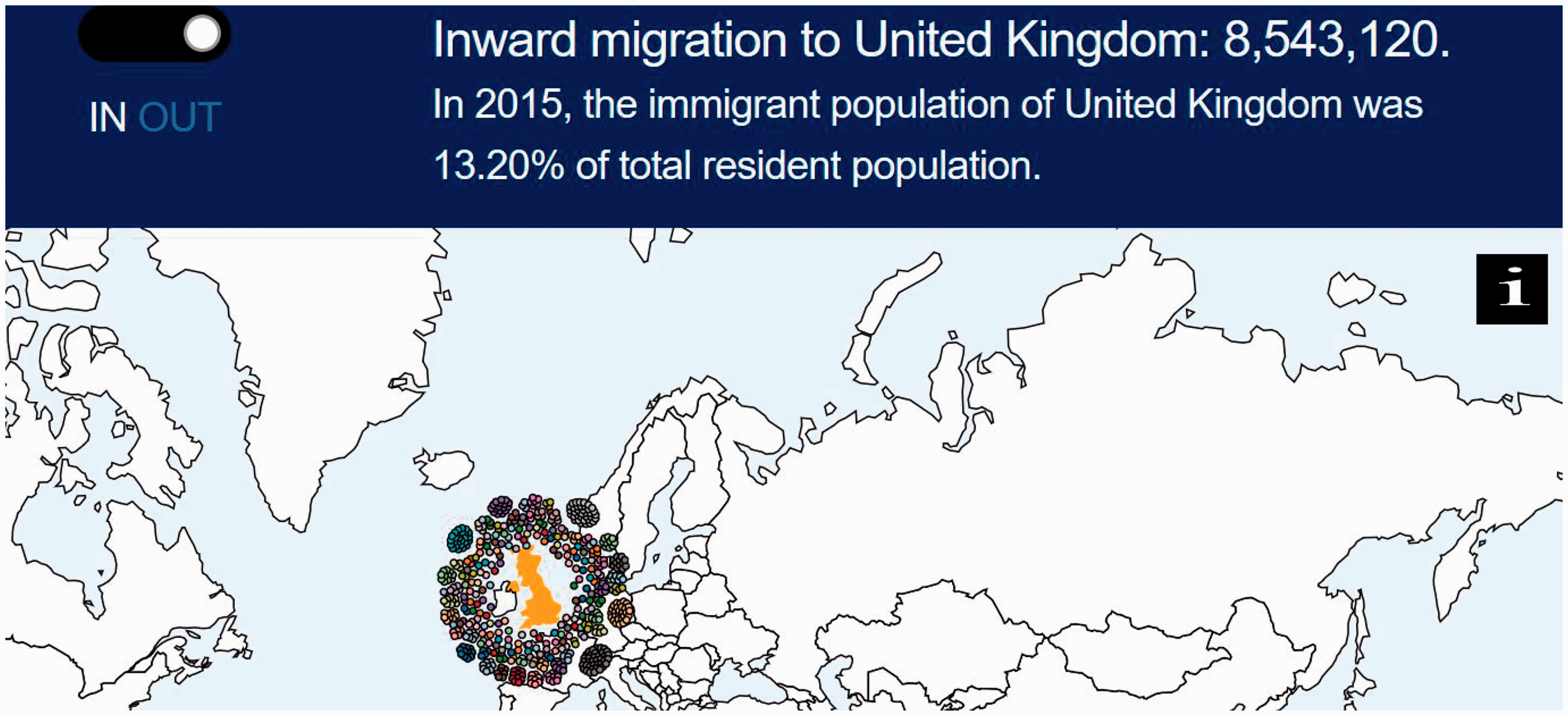
GMFIA. Source: Screenshot taken by the authors. https://www.iom.int/world-migration (accessed 9 October 2017).
What the GMFIA and similar migration visualization tools demonstrate is that the field of migration management features a politics of ignorance in regards to the known limits of quantifying migration. Combing contributions from ignorance studies (Gross and McGoey, 2015) with work on the performativity of methods in science and technology studies (STSs), we argue that the GMFIA does not just represent an external reality called “world migration.” We rather understand this “visualization tool” as a digital device that helps to enact migration in the world as a reality in a particular way (Law, 2008; Mol, 2002; Ruppert et al., 2013). More precisely, the GMFIA enacts migration—through the provision of seemingly accurate, coherent figures—as a reality that can be managed because it can be precisely known and quantified. But this enactment is only possible through the production of “strategic unknowns” (McGoey, 2012a) about the known limits of quantifying migration. As such, the GMFIA supports the IOM’s agenda which has been promoting the paradigm of migration management since the 1980s.
The IOM describes itself as an international organization that promotes “humane and orderly migration” in a way that “benefits migrants and society.” 3 It has been repeatedly demonstrated, however, that the IOM’s activities aim at the regulation of migratory flows according to the interests of nation-state governments which fund most of the IOM’s activities (Andrijasevic and Walters, 2010; Ashutosh and Mountz, 2011; Georgi, 2010; Pécoud, 2018). Importantly, the paradigm of migration management fuels—in tandem with the turn toward evidence-based policy-making—a quest for more and better knowledge on migration, especially in terms of its quantification (Boswell, 2009; Geiger and Pécoud, 2010). The migration management paradigm contributes to this shift because it renders the government of migration as a question of expert knowledge (Andrijasevic and Walters, 2010).
Quantification practices like migration statistics play, in turn, a key role in the demonstration of expertise due to the authoritative power of numbers which imbue their producers with the aura of scientific exactitude (Espeland and Stevens, 2008; Hansen, 2015; Hansen and Porter, 2012; Porter, 1995; Takle, 2017). This explains why many actors in the field of migration management have become keen producers of numerical facts. The annual Risk Analyses of the European border agency FRONTEX, the IOM’s annual World Migration Reports and the Global Appeal Reports by the United Nations High Commissioner for Refugees (UNHCR) all build their narratives around figures, tables, and charts. The representation of migration as a series of numerical facts serves a twofold purpose. First, it allows agencies like the IOM to present themselves as competent actors with the expertise to deliver projects of migration management. Second, the numbers circulated in reports, press releases, and visualizations like the GMFIA enact migration as a single, coherent and therefore knowable and manageable reality, thus reproducing one of the very doxa of the field of migration management. Our analysis of the GMFIA supports, however, an alternative enactment of migration as a ghostly and slippery reality that defies attempts to quantify it.
The article’s contribution is twofold: First, it advances the enactment agenda in STS, which studies how knowledge practices perform the realities they allegedly only study and describe, by highlighting the important role that the production of ignorance plays in the enactment of realities. In line with recent contributions to ignorance studies, the article thus underscores the productive nature of ignorance and nonknowledge (Aradau, 2017; Gross, 2012, 2016; Gross and McGoey, 2015; McGoey, 2012a). Building on the work of McGoey (2012b) on strategic ignorance, the article contributes, secondly, to ignorance studies by outlining four specific practices through which strategic unknowns are produced.
In the following we develop these arguments by tracing the data that informs the GMFIA back to its sites of production. To concentrate the analysis on just one visualization tool with a global scope allows us to study in detail how “strategic unknowns” (McGoey, 2012a) about the known limits of quantifying migration are produced in context of the GMFIA. Although there are numerous other visualization tools, like those to be found on the IOM’s Migration Data Portal or UNHCR’s Interactive Dataviz, we chose the GMFIA for the following reasons: First, it is directed to a wider public. Second, the GMFIA combines the authority of numbers with the persuasive power of maps to enact migration as a coherent, manageable reality. Finally, we focus on the GMFIA because its host, the IOM, is currently the most important actor in the field of migration management, which we understand with Pierre Bourdieu as a field of struggle in which various think tanks, border agencies, international and nongovernment organizations compete over influence, funding, and agendas (Bourdieu and Wacquant, 1992). 4
The data we build our argument on come from a research project called “ARITHMUS – How Data Make a People” that studies efforts to harmonize and innovate population statistics in Europe amidst methodological changes in light of technological and political developments. We have conducted a multi-sited, collaborative ethnography in which we have studied the working practices of statisticians, data scientists, and other stakeholders through interviews, participant observations, organization of collaborative workshops, and analysis of documents, reports, and statistical manuals. The following analysis focuses particularly on the production of migration statistics at four national statistical institutes (NSIs): the Central Statistical Bureau of Latvia (CSB Latvia), ONS, Statistics Estonia (SE), and the National Statistical Institute of Turkey (Turkstat). Methodologically, the focus on members of the European Statistical System (ESS) makes sense because the ESS resembles a “hard case” insofar as it is regarded as one of the most advanced, harmonized, and robust statistical systems in the world (Singleton, 2016; Takle, 2017). 5
After outlining our understanding of the relationship between expertise, knowledge, and ignorance, we elaborate on four different practices that are mobilized for producing strategic ignorance. The second section illustrates how the known divergence between reported emigration and immigration events is ignored in the GMFIA through a practice we call omission. In the third section we look at the compression of different accounts of migration into one “world migration map” and the deflection of knowledge about the specificities of different methods. In the fourth section, we show that metadata reports constitute key sites for the production of ignorance as they are used to sanitize the statistical production process of any messy moments.
The politics of expertise and the strategic production of ignorance
The demonstration of expertise, understood as highly technical, specialized knowledge, plays a central role in the competition over authority, funding, and influence in the field of migration management (Boswell, 2009: 7). The central role assigned to expertise is not surprising given that in any policy field, governance is “inherently bound up with knowledge claims about that which is to be governed” (Sending, 2015: 8). In The Political Uses of Expert Knowledge, Christina Boswell (2009) writes, organizations like the IOM are “fundamentally concerned to secure legitimacy from relevant actors in their environment” (11). However, the primary aim of the quest for expertise is not necessarily improving the outputs of migration policy. Rather, organizations produce and display expert knowledge to increase their legitimacy and bolster their “claim to resources or jurisdiction over particular policy areas” (Boswell, 2009: 7). In Bourdieusian terms, expertise resembles a form of cultural capital that may allow an actor to attain the status of an “epistemic authority” in a given field. An epistemic authority has the capacity to shape agendas and attract funding in that field “by virtue of possessing theoretical knowledge [and] being [regarded as] a reliable source of information or a skillful practitioner of a certain craft” (Geuss, 2001: 38). Importantly, expertise is not a fixed attribute of an organization. Instead, organizations like the IOM need to constantly perform themselves as knowledgeable, competent actors through publication of reports and studies, maintenance of research units, digital devices like the GMFIA, and other knowledge practices. The reason is that expertise is a product of politics and culture and therefore context-specific and mutable (Jasanoff, 2003: 159).
To perform themselves as competent and showcase their expertise, many actors in the field of migration management engage in quantification practices thanks to the authority granted to numerical facts and their producers. Migration statistics belong to the “numerical operations” that promise to make certain aspects of social life—in this case migration—“transparent and governable” (Hansen, 2015: 204). Hence, “[a] shift to numbers implies […] a shift towards accuracy and truth, and this plays an important role in the legitimation and control of power” (Hansen and Porter, 2012: 415). The mobilization of numerical facts as a source of expertise is intensified by recent calls for “strengthening evidence-based policy making” in the field of migration management through more and better statistics on migration (e.g. ICMPD, 2013). These calls have intensified in the context of the availability of unprecedented quantities of digital data due to the introduction of innovative surveillance and information technologies for purposes of border and migration management, such as biometric databases, or satellites and UAVs for the monitoring of borders (Tazzioli, 2016). They have also received a boost by the promise to produce more reliable and timely migration statistics with new methodologies based on various types of big data such as Google searches or mobile positioning data (Scheel and Ustek-Spilda, 2018).
In general, numbers and statistics, and the colorful charts and neat tables in which they are presented, resemble veritable “technologies of truth production” (Urla, 1993: 819). They endow otherwise diffuse social processes like migration with the quality of quantifiable objectivity by constituting them as countable “matters of fact.” One important source of the “quantitative authority” numbers is the influential epistemology of “metrological realism” (Espeland and Stevens, 2008: 417). Following this epistemological register, statistics measure objects that exist independently of the practices used to quantify them. Thus, the reality-status of abstract and often diffuse social processes (e.g. migration) “[are] presumed to be as permanent and real as any physical object” (Espeland and Stevens, 2008: 417). Consequently, a presumed external reality becomes the yardstick for the accuracy, precision, and reliability of statistics that are conceived of as measurements (Desrosières, 2001). In short, metrological realism confirms the central assumptions of “Euro-American common sense realism” which presumes a definite, singular, and coherent reality “out there [that] substantially precedes our actions and attempts to know it” (Law, 2012: 156). This reality effect of metrological realism is particularly powerful when the authority of numbers is combined with the persuasive power of maps. For maps like the GMFIA suggest, precisely because they promise a total “God’s eye-view” on the world that “represents ‘the real’” (Pickles, 2004: 13), a complete and all-encompassing knowledge, in this instance, of “migration in the world.” Hence, metrological realism resembles an epistemic cornerstone of migration management that allows its advocates to promote their policy recipes as universal “solutions” which can be applied in any context. As such, methodological realism helps to legitimize catch-all-policies and to marginalize alternative policy options.
To challenge this common-sense realism and its political implications, we adopt a constructivist approach that understands statistical practices as performative. Drawing on STS-scholarship on the concept of enactment (Law, 2004; Mol, 2002), we argue that quantification practices like statistics do not just count or measure a reality that exists out there. Rather, they help enact the object they set out to measure as an intelligible reality. Likewise, critical cartographers have demonstrated that “maps do not just represent space and place, but create them” (Cidell, 2008: 1208; see also Pickles, 2004; Wood, 1993). Due to their performative effects, maps—especially those produced for popular consumption—embody and promote the interests of their producers (Wood, 1993). Importantly, the conception of quantification and other knowledge practices as performative opens up a political space that concerns the enactment of the real, a space Annemarie Mol (2002) calls “ontological politics.” If realities do not exist outside the time and place of specific practices that enact them, then different practices enact different versions of the real (Law, 2009: 242). This calls for an “empirical ontology” which attends to the specifities of practices and particularities of realities (Law and Lien, 2012). Moreover, if we start from the idea that different quantification practices enact different versions of the real, then the enactment of migration as a single, coherent reality by visualizations like the GMFIA ceases to be an expected, self-evident outcome. It rather becomes an accomplishment that hinges on the production of strategic ignorance about the known limits of quantifying migration.
By highlighting the importance of ignorance, this article seeks to advance the enactment agenda, which has so far mostly focused on knowledge and representational practices in the doing of realities. Less attention has been paid to the role of ignorance and nonknowledge in the enactment of realities. To illustrate this point we draw on contributions to ignorance studies which investigate ignorance and nonknowledge as “regular” rather than “deviant” or exceptional features of knowledge production and decision-making (Gross and McGoey, 2015: 4). Yet, to date these discussions lack a coherent, agreed-upon nomenclature (Smithson, 2008). While some scholars use ignorance and nonknowledge interchangeably (e.g. Kleinman and Suryanarayanan, 2013: 495), others distinguish between the two (e.g. Gross, 2012) or develop taxonomies of different types of ignorance and nonknowledge (e.g. Aradau, 2017; Beck and Wehling, 2012; Gross, 2016). As the name of the scholarly field suggests, ignorance has gained acceptance as the overarching term. Ulrich Beck and Peter Wehling (2012: 53) note, however, that ignorance carries negative connotations and related moral judgments in the sense of active disregard. Therefore, they prefer to speak of nonknowledge. Furthermore, Claudia Aradau (2017) argues that “the very use of ‘ignorance’ as an overarching term risks limiting attention to how different modes of nonknowledge are enacted […]” (332), as the focus is on what has been ignored rather than how and why. Following Aradau, we thus understand ignorance as a particular type of nonknowledge that is actively produced as it involves the obfuscation or suppression of otherwise available knowledge. Hence, while nonknowledge refers to various forms and states of not-knowing, including those resulting from an incapacity to know, we reserve the term ignorance for actively generated forms of nonknowledge.
However, in order to avoid allusions to any “conspirational logic,” which Scott Frickel and Michelle Edwards (2014: 216) identify in earlier works in ignorance studies, we build on Lindsey McGoey’s (2012b) notion of “strategic ignorance.” McGoey emphasizes that ignorance is productive and not just the negative side of knowledge. She shows that actors may actively try to nurture and preserve ignorance to use it as a resource to advance their interests be it in claiming more funding, denial of responsibility, or assertion of expertise (McGoey 2012b: 555). Importantly, McGoey emphasizes that such a production and use of ignorance may be strategic and deliberate, but not necessarily conscious. Rather, the production of strategic ignorance may be tacit and distributed, when, for instance, it would be more advantageous to avoid troubling knowledge, in the face of social taboos or organizational and professional pressures (McGoey 2012b: 557, 559).
To emphasize McGoey’s stance that strategic ignorance is not necessarily the outcome of a conscious, orchestrated plan, and to retain a safe distance from conspiracy theories, we show that the production of strategic ignorance can also result from the nontransfer of knowledge from one epistemic community to another (Schiebinger, 2005). This nontransfer may result from the fact that different professional or intellectual fields of practice deploy—and are partly defined through—distinct epistemic forms, understood as “the suite of concepts, methods, measures and interpretations that shapes the ways in which actors produce knowledge and ignorance in their professional/intellectual fields of practice” (Kleinman and Suryanarayanan, 2013: 492). This is why different fields of practice may develop distinct “epistemic cultures of nonknowledge” over time (Böschen et al., 2010). One crucial source for nontransfer of knowledge between different fields of practice is data friction—the moments of distortion, reinterpretation, and loss that may occur when “data move between people, substrates, organizations, or machines” (Edwards et al., 2011: 669).
In the remainder of this article, we look at the GMFIA to show how the production of ignorance features in the enactment of migration as a precisely quantifiable reality. Our analysis allows us to advance McGoey’s work on strategic ignorance by showing how strategic unknowns are produced through four distinct practices: omitting, compressing, deflecting, and sanitizing. Furthermore, our conceptual framework permits us to illustrate that this production of ignorance is strategic in a twofold sense: First, it helps to secure the doxa of the field of migration management, namely the belief that migration is something that can be ordered and managed according to certain policy objectives. 6 Second, individual actors in the field of migration management produce strategic unknowns about the known limits of quantifying migration to increase the legitimacy and force of their expertise in order to improve their relative position in the field.
Entries, exits, and unknowns
Inconsistencies between the numbers of migrants reported by different countries are a known issue in migration statistics. In theory, each emigration event from a country should correspond to an immigration event in the receiving country. This is reflected in the 1998 United Nations Recommendations on Statistics of International Migration where an international migrant is defined as a person who moves to a country other than that of his or her usual residence for a period of at least a year (12 months), so that the country of residence effectively becomes his or her new country of usual residence. From the perspective of the country of departure, the person will be a long-term emigrant and from that of the country of arrival, the person will be a long-term immigrant. (see also UNECE, 2015: 137; UNSD, 1998: 10)
However, any mismatches between recorded immigration and emigration events are bracketed out in the GMFIA. If one compares the recorded emigration events of a given country, like Latvia, with the recorded immigration events of the corresponding destination country, like the UK, the numbers match perfectly on the GMFIA: 66,046 people. 8 Hence, the GMFIA simply omits this known weakness of migration statistics by providing perfectly matching figures for emigration and immigration. This raises the question how this perfect correspondence is achieved.
Regarding the origin of the data informing the visualization, the GMFIA provides only scarce information to users. Only if they follow a link to an external webpage, users might find out that the data were taken from the 2015 edition of a database on Trends in International Migrant Stock by the United Nations Department of Economic and Social Affairs (UNDESA). Here, the crucial point is that the UN database only provides data on stocks of immigrants in a given country and that the data have simply been equated in the GMFIA with the number of emigration events in corresponding countries of origin. Through this equivalence the known inconsistencies between reported emigration and immigration events are omitted with the effect that migration is enacted as a single, coherent, and precisely measurable reality.
One reason that may justify this omission is that data on immigration events in receiving countries are usually regarded as “more reliable” than data on emigration events in sending countries (Fieldwork Notes, Statistics Norway, April 2017; see also UNECE & Eurostat, 2010: 7). However, “receiving country data should not always be considered better than sending country data” (De Beer et al., 2010: 471). Hence, the creation of an equivalence between recorded immigration and emigration events by using the former as a stand-in for the latter is methodologically questionable.
As noted in the “Introduction” section, ONS had to revise both the population size of the UK and migration statistics after the 2011 census after it had diagnosed “a substantial underestimation” of immigration from eight new EU member states in its migration statistics preceding the census. Another country that revised its migration figures after the 2011 census was Latvia, one of the eight countries of origin identified by ONS as a source for the “significant underestimation” of immigration to the UK. In Latvia the 2011 census results indicated a population size that was 155,000 or 7% smaller than the previously published population size based on the cohort component method (CSB Latvia, 2015). The latter adjusts the population size of the previous census on an annual basis by recorded births, deaths, and net-migration figures. An analysis of the divergence cites “unregistered emigration” as the main reason for this discrepancy (CSB Latvia, 2015: 3). While the UK is considered an important destination country of Latvian emigrants, the exact number of Latvians living in the UK remains unknown. Since the IPS, the principal method for migration statistics in the UK, extrapolates the number of immigrants from a particular country from a small number of migrants identified at the border, “it can only produce estimates with margins of error rather than pinpoint numbers” (Migration Observatory, 2011: 4). Hence, statisticians resorted to a different data source to assess how many Latvians had emigrated to the UK through so-called mirror statistics on recorded immigration events in the UK: the number of national insurance numbers that have been allocated to Latvian citizens in the UK in the reference year (interview CSB Latvia, October 2016). Nevertheless, these data can “only be used to evaluate the general trend” because national insurance numbers are also given to people staying less than one year (CSB Latvia, 2015: 7). Consequently, this method is haunted by a similar problem of unregistered emigration, since immigrants may also re-emigrate (either to another country or their country of origin) without notifying authorities in the UK. Thus, “the mirror [recorded immigration events] reflects biased images [of emigration events in countries of origin],” as a statistician of Eurostat put it in a presentation on migration statistics (Fieldwork notes, Conference of European Statisticians in Paris, April 2014).
What these examples demonstrate is that the establishment of an equivalence between recorded immigration events in a receiving country and recorded emigration events in a corresponding sending country is based on the methodologically questionable omission of the known incoherence between the two. While the IOM’s GMFIA suggests that the number of Latvian immigrants in the UK can be quantified precisely, the difficulties of ONS and CSB Latvia to provide a reliable estimate of this migration flow indicate that the exact number of Latvian migrants living in the UK is not known by statistical authorities. Ultimately, migration emerges as a “slippery” (Law and Lien, 2012) and “ghostly,” indeed “more-than-single” reality (Walters, 2014: 103) that regularly defies and escapes statisticians’ attempts to quantify it.
Multiple methods, different numbers, single migration reality?
If users of the GMFIA trace back the origin of the data informing the IOM’s “migration visualization tool” they will learn from the documentation on the UN webpage that data from various sources have been combined in the dataset, including censuses, surveys, and administrative registers (UNDESA, 2015: 7). Yet, this cannot be done without ignoring important methodological specificities. Ignoring methodological heterogeneity is necessary because the usage of different definitions, methods, and data sources makes comparison of migration data “difficult and confusing” (Wisniowski et al., 2013: 460). This concerns both spatial comparisons between countries and temporal comparisons in the migration time series of one country (Herm and Poulain, 2012). Consequently, the GMFIA’s representation of “world migration” as a series of precise, stable, and comparable figures emerges as an accomplishment. In the following we show how different versions of migration are negotiated at SE before attending to how the GMFIA deflects knowledge about the heterogeneity of statistical methods.
According to the GMFIA, Estonia hosts 202,348 immigrants. If we hover over the colored circles which visualize the composition of Estonia’s immigrant population we learn that 143,677 people from Russia, 1271 people from Germany, 1 person from Sudan, and 13 people from Nigeria reside in Estonia. Through the provision of these very exact figures migration appears as something that can be precisely quantified.
Yet, this account of migration requires that multiple efforts and methodological changes to quantify migration are ignored. In 2013, SE reported 6740 emigrants and 4098 immigrants and in 2014, 4637 emigrants and 3904 immigrants (SE, 2015). 9 In 2015, however, 15,413 immigrants and 13,003 emigrants were reported—an increase of nearly 400% in immigration and 300% in emigration. In press releases, Estonian statisticians attributed this “jump” to a change in methodology (SE, 2016a, 2016b). Until 2016, SE mainly relied on recorded migration events in the Estonian population register (RR). However, the low number of reported migration events was increasingly regarded as implausible by statisticians as well as policy makers and demographers (interview SE, December 2015).
Statisticians cited unreliable RR-data as the principal reason for the low figures. Many individuals would simply not notify authorities about their departures. Furthermore, statisticians pointed out an issue with the computer software used for producing migration statistics. The software required statisticians to enter a person’s previous country of usual residence to include that person in the immigrant population. While introduced with the intention of obtaining as much detailed information on the immigrant/emigrant population as possible, this requirement produced a significant “undercount” of immigration from EU member states (two interviews SE, March 2016).
Hence, statisticians developed a new method, the residency index (RI), for the production of migration statistics. The RI is based on a relatively simple idea. If a person with a record in the RR does actually live in Estonia, it is assumed she will engage in more transactions with government institutions than a person who does not reside in the country. These transactions will leave traces behind (so-called signs of life) in various administrative registers (Tiit and Maasing, 2016). To illustrate, if a person studies in Estonia, she will have a record in the education register. If she is employed, she will pay taxes. If she is retired, she will receive a pension and so forth. Thanks to the unique personal identification number that is used across all administrative registers, Estonian statisticians can link data from 14 different registers to calculate a RI for each person with a record in the RR. The value of a person’s RI ranges between 0 and 1, depending on the number of the signs of life she accumulates across all government registers in a given year. The higher the value of the index, the higher is the probability that she is a permanent resident of Estonia. To be considered a resident of Estonia, a person’s RI has to be above the threshold of 0.7 (Tiit and Maasing, 2016).
In press releases SE (2016a) promotes the RI-model as “reflect[ing] reality more accurately.” The change in methods also made it necessary to address the software issue as the RI-model “discovered” many EU immigrants whose previous country of residence was unknown (interview SE March 2016). Hence, Estonian statisticians claim—in the language of metrological realism—that the new methodology better accounts for “immigration of European citizens, which the previous methodology reflected to a smaller extent” (SE, 2016b).
This framing of the RI-model as “more accurate” indicates that statisticians assume an objective, external reality that can be used as a yardstick to assess their methods in terms of “accuracy” and to hierarchize between them. This hierarchization permits statisticians to assemble migration into a single, coherent reality. This illustrates Annemarie Mol’s (2002) observation that “if two objects that go under the same name clash, in practice one of them will be privileged over the other” (47). In the following we describe how this orchestration of different versions of the real is done in practice through the concepts of “over-” and “under-coverage.”
In Estonia the old methodology for migration statistics was problematized after the 2011 census as entailing a significant under-coverage of emigration. The census questionnaire included a question on emigration of any household members. Results suggested that more people emigrated than previously calculated with the cohort component method on the basis of RR-data. By diagnosing an under-coverage in the RR-based methodology, the census was elevated to the position of the superior method (Tiit, 2012). However, since the census is only conducted once per decade, it is unable to provide a methodology for SE’s annual migration statistics. Hence, statisticians developed the RI-model and subsequently declared this new methodology as the new gold standard. An article published in SE’s house journal assesses, for instance, the registration behavior of people in Estonia, based on a comparison between RR-data and calculations with the RI-model. The article stresses that “in the case of a discrepancy between the two datasets, the data according to the index, and not the population register, are considered accurate” (Meres, 2017: 72).
The establishment of hierarchies between different statistical methods highlights, however, that over- and under-coverage do not express a relation to an objective, external migration reality. They rather express relations between different versions of migration that have been produced with different methods. The under-coverage of emigration events by the RR-based methodology only emerged as a problem when a second methodology—the 2011 census—was brought into play. Hence, the diagnosed under-coverage in the RR-data expresses a relation to census data and not to an external reality. This relational character of over- and under-coverage shows that there is no objective migration reality that could provide a standard to assess the quality of statistical methods since any migration reality only exists in relation to the practices and methods that are used to know it.
However, the invocation of over- or under-coverage permits statisticians to establish hierarchies between different versions of migration that have been produced with different methods. This hierarchization is important groundwork for the next steps that are needed to comply with the convention of common-sense realism that there can only be one, more, or less coherent migration reality: the discontinuation of any method that has been established as inferior and the compression of essentially different versions of migration into one time series. All that remains is a significant increase in migration events in 2015, a “jump” in the time series of Estonia’s migration statistics which may be, if interpreted carefully, attributed to a change in methodology (Herm and Poulain, 2012).
The crucial point concerning the GMFIA is that changes in methodology within one NSI, as well as the usage of different methodologies across NSIs, imply that migration is not comparable across time and space (UNECE, 2014). The analyst is essentially dealing with different versions of migration. For what migration is—and how large or small in terms of numbers—“depends on how ‘it’ is being done in practice” (Law and Lien, 2012: 366). Depending on the methodology used, emigration from Estonia can be a “yes” to the question “has any close relative of yourself or of a member of your household […] left Estonia in 2000 or later and is currently living abroad?” (Tiit, 2014: 85); a recorded emigration event in the population register or a RI value of less than 0.7 in two consecutive years. And as described in the previous section, other NSIs use different methodologies like an estimation method based on administrative data (CSB Latvia) or a sample survey (ONS). These are all different methods that enact not only different accounts, but different versions of migration. The IOM’s GMFIA ignores all these methodological differences by compressing essentially different versions of migration into one “world migration map.”
Transparency—The (unfulfilled) promise of metadata
This section attends to metadata to elaborate two more practices for the production of strategic ignorance: deflection and sanitizing. The purpose of metadata is to explain the production process of datasets to their users. Ideally, metadata should comprise all “additional descriptions necessary to understand data” (Edwards et al., 2011: 671). Hence, principle 15 of the European Statistics Code of Practice calls on statisticians to present “statistics and the corresponding metadata […] in a form that facilitates proper interpretation and meaningful comparisons” (Eurostat, 2011: 8). Thus, the provision of metadata is set as a proxy for accountability and transparency of official statistics. This “data-driven transparency” conceives of metadata as pure, preinterpretative information that is produced and communicated free of any interest and that can therefore elucidate the production process (Birchall, 2015). Yet, in this section we show that metadata fall short of this promise. To this end we trace the chain of references to metadata on the data underpinning the GMFIA.
As noted above, the GMFIA provides only scarce information about the data informing its visualization. All we can learn from a description below the map is that “the underlying data for the map was published by the UNDESA in 2015.” 10 Moreover, the app does not provide any information on how these data were translated into a visualization. In this way the establishment of an equivalence between emigration events in countries of origin and numbers on the stocks of immigrants in host countries is omitted. Users can only learn about this decisive methodological move if they follow the link to an external webpage and read the documentation of UNDESA’s International migrant stock 2015 dataset. 11 In this way the GMFIA suppresses information that would be essential for “proper interpretation and meaningful comparisons” (Eurostat, 2011: 8) of the provided data.
This method for producing strategic ignorance is based on the deflection of any knowledge that may destabilize the enactment of migration as a quantifiable reality. Deflection shows that metadata are shaped by institutional interests and agendas. Moreover, the strategy of deflection illustrates that data-driven transparency places the burden of tracing the origin of data and assessing its quality on the individual user whose “experience of agency in this respect is reliant upon technological competence” (Birchall, 2015: 190), most notably statistical literacy. In this way data-driven transparency facilitates the production of strategic ignorance about the known limits of quantifying migration.
If users do however retrieve relevant metadata from the two linked UN webpages, they will discover that information provided on the sources of UNDESA’s dataset is generic and incomplete. For Estonia and Latvia, for instance, there is the same text block: “Based on official estimates of international migration, and estimates derived as the difference between overall population growth and natural increase through 2015” (UNDESA, 2017: 27, 46). This information does certainly not offer all “additional descriptions necessary to understand [the provided] data” (Edwards et al., 2011: 671). It rather illustrates that metadata tend to be partial and subject to data friction.
The production of strategic ignorance through data friction may also occur as a field effect through nontransfer of knowledge from one epistemic community to the next. In case of the field of migration management there is, for instance, a nontransfer of knowledge from the field of official statistics because statisticians also mobilize metadata as a strategy of sanitizing. During our research we frequently encountered metadata that were outdated and incomplete. We also encountered metadata reports where whole sections had obviously been copied and pasted either from reports of previous years or even from metadata reports of other NSIs. This indicates that statisticians do not invest as much time and care in the provision of metadata as the notion of data-driven transparency suggests.
One factor that explains this is production pressure. Although many statisticians describe metadata as “absolutely crucial,” some of them also regard the task of producing it as “a drag [burden]”; while others note that “it is crucial to have it, if only I did not need to do [write] it” (Field notes, Turkstat November 2015). Statisticians are often struggling to meet deadlines of a tight annual production schedule and often lack the time needed for compiling comprehensive metadata (Interview SE, June 2016).
There is however another reason for incomplete metadata: rather than making the statistical production process fully transparent to users, statisticians use metadata to sanitize accounts of the statistical production process of any messy moments that may compromise the authority of the published figures or their producers. This is possible because metadata are potentially infinite as statisticians emphasize: “In methodology it is always a question of details, so the question is how deep do you go into the details when you describe the methodology? … who will read 5000 steps in SPSS?” (Interview SE, March 2016). Hence, precisely because they have to be selective, statisticians can provide metadata in a way that sanitizes the statistical production process of any messy, potentially compromising moments in order to represent it as a methodologically rigorous, replicable procedure. No metadata on Estonia’s migration statistics mention, for instance, the issues with the computer software discussed earlier, despite the massive under-coverage of immigration events implicated by it. Likewise, the issue of unregistered emigration is only mentioned in metadata from 2016 onwards to justify the introduction of the RI-model, but not in metadata of previous years.
The reason for this production of strategic ignorance through sanitizing resides in what Alain Desrosières describes as the “metadata paradox.” He likens the provision of metadata to the exhibition of the scaffolding of a building and concludes that “as with great monuments, exhibiting these ‘scaffoldings’ may […] blur if not the beauty at least the argumentative efficiency of the factual evidence consisting in the publication of a plain, bare figure” (Desrosières, 2009: 317). This explains why the politics of expertise in the field of official statistics also feature the production of strategic ignorance. This results in a partial nontransfer of knowledge about problems of quantifying migration from the field of official statistics to the field of migration management.
In sum, our analysis suggests that the production of strategic ignorance through metadata is distributed between different professional fields. It confirms that the demands, (informal) rules, established procedures and protocols of different professional and intellectual fields of practice shape how and what kind of ignorance and nonknowledge are produced by the actors of a field of practice (Kleinman and Suryanarayanan, 2013). In official statistics metadata reports function as means of purification that sanitize the statistical production process of any aspects that might compromise the authority of the published figures. We regard this production of strategic unknowns as an effect of the field of official statistics where the epistemic community of statisticians has to perform according to the expectations of users to secure legitimacy and funding. And many users of official statistics are primarily interested in numerical facts they can rely on for decision-making, rather than lengthy descriptions of methodological issues that cast doubts on the reliability of the published figures (interview SE, March 2016). This is why sanitizing metadata has become part of the “epistemic culture of nonknowledge” (Böschen et al., 2010) of the field of official statistics, just as the deflection of knowledge about the known limits of quantifying migration constitutes a central element in the epistemic culture of nonknowledge of the field of migration management.
Conclusion
This article has shown how the GMFIA enacts migration as a single, coherent, and measurable reality by producing strategic ignorance about the known limits of quantifying migration through four different practices: omission, compression, deflection, and sanitizing. To conclude, we discuss the implications of this enactment of migration for the “politics of international migration management” (Geiger and Pécoud, 2010).
With Lindsey McGoey we understand the production of ignorance about the known limits of quantifying migration as strategic in a twofold sense. On the one hand, individual actors like the IOM produce this ignorance to increase the legitimacy and force of their expertise as a way to improve their position in the field of migration management. In case of the GMFIA, the strategic nature of the production of ignorance is highlighted by the fact that, since 2015, the IOM maintains a Global Migration Data Analysis Centre (GMDAC) which hosts various “experts” who occasionally highlight the known limits of quantifying migration (Ardittis and Laczko, 2017). 12 This shows that the enactment of migration as a precisely measurable reality through devices like the GMFIA does not contradict the showcasing of the “ever-perfectionability” (Rocha de Siqueira, 2017) of existing data practices for quantifying migration. For what is questioned by the experts of the GMDAC is not the measurability of migration, but the adequacy of existing methods available for this task. The continued relevance of numerical evidence as a source of expertise is in turn highlighted by the mobilization of statistical facts by the IOM and other stakeholders in the field of migration management who invoke the authority of numbers to justify particular projects of migration management. One example is the Assisted Voluntary Return and Reintegration Program (AVRR), which constitutes “a core activity of IOM” in Greece. 13 The IOM’s AVRR Annual Report cites, for instance, the number of “131,847 refugees and migrants” that have entered Greece in 2016 to diagnose an “imminent need for AVRR information and assistance throughout Greece” (IOM Greece, 2017: 21).
Yet, the production of ignorance is also strategic insofar as it secures the doxa of the field of migration management, most notably the belief that migration is something that can be ordered according to certain policy objectives. In this context, the production of ignorance about the known limits of quantifying migration emerges as the combined effect of different professional fields of practice. Whereas statisticians tend to provide metadata in a way that does not compromise the authority of the published figures, actors of the field of migration management have ample reason to ignore any knowledge that may destabilize the enactment of migration as a measurable, orderable reality. Indeed, to tolerate any knowledge that enacts migration as a multiple, messy reality would cast doubts on the possibility to manage it. For what is difficult to measure is certainly difficult to manage.
This is why metrological realism and its enactment of migration as a definite, singular reality emerge as one of the central epistemic pillars of the migration management paradigm. Besides providing the evidence base for the very viability of migration management, metrological realism permits advocates of migration management to present their policy recipes as universal “solutions” that can be applied in any context world-wide. In this way metrological realism permits advocates of migration management to marginalize alternative policy options like the open borders approach (Pécoud and De Guchteneire, 2007) which, rather than ordering migration according to policy objectives of nation-states, envisages the self-regulation of migration.
Moreover, metrological realism reduces migration to a series of precisely measurable, unidirectional flows. What gets erased by this enactment of migration is the irreducible heterogeneity and singularity of migratory projects and movements (Tazzioli, 2015) and the elusive, pluri-focal character of migrants’ often “fragmented journeys” (Collyer, 2010). In this way metrological realism wipes out the subjective moment of migration. This permits advocates of migration management to ignore that “migrants have a will of their own, one that lies outside of the hands of those who wish to control them” (Sharma, 2009: 469). Hence, metrological realism supports the authoritarian potential of the migration management paradigm which is full of prescriptions of how migrants should be and where they should move (or stay) (Geiger and Pécoud, 2010).
The central role that metrological realism plays in sustaining the hegemony of migration management raises a crucial question: how to challenge this epistemic cornerstone of the migration management paradigm? A critique of particular migration numbers as inaccurate or inflated is certainly counterproductive. While such number games do exist, as the double-count of unauthorized border-crossers by Frontex on the height of the “migration crisis” illustrates (Sigona, 2015), such a critique ultimately reaffirms the epistemological register of metrological realism. What is required is a critique of metrological realism itself, and the related production of strategic ignorance about the known limits of quantifying migration. To paraphrase Robert Proctor (2008): If the power and persuasiveness of migration management rest, to a large extent, on the production of ignorance about the known limits of quantifying migration, then dismantling this power “may require the reintroduction of bodies of ignorance – hence impotence – in that realm” (22). This is the research agenda that we have tried to initiate in this article by highlighting some of the manifold issues that haunt existing attempts to quantify migration. Ultimately migration emerges as a ghostly, elusive, and slippery reality that is much less measurable and manageable than the IOM and its GMFIA suggest. Some of the challenges and issues statisticians encounter in their efforts to “measure” migration might indeed be an expression of the autonomy of migration (Mezzadra, 2011; Scheel, 2013), that is the moments of uncontrollability and excess that migrations show in relation to ever more labored efforts to manage them.
Footnotes
Declaration of conflicting interests
The author(s) declared no potential conflicts of interest with respect to the research, authorship, and/or publication of this article.
Funding
The author(s) disclosed receipt of the following financial support for the research, authorship, and/or publication of this article: This study was funded by the European Commission, Seventh Framework Programme, FP7 Ideas: European Research Council – 615588.