




Abstract
This paper examines ways of knowing “the Roma” as a category of people. It attends to mobility and its obstructions, and the ways that coincide with bureaucratic, institutional, and everyday modes of sorting and racializing groups of people. Our case study is situated in Romania. Whereas “the Roma” do not exist as a category in the Romanian national registry of citizens, mainstream public discourses regarding “Roma migration” have significantly proliferated over the past decades. Yet, how do authorities come to know “the Roma” and how do they render groups of citizens into racialized populations? We examine two bureaucratic practices in Romania, the census and the registry of citizens, and show how the latter is enacted through various “technologies of vision.” We focus on the category of “the Roma” as a material semiotic configuration enacted by various “data” regarding issues such as territorial segregation, phenotypic appearance, smell, and dialect. Situated at the intersection of Border and Surveillance Studies, Romani Studies, and Science and Technologies Studies, this paper contributes to debates about how “the Roma” are rendered visible in practices of identification and migration management in Europe.
In Europe race is resurfacing in a variety of discourses and practices. In the context of populism, xenophobia, and increasing racism on the one hand and a growing essentialization and biologization of differences on the other, attending to what race is made to be in practices in which it emerges, might help to grasp its specificities. The fact that race became a taboo issue in Europe after the Second World War does not mean that race has become obsolete (Goldberg, 2006; Lentin, 2008). Race and race categories have continued to exist in census data, research, and scientific literatures (Lipphardt, 2012). Moreover, the ways in which categories of belonging have been produced and maintained in practices of governance often enact sameness and otherness in racial terms. M’charek et al. (2014: 468) introduce the term “phenotypic other” to argue that “race is a topological object, an object that is spatially and temporally folded in distributed technologies of governance.” As such, race can neither be reduced to the body or biology, nor to ideology. It is a material semiotic object and, accordingly, enacted in situated practices as a set of relations between the body as well as other varied entities (see also M’charek, 2013).
While race is made absent in governmental classificatory practices in Romania, it is, as we show, simultaneously and ambiguously present and continues to be materialized through the sorting and classification of individuals or groups. Producing census data and registering people in state records are two fundamental practices of population governance. We particularly focus on these two practices to examine how “the Roma” are racialized and attend to the consequences of racializing bureaucratic practices.
We do not presuppose we know “the Roma” nor do we look for ways to define it. Rather, we move between different administrative practices and focus on how and when this category becomes relevant, and what kinds of visibilities and invisibilities it brings into being. By doing so, we are concerned with how these classifications enact certain categories of people as a racial group, as well as with the kinds of knowledge, markers, and identification strategies that are used in the practices of governance under discussion. Thus, we analyze how “the Roma”—as a racial category—comes into being in everyday bureaucratic practices.
While we acknowledge the importance of counting practices for revealing the (degree of) discrimination against marginalized or stigmatized groups and communities, in this paper, we discuss neither Roma self-articulation and self-representation, nor the tackling of discriminatory attitudes or mechanisms through practices of counting. Instead, we draw attention to how practices of counting and ordering rely on and reinforce certain, mostly negative assumptions about who Roma are, as well as to the impact of these often-implicit racializing practices on the groups of people involved. While doing so, just to be sure, we are not questioning Roma as a people or their ethnic identity. Instead, we are interested in how “the Roma” is racialized in bureaucratic and state practices of categorizing and governing citizens in Romania, and the lessons this case teaches us about the absent presence of race in Europe. To clearly distinguish between Roma ethnic identity and “the Roma” as a racialized category, in this paper we put the latter in inverted commas.
This paper thus explores modes of making populations visible for the Romanian authorities. These modes, we suggest, are versions of “technologies of vision” (Haraway, 1991). Vision is not about an objective “re-presentation” of a pre-given reality, a “god eye view,” but is always a partial, situated, and a “technologically” mediated practice. Statistical tools, the categories applied, and the visual representations of the phenomenon mediate between the viewer and the phenomenon observed and enact the latter in one version or another. If vision is not a neutral representation, how citizens are made visible and known has specific effects; it also delimitates groups of people whose rights to mobility might be restrained. Such groups, we argue, are constituted not only in the daily practices of producing and governing citizens by overlapping markers such as territorial location, number of children, or the lack of education, but also by physical appearances and other sensorial factors, such as smell or accent. Specific configurations of these markers help to enact these populations as racial groups; groups that could subsequently become stigmatized, criminalized, disabled, and considered as less than normal “citizens” and eventually, less than human.
The use of ethnic and racial arguments to delineate “the Roma” from the rest of society is salient for both “minority governance” and social scientists working in the field of Roma studies. But how does this (bureaucratic) category come into being in the first place? While there is an entire scholarship dealing with the precarious situation of Roma minorities in Europe, census data and statistics are rather taken for granted and are often cited to make claims about identity formation and representation, as well as about allegedly “neutral” or “a-political” developments at local, national, and European levels (but see Surdu, 2016; Van Baar, 2011a). The way in which, for instance, international governing institutions such as the European Union (EU), the World Bank, and the United Nations Development Programme frequently refer to “the Roma” as “the largest ethnic minority of Europe” is a case in point. Indeed, the problematization of the Roma in terms of their specific “ethnic” minority belonging to Europe always already involves an ambiguous minoritization and a specific biopolitical bordering within and of “Europe” (Van Baar, 2011a, 2017; Yıldız and De Genova, 2018). In this paper, we aim to contribute to the debate by scrutinizing the ways in which such numbers come into being and present themselves as knowledge objects (Galison and Daston, 2008) and as social facts that provide the basis for governmental intervention. To this end we unpack bureaucratic practices of knowing, counting, and visualizing groups of people and ask how they enact race. We use the concept of “enactment” (Mol, 2002) to clarify that race is not a unified entity that exists “out there” in nature or society. The notion of enactment helps us to underline that race is done. It comes about in specific practices as a Foucauldian effect of specific material–semiotic relations.
“The Roma” as a category can be found at various European administrative levels, such as in regulations and policies, or in earmarked budgets aimed at improving the situation of Roma (Surdu, 2016; Van Baar, 2018). Interestingly, the Romanian authorities cannot know or see “the Roma” in their policy practices, because, according to Romanian legislation, 1 the national registry does not collect data about the ethnic or religious background of its citizens. How is it possible then, that a category that is so prominently present in public and political discourses tends to disappear in the policy practices involved? Let us reformulate this paradox: “the Roma” is everywhere and nowhere. In public and political discourses, “the Roma” is not only enacted as a “European minority” optima forma, but it is also highly visible—if not hypervisible—due to the prominent and primarily pejorative role the category plays in debates about mobility and migration within the contested borders of Europe (Van Baar et al., 2019; Van Baar and Vermeersch, 2017). This is particularly the case when considering the migration of Roma from Eastern European countries, such as Romania and Bulgaria, to Western Europe and beyond. Here we deal with an ambiguous articulation of “un/free mobility” that has been dismissively qualified as “poverty migration” or “social tourism” in public and political debates throughout Europe (Fox et al., 2012; Yıldız and De Genova, 2018). However, when it comes to everyday bureaucratic practices of counting and managing people and databases in Romania, the category of “the Roma” is absent, at least officially. To explore the antagonism between the empty set of ethnic categories in the Romanian registry and the hypervisibility of “the Roma” in the media and the census, we problematize the in/visibility of “the Roma” in two bureaucratic practices, the Romanian census and the departments for “The Evidence of People and Administration of Databases” where the Romanian ID cards are issued. We start our argument by looking at how, in the media, “Roma mobilities” are largely framed through the assumed risk they pose to European security (cf. Van Baar et al., 2019). Then, we move on to two state practices, the census and the national registry of citizens, through which the Romanian state gets to know and govern its population groups. We examine how census data in Romania configure “the Roma” as a national and European minority that is different from other ethnic minorities in Romania. Subsequently, we draw on ethnographic research, conducted at a local department of issuing ID cards in Romania. This allows us to unpack how racial categories come about through the configuration of various data and (bodily) markers in the registry of citizens.
The least wanted travel the most 2 : “Roma migration”
On 17 February 2014, the British company Channel 4 broadcasted the first episode of the series The Romanians are coming (Figure 1). Timed for a period of political campaigns in the United Kingdom, the documentary series claimed to analyze the situation of Romanian migrants. However, in the first few minutes, the main character of the series introduces himself not just as a Romanian citizen, but as a member of the Roma minority or, more precisely, as a Romanian Gypsy. “In these days, you know, people are planning to go to Mars and we’re still riding horses. That’s unbelievable!” starts the narration of the main character of the documentary. “That’s the difference between nations, you see? USA is planning to go to the Mars and Gypsies from Romania ride horses. […] My name is Alex and I’m proud to be a Romanian Gypsy” (italics added).
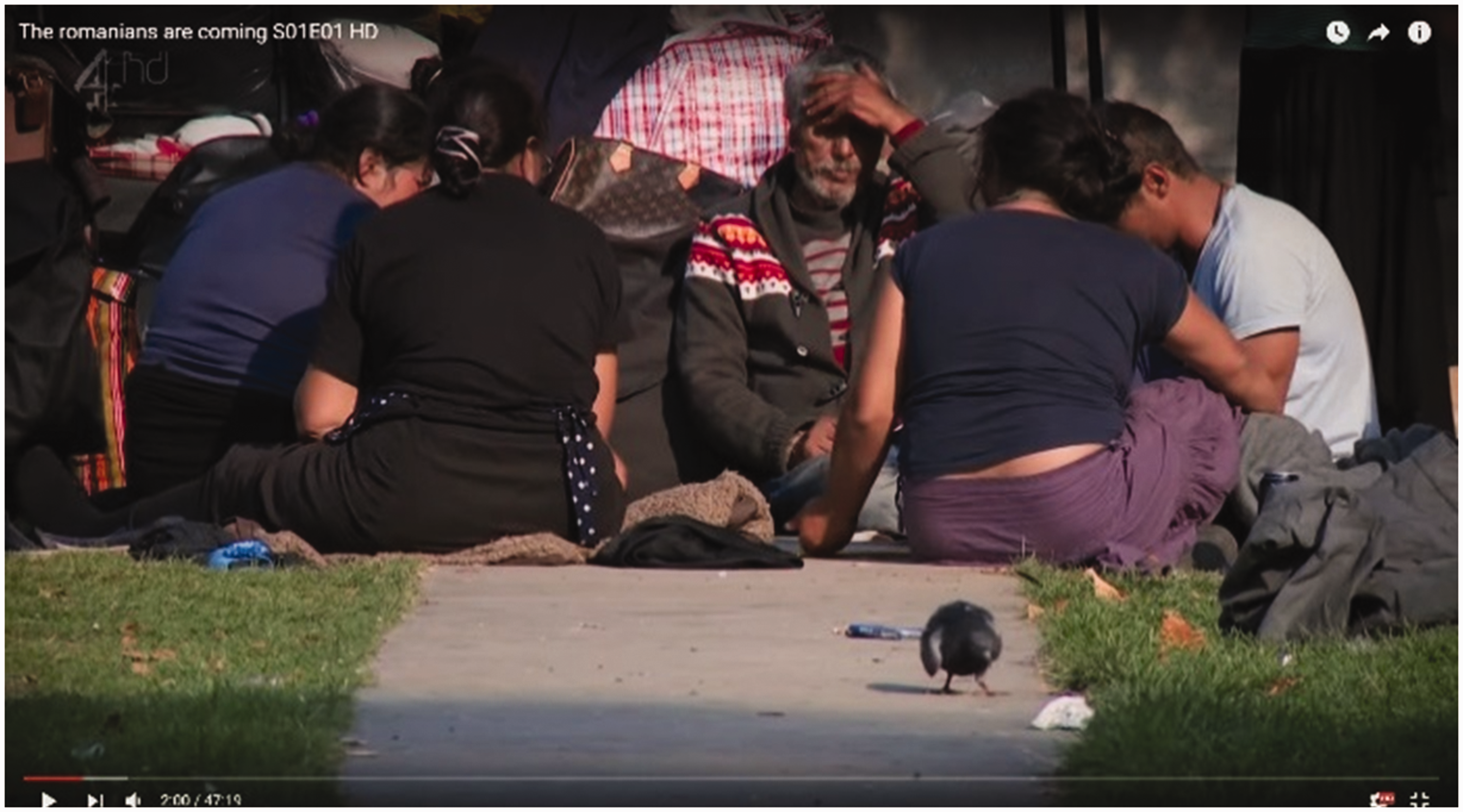
Still from the documentary The Romanians are coming. https://youtu.be/Yb1AkaKJL08.
The broadcasting of the documentary instantaneously provoked a chain of official reactions. The Minister of Foreign Affairs of Romania expressed his deep regrets for the distorted image about Romania that the documentary produces to his counterpart in Britain, while the Romanian ambassador in London condemned the series which “incites ‘hatred and discrimination’ of migrants.” 3 Outside the Channel 4’s studios, more than hundred Romanians gathered to protest against the confusion of Romanians with the Roma, holding placards “Our identity is not a joke,” “Stop discrimination,” and “We have more than one color.” At the climax of the diplomatic commotion, two Romanian deputies submitted a bill to the Romanian parliament in which they requested changing the official name of the Roma population in Romania into “Gypsy” (ţigani”) 4 to avoid further confusion, or better, further “con-fusing,” of the name “Romanian” with that of “Roma.” 5 The draft of the law was eventually rejected. However, the chain of events could be seen as an attempt of purification politics illustrating the widespread anxiety that Romania would suffer from a misrepresentation of Romanians abroad, due to an overrepresentation of “certain ethnic minorities” who have become hypervisible in media, public, and political discourses throughout Europe. The events unfolding in the aftermath of the broadcasting underline how, in popular media, a slippage between terms like “Roma,” “Gypsy,” and “Romanian” can mobilize different imaginations and can be explored for various political and ideological purposes.
Although the series The Romanians are coming elicited significant public and diplomatic outrage both in England and Romania, presenting Eastern European migrants as “Roma beggars” and “poverty migrants” coming from Romania or Bulgaria is also a common trope in Italian, French, German, and Scandinavian media, and has generally remained largely unquestioned by their mainstream audiences. The ways in which “Roma migration”—as a supposedly distinct phenomenon—is captured in media reports and instrumentalized by political actors have serious consequences, as has become tangible during repeated and ongoing evictions and expulsions of “Roma migrants” from France, Italy, and Spain (Hepworth, 2016; Van Baar, 2011b; Vrăbiescu, 2016).
The governing of “the Roma” and their mobilities has become not only a national, but also a European issue, since it has become significantly entangled with the more general trends toward the irregularization of migration to and within Europe (Jansen et al., 2015; New Keywords Collective, 2016; Van Baar, 2017). Yet, while the migration of Roma from Romania and Bulgaria is routinely framed as a concern with risk and security in Europe (Van Baar, 2018; Vermeersch, 2013), when it comes to bureaucratic practices regarding public policies in Romania, “the Roma” seems absent as a category. But how, given this invisibility, can Romanian and other governmental organizations tell apart “the Roma” and other Romanian citizens, as to monitor the mobility of the former? In an era in which the rights to free movement of Romanian, Bulgarian, and other EU citizens are protected through European legislation and officially depend on (legal) citizenship, and not on ethnic or other types of identification, what does “Roma migration” mean?
How many?
How large is “the Roma population”? This is a question that government authorities often want to address before they can begin to tackle “Roma-related” issues in a “meaningful” and “effective” way. While national censuses are the counting pro forma of the people, counting is an ordering practice that simultaneously represents and enacts (groups of) people. 6 There is a growing body of literature pointing at the fluid nature of such categorizations and the multifaceted political projects underlying them (Bowker and Star, 2000; Kertzer and Arel, 2002). Categories “make up people,” as Hacking (1986) has shown, and they have “inventive capacities” (Ruppert, 2012). Census categories and social worlds co-construct each other: “In the hands of a central authority, the category is an objectifying technique of configuring social relations and when all categories are assembled (gender, origin, occupation, income, and so on) the population comes into being” (Ruppert, 2012: 38). This is not to suggest that Roma ethnicity or identity is merely or primarily a bureaucratic invention and the result of often highly politicized expert practices of classification (see also Law and Kovats, 2018; Surdu and Kovats, 2015). The history of the diverse people who identify (or are identified) as Roma is more complex and heterogeneous, relying both on more or less violent state or nonstate practices of intervention, categorization, and monitoring, and on the interrelated, active articulation of a Roma identity by people who consider themselves for various reasons part of a larger Roma community or diaspora (Van Baar, 2011a). 7
In the case of Roma, the politics of numbers and the complex relationship between ethnic/racial categorization, knowledge formation, and policymaking has also been extensively debated (Clark, 1998; Krizsán, 2013; Messing, 2014; Surdu, 2016; Van Baar, 2011a, 2013). Of particular relevance in the context of our paper is Surdu’s (2016) study Those Who Count, in which he elaborates on the ways in which “the Roma” are produced and counted through census data. In his approach, census data are at most a “solid administrative practice” to create and fix ethnicity for the use of discourse and political action. Thinking along the lines that Surdu formulates here, we ask not only how the Romanian state knows the number of Roma in the country but we also unpack both the category of “the Roma” as it emerges from these counting practices, and the numbers themselves. While doing so, we will pay special attention to when and how the ethnic label slips into a racial one. To ground our argument, we first look at the results of the latest census in Romania, conducted in 2011 by the Romanian National Institute of Statistics.
According to the results of this census, the total population of Romania included 20,121,641 people, drawn up out of 16,792,868 Romanians, 1,227,623 Hungarians, 621,573 Roma, 50,920 Ukrainians, and smaller numbers from 13 other “ethnicities.” When circulated in media, these numbers are often rounded up to thousands and millions or translated into percentages. But the exact census data does matter. First, it enjoys the highest legitimacy when it comes to public resource allocation and it frequently forms the basis for subsequent classifications, such as policy evaluations and revisions, and the ways in which opinion polls are framed. Though usually produced by the state and, particularly since the 1990s, also and increasingly by International Organizations and NGOs, over time the data acquire a more “scientific” status; the data become a matter of “fact” (Ruppert, 2012). Perhaps most importantly, the census data about Roma assume a legitimate basis for accessing European development funds allocated specifically for Roma across Europe, Central and Eastern Europe particularly. 8
In the following, we ask, first, out of which the category of “the Roma” consists and on what kind of knowledge and (historical) practices of counting and ordering it relies and, second, to what extent these counting practices conflate ideas of ethnicity with those of race in the case of the Roma minority. What is race made to be in these practices?
Unpacking the census categories
Though more than 600,000 people were counted as Roma in Romania, this does not mean that all of these people defined their ethnicity as “Roma.” During the 2011 census, ethnicity was a self-assigned and optional category (see Figure 2). People could, if they wanted, declare their ethnic identity, and more than one million people did not wish to do so. Despite the huge variety of self-ascribed labels, in the ways in which the individual choices were processed, these answers were amalgamated into the categories of Romanian, Hungarian, Roma, Ukrainian, German, and the like. Interestingly, the category “Roma” was the most heterogeneous of all consisting of no less than 19 labels, out of which 17 were related to specific crafts associated with “Gypsy types of works” (Surdu, 2016: 135). In the census, all these labels were brought together under the single umbrella term “Roma.” We see thus how the definition of those who count as Roma does not depend on a personal choice per se, but should better be seen as a composite, which comes into being and is highly influenced by the methodology of the census. 9
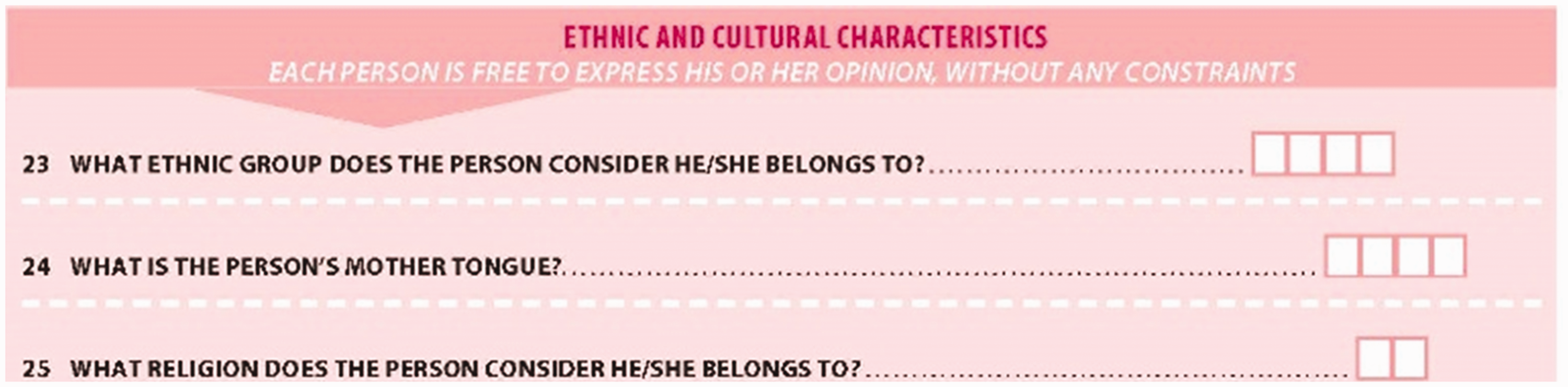
Excerpt from the questionnaire used in the 2011 Census in Romania.
When publishing the results of the census, not only the methodological work that is involved in producing these numbers gets veiled, but also the turbulent history of how these labels came into being in the first place.
State practices of counting and categorizing “Gypsy populations” in Romania go back to the Middle Ages (Achim, 2004). In the feudal system of premodern Romania, landowners did not pay taxes after the Enslaved Gypsies; therefore, they tried to categorize as many of their slaves as Gypsies. The state, to increase its income, was obviously interested in the opposite. During the fascist politics of the 1930s, also the period when the first modern censuses were conducted, Gypsies were classified as an inferior race. A simple visual inspection was enough to identify and collect Gypsies and to deport and exterminate them in the Roma Holocaust. Under the Ceaușescu regime everybody was encouraged to be “Romanian,” hence the size of the Gypsy population further dropped. Only after the fall of communism, census data in Romania began to reflect a politics of inclusion, shaped primarily by social scientists, Roma representatives, and policymakers. The example of the 2011 census in Romania actually provides the many examples that Surdu (2016) discusses. They clarify how ideas about ethnic identity as a cultural, self-assigned marker are historically conflated with the idea that ethnicity is a “visible characteristic” that others can observe.
This brief history of the labels “Gypsy” and “Roma” in Romania can partly explain the big fluctuation of the numbers on the chart presenting the history of census data in Romania on the website of the National Institute of Statistics. According to this table, in 1966 there were 64,000 “Roma” living in Romania, a number that had increased by one thousand percent by 2011. However, what is perhaps even more interesting here is the unreflective use of the label “Roma.” The censuses from 1930, 1956, and 1977 used the label “Gypsy” and only the 2002 census introduced the term “Roma” still used together with that of “Gypsy” (“Roma/Gypsies”). In 2011, the key-quantifying category has become “the Roma,” not only dropping the label “Gypsy” altogether, but simultaneously erasing the complex history of the labels and numbers. This example clearly shows how, in the practices of compiling census tables, very different categories, methodologies, and numbers are brought together contributing to the solidification of these numbers into scientific, objective data, while at the same time drawing a veil over the historical aspects and the complex and ambiguous negotiations in producing them (Hacking, 1986; Ruppert, 2012).
Contested numbers
The eventual solidification of census data did not put an end to the contestations and negotiations around the labels and numbers produced by statisticians and other experts. It also did not mean that, with establishing the label “Roma” as a quasi-neutral, ethnic label by the Romanian National Institute for Statistics, assumptions about the biological and/or racial distinctiveness of the Roma population have disappeared. The ongoing discussions about the undercount of the Roma population in the 2011 census are a case in point.
Many social scientists, policymakers, and Roma representatives agreed that the “real number” of Roma was much higher than the census data indicated. The reason for this, so the argument goes, was that many Roma would disguise their “real identity” out of fear for stigmatization. During the 2011 census, over 1.23 million people out of a total of 20,121,641 respondents did not want to declare their ethnicity, which equals to more than 6% of the respondents. Both sociologists and Roma activists interpret this “group,” ironically the largest “minority” of Romania, as being (at least partially) composed of those Roma who would have concealed their “identity.” Consequently, the “real” number of Roma is estimated to be as large as two million, indicating that the group is three times larger than the one counted in the census. Parallel counting done by the World Bank Group (2014) and the Council of Europe also estimated the “real number” of Roma in Romania to be somewhere between 1.2 and 2.5 million. 10
The considerable gap between census data and the estimated “real numbers” of Roma points at the specific character of Roma ethnicity and the underlying assumptions that being Roma is somehow different than being, for instance Hungarian, German, or Ukrainian. In the decades of nationalist and assimilationist politics of the postsocialist era, when practically all minorities were fighting for survival (see Brubaker et al., 2006), the Roma minority seemed to be the only one that allegedly denied its “true” ethnicity. Ethnicity here appears to be something different than cultural identity, shared history, or a spoken language, a marker that stays and sticks to the body, even when the individual person would rather hide it. This shows how the ethnic identity of Roma is essentialized and taken as an objectively knowable, even measurable characteristic; not a cultural identity, but rather a biological, inherited trace which cannot be left behind.
To draw attention to the census and to underline the importance of an “honest” declaration, prior to the 2011 census, the Romanian authorities circulated commercial and informative videos: “Answer honestly!.” The campaign emphasized that the answers will be anonymized and, therefore, not traceable to specific persons. However, they should reflect reality as these numbers turned into statistical data providing the foundation for political interventions. This is beneficial for both the government and citizens, for example for Roma or Roma organizations that can claim seats in parliament, lobby for cultural, educational, and development projects or access European funds that specifically target Roma minorities.
While the statistical numbers produced might not present an immediate danger of profiling or discrimination, as Surdu (2016) convincingly shows, they nevertheless produce population groups with the aim of governmental intervention. Indeed, an obvious form of profiling is implicated through a sophisticated system of connecting data with ethnicity. Here, “ethnicity” is configured as a relation between markers as varied as types of dwelling, access to infrastructure, the level of education, the number of children, or the number of family members living in one room. In a reifying gesture, these diverse kinds of information are “projected” on a map with settlement types and well-defined administrative borders.
Who “the Roma” are in the 2011 census is produced through cross-tabulation, by establishing correlation between different indicators. The ethnic identity in the census is registered and presented in conjunction with the history of the numbers, but also in relation to types of settlement, gender, the level of education (specifically illiteracy), mother tongue, religion, the number of children, dwelling type, access to infrastructure, etc. Figure 3, for instance shows the overall number of different ethnicities in Romania in relation to their level of education.
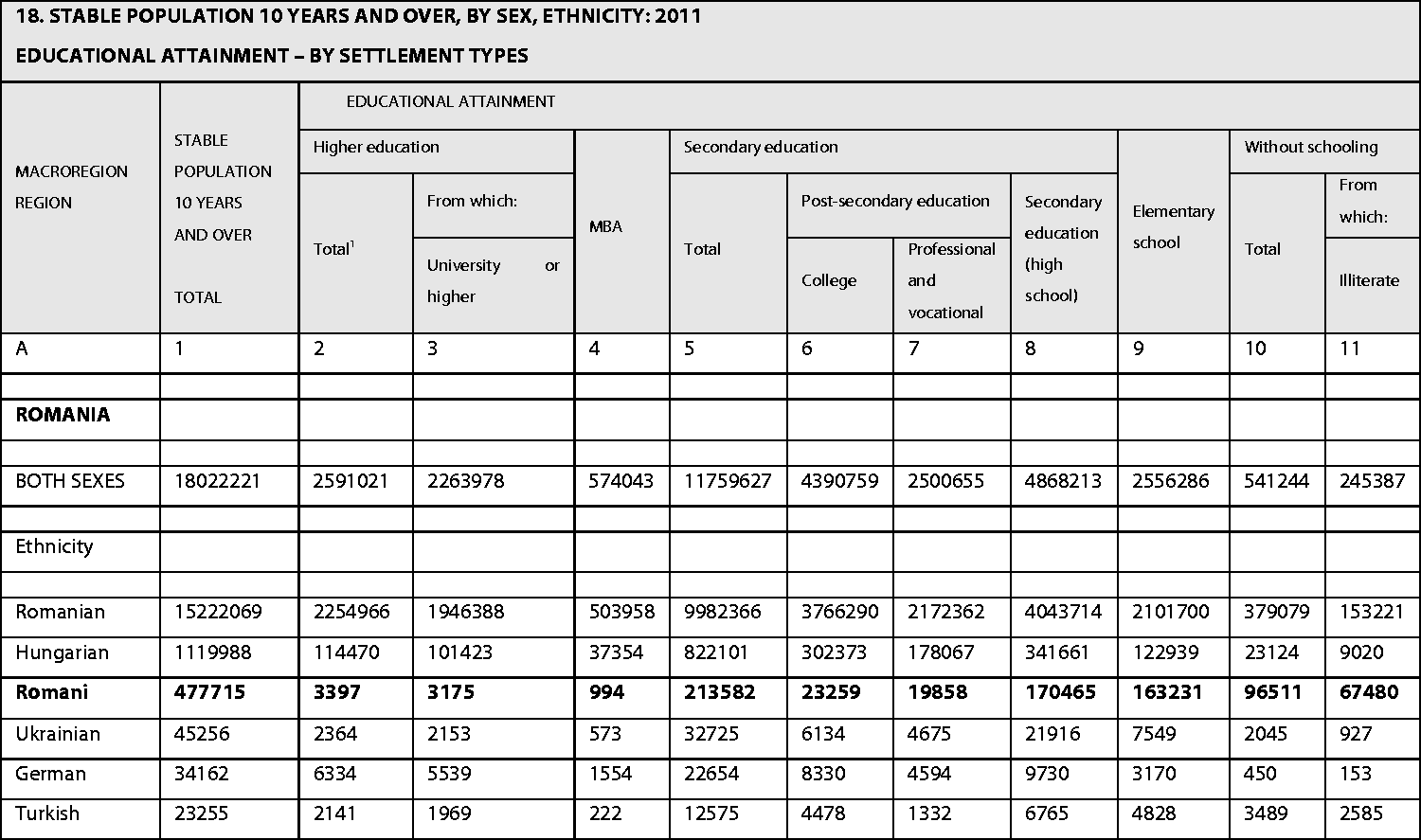
Excerpt from the table with the cross-tabulation of ethnicity and level of education. http://www.recensamantromania.ro/rezultate-2/.
Talking about the instrumental dimension of census politics, Kertzer and Arel (2002) note that cross-tabulation “can be used to suggest how some groups lag behind others on certain indicators, leading to demands for further remedial policies by the state” (30). In the 227 Excel files provided by the National Institute of Statistics, the question of who “the Roma” are is defined not through their individual bodies, but through their environment or what could be qualified as their “milieu.” 11 We see the material and economic configuration of the collective body enacted by conflating statistical indicators, such as level of education, type of dwelling, access to running water, electricity, gas, possession of electronic devices, and the Internet. The number of children, the level of education, and the type of employment are perhaps the most important markers.
Again, there is a paradox here. Through statistics, “the Roma” are articulated as different, i.e. as a specific ethnic group. Yet, since they are made comparable to other Romanian groups they are also made the same. This is what statistics does (Strathern, 2005). However, what is made absent are markers that help to set them apart; markers such as the number of children, level of education, dwelling type that are mobilized in social discourse and help to make “the Roma” knowable, and a population that can be acted upon. Most importantly, while “the Roma” as a category is not present as an ethnicity in the bureaucratic practices of registering citizens, it is nevertheless configured as “a racial other” through stereotyping and thus made incomparable.
In the next section, we move from statistics to bureaucratic practices and turn to one of the local departments of issuing ID cards in Romania. These cards are also used as travel documents within the EU. We focus on what happens when the state’s gaze does not have the group in focus, but the individual citizen, the body, and its traces. Though the category of “the Roma” does not exist in the registry of citizens, we argue that the ways in which data spill over into the daily bureaucratic practice of issuing an identity document enact “the Roma” as a racial other. Interestingly, these data overlap with the markers that configure “the Roma” in the census. Regarding the consequences of such bureaucratic practices, as the Romanian ID card is also a travel document, we also look at how the registry functions as a filter to stop the mobility of “certain,” unwanted citizens, depriving them of full rights entitled by their legal citizenship status.
How to recognize? Bodies that stay put
At the local departments for “The Evidence of People and Administration of Databases” 12 in Romania, “the Roma” does not exist as a category. Romania, following mostly the French republican conception of the “nation”—in which citizens are only identified by their civic identity (Kertzer and Arel, 2002: 24)—does not officially register data about ethnic, religious, or other types of identities of its citizens. It is important to note that, since Romanian citizens are free to travel within the EU, from the moment they are issued an ID card, which also serves as a travel document within the EU, “Roma migration” does not exist.
In November–December 2016, one of us (IP) conducted fieldwork in a department where identity cards were issued. 13 For a couple of weeks, IP was allowed to observe and learn the ins and outs of the bureaucratic practice of issuing ID cards. Being interested in technologies of vision, IP spent most of her time sitting next to the person whose task was to take the ID photo. The following stories are based on personal observations and though they are necessarily partial and situated (Haraway, 1991; Strathern, 2005), they nevertheless offer us valuable cases to understand how particular markers that are mobilized contribute to the racialization of bodies that enter these bureaucratic settings.
A couple enters the “counter.” This is the room, called so by the bureaucrats working at the local department of issuing ID cards. The woman, around 20, wearing dark colored trousers and a dark brown oversized jacket asks murmuring: “What document do we need? And when will the ID card be ready?” The bureaucrat starts to enlist the answers with boredom mixed with irritation.
The daily office routine offers little excitement. A prepared citizen has the possibility to look up the information on the institution’s website or inquire telephonically. Most of the people would walk in with their files already prepared, only special cases or “those people” who have difficulty understanding the bureaucratic procedure and need special assistance, break this daily routine.
While the woman lays out the old, yellowish documents on the table, the bureaucrat starts to check them systematically. The photocopies go on the right side; the originals are put on the left edge of the table. “Please prepare for the photo,” the bureaucrat utters. The woman drops her jacket on the chair in front of the table and strokes her forefront as she sits down in front of the camera. She neither uses the hanger for her coat, nor the mirror to check her appearance. “Please look at the camera. Head straight. Lean a bit back and tilt your head slightly to the wall. That’s not tilting, that’s turning! Now, hold on like that, don’t blink!” She keeps her chin high as she looks at the camera. Her lips are tightly closed in a thin line. “Click!”
While sitting in the corner of this office for weeks, IP noticed how differently people tend to make use of the scarce furniture available. Some people would walk in gracefully, hang their expensive coats on a hanger, and take the time to arrange their hair or makeup in front of the mirror hanging on the wall. Others, like the couple in the office lack this type of confidence.
“When did you say will the ID card be ready?” the woman asks while she puts on her jacket. “We want to go to Germany. And the company who’s taking us said that they might call on 10 or 11 December.” The bureaucrat does not respond. “Is there perhaps any fee to get it faster? When will it be ready?” the couple insists, but without being given an answer. “Go, and pay first the ID card-fee!” the bureaucrat responds unfriendly.
“H-i came to h-make an h-identity h-card,” 14 the other colleague is joking when the couple leaves the room. “You know who talks like this?” he turns toward me. “I have no idea,” I admit honestly. “- Ţiganii,” he says laughing.
The bureaucrats apparently knew without hesitation that these people where some of “those” who cannot hide their “real” identity. Was it their clothing or the way they dropped their jackets confused on the chair? Or perhaps the fact that they insisted to get the IDs as fast as possible because they needed them to work abroad? In this case, the skilled vision of the bureaucrats was aided by his ears as well: if the rest of the cross-tabulation would not be enough (as we saw in the case of the census), the specific dialect attributed to the “Gypsies” made the final word. Drawing markers together is only one way to recognize “the Roma” in these departments. Another, more obvious way of “knowing the Roma” is by the type of the ID card some marginalized groups are allowed to get.
The Romanian departments for “Persons Record and Databases Management” issue two types of documents, a regular electronic ID card and a temporary ID card, called “Cartea de Identitate Provizorie” or CIP. Citizens who cannot prove residential arrangements, do not own a house, do not have a legal rental contract or temporal housing agreement, or whose documents are not “in order” can only get such a “provisional,” temporary identity card. “Temporary” is perhaps not the adequate term here, because, for a segment of society, this type of document has actually turned out to be permanent. This is often also the case with social housing that is offered by the municipality to families evicted during re-urbanization. 15 The technical procedure of de-documenting citizens in Romania, Vrăbiescu (2017) argues, is not only a way to limit access to civil rights, but also a form of citizenship dispossession. Indeed, people having temporary ID cards are exposed to heightened surveillance and are “procedurally expelled” from full citizenship, constraining their mobility both inside and outside the country (Vrăbiescu, 2017: 30–31).
The special territorial arrangements, fragmentation, and exclusion of Roma groups are not a Romanian specificity in Europe, argues Picker (2017). He maintains that “the fundamental principle behind the genesis and persistence of so-called ‘Gypsy Urban Areas’ is race, in its tight connection to contemporary urban processes of economic restructuring and governance” (2). Race here, as opposed to ethnicity, is entwined with the idea of lineage, heritage, and immutable characteristics, presenting itself as an “objective” base for categorizing people. In line with Douglas’ (1996) observations, Picker (2017) argues that race, emerging in European colonial projects, evokes ideas about purity and pollution: “as a system legitimizing ‘the good’, purity, and by extension sameness and appropriateness, while discarding ‘the evil’, dirt, otherness and incongruity, race is a structuring force rather than an ex-post rationalization of exclusion” (9). Purity and dirt do not necessarily refer to bodily features but to an “urban body […] in which space, along with housing – and, by proxy, its population – is racially connoted” (Picker 2017: 9).
CIP holders are regular visitors to the department of issuing ID cards. While a permanent identity card is valid for 10 years, the CIP expires annually, so CIP holders must return each year for renewing their documents. Bureaucrats almost know “them” by name or the streets where they live. They also warn each other: “Watch out, another family of CIPs are coming. It already smells in the corridor.”
A couple enters the room. A shabby young woman with disarticulate movements. The partner is young, too. The man is more collected, a short, skinny, good-looking, young man. Olive skin, brown hair, a large worn leather jacket, dark jeans, and a pair of black shoes. He talks fast and loud with the bureaucrats, but with an air of respectful subordination. He asks for help to get a new ID card made for “his woman.”
Upon their entrance a general state of agitation emerges in the “counter.” The bureaucrats slightly raise their voice and the citizens who were just about to finish their paper work make room for the couple. IP starts to pay attention, too, though she is sitting next door, behind the computer with a camera where the photos are taken. The two rooms are interconnected so it is easy to hear the loud and nervous dialogue. “Give here the documents. Hurry up. The photocopies? And the photos?” Confusion prevails the trickling daily routine.
Bureaucrats do not necessarily treat “these” people disrespectfully in the department. The paternalistic way they try helping “them” shows a certain mix of care and contempt. This care became apparent in other situations as well, for example when one of the bureaucrats would go out to the corridor to help people who could not read or write filling the forms.
The colleague who handles the documents steers the couple quickly toward the photo camera. She brings the file herself and hands it to the bureaucrat sitting at the computer next to me. Meanwhile she instructs the girl: “Sit down here!” and points to the chair in front of the camera. The young woman pulls her cap and knitted scarf off but moves in all directions. “Hold your head straight. First look here. Look at the camera!” speaks up the bureaucrat.
The other bureaucrat who handled their file meanwhile tries to reason with the young man: “And you’re still making children with her? Where’s your judgment?” The confusion around the woman makes her restless and she turns her head toward the noise. “Not good! Look here!” the bureaucrat at the photos starts to lose her patience. She makes a couple of failed attempts to take a frontal photo. “I leave it like this.” “It’s only for the database anyway.” “It is ok, it is done” the bureaucrat says in a hurry to get rid of them as quickly as possible. The man murmurs “Thanks” and excuses himself for the trouble. The bureaucrat opens the door and before the man could finish his sentence, pushes them out of the office.
It suddenly gets quiet. “Open the window!” she says to her colleague. “It stinks horribly.” An older man comes into the room to have his photo taken with his file in his hand: “So, did Waste Road leave?” using the name of the street as a surrogate for “gypsy.” It is common knowledge that this is the street where many Roma families were forcibly moved by the local authorities in the context of a gentrification project of the city. 16
The bureaucrat who just closed the door says loudly: “I have to go to wash my hands.” The colleague from the photos responds “I wash my hands, too!” as if taking the picture of the woman would have meant some sort of physical contact. “At least we get some fresh air till I come back.”
This scene with a clear beginning and end can be seen as a disruption in the bureaucratic practice of dealing with “regular” Romanian citizens. The rhythm of the scene compared to the daily routine is remarkably faster, louder. The couple enters the room, but when they leave, they are not yet gone. The smell would have stayed behind and other traces had to be cleaned as well. The scene finishes when the bureaucrats wash their hands and close the window.
While Roma do not exist in the database of the national registry of Romanian citizens, when a bureaucrat opens a file, there is abundance of ways in which “the Roma” is enacted. This is evident when we look at the temporary ID cards and its holders. People who have to renew their documents annually end up with many more entries and ID photos than “regular” citizens. The history of encounters with the state and the material traces they leave in the file result in an “excess” of data. The larger the file—meaning the more traces—the more “suspicious” the person becomes. The heightened surveillance and a chronically temporal ID card thus contribute to racialization. They also result in halting the movement of people, who cannot leave the country without a permanent ID card. In other words, it is not the singular body nor its image that is incriminated, but the number of entries in relation to other markers, such as the number of children, the level of education, their occupation, their site of residence, etc. that is decisive. The markers enacting “the Roma” are not dissimilar from those produced by the census. The lack of the category “Roma” in the registry, thus, is coupled with a hypervisibility inside the individual file. These are material racializations that stand in for the absence of a racial qualifier in the database.
In a discussion one of the bureaucrats explains: “You see instantly if someone tries to cheat you. As it happens regularly with ‘certain groups’.” When IP asked him what the suspicious elements are, he replied: Well, if someone for example says that he is a lawyer but then you see that he lives in one of “those streets”. And let’s say, he has 5 to 10 children. Then you also look at his face. You can just see it!
Conclusions
In this paper, we examined practices of knowing, sorting, and managing “the Roma” and their movement by Romanian bureaucratic authorities. After briefly pausing with the ways Roma mobility was captured in international media reports, we moved to bureaucratic practices to see how the Romanian state came to know “the Roma.” First, we examined how census data enact “the Roma” as a racial category. Second, we considered ethnographically the everyday bureaucratic practices of issuing identity cards at a local department for the evidence of population and management of databases in Romania.
Our first case dealt with the aggregate numbers that bodies add up to, while the second was about how individual racialized bodies, entwined with smells, dialects, and colors “leak into” the bureaucratic machinery. Though racial categories do not exist per se in the registry of Romanian citizens, the excess of body and data surrounding it contributes to a racialization of “certain citizens.” This becomes visible through the compilation of various data, but also through the large amount of entries. In these “specific files,” the data contribute to the filtering of mobility of “certain citizens,” as people who only have a temporary identity card and who cannot leave the country.
In both cases, the markers of ethnic or cultural distinctiveness translated mostly into the number of children, the level of education, the type of occupation and territorial segregation conflated with markers of the body, like smell, clothing, skin color, dialect, and similar indicators. These markers are also at the foundation of the Roma/Gypsy stereotypes that are shared by the majority of the Romanian population and that are generally articulated by local and national media. The examples discussed in the paper also show how “the Roma” is not one thing, but is a multiple (Mol, 2002), distributed across various and heterogeneous practices. For the bureaucrats and civil servants in Romania, not only sensorial markers like the shade of the skin or the smell of the body expose the “real (racial) identity” of “certain people,” but also the material configurations surrounding the body, like clothing, earrings, and various data regarding their “milieu,” such as their number of children, the level of education, occupation, or residence.
Attending to the racializing effect of state bureaucracies does not imply that the category of the Roma is only an effect of these. As many Roma scholars have shown, there is much more at stake with regards to identity politics, agency, and self-articulation when it comes to the complex and messy ways in which self-assertion and group differentiation is entangled with bureaucratic and state practices of governing minorities. However, in this paper we only focus our attention on the racializing effect of these bureaucratic practices to discuss the issue of race in contemporary Europe.
Although our case study was situated in Romania, our points are in no particular way limited to this country or the eastern European context more generally. Rather, we focused on practices of counting and registering citizens to learn about how the slippage between ethnic and the racial happens and how contemporary formations of racialized groups look like in Europe. Though we discussed case studies in the specific Romanian, postsocialist context, we think that our analyses are relevant within the larger context of b/ordering Europe and within that of the contemporary management of the movement of “unwanted” populations. Race here, as M’charek et al. (2014) argue, is a topological object that draws the borders between the inside and the outside, of those who belong and those who do not. Counting and categorizing “the Roma” and analyzing the racial effects of these practices, thus, are not just a Romanian issue, but key to adequately understand the racial and biopolitical bordering of and within “Europe” today.
Footnotes
Acknowledgments
We would like to thank the Romanian Ministry of Administration and Interior for granting a research permit, and the employees of the Department of “The Evidence of People and Administration of Databases” for hosting one of us during the fieldwork. We also express our gratitude to the ARITHMUS Research Team for inviting our paper to the workshop Peopling Europe Through Data Practices, which took place at Tate Modern and Goldsmith University in March 2016. We thank the organizers and especially Evelyn Ruppert, Stephan Scheel, and Funda Ustek-Spilda for their generous comments and editorial work. The article has benefited from the valuable comments from three anonymous reviewers and from members of the RaceFaceID team: Lisette Jong, Ryanne Bleumink, Roos Hopman, Lieke Wissink, Irene van Oorschot, and Alana Helberg-Proctor.
Declaration of conflicting interests
The author(s) declared no potential conflicts of interest with respect to the research, authorship, and/or publication of this article.
Funding
The author(s) disclosed receipt of the following financial support for the research, authorship, and/or publication of this article: We would like to thank the European Research Council for supporting our research through an ERC Consolidator Grant (FP7-617451-RaceFaceID-Race Matter: On the Absent Presence of Race in Forensic Identification).