




Abstract
Shea butter, derived from the African shea tree, has acquired a pivotal position in global agro-food and cosmetics industries. In Burkina Faso, public and private actors as well as civil society are converging upon the product to boost the incomes of rural female producers. As a result of these trends, the shea value chain is increasingly segmented; shea nuts are sold in a low-return, conventional market and simultaneously enter an alternative, high-value niche market. In the latter strand of the value chain, some producers are improving their prospects by forming an association. Tracing relationships across the two strands, we demonstrate how ‘horizontal’ relations based on gender, ethnicity, age and geography contribute to shaping participation and benefit capture in the shea value chain. We argue that processes of social inclusion and exclusion operate in parallel, as differentiated actors both cooperate and compete to secure their place within the chain. While collective organizing brings positive social and economic benefits, we show that producers’ associations need not be empowering for all women. The significance of collective enterprises, but also their drawbacks must be considered when valorising pathways to women's empowerment. Our study reinforces calls for greater integration of horizontal elements in value chain analyses.
Introduction
Shea nuts are obtained from the shea tree (Vitellaria paradoxa), which grows across a 5000 kilometre-wide expanse of semi-arid savanna, south of the Sahara. Women living in the ‘shea belt’ transform shea nuts into a multi-purpose butter that represents the primary source of dietary fat for many agriculturalists living in the species’ range. For centuries, the shea value chain – that is, the sequence of processes in which shea nuts are collected, transformed into butter, transported, traded and consumed – has provided a primary source of income for women from agricultural groups (Chalfin, 2004). The growth of the international shea trade and emerging specialty markets in the global North since the 1990s have generated new contexts for actors along the chain, including the women who sell the product at its source in the villages of Burkina Faso (Elias and Saussey, 2013).
Improved prospects in the shea trade have led the government of Burkina Faso to promote the importance of this commerce for women's empowerment and support the product's export. In its forestry programme, the Burkinabè government has advocated upgrading the trade and modernising a traditional division of labour where women are economically marginalised due to their isolation from markets (Westholm and Arora-Jonsson, 2015). Various actors, including national and international non-governmental organisations (NGOs), multilateral institutions, and the private sector have converged in giving shape to the shea value chain (Laube, 2015). The result has been the emergence of what we call the ‘alternative’ strand of the value chain, in which shea butter production and sale have moved from an individual endeavour in the longstanding ‘conventional’ strand to a collective female enterprise.
Yet, policy and NGO discourses around shea have paid little heed to the processes of social inclusion and exclusion that mediate gains in an increasingly segmented shea value chain. Shea producers are frequently portrayed as an undifferentiated group of poor women who benefit equally from collective participation in alternative value chain configurations. 1 Scarce attention is given to the ‘horizontal relations’ (e.g. Leslie and Reimer, 1999) that shape unequal prospects for producers from different geographical areas, ethnicities and ages within new marketing arrangements, which undermines efforts to promote equity within the value chain.
Value chains are normally studied with an inherent political economy logic, with a focus on vertical linkages among actors fulfilling different functions in the chain (e.g. Gereffi et al., 2005). Yet, a growing body of feminist scholarship has shown how value chain development and economic globalization reproduce ever greater differences in horizontal relations; that is, among actors occupying the same function in the chain in a particular region (Bair, 2010; Tsing, 2016). In a time where value chains are said to be becoming more buyer driven and quality considerations are foremost (Ponte, 2005), we highlight the primary role that social relations across gender, ethnic, and age groups as well as geographies play in determining the opportunities to be seized at the bottom of the shea value chain. We glimpse the possibilities that can be opened up for greater equity for producers on the ground; not automatically by their inclusion in value chains or in collectives, but by paying heed to the structural, organizational and political work required to bring about a more equitable trade. The challenge rests in meaningfully integrating vertical and horizontal factors in value chain analyses to understand whether or how prospects arising within a chain can translate into improved livelihoods for impoverished chain actors (Bolwig et al., 2010; Jarosz, 2008).
In what follows, we unpack the movement of different actors in and out of the shea value chain as the chain assumes new configurations. We begin with an overview of the precepts of value chain analysis, before presenting the methodology for the study. We then analyse the inclusion of women into the conventional strand of the value chain, wherein women's labour results in low margins and where female shea nut collectors risk loosing their prevailing access to the resource and trade. Subsequently, we turn our focus to the convergence of interests that led to the parallel creation and support of women's collectives that emerged, like many others in the Global South, from development discourses on gender equality and empowerment (Arora-Jonsson, 2013), and that enabled some producers to tap into a more promising shea butter market.
Conceptualizing cooperation in the midst of exclusions in the shea value chain
Drawn from the work of Hopkins and Wallerstein (1986: 159), the most widely cited definition of a commodity or value chain is “a network of labour and production processes whose end result is a finished commodity.” The shea value chain centres on a specific product – shea butter – and encompasses diverse actors situated at various geographical scales and spaces, ranging from the individual and household realms to the spheres of enterprises and nation states. Through successive transactions or ‘nodes’ where value addition occurs, shea nuts are transformed materially (into butter) and symbolically (into a natural cosmetic with the potential to empower African women) and profits are generated (Elias and Saussey, 2013).
Despite the importance of gender in early value chain conceptualizations and the feminist scholarship on production and reproduction that emerged in the 1970s, gender has more or less disappeared from mainstream accounts of value chains (Dunaway, 2014). However, as inter-disciplinary interest in the approach has grown, there have been renewed calls to move beyond vertical linkages of value chains, to consider how social relations and historically rooted, place-based factors – or ‘horizontal’ elements – shape the chains (Bair and Werner, 2011; Leslie and Reimer, 1999; Ramamurthy, 2000, 2004). Drawing on feminist theory, this literature has shown that value chains and markets are embedded in gender norms, ideologies and power relations operating across scales – from the household to the global (gendered) economy – that define chain dynamics (Barrientos, 2001; Dunaway, 2014). Gender specific constraints – including norms stipulating acceptable work for women and men, women's typically lower education levels or skills, time poverty, competing work demands in the reproductive sphere and unequal access to and control of assets – have been shown to affect women's ability to make decisions and to access more profitable nodes and value chains (Coles and Mitchell, 2011; Dolan, 2001; Quisumbing et al., 2015). In an iterative manner, participation in value chains (re)produces and can reform gender relations; for instance, by altering the gender division of labour, affecting women's asset ownership, and fostering women's empowerment (Barrientos, 2001; Quisumbing et al., 2015; Said-Allsopp and Tallontire, 2014). Many methodological toolkits have been developed to guide value chain interventions in enhancing gender equity and women's livelihoods (KIT et al., 2012; Mayoux and Mackie, 2008; Riisgaard et al., 2010). Yet, the challenge of integrating vertical and horizontal dimensions in value chain analyses remains. As Bolwig et al. (2010: 185) argue: “integrating horizontal aspects into value-chain analysis requires more than a cursory look at the incomes of participants, or even at local income distributions. Rather, it requires a contextual analysis of local social process, teasing out the implications of power relations and resource access for participants’ social agency and empowerment.”
Central to this analysis are the processes of social inclusion and exclusion that mediate the interest and ability – or inability – of value chain actors to benefit from a given value chain. In this respect, Carr and Chen (2004) distinguish between new opportunities for women in the global economy and the often questionable quality of women's employment, including the typically low benefits they capture in relation to the labour they invest as producers in global value chains. Yet, few authors, like Ramamurthy (2000), carefully consider how intersecting relations of power reproduce exclusions for different groups of women in particular value chain ‘places’ or nodes. In her analysis of the textile industry in India and Japan, Ramamurthy (2000: 571) shows that “changing material conditions of production – labour arrangements, capital intensive hybrid agriculture, export agriculture – act recursively with ideologies of gender and those of caste and class to produce a systematicity that colludes with, rather than radically transforms patriarchy.” In so doing, she demonstrates how multi-faceted individual and collective identities are constitutive of, and constituted by, the production and consumption of commodities.
Understanding processes of inclusion and exclusion further requires attention to the ways personal motivations influence participation in value chains. Hence, we examine value chain processes from the perspective of women producers and workers to explore motivations and move beyond asset-based analyses of factors influencing participation. By ‘giving voice’ to producers and traders in the shea value chain, we examine how exclusions can also result from personal motives not to engage in certain social interactions, and heed the call for more qualitative research and process evaluations to understand the impacts of value chain development (Quisumbing et al., 2015).
We examine the sites where the shea value chain touches down geographically and demonstrate that new relations of shea butter production and trade have generated positive effects for some producers and less so for others. The premise of third world gender inequality has provided legitimacy to development agencies to intervene in local gender relations and support women's collectives. Arora-Jonsson's (2013) research with women's groups in India demonstrates that while not all collectives are empowering or emancipatory as often assumed in development discourses, outside support can open up space for action for women who choose to come together across lines of class or ethnicity around issues that concern them, in the shea case, as female producers. Applying this thinking, we explore how the shea producers' Union, built up with national and international support, enabled women from different social groups to negotiate coinciding and competing interests, wherein diverse cooperative arrangements differentially favour some members over others.
Following Bolwig et al.'s (2010) framework for integrating vertical and horizontal elements in value chain analyses, we analyse the inclusion of new actors such as FulBe women and male nut collectors in existing or new value chains or strands, the negotiations of positions through which chain actors can participate in the value chain under new terms, as well as the expulsion of some actors from the chain as it assumes new configurations. We specifically unpack the shea value chain's producer and small-scale trader nodes, where poverty impacts are typically the strongest, in Burkina Faso's province of Sissili. Paying heed to relations of ethnicity, geography and age, we examine how social differences are bound up with the production and trade of shea nuts and butter. This calls attention to aspects of exclusion in the emergent, alternative strand of the shea value chain, thus cautioning against easy solutions to complex relations on the ground.
Methodology
Situating the study: Social relations of shea collection and processing in the province of Sissili
The shea value chain on which we focus originates in the province of Sissili, in the central-west region of Burkina Faso. The province is multi-ethnic, with its indigenous Gurunsi residents outnumbered by the predominantly Moose migrants who arrived in successive waves since the 1970s (Howorth and O'Keefe, 1999). In addition, FulBe agro-pastoralists migrated from the Sahel in search of pasture and dry season watering-points and became sedentarized in the area (Ouédraogo, 2003). Relations were particularly fragile between these herders and local agriculturalists, who complained that FulBe livestock trampled crops in their fields (various interviews, Breusers et al., 1998).
Shea nut collection and processing are traditionally performed by women in agricultural ethnic groups, such as the Moose and Gurunsi, who rely on vegetal fat in their diets. In contrast, pastoralists such as the FulBe are not in the habit of collecting or processing shea nuts. In Sissili's rural areas, female farmers of all wealth classes make shea butter given their agricultural lifestyles, the often relatively limited differentiation across class, and the lack of alternative incomes. In contrast, in urban areas, only poorer women process shea butter, due to the high labour and drudgery it requires, the relatively low returns to labour, and the association of this activity with a lower class endeavour.
Shea nut gathering traditionally occurs according to normative rules about where and how the activity should be conducted. In fields cultivated by indigenous Gurunsi farmers, shea nuts are the right of the land's custodian. Men typically grant their wives access to nuts on cooperatively farmed household fields, and married women retain collection rights on their personal plots. In fields temporarily ‘borrowed’ by migrants from Gurunsi hosts, migrants do not have exclusive rights over valuable tree products. In unclaimed lands used for pasture, fuelwood and plant collection, nut collection is traditionally open to all on a first-come-first-serve basis. As we discuss below, however, these traditional access rules are being challenged as shea nuts gain value.
Fieldwork in Sissili
The first author carried out fieldwork between October 2006 and March 2007 in the province of Sissili's villages of Prata (rural), Lan (peri-urban), the town of Léo, and in Ouagadougou, Burkina Faso's capital. Sissili has long been integrated in local and international shea butter markets due to its shared border with Ghana and its Sudanian climate, which favours the growth of shea trees. Léo is the seat of the former Union des groupements de productrices de produits karité de la Sissili et du Ziro (UGPPK), now renamed the Fédération NUNUNA and the largest union of shea butter producers in the country. At the time of this study (2006–2007), the Union comprised over 1200 women producers organised in 33 primary-level women's groups located throughout Sissili and Ziro. 2 Outside organizations provided the Union with essential support, consisting of funding, organizational expertise and infrastructure. The all-women association included Gurunsi and Moose women, predominantly from rural areas. The large majority of the members were impoverished and relied on shea butter sales as a primary economic activity.
Adapting Bolwig et al.'s (2010) framework, we sought data from four types of actors: (1) chain actors who were directly involved in within-chain exchanges of products (producers and vendors); (2) external actors who provided services to chain actors (NGOs and certification agencies); (3) actors who withdrew from the value chain or one of its strands (expelled/excluded actors); and (4) non-participants who never participated in the value chain or in a given strand of the value chain (shea producers' husbands).
The chain actors interviewed included 78 Gurunsi and Moose Union members from Léo, Lan, and Prata as well as rural non-member shea kernel and/or butter vendors of Moose or FulBe origin (n = 21). Questions centred on their livelihoods, shea-related activities and social relations within their place of residence. The husbands (n = 85) of all these women, when possible, were interviewed to understand how they perceived their wives' participation in the shea value chain. Sex-disaggregated focus groups held with butter producers and their husbands in Lan and Prata provided group perspectives on these issues.
All of the shea nut and butter vendors (n = 31) encountered at Léo's weekly market – some of whom were and others who were not Union members (expelled or excluded actors) – were also interviewed. Questions centred on the shea market and reasons why producers chose to participate, not to participate or to leave the different strands of the shea value chain.
Key informant interviews were carried out with each executive officer of the UGPPK and with NGO personnel (n = 19) (external actors) who supported shea butter producers in Ouagadougou and Léo. Direct observation and detailed notes taken by the first author, who lived among shea producers in the villages and town where the study took place, complemented these data. A shea market analysis consisting of observation of prices and product qualities and informal conversations with vendors was carried out in Léo on a bi-weekly basis throughout the fieldwork. Financial records of the Union provided information on production quantities, prices and the shea-related incomes of interviewed Union members.
Interview data were analysed qualitatively for recurring themes. Based on the information gathered from shea producers, vendors and from interviews with NGO personnel, consultants and academics, we trace the shea value chain within Burkina Faso and beyond, relying on secondary sources to complete the analysis.
The shea butter value chain
The growth in international shea sales has engendered changes in Burkina Faso's local and national shea markets. Approximately half of shea nuts produced are still consumed within producing countries (Reynolds, 2010; Rousseau et al., 2015). The rest is primarily exported to two multinational industries. The first and largest is the agro-food industry, which consumes 90 per cent of the shea butter used outside of the African continent as a ‘hidden’ ingredient in margarine, pastries, animal feeds, and as a cocoa butter equivalent in chocolate (Yinug and Fetzer, 2008). Demand from this industry is longstanding and drives the first strand of the international shea value chain, wherein atomized small-scale shea butter producers sell their shea kernels and butter informally on the local market for meagre returns. We term this the ‘conventional’ strand, as it describes the trade relations that existed long before development interventions weighed in on the value chain.
The second, newer player is the cosmetics industry, which values shea butter for its moisturizing and healing properties. Since the 1990s, the integration of shea butter in ‘natural’ and high-end lines of cosmetics has represented a minor but fast-growing market for the product (Masters et al., 2004; Yinug and Fetzer, 2008). As opposed to multinational food companies that import raw shea kernels, some cosmetics companies have shown a willingness to import artisanally processed shea butter, partly in an effort to demonstrate social corporate responsibility (Elias and Saussey, 2013). This has created potential for value-added activities among producers and created an alternative strand of the value chain, wherein producers supported by NGOs associate and process shea butter for improved returns through specialty markets.
Conventional strand of the shea butter value chain
The conventional strand of the shea butter value chain we observed originated in rural areas of Sissili. Women, predominantly Gurunsi and Moose, often accompanied by their children, performed the labour-intensive task of shea nut collection from June to September. After boiling, drying and shelling shea nuts, they typically retained a portion of their nuts for processing and household consumption and sold the rest. Despite low returns, shea income represented one of the few revenue-generating opportunities, as shea processing falls within the female sphere of activities and barriers to entry into the trade are relatively slim. On a small scale, the main inputs required to enter the trade are (a great deal of) labour, shea nuts, firewood and water.
The shea kernel collectors interviewed and described above also sold kernels to fellow female villagers, female acquaintances in neighbouring villages or through kinship networks to relatives from their native village. The women who purchased their kernels processed them into butter for local sale, often through similar networks, or for use in cooking dishes for sale as street food. The rural Gurunsi and Moose women who collected shea nuts and sold shea kernels also supplied a portfolio of tree products (primarily shea and néré – Parkia biglobosa) and crops grown on their personal fields to several dispersed markets in rotating village markets or nearby towns, such as Léo. 3 In those marketplaces, town-based shea kernel vendors – both women and men, also of Moose and Gurunsi origin – purchased their kernels and marketed them along with a range of cereals and foodstuffs.
The structure of this shea value chain strand matched that traced by Rousseau et al. (2015): a pyramidal supply chain wherein town-based vendors sold kernels for low profits to town-based female shea butter producers, or to male, mid-level vendors or agents of Moose or Ghanaian origin, who in turn supplied wholesalers further along (downstream – towards the end user) the value chain. Gross margins per volume of kernels sold were similar across nodes of the value chain, as, “as a low value high-volume market, it is the volume of shea traded that makes the difference in business income” (Rousseau et al., 2015: 416). Yet, vendors traded in progressively larger kernel quantities and realized greater profits moving downstream the value chain. As Chalfin (2004) observed, wholesalers worked on behalf of large-scale Ghanaian importers or urban-based Burkinabè exporters. Via this handful of exporters, shea kernels made their way to West African coastal countries and overseas to European, Indian, Malaysian and Japanese agro-food industries and refineries (Rousseau et al., 2015).
To a lesser extent, shea kernels were industrially processed in West Africa before being exported to the West. This was increasingly the case due to stricter European and Japanese environmental legislation against ‘dirty’ (polluting) industries – such as oil seed crushing that generates organic solid waste, residues and by-products, and particulate (atmospheric) and greenhouse gas emissions – in their own countries (Ferris et al., 2001: 25). Capitalizing upon market opportunities emerging from this legislation, small to medium scale oil mills that extract shea butter proliferated in Ghanaian towns (Lovett, 2003). These African mills supplied shea butter to European refineries, and largely accounted for the drastic increase in the proportion of shea butter (versus raw nuts) exported from Africa – from 10 to 35 per cent between 2005 and 2010 (Reynolds, 2010). This contributed to the surge in demand for shea kernels from Ghanaian importers.
A distinguishing feature of this strand of the value chain was that it comprised shea kernels of all qualities, which male mid-level vendors or agents purchased in large volumes, indiscriminately, at low prices for subsequent industrial processing. Some of the kernels sold were even rancid and would previously have been considered worthless for eating and exchange purposes. The new market for poor quality kernels expanded the availability of shea kernels for sale and the economic opportunities of local shea kernel vendors, all the while reproducing uneven geographical relations (Bair and Werner, 2011) as the polluting work of butter extraction was increasingly concentrated in West Africa.
Alternative strand of the shea butter value chain
Like in the conventional strand of the shea butter value chain, in the alternative strand, rural women mainly of Moose and Gurunsi origin collected shea nuts in farm areas, fallows or woodlands. Alternatively, they purchased kernels from other rural shea kernel collectors and vendors. Beyond this point, the two strands of the chain diverged, as shea butter producers came together in associations at various levels to supply the cosmetics industry. Within this new configuration, opportunities for remuneration could be higher for a premium quality product, particularly when supplying alternative, ‘ethical’ outlets such as the fast growing fair trade and organic certified markets.
Capitalizing upon consumer interest in alternative consumption as well as advances in the shea cosmetics market, NGOs and multilateral organizations such as UNIFEM worked to enhance women's incomes in Africa. Through shea butter projects, they provided financial and technical support to producer associations, and transformed shea processing from an informal activity carried out by atomized, geographically dispersed female producers into a formal enterprise of producers associated in first, second and sometimes third-level associations (women's groups organized in union structures, organized in a federation of unions). NGOs were instrumental in helping informal village-level women's groups (Groupements villageois féminins or GVFs) to come together and obtain formal status as associations, and in securing and maintaining international clients, meeting international quality standards, and acquiring third-party fair trade and organic certification. As opposed to individual producers, producer collectives demonstrated the capacity to supply large quantities of quality shea butter to international clients within reasonable delays. Moving production to the villages offered new economic prospects, and created the possibility of introducing shared labour-saving technologies, such as mills and improved cookstoves.
The UGPPK on which we focus was created within the context of one such shea butter project. The Union's stated economic and social goals included strengthening the capacity of its member producers, promoting local development and empowering women. Each GVF had three elected representatives and an executive committee composed of eight women (seven of whom were from Léo) chaired the Union.
National and international shea butter orders were channelled through the Union's head office that distributed orders to member GVFs, which allocated quotas to member producers. Most producers were illiterate and from remote areas lacking infrastructure and market information. The Union offered them a unique opportunity to tap into relatively remunerative international commercial circuits. The Union sold butter directly to international importers – the main one being the French multinational company L'Occitane – that integrated it in their cosmetics products (Elias and Saussey, 2013). The value chain was greatly shortened and the superior remuneration producers received for a high-quality product featured prominently in the multinational company's marketing strategy.
In this alternative strand of the shea value chain, producers had to respect deadlines, quotas and stringent international quality standards. Much NGO emphasis was on providing training in standardized production methods, which required additional inputs, particularly in labour. In contrast to the conventional strand, here shea butter producers were attentive to kernel quality, carefully sorting kernels prior to their processing, and could pay a premium for high quality material.
In sum, the two strands of the shea value chain were conditioned by distinct international markets for shea butter. In the first, demand for inexpensive nuts traded via Ghanaian businessmen for the agro-food industry drove low quality transactions among atomized shea kernel traders. In the second, European demand for high quality butter generated an alternative, higher-value market premised on cooperative production arrangements requiring producer knowledge and skills to generate a quality product. As detailed below, horizontal factors, such as gender and ethnicity, positioned actors differently vis à vis these strands, and influenced their capacity and motivation to participate in the value chain.
Negotiating spaces in the shea value chain
Inclusion of new participants
As explained above, shea nut collection and processing are traditionally the purview of agricultural ethnic groups, such as the Gurunsi and Moose. Yet, as the shea market expanded, many FulBe pastoralists who settled in and around Léo began partaking in the shea trade. Gurunsi, Moose and FulBe women reported that since early 2000, increased competition had triggered changes in access rights to shea nuts and collection activities. Nearly all participants claimed that nuts were being gathered from their fields before dawn, prior to their own arrival in their fields. Gurunsi women mainly attributed these ‘thefts’ to Moose and FulBe women, and explained that when caught, trespassers were verbally insulted and may have their nuts confiscated. Punishment depended on factors such as the familiarity between the land user and the intruder, the number of times the culprit had trespassed, and the indigenous or migrant status of the intruder. Moose nut collectors Assétou from Lan and Tibila from Prata corroborated that if they were found in Gurunsi fields, they would be disparaged (pejoratively referred to as ‘Gaoulia’, meaning person of the bush) and chased. 4 In contrast Gurunsi women openly collected nuts from Moose-farmed fields and Moose women were compelled to passively tolerate this act to avoid problems with their hosts. When other migrant Moose or FulBe women gathered nuts in their fields, however, they chased them away and sometimes confiscated their pickings.
Moose and FulBe migrants additionally reported conflicts over shea nuts in unclaimed lands. Due to competition, Gurunsi collectors were allegedly asserting greater rights to nuts on these lands than Moose and FulBe ‘strangers’, whose nuts they had begun to confiscate. Migrant FulBe and Moose women explained that, as was the case in Gurunsi fields, indigenous nut collectors could confiscate their shea nuts, insult or threaten them if they encountered them gathering nuts in the bush. FulBe women reported that in some instances, clashes had escalated. These incidences depict the weakness of migrants’ claims over shared resources that had become scarce as they gained value. Moreover, they demonstrate how prospective gains in the increasingly lucrative shea nut market were intensely negotiated among ethnic groups in the study sites.
In light of fierce competition for shea nuts, Moose collector Koulsoum stated that during the shea season “you must not be lazy.” Nouria, her Moose neighbour, concurred that you must wake up at “the crow's first song” to arrive in your fields before others do. Stiff competition led some women to sleep in their fields during the rains, whereas others rushed there in the morning by bicycle, when possible. Older women, who required rest and moved more slowly, were disadvantaged by this competition. In fact, many older Gurunsi shea butter producers reported purchasing the greater portion of their shea nuts because they could no longer collect substantial quantities.
Despite the strain competition for shea nuts had placed on inter-ethnic relations, Gurunsi producers explained that new economic prospects in the shea trade had also prompted fruitful knowledge and commercial exchanges among local ethnic groups. Recognizing the need to access large quantities of quality kernels to sustain their high-grade shea butter production, these Gurunsi women had taught FulBe women to collect and prepare quality kernels. FulBe women had become reputed for preparing high quality kernels, which Gurunsi women purchased and processed into butter for sale to the UGPPK. FulBe nut vendors' attention to product quality had thus allowed them to carve out a niche in the alternative strand of the value chain. Although they competed in their shea nut collection activities, Gurunsi women admitted that the relatively small quantity of nuts the FulBe collected did not represent a threat to their shea enterprise. In this case, the alternative strand of the shea value chain fostered cooperative relations in unconventional ways in the midst of ethnic differences.
As shea nuts gained value, young men also became involved in nut collection and trade. Male gatherers collected shea nuts on a bicycle, motorcycle or donkey cart, which helped them canvass greater and more distant areas than women. Access to these assets gave them a comparative advantage over women; particularly, as rising kernel prices coupled with years of poor yields had required nut collectors to explore remote areas to find untapped trees.
Young men brought shea nuts home to their mothers or wives, who prepared and sorted them for sale. Some men offered women money for their labour, but most retained the lion's share of revenues. Others sold the nuts they gathered to their wives for use in their butter-making enterprise. In this way, men competed for nuts with women, all the while making shea nuts available for their wives' shea butter business through a market transaction.
Yet, male collectors' lack of attention to kernel quality hindered their integration in the alternative strand of the value chain, where butter (and thus kernel) quality considerations and related skills were critical. In contrast, although men represented a small minority of nut gatherers, their greater access to social and financial capital and to means of transport helped them capture market opportunities in the conventional strand, confirming that gender-specific control over assets can give men the upper hand in value chains (Quisumbing et al., 2015). The more remunerative nodes of this strand of the value chain also continued to be dominated by men, thanks to their expansive networks of vendors and access to capital. Although women's associations represented a force to be reckoned with in the alternative strand of the shea value chain, men's involvement at the nut collection node of the conventional strand could jeopardize women's hold over one of the region's female economic opportunities. Male takeover of value chain production activities traditionally under women's purview has been reported in other contexts as these activities become more remunerative (Dolan, 2001; Njuki et al., 2011).
Women's participation under new terms
Aside from the arrival of new actors in the shea value chain, nearly all (90%) of the Union members interviewed stated that they were already involved in the conventional shea kernel and/or butter trade prior to the creation of the Union. They had chosen to participate in the alternative strand of the value chain for income, but also to a great extent because of the social benefits they experienced in the Union, which are explored below. Income figures from the UGPPK help contextualize this sentiment.
Shea butter production and trade figures (2005–2007).
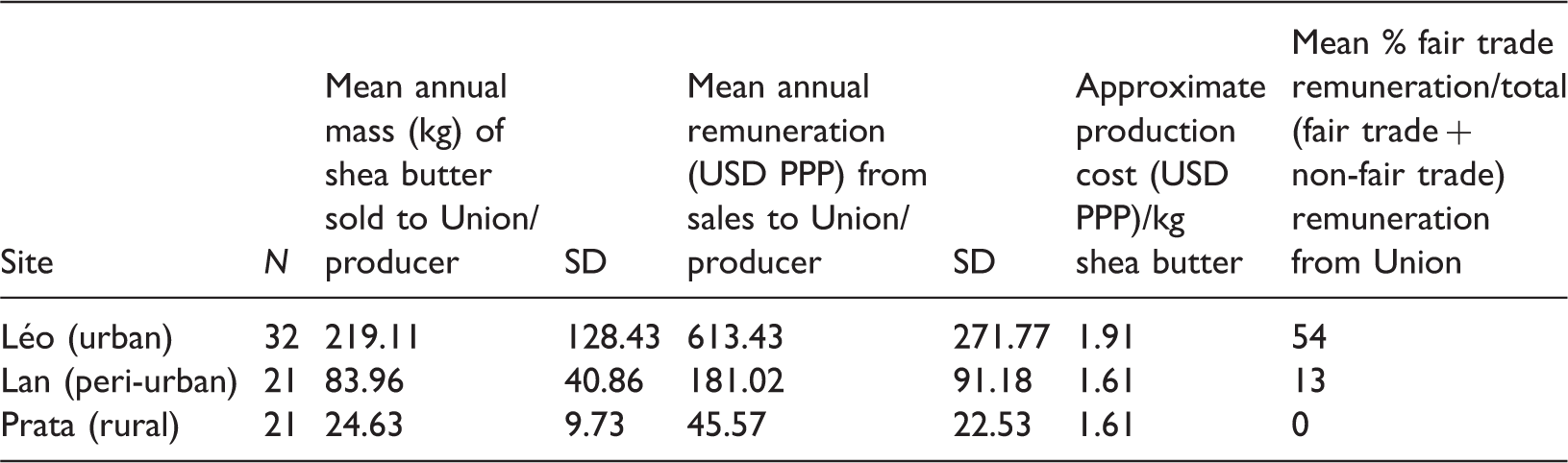
Source: Adapted from Pouliot and Elias (2013).
Hence, net returns were quite low, particularly considering that at the very least over 2.5 hours of labour were required to produce one kilogram of shea butter, excluding the time required to collect water and firewood (see Elias, 2010). Yet, shea revenues were one of the only sources of income available to rural women in the study sites, which illuminates their economic significance, and particularly that of the more lucrative fair trade market, for producers. Moreover, the fact that the UGPPK remunerated women in lump sums, as opposed to the small amounts women could earn periodically from local shea butter sales, enabled members to make productive investments rather than only spending their money on immediate needs. 6
The fair trade market was not available to all producers, however. The Union's by-laws allocated production quotas to members according to their performance during previous orders. Producers with a demonstrated ability to fulfil large orders on time were apportioned larger quotas of higher return, fair trade orders. Urban producers, who had access to labour-saving technology and running water, had supplied larger quantities of shea butter to the Union during non-fair trade certified orders than their rural counterparts. In so doing, they had gained access to the fair trade market. Hence, rural producers – while able to capture some opportunities in the alternative strand of the shea value chain – could not benefit to the same extent from this strand as urban producers.
Evidence that the fair trade system bypassed the most marginal producers is nothing new (Henderson, 2008). Studies have shown that producer groups with greater assets and skills can better satisfy the demands of a specialty niche market and of third-party certifying agencies, leading critics to state that fair trade is only reaching an elite group of producers (Taylor et al., 2005). In the case of the UGPPK, this was reinforced by the Union's internal policies. Although Prata's producers, as Union members, were eligible to supply the fair trade market, the Union's policies, drafted in Léo, legitimized the exclusion of rural producers from more remunerative orders. Spatial aspects became a dividing line among producers, as physical distance from the Union's centre also laid grounds for social and political distance that marginalized many rural producers from lucrative opportunities. This situation underscores the importance of exploring distributional issues within, and not merely across, groups participating in alternative markets, and of examining the role of informal and formal procedures – even those intended to promote transparency and equity, such as the Union's by-laws – in influencing distributional outcomes.
Coupled with their limited access to fair trade sales, rural producers felt demotivated to participate in the Union due to a lack of trust towards the Union's executive officers. This sentiment was fuelled by poor circulation of information to and knowledge among members in the Union's periphery. Tensions arose when butter was weighed and collected from rural GVFs because members – who were accustomed to selling their product locally according to volume-based measures – lacked understanding of the weighing process. Rural producers felt cheated by urban officers who remunerated them according to the mass of the butter they produced, with some women contemplating abandoning the Union over this issue.
In parallel, however, other producers described their motivation to participate in the Union based on its role in cementing social relations. This was particularly the case among GVF representatives, who came together across villages during Union assemblies, learned from each other and forged friendships. It was also most evident in Léo, where Union headquarters became a common site of production. Women, at times of different ethnic groups, supported each other's production, particularly during the most demanding steps in the process, and encouraged each other as they talked and enjoyed each other's company while working. Participation in the Union had made producers feel less isolated and had engendered benefits beyond the economic (c.f. Arora-Jonsson, 2013). As one middle-aged Moose producer explained, “when you're alone at home, you have too much time to think of your problems, but when you're surrounded by other people, you feel better because you see that they also suffer, maybe even more than you do, and with their husbands as well.” A recurrent sentiment among urban members was that UGPPK headquarters represented a secure feminine space, which they frequented in good and bad times, even when not producing butter. Bintou, a Gurunsi member from Léo, emphasized that the UGPPK's buildings and equipment are in the Union's name, and thus in women's name. In a context where women scarcely owned any property or physical assets, these buildings were a source of security and pride, and as a number of producers indicated, they attested to the professionalism of their enterprise.
According to Union members, this feeling of professionalism, which motivated their participation in the alternative strand of the shea value chain, was also fostered by the NGO trainings. These took on particular importance as they were often the only form of formal education women had received. A common observation during interviews with producers and their husbands was that this ‘professionalization’ of the shea trade had also affected gender relations, as many husbands reported gaining respect for their wives’ skills and appreciated consuming their quality butter at home.
In fact, all of the rural members' spouses we spoke with accepted their wives' involvement in the Union largely due to the significance of the additional income, however small, for their household. In a focus group held with members' husbands in Lan, one man expressed his satisfaction by rhetorically asking: “Who is happier: a person whose hunger is satisfied or a person who is hungry?” Male acceptance of their wives' participation in the Union was favoured by the fact that shea processing traditionally falls within the sphere of female responsibilities and sits comfortably with their relationship and lifestyle. For example, Hamadou, an older Moose man from Lan, stated that making shea butter is “a female activity, so there is no point in prohibiting my wife from practicing it.” The alternative strand of the shea butter value chain thus garnered most men's support by reproducing and reaffirming traditional gender roles at the value chain's producer node.
In Léo, however, problems arose when women gained power vis à vis their husbands and no longer fulfilled their expected roles within the household. Dissatisfied husbands were primarily those married to the UGPPK's executive officers, who worked long hours at Union headquarters and occupied publicly visible leadership positions within the Union. In two such households, serious marital problems transpired. Salif, the husband of one of the Union's Gurunsi executive officers, conveyed his grievances: “My wife no longer cooks and could spend one week without bringing me water. She could spend three to five days without seeing me because she leaves early and comes home late. When I ask my children where their mother is, they say: ‘she is at the Union.’ Sometimes the men here even have to clean and feed the young children. Clearly, my wife is nobody's wife anymore if she does not see her husband and serve him.” Other grievances were related to the awkwardness of women earning more money than their husband due to sales to the Union. As Salif indicated, “If a woman is your responsibility, it's shameful for her to buy her own things. When you are economically weaker than your wife, you can't carry out relations with her. She will insult you if you approach her in the night. It's not good. Her behaviour can bring me problems, even with the family counsel.” Three executive officers admitted that tensions with their spouse weighed heavily upon them. Their willingness to engage in the Union despite conflictual relations at home may be seen as a stance taken as ‘women’ to challenge inequalities in the home, strengthened by their association's gendered group identity (Arora-Jonsson, 2013).
Beyond the Union: New relations amid exclusions
Intra-household dynamics also resulted in the exclusion of some women from the Union, however. Karim and Sibdou, two Gurunsi men from Prata, confided in us that some of their fellow villagers had failed to see the benefit of the UGPPK and made their wives withdraw from the Union. Likewise, Abdou, a Moose resident in Léo, acknowledged that some of his acquaintances forbade their wives from participating in the Union. We were unable to identify and interview these men since participants maintained their anonymity, yet the concerns outlined above may reveal the reservations guiding their decision. Gender relations were thus important in shaping value chain dynamics.
Other factors leading to women's exclusion from the alternative strand of the shea value chain included the physically taxing nature of shea butter processing. The drudgery of transforming shea nuts particularly precluded older women from producing the relatively large quantities of butter required for delivery to the Union at once during orders. In contrast, it was easier for them to produce smaller quantities of shea butter for sale on the local market in the conventional strand of the value chain. In fact, the average age of the Union members interviewed was 46, 36 and 45 years old in Léo, Lan and Prata, respectively. Older women who could draw on their social networks, mainly their daughters or daughters-in-law, could request them to produce shea butter on their behalf. Some others opted not to join the Union for this reason.
Ethnic divisions also reasserted themselves in some cases. Poor ethnic integration was evident in Prata, where Moose women such as Zali preferred not to join the Union than to work with its Gurunsi members. In a focus group with Moose women held in the village, participants explained that indigenous Gurunsi residents monopolized village assets, for instance by assuming priority at the water pump even if they arrived there after their Moose counterparts, making production difficult. While we cannot establish whether these dynamics were reproduced in other villages, it is telling that nearly all of the UGPPK's GVFs comprised only Gurunsi women, and merely four Moose GVFs figured among the Union's 33 constituent groups. Other women, such as Koura, a Gurunsi producer in her mid-30s, claimed to have been excluded from GVFs or from the Union because they did not get along with their more powerful members. Politics of exclusion thus contributed to shaping Union membership, and influenced who could reap benefits in this alternative value chain configuration.
The 20 shea butter producers we interviewed who sold shea butter in Léo but had not joined the Union also faced new challenges amid a reorganization of the shea value chain. Many were from Léo's peripheral neighbourhoods where there were no women's groups formed to join the Union. They remarked that prior to the Union's creation, local shea butter producers marketed butter out of their homes and in marketplaces. The large number of producers who sold shea butter in local trade hubs such as Léo attracted shea butter wholesalers from Ouagadougou and other Burkinabè cities on a weekly basis. Since the UGPPK began securing international contracts in 2004, however, most local shea butter producers joined the Union and largely reduced or altogether stopped selling their butter at the local market. Katia, a Gurunsi producer who sold her butter in Léo, remarked that the local supply of shea butter had thus shrunk and urban wholesalers had abandoned their trips to these markets in search of the product.
Whereas the shea kernel vendors described earlier found that they benefited from an increased demand for their product from the Union's member producers, the non-member shea butter producers we met in Léo found that there is no more money to be earned in their trade outside of the Union. “The Union has stolen the market,” remarked Djamila, a Gurunsi producer. Non-member producers we interviewed remained in the business for lack of alternative economic options. Moreover, Daphnée, a Gusunsi producer, justified her continued engagement in the local shea butter market by explaining that they “were born into it. We do it to avoid crossing our arms and waiting.” Being a shea butter producer was a way of life, transmitted from mother to daughter. As part of a livelihood style and constitutive of identity, women were reluctant to altogether abandon the activity. Nonetheless, some shea producers had become discouraged and renounced the trade, focusing on selling vegetables or yogurt instead.
Those producers who continued in the trade were affected by changes in the quality of shea butter sold on the local market (Focus group with Lan's shea vendors). Training in standardized production methods had altered the quality of butter produced by Union members, some of whom also continued to sell butter on the local market. These producers explained that they were less concerned with quality when processing butter for this market, but they applied some of the techniques they learned in the alternative strand and supplied butter deemed of superior quality than previously available locally. Eager to produce a competitive product, nearly half of the non-member producers we interviewed had also adopted aspects of these processing techniques, which they learned from their Union member counterparts. While they did not receive a premium for this butter, they believed that quality improvements made their product more attractive to clients. In this way, their relations with women involved in the alternative strand of the value chain had allowed them to acquire knowledge to survive in the increasingly competitive conventional strand of the chain. In contrast, producers who continued selling a more traditional, odorous, yellower butter were further marginalized and risked exclusion from the local shea butter market.
Rethinking vertical and horizontal relations in value chains
The shea case illustrates how shifts in value chains engender processes of social inclusion and exclusion through which different actors are motivated and able – or not – to benefit from new market opportunities. Local growth in the conventional strand of the value chain provided a market opportunity for some women, but offered them low returns, and their labour was enrolled in fuelling profits concentrated in the hands of wholesalers in Ouagadougou and Ghana who could market larger quantities of the product. Moreover, women forfeited a portion of the market to young men with the assets required to outcompete them at the nut collector/rural kernel vendor node.
At the same time, the consolidation of the alternative strand of the shea value chain and the creation of the Union present a new picture. The Union allowed producers to access more remunerative markets for their product and for women to strengthen their social ties. It strengthened a sense of identity, common culture, and community among urban members that encouraged them to produce for the Union. Yet, these processes were unequal, nuanced and ambiguous.
Our analysis presents two important insights for value chain analyses. The first concerns the need to consider cross-cutting axes of social differentiation in understanding value chains. Vertically, gender was a primary factor determining participation in the shea value chain, with women concentrated in their traditional roles of shea nut collectors and processors and men with capital occupying the downstream, more remunerative nodes. Horizontally, gendered access to resources coupled with an expanding market for shea kernels encouraged the integration of young men and threatened women's monopoly at the collector node. Gender relations contributed to shaping women's (in)ability to join the Union, as their relations with their husbands enabled or hindered this participation.
Unpacking producers' gendered identities revealed how geography, age, ethnicity and inter-personal (dis)agreements created an exclusionary force that deterred certain women from engaging in the alternative and more lucrative strand of the value chain. Spatial divides across rural and urban areas created cleavages as some rural producers were distrustful of the Union's urban leaders and as urban GVFs captured the greater share of remunerative orders. The uneven global geographies (Bair and Werner, 2011) between the polluting industry in West Africa and Europe evident in the conventional strand were underlined by geographical inequalities of urban and rural in Burkina itself. Older women were disadvantaged by production processes that marginalized them in the alternative strand of the value chain and as the skewed ethnic makeup of the Union suggests, social relations, in this case based on ethnicity or indigenous versus migrant status, played a significant role in shaping access to new market opportunities. This was due not only to potential asset-based differences across groups, but also to social dynamics across groups that made it difficult for them to act collaboratively in some configurations within the Union. Paying greater attention to such social dynamics can enhance the analytical purchase of the gender in value chains literature, which has tended to focus on structural gendered barriers to entry in value chains (Carr and Chen, 2004; Coles and Mitchell, 2011).
Second, the creation of the alternative strand promoted cooperative relations, in tension with prevailing axes of differentiation within the household and at the level of the Union, across geographic spaces, within and among groups. New male collectors competed for shea nuts with their female counterparts, while making nuts available to their wives to pursue their enterprise, albeit at a price. Older women who were outcompeted by their younger counterparts at times relied on the labour of their daughters or daughters-in-law to produce butter on their behalf. At the village level, Gurunsi Union members and Moose and FulBe non-members competed over shea nuts, even as Gurunsi women taught FulBe women to prepare quality nuts and purchased these for processing. In Léo and elsewhere, Union members sold shea kernels to each other, and both competed and collaborated in the collection and purchase of quality kernels.
Across villages, GVFs dealt with different access to labour-saving technology, decision-making over Union policies, and quotas for remunerative contracts. Urban GVFs were better poised to capture benefits than rural GVFs. Yet the Union's urban executive officers had to retain the interest of rural members, without whom it would not be possible to produce the shea butter quantities needed to fulfil international contracts. Managing relationships across GVFs and promoting inter-group and inter-village collaboration showed the most promise for the sustainability of the enterprise, and social benefits motivated producers to engage in the alternative strand of the value chain. Thus, despite axes of social differentiation and exclusion, the space provided by the Union and the new strand configuration also led to cooperative relations among groups, even as they competed for a space within the chain. These spaces were intensely negotiated, as actors collaborated when they believed that doing so was more favourable for them than non-cooperation.
In this respect the space opened up by outside interventions and provided by the Union was an important aspect of the trade for women. Although we cannot assume that this would be true of all collectives, such a space outside the home, sanctioned by outside authority, eager to empower women, can enable women to forward their own agendas. Yet, we need to be alert to how these empowering collectives can bring new exclusions in their wake. Outside intervention can reinforce existing relations, but can also engender possibilities for new (cooperative and competitive) relations of production. Members cooperate – sometimes in unconventional ways – when doing so outweighs the costs of collaboration, and this may provide them with an identity and support structure beyond the merely economic (Arora-Jonsson, 2013).
Keeping sight of the power relations structuring interactions on the ground, we must consider how outside organizational support can reduce rather than exacerbate existing inequalities based on ethnicity, class, and other axes of social differentiation. NGOs and other organizations must recognize that interventions that affect market relations reach into the multiple arenas of social life, such as within the household. Importantly, geography needs to be considered so that development interventions do not (re)create new or existing rural and urban (or North-South) cleavages. In this respect, institutions that respond to different conditions of production across geographies as well as better information sharing and representation of rural producers in decision-making positions would help redress imbalances across the rural-urban continuum. Rather than mere inclusion of women in value chains, this calls for an acknowledgment of power relations throughout the value chains' vertical but also horizontal links to bring about more equitable relations.
Footnotes
Acknowledgements
Thanks are due to the Burkinabè women and men who generously shared their experiences with us and to Azizou Yago, Fatimata Traoré, Pamoussa Ouédraogo and Nassiratou Nébié for field assistance. We thank Sarah Turner, the Editor and two anonymous reviewers for their valuable comments on earlier versions of the manuscript.
Declaration of conflicting interests
The author(s) declared no potential conflicts of interest with respect to the research, authorship, and/or publication of this article.
Funding
The author(s) disclosed receipt of the following financial support for the research, authorship, and/or publication of this article: Canada’s Social Sciences and Humanities Research Council, the CGIAR Research Program on Forests, Trees and Agroforestry, the CGIAR Fund Donors and the Swedish Research Council.