



Abstract
This study investigates the efficacy of environmentally friendly silica-based nanocomposites, SiO2-Fe3O4 and SiO2-ZnO, for removing Ibuprofen (IBU) from aqueous solutions. The synthesized nanocomposites were characterized using various techniques, such as SEM, TEM, EDS, and FTIR. The adsorption capabilities of IBU onto these nanocomposites were explored through comparative analysis, focusing on factors such as pH, initial pollutant concentration, contact time, and temperature. Results reveal that the adsorption process is pH-dependent, and the lower pH levels enhance the adsorption process. The IBU removal process is faster with SiO2-Fe3O4 compared to SiO2-ZnO. Kinetic modeling suggests a pseudo-second-order mechanism
Introduction
Exponential population growth and the increase in industrial facilities have led to negative impacts on the environment and human beings (Alrumman et al., 2016; Singh et al., 2019). Consequently, the demand for water supplies increases in parallel with the depletion and pollution of water resources like streams, lakes, rivers, and oceans (Ladu et al., 2018). Pollution causes pressure on the quality and quantity of water resources available and leads to many infectious diseases, that affect human health, such as typhoid fever, diarrhea, vomiting, and kidney problems (Ladu et al., 2018; Yunus et al., 2012).
Numerous substances, including pharmaceuticals, plastics, polythene bags, fertilizers, pesticides, fertilizers, and surfactants, can contaminate environmental water. Pharmaceutical compounds are produced and used in large quantities, which lead to the uncontrolled continuous release of these contaminants into the water environment; therefore, the presence of pharmaceutical residues in the environment is an emerging issue (H. Jones et al., 2005; Ziylan and Ince, 2011). Pharmaceutical compounds have been found to be more prevalent in sewage treatment plant (STP) effluents and surface waters compared to drinking water and groundwater (Beere et al., 2010; Tambosi et al., 2010). The main sources of pharmaceuticals in the environment are hospitals, research activities using therapeutic compounds, disposing of expired drugs in the environment, and pharmaceutical industries (Hernando et al., 2006; Tiwari et al., 2017; Yang et al., 2011). Increased levels of trace active pharmaceutical ingredients, which are present in water in the range of ng.L−1 to μg.L−1 attract researchers attention to investigate the fate and occurrence of such compounds in the aquatic environment (Cunningham et al., 2009; Luo et al., 2014; Narvaez and Jimenez, 2012). Ibuprofen (IBU) is a nonsteroidal anti-inflammatory drug (NSAID), chemically named 2-(4-(2-Methylpropyl) phenyl) propanoic acid, C13H18O2, and is used to relieve acute pain and antipyretic. Although Ibuprofen contains the polar carboxyl group COOH, the presence of a benzene ring and a non-polar alkyl group reduces its polarity (Figure 1). Ibuprofen is one of the persistent organic pollutants (POPs) that has an adverse effect on human health and the environment (Davarnejad et al., 2018; Jiménez-Silva et al., 2019). With the continuous spreading of pharmaceutical residuals in the aquatic environment, the development of a cost-effective method and high capacity for removing the pharmaceutical contaminants from the aquatic environment has become an urgent necessity (Chauhan et al., 2019).

Ibuprofen (IBU) chemical structure.
Most conventional wastewater treatment methods, such as activated sludge, sand filtration, and flocculation-coagulation, are inefficient in the removal of chemical pollutants, which leads to the accumulation of the remaining quantities in water (Gupta et al., 2021; Krishnakumar et al., 2022). The IBU removal techniques incorporate advanced oxidation processes in chemical methods, adsorption in physical methods, and the utilization of microbial cultures in biological methods for pollutant biodegradation (Khan and Yadav, 2021; Naghiloo et al., 2015; Packer et al., 2003; Shi et al., 2017; Tanveer et al., 2019). Also, analysis is being conducted to assess the advantages and drawbacks of each technique. The majority of these approaches are both expensive and relatively ineffective at reducing pharmaceutical concentrations in water. Nanotechnology is applied to produce an effective nano-adsorbents for wastewater treatment. These nanomaterials have gained a lot of attention as eco-friendly, high surface area, magnetic properties, and effective substances for removing pharmaceutical residues from wastewater (Kunduru et al., 2017; Theron et al., 2008).
Nano-adsorbents, clays, polymers, modified silica, activated carbon, and composites have been employed as materials for the removal of IBU (França et al., 2020; Obradović et al., 2023; Skwierawska et al., 2022). Metal oxides nanoparticles have receiving noticeable attention for nanoparticles adsorbent synthesis; previous studies show that the metal oxides nanoparticles have the ability to alter the surface structure and properties which increase the active adsorption sites (edges, corners, and vacancies), which improve the adsorption for removing the pharmaceuticals from wastewater (Fallah et al., 2021; Talbot et al., 2021; Taoufik et al., 2019). The magnetic Iron oxide is present in several forms, like maghemite (γ-Fe2O3), hematite (α-Fe2O3), and magnetite (Fe3O4) (Taoufik et al., 2019).Numerous previous researches have been applied magnetics nanocomposites in many fields because of their large specific surface area, high adsorption capacity, super-paramagnetic properties, specific functionality, and short adsorption equilibrium time. These characteristics make it possible to eliminate pollutants in a short time (Al-Rimawi et al., 2022; Barrera et al., 2019; Mehmanravesh et al., 2019).The magnetic Fe3O4 nanoparticles are synthesized using several methods such as hydrothermal, microemulsion, colloidal chemistry, and co-precipitation. The preferred approach for preparing Fe3O4 is the co-precipitation method because of simplicity, ability to use water as a solvent, reproducibility, and short-time reaction (Hui and Salimi, 2020; Noqta et al., 2020).The magnetic dipole attractions between magnetic nanoparticles reduce their stability in aqueous solutions and limits their efficiency in various applications (Kharisov et al., 2014). Surface modification of Fe3O4 nanoparticles has been used with different biocompatible and biodegradable polymers to enhance stability and dispersibility of Fe3O4 nanoparticles, such as surfactants or xerogels (Amgoth et al., 2019; Huong et al., 2009; Khamkure et al., 2022).
ZnO nanoparticles are known as a luminescent material and are one of the metal oxides that have been given attention due to their distinctive characteristics like optical properties, low cost, low toxicity, a wide range of UV absorption, and was used as a photocatalyst for the degradation of pollutants in water (Ragavendran et al., 2023). Several methods have been used to synthesize ZnO nanoparticles, such as the sol-gel method, hydrothermal reaction, and chemical precipitation (Raoufi, 2013; Singh et al., 2022). The chemical precipitation method is commonly used to synthesize ZnO nanoparticles because of its low cost, low temperature, and the ability to control size (Jay Chithra et al., 2015).
In this study, the synthesized silica-based nanocomposite: SiO2-ZnO and -SiO2-Fe3O4 were used for studying the removal efficiency of ibuprofen from aqueous solutions. The characterization of the synthesized nanomaterials involved utilizing techniques such as Fourier-Transform Infrared Spectroscopy (FT-IR), Energy-Dispersive X-ray Spectroscopy (EDS), Scanning Electron Microscopy (SEM), and Transmission Electron Microscopy (TEM). Furthermore, an examination of various parameters that could influence removal efficiency, including contact time, pH, temperature, and initial pollutant concentration. Finally, the adsorption mechanisms were explored through the application of various relevant kinetic models.
Experimental
Chemicals
Ibuprofen (C13H18O2), ferrous chloride tetrahydrate (FeCl2.4H2O, ≥ 99%), ferric chloride (FeCl3, ≥ 99%), sodium hydroxide (NaOH, ≥ 98%), ammonium hydroxide (28% NH3 in H2O), tetraethyl orthosilicate (TEOS, ≥ 99%), ethyl acetate (EtAc, ≥ 99%), ethanol (≥99%), cetyltrimethylammonium bromide (CTAB, ≥ 98%), Lithium hydroxide (LiOH, 99%), sodium chloride (NaCl, ≥ 99%), hydrochloric acid (HCl, 32%), and zinc acetate dihydrate (Zn(CH3CO2)2·2H2O, 99% pure). The chemicals utilized were sourced from Sigma-Aldrich Chemical Company, and all aqueous solutions were prepared using Milli-Q water having resistivity 18.2 MΩ.cm.
Synthesis of magnetite (Fe3O4) nanoparticles
The synthesis of magnetite nanoparticles was previously reported via Fe2+ and Fe3+ at a ratio of 1 to 2, according to the following chemical reaction (Iida et al., 2007):

Synthesis of zinc oxide nanoparticles
ZnO nanoparticles were synthesized through a precipitation method (Tang et al., 2010). In each batch, 0.0439 g of Zn(CH3CO2)2·2H2O was completely dissolved in 40 ml of absolute ethanol with stirring for 30 min at room temperature. Following this, 5.5 mg of LiOH was added to the zinc/ethanol solution under continuous stirring at room temperature for 2 h. The resulting ZnO mixture was stored in tightly sealed bottle.
Synthesis of SiO2-Fe3O4 and SiO2-ZnO nanocomposites
To prepare a batch of SiO2-Fe3O4 nanocomposite, 0.2 g of CTAB was dissolved completely in 10 ml of MQ water. Subsequently, 1.0 ml of the Fe3O4/ethanol mixture was introduced into the surfactant solution with continuous vigorous stirring for 10 min, followed by adding 80 ml of NaOH (13 mM). Next, 6.0 ml of ethyl acetate and 1.0 ml of TEOS were added to the solution, and continuous stirring was maintained for one hour. Finally, 0.1 g of NaOH was introduced to the solution with continuous stirring for an additional one hour. The same procedure was replicated to prepare the SiO2-ZnO nanocomposite, wherein 1.0 ml of the ZnO/ethanol mixture was introduced instead of the Fe3O4 mixture.
Characterization techniques
Various techniques were employed to characterize both the SiO2-Fe3O4 and SiO2-ZnO nanocomposites. The absorption spectra of the solutions were assessed using an Agilent 8453 UV-Vis spectrophotometer equipped with deuterium lamps and a photodiode array detector. Scanning Electron Microscopy (SEM) with a Lyra3-Tescan field emission was employed to examine the size, shape, and surface morphology of the materials. Transmission Electron Microscopy (TEM) images were captured using a JEM-2100F instrument. Fourier Transform Infrared Spectroscopy (FT-IR) spectra of the nanoparticle samples were acquired using a Bruker TENSOR II Spectrometer. The spectra were obtained with KBr pellets in the range of 4000–380 cm−1.
Adsorption experiments
Effect of pH
A 1000- mg.L−1 solution of IBU was prepared by dissolving appropriate amount of IBU in a mixture of absolute ethanol and MQ water in a 1:1 volume ratio. The pH of 25 mg.L−1 IBU solutions were adjusted using 0.1 M NaOH and HCl solutions as needed before adding 50 mg of adsorbent. These mixtures were then placed in a shaking water bath held at a constant temperature. A calibration curve for IBU was constructed within the range of 5.0–35.0 mg.L−1 (Fig.
The point of zero charge (PZC) for the two types of nanocomposites (SiO2-ZnO and SiO2-Fe3O4), was determined via a simple chemical method. This involved adding 40 ml of 0.01 M sodium chloride to a series of beakers, with the pH adjusted to 2, 3, 4, 5, 6, 7, 8, 9, 10, and 11. Subsequently, 50 mg of nanocomposites were introduced into each beaker and agitated on a shaker for 24 h at 25°C, then the final pH values were recorded.
Removal efficiency and effect of contact time
To ascertain the optimal removal of IBU, various initial IBU concentrations were investigated by introducing 50 mg of SiO2-ZnO and SiO2-Fe3O4 nanocomposite into 75 ml of IBU solutions with concentrations of 15.0, 25.0, and 35.0 mg.L−1. These solutions were adjusted at pH = 4 and agitated at 150 rpm for three hours. Subsequently, each solution underwent filtration through a 0.45 µm syringe filter and the maximum absorbance of each aliquot was measured using a UV-Vis spectrophotometer at a fixed wavelength of 222 nm. Then, the concentration of IBU in each aliquot was determined utilizing a calibration curve. All samples were analyzed at different time intervals (5, 10, 20, 30, 60, and 90 min), and the removal efficiency of the adsorbents was calculated using Eq. (1):

Effect of temperature
The impact of temperature on the adsorption process was investigated. Initially, 50 mg of adsorbent was added to 75 ml of an IBU solutions with a concentration of 25 mg.L−1. The mixtures were then shaken in a thermostat shaker at 150 rpm for 90 min, with the temperatures set to 288 K, 298 K, and 318 K. After filtration, the final concentration of IBU was determined by measuring the absorbance at a fixed wavelength of 222 nm.
Results and discussion
Material characterization
The synthesized material underwent characterization using SEM, TEM, EDS, and FT-IR. The surface structure and morphology of ZnO, Fe3O4, SiO2-ZnO, and SiO2-Fe3O4 were analyzed using SEM and TEM techniques, as shown in Figure 2, as depicted in Figure 2. The morphology of ZnO nanoparticles and SiO2-ZnO nanocomposite exhibited a spherical-like structure, while the TEM image clearly revealed the birefringence of ZnO quantum dots with a particle size of approximately 6 nm, Figure 2 (a). The TEM image shows ZnO nanoparticles as black dots distributed on the surface of SiO2 and within its layers, Figure 2 (b) (Al-Jabari et al., 2018). Furthermore, the SiO2-ZnO nanocomposite showed an average diameter ranging from 50 to 90 nm, as illustrated in Figure 2 (b,c).
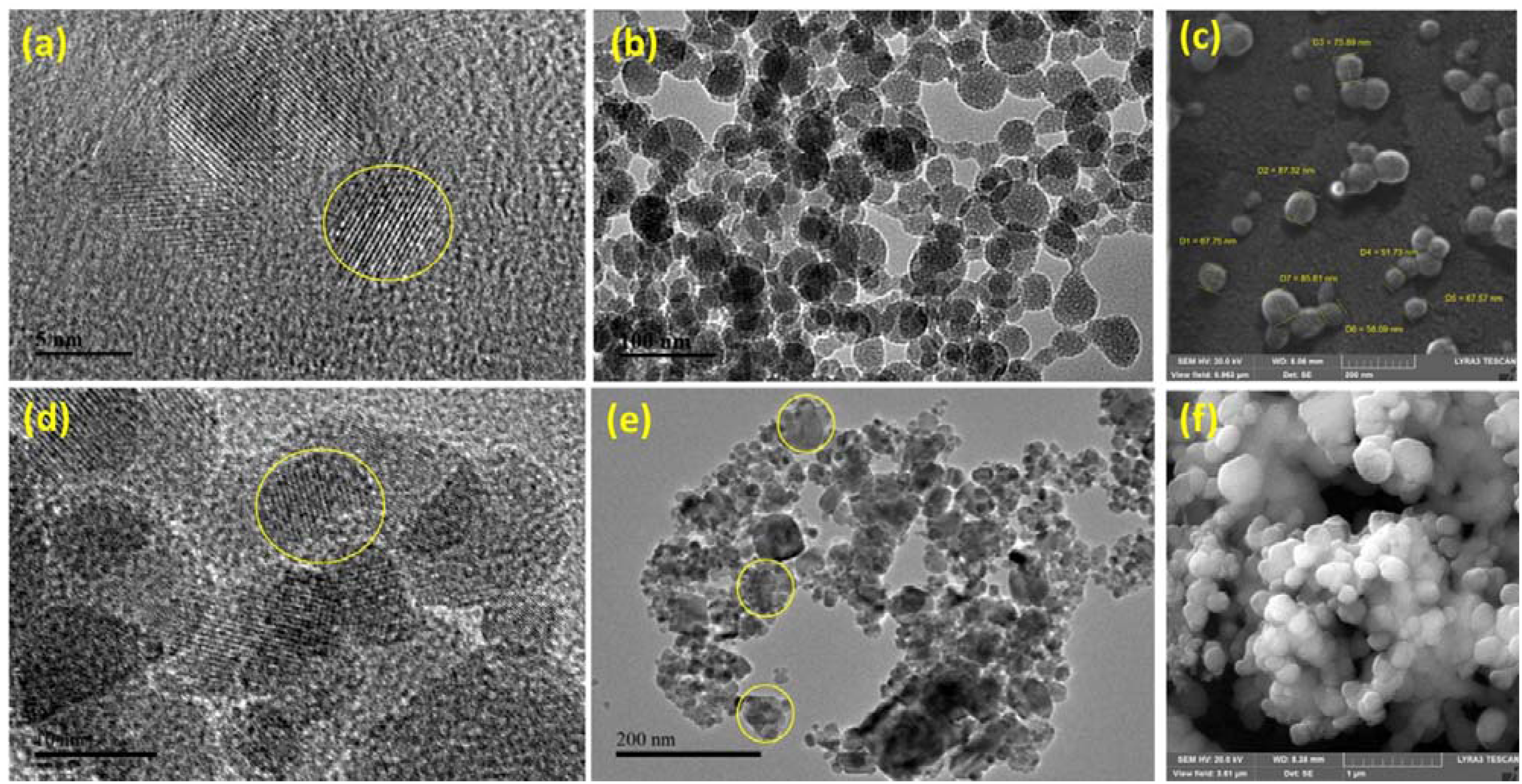
(a) and (d) are the TEM images of ZnO and Fe3O4, nanoparticles respectively. (b) and (c) are the TEM and SEM images of SiO2-ZnO nanocomposite, respectively. (e) and (f) are the TEM and SEM images of SiO2-Fe3O4 nanocomposite, respectively.
Figure 2 (e-f) displays the TEM and SEM images of Fe3O4 nanoparticles and SiO2-Fe3O4 nanocomposite. In Figure 2 (d) the Fe3O4 magnetite nanoparticles exhibit aggregated behavior attributed to their magnetic properties, showcasing a spherical shape with an average diameter of 10 nm (Al-Jabari et al., 2019). TEM images of SiO2-Fe3O4 in Figure 2 (e) illustrate the irregular distribution of Fe3O4 nanoparticles on the surface of silica, suggesting variability in the thickness of SiO2-Fe3O4. Additionally, the SEM image of SiO2-Fe3O4 nanocomposite as shown in Figure 2 (f) reveals a spherical morphology with an approximate diameter range of 80 to 250 nm. Furthermore, the energy-dispersive spectroscopy (EDS) of SiO2-ZnO and SiO2-Fe3O4 was conducted. The EDS spectra clearly confirm the presence of the anticipated elements: Zn, Fe, Si, and O, which are the principal constituents of the nanocomposite, as illustrated in Figures S2 and S3.
FT-IR spectroscopy was utilized to analyze surface functional groups before and after IBU adsorption. Figure 3 depicts the FT-IR spectra of IBU before and after adsorption using the two nanocomposites. The main characteristic peaks were identified in the range of 380–4000 cm−1 for IBU and the nanocomposites (SiO2-Fe3O4-IBU and SiO2-ZnO-IBU). The peaks within 500–1500 cm−1 represent the fingerprint region of vibration bands associated with the aromatic ring. The spectrum of IBU exhibits two distinctive peaks: one at 1709 cm−1 attributed to the C = O asymmetric stretching vibration of the carboxyl functional group, and another at 1220 cm−1 corresponding to C-O ester group vibrations. Additionally, peaks for (C-H)sym and (C-H)asym of the alkyl chains appear around 2850–3000 cm−1. Furthermore, characteristic peaks indicative of bending vibrational modes appear at 440 cm−1, suggesting the presence of Si-O bonds. Peaks observed at 1070 cm−1 and 789 cm−1 are attributed to the asymmetric and symmetric stretching vibrational modes, respectively, of the Si–O–Si bridge of the siloxane group. The presence of metal oxide (MxOy) is indicated by stretching vibrational modes observed between 400–600 cm−1. A shoulder peak at 963 cm−1 confirms the presence of the M–O–Si vibration mode, indicating the presence of metal oxide on the surface of SiO2. The vibrational absorption peak of the silanol Si-OH bond is situated at 1479 cm−1, while the O-H stretching vibration occurs at 3430 cm−1 (Galedari et al., 2017; Wang et al., 2016).

FT-IR spectra for (a) IBU (b) SiO2-Fe3O4-IBU (c) SiO2-ZnO-IBU scanning range 4000- 380.
Removal efficiency
The adsorption of IBU onto the surface of SiO2-ZnO and SiO2-Fe3O4 nanocomposites is significantly influenced by both pH value and adsorbate concentration. Figure 4 (a) illustrates the impact of different initial pH values on the extent of IBU removal. Specifically, in the case of iron oxide, it is evident that the adsorption of IBU initially decreases gradually and then rapidly as pH levels rise from 6 to 8. This transition corresponds to a substantial decrease in IBU adsorption efficiency, falling from 95.8% to 39.5%. However, at pH values of 4 and 6, a decrease in percentage removal is still observed, albeit at a slower rate. This pH dependence can be explained by the molecule's behavior at different pH levels. At lower pH (less than 4.91), IBU exists primarily in its neutral form. This allows for favorable hydrogen bonding interactions between the electronegative oxygen atom in IBU and the hydroxyl groups (–OH) present on the SiO2-Fe3O4 surface, and this interaction promotes efficient IBU adsorption. As the pH increases above (4.91), IBU progressively deprotonates, acquiring a negative charge. At the same time, the SiO2-Fe3O4 surface may also become more negatively charged due to deprotonation. This creates a repulsive force between the negatively charged IBU and the negatively charged nanocomposite surface which hindering the adsorption process, these findings are consistent with previous studies (Choong et al., 2019; Oba et al., 2021). Similar to SiO2-Fe3O4 nanocomposite, zinc oxide nanocomposite exhibits a pH-dependent adsorption pattern for ibuprofen (IBU) (Morales et al., 2023). As the solution's pH (alkalinity) increases, the removal efficiency of IBU on SiO2-ZnO decreases. Also, this can be attributed to the changing charge of IBU. At lower pH (below its pKa), IBU remains neutral and readily forms hydrogen bonds with the hydroxyl groups SiO2-ZnO, promoting adsorption. However, at higher pH, IBU becomes negatively charged, creating electrostatic repulsion with the potentially negatively charged SiO2-ZnO surface. Interestingly, the removal efficiency appears to reach a plateau above pH 4. This could be due to a limited number of negatively charged sites on the surface of nanocomposite or the influence of other pH-independent adsorption mechanisms (Ma et al., 2020).

Graphs represent (a) the effect of pH on the percentage removal of IBU (b) the estimation of pHpzc for both SiO2−ZnO and SiO2- Fe3O4 nanocomposite at 298 K.
In addition, the point of zero charge (PZC) is a crucial factor influencing the adsorption capacity and surface charge of these nanocomposites. As shown in Figure 4 (b), PZC for SiO2-Fe3O4 is 9.0 and for SiO2-ZnO is 9.13. When the pH of the solution is below the pKa of IBU, the carboxyl group (-COOH) of IBU remains largely undissociated, keeping IBU in a neutral form. At this lower pH, which is also below the PZC of the nanocomposites, the surface of the adsorbent becomes positively charged due to protonation from the acidic medium. Even though IBU is mostly neutral at this pH, the positively charged surface of the adsorbent can still attract IBU molecules through hydrogen bonding and van der Waals interactions. Additionally, if some IBU molecules become negatively charged (due to partial dissociation of the carboxyl group), they will be strongly attracted to the positively charged adsorbent surface via electrostatic forces, further enhancing adsorption. Therefore, at pH values lower than the pKa of IBU and the PZC of the nanocomposites, the combination of electrostatic attraction, hydrogen bonding, and van der Waals interactions maximizes the adsorption efficiency. This results in effective removal of IBU in acidic conditions (Choong et al., 2019; Oba et al., 2021). Conversely, a pH above PZC leads to a negatively charged surface (due to deprotonation), creating repulsion between the negatively charged IBU (at higher pH) and the nanocomposite, hindering adsorption. Therefore, these nanocomposites exhibit optimal IBU removal efficiency at lower pH conditions due to favorable electrostatic interactions and hydrogen bonding (Bhadra et al., 2017; Chham et al., 2018; Vicente-Martínez et al., 2020).
The effect of the initial ibuprofen (IBU) concentration on its removal efficiency and adsorption capacity (AC) by SiO2-Fe3O4 and SiO2-ZnO nanocomposites was investigated (Figure 5). Overall, SiO2-Fe3O4 exhibited a higher removal efficiency and adsorption capacity compared to SiO2-ZnO across all initial IBU concentrations. The effect of initial IBU concentration is evident in two opposing trends. While the adsorption capacity increases with increasing IBU concentration, the percentage removal decreases. This can be observed for SiO2-Fe3O4 at 15 mg.L−1 (R%: 84.67, AC: 19.05 mg.g−1) while at 35 mg.L−1 (R%: 73.07, AC: 38.3 mg.g−1), whereas for SiO2−ZnO at 15 mg.L−1 (R%: 78.93, AC: 17.8 mg.g−1) while at 35 mg.L−1 (R%: 63.26, AC: 31.9 mg.g−1). The data suggests that both nanocomposites effectively adsorbed IBU at low and high concentrations until their adsorption sites became saturated. However, increasing the IBU concentration beyond 35 mg.L−1 did not significantly enhance removal efficiency, suggesting that both SiO2-Fe3O4 and SiO2-ZnO nanocomposites possess a limited number of active sites available for IBU adsorption.

Effect of initial IBU concentration on the adsorption capacity and the percentage removal for both SiO2−ZnO and SiO2- Fe3O4 nanocomposite at 298 K.
Kinetic adsorption
A kinetic experiment investigated the effectiveness of SiO2-Fe3O4 and SiO2-ZnO nanocomposites in removing ibuprofen (IBU) from water as contact time increased. The amount of IBU adsorbed onto the surface of both nanocomposites was determined using a mass balance equation, Eq. (2).

To understand the rate and mechanism of IBU adsorption, kinetic experiments were conducted and different models, including the Lagergren pseudo-first-order and pseudo-second-order models, were applied to analyze the kinetic processes (Lagergren, 1898). For this purpose, the linear form of Lagergren's equation, representing the pseudo-first-order rate equation was utilized, Eq. (3).

The obtained data reveal that the correlation coefficient (R2) has a lower value, indicating that the data does not fit well with the pseudo-first-order model, Table 1. Consequently, another kinetic model was examined to better match the experimental data. The nonlinear pseudo-second-order form of Ho's equation is provided, Eq. (4):

Kinetic parameters for both adsorbents were obtained using linear and nonlinear forms for the pseudo-first-order and pseudo-second-order models.

And the linearized pseudo-second-order model as given by Ho's Eq. (5) (Ho, 1995):

The linear fit model of pseudo-second-order sorption kinetics studies of IBU via (a) SiO2-Fe3O4 and (b) SiO2-ZnO nanocomposites by various initial concentrations at 298 K.
To assess the efficacy of the non-linear pseudo-second-order model for IBU adsorption onto the surface of nanocomposites, the non-linear fitting for both SiO2-Fe3O4 and SiO2-ZnO was evaluated. This enabling a direct comparison between the model's predicted adsorption capacities 

The nonlinear fit model of pseudo-second-order sorption kinetics studies of IBU via (a) SiO2-Fe3O4 and (b) SiO2-ZnO nanocomposites by various initial concentrations at 298 K.
Where
Adsorption isotherms
Researchers employed adsorption isotherms to characterize the equilibrium distribution of IBU between the liquid and solid phases. The isotherm models describe the relationship between the amount of IBU adsorbed by the nanocomposites and its concentration in the surrounding solution. Two frequently used models, Langmuir and Freundlich, were employed. The Langmuir isotherm model assumes a single, uniform layer (monolayer) of IBU molecules covering the entire surface of the adsorbent (Ulfa and Iswanti, 2020).
Table 2 presents the correlation coefficient (
Correlation coefficients (R2) values of linear Langmuir forms at 288 K.

Qm represents the maximum amount of IBU (mg) adsorbed per gram of adsorbent for complete monolayer coverage, while
The Freundlich isotherm is also a commonly applied adsorption model, particularly applicable to heterogeneous adsorbent surfaces where adsorption energies vary across different sites. Eq. (8) illustrates the linearized form of the Freundlich isotherm model.
The adsorption of ibuprofen (IBU) onto surfaces of SiO2-Fe3O4 and SiO2-ZnO nanocomposites was investigated using the linear Langmuir and Freundlich isotherm models (Eqs. 7 and 8), and were illustrated in Figure 8. The model parameters for both nanocomposites were determined at three different temperatures (288 K, 298 K, and 318 K), and the results are presented in Table 3. At each temperature, the correlation coefficient (

Linear form plots of Langmuir and Freundlich isotherm models of IBU adsorption on: a) SiO2-Fe3O4 and b) SiO2-ZnO nanocomposites at 288 K.
Parameter values were obtained from the Langmuir and Freundlich models for IBU sorption using SiO2-ZnO and SiO2-Fe3O4 nanocomposites.

Thermodynamic parameters
The effect of temperature on the adsorption process was studied using both nanocomposites at different temperatures. To explore the nature of the adsorption process, the activation energy (

Arrhenius (a) and van't Hoff (b) plots for ibuprofen (IBU) adsorption onto both SiO2-ZnO and SiO2-Fe3O4 nanocomposites.
Physisorption (physical adsorption) occurs when the
As depicted in Table 4, the activation energy barrier for IBU adsorption onto SiO2-ZnO nanocomposite was determined to be 64.8 kJ mol−1, suggesting a weak chemisorption mechanism. Conversely, the activation energy barrier in the adsorption process of SiO2-Fe3O4 nanocomposite was calculated to be 16.9 kJ mol−1, indicating a physisorption process. These findings highlight the contrasting adsorption behaviors of IBU on the two nanocomposites. The presence of ZnO in the SiO2 nanoparticles appears to promote the formation of weak chemical bonds with IBU, ZnO possesses Lewis acidic sites on its surface due to defects or imperfections on the ZnO lattice, creating Zn2+ sites with incomplete octets (Maleki and Pacchioni, 2022; Vankudoth et al., 2017). These Lewis acid sites can interact with the lone electron pairs on the oxygen atoms of the ibuprofen molecule, leading to weak chemical bonding (chemisorption) during adsorption. In contrast to SiO2-ZnO, the SiO2-Fe3O4 composite appears to prefer a physisorption mechanism for IBU molecules. This might be due to a weaker or more uniform distribution of electrical charges on its surface. This weaker charge distribution could lead to less favorable interactions with the polar regions of IBU molecules. While hydrogen bonding is another possibility for physisorption, the extent to which Fe3+ cations on the surface can participate in hydrogen bonding with suitable functional groups on IBU molecules likely depends on the specific arrangement of atoms on the composite's surface (Al-Jabari et al., 2019; Anchique et al., 2021).
Thermodynamic parameters for IBU adsorption on both SiO2-ZnO and SiO2-Fe3O4 nanocomposites.

The obtained results from the temperature effect were utilized to compute the thermodynamic parameters of sorption, including standard Gibbs free energy changes (
The 


Conclusion
This study explores the potential of silica-based nanocomposites (SiO2-ZnO and SiO2-Fe3O4) for ibuprofen removal from aqueous solutions. The synthesized nanocomposites were characterized using various techniques. Adsorption experiments investigated the influence of pH, contact time, initial ibuprofen concentration, and temperature. The interplay between IBU's ionization state and the surface charge of nanocomposite governs the adsorption process. Lower pH enhanced adsorption through electrostatic interactions, favorable hydrogen bonding dominates at lower pH, while electrostatic repulsion becomes significant at higher pH, leading to reduced IBU removal efficiency. Langmuir and Freundlich isotherms were employed to analyze the equilibrium data. IBU adsorption on SiO2-Fe3O4 favored monolayer adsorption uniformly across temperatures, indicating a homogeneous surface. In contrast, SiO2-ZnO showed temperature-sensitive, heterogeneous adsorption with better fit at 298 K. SiO2-Fe3O4 generally had higher IBU adsorption capacities than SiO2-ZnO due to surface property variations. The calculated activation energy indicated a physisorption and a chemisorption mechanism for SiO2-Fe3O4 and SiO2-ZnO, respectively. Thermodynamic analysis revealed exothermic adsorption (negative
Supplemental Material
sj-docx-1-adt-10.1177_02636174241296362 - Supplemental material for Efficient removal of ibuprofen from aqueous solutions using silica-based nanocomposites: A comparative study
Supplemental material, sj-docx-1-adt-10.1177_02636174241296362 for Efficient removal of ibuprofen from aqueous solutions using silica-based nanocomposites: A comparative study by Laila A. Khalil, Mohammed H. Al-Jabari and Saleh M. Sulaiman in Adsorption Science & Technology
Footnotes
Abbreviations
Acknowledgments
The authors would like to thank support received from the Scientific Research Committee at Birzeit University. The authors would also like to thank their colleagues from Birzeit University: Asem Mubarak, A.N. Dudin, and I. Shalash for their technical support.
Author contribution
Laila A. Khalil: formal analysis, investigate, writing.
Mohammed H. Al-Jabari: conceptualization, supervision, writing, review and editing.
Saleh M. Sulaiman: supervision, Methodology, review and editing.
Declaration of conflicting interests
The authors declared no potential conflicts of interest with respect to the research, authorship, and/or publication of this article.
Ethical committee as applicable
No ethical issues were identified in this study.
Funding
The authors received no financial support for the research, authorship, and/or publication of this article.

Supplemental material
Supplemental material for this article is available online.
References
Supplementary Material
Please find the following supplemental material available below.
For Open Access articles published under a Creative Commons License, all supplemental material carries the same license as the article it is associated with.
For non-Open Access articles published, all supplemental material carries a non-exclusive license, and permission requests for re-use of supplemental material or any part of supplemental material shall be sent directly to the copyright owner as specified in the copyright notice associated with the article.
