




Abstract
The adsorption of Pb(II) and Cu(II) onto Fe3O4@Mg2Al-NO3 Layered Double Hydroxide (LDH) as a function of Fe3O4@Mg2Al-NO3 LDH concentration was studied. An adsorbent concentration effect (Cs effect), namely adsorption isotherm declines as adsorbent concentration (Cs) increases, was observed. The experimental data were fitted to the adsorption models including the classic Freundlich model, the metastable-equilibrium adsorption theory, the flocculation model, the power function model, and the surface component activity model. The results show that the Freundlich-type metastable-equilibrium adsorption equation, the power function model, and the Freundlich-surface component activity equation can adequately describe the Cs effect observed in the batch adsorption tests as all the correlation coefficients (R2) of the nonlinear plots are higher than 0.96. In other words, their intrinsic parameters simulated from the experimental data are independent of Cs value. It is considered that the Freundlich-surface component activity equation is the best model to describe the Cs effect of the studied adsorption systems by Akaike Information Criterion evaluation criterion.
Keywords
Introduction
In studies of adsorption at the solid–liquid interface, an anomalous phenomenon of “adsorbent concentration effect” (Voice and Weber, 1985) or “solids effect” (O’Connor and Connolly, 1980; Voice et al., 1983) (Cs effect), namely adsorption isotherm declines as adsorbent concentration increases, has been observed since the 1980s. Thermodynamically, the adsorption equilibrium constant (or equilibrium partition coefficient) for a given adsorption reaction under constant temperature, pressure, and medium composition (e.g. pH, ionic strength) should be independent of both adsorbate and adsorbent concentrations (Pan and Liss, 1998). So, the classic adsorption model cannot explain this anomalous phenomenon because it was derived on the assumption that the adsorption equilibrium constant is independent of the adsorbent concentration (Cs).
In fact, there has been controversy about the reasons for the Cs effect over the last 30 years. Some researchers (Cohen-Stuart et al., 1980; Grolimund et al., 1995; Gschwend and Wu, 1985; Nyffeler et al., 1984) have attributed the Cs effect to a variety of experimental artifacts, while other researchers (Chang and Wang, 2002; DiToro et al., 1986; Helmy et al., 2000; Lu et al., 2008; Pan and Liss, 1998; Pan et al., 1999; Utomo and Hunter, 2010; Voice and Weber, 1985; Wu et al., 2006) believed that the Cs effect is a constancy phenomenon based on thermodynamic principles although many artifacts may cause a pseudo Cs effect. Because the substances for which adsorption isotherm apparently declined with increasing Cs include inorganic and organic adsorbates in freshwater and marine sediments, quarts, clays and clays minerals, and digested sewage sludge, it seems unlikely that experimental artifacts could explain widespread agreement of a Cs effect for so diverse a set of adsorbates, adsorbents, and investigators (McKinley and Jenne, 1991). Thus, it can be concluded that the Cs effect is an experimental fact indeed, not an artifact, and there should be a universal reason that causes the Cs effect although it is still not clear now.
In order to explain the reasons for the Cs effect, many models have been proposed, e.g. the solute complexation model (Voice and Weber, 1985), the particle interaction model (DiToro et al., 1986), the metastable-equilibrium adsorption (MEA) theory (Pan and Liss, 1998), the flocculation model (Helmy et al., 2000), the power function (Freundlich-like) model (Chang and Wang, 2002), and the surface component activity (SCA) model (Zhao and Hou, 2012; Zhao et al., 2012, 2013). It needs to fully examine the applicability of the models in describing adsorption equilibriums with the Cs effect. In this study, the Cs effect of the adsorption of Pb(II) and Cu(II) on Fe3O4@Mg2Al-NO3 LDH was analyzed and the applicability of the current theories was examined, including the MEA theory, the flocculation model, the power function model, and the SCA model. The present work can improve our understanding of the Cs effect adsorption phenomenon as well as the applicability of the current models in describing adsorption equilibriums.
Materials and methods
Materials
All chemicals used in this work were of analytical grade. Ultrapure water was used in all cases.
Magnetic nanoparticles were prepared by dissolving 0.01 mol of FeCl2·4H2O and 0.02 mol of FeCl3·6H2O in water solution under stirring at 65℃, and 20 wt% of NH3·H2O was added dropwise together at a constant pH value of 10–11. The obtained material (Fe3O4) was recovered, washed several times with deionized water until the pH was neutral. The obtained Fe3O4 was preserved as suspension.
Fe3O4@Mg2Al-NO3 LDH with an Mg2+/Al3+ molar ratio of 2:1 was prepared by coprecipitation. An aqueous solution containing 0.1 mol Mg(NO3)2·6H2O and 0.1 mol Al(NO3)3·9H2O was added dropwise to Fe3O4 solution with Fe/Mg molar ratio equal to 0.02, under vigorous stirring. During the synthesis, the temperature was maintained at 65℃ and pH at 11–12 by the simultaneous addition of NaOH solution. The reaction mixtures were aged for 45 min in mother solution at room temperature and then filtered, washed with deionized water until the pH was neutral. The filter cakes were further hydrothermally treated at 80℃ for 24 h. The sols were dried, triturated, and sieved to collect the particles of <74 µm in diameter.
Magnetic Fe3O4@Mg2Al-NO3 LDH was characterized by X-ray diffraction (XRD) and transmission electron microscopy (TEM) (Figures 1 and 2). XRD was performed on a D/maxrA model diffractometer (Bruker, Germany) using Cu Kα radiation (λ = 1.5418 Å) at 40 kV and 40 mA. The morphologies were observed by TEM (JEM-2100, JEOL, Japan). The magnetization curves were obtained at ambient temperature by vibrating sample magnetometry (JDM-13, Jilin University, China) in a magnetic field range of 0–8000 Oe (Figure 3). The characteristic text results show that the Fe3O4@Mg2Al-NO3 LDH complex still has the characteristic diffraction peaks of the LDH, and there is no obvious diffraction peak of Fe3O4 phase. The complex particles are approximately spherical. LDH clad on the surface of Fe3O4. These indicate that the magnetic Fe3O4 particles are highly dispersed into the LDH phase and Fe3O4@Mg2Al-NO3 LDH inherits the magnetic property from the Fe3O4.
XRD patterns of Fe3O4@Mg2Al-NO3 LDH sample. LDH: Layered Double Hydroxide; XRD: X-ray diffraction. TEM images of Fe3O4@Mg2Al-NO3 LDH. LDH: Layered Double Hydroxide; TEM: transmission electron microscopy. Magnetization curves of Fe3O4@Mg2Al-NO3-LDH and the inset is the magnetization curve of Fe3O4. LDH: Layered Double Hydroxide.


Adsorption experiments
Adsorption tests of Pb(II) and Cu(II) on Fe3O4@Mg2Al-NO3 LDH sample were carried out by batch equilibration technique (Ding et al., 2010; Hermosin et al., 1995; Ma et al., 2010). Solutions with various concentrations (0–800 mg/l) of Pb(II) and Cu(II) were prepared in 0.01 mol/l of NaNO3 with Pb(NO3)2 and Cu(NO3)2·3H2O, and the pH values of the solutions were adjusted to 5.0 with 0.1 mol/l HNO3 and NaOH solutions. Known masses (0.025–0.20 g) of Fe3O4@Mg2Al-NO3 LDH samples were mixed with 25 ml Pb(II) and Cu(II) solutions of various initial concentrations in polyethylene centrifugal tubes. The centrifugal tubes were put into a thermostatic water bath shaker at 25±0.2℃ for 24 h. Then the suspensions were centrifuged at a speed of 4000 r/min for 5 min. The Pb(II) and Cu(II) equilibrium concentrations in the supernatants were determined by flame atomic absorption spectrometry (TAS-990, Beijing Purkinje General Instrument Co., Ltd). The equilibrium adsorption amounts were calculated using the following equation

Results and discussion
Figure 4 shows the adsorption isotherms of Pb(II) and Cu(II) on Fe3O4@Mg2Al-NO3 LDH at different Fe3O4@Mg2Al-NO3 LDH concentrations. As can be seen, the adsorption isotherms are L-type, and they decline significantly as the adsorbent concentrations increase. The L-type isotherms can be commonly described using the Langmuir and Freundlich isotherms. This phenomenon accords with the law which is described by a Cs effect. The adsorption equilibrium constants should be dependent on the Cs. The applicability of current theories to predict the Cs effect phenomenon was examined as following.
Adsorption isotherms of Pb(II) (a) and Cu(II) (b) on Fe3O4@Mg2Al-NO3 LDH at different adsorbent concentrations. LDH: Layered Double Hydroxide.
Classical adsorption equations
The classical Langmuir equation was introduced by Irwin Langmuir in 1916. It was originally formulated for describing the adsorption of gases onto a solid phase. It is now also used to predict the adsorption of the liquid–solid system. The equation is based on following assumptions: (1) the surface of the adsorbent is uniform, that is, all the adsorption sites are equivalent; (2) adsorbed molecules do not interact; (3) all adsorption occurs through the same mechanism; and (4) at the maximum adsorption, only a monolayer is formed, i.e. molecules of adsorbate do not deposit on other, already adsorbed, molecules of adsorbate, only on the free surface of the adsorbent (Langmuir, 1918; Iraolagoitia and Martini, 2010). The Langmuir equation is stated as

Equation (2) can be expressed by the following linear form

As we know, Langmuir model was developed on the basis of the thermodynamic equilibrium theory while Freundlich model was originally an empirical equation. However, it was found that Freundlich equation could be thermodynamically derived based on assuming that the adsorption sites of adsorbent are of different energies and the adsorption of sorbate on the sites having same energy level obeys Langmuir equation (Sheindorf et al., 1981).
Classical Freundlich equation is represented as (Santhi et al., 2010; Sheindorf et al., 1981)

Equation (4) can be expressed by the following linear form

The adsorption data of Pb(II) and Cu(II) on Fe3O4@Mg2Al-NO3 LDH (Figure 4) were fitted with the Langmuir equation and the Freundlich equation (see Figures 5 and 6). It was found that Freundlich equation can adequately describe the adsorption equilibriums of Pb(II) and Cu(II) on Fe3O4@Mg2Al-NO3 LDH for a given Cs value better than Langmuir equation, and all the correlation coefficients (R2) are greater than 0.95. The fitted Freundlich parameters, KF and nF, for various Cs values are presented in Table 1. It can be seen from Table 1 that both two Freundlich parameters vary with Cs value and similar results were reported in the literature (Sheindorf et al., 1981). This dependence of the Freundlich parameters on Cs showed that the classical Freundlich model cannot predict the Cs effect. That is to say, using the Freundlich parameters obtained with given Cs values to predict the adsorption behavior of adsorbate at other Cs values will be inaccurate.
Linear correlation plots for the classical Langmuir equation: (a) Pb–Fe3O4@Mg2Al-NO3 LDH system and (b) Cu–Fe3O4@Mg2Al-NO3 LDH system. LDH: Layered Double Hydroxide. Linear correlation plots for the classical Freundlich equation: (a) Pb–Fe3O4@Mg2Al-NO3 LDH system and (b) Cu–Fe3O4@Mg2Al-NO3 LDH system. LDH: Layered Double Hydroxide. Parameters of the classical Freundlich equation for Pb(II) and Cu(II) adsorption on Fe3O4@Mg2Al-NO3 LDH at different adsorbent concentrations. LDH: Layered Double Hydroxide. The data in parentheses are the standard deviations.


The fact that Freundlich equation can adequately describe the adsorption behavior for a given Cs value indicates that Freundlich equation is available for the real adsorption systems studied. Therefore, the deviation of the prediction of Freundlich equation from the experimental data for different Cs values should be because the effect of Cs on adsorption was not accounted for in the derivation process of the classical Freundlich equation.
Examining using MEA theory
In order to explain the fundamental mechanism of the Cs effect, Pan and Liss (1998) developed an “MEA theory.” It suggests that, in reality, the experimentally measured “equilibrium” state of solid–liquid adsorption system is generally a metastable-equilibrium state. So, the measured “equilibrium” adsorption density (Γe) is no longer a state variable. In this case, the same number of adsorbed molecules on the solid surface could contain different amounts of energy depending on the different metastable-equilibrium states of the adsorbed molecules. A definite value of Γe could therefore have different values of chemical potential (μ) and represents different thermodynamic states of the adsorbate on the solid surface. Based on the MEA theory, Pan and Liss (1998) obtained a Langmuir-like and a Freundlich-like MEA isotherm.
The Freundlich-type metastable-equilibrium isotherm equation (Pan and Liss, 1998) is


The plots of lg Γe versus lg Cs at various Ce values were examined for the two adsorption systems studied, respectively. It was found that all plots showed fairly straight lines (Figure 7). The αP values obtained from the slopes of the plots change in a small amplitude with Cs. Using the average values of the αP values obtained at various Ce values (see Table 2), the normalized nonlinear plots of Plots of lg Γe versus lg Cs at different equilibrium concentrations: (a) Pb–Fe3O4@Mg2Al-NO3 LDH system and (b) Cu–Fe3O4@Mg2Al-NO3 LDH system. LDH: Layered Double Hydroxide. Parameters of Freundlich-like equations for two adsorption systems. MEA: metastable-equilibrium adsorption; SCA: surface component activity. The data in parentheses are the standard deviations. The Freundlich-type MEA isotherms: (a) Pb–Fe3O4@Mg2Al-NO3 LDH system and (b) Cu–Fe3O4@Mg2Al-NO3 LDH system. LDH: Layered Double Hydroxide; MEA: metastable-equilibrium adsorption.


Examining using the flocculation model
Helmy et al. (2000) proposed a “flocculation model.” It hypothesizes that particles associate through flocculation, thus the surface area available for adsorption decreases. Based on the classic theory of flocculation, a straight-line relation was obtained relating the square root of the adsorption maximum to adsorbent concentration as follows

Figure 9 shows the plots of Relationships between 
Examining using the power function model
A power function (Freundlich-like) model was proposed by Chang and Wang (2002) using batch experimental data with dimensional analysis method. It assumed that the total sorbed amount of sorbate is a function of the equilibrium concentration of sorbate, the volume of sorbate solution, and the adsorbent amount in the system. A relationship among Γe, Ce, and Cs was derived as follows


If power function model is applicable for a given system, the plot of ln(Γe) versus ln(Ce/Cs) will give a unique straight line for various Cs values.
The experimental data of Pb(II)–Fe3O4@Mg2Al-NO3 LDH and Cu(II)–Fe3O4@Mg2Al-NO3 LDH systems were fitted by equation (9), and the results are shown in Figure 10. As shown in figures, the nonlinear plots for various Cs values show a unique curve for each adsorption system, and their correlation coefficients (R2) are higher than 0.97. These results indicate that the power function model can adequately describe the Cs effect observed in the two systems. The KC and nC values are listed in Table 2.
Fitting curves of the power function model: (a) Pb–Fe3O4@Mg2Al-NO3 LDH system and (b) Cu-Fe3O4@Mg2Al-NO3 LDH system. LDH: Layered Double Hydroxide.
Examining using the Freundlich-SCA equation
Considering the deviation of a real adsorption system from an ideal one, we proposed an alternative model, SCA model (Zhao and Hou, 2012; Zhao et al., 2012, 2013). It suggests that (1) the surface of the adsorbent is uniform, that is, all the adsorption sites are equivalent; (2) all adsorption occurs through the same mechanism; (3) at the maximum adsorption, only a monolayer is formed; (4) the molecular size of solute and solvent are similar; and (5) surface component (adsorption site or adsorbed solute) activity coefficient is not equal to unity because of the deviation of a real adsorption system from an ideal one. A Cs-dependent Freundlich equation (or Freundlich-SCA equation) can be derived as following

The linear form of equation (11) is

The coefficients, nS and KS, of a given system are independent of adsorbent concentration.
The Cs-dependent function of 


Thus, the Cs-dependent function of
The changes of the KF with Cs for the four adsorption systems were fitted to equation (14) using a nonlinear least-squares method (Excel Solver) (Figure 11), and the best-fit values of the empirical constants, γ and α, are listed in Table 2.
Relationships between KF and Cs in two systems: (a) Pb–Fe3O4@Mg2Al-NO3 LDH system and (b) Cu–Fe3O4@Mg2Al-NO3 LDH system. LDH: Layered Double Hydroxide.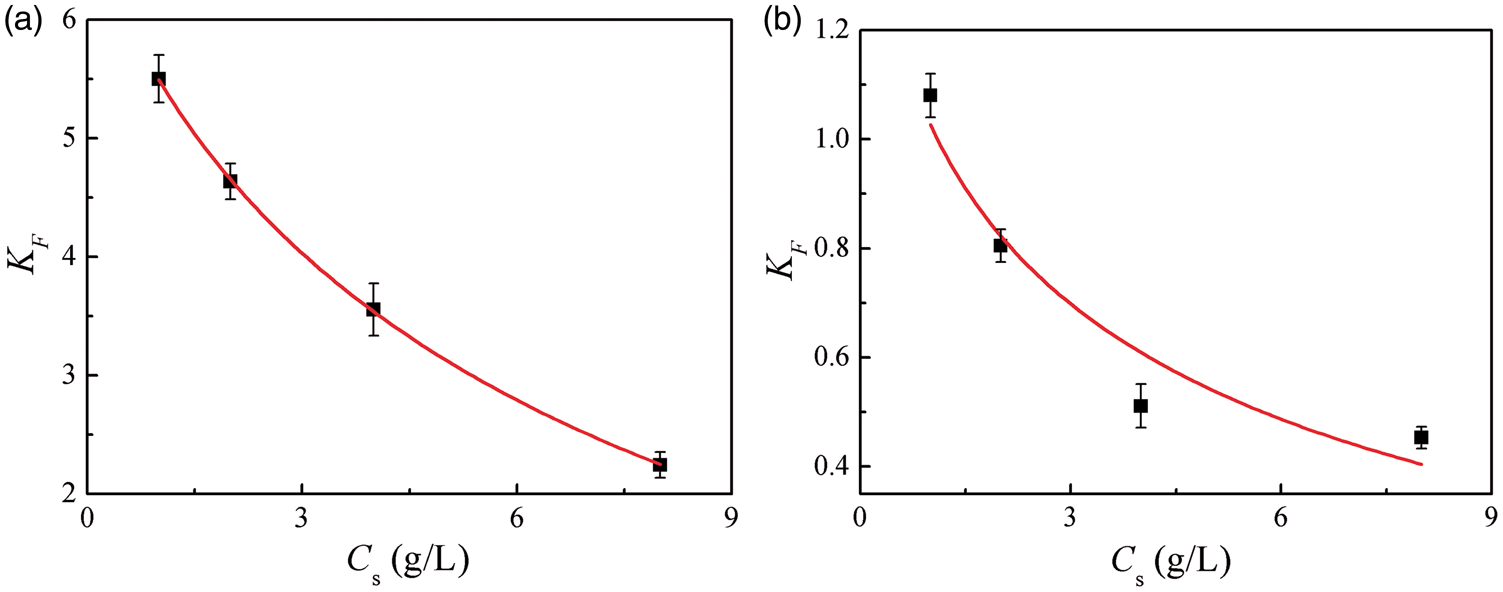
Using the simulated γ and α value (Table 2), the normalized nonlinear plots of The Freundlich-SCA isotherms for (a) Pb–Fe3O4@Mg2Al-NO3 LDH system and (b) Cu–Fe3O4@Mg2Al-NO3 LDH system. LDH: Layered Double Hydroxide; SCA: surface component activity.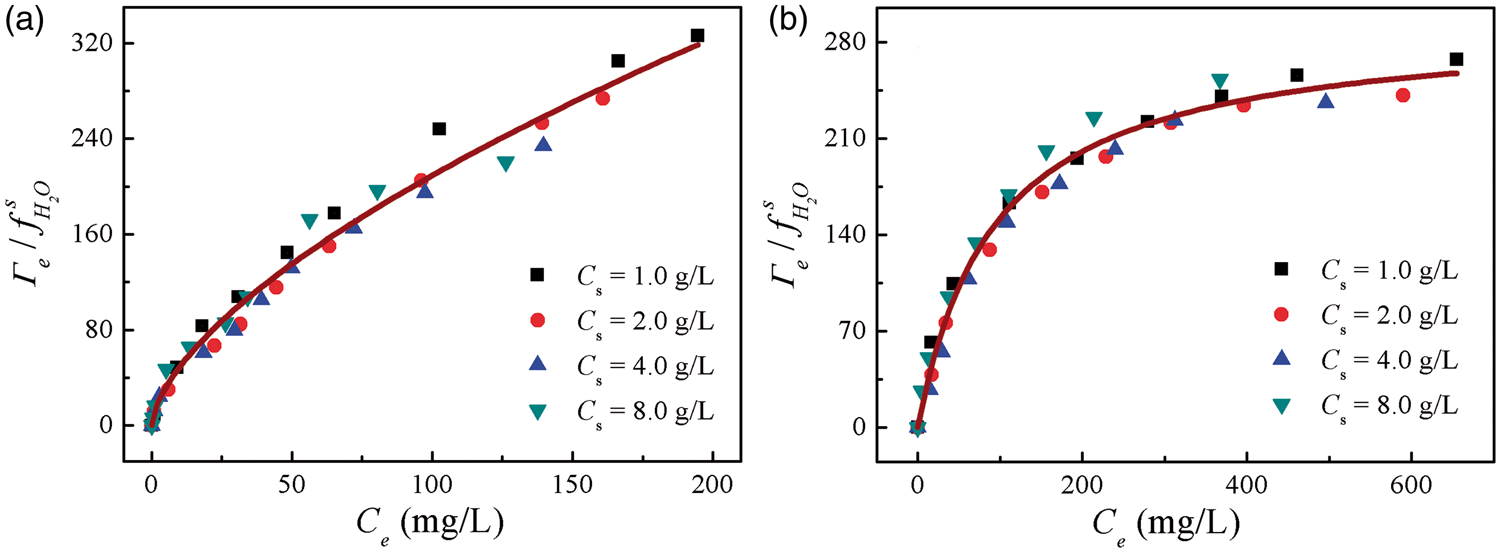
Evaluation values of the models.

AIC: Akaike Information Criterion; MEA: metastable-equilibrium adsorption; SCA: surface component activity.
Conclusions
The adsorption of Pb(II) and Cu(II) onto Fe3O4@Mg2Al-NO3 LDH in the studied conditions is subject to the Cs effect in which the adsorption isotherm declines as the adsorbent concentration increases. The above fitting results of the adsorption data of the two systems with Freundlich-like equations show that Freundlich-type MEA equation, power function model, and Freundlich-SCA equation can be used to describe the Cs effect observed in the batch adsorption tests. In this case, the values of parameters obtained at given Cs values can be used to predict the adsorption behavior for any Cs values.
The fitting process of the power function model is simplest; however, the model cannot interpret any particular mechanism for the Cs effect as what Chang and Wang (2002) claimed, and it should be regarded as a curve-fitting model or a mathematical tool for describing experimental data. The MEA theory and the SCA model provided the fundamental reason for the Cs effect. The MEA theory implies that the changes in Cs can affect the MEA state, which in turn can fundamentally affect the adsorption isotherm. However, seemingly it cannot explain the Cs effect observed in desorption experiments because in this case the adsorption state of sorbate should be independent of solid concentration utilized in the experimental systems. The SCA model supposes that it is the interaction between the adsorbent particles that induces the deviation of a real adsorption system from an ideal one, just as the deviation of a real solution from an ideal one. With increasing the Cs value, the interaction between the adsorbent particles strengthens, resulting in the decrease of the effective adsorption site density, therefore, the adsorption isotherms decline.
It is considered that the Freundlich-SCA equation is the best model to describe the Cs effect of Pb(II)–Fe3O4@Mg2Al-NO3 LDH and Cu(II)–Fe3O4@Mg2Al-NO3 LDH adsorption systems by AIC evaluation criterion. This work improves our understanding of the Cs effect adsorption phenomenon and confirms the applicability of the SCA model in describing adsorption equilibriums with the Cs effect.
Footnotes
Declaration of Conflicting Interests
The author(s) declared no potential conflicts of interest with respect to the research, authorship, and/or publication of this article.
Funding
The author(s) disclosed receipt of the following financial support for the research, authorship, and/or publication of this article: This work was supported by the Shandong Provincial National Natural Science Foundation of China (No. ZR2015YL014), the Youth Science Funds of Shandong Academy of Sciences (No. 2014QN001), the National Natural Science Foundation of China (No. 21603124), and the Major Science and Technology Program for Water Pollution Control and Treatment (No. 2015ZX07203007 and 2015ZX07203005).