




Abstract
Very few studies have investigated the adsorption performance of hydrophobic and hydrophilic silicas with dissolved organics in water, which is a required final step during produced water treatment. The cost of functionalization also hinders the use of hydrophobic materials as sorbents. Novel hydrophilic silicas, prepared at low temperature and ambient pressure, were characterised by SEM, FTIR and BET analysis, and studied for the adsorption of aqueous phase organic compounds at concentrations below their solubility limits. Adsorption capacities were found to be up to 264 mg/g for benzene and 78.8 mg/g for toluene. Direct comparison is made with the analogous hydrophobic version of one of the silica materials, demonstrating comparable uptakes for benzene concentrations lower than 50 mg/L. This finding supports the hypothesis that, at very low aqueous phase organic concentrations, hydrophobicization has no discernible effect on access of the pollutants to the internal porosity of the material.
Introduction
Silica aerogels are materials with large surface areas, high porosities, low densities and conductivities, which can be successfully used as thermal insulators, catalyst supports, adsorbents, and in many other scientific and commercial applications (Wang et al., 2015). Researchers reported a CF3(CH2)2– functionalized aerogel powder capable of absorbing up than 230 times its weight in oil (Reynolds et al., 2001), while further studies showed that such doped hydrophobic materials can adsorb more than 30 times the volume of toluene compared with Granular Activated Carbon (GAC) (Hrubesh et al., 2001). Silica gels, synthesised using tetramethoxysilane (TMOS) as the precursor, were modified by replacing the Si–OH groups, responsible for the adsorption of water, with S–CH3 groups via addition of methyltrimethoxysilane (MTMS) and trimethylethoxysilane (TMES). Adsorption tests on the subsequent gels revealed maximum benzene adsorption capacities 300 times higher than GAC (Standeker et al., 2007), with equilibrium established in less than 30 min. Silica aerogels have been shown to uptake pure organic compounds, such as benzene and toluene, to levels in excess of 13 g/g aerogel (Wang et al., 2011). The high uptakes are mainly due to the resulting swelling of the adsorbent.
Consequently, aerogels have been studied extensively for the absorption of oil spills (Adebajo et al., 2003; Olalekan et al., 2014; Reynolds et al., 2001; Wang et al., 2012); however, despite their adsorption potential for organic species, they have not been used in water treatment plants for the separation of petroleum hydrocarbons. Several researchers have previously tested aerogels on crude oil-water mixtures, and it has been proven that functionalization with fluorinated organic groups, which maximises hydrophobicity, gives the best performance in terms of organic adsorption from pure oil or oil-water mixtures (Hrubesh et al., 2001; Wang et al., 2012).
An issue with these past studies is that many work at excessive concentrations of organic species within the aqueous phase; whereas produced water, at the refining stage, contains only low concentrations of dissolved oil droplets, mainly part of the BTEX group (benzene, toluene, ethylbenzene and xylene). Hence, it is essential to evaluate the adsorption performance of potential sorbent materials with concentrations of these pollutants well below the solubility limits. Previous work compared benzene adsorption isotherms, using aerogel materials, an activated carbon and a polymeric resin, at similar concentrations, and no free oil phase present in the batch tests; the results showed that greater amounts of benzene and toluene were adsorbed from aqueous solution using activated carbons or polymeric resins rather than functionalized aerogels (Wang et al., 2011). Using aqueous concentrations of selected organic pollutants at one-tenth of their solubility limits, polymeric resin XAD4 and activated carbon AC F400 were shown to respectively adsorb 150 mg/g and 320 mg/g of benzene, 180 mg/g and 340 mg/g of toluene (Simpson et al., 1993; Wang et al., 2011). Hydrophobic silica aerogel ‘Nanogel’ TLD 301, the surface of which is decorated with trimethyl-silyl groups (–Si(CH3)3), was recently tested for the adsorption of organic compounds from aqueous phase, using adsorbate concentrations below the water solubility limits. Equilibrium was reached in under 20 min and the adsorption capacities were 87 mg/g for benzene and 223 mg/g for toluene, while the individual uptake of both organics, at C = 0.1CSAT, was found to be less than 10 mg/L (Wang et al., 2011). Recently aerogels obtained from MTMS as a precursor and dried supercritically were shown to uptake more than 50 mg/g of benzene at a concentration of 50 mg/L of aqueous benzene, which is a significant result at such a low concentration (Perdigoto et al., 2012).
The results discussed above suggest that hydrophobic silica aerogels could be potential adsorbents for the treatment of oil spills. Hence, previous research has focussed markedly on hydrophobic media, with no known studies specifically related to the uptake of aqueous phase BTEX organics using hydrophilic silicas; consequently, many studies have focussed on improving the hydrophobicity of these materials. Hydrophobization of the inner surfaces of aerogels not only improves affinity to organic adsorbates, but it also helps to prevent long-term deterioration of the structure, due to the absorption of water; if water fills the pores of an aerogel and subsequently evaporates, then this acts as a second drying cycle and the structure can collapse, at least partially (Venkateswara Rao et al., 2011). The need to recycle hydrophilic silicas may be considered irrelevant if the absence of functionalising agents and the use of cheaper precursors and synthesis make the production and waste management of these materials economically suitable for a single adsorption cycle, hence, removing regeneration costs and associated issues. Such gains may be achieved by using simpler, less energy intensive processing methods and low cost synthetic routes using ambient pressure drying are already known to produce silica aerogels, from waterglass, with excellent mechanical properties (Zong et al., 2015).
In this paper, we propose a study of hydrophilic silicas that have been seemingly overlooked for organics removal from aqueous systems in the past. Hence, we characterise both hydrophilic and hydrophobic amorphous silicas, determining and comparing their kinetics and capacities of adsorption to selected organic species from aqueous media at a range of different concentrations below the solubility limit. Thus, allowing evaluation of the feasibility of the use of these materials as sorbents for produced water treatment.
Experimental
Adsorbents
Four Quartzene based sorbents were used in the study, namely: ND, Z1, Z1HPO and CMS types, all supplied by Svenska Aerogel AB (SvAAB). The structure of Quartzene and its properties are comparable to silica aerogels but the former is an amorphous silica material. Both have skeletal structures composed of porous silica, very low densities, and very low thermal conductivities. The only significant physical difference is that Quartzene is produced as a powder, not as a gel from a sol-gel process. Its chemical properties, in terms of hydrophilicity/hydrophobicity, can be tailored to fit a specific application and the porous structure can also be controlled, notably without the need of a surfactant. Unlike traditional aerogels, Quartzene is an environmentally friendly material, which is significantly cheaper to produce, as a result of the ambient pressure and temperature conditions used in its manufacture.
ND type Quartzene: prepared via the precipitation of sodium silicate with sodium chloride (NaCl) at ambient temperature. A defined amount of dilute active aqueous sodium silicate solution (SiO2:Na2O = 3.35) was prepared, representing solution A, while solution B was composed of aqueous NaCl. Solutions A and B were mixed under rapid stirring and the resulting precipitate mixed with a defined amount of tap water, before vacuum filtration through a filter paper until a paste, comprising up to 85% water, was obtained and dried via spray drying. Z1 type Quartzene samples: prepared using a method analogous to that for ND but with a different level of activation of the silica source (Twumasi Afriyie et al., 2014). Furthermore, a methylated version of Z1, herein called Z1HPO, was developed by SvAAB, allowing direct comparison of adsorption uptakes and kinetics between hydrophilic and hydrophobic versions of the same base material. CMS type Quartzene: prepared by adding calcium and magnesium sources at concentrations of 1:2 to the silica source (Waterglass SiO2/Na2O = 3.35). A 500 mL salt solution, consisting of MgCl2 hexahydrate and CaCl2 dihydrate was prepared at a ratio of 68 mol% Mg and 32 mol% Ca; 500 mL salt solution, was poured onto 1.5 M (with respect to SiO2) sodium silicate solution (500 mL), and the resulting mixture agitated at room temperature. Subsequent coagulation occurred, as previously described (Twumasi Afriyie et al., 2013), and the obtained gel was washed, filtered and dried in the same manner as ND.
ND and CMS type samples used in this study were powders, with particle sizes between 2 and 150 µm, and Dv90 (particle size below which 90% of the sample falls) equal, respectively, to 46 and 75 µm, measured with a Malvern Hydro 2000S. Granules of Z1 and Z1HPO were also used, with particle sizes between 1 and 1.5 mm.
Characterization of adsorbents
Samples were dried for 2 h at 358 K prior to coating with a thin layer (1.5 nm) of gold for FE-SEM analysis using a HITACHI SU-6600 (2010) Field Emission Scanning Electron Microscope. The instrument is equipped with Energy Dispersive Spectroscopy (EDS), Oxford Inca 350 with 20 mm X-Max detector and Wavelength Dispersive Spectroscopy (WDS), and uses Oxford Inca Wave 700 Microanalysis System with Energy + Software.
Surface chemical functionalities of adsorbent materials are known to determine their hydrophilic or hydrophobic nature and this is also true of silicas (El Rassy and Pierre, 2005). FT-IR analysis, obtained using an ABB MB 3000 spectrophotometer with Horizon MB™ FTIR software, were used to determine surface functionalities of samples (dried at 248 K for 2 h) prepared as hydrophilic.
Nitrogen sorption measurements were performed at 77 K using a Micromeritics ASAP 2420, on samples accurately weighed between 0.15 and 0.5 g and degassed at 393 K, for 3.5 h. Degassing at low temperatures requires longer treatment times but has the benefit that the structure of the material is preserved. Forty adsorption points and 30 desorption points were collected per isotherm, spanning the relative pressure range 0–0.99. BET analysis (Brunauer et al., 1938) was used to interpret the data obtained.
A film of adsorbate is known to cover an adsorbent with a defined density profile but, by assuming that the film thickness is uniform, it is possible to obtain a ‘statistical thickness’ (t) from gas sorption isotherms, such as the nitrogen sorption analysis used here. The Harkins–Jura thickness equation, derived from Lippens and De Boer’s analysis for non-porous siliceous materials characterised by nitrogen adsorption at 77 K (Lippens and De Boer, 1965), can be employed as a reference, to estimate surface area, average pore size and pore volume of materials with similar composition and BET C constants, using the t-plot analysis method. An assumption of the t-plot method is the uniformity of the thickness of the adsorbent layer, hence, adsorption on a mesoporous surface is considered similar to adsorption on a flat surface; however, the adsorbed thickness on small mesopores is not constant, but varies as a function of the pore diameter. Consequently, this method, when applied to nitrogen adsorption, should be used with caution in the presence of mesopores with diameters <3.5 nm (Galarneau et al., 2014), which, in this study, includes ND samples. Furthermore, it is essential that the reference surface should be energetically and structurally similar to the porous solid surface under analysis, as both factors affect the level of adsorbate loading at a given relative pressure; however, the BET C value does not guarantee a similar surface structure, so it is not sufficient basis for selection of a reference isotherm (Biggs et al., 2004). For these reasons, surface areas and pore volumes reported in this study were estimated using α-plot analysis, as this is considered more reliable than the t-plot method.
Parameters of the reference adsorbent Lichrospher-1000 were applied in the following equation (Gregg and Sing, 1982):

Adsorptives
Benzene and toluene were used in this study as representative components of dissolved oils in produced water from the BTEX family; the organics were purchased from Sigma Aldrich as chromatography grade reagents (HPLC,≥99.9%). Benzene is more representative of dissolved oil, as the most difficult of the BTEX group to adsorb from solution, due to the fact that the adsorption potential of the solute in the liquid carrier decreases with increasing solubility of the adsorbate. Since, the solubility of the monoaromatics in the BTEX group decreases with molecular weight, their adsorption potential increases with the molecular weight (Wang et al., 2011), hence, the lowest molecular weight species (benzene) is the most difficult to adsorb.
Adsorption experiments
Borosilicate glass bottles were used for all adsorption studies, and bottle volumes were selected in order to reduce headspace within the vessel. Mixtures of water and benzene were stirred in filled bottles for 1 h using a magnetic stirrer to solubilize the organic, before samples were extracted with a micropipette, then mixed with methanol and internal standard before injection, using a microsyringe, into the port of a Shimadzu GC 2014 gas chromatograph equipped with FID detectors to determine the concentration present. Pre-determined amounts of adsorbent were added to prepared bottles of aqueous phase organics to study adsorption characteristics. Kinetic tests were conducted at pre-determined intervals, over 24 h, to determine times for maximum equilibria to be achieved for each sample; the aqueous concentrations of benzene and toluene were respectively ∼1 g/L and ∼0.35 g/L. All measurements were conducted at 293 K.
Adsorption tests involved the addition of benzene, at concentrations in the range 0–1100 ppm, to 110 mL of distilled water mixed with 100–500 mg of adsorbent, equilibrated for 24 h before analysis. An analogous procedure was used for toluene but using aqueous concentrations in the range 0–400 ppm.
The adsorption behaviour of hydrophobic Z1HPO was only tested using aqueous benzene, agitated using a rotary shaker to guarantee sorbent contact with the aqueous phase, which could not be guaranteed by use of a magnetic stirrer, as used for the hydrophilic materials, due to the fact that the light hydrophobic material floats in water. All procedures were performed at 293 K using sealed cups with minimal headspace, as outlined above, to reduce volatilisation losses. Lower temperatures were not investigated as the reduction in temperature significantly impacts on kinetic performance by increasing the time required for equilibration and making kinetic measurements impractical. Blank tests, conducted without sorbent, demonstrated that volatilisation rates were negligible for both kinetic and adsorption measurements. The stirring rates used were constant, at 200 r/min for magnetic stirring and 20 r/min for rotary stirring. Sampling was performed at various depths within a selected test vessel to verify the absence of concentration gradients within the bulk.
Measurement of organic concentrations: Gas chromatography
Gas chromatography, using a Shimadzu GC 2014 gas chromatograph equipped with FID detectors was used to measure the concentrations of organic species in the aqueous systems studied. A fused silica chromatographic capillary column (5% diphenyl/95% dimethyl siloxane phase), 25 m × 0.32 mm, was used. The column was purchased from Sigma Aldrich and conditioned at 553 K for 3 h before first use. Samples were extracted and placed in sealed vials, to which the solvent (methanol) and internal standard were also added; from these vials, 1 µL was removed, by microsyringe, and injected into the chromatograph sample port, piercing a rubber septum. Toluene was used as the internal standard for benzene, and vice versa; the construction of a calibration curve allowed direct comparison of peak ratios, thus, the determination of the concentration of the organic species in the test system. Column flows, oven and detector temperatures were evaluated to optimise peak resolution; parameters used in this study were: carrier gas: helium; injection: splitless; injector temperature: 523 K; detector temperature: 523 K; column flow: 1.5 mL/min; purge flow: 2.5 mL/min; oven program: 4 min at 323 K, ramp to 453 K at 10 K/min, ramp to 673 K at 10 K/min, with final holding time of 5 min. Analyses were run in duplicate to ensure equipment precision; additional experiments were conducted on different days, both within a continuous series of analyses, and once on cold start-up, to verify reproducibility of results.
Result and discussion
Characterization results
The results of FE-SEM analysis are presented in Figure 1 and it is evident that the observed networks are quite different despite the similarity of their synthetic processes.
FE-SEM analysis of Quartzene samples: CMS (a: ×1 k, b: ×10 k), ND (c: ×1 k, d: ×10 k) and Z1 (e: ×1 k, f: ×10 k).
The obtained FTIR spectra (Figure 2) show the presence of silanol polar groups (Si–OH), in the range 2700–3650 cm−1, for all materials studied, with Z1 and ND showing similar surface chemistries, while CMS exhibits more refined Si–OH bond peaks; consequently, these Quartzene materials can be categorised as hydrophilic in nature. The FTIR spectra of Z1HPO show a small peak around 1250 cm−1, attributed to the Si–CH3 bonds, formed as consequence of the functionalization process. The presence of CO2 can produce an absorption peak at ∼2300 cm−1, however, immediately prior background measurements were used to account for its atmospheric presence and as the peak observed for Si–H occurs for all samples, this provides evidence of such functionality in the materials used.
FT-IR spectra of silica samples: (a) Z1, ND and CMS and (b) comparison between the FT-IR spectra of Z1 and hydrophobic Z1HPO. The presence of Si–CH3 bonds in the sample Z1HPO is confirmed by the small peak around 1250 cm−1.
Figure 3 shows the α-plot analysis of the nitrogen adsorption isotherm obtained at 77 K for Quartzene ND. The gradient of the solid line provides an estimation of the total specific surface area, while the gradient of the upper dashed line corresponds to the surface area external to the primary mesopores, which is ascribed as the surface area of any large mesopores and macropores present in the material. The intercept of the dashed line provides an evaluation of the already filled small mesopores, i.e. the small mesopore volume.
α-plot analysis of ND nitrogen adsorption isotherm measured at 77 K (dotted line fit of low pressure data, dashed line fit of high pressure data).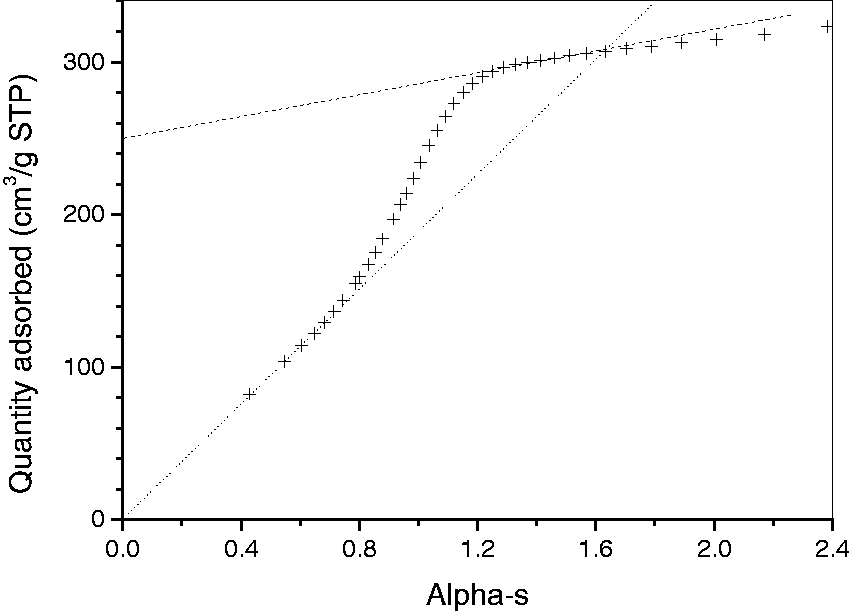
Surface areas and porosities of samples used in this study.
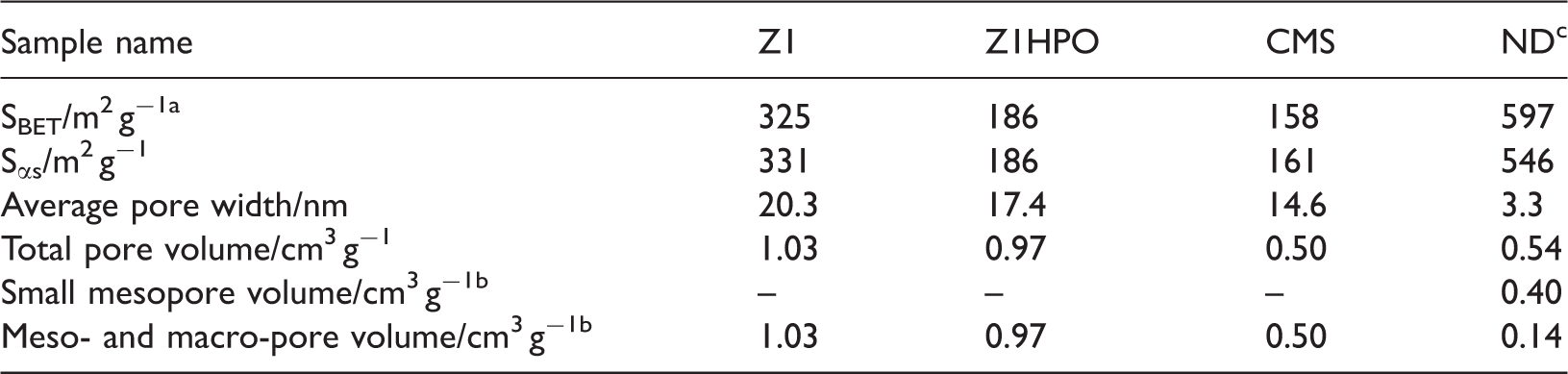
BET linearization (p/[na·(p°−p)] vs. p/p°) was performed over the relative pressure range 0.05–0.3.
Pore volume contributions were determined using the αs method.
α-plot for ND exhibits two ranges of mesoporosity (Figure 3); surface area of small mesopores is estimated as 524 m2/g.
The low flow used for the carrier gas in the chromatography analyses was imperative to allow separation of the solvent and benzene peaks (Figure 4). The larger peak, beginning at 4.3 min, is due to the solvent (methanol), followed by the benzene peak (elution time: 6.5 min) and finally the toluene peak (elution time: 8.3 min).
Gas chromatograph analysis of aqueous benzene, with toluene as internal standard and methanol as solvent. x-axis: time/min; y-axis: signal/µV k, where k is the magnification factor.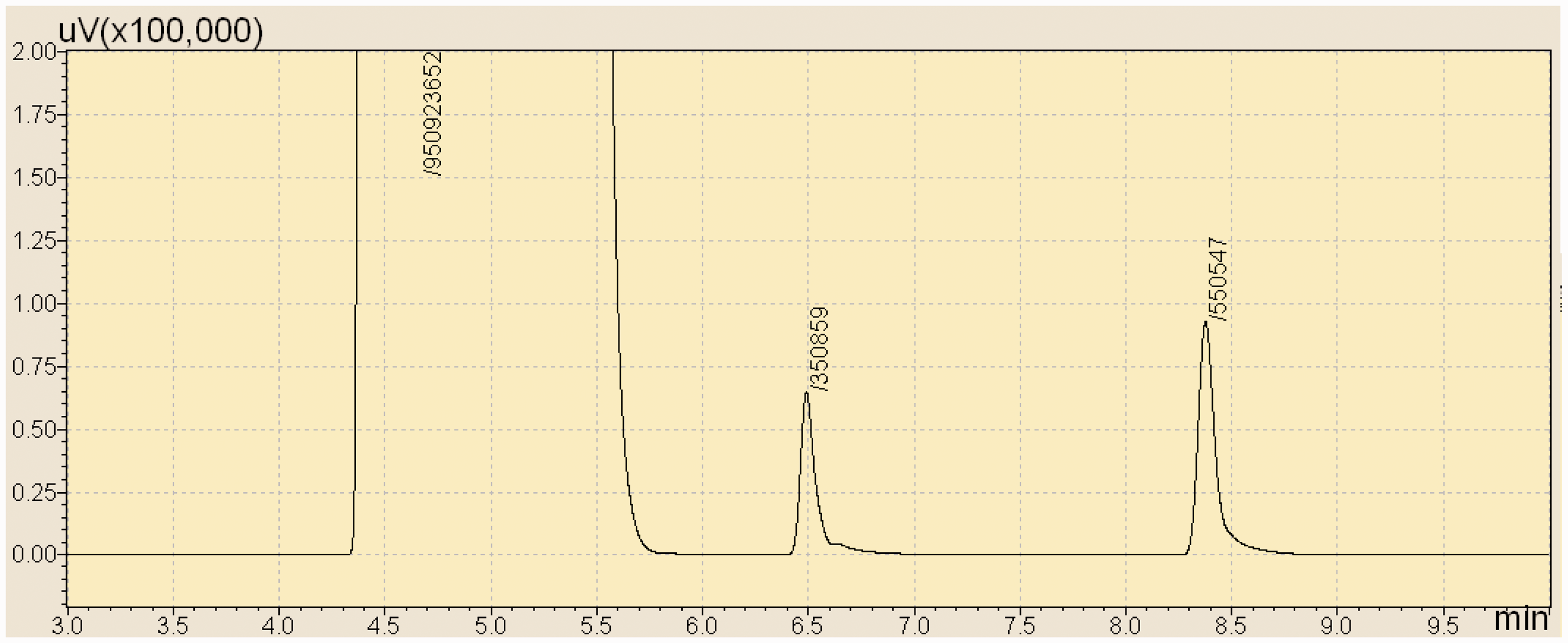
Kinetic analysis and isotherms of the hydrophilic materials
Kinetic data were obtained as outlined above and the results show a logarithmic relationship for the first 6 h of data, in which 84–90% of adsorption take place on CMS and ND samples (Figure 5). The full equilibration time is less than 24 h, for both benzene and toluene uptake.
Kinetic profiles of (a) benzene and (b) toluene adsorption on Z1 (filled triangle), ND (filled square) and CMS (empty circle) at 293 K.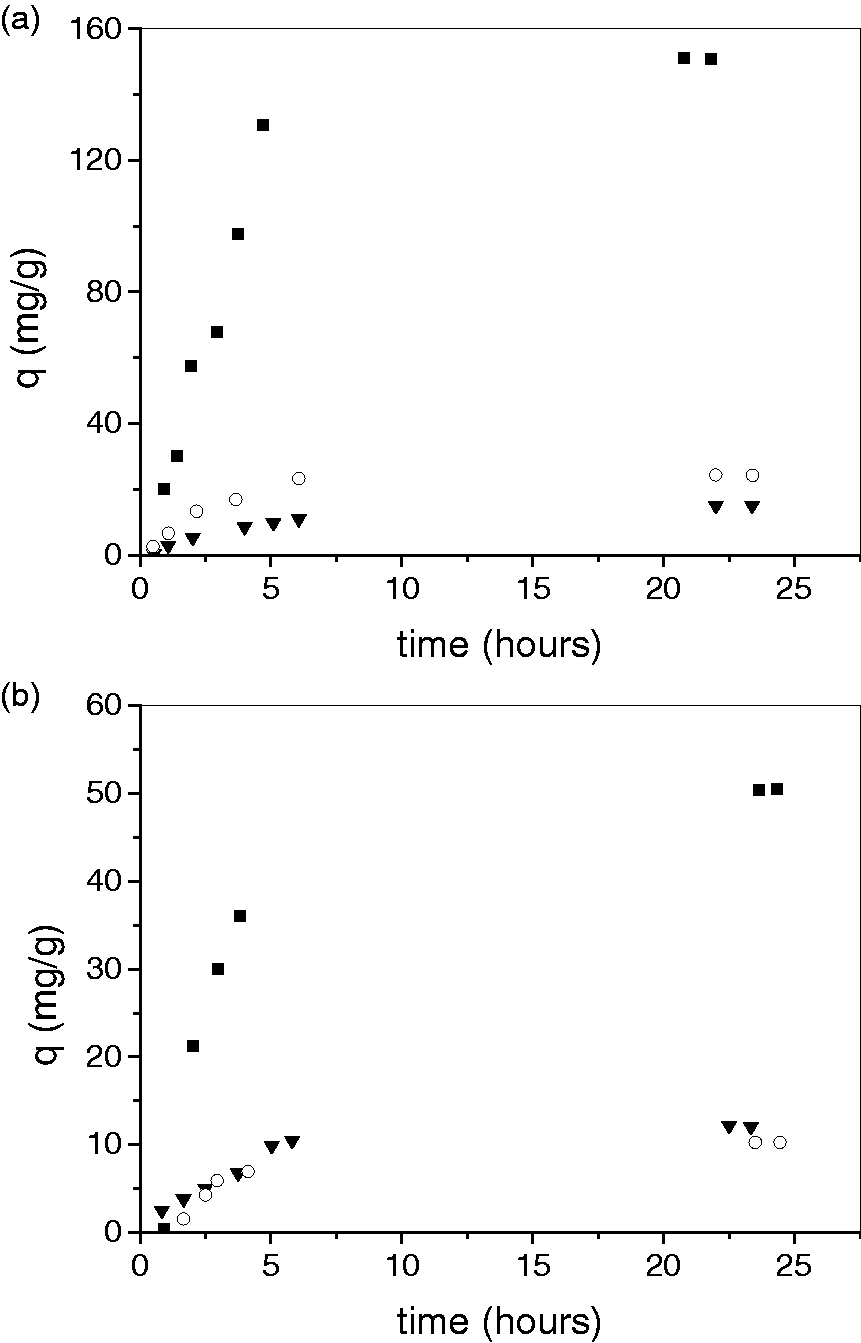
Quartzene Z1 shows slower kinetics, with <80% of toluene and <70% of benzene adsorbed after 24 h. Hydrophobic silica aerogels have been shown to reach their full adsorption capacities in <1 h (Perdigoto et al., 2012) or even <30 min (Standeker et al., 2007), the materials tested here show good short time performance but it should be noted that full equilibration takes several hours.
The Freundlich adsorption model (Freundlich and Hatfield, 1926) has been used extensively to determine adsorption capacities, mainly due to the fact that it considers the heterogeneity of real surfaces:

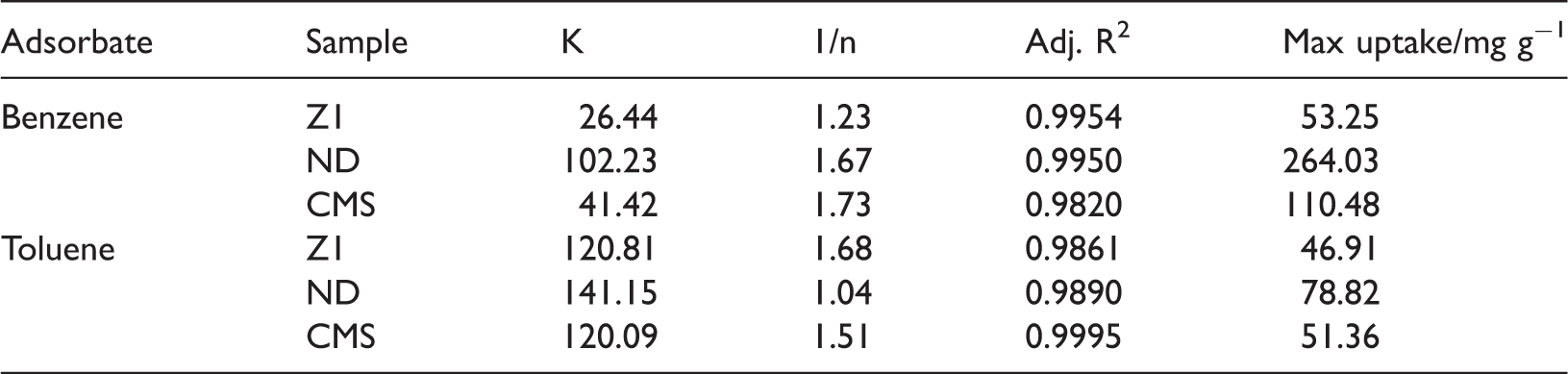
The Freundlich adsorption model parameters calculated using data obtained for adsorption of toluene and benzene of samples used in this study, measured at 293 K. Maximum uptakes are determined from extrapolative interpolation to either a benzene solubility of 1.763 g/L or a toluene solubility of 0.57 g/L (Stephen and Stephen, 1963).
Comparison of hydrophilic and hydrophobic version of Z1
Only aqueous benzene concentrations below 0.25 ppm were explored in the comparison of adsorption characteristics the hydrophilic and hydrophobic versions of Z1. Adsorption was faster and a higher quantity of benzene was adsorbed for Z1HPO (Figure 7); furthermore, this material showed no significant mechanical degradation even after five days of rotary stirring at 20 r/min.
Adsorption isotherms for benzene (a) and toluene (b) on Z1 (filled triangles), ND (filled squares) and CMS (empty circles) at 293 K. Kinetics (a) and isotherms (b) obtained for benzene adsorption by granular forms of Quartzene Z1 (filled squares) and Z1HPO (empty triangles) at 293 K.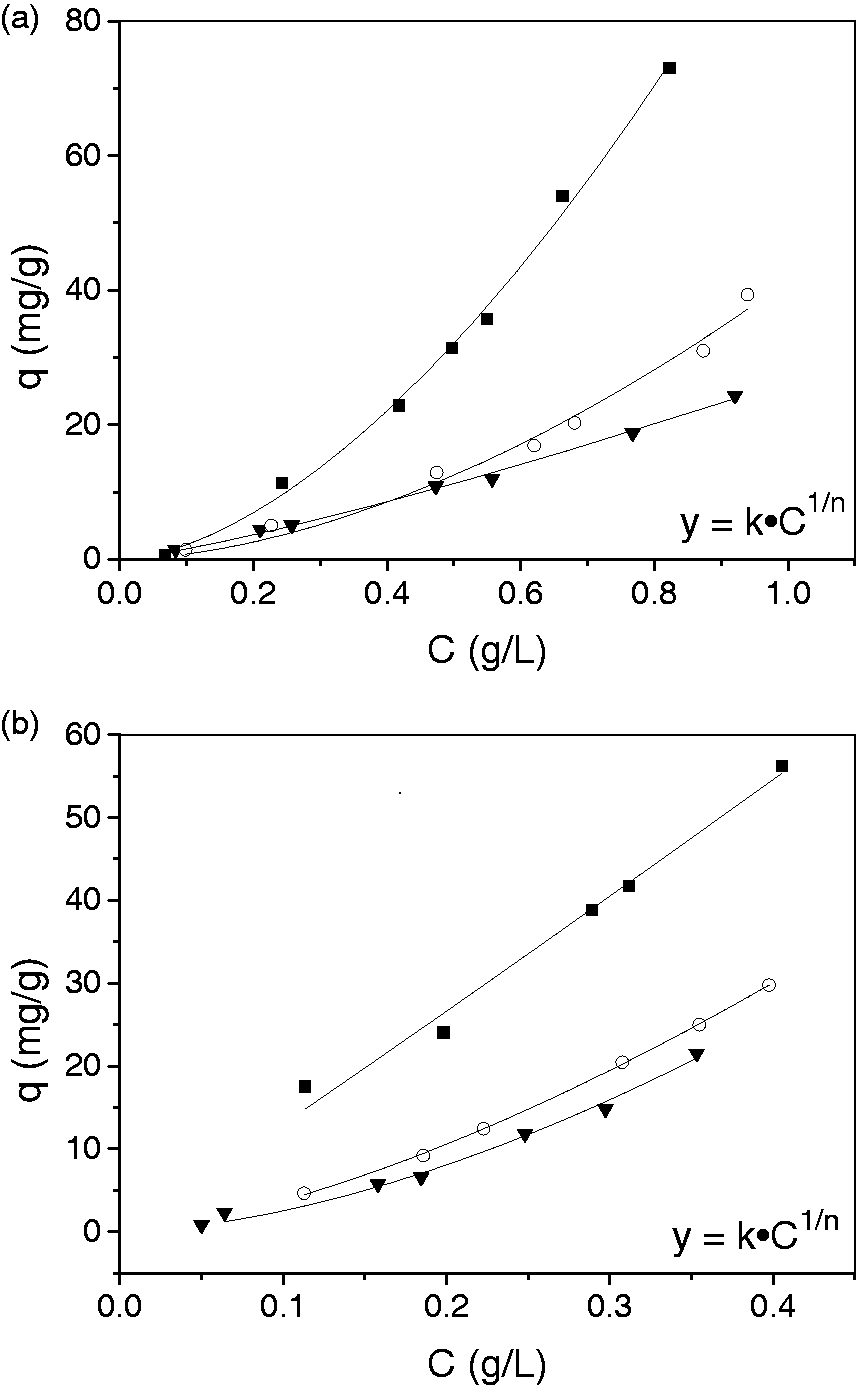

Equilibrium was reached in less than 3 h for Z1HPO, while previously studied hydrophobic aerogels, particle size <250 µm, were found to reach full adsorption capacity in less than 1 h, adopting a similar method and rate of stirring (Perdigoto et al., 2012); this difference is likely due to differences in particle size, with a much larger particle size studied here. Testing the granular form of sorbents, as opposed to powders, provides greater insight in to material performance within a filter configuration, which is the most probable layout in a tertiary process dedicated to organics separation from water. The comparison of adsorption behaviour for hydrophilic Z1 and hydrophobic Z1HPO confirms that hydrophobicization is fundamental to multiple cycle use of a material. At high benzene concentrations, adsorption on Z1HPO is significantly higher than for Z1, but the difference in terms of uptake between the two adsorbents is reduced with decreasing organic concentration. Hence, at very low aqueous concentrations of organics, the effect of hydrophobicization on pollutant access to the internal porosity of the material may be not great enough to justify the expense of the functionalization process. Recently, it was proposed that organics dissolved in aqueous media in very diluted systems are unable to access the interior porosity of functionalized silica aerogels as a consequence of their inherent hydrophobic nature, suggesting that only the external surfaces are available for adsorption (Shi et al., 2014). These findings suggests a necessity to test adsorption performances of both hydrophilic and hydrophobic materials, especially when target organic pollutant concentrations are low enough as to make the economic profit of cyclic use, and associated regeneration costs, questionable given the expense of sorbent functionalization.
Conclusions
Novel hydrophilic amorphous silicas were synthetized at low temperature and ambient pressure. Two samples with varied levels of silica source activation, and one sample prepared via the addition of calcium and magnesium sources (ratio of 1:2) were tested for the adsorption of aqueous phase organics (benzene and toluene), at concentrations below their solubility limits. Kinetic tests reveal up to 90% of benzene and toluene is adsorbed in the first 6 h of treatment, and up to 50% in the first 2 h. There are no significant differences between the rates of adsorption for either benzene or toluene. The adsorption mechanism is favourable and described fully by the Freundlich model, with 1/n > 1 and higher for both adsorbates, while the adsorption capacity, at low concentrations, is higher for toluene, as expected from the literature (Love et al., 2003; Standeker et al., 2007).
Quartzene ND outperforms the other material tests and shows adsorption capacities of 264 mg/g for benzene (solution concentration of 1.76 g/L) and 78 mg/g for toluene (solution concentration of 0.57 g/L). By testing materials in a granular, the results provided a clearer indication of how the material can be expected to perform in a filter configuration, which is the most likely tertiary treatment process layout for organics separation from water. The comparison between hydrophilic Z1 and hydrophobic Z1HPO demonstrated that hydrophobicization is required to impart the mechanical longevity required for cyclic use, and leads to increased adsorption of benzene from aqueous phase concentrations >50 ppm. It is notable that the observed differences in uptake between the two forms of Z1 are reduced as organic concentration decreases. This finding supports the hypothesis that, at very low aqueous phase organic concentrations, the effect of hydrophobicization on access of the pollutants to the internal porosity of the material may be not great enough to justify the expense of the functionalization process. Hence, tuning the hydrophobicity of sorbents to perform multiple adsorption cycles, with the added costs of regeneration should be fully evaluated via a cost analysis to determine whether the actual pollutant concentrations are significantly high to justify the expense of a functionalization process.
The adsorption results presented in this paper suggest that amorphous silica, such as Quartzene based materials, are a promising family of sorbent materials for application in the final stages of produced water treatment. To establish their full capabilities, defined ranges of pollutant concentration should be identified to allow selection of the most appropriate hydrophilic or hydrophobic material type, with additional lifetime cycling measurements to assess the economic feasibility of their use in water treatment plants.
Footnotes
Acknowledgements
The authors kindly thank Svenska Aerogel AB for providing adsorbent materials and associated particle size distribution data.
Declaration of Conflicting Interests
The author(s) declared no potential conflicts of interest with respect to the research, authorship, and/or publication of this article.
Funding
The author(s) received no financial support for the research, authorship, and/or publication of this article.