




Abstract
The present study provides performance evaluation of two kinds of crosslinked hydrophilic organic polymer sorbents (PS-I and PS-II) for desiccant air-conditioning applications. In this regard, optimum temperature and humidity zones are established for various air-conditioning applications which include (i) humans’ thermal comfort, (ii) animals’ thermal comfort, and (iii) postharvest storage of fruits/vegetables. Honeycomb-like desiccant blocks composed of PS-I/PS-II are assumed for numerical simulation analysis. The numerical simulation model is programmed into MATLAB which utilizes the scientific relationships of adsorption isotherms, adsorption kinetics, isosteric heat of adsorption, and thermophysical properties for each sorbent. A particular desiccant air-conditioning system design is proposed, and numerical simulation has been conducted for the performance evaluation of PS-I and PS-II. According to the results, PS-I enables higher dehumidification than PS-II at low regeneration temperature (50℃) and cycle time of 60:90 min. It is because the PS-I possesses better water vapor sorption kinetics as compared to PS-II. Although the PS-II enabled higher steady-state adsorption amount but it could not influence the overall system performance. On the other hand, the optimum performance by the PS-II is limited to relatively long cycle time and higher regeneration temperature (≥80℃). It has been concluded that the PS-I is relatively better choice for desiccant air-conditioning, and consequently can be considered for various air-conditioning applications. Furthermore, effects of mass flow rate, isosteric heat of adsorption, regeneration temperature, and cycle time on air humidity ratio and air temperature profiles have been discussed in order to highlight the performance variability of desiccant air-conditioning system.
Introduction
Temperature and humidity control is essential not only for human’s thermal comfort but also for various agricultural and livestock applications, e.g. (i) postharvest storage of fruits and vegetables, (ii) greenhouse growing, (iii) grains drying, and (iv) animals’ thermal comfort. Similarly there are many other parallel air-conditioning (AC) applications that include hospitals, museums, marine ships, industrial processes, product preservation and storage, etc. (Sultan et al., 2015a). Vapor compressor-based conventional AC systems are in practice worldwide to achieve the AC loads. These are not only environmentally harmful but also consumes huge amount of primary energy (Sultan et al., 2015a). On the other hand, desiccant air-conditioning (DAC) is an emerging technology which can achieve the sensible (temperature) and latent load (humidity) of AC distinctly. This ability makes the DAC system more adaptable and flexible than the conventional systems. Furthermore, it can be operated by means of low-grade waste heat and/or solar thermal energy. The DAC mainly consists of (i) desiccant dehumidification for the control of latent load and (ii) evaporative cooling for the control of temperature. The conventional low-cost direct evaporative cooling (DEC)/indirect evaporative cooling (IEC) technologies are usually preferred in order to achieve the sensible load of AC. The DAC is not involved in the use of any kind of refrigerant which makes the technology environmentally sustainable. The DAC possesses zero global warming and ozone layer depletion potentials. Studies have shown that the DAC systems can reduce the primary energy consumption significantly and increase the overall system performance (De Antonellis et al., 2010; Nagaya et al., 2006). Desiccants are hydrophilic water adsorbing materials whose main role is to remove the moisture from the air (De Antonellis et al., 2010; Nagaya et al., 2006; Sultan et al., 2015a). These are hygroscopic substances which adsorb the water vapors due to vapor pressure difference between desiccant and air. According to the recent studies, desiccants have been successfully utilized for various agriculture-based applications, e.g. agricultural greenhouse AC (Sultan et al., 2016c), grains/cereal drying (Ismail et al., 1991), fruits and vegetables storage (Mahmood et al., 2016a), and other agricultural products storage and preservation (Sultan et al., 2015a). It is worthy to mention that the applicability of any desiccant as well as DAC system is limited in relatively dry regions because of unavailability of inlet air moisture for the desiccant. However, type-I adsorption isotherm (Sing et al., 1985, 2015) based desiccant could be an interesting option in this case but this will require high regeneration temperature to run the DAC cycle, which may not be cost effective. An additional option could be the precooling of inlet air sensibly in order to enhance relative pressure of water vapors for the desiccant (Sultan et al., 2016c).
As the conceptual performance of DAC system is mainly based on desiccant dehumidification, therefore, selection of desiccant material is always crucial for any DAC application. Many desiccant materials have been developed and utilized for various AC applications (Mahmood et al., 2016b; Sultan et al., 2015a, 2016c). Commonly used desiccant for AC applications includes silica gel (Srivastava and Eames, 1998), molecular sieve/synthetic zeolite (Karamanis and Vardoulakis, 2012; Kodama, 2010), activated alumina (Abd-Elrahman et al., 2011; Dupont et al., 1994), and montmorillonite/bentonites clay (Dios Cancela et al., 1997). In this regard, the present study proposes two recently developed novel organic polymer-based sorbents which present better sorption properties as compared to conventional desiccants (Sultan, 2015; Sultan et al., 2015b, 2016a). For example, both sorbents enable 2–2.5 times higher equilibrium water vapor adsorption amount than conventional silica gel at 30℃ on saturation conditions (Sultan et al., 2015b, 2016c). Similarly, the proposed polymer sorbents are advantageous in terms of minimization of isosteric heat of water vapor adsorption (Qst). It has been found that both sorbents enable low Qst when total adsorption uptake exceed from 0.50 kg/kg (Sultan, 2015; Sultan et al., 2015b, 2016a). Therefore, numerical simulation of DAC cycle has been made in this study for both polymer sorbents using MATLAB in order to optimize their performance.
AC applications
Human beings are sensitive to temperature and humidity and therefore require AC. However, the AC requirements for humans’ thermal comfort are different at different conditions, e.g. summer and winter, day and night time, offices and labs, playing and reading situations, etc. (ASHRAE, 2007). This variability is mainly due to the optimum heat and mass transfer rate from the body to the ambient. It also depends on the metabolism rate which might vary from person to person and gender to gender.
Figure 1(a) shows the ideal AC zones for humans’ thermal comfort at (i) bars, bus terminals, night clubs, office buildings, casinos; (ii) libraries, archives, galleries, museums; (iii) terminal rooms (telephone); and (iv) class rooms, auditoriums, libraries, laboratories. In addition to humans’ thermal comport, the AC is also essential for agriculture and livestock sector. In a study, the relative humidity requirements for greenhouse AC have been found entirely different as compared to the humans’ thermal comfort zone (Sultan et al., 2016c). The details can be found from Sultan et al. (2016c). In the present study, AC zones for postharvest storage of fruits/vegetables and animals’ thermal comfort are established. Figure 1(b) shows ideal temperature and humidity zones in order to obtain optimum thermal conform for (i) sheep and lamb (at growing stage), (ii) dairy cattle and cow, (iii) pig farrowing houses, (iv) pig nursery houses, (v) beef cattle and cow, and (vi) poultry breeder and laying houses. Figure 1(c) shows ideal temperature and humidity zones for the storage of (i) green tomatoes and sweet potatoes; (ii) sapodilla; (iii) banana, bitter melon, and bread fruit; (iv) papayas, sweet pepper, and pineapples; (v) ugli fruit and sugar apples; (vi) cabbage, onion, and mushroom; and (vii) dew berries, blue berries, black berries, grapes, and dates. The ideal temperature/humidity zones provided in Figure 1 are established using the guidelines provided by American Society of Heating, Refrigerating and Air-conditioning Engineers and Food and Agriculture Organization (ASHRAE, 2007; Kitinoja and Kader, 2002). It is worthy to mention that the information provided in this section is useful for DAC system for setting the inlet air conditions (to the desiccant unit) and to provide optimal outlet air conditions (i.e. supply air) for different applications.
Psychrometric representation of ideal AC zones for (a) humans’ thermal comfort, (b) animals’ thermal comfort, and (c) postharvest storage of fruits/vegetables. AC: air-conditioning.
Materials and methods
Materials
Organic hydrophilic crosslinked polymer sorbents PS-I and PS-II are recently introduced novel desiccant materials (Sultan, 2015; Sultan et al., 2015b, 2015c, 2016a, 2016b) which possesses better adsorption properties (e.g. 2–2.5 times higher water vapor adsorption equilibrium amount) as compared to conventional silica gel (Sultan et al., 2015b). In addition, microparticles of polymer sorbents provide opportunity to develop various shapes/designs of desiccant unit, e.g. honeycomb structure consisting of polymer sorbent and air flow channels. Laser microscope images of few particles of PS-I and PS-II are given in Sultan et al. (2015b). The average diameters of PS-I and PS-II are 2.6 × 10⁻⁶ and 19.3 × 10⁻⁶ m, respectively. The study addresses dynamic behaviors of polymer sorbents for the development of advance DAC system for various agricultural applications. In this regard, honeycomb-like desiccant blocks composed of PS-I/PS-II sorbents are assumed for the investigation of DAC cycle using the numerical simulation model given by Miyazaki et al. (2009a, 2009b, 2011). The details of simulation model are discussed in “Simulation model” section.
Proposed DAC system
An open-cycle DAC system consisting of honeycomb-like desiccant blocks of PS-I and PS-II is proposed for various AC applications (see “AC applications” section). Selection of desiccant block is advantageous as compared to desiccant rotor in terms of carrying the dehumidification and regeneration processes distinctly which may be required in many application/situations. The schematic diagram of the proposed system is shown in Figure 2. It is worth mentioning that the fundamental adsorption properties of PS-I/PS-II are already determined in the authors’ previous work (Sultan et al., 2015b, 2016a). The system contains a flat plate heat exchanger (HX), heat source unit, and DEC and IEC devices. The wet-bulb effectiveness of DEC and HX are considered as 0.90 and 0.80, respectively. The return air from the conditioned space (CS) is mixed with outdoor air (OA) and passed through the DAC system points (1) to (4) in order to maintain the ideal conditions. The Desiccant Block-II will be switched for active operation once after the saturation of Desiccant Block-I. Meanwhile the Desiccant Block-I will be regenerated by the regeneration air as shown in Figure 2. The principle features of DAC cycle presented can be found from Sultan et al. (2015a). Furthermore, air state conditions associated with HX, DEC, and IEC units for identical air flow rate are estimated using the following equations (1) to (7) (ASHRAE, 2007, 2008; Daou et al., 2006)
The proposed desiccant air-conditioning system: (a) schematic diagram and (b) psychrometric representation of the cycle.







Simulation model
Mathematical model of desiccant blocks for the presented open-cycle DAC unit (see Figure 2) is similar to the one used by Miyazaki et al. (2009a, 2009b, 2011). The schematic diagram of the flat plate numerical simulation model for honeycomb-like desiccant blocks composed of PS-I/PS-II is shown in Figure 3. The model has already been validated with experimental data for various desiccant materials as well as various shapes of desiccant unit. The details about the model configuration can be found from the cited literature. In the present study, numerical simulation of the DAC cycle is performed by means of MATLAB using equations (8) to (10) (Miyazaki et al., 2009a, 2009b, 2011)
Flat plate numerical simulation model for honeycomb-like desiccant blocks composed from PS-I/PS-II.



The fundamental adsorption properties, e.g. adsorption equilibrium, isosteric heat of adsorption, and thermophysical properties for the PS-I/PS-II can be found from Sultan et al. (2015b). The convection heat transfer coefficient is calculated for laminar and turbulent air flows (Hamamoto et al., 2002). The water vapor adsorption kinetics is determined by modified Linear Driving Force (LDF) model given by equation (11) (Sultan, 2015)





Optimized values of GAB model parameters for PS-I and PS-II (Sultan et al., 2015b).

GAB: Guggenheim, Anderson, De Boer.
Operating parameters of the DAC system for simulation analysis.

DAC: desiccant air-conditioning.
Results and discussion
In this study two recently developed organic polymer sorbents PS-I and PS-II are numerical simulated using MATLAB for DAC cycle. For both polymer sorbents, fundamentals and modeling of basic adsorption properties including adsorption isotherms, adsorption kinetics, isosteric heat of adsorption have already been reported in the literature by the authors’ previous work (Sultan, 2015; Sultan et al., 2015b, 2016a). Figure 4(a) shows comparison of adsorption isotherms of PS-I/water and PS-II/water pairs at adsorption temperature of 30℃. In addition, Figure 4(b) shows comparison of instantaneous water vapor adsorption uptakes of PS-I and PS-II at adsorption temperature of 30℃ and at different evaporator temperature.
Experimental results of water vapor adsorption by PS-I/water and PS-II/water pairs at adsorption temperature of 30℃: (a) adsorption isotherms profile, reproduced from Sultan et al. (2015b) and (b) adsorption kinetics profile, reproduced from Sultan et al. (2016a).
Performance evaluation
Temporal variation of inlet/outlet air conditions to desiccant blocks (composed of PS-I and PS-II) has been determined using the numerical simulation model presented in “Simulation model” section. The switching time of 60 and 90 min is considered for regeneration and dehumidification processes, respectively. The operational temperatures for regeneration and process air streams are set to 50 and 20℃, respectively. It is worth mentioning that process air temperature is a representative value for setting the inlet air conditions (to the desiccant unit) of DAC system, which could be different for different DAC application as expressed in Figure 1(a) to (c). Similarly, conditions of the air at the exit of desiccant unit are important in order to provide optimum supply air conditions for different DAC applications as explained in “AC applications” section. The details of operating parameters for numerical simulation analysis of desiccant blocks are given in Table 2. The performance evaluation results for PS-I and PS-II are shown in Figure 5(a) and (b) for air humidity ratio and air temperature profiles, respectively. It can be observed that the polymer sorbent PS-I enables deep dehumidification as compared to the PS-II. It is because the PS-I possesses better water vapor sorption kinetics than PS-II which can also be observed from Arrhenius equation (equation (12)) and its parameters as discussed in “Simulation model” section. Similarly it has been reported by authors’ previous work (Sultan et al., 2016a) that PS-I possesses better diffusion time constant (Ds/Rp2) than PS-II particularly at lower relative pressure range (i.e. P/Po < 0.60), which will promote deep dehumidification performance by PS-I. In contrast to humidity ratio profile, both polymer sorbents enable almost similar temperature behavior which could be because of nearly same isosteric heat of adsorption as reported in Sultan et al. (2015b). According to the GAB model (equations (13) to (16)) and its optimized parameters (Table 1), the PS-II enables higher steady-state adsorption amount than PS-I (Sultan et al., 2015b); however, it could not influence the dynamic performance of the desiccant blocks in the DAC system. Hence, it can be concluded that the organic polymer sorbent PS-I is relatively better choice for DAC as compared to PS-II at regeneration temperature of 50℃ and cycle time of 60:90 min. Moreover, PS-I performance in comparison with PS-II can also be considerably improved if DAC system is operated on lower relative humidity range.
Performance evaluation results for PS-I- and PS-II-based desiccant blocks at low regeneration temperature (i.e. 50℃) and short cycle time (i.e. 60:90 min): (a) air humidity ratio profile and (b) air temperature.
Furthermore, the present study also provides a comparison between PS-I- and PS-II-based desiccant blocks while employing high regeneration temperature (i.e. 80℃) and relatively long switching/cycle time (i.e. 60:120 min). Consequently, the performance evaluation results for PS-I and PS-II are shown in Figure 6(a) and (b) for air humidity ratio and air temperature profiles, respectively. It contrast with previous results presented in Figure 5, the polymer sorbent PS-II shows its potential at higher regeneration temperature (80℃) for long cycle time. It can be concluded that the polymer-based sorbent PS-II would be effective only if considered for long cycle time at higher regeneration temperature. Furthermore, it will be difficult to employ PS-II in renewable energy operated DAC systems due to unavailability of high regeneration temperature. So it can be concluded generally that the PS-I would be the better choice for DAC because it could be employed to short cycle-based DAC system at low regeneration temperatures.
Performance evaluation results for PS-I- and PS-II-based desiccant blocks at high regeneration temperature (i.e. 80℃) and long cycle time (i.e. 60:120 min): (a) air humidity ratio profile and (b) air temperature.
Parametric analysis
Effect of mass flow rate
Mass flow rate is an essential key of any DAC system, and all the performance parameters including system coefficient of performance (COP) and return-to-OA mixing ratio are directly dependent on it. Effect of mass flow rate on latent and sensible performance of PS-I-based desiccant block is analyzed. The results are plotted in Figure 7(a) and (b) for air humidity ratio and air temperature, respectively. It can be seen that the high mass flow rate (e.g. 0.20 m3/s) possesses deep dehumidification at regeneration air side (0–60 min). On the other hand for process air side (60–180 min), low mass flow rate (e.g. 0.10 m3/s) yields more dried air. Similarly high mass flow rate enables higher air temperature at regeneration air side (0–60 min). But on the process air side (60–180 min), higher mass flow rate yields low air temperature and lower mass flow rate yields high air temperature. It may be due to the isosteric heat of adsorption (Clausius–Clapeyron relationship) which decreases with the increase in adsorption uptake, and therefore high mass flow rate possesses low air temperature. The detailed discussion on isosteric heat of adsorption is given in the following section.
Effect of mass flow rate on the performance of desiccant block of PS-I for (a) humidity ratio and (b) air temperature.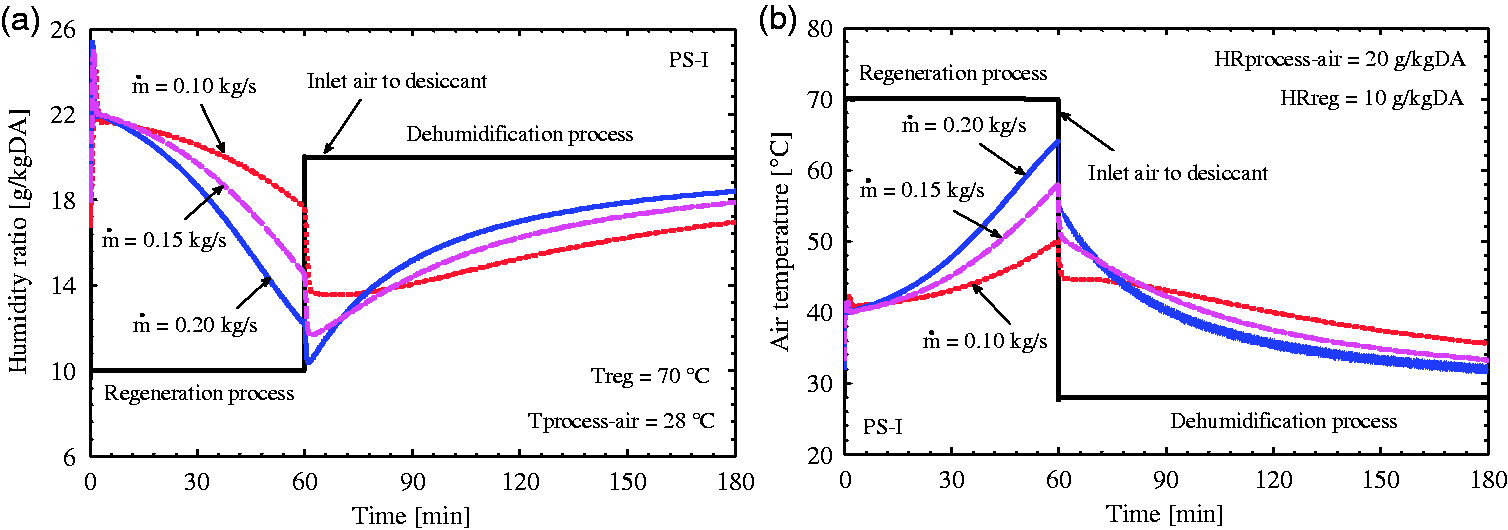
Effect of isosteric heat of adsorption
Isosteric heat of adsorption by any adsorbent (including PS-I and PS-II) varies according to the amount of adsorption uptake as defined by Clausius–Clapeyron relationship. It always plays a crucial role in adsorbent bed temperature and obviously effects dehumidification process of the DAC system. The effect of isosteric heat of adsorption on dehumidification performance of desiccant block is shown in Figure 8. As isosteric heat of adsorption is a function of adsorption uptake which is changing instantaneously, therefore, adsorption heat is also changing accordingly. However in Figure 8 isosteric heat of sorption is artificially changed from one simulation run to the other in order to identify its sensitivity theoretically. Figure 8 is worthy in order to optimize the regeneration conditions (e.g. partial, medium, or full regeneration of desiccant unit) as well as operating conditions of DAC system. It can be seen that the net dehumidification ability of the desiccant block decreases with the increase in isosteric heat of water vapor adsorption. The performance of desiccant blocks during the air dehumidification process can be imagined by the following expression
Effect of isosteric heat of water vapor sorption on dehumidification performance by the PS-I-based desiccant block.

Effect of regeneration temperature
Regeneration temperature is one of the most important parameter in any DAC system by which the operating cost of the system is decided. Higher regeneration temperature will cause higher desiccant dehumidification. However, it is not directly proportional to the system’s COP. Lower regeneration temperature conditions are always favorable for renewable energy utilization preferably solar thermal energy. In this regard, effect of regeneration temperature on the performance of PS-I-based desiccant blocks for air humidity ratio and air temperature is shown in Figure 9(a) and (b), respectively. Using these plots, one can obtain the optimum regeneration temperature in order to improve the system COP by performing the simple cost analysis.
Effect of regeneration temperature on the performance of PS-I-based desiccant blocks for (a) air humidity ratio and (b) air temperature.
Effect of switching/cycle time
Optimum regeneration temperature and corresponding switching/cycle time are the most important parameters for the economic feasibility of the DAC system. In this regard, effect of switching/cycle time on the variation of the humidity ratio of the dehumidified air is investigated at low temperature regeneration (i.e. 50℃). The results from the numerical simulation analysis are presented in Figure 10 for PS-I. It can be seen that the dehumidification ability of the desiccant blocks is a function of cycle switching time. A simple cost analysis will be required (on the basis of available thermal heat) to answer the optimum switching/cycle time of the proposed DAC system. It will also depend on designed numerical values of temperature and humidity. In other words, the optimum cycle switching time will wary according to the individual AC applications presented in “AC applications” section. The objective of this analysis is to highlight the importance of long cycle- and short cycle-based DAC utilization. Furthermore, it also focuses on the importance of low temperature regeneration which is always preferred to operate the system on renewable energy (preferably solar thermal and/or biogas). If the potential sources of renewable energy or low-grade waste heat are available abundantly, then it might be preferred to design the system for long cycle time in order to make it cost effective. On the other hand for lavish regeneration, the system must be considered to design for relatively short cycle time for high COP.
Effect of switching/cycle time on the variation of the humidity ratio of the dehumidified air for PS-I-based desiccant block.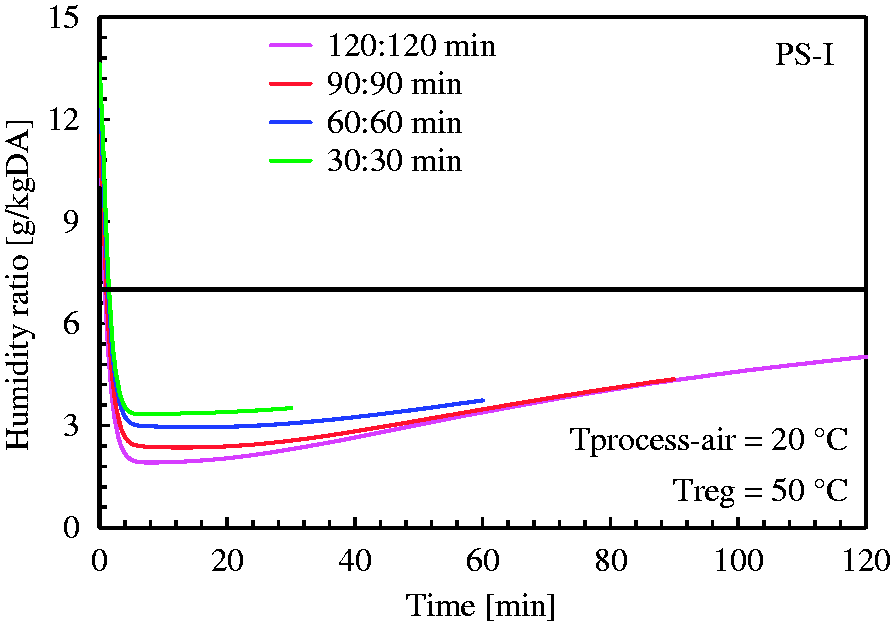
Conclusions
Two kinds of honeycomb-like desiccant blocks composed of novel organic hydrophilic polymer sorbents PS-I and PS-II are assumed for numerical simulation of DAC cycle for several applications. Ideal temperature and humidity requirements for various AC applications are determined and compared via psychrometric representations. These AC applications include (i) few situations for humans’ thermal comfort, (ii) thermal comfort zones for few animals, and (iii) postharvest storage of few fruits/vegetables. In this regard, a numerical simulation model is programmed into MATLAB which utilizes the scientific relationships of adsorption isotherms, adsorption kinetics, isosteric heat of adsorption, and thermophysical properties of the polymeric sorbents.
Performance evaluation results showed that the PS-I enables deep dehumidification as compared to the PS-II at regeneration temperature of 50℃ and switching/cycle time of 60:90 min. It is because the PS-I enables better water vapor sorption kinetics as compared to PS-II. Although the PS-II enabled higher steady-state adsorption amount it could not influence the system’s dynamic performance. Therefore, it is concluded that the organic polymer sorbent PS-I is a relatively better choice for DAC as compared to PS-II at low regeneration temperature and short cycle time. On the other hand, polymer sorbent PS-II possesses better performance at high regeneration temperature (i.e. 80℃) and relatively long cycle time (i.e. 60:180 min). In order to operate the DAC system on renewable energy (preferably solar thermal and/or bio gas) for various AC applications, the PS-I polymer sorbent is finally considered advantageous than the PS-II.
Furthermore, effects of (i) mass flow rate, (ii) isosteric heat of adsorption, (iii) regeneration temperature, and (iv) switching/cycle time on the air humidity ratio and air temperature profiles have been discussed in order to highlight the importance of DAC variability. Results show that the high mass flow rate possesses deep dehumidification at regeneration air side whereas low mass flow rate yields more dried air at process air side. The net dehumidification ability of the desiccant blocks decreases with the increase in isosteric heat of water vapor adsorption. Higher regeneration temperature causes higher desiccant dehumidification, though it is not always directly proportional to the system’s COP. According to the numerical simulation results, the dehumidification ability of the desiccant blocks is a function of cycle switching time. It is preferred to design the DAC system on long cycle time in order to make it cost effective only if the potential sources of renewable energy or low-grade waste heat are available abundantly. On the other hand for lavish regeneration, the system should be designed at relatively short cycle time for high COP.
Declaration of Conflicting Interests
The author(s) declared no potential conflicts of interest with respect to the research, authorship, and/or publication of this article.
Funding
The author(s) received no financial support for the research, authorship, and/or publication of this article.