




Abstract
The suspension of US foreign aid by President Trump in January 2025 marked a significant shock to the global aid ecosystem, raising critical questions about the behaviour of European official development assistance (ODA) donors as media coverage of the event and public opinion might affect political decision-making. Against this backdrop, we examine the German public’s opinion on the USAID shutdown and their preferences for Germany’s and the European Union’s aid policies. A rapid survey conducted in February–March 2025 (N = 1055) shows that while Germans broadly view the Trump administration’s decision to freeze US aid negatively, expressing particular concern about its impact on humanitarian issues, a substantial majority prefers no change to Germany’s foreign aid policy. Our analysis indicates that political ideology, populist attitudes and trust in the German federal government significantly shape whether individuals view the shutdown favourably and whether they support either mimicking US aid cuts or stepping in to fill the gap. By contrast, concerns about the German economy do not translate into support for foreign aid cuts.
Introduction
On 20 January 2025, United States President Donald Trump issued an Executive Order freezing foreign aid programmes pending a review (White House, 2025). Within days of the Executive Order, the administration began efforts to dismantle the United States Agency for International Development (USAID) and suspended approximately 44 billion USD in funds for foreign development assistance programmes channelled through USAID. On 27 January, a directive was issued to freeze not only new, but the majority of existing federal assistance programmes administered by USAID. In the following months, the foreign aid freeze escalated into a legal battle between federal courts and the Trump administration. 1 On 1 July 2025, USAID was finally closed.
President Trump’s sudden suspension of US foreign aid represents a major shock to the global aid ecosystem, as the United States had long been the largest Official Development Assistance (ODA) donor country (Organisation for Economic Co-operation and Development’s Development Assistance Committee (OECD DAC), 2025). The future of US foreign aid remains uncertain, and aid agencies and human rights groups are increasingly alarmed about the consequences of the cuts. Although other ODA donors have previously restructured their development policies (e.g. the merger of Department for International Development with the Foreign Office in the UK in 2020) or reduced aid budgets, the radical cuts implemented by the Trump administration have been unprecedented. Scholars and experts warn that the suspension of US aid will particularly jeopardise global health (Balakrishnan, 2025; Zumla et al., 2025), food and nutrition (Locks et al., 2025), climate change adaptation and mitigation and efforts to strengthen democratic institutions (Haug et al., 2025). The highly sensationalised media coverage of the USAID shutdown also brought unprecedented public attention to foreign aid.
The shift in US aid policy raises important questions about the responses of European ODA donors. Some European donors may choose to mimic the United States, reducing their own development assistance, particularly in countries experiencing a populist backlash against the liberal international order. Other donors might step in to fill the gap left by the United States, motivated by humanitarian concerns or strategic interests (e.g. geopolitical competition with China or Russia). Whichever policy path they pursue, donor governments will need and seek public support. While public opinion does not dictate development policy, research indicates that public preferences in democratic donors play a role in the design of development policy strategy as well as in shaping the amount and direction of aid flows (e.g. Heinrich et al., 2021; Milner, 2006; Milner and Tingley, 2010, 2013; Powers et al., 2010; Prather, 2024; Riddell, 2007).
Against this backdrop, we investigate the German public’s opinion on the USAID shutdown and its preferences regarding Germany’s and the European Union’s (EU) aid policies, using data from an original rapid survey fielded in February 2025. Germany represents a crucial case. Following the shutdown of USAID, Germany emerged as the largest provider of ODA, making German aid more critical than ever for addressing global development challenges. 2 Second, although the German public has traditionally been more supportive of foreign aid than the American public, Germans’ support for aid has fluctuated over the years (e.g. Schneider et al., 2024). As the topic of aid spending has come under increasing scrutiny since 2022 amid persistent inflation, economic downturn and fiscal stress, calls to cut foreign aid and close the development ministry have intensified. Prominent news coverage of the USAID shutdown has further raised the salience of development policy in the media (see Figure S2 in the Supplement) and amplified demands for cuts. These dynamics suggest meaningful variation in German public opinion that can shed light on European donor publics’ views on aid in the changing development landscape.
On the one hand, the German public may be concerned about the negative impact of US aid cuts, particularly regarding humanitarian and life-saving assistance. Given Germany’s historical role as a major ODA donor (Organisation for Economic Co-operation Development (OECD), 2021), Germans may feel a sense of responsibility to help fill the void. Despite a substantial drop since 2022, most of the German population still supports current aid spending (Schneider et al., 2024). On the other hand, some segments of the public may view the US aid cuts as justification for reducing Germany’s foreign aid spending. Indeed, scholarship on international policy diffusion suggests that one country may adopt another’s policies to achieve similar desired outcomes and that public opinion as well as mass media may play a crucial role (Blatter et al., 2021; Gilardi and Wasserfallen, 2019; Linos, 2011; Simmons et al., 2006).
Data and methods
Between February and March 2025, we fielded an original survey in Germany. The survey was designed to capture public attitudes towards the USAID shutdown shortly after it was announced and explore their potential drivers. The sample included 1055 respondents, drawn via the online access panel of the survey company Bilendi, using representative quotas for gender, age, education and federal state (see Tables S2 and S3 in the Supplement).
Our survey instrument, provided in the Supplement, included three sets of questions. The first assessed respondents’ awareness of and reactions to the USAID shutdown, asking whether they had heard about the Trump administration’s decision, how they felt about it and whether they viewed it as a good or a bad decision, and loss of aid in which policy sectors concerned them the most. The second set of questions asked respondents about their aid policy preferences for the German government and the EU. The third set of questions measured broader ideological and political attitudes, including vote choice in the 23 February German federal election. 3
In the following section, we first present a detailed picture of the perceptions and feelings about the USAID shutdown and preferences for the German government’s and other European donors’ policy responses. This allows for a first look at the public’s reaction, mapping out potential public expectations and worries. Second, we explore the effects of established drivers of individual support for foreign aid on attitudes towards the shutdown of USAID and preferred government responses. Based on these results, we can draw conclusions regarding which segments of society sympathise with such radical policies and likely prefer them for Germany and how similar patterns might emerge in other European donors. While we refrain from making causal inferences due to the cross-sectional nature of our data, we hope to offer valuable insights about how donor public attitudes towards development aid might shift in the aftermath of the USAID shutdown.
Results
Reactions to US aid cuts
About 57% of respondents report having heard about the USAID shutdown. By contrast, 28% have not heard about it, and 5% are unsure whether they have heard about it (Figure S3 in the Supplement). This is not particularly surprising as the USAID shutdown had received major media coverage in Germany (see Figure S2 in the Supplement) and coincided with an ongoing debate about how much of the federal budget should be allocated to ODA.
As shown in Figure 1, nearly half of respondents (49%) view the USAID shutdown as a bad decision, and 16% consider it as a rather bad decision. By contrast, only 7%, respectively, regard the shutdown as a good or rather good decision. As can be seen on Panel (a) in Figure 2, respondents generally have negative feelings about the shutdown. Nearly 50% report feeling worried about the decision, while around 40% say that they were sad or angry. By contrast, fewer than 7% report feeling proud, happy or relieved. Taken together, these descriptive results regarding the shutdown suggest that a relative majority of Germans disapprove of President Trump’s decision.
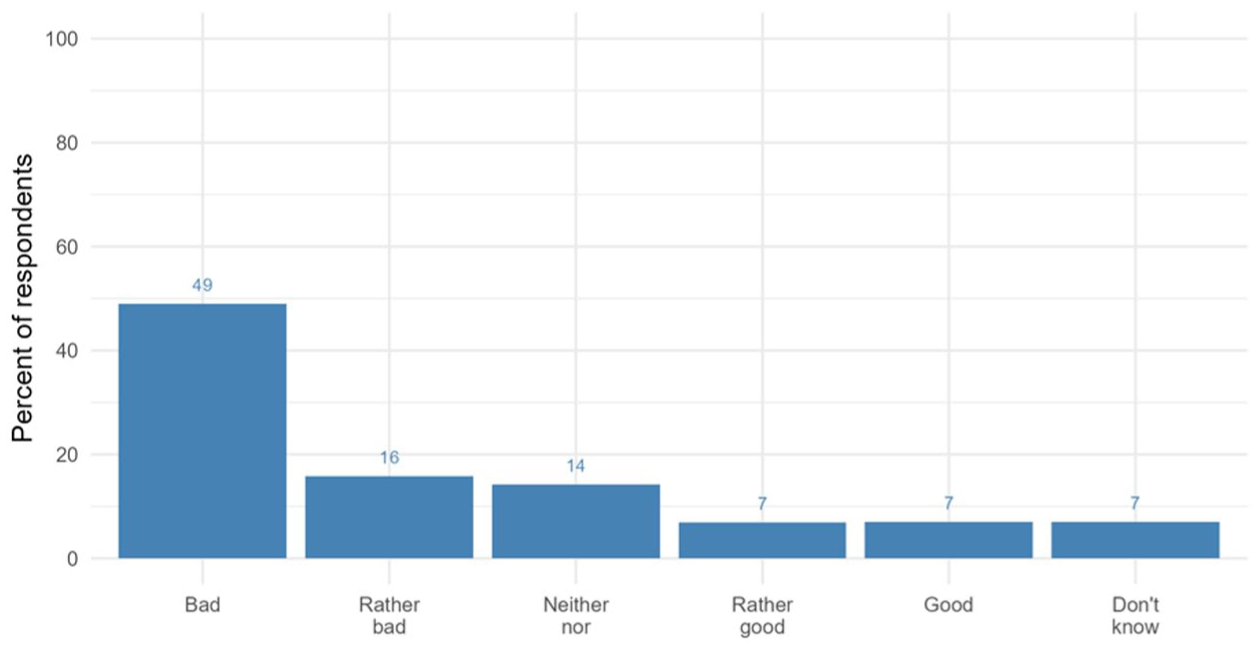
Assessment of the USAID shutdown.
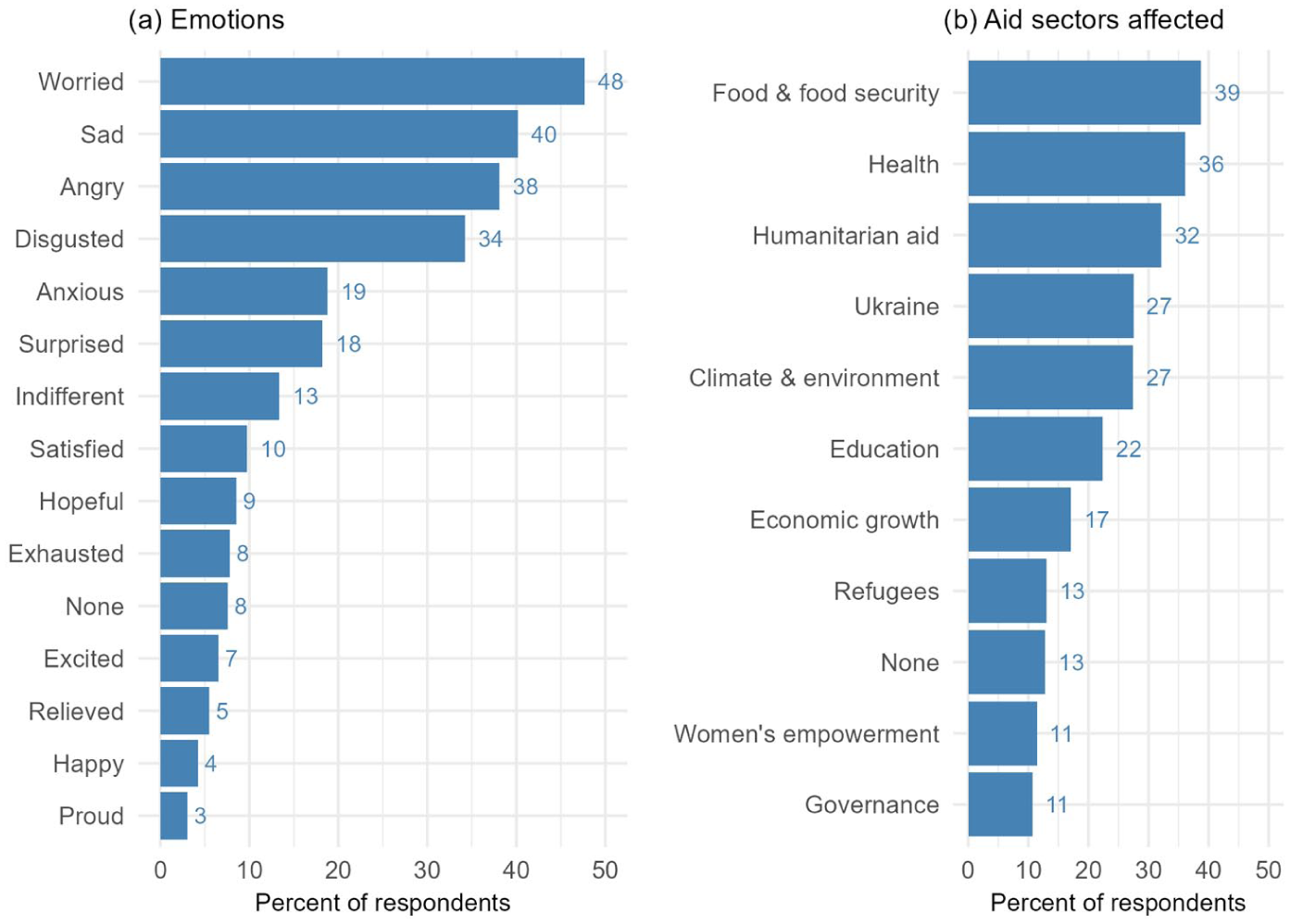
Emotions and aid sectors likely affected.
As shown in Panel (b) of Figure 2, our respondents worry most about the negative impact of aid cuts on global food security, health and humanitarian aid. Moreover, 28% of the participants expressed worry that support for Ukraine may be affected by US aid cuts. What respondents in our survey identified as the most important concerns largely map onto what development experts view as the sectors most likely to be affected by the US aid freeze and are generally consistent with what the German public generally perceives as most important development areas (Schneider et al., 2024). It is also conceivable that the results were partly shaped by the ongoing war in Ukraine and humanitarian crises in the Gaza Strip and Sudan at the time of the survey.
Finally, we asked respondents whether they believe the United States will resume disbursing foreign aid and return to previous levels of ODA. In response, 53% answered ‘no’, 14% ‘yes’, and 32% ‘do not know’ (see Figure S4 in the Supplement). These results suggest that most respondents either expect the United States to maintain its current policy approach for the foreseeable future or are at least unsure about the Trump administration’s intentions.
Policy preferences in face of US aid cuts
The second set of questions examined respondents’ preferences for Germany’s foreign aid strategy. Specifically, we asked what action the German government should take in response to US aid cuts. Respondents could choose one of three options: the German government should (a) increase its ODA disbursements to compensate for the absence of USAID, (b) maintain current levels of ODA disbursements or (c) follow the United States and reduce ODA disbursements. We posed a similar question regarding the appropriate response of other EU member states.
A substantial share of the respondents prefers to maintain current levels of German aid spending (40%), with relatively limited support for increasing (20%) or decreasing (24%) it (see Panel (a) in Figure 3). Regarding preferences for other EU countries, the general pattern mirrors the findings for Germany. As shown in Panel (b) in Figure 3, the largest share of respondents (40%) favour keeping aid spending at current levels, while 26% support an increase and 20% support a decrease. Notably, the share responding ‘don’t know’ was relatively high in both cases – 13% for Germany and 14% for the EU – suggesting that a non-negligible portion of the public remains uncertain in this complex situation.
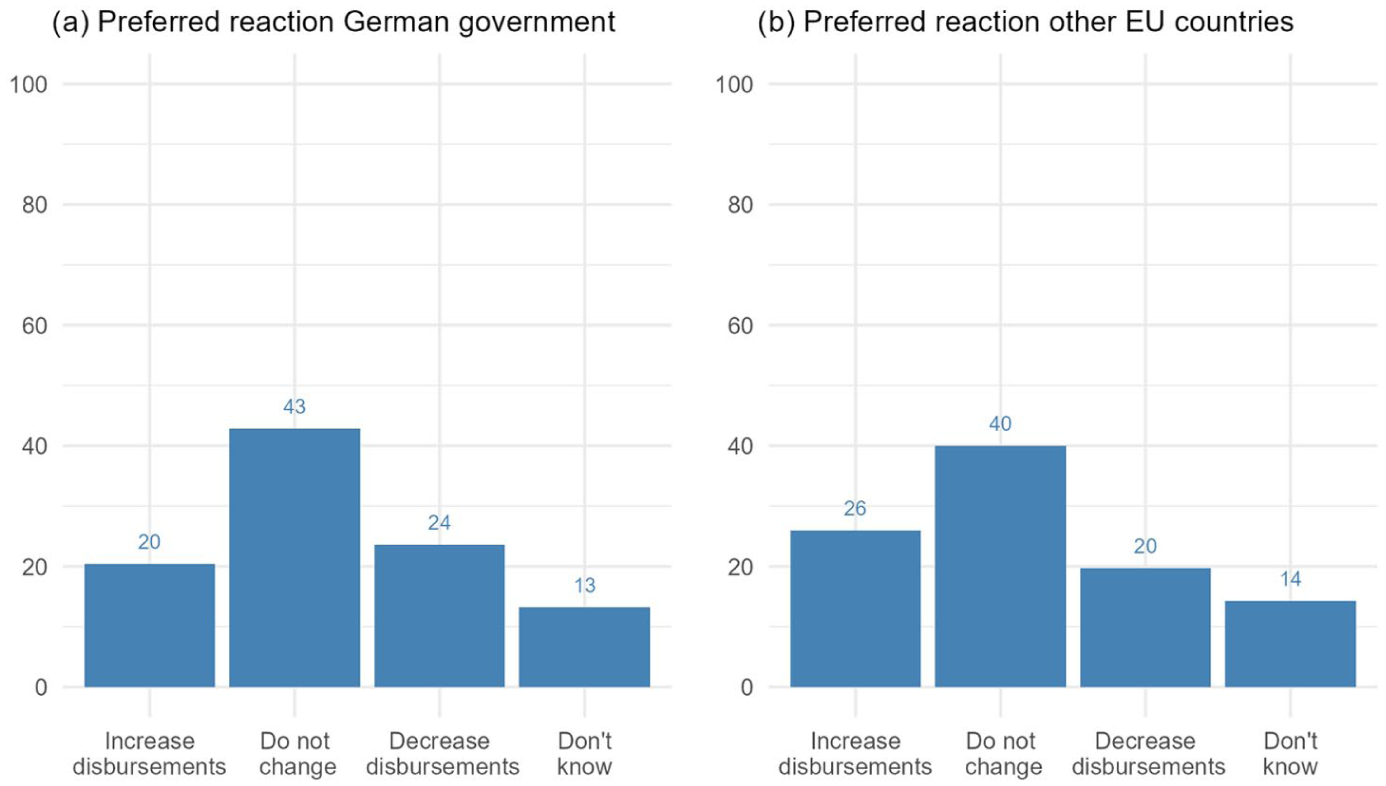
Preferred reactions to the USAID shutdown.
These findings suggest that although respondents largely disapprove of the Trump administration’s decision to shut down USAID and express concern about its negative consequences, they do not support the German government increasing its foreign aid to fill the gap.
Exploring the drivers of respondent preferences
Theoretical expectations
Drawing from existing scholarship on public opinion and foreign aid, we expect that Germans’ aid policy preferences following the USAID shutdown are likely shaped by four key variables: political ideology, concerns about the national economy, trust in government and populist attitudes. In particular, we anticipate that right-wing conservatism, heightened economic worries, lower trust in the German government and pronounced populist attitudes will be associated with a positive attitude towards the USAID shutdown and greater support for cutting German foreign aid. We unpack these expectations in the following paragraphs (see Table 1 for an overview).
Expected effects and results.
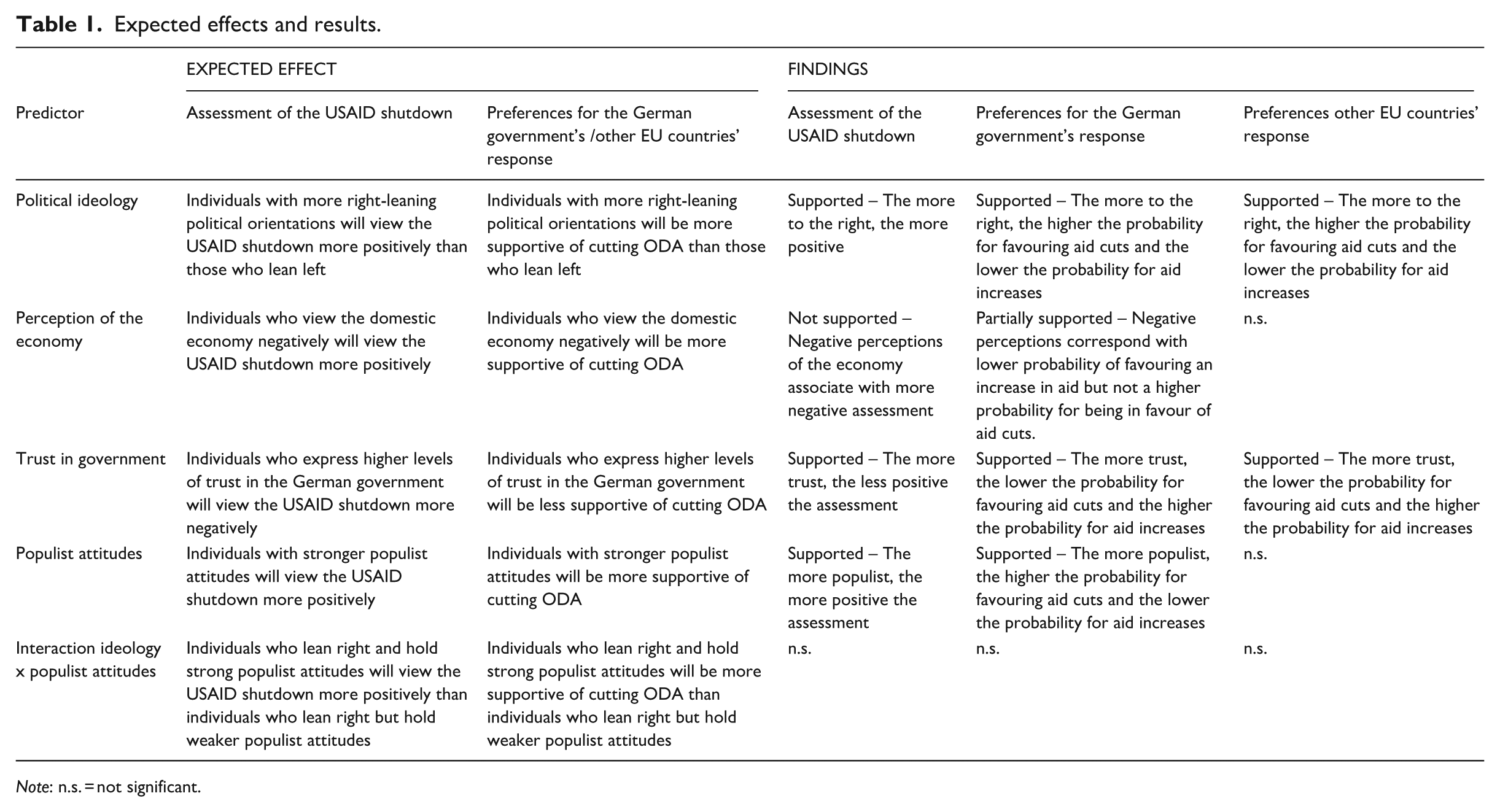
Note: n.s. = not significant.
As discussed in Milner and Tingley (2013) and shown empirically for instance in Bodenstein and Faust (2017), individuals who place themselves on the left (or liberal) end of the political spectrum are more likely to support foreign aid. By contrast, those on the right (conservative) end tend to show lower levels of support. The underlying theoretical mechanism relates to greater endorsement of domestic and global redistribution, as well as values centred on caring for those in need (e.g. Bayram, 2016). Following this literature, we expect that those who identify with the political right will be more likely to support the USAID shutdown and less likely to favour increasing German aid spending to fill the gap left by USAID.
As the benefits of foreign aid are often unclear to the general public, which widely overestimates foreign aid spending, economic and financial crises may trigger ‘us vs. them’ thinking that leads to lower support for aid (see, for example, Schneider et al., 2021). This relationship has been supported by Heinrich et al. (2016) for the EU and Schneider et al. (2024) for Germany. Thus, we hypothesise that the more negatively the economy is perceived, the greater the support for measures such as the USAID shutdown, and the lower the support for increasing foreign aid spending.
Third, political trust may influence attitudes towards foreign aid. As MacDonald (2025) argues, since the benefits of foreign aid tend to be not tangible to the general public, individuals who trust the German government might be more likely to believe it is acting competently and that foreign aid serves the interests of the donor country. Indeed, MacDonald (2025) finds a robust positive relationship between political trust and support for foreign aid in the United States. In light of this, we expect that higher trust in the German government should be associated with lower support for President Trump’s decision and greater support for increasing ODA disbursements to compensate for the US withdrawal.
Fourth, populist attitudes may shape public attitude towards the USAID shutdown. According to the idealist approach, populism is characterised by ‘a) a Manichean and moral cosmology; b) the proclamation of “the people” as a homogeneous and virtuous community; and c) the depiction of “the elite” as a corrupt and self-serving entity’ (Hawkins and Kaltwasser, 2018: 3). President Trump is often considered the paragon of a populist leader (Boucher and Thies, 2019). The USAID shutdown reflects these populist characteristics, as the new US administration framed USAID as part of a corrupt elite that wastes taxpayers’ money on initiatives that harm the national interest. As foreign aid is often considered a liberal or progressive cause – and represents only a small fraction of the US federal budget – it is an easy target for political actors seeking to disrupt the established order (Yanguas, 2018). Such rhetoric is likely to resonate with individuals who hold populist attitudes. Empirically, Heinrich et al. (2021) found that populist attitudes are negatively correlated with support for foreign aid in both the United Kingdom and United States. Providing causal evidence by using survey experiments, Bayram and Thomson (2022) and Bayram et al. (2024) found that right-wing, populist, anti-aid rhetoric reduces support for multilateral foreign aid. However, this negative effect is conditional on preexisting populist attitudes as well as political ideology. Accordingly, we expect that individuals with pronounced populist attitudes are more likely to welcome the Trump administration’s decision to dismantle USAID and oppose any increase in German ODA spending.
Finally, we expect an interaction between political ideology and populist attitudes (see, for example, Huber, 2020, for a similar argument regarding climate change scepticism). President Trump’s decision to dismantle USAID is likely to resonate more strongly with individuals who lean right on the political spectrum and simultaneously hold populist attitudes. By contrast, conservatives who are sceptical of foreign aid but nonetheless dislike populist approaches to politics may be deterred by the radical nature of President Trump’s decision, particularly the broader effort to dismantle core elements of the US public administration.
Analysis
We focus on two dependent variables: respondents’ assessment of the decision to shut down USAID, and their preferred response from the German government and other EU countries. Key predictors include self-placement on the left–right political ideology scale, assessment of the national economy, trust in government and populist attitudes.
Regarding our dependent variables, the assessment of the decision is measured using a 5-point Likert-type-item ranging from 1 (‘bad’) to 5 (‘good’). The preferred response of the German and other EU countries’ government is measured with two 3-category items that ask whether the German government’s [EU’s] spendings for ODA should be increased, decreased or stay the same. The latter serves as the reference category.
With regard to our predictors, ideological self-placement is measured on an 11-point scale ranging from 0 (‘left’) to 10 (‘right’). Economic assessment is captured via a 5-point scale ranging from 1 (‘worsened substantially’) to 5 (‘improved substantially’); given the right-skewed distribution and limited category spread, this variable is recoded into a binary indicator: ‘worsened’ versus ‘did not change/improved’. The latter serves as the reference category. Trust in government is measured on an 11-point scale ranging from 0 (‘do not trust at all’) to 10 (‘trust completely’). Populist attitudes are captured through an additive index combining the answers to six statements describing populism; ranging from 1 to 7, the index has high internal reliability with a Cronbach’s alpha of 0.86 (Table S4 in the Supplement), and higher values indicate more pronounced populist attitudes. 4
Control variables include age, gender, education, region and prior awareness of the USAID shutdown. The latter serves as a proxy for the level of political awareness, which may affect attitudes towards the shutdown. 5
For models that use our first dependent variable, we employ an ordinary least squares (OLS) regression model and, due to the ordinal nature of the variable, an ordinal logistic regression as a robustness check. For models that use our second dependent variable, we use a multinomial logistic regression, with ‘do not change ODA disbursements’ as the reference category (see Figure 3 for the distribution of responses).
Findings
The results of the OLS regression analysis in Figure 4 are broadly consistent with theoretical expectations (see Table 1 for an overview). First, respondents positioned further to the right on the ideological spectrum are more likely to view the USAID shutdown positively. Specifically, each one-point increase on the left–right scale corresponds to a 0.16-point increase in support for the shutdown (β = 0.16; p < 0.001). 6 Second, greater trust in the German government is associated with lower support for the shutdown (β = –0.08; p < 0.001). Third, higher scores on the populist attitudes scale positively correlate with support for the USAID shutdown (β = 0.22; p < 0.001). Contrary to our expectations, our analysis reveals a negative relationship between negative economic perceptions and support for the shutdown (β = –0.42; p < 0.001). Respondents who believe the economy has worsened in the past 12 months are more likely to assess the shutdown negatively than those who think it has remained stable or even improved.
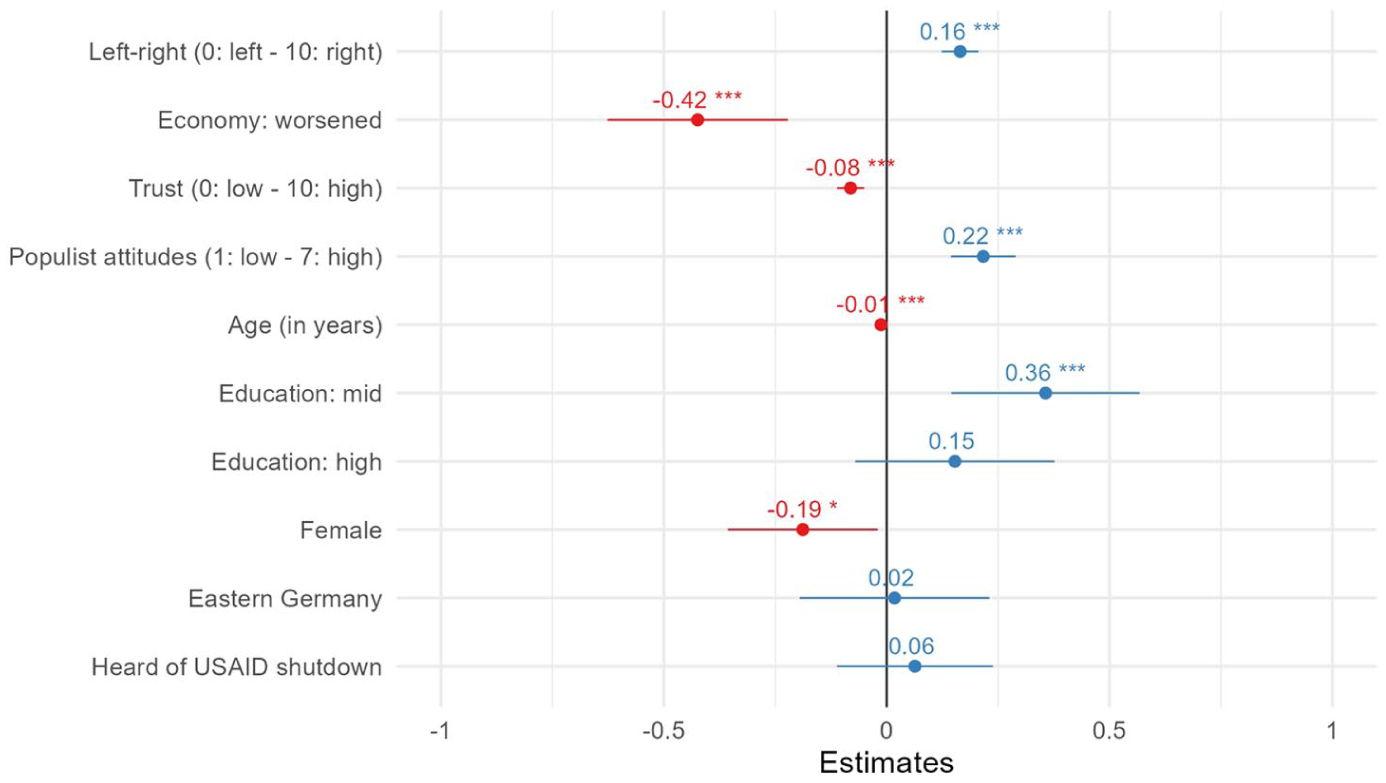
OLS regression – assessment of the USAID shutdown.
In addition, age is negatively correlated with support for the shutdown, with older respondents more likely to assess the decision negatively (β = –0.01; p < 0.001). Compared with men, women tend to view the shutdown more negatively on average (β = –0.19; p < 0.05). Finally, respondents with a general certificate of secondary education (Realschulabschluss) rate the decision more positively than those without a formal qualification or with only a low-level certificate (0.36; p < 0.001). 7
We expected an interaction between ideological self-placement on the left–right scale and populist attitudes. However, our findings do not support this prediction. We do not find evidence that individuals on the right of the political spectrum with strong populist attitudes are more likely to view the shutdown of USAID positively than those who hold weaker populist attitudes. 8
Regarding respondents’ preferred reaction of the German government, the multinomial logistic regression yields similar results as our analysis of the assessment of the shutdown decision. First, the logit coefficients for ideological self-placement in Figure 5 indicate that individuals on the right are more likely to favour decreasing aid disbursements (β = 0.30, p < 0.001) and less likely to support increasing them (β = –0.10, p < 0.01), compared with those preferring no change. Illustrating this relationship using predicted probabilities, the probability for choosing ‘decrease disbursement’ moves from around 0.05 at the left end of the scale to 0.5 at the right. Conversely, the probability for picking ‘increase disbursements’ declines from nearly 0.4 on the left to 0.1 on the right. Second, the more negative a respondent’s perception of the national economy, the lower their probability of endorsing higher aid disbursements (β = –0.49, p < 0.01; predicted probability = 0.21, compared with 0.28 among those who perceive the economy as stable or improved). Surprisingly, however, negative economic perceptions are not associated with higher support for decreasing disbursements (β = –0.34, p = 0.255; predicted probability = 0.15, compared with 0.18 among those who perceive the economy as stable or improved). Third, trust in the German government is strongly related to aid preferences. Higher trust is associated with lower support for decreasing aid (β = –0.36, p < 0.001; probability of decrease: 0.42 at trust = 0 vs 0.01 at trust = 10) and greater support for increasing aid (β = 0.14, p < 0.001; probability of increase: 0.11 at trust = 0 vs 0.47 at trust = 10). Fourth, more pronounced populist attitudes increase the probability of favouring a decrease in ODA disbursements (β = 0.44, p < 0.001; probability = 0.02 at scale minimum vs 0.32 at maximum) and reduce the probability of favouring an increase (β = –0.14, p < 0.05; probability = 0.38 at minimum vs 0.15 at maximum). For the control variables, our analysis does not yield any noteworthy results. Finally, replicating our earlier finding, we do not find a significant interaction between these variables. Comparing models with and without the interaction terms does not yield an improved model fit. 9
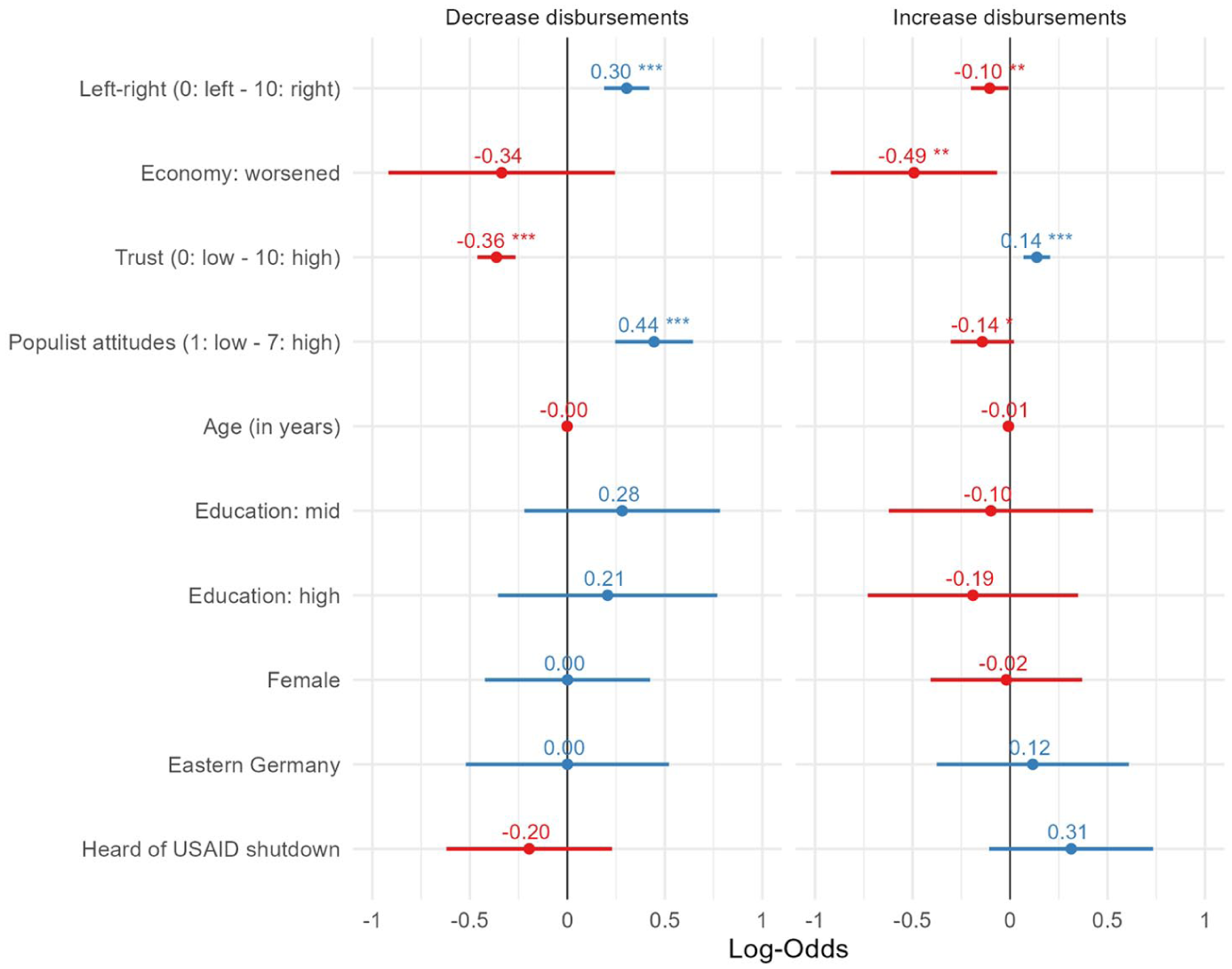
Multinomial regression – preferred response of the German government.
When we use respondents’ preferred reaction of other EU countries as the dependent variable in our multinomial logistic regression model, we observe largely similar results (see Table S8 and Figure S8 in the Supplement). The coefficients for our key predictors have mostly the identical sign and statistical significance, though their magnitude varies slightly. Yet there are some notable differences. First, perceptions of the national economy are not significantly associated with preferences in this model. Second, populist attitudes are not correlated with support for or opposition to increased ODA disbursements. This may be because individuals with strong populist attitudes are less concerned with the foreign policy decisions of other countries. Moreover, respondents who have heard about the USAID shutdown before the survey were more likely to favour an increase in aid disbursements than those who had not (β = 0.47; p < 0.001; predicted probability: 0.33 among those aware of the shutdown, compared with 0.24 among those who had not heard/don’t know). 10 Once again, we do not observe an interaction between ideology and populist attitudes. 11
Discussion
Results from our survey fielded 1 month after the USAID shutdown in Germany show that while Germans view the US aid freeze negatively, a substantial majority prefers no change to Germany’s ODA spendings. Furthermore, our analysis shows that political ideology, populist attitudes and political trust are important predictors of how respondents perceive the shutdown and whether they favour mimicking US cuts or prefer the German government to compensate for the gap. Specifically, individuals on the right of the political spectrum, with pronounced populist attitudes and those who distrust the government are more likely to support the USAID shutdown and favour aid cuts. Surprisingly, those who think the economy has worsened in the past year tend to view the shutdown more negatively and are less likely to support increasing ODA disbursements, but do not exhibit greater support for aid cuts.
These findings are relevant to the aid sector as a whole and could be conceived as potentially reassuring. Despite harsh public and political criticism of development aid since late 2022, our results indicate that the German public does not endorse mimicking the US approach. Recent repeated cross-sectional data collected in January and June 2025 further corroborates this assumption as support for the current German ODA budget has not changed (Oh, 2025a, 2025b). Yet, given ongoing debates about scarce resources and government debt in Germany, it seems plausible that Germans would be unlikely to prefer their government stepping in to compensate for US aid withdrawals. At the same time, the continued rise of right-wing populism (i.e. the AfD) in Germany suggests a growing threat to the aid sector as more extreme positions on foreign aid – such as those adopted in the United States – could find greater public support in the future.
From a policy perspective, our results imply that ODA disbursements require more firmly grounded justifications to constituencies in times of tight budgets. Greater efforts to showcase aid effectiveness, efficient use of ODA resources and improved donor coordination are likely to be more important than ever (e.g. Riddell, 2007). Whether such efforts will motivate European donor publics to support their government’s filling the gap left by USAID remains to be seen. Recent aid cuts by such countries as the United Kingdom, the Netherlands and Austria since January 2025 suggest that OECD DAC members are not eager to compensate for the shortfall and are not seeking to mobilise public support for more aid. In the context of global donor competition for strategic influence, how policy changes by China, Russia and other non-OECD donors may ultimately shift the aid calculus for DAC members remains an important question.
We recommend that future studies use longitudinal and experimental designs to explore causal and longer-term effects of the USAID shutdown on public attitudes towards aid in Germany and other ODA donor countries. Another intriguing question to explore is whether geopolitical donor competition could convince the European donor publics to invest more in global development cooperation. These insights may have consequences for future strategies and communications efforts of development policymakers.
Supplemental Material
sj-pdf-1-pol-10.1177_02633957251387303 – Supplemental material for Neither mimicry nor substitution but business as usual: German aid attitudes in the wake of the USAID shutdown
Supplemental material, sj-pdf-1-pol-10.1177_02633957251387303 for Neither mimicry nor substitution but business as usual: German aid attitudes in the wake of the USAID shutdown by Sebastian H Schneider, A Burcu Bayram, Alexandra Gödderz and Helge Zille in Politics
Footnotes
Acknowledgements
We thank the two anonymous reviewers and the editors of Politics for their valuable comments. We also thank Luca Schneider for his support in the preparation of the manuscript.
Funding
The authors received no financial support for the research, authorship, and/or publication of this article.

Supplemental material
Supplemental material for this article is available online.
Notes
Author biographies
References
Supplementary Material
Please find the following supplemental material available below.
For Open Access articles published under a Creative Commons License, all supplemental material carries the same license as the article it is associated with.
For non-Open Access articles published, all supplemental material carries a non-exclusive license, and permission requests for re-use of supplemental material or any part of supplemental material shall be sent directly to the copyright owner as specified in the copyright notice associated with the article.
