




Abstract
Candidates and parties often have to decide in campaigns whether to remain consistent on policy positions that do not match the median voter or reposition towards moderate. This type of strategic ‘flip-flopping’ is controversial and debated regularly in the media. This study provides causal evidence on this topic by placing candidates and voters on the same policy scale in an experimental setting (n = 4351). Candidates randomly reposition to the centre, extremes, or remain consistent on a non-median position. This creates a test of repositioning versus consistency within the framework of proximity voting. To precisely estimate proximity, the policy is operationalized as numbers: preferred number of asylum seekers resettled annually. Results show that consistent positioning caused a substantial increase in favorability among those who were proximally close. This suggests that consistency is especially important to voters who hold the same position as the candidate. Repositioning toward respondents’ position did not change favorability, but repositioning away from respondents caused a reduction in favorability. The strategically important median voter subgroup did not increase support for candidates who adopted their preferred position. Taken together, this suggests that consistently supporting a non-median immigration policy is preferred to repositioning to the middle.
The strategic choice to move closer to voters
Candidates and parties regularly reposition on policy. That is, switching from one policy position to another over time. This often occurs in strategic ways in order to be closer to most voters. For example, in the 2024 US presidential campaign, Donald Trump repositioned in the moderate direction on abortion policy after being blamed for overturning Roe vs Wade (Korecki, 2024). Trump also tried to reposition away from the policy positions of ‘Project 2025’ because of their perceived extremity (Steakin and Kim, 2024). Likewise, Kamala Harris repositioned on healthcare (from supporting Medicare-for-all to opposing single-payer), energy (no longer supported fracking), and immigration (tougher border protections) in a way that put her closer to the perceived median voter (Abutaleb and Pager, 2024). And debate among journalists and campaign practitioners after the 2024 election revolved around whether Harris made the right decision to reposition instead of holding firm to her previously held liberal positions (Levitz, 2024). These examples demonstrate that candidates care about policy proximity during elections. They infer the policy positions of the public and then try to reposition themselves closer to voters regardless of their previous stances.
This observed behaviour is best characterised by classic models of candidate competition. Candidates position themselves on a left-right policy spectrum to be proximally close to a majority of voters (Downs, 1957). These models show that moderating is advantageous because most voters hold moderate positions. An ongoing empirical debate in political science exists about whether moderate candidates actually perform best in elections. Perhaps the best evidence of moderation comes from US election data showing that candidates who were moderate received a higher vote share compared to extremists (i.e. Canes-Wrone et al., 2002; Hall, 2015). However, a reanalysis with more recent data showed that the advantage of moderating is shrinking to the point of being almost inconsequential (Canes-Wrone and Kistner, 2022; Handan-Nader et al., 2025; Utych, 2020). This leaves open the question of whether repositioning to moderate is worthwhile. If extremists win at the same rate as moderates, then repositioning on policy might no longer be the dominate strategy for candidates and parties.
Another factor to consider is whether or not consistency matters. Candidates who reposition seem to believe that being proximally close to voters outweighs penalties for being inconsistent. Formal models show that consistent positioning helps candidates win elections because it maintains a party brand (Snyder and Ting, 2002). Experimental evidence shows that repositioning might also be interpreted as a negative valence. For example, repositioning candidates might be perceived as unprincipled, less reliable, or incompetent (i.e. Allgeier et al., 1979; Gooch, 2022; Stimson, 2015). However, previous research has not evaluated repositioning within the context of the Downsian model of candidate competition. This study bridges the gap between proximity models and repositioning. Specifically, this study assesses the causal effects of repositioning closer to, and farther away from, voters on a policy space that includes extreme and moderate positions. The experiment to follow used a salient policy; specifically, the number of asylum seekers allowed to enter the United States annually. Even though the experiment is centred in the United States, immigration asylum is a salient issue in other western Democracies as well (i.e. Lutz, 2021).
This design yielded several interesting findings about proximity and repositioning. Candidates who were consistent and held the same position as respondents received a substantial increase in favorability. This demonstrates that consistency is especially valued among those who are proximally close to candidates. Consistent candidates also had the highest overall favorability despite not holding the median position. Contrary to a Downsian expectations, repositioning to be proximally close to respondents did not increase candidate favorability. Moreover, the median voter subgroup did not increase their support for candidates who adopted their position. However, repositioning away from respondents caused a substantial decrease in favorability. At least for the issue of asylum seekers, this suggests that candidates do not reap the reward of repositioning and instead, are punished for moving away from voters who supported the initial position.
Results also demonstrated dynamics that are typically characterised by proximity voting theories. The farther away the candidate was from a respondent, the worse their favorability on average. In addition, partisan respondents evaluated candidates in a Downsian way in most treatment conditions. For example, moving in the liberal direction improved candidate favorability among Democratic respondents (the liberal party) and penalised among Republicans (the conservative party). Repositioning to the moderate position increased favorability relative to a control group among partisans but only when it was in the direction of their party’s dominate position. That is, moving from a liberal position to the status quo increased favorability among Republicans, and moving from a conservative position to the exact same status quo increased favorability among Democrats. That being said, the decrease of in-party support far outnumbered the increase of out-party support, which suggests that the losses outweigh the gains unless support is extremely lopsided.
This study provides causal evidence that consistency is valued, and repositioning proximally closer to a voter’s position does not guarantee support. Repositioning might risk alienating voters who supported the candidate’s previous positions, and supporters of the new position might be sceptical. Broadly speaking, this research contributes to the growing literature that shows the diminished value of moderating policy positions during elections. This study proceeds as follows. The next section reviews the literature, then the data and methods, results, and finally the conclusions and implications are discussed.
Policy proximity and electoral outcomes
Classic models of candidate competition emphasis proximity between candidates and voters. In competitive democracies, citizens select candidates and parties that operate as policymakers once in-office (Powell, 2000). Downs (1957) theorised that candidates compete on a left-right policy space and strategically position themselves to be closest to most voters. This would lead candidates to be close to the median voter in order to receive the largest vote share. Of course, not all successful candidates are precisely moderate as models would suggest. Elections are ‘clumsy instruments’ for turning policy preferences of citizens into government action for a variety of reasons (Powell, 2000: 6). However, evidence exists that deviating from the median could hurt candidates’ chances of winning (i.e. Canes-Wrone et al., 2002; Costello et al., 2020; Hall, 2015). Many empirical studies test proximity and electoral performance by placing candidates and voters on the same policy space, and then correlating this proximity with vote choice or vote shares. For example, a regression discontinuity design showed that candidates who were closer to moderate received a much higher vote share compared to candidates who were more extreme (Hall, 2015). This is credible evidence because the method used most closely resembles random assignment between a moderate and extreme candidate.
On the other hand, evidence from recent elections suggests that the advantage of being moderate might be dissipating. The moderate’s advantage was strong in 1980 and has since decreased linearly over time (Utych, 2020). By 2008, the advantage vanished and ideologically extreme candidates were just as likely to win as moderates (Utych, 2020). Moreover, the same researchers who credibly showed the advantage of moderating have analysed recent data to show how those findings might not hold for the current political realities (Canes-Wrone and Kistner, 2022; Handan-Nader et al., 2025) For example, a steady decline of the moderate’s advantage occurred from 2000 to 2020 in US state legislatures – moderates are now only slightly advantaged over extremists to the point of being almost inconsequential (Handan-Nader et al., 2025). Likewise, the moderate’s advantage declined in the US Congress over the last 45 years to the point of no longer being an advantage at all (Canes-Wrone and Kistner, 2022).
Non-median candidates might be preferred by the public. To assess this, researchers used experiments with randomised policy positions for candidates. This procedure is done so that the causal effects of positions can be directly measured. Results showed that voters hold non-median opinions on a variety of specific issues and do not care if candidates are extreme across a range of issues (Ahler and Broockman, 2018; Broockman, 2016). Even respondents who were identified as moderate might be best represented by extreme candidates because moderates sometimes hold a combination of ‘idiosyncratic’ positions (sometimes left, sometimes right) that are far from the actual median position (Ahler and Broockman, 2018: 1117).
Taken together, models suggested that moderate candidates perform better, and election results demonstrated these theories decades ago. However, extreme candidates are now performing just as well as moderates. Therefore, it is unclear if the conventional wisdom of repositioning in the moderate direction still helps candidates when parties and voters are polarised.
Proximity voting in the context of repositioning
Candidate repositioning is ubiquitous globally and is studied in a variety of contexts. Candidates choose to be consistent on their policy stances over time, or they can reposition to the left, right, or centre. Candidates and parties in the United States adjust their positions over time to match the policy preferences of the public (i.e. Croco, 2016; Doherty et al., 2016; Stimson, 2015). Candidates also switch positions in the short-term depending on the electoral context – for example, candidates hold extreme positions during the party primaries and then switch to moderate positions a few months later in the general (Macdonald et al., 2025). Repositioning is not unique to the United States. Several multi-country studies documented parties switching positions in long-standing West European (WE) democracies or Central and Eastern European (CEE) democracies (Adams et al., 2011; Adams and Somer-Topcu, 2009a, 2009b; Han, 2017; Heinisch et al., 2021; Tavits, 2007). Parties switched positions often (Adams and Somer-Topcu, 2009b; Ferland and Dassonneville, 2021; Golder and Ferland, 2018 [2017]), and in terms of proximity, parties that moved towards the median voter gained vote shares in subsequent elections (Adams and Somer-Topcu, 2009a; Han, 2017).
Repositioning does not only occur in long-standing democracies. A reoccurring pattern emerged among presidents in Argentina, Peru, Bolivia, and Ecuador who campaigned on liberal policies and then switched to conservative policies once elected (Stokes, 2012 [1999]). In Hungary, a far-right party (Jobbik) repositioned to moderate after years in power as evident by the company they kept – protest events supported by Jobbik went from ‘disruptive acts of symbolic violence’ (Pirro et al., 2021: 26) to non-violent public assemblies (Pirro et al., 2021). These changes also accompanied policy U-turns towards moderate (Pirro et al., 2021). These examples demonstrate the pervasive nature of repositioning by candidates and parties around the world.
Repositioning on immigration policy specifically occurs in a variety of ideological directions. Although researchers might typically model repositioning as extremists adopting moderate positions to win elections, evidence from WE democracies also suggests that mainstream parties move to the extremes (Abou-Chadi, 2016; Alonso and Fonseca, 2012). 1 This is particularly evident on issues about multiculturalism and immigration policy (Abou-Chadi, 2016; Alonso and Fonseca, 2012; Down and Han, 2020; Han, 2015; Lutz, 2021), but it also occurs on other issues like national defence (Matsunaga and Winzen, 2025) and environmental protection (Abou-Chadi, 2016). Mimicking fringe parties might be a result of the rightward shift on immigration policy in general, suggesting that parties are trying to keep up with voters (Alonso and Fonseca, 2012). Evidence also exists that WE parties staked out more extreme positions on immigration during campaigns than the actual policy outcomes once in-office, demonstrating a ‘gap’ between campaign positions and government outcomes (Czaika and De Haas, 2013; Lutz, 2021). Voters might have taken notice of these immigration policy U-turns because party registration shifted as well (Ferland and Dassonneville, 2021).
Repositioning examples are never random. Because of this non-random candidate and party behaviour, analysing the effect of repositioning on voters is difficult using observational data. Researchers have recognised this endogeneity problem in observational data (i.e. Doherty et al., 2016; Ferland and Dassonneville, 2021). This has led researchers to randomised experiments. Many repositioning experiments tested important mechanisms but were unrelated to policy proximity. Important studies focused on conditions where repositioning was not penalised. For example, candidates are given leeway to reposition during a crisis (Levendusky and Horowitz, 2012), when the original position occurred decades earlier (Doherty et al., 2016), and when new scientific information is brought to bear on an issue (Nasr and Hoes, 2024). Candidates can also use emphasis frames to persuade the public of their new position (Robison, 2017).
Several foundational repositioning experiments conducted analyses of proximity, but the results were mixed and potentially not applicable to models of candidate competition. Proximity did not matter for ‘a stranger’ who repositioned on attitudes unrelated to policy – that is, adopting respondents’ attitudes did not change evaluations (Allgeier et al., 1979). Although this was the first study to evaluate proximity and repositioning, the procedure did not evaluate candidates or policy. In a later study, repositioning away from respondents on gun control was penalised, but politicians who adopted respondents’ preferred position ‘received no credit for doing so’ (Hoffman and Carver, 1984: 384). Politicians who remained consistent on gun control received the highest candidate evaluations (Hoffman and Carver, 1984). These results suggest that consistency is important to the public. An experiment building on these findings created a vignette with a hypothetical president and hypothetical conflict in Angola, but proximity results were mixed (Sigelman and Sigelman, 1986). Results showed that ‘hawk’ respondents approved of ‘dove’ candidates repositioning to hawkish actions. But this effect did not occur for ‘dove’ respondents. Taken together, these studies demonstrated the value of answering these questions with random assignment. That being said, these initial studies are also limited because they used very small student samples and used ambiguous worldviews in place of policy positions. In addition, they do not consistently show a benefit or penalty for repositioning proximally close to the public.
Researchers with more advanced methods and representative samples furthered knowledge on proximity and repositioning (Croco, 2016; Croco and Gartner, 2014; Doherty et al., 2016; Nasr and Hoes, 2024). Using a specific policy position, Senators who moved from anti-war in Afghanistan to pro-war received increased support among pro-war respondents. Like previous research, results were mixed because this proximity effect did not occur for anti-war respondents (Croco and Gartner, 2014). For the Iraq War, consistency was more important than repositioning towards respondents (Croco, 2016). In a study where the results were not mixed, respondents favoured a candidate who repositioned towards them 20 years later on Social Security, abortion, and fighting ISIS (Doherty et al., 2016). This shows how the public is accepting of a candidate if they ‘evolve’ on an issue after a long period of time. Similarly, parties who reposition on issues affected by new scientific discovery gained support from respondents who are pro-science (Nasr and Hoes, 2024). The latter two studies are similar in that they showed specific conditions where repositioning might be interpreted as pragmatic, which might make proximally close respondents less sceptical of their newfound position.
Observational research testing theories of candidate competition used policy scales that differentiate between moderate and ideologically extreme positions (i.e. Hall, 2015; Utych, 2020). There is a wealth of previous research on repositioning in a variety of contexts, but no previous research evaluated repositioning in the context of these proximity models. Previous repositioning studies assessing proximity used binary scales of agree/disagree or pro/anti to match candidates and voters. Pro/con positioning makes application to these models difficult because they (1) cannot simulate a left-right policy space and (2) lack a median that candidates often reposition themselves around. To further the literature, more policy options should be provided for candidates and respondents. In addition, I argue that binary scales can potentially underestimate the degree to which repositioning is penalised. In experiments, the benefit of binary scales is that the policy is simplified (for example, ‘pro-life’ or ‘pro-choice’ only), and a high sample size can be maintained for the two subgroups. The downside is that lumping all respondents into the liberal or conservative side of an issue reduces the options to ambiguous policies or worldviews. Ambiguous policies give respondents leeway to interpret positions as they see fit (Tomz and Van Houweling, 2009). Ambiguous policies might understate the penalties for repositioning because voters might ‘fill in’ the reposition with their own view. It should be noted that most previous research tested specific mechanisms unrelated to policy proximity (e.g. uncertainty during a crisis, the role of emphasis frames, new information, etc.), and so this critique is not a condemnation of past research. Instead, it is meant to highlight a gap in the literature that is taken up by this study.
Hypotheses
Below are my pre-registered hypotheses based on the literature. Note that all hypotheses mention a control group where a candidate holds a position during a campaign. The experiment to follow compares campaign candidates (control group) to consistent or repositioned candidates in-office (treatment groups). Most previous research typically compared a repositioned candidate to a consistent candidate, which is effectively two treatment conditions. Therefore, it is impossible to tell if candidates actually received a boost in support from being consistent or are penalised for repositioning.
H1 stems from past research that shows consistency is rewarded and repositioning is penalised across all citizens (i.e. Allgeier et al., 1979; Croco, 2016; Downs, 1957; Gooch, 2022; Hoffman and Carver, 1984). H1 also provides an opportunity to show average treatment effects across all respondents, which is a standard first analysis for experiments (Gerber and Green, 2012). Voters ‘regard reliability as an asset’ and that policy information during campaigns is useful ‘only insofar as those statements serve as guides to the policies that party will carry out in-office’ (Downs, 1957: 107). Consistency also helps candidates stake out a clear brand – ‘mavericks’ who deviate from the party’s positions are worse off in terms of winning elections (i.e. Snyder and Ting, 2002).
H1: A consistent candidate will have a higher favorability on average than a campaign candidate (control group), and a repositioned candidate will have a lower favorability on average than a campaign candidate (control group).
H2 and H3 directly test the idea that proximity matters when candidates reposition. These hypotheses test whether repositioning in accordance with the Downsian model is rewarded. These hypotheses draw on empirical findings that show voters prefer candidates and parties who reposition closer to them on policy (Adams and Somer-Topcu, 2009b; Croco, 2016; Croco and Gartner, 2014; Doherty et al., 2016; Nasr and Hoes, 2024). Although not in the context of repositioning, evidence also suggests that US voters select candidates who are closest to them on policy (i.e. Canes-Wrone and Kistner, 2002; Hall, 2015). Therefore, H2 argues that candidates should improve their standing by moving proximately closer to voters. Likewise, H3 argues that repositioning away from respondents should cause a reduction in support.
H2: When the candidate moves towards the respondent, the repositioned candidate will have a higher favorability than the campaign candidate (control group).
H3: When the candidate moves away from the respondent, the repositioned candidate will have a lower favorability than the campaign candidate (control group).
Data and methods
This section describes the pre-treatment policy question, randomised conditions, the outcome measure, analysis strategy, and data. This experiment was pre-registered at asperdicted.org. The Supplemental Appendix section 1 contains balance tests including means, standard deviations, and an f-test of joint significance demonstrating that the randomisation was conducted correctly.
Pre-treatment policy question: asylum seekers
Because this study is about policy proximity, respondents are asked their position before the experiment. I am interested in studying repositioning in the context of immigration policy, particularly asylum seekers. Immigration – and those who cross the border seeking asylum – is a particularly salient topic in US elections and media coverage (Sides et al., 2024). It is also the most cited non-economic problem facing the United States (Jones, 2024). This case might also be generalizable to other democracies where immigration and asylum seeking is a salient issue. For example, immigration was cited as one of the most important issues facing the European Union (EU) among respondents from 11 EU countries (Wells, 2018). Immigration – and specifically the issue of asylum seekers – was one of the most salient issues in the 2022 Italian general election (De Ghantuz Cubbe, 2022), the 2023 election in the Netherlands (Reuters 2023), and the 2024 European election (Guillou, 2024). Moreover, the politics of immigration is also organised similarly to the United States, where right-wing parties support limiting asylum. Restrictive immigration policies and their effects on migration are similar in Europe, North America, and Australia (Hollifield et al., 2014). Substantial evidence also exists of European parties repositioning on immigration to be proximally closer to voters (Abou-Chadi, 2016; Alonso and Fonseca, 2012; Down and Han, 2020; Han, 2015; Lutz, 2021). Therefore, this experiment is potentially generalizable to other countries where immigration is salient and can be situated on a left-right continuum.
The question wording and marginal distribution is below. Respondents are told the definition of an asylum seeker and are told how many were resettled in the United States in 2022. This design decision was made so that the policy was clear and not subject to multiple interpretations. I used 2022 because it was the most recent year with publicly available data at the time of fielding. In this way, the status quo policy reflects the current state of the world when the experiment was conducted. It is also the median position on the scale. Also note that the number of ‘about 36,000’ (the status quo policy) was rounded to a whole number for ease of interpretation. Table 1 shows that the most popular option was ‘maintain’ current levels, and therefore, this policy option represented the median voter subgroup. The answer choices mirror the policy positions in the experiment so that candidates and respondents can be placed on the same scale. Conservative positions (as labelled throughout this article) reduce the number, and liberal positions increase the number. The question wording was:
We are interested in your views on immigration. Specifically, asylum seekers. “Asylum” occurs when the United States grants legal immigration to people who are victims of persecution in their home country, or have a reasonable expectation of persecution in the future. In 2022, the U.S. allowed about 36,000 asylum seekers to relocate to the U.S. If you had to choose, which best represents your opinion on asylum seekers?
This design has multiple benefits methodologically. Using numerical values allow for an equal distance between liberal and conservative policy positions and is centred at a moderate, status quo policy. The status quo policy also provides a ‘benchmark’ for respondents (Ansolabehere et al., 2013: 50). Benchmarks give context to quantitative survey questions – for example, researchers should report the unemployment rate and how it is calculated before asking opinion questions about unemployment (Ansolabehere et al., 2013). My study provided a benchmark with this status quo policy. Finally, policies-as-numbers are precise and help avoid ambiguous treatments commonly used to distinguish between liberal and conservative positions.
Pre-treatment policy preferences for asylum seekers.
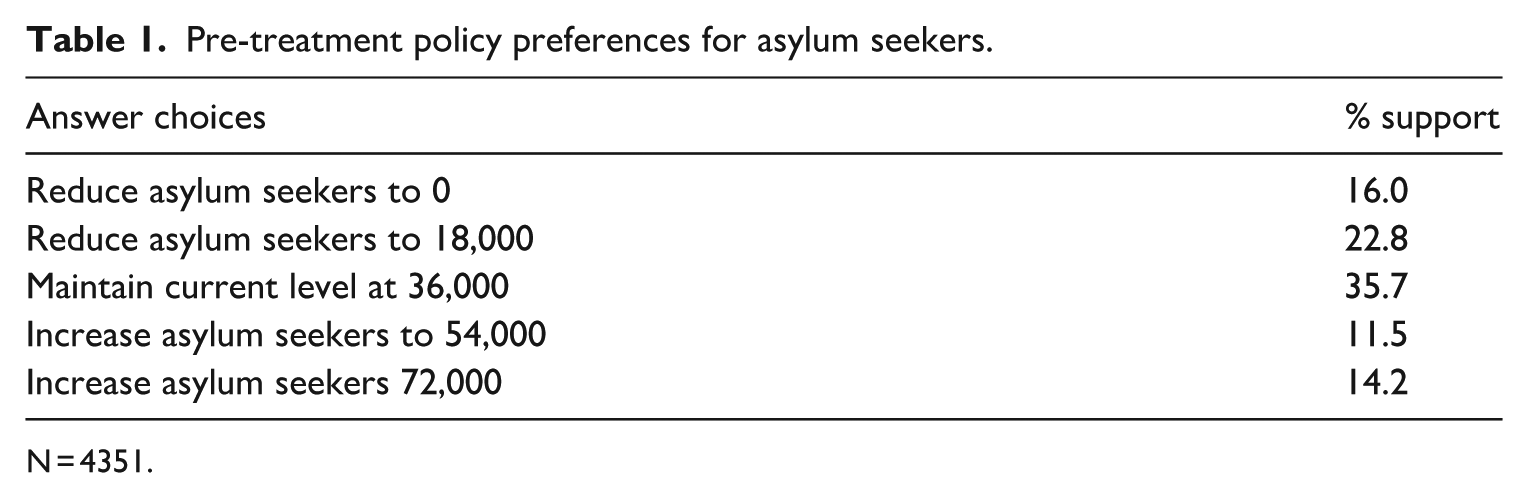
N = 4351.
Experimental vignettes
A candidate for the US House of Representatives holds a position on asylum seekers during a campaign or while in-office. In-office candidates can hold the same position as the campaign (consistent) or a different position (repositioning). In-office treatments also included the same campaign information as the control group, and so treatment conditions build on the control group. Comparing a campaign condition acts as a harder test because consistency and repositioning treatments convey the opposite information, whereas, a campaign position is neutral. Differences found between treatment and control are the causal effect of consistency or repositioning. Candidate profiles are summarised in Table 2. See the Supplemental Appendix for full question wording. Respondents randomly saw 1 of 10 conditions. The candidate can reposition in the liberal direction, conservative direction, or to the status quo. This design accounts for each proximate direction. Note that the liberal candidate control group will be compared with liberal in-office candidates, and likewise for conservative candidates.
Randomised candidate positions.
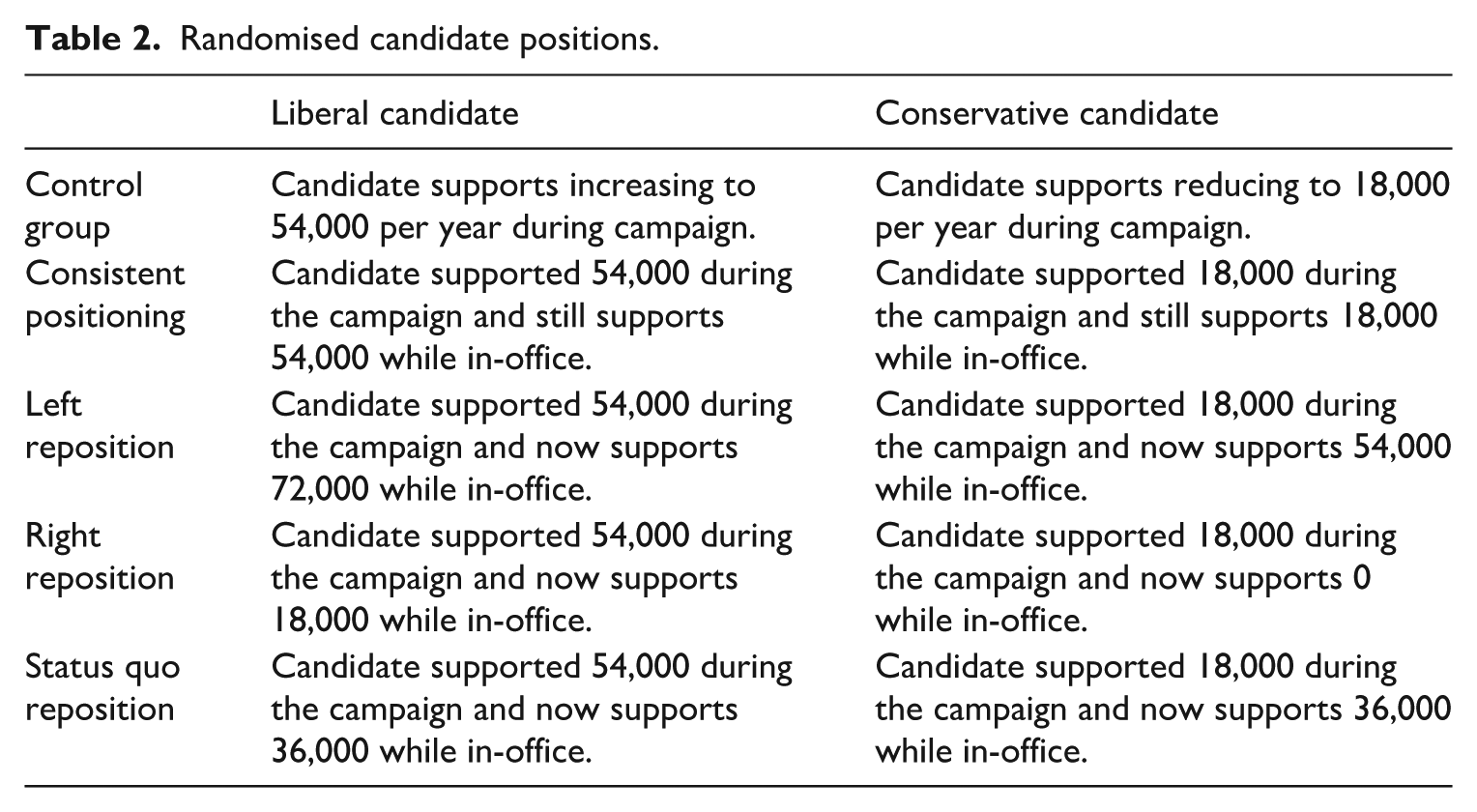
No party or ideological labels were used because that might be too much information for respondents. Goggin et al. (2020) showed that respondents can responsibly guess candidates’ party identification when they support salient issue positions, which suggests that both policy and party information are signalled by issue positions. For example, respondents can correctly associate ‘addressing the immigration problem’ with Republican candidates (Goggin et al., 2020: 4). Respondents’ ability to guess a candidate’s party did not vary by political knowledge levels either; therefore, this is not just a high information phenomenon (Goggin et al., 2020). Evidence from the United Kingdom also suggests that policy and party signal equivalent information to voters (Titelman and Lauderdale 2025). Moreover, Dias and Lelkes (2022) argued that party and policy are intertwined for many salient issues and therefore, should not be included in a treatment simultaneously because both together would be ‘a compound treatment’ (Dias and Lelkes, 2022: 2). For these reasons, the experiment also excludes any candidate personalization (i.e. Arter and Poyet, 2024; Karvonen, 2014; Pedersen and Rahat, 2021; Rahat and Kenig, 2018) and instead uses a hypothetical candidate in accordance with past experimental research (i.e. Tomz and Van Houweling, 2009). Personalization is discussed further in the conclusion. An example of the vignette from the respondent’s perspective is in the Supplemental Appendix Section 2.
Outcome measure
Respondents answered an outcome measure that taps into candidate favorability. Favorability was asked as a feeling thermometer from 0 to 100 using a slider. Proximity is operationalized as closeness between the candidate and respondent on preferences for asylum seekers. As a robustness check, favorability results will also be stratified by respondents’ party identification (including leaners). Because many citizens can guess the party of a candidate (Goggin et al., 2020), repositioning might be interpreted as moving closer to, or farther away from, their preferred party.
Analysis strategy
I briefly describe the analysis here. I used ordinary least squares (OLS) regressions with predictors for treatment groups and pre-treatment covariates. Control groups are excluded from the models as the reference category. The dependent variable is favorability scaled from 0 to 100 so that treatment coefficients can be interpreted as percentage point changes relative to the control group. Pre-treatment covariates were race, gender, income, education, party identification, and preferred position on asylum seekers. I used one model for the conservative candidate and one model for the liberal candidate because they both have their own control group. Although presented graphically with 95 percent confidence intervals, point estimates and p values will be reported in-text. Full regression tables are in the Supplemental Appendix Section 3.
For the proximity models, respondents are matched with candidate positions based on the pre-treatment policy question. When candidates are consistent in-office, respondents can either hold the same position as the candidate or a different position. When candidates repositioned in-office, they are categorised as moved ‘toward’ respondents or moved ‘away from’ them. A scale with nine possible proximity locations was also created. For party proximity, the treatment effect regression models described in the previous paragraph were stratified by party. Finally, I displayed means, differences in means, and t-test p values for the median voter subgroup.
Data
Data come from Lucid, an online survey sampling company. Lucid uses quota samples from pre-survey demographics. Five replication datasets using Lucid showed that the estimates mirrored those found in the original studies (Coppock and McClellan, 2019). This suggests that Lucid is roughly similar to other samples that are regularly used in the social sciences The total sample size in this study is 4,226, and each randomised condition contains between 397 and 456. After consenting to participate, respondents had to pass an attention check question.
Results
Average treatment effects
This section displays overall treatment effects. Figure 1 shows changes to candidate favorability from repositioning with points for conservative candidates (circles) and liberal candidates (squares). ‘Consistent’ are candidates who held the same position during the campaign and while in-office, ‘Left’ are candidates who repositioned to the left, ‘Right’ are candidates who repositioned to the right, and ‘SQ’ are candidates who repositioned to the status quo.
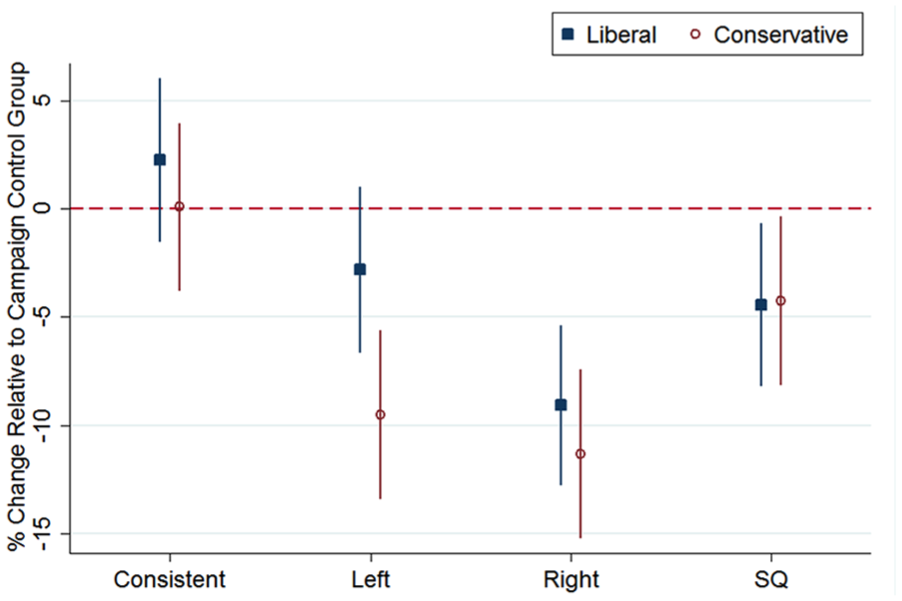
Candidate favorability average treatment effects.
Consistent candidates did not receive a significant increase in favorability on average, contrary to the first half of H1. The consistently liberal candidate increased favorability by 2.3 percentage points (p value = 0.24), and the consistently conservative candidate increased favorability by 0.1 percentage points (p value = 0.97). However, the second part of H1 is mostly confirmed because all repositioning treatment effects are negative, and five of six showed significantly less favorability compared to the control group. These decreases in favorability ranged from an insignificant decrease of 2.8 percentage points (p value = 0.15) to a highly significant decrease of 11.3 percentage points (p value = 0.00). Even repositioning to the status quo position was viewed less favourable on average. Repositioning to the status quo policy decreased favorability by 4.4 percentage points (p value = 0.02) for the liberal candidate, and decreased favorability by 4.3 percentage points (p value = 0.03) for the conservative candidate. This demonstrates that moving to the median voter position was penalised for liberal and conservative candidates on average across all respondents. Although being consistent is not necessarily rewarded on average across all respondents, these initial findings suggest that switching positions comes with a penalty.
It is important to note that the consistent candidates received the highest overall favorability. A consistently liberal candidate’s favorability was 54.6, and a consistently conservative’s favorability was 53.9. This demonstrates that the null results in Figure 1 are not because consistent candidate profiles are unpopular; on the contrary, those candidates were the most popular. However, the candidates who held a non-median position during the campaign (control group) were almost as popular as consistent candidates, making the treatment effects negligible.
Policy proximity
The first proximity analysis demonstrates the basic mechanics of the Downsian model. Candidates who are proximally close to respondents should have the highest favorability, and candidates farther away from respondents should be preferred less. Figure 2 shows these results. Points are average favorability for each distance. Figure 2 does not distinguish between treatment and control in order to highlight the proximity scale. Diamonds are respondents who saw liberal candidates, and triangles are respondents who saw conservative candidates. Points in the middle are respondents who held the same policy as the randomised candidate (‘matched policy’), and respondents can be up to four policy positions away from the candidate. A solid line shows the distribution of respondents at each category. Results show that matched candidates have the highest favorability on average, and favorability drops as the respondent becomes farther away from the randomised candidate. The magnitude of the drop is largest when the candidate is maximally far from the respondent. The drop in favorability is slightly steeper for liberal candidates than conservative candidates, but both types of candidates exhibit the same pattern of support. These results confirm past research that shows the importance of being close to voters on policy, and importantly, it demonstrates construct validity for the policy scale.
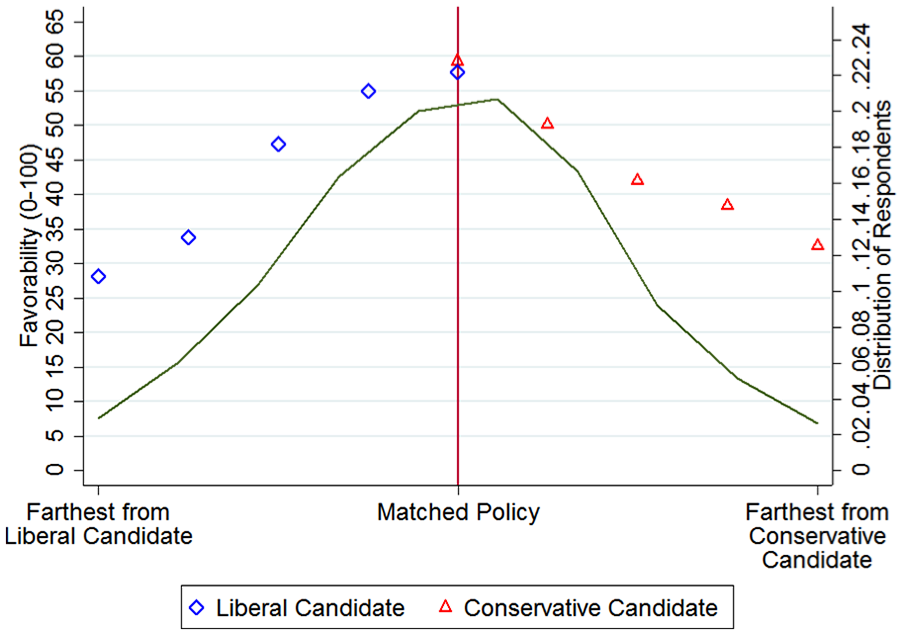
Candidate favorability by policy proximity.
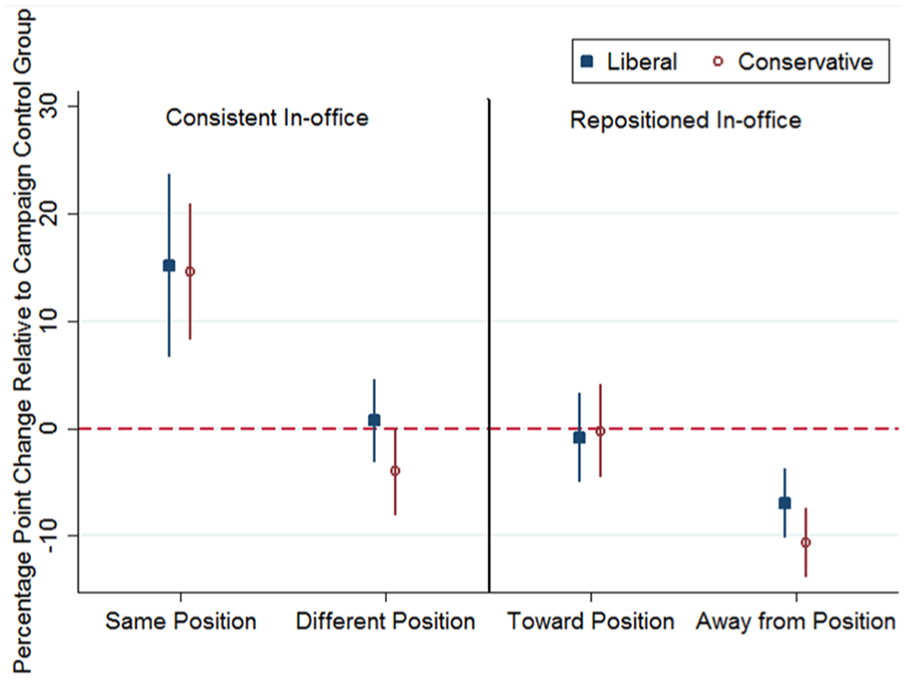
The point of this study is to evaluate the importance of proximity when a candidate repositions, and Figure 3 displays those results. If a respondent was randomised into a consistent treatment, they could hold the ‘same position’ as the candidate or a ‘different position’ as the candidate. For repositioning conditions, the respondent could hold the same position as the candidate’s in-office reposition (‘towards position’) or a position that does not match the reposition (‘away from position’).
Candidate favorability by policy proximity.
Figure 3 demonstrates that the effects of proximity on repositioning are a bit more nuanced than previous research would suggest. Consistent candidates received higher favorability among those who are proximity close to the candidate. The difference from the campaign control group is substantial. This effect was found for both liberal and conservative candidates. Consistently liberal candidates increased their favorability by 15.1 percentage points (p value = 0.00) compared to control. Likewise, consistently conservative candidates increased their favorability by 14.6 percentage points (p value = 0.00). These results show that consistency is valued among those who hold the same position as the candidate.
H2 is not confirmed, but H3 is confirmed. Respondents did not reward candidates who repositioned towards them in Figure 3. Surprisingly, when candidates adopted the preferred position of respondents, their favorability did not increase on average relative to the control group (‘towards position’ in Figure 3). These insignificant differences were −0.9 percentage points (p value = 0.67) for the liberal candidate and −0.2 percentage points (p value = 0.91) for the conservative candidate. In other words, candidates did not improve their standing even though they became proximally closer to respondents. Finally, candidates who moved in the opposite direction as the respondent received lower favorability ratings. Liberal candidates received a reduction in favorability by 7.0 percentage points (p value = 0.00), and conservative candidates received a reduction in favorability by 10.7 percentage points (p value = 0.00).
In sum, this suggests a refined interpretation of proximity and repositioning with regard to immigration policy. The first position staked out during a campaign was important to respondents. On one hand, results showed a consequential boost in favorability for candidates who consistently held the same position as the respondent. Proximity mattered greatly for these consistent candidates. On the other hand, candidates who repositioned to the respondent’s preferred position did not increase their favorability, perhaps, because respondents are anchoring their opinion to the original position. Respondents might be sceptical of the candidate even if they support the same position. Repositioning away from respondents was punished regardless if the candidate was liberal or conservative. This suggests that candidates risk alienating previous supporters.
Repositioning to the median voter
What about those who support the status quo policy? These individuals represented the median voter on asylum seekers because (1) they support the ideologically middle policy and (2) they are the largest policy position subgroup at 35.7% of the sample. This is also a group that has real world relevance because candidates for office will typically reposition towards the median voter to appear more moderate.
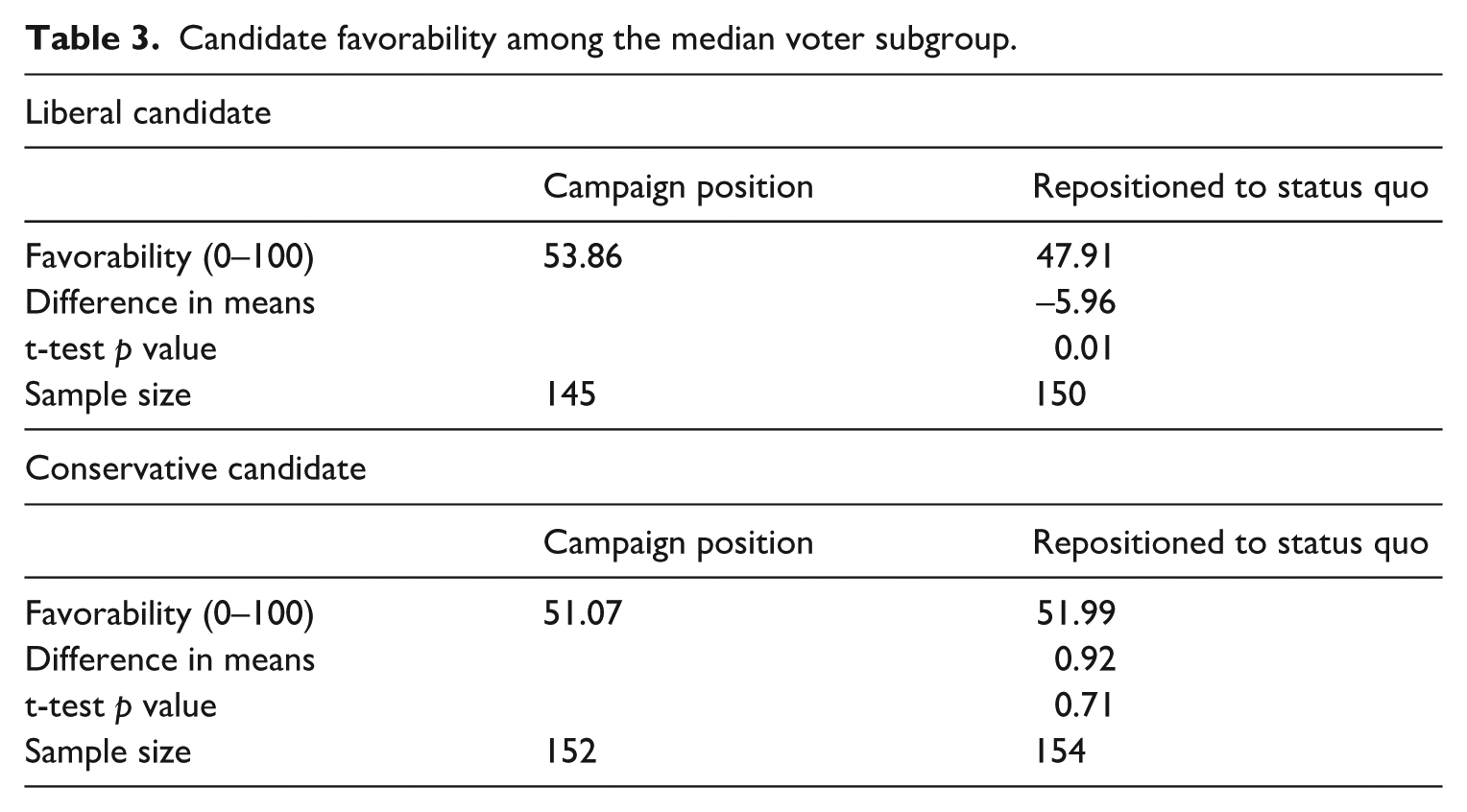
Results are displayed in Table 3, and they show no real benefit from repositioning towards moderates. Compared to the campaign control group, a liberal candidate who repositioned to the status quo has a lower favorability than a liberal candidate during the campaign (a reduction of 5.96 percentage points with a t-test p value of 0.01). In other words, the candidate is less preferred when they move towards supporters of the status quo. For a conservative candidate, repositioning to the status quo modestly increased their favorability by 0.92 percentage points but is not significantly different than the campaign control group (p value = 0.71). This provides evidence that repositioning on asylum seekers towards the median voter did not increase support among that group.
Candidate favorability among the median voter subgroup.
Party proximity
Many citizens can associate policy positions with their respective parties. Therefore, proximity might also be interpreted as moving closer to, or farther away from, the respondent’s preferred party. To that end, the next series of graphs stratified the treatment effects regression models by self-placed party identification.
Figure 4 shows candidate favorability among Democrats only. Unlike the overall average, repositioning to the left was not penalised by Democrats regardless if the candidate is liberal or conservative – these treatments showed no significant difference from the control group. Repositioning to the right was uniformly penalised by a substantial degree among Democrats. A liberal candidate who repositioned to the right dropped in favorability by 18.9 percentage points (p value = 0.00), and a conservative candidate who repositions to the right dropped in favorability by 13.0 percentage points (p value = 0.00). Interestingly, a conservative candidate who repositioned to the status quo increased favorability by 7.3 percentage points (p value = 0.01), and a liberal candidate who repositioned to the same status quo position reduced their favorability by 14.5 percentage points (p value = 0.00). These results suggest that the initial campaign position provided important context for respondents when evaluating the candidate. Moving towards the Democratic party was interpreted through a positive lens, but moving away from the Democratic party was interpreted negatively (and the magnitude of moving away was almost twice as much).
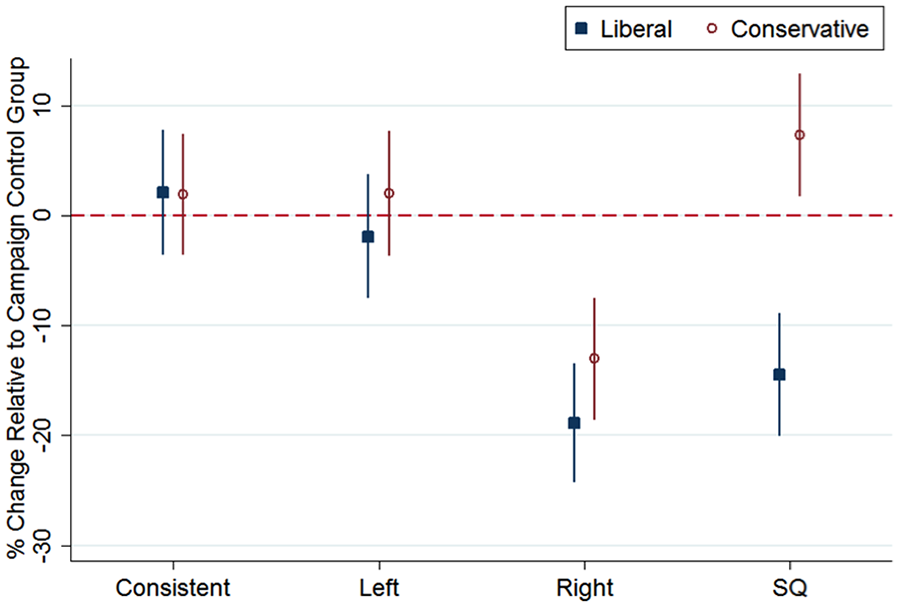
Candidate favorability among democrats.
Figure 5 shows candidate favorability among Republicans only. Similar to Democratic respondents, proximity to their party was important for evaluating the candidates. Among Republicans, a conservative candidate who repositioned to the left is severely penalised – favorability decreased by 24.1 percentage points (p value = 0.00). A liberal candidate who repositioned to the left received a reduction in favorability but only by 2.6 (p value = 0.42), which is a modest difference by comparison. A liberal candidate who repositioned to the right improved their favorability by 4.7 percentage points, but the difference does not reach convincing levels of significance (p value = 0.13).
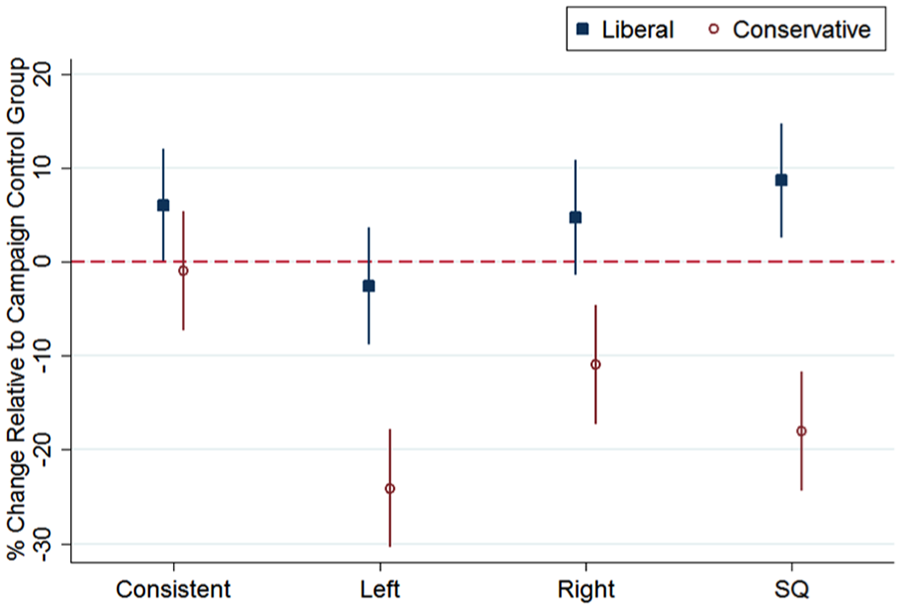
Candidate favorability among republicans.
The status quo repositioning groups in Figure 5 show the same directional effects found in Figure 4. That is, a liberal candidate who repositioned to the status quo increased favorability by 8.7 percentage points (p value = 0.01) among Republicans, and a conservative candidate who repositioned to the same status quo position reduced their favorability by 18.0 percentage points (p value = 0.00). This again provides evidence that the direction relative to their party matters. Moving towards the status quo is viewed positively among Republicans if it is in the conservative direction, but moving towards the status quo is viewed negatively if it is in the liberal direction. Republican respondents penalised in-party repositioning to the status quo at about twice the magnitude as out-party repositioning gains. This partisan effect mirrors Democratic respondents in Figure 4, which suggests that candidates have more to lose from their own party than what can be gained from the out-party. This effect stands in comparison to results found among the median voter subgroup – candidates were not reward for adopting their preferred position (Table 3). Instead, partisans in Figures 4 and 5 showed a stronger reaction to repositioning towards the median voter. This has implications for real-world candidates who try to moderate their positions. When candidates strategically reposition towards moderate, changes in opinion might be more likely to occur from partisans than the median voter group being targeted.
However, some of the results in Figure 5 do not support the theory of Downsian spatial voting. Consistently liberal candidates actually improved their favorability relative to the control group by 6.1 percentage points (p value = 0.05) among Republicans. Moreover, a conservative candidate who repositioned further to the right was penalised; candidate favorability went down by 11.0 percentage points (p value = 0.00). To explain the latter results, the analysis was stratified by strong Republicans compared to weak and leaning Republicans in the Supplemental Appendix. Results showed that strong Republicans did not penalise conservative candidates for moving right – no significant difference from the control. Weak and leaning Republicans were driving this reduction in support for moving farther right. These caveats notwithstanding, results mostly showed that partisans interpreted repositioning as moves towards or away from their preferred party.
Conclusion and discussion
This study shows that consistent positioning influences the dynamics of candidate competition and theories of the median voter. Results show that close proximity between candidates and respondents increased support for the candidate, but this support was conditional on whether the candidate was consistent or repositioned to match respondents. Substantial increases in support occurred for consistent candidates who held the same position as respondents, but repositioning to match respondents did not increase support. This effect occurred for liberal and conservative candidates. Moreover, repositioning to the median voter did not increase support among that group. Repositioning away from a respondent’s preferred position had consequences – support decreased for candidates who moved away from respondents. These results have implication for the literature on proximity voting. When policy positioning occurs over time, consistency plays a role in shaping candidate evaluations beyond the median voter theorem. The benefits of being consistent on a non-median position might outweigh risks associated with repositioning to the centre. These results comport with recent observational research that shows moderate candidates no longer have an electoral advantage over extreme candidates (Canes-Wrone and Kistner, 2022; Handan-Nader et al., 2025; Utych, 2020). In addition, repositioning might come with valence penalties that interact with proximity. A candidate who repositions might be viewed as less trustworthy (i.e. Allgeier et al., 1979) or incompetent (Gooch, 2022). Individuals might be sceptical of a candidate’s newfound position, and those who supported the previous position might feel betrayed. Whereas, consistent candidates might receive a boost in support for positive valence reasons like loyalty. Future research should determine what specific valences arise when repositioning within proximity models.
Partisan respondents more closely represented the Downsian model despite the median voter group being unmoved. When liberal candidates repositioned to the centre, their favorability increased among Republicans (the out-party) and decreased among Democrats (the in-party). When conservative candidates repositioned to the centre, their favorability increased among Democrats (the out-party) and decreased among Republicans (the in-party). This suggests that the hang-ups about repositioning might less prevalant among partisans. Repositioning towards moderate – which regularly occurs among candidates and parties – might have a larger influence on partisans than the median voter. In this way, repositioning towards moderate is more about signalling that a candidate is willing to move towards the opposite party. However, the out-party would have to be substantially larger than the in-party for this strategy to be effective because in-party support decreased much more than out-party support increased.
Broadly speaking, these results shed light on strategic decision-making during campaigns. First, candidates might be more likely to organise a passionate base of supporters from consistency. This is demonstrated by the substantially large increase in favorability that consistent candidates received among those who were proximally close. Second, repositioning risks alienating previous supporters. Repositioning away from voters’ preferred position might affect their strength of support or the likelihood of turning out. This might be especially true for salient issues like immigration in which inconsistencies are highlighted by opponents during campaigns. This occurred most recently when the Trump campaign focused their advertising on Harris’s changing positions from 2016 to 2024 (Contorno and Wright, 2024). The Harris campaign made a decision to reposition towards moderate on several issues including immigration, and this might have demobilised liberal voters. Although Trump changed positions on many issues, he has remained extremely conservative on immigration.
This study also has limitations. Other considerations beyond policy preferences go into the voting calculus. For example, some electoral systems allow for personalization where candidates running for office are more important than the parties they represent (i.e. Karvonen, 2014). Personalization is a feature in American politics, and it may interact with the types of policy preferences investigated here. This might be particularly important because personalization is becoming a prominent part of elections in dozens of other established democracies (i.e. Arter and Poyet, 2024; Pedersen and Rahat, 2021; Rahat and Kenig, 2018). Relatedly, party identification is also an important cue for voters when adopting policy preferences (i.e. Han, 2023; Lenz, 2012). Similar to personalization, party was purposely excluded from this experiment to measure policy preferences in isolation, but party cues still influence policy preferences for many voters. Parties also vary on how competent they are perceived to handle immigration, which influences the effect of repositioning to the right and left (Down and Han, 2020). Further research should investigate the interaction of policy proximity, personalization, and party. Another limitation is that these results about immigration policy might not generalise to other issue positions (Clifford and Rainey, 2025). Immigration is a highly salient issue that is tied to nationalism, culture, and race. Researchers are typically cautious to generalise a single-issue experiment to all issues, and recent research demonstrates why this caution is warranted (Clifford and Rainey, 2025).
It should also be noted that circumstances around immigration can change. Immigrant flows change annually, and the saliency of the issue can change too. Penalties for repositioning or rewards for consistency might change with the circumstances. Previous research shows that politicians are less likely to be punished for changing positions when circumstances change (Levendusky and Horowitz, 2012). Governments also increase and decrease spending on immigration enforcement, and research shows that the public responds like a thermostat in the opposite direction of government spending (Wlezien, 1995). This might also lead candidates to reposition as the public changes their views (Stimson, 2015). However, if views of asylum seekers are rooted in identity, then changing circumstances might be less influential on opinion change.
Although centred in the United States, this study is potentially generalizable to other countries where immigration is salient and the parties reposition. Asylum seekers, and immigration policy more generally, are hotly contested in European politics as well. Asylum seekers were a major issue in recent elections in the Netherlands, Italy, and the EU (De Ghantuz Cubbe, 2022; Guillou, 2024; Reuters, 2023). Moreover, there is a ‘convergence’ of immigration policy positions and their outcomes in Europe, North America, and Australia (Hollifield et al., 2014: 3). Political parties in these countries reposition on immigration in the moderate and extreme directions (Abou-Chadi, 2016; Alonso and Fonseca, 2012; Han, 2015; Lutz, 2021) in ways that are similar to the experimental design in this study. From that respect, these results might be generalizable to other electorates where immigration policy is salient and repositioning in different ideological directions occurs. If generalizable, this study suggests that parties might be advantaged by holding consistent positions on asylum seekers, and that the costs of repositioning might outweigh the benefits.
Supplemental Material
sj-docx-1-pol-10.1177_02633957251365778 – Supplemental material for Policy proximity and candidate repositioning: The value of consistency
Supplemental material, sj-docx-1-pol-10.1177_02633957251365778 for Policy proximity and candidate repositioning: The value of consistency by Andrew Gooch in Politics
Footnotes
Acknowledgements
The author thanks participants at the 2024 APSA conference for helpful comments. The contribution was also improved from three anonymous reviewers. Finally, data were collected using startup funds from Rowan University’s Ric Edelman College of Humanities and Social Sciences.
Funding
The author received no financial support for the research, authorship, and/or publication of this article.

Supplemental material
Supplemental material for this article is available online.
Notes
Author biography
References
Supplementary Material
Please find the following supplemental material available below.
For Open Access articles published under a Creative Commons License, all supplemental material carries the same license as the article it is associated with.
For non-Open Access articles published, all supplemental material carries a non-exclusive license, and permission requests for re-use of supplemental material or any part of supplemental material shall be sent directly to the copyright owner as specified in the copyright notice associated with the article.
