




Abstract
This article studies how the COVID crisis affected polarisation, politicisation and consensus in Finnish parliamentary discourse, a case in which we expect pluralist political institutions and culture to mitigate polarisation. In addition to the empirical contribution, we add to the theory of polarisation by drawing from Chantal Mouffe’s theory of plural democracy to argue that the opposite of polarisation may take the form of a depoliticised consensus or a pluralism of legitimate positions (‘agonism’). Furthermore, we apply Norman and Isabela Fairclough’s political discourse analysis to studying polarisation qualitatively, arguing that scrutiny of argumentative premises enables assessment of how profound certain political conflicts are. Studying 485 parliamentary speeches given in 2020–2021, we argue that a morally charged consensus imperative with nationalistic overtones quickly developed in Spring 2020, and pluralism gradually re-emerged later. The article highlights that while polarisation can threaten democracy, so can moralisation and enforced consensus.
Introduction
The COVID-19 pandemic created a sudden and dramatic imperative for societies worldwide to immediately adapt and coordinate massive policy responses with limited information. Many such measures involved severe restrictions on citizens’ rights, which naturally proved contentious. The call to make sense of and respond swiftly to a novel situation provided a challenge for democratic institutions and political actors. Existing political conditions, such as polarisation, affected and were affected by the crisis.
Most research on COVID and polarisation has focused on the United States. In the polarised US polity under the Trump administration, public understanding of the pandemic and views on necessary mitigation policies were rapidly polarised along partisan lines, which made it more difficult for the country to respond to the crisis (e.g. Beramendi and Rodden, 2022; Gadarian et al., 2022; Roberts, 2022). However, in the light of research existing on non-US countries, the US seems to be an exceptional case, since in some countries a crisis-time unity emerged instead (e.g. Bernacer et al., 2021; Merkley et al., 2020; Schraff, 2021). Even political actors of the same party family, such as right-wing populists, adopted notably divergent policies in various countries (Rovira Kaltwasser and Taggart, 2022), highlighting how country-specific cultural and institutional factors have had notable effects on polarisation dynamics during COVID.
Finland is a particularly intriguing case because of its multi-party parliamentary system with proportional representation and a political culture that has been described as consensus-seeking (e.g. Saukkonen, 2012), characterised by coalition governments and a high level of political trust (e.g. Koivula et al., 2017). It has been argued that Finland’s geopolitically perilous location between Western Europe and Russia has historically forced cautionary politics and national unity as a necessary condition for the continued survival and independence of the nation-state – incentivising a pluralist political culture that is able to include a wide variety of opinions (Alapuro, 2010). Such a consensual pluralist political culture with corresponding institutions could theoretically mitigate polarisation even in times of crisis. However, in recent times ideological and affective polarisation along the conservative–liberal axis has been on the rise even in Finland (Kawecki, 2022; Kekkonen and Ylä-Anttila, 2021; Lönnqvist et al., 2020), which has coincided with the rise of right-wing populists, The Finns Party. A crisis such as a pandemic could mark a crossroads in terms of developing polarisation. How did the COVID crisis affect the dynamics of polarisation in Finnish parliamentary politics? We show that politicians’ reactions to COVID temporarily depolarised parliament, whereas later in the pandemic, pluralism re-emerged, still devoid of pernicious polarisation.
Along with the empirical contribution, we aim to contribute to the theory of polarisation by developing a more nuanced qualitative understanding of how polarisation takes place in political discourse – what we referred to as the dynamics of polarisation, above. For this task, too, the empirical case of Finland is illustrative because of its potentially polarisation-mitigating political culture. Theories of polarisation typically imply it is a threat to democracy, but the normative implications are often left unexplored in terms of what kind of democracy is, then, considered ideal or desirable. We connect the theory of pernicious polarisation (McCoy and Somer, 2019; Somer and McCoy, 2018) with the normative theory of plural democracy (Mouffe, 1999, 2005a, 2005b) to argue for renewed focus on the quality, not just the quantity of polarisation and related processes of politicisation and consensus. While our study elaborates on how cooperation can be promoted in political discourse, we argue it should also be acknowledged that coming-together, in crisis or otherwise, can narrow the space for legitimate plural democratic conflicts (Mouffe, 1999).
This article proceeds as follows. We first present our theoretical perspective to polarisation and plural democracy, followed by a brief review of empirical literature on polarisation in the pandemic. We then move on to our methodology and data, analysis and conclusions.
Pernicious polarisation and plural democracy
Polarisation has become a buzzword in analyses of contemporary democracy despite lacking a widely shared clear definition (Kubin and von Sikorski, 2021). Still, a large portion of the polarisation literature describes polarisation as at least potentially detrimental to democracy, making the pertinent theoretical task defining and understanding how, and what kind of, polarisation may be harmful to democratic institutions and policy-making (Yair, 2020).
For a viable point of departure, Somer and McCoy (2018, McCoy and Somer, 2019) have suggested the concept of pernicious polarisation. In their definition, pernicious polarisation is when society is increasingly divided into two politically opposed camps, and instead of a pluralism of cross-cutting political cleavages representing societal multiplicity, opinions align more and more around this single division. The overarching political division further becomes cemented as group identities: us and them, others becoming enemies instead of political adversaries (Somer and McCoy, 2018; see also Mason, 2018). In short, the definition includes two interrelated dimensions of political polarisation: issue sorting (partisan alignment) and animosity between political camps (affective polarisation) (Jost et al., 2022).
Pernicious polarisation has been discussed to potentially harm democracy by leading to unnecessary acrimonious politicisation of seemingly non-political issues (DellaPosta et al., 2015; Talisse, 2019) and creating an atmosphere where losing elections is seen as an existential threat (Somer and McCoy, 2018). Citizens might thus lose their trust in political institutions and democracy, and the threat of using illiberal political strategies or violence rises (Mason, 2018: 128; Rapp, 2016; Somer and McCoy, 2018).
While the theory of pernicious polarisation addresses well how polarisation may be harmful to democracy, we argue that it falls short in explicating either descriptively or normatively what is or what ought to be the opposite of polarisation. We suggest that the normative theory of plural democracy (Mouffe, 1999, 2005a) may address this shortcoming.
Chantal Mouffe (1999) distinguishes the political from politics, the former referring to the inherent antagonism present in all human life. Politics, in turn, refers to ways of organising feasible coexistence in the conditions of always potential conflict. In relation to politics, Mouffe commits to the normative idea of agonistic plural democracy, which aims for antagonistic conflicts to take agonistic form, meaning that political opponents are perceived as legitimate adversaries rather than enemies, and political plurality is constructed on the legitimacy of conflict and agreement over core democratic values (Mouffe, 1999, 2005a: 52, 2005b: 103).
In Mouffean terms, pernicious polarisation can be seen to lead to an antagonistic conflict as competing political views are not regarded as legitimate, and thus, the organisation of the political into plural democracy fails. This can be understood as moralisation of politics: political conflicts taking the form of good versus evil (Mouffe, 2005a: 5). Yet importantly, in an agonistic plural democracy, conflict is not to be avoided. It is rather a central feature of democracy, as any established order is a hegemonic articulation and thus contestable (Laclau and Mouffe, 2001).
Political contestations make conflict visible, which can be understood as politicisation: rendering something previously taken-for-granted playable (Meriluoto, 2021; Palonen, 2003). In polarisation literature, polarisation is typically seen as ‘too much’ politics or political conflict getting overheated (e.g. Talisse, 2019), but building on Mouffe we argue that pernicious polarisation could also be seen as a decrease of the possibilities for politicisations, if it means the emergence of an imperative to align any political contestations along the established two-camp division. On the other hand, consensual politics would suppress political conflict altogether (see Warren, 1999).
These complicated relations of politicisation and polarisation as well as consensus and pluralism call for a nuanced study of political polarisation beyond measuring its quantity, we argue. The pandemic was a sudden situation in which novel topics entered the political arena, and how these topics became politicised in argumentation can indicate antagonistic (polarised), agonistic (depolarised – plural) or consensual (depolarised – unified) politics. Further, the capability of political cooperation in a crisis can indicate whether political opponents are regarded as legitimate adversaries or illegitimate enemies.
(De)polarisations during the pandemic
We can roughly divide the political consequences of COVID-19 in various countries into uniting and dividing, or depolarising and polarising. First, there have been various examples of a rally-around-the-flag effect (Mueller, 1970; Schraff, 2021), in which a severe crisis or war causes a temporary coming-together – either as increased popular support of governing politicians or more broadly as reinforced common ground in politics. For example, in Canada, a broad consensus on the COVID crisis was formed among the political elite which had been described as polarised before the crisis (Merkley et al., 2020). In Spain, tolerance for government control and intrusion quickly increased among left-wing voters supporting the left-aligned government and was noticeable in right-wing voters as well (Bernacer et al., 2021). In Sweden, the ruling Social Democrat party experienced a significant boost in polling from 23–24% before the pandemic to over 30% during it (Johansson et al., 2021). These findings point to a possible depolarising effect of an external shock or crisis such as a sudden pandemic, perhaps due to an atmosphere of national unity.
Second, despite the depolarising potential of perceived threat, we have the much-studied, yet rather exceptional example of the United States, where the pandemic and its mitigation measures were antagonistically polarised very quickly along existing party-political lines (Beramendi and Rodden, 2022; Druckman et al., 2021; Gadarian et al., 2022; Hatcher, 2020; Roberts, 2022). Decisions such as whether to use a mask or not became identity-political symbols, as Democrats largely united behind a message of shared collective responsibility by wearing masks, whereas Republicans mocked mask-wearing (Hegland et al., 2022). The role of President Donald Trump in polarising the pandemic in the United States should not be underestimated: he quickly chose to relate to masks with disdain and mock his political opponents for wearing them (Gadarian et al., 2022: 9, 104–105; Roberts, 2022; Scoville et al., 2022).
Visible figures such as Trump and Brazilian president Jair Bolsonaro have created a popular impression that right-wing populists polarised COVID (Ringe and Rennó, 2023: 11). Indeed, the broader populism literature gives reasons to expect populist actors to polarise a crisis such as the pandemic: their tendency to utilise crisis talk, emphasise antagonisms, their anti-elitism and politicisation of scientific knowledge (e.g. Mudde and Rovira Kaltwasser, 2017). Nevertheless, research suggests a variety of ways to react to the pandemic among right-wing populists, as most populists in power did not downplay the pandemic but rather implemented policies to mitigate the virus (Meyer, 2022). In opposition, varying responses emerged as well. In Italy, the populist-right opposition initially downplayed the threat but turned later to demand harsher restrictions, whereas in Germany and Austria, they instead initially supported strict restrictions but soon after accused the government of implementing ‘pandemic dictatorship’ (Rovira Kaltwasser and Taggart, 2022; Thiele, 2022). We will show that in the Finnish case, the populist-right opposition performed a similar U-turn – demanding harsher restrictions first, later turning to call for more individual liberties – yet in Finland, the populist right never downplayed the seriousness of the crisis.
For a more general viewpoint on polities reacting to crises, Phillip Y. Lipscy (2020: E99), adapting Brecher et al. (2020), usefully defines a crisis as ‘a situation that threatens significant harm to a country’s population or basic values and compels a political response under time pressure and uncertainty’. He hypothesises that, among other changes, crisis politics will be characterised by the ‘central role of leaders’ as well as a shift of the locus of power from ‘established institutions’ to ‘ad hoc arrangements’ (Lipscy, 2020: E104). Indeed, we might assume the executive and/or health experts and various ad hoc committees assume more power during a pandemic, and this did happen in Finland, as the government and president in cooperation invoked the Emergency Powers Act in March 2020, limiting travel to and from the capital Uusimaa region, closing schools for two months and enacting other emergency measures. Further, government ministers, together with experts, acted as the ‘faces of crisis management’ (Wodak, 2021: 329), reassuring citizens and uniting the nation (Boussaguet et al. 2023).
However, the focus of this article is not government responses, the locus of hard or soft power (see, e.g. Christensen et al., 2023) or public debates outside parliament; it is how the crisis affected polarisation in parliamentary discourse; thus shifts of power and extra-parliamentary debates will be studied in terms of how they were understood and discussed in parliament. The parliament is not just the supreme legislative authority under the Finnish constitution, but also the most central arena of political debates, we argue. We understand parliamentary debates as ‘the characteristic form of parliamentary politics’ (Palonen, 2005: 143; our translation), argumentation for and against various matters, aiming at persuasion; the parliamentary arena is (politically the weightiest) part of the public sphere. We expect parliamentary debates to reflect societal debates at large, at least partly and public debates outside parliament to be taken up in parliament. In the ‘Conclusions’ section, we offer some brief reflections of Finnish pandemic politics outside parliament.
Political discourse analysis for qualitative study of polarisation
For the qualitative analysis of polarisation we have argued for, we employ Fairclough and Fairclough’s (2012, 2018) political discourse analysis, grounded in the notion that political discourses are practical argumentation. In other words, political speakers make claims about what to do, and political debates consist of presenting, supporting and challenging these practical arguments. Political discourse analysis is a combination of a critical discourse-analytical and an argumentation theory approach to examine political debates comprehensively.
Fairclough and Fairclough’s structural model of practical argumentation (Figure 1) presents a simple, yet useful roadmap to political debates. Political conversations are built around political claims, and these claims are supported in argumentation by four main premises. First, the circumstantial premise (C) defines what is happening and consists of representations of the context of political action. Second, the goal premise (G) describes political goals as imagined futures. Third, the means-goal premise (M-G) bridges goals to claims by arguing how certain means are necessary and sufficient to reach the proposed goal. Finally, the value premise (V) presents what the speaker is or ought to be concerned with.
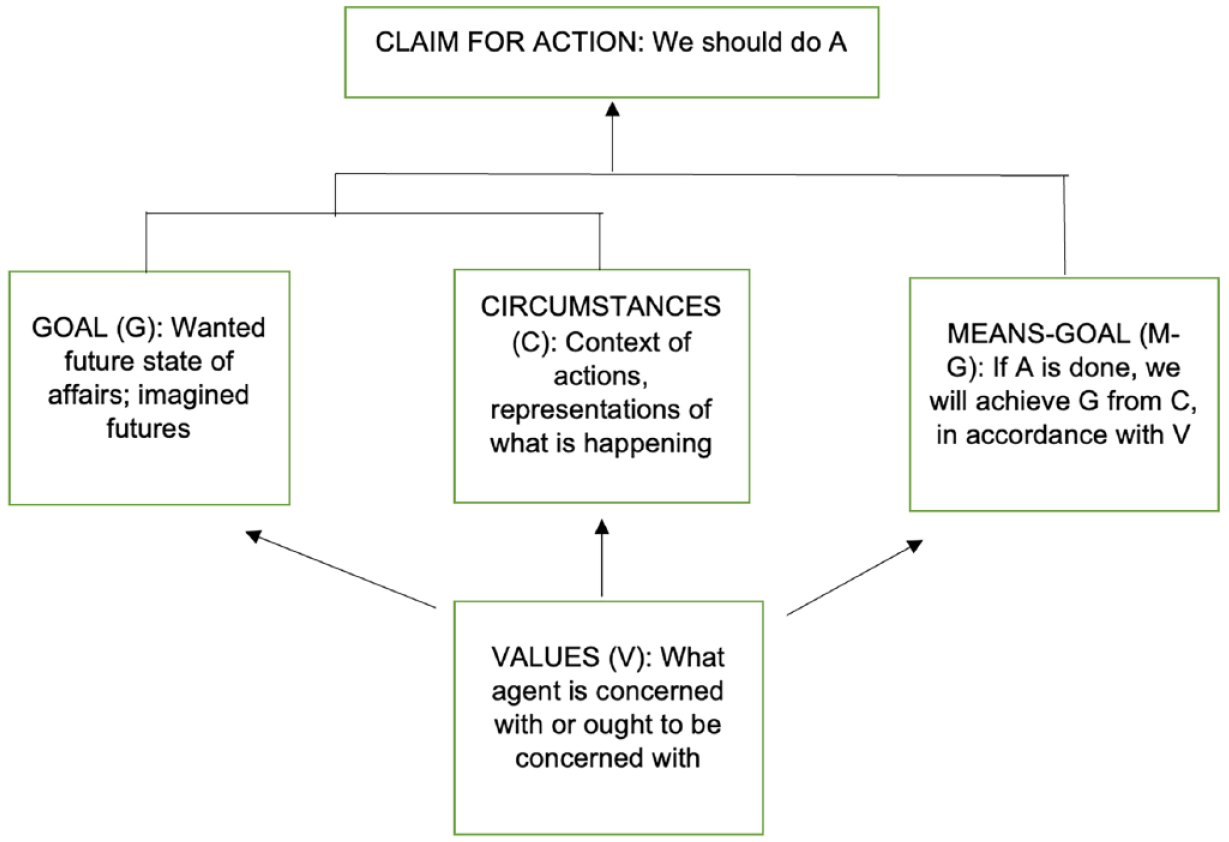
Simple model of practical argumentation, modified from Fairclough and Fairclough (2012: 45).
We apply the model to study political polarisation and agreement. We argue that dissecting speeches into claims and their premises allows a nuanced examination of the sites of agreements, disagreements and contestations. Even when political actors disagree on what to do, there are variations on how widely argumentative premises are shared, which can inform us of how profound the disagreement is. For example, disputes focusing solely on the means-goal (M-G) premise, in other words, how to reach a common goal while other premises are shared, can be understood to be minor contestations. When political goals are rebutted altogether, for instance, by pleading to fundamental values not to be violated, the critique of the political claim is deeper.
Disagreement under any premise as such, however, does not indicate that differences are fundamental. For example, some values can be contested while most essential values are shared, and disagreement over circumstances can occur in varying degrees, ranging from minor interpretation differences to conflicting ways of understanding reality. Connecting to Mouffe’s idea of plural democracy, (conflictual) agreement over democratic values and what constitutes democratic politics could be considered the bare minimum for legitimate agonistic political contests (Mouffe, 2005a, 2005b), which leaves yet plenty of space for disagreements under argumentative premises. We argue that the model of practical argumentation is a useful tool to assess polarisation and agreement qualitatively – particularly in a crisis in which novel political topics entered the parliament, that is, the circumstances (C) were suddenly changed and had to be politically interpreted to produce appropriate goals (G), means-goals (M-G) and claims.
Before a hands-on description of the analysis, we will below describe our data.
Research data: The Finnish parliament during the pandemic
We studied Finnish parliamentary discussions focusing on two central topics: face mask debates during the first pandemic year (March 2020 to March 2021) and debates over so-called COVID passes in 2021. Our research data consists of speeches in plenary sessions, the main arena of parliament debates and the place of enacting legislation. Plenary sessions gather four times a week, and they are the most visible arena of parliament work as discussions are broadcast and open to the public. Transcripts of all speeches are available on the parliament’s website (eduskunta.fi). Speeches in plenary sessions are addressed to political opponents as well as to the general public and often comment on not only the legislative agenda but day-to-day issues in society at large.
During the COVID crisis, the ruling left-centre government was led by Prime Minister Sanna Marin of the Social Democrats, who had been in office since 2019. The Social Democrats had 40 parliament seats, the Centre Party 31 seats, the Greens 20, the Left Alliance 16 and the Swedish People’s Party of Finland 10. The right-aligned opposition consisted of the right-wing populist Finns Party (39 seats), moderate-right National Coalition (37), Christian Democrats (5) and two one-person parties: Movement Now and Power Belongs to the People.
Face masks and COVID passes were widely utilised and discussed policies around the globe brought on by the pandemic (Avigur-Eshel, 2022; Scoville et al., 2022). They were novel yet pressing topics in a new situation, and political parties had no preconceived opinions regarding masks or passes. Political claims as well as possible political factions concerning these policies, were formed in an ongoing crisis with limited knowledge and amid uncertainty, which makes them intriguing topics in studying agreement and polarisation.
In addition, face masks and COVID passes were potentially polarising. They entailed strong moral aspects of responsibility and protecting others as well as individual freedom and citizen rights. Masks, passes, and vaccines are also intimate matters in the sense that masks cover the face, possibly make one feel uncomfortable, and affect breathing and social interaction, while passes, when related to vaccines as they were in political discussions, are connected to inoculation, possibly intervening in medical autonomy.
In Finland, face masks and COVID passes were prevalent political topics during the pandemic (figure 2). In particular, face mask disputes in the parliament during autumn 2020 were also widely covered in news broadcasts and public discussions. A mask recommendation was given in August 2020, after which a mask mandate was debated in late 2020 and March 2021. Eventually, face mask discussions faded during 2021. With the second pandemic year, as vaccinations proceeded, COVID passes entered political discussions in April 2021, and this was the policy issue through which vaccines were, in practice, mostly discussed. Pass debates intensified in parliament and in media in the latter part of 2021, and COVID passes were eventually implemented in Finland in October so that certain restrictions could be evaded with a pass, which one could acquire based on vaccination, valid negative COVID test or proof of past COVID infection. Passes were short-lived in Finland: they were deactivated at the end of 2021.
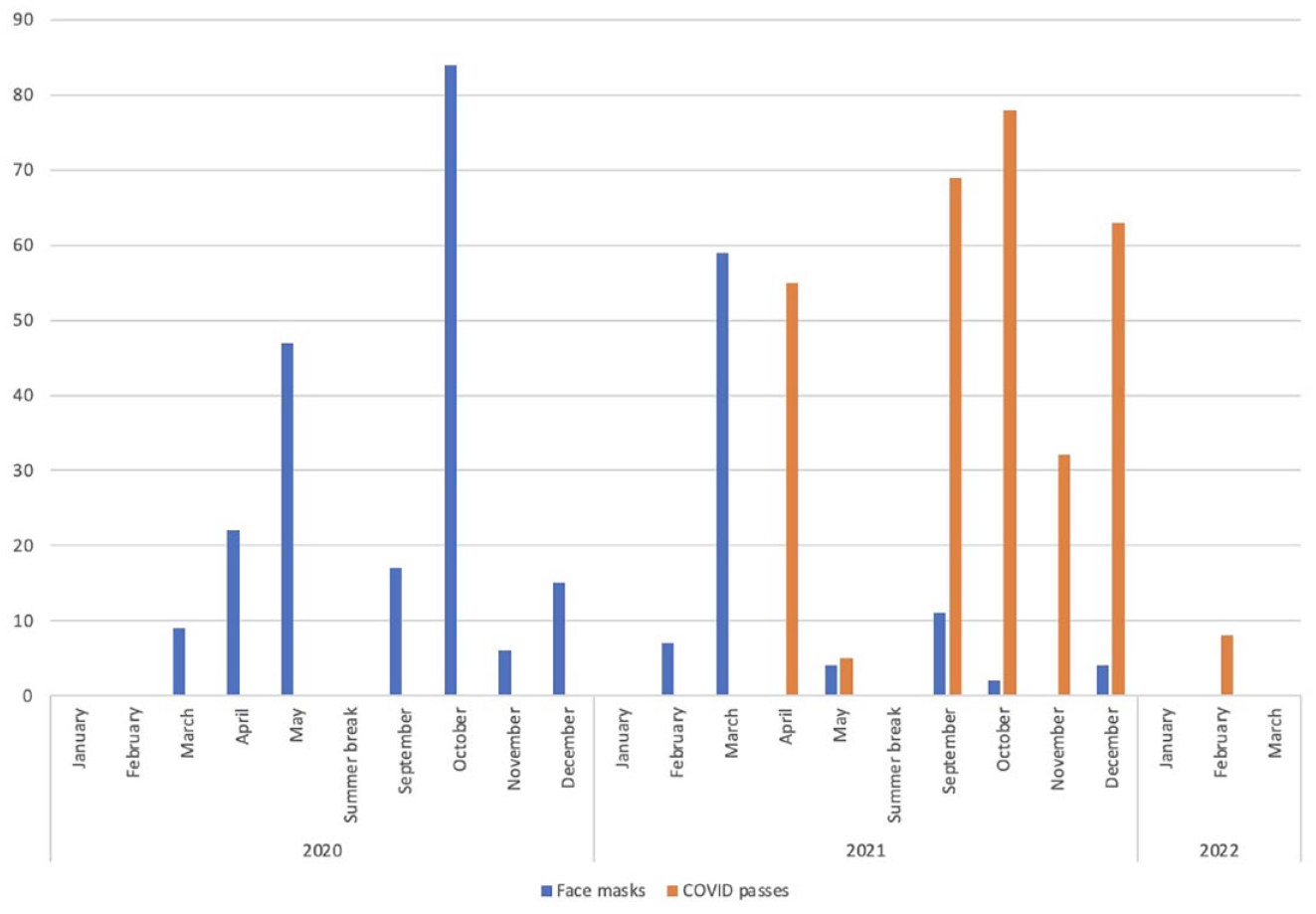
Number of parliament speeches by topic (public use of face masks and COVID passes inside Finland).
We collected data from the parliament website using predetermined keywords to detect face mask (kasvo*, mask*, hengity*, suoja* (face*, mask*, respirat*, cover*)) and COVID pass discussions (pass*, todist*, rokot* (pass*, certificat*, vacc*)). We qualitatively excluded irrelevant speeches, as well as speeches that did not deal with public use of face masks and COVID passes implemented inside Finland or did not apply to all citizens (thus excluding e.g. the EU travel pass). We ended up with 266 parliament speeches concerning face masks, all of which were analysed. Our data comprised 310 speeches discussing COVID passes, of which we picked six most ample plenary sessions (in which 20 or more relevant speeches were delivered) and ended up with 219 speeches about passes. In total, our analysed data consists of 485 parliament speeches during two pandemic years.
Analysis
The analysis proceeded as follows. First, we organised the gathered plenary speeches chronologically in text files. Using the political discourse analysis model of practical argumentation, we closely read parliament speeches as arguments for political claims and identified the argumentative premises in each (see Fairclough and Fairclough, 2012: 125–127). We categorised speech extracts in a spread sheet file into premises: circumstances (C), goals (G), means-goals (M-G) and values (V), each of which was divided into categories and further into subcategories. For instance, under values (V), the most prevalent categories were Health, Economy, Unity and patriotism, Rights and virtues, and Democracy (see Appendix 1 for the final codebook). After this categorisation work, we read through the texts a second time, this time premise by premise and category by category, to form a nuanced understanding of each mode of argumentation.
Shared perception of the pandemic
In a crisis, when quick political decisions are called for amid uncertainty, the political elites’ capability to form a shared (enough) understanding of the situation facilitates responsiveness. Perceptions of the pandemic itself did not become polarised in the Finnish parliament, as the threatening nature of the pandemic was not questioned. Despite limited knowledge in the early pandemic, members of parliament quickly established a unanimous understanding of the crisis: under the circumstances premise (C), COVID-19 was described as a serious threat, and the value (V) of protecting life, health and economy emerged. Consequently, the shared goal (G) among members of the Finnish parliament became mitigating and fighting the virus:
All these premises prevail throughout our data and are engaged with by members of all political parties, with one exception: Ano Turtiainen of the one-man far-right Power Belongs to the People party, who was alone in the 200-strong parliament in voicing COVID denialist, anti-mask and anti-vaccine stands. Beyond this exception to the rule, we found no outright COVID-19 denialism.
Mask argumentation: debate about means
One of the first significant political issues brought on by the pandemic was face masks. Public use of masks entered parliamentary discussion for the first time on 17 March 2020, when representatives of the nationalist right-wing Finns Party (in opposition) suggested that the government should give a recommendation to wear masks in public places. During the spring, right-wing opposition parties broadly supported this, while left and centre-aligned government party representatives were more hesitant. In late spring, the government decided that a scientific review of advantages and disadvantages of public mask use would be needed, which caused opposition parties to protest the waste of time and resources since, according to them, international research and examples already favoured mask usage. Once conducted, the review did not find convincing evidence for the usefulness of masks. Yet on 13 August, the Finnish government declared a mask recommendation in public places.
In Finnish parliament there was no real anti-mask political wing (cf. Scoville et al., 2022), bar the one above-mentioned outlier. Members of parliament widely regarded masks as a good tool among others in fighting the pandemic, and broad common ground prevailed in mask debates as in the broader picture: a severe pandemic (C) threatens health and economy (V). Thus, we need to fight the pandemic (G):
Still, divisions in the means-goal (M-G) premise led to varying understandings of how important tool masks were. Disputes over masks were indeed mostly about competing means to achieve a shared common goal, which can be understood as minor contestations (Fairclough and Fairclough, 2012: 63–64):
Conservative right perspectives on face masks were intriguing in Finland. We know that in the United States, masks became identity-political symbols and the far right was vehemently anti-mask (Gadarian et al., 2022). In stark contrast, the populist right-wing Finns Party was the most pro-mask political faction in Finland, and many of their representatives even demanded masks to be mandatory in public places:
The far right was surprisingly most favourable towards this pro-social collective action, citizens protecting each other by wearing masks, whereas left- and centre-aligned government representatives emphasised individual choices in mask usage (cf. Grimalda et al., 2023).
After the spring 2020 initial shock and mask debate, resulting in an official mask recommendation (not legally enforced), mask debates re-ignited in the autumn along government-opposition lines in a retrospective fashion: the opposition now criticised the government of having been too slow in acquiring masks and enacting a mask recommendation in the spring. Representatives of the moderate-right National Coalition Party demanded that the Social Democratic Minister of Family Affairs and Social Services resign because she had allegedly lied about the mask situation and therefore lost the trust of the people (extract below). All parties still agreed on the implemented mask recommendation policy, and masks as such did not become divisive. In a prolonged pandemic, where space for politics had diminished significantly because of the perceived need for cooperation, opposition parties probably felt a need to finally challenge some aspects of government politics, which they had, exceptionally, widely supported in times of crisis.
Consensus imperative
As argued above, there was little disagreement over argumentative premises during the first pandemic year. Unity in crisis was carefully constructed and reinforced in parliament speeches, creating a rally-around-the-flag effect (Mueller, 1970; Schraff, 2021). COVID was widely interpreted as a national emergency, and depoliticisation of the crisis came seemingly naturally. Government and opposition politicians used several strategies to narrow down space for political conflicts.
First, politicians emphasised broad parliamentary cooperation, which appeared as a descriptive and normative element alike. On one hand, Finnish politicians reciprocally praised each other for their ability to reach consensus and work together across government-opposition divisions, and on the other, a continuation of cooperation in an ongoing pandemic was constantly demanded. Even when criticising the government, representatives of opposition parties constantly reminded that in the big picture they supported COVID policies and were willing to cooperate, as in the extract below. Furthermore, members of parliament from all parties proposed that Finland had controlled the COVID crisis extremely well in international comparison, mostly thanks to political cooperation and a consensual understanding of the seriousness of the crisis.
Second, a strong imperative for acting responsibly emerged. Members of parliament explicitly demanded not to politicise COVID, and politicking during the crisis was represented as immoral. Demands of depoliticisation were normative, and during autumn 2020, they were also used to accuse members of the opposition, mainly the National Coalition Party, of trying to do politics untimely and thus not understanding that the crisis still prevailed:
Responsibility was moreover displayed in evidence-based-policy arguments. All parties emphasised the role of science and research in the pandemic throughout the period we studied, and expertise was used to diminish the space of political decision-making, deferring to scientific expertise as the ultimate source for correct policy (cf. Esmark, 2021). Opposition parties demanded that government follow the science and latest research, and government parties stressed that their policies always relied on scientific knowledge.
Finally, while members of parliament committed to protecting health of the citizens, the crisis became concurrently represented as a national emergency – a war-like situation – calling for ‘us Finns’ to take action in solidarity:
In parliament speeches, patriotism was demanded and underlined across the political spectrum. In argumentation, only a united nation could mitigate the outside threat, and patriotism emerged in discussions describing how the Finnish society, with its high trust, was well capable of facing the pandemic, even in speeches of the left-aligned parties, which do not typically engage with nationalistic repertoires:
When mask debates were politicised retrospectively during the autumn 2020, patriotism was also utilised as a political tool by government party representatives to dismiss the critique:
To conclude, all three strategies to promote unity in crisis were moral in tone, and together, they created an imperative not to allow space for political conflicts. The pandemic was perceived as an existential threat, which required politicians as well as citizens to stay in line.
COVID pass disputes: divisive vaccines
During the second pandemic year (2021), parliamentary discussions on COVID in Finland largely shifted from masks to so-called COVID passes. They were originally implemented as travel documents inside the EU in March 2021 to prove that one has either been vaccinated or had COVID. In April, representatives of the moderate-right National Coalition Party started advocating the use of COVID passes also inside Finland. Their main argument was that with COVID passes, certain services and events could be opened for vaccinated or recovered individuals earlier, which would provide a much-needed boost for the economy and enable individual liberties, while still ensuring health security (cf. Avigur-Eshel, 2022). Similarly to the mask topic, government parties initially took more cautious stands. After summer, however, the government started preparing COVID pass legislation, and in October 2021, passes were implemented in Finland as an alternative to restrictions such as restaurant closures.
Making a U-turn, the conservative-right Finns Party and Christian Democrats, who in the previous year had supported strict mask mandates, were now manifestly against COVID passes. The Finns Party did support the EU pass as a means to hinder the virus crossing borders, but they did not approve passes inside Finland, and unlike with masks, agreement on passes was never reached in parliament. Passes were associated with vaccines, and the decision to vaccinate is arguably weightier than that of mask-wearing; indeed, it proved more controversial. In an April 2021 survey, Finns Party supporters were most hesitant about the COVID vaccine, with 29% of them responding they have not and do not plan to take it, compared to 11% of all respondents and just 2% of Social Democrats (EVA, 2021). This, in turn, is likely explained by Finns supporters having lower levels of social trust than the generally high baseline in Finnish society (Koivula et al., 2017).
In pass debates, several divisions in premises generated distinct political claims. First, in goal (G) premises, agreement on fighting the pandemic and protecting public health remained, but there was no consensus on whether and how quickly society should be opened. Pass supporters advocated partial opening, which could happen faster with the passes, while anti-pass representatives favoured removal of all restrictions and return to normal, in stark contrast to earlier debates. The Finns Party and Christian Democrats, who in mask conversations were most pro-restriction, had now shifted to no-more-restrictions politics. Values (V) of health and economy were still shared across parliament, but they transformed into political goals (G) differently than before.
Second, the principal division in pass argumentation was now the speakers’ outlook on vaccines, under the circumstances (C) premise. There were hardly any outright anti-vaccine voices in Finnish parliament during COVID-19 – except for the one far-right outlier discussed above. However, in COVID pass discussions, particularly Finns Party representatives challenged whether vaccines truly prevented the virus from spreading effectively. In their argumentation, vaccines provided protection from serious forms of COVID-19, but there was no proof that vaccinated people would not get sick or spread the virus; thus, there was no justification for the implementation of what they called ‘vaccine passes’. Later, Finns Party representatives raised more and more concerns over the safety of vaccines and were thus delicately balancing between anti-vaccine and pro-vaccine stands – not outright saying that people should not be inoculated, but claiming that there were justifiable concerns about vaccines among citizens:
Pro-pass speakers, in turn, used two strategies to respond to vaccine-related pass critiques: by repeatedly correcting the term ‘vaccine pass’, since passes would be issued not only to the vaccinated but also to those who had already had the disease or a recent negative test, and by emphasising the efficiency of vaccines in mitigating the virus.
Finally, a deep dispute in the value (V) premise emerged. This was the most serious rift thus far, in our interpretation. The major argument against passes was that they would violate constitutional rights. Passes would divide people, polarise, lead to inequality, and could be seen to constitute mandatory vaccination, thus violating self-determination of health choices of citizens:
Again, it is notable how representatives of the Finns Party and Christian Democrats were for collective and state-driven action in earlier mask conversations, but later, in relation to COVID passes, they advocated strong individual and constitutional rights. Pro-pass representatives instead emphasised how passes would be an enabling tool, so that, for example, vaccinated elderly citizens could attend events earlier. In part of the pro-pass argumentation, a juxtaposition of the rights of the vaccinated and unvaccinated was created. According to these arguments, those who irresponsibly decide not to take vaccines should not be able to hinder the opening of society for the vaccinated. COVID passes were therefore a way to guard the rights of the vaccinated majority:
The above quotation also highlights how enforcement of expertise was still used by some to try to depoliticise the crisis, discussed earlier, accusing the vaccine-hesitant as irresponsibly political now that vaccines had become somewhat politicised.
To conclude, in COVID pass discussions, differing political claims were backed by several divisions in argumentation premises. Unlike in mask discussions, the divisions were not only about whether passes were a good tool to mitigate the virus (M-G), but passes were rebutted by pleading to fundamental values not to be violated, which can be understood as a profound critique of the political claim (Fairclough and Fairclough, 2012: 156). Also, one main concern voiced in such speeches was a meta-level worry about the polarising effect of COVID passes. This leads us to discuss how unity was (de)constructed during the second pandemic year, as deeper rifts between politicians emerged and concerns over polarisation started to be voiced.
Rise of polarising and depolarising voices
In our data, members of the Finnish parliament sustained strong awareness of the crisis throughout the second pandemic year. A spirit of unity still prevailed in interpreting the virus as a serious threat to Finnish society, and the professed values of mitigating the crisis together while not politicising COVID remained robust. However, compared to the first pandemic year, the strongest patriotic discourses had faded as the most acute phase of the crisis had passed. The space for politics widened in the prolonged pandemic, which led to balancing acts of politicisations and depoliticisations.
First, a shared concern over polarisation emerged explicitly in parliament discussions. Especially Finns Party representatives criticised COVID passes for polarising Finnish society:
Many pro-pass members of parliament shared the concern of polarisation, but for them, the problem was rather mis- and disinformation circulating among citizens. The perceived source of polarisation differed, but the concern of divisions and, thus, the implicit value of remaining united was shared.
While the Christian Democrats, too, opposed the COVID pass on the grounds of avoiding sowing divisions among the people, they were not vaccine-sceptical like many Finns Party representatives:
Second, even though the concern of polarisation was shared, we found intensified divisive discourses in parliament during the second pandemic year, with exaggerations of opposing parties:
The Finns Party was allegedly feeding the already existing problem of disinformation and undermining Finnish unity. These mutual accusations of polarising politics were also challenged. Government representatives denied that the COVID pass would polarise society, and Finns Party members professed their pro-vaccine stances and that they take COVID seriously. The bottom-line value of unity prevailed in that no one wanted to seem like a polarising figure, while the concept of polarisation was used as a tool of political contestations.
Speeches in 2021 also explicitly aimed to mitigate polarisation. Attempts to re-create unity among parliament and more widely in Finnish society were initiated by the Left Alliance, and their ideas were echoed across the political spectrum.
As the extract above exemplifies, mitigating polarisation was now constructed on the idea of pluralism. Unity-building had clearly changed from the previous year’s mask discussions. In 2021, political disagreement was becoming something to be acknowledged and embraced. The external threat (the pandemic) did not lead to a consensus imperative and suppression of political space anymore, but a relative unity that could incorporate politicisations and disagreements.
Conclusion
We find that similarly to cases such as Canada (Merkley et al., 2020) and Sweden (Johansson et al., 2021), and as the ‘rally-around-the-flag’ theory would suggest (Mueller, 1970; Schraff, 2021), political conflicts were temporarily put aside in the face of the COVID crisis in Spring 2020 in Finland. In our parliamentary data, this took the form of a shared, morally charged consensus imperative, with a gradual re-emergence of politics later, in Fall 2020 and in 2021. Indicating minor disagreement, the efficacy of masks as a means to the shared goal of mitigation was debated in Spring 2020. That debate continued in Fall when a retrospective, stronger politicisation of masks also emerged as opposition parties accused the government of previously lying about the sufficiency of masks and delaying the mask recommendation. Then, in 2021, even goals, values and circumstances started to be seen differently by politicians, highlighted by the far-right’s U-turn on mitigation policies: so-called COVID passes were now argued to violate constitutional rights, and the efficacy of vaccines was questioned by some.
Still, conflicts took an agonistic rather than antagonistic form, and opinions did not align with polarised camps. We perceive that pandemic politics in the Finnish parliament indicate no pernicious polarisation, which could lead to erosion of the legitimacy of competing views (Somer and McCoy, 2018). With the politicisation of COVID also came a widely shared worry over its polarisation, and instead of the consensus imperative of 2020 in which any political contestation was deemed irresponsible and even unpatriotic, representatives in 2021 explicitly voiced their support for the legitimate coexistence of a plurality of opinions, what could be called agonistic pluralism in Mouffean terms. This differentiates the Finnish case, with its pluralist political system and culture, from polarised cases such as the United States.
Intriguingly in international comparison (e.g. Meyer, 2022; Rovira Kaltwasser and Taggart, 2022; Thiele, 2022), the right-wing populist Finns Party (in opposition) initially advocated the sternest restriction policy in the parliament, and even when they turned to oppose COVID passes, they still supported citizen solidarity, e.g. social distancing as recommendable, encouraged citizens to inoculate, emphasised parliamentary cooperation and never downplayed the seriousness of the crisis. They carefully maintained a balance of articulating vaccine hesitancy, yet not sliding into an outright anti-vaccine position to avoid losing more support than there was to be gained. The one-man far-right Power Belongs to the People was likely beneficial for the Finns Party in this regard, as the Finns could position themselves as critical towards vaccines, while not being such extreme denialists as he was.
Researching parliamentary data leaves out debates in the public sphere and civil society at large as well as executive actions. Briefly, we would argue that parliamentary debates were fairly reflective of Finnish society at large in the sense that broader debates were taken up in parliament, and parliamentary debates were discussed in society more broadly. Most citizens, as did parliamentarians, took the pandemic seriously and complied with recommendations. Severe criticism of policies and even COVID denialism emerged online, and demonstrations against restriction policies were held (e.g. Helsingin Sanomat, 2021; Yle, 2022). As discussed earlier, power was temporarily somewhat concentrated in the hands of the executive due to the adoption of emergency legislation.
Still, pluralism prevailed, and we interpret that a pluralistic and trusting political culture together with corresponding institutions, provided capabilities for political actors to depolarise enmities while legitimately contesting opponents and upholding the functioning of democracy. Without the interplay of pluralist institutions and culture, results would likely have been different.
We have argued that the theory of pernicious polarisation lacks in defining the opposite of polarisation, and to complement this our study suggests two forms of non-polarisation: agonistic pluralism and consensual politics. Agonism allows plurality of politicisations, namely making competing views and conflicts visible, while consensuality can be seen to suppress the space for any political conflicts, even agonistic ones. Even if there was no pernicious polarisation in the Finnish parliament, we could regard the strong consensus imperative of 2020 as problematic for plural democracy (Mouffe, 2005a).
Pernicious polarisation can be understood as politics taking an antagonistic form, building on Mouffe, a moralisation of politics as good versus evil. Our empirical case suggests, however, that in addition to antagonism, the absence of political conflict (consensus) can also be constructed in moralistic terms. Especially in Spring 2020, but also in some later speeches, COVID was represented in the Finnish parliament as something too important for mundane political battles, and a moralised ideal of national security was prioritised over a plural space for democratic disputes – essentially, any political contestation of COVID measures was morally condemned. In a pandemic, it can of course be argued that this was necessary to save lives. Still, we should carefully analyse whether such a morally-charged consensus imperative generates longer-term impacts in democratic systems and further discuss how polities could navigate future crises without eroding democratic plurality.
Footnotes
Acknowledgements
The authors wish to thank colleagues from the Centre for Sociology of Democracy, University of Helsinki, and two anonymous reviewers for their valuable and constructive comments. All errors remain the authors’ alone.
Funding
The author(s) disclosed receipt of the following financial support for the research, authorship, and/or publication of this article: This work was supported by the Kone Foundation under Grants 201901570 and 202201305; and Academy of Finland under Grant 339797.
